


Abstract
Human thermophysiological responses differ greatly between individuals. However, textile and clothing systems are usually designed using average population data. They also follow the idea that one product can provide acceptable comfort for most users. This perspective paper introduces the concept of thermophysiological comfort classes (CCs). The aim is to group continuous physiological differences into a small number of practical categories. Similar to anthropometric sizing, each CC includes people who show similar physiological responses and comfort perceptions under defined environmental and activity conditions. The proposed framework combines physiological measurements, environmental and behavioural factors, subjective evaluations, and individual characteristics. Data science and artificial intelligence can support data processing, feature selection, clustering, and validation. At first, the development of CCs will require detailed questionnaires and several types of measurements. The long-term goal, however, is to identify a small set of reliable indicators for a practical assessment protocol. The concept may support textile products designed for representative thermophysiological profiles rather than for an average user. Comfort-class assignment may also change over time. Thermophysiological classification is therefore proposed as a complement to anthropometric sizing and as a basis for personalised and industrially scalable textile design.
1. Introduction
Anthropometric sizing systems are among the most successful examples of translating human variability into practical engineering solutions. Their development was closely linked to the growth of mass production and the need to provide standardised clothing for large populations [1]. During the nineteenth and early twentieth centuries, military organisations faced the particular challenge of producing uniforms for thousands of soldiers with different body dimensions [2,3]. This need encouraged large-scale anthropometric surveys and the systematic collection of body measurements. Human body variability, once considered too complex for standardisation, gradually became manageable through measurement, statistical analysis, and the development of sizing systems [1]. These systems do not describe the unique body shape of every individual. However, they provide a practical method for matching products to users and remain a cornerstone of modern clothing design and production.
Today, a comparable challenge exists in the field of thermophysiological comfort. Anthropometric variability has been systematically classified and integrated into textile design. In contrast, physiological variability has not yet been translated into a comparable classification system. Differences in thermal sensation, sweating behaviour, skin sensitivity, thermoregulation, and comfort perception are usually treated as statistical variation around a population average [4,5]. Physiological responses may also change within the same individual because of ageing [6], health status [7], hormonal influences [8], physical activity [9], acclimatisation [10], environmental conditions [11], and other interacting factors. As a result, the same textile product may feel comfortable in one situation and uncomfortable in another, even for the same person.
Thermophysiological comfort is commonly described as dependent on the interactions between the human body activity, the textile system, and the surrounding environment. Many assessment methods and predictive models have therefore been developed. They use physiological measurements, skin and clothing microclimate parameters, textile properties, and subjective evaluations [12,13,14,15,16,17]. Despite these advances, most existing approaches still focus on average population responses. Dynamic differences between individuals remain insufficiently represented in textile engineering and design. In this paper, the term “textile system” refers to the complete set of textile products worn by the user at a given time. Depending on the conditions, it may consist of a single product or several clothing layers.
The skin has a central role in these interactions because it is the main interface between the body, clothing, and the environment. However, many existing models describe the skin through a limited number of variables, such as skin temperature, humidity, heat flux, and subjective sensation [18,19,20]. Evidence shows that skin responses are highly dynamic. They are continuously affected by physiological regulation, hydration, vascular responses, sweating, environmental exposure, and behavioural adaptation [21,22,23,24,25,26,27]. Thermophysiological comfort should therefore be viewed as a dynamic outcome of human–textile–environment interaction and not as a fixed property of either the individual or the textile product.
This perspective raises a fundamental question. Anthropometric research transformed differences in body dimensions into standardised clothing sizes. Could thermophysiological variability be organised in a similar practical way? Unlike anthropometric sizes, which are based on relatively stable body dimensions, thermophysiological classes would describe recurring patterns of physiological response and comfort perception under defined conditions.
The present perspective paper proposes the concept of thermophysiological comfort classes (CCs). It is based on the premise that comfort emerges from the interaction between a textile system and the user’s current thermophysiological state. This state changes continuously under the influence of internal and external conditions. The proposed classification aims to organise continuous physiological variability into a limited number of engineering-relevant CCs.
The paper also discusses how multimodal physiological measurements, data integration, pattern recognition, clustering techniques, and artificial intelligence may contribute to the identification and validation of these classes. Thermophysiological CCs could provide a practical basis for integrating physiological diversity into textile design and for developing more personalised, adaptive, and user-oriented textile products.
2. From Anthropometric Sizing to Thermophysiological Comfort Classes
Anthropometric sizing systems demonstrate that complex human variability can be successfully transformed into a practical engineering framework. Through systematic measurement of body dimensions, statistical analysis, and the classification of individuals into a limited number of size categories, the clothing industry has developed standardized products that accommodate large populations with acceptable accuracy. Although these systems do not fully capture the unique characteristics of every individual, they provide an effective balance between biological diversity and engineering practicality [1,28].
The challenge of thermophysiological comfort is conceptually similar but considerably more complex. Thermophysiological comfort does not rely on relatively stable anthropometric characteristics. Instead, it involves a dynamic physiological system influenced by multiple interacting factors, including environmental conditions, physical activity, health status, ageing, hormonal influences, and psychological characteristics [4,29,30]. Consequently, thermophysiological comfort cannot be adequately represented by a single physiological parameter or by a universal model applicable to all individuals.
Despite this complexity, the fundamental principle underlying anthropometric sizing remains highly relevant. If variability in human body dimensions can be transformed into a limited number of practically applicable size categories, a comparable engineering approach may also be developed for thermophysiological variability. Instead of classifying individuals according to their geometric body characteristics, future systems could classify them according to recurring patterns of physiological responses to the thermal environment. In this context, a dynamic physiological response pattern describes how a combination of physiological responses changes over time under defined environmental and activity conditions. Such classification would be based on the integration of multimodal physiological measurements, environmental conditions, and subjective thermal comfort evaluations [12,31,32]. This would provide a practical basis for engineering-oriented thermophysiological comfort classification.
The central premise of the proposed concept is to translate continuous thermophysiological variability into a limited number of engineering-relevant CCs. Similar to anthropometric size systems, these classes represent an engineering abstraction of complex human variability, enabling physiological diversity to be systematically incorporated into textile design and product development.
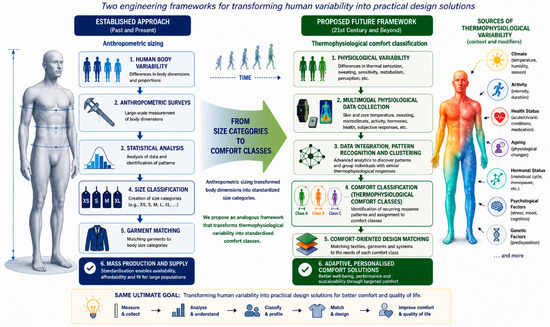
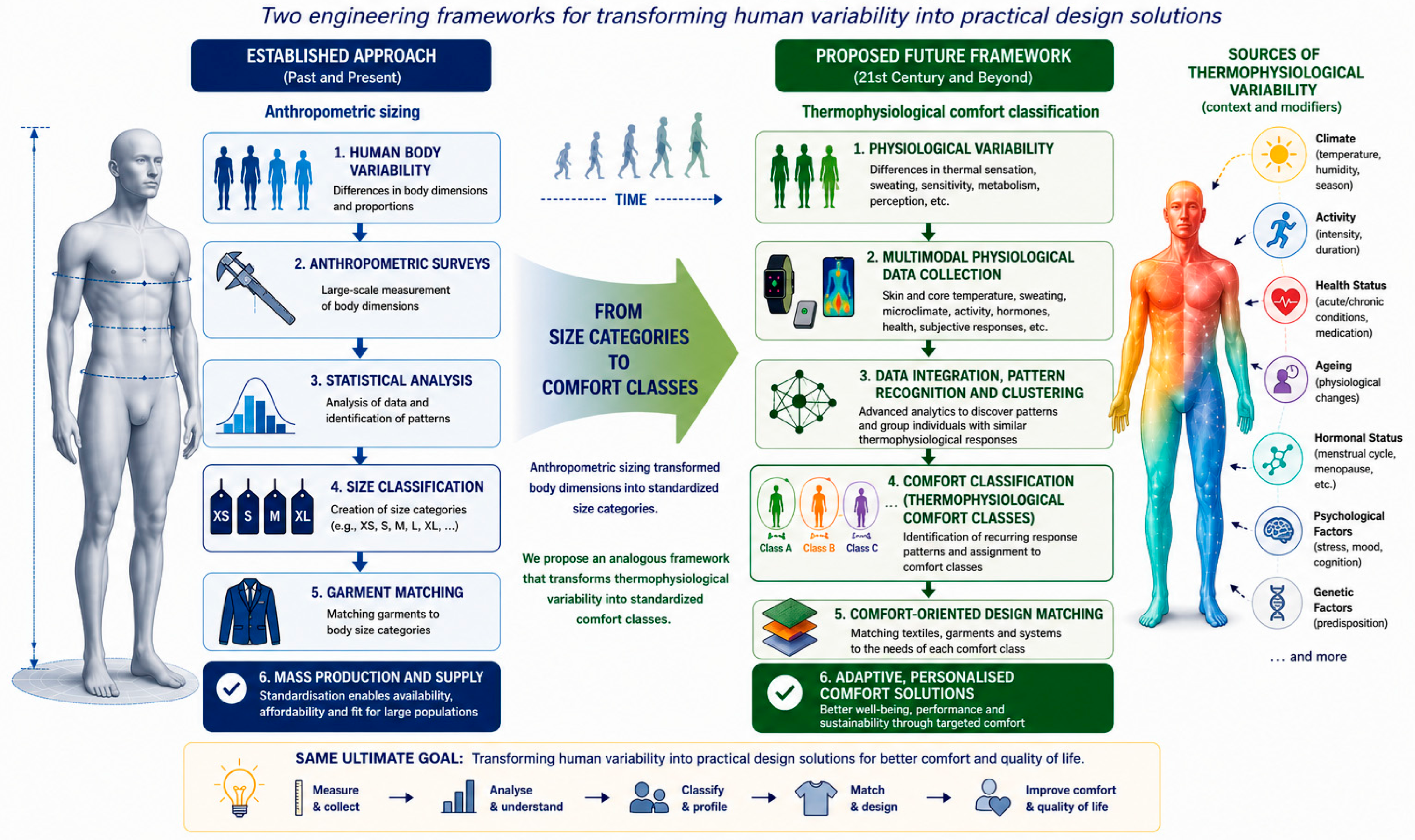
Figure 1 illustrates the conceptual analogy between conventional anthropometric sizing and the proposed approach of thermophysiological comfort classification. The left-hand side summarises the engineering workflow that has been successfully applied in clothing design for more than a century. Human variability in body dimensions is quantified through anthropometric surveys, analysed statistically, and transformed into standardized size categories. These size classifications provide an engineering representation of continuous human variability, enabling efficient garment matching and large-scale production.
Figure 1.
Conceptual analogy between anthropometric sizing and the proposed framework for thermophysiological comfort classification.
The proposed concept, shown on the right-hand side, follows the same engineering logic while addressing a fundamentally different type of human variability. Instead of static anatomical characteristics, the starting point is the multidimensional variability of thermophysiological responses arising from the interaction between intrinsic physiological characteristics and continuously changing contextual factors. These factors include environmental conditions, physical activity, health status, ageing, hormonal influences, and psychological state. Rather than relying on isolated physiological parameters, the concept integrates multimodal physiological measurements with contextual information and subjective thermal comfort evaluations.
These heterogeneous data are subsequently processed through data integration, pattern recognition, and clustering techniques to identify recurring physiological response patterns across individuals. The outcome is a limited number of thermophysiological CCs, each representing a group of individuals, who exhibit similar physiological responses under comparable conditions. Thus, continuous physiological variability is transformed into an engineering representation that can be systematically applied in textile and clothing design.
Finally, the lower part of the figure highlights that, despite relying on different types of human data, both approaches share the same engineering objective: transforming human variability into practical design solutions. While anthropometric sizing supports the development of garments that fit the human body geometrically, thermophysiological comfort classification is proposed as a complementary concept for developing textile products that better correspond to the dynamic physiological characteristics of different user groups. In this sense, the proposed concept extends the engineering philosophy of anthropometric sizing from body geometry to human thermophysiological behaviour.
3. Establishing Thermophysiological Comfort Classes
3.1. Defining Thermophysiological Comfort Classes
The concept of a thermophysiological CC extends the engineering philosophy of anthropometric sizing from relatively stable body dimensions to dynamic physiological behaviour [1,2,3]. A thermophysiological CC is an engineering category representing a recurring pattern of physiological response and comfort perception. Environmental and activity conditions provide the context required to interpret and compare these responses. Once the CC system has been established, individuals whose current thermophysiological profiles correspond to a particular response pattern can be assigned to the respective class.
Individuals with the same CC are expected to respond similarly to comparable thermal exposures. This similarity could support the selection, use or the design of textile systems that are optimised for representative physiological profiles instead of an average individual.
The environmental and activity conditions for textile evaluation are defined by the intended application of the textile product. A garment is already designed for a particular application, such as cold-weather sports, occupational activity, or rest. It can therefore be evaluated under these conditions to determine the CCs for which it provides acceptable or optimal comfort.
Comfort-class assignment would not require testing with a specific textile product or a reference set of garments. It would be based on a validated combination of individual characteristics, information on behavioural adaptation, subjective thermal preferences, and physiological indicators that describe the user’s thermophysiological response profile. These indicators may include preferred ambient temperature, seasonal clothing behaviour, tendency to sweat, and, where appropriate, responses to a standardised activity challenge. If physiological measurements are included in the final assessment protocol, the corresponding test conditions, including clothing conditions where relevant, would be standardised. Textile products would be evaluated separately after the CCs have been established, to determine the classes for which they are best suited.
Similar to anthropometric size assignment, an individual’s thermophysiological CC assignment is not necessarily permanent. It reflects the individual’s current physiological state under defined conditions and may change over time owing to health status, ageing, hormonal influences, physical fitness, acclimatisation, environmental exposure, or other internal and external factors [6,7,8,9,10,21,22,23,24,25].
Consequently, the same person may be assigned to a different CC when these factors modify person’s thermophysiological response profile. CC should therefore be interpreted as a context-dependent characteristic representing the individual’s current physiological state relevant to thermal comfort.
The proposed concept differs fundamentally from conventional classifications based on demographic variables such as age or sex, as well as from medical or physiological diagnoses. Instead, it provides an engineering abstraction that simplifies the multidimensional complexity of human thermophysiological variability into a manageable number of recurring response patterns. Similar to anthropometric sizing, this abstraction does not aim to eliminate individual variability but to organise it into categories that can support practical engineering decision-making.
A thermophysiological CC cannot be established from a single physiological parameter. Instead, the comfort-class system must be developed through the integration of multiple sources of information describing the interaction between the human body and the thermal environment [21,26,27,33,34]. The resulting response patterns provide an engineering framework for translating human thermophysiological variability into textile design requirements.
From an engineering perspective, CCs constitute an intermediate level of representation between individual physiological measurements and textile product design. CCs provide a common language through which complex thermophysiological responses can be translated into design requirements. Future textile systems could therefore respond not only to body dimensions but also to the thermophysiological characteristics of their users.
3.2. Exploratory Data Domains for Developing the Comfort-Class System
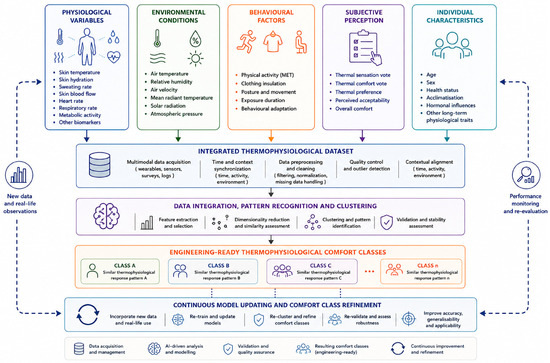
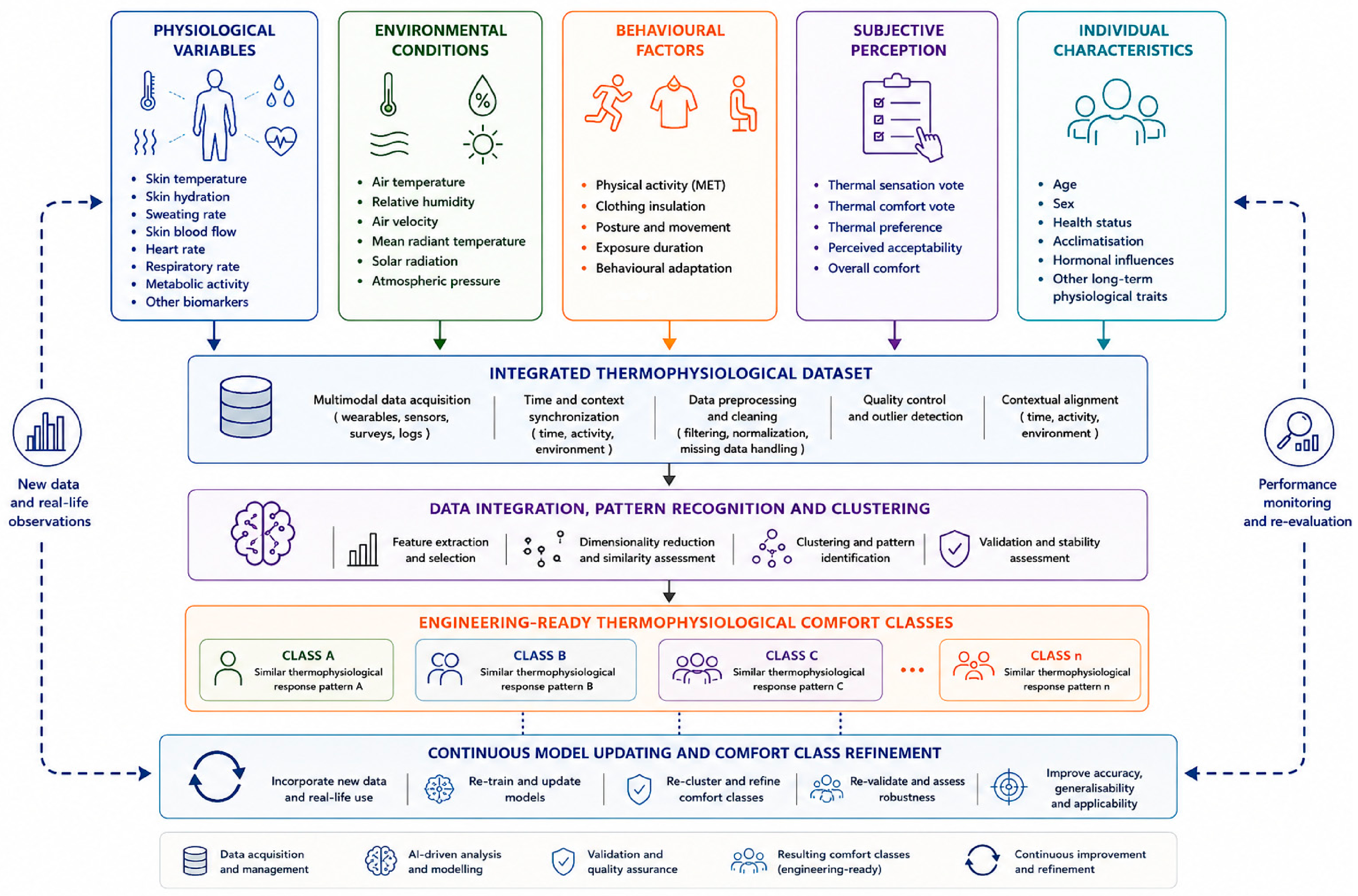
Figure 2 summarises the development of the thermophysiological comfort-class system at population level. The variable groups shown in the figure define the broad exploratory data domains from which recurring thermophysiological response patterns may be identified. They do not constitute a mandatory set of measurements for every study participant or for subsequent individual comfort-class assignment. Environmental and activity variables describe the context, in which physiological and subjective responses are observed, while the relevance of the remaining variables may differ among populations and application domains.
Figure 2.
Conceptual framework for developing and refining the thermophysiological comfort-class system through exploratory multimodal population data.
The purpose of the exploratory stage is therefore to consider the full range of potentially relevant influences and subsequently identify which variables have sufficient discriminatory value for establishing reproducible CCs.
Physiological variables constitute the primary source of information on the body’s thermoregulatory response. These may include skin temperature, skin hydration, sweating rate, skin blood flow, heart rate, respiratory rate, metabolic activity, and other measurable indicators of heat production and heat dissipation [12,13,18,20,21,23,24,25]. Advances in wearable sensors and non-invasive monitoring technologies increasingly allow the continuous collection of such physiological data under real-life conditions [35,36].
Environmental conditions provide the external context in which physiological responses occur. Air temperature, relative humidity, air velocity, mean radiant temperature, and radiation directly affect heat exchange between the human body and the environment [11,14,37]. Similar values for an isolated physiological variable may be associated with different comfort perceptions under different environmental conditions. Environmental variables are therefore an essential part of the proposed classification.
Human behaviour introduces an additional source of variability. Physical activity modifies metabolic heat production. At the same time, behavioural adaptation—including changes in clothing, posture, movement, and exposure time—continuously alters the interaction between the body and the surrounding environment. These variables can be assessed through questionnaires, direct observation, or objective activity monitoring, depending on the study design. Consequently, behavioural and activity-related parameters should be considered together with physiological measurements rather than independently [9,22,23,24].
Subjective perception represents another indispensable dimension of thermophysiological comfort. Thermal sensation, thermal comfort, thermal preference, and perceived acceptability provide information that cannot be obtained from objective physiological measurements alone. Their integration enables engineering models to reflect not only physiological regulation but also the human experience of thermal comfort [4,5,17,19,20].
Finally, individual characteristics—including age, sex, health status, acclimatisation, hormonal influences, and other relevant physiological attributes—affect the relationships among physiological responses, environmental conditions, and subjective perception [6,7,8,9,10,22,23,24,25,38,39]. These characteristics help to explain why individuals exhibit different thermophysiological response patterns under otherwise comparable conditions. The relevance of hormonal factors and the methods used to assess them would depend on the studied population and the objectives of the specific experimental study.
The proposed approach therefore treats the development of the comfort-class system as a multidimensional data integration problem. Depending on the population and application context, relevant combinations of physiological responses, subjective evaluations, behavioural information, individual characteristics, and contextual variables may be analysed. Through data integration, pattern recognition, and clustering, recurring thermophysiological response profiles can be identified and evaluated as potential CCs.
3.3. From Multimodal Data to Comfort Classes
The proposed approach requires a change in how thermophysiological variability is interpreted and classified. Established engineering classification systems, such as anthropometric sizing, operate with categories that have already been derived from extensive population measurements and statistical analysis. Once a sizing system has been established, an individual can be assigned to an existing category using only a limited number of key body dimensions.
No equivalent classification system currently exists for thermophysiological comfort. The initial CCs must therefore be derived from experimental observations and cannot be defined a priori. This process would involve two related stages. The first is the establishment and validation of the comfort-class system through extensive multimodal data collection and analysis at population level (Figure 2). The second is the development of a simplified assessment protocol that allows new users to be assigned to one of the established classes.
The workflow illustrated in Figure 2 includes the following stages:
- Exploratory data collection. The initial stage requires a broad dataset capable of capturing the multidimensional nature of thermophysiological comfort. Data may be collected using extensive questionnaires, physiological measurements, environmental monitoring, activity-related variables, subjective comfort assessments, and relevant individual characteristics. At this stage, the objective is not to minimise the number of variables. It is to collect enough information to identify potentially meaningful relationships and recurring response patterns.
- Data preprocessing and harmonisation. Because the collected data come from different measurement systems and represent different dimensions of human response, they must be prepared before analysis. This stage may include signal filtering, handling of missing values, detection of implausible observations, standardisation of measurement units, normalisation of variables, quality control, temporal synchronisation, and contextual alignment. Physiological measurements must be linked to the environmental conditions, activity level, clothing system, exposure duration, and subjective evaluations recorded during the same period. These procedures produce a harmonised analytical dataset in which heterogeneous observations can be compared within a common temporal and contextual framework.
- Identification of informative variables. Feature extraction, feature selection, and dimensionality reduction methods are then applied to determine which questionnaire items, physiological measurements, and contextual variables contribute most strongly to distinguishing recurring thermophysiological response profiles. Many variables collected during the exploratory stage may provide overlapping, weak, or irrelevant information. The objective is therefore to identify the smallest set of variables that retains sufficient information for reliable classification. For illustration, an exploratory protocol containing 200 questionnaire items and 20 physiological measurements might ultimately be reduced to 20 questions and five measurements with the greatest classification value.
- Discovery of thermophysiological CCs. The selected variables are analysed using pattern recognition and clustering techniques to identify reproducible groups of similar thermophysiological response profiles under defined environmental and activity conditions. The primary unit of analysis is the response profile rather than the individual considered as a permanent member of a particular group. The same person may generate different response profiles at different times. They may therefore be assigned to another CC when health status, pregnancy, medication, ageing, physical fitness, acclimatisation, or other factors modify the physiological response.
- Validation and stability assessment. The identified classes must be evaluated using independent datasets, different populations, environmental conditions, and activity levels. Validation should assess their robustness, reproducibility, interpretability, and engineering relevance. Reproducibility should be demonstrated by consistent identification of the main response patterns when measurements are repeated under comparable conditions, despite normal behavioural variability between observations. Equipment invariance should be demonstrated by comparable classification results obtained with different measurement systems that provide equivalent physiological variables with sufficient accuracy and calibration. It should also demonstrate that the classes represent recurring physiological response patterns rather than artefacts of a particular dataset, measurement protocol, or analytical method. Only after this stage can the resulting classes be considered sufficiently reliable for engineering application.
The preceding stages, represented in Figure 2, describe the establishment of the thermophysiological comfort-class system. Once the classes and their distinguishing variables have been identified and validated, a second stage is required for their practical application:
- Development and validation of a practical classification tool. The reduced set of informative questions and measurements can be transformed into a standardised comfort-class assessment protocol. A user would complete the selected questionnaire items, undergo the required measurements, and be assigned to the class that best corresponds to their current thermophysiological profile. The practical objective is not to preserve the full complexity of the exploratory dataset. Instead, it is to identify the smallest reliable combination of indicators required for accurate comfort-class assignment. The simplified protocol must itself be validated to confirm that it assigns new users to the established classes with sufficient reliability.
- Reassessment and scientific refinement. Once validated, a given version of the classification should remain sufficiently stable for engineering application, textile development, and product labelling. Individual users may nevertheless be reassessed when their physiological state changes. In addition, the analytical model and class boundaries may be periodically refined as larger and more diverse datasets become available. Such refinement represents the normal development of scientific knowledge rather than a sign of instability in the practical application of the classification.
Artificial intelligence and machine-learning methods may support several stages of this process, including feature selection, dimensionality reduction, identification of nonlinear relationships, clustering, classification, and validation. Within the proposed approach, however, artificial intelligence is an enabling analytical methodology rather than the central concept. The principal objective is to establish a reproducible engineering system capable of transforming continuous thermophysiological variability into meaningful CCs and of assigning users to these classes through a practical and standardised procedure.
The proposed process is conceptually analogous to anthropometric sizing. Large population surveys and numerous body measurements are required to establish a sizing system. However, the practical determination of an individual’s clothing size may subsequently rely on only a few key dimensions, such as chest, waist, and hip circumference. Similarly, the establishment of thermophysiological CCs may initially require extensive questionnaires and multimodal measurements, while their practical application should ultimately rely on a limited and validated set of indicators. Similarly to anthropometric sizing, the proposed concept classifies users rather than textile products. Textile systems are evaluated afterwards to determine the comfort classes for which they are most suitable.
Once established and validated, thermophysiological CCs can provide a common engineering basis for translating complex physiological behaviour into textile design requirements. Their practical implications are discussed in the following section.
4. Discussion: Engineering Significance of Thermophysiological Comfort Classes
The novelty of this paper lies not in proposing a new thermal comfort model but in introducing a new engineering classification concept capable of supporting future textile design. The primary engineering value of thermophysiological comfort classes (CCs) lies in shifting textile design from a universal approach towards the development of textile products that are either suitable for or specifically optimised for representative thermophysiological profiles.
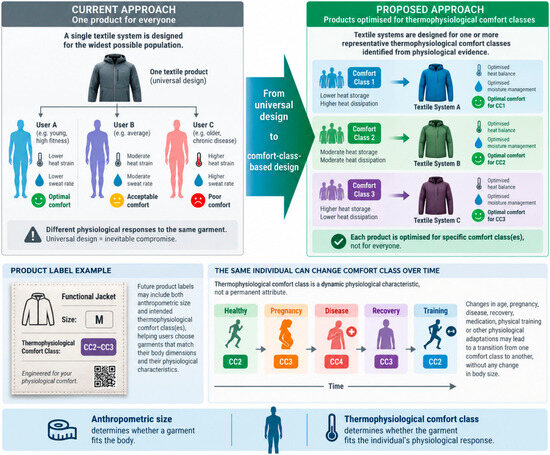
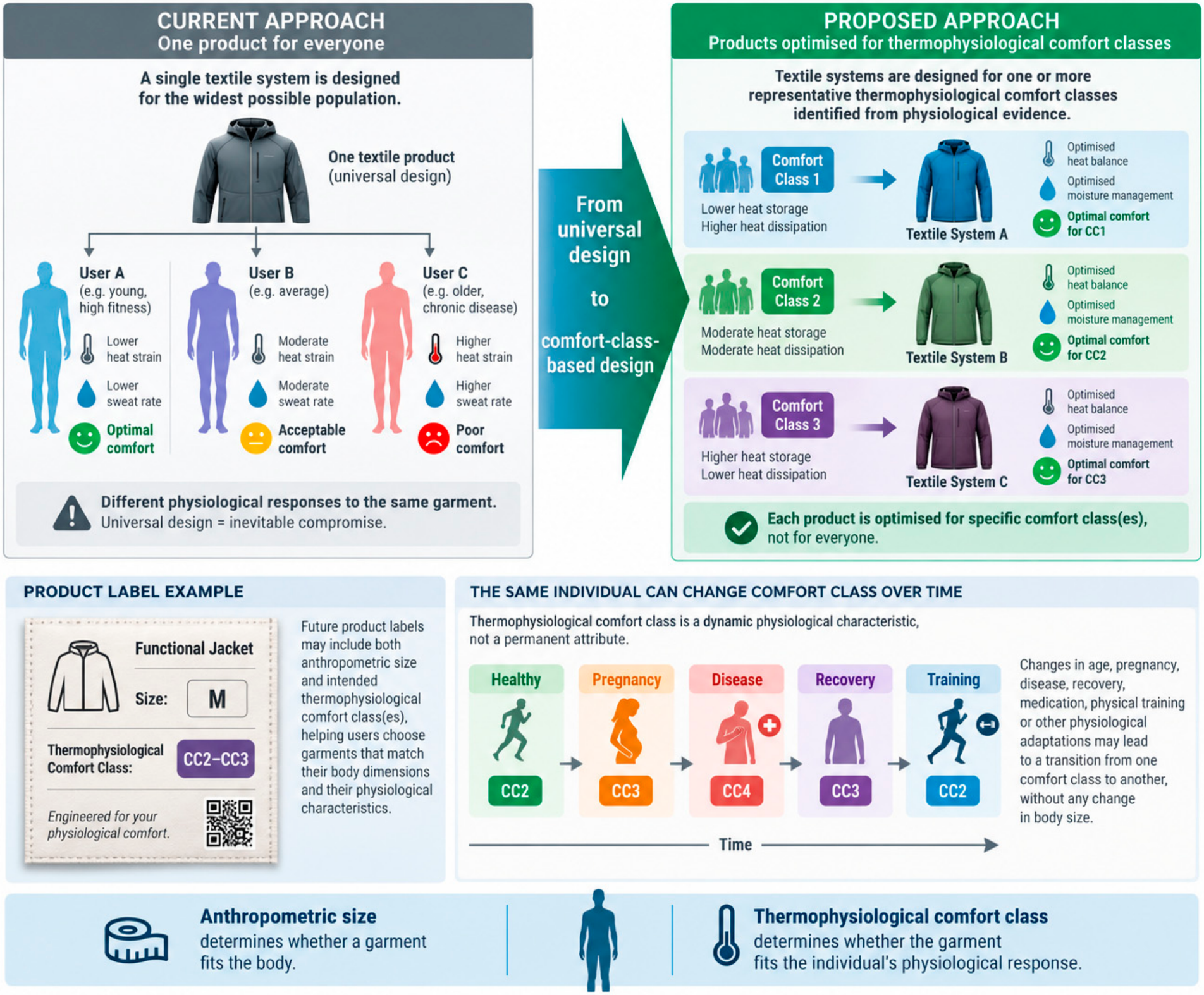
Figure 3 illustrates this conceptual transition. Current functional clothing is generally designed to provide acceptable comfort for the broadest possible population. However, because thermophysiological responses vary substantially between individuals, even within the same occupational or user group, a single textile system can rarely provide optimal comfort for every wearer. Consequently, universal textile design inevitably represents a compromise between diverse thermophysiological requirements.
Figure 3.
Illustrative representation of the transition from universal textile design to thermophysiological comfort-class-based design.
The proposed concept introduces an alternative engineering strategy. Instead of seeking a single “best” textile solution for an entire population, different textile systems could be developed and optimised for one or more CCs identified through physiological data. For illustrative purposes, one garment may be designed to provide optimal comfort for CCs 2 and 3, whereas another may be more appropriate for CCs 4 and 5. The engineering objective would thus shift from maximising average comfort across an entire population to maximising comfort within representative thermophysiological groups.
This concept could also extend product labelling. Just as clothing labels currently indicate anthropometric size, future functional garments could additionally specify the CCs for which they have been optimised. Users could therefore select clothing not only according to their body dimensions but also according to their current thermophysiological profile. This could enable a more evidence-based match between the individual and the textile system.
Unlike anthropometric size, an individual’s CC assignment should not be regarded as a permanent personal characteristic. It reflects the individual’s current thermophysiological state and may change over time owing to ageing, pregnancy, disease, recovery, medication, physical training, acclimatisation, or other physiological adaptations. Consequently, a person may move from one CC to another without any corresponding change in body size and may continue to wear the same anthropometric size while requiring a textile product designed for a different CC.
This perspective has important implications for the future development of functional textiles. Considerable research and engineering effort is currently devoted to developing increasingly sophisticated textile systems intended to satisfy all users within a target population, such as soldiers, healthcare professionals, firefighters, police officers, or pilots. However, these populations are themselves thermophysiologically heterogeneous. A firefighter with diabetes, a pilot taking medication, or a healthcare professional during pregnancy may respond differently to thermal exposure than colleagues performing the same task under comparable conditions. A highly complex textile system may therefore be necessary for certain CCs while offering little additional benefit to the most prevalent or least demanding user groups, whose requirements could be met by a simpler product.
Instead of pursuing a single increasingly complex universal solution, textile engineering could develop differentiated products optimised for particular CCs. A comparatively simple textile system might provide sufficient comfort for the most prevalent classes, whereas a more advanced product could be reserved for classes with specific or more demanding thermophysiological requirements. Such an approach could reduce unnecessary product complexity, direct technological innovation towards the users who would benefit from it most, improve comfort, and support personalised product selection on an industrial scale. Thermophysiological CCs could thus become a practical complement to anthropometric sizing systems: anthropometric size would indicate whether a garment fits the body geometrically, whereas the CC would indicate whether the textile system is appropriate for the user’s current thermophysiological response profile.
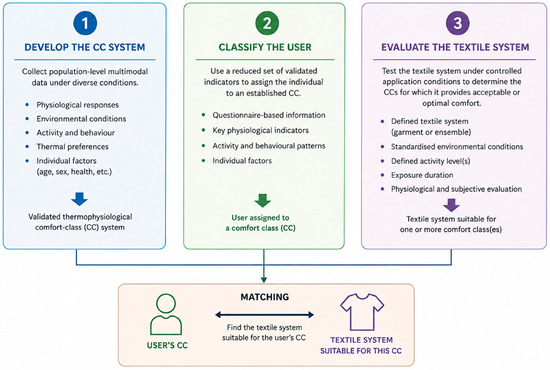
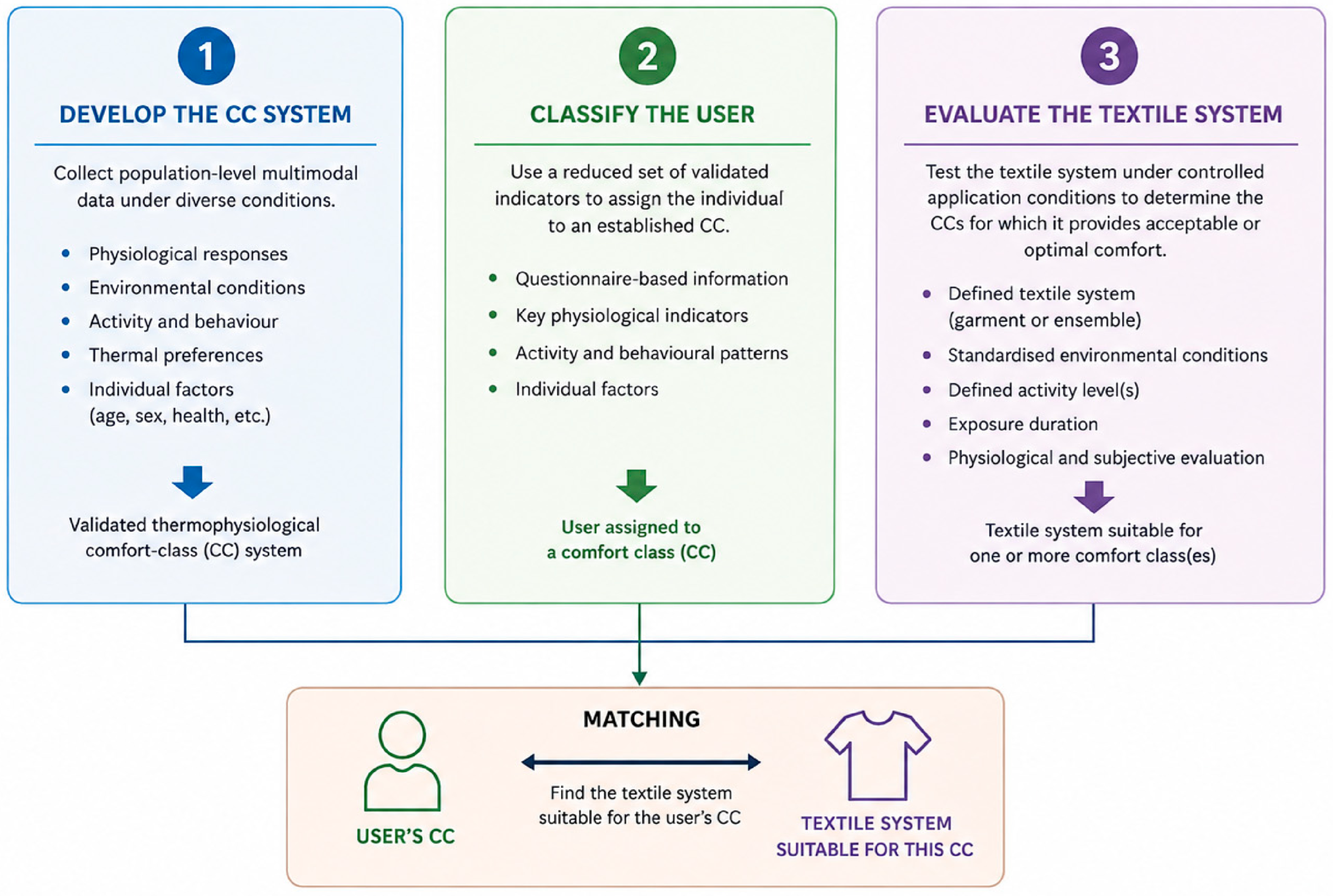
The practical application of the proposed concept involves three distinct processes (Figure 4). First, the CC system is established and validated using population-level data. Second, individual users are assigned to an established CC using a validated assessment protocol. Third, textile systems are evaluated separately to determine the CCs for which they provide acceptable or optimal comfort.
Figure 4.
Practical application of the thermophysiological comfort-class concept.
The proposed concept also has several limitations that should be acknowledged. As a perspective paper, it introduces an engineering concept rather than a fully established classification system. The physiological, behavioural, and subjective indicators required for reliable CC assignment have yet to be standardised, and extensive multimodal datasets representing diverse populations, environmental conditions, and activity levels will be required to establish robust and reproducible classes. In addition, the stability of CC assignment over time and under changing physiological conditions remains to be investigated through longitudinal studies. Because the proposed concept classifies users rather than textile products, further research will also be necessary to determine how different textile systems perform for different comfort classes within specific application domains. These challenges define the research agenda required for transforming the proposed concept into a validated engineering classification system.
5. Conclusions
This perspective paper proposes the concept of thermophysiological comfort classes as an engineering approach to transforming continuous human physiological variability into a limited number of practically applicable comfort classes. Extending the philosophy of anthropometric sizing, the proposed concept introduces a complementary dimension of human classification based not on body geometry but on recurring multidimensional patterns of physiological response and comfort perception under defined environmental and activity conditions.
The establishment of such a system would require extensive multimodal data collection, integration, feature selection, pattern recognition, clustering, and validation. The ultimate objective, however, is not to preserve the full complexity of the exploratory dataset in practical use. Once the comfort classes and their most informative indicators have been identified, this complexity should be reduced to a validated assessment protocol based on a limited set of questionnaire items and physiological measurements. Such a tool could enable individuals to determine their current comfort class in a manner conceptually comparable to the use of a few key body dimensions for determining anthropometric size. Artificial intelligence and data science methods may support this process, but they remain enabling tools rather than the central contribution of the proposed concept.
The principal engineering significance of thermophysiological comfort classes lies in replacing the pursuit of one universally optimal textile product with the development of products matched to representative thermophysiological profiles. Future garments could indicate not only anthropometric size but also the comfort classes for which they are suitable or for which have been optimised. Because an individual’s CC assignment may change with ageing, pregnancy, illness, recovery, medication, physical training, or other physiological adaptations, comfort-class assessment may therefore need to be repeated over time. Thermophysiological comfort classes should therefore be regarded as a functional complement of the anthropometric sizing: anthropometric size indicates whether a garment fits the body geometrically, whereas comfort class indicates whether the textile system is appropriate for the user’s thermophysiological response profile.
Future research should focus on the construction of large and diverse thermophysiological datasets, the identification and validation of reproducible comfort classes, and the development of reliable assessment protocols suitable for engineering practice and product labelling. If successfully established, this system could provide a scientifically grounded basis for personalised comfort while remaining compatible with industrial-scale textile design and manufacturing.
Funding
This work has been accomplished with financial support by the European Regional Development Fund within the Operational Programme “Bulgarian national recovery and resilience plan”, procedure for direct provision of grants “Establishing of a network of research higher education institutions in Bulgaria”, and under Project BG-RRP-2.004-0005 “Improving the research capacity and quality to achieve international recognition and resilience of TU-Sofia (IDEAS)”.
Data Availability Statement
The original contributions presented in this study are included in the article. Further inquiries can be directed to the corresponding author.
Acknowledgments
The research of this work has been supported by the Competence Center for Mechatronics and Clean Technologies—MIRACle, developed by the No BG16RFPR002-1.014 Pro-gram “Research, Innovation and Digitalization for Smart Transformation” 2021–2027 (PRIDST), co-financed by the European Union through the European Structural and Investment Funds. During the preparation of this manuscript, the author used ChatGPT (OpenAI, GPT-5.6 Sol) for the visual enhancement of author-created schematic figures. The author reviewed and edited the output and takes full responsibility for the content of this publication.
Conflicts of Interest
The author declares no conflicts of interest.
References
- Gupta, D.; Zakaria, N. (Eds.) Anthropometry, Apparel Sizing and Design; Elsevier: Amsterdam, The Netherlands, 2014. [Google Scholar]
- Marriott, B.M.; Grumstrup-Scott, J. Body composition and military performance: Origins of the Army standards. In Body Composition and Physical Performance: Applications for the Military Services; National Academies Press (US): Washington, DC, USA, 1990. [Google Scholar]
- Komlos, J. Anthropometric history: An overview of a quarter century of research. Anthropol. Anz. 2009, 67, 341–356. [Google Scholar] [CrossRef] [Scilit] [PubMed]
- Wang, Z.; De Dear, R.; Luo, M.; Lin, B.; He, Y.; Ghahramani, A.; Zhu, Y. Individual difference in thermal comfort: A literature review. Build. Environ. 2018, 138, 181–193. [Google Scholar] [CrossRef] [Scilit]
- Lee, J.Y. Thermal Perception and Thermal Sensation. In The Thermal Environment: From Viewpoints of Physiological Anthropology and Environmental Ergonomics; Springer Nature: Singapore, 2025; pp. 67–81. [Google Scholar]
- Wu, Y.; Zhang, Z.; Liu, H.; Li, B.; Chen, B.; Kosonen, R.; Jokisalo, J. Age differences in thermal comfort and physiological responses in thermal environments with temperature ramp. Build. Environ. 2023, 228, 109887. [Google Scholar] [CrossRef] [Scilit]
- Ormandy, D.; Ezratty, V. Health and thermal comfort: From WHO guidance to housing strategies. Energy Policy 2012, 49, 116–121. [Google Scholar] [CrossRef] [Scilit]
- Zhang, X.; Hu, S.; Guo, C.; Liu, R.; Tong, L.; Shi, B.; Li, B. Association between thermal comfort and cortisol depends on the air temperature and exposure time. Build. Environ. 2023, 233, 110073. [Google Scholar] [CrossRef] [Scilit]
- Lin, Y.; Jin, H.; Jin, Y.; Kang, J. Experimental study on the effects of exercise intensity and thermal environment on thermal responses. Build. Environ. 2023, 232, 110067. [Google Scholar] [CrossRef] [Scilit]
- Lam, C.K.C.; Lau, K.K.L. Effect of long-term acclimatization on summer thermal comfort in outdoor spaces: A comparative study between Melbourne and Hong Kong. Int. J. Biometeorol. 2018, 62, 1311–1324. [Google Scholar] [CrossRef] [Scilit] [PubMed]
- Aghniaey, S.; Lawrence, T.M. The impact of increased cooling setpoint temperature during demand response events on occupant thermal comfort in commercial buildings: A review. Energy Build. 2018, 173, 19–27. [Google Scholar] [CrossRef] [Scilit]
- Barone, G.; Buonomano, A.; Forzano, C.; Giuzio, G.F.; Palombo, A.; Russo, G. A new thermal comfort model based on physiological parameters for the smart design and control of energy-efficient HVAC systems. Renew. Sustain. Energy Rev. 2023, 173, 113015. [Google Scholar] [CrossRef] [Scilit]
- Chaudhuri, T.; Zhai, D.; Soh, Y.C.; Li, H.; Xie, L. Thermal comfort prediction using normalized skin temperature in a uniform built environment. Energy Build. 2018, 159, 426–440. [Google Scholar] [CrossRef] [Scilit]
- Abedin, F.; DenHartog, E. Clothing impact on post-exercise comfort: Skin-clothing physiology in transient environment. Ergonomics 2024, 67, 1080–1096. [Google Scholar] [CrossRef] [Scilit] [PubMed]
- Mandal, S.; Annaheim, S.; Greve, J.; Camenzind, M.; Rossi, R.M. Modeling for predicting the thermal protective and thermo-physiological comfort performance of fabrics used in firefighters’ clothing. Text. Res. J. 2019, 89, 2836–2849. [Google Scholar] [CrossRef] [Scilit]
- Mandal, S.; Mazumder, N.U.S.; Agnew, R.J.; Song, G.; Li, R. Characterization and modeling of thermal protective and thermo-physiological comfort performance of polymeric textile materials—A review. Materials 2021, 14, 2397. [Google Scholar] [CrossRef] [Scilit] [PubMed]
- Nico, M.A.; Liuzzi, S.; Stefanizzi, P. Evaluation of thermal comfort in university classrooms through objective approach and subjective preference analysis. Appl. Ergon. 2015, 48, 111–120. [Google Scholar] [CrossRef] [Scilit] [PubMed]
- Arens, E.; Zhang, H. The skin’s role in human thermoregulation and comfort. In Thermal and Moisture Transport in Fibrous Materials; Pan, N., Gibson, P., Eds.; Woodhead Publishing: Cambridge, UK, 2006; pp. 560–602. [Google Scholar]
- Staiger, H.; Laschewski, G.; Grätz, A. The perceived temperature–a versatile index for the assessment of the human thermal environment. Part A: Scientific basics. Int. J. Biometeorol. 2012, 56, 165–176. [Google Scholar] [CrossRef] [Scilit] [PubMed]
- Enescu, D. Models and indicators to assess thermal sensation under steady-state and transient conditions. Energies 2019, 12, 841. [Google Scholar] [CrossRef] [Scilit]
- Fiala, D. Dynamic Simulation of Human Heat Transfer and Thermal Comfort. Ph.D. Thesis, De Montfort University Leicester, Leicester, UK, 1998. [Google Scholar]
- Jendritzky, G.; de Dear, R. Adaptation and thermal environment. In Biometeorology for Adaptation to Climate Variability and Change; Springer: Dordrecht, The Netherlands, 2009; pp. 9–32. [Google Scholar]
- Vanos, J.K.; Warland, J.S.; Gillespie, T.J.; Kenny, N.A. Review of the physiology of human thermal comfort while exercising in urban landscapes and implications for bioclimatic design. Int. J. Biometeorol. 2010, 54, 319–334. [Google Scholar] [CrossRef] [Scilit] [PubMed]
- Lundgren, K.; Kuklane, K.; Gao, C.; Holmér, I. Effects of heat stress on working populations when facing climate change. Ind. Health 2013, 51, 3–15. [Google Scholar] [CrossRef] [Scilit] [PubMed]
- Lim, C.L. Fundamental concepts of human thermoregulation and adaptation to heat: A review in the context of global warming. Int. J. Environ. Res. Public Health 2020, 17, 7795. [Google Scholar] [CrossRef] [Scilit] [PubMed]
- de Dear, R.J.; Akimoto, T.; Arens, E.A.; Brager, G.; Candido, C.; Cheong, K.W.D.; Li, B.; Nishihara, N.; Sekhar, S.C.; Tanabe, S.-I.; et al. Progress in thermal comfort research over the last twenty years. Indoor Air 2013, 23, 442–461. [Google Scholar] [CrossRef] [Scilit] [PubMed]
- Humphreys, M.; Nicol, F.; Roaf, S. Adaptive Thermal Comfort: Foundations and Analysis; Routledge: Abingdon, UK, 2015. [Google Scholar]
- Alhassawi, R.; Gill, S.; Hayes, S.; Brubacher, K. Evaluating machine learning models for clothing size prediction using anthropometric measurements from 3D body scanning. Sci. Rep. 2025, 15, 40781. [Google Scholar] [CrossRef] [Scilit] [PubMed]
- Lee, Y.; Bae, C.; Chun, C. Thermal personality mapping for personal comfort system. Build. Environ. 2025, 286, 113677. [Google Scholar] [CrossRef] [Scilit]
- Biswas, B.K.; Ishii, K.; Watanabe, Y.; Li, J.; Tan, Y.; Dempoya, A.; Lee, S.-I.; Iwamura, T.; Konoshita, S.; Wakabayashi, H. Predicting individual variability in thermal sensation, PMV predictions, and local skin temperature differences using infrared thermography. Build. Environ. 2025, 269, 112477. [Google Scholar] [CrossRef] [Scilit]
- Jia, C.; Li, Y.; Gao, S.; Zhao, S.; Liu, S.; Zhang, H.; Zhai, Y. Thermal responses under different exercise intensity and air temperature. Build. Environ. 2025, 271, 112591. [Google Scholar] [CrossRef] [Scilit]
- Luo, M.; Guo, F.; Tang, H.; Ming, R.; Huang, L.; Zhao, H. A systematic review of the influence of physiological factors on outdoor thermal comfort. Hum. Settl. Sustain. 2025, 1, 27–40. [Google Scholar] [CrossRef] [Scilit]
- Younes, J.; Khovalyg, D. Advances in human thermophysiology modelling: Methodological review of a century of developments. Comput. Biol. Med. 2025, 198, 111218. [Google Scholar] [CrossRef] [Scilit] [PubMed]
- Gao, H.; Ghahramani, A. Physiological-based personal thermal comfort models: A review of sensing systems, data preprocessing, and modeling approaches. Energy Build. 2026, 351, 116690. [Google Scholar] [CrossRef] [Scilit]
- Persiani, S.G.; Kobas, B.; Koth, S.C.; Auer, T. Biometric data as real-time measure of physiological reactions to environmental stimuli in the built environment. Energies 2021, 14, 232. [Google Scholar] [CrossRef] [Scilit]
- Morresi, N.; Cipollone, V.; Casaccia, S.; Revel, G.M. Measuring thermal comfort using wearable technology in transient conditions during office activities. Measurement 2024, 224, 113897. [Google Scholar] [CrossRef] [Scilit]
- Ryu, S.; Choi, D.; Kim, C. Evaluation of personalized environmental control systems to improve local thermal comfort during cooling season in Korea. Energy Rep. 2025, 14, 1434–1451. [Google Scholar] [CrossRef] [Scilit]
- Notley, S.R.; Meade, R.D.; Looney, D.P.; Chapman, C.L.; Potter, A.W.; Fogarty, A.; Howlader, T.; Main, L.C.; Friedl, K.E.; Kenny, G.P. Physiological monitoring for occupational heat stress management: Recent advancements and remaining challenges. Appl. Physiol. Nutr. Metab. 2025, 50, 1–14. [Google Scholar] [CrossRef] [Scilit] [PubMed]
- Filingeri, D.; Koch Esteves, N. How hot is too hot for people? A review of empirical models of perceptual, physiological and functional limits of human heat tolerance. Exp. Physiol. 2026, 111, 1669–1686. [Google Scholar] [CrossRef] [Scilit] [PubMed]
Disclaimer/Publisher’s Note: The statements, opinions and data contained in all publications are solely those of the individual author(s) and contributor(s) and not of MDPI and/or the editor(s). MDPI and/or the editor(s) disclaim responsibility for any injury to people or property resulting from any ideas, methods, instructions or products referred to in the content. |
© 2026 by the author. Licensee MDPI, Basel, Switzerland. This article is an open access article distributed under the terms and conditions of the Creative Commons Attribution (CC BY) license.