


Abstract
Fabric defect detection is one of the most significant challenges in the textile industry due to its critical role in quality assessment and management. Conventional single-stage detectors often capture small-scale and low-contrast defects inadequately. On the other hand, high-accuracy two-stage methods suffer from excessive computational complexity. This study proposes an improved Single Shot MultiBox Detector (SSD) model by replacing the feature map layer with the Bidirectional Feature Pyramid Network (BiFPN) from EfficientDet. Also, Bayesian optimization is utilized to systematically tune the related hyperparameters, which improves convergence stability and detection performance without manual intervention. Performance evaluation involves a trade-off between mean average precision at IoU 0.5 (mAP50) and execution time or frames per second (FPS), given that fabric defect detection requires the rotation of fabric motors or rollers. Experiments on a fabric defect dataset demonstrate that the proposed SSD-BiFPN framework outperforms baseline SSD models when it comes to precision, recall, and mean average precision, particularly for small and irregular defects. Additionally, the proposed architecture demonstrates satisfactory real-time performance when implemented on an NVIDIA Jetson Nano platform, highlighting its appropriateness for edge-based industrial inspection scenarios.
1. Introduction
The textile industry consists of various technologies, materials, components, and strategies. Cotton, linen, and wool are the basic materials in the textile industry, while polypropylene (PP), polyamide (PA), polyester (PES), polyethylene (PE), polyacrylonitrile (PAN), and viscose (VS) represent synthetic fibers that also contribute to the textile industry [1]. Intensive processing in the textile industry is limited to dyeing and final evaluation. Product quality is therefore an important factor, as it indicates the status of the factory. If the products produced by the factory are defective, this leads to the waste of raw materials. Textiles are an essential component of people’s daily lives, and as a basic industry, they occupy a significant position in global industry. However, defective fabrics are inevitable during the textile production process [2,3]. Therefore, it is essential to ensure improved fabric production quality. Detecting fabric surface defects has become a key process in textile manufacturing, as these defects not only affect product quality but also cause significant waste. These defects in textile fabrics typically arise from raw materials (warp or weft threads) as well as mechanical failures in the production process, which negatively impact the final quality of the fabrics and lead to lower selling prices [4]. According to market research, the price of second-grade fabrics decreases by 45–65% compared to first-grade fabrics [5]. Moreover, these unqualified textiles not only damage a company’s reputation but also have a vital impact on the safety of some products. To enhance profits and product competitiveness, inspection has become an essential step in the textile industry. Many textile industries still rely on traditional defect detection methods, including manual and visual inspection. Human visual inspection is one of the methods used to detect and locate defects, with a human detection rate of only 12 m per minute [6]. However, this method is limited in handling highly variable and unorganized defects. Human-based inspection is unsuitable and lacks flexibility and adaptability when faced with large amounts of production data processing. Prolonged observation can strain the eyes, leading to an increase in the number of defects that are overlooked. Manual inspection typically has an accuracy rate of less than 70% [7], and this method places a significant burden on companies due to its high labor costs. Furthermore, fabric production lines and outputs have become increasingly complex, making it difficult for workers to accurately identify and locate defects. Generally, manual detections and traditional methods for detecting and identifying defects lead to the wasteful use of human resources, and increased costs and time for large-scale production [8,9,10]. Therefore, it became necessary to develop an automated, online inspection model that would inspect, analyze, and classify fabric defects to ensure efficient fabric quality control.
Fabric defect inspection methods are commonly classified into five categories. Structural methods [11] which extract the basic textural structure of fabric images and detect defects by comparing damaged structures with normal fabric patterns. Statistical methods [12] rely mainly on the grayscale characteristics of pixels and their neighboring regions, using techniques such as gray-level co-occurrence matrices, mathematical morphology, and histogram statistics. Frequency-domain methods [13] analyze image texture spectra based on the relationship between fabric periodicity and spectral properties; common approaches include wavelet, Gabor, and Fourier transforms. Model-based methods [14] use predefined distributions and parameters to evaluate images during testing and are suitable for fabrics with irregular surface variations. The latest category belongs to learning-based methods [15], which adapt to various texture defects and include deep learning, and traditional machine learning techniques.
Recently, computer vision has become a major research direction in fabric defect detection [16]. Real-time inspection systems capture digital fabric images and apply deep learning-based defect detection techniques to enhance inspection efficiency and accuracy [17,18]. Artificial intelligence has been widely used in textile defect detection, having significantly revolutionized the process of improving textile quality control through the detection and classification of textile defects [19]. There are several state-of-the-art and cutting-edge object detection models developed in this field, the most popular of which are YOLO (You Only Look Once) [20], SSD (Single Shot MultiBox Detector) [21], and EfficientDet [22]. YOLO is a real-time object detection framework that predicts bounding boxes and class probabilities directly from the entire image in one forward pass, enabling a very high detection speed. SSD is a single-stage object detection model that detects objects by applying multi-scale convolutional feature maps. EfficientDet is a family of state-of-the-art object detection models designed to achieve an optimal balance between accuracy and computational efficiency. However, these techniques are still limited in terms of accuracy, computational cost, and overall performance [23].
Existing fabric defect detection systems often face a persistent and practical challenge: providing the reliable detection of small and low-contrast defects in practical industrial conditions while maintaining real-time performance on computationally constrained platforms. Conventional high-accuracy detectors often rely on computationally intensive architectures that are unsuitable for continuous on-site inspection, whereas lightweight single-stage models typically suffer from reduced sensitivity to fine-grained defects due to insufficient multi-scale feature representation. This research addresses this gap by proposing a detection framework that explicitly targets the accuracy–efficiency trade-off rather than hardware novelty. The dataset used in this study included two types of fabric, three different colors for each type of fabric, and four types of defects (oil, seam, hole, and trimming). The main contributions of this paper can be listed as follows:
- We propose a task-specific enhancement of the SSD architecture by integrating a BiFPN in a manner tailored to the characteristics of fabric defect detection, particularly for small-scale and low-contrast anomalies. Unlike direct adoption from generic object detection frameworks, the integration is designed to improve feature propagation and multi-scale representation under texture-dominant conditions.
- We introduce a Bayesian optimization-based hyperparameter tuning framework that systematically explores the configuration space of the detection model. This includes the optimization of the learning rate, feature scaling parameters, and anchor configurations, leading to improved convergence stability and detection performance. Such systematic optimization is rarely addressed in existing textile defect detection studies, which often rely on manual tuning.
- We develop an edge-aware detection pipeline that explicitly considers deployment constraints. The proposed model is evaluated on a resource-constrained embedded platform, demonstrating a practical balance between detection accuracy and real-time inference performance.
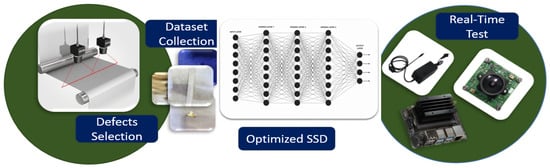
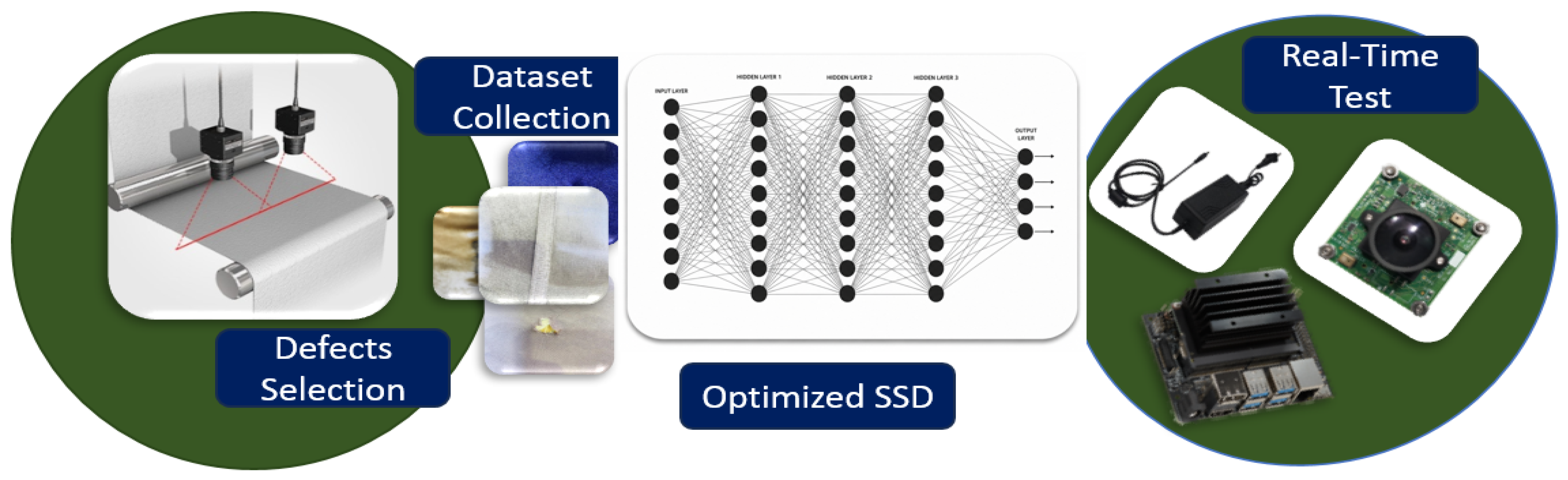
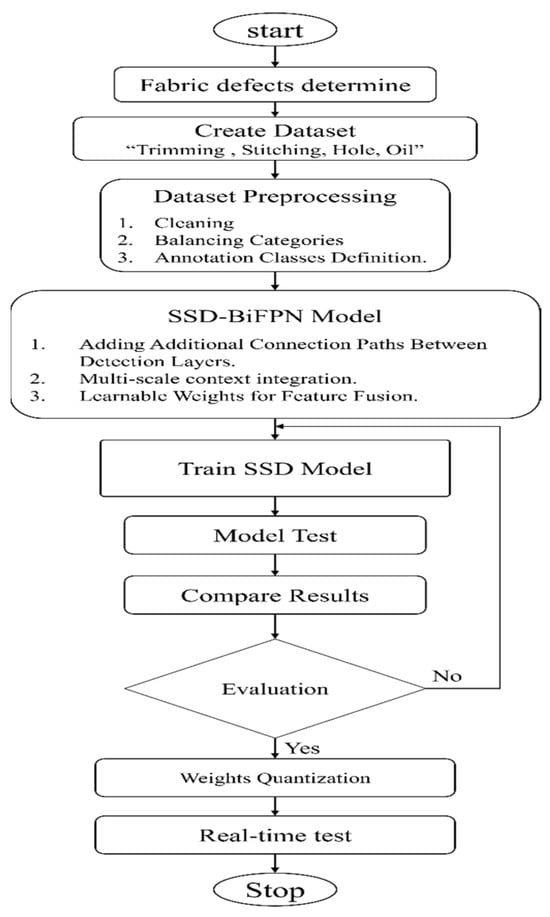
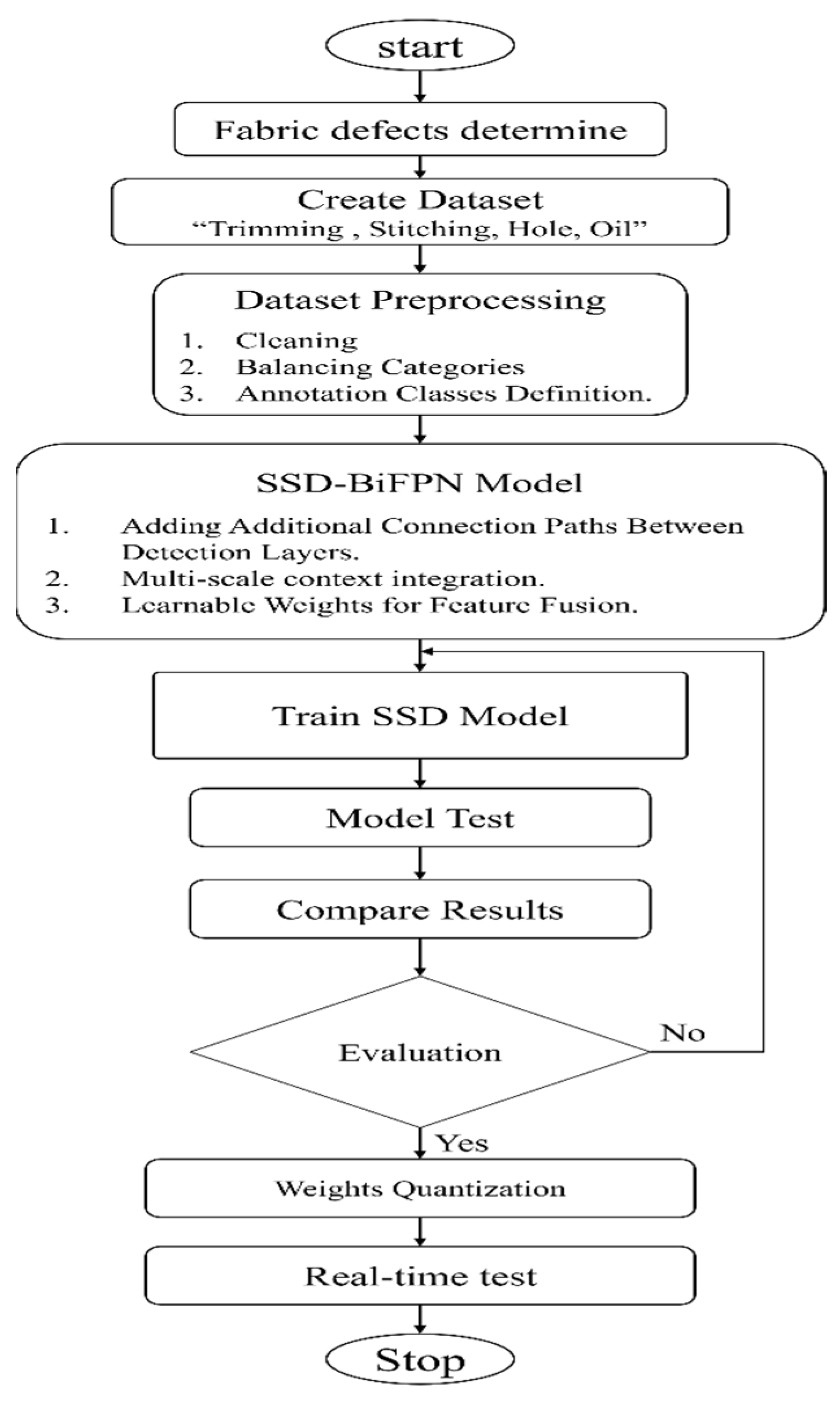
The organization of the paper is as follows. Section 1 introduces the study and provides an overview of the research problem. Section 3 presents a review study, while Section 3 presents the methodology and details the study resources and improvements. Section 4 presents the results, including a comparison with state-of-the-art models and a discussion. Section 5 provides a conclusion, and discusses future directions. Figure 1 provides an overview of the proposed research stages.
Figure 1.
Proposed study stages overview.
2. Related Work
Early research in detecting fabric defects mostly used traditional machine learning and optimization-based methods. These techniques most of the time depend on hand-made features and heuristic optimization methods. For instance, competitive swarm optimization strategies have been utilized to improve the performance of defect detection. A repeated pattern detection structure based on convolutional neural networks (CNNs) was proposed in [24] to identify periodic framework in fabric images. Particle swarm optimization (PSO) combined with discrete wavelet transform features was also used to improve defect classification, achieving an accuracy of 94% [25]. Ant Colony Optimization (ACO) was used to classify defects based on color-based features in another way. It achieved 97% accuracy for five defect types and also sped up convergence [26]. Neuro-fuzzy systems have also been extensively utilized for defect detection by amalgamating fuzzy logic with neural networks, attaining superior performance in quality control tasks, yet frequently encountering significant computational complexity [27,28].
Although these traditional approaches demonstrated promising results in controlled environments, they are inherently limited by their reliance on handcrafted features and lack robustness to variations in texture, illumination, and defect patterns. These constraints have driven the shift towards deep learning-based methodologies, facilitating automatic feature extraction and enhanced generalization.
In recent years, deep learning-based object detection models have shown significant improvements in fabric defect detection performance. In particular, YOLO-based architectures have been extensively explored due to their real-time capabilities. For instance, by using an improved YOLO model incorporating attention mechanisms and advanced feature extraction techniques, the mAP ratio improved by 8.49%, to 82.92%, which contributes to reducing the economic losses caused by textile defects, in addition to overcoming the limitations of traditional manual textile detection methods [29]. Another study combined an improved YOLO-v4 model with multi-channel fusion segmentation to detect impurities in machine-harvested cotton, achieving a detection rate of 94.1% [30]. Moreover, an improved YOLO-v7-tinier model that combines a dilated spatial pyramid pooling module, a convolutional structure with an attention mechanism, as well as fast cross-stage partial merging and partial convolution, has used for fabric defect detection. The performance of the proposed model was verified, with an improved mean accuracy of 9.55% and a 10.81% decrease in coefficients compared to the traditional YO-LO-v7 model. Thus, the proposed model is effective in enhancing the low accuracy and poor performance of real-time online fabric defect detection [31].
Other studies have focused on improving small object detection performance. For example, an enhanced YOLO-v4 model incorporating anchor optimization, attention mechanisms, and improved loss functions achieved a 12% improvement in small target detection and a 3% increase in mAP [32]. Similarly, another YOLO-v4-based framework integrated clustering algorithm (e.g., DBSCAN and K-means) and multi-level feature fusion to improve robustness, achieving an mAP of 98.97% and outperforming SSD and Faster R-CNN baselines [23]. More recently, lightweight and real-time models such as Mobile-YOLO, which combines MobileNetV3, YOLO-v8n, and attention mechanisms, achieved a high accuracy (99.4%) and real-time performance (186 FPS), demonstrating the potential for industrial deployment [33].
Despite these advances, several important challenges remain. First, many existing studies focus primarily on improving detection accuracy without adequately addressing the trade-off between accuracy and computational efficiency, which is critical for real-time industrial applications. Second, although YOLO-based models achieve high performance, they often struggle with detecting small and low-contrast defects due to limitations in multi-scale feature representation. Third, most prior works rely on manual or heuristic hyperparameter tuning, which may lead to suboptimal performance and lack reproducibility. Finally, comparisons across studies are often inconsistent due to differences in datasets and evaluation protocols.
To address these limitations, the present study proposes a modified SSD-based framework enhanced with a Bidirectional Feature Pyramid Network (BiFPN) to improve multi-scale feature representation, particularly for small and low-contrast defects. In addition, a Bayesian optimization strategy is employed to systematically tune hyperparameters, improving convergence stability and detection performance. Unlike many previous studies, this work explicitly targets the balance between detection accuracy and real-time performance, making it more suitable for deployment in resource-constrained industrial environments.
3. Dataset and Methodologies
Recently, with the rapid development of artificial intelligence models, it has become necessary to develop a parallel GPU for use on edge devices. NVIDIA has developed several edge devices with varying specifications and computational resources. An optimized YOLOv5 method to improve the accuracy of fabric defect detection was applied by [34]. First, they proposed a Deep Particle Convolution (PDConv) to extract spatial features more efficiently, while reducing redundant calculations and memory access, which improves detection speed and reduces model computation. Second, to enhance the attention of spatial feature maps and channel maps and integrate information at different scales, they proposed Enhanced-BiFPN (EB) based on the BiFPN architecture. Third, they proposed an IN loss (a loss function built using Instance Normalization statistics) to improve the loss function, which contributes to improving the problem of the original IOU loss (Intersection over Union loss is a loss function commonly used in object detection and image segmentation tasks to directly measure how well a predicted region overlaps with the ground truth region) in detecting small targets and accelerating model convergence. This proposed method was used on the GuangDong TianChi fabric defect dataset, where the proposed method improved the mAP value by 3.61%. The proposed method was also used on the NEU surface defect dataset (a benchmark dataset for surface defect detection, originally developed for steel defect classification), where the mAP value reached 79.37%. Thus, the proposed model was tested by the NVIDIA Jetson TX2 embedded development board (NVIDIA Corporation, Santa Clara, CA, USA), where the detection rate reached 31 FPS. Another study proposed an enhanced EfficientDet to improve the performance of anomaly detection in endpoints. The proposed model combines the lightweight and scalable EfficientDet detection algorithm with the NVIDIA Jetson TX2 to address data latency and power consumption issues between endpoints and the cloud. Moreover, with TensorRT (an inference optimization framework developed by NVIDIA for deploying deep learning models efficiently on GPUs), which accelerates detection speed, the proposed model’s performance was evaluated on five texture datasets on an NVIDIA Jetson TX2 edge device. The results showed that the detection speed increased by 22.7 FPS and that latency was reduced by 2.5 times compared to edge-based detection models [35].
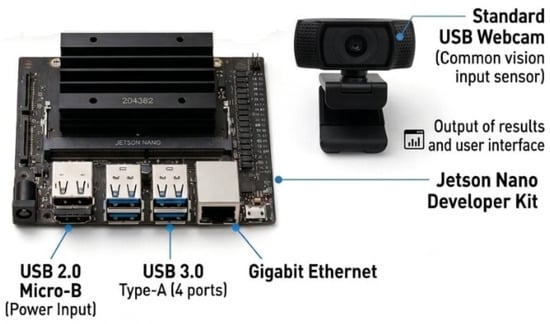
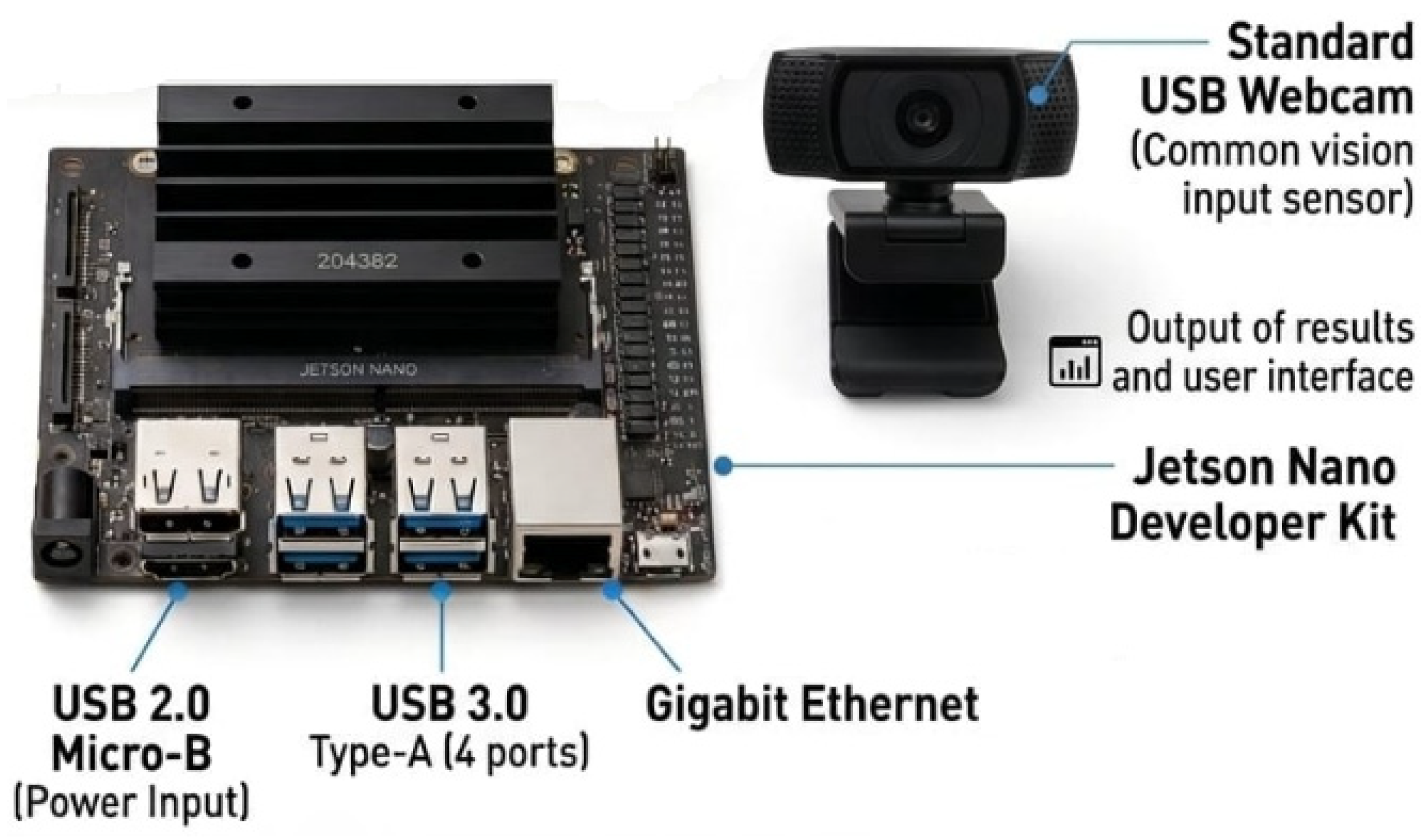
One of the first and least resource-intensive devices is the Jetson Nano developer kit (NVIDIA Corporation, Santa Clara, CA, USA) which is based on 128 Maxwell CUDA cores. The Jetson Nano operates on a power supply of 5 or 10 watts, depending on the user’s needs and applications. However, it is considered very resource-intensive compared to its peers. However, it is also considered a benchmark for measuring and implementing computer vision models and tasks. Due to its low use of computational resources, it is a good measure of the computational cost of computer vision tasks and models. In contrast, a camera with a maximum resolution of 1080 p (1920 × 1080 pixels) was also used in this study to test the proposed model. Figure 2 illustrates the hardware used to test the proposed model in real time.
Figure 2.
Hardware setup used for the SSD-BiFPN model.
Several datasets on fabric defects have been developed by previous researchers. The KTH-TIPS dataset, the first version of which was compiled in 2004, consisted of ten defect types across 357 images at 200 × 200 resolution. It was further developed in 2006 to include 11 defect types, with the addition of another defect type [36]. In 2013, the HKUFabric dataset was developed with 250 images at 256 × 256 resolution, including six defect types [37]. The TianchiAI dataset was developed in 2018, containing 1000 images at 513 × 513 resolution, comprising 15 defect types [38]. The ZJU-Leaper dataset was developed in 2020, with 98,777 images comprising 19 defect types [39]. The TILDA dataset was developed in 2021, with 896 images at 416 × 416 resolution, including four defect types [40]. In 2022, the YDFID dataset was developed with 3830 images at 512 × 512 × 3 resolution and 19 defect types [41]. Newer datasets developed in 2024 include the Lusitano dataset [42], with 36,000 images at 4096 × 1024 resolution and 35 defect types, and the FD_Dataset [43], with 720 images at 640 × 640 resolution and 4 defect types.
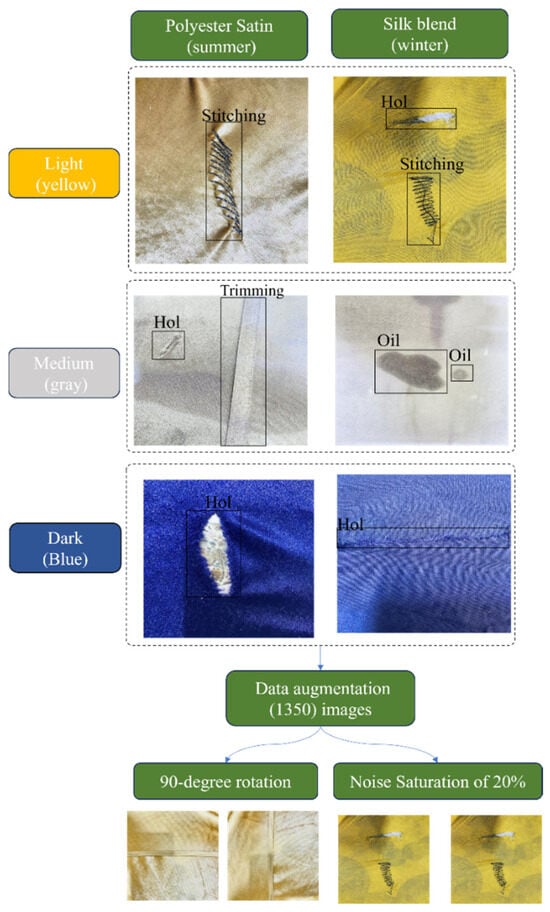
The dataset used in this study consists of two distinct fabric types selected to represent different industrial textile characteristics: (1) a polyester satin fabric typically used in lightweight summer garments, and (2) a silk-blend fabric commonly used in winter textiles. These fabrics were intentionally selected to introduce variability in texture, reflectance, and structural properties, which directly affect defect visibility and detection complexity. The key physical and structural parameters of the fabric samples were measured, and are summarized in Table 1. These parameters include the fabric weight (GSM), thread density (PPI), fiber composition (blend ratio), weave structure, and color variations.
Table 1.
Physical and structural properties of the fabric samples used in this study.
In this study, four defect categories were selected: hole, stitching, trimming, and oil contamination. These defect types were chosen to represent a diverse set of visual and structural characteristics commonly encountered in textile inspection tasks. Specifically, hole defects represent clear structural discontinuities, stitching and trimming defects correspond to linear and edge-related irregularities, and oil contamination represents low-contrast and diffuse anomalies. The selection was also influenced by practical considerations, including dataset availability, annotation consistency, and the need to ensure a sufficient number of samples per class for reliable model training and evaluation. By focusing on a limited but representative set of defect categories, the study aims to provide a controlled evaluation of the proposed detection framework.
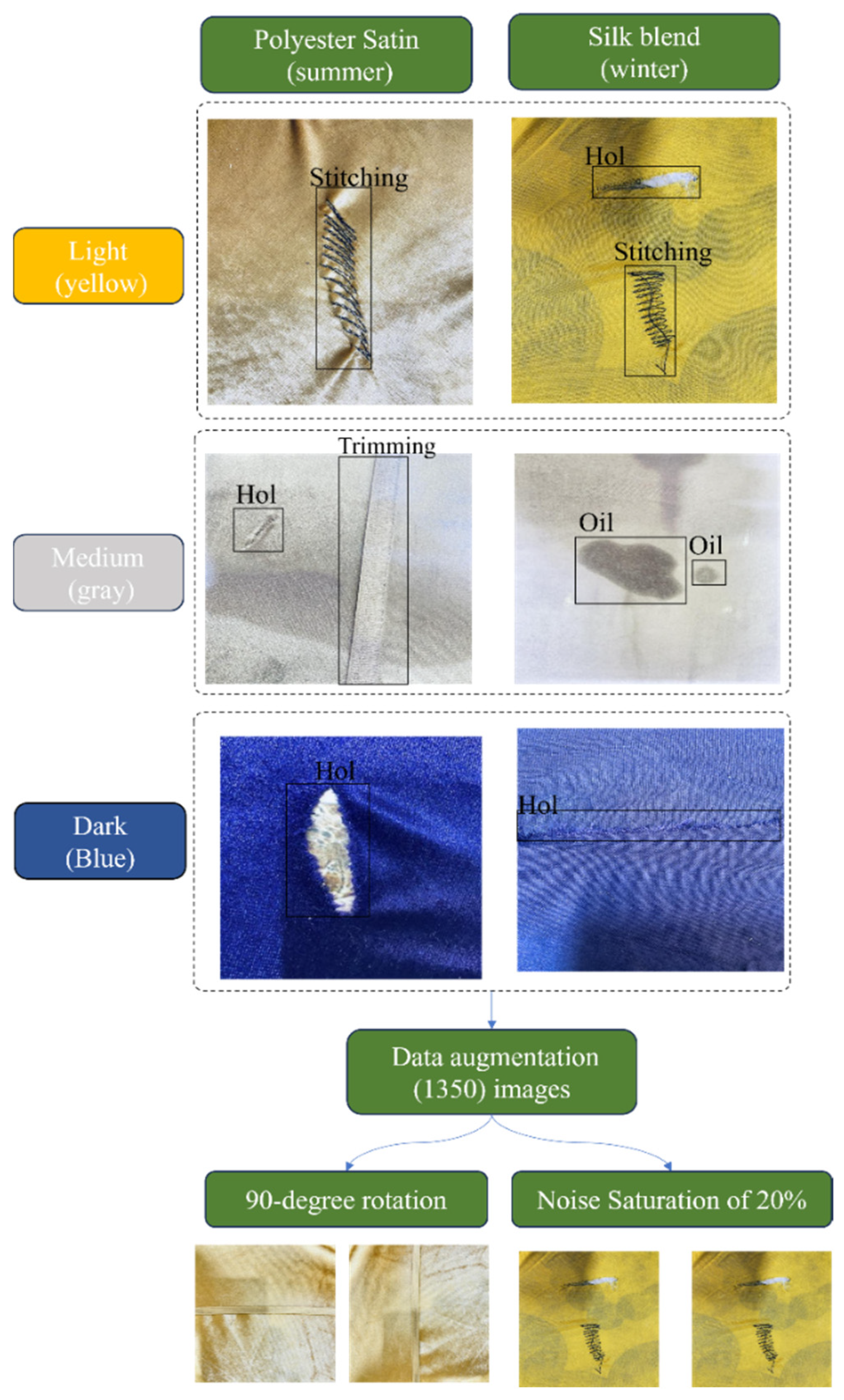
The dataset used in this study was collected under conditions that closely resemble real industrial textile production environments. Fabric samples were processed using a laboratory-scale loom system configured to simulate continuous fabric movement, similarly to standard industrial weaving operations. The loom operated at a controlled speed ranging between 250 and 300 picks per minute (PPM), which is representative of medium-speed industrial textile production. The fabric was continuously fed through the inspection area using a motorized roller mechanism to emulate real production-line dynamics. The tension of the fabric was maintained at a constant level to minimize wrinkles and ensure consistent surface appearance during image acquisition. Image acquisition was performed using a high-definition RGB camera, mounted above the fabric production line. The camera-to-fabric distance was fixed to ensure consistent spatial resolution, and images were resized to 300 × 300 pixels for model training. Illumination conditions included both uniform lighting and slight variations to simulate realistic factory environments, including shadows and brightness fluctuations. A controlled illumination setup was used, consisting of diffuse LED lighting positioned at multiple angles to reduce shadows and reflections. However, slight variations in lighting intensity were intentionally introduced to simulate realistic industrial conditions, where perfect illumination cannot always be guaranteed. All images were manually annotated using bounding boxes by domain experts familiar with textile defect inspection. To maintain the quality of annotations, they were conducted in two stages. The first stage began with one annotator completing the first draft. The second stage began when all of the annotations were reviewed by a second annotator acting independently. A consensus was formed when discrepancies were found. This process ensured consistency of the annotating. The reliability of the ground truth was increased and the noise of the annotations was decreased. This was also the reason for the analysis of the dataset, which confirmed a relatively consistent allocation of all the classes of defect. A slight imbalance in the ground truth dataset was found in the oil class of defect due to the class’s low natural occurrence, and consequently higher underrepresentation. To resolve this data imbalance and to reduce the risk of a biased model, the gaps in class membership were constrained by implementing data augmentation. Geometric transformations were applied to sample original images with a 90-degree rotation, and image noise was added to represent sample images under sensor and/or scene lighting. Data augmentation was only applied after splitting to ensure a given augmented image would only be assigned to the determined dataset subset. This process was applied until the dataset contained 1380 images post augmentation. As indicated in Figure 3, the dataset exhibited no image leakage, and the integrity of the evaluation metrics was ensured by the control of multiple transformations and augmentations.
Figure 3.
Case dataset developed for the proposed study.
In industrial settings, textile materials form a continuous web, and defects may extend beyond the boundaries of a single image frame. To address this, a sliding-window inference strategy with overlapping regions was adopted during testing. This ensures that defects located at image borders are fully captured in at least one inference window. Moreover, the overlap between adjacent frames enables the detection of elongated or partially visible defects that span multiple image segments. This approach improves robustness and makes the proposed method more suitable for real-time deployment in continuous inspection systems. In practical textile inspection systems, the imaging process is closely coupled with the mechanical motion of the fabric. As the fabric moves along the production line, the relative velocity between the camera and the textile surface can introduce motion blur, particularly when exposure time is not sufficiently short. To mitigate this effect, the acquisition setup in this study employs short exposure times in conjunction with high-intensity diffuse illumination, ensuring that motion blur is minimized even under continuous fabric movement. Consequently, the captured dataset reflects realistic yet controlled imaging conditions representative of industrial environments.
4. Optimized Model
The SSD model is a single-stage object detection algorithm that relies on a trade-off between accuracy and computational cost. For this reason, it has found widespread acceptance in computer vision. The SSD model was developed with two input resolutions: a 300 × 300 input and a 512 × 512 input, also for pretraining 07, 07 + 12, and 07 + 12 + COCO (a large-scale dataset for object detection, segmentation, and captioning, containing images of everyday scenes with richly annotated objects). This study focuses on the baseline SSD300 with pretraining 07 [44]. Several backbone classification models have been developed for SSD models, the most popular of which are VGG16 (a deep convolutional neural network consisting of 16 layers, known for its simple and uniform architecture using stacked 3 × 3 convolutional filters), MobileNet (a lightweight convolutional neural network designed for efficient image recognition on mobile and embedded devices using depthwise separable convolutions), and ResNet (residual connections that enable the training of very deep networks by mitigating the vanishing gradient problem). In SSD, object detection is performed using a multi-scale approach that leverages multiple feature maps of varying resolutions. Each of these maps is processed using a set of predefined virtual bounding boxes (also known as priors) with multiple aspect ratios and scales to accommodate objects of different shapes and sizes. To extract useful predictions, SSD applies a small set of convolutional filters to each spatial location in the feature maps. These filters are responsible for simultaneously generating class confidence scores, which indicate the presence and class of objects, and bounding box offsets, which refine the spatial location of each predicted object. Importantly, SSD utilizes all feature maps, including those from shallower and higher-resolution layers, allowing for dense coverage of the image. The feature map of the original SSD model is based on a feature pyramid (multi-scale feature maps), which is a simple bounding boxing strategy that limits the localization accuracy. For this reason, this study improves the feature pyramid by replacing it with Bidirectional Feature Pyramid Network (BiFPN), which significantly improves the performance. BiFPN introduces a multi-path fusion technique that enables rich cross-scale interactions by allowing features to flow both top-down and bottom-up [22]. The fused feature is used by combining input features from both top-down and bottom-up paths. A weighted feature fusion can be expressed as in (1):
The fusion is performed via depthwise separable convolutions, and Swish activations are typically applied post-fusion. At each feature level two parallel convolutional subnets predict object locations and class scores. Let be the number of anchor boxes per location, is the number of classes, bounding box regression is as in (2), and classification representation is as in (3):
The SSD model is trained using the Multi-box Loss as defined in (4):
where
Post-processing uses Non-Maximum Suppression to remove redundant predictions as in (5):
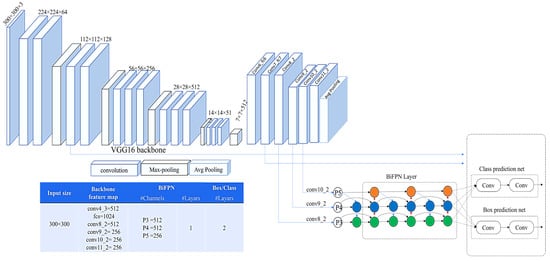
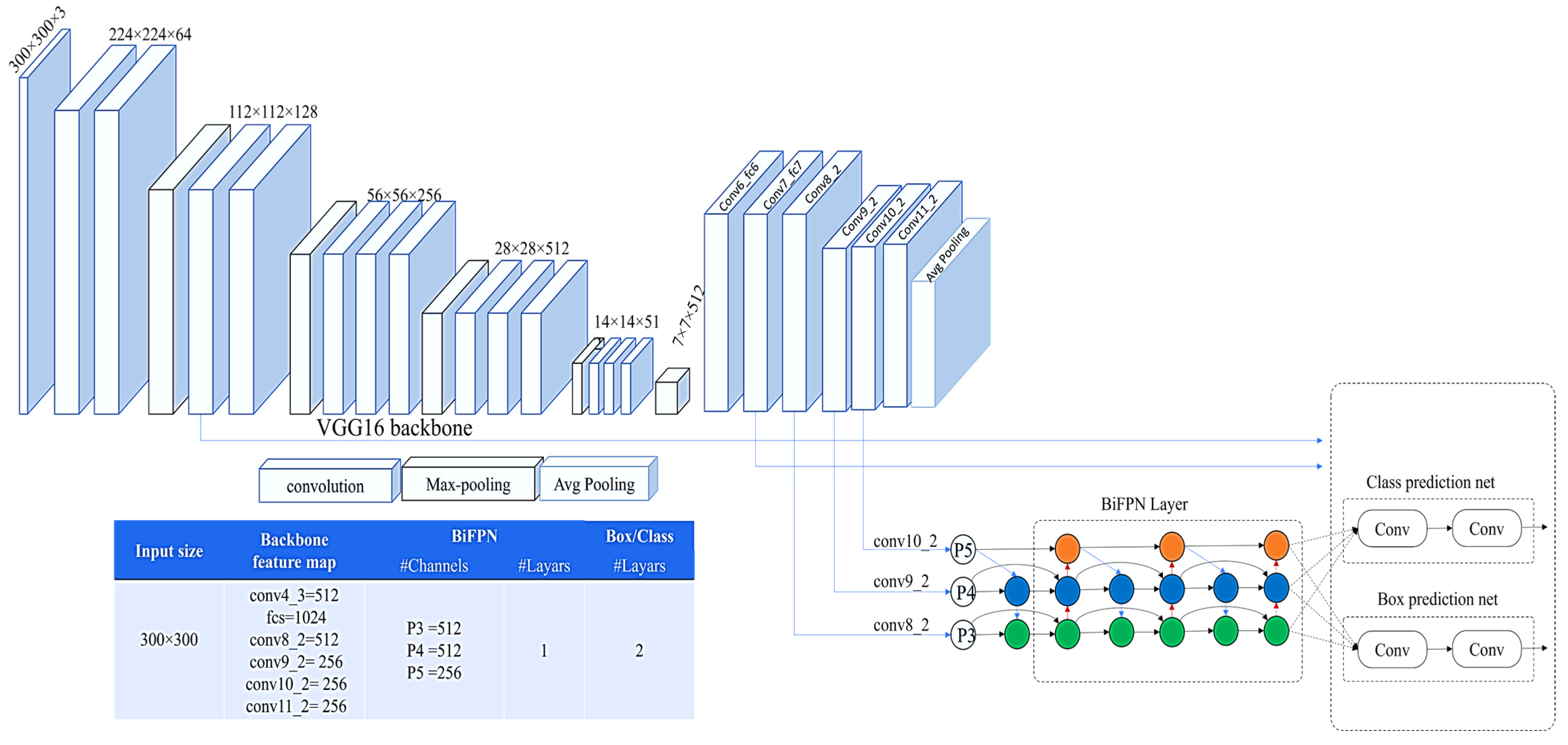
Hierarchical features are extracted from the input image using a VGG16 backbone network, which is at the core of the architecture. The input size is set at 300 × 300 pixels, which is a typical compromise between speed and resolution. The backbone is made up of a number of convolutional and pooling layers that resemble VGG. The feature maps of some intermediate layers—conv4-3, fc6, conv8-2, conv9-2, conv10-2, and conv11-2—are tapped. These layers record data at different semantic levels and receptive fields. For example, fc6 and subsequent layers carry more abstract properties that are advantageous for detecting larger items, but conv4-3 contains fine-grained spatial information appropriate for detecting small things. Figure 4 illustrates the optimized SSD layers by BiFPN.
Figure 4.
Optimized SSD architecture by BiFPN features map.
The improvements that BiFPN offers in terms of feature hierarchy improvement is bidirectional feature flow, unlike the original SSD model which has a simple forward pathway, weighted feature fusion with learnable weights, unlike the original SSD which has no feature fusion between layers. In terms of scaling, which is fixed in the original SSD, BiFPN has adaptive multi-scale feature representation and cross-scale feature flow. The intersection exceeding a union threshold of 0.50 (mAP@50) is a standard evaluation metric for object detection tasks. This metric calculates the average of the AP scores for all object classes, with a detection considered correct if the predicted selection box’s IoU value is ≥0.50 with the ground truth box of the same class as in (6), where is the number of object detection classes:
To measure the model’s complexity and capacity, the total number of parameters is calculated, as it directly affects the memory consumption during training. In addition, the model’s FLOPs are evaluated to assess its computational cost. These are important evaluation criteria in real-time applications with limited resources, as in (7) and (8), where is the number of layers, are the Kernal dimensions, are channel inputs and outputs, and is the output positions number for each layer:
The model’s processing speed for a set of images per second is measured in FPS. The higher the FPS, the faster the model, which reduces latency during execution, as in (9):
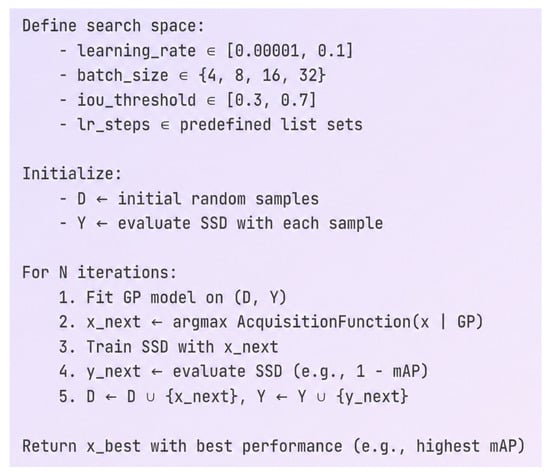
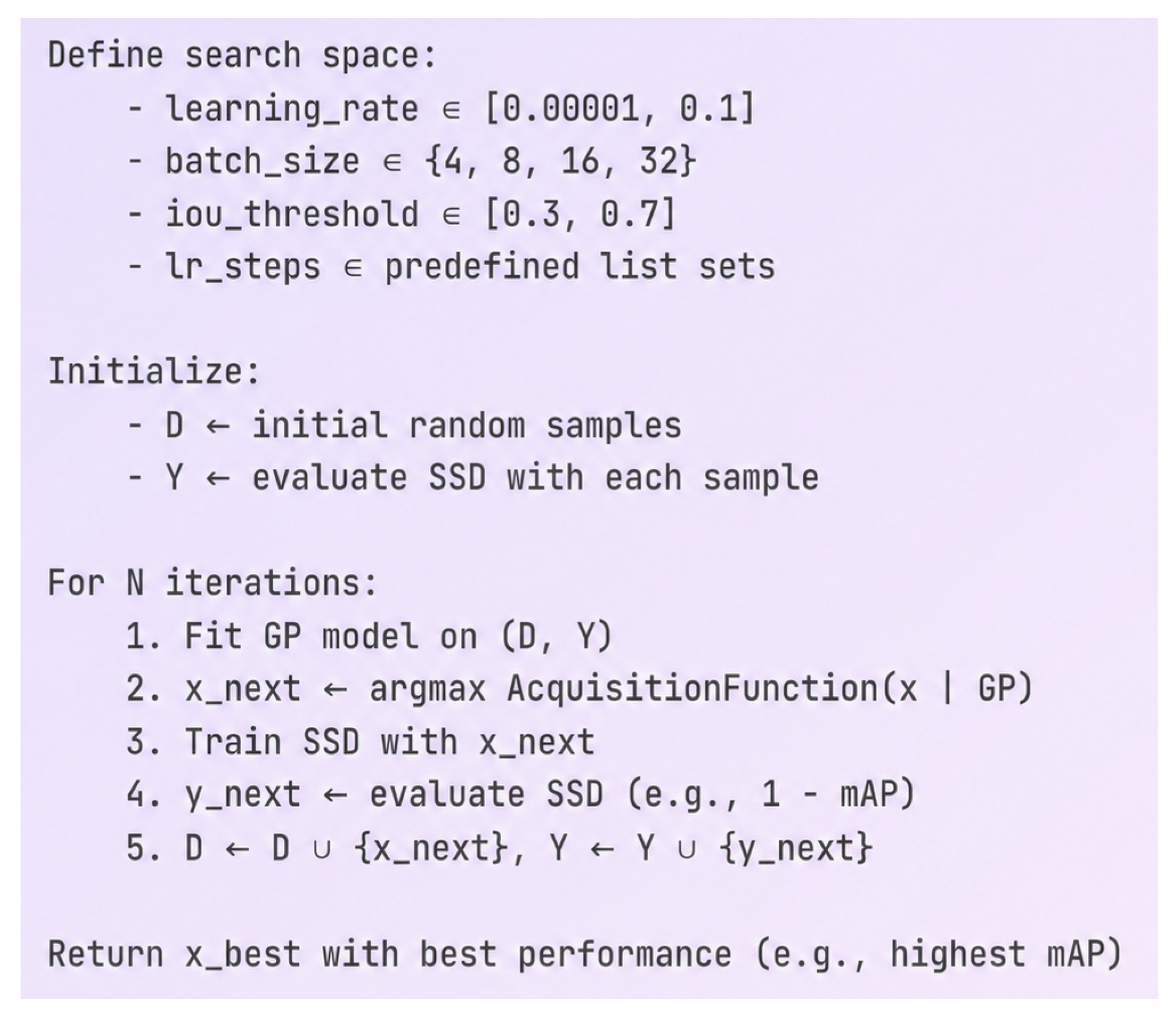
Optimizing and selecting hyperparameters is one of the most important challenges facing any computer vision model. There are several types of optimizations to find the optimal values for hyperparameters for the developed models, such as grid search, random search, and Bayesian optimization. Grid search relies on integrating all probabilities into the model, making it computationally expensive. In contrast, random search relies on random experimentation, which is successful in some simple applications, but its optimality rate is low. In this study, hyperparameter optimization was used for the developed SSD model based on Bayesian optimization. Bayesian optimization is based on the Gaussian process and measures the probability that maximizes the objective function until it reaches the optimal values, as shown in the pseudocode in Figure 5.
Figure 5.
Pseudocode for the optimized SSD hyperparameters.
5. Experimental Results
This section will discuss the method justification and results of the proposed optimization, with the discussion comparing it with previous, related studies. The SSD-BiFPN model was trained on Google Colab (Google LLC, Mountain View, CA, USA), and the weights were then uploaded to a Jetson Nano using Linux. The Jetson Nano is equipped with a 128-core NVIDIA Maxwell GPU, a quad-core ARM Cortex-A57 CPU, and 4 GB of LPDDR4 memory, providing a balance between computational capability and energy efficiency [45]. This platform is widely used for real-time computer vision and deep learning inference in resource-constrained environments due to its support for GPU-accelerated frameworks such as CUDA and TensorRT. In this study, the Jetson Nano was selected to evaluate the practical feasibility of deploying the proposed model in an edge-based industrial inspection system. The weights were then quantized, which maximizes the FPS by minimally impacting the real-time mAP50. The model was trained with hyperparameters at a learning rate of 0.001, scales [0.1, 0.2, 0.375, 0.55, 0.725, 0.9], and eight epochs. The model was trained using a rigorously defined data split protocol consisting of 80% training, 10% validation, and 10% testing sets. The split was performed at the original image level prior to augmentation to ensure strict independence between subsets. Stratified sampling was applied to maintain consistent class distributions across all subsets. All augmentation operations were applied exclusively to the training set after splitting, thereby preventing any form of data leakage. Model selection and hyperparameter tuning were conducted using the validation set, while the final performance metrics were reported on the unseen test set. Figure 6 illustrates the flowchart of proposed study with their details of hyperparameters for the case study fabric defects detection.
Figure 6.
Flowchart of fabric defects detection by SSD-BiFPN case study.
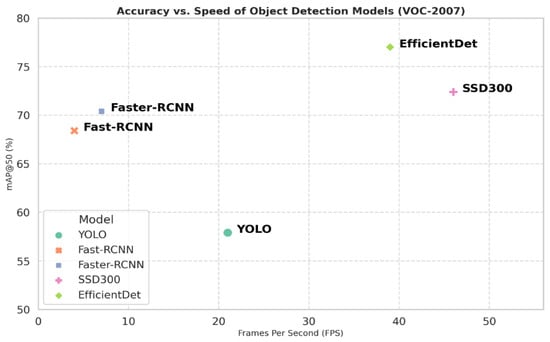
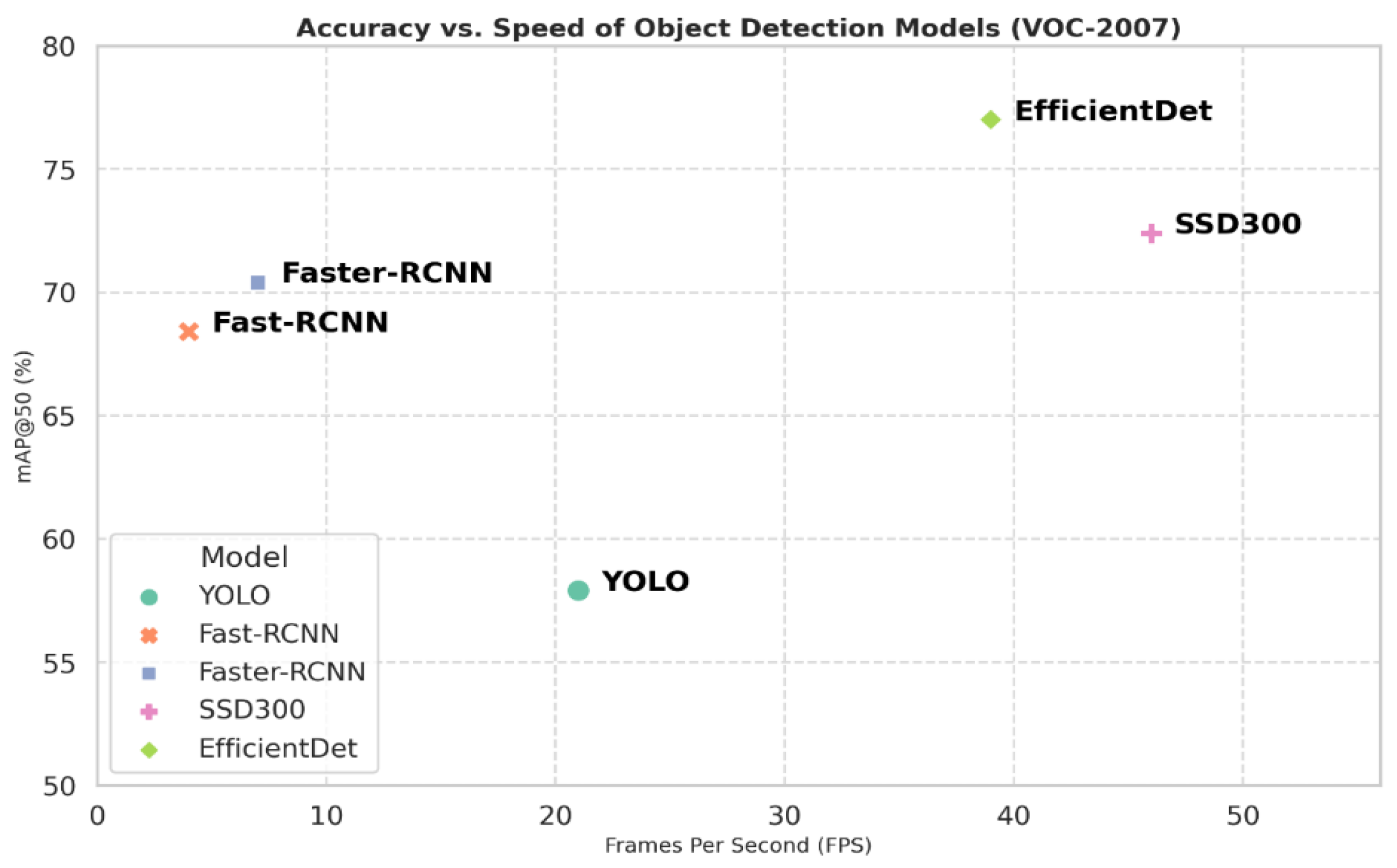
For proposed method justification in following study, several models were developed by the researchers and tested on the VOC-2007 dataset, including the YOLO, Fast-RCNN, Faster-RCNN, and EfficientDet models, to ensure their generalization and robustness. The YOLO (VGG16) model achieved an mAP50 of 57.9% with 21 FPS, while the Fast-RCNN model achieved an mAP50 of 68.4% with 3 FPS, and the Faster-RCNN model achieved an mAP50 of 70.4% with 7 FPS [44]. EfficientDet, which features a BiFPN layer for feature extraction, reached an mAP50 of 77% with 39 FPS. Figure 7 illustrates state-of-the-art object detection models based on the VOC 2007 dataset.
Figure 7.
State-of-the-art object detection comparison.
The improvements were primarily based on the dataset used in the VOC-2007 computer vision dataset, where the SSD-BiFPN model achieved a 2.3% increase in mAP50 over the traditional 300 × 300 SSD model. The mAP50 accuracy of traditional SSDs has been increased from 72.4% to 74.7%, but at the expense of the computational cost of BiFPN for feature extraction. Figure 7 illustrates the state-of-the-art methods’ comparison.
The SSD-BiFPN model was trained for fabric defect detection tasks involving holes, stitching, trimming, and oil, and the results were compared with the original SSD model. The SSD-BiFPN model achieved an mAP@50 accuracy of 86.82% across all classes, outperforming the original SSD model, which achieved an mAP@50 of 78.66%. In the oil class, the SSD-BiFPN model achieved an AP of 60.81%, compared to 57.15% for the original SSD model, a 3.66% improvement. The hole class achieved an AP of 91.74%, compared to 82.81% for the original SSD model, an 8.93% improvement. The trimming class showed significant improvements, achieving an AP of 94.74%, compared to 74.93% for the original SSD model, a 19.81% improvement. The stitching class outperformed both models in achieving a high AP. The SSD-BiFPN model achieved AP of 100%, while the original SSD model achieved 99.76%, with a slight improvement of 0.24%. Table 2 shows the mAP50 results for the models trained for fabric defect detection, along with the improvement differences.
Table 2.
Model comparisons (mAP50 of each class).
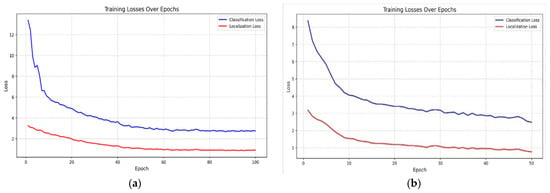
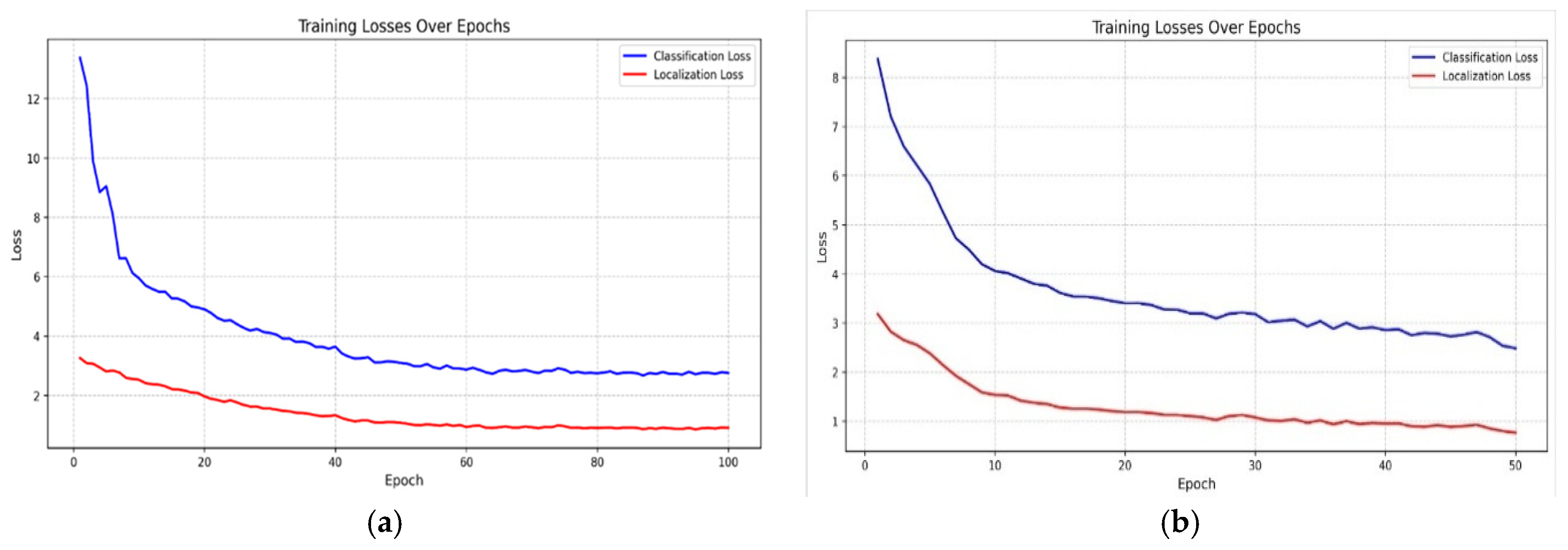
The training curves for fabric defect detection showed significant differences in the loss curves. The original SSD model showed a curvature in the initial classification loss at ~3.5 epochs and localization loss at ~13 epochs, in contrast to SSD-BiFPN, which showed a curvature in the initial classification loss at classification ~9 epochs and localization ~3 epochs, which is an important indicator of the efficient feature extraction of the SSD-BiFPN model. In the final loss formulation, the SSD-BiFPN model showed lower curves, indicating its better generalization and accuracy in fabric defect prediction tasks. The convergence of the curves for SSD-BiFPN showed superiority at ~50 epochs, while the original SSD did not reach the same result until ~100 epochs, indicating that the SSD-BiFPN model outperformed the original SSD. Figure 8 illustrates the training curves for fabric defects detection models.
Figure 8.
Training curves of fabric defects detection: (a) Original SSD. (b) SSD-BiFPN.
A more comprehensive examination of the model’s results is recommended through real-time testing. The real-time testing of the models was performed using a Jetson Nano, where the original model achieved 30.58 G of FLOPs and a total parameter of 24.15 M, achieving an FPS of 23.44 at 50% mAP accuracy. The SSD-BiFPN model achieved 30.93 G of FLOPs and a total parameter of 30.05 M, achieving an FPS of 23.16 at 50% mAP accuracy. BiFPN had a significant impact on the total parameter of the SSD model, resulting in higher memory consumption than the original SSD. In fabric defect detection applications, it is important to balance mAP50 with FPS. To improve inference efficiency on edge devices, a model quantization strategy was applied. Specifically, the trained SSD-BiFPN model was converted from 32-bit floating-point (FP32) precision to 8-bit integer (INT8) precision using TensorRT. This positively impacted the FPS metric, increasing it from 23 to approximately 30, a clear improvement. However, it negatively impacted the mAP50, decreasing it by ~2%, to 84.76%.
Instead of conducting a comprehensive and justified evaluation of the proposed SSD-BiFPN model, we generalized our practical study to include several other well-known object detection algorithms. These selections include both single-stage and two-stage detectors, including Faster R-CNN, EfficientDet-D0, and YOLOv5s.
All models were evaluated and implemented under the same experimental conditions to provide a fair comparison. For this purpose, the same dataset was applied for the training and testing of all models. The resolution of the input images was fixed at 300 × 300 pixels for all models, and the evaluation metrics were consistently computed using mAP@0.5 and FPS. Training was performed using the same hardware environment (Google Colab for training and NVIDIA Jetson Nano for inference), and hyperparameters were either adopted from original implementations or tuned using the same validation protocol. To evaluate the robustness and statistical reliability of the proposed SSD-BiFPN model, all the experiments were repeated five times using different random initialization seeds. For each run, the model was trained and evaluated under identical conditions, including the same dataset splits and hyperparameter configurations. The reported performance metrics, including mAP@50 and FPS, are presented as the mean ± standard deviation across the five runs. This provides a more comprehensive evaluation of the model’s stability and sensitivity to random initialization. Table 3 presents the computational cost results for the developed models in real time and their comparison.
Table 3.
Real-time evaluation metrics results.
The results demonstrate that the proposed SSD-BiFPN model achieves competitive performance compared to state-of-the-art methods. While Faster R-CNN achieves a slightly higher detection accuracy, it suffers from a significantly lower inference speed, making it unsuitable for real-time applications. On the other hand, lightweight models such as YOLOv5s [34] and EfficientDet [35] offer higher FPS but exhibit slightly lower detection accuracy, particularly for small and low-contrast defects. The proposed SSD-BiFPN model achieves a favorable balance between accuracy and computational efficiency. It outperforms the original SSD by a significant margin (+8.16% mAP@50) and remains competitive with modern single-stage detectors while maintaining stable performance on resource-constrained hardware. Furthermore, the quantized version of the model achieves near real-time performance (~30 FPS) with only a minor reduction in accuracy, making it particularly suitable for edge deployment scenarios. However, it has several disadvantages that can be improved and discussed, such as the 300 × 300 resolution, which is considered modest compared to previous studies and the reality of the textile industry. In addition, the accuracy needs further investigation and must increase, as some types of defects, such as oil, achieved an mAP50 of only 60%, which is a clear weakness justified by the dark colors.
6. Discussion
Most conventional fabric defect inspection systems use a combination of handcrafted features and classical classifiers. While such approaches are computationally lightweight, they are very sensitive to changes in texture, lighting, and defect size. In contrast, the proposed SSD-BiFPN model framework in this paper automatically learns hierarchical feature representations, which makes it better at generalizing across different defect patterns. The experimental results validate that the proposed model substantially exceeds conventional methods in terms of detection accuracy and robustness, especially for minor and irregular defects frequently encountered in actual industrial settings. Two-stage detectors such as Faster R-CNN have been widely adopted for defect detection. However, their region proposal mechanisms result in a lot of extra work for the computer, which makes them less useful for real-time industrial inspection. Compared to these methods, the proposed SSD-BiFPN architecture achieves a favorable trade-off between accuracy and speed. Two-stage detectors may be slightly more accurate in controlled settings, but the proposed method demonstrates significantly lower inference latency and reduced model complexity, which are critical for deployment on embedded edge devices. Single-stage detectors like the original SSD and YOLO variants work in real-time, but often have trouble with detecting small or low-contrast defects, because they do not have enough multi-scale feature representation. The proposed framework solves this problem by adding the BiFPN module, which allows for efficient bidirectional feature fusion across multiple resolution levels. The comparative results in Table 3 indicate improvements in recall and mean average precision over baseline SSD models, particularly for fine-grained defect categories, without incurring significant computational cost. Unlike many existing studies that rely on manual or grid-based hyperparameter tuning, this study utilizes Bayesian optimization to systematically identify optimal training configurations. This strategy contributes to improved convergence stability and enhanced detection performance.
Even if the SSD-BiFPN model, which we recommended, performs very well, there are some issues that we cannot ignore. First, the data that was used in this research is not that extensive and only shows four major types of defects. Secondly, the defects which are covered by the data are only the most common ones seen in the industry, so the data does not represent the whole spectrum of defect types that can be found in textile production environments on a large scale. Now, if we look one more time at the data and focus on the individual defect types, we can see that the accuracy of the detection is not the same for all the different defect categories. One of the defect classes that show the lowest performance, is “oil”. This can be attributed to several factors. For instance, oil stains have low contrast with the fabric, especially if the fabric is dark in color, and this makes it very hard to use even the most common features of convolution for separation. Next, the outlines of oil spots are usually very fuzzy and irregular, and this is a great source of confusion for both annotation and localization. Third, intra-class variability is relatively high, as oil defects can appear in different shapes, sizes, and intensity levels, further complicating the learning process. In contrast, defect classes such as “hole” and “trimming” achieve higher detection accuracy due to their more distinct structural characteristics and sharper edges, which are more effectively captured by convolutional feature extractors. Second, the dataset was collected under semi-controlled conditions with limited variation in environmental factors such as illumination, fabric motion dynamics, and sensor noise. Although augmentation techniques were applied to simulate variability, real-world deployment scenarios may involve more complex and unpredictable conditions. Third, while additional benchmarking on standard datasets supports the effectiveness of the proposed architectural improvements, such evaluations are not fully representative of fabric-specific defect detection tasks. Therefore, cross-domain generalization remains an open challenge. The SSD-BiFPN network has been trialed specifically with polyester satin and silk-blend woven fabrics. While the results have shown that the current model performs well in the tested fabric domain, there remains an unanswered develop-the-ability concern for this model in relation to other fabric structures, especially knitted fabrics. Comparatively speaking, building a model architectural structure for woven fabrics and knitted fabrics is almost meaningless due to how different woven and knitted fabrics are from each other. Woven fabrics are made from two types of yarns, the warp and the weft, woven perpendicular to each other, whereas knitted fabrics are made from loops of yarn with the same material. Loop structures make knitted fabrics highly elastic, and they are more varied and non-uniform in texture and even appear more bulky. The same structure also makes knitted fabrics more deformable under tension. However, the more deformable structure also applies to common defects in knitted fabrics like dropped stitches. Those structural defects are usually more compliant with non-meaningful non-regular visual structures, even defects in woven fabrics. These differences in woven and knitted fabrics are likely to affect a machine learning models’ woven fabric feature representation and defect detection. Even though the BiFPN component has facilitated the fusion of multi-scale features, the features that have been learned are still dependent on the statistical properties of the training data. In other words, a model that has only been trained on woven fabrics will likely suffer from a decrease in performance when it is used on knitted fabrics or other material types that it has not seen before. In terms of industrial applicability, the proposed model demonstrates promising characteristics, particularly in balancing detection accuracy and real-time performance on resource-constrained hardware. This makes it suitable for deployment in edge-based inspection systems. However, real industrial environments present significantly greater variability than the controlled conditions considered in this study. Such variability includes a broader range of fabric types, defect categories, machine speeds, lighting conditions, and environmental factors. To ensure robust industrial-scale deployment, the model would require further training on large-scale and diverse datasets that capture this variability. Additionally, techniques such as domain adaptation, transfer learning, and continual learning could be incorporated to improve generalization across different fabric structures, including knitted materials. Integrating adaptive preprocessing methods may further enhance robustness under varying production conditions.
It is important to emphasize that real-time performance in industrial textile inspection is governed by both algorithmic efficiency and imaging system constraints. While the proposed SSD-BiFPN model demonstrates competitive FPS performance at the computational level, the overall system throughput in practical deployments depends on factors such as the camera frame rate, exposure time, lighting conditions, and fabric transport speed. In particular, higher production speeds may introduce motion blur, which cannot be fully compensated for through algorithmic improvements alone. Therefore, the effective deployment of the proposed model requires a co-designed hardware–software pipeline, where illumination and acquisition parameters are carefully synchronized with the detection algorithm to maintain both image quality and detection accuracy.
7. Conclusions
This study presented an effective and pragmatic deep learning-based framework for automated fabric defect detection, targeting the significant challenges of accuracy, computational efficiency, and real-time implementation in industrial textile inspection systems. The proposed method improves multi-scale feature representation by adding a Bidirectional Feature Pyramid Network (BiFPN) to the Single Shot MultiBox Detector (SSD). This makes it easier to find small-scale and low-contrast fabric defects that are common in real-world manufacturing settings. The training and testing dataset included four defects of different colors for two fabric types, 1380 images by data augmentation. The real-time results included an 84.76% improvement in mAP50 accuracy and a 30% improvement in FPS (34%) at 300 × 300 image resolution. Future research will focus on improving the weak points such as the problem of color interference on defects, such as oil defects, as well as increasing the model’s implementation resolution and developing the system into an interpreter. A notable contribution of this work is the effective real-time deployment of the proposed model on an NVIDIA Jetson Nano platform. Unlike many existing studies that focus primarily on accuracy under high-performance computing conditions, this work explicitly considers practical deployment constraints, including inference speed and hardware limitations. However, it is important to note that these findings are based on a dataset with limited scale and defect diversity. Therefore, the conclusions should be interpreted within the context of the current experimental setup. Future work will focus on expanding the dataset to include a broader range of industrially relevant defect categories, such as slubs, mispicks, barre, and dye streaks. These defects introduce additional complexity due to their periodic, low-contrast, and texture-dependent characteristics. Incorporating such defect types will enable a more comprehensive evaluation of the proposed framework and improve its applicability to real-world textile inspection systems. Also, future research will concentrate on expanding the proposed framework to facilitate cross-fabric generalization, incorporating lightweight attention mechanisms to enhance defect localization, and on investigating multimodal inspection strategies that integrate visual data with alternative sensing modalities. In addition, large-scale deployment studies in real production environments can be explored to validate the practical applicability of the proposed framework.
Author Contributions
Conceptualization, A.M.H.A.-K., S.G. and A.A.G.; methodology, A.A.G. and A.M.H.A.-K.; validation, S.G. and A.M.H.A.-K.; formal analysis, S.G. and A.M.H.A.-K.; investigation, A.A.G., S.G. and A.M.H.A.-K.; software, S.G. and A.M.H.A.-K.; resources, A.M.H.A.-K.; data curation, A.M.H.A.-K.; writing—original draft preparation, A.A.G., S.G. and A.M.H.A.-K.; writing—review and editing, A.A.G., S.G. and A.M.H.A.-K.; supervision, A.A.G. and S.G.; and funding acquisition, A.M.H.A.-K. and S.G. All authors have read and agreed to the published version of the manuscript.
Funding
This research received no external funding.
Data Availability Statement
The datasets generated during and/or analyzed during the current study are available from the corresponding author on reasonable request.
Conflicts of Interest
The authors declare no conflicts of interest.
References
- Grau, P. Textile industry wastewaters treatment. Water Sci. Technol. 1991, 24, 97–103. [Google Scholar] [CrossRef] [Scilit]
- Shakhnoza, U.; Mirpolat, K.; Khasan, A.; Rustam, A.; Tulkin, O.; Islombek, N. Change of Quality Indicators of Fabric Fabrics. Ann. Rom. Soc. Cell Biol. 2021, 25, 2869–2874. [Google Scholar]
- Kahraman, Y.; Durmuşoğlu, A. Deep learning-based fabric defect detection: A review. Text. Res. J. 2023, 93, 1485–1503. [Google Scholar] [CrossRef] [Scilit]
- Li, C.; Li, J.; Li, Y.; He, L.; Fu, X.; Chen, J. Fabric defect detection in textile manufacturing: A survey of the state of the art. Secur. Commun. Netw. 2021, 2021, 9948808. [Google Scholar] [CrossRef] [Scilit]
- Jing, J.; Ma, H.; Zhang, H. Automatic fabric defect detection using a deep convolutional neural network. Color. Technol. 2019, 135, 213–223. [Google Scholar] [CrossRef] [Scilit]
- Li, W.; Zhang, Z.; Wang, M.; Chen, H. Fabric defect detection algorithm based on image saliency region and similarity location. Electronics 2023, 12, 1392. [Google Scholar] [CrossRef] [Scilit]
- Biradar, M.S.; Sheeparamatti, B.G.; Patil, P.M. Fabric defect detection using competitive cat swarm optimizer based RideNN and deep neuro Fuzzy network. Sens. Imaging 2022, 23, 3. [Google Scholar] [CrossRef] [Scilit]
- Thakur, R.; Panghal, D.; Jana, P.; Rajan; Prasad, A. Automated fabric inspection through convolutional neural network: An approach. Neural Comput. Appl. 2023, 35, 3805–3823. [Google Scholar] [CrossRef] [Scilit]
- Voronin, V.; Sizyakin, R.; Zhdanova, M.; Semenishchev, E.; Bezuglov, D.; Zelemskii, A. Automated visual inspection of fabric image using deep learning approach for defect detection. In Proceedings of the Automated Visual Inspection and Machine Vision IV; SPIE: Bellingham, WA, USA, 2021; pp. 174–180. [Google Scholar]
- Dang, T.; Zhao, M. The application of smart fibers and smart textiles. J. Phys. Conf. Ser. 2021, 1970, 012084. [Google Scholar] [CrossRef] [Scilit]
- Kayumov, A.; Sobirov, M.; Musayev, K. Methods of fabric defect detection using expert systems-a systematic literature review. In E3S Web of Conferences; EDP Sciences: Les Ulis, France, 2024; p. 04015. [Google Scholar]
- Çıklaçandır, F.G.Y.; Utku, S.; Özdemir, H. Determination of various fabric defects using different machine learning techniques. J. Text. Inst. 2024, 115, 733–743. [Google Scholar] [CrossRef] [Scilit]
- Liu, G.; Zheng, X. Fabric defect detection based on information entropy and frequency domain saliency. Vis. Comput. 2021, 37, 515–528. [Google Scholar] [CrossRef] [Scilit]
- Liu, Z.; Wang, M.; Li, C.; Ding, S.; Li, B. A dual-branch balance saliency model based on discriminative feature for fabric defect detection. Int. J. Cloth. Sci. Technol. 2022, 34, 451–466. [Google Scholar] [CrossRef] [Scilit]
- Yashini, P.; Karthika, G.; Sunitha, T.; Magthalin, R.B. Machine Learning-Based Textile Fabric Defect Detection Network. In Proceedings of the 2024 4th International Conference on Sustainable Expert Systems (ICSES); IEEE: New York, NY, USA, 2024; pp. 1470–1477. [Google Scholar]
- Rasheed, A.; Zafar, B.; Rasheed, A.; Ali, N.; Sajid, M.; Dar, S.H.; Habib, U.; Shehryar, T.; Mahmood, M.T. Fabric defect detection using computer vision techniques: A comprehensive review. Math. Probl. Eng. 2020, 2020, 8189403. [Google Scholar] [CrossRef] [Scilit]
- Lu, B.; Xu, D.; Huang, B. Deep-learning-based anomaly detection for lace defect inspection employing videos in production line. Adv. Eng. Inform. 2022, 51, 101471. [Google Scholar] [CrossRef] [Scilit]
- Arshad, S.R.; Shahzad, M.K. Deep learning based fabric defect detection. Res. Rep. Comput. Sci. 2024, 3, 1–11. [Google Scholar] [CrossRef] [Scilit]
- Ozek, A.; Seckin, M.; Demircioglu, P.; Bogrekci, I. Artificial intelligence driving innovation in textile defect detection. Textiles 2025, 5, 12. [Google Scholar] [CrossRef] [Scilit]
- Redmon, J.; Divvala, S.; Girshick, R.; Farhadi, A. You only look once: Unified, real-time object detection. In Proceedings of the IEEE Conference on Computer Vision and Pattern Recognition; IEEE: New York, NY, USA, 2016; pp. 779–788. [Google Scholar]
- Arwidiyarti, D. Single shot multibox detector (SSD) in object detection: A review. Int. J. Adv. Comput. Inform. 2025, 1, 118–127. [Google Scholar]
- Tan, M.; Pang, R.; Le, Q.V. Efficientdet: Scalable and efficient object detection. In Proceedings of the IEEE/CVF Conference on Computer Vision and Pattern Recognition; IEEE: New York, NY, USA, 2020; pp. 10781–10790. [Google Scholar]
- Li, Y.; Song, L.; Cai, Y.; Fang, Z.; Tang, M. Research on fabric surface defect detection algorithm based on improved Yolo_v4. Sci. Rep. 2024, 14, 5537. [Google Scholar] [CrossRef] [Scilit] [PubMed]
- Huang, Y.; Xiang, Z. RPDNet: Automatic fabric defect detection based on a convolutional neural network and repeated pattern analysis. Sensors 2022, 22, 6226. [Google Scholar] [CrossRef] [Scilit] [PubMed]
- Gnanaprakash, V.; Vanathi, P.T.; Suresh, G. Performance Analysis of Improved Particle Swarm Optimization for Fabric Defect Detection. In Proceedings of the 2021 Smart Technologies, Communication and Robotics (STCR); IEEE: New York, NY, USA, 2021; pp. 1–4. [Google Scholar]
- Xu, J.; Zhang, J.; Zhang, K.; Liu, T.; Wang, D.; Wang, X. An APF-ACO algorithm for automatic defect detection on vehicle paint. Multimed. Tools Appl. 2020, 79, 25315–25333. [Google Scholar] [CrossRef] [Scilit]
- Huang, C.-C.; Chen, I.-C. Neural-fuzzy classification for fabric defects. Text. Res. J. 2001, 71, 220–224. [Google Scholar] [CrossRef] [Scilit]
- Elragal, H.M. Neuro-fuzzy fabric defect detection and classification for knitting machine. In Proceedings of the Twenty Third National Radio Science Conference (NRSC’2006); IEEE: New York, NY, USA, 2006; pp. 1–8. [Google Scholar]
- Luo, X.; Ni, Q.; Tao, R.; Shi, Y. A lightweight detector based on attention mechanism for fabric defect detection. IEEE Access 2023, 11, 33554–33569. [Google Scholar] [CrossRef] [Scilit]
- Zhang, C.; Li, T.; Zhang, W. The detection of impurity content in machine-picked seed cotton based on image processing and improved YOLO V4. Agronomy 2021, 12, 66. [Google Scholar] [CrossRef] [Scilit]
- Yaohui, Z.; Jia, R.; Yu, L. Yolov7-tinier: Towards high-precision and lightweight detection of fabric defects in textile plant. Fibers Polym. 2024, 25, 3549–3562. [Google Scholar] [CrossRef] [Scilit]
- Yue, X.; Wang, Q.; He, L.; Li, Y.; Tang, D. Research on tiny target detection technology of fabric defects based on improved YOLO. Appl. Sci. 2022, 12, 6823. [Google Scholar] [CrossRef] [Scilit]
- Li, J.; Kang, X. Mobile-YOLO: An accurate and efficient three-stage cascaded network for online fiberglass fabric defect detection. Eng. Appl. Artif. Intell. 2024, 134, 108690. [Google Scholar] [CrossRef] [Scilit]
- Li, X.; Zhu, Y. A real-time and accurate convolutional neural network for fabric defect detection. Complex Intell. Syst. 2024, 10, 3371–3387. [Google Scholar] [CrossRef] [Scilit]
- Song, S.; Jing, J.; Huang, Y.; Shi, M. EfficientDet for fabric defect detection based on edge computing. J. Eng. Fiber Fabr. 2021, 16, 15589250211008346. [Google Scholar] [CrossRef] [Scilit]
- KTH-TIPS-I Dataset. Available online: https://www.csc.kth.se/cvap/databases/kth-tips/index.html (accessed on 22 May 2025).
- HKUFabric Dataset. Available online: https://ytngan.wordpress.com/codes/ (accessed on 22 May 2025).
- Tianchi AI Dataset. Available online: https://tianchi.aliyun.com/dataset/79336 (accessed on 22 May 2025).
- ZJU-Leaper Dataset. Available online: http://www.qaas.zju.edu.cn/zju-leaper/ (accessed on 22 May 2025).
- TILDA Dataset. Available online: https://universe.roboflow.com/irvin-andersen/tilda-fabric/dataset/2 (accessed on 22 May 2025).
- YDFID-1 Dataset. Available online: https://github.com/ZHW-AI/YDFID-1/blob/main/README_ENG.md (accessed on 22 May 2025).
- Lusitano Dataset. Available online: https://kailashhambarde.github.io/Lusitano/#dataset (accessed on 22 May 2025).
- Neamah, O.N. Fabric Defects Object Detection Dataset; Figshare: Farringdon, London, 2024. [Google Scholar] [CrossRef]
- Liu, W.; Anguelov, D.; Erhan, D.; Szegedy, C.; Reed, S.; Fu, C.Y.; Berg, A.C. Ssd: Single shot multibox detector. In Proceedings of the Computer Vision–ECCV 2016: 14th European Conference, Amsterdam, The Netherlands, 11–14 October 2016; Proceedings, Part I 14; Springer: Cham, Switzerland, 2016; pp. 21–37. [Google Scholar]
- Uzun, F.N.; Kayrici, M.; Akkuzu, B. Nvidia jetson nano development kit. In Programmable Smart Microcontroller Cards; ISRES Publishing: Konya, Türkiye, 2021; p. 82. [Google Scholar]

Disclaimer/Publisher’s Note: The statements, opinions and data contained in all publications are solely those of the individual author(s) and contributor(s) and not of MDPI and/or the editor(s). MDPI and/or the editor(s) disclaim responsibility for any injury to people or property resulting from any ideas, methods, instructions or products referred to in the content. |
© 2026 by the authors. Licensee MDPI, Basel, Switzerland. This article is an open access article distributed under the terms and conditions of the Creative Commons Attribution (CC BY) license.