


Abstract
Drought represents one of the major constraints limiting maize productivity in southeastern Europe, particularly under non-irrigated conditions. This study evaluated the effectiveness of foliar biostimulants derived from animal collagen and keratin hydrolysates in mitigating drought stress and improving maize performance in southern Romania during a six-year field experiment (2020–2025). During the screening phase (2020–2022), four formulations (FM1, FM2, KC, and K2) were applied at two rates (5 and 10 L ha−1) and compared with an untreated control. Significant effects of biostimulant formulation and dose were identified for plant height and grain yield (p < 0.001). Duncan’s multiple range test showed that K2 applied at 10 L ha−1 achieved the highest mean grain yield (87.71 q ha−1), significantly exceeding the untreated control (70.94 q ha−1). Based on these results, K2 was selected for long-term validation during 2023–2025 and subsequently evaluated across the entire six-year experimental period. Mean grain yield increased from 52.06 q ha−1 in the untreated control to 58.74 and 64.91 q ha−1 following K2 application at 5 and 10 L ha−1, respectively. Yield improvements were particularly pronounced during years characterized by severe precipitation deficits, when relative yield increases reached up to 41.9%. Economic analysis demonstrated positive net returns in all experimental years, with average profits of 108.6 EUR ha−1 and 206.9 EUR ha−1 for the 5 and 10 L ha−1 application rates, respectively. The results demonstrate that keratin-based biostimulants derived from industrial by-products can improve maize productivity, enhance drought resilience, and contribute to circular-economy approaches in sustainable agriculture.
1. Introduction
Maize (Zea mays L.) is one of the most important cereal crops worldwide, serving as a source of food, animal feed, and industrial raw materials. Global maize production exceeds 1.2 billion tons annually and continues to increase due to growing demand from the livestock, food-processing, and bioeconomy sectors. Maintaining stable maize yields is therefore essential for global food security and agricultural sustainability [1,2].
Among the abiotic stresses affecting agricultural productivity, drought is considered one of the most damaging factors [3,4,5]. Recent climate trends indicate an increasing frequency, duration, and intensity of drought events in many agricultural regions worldwide [1,5,6]. It has been estimated that drought accounts for approximately 15–30% of annual maize yield losses globally, while severe drought episodes can reduce grain production by more than 50%, depending on their timing and duration [4,7,8]. The sensitivity of maize to water deficit varies during its development, with the reproductive stages, particularly tasseling, silking, and grain filling, being the most vulnerable [9,10]. Water shortages occurring during flowering may reduce grain yield by 40–70%, whereas drought during vegetative growth can decrease biomass accumulation and limit subsequent reproductive development [9,11,12].
In Europe, climate change has intensified concerns regarding maize cultivation, particularly in southern and southeastern regions [6,9]. Recent projections indicate that increasing temperatures and reduced summer precipitation may significantly affect maize productivity during the coming decades [5,6]. Several modelling studies have predicted yield reductions ranging from 10% to 30% across southeastern Europe under moderate climate scenarios, while more severe scenarios suggest even larger losses in areas already affected by recurrent drought [6,7]. Romania is among the countries expected to experience substantial impacts due to rising temperatures, increased evapotranspiration, and declining soil moisture reserves during the growing season [13,14].
These climatic challenges have stimulated extensive research aimed at improving maize adaptation to drought conditions. Since the cultivation of genetically modified maize is highly restricted within the European Union, breeding programs have focused on the development of drought-tolerant hybrids capable of maintaining productivity under water-limited conditions [15,16,17,18,19,20,21,22]. Romanian maize breeding programs have produced several hybrids adapted to continental and semi-arid environments, including the hybrid Olt (FAO 430), which has demonstrated good tolerance to drought, high temperatures, and lodging under the pedoclimatic conditions of southern Romania [23]. Previous studies have reported stable agronomic performance of the Olt hybrid under moderate water stress, making it a suitable genetic material for evaluating complementary drought-mitigation strategies [23,24].
In parallel with genetic improvement, increasing attention has been directed toward the use of plant biostimulants. According to current European regulations, plant biostimulants are products that stimulate plant nutrition processes independently of their nutrient content, with the aim of improving nutrient-use efficiency, tolerance to abiotic stress, crop quality, or nutrient availability in the rhizosphere [25]. Among the different categories of biostimulants, protein hydrolysates derived from plant or animal materials have received considerable interest due to their high content of amino acids, peptides, and bioactive compounds [26,27,28].
Numerous studies have demonstrated that protein hydrolysates can improve plant responses to drought stress by enhancing root development, nutrient uptake, osmotic adjustment, antioxidant activity, and water-use efficiency [26,29,30,31]. Under water-deficit conditions, foliar applications of protein hydrolysates have been associated with increased chlorophyll content, improved photosynthetic performance, better maintenance of cellular hydration, and higher crop yields in several agricultural species [32,33,34,35]. Animal-derived protein hydrolysates obtained from collagen and keratin residues are particularly attractive because they combine agronomic benefits with the principles of circular economy through the valorisation of industrial by-products from the leather and food-processing sectors [36,37,38]. Their agricultural utilization contributes simultaneously to waste valorization, resource efficiency, and sustainable crop production.
Collagen and keratin hydrolysates contain readily available organic nitrogen, that can contribute to plant nutrition and stress tolerance [39,40,41]. In addition, these compounds may form protective films on plant surfaces and stimulate physiological processes associated with adaptation to environmental stress [29,42]. Their use therefore represents a promising strategy for improving crop resilience under increasingly frequent drought conditions while simultaneously reducing waste streams from industrial activities [37,38,43].
Southern Romania represents an appropriate region for evaluating such technologies because maize production is increasingly constrained by recurrent drought and because more than 90% of the cultivated area remains non-irrigated [13,14]. Under these conditions, identifying sustainable approaches capable of maintaining plant growth and productivity is of considerable agronomic importance.
Despite the growing body of literature on plant biostimulants, relatively limited information is available regarding the long-term field performance of animal-derived collagen and keratin hydrolysates under naturally occurring drought conditions. Most published studies have been conducted under controlled environments or over one to two growing seasons. Consequently, further field validation is required to assess the consistency of biostimulant responses across contrasting climatic conditions. Furthermore, information regarding the agronomic and economic performance of animal-derived biostimulants under long-term field conditions remains scarce, particularly in drought-prone regions of southeastern Europe.
The objective of this study was to evaluate, under six consecutive growing seasons (2020–2025), the effectiveness of foliar biostimulants derived from animal collagen and keratin hydrolysates in mitigating drought stress and improving maize growth and productivity under non-irrigated conditions in southern Romania.
Few studies have evaluated animal-derived collagen and keratin hydrolysates under six consecutive years of field conditions. The study combines agronomic, statistical, climatic, and economic analyses, providing a comprehensive long-term assessment of biostimulant performance under naturally occurring drought stress.
2. Results
2.1. Effect of Biostimulants on Maize Growth and Productivity
2.1.1. Raw Data on Plant Heights and Yields
Table 1 summarizes plant height measured after the first (Height I) and second (Height II) foliar applications, together with grain yield, during the experimental period (2020–2025). Substantial variability in plant height and grain yield was observed among experimental years, biostimulant formulations, and application doses.
Table 1.
Plant height after the first (Height I) and second (Height II) foliar applications and grain yield of maize treated with animal-derived biostimulants during the experimental period (2020–2025).
Across the screening phase (2020–2022), grain yield ranged from 52.23 to 111.61 q ha−1, reflecting both treatment effects and contrasting climatic conditions. During the validation phase (2023–2025), K2-treated variants consistently recorded greater plant height and grain yield values than the untreated control.
2.1.2. Comparative Evaluation of Selected Biostimulants During 2020–2022
The effects of year, biostimulant formulation, and dose on maize growth and productivity during the screening phase were evaluated using three-factor ANOVA (Table 2).
Table 2.
Three-factor ANOVA for the effects of year (Y), biostimulant and dose (D) on maize plant height and grain yield during the 2020–2022 screening phase, calculated for the treated formulations only (FM1, FM2, K2 and KC).
Three-factor ANOVA revealed a highly significant effect of year on all measured variables (p < 0.001). Biostimulant formulation significantly influenced Height II and grain yield, whereas application dose significantly affected Height II and grain yield. None of the interaction terms were statistically significant, indicating that treatment responses were generally consistent across years. Coefficients of variation ranged from 4.02% to 7.58%.
2.1.3. Comparison of Treatments with the Untreated Control (2020–2022)
To compare all treatment–dose combinations with the untreated control, the data were analyzed using year and treatment–dose combination as fixed factors (Table 3).
Table 3.
ANOVA for the effects of year (Y), biostimulant-dose and their interaction on maize plant height and grain yield during 2020–2022, including the untreated control.
Year significantly affected Height I, Height II, and grain yield (p < 0.001). Treatment–dose combination also significantly affected all measured variables, with F-values of 3.111 for Height I, 9.639 for Height II, and 21.196 for grain yield. No significant interaction between year and treatment–dose combination was detected.
Because significant differences were identified for grain yield, Duncan’s multiple range test was applied to separate treatment means (Table 4).
Table 4.
Mean maize yield (q ha−1) and Duncan grouping for treatment-dose combinations during 2020–2022.
Duncan’s test separated the evaluated treatments into five statistical groups. K2 applied at 10 L ha−1 achieved the highest mean grain yield (87.71 q ha−1), followed by KC at 10 L ha−1 (85.64 q ha−1). Both treatments were assigned to the highest Duncan group (a). The untreated control produced the lowest mean yield (70.94 q ha−1) and was classified separately in group (e).
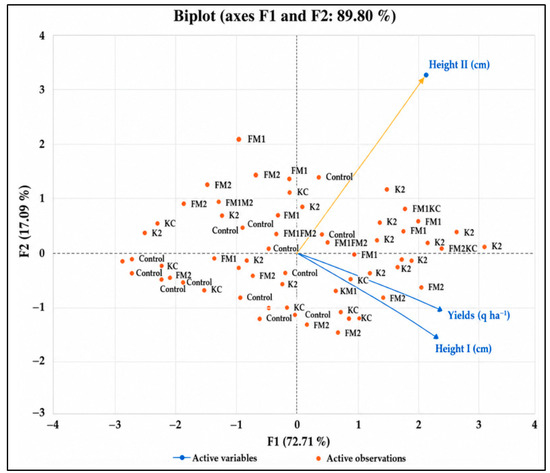
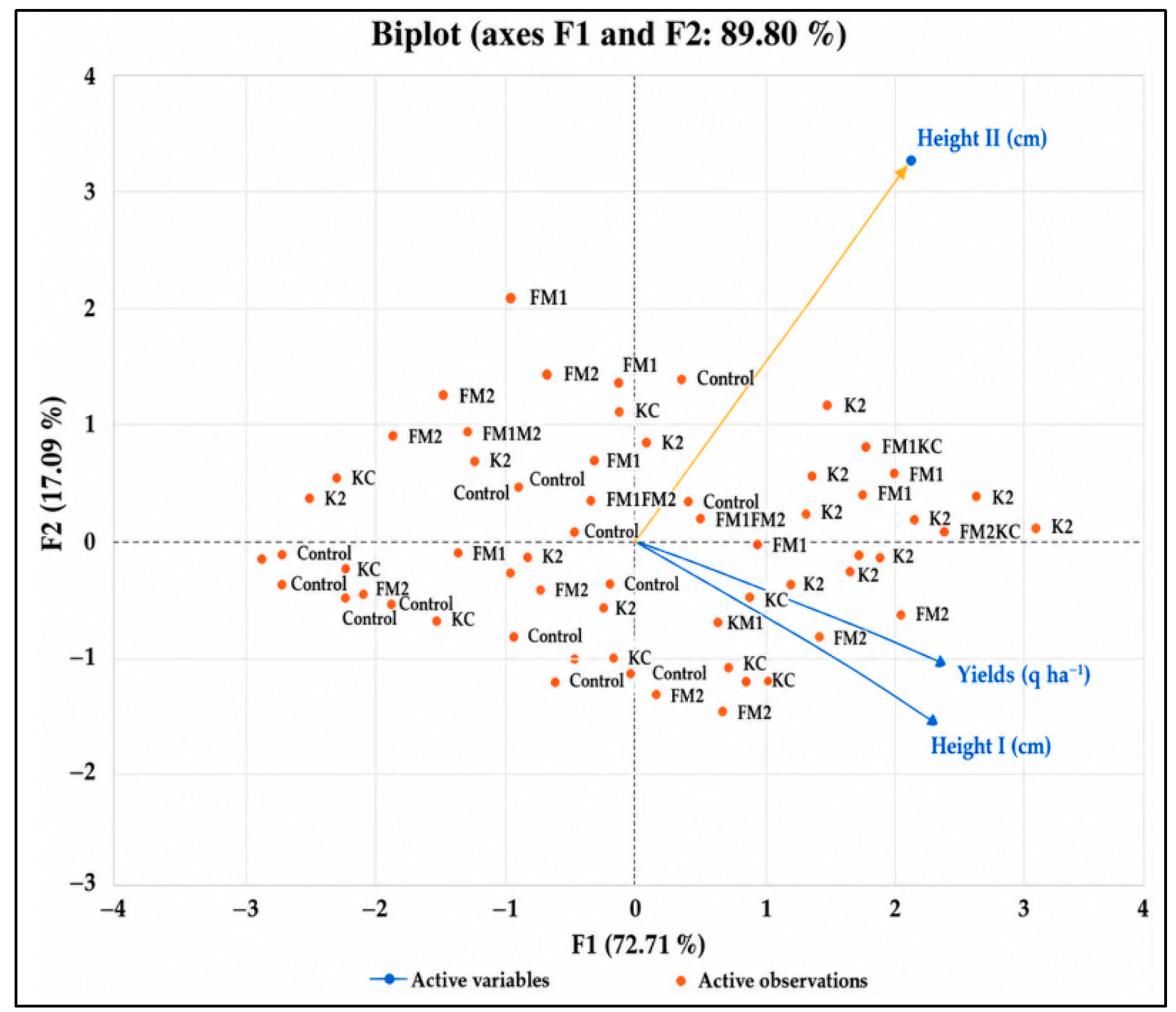
To further examine the relationships among plant height and grain yield variables, principal component analysis (PCA) was performed (Figure 1).
Figure 1.
Principal Component Analysis (PCA) biplot illustrating the multivariate relationships among plant height after the first foliar application (Height I), plant height after the second foliar application (Height II), and grain yield of maize under different animal-derived biostimulant treatments (FM1, FM2, KC, K2, and untreated control) during the 2020–2022 screening phase. The blue vectors correspond to variables showing a similar orientation within the PCA space (Height I and grain yield), whereas the yellow vector distinguishes Height II because of its different orientation along the second principal component. Orange points represent the experimental observations.
The first principal component (F1) accounted for 72.71% of the total variance and was primarily associated with variation in plant growth and productivity. The second principal component (F2) explained an additional 17.09% of the variance. Together, the two components explained 89.80% of the total variability. Height I and Height II showed similar vector orientations, indicating a positive association between the two measurements, whereas grain yield occupied a distinct position within the ordination space. Treatment observations were distributed according to their respective responses for the measured variables.
2.1.4. Validation of K2 During the Experimental Period (2020–2025)
The K2 formulation was subsequently evaluated over the entire six-year experimental period using year and dose as experimental factors (Table 5). Year significantly affected Height II and grain yield (p < 0.001), whereas dose significantly affected Height I, Height II, and grain yield. No significant interaction between year and dose was detected.
Table 5.
Two-factor ANOVA for the effects of year and K2 dose on maize plant height and grain yield during 2020–2025.
Year significantly affected Height II and grain yield, whereas K2 dose significantly influenced all measured variables. No significant year × dose interaction was detected.
Mean grain yield differed significantly among K2 dose levels (Table 6). Mean grain yield increased progressively with K2 application rate. The 10 L ha−1 treatment produced the highest mean yield (64.91 q ha−1), followed by the 5 L ha−1 treatment (58.74 q ha−1), while the untreated control recorded 52.06 q ha−1.
Table 6.
Mean maize grain yield and Duncan grouping for K2 doses during the validation period (2020–2025).
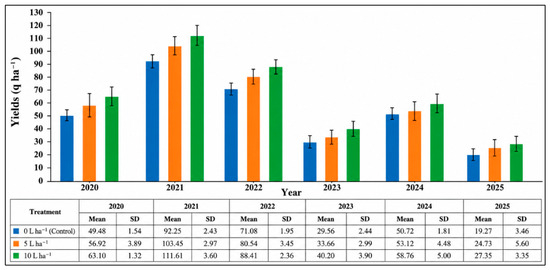
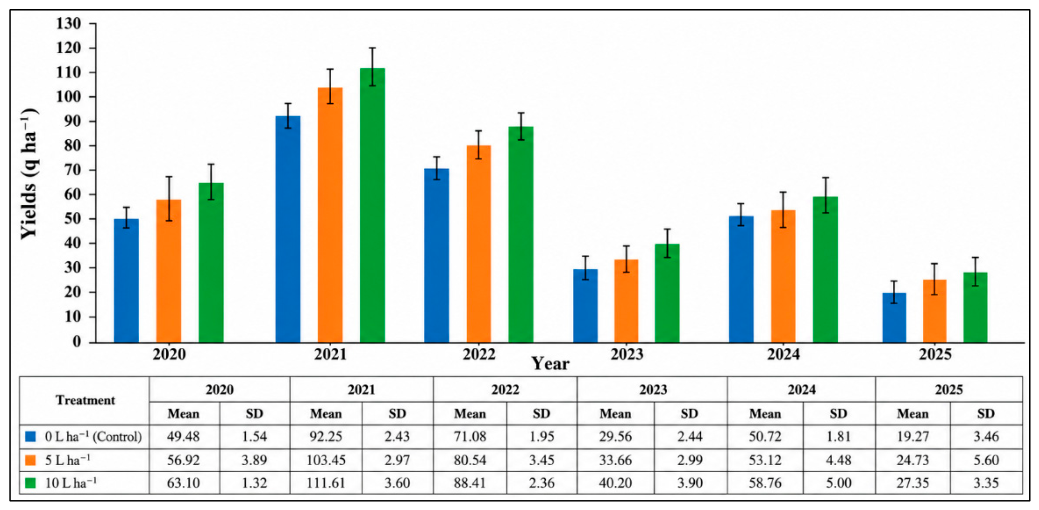
The temporal grain-yield response of maize to K2 application during the six-year experimental period is presented in Figure 2.
Figure 2.
Mean grain yield response of maize to K2 biostimulant application during the six-year validation period (2020–2025) under field conditions. Bars represent mean grain yield (q ha−1), while error bars indicate standard deviation (SD) calculated from three field replicates. Control = untreated plants; K2 was applied at 5 and 10 L ha−1.
Grain yield ranged from 19.27 q ha−1 in 2025 to 111.61 q ha−1 in 2021. In each experimental year, both K2 application rates recorded higher grain yield values than the untreated control.
2.2. Relationship Between Climatic Conditions, Plant Height and Yield Response
2.2.1. Climatic Conditions During the Experimental Period (2020–2025)
Monthly air temperature data recorded during the study period are presented in Table 7. Growing-season mean temperature (April–September) varied from 19.0 °C in 2021 to 20.7 °C in 2020.
Table 7.
Monthly air temperature and precipitation recorded during the maize growing seasons (2020–2025) compared with the climatic reference period (1981–2010).
The six-year average temperature was 19.8 °C, compared with 19.1 °C for the reference period (1981–2010). Positive temperature anomalies were recorded in five of the six experimental years.
Monthly precipitation totals recorded during the experimental period are presented in Table 8.
Table 8.
Monthly precipitation and temperature patterns during the experimental period relative to the climatic normal (1981–2010).
Growing-season precipitation (April–September) ranged from 129 mm in 2025 to 285 mm in 2021. The six-year average precipitation total was 213 mm, representing a reduction of 72 mm relative to the climatic normal (285 mm) for the 1981–2010 reference period. Seasonal precipitation deficits ranged from 31 mm in 2024 to 156 mm in 2025.
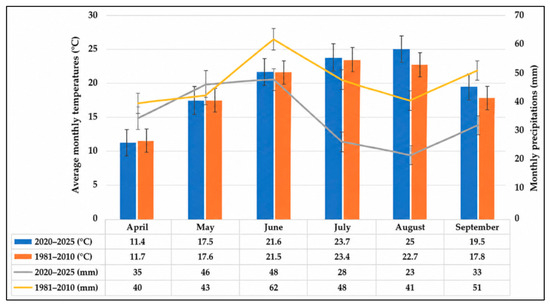
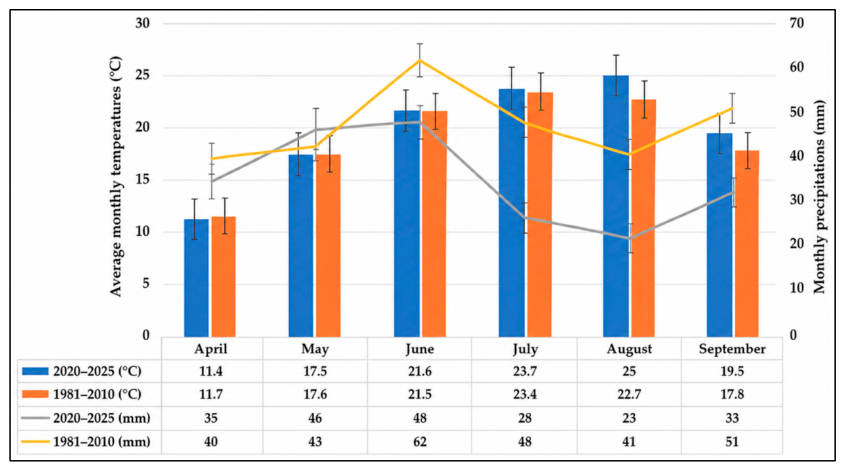
A comparative overview of growing-season temperature and precipitation patterns is presented in Figure 3.
Figure 3.
Comparative climatic profile of the experimental period (2020–2025) and the reference climatic normal (1981–2010) during the maize growing season (April–September). Bars represent average monthly temperatures, while lines indicate monthly precipitation totals. Orange symbols correspond to the experimental period (2020–2025), whereas blue and purple symbols correspond to the long-term climatic normal (1981–2010). Values represent mean monthly conditions calculated for the April–September growing season.
Compared with the 1981–2010 climatic normal, the experimental period was characterized by consistently higher growing-season temperatures and reduced precipitation totals. The greatest deviations from the climatic normal occurred during July–September, when precipitation was substantially lower than the long-term average.
2.2.2. Associations Between Climatic Conditions and Maize Development
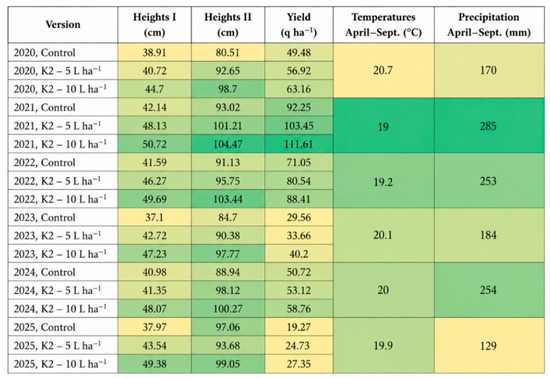
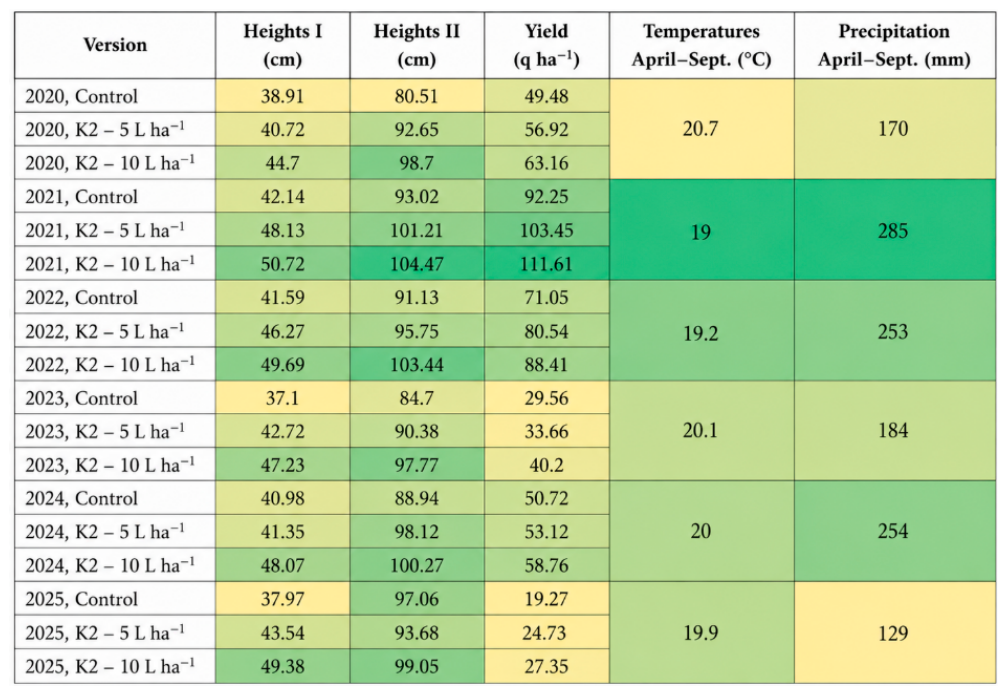
Relationships among plant height, grain yield, growing-season temperature, and precipitation are presented in Figure 4.
Figure 4.
Heat map visualization of plant height, grain yield, and growing-season climatic variables associated with K2 biostimulant treatments during the six-year experimental period (2020–2025). Color intensity reflects the relative magnitude of values within each variable column, with lighter shades indicating lower values and darker green shades indicating higher values. Height I and Height II represent plant height measured after the first and second foliar applications, respectively. Temperature and precipitation correspond to mean growing-season temperature and cumulative precipitation recorded between April and September. Colors were normalized independently for each variable to facilitate visual comparison of treatment responses and climatic conditions across years.
The heat map highlights substantial interannual variability in plant growth, grain yield, temperature, and precipitation. Across all experimental years, K2-treated variants generally displayed higher Height I, Height II, and grain yield values than the corresponding untreated controls.
2.3. Economic Evaluation of K2 Application
The economic performance of K2 application was assessed using a maize grain price of 200 EUR t−1 and a product cost of 5 EUR L−1 (Table 9).
Table 9.
Economic evaluation of K2 application during 2020–2025.
Positive net returns were recorded for both K2 application rates in all experimental years. Net profit ranged from 23.0 to 199.1 EUR ha−1 for the 5 L ha−1 treatment and from 110.8 to 337.3 EUR ha−1 for the 10 L ha−1 treatment. The highest annual net returns were recorded in 2021, while positive economic returns were maintained under all climatic conditions evaluated during the study period.
3. Discussion
3.1. Overall Effect of Animal-Derived Biostimulants on Maize Growth and Yield
The six-year field experiment demonstrated that foliar applications of animal-derived protein hydrolysates improved maize growth and grain yield under non-irrigated conditions in southern Romania. During the screening phase (2020–2022), all selected formulations produced higher grain yields than the untreated control, although the magnitude of the response differed among products and doses. Duncan’s multiple range test identified K2 applied at 10 L ha−1 and KC applied at 10 L ha−1 as the highest-performing treatments, with mean grain yields of 87.71 and 85.64 q ha−1, respectively, compared with 70.94 q ha−1 in the untreated control.
K2 was selected for long-term validation because it consistently ranked among the highest-yielding treatments during the 2020–2022 screening phase and produced significantly greater grain yield than the untreated control under all evaluated conditions.
The superior performance of K2 was confirmed during the validation phase (2020–2025). Across the entire experimental period, mean grain yield increased from 52.06 q ha−1 in the untreated control to 58.74 q ha−1 and 64.91 q ha−1 following K2 application at 5 and 10 L ha−1, respectively. Similar responses were observed for plant height after both foliar applications, indicating a consistent positive effect of the biostimulant on vegetative development and final productivity.
These findings are consistent with previous studies reporting improved crop performance following the application of protein hydrolysates rich in amino acids and bioactive peptides [26,29,30,32,33]. Comparable increases in biomass production, nutrient-use efficiency, and grain yield have been reported in maize and other field crops exposed to environmental stress [29,30,32,33,34,35,45].
3.2. Influence of Climatic Conditions and Drought Stress
The climatic characterization of the experimental period revealed substantial interannual variability in temperature and precipitation. Growing-season precipitation ranged from 129 mm in 2025 to 285 mm in 2021, while the six-year average precipitation total was 213 mm, which was 25.3% lower than the climatic normal of 285 mm recorded for the 1981–2010 reference period. At the same time, growing-season temperatures were generally higher than the long-term average, confirming the occurrence of recurrent drought stress during the study period.
The strongest yield responses to K2 were observed during years characterized by severe water deficit. Relative yield increases of the 10 L ha−1 treatment reached 27.6% in 2020, 36.0% in 2023, and 41.9% in 2025. In contrast, smaller relative responses were observed in years with more favorable precipitation conditions. These results indicate that the effectiveness of K2 was maintained across contrasting environmental conditions and tended to increase under stronger drought pressure.
Previous studies have reported similar behavior for protein hydrolysates, which often produce larger agronomic responses under stress conditions than under optimal environments [29,30,31,45]. The present findings therefore support the potential role of animal-derived biostimulants as complementary tools for improving maize resilience under increasingly variable climatic conditions.
3.3. Possible Mechanisms Responsible for the Observed Effects
The mechanisms responsible for the positive effects of protein hydrolysates on crop performance have been extensively discussed in previous studies [26,29,39,40]. Under field conditions, these products have been associated with improvements in plant growth, nutrient acquisition, and tolerance to abiotic stress, including drought [26,29,30,31].
In the present study, foliar application of the K2 formulation consistently increased plant height and grain yield relative to the untreated control throughout the experimental period. The absence of significant year × dose interactions indicates that the positive response was maintained across years characterized by contrasting climatic conditions, including substantial differences in growing-season precipitation and temperature.
Because the present research focused primarily on agronomic performance under field conditions, no physiological or biochemical measurements were conducted. Consequently, the mechanisms responsible for the observed responses cannot be identified directly from the current dataset. The improved growth and productivity observed following K2 application may reflect the combined effects of enhanced plant vigor and improved adaptation to environmental stress, as previously reported for protein-based biostimulants [26,29,30,31].
The results therefore provide evidence that animal-derived protein hydrolysates can improve maize performance under non-irrigated conditions in drought-prone environments. However, further research incorporating physiological and biochemical measurements would be required to clarify the processes underlying these responses and to determine how such products influence plant functioning under water-limited conditions [29,30,31,39,40].
3.4. Comparison Among the Tested Formulations
The screening phase demonstrated clear differences among the tested formulations. Although all selected products improved maize productivity relative to the untreated control, K2 consistently produced the highest agronomic response. During 2020–2022, K2 applied at 10 L ha−1 recorded the highest mean grain yield among all evaluated treatments and remained the best-performing formulation during the subsequent validation phase.
The differences observed among formulations may be related to variations in protein source, peptide composition, hydrolysis technology, and physicochemical characteristics. FM1 and FM2 were collagen-based products characterized by high protein concentrations, whereas K2 was obtained from keratin-rich wool residues.
Even if the physiological mechanisms responsible for the observed responses were not investigated directly, previous studies have reported that protein hydrolysates may improve nutrient acquisition, plant growth, and tolerance to abiotic stress. The higher grain yields observed in the present study are consistent with these previously reported effects, although additional physiological investigations are required to clarify the mechanisms involved under field conditions [42,46,47,48,49,50].
The KC formulation, which combined collagen and keratin hydrolysates with supplementary nutrients, also produced high yields and was statistically grouped with K2 at the highest application rate during the screening phase. However, the consistently superior performance of K2 suggests that peptide composition and biological activity may play a more important role than nutrient supplementation alone in determining overall biostimulant effectiveness.
3.5. Comparison with Previous Studies
The results obtained in the present study are consistent with previous investigations reporting positive effects of protein-based biostimulants on crop growth and productivity under drought conditions. Numerous studies have demonstrated that protein hydrolysates improve plant establishment, nutrient uptake, photosynthetic performance, and stress tolerance, resulting in increased biomass accumulation and grain yield [35,51,52,53,54,55,56].
The yield increases observed in the present experiment, ranging from approximately 14% to 42% depending on year and application rate, are within the upper range of responses reported for commercial biostimulants applied to maize under water-limited conditions [45]. Similar positive effects of collagen- and keratin-derived hydrolysates have previously been reported [48,49,50], mentioning improvements in seed germination, seedling development, and maize productivity following the application of animal-derived protein formulations.
An important contribution of the present study is the duration of the field validation. While most published investigations evaluate biostimulant performance during one or two growing seasons, the current research covered six consecutive years characterized by substantial climatic variability. This long-term evaluation provides additional evidence regarding the stability of biostimulant performance under contrasting environmental conditions and reinforces the potential value of protein hydrolysates as tools for improving crop resilience under drought stress.
3.6. Economic Evaluation of Biostimulant Application
The agronomic benefits associated with K2 application were reflected in positive economic returns throughout the entire experimental period. Net profit ranged from 23.0 to 199.1 EUR ha−1 for the 5 L ha−1 treatment and from 110.8 to 337.3 EUR ha−1 for the 10 L ha−1 treatment. Average net profit across the six-year period reached 108.6 EUR ha−1 for the 5 L ha−1 dose and 206.9 EUR ha−1 for the 10 L ha−1 dose, demonstrating a clear economic advantage of the higher application rate.
The greatest economic benefits were obtained during years characterized by severe drought stress, when the relative yield increases generated by K2 were largest. This observation suggests that the economic value of biostimulant application may increase as environmental conditions become less favorable and yield losses associated with drought become more pronounced.
These findings are consistent with previous reports indicating that biostimulants can contribute not only to improved crop productivity but also to increased farm profitability through enhanced tolerance to abiotic stress [30,45]. Nevertheless, the economic performance of biostimulants remains influenced by crop market prices, product costs, and annual climatic variability. Consequently, profitability should be evaluated within the specific agronomic and economic conditions of each production system.
3.7. Innovation, Practical Implications and Study Limitations
The present study provides several original contributions to the current knowledge regarding agricultural biostimulants. First, the evaluated products were obtained from collagen- and keratin-rich by-products originating from the leather and food-processing industries, demonstrating the potential agricultural valorization of materials that are traditionally considered waste streams. The research therefore contributes to the development of circular-economy approaches that combine waste recovery with sustainable agricultural production.
Second, the study compared several formulations differing in raw material origin and hydrolysis technology under identical field conditions, allowing the identification of formulation-specific responses. Among the tested products, the keratin-based formulation K2 consistently generated the highest agronomic response, increasing mean grain yield from 52.06 q ha−1 in the untreated control to 64.91 q ha−1 at the 10 L ha−1 application rate during the six-year experimental period, while also providing the highest economic return.
A major strength of the research is the six-year duration of the field experiment. Long-term field validations of biostimulants remain relatively uncommon, particularly under non-irrigated conditions and under naturally occurring drought stress. The inclusion of years with contrasting temperature and precipitation patterns provided a robust assessment of product performance under realistic farming conditions.
From a practical perspective, the results indicate that animal-derived protein hydrolysates may represent a useful complementary strategy for improving maize productivity in drought-prone regions. The positive economic returns observed across all experimental years further support the practical feasibility of integrating animal-derived biostimulants into commercial maize production systems.
The principal limitation of the study is the absence of direct physiological measurements capable of explaining the mechanisms responsible for the observed agronomic responses. Future research should therefore include evaluations of photosynthetic activity, water-use efficiency, nutrient dynamics, antioxidant metabolism, and root development. Additional studies involving other crops and agroecological conditions would further clarify the broader applicability of animal-derived protein hydrolysates in sustainable agricultural systems.
Beyond their agronomic and economic benefits, animal-derived protein hydrolysates contribute to resource efficiency and waste valorization by transforming industrial by-products into value-added agricultural inputs. Consequently, their adoption may support both climate-change adaptation and circular-economy objectives, contributing to the development of more sustainable and resilient cropping systems.
4. Materials and Methods
4.1. Products Tested Between 2020 and 2025
The biostimulants evaluated in this study were developed through a collaborative research programme between the Research and Development National Institute for Textiles and Leather (INCDTP-ICPI, Bucharest, Romania) and Probstdorfer Saatzucht Romania. The formulations were obtained from animal-derived by-products originating from the leather-processing and food industries and were evaluated as foliar biostimulants for maize cultivation under drought-prone conditions.
The experimental programme was conducted in two consecutive stages. During the preliminary screening phase (2020–2022), nine biostimulant formulations (FM1, FM2, C, K1, K2, K3, K4, K5 and KC) were evaluated under field conditions. Based on the agronomic results obtained during this period, formulation K2 was selected for further validation and was subsequently tested throughout the 2023–2025 experimental period (Table 10).
Table 10.
Biostimulants based on animal-derived collagen and keratin, tested on maize crops between 2020 and 2025.
4.1.1. Production Process, Characterisation and Quality Control of the Biostimulants
The experimental biostimulants were obtained through controlled hydrolysis processes designed to convert collagen and keratin proteins into soluble fractions. Collagen hydrolysates were produced from collagen-rich residues generated by the leather and food-processing industries, whereas keratin hydrolysates were obtained from sheep wool. Following hydrolysis, the resulting solutions were filtered, stabilised and conditioned to ensure the required physicochemical properties before field application.
The analytical characterisation of the formulations included determination of pH, dry matter content, total nitrogen concentration and protein content. The physicochemical characteristics of the tested products are presented in Table 11.
Table 11.
The main ingredients used in the tested biostimulants.
The analytical parameters presented in Table 11 were determined for each formulation prior to field application. The products were characterized by alkaline pH values (6.84–7.05), protein contents ranging from 7.79% to 29.29%, and nitrogen concentrations between 7.87% and 14.87%. These parameters were used as quality-control indicators to ensure batch-to-batch consistency throughout the experimental programme.
4.1.2. Regulatory Status and Safety Considerations
All formulations evaluated in this study were experimental biostimulant products developed for research purposes and tested exclusively under field conditions.
Product handling, storage and application were performed according to the recommendations established by the product developers and in compliance with standard agricultural safety practices. No phytotoxic symptoms or adverse effects on maize plants were observed during the experimental period, irrespective of formulation or application rate.
4.2. Experimental Site and Crop Management
4.2.1. Location of the Field Tests and the Pedo-Climatic Conditions
Field experiments were conducted between 2020 and 2025 at the experimental facilities of Probstdorfer Saatzucht Romania located in Calarași County (44.20° lat. N, 27.39° long. E), southern Romania.
The experimental site is located within the Bărăgan Plain, one of the most drought-prone agricultural regions of Romania. The climate is temperate-continental, characterized by hot summers, frequent rainfall deficits during the growing season, and high interannual variability in precipitation. These conditions provide a suitable environment for evaluating drought-mitigation strategies in maize production.
The soils under cultivation are classified as leached, slightly carbonated chernozems, containing approximately 23.8–25.3% clay and 3.11–3.35% organic matter. The soil is relatively permeable to water, indicating that water from precipitation is particularly important. In its absence, irrigation is necessary in order to achieve high agricultural yields.
4.2.2. Plant Material
The maize hybrid Olt (FAO 430), developed by the National Agricultural Research and Development Institute Fundulea, was used throughout the study. The hybrid was selected because of its adaptation to the pedoclimatic conditions of southern Romania and its previously reported tolerance to drought and high-temperature stress.
4.2.3. Field Experimental Design
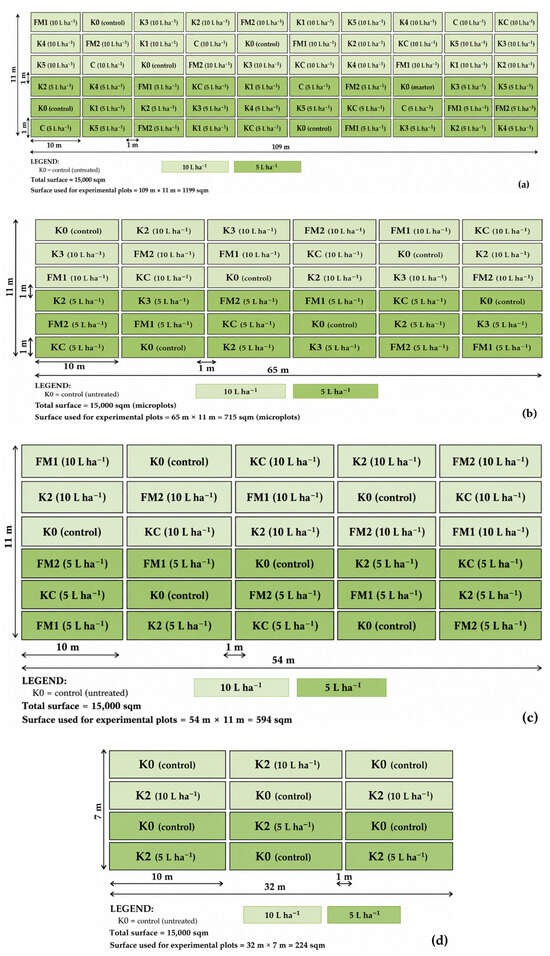
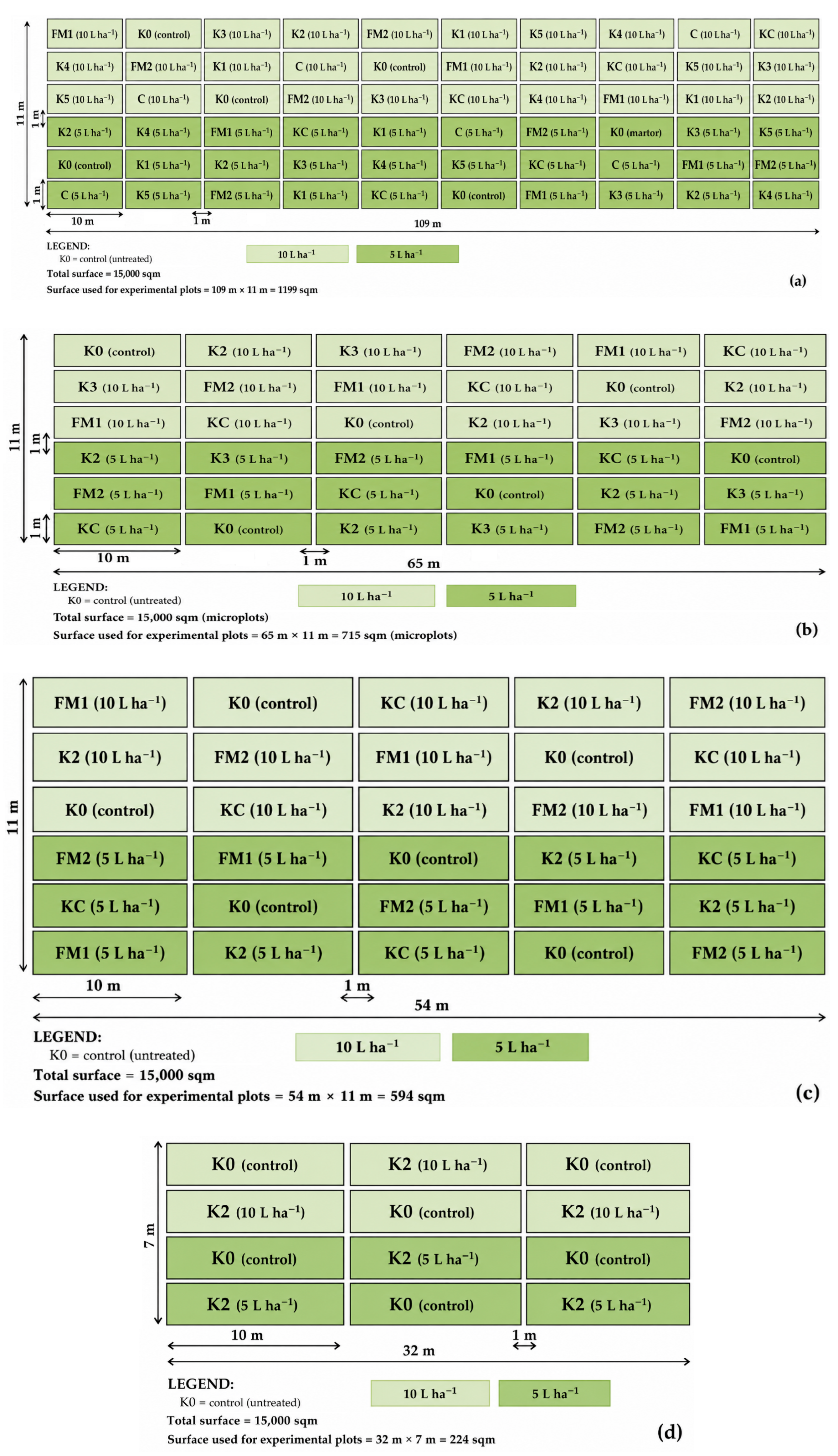
During the research period (2020–2025), the field research was conducted in different designs, according to the management schemes (Figure 5). The modification of the management layout during the first three years (2020–2022) was motivated by a change in the number of tested products. During the 2023–2025 period, only the K2 formulation and the control were maintained in the field trials, corresponding to the product-registration testing phase.
Figure 5.
The layout used for the placement of research plots in different years: (a) 2020, (b) 2021, (c) 2022, (d) 2023–2025.
The experimental scheme comprised two main factors: application dose and biostimulant. The application doses were assigned to distinct blocks, represented by different application rates, a 10 L ha−1 dose (light green blocks) and a 5 L ha−1 dose (dark green blocks), each with three replicates of control. Within each dose block, individual biostimulants were arranged in randomized plots, each measuring 10 m in length and 1 m in width (10 sqm per individual plot), separated by a 1 m buffer zone to prevent cross-contamination between adjacent treatments.
In 2020–2022, the field experiment was established using a split-plot randomized complete block design (RCBD) with three independent field replicates. Randomization was performed annually to minimize the influence of spatial heterogeneity within the experimental field.
For the last three years (2023–2025), a systematic block design with an alternating layout was implemented, also with three replicates. The experimental area comprised 12 distinct plots arranged in a 4 × 3 matrix. This systematic spatial distribution was chosen to maximize the interspersion of treatments, thereby mitigating localized soil heterogeneity, preventing treatment drift between neighboring plots, and ensuring that environmental variance was balanced equally across all evaluated variants.
4.2.4. Crop Management for the Trials
The maize was sown between 10 and 15 April of each experimental year, depending on soil conditions. Row spacing was 70 cm, with 24 cm apart between plants, meaning a target plant population of 59,523 plants ha−1. All plots received the same conventional agronomic management throughout the study period.
To ensure consistent results, the study also considered cultivation following the same preceding crop, namely, wheat, a very common crop rotation in Romania, as these are the two main agricultural crops.
Basal fertilization was applied before sowing at a rate of 250 kg ha−1 NPK (20-20-0), supplemented with 120 kg N ha−1 as ammonium nitrate applied at the 6–8 leaf stage. No irrigation was used during the experimental period.
At physiological maturity (1–5 October, every year), plants from the research plots were harvested manually. Grain yield was determined after shelling and adjusted to a standard moisture content of 14%. Yield values were expressed as q ha−1.
4.2.5. Crop Protection Practices for the Trials
Weed control was performed using a post-emergence herbicide treatment at the 4–6 leaf stage of maize (BBCH 14–16). To control annual grass weeds, volunteer winter wheat, and broadleaf weed species, a tank mixture of nicosulfuron (1.0 L ha−1) and dicamba (0.6 L ha−1) was uniformly applied across all experimental plots.
At the 7–8 leaf stage (BBCH 17–18), a preventive fungicide treatment containing azoxystrobin and cyproconazole (0.75 L ha−1) was applied uniformly throughout the experimental field to minimize the potential influence of foliar diseases, including northern corn leaf blight (Exserohilum turcicum), on crop development. Because wheat was the preceding crop, disease prevention was considered necessary to maintain uniform phytosanitary conditions. All plots, including the untreated control, received identical crop-protection measures, thereby ensuring that observed differences in plant growth and grain yield were attributable primarily to the evaluated biostimulant treatments.
4.3. Foliar Application Procedure
Biostimulants were applied twice during the growing season: at the 4–6 leaf stage (BBCH 14–16) and at the 7–8 leaf stage (BBCH 17–18). The foliar applications of the tested biostimulant formulations, at doses of 5 L ha−1 and 10 L ha−1, were strictly timed to coincide with critical physiological windows for yield component determination, specifically at the 4–6 leaf stage (BBCH 14–16) and at the 7–8 leaf stage (BBCH 17–18).
To ensure high distribution uniformity and precise dosing across the individual 10 sqm experimental plots, treatments were applied using a calibrated, CO2-pressurized plot backpack sprayer equipped with a handheld boom fitted with flat-fan nozzles (TeeJet XR 11002, Wheaton, IL, USA). The equipment was calibrated to deliver a constant spray volume equivalent to a standard field water rate of 250 L ha−1.
To prevent cross-contamination and treatment drift between adjacent variants within the systematic alternating layout, foliar applications were carried out under strict meteorological conditions:
- wind below 2.0 m s−1, monitored using a portable anemometer;
- air temperatures below 25 °C—in early morning (07:00–09:00), to minimize evaporative losses, prevent stomatal closure caused by midday heat stress, and avoid leaf scorch (phytotoxicity);
- no precipitation for at least 12 h—to ensure optimal cuticular absorption.
The absolute volume of biostimulant and working solution allocated per 10 sqm plot was mathematically calculated based on the designated hectare rates (5 L ha−1 and 10 L ha−1), ensuring exact concentration delivery. Control plots (K0) were sprayed simultaneously with an equivalent volume of pure water to maintain uniform mechanical and hydrological conditions across the entire trial.
4.4. Plant-Height Measurements
For each individual 10 sqm plot, a representative sample of 10 randomly selected maize plants from the central rows—excluding border plants to eliminate edge effects—was permanently marked for longitudinal tracking. Plant height was measured manually using a graduated telescopic measuring rod with an accuracy of ±0.5 cm.
The measurements were taken from the soil surface level up to the highest visible leaf arch under natural, unextended positioning. The individual plant data per plot were then averaged to obtain a single mean height value per treatment replicate for subsequent statistical analysis.
4.5. Yield Calculation
Maize grain yield was determined at physiological maturity by harvesting all plants from the useful area of each experimental microplot. After harvesting, the ears were manually shelled and the grain mass was recorded using a calibrated electronic balance with an accuracy of ±0.01 kg.
Grain moisture content was measured at harvest using a portable grain-moisture meter and, in the laboratory, a Infratec 1241 FOSS grain analyzer. To ensure comparability among treatments and years, grain yields were standardized to the reference moisture content of 14% according to the following equation:
where Y14% represents the grain yield corrected to 14% moisture (kg), Yh is the harvested grain yield (kg) and Mh is the grain moisture content at harvest (%).
The corrected grain yield obtained from each microplot was converted to yield per hectare using the following equation:
where Yha represents the grain yield (kg ha−1), Y14% is the grain yield corrected to 14% moisture (kg) and A is the harvested plot area (sqm).
The final results were expressed as quintals per hectare (q ha−1), where 1 q = 100 kg.
4.6. Climate Monitoring
To accurately interpret the agronomical responses of the Olt maize hybrid and the efficacy of the biostimulant treatments across the experimental years, macro-climatic parameters were monitored personally on-site throughout the entire period (2020–2025).
Environmental parameters were recorded daily using reliable, standard agricultural monitoring instruments positioned within the experimental area:
- a standard analog maximum–minimum thermometer housed in a ventilated weather shelter to prevent direct solar radiation interference;
- a standard agricultural cylindrical rain gauge (pluviometer) with a graduated scale (mm).
The collected data for temperatures and precipitations were noted daily and calculated at the end of each month.
To evaluate the extent of recent climate deviations during the experimental period (2020–2025), the personally collected on-site meteorological data were compared against the historical standard reference normal of 1981–2010, for Calarasi county, obtained from the NOAA National Centers for Environmental Information (NCEI) WMO Climate Normals database for Romania [44].
4.7. Economic Evaluation of Biostimulants
The economic performance of K2 application was assessed using grain-yield increases recorded during the validation phase. Additional income was calculated from the difference between treated and untreated variants using an average maize grain price of 200 EUR t−1.
Product costs were calculated according to the commercial price of K2 (5 EUR L−1), corresponding to application costs of 25 EUR ha−1 for the 5 L ha−1 treatment and 50 EUR ha−1 for the 10 L ha−1 treatment.
Net profit was calculated as:
Net profit (EUR ha−1) = Additional income − Product cost
Economic indicators were determined separately for each year and treatment dose.
The economic calculations did not include additional machinery or labor expenses because the biostimulant applications were integrated into existing crop-protection operations already scheduled within the production system. Consequently, no additional field passes were required beyond standard farm management practices.
4.8. Statistical Analysis
Statistical analyses were performed using XLSTAT 2026.1.1 software (Addinsoft, Paris, France). Analysis of variance (ANOVA) was applied to evaluate the effects of year, biostimulant formulation, and application dose on plant height and grain yield. When significant differences were detected, treatment means were separated using Duncan’s Multiple Range Test at p ≤ 0.05. Principal Component Analysis (PCA) was used to explore relationships among plant growth, yield, and climatic variables.
During the screening phase (2020–2022), a three-factor analysis of variance (ANOVA) was applied using year, biostimulant formulation, and application dose as fixed factors. Additional ANOVA models including the untreated control were subsequently performed to compare all treatment–dose combinations.
For the validation phase (2020–2025), data were analyzed using a two-factor ANOVA with year and K2 dose as fixed factors.
When significant treatment effects were detected, mean separation was performed using Duncan’s multiple range test at p ≤ 0.05. Fisher’s least significant difference (LSD) values were calculated to facilitate pairwise comparisons.
Multivariate relationships among plant height and grain yield variables were investigated using Principal Component Analysis (PCA). Climatic variables were integrated through descriptive analyses and heat-map visualization to evaluate relationships between treatment response and environmental conditions.
All statistical tests were considered significant at p ≤ 0.05.
5. Conclusions
This six-year field study (2020–2025) demonstrated that foliar biostimulants derived from animal collagen and keratin hydrolysates can effectively improve maize growth and productivity under non-irrigated conditions in southern Romania. Significant differences among formulations were identified during the screening phase (2020–2022), with the keratin-based formulation K2 providing the most consistent agronomic response.
Statistical analyses confirmed that both experimental year and biostimulant treatment significantly influenced maize performance. During the screening phase, K2 applied at 10 L ha−1 achieved the highest mean grain yield (87.71 q ha−1), significantly exceeding the untreated control (70.94 q ha−1). During the validation phase, K2 application increased mean grain yield from 52.06 q ha−1 in the control to 58.74 and 64.91 q ha−1 at application rates of 5 and 10 L ha−1, respectively. Plant height measured after foliar applications followed a similar pattern, indicating a positive effect on vegetative growth and crop development.
The beneficial effects of K2 were maintained across years characterized by contrasting climatic conditions. Yield advantages were particularly evident during seasons with pronounced precipitation deficits and elevated temperatures, confirming the capacity of animal-derived protein hydrolysates to improve performance under drought-prone field conditions. These results support the hypothesis that keratin-based biostimulants may contribute to improving maize resilience in rainfed agricultural systems increasingly exposed to climate variability.
From an economic perspective, K2 application generated positive returns under all climatic scenarios evaluated. Average net profit reached approximately 109 EUR ha−1 for the 5 L ha−1 treatment and 207 EUR ha−1 for the 10 L ha−1 treatment, demonstrating that the agronomic benefits were accompanied by measurable economic gains. The highest profitability was recorded in years with severe drought stress, highlighting the practical value of biostimulant use as a risk-mitigation strategy.
Beyond their agronomic performance, the tested products offer additional sustainability benefits because they are produced from collagen- and keratin-rich residues originating from the leather and food-processing industries. Their utilization contributes to the valorization of industrial by-products and supports circular-economy approaches aimed at reducing waste while improving agricultural productivity.
Although the study demonstrated consistent positive effects under commercial field conditions, further research should investigate the physiological and molecular mechanisms underlying the observed responses, including effects on photosynthetic activity, water-use efficiency, antioxidant metabolism, nutrient dynamics, and root architecture. Validation across additional maize hybrids, soil types, and agroecological regions would further strengthen the applicability of animal-derived biostimulants as climate-adaptation tools for sustainable crop production.
The results indicate that keratin-based biostimulants, particularly K2 applied at 10 L ha−1, represent a promising and economically viable strategy for improving maize productivity and drought tolerance under the increasingly challenging climatic conditions of southeastern Europe.
The six-year field validation demonstrated that animal-derived protein hydrolysates can represent an effective strategy for mitigating drought-induced yield losses in maize cultivated under non-irrigated conditions. Among the tested formulations, K2 consistently produced the strongest agronomic response, increasing mean grain yield by 24.7% at 10 L ha−1 compared with the untreated control. The effectiveness of K2 was particularly evident during severe drought years, when yield improvements exceeded 40%. In addition to its agronomic benefits, K2 generated positive economic returns in all experimental years and supports circular-economy principles through the valorization of keratin-rich industrial by-products. These findings indicate that keratin-based biostimulants may become a valuable component of climate-adaptation strategies for maize production in drought-prone regions of southeastern Europe.
6. Patents
Patent application, OSIM, no A/00666 from 02.10.2022, “Processes for Obtaining and Structured Emulsion, based on Protein Hydrolysate and Surfactants, with Application in Agriculture”, Gaidau C., Simion D., Berechet M.D., Becheritu M., Horoias R., Cioineag C.F., Borovina P-M., Nica A-O., published by OSIM in Official Bulletin of Industrial Property, no. 4, 2024, pg. 37.
FERTI KER, plant biostimulant, Registration decision number: 5612, 21.08.2023, Central Institute of Agricultural Control and Testing, Brno, Czech Republique.
Author Contributions
Conceptualization, R.H. and C.G.; methodology, R.H., C.A. and C.G.; software, R.H., C.C. and C.A.; validation, R.H., C.C., M.B., P.B. and V.S.; formal analysis, R.H., C.G., J.P. and L.S.; investigation, R.H., M.B., V.S. and C.G.; resources, R.H., J.P. and L.S.; data curation, R.H., C.C., M.B. and P.B.; writing—original draft preparation, R.H. and C.G.; writing—review and editing, R.H., C.G., C.A. and J.P.; visualization, R.H. and C.G.; supervision, R.H. and C.G.; project administration, M.B. and C.G. All authors have read and agreed to the published version of the manuscript.
Funding
This research was funded by a grant of the Romanian Ministry of Research, Innovation and Digitalization, CCCDI—UEFISCDI, project number PN-III-P3-3.5-EUK-2017-D-0098, E!12610, Ferti-Maize, contract 127/2020, within PNCDI III. The implementation period was 2020–2022, and the post-implementation period was 2023–2025.
Institutional Review Board Statement
Not applicable.
Informed Consent Statement
Not applicable.
Data Availability Statement
A part of the annual results is available in the short reports, posted on the project website: https://www.probstdorfer.ro/proiect-ferti-maize-ro/ (accessed on 21 May 2026).
Acknowledgments
The authors used ChatGPT 5.5 as a language-support tool during manuscript preparation to assist with English language editing, text and charts organization, and stylistic refinement. The authors take full responsibility for the scientific content, data analysis, interpretation of results, and conclusions presented in the manuscript. We appreciate the anonymous reviewers for providing constructive comments to help us to improve the paper.
Conflicts of Interest
The authors declare no conflicts of interest.
References
- Jing, L.; Weng, B.; Yan, D.; Yuan, F.; Zhang, S.; Bi, W.; Yan, S. Assessment of resilience in maize suitable planting areas under drought stress. Agric. Water Manag. 2023, 277, 108096. [Google Scholar] [CrossRef] [Scilit]
- Ravazzolo, L.; Chichi, A.; Meggio, F.; Buzzicotti, L.; Ruperti, B.; Varotto, S.; Malagoli, M.; Quaggiotti, S. A maize mutant impaired in SL biosynthesis (zmccd8) shows a lower growth, an altered response to nitrogen starvation, and a potential secondary effect on drought tolerance. Stresses 2024, 4, 614–626. [Google Scholar] [CrossRef] [Scilit]
- Begna, T. Impact of drought stress on crop production and its management options. Int. J. Res. Stud. Agric. Sci. (IJRSAS) 2022, 8, 1–13. [Google Scholar] [CrossRef] [Scilit]
- Daryanto, S.; Wang, L.; Jacinthe, P.-A. Global synthesis of drought effects on maize and wheat production. PLoS ONE 2016, 11, e0156362. [Google Scholar] [CrossRef] [Scilit] [PubMed]
- Alotaibi, M. Climate change, its impact on crop production, challenges, and possible solutions. Not. Bot. Horti. Agrobo. 2023, 51, 13020. [Google Scholar] [CrossRef] [Scilit]
- Kim, K.-H.; Lee, B.-M. Effects of climate change and drought tolerance on maize growth. Plants 2023, 12, 3548. [Google Scholar] [CrossRef] [Scilit] [PubMed]
- Jin, Z.; Zhuang, Q.; Tan, Z.; Dukes, J.S.; Zheng, B.; Melillo, J.M. Do maize models capture the impacts of heat and drought stresses on yield? Using algorithm ensembles to identify successful approaches. Glob. Chang. Biol. 2016, 22, 3112–3126. [Google Scholar] [CrossRef] [Scilit] [PubMed]
- Zipper, S.C.; Qiu, J.; Kucharik, C.J. Drought effects on US maize and soybean production: Spatiotemporal patterns and historical changes. Environ. Res. Lett. 2016, 11, 094021. [Google Scholar] [CrossRef] [Scilit]
- Sah, R.P.; Chakraborty, M.; Prasad, K.; Pandit, M.; Tudu, V.K.; Chakravarty, M.K.; Narayan, S.C.; Rana, M.; Moharana, D. Impact of water deficit stress in maize: Phenology and yield components. Sci. Rep. 2020, 10, 2944. [Google Scholar] [CrossRef] [Scilit] [PubMed]
- Yan, S.; Weng, B.; Jing, L.; Bi, W. Effects of drought stress on water content and biomass distribution in summer maize (Zea mays L.). Front. Plant. Sci. 2023, 14, 1118131. [Google Scholar] [CrossRef] [Scilit] [PubMed]
- Koutoua, A.; N’guessan, K.; Dognimeton, S.; Soumaila, O.; Blaise, K.A.; Nadia, K.A.; Justin, K.Y. Impact of drought on the foliar physiology of maize plants irradiated with gamma radiation. Int. J. Plant Physiol. Biochem. 2021, 13, 30–37. [Google Scholar] [CrossRef] [Scilit]
- Ghazi, D.A. Impact of drought stress on maize (Zea mays) plant in presence or absence of salicylic acid spraying. J. Soil Sci. Agric. Eng. 2017, 8, 223–229. [Google Scholar] [CrossRef] [Scilit]
- Marcu, E.; Ghiorghe, I.A.; Serban, D.; Cioromele, G.A.; Turek Rahoveanu, M.M. Efficiency of maize and sunflower crops under the impact of drought in Braila County, Romania. Sci. Pap. Ser. Manag. Econom. Eng. Agric. Rural Dev. 2024, 24, 515–522. [Google Scholar]
- Popescu, A.; Dinu, T.A.; Stoian, E.; Serban, V. Climate change and its impact on wheat, maize and sunflower yield in Romania in the period 2017–2021. Sci. Pap. Ser. Manag. Econom. Eng. Agric. Rural Dev. 2023, 23, 587–602. [Google Scholar]
- Abdulhamed, Z.A.; Abas, S.A.; Noaman, A.H.; Abood, N.M. Review on the development of drought tolerant maize genotypes in Iraq. IOP Conf. Ser. Earth Environ. 2021, 904, 012010. [Google Scholar] [CrossRef] [Scilit]
- Gao, Z.-W.; Cui, Y.-H.; Li, X.-N.; Bai, M.-Y.; Asseri, T.A.Y.; Hashem, M.; Wang, Z.-J. Genetic improvement of drought stress tolerance in maize, recent advancements and future research direction. Not. Bot. Horti. Agrobo. 2024, 52, 13840. [Google Scholar] [CrossRef] [Scilit]
- Garoma, B. Conventional and molecular improvement of maize for drought tolerance: Research review. J. Environ. Sci. Agri. Res. 2024, 2, 1–6. [Google Scholar] [CrossRef] [Scilit]
- Lunduka, R.W.; Mateva, K.I.; Magorokosho, C.; Manjeru, P. Impact of adoption of drought-tolerant maize varieties on total maize production in south eastern Zimbabwe. Clim. Dev. 2019, 11, 35–46. [Google Scholar] [CrossRef] [Scilit] [PubMed]
- Mastenbroek, A.; Gamucio, T.; Nakanwagi, J. Gender, agricultural risk perception, and maize seed system: A case study of drought-tolerant maize varieties in Uganda. Agric. Syst. 2024, 217, 103912. [Google Scholar] [CrossRef] [Scilit]
- Amondo, E.; Simtowe, F.; Rahut, D.B.; Erenstein, O. Productivity and production risk effects of adopting drought-tolerant maize varieties in Zambia. Int. J. Clim. Chang. Strat. Manag. 2019, 11, 570–591. [Google Scholar] [CrossRef] [Scilit] [PubMed]
- Fatima, A.; Mahmood, A.; Alawadi, H.F.N.; Javaid, M.M.; Ahmad, H.B.; Al-Khayri, J.M.; Aldaej, M.I.; Al-Dossary, O.; Alsubaie, B.; Shehata, W.F. Chilling and drought stresses in maize: Mitigation strategies and potential management opportunities. Not. Bot. Horti Agrobot. 2024, 52, 13855. [Google Scholar] [CrossRef] [Scilit]
- Fufa, B. Conventional and molecular improvement of maize for drought tolerance: Review. J. Smart Agric. Environ. Tech. 2024, 2, 87–92. [Google Scholar] [CrossRef] [Scilit]
- Berca, M.; Robescu, V.O.; Horoias, R. Management issues of the maize crop on the eutricamboils from Brebu area (Prahova County). Sci. Pap. Ser. Manag. Econom. Eng. Agric. Rural Dev. 2014, 14, 31–34. [Google Scholar]
- Ionescu, N. Influence of crop systems in reducing of drought effect for maize plants. AgroLife Sci. J. 2015, 4, 37–42. [Google Scholar] [CrossRef] [Scilit]
- Du Jardin, P. Plant biostimulants: Definition, concept, main categories and regulation. Sci. Hortic. 2015, 196, 3–14. [Google Scholar] [CrossRef] [Scilit]
- Colla, G.; Hoagland, L.; Ruzzi, M.; Cardarelli, M.; Bonini, P.; Canaguier, R.; Rouphael, Y. Biostimulant action of protein hydrolysates: Unraveling their effects on plant physiology and microbiome. Front. Plant Sci. 2017, 8, 2202. [Google Scholar] [CrossRef] [Scilit] [PubMed]
- Jolayemi, O.L.; Malik, A.H.; Ekblad, T.; Fredlund, K.; Olsson, M.E.; Johansson, E. Protein-based biostimulants to enhance plant growth—State-of-the-art and future direction with sugar beet as an example. Agronomy 2022, 12, 3211. [Google Scholar] [CrossRef] [Scilit]
- Moreno-Hernandez, J.M.; Benitez-Garcia, I.; Mazorra-Manzano, M.A.; Ramirez-Suarez, J.C.; Sanchez, E. Strategies for production, characterization and application of protein-based biostimulants in agriculture: A review. Chil. J. Agric. Res. 2020, 80, 274–289. [Google Scholar] [CrossRef] [Scilit]
- Ma, Y.; Freitas, H.; Dias, M.C. Strategies and prospects for biostimulants to alleviate abiotic stress in plants. Front. Plant. Sci. 2022, 13, 1024243. [Google Scholar] [CrossRef] [Scilit] [PubMed]
- Van Oosten, M.J.; Pepe, O.; De Pascale, S.; Silletti, S.; Maggio, A. The role of biostimulants and bioeffectors as alleviators of abiotic stress in crop plants. Chem. Biol. Technol. Agric. 2017, 4, 5. [Google Scholar] [CrossRef] [Scilit]
- Nardi, S.; Pizzeghello, D.; Schiavon, M.; Ertani, A. Plant biostimulants: Physiological responses induced by protein hydrolyzed-based products and humic substances in plant metabolism. Sci. Agric. 2016, 73, 18–23. [Google Scholar] [CrossRef] [Scilit]
- Andreotti, C.; Rouphael, Y.; Colla, G.; Basile, B. Rate and timing of application of biostimulant substances to enhance fruit tree tolerance toward environmental stresses and fruit quality. Agronomy 2022, 12, 603. [Google Scholar] [CrossRef] [Scilit]
- Colla, G.; Cardarelli, M.; Bonini, P.; Rouphael, Y. Foliar applications of protein hydrolysate, plant and seaweed extracts increase yield but differentially modulate fruit quality of greenhouse tomato. HortScience 2017, 52, 1214–1220. [Google Scholar] [CrossRef] [Scilit]
- Cristiano, G.; Pallozzi, E.; Conversa, G.; Tufarelli, V.; de Lucia, B. Effects of an animal-derived biostimulant on the growth and physiological parameters of potted snapdragon (Antirrhinum majus L.). Front. Plant Sci. 2018, 9, 861. [Google Scholar] [CrossRef] [Scilit] [PubMed]
- Genc, E.; Atici, O. Chicken feather protein hydrolysates as a biostimulant improves the growth of wheat seedlings by affecting biochemical and physiological parameters. Turk. J. Bot. 2019, 43, 67–79. [Google Scholar] [CrossRef] [Scilit]
- Madende, M.; Hayes, M. Fish by-product use as biostimulants: An overview of the current state of the art, including relevant legislation and regulations within the EU and USA. Molecules 2020, 25, 1122. [Google Scholar] [CrossRef] [Scilit] [PubMed]
- Gendaszewska, D.; Pipiak, P.; Wieczorek, D.; Miskiewicz, K.; Lawinska, K.; Popinska, W. Utilization of protein hydrolysates from animal waste for the production of biostimulants in wheat cultivation (Triticum aestivum L.). Fibres Text. East. Eur. 2025, 33, 40–48. [Google Scholar] [CrossRef] [Scilit]
- Timorshina, S.; Popova, E.; Osmolovskiy, A. Sustainable applications of animal waste proteins. Polymers 2022, 14, 1601. [Google Scholar] [CrossRef] [Scilit] [PubMed]
- Gousterova, A.; Braikova, D.; Goshev, I.; Christov, P.; Tishinov, K.; Vasileva-Tonkova, E.; Haertle, T.; Nedkov, P. Degradation of keratin and collagen containing wastes by newly isolated thermoactinomycetes or by alkaline hydrolysis. Lett. Appl. Microbiol. 2005, 40, 335–340. [Google Scholar] [CrossRef] [Scilit] [PubMed]
- Matinong, A.M.E.; Chisti, Y.; Pickering, K.L.; Haverkamp, R.G. Collagen extraction from animal skin. Biology 2022, 11, 905. [Google Scholar] [CrossRef] [Scilit] [PubMed]
- Da Silva, R.R. Enzymatic synthesis of protein hydrolysates from animal proteins: Exploring microbial peptidases. Front. Microbiol. 2018, 9, 735. [Google Scholar] [CrossRef] [Scilit] [PubMed]
- Ambrosini, S.; Prinsi, B.; Zamboni, A.; Espen, L.; Zanzoni, S.; Santi, C.; Varanini, Z.; Pandolfini, T. Chemical characterization of a collagen-derived protein hydrolysate and biostimulant activity assessment of its peptidic components. J. Agric. Food Chem. 2022, 70, 11201–11211. [Google Scholar] [CrossRef] [Scilit] [PubMed]
- Stefan, D.S.; Bosomoiu, M.; Dancila, A.M.; Stefan, M. Review of soil quality improvement using biopolymers from leather waste. Polymers 2022, 14, 1928. [Google Scholar] [CrossRef] [Scilit] [PubMed]
- National Centers for Environmental Information (NCEI). WMO Climatological Normals (1981–2010): Romania, Region VI (Europe). National Oceanic and Atmospheric Administration (NOAA), Asheville, NC, USA. Available online: https://www.ncei.noaa.gov/data/normals-old/WMO/1981-2010/RA-VI/Romania/ (accessed on 10 June 2026).
- Zhang, X.; Yin, J.; Ma, Y.; Peng, Y.; Fenton, O.; Wang, W.; Zhang, W.; Chen, Q. Unlocking the potential of biostimulants derived from organic waste and by-product sources: Improving plant growth and tolerance to abiotic stresses in agriculture. Environ. Technol. Innov. 2024, 34, 103571. [Google Scholar] [CrossRef] [Scilit]
- Gaidau, C.; Stanca, M.; Niculescu, M.D.; Alexe, C.A.; Becheritu, M.; Horoias, R.; Cioineag, C.; Rapa, M.; Stanculescu, I.R. Wool keratin hydrolysates for bioactive additives preparation. Materials 2021, 14, 4696. [Google Scholar] [CrossRef] [Scilit] [PubMed]
- Niculescu, M.D.; Epure, D.G.; Lason-Rydel, M.; Gaidau, C.; Gidea, M.; Enascuta, C. Biocomposites based on collagen and keratin with properties for agriculture and industrie applications. Eurobiotech J. 2019, 3, 160–166. [Google Scholar] [CrossRef] [Scilit]
- Becheritu, M.; Horoias, R.; Cioineag, C.F.; Borovina, P. Effects of rape seeds pelleting with bioactive products based on collagen and keratin extract on germination and plantlets development. Rom. Biotechnol. Lett. 2020, 25, 1953–1960. [Google Scholar] [CrossRef] [Scilit]
- Becheritu, M.; Horoias, R.; Cioineag, C.F.; Borovina, P.; Gaidau, C.; Niculescu, M. Yield results obtained in maize crop following the foliar fertilization with new biostimulants based on keratin and collagen hydrolysates of animal origin. Rom. Biotechnol. Lett. 2021, 26, 3129–3136. [Google Scholar] [CrossRef] [Scilit]
- Horoias, R.; Becheritu, M.; Cioineag, C.; Borovina, P.; Gaidau, C.; Niculescu, M. Biometric results for maize crop, as a result of treatment with new biostimulants based on protein additives. Sci. Bull. Ser. F. Biotechnol. 2021, 25, 26–31. [Google Scholar]
- Atta, M.M.M.; Abdel-Lattif, H.; Absy, R. Influence of biostimulants supplement on maize yield and agronomic traits. Biosci. Res. 2017, 14, 604–615. [Google Scholar]
- Corte, L.; Dell’Abate, M.T.; Magini, A.; Migliore, M.; Felici, B.; Roscini, L.; Sardella, R.; Tancini, B.; Emiliani, C.; Cardinali, G.; et al. Assessment of safety and efficiency of nitrogen organic fertilizers from animal-based protein hydrolysates—A laboratory multidisciplinary approach. J. Sci. Food Agric. 2014, 94, 235–245. [Google Scholar] [CrossRef] [Scilit] [PubMed]
- D’Amato, R.; Del Buono, D. Use of a biostimulant to mitigate salt stress in maize plants. Agronomy 2021, 11, 1755. [Google Scholar] [CrossRef] [Scilit]
- Fitriyah, F.; Kresnawaty, I.; Santoso, D. Protein hydrolysates enhance germination and early growth of maize and sugarcane. IOP Conf. Ser. Earth Environ. Sci. 2022, 974, 012066. [Google Scholar] [CrossRef] [Scilit]
- Li, B.; Song, D.; Guo, T.; Xu, X.; Ai, C.; Zhou, W. Combined physiological and metabolomic analysis reveals the effects of different biostimulants on maize production and reproduction. Front. Plant Sci. 2022, 13, 1062603. [Google Scholar] [CrossRef] [Scilit] [PubMed]
- Velicu, F.; Ion, V. Effects of different foliar treatments at maize crop. Sci. Pap. Ser. A. Agron. 2024, 67, 467–472. [Google Scholar]

Disclaimer/Publisher’s Note: The statements, opinions and data contained in all publications are solely those of the individual author(s) and contributor(s) and not of MDPI and/or the editor(s). MDPI and/or the editor(s) disclaim responsibility for any injury to people or property resulting from any ideas, methods, instructions or products referred to in the content. |
© 2026 by the authors. Licensee MDPI, Basel, Switzerland. This article is an open access article distributed under the terms and conditions of the Creative Commons Attribution (CC BY) license.