


Abstract
This state-of-the-art review critically evaluates shotcrete for concrete rehabilitation using an application-based framework covering buildings, bridges, tunnels and underground works, hydraulic and marine structures, and industrial facilities. The review synthesizes deterioration mechanisms, substrate and interface conditions, material and process variables, mechanical and durability performance, quality control, and alternative repair systems. Recent studies are integrated with established guidance and case histories, and quantitative evidence tables are used to facilitate cross-study comparison. Across structural applications, the shotcrete–substrate interface is identified as a critical factor governing rehabilitation performance, with surface condition, moisture state, shrinkage, curing, and environmental exposure affecting bond and durability. The synthesis further demonstrates that performance requirements vary by application, including section restoration, confinement, bond, and durability in buildings and bridges; early-age support, toughness, and residual capacity in tunnels; and low permeability and abrasion/erosion resistance in hydraulic and marine structures. Five research questions are proposed to address key uncertainties in interface behavior, durability, field performance, material development, and quality assurance. The resulting framework provides a systematic basis for evaluating shotcrete rehabilitation strategies and identifying priorities for future research.
1. Introduction
Concrete is one of the most widely used construction materials, yet many reinforced concrete (RC) structures around the world are now showing signs of deterioration. Common problems such as cracking, spalling, reinforcement corrosion, leakage, abrasion, and excessive deflection appear due to aging, poor workmanship, design errors, and harsh environmental exposure [1]. Many studies confirm that RC structures placed in aggressive environments such as coastal areas, marine zones, and regions with freeze–thaw cycles tend to deteriorate faster because of chlorides, moisture, carbonation, temperature variation, and chemical attack [2]. Similar deterioration issues have been observed in underwater and hydraulic structures where flowing water, abrasion, and erosion continuously damage concrete surfaces [3].
In specialized systems like post-tensioned structures, the progression of corrosion inside ducts and tendons can be severe and difficult to detect early, leading to sudden failures if not repaired in time [4]. For conventional RC members such as beams and columns, deterioration often reduces load-carrying capacity, stiffness, and durability, sometimes requiring strengthening or rehabilitation to restore performance [5,6]. Damage in bridge components is also common because many bridges have been exposed to deicing salts, salt spray, and mechanical fatigue over long periods, leading to cracking, corrosion, and loss of serviceability [7].
Because full reconstruction of deteriorated structures is expensive, time-consuming, and environmentally unsustainable, repair and rehabilitation have become essential strategies for maintaining existing infrastructure. Effective repair helps extend service life, improves structural safety, and avoids large financial losses caused by advanced deterioration [8]. Choosing the right repair method requires proper inspection, understanding of the damage mechanism, and selection of materials that are compatible with the existing concrete. Various repair materials such as polymer mortars, cement grouts, fiber-reinforced polymer (FRP) systems, ultra-high-performance fiber-reinforced concrete (UHPFRC) overlays, and concrete jackets have been used to restore strength and durability, each offering specific advantages and limitations [9].
Among the many available repair methods, shotcrete has become one of the most widely used solutions for concrete rehabilitation. Shotcrete is a process where concrete or mortar is sprayed at high velocity onto a surface, allowing it to be placed and compacted at the same time [10]. It is available for both the dry-mix and wet-mix processes, and it can be applied on vertical surfaces, overhead elements, and locations that are difficult to access. Several guideline documents and reviews describe shotcrete as a fast, economical, and durable repair method that requires little or no formwork, provides good bond with existing concrete, and can achieve high strength and low permeability when properly applied [11]. Shotcrete has been used successfully in repairing beams, columns, slabs, retaining walls, bridges, hydraulic structures, tunnels, and mines [11].
Shotcrete is especially useful when rapid construction is required or when working in confined or uneven spaces. Its ability to incorporate fibers, silica fume, admixtures, and high-performance materials allows for the production of tougher, more durable, and more workable mixes suitable for modern repair needs [12]. Shotcrete has also been applied effectively in marine environments, fire-damaged structures, and seismic strengthening projects, where reliable bond, low permeability, and quick application are important for long-term performance [13]. Because deterioration of RC structures continues to increase worldwide and infrastructure systems require reliable and efficient repair solutions, shotcrete has become an important technique in modern rehabilitation practice. This review paper examines the fundamentals of shotcrete technology, material characteristics, construction methods, structural and durability performance, and various repair applications. It also highlights existing standards, challenges, and future research needs to support the continued development of effective shotcrete-based rehabilitation strategies.
In this review, repair denotes localized actions intended to restore damaged concrete or reinforcement protection, while rehabilitation denotes the broader intervention required to recover or upgrade serviceability, durability, or structural capacity. Rehabilitation may therefore include repair alone, strengthening/retrofitting, protective measures, or a combined intervention. This distinction is important because a thin nonstructural patch and a reinforced shotcrete jacket have different design objectives, acceptance criteria, and evidence requirements. The review addresses three central questions: (1) How do deterioration mechanism and structural type change the requirements imposed on shotcrete repair? (2) Which material, substrate, placement, and curing variables most consistently govern interface and mechanical performance? (3) Where is the present evidence sufficiently quantitative to make engineering decisions, and where are the remaining unresolved uncertainties? The contribution is an application-based classification combined with cross-study evidence matrices that connect deterioration mechanism → repair objective → shotcrete function → performance indicator. This structure is used throughout the review to avoid treating buildings, bridges, tunnels, and hydraulic/marine structures as interchangeable applications.
Review Scope and Synthesis Framework
The literature was screened for studies and guidance directly relevant to shotcrete materials, sprayed-concrete construction, concrete repair interfaces, structural rehabilitation, durability, and quality control. Evidence was synthesized by structural application, deterioration mechanism, material/process variables, test method, and reported performance outcome.
2. Fundamentals of Shotcrete Technology
2.1. Definition and Classification
Traditional shotcrete approaches are based on two placement methods: dry-mix and wet-mix. Both use compressed air to propel the material onto the substrate [14]. The method is applied to new construction and repair situations where access is limited or formwork is impractical [10].
2.1.1. Dry-Mix Shotcrete
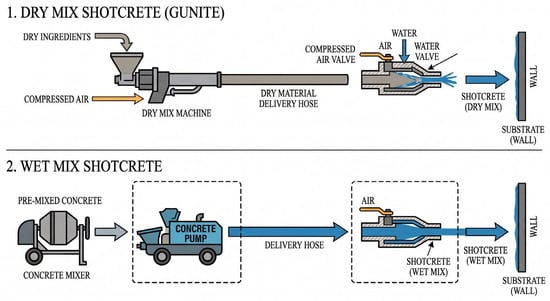
In dry-mix shotcrete, dry materials are conveyed through a hose and water is added at the nozzle. It offers good control of the water content and is suitable for smaller repairs and overhead applications [15]. It also allows for material adjustment on-site and has lower equipment complexity [11], although the nozzleman has greater responsibility for controlling the quality of the finished product than in the wet-mix process. Table 1 summarizes the main differences between dry-mix and wet-mix shotcrete processes.
Table 1.
Comparison of Dry-Mix and Wet-Mix Shotcrete Processes [16].
2.1.2. Wet-Mix Shotcrete
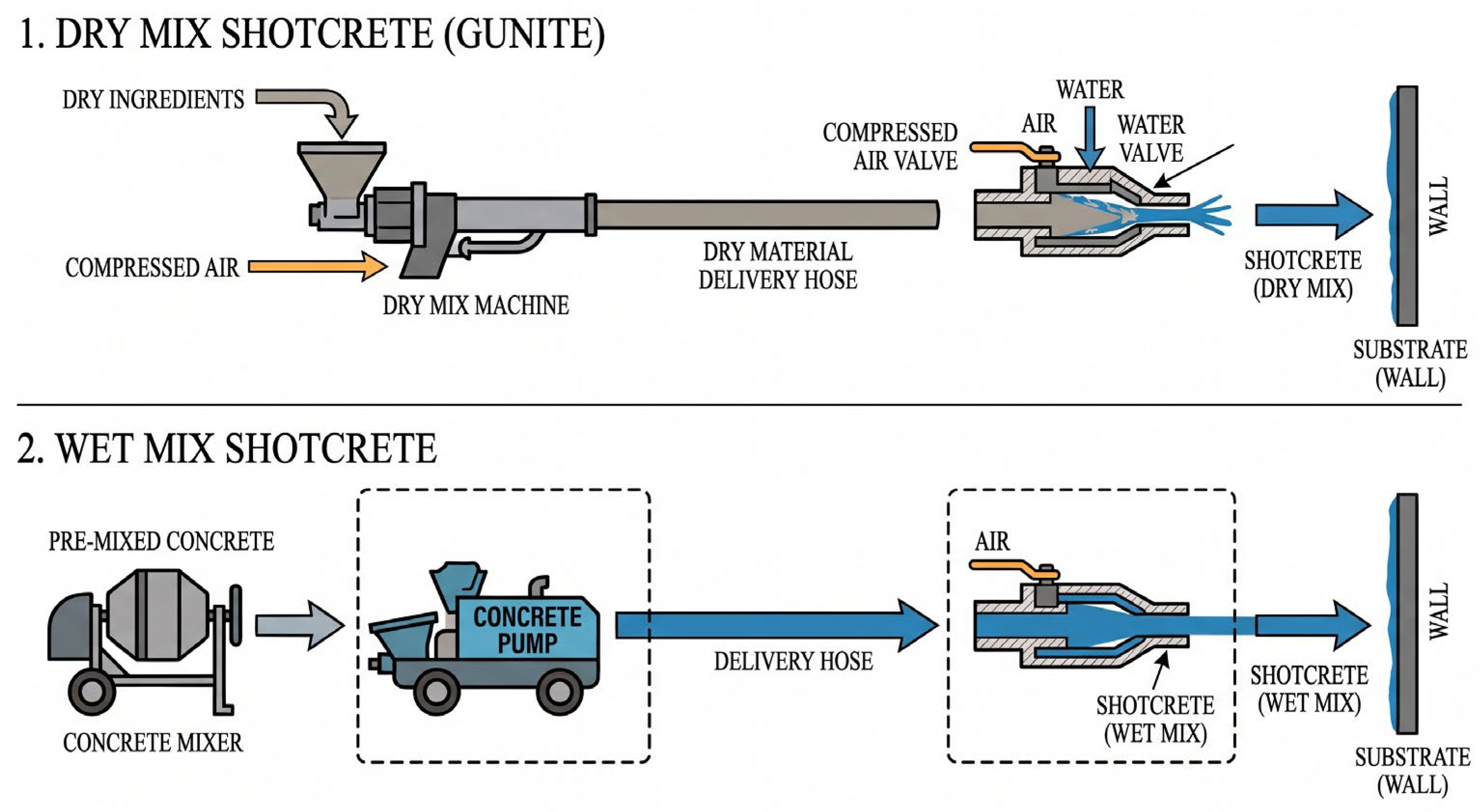
Wet-mix shotcrete uses pre-mixed material pumped through a hose. It provides consistent quality, higher production rates, and lower dust generation, making it suitable for larger repair projects [12]. Figure 1 depicts a schematic of dry and wet shotcrete application processes.
Figure 1.
Shotcrete application processes: (1) dry-mix, (2) wet-mix.
2.2. Materials and Mix Design
Shotcrete mixtures generally consist of cementitious materials, fine aggregates, water, admixtures, and sometimes fibers, with performance depending on a cohesive mix that can be pumped and sprayed without segregation. Portland cement or blended cements are commonly used, and silica fume is often added to increase cohesiveness and reduce permeability, especially for durable repair applications [12]. Well-graded fine aggregates are preferred to ensure smooth flow through hoses and to minimize rebound during placement [10]. Admixtures such as accelerators, water reducers, and viscosity-modifying agents are frequently incorporated to improve workability, control setting time, and stabilize the mixture during high-velocity projection [11]. Fiber reinforcement, including steel and synthetic fibers, is also used to enhance toughness, crack resistance, and impact behavior, making fiber-reinforced shotcrete suitable for demanding repair and stabilization projects [10,12].
2.3. Equipment and Application Process
Shotcrete requires pumps or air-delivery systems, hoses, and nozzles. Proper equipment setup ensures continuous flow, minimal blockage, and uniform application [11]. Application technique strongly affects the final quality and must be controlled by an experienced operator [10]. The nozzleman regulates water addition (for dry-mix), spray angle, and layer thickness. Accurate control prevents segregation and ensures strong adhesion [15]. Robotic spraying provides consistent coverage, increased safety, and higher productivity, especially in hazardous or confined environments [11,13].
2.4. Fresh and Hardened Properties
Fresh shotcrete must display cohesive flow and stable spray patterns. Proper mixture design minimizes rebound and ensures uniform deposition [11]. Hardened shotcrete typically develops high compressive strength, strong adhesion, and low permeability. Silica-fume shotcrete demonstrates improved resistance to chloride penetration and enhanced durability [10,11].
3. Deterioration Mechanisms of Concrete Structures and Role of Shotcrete
3.1. Common Deterioration Mechanisms
Concrete structures deteriorate over time due to several interacting mechanisms, including reinforcement corrosion, cracking, spalling, chemical attack, environmental exposure, and mechanical damage. Corrosion of steel reinforcement is one of the most common and severe forms of deterioration, often caused by chloride ingress or moisture penetration, which eventually leads to cracking, delamination, and loss of structural capacity [4]. Many reinforced concrete buildings and bridges also experience deterioration from freeze–thaw cycles, abrasion, erosion, and long-term loading, leading to surface scaling, reduced strength, and serviceability problems [1,9]. Damage in underwater and hydraulic structures can progress faster due to continuous water movement, dissolved chemicals, and physical abrasion from sediments [3]. Structural components such as beams, columns, and slabs may additionally suffer from fire exposure, impact loads, or construction defects, further accelerating cracking, stiffness loss, and material degradation [2,17,18]. Overall, these deterioration mechanisms reduce durability and structural performance, making timely and effective repair essential for extending service life [8].
Application-Specific Deterioration and Repair Objectives
The dominant deterioration mechanism is strongly dependent on structural type. In buildings, corrosion-induced cover delamination, fire damage, impact, construction defects, and seismic deficiencies commonly lead to localized section loss or a need for confinement. Bridges combine chloride/deicing-salt exposure, wet–dry and freeze–thaw cycling, fatigue, impact, and leakage at joints; therefore, bond durability and resistance to transport of water and ions are central. Tunnels and underground works experience ground deformation, cyclic/dynamic loading, groundwater, sulfate exposure, fire, and time-dependent lining loads, making early-age strength, toughness, adhesion, and crack control particularly important. Hydraulic and marine structures are dominated by abrasion–erosion, cavitation, saturation, chloride or sulfate ingress, and difficult access, so low permeability and resistance to surface loss are primary requirements. Industrial facilities may add chemical exposure, thermal cycling, and abrasion. Across all categories, removal of unsound concrete, reinforcement treatment, substrate profiling, and curing remain common requirements; what changes is the governing exposure and structural function of the new shotcrete layer.
Table 2 summarizes this application-based classification and the corresponding rehabilitation objectives and governing shotcrete performance requirements.
Table 2.
Application-based classification of deterioration mechanisms, rehabilitation objectives, and governing shotcrete performance requirements.
3.2. Repair Requirements
Effective repair of deteriorated concrete structures requires understanding the type and extent of damage, ensuring compatibility between the repair material and the existing concrete, and restoring structural performance safely and durably. Proper surface preparation is essential because contaminants, weak layers, or corrosion products can prevent good bonding between new and old materials; therefore, cleaning, roughening, and removing deteriorated concrete are necessary steps before repair application [1,2,8,17,18]. The repair material must be mechanically compatible with the substrate so that differences in stiffness, thermal behavior, and deformation capacity do not create stress concentrations that could lead to future cracking or debonding [9]. When corrosion is present, repair strategies should address both the damaged concrete and the reinforcement by removing rust, restoring section loss, and reducing factors that allow corrosion to continue [4]. Durability requirements must also be considered, especially for structures exposed to freeze–thaw cycles, chlorides, or underwater environments, where low permeability and strong adhesion are critical for long-term performance [3]. Finally, the chosen repair method should be constructible, accessible, and maintainable, particularly for beams, columns, and bridge elements where load demand and geometry influence the suitability of different repair techniques [4,17].
4. Applications of Shotcrete in Repair and Rehabilitation
Shotcrete is widely used for repairing and rehabilitating deteriorated concrete structures because it can restore damaged surfaces, rebuild lost concrete sections, increase load-carrying capacity, and protect structures from further deterioration. Its ability to bond strongly to existing concrete, conform to complex geometries, and be applied vertically or overhead makes it effective in many repair scenarios. Numerous studies and field applications across buildings, bridges, tunnels, marine structures, retaining walls, foundations, and industrial facilities demonstrate its versatility and efficiency in both structural and nonstructural rehabilitation [15,19].
Shotcrete is commonly used to repair spalled and delaminated concrete caused by reinforcement corrosion, freeze–thaw cycles, abrasion, chemical attack, or mechanical damage. In many practical cases, deteriorated cover concrete is removed, reinforcing bars are cleaned or replaced, and a new layer of shotcrete is applied to restore the original section and protect the reinforcement [4,20]. Industrial structures such as retaining walls, storage tanks, and exposed beams often benefit from shotcrete overlays that rebuild the section without requiring formwork, minimize downtime, and provide improved durability through modern admixtures and dense mix designs [21]. Field reports show that wet-mix shotcrete, enhanced with shrinkage-compensating and crystallization admixtures, can effectively rehabilitate old industrial concrete components subjected to marine aerosols, chemical attack, and long-term mechanical stress [22].
Shotcrete is also widely used for strengthening and upgrading structural elements. Many studies show that applying shotcrete jackets around columns, beams, and walls increases confinement, stiffness, and load capacity, making the method suitable for seismic retrofitting and structural upgrades [23,24]. Shotcrete jacketing has been used to improve shear resistance, enhance flexural performance, and restore fire-damaged or impact-damaged components. Experiments demonstrate that properly anchored reinforcement within the shotcrete layer helps mobilize composite action between the new and old concrete, especially when the interface is roughened or provided with dowels [25]. In many bridge applications, shotcrete strengthening has been used to rehabilitate girders, caps, piers, and abutments where geometric constraints prevent formwork installation [26,27].
In hydraulic and marine structures such as dams, spillways, sea walls, culverts, and underwater elements, shotcrete is applied to repair abrasion, erosion, cavitation, and chloride-related deterioration. Its ability to form a dense, low-permeability overlay is documented as an important advantage for protecting structures against water flow and aggressive ions [3]. Historical applications also show that shotcrete can successfully rehabilitate large-scale marine concrete elements, as demonstrated in the restoration of WWII concrete ship hulks, where shotcrete was used to rebuild deteriorated hull panels exposed to harsh seawater conditions [19].
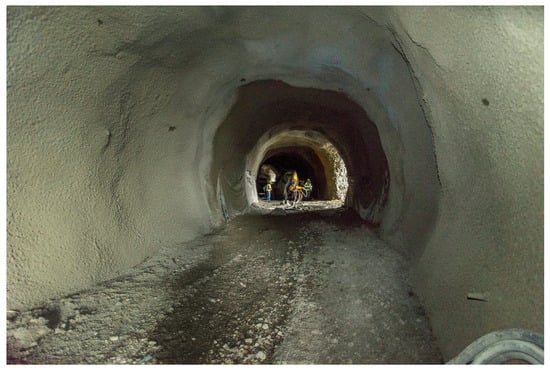
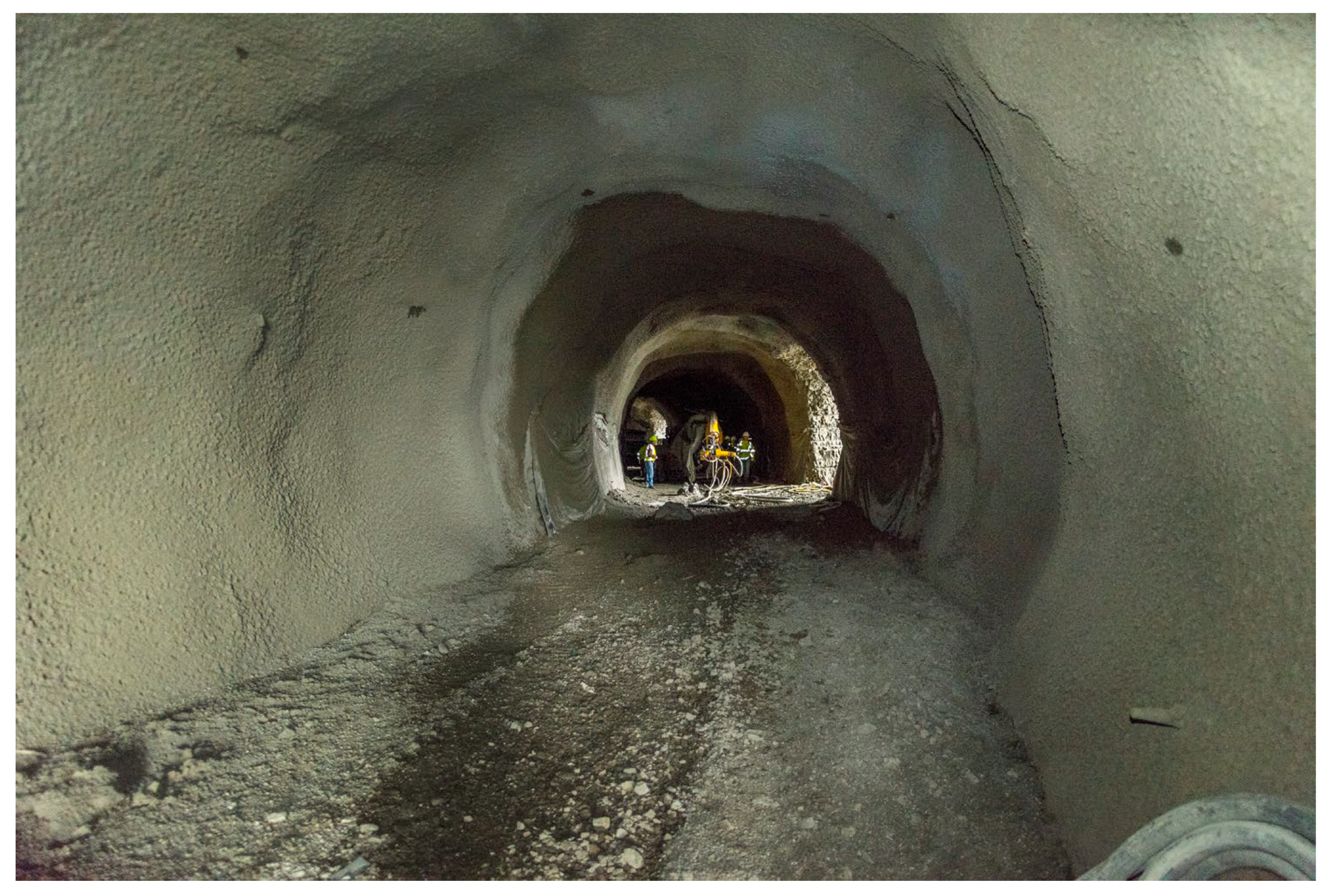
Shotcrete is frequently used in tunnels, mines, slopes, and underground structures for stabilization, surface repair, and protective lining. Figure 2 shows the application of shotcrete in a tunnel. Fiber-reinforced shotcrete provides improved toughness, crack control, and impact resistance, making it suitable for areas subjected to rock movement or dynamic loads [28,29]. Several studies highlight the composite action achieved when fiber-reinforced shotcrete is applied over cracked or damaged concrete, improving both strength and crack distribution while maintaining structural continuity [30,31]. Ultra-high-performance fiber-reinforced shotcrete (UHPFRSC) has also been successfully tested for thin, durable overlays capable of improving mechanical behavior and chloride resistance in heavily deteriorated structures [32].
Figure 2.
Application of shotcrete for structural support in Mitchell Point Tunnel. Photograph by Oregon Department of Transportation, licensed under CC BY 2.0.
Shotcrete has also been used effectively in fire-damaged and heat-affected structures. Research shows that areas where concrete has lost strength due to high temperatures can be repaired by removing damaged material, cleaning reinforcement, and applying shotcrete to rebuild the section [33]. In retrofit cases, applying shotcrete layers improves structural performance along with providing a protective barrier against further environmental deterioration.
In heritage and historic structures, shotcrete has been applied in a controlled and minimally invasive manner to stabilize weakened sections and replicate original forms. Repair of large historical concrete shells and architectural elements has been performed using shotcrete overlays to restore structural integrity while preserving appearance [34]. For massive or complex geometries, shotcrete provides a practical solution that avoids large-scale formwork and reduces overall intervention time.
Shotcrete is also used in special-purpose rehabilitation such as strengthening bridge decks, providing protective linings in wastewater structures, and improving durability in chemically aggressive industrial environments. Laboratory studies show improvements in mechanical behavior and reduced transport properties when high-performance or fiber-modified shotcrete mixes are used [33,35]. In addition, optimization studies on shotcrete mix design and spray parameters provide guidance for improving shootability, reducing rebound, and achieving uniform coverage in real-world rehabilitation projects [31,36]. Overall, applications of shotcrete in repair and rehabilitation demonstrate its versatility, constructability, and long-term performance. Across diverse structural types and exposure conditions, shotcrete offers an effective means to restore deteriorated concrete, enhance structural capacity, and improve durability, making it an essential tool for modern infrastructure rehabilitation.
Recent Advances
Recent studies illustrate several recent directions in shotcrete research that are directly relevant to repair and rehabilitation. Kaufmann et al. [37] examined the sulfate resistance of wet-sprayed concrete and showed that cement type, water-to-binder ratio, accelerator chemistry, porosity, and permeability jointly control sulfate-related damage. Menu et al. [38] quantified how mixture parameters and shrinkage-control admixtures affect free shrinkage and restrained cracking in dry-mix repair shotcrete. Yin et al. [39] used 205 field-derived datasets to develop machine-learning models for predicting the compressive strength of sprayed-concrete tunnel linings. Ortiz et al. [40] investigated lightweight polypropylene-fiber shotcrete as a means of reducing the hazard associated with tunnel-lining detachment. Zhu et al. [26] developed high-early-strength steel-fiber-reinforced shotcrete for rapid rehabilitation of disaster-damaged tunnel linings and evaluated its mechanical, durability, and structural repair performance. More recently, Castellón et al. [41] directly compared laboratory-produced and on-site sprayed fiber-reinforced shotcrete, demonstrating the importance of fiber distribution and orientation when laboratory results are transferred to field conditions. Collectively, these studies show that material design, spraying process, exposure condition, and specimen-production method should be considered together when interpreting shotcrete performance. Table 3 summarizes the principal quantitative findings and engineering implications reported in these studies.
Table 3.
Quantitative evidence matrix from recent shotcrete studies. Values are reported study outcomes; therefore, materials, curing, test methods, and structural contexts differ.
5. Mechanical Performance of Shotcrete Repairs
The mechanical performance of a shotcrete repair is governed by a composite system comprising the substrate, the interface, and the sprayed layer. Interface adhesion and friction, aggregate interlock created by surface profiling, local mechanical interlock around exposed reinforcement, and time-dependent stresses from shrinkage and thermal mismatch collectively determine whether the repaired section behaves monolithically. Consequently, a single bond-strength value cannot fully characterize performance. Pull-off/direct-tension tests primarily quantify tensile adhesion, shear tests emphasize friction and interlock, and fracture tests quantify energy required for crack propagation; the measured value is also sensitive to substrate strength, moisture state, curing, specimen geometry, and failure location [42,43,44,45,46,47,48,49].
Mechanistically, surface preparation increases bonding by removing weak laitance and contaminants and by increasing the real contact area and mechanical interlock. However, excessive roughening is not automatically beneficial if it induces microcracking in the substrate. Moisture conditioning affects suction and the local water-to-binder ratio at the interface, while differential shrinkage and thermal deformation generate self-equilibrating stresses that can initiate debonding before external loading. Freeze–thaw and chemical exposure then exploit connected pores and pre-existing interface defects. This explains why studies using different preparation methods or bond tests can produce different rankings and why the failure mode—interlayer failure, failure in substrate, failure in overlay, or mixed failure—must be reported together with strength [44,45,46,47,48,49].
In buildings and bridge members, the principal mechanical objective is composite action for section restoration, flexural/shear strengthening, or confinement; bond, shrinkage compatibility, and reinforcement anchorage therefore dominate. For tunnels and underground structures, early-age compressive strength must be considered together with residual flexural capacity, toughness, fracture energy, and dynamic response because the sprayed layer may be loaded soon after placement and may experience ground movement. Hydraulic and marine repairs are often less governed by early structural strength than by retention of bond and integrity under saturation, abrasion, and ion ingress. Industrial repairs require case-specific consideration of thermal and chemical exposure. Despite these differences, a common finding is that interface quality and the properties of the as-sprayed, not merely laboratory-cast, material control field performance [42,44,45,46,47,50,51,52,53].
Mechanical Performance by Structural Application
Bond performance between shotcrete and existing concrete is central to repair effectiveness. The measured bond response depends strongly on substrate condition, surface preparation, test method, and environmental exposure. Experimental and long-term investigations of shotcrete–concrete interfaces show that surface preparation and interface condition significantly influence tensile bond performance and failure behavior [44,45,54,55]. Freeze–thaw testing further demonstrates that cyclic environmental exposure can progressively degrade the shotcrete–concrete interface and that the method of substrate preparation affects the retained tensile bond strength [44]. Adhesion testing also shows that shotcrete bond development is associated with the development of the mechanical properties of the sprayed material, while shrinkage and substrate preparation influence long-term interface performance [45].
Fracture mechanics provides additional information that cannot be obtained from bond strength alone. Experimental characterization of the shotcrete–concrete interface demonstrates that fracture energy can be used to quantify resistance to crack initiation and propagation [46]. Mode II fracture is particularly relevant to shotcrete repairs because it represents interface cracking dominated by in-plane shear or sliding along the shotcrete–substrate interface. Such loading can develop when the repaired member transfers shear across the interface or when differential deformation between the substrate and repair layer generates tangential stresses. Numerical analyses based on cohesive-zone modeling under Mode II loading show that interface strength and critical fracture energy influence the initiation and propagation of interface cracks and the resulting failure behavior [47]. Therefore, both strength-based measurements and fracture-based parameters should be considered when assessing the mechanical integrity of shotcrete repairs, particularly when delamination or interface crack propagation is a governing failure mechanism [46,47].
The intrinsic mechanical properties of the sprayed material are also important. Wet-process sprayed concrete can develop satisfactory compressive strength and other hardened properties for structural repair, although its performance may differ from conventionally cast material because of the spraying and placement process [42]. Accelerated shotcrete has also been investigated in terms of mechanical properties, permeability, and durability, demonstrating that rapid strength development must be considered together with longer-term material performance [50]. These characteristics are particularly important in tunnels, transportation structures, and other contexts where early loading or rapid return to service is required.
Tensile and post-cracking behavior become especially important when shotcrete is subjected to cracking, deformation, impact, or dynamic loading. Direct tensile testing provides a method for characterizing the tensile response of shotcrete and evaluating behavior that cannot be fully represented by compressive-strength testing alone [51]. Engineered Cementitious Composites (ECCs) applied through the wet-mix shotcreting process have also demonstrated favorable mechanical behavior for repair applications, including enhanced deformation capacity and crack control [52]. Fiber-reinforced and strain-hardening sprayed materials can therefore be particularly beneficial in applications where residual load-carrying capacity and crack control are important mechanical requirements [51,52].
Environmental conditions may alter these mechanical properties and should be considered according to structural application. High-temperature exposure can modify the microstructure and mechanical properties of shotcrete, which is particularly relevant to tunnels, underground facilities, industrial structures, and fire- or heat-exposed repairs [53]. Shrinkage can also generate restrained stresses at the shotcrete–substrate interface and contribute to cracking or loss of adhesion, particularly when deformation of the repair layer is restrained by the existing substrate [45]. Recycled concrete aggregate can influence the porosity, mechanical behavior, and durability of dry-mix shotcrete and therefore requires appropriate mixture proportioning when used in repair applications [43].
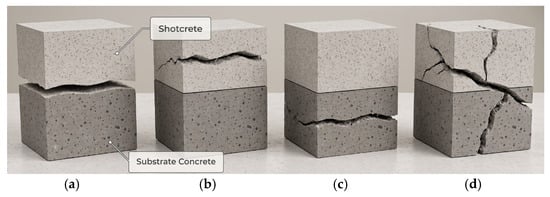
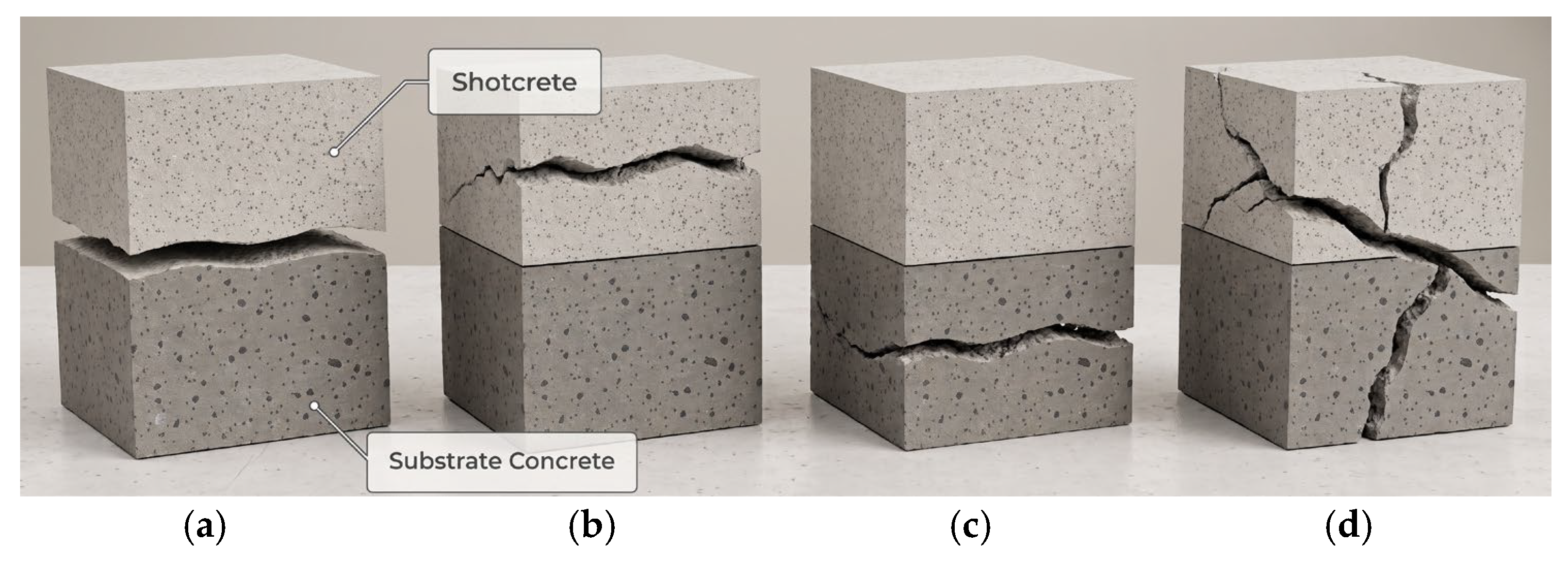
The governing mechanical requirements also vary with structural application. In buildings and bridge members, reliable composite action between the substrate and the shotcrete layer is required for section restoration, confinement, and structural strengthening; consequently, interface bond, shrinkage compatibility, and load transfer are particularly important [44,45,46,47]. In tunnels and underground structures, early-age strength must be considered together with toughness, residual capacity, fracture behavior, and resistance to environmental deterioration [46,47,50,52]. Hydraulic and marine repairs require the interface and sprayed material to retain mechanical integrity under persistent moisture, abrasion, erosion, and aggressive-ion exposure. Industrial repairs may additionally require resistance to thermal and chemical actions [53]. Despite these application-specific differences, successful mechanical performance depends on the combined behavior of the substrate, interface, and as-sprayed material rather than on the compressive strength of the shotcrete alone [44,45,46,47,50]. Figure 3 illustrates the principal failure modes that may occur at or near the shotcrete–concrete interface, while Table 4 summarizes the key variables governing interface performance and their engineering implications.
Figure 3.
Interface bond failure modes between shotcrete overlay and concrete substrate: (a) interlayer failure, (b) failure within the shotcrete, (c) failure within the concrete, and (d) mixed failure.
Table 4.
Mechanistic framework for shotcrete–substrate interface performance.
6. Construction Practices, Quality Control, and Standards
Effective shotcrete repair depends on proper construction practices, consistent quality control, and adherence to established standards. High-quality results begin with correct surface preparation, since debris, laitance, weak concrete, or corrosion products can prevent proper adhesion. Studies show that techniques such as chipping, hydrodemolition, sandblasting, and pressure washing significantly improve surface cleanliness and interface performance, reducing the risk of delamination and premature failure [4,42,44]. Field projects also demonstrate that roughened or water-jet-scaled surfaces provide more reliable bonding when subjected to environmental exposure or cyclic loading [54,56].
During placement, control of nozzle angle, spray distance, and layer thickness is critical to achieving uniform consolidation and minimizing rebound. Practical guidance from construction reports and case studies shows that incorrect nozzle motion or excessive spraying distance can create voids, segregation, or weak layers, especially in overhead or confined areas [10,15,55]. Wet-mix shotcrete applications in structural repair projects, such as pier rehabilitation and dam restoration, demonstrate the importance of controlled pump pressure and consistent flow to avoid variability in strength and density [57,58]. When repairing marine or industrial structures, quality control also involves monitoring ambient conditions such as moisture, temperature, chemical exposure, and wind, which can affect setting, bonding, and long-term durability [19,22].
Material quality control is equally important. Laboratory and field evaluations highlight that proper control of water content, admixture dosage, and fiber distribution improves shootability and mechanical performance [50,59]. Tests on chloride-exposed and high-temperature environments show that mix adjustments, such as silica fume addition, optimized aggregate grading, and steel or synthetic fiber reinforcement, contribute to improved resistance against cracking, shrinkage, and chemical attack [53].
Standards and guidelines provide the framework for proper construction and evaluation. The USACE EM 1110-2-2005 standard [11] outlines material requirements, curing procedures, equipment selection, surface preparation, and acceptance criteria for structural repairs. Industry guidelines place strong emphasis on structured quality control throughout the shotcrete process. The ACI 506R-16 Guide to Shotcrete outlines detailed requirements for preconstruction testing, mock-up panels, nozzleman qualification, material submittals, and continuous QA/QC monitoring during placement to ensure proper reinforcement encasement and uniform consolidation [60]. For sewer-tunnel rehabilitation, laboratory testing has shown that the acid resistance of pozzolan-modified shotcrete depends on pozzolan type, replacement level, and exposure acidity [61]. These practices are complemented by project specifications from dam, tunnel, and structural repair case studies, which highlight the importance of documenting field conditions, verifying mixture properties, and performing in-place testing to confirm that shotcrete achieves the expected performance [58].
Overall, successful shotcrete repair relies on a combination of proper substrate preparation, controlled application techniques, thorough material quality checks, and compliance with established standards. The combined evidence across numerous laboratory studies, field investigations, and rehabilitation case histories confirms that disciplined construction and quality control practices are essential for achieving long-lasting and structurally reliable shotcrete repairs. To summarize the main construction quality-control requirements used in shotcrete repair projects, Table 5 compiles the most widely used QC parameters found in ACI guides, military standards, and project specifications from the collected literature. These requirements emphasize proper substrate preparation, nozzleman qualification, controlled placement procedures, environmental monitoring, and in-place performance verification.
Table 5.
Practical construction quality-control (QC) requirements for shotcrete repair, synthesized from major standards, guidelines, and project specifications.
7. Comparison of Shotcrete with Alternative Repair Methods
Shotcrete is frequently compared with other concrete repair and strengthening methods such as cast-in-place (CIP) concrete, fiber-reinforced polymer (FRP) systems, textile-reinforced mortar (TRM), ferrocement, grout/epoxy injection, and seismic retrofitting techniques to determine the most suitable option for different structural conditions. Across many studies, shotcrete provides strong advantages in constructability, access, and performance, particularly for deteriorated concrete, masonry, tunnels, and buried pipelines.
Compared with cast-in-place repair, shotcrete eliminates most formwork and achieves superior compaction due to high-velocity placement, producing lower permeability and better transport properties, which translates to improved durability [62,63]. Several comparative durability studies demonstrate that well-executed shotcrete can match or exceed CIP concrete in chloride resistance, absorption, and diffusion, making it well suited for marine structures, dams, and bridge components [62]. In repair of large areas or overhead surfaces, shotcrete also offers significant labor and cost efficiencies by reducing installation time [63].
In contrast, FRP and TRM systems, while widely used for seismic strengthening of masonry and concrete walls, provide high tensile capacity and improved ductility but often require smooth, well-prepared substrates and controlled environmental conditions during installation. Reviews of seismic retrofitting approaches emphasize that FRP/TRM overlays significantly enhance the in-plane and out-of-plane shear resistance of masonry but may pose compatibility and reversibility concerns in heritage structures [64,65,66]. Shotcrete, especially steel-fiber or mesh-reinforced types, remains a preferred option when both section enlargement and structural confinement are needed, such as in bridges, piers, and load-bearing walls [32,67].
For masonry retrofitting, several studies show that FRP/TRM systems are lighter and less intrusive, but shotcrete provides greater stiffness and enhances integrity by forming a continuous shell. This makes it particularly effective in seismic rehabilitation of tunnels and rubble-masonry systems, where structural mass and ductility must be increased to resist ground deformation [67]. In heritage-sensitive contexts, however, shotcrete may be considered too invasive compared with reversible strengthening methods such as grout injection or textile overlays [68].
When compared with traditional reinforced concrete linings for buried pipes or culverts, shotcrete offers faster placement, reduced material consumption, and improved adaptability to irregular geometries. Research on steel pipeline rehabilitation shows that modern fiber-reinforced shotcrete and repair mortars deliver comparable or superior structural performance with better economic efficiency relative to thick concrete linings [32].
Taken together, studies consistently indicate that shotcrete excels when rapid construction, difficult access, geometry adaptability, or the combination of structural strengthening and surface restoration are primary objectives. Alternative methods such as FRP, TRM, ferrocement, or grout injection remain valuable for lightweight applications, heritage preservation, or where minimal intervention is needed, but shotcrete stands out as a robust, versatile, and cost-effective solution for many concrete and masonry rehabilitation scenarios. To provide a clear comparison between shotcrete and the most commonly used repair and strengthening techniques, Table 6 summarizes the key differences among shotcrete and alternative repair and strengthening methods in terms of formwork requirements, accessibility, structural performance, durability, cost, and suitability for different repair conditions. The comparison is an evidence-based qualitative synthesis of the literature, in which terms such as “high,” “moderate,” and “low” are used as relative screening descriptors. Cost and application speed are particularly project-dependent because they vary depending on access, project scale, labor, formwork requirements, and mobilization. Therefore, the comparison provides a basis for preliminary method selection while recognizing the need for project-specific structural design and life-cycle cost assessment.
Table 6.
Comparison of shotcrete with major alternative repair and strengthening methods.
8. Research Gaps and Future Directions
The synthesis identifies five research questions (RQs) that are specific enough to be tested experimentally or numerically:
- RQ1: How can mixed-mode fracture parameters measured with different interface test geometries be converted into transferable design properties? Current studies use non-equivalent stress states and specimen geometries, which limits comparison; coordinated round-robin testing and inverse identification of cohesive-zone parameters are needed.
- RQ2: How does the shotcrete–substrate interface deteriorate under coupled chloride, freeze–thaw, moisture, thermal, and fatigue exposure rather than isolated laboratory actions? The main limitation is the duration and complexity of multi-factor testing; accelerated protocols should be calibrated against instrumented field repairs.
- RQ3: What correction factors are required to translate laboratory-cast or laboratory-sprayed material properties to in-place shotcrete? Recent evidence shows substantial differences in fiber orientation and residual strength between laboratory and field specimens; paired field/laboratory datasets should quantify process-induced variability.
- RQ4: Can low-clinker, geopolymer, recycled-aggregate, and other low-carbon shotcretes achieve equivalent service life without sacrificing shootability, bonding, or early-age performance? Future studies should report embodied carbon together with rebound, pumpability, early strength, shrinkage, transport properties, and interface durability.
- RQ5: Which real-time measurements can reliably support automated quality assurance during robotic or conventional spraying? Nozzle distance/angle, flow rate, accelerator dosage, layer thickness, rebound, temperature, and surface condition should be linked to in-place density, bond, and mechanical properties through validated sensing and data-driven models.
9. Conclusions
This review reframes shotcrete rehabilitation according to structural application, deterioration mechanisms, and interface performance. Repair is defined as the localized restoration of material integrity and serviceability, whereas rehabilitation represents a broader intervention that may encompass repair, strengthening, protection, and retrofitting. For buildings and bridges, the primary performance requirements generally include section restoration, confinement, reliable interface bond, and durability. In tunnels and underground structures, greater emphasis is placed on early-age support, toughness, residual load-carrying capacity, and resistance to environmental deterioration. For hydraulic and marine structures, low permeability and resistance to abrasion and erosion are particularly important. Despite these application-specific requirements, the shotcrete–substrate interface remains a critical factor governing rehabilitation performance across structural applications. Its behavior should therefore be evaluated considering substrate surface condition, moisture state, curing, shrinkage and thermal compatibility, environmental exposure, test method, and failure mode. Recent studies also highlight differences between laboratory and as-sprayed properties and advances in low-carbon materials, fibers, and automated construction. Future research should focus on establishing transferable relationships among mixture design, spraying process, interface performance, durability, and structural response.
- The mechanical behavior of shotcrete repairs depends heavily on the quality of the interface, which governs load transfer and long-term integrity. Research confirms that roughened and cleaned substrates, optimized mixtures, and fiber reinforcement significantly enhance bond strength, fracture resistance, and toughness. Modern materials such as silica fume shotcrete, fiber-reinforced shotcrete, and engineered cementitious composites further improve shrinkage control, environmental durability, and crack behavior.
- Construction practices and quality control play a major role in achieving reliable repairs. Standards such as ACI 506R-16 and USACE guidelines USACE EM 1110-2-2005 emphasize proper surface preparation, preconstruction testing, nozzleman qualification, and monitoring of mixture properties and environmental conditions. Field studies demonstrate that strict adherence to these procedures reduces variability and enhances in-place performance.
- Despite extensive research and successful field applications, several knowledge gaps remain, especially regarding interface fracture mechanics, long-term field monitoring, sustainability of modern materials, performance in harsh environments, and opportunities for automation. Addressing these gaps will enable the development of more durable, efficient, and environmentally responsible shotcrete repair solutions. Overall, the evidence confirms that shotcrete is a robust and versatile technique that will continue to play a central role in the future of concrete infrastructure rehabilitation.
Author Contributions
Conceptualization, M.M. and P.R.; methodology, M.M. and P.R.; software, M.M.; validation, P.R.; formal analysis, M.M. and P.R.; investigation, M.M.; resources, M.M. and P.R.; data curation, M.M.; writing—original draft preparation, M.M.; writing—review and editing, M.M. and P.R.; visualization, M.M.; supervision, P.R. All authors have read and agreed to the published version of the manuscript.
Funding
This research received no external funding.
Data Availability Statement
No new data were created or analyzed in this study. Data sharing is not applicable to this article.
Acknowledgments
During the preparation of this work, the authors used AI assistant tools to improve the language of a few sections of the manuscript and used Google Gemini 3.1 Pro to generate the illustrations presented in Figure 1 and Figure 3. After using these tools, the authors reviewed and edited the content as needed and take full responsibility for the content of the published article.
Conflicts of Interest
The authors declare no conflicts of interest.
References
- Ravinder, R.; Vittalaiah, A. Repair and Rehabilitation of RCC Structures. In Proceedings of the 6th National Conference on Water, Environment and Society (NCWES-2019), Hyderabad, India, 5–7 June 2019. [Google Scholar]
- Ramesh, G.; Prakash, D.A.R. Repair, rehabilitation and retrofitting of reinforced concrete structures. Int. J. Eng. Res. Technol. 2021, 9, 32–35. [Google Scholar]
- Wang, Z.; Lian, J.; Liu, H.; Liang, C.; Zou, K.; Chen, L.; Wang, S.; Shao, N.; Yao, Y. Review on Repair Technologies for Underwater Concrete Structure Damage of Infrastructures. Water 2025, 17, 35. [Google Scholar] [CrossRef] [Scilit]
- Alsuwaidi, H.; Al-Sadoon, Z.A.; Altoubat, S.; Barakat, S.; Junaid, M.T.; Maalej, M.; Metawa, A.; Habib, A. Evaluation and Restoration of Corrosion-Damaged Post-Tensioned Concrete Structures. Civ. Eng. J. 2024, 10, 3834–3850. [Google Scholar] [CrossRef] [Scilit]
- Ganesh, P.; Murthy, A.R. Repair, retrofitting and rehabilitation techniques for strengthening of reinforced concrete beams-A review. Adv. Concr. Constr. 2019, 8, 101–117. [Google Scholar]
- Bengar, H.A.; Mousavi, M. Performance of an innovative anchorage system for strengthening RC beams in adjacency of columns with FRP laminates. Structures 2020, 28, 197–204. [Google Scholar] [CrossRef] [Scilit]
- Bencardino, F.; Cascardi, A. Revitalizing an Existing Reinforced Concrete Bridge: Deficiencies, Repair Techniques and the Role of FRPs. Procedia Struct. Integr. 2024, 62, 972–982. [Google Scholar] [CrossRef] [Scilit]
- Ishaq, A. Repair and rehabilitation of RCC structures using FRP. Int. J. Innov. Res. Eng. Manag. 2023, 10, 74–79. [Google Scholar] [CrossRef]
- Bandara, S.; Wijesundara, K.; Rajeev, P. Ultra-High-Performance Fibre-Reinforced Concrete for Rehabilitation and Strengthening of Concrete Structures: A Suitability Assessment. Buildings 2023, 13, 614. [Google Scholar] [CrossRef] [Scilit]
- Khitab, A. Shotcrete: Methods and Compositions. 2015. Available online: https://www.researchgate.net/profile/Anwar-Khitab/publication/281443236_Shotcrete_Methods_and_Compositions/links/55e74a8508aeb6516262df3d/Shotcrete-Methods-and-Compositions (accessed on 24 November 2025).
- United States Army Corps of Engineers. Standard Practice for Shotcrete; United States Army Corps of Engineers: Washington, DC, USA, 1993. Available online: https://www.online-pdh.com/file.php/347/SCP_SG.pdf (accessed on 24 November 2025).
- Bernardo, G.; Guida, A.; Mecca, I. Advancements in Shotcrete Technology; WIT Press: Southampton, UK, 2015; Volume 153, pp. 1743–3509. [Google Scholar] [CrossRef] [Scilit]
- Alzate, A.; Giraldo, I.; Suarez, L.; Montoya, A.A. Shotcrete: Historical and Technical Overview. Rev. EIA 2025, 22, 1–26. [Google Scholar] [CrossRef] [Scilit]
- Yoggy, G.D. The History of Shotcrete. In Shotcrete; American Shotcrete Association: Wakefield, MA, USA, 2000; Available online: https://www.canusaequipment.com/wp-content/uploads/2009/08/History.pdf (accessed on 24 November 2025).
- Anderson, M. Shotcrete for Expedient Structural Repair; Air Force Engineering and Services Center: Tyndall Air Force Base, FL, USA, 1991; Available online: https://apps.dtic.mil/sti/html/tr/ADA260788/ (accessed on 8 September 2026).
- American Concrete Institute. R-19 Guide for the Evaluation of Shotcrete; American Concrete Institute: Farmington Hills, MI, USA, 2019; Available online: https://www.concrete.org/publications/internationalconcreteabstractsportal.aspx?m=details&id=51719116 (accessed on 1 December 2025).
- Ma, C.-K.; Apandi, N.M.; Sofrie, C.S.Y.; Ng, J.H.; Lo, W.H.; Awang, A.Z.; Omar, W. Repair and rehabilitation of concrete structures using confinement: A review. Constr. Build. Mater. 2017, 133, 502–515. [Google Scholar] [CrossRef] [Scilit]
- Mousavi, M.; Bengar, H.A. Investigation of the Effect of Internal Curing as a Novel Method for Improvement of Post-Fire Properties of High-Performance Concrete. Comput. Concr. 2024, 33, 309–324. [Google Scholar] [CrossRef]
- McAskill, N.; Heere, R. Shotcrete Repair of WWII Concrete Hulks. In Shotcrete; American Shotcrete Association: Wakefield, MA, USA, 2004; Available online: https://www.researchgate.net/profile/Roland-Heere/publication/265218614_Shotcrete_Repair_of_WWII_Concrete_Hulks/links/54b70e2b0cf2e68eb2800a83/Shotcrete-Repair-of-WWII-Concrete-Hulks.pdf (accessed on 24 November 2025).
- Yu, C.; Chen, X.; Tian, Y.; Garba, M.J.; Zhou, X.; Xie, Z.; Yuan, Q. Characterization methods and improvement strategies of shotcrete shootability: A systematic review. Arch. Civ. Mech. Eng. 2025, 25, 78. [Google Scholar] [CrossRef] [Scilit]
- Naidenov, V.; Mironova, M. Innovative hybrid fiber-reinforced shotcrete for thin repairing concrete overlays. Int. Sci. J. Innov. 2020, 8, 73–78. [Google Scholar]
- Segerstedt, N.; Keijser, O. Sustainable Shotcrete in Tunneling: Shotcrete Material Alternatives and Process Optimization. Bachelor’s Thesis, Luleå University of Technology, Luleå, Sweden, 2024. Available online: https://www.diva-portal.org/smash/record.jsf?pid=diva2:1851686 (accessed on 24 November 2025).
- Tsonos, A.-D.G. Performance enhancement of R/C building columns and beam–column joints through shotcrete jacketing. Eng. Struct. 2010, 32, 726–740. [Google Scholar] [CrossRef] [Scilit]
- Caner, A.; Zlatanic, S.; Munfah, N. Structural Fire Performance of Concrete and Shotcrete Tunnel Liners. J. Struct. Eng. 2005, 131, 1920–1925. [Google Scholar] [CrossRef] [Scilit]
- Jannadi, M.; Tahir, B.M. A concrete pier: Case history of failure and repair. Constr. Build. Mater. 2000, 14, 7–16. [Google Scholar] [CrossRef] [Scilit]
- Zhu, Z.; Ding, Y.; Dong, J.; Chen, S.; Han, W.; Ma, C.; Ma, K. Preparation and numerical analysis of shotcrete with high early strength and performance used for the repair of disaster-damaged tunnels. Structures 2025, 80, 109927. [Google Scholar] [CrossRef] [Scilit]
- Luu, X.-B. Finite element modelling of reinforced concrete beam strengthening using ultra-high performance fiber-reinforced shotcrete combined with reinforcing bars. Structures 2024, 60, 105794. [Google Scholar] [CrossRef] [Scilit]
- Naidenov, V.; Zhelezov, L. Method for repair and recovery of defected industrial reinforced concrete structures through an effective thin repair overlay. Mach. Technol. Mater. 2022, 16, 130–133. [Google Scholar]
- Strotmann, A.; Jungwirth, J. Crack control for repair and strengthening of reinforced concrete structures using the multi-cracking behaviour of Ultra-high Performance Fibre Reinforced Shotcrete (UHPFRSC). MATEC Web Conf. 2022, 364, 04003. [Google Scholar] [CrossRef] [Scilit]
- Teymür, P. The Effect of Soil Improvement on the Structural Response of a Retrofitted Building with Shotcrete Panels. Arab. J. Sci. Eng. 2025, 51, 4043–4073. [Google Scholar] [CrossRef] [Scilit]
- Yazdi, B.R.; Tafti, M.R.J.; Mirjalili, A. Experimental study on seismic behavior of damaged unreinforced masonry walls retrofitted by vertical concrete ties and bed rebar with and without shotcrete. J. Build. Pathol. Rehabil. 2023, 8, 87. [Google Scholar] [CrossRef] [Scilit]
- Mircea, C.G.; Blaga, S.; Dăbăcan, O. Comparative study on shotcrete repair solutions of buried steel pipelines. MATEC Web Conf. 2019, 289, 05005. [Google Scholar] [CrossRef] [Scilit]
- Gao, W.-Y.; Hu, K.-X.; Dai, J.-G.; Dong, K.; Yu, K.-Q.; Fang, L.-J. Repair of fire-damaged RC slabs with basalt fabric-reinforced shotcrete. Constr. Build. Mater. 2018, 185, 79–92. [Google Scholar] [CrossRef] [Scilit]
- Warnar, J. Shotcrete in Seismic Repair and Retrofit. In SP-160: Seismic Rehabilitation of Concrete Structures; American Concrete Institute: Wakefield, MA, USA, 1996. [Google Scholar] [CrossRef] [Scilit] [PubMed]
- Huang, M.; Song, Y.; Zhang, X.; Sun, T. Experimental Study and Engineering Application of the Spatial Reticulated Grid Bolt-Shotcrete Support Structure for Excavation Tunnels. Appl. Sci. 2022, 12, 8506. [Google Scholar] [CrossRef] [Scilit]
- Liu, C.; Zhang, X.; Lai, J.; Qin, Y. Steel fiber-reinforced recycled coarse aggregate shotcrete repair for tunnel lining corrosion: Experimental tests and calculation analysis. Tunn. Undergr. Space Technol. 2025, 157, 106236. [Google Scholar] [CrossRef] [Scilit]
- Kaufmann, J.; Loser, R.; Winnefeld, F.; Leemann, A. Sulfate resistance and phase composition of shotcrete. Tunn. Undergr. Space Technol. 2021, 109, 103760. [Google Scholar] [CrossRef] [Scilit]
- Menu, B.; Beaudet, A.P.; Jolin, M.; Bissonnette, B. Experimental study on the effect of key mix design parameters on shrinkage and cracking resistance of dry-mix shotcrete. Constr. Build. Mater. 2022, 320, 126216. [Google Scholar] [CrossRef] [Scilit]
- Yin, X.; Gao, F.; Wu, J.; Huang, X.; Pan, Y.; Liu, Q. Compressive strength prediction of sprayed concrete lining in tunnel engineering using hybrid machine learning techniques. Undergr. Space 2022, 7, 928–943. [Google Scholar] [CrossRef] [Scilit]
- Ortiz, C.; Lillo, P.; Lopez, M. A lightweight fiber-based approach to reduce the risk of concrete detachment in shotcrete fortified tunnels. Constr. Build. Mater. 2021, 270, 121453. [Google Scholar] [CrossRef] [Scilit]
- Castellón, R.C.; Alberti, M.G.; Gálvez, J.C.; Vera-Agulló, J.; Pina-Zapardiel, R. Comparison of the mechanical properties of fiber reinforced shotcrete at laboratory and on-site conditions. Case Stud. Constr. Mater. 2025, 23, e05138. [Google Scholar] [CrossRef] [Scilit]
- Goodier, C.I.; Austin, S.A.; Robins, P.J. Low-volume wet-process sprayed concrete: Hardened properties. Mater. Struct. 2008, 41, 99–111. [Google Scholar] [CrossRef] [Scilit]
- Nobre, J.; Bravo, M.; de Brito, J.; Duarte, G. Durability performance of dry-mix shotcrete produced with coarse recycled concrete aggregates. J. Build. Eng. 2020, 29, 101135. [Google Scholar] [CrossRef] [Scilit]
- Manawadu, A.; Qiao, P.; Wen, H. Freeze-thaw durability of shotcrete-concrete interface bonds in tension. Cold Reg. Sci. Technol. 2023, 208, 103798. [Google Scholar] [CrossRef] [Scilit]
- Malmgren, L.; Nordlund, E.; Rolund, S. Adhesion strength and shrinkage of shotcrete. Tunn. Undergr. Space Technol. 2005, 20, 33–48. [Google Scholar] [CrossRef] [Scilit]
- Manawadu, A.; Qiao, P. Fracture of Shotcrete-to-Concrete Interface: A New Method to Evaluate the Fracture Energy. Exp. Mech. 2025, 66, 253–272. [Google Scholar] [CrossRef] [Scilit]
- Manawadu, A.; Qiao, P. Cohesive fracture simulation and failure modes of shotcrete-concrete interface bond in Mode II loading. Eng. Fract. Mech. 2024, 299, 109959. [Google Scholar] [CrossRef] [Scilit]
- Manawadu, A.; Qiao, P.; Wen, H. Characterization of Substrate-to-Overlay Interface Bond in Concrete Repairs: A Review. Constr. Build. Mater. 2023, 373, 130828. [Google Scholar] [CrossRef] [Scilit]
- Liu, H.; Zou, H.; Zhang, J.; Zhang, J.; Tang, Y.; Zhang, J.; Guo, Y.; Xiao, J. Interface bonding properties of new and old concrete: A review. Front. Mater. 2024, 11, 1389785. [Google Scholar] [CrossRef] [Scilit]
- Wang, J.; Niu, D.; Zhang, Y. Mechanical properties, permeability and durability of accelerated shotcrete. Constr. Build. Mater. 2015, 95, 312–328. [Google Scholar] [CrossRef] [Scilit]
- Kabancev, O.V.; Simakov, O.A. Direct Tensile Test Method for Shotcrete. Buildings 2024, 14, 3713. [Google Scholar] [CrossRef] [Scilit]
- Kim, Y.; Fischer, G.; Lim, Y.; Li, V.C. Mechanical performance of sprayed engineered cementitious composite using wet-mix shotcreting process for repair applications. Mater. J. 2004, 101, 42–49. [Google Scholar] [CrossRef] [Scilit] [PubMed]
- Liu, G.; Zhao, J.; Zhang, Z.; Wang, C.; Xu, Q. Mechanical Properties and Microstructure of Shotcrete under High Temperature. Appl. Sci. 2021, 11, 9043. [Google Scholar] [CrossRef] [Scilit]
- Wen, B.H.; Qiao, P.P.; Manawadu, P.A. Test Methods and Bond Performance Characterization of Shotcrete-Concrete Interface; National Center for Transportation Infrastructure Durability & Life-Extension: Pullman, WA, USA, 2022. Available online: https://rosap.ntl.bts.gov/view/dot/68698 (accessed on 25 November 2025).
- Manawadu, A. Mechanical and Long-Term Characterization of Shotcrete-Concrete Interface Bonds. Ph.D. Thesis, Washington State University, Pullman, WA, USA, 2022. Available online: https://search.proquest.com/openview/0dc7d20e420e467d6877ae078c62499e/1?pq-origsite=gscholar&cbl=18750&diss=y (accessed on 25 November 2025).
- ElKhatib, L.W.; Elkordi, A.; Khatib, J. Methods and Surface Materials Repair for Concrete Structures—A review. Bau J. Sci. Technol. 2023, 4, 7. [Google Scholar] [CrossRef] [Scilit]
- Bubshait, A.A.; Tahir, B.M. Evaluation and Rehabilitation of Concrete Pier. J. Perform. Constr. Facil. 1997, 11, 113–118. [Google Scholar] [CrossRef] [Scilit]
- Li, K. Shotcrete-Substrate Interfacial Bonding Behaviours and Mechanisms. Ph.D. Thesis, UNSW Sydney, Sydney, Australia, 2025. [Google Scholar] [CrossRef]
- Hwalla, J.; El-Hassan, H.; El-Mir, A.; Assaad, J.J.; El-Maaddawy, T. Development of geopolymer and cement-based shotcrete mortar: Impact of mix design parameters and spraying process. Constr. Build. Mater. 2024, 449, 138457. [Google Scholar] [CrossRef] [Scilit]
- American Concrete Institute. Guide to Shotcrete Reported by ACI Committee 506; American Concrete Institute: Wakefield, MA, USA, 2016; Available online: https://www.concrete.org/Portals/0/Files/PDF/Previews/506R_16_preview.pdf (accessed on 25 November 2025).
- Wu, L.; Hu, C.; Liu, W.V. Effects of pozzolans on acid resistance of shotcrete for sewer tunnel rehabilitation. J. Sustain. Cem. Mater. 2019, 8, 55–77. [Google Scholar] [CrossRef] [Scilit]
- Zhang, L.; Morgan, D.; Mindess, S. Comparative Evaluation of Transport Properties of Shotcrete Compared to Cast-in-Place Concrete. ACI Mater. J. 2016, 113, 373–384. [Google Scholar] [CrossRef] [Scilit]
- Austin, S.; Robins, P.; Goodier, C. Construction and Repair with Wet-Process Sprayed Concrete and Mortar; Loughborough University: Loughborough, UK, 2002; Available online: https://repository.lboro.ac.uk/articles/Construction_and_repair_with_wet-process_sprayed_concrete_and_mortar/9440180/files/17061857.pdf (accessed on 26 November 2025).
- Wang, C.; Sarhosis, V.; Nikitas, N. Strengthening/Retrofitting Techniques on Unreinforced Masonry Structure/Element Subjected to Seismic Loads: A Literature Review. Open Constr. Build. Technol. J. 2018, 12, 251–268. [Google Scholar] [CrossRef] [Scilit]
- Padalu, P.K.V.R.; Trivedi, S.; Gaulkar, S.; Vashisht, R.; Kumar, V. Seismic Retrofitting Systems for Unreinforced Masonry from a Rural Community Perspective: An Overview. Iran. J. Sci. Technol. Trans. Civ. Eng. 2025, 49, 3293–3363. [Google Scholar] [CrossRef] [Scilit]
- Hafner, I.; Kišiček, T.; Gams, M. Review of Methods for Seismic Strengthening of Masonry Piers and Walls. Buildings 2023, 13, 1524. [Google Scholar] [CrossRef] [Scilit]
- Daraei, A.; Ali, H.F.H.; Qader, D.N.; Zare, S. Seismic retrofitting of rubble masonry tunnel: Evaluation of steel fiber shotcrete or inner concrete lining alternatives. Arab. J. Geosci. 2022, 15, 1074. [Google Scholar] [CrossRef] [Scilit]
- Yavartanoo, F.; Kang, T.H.-K. Retrofitting of unreinforced masonry structures and considerations for heritage-sensitive constructions. J. Build. Eng. 2022, 49, 103993. [Google Scholar] [CrossRef] [Scilit]

Disclaimer/Publisher’s Note: The statements, opinions and data contained in all publications are solely those of the individual author(s) and contributor(s) and not of MDPI and/or the editor(s). MDPI and/or the editor(s) disclaim responsibility for any injury to people or property resulting from any ideas, methods, instructions or products referred to in the content. |
© 2026 by the authors. Licensee MDPI, Basel, Switzerland. This article is an open access article distributed under the terms and conditions of the Creative Commons Attribution (CC BY) license.