


Abstract
The management of sludge generated during drinking water treatment poses an environmental challenge due to the large volumes produced and the associated disposal costs. This study evaluates the potential use of sludge from the El Bosque Drinking Water Treatment Plant (Cartagena, Colombia) as a partial replacement of fine aggregate in concrete production. The sludge was characterized through physical, chemical, mineralogical, and microstructural analyses, including particle size distribution, Atterberg limits, specific gravity, X-ray diffraction (XRD), X-ray fluorescence (XRF), scanning electron microscopy coupled with energy-dispersive spectroscopy (SEM-EDS), and petrographic examination. Five concrete mixtures were produced by replacing the fine aggregate with sludge at 0%, 5%, 10%, 15%, and 20% by mass. Mechanical performance was assessed through compressive strength and splitting tensile strength tests at curing ages of 7, 14, and 28 days. The results showed that increasing sludge content led to a progressive reduction in mechanical strength. Nevertheless, the mixture containing 5% sludge achieved a 28-day compressive strength of 26.15 MPa, corresponding to 96.9% of the design strength and comparable to the control mixture. Microstructural analyses revealed that higher sludge incorporation levels increased porosity and microcracking while reducing the relative proportion of cementitious matrix, explaining the observed decline in mechanical performance. These findings demonstrate the technical feasibility of incorporating DWTS from the El Bosque Drinking Water Treatment Plant as a limited replacement for fine aggregate without substantial losses in mechanical performance. The study provides site-specific physicochemical, mineralogical, and microstructural information that supports the sustainable valorization of this locally generated residue within circular economy strategies for the construction sector.
1. Introduction
The continuous growth of the global population, urbanization, and industrial development has led to a substantial increase in drinking water demand [1,2]. To ensure the supply of safe water, drinking water treatment plants (DWTPs) have become essential infrastructure worldwide [3,4]. However, the treatment processes employed in these facilities generate large quantities of sludge as a by-product, posing significant environmental and economic challenges for its handling and final disposal [5,6]. Depending on the characteristics of the raw water and treatment conditions, drinking water treatment sludge (DWTS) may contain high moisture contents, mineral particles, metal hydroxides, and organic matter, making its management increasingly complex [7,8].
Conventional disposal practices, including landfilling, uncontrolled dumping, and lagoon storage, are often associated with high operational costs and potential environmental impacts [9,10]. Consequently, increasing attention has been paid to developing sustainable management strategies based on the principles of waste reduction, reuse, and recycling [5,11,12]. Previous studies have explored several alternatives for DWTS valorization, including aluminum recovery, agricultural applications, ceramic production, and incorporation into cement-based materials [11,13]. These approaches are consistent with circular economy principles, which seek to transform industrial by-products into valuable resources while reducing the consumption of virgin raw materials.
Among the various reuse alternatives, the construction industry represents one of the most promising sectors due to its capacity to consume large volumes of secondary materials [14,15]. The incorporation of industrial and municipal residues into concrete has been widely investigated as a strategy to reduce environmental burdens associated with both waste disposal and aggregate extraction. In the specific case of DWTS, several studies have reported that its physicochemical characteristics may enable its use as a partial replacement for conventional constituents in cementitious materials [16]. Depending on its mineralogical composition, particle-size distribution, and treatment conditions, DWTS may influence hydration processes, pore-structure development, and the resulting mechanical performance of concrete [12,15,17].
Beyond drinking water treatment sludge, considerable research has focused on the incorporation of alternative aggregates and industrial by-products to improve the sustainability of concrete while maintaining satisfactory engineering performance [18,19]. Recent studies have demonstrated that advanced mix optimization strategies, combined with data-driven predictive models, can effectively support the design of sustainable concretes incorporating unconventional materials [20,21]. Likewise, modifications of recycled aggregate concrete through complementary treatments and supplementary cementitious materials have shown that improvements in durability and long-term performance can be achieved by tailoring the microstructure and transport properties of the cementitious matrix. These investigations illustrate the growing emphasis on understanding the relationships among material characteristics, microstructural development, and engineering performance, providing a broader framework within which the present study contributes through the evaluation of DWTS as a partial replacement for fine aggregate under tropical conditions [20,21].
Previous research has demonstrated the feasibility of incorporating DWTS into construction materials, including Portland cement clinker, fired bricks, lightweight aggregates, mortars, and concrete. Some studies have reported that replacement levels of 15% to 20% can produce materials that meet minimum engineering requirements while reducing disposal costs and environmental impacts [22]. Furthermore, certain sludge compositions containing aluminum- and iron-rich phases have been associated with modifications in cement hydration and microstructural development, highlighting the importance of detailed physicochemical characterization prior to their incorporation into concrete mixtures.
Although previous studies have reported feasible DWTS replacement levels generally ranging between 15% and 20%, substantial variability exists in the physicochemical properties of these materials due to differences in raw water quality, coagulant type, and treatment processes. Compared with many DWTS materials reported in the literature, the sludge investigated in the present study exhibited exceptionally high moisture content (338%), a very high plasticity index (153.06%), and a predominantly fine particle-size distribution. These characteristics indicate a greater water-retention capacity and a stronger clay-like behavior than those typically associated with conventional fine aggregates, which may partly explain the lower optimum replacement level identified in this study. Consequently, replacement levels considered suitable for one DWTS source should not be directly extrapolated to other materials without prior physicochemical characterization.
Despite these advances, the performance of DWTS in cement-based materials remains strongly dependent on the sludge source, treatment processes, chemical composition, and local environmental conditions. As highlighted by Ahmad et al. (2016) [5] and Ching et al. (2021) [23], the variability in sludge characteristics limits the direct extrapolation of results across regions and treatment plants. Consequently, site-specific investigations are required to establish the technical feasibility of sludge reuse and to identify optimal incorporation levels. In tropical regions, where information remains limited, further studies are needed to elucidate the relationships among sludge characteristics, concrete performance, and microstructural evolution.
In Colombia, research on the beneficial use of DWTS has primarily focused on sludge treatment, coagulant recovery, and alternative applications in construction materials. Studies have reported the potential of these residues for use in ceramic products, cementitious systems, and supplementary construction materials, emphasizing their environmental and economic benefits. However, information on incorporating DWTS from Caribbean water treatment facilities into concrete remains scarce. In particular, no previous studies have evaluated the reuse of sludge generated at the El Bosque Drinking Water Treatment Plant in Cartagena, one of the region’s main water supply facilities.
Given the growing interest in sustainable construction materials and the need for environmentally responsible sludge management strategies, this study investigates the potential use of DWTS from the El Bosque Drinking Water Treatment Plant as a partial replacement for fine aggregate in concrete production. A comprehensive physicochemical, mineralogical, and microstructural characterization of the sludge was conducted using conventional laboratory tests, X-ray diffraction (XRD), X-ray fluorescence (XRF), scanning electron microscopy coupled with energy-dispersive spectroscopy (SEM-EDS), and petrographic analyses. Concrete mixtures with varying sludge replacement levels were subsequently produced and evaluated using compressive and splitting tensile strength tests. Given the variability in DWTS characteristics among water treatment plants, this study focuses on the comprehensive characterization of sludge generated at the El Bosque Drinking Water Treatment Plant (Cartagena, Colombia) and evaluates its suitability as a partial replacement for fine aggregate in concrete. The work combines physicochemical, mineralogical, and microstructural characterization with mechanical testing to provide a site-specific assessment of this locally available material. Rather than proposing a new methodology, the study contributes experimental evidence on the behavior of Colombian DWTS in concrete, supporting future sustainable management strategies and circular economy initiatives in the region.
2. Materials and Methods
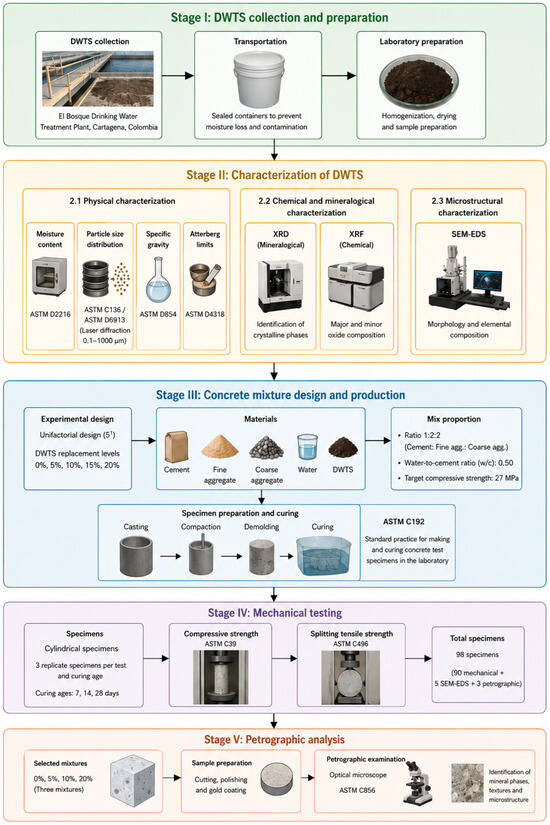
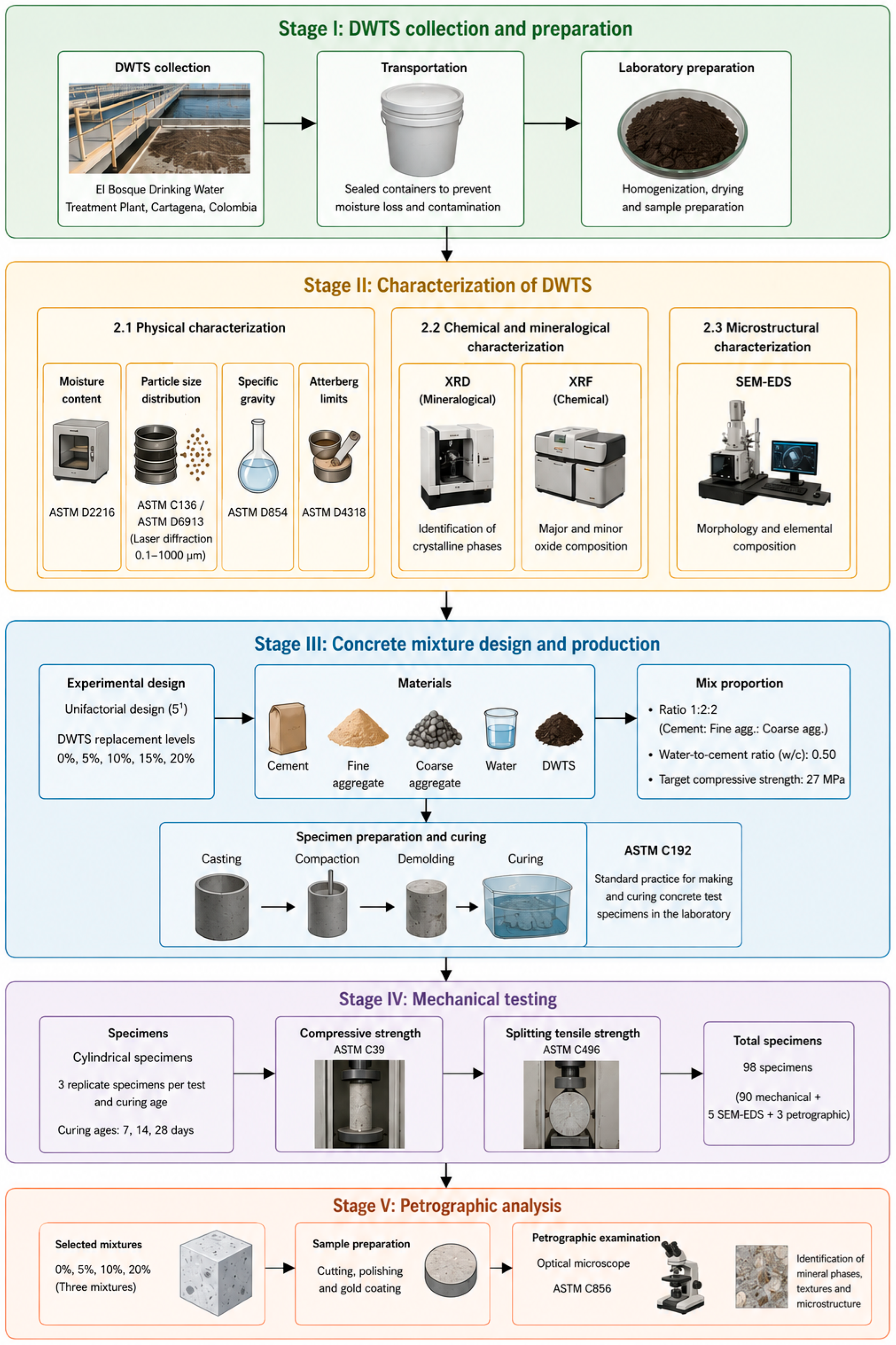
This section describes the materials, experimental procedures, and analytical techniques used to evaluate the potential use of sludge from drinking water. The research aimed to investigate the qualitative relationship between the physicochemical and microstructural characteristics of DWTS and the mechanical behavior of concrete mixtures incorporating this material. The experimental program included DWTS characterization, concrete production, mechanical testing, and petrographic evaluation to qualitatively interpret the microstructural features associated with the observed mechanical behavior. The entire experimental workflow used in this research is shown in Figure 1.
Figure 1.
Experimental workflow adopted in the study.
2.1. Physical Characterization of DWTS
Drinking water treatment sludge (DWTS) was collected from the El Bosque Drinking Water Treatment Plant, operated by Aguas de Cartagena, in Cartagena de Indias, Colombia. The sludge was transported to the laboratory in sealed containers to prevent moisture loss and external contamination. Prior to testing, the material was homogenized and prepared according to the requirements of each characterization procedure.
The physical characterization of the DWTS included moisture content, particle size distribution, specific gravity, and Atterberg limits. Moisture content was determined by oven-drying representative sludge samples until a constant mass.
Particle-size distribution was evaluated by conventional sieve analysis. The analysis was used to determine the mass fraction of dried DWTS passing the No. 200 sieve (75 μm). Specific gravity was determined using a pycnometer-based procedure. The liquid limit, plastic limit, and plasticity index were determined to assess the consistency and plastic behavior of the sludge, given its potential interaction with the cementitious matrix when used as a partial replacement for fine aggregate.
2.2. Chemical, Mineralogical, and Microstructural Characterization
2.2.1. Mineralogical Characterization, XRD
The mineralogical composition of the DWTS was determined by X-ray diffraction (XRD). Before the analysis, the sludges were dried, ground, and thoroughly mixed to obtain a representative powdered sample. The XRD measurements were carried out using a Bruker D4 Endeavor diffractometer fitted with a LYNXEYE detector (Bruker AXS GmbH, Karlsruhe, Germany), using Cu Kα radiation (λ = 1.5406 Å) and a Ni filter at 40 kV and 30 mA. The data were collected over a 2θ range of 5–70°, with a step size of 0.015° and a counting time of 0.4 s per step. Quantitative phase analysis was performed by the Rietveld method using TOPAS software (Version 7). Zincite (ZnO) was added as an internal standard at 20 wt.%, corresponding to a DWTS-to-ZnO mass ratio of 8:2. The crystalline phases and the internal standard were included in the refinement, from which the amorphous fraction of the complete analyzed DWTS–ZnO mixture was estimated. The refinement yielded an amorphous fraction of 48.85 wt.% on the basis of the total analyzed mixture.
2.2.2. Chemical Characterization, XRF
The chemical composition of the DWTS was determined by X-ray fluorescence (XRF) at the Universidad de los Andes, Colombia. Prior to analysis, the sample was dried, crushed, and homogenized. The available original analytical record does not specify whether the final XRF specimen was prepared as a pressed pellet or a fused bead; therefore, this detail is not assigned in the present manuscript. The XRF results reported herein correspond to selected major oxides and trace elements identified in the DWTS and were used to complement the mineralogical characterization obtained by XRD. Loss on ignition (LOI) was not determined; consequently, the reported oxide values should not be interpreted as a complete compositional mass balance.
2.2.3. Microstructural Characterization, SEM-EDS
The morphology and elemental composition of the DWTS were examined using scanning electron microscopy coupled with energy-dispersive spectroscopy (SEM-EDS; Tescan, Brno, Czech Republic) at the MicroCore facility (Universidad de los Andes, Bogotá, Colombia). The samples were dried and mounted on suitable supports before observation. SEM images were used to analyze particle morphology, texture, and surface characteristics, while EDS spectra provided localized elemental information. This analysis was used as a qualitative complementary tool to characterize the morphology and elemental composition of the DWTS particles. It was not intended to provide quantitative information on pore structure, phase abundance, or hydration products within the hardened concrete.
2.3. Concrete Mixture Design and Mechanical Testing
2.3.1. Concrete Mixture Design
A unifactorial experimental design (51) was adopted, considering the DWTS replacement percentage as the only independent variable. Five replacement levels (0%, 5%, 10%, 15%, and 20%) were selected based on previous studies reporting that this range provides an appropriate balance between the valorization of drinking water treatment sludge and the preservation of concrete mechanical performance. The DWTS replacement percentages were calculated on a dry mass basis. Prior to concrete production, the sludge was oven-dried to constant mass, and the corresponding dry mass of DWTS was used to replace an equivalent dry mass of natural fine aggregate.
Furthermore, the preliminary characterization of the investigated DWTS revealed an exceptionally high moisture content, high plasticity index, and predominantly fine particle-size distribution, suggesting that substantially higher replacement levels may result in increased water demand, reduced workability, and greater losses in mechanical performance. Consequently, replacement levels above 20% were considered beyond the scope of this initial feasibility assessment, which aimed to identify practical incorporation levels while maintaining acceptable engineering performance (Table 1) [22,23]. The concrete mixtures were prepared using commercially available general-purpose gray cement (Argos, Cartagena, Colombia), classified as Type GU according to ASTM C1157 [24], natural sand as fine aggregate, natural coarse aggregate, potable water, and DWTS. The natural sand exhibited a specific gravity of 2.87, a natural moisture content of 6.46%, and a sand equivalent of 75%. Its particle-size distribution is summarized in Table 2. The main physical and granulometric characteristics of the coarse aggregate, obtained from the supplier’s technical specifications, are also presented in Table 3. Concrete mixtures were proportioned using a 1:2:2 ratio of cement, fine aggregate, and coarse aggregate, respectively, with a target compressive strength of 27 MPa (Table 4). A target compressive strength of 27 MPa was selected as a representative strength level for conventional concrete applications and was maintained for all mixtures to provide a common reference for assessing the effect of DWTS replacement on mechanical performance. The target value was not intended to represent an optimized mixture strength, but rather to establish a consistent baseline against which the different replacement levels could be compared. The material quantities reported in Table 4 correspond to the laboratory batches employed for specimen fabrication and do not represent the composition of 1 m3 of concrete. All mixtures were prepared with a constant nominal water-to-cement ratio (w/c) of 0.50 to isolate the effect of DWTS replacement level on concrete performance.
Table 1.
Experimental program and number of specimens included in the mechanical analyses.
Table 2.
Main characteristics of the natural fine aggregate used in the concrete mixtures.
Table 3.
Main characteristics of the natural coarse aggregate.
Table 4.
Mix proportions of concrete mixtures.
Cylindrical concrete specimens (3 in × 6 in; 76.2 mm × 152.4 mm) were prepared and cured in accordance with ASTM C192/C192M [25]. The fresh concrete was placed in molds and compacted to minimize air voids. After demolding, the specimens were cured under controlled laboratory conditions until the corresponding testing age. The experimental program included specimens for compressive strength, splitting tensile strength, SEM-EDS analysis, and petrographic examination.
The natural sand had an initial moisture content of 6.46%. Before mixture preparation, the sand was oven-dried, and the aggregate masses reported in Table 4 were therefore based on dry material. Consequently, the initial moisture contained in the natural sand was not included as mixing water, and no moisture correction was applied to the batch water. Prior to incorporation into the concrete mixtures, the drinking water treatment sludge (DWTS) was also oven-dried at 110 °C for 24 h to substantially reduce its moisture content, and subsequently particle-size conditioned, before being used as a partial replacement for natural sand on a dry mass basis. The mixtures were tested at replacement levels of 5%, 10%, 15%, and 20%, while keeping the cement content, aggregate proportions, and nominal water-to-cement ratio constant. Each mixture was given 5.02 L of additional water per 10.04 kg of cement, yielding a nominal water-to-cement ratio (w/c) of 0.50. The DWTS was therefore added in its dried form rather than using it at its natural moisture content (338.37%), and its initial moisture was not taken into account when calculating the mixing water.
2.3.2. Mechanical Testing
For each mixture, three cylindrical specimens were originally prepared for compressive strength and three for splitting tensile strength at each curing age (7, 14, and 28 days). Compressive strength tests were performed according to ASTM C39 [26], while splitting tensile strength tests were performed according to ASTM C496 [27]. This corresponded to 90 mechanical-test specimens: 45 for compressive strength and 45 for splitting tensile strength. Valid results were obtained for all three replicates per condition for M0, M10, and M20, whereas two valid results per curing age and mechanical test were available for M5 and M15. Consequently, 39 valid compressive-strength results and 39 valid splitting-tensile-strength results were included in the analysis. Together with five specimens allocated to SEM–EDS analysis and three specimens allocated to petrographic examination, a total of 98 specimens were originally prepared in the experimental program (Table 1).
2.3.3. Statistical Analysis
Mechanical test results are expressed as mean ± standard deviation (SD). Three specimens were originally prepared for each mixture, curing age, and mechanical test condition. For mixtures M0, M10, and M20, three valid results (n = 3) were available for each curing age and mechanical test. For mixtures M5 and M15, two valid results (n = 2) were available for each curing age and mechanical test. Accordingly, the statistical analysis was based on n = 2–3 depending on the mixture. The detailed records required to establish the specific reason for the unavailable third result in the M5 and M15 conditions were not available; therefore, no further exclusion criterion is assigned or interpreted in this study. The coefficient of variation (CV) was calculated to assess the relative variability of the measurements. The individual valid experimental results are provided in Appendix A.
Given the small number of valid replicates per experimental condition, the statistical analyses were considered exploratory. Formal normality tests were not performed because of their limited statistical power at these sample sizes. To explore the effect of DWTS replacement level, one-way analysis of variance (ANOVA) was performed independently for each curing age (7, 14, and 28 days) and for each mechanical property. Statistical significance was established at p < 0.05. When statistically significant differences were identified by ANOVA, pairwise comparisons among mixtures were performed using the Tukey–Kramer post-hoc test, which accommodates unequal sample sizes. Accordingly, the ANOVA and post-hoc results were interpreted as complementary statistical evidence supporting the observed experimental trends rather than as definitive inferential conclusions. Detailed pairwise comparisons are provided in Appendix A.
2.4. SEM–EDS Analysis of Hardened Concrete
SEM–EDS analysis was performed on hardened concrete specimens from all five mixtures (M0, M5, M10, M15, and M20) after 28 days of curing to qualitatively examine the morphology of the cementitious matrix and its local elemental composition. Representative fragments were obtained from the hardened concrete specimens and oven-dried at 60 °C for 24 h to reduce residual moisture. The fragments were mounted on aluminum stubs using conductive carbon tape and, when necessary, coated with a thin gold layer to improve surface conductivity. No polishing procedure was applied because fractured surfaces were examined to preserve the morphology of the cementitious matrix.
Microstructural observations were performed using a TESCAN LYRA-3 SEM-FIB system (TESCAN ORSAY HOLDING, Brno-Kohoutovice, Czech Republic) at accelerating voltages of 15–20 kV, using secondary-electron (SE) and backscattered-electron (BSE) imaging as appropriate. Multiple representative areas of each specimen were examined at different magnifications, and localized EDS analyses were performed on selected regions of the cementitious matrix and DWTS-containing zones. The SEM–EDS observations were used qualitatively and were not intended to provide quantitative measurements of porosity, hydration-product abundance, or phase distribution.
Although SEM–EDS analysis was conducted on all five concrete mixtures, the detailed microstructural discussion in Section 3.3 presents representative SEM–EDS observations for M0, M5, and M20. These mixtures were selected for presentation to represent the control concrete, the DWTS mixture exhibiting mechanical performance closest to the control, and the highest DWTS replacement level, respectively. The intermediate mixtures M10 and M15 were also analyzed by SEM–EDS but are not presented in detail for conciseness.
2.5. Petrographic Analysis
Petrographic analysis was performed on selected hardened concrete samples to evaluate the effect of DWTS incorporation on the material’s microstructure. Three representative mixtures were selected for this analysis: the control concrete containing 0% DWTS, the mixture containing 5% DWTS, and the mixture containing 20% DWTS. These mixtures were selected to represent the reference condition, the best-performing concrete incorporating DWTS, and the highest replacement level associated with the greatest reduction in mechanical performance, respectively. This selection was intended to evaluate the microstructural characteristics corresponding to the lower and upper bounds of the investigated replacement range. Although including the intermediate replacement levels (10% and 15%) would have provided a more detailed assessment of the progressive microstructural evolution, this was beyond the scope of the present study.
The analysis was conducted on thin sections prepared from hardened concrete specimens in accordance with ASTM C856 [28]. The sections were cut parallel to the longitudinal axis of the cylindrical specimens. The samples were cleaned, cut with a diamond saw, polished, and vacuum-impregnated with blue-dyed resin to facilitate the identification of pores and microcracks. The final thin sections had an approximate thickness of 25 μm. Petrographic observations were carried out using stereomicroscopy and polarized light microscopy. The analysis focused on the cementitious matrix, aggregate distribution, porosity, microcracking, and presence and distribution of DWTS particles within the concrete matrix.
Quantitative petrographic characterization was performed using a point-counting procedure based on a 1.5 mm × 1 mm counting grid, with an average of 906 counting points evaluated per specimen. Petrographic examinations were conducted using an Olympus CX31 P polarized-light microscope (Olympus Corporation, Tokyo, Japan) equipped with 4×, 10×, and 20× objectives, while stereomicroscopic observations were performed at magnifications ranging from 7.5× to 45×. The analysis focused on directly distinguishable petrographic features, including the cementitious matrix, microcracking, and microporosity. Although hydration-related features may be observed within the cement paste by optical petrography, this technique was not considered sufficient for phase-specific quantification of C–S–H in the absence of independent hydration analyses. Consequently, no quantitative C–S–H content is reported in this study.
One representative thin section was analyzed for each selected mixture (M0, M5, and M20). Accordingly, the reported area fractions represent estimates obtained from individual representative sections rather than mean values from replicate petrographic specimens, and no between-specimen uncertainty could be calculated. These results should therefore be interpreted as descriptive petrographic indicators and not as statistically representative quantitative measurements of the complete concrete mixtures.
3. Results
3.1. DWTS Characterization
The drinking water treatment sludge (DWTS) exhibited physical characteristics typical of residues generated during coagulation, flocculation, and sedimentation processes. The material showed a very high natural moisture content, approximately 338%, indicating a strong capacity for water retention. This behavior is consistent with the presence of fine particles, colloidal fractions, and hydrated compounds commonly found in sludge from drinking water treatment plants.
The Atterberg limits confirmed the highly plastic nature of the material. The liquid limit, plastic limit, and plasticity index were 315.89%, 162.83%, and 153.06%, respectively (Table 5). These values indicate that the DWTS cannot be considered equivalent to conventional fine aggregate, as its high plasticity and clay-rich mineralogical composition may be associated with increased water demand and reduced workability, and could potentially contribute to drying shrinkage when incorporated without prior conditioning. These effects, however, were not directly evaluated in the present study.
Table 5.
Physical properties of DWTS.
The exceptionally high plasticity index of the DWTS is consistent with its mineralogical composition. XRD analysis identified kaolinite and illite as the principal clay minerals, together with a predominance of amorphous aluminosilicate material. Although kaolinite generally exhibits relatively low swelling potential compared with expansive clay minerals such as smectite, the combined presence of fine clay particles and amorphous phases can substantially increase water retention and plastic behavior. Consequently, when incorporated into concrete, these characteristics may increase the water demand of the mixture and could contribute to greater drying shrinkage and dimensional instability, particularly at higher replacement levels. Since drying shrinkage was not evaluated in the present study, these potential effects should be regarded as hypotheses based on the physicochemical characteristics of the DWTS and should be confirmed in future investigations.
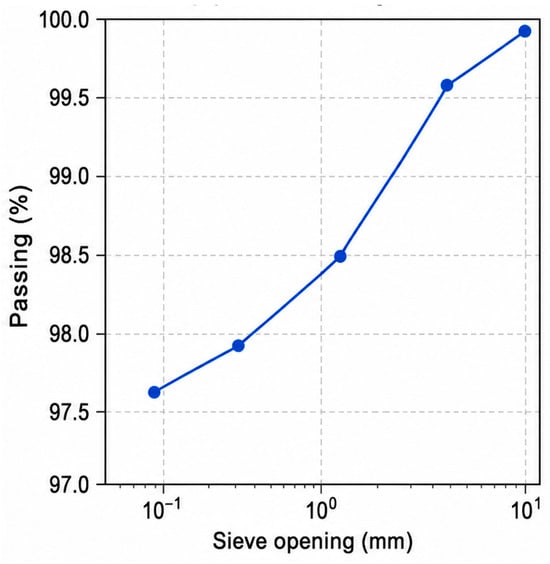
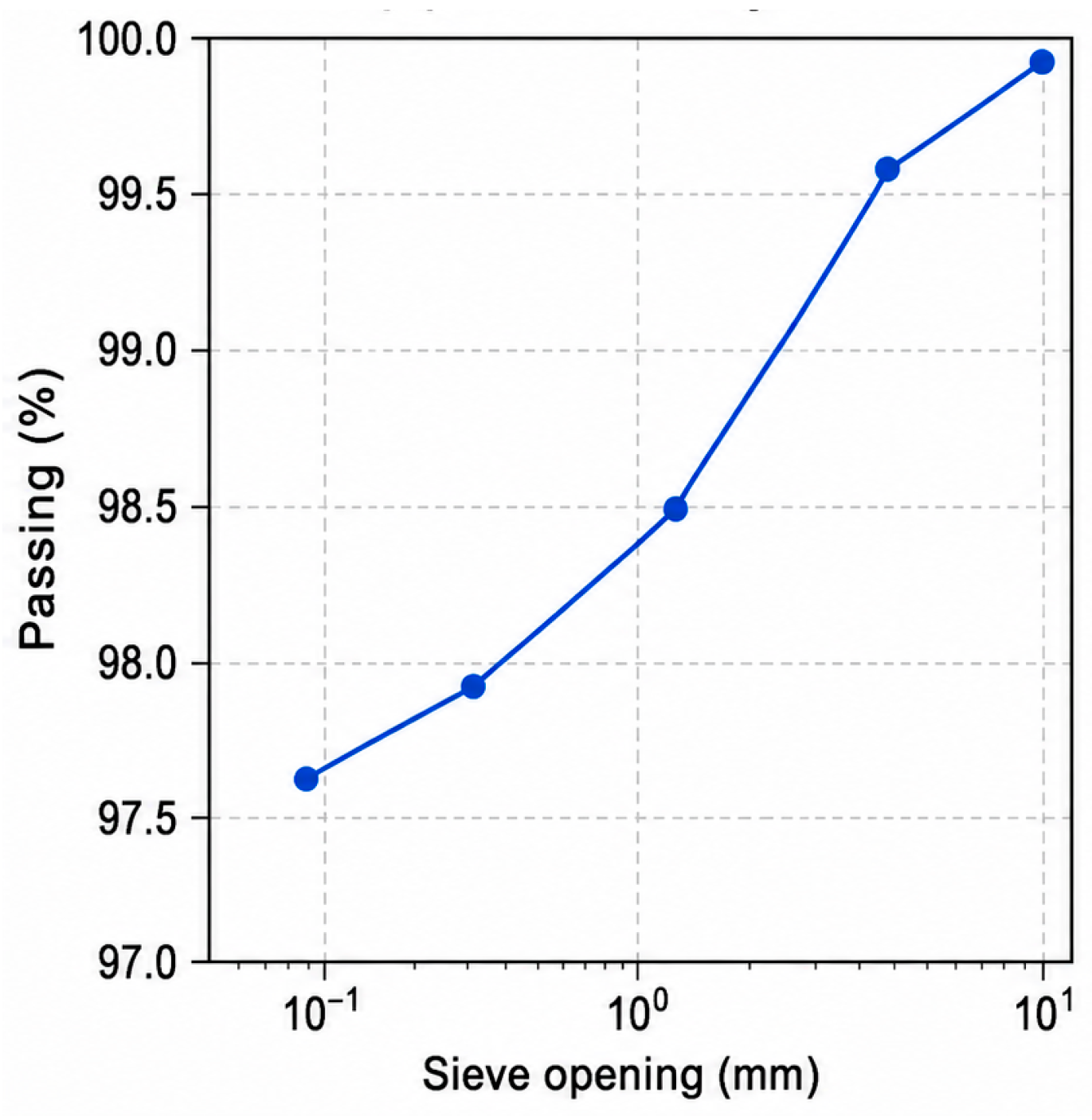
Conventional sieve analysis showed that 97.64% of the dried DWTS passed the No. 200 sieve (75 μm), confirming the predominance of particles within the fine fraction (Figure 2). This result is consistent with the highly plastic behavior of the material and supports its characterization as a fine-grained residue rather than as a conventional natural fine aggregate. The specific gravity of the DWTS was 2.29, consistent with a predominantly mineral fraction (Figure 2).
Figure 2.
Particle-size distribution of DWTS determined by conventional sieve analysis.
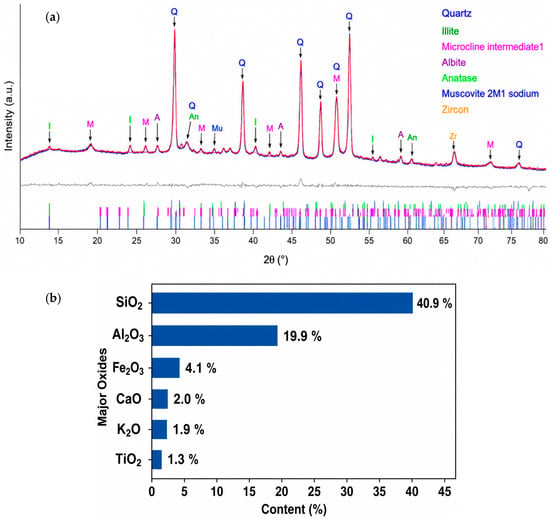
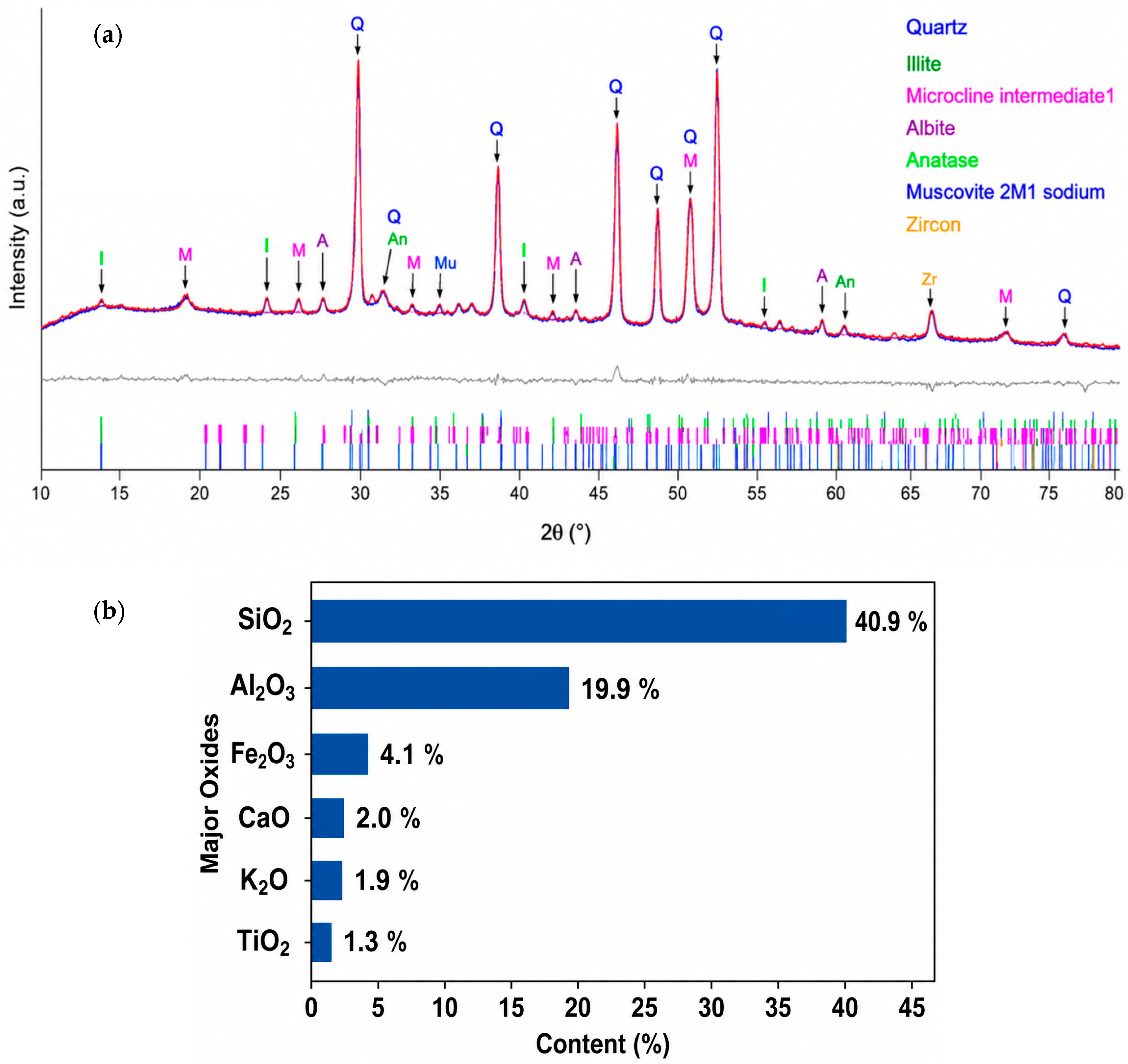
The Rietveld refinement yielded an amorphous fraction of 48.85 wt.% relative to the complete analyzed mixture, which contained 80 wt.% DWTS and 20 wt.% ZnO internal standard. Because the ZnO addition diluted the original DWTS in the analyzed specimen, the amorphous fraction was recalculated on a DWTS-only basis by dividing the refined value by the DWTS mass fraction: 48.85/0.80 = 61.06 wt.%. Accordingly, the amorphous content of the original DWTS was reported as 61.1 wt.%.
Among the selected major oxides reported by XRF, SiO2 and Al2O3 showed the highest concentrations, at 40.9% and 19.9%, respectively, followed by Fe2O3 (4.1%), CaO (2.0%), K2O (1.9%), and TiO2 (1.3%). Loss on ignition (LOI) was not determined; therefore, these values represent selected oxide concentrations rather than a complete compositional mass balance. This chemical composition confirms the aluminosilicate character of the DWTS and supports its classification as a mineral-rich residue. However, although the material contains a high proportion of amorphous phases together with significant amounts of silica and alumina, these characteristics alone do not demonstrate pozzolanic activity or chemical reactivity within the cementitious matrix. Dedicated pozzolanic activity tests were beyond the scope of the present study and are required to evaluate the potential contribution of the DWTS to cement hydration. Furthermore, the high plasticity and fine particle content indicate that its incorporation as a fine aggregate replacement should be limited and carefully controlled.
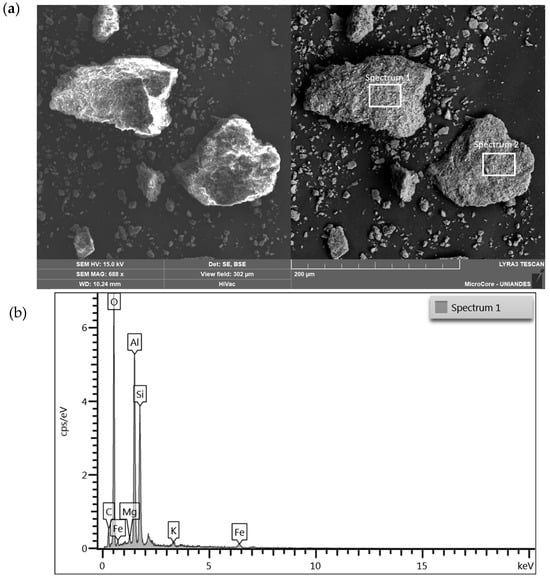
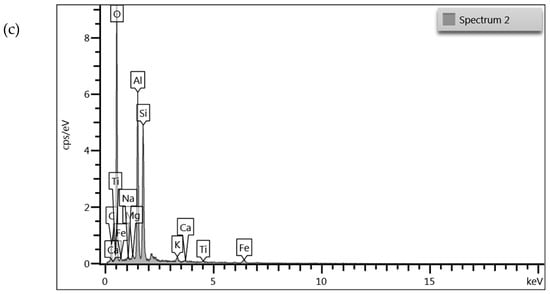
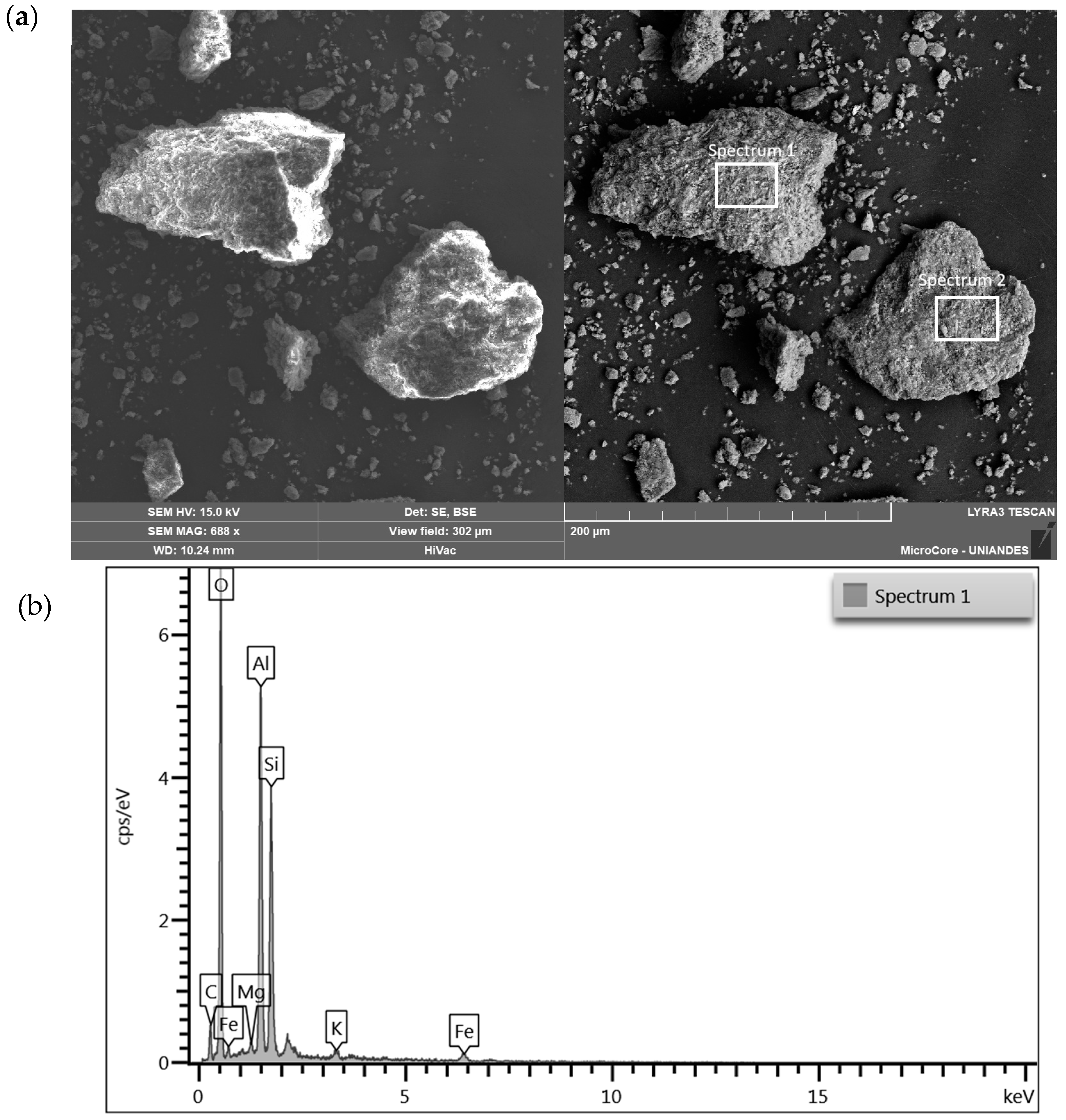
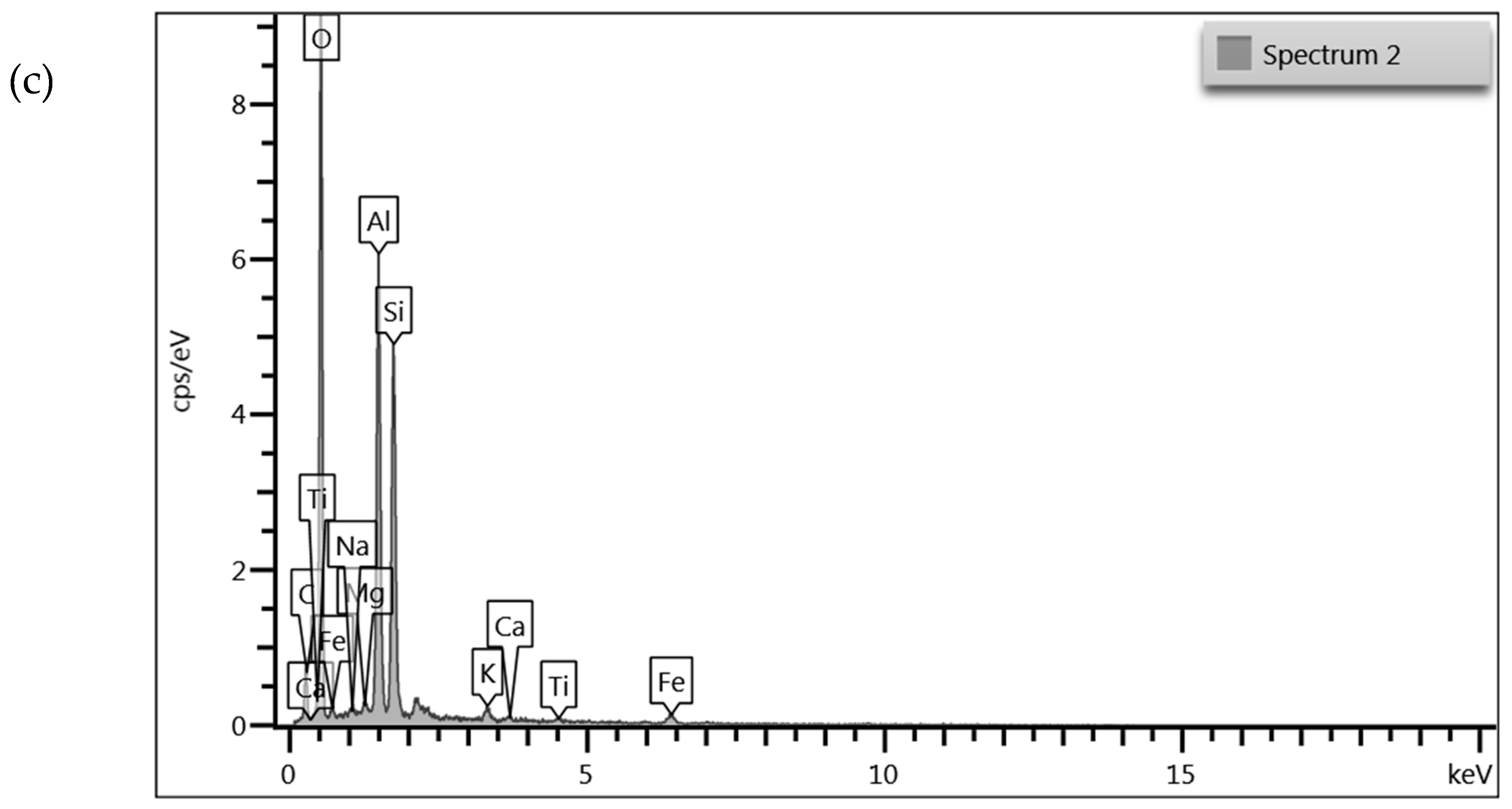
The SEM micrograph revealed irregular, agglomerated particles with rough surface textures, and fine particles adhered to larger aggregates. The EDS spectra obtained from two representative locations showed a relatively homogeneous elemental composition, dominated by oxygen (≈50 wt.%), carbon (14–16 wt.%), aluminum (15–17 wt.%), and silicon (13–14 wt.%), indicating the predominance of aluminosilicate compounds. Minor amounts of iron (2.2–2.8 wt.%), potassium (<1 wt.%), and magnesium were detected in both analyses, while sodium, calcium, and titanium were identified in trace concentrations at one analysis point. The predominance of Si and Al is consistent with the XRD and XRF results, which confirmed the presence of aluminosilicate minerals and identified SiO2 and Al2O3 as the major oxides. These observations indicate that DWTS is primarily composed of aluminosilicate particles with heterogeneous, rough morphologies that may influence their interaction with the cementitious matrix. However, the SEM-EDS analyses performed in this study were qualitative and should not be interpreted as direct evidence of changes in pore structure, hydration products, or matrix continuity within the hardened concrete (Figure 3 and Figure 4).
Figure 3.
Mineralogical and chemical characterization of DWTS: (a) XRD diffractogram showing the identified crystalline phases and amorphous fraction, and (b) selected major oxides determined by XRF analysis.
Figure 4.
SEM–EDS characterization of DWTS: (a) SEM micrographs and locations selected for EDS analysis; (b) EDS spectrum of region 1, and (c) EDS spectrum of region 2.
Although the characterization performed in this study provided comprehensive information regarding the physical, mineralogical, chemical, and microstructural properties of the investigated DWTS, additional engineering properties such as water absorption, organic matter content, pH, and batch-to-batch variability were not evaluated. These parameters may further influence the behavior of DWTS when incorporated into cement-based materials. They should therefore be considered in future studies aimed at optimizing mixture design and assessing the broader applicability of this residue. Likewise, assessing potentially harmful constituents and leaching behavior would be valuable for supporting large-scale environmental applications, although these aspects were beyond the scope of the present investigation.
3.2. Mechanical Performance
The incorporation of DWTS as a partial replacement of fine aggregate produced a progressive reduction in the mechanical performance of concrete. This trend was observed for both compressive strength and splitting tensile strength and became more evident as the replacement level increased.
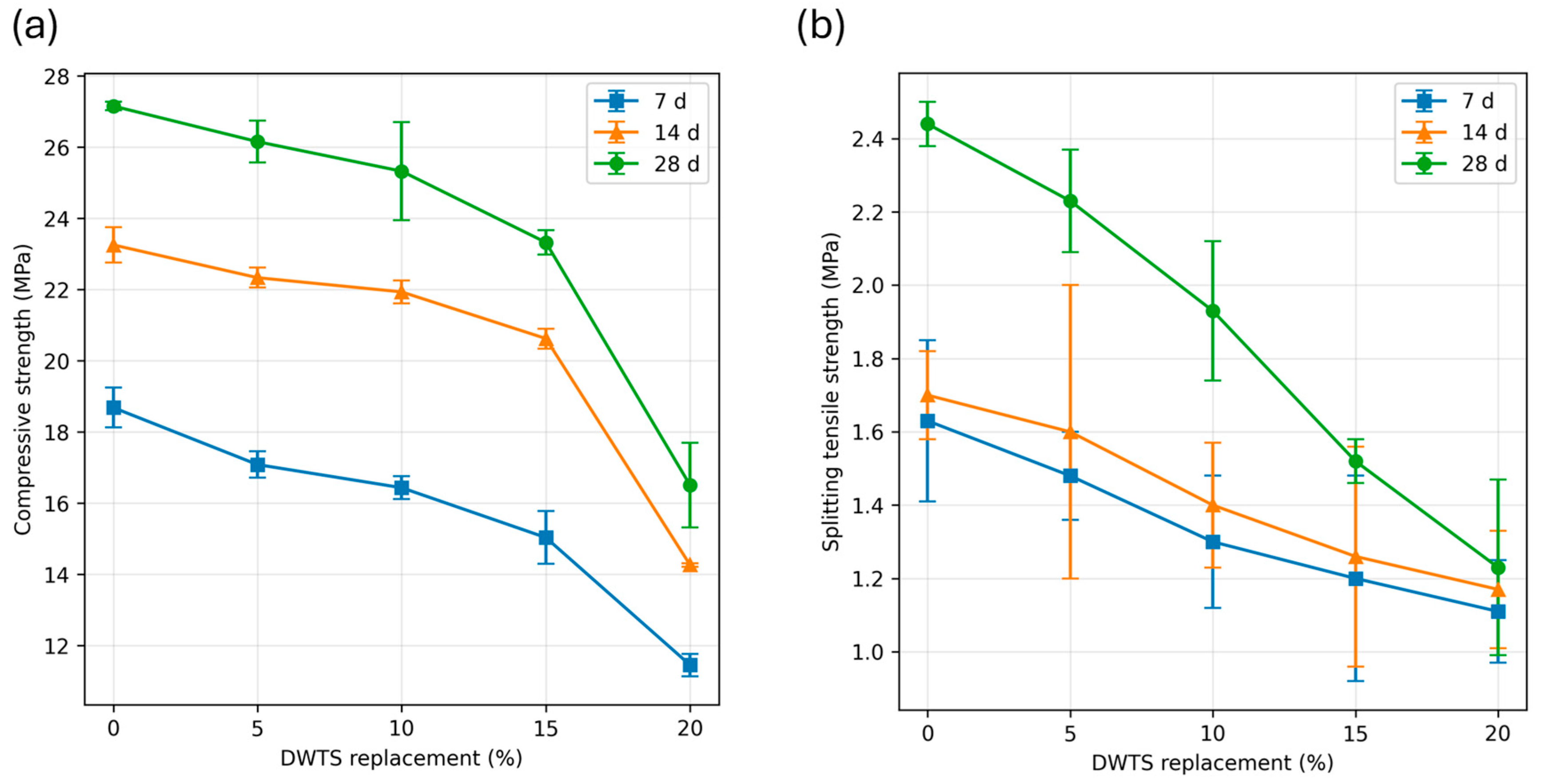
At 7 days, the control mixture reached an average compressive strength of 18.68 MPa, while mixtures containing 5%, 10%, 15%, and 20% DWTS reached 17.08, 16.43, 15.03, and 11.45 MPa, respectively. A similar trend was observed at 14 days, when compressive strength decreased from 23.25 MPa in the control mixture to 14.26 MPa in the mixture with 20% DWTS. At 28 days, the control mixture reached 27.15 MPa, slightly exceeding the design strength, whereas the 5% DWTS mixture achieved 26.15 MPa, corresponding to 96.9% of the target strength. The 10%, 15%, and 20% mixtures reached 25.32, 23.32, and 16.50 MPa, respectively (Table 6, Figure 5).
Table 6.
Mechanical properties of concrete mixtures.
Figure 5.
Effect of DWTS replacement percentage on (a) compressive strength and (b) splitting tensile strength of concrete mixtures after 7, 14, and 28 days of curing. Error bars represent ±1 standard deviation (SD). For M0, M10, and M20, n = 3 at each curing age and test condition; for M5 and M15, n = 2.
The splitting tensile strength followed the same general trend. At 28 days, the control mixture reached 2.44 MPa, while the mixtures with 5%, 10%, 15%, and 20% DWTS reached 2.23, 1.93, 1.52, and 1.23 MPa, respectively. The reduction in tensile strength was more sensitive to increases in DWTS content than compressive strength. This behavior may be associated with changes in the internal cohesion of the cementitious matrix and the quality of the interfacial transition zone caused by the incorporation of DWTS. However, because fresh-state properties such as workability, fresh density, air content, and rheological behavior were not evaluated, these mechanisms should be regarded as plausible interpretations rather than experimentally verified causes.
The coefficients of variation obtained for both compressive and splitting tensile strengths were generally below 10% for most mixtures, indicating acceptable experimental variability. Higher CV values were observed for some DWTS replacement levels in splitting tensile strength, which is expected given the greater sensitivity of this property to microstructural heterogeneities. The complete statistical analysis, including CV values, is provided in Table A1 to Table A5.
ANOVA indicated that DWTS substitution significantly affected the compressive strength of the concrete at all curing ages (p < 0.001). Furthermore, the high F-values obtained at 7 days (F = 102.31), 14 days (F = 350.29), and 28 days (F = 60.18) indicate that the variability in compressive strength is strongly associated with the level of DWTS substitution. This behavior indicates that the incorporation of DWTS exerts an immediate and marked influence on the load-bearing capacity of the cementitious matrix, even at early curing ages. The reduction in compressive strength observed with increasing DWTS content is consistent with the sludge’s high proportion of fine particles and water-retention capacity; these characteristics may have contributed to changes in cement hydration, increased porosity, and reduced continuity of the interfacial transition zone between the aggregates and the cement paste. However, these mechanisms were not directly quantified in the present study.
In contrast, the effect of DWTS incorporation on splitting tensile strength showed a different pattern. No statistically significant differences were identified among the mixtures at 7 days (F = 3.27; p = 0.072) or 14 days (F = 2.81; p = 0.100), indicating that, during the initial curing stages, the tensile behavior of the concrete is less sensitive to variations in DWTS content. However, statistically significant differences emerged after 28 days of curing (F = 25.35; p < 0.001), suggesting that the influence of DWTS on tensile strength becomes more pronounced as the cementitious matrix evolves.
The Tukey–Kramer multiple comparison test revealed that low levels of DWTS substitution (5% and 10%) did not significantly affect 28-day compressive strength compared to the control mix. In contrast, substitution levels of 15% and 20% resulted in statistically significant reductions in compressive strength (p < 0.05). Overall, the results indicate that incorporating DWTS at low replacement levels may be feasible without severely compromising the concrete’s mechanical performance, whereas higher substitution levels negatively affect the development of the cementitious matrix.
Regarding splitting tensile strength, statistically significant differences were observed only after 28 days of curing. The Tukey–Kramer test indicated that reductions in tensile strength occurred more gradually than those observed in compressive strength, suggesting that the detrimental effects of DWTS incorporation on tensile behavior become apparent only after prolonged curing periods. The results of the Tukey–Kramer test are shown in the Table A2 and Table A3.
The ANOVA results indicate that DWTS replacement level had a markedly stronger influence on compressive strength than on splitting tensile strength during the early curing stages. The high F-values obtained for compressive strength demonstrate that the replacement percentage explained a substantial proportion of the observed variability. In contrast, the absence of statistically significant differences in splitting tensile strength at 7 and 14 days suggests that the influence of DWTS on tensile behavior developed more gradually and became evident only after 28 days of curing.
3.3. Microstructural Analysis
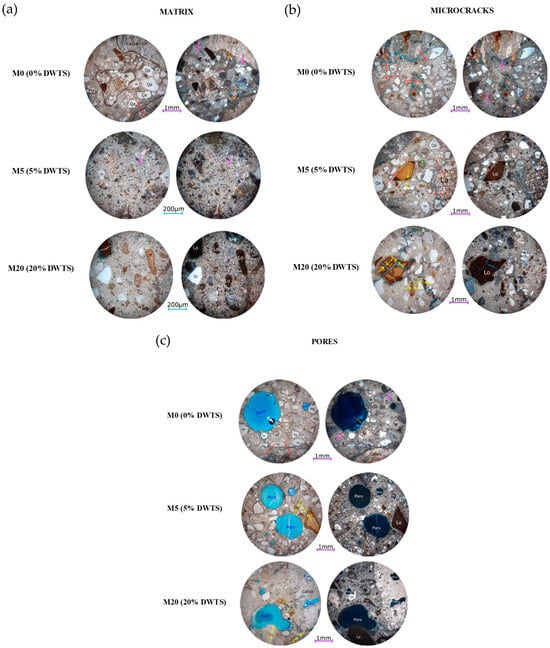
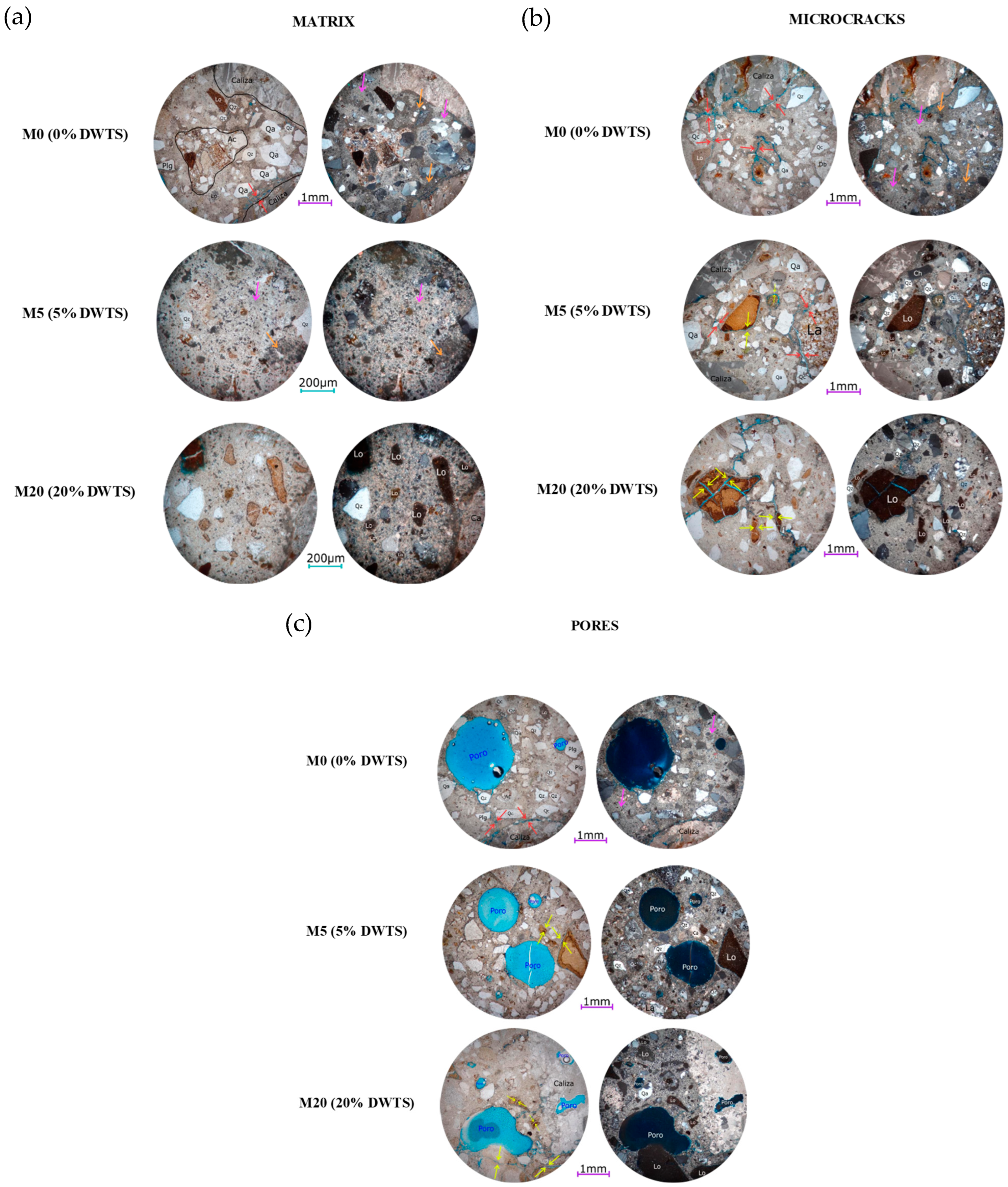
Petrographic analysis provided evidence of the microstructural changes associated with DWTS incorporation (Table 7 and Figure 6). Three representative mixtures were analyzed: the control concrete, the 5% DWTS mixture, and the 20% DWTS mixture. The results showed a progressive reduction in cementitious matrix quality as sludge content increased (Table 7).
Table 7.
Petrographic indicators of hardened concrete.
Figure 6.
Petrographic characterization of hardened concrete incorporating DWTS. Representative thin-section photomicrographs illustrating (a) matrix characteristics, (b) microcracks, and (c) pore features in hardened concrete mixtures M0 (0% DWTS), M5 (5% DWTS), and M20 (20% DWTS). For each mixture, the left image shows plane-polarized light (PPL), and the right image shows cross-polarized light (XPL). Abbreviations: Qa, quartz sandstone; Qz, quartz; Plg, plagioclase; Qc, quartzite; Ch, chert; and Lo, lithic fragment.
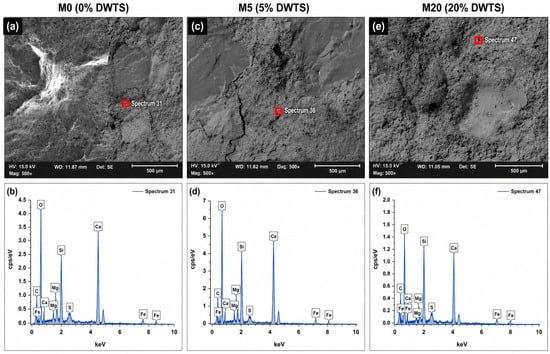
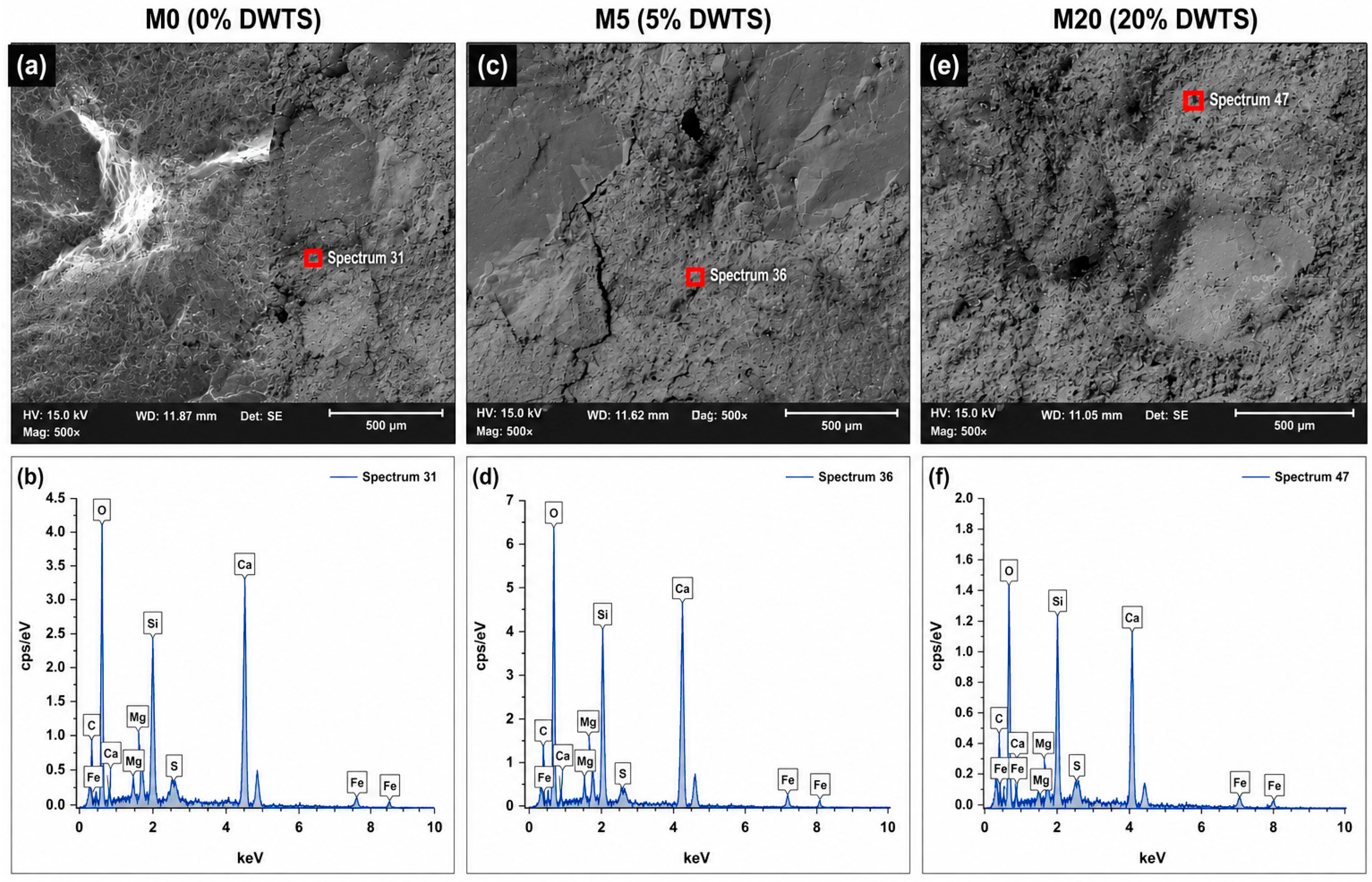
Two distinct SEM–EDS analyses were conducted in this study. The SEM–EDS results presented in Section 3.1 (Figure 4) correspond to the raw DWTS before incorporation into concrete and were used to characterize particle morphology and local elemental composition. In contrast, the SEM–EDS observations presented later in this section (Figure 7) correspond to 28-day hardened concrete and were used as complementary qualitative observations of matrix morphology and local elemental composition. Neither SEM–EDS dataset was used for quantitative determination of porosity, hydration-product abundance, or phase distribution.
Figure 7.
SEM micrographs and corresponding EDS spectra of hardened concrete mixtures containing 0% (M0), 5% (M5), and 20% (M20) DWTS. Panels (a,b) correspond to the SEM image and EDS spectrum of the control mixture (M0), respectively. Panels (c,d) show the SEM image and EDS spectrum of the mixture containing 5% DWTS (M5), respectively. Panels (e,f) present the SEM image and EDS spectrum of the mixture containing 20% DWTS (M20), respectively. Red squares indicate the locations selected for EDS analysis.
The estimated cementitious-matrix area fraction decreased from 23.6% in the control concrete to 20.8% and 18.9% in the mixtures containing 5% and 20% DWTS, respectively. This descriptive petrographic trend indicates a lower relative presence of cementitious matrix within the analyzed thin-section areas as DWTS replacement increased. Because phase-specific hydration products were not independently quantified, these results should not be interpreted as evidence of a reduction in C–S–H formation or degree of cement hydration.
Microcracking also increased with DWTS content. The total microcracking indicator increased from 7.4% in the control mixture to 10.6% in the 5% mixture and 18.4% in the 20% mixture. Microcracks were observed in the cement paste, at aggregate interfaces, and within aggregate-related zones, indicating a progressive increase in internal discontinuities as the DWTS replacement level increased. Although these observations are consistent with the reduction in mechanical performance, the present study did not include quantitative characterization of the interfacial transition zone (ITZ), and therefore any effects on matrix–aggregate bonding should be regarded as plausible interpretations rather than directly demonstrated mechanisms.
The porosity indicators followed the same tendency. Total microporosity increased from 5.7% in the control mixture to 6.7% in the 5% mixture and 8.6% in the 20% mixture. Similarly, although the petrographic observations indicated a reduction in the relative proportion of cementitious matrix with increasing DWTS content, the present study did not include hydration analyses capable of directly quantifying changes in C-S-H formation or cement hydration products. Consequently, these effects should be interpreted cautiously and verified through complementary techniques in future investigations.
SEM–EDS observations of the hardened concrete provided complementary qualitative information to the petrographic observations (Figure 7). The control concrete exhibited a comparatively homogeneous matrix morphology, whereas the DWTS-containing specimens showed greater local heterogeneity. Localized EDS analyses of DWTS-containing regions also showed variations in elemental composition, including Al- and Fe-rich areas consistent with the incorporation of the aluminosilicate-rich sludge. Because these observations were obtained from selected areas and were not based on quantitative phase mapping or pore-structure analysis, they are interpreted only as qualitative microstructural evidence and not as measurements of hydration-product abundance, porosity, or phase distribution.
3.4. Relationship Between Microstructure and Mechanical Behavior
The mechanical behavior of the concrete mixtures showed qualitative agreement with the microstructural trends observed in the representative petrographic specimens. At low replacement levels, particularly 5%, the sludge appears to act primarily as a fine mineral filler, producing only minor changes in the cementitious matrix and allowing the concrete to maintain a compressive strength close to that of the reference mixture. This explains why the 5% mixture reached 26.15 MPa at 28 days, equivalent to 96.9% of the design strength.
However, as the replacement level increased, the high plasticity, fine particle content, and water-retention capacity of the DWTS became increasingly detrimental. These characteristics likely increased the internal water demand and reduced the effective quality of the cementitious matrix. The petrographic observations were consistent with this interpretation, showing a lower cementitious-matrix area fraction, greater microcracking, and increased microporosity as sludge content increased.
The reduction in tensile strength was particularly important because tensile behavior is more sensitive to defects, pores, microcracks, and weak interfacial transition zones. Therefore, the marked decrease in splitting tensile strength at 15% and 20% DWTS is consistent with the observed increase in internal discontinuities.
Therefore, under the investigated laboratory conditions, lower DWTS replacement levels resulted in substantially smaller mechanical losses than higher replacement levels, with the 5% mixture providing the closest performance to the control concrete. In contrast, the 20% replacement level showed pronounced reductions in mechanical strength together with greater microcracking and microporosity in the representative petrographic specimen. These findings should be regarded as preliminary evidence of mechanical and microstructural behavior rather than as validation of DWTS-containing concrete for practical applications, which would require evaluation of fresh-state properties, durability, shrinkage, and leaching behavior.
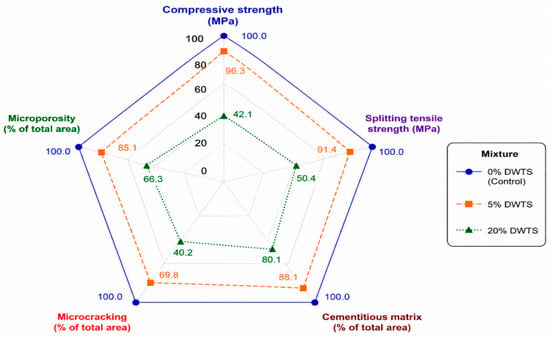
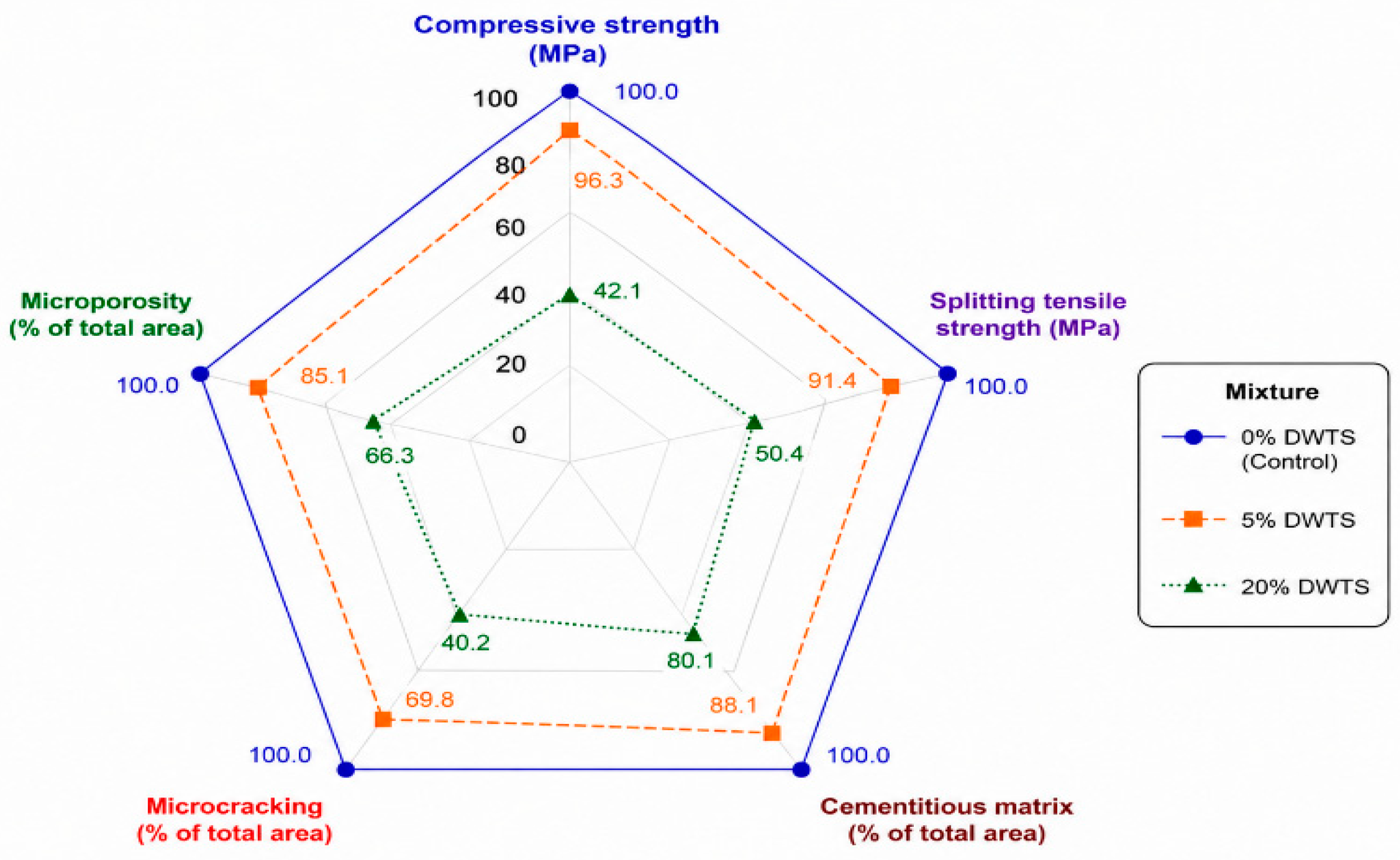
Figure 8 provides a descriptive comparison of the mechanical and petrographic indicators for the three representative mixtures subjected to detailed microstructural analysis (M0, M5, and M20). The figure is intended only to facilitate comparison among these discrete experimental conditions and should not be interpreted as demonstrating a continuous or predictive relationship between DWTS content and microstructural development.
Figure 8.
Normalized comparison of mechanical and petrographic indicators for the representative concrete mixtures M0, M5, and M20. The normalized scores are presented solely to facilitate a descriptive comparison between mechanical performance and selected microstructural indicators. For indicators in which higher values indicate better performance (compressive strength, splitting tensile strength, and cementitious matrix content), the normalized score was calculated as Si = 100 (Xi/Xmax). For deterioration indicators for which lower values represent better performance (microcracking and microporosity), the normalized score was calculated as Si = 100 (XMin/Xi). The figure includes only the three mixtures subjected to detailed petrographic analysis and therefore should not be interpreted as demonstrating a continuous, predictive, or statistically fitted relationship between DWTS replacement level and microstructural or mechanical performance.
4. Discussion
The results obtained in this study confirm that incorporating drinking water treatment sludge (DWTS) into cementitious materials is technically feasible but highly dependent on the physical condition, treatment history, chemical–mineralogical composition, and replacement strategy adopted. This agrees with the broader literature, in which DWTS has been evaluated as a sand substitute, mineral filler, supplementary cementitious material, sludge ash, precursor for alkali-activated binders, and raw material for concrete blocks or paving units [12,29,30]. However, the comparison with previous studies also shows that DWTS cannot be treated as a standardized by-product. Its behavior is source-dependent, because the treatment process, type of coagulant, organic matter content, particle-size distribution, and degree of pre-treatment strongly influence its interaction with cementitious matrices [6,12,31].
The DWTS evaluated in the present study exhibited very high moisture retention capacity, high plasticity, and a predominantly fine particle-size distribution. These characteristics indicate that, although it was incorporated as fine aggregate replacement, the material behaves more like a clay-rich mineral filler than a conventional natural sand. This distinction is important for interpreting the results. Kaish et al. [32] reported that oven-dried and 300-treated alum sludge could replace fine aggregate up to 10%, improving microstructure and durability; however, their material was crushed and ground to a controlled maximum particle size and thermally conditioned before use. Similarly, Odimegwu et al. [33] evaluated alum sludge as a fine filler, emphasizing that workability is directly controlled by the rheological effect of very fine waste particles. In contrast, Meert et al. [34] used wet sludge in natura as a sand replacement and reported reductions in flowability, density, strength, and tensile strength with increasing replacement. Therefore, the behavior observed in the present study is closer to the results obtained with a minimally processed sludge than to those reported for thermally conditioned, ground, or optimized alum sludge systems.
The progressive reduction in compressive strength from 27.15 MPa in the control mixture to 16.50 MPa with 20% DWTS replacement aligns with the most common trend reported for raw or untreated sludge used as an aggregate replacement. This reduction may be associated with several coupled mechanisms, including increased internal water demand, changes in particle packing efficiency, and the development of a more porous and discontinuous cementitious matrix. Meert et al. [34] observed that using DWTS as a fine-aggregate replacement caused marked losses in workability, with reductions of up to 50%, accompanied by higher porosity and water absorption. Liu et al. [35] also reported that replacement levels above 10% DWTS were detrimental to the performance of concrete paving blocks, especially regarding compressive strength, water absorption, abrasion resistance, sulfate resistance, and leaching behavior. These findings are consistent with the present results, where the strength reduction became more pronounced beyond 10% replacement.
Nevertheless, the mixture containing 5% DWTS reached 26.15 MPa at 28 days, corresponding to 96.9% of the design strength. This suggests that low replacement levels can be tolerated without substantial mechanical loss. This behavior agrees with studies indicating that limited sludge incorporation may provide a filler effect, improving local packing or partially filling voids before the negative effects of excessive fines become dominant [12,32]. However, unlike Kaish et al. [32], who identified 10% as the optimum replacement level for treated alum sludge, the present study identifies 5% as the most favorable dosage. This difference is scientifically meaningful and can be explained by the extremely high plasticity and water retention of the El Bosque sludge. In other words, the optimum content is not universal; it depends on whether DWTS behaves as a beneficial microfiller or as a highly absorbent clayey residue that disrupts the paste–aggregate skeleton.
The comparison with studies on concrete blocks and paving units also highlights the importance of the final application. Sajitthan et al. [36] reported that DWTP sludge could be incorporated at much higher replacement levels in concrete paving blocks, with 40% replacement of quarry dust achieving 20.94 MPa under specific conditions of water-to-cement ratio and admixture dosage. Similarly, Liu et al. [35] evaluated DWTS in concrete paving blocks and found that moderate contents may be viable, although replacement above 10% impaired durability and microstructure. These results do not contradict the present study; rather, they indicate that paving blocks and low-strength precast units have different performance requirements from conventional concrete designed for approximately 27 MPa. Therefore, the 5% optimum identified here is more appropriate for concrete, where mechanical integrity and matrix continuity are required, whereas higher sludge contents may be reserved for low-demand, non-structural, or specially optimized precast products.
A separate group of studies has shown more favorable results when DWTS is thermally activated and used as a cement replacement or precursor. Bhusal et al. [19] reported that calcined alum sludge can develop pozzolanic potential, although concrete with 20% cement replacement using alum sludge and metakaolin reached only 77% of the control strength at 28 days, suggesting slower reaction kinetics. Girskas and Kligys [37] showed that DWTS calcined at 850 °C could replace up to 5% cement in mortar without loss of compressive performance. Liu et al. [38] confirmed the pozzolanic reactivity of drinking water sludge ash, reporting acceleration of hydration and formation of Al-rich C-(A)-S-H, ettringite, and calcium aluminate hydrates, with improved long-term strength at 10% replacement but detrimental effects at 20–30%. Abdelhalim et al. [39] further demonstrated that calcination at 650 °C for 90 min significantly increased pozzolanic reactivity and allowed the use of WTPS as a precursor in alkali-activated concrete. Compared with these studies, the present work intentionally evaluates raw DWTS as a replacement for fine aggregate. Therefore, although the sludge is rich in SiO2 and Al2O3 and contains a significant amorphous fraction, the mechanical results do not support a strong pozzolanic contribution under the adopted conditions. Its role is better interpreted as a physical filler at low dosages and as a matrix-disrupting fine residue at higher dosages.
The microstructural observations obtained in this study complement the mechanical results and strengthen their qualitative interpretation. Petrographic analysis showed that increasing DWTS content was associated with a lower cementitious-matrix area fraction and higher microcracking and microporosity within the representative thin sections examined. Because phase-specific hydration analysis was not performed, these observations cannot establish changes in C–S–H content or degree of hydration. Liu et al. [40] also reported that DWTS degraded the mechanical and durability properties of concrete blocks because of high water absorption and organic matter, although early-age carbonation improved performance through CaCO3 formation and pore refinement. He et al. [41] demonstrated from a nanoscale perspective that the water–binder ratio strongly controls the effect of sludge ash, because lower w/b ratios reduce pore phases, improve high-density C-S-H, and decrease ITZ width. These studies support the mechanism observed here: strength loss is not only a consequence of replacing sand, but of the progressive degradation of matrix quality, pore structure, and interfacial continuity.
The splitting tensile strength results are particularly relevant because tensile response is more sensitive to flaws than compressive strength. In this study, 28-day splitting tensile strength decreased from 2.44 MPa in the control mixture to 1.23 MPa at 20% DWTS. This reduction is consistent with the petrographic increase in microcracking from 7.4% to 18.4%. The stronger sensitivity of tensile strength indicates that DWTS affects the internal cohesion of the cementitious skeleton and the quality of the interfacial transition zones. This behavior is consistent with microstructural findings reported for DWTS concrete blocks and sludge ash systems, in which increased porosity, weaker ITZs, and heterogeneous distribution of hydration products controlled mechanical losses [35,40,41].
An additional aspect that should be considered is that all concrete mixtures were prepared with the same nominal water-to-cement ratio (0.50). Although this approach allowed the influence of DWTS replacement level to be evaluated under consistent mixing conditions, the very high moisture content, fine particle size, and high plasticity of the DWTS may have altered the effective free water available for cement hydration. Consequently, differences in hydration kinetics and microstructural development may have contributed to the observed reductions in mechanical performance. Because the effective free water content was not experimentally determined, this effect could not be quantified and should be regarded as a limitation of the present study. Future investigations should consider moisture corrections and optimized mixture designs that account for the water-retention characteristics of DWTS.
Therefore, the principal contribution of the present study is not merely the identification of a feasible replacement percentage but the direct linkage between raw sludge characteristics, mechanical performance, petrographic indicators, and SEM-EDS observations. Previous studies have commonly focused on mechanical performance [32,34], structural response [42], fresh properties [33], paving block production [36], durability and leaching [35], carbonation curing [40], or activated sludge ash as SCM [19,37,38,39,41,43]. In contrast, this work integrates physical, chemical, mineralogical, mechanical, petrographic, and microstructural evidence for a raw DWTS generated in a tropical Caribbean drinking water treatment facility. This regional and methodological perspective is relevant because reviews emphasize that DWTS reuse requires site-specific validation before practical implementation [6,12,31].
It should be noted that fresh concrete properties, including slump, fresh density, air content, and rheological behavior, were not evaluated in this study. Therefore, although the high moisture content, fine particle size, and high plasticity of the DWTS may have influenced the effective water availability, particle packing, and workability of the mixtures, these effects were not directly quantified. Consequently, the proposed mechanisms explaining the observed reduction in mechanical performance should be interpreted as hypotheses supported by the physicochemical characteristics of the DWTS rather than as experimentally demonstrated phenomena.
5. Conclusions
This study investigated the preliminary mechanical performance and microstructural characteristics of concrete incorporating drinking water treatment sludge (DWTS) from the El Bosque Drinking Water Treatment Plant (Cartagena, Colombia) as a partial replacement for natural fine aggregate under controlled laboratory conditions.
The investigated DWTS was characterized by high moisture content, high plasticity, and a predominantly fine particle-size distribution. Mineralogical and chemical analyses indicated a material rich in aluminosilicate phases, including a substantial amorphous fraction. These characteristics emphasize the source-specific nature of DWTS and the importance of physicochemical characterization before its incorporation into cement-based materials.
Increasing DWTS replacement progressively reduced compressive and splitting tensile strengths. Among the DWTS-containing mixtures, the 5% replacement level showed the closest mechanical performance to the control, reaching a 28-day compressive strength of 26.15 MPa, corresponding to 96.9% of the design strength. Higher replacement levels produced increasingly pronounced mechanical losses. Petrographic examination of representative M0, M5, and M20 specimens showed a decreasing cementitious-matrix area fraction and increasing microcracking and microporosity with increasing DWTS content. These observations provide descriptive microstructural support for the mechanical trends but should not be interpreted as quantitative evidence of changes in C–S–H content or degree of cement hydration.
Accordingly, the results provide preliminary evidence that low DWTS replacement levels can maintain mechanical performance close to that of the reference concrete under the specific materials, mixture proportions, curing conditions, and laboratory procedures investigated. However, the present results are insufficient to establish practical, structural, or durability-related suitability. Fresh-state properties, drying shrinkage, long-term durability, and leaching behavior were not evaluated. These properties, together with additional replicate-based quantitative microstructural and hydration analyses, should be investigated before practical applications can be considered. Because DWTS characteristics are strongly source-dependent, the findings should not be generalized to sludge from other drinking water treatment plants without specific characterization and experimental validation.
Author Contributions
Conceptualization, M.S.; methodology, M.S., M.E.-U., and J.D.J.A.B.; formal analysis, M.S. and M.E.-U.; investigation, O.J.C.P. and W.E.M.S.; resources, M.S., M.E.-U., and J.D.J.A.B.; writing—original draft preparation, M.S. and M.E.-U.; writing—review and editing, M.S. and M.E.-U.; visualization, M.S. and M.E.-U.; supervision, M.S., M.E.-U., and J.D.J.A.B.; project administration, M.E.-U.; funding acquisition, M.S., M.E.-U., and J.D.J.A.B. All authors have read and agreed to the published version of the manuscript.
Funding
This research was financially supported by Aguas de Cartagena S.A. E.S.P Grant Number 001. The sponsor provided funding for the execution of the research project.
Data Availability Statement
The original contributions presented in this study are included in the article. Further inquiries can be directed to the corresponding author.
Acknowledgments
This manuscript is a scientific output of the project “Evaluación de alternativas de aprovechamiento de lodos producto de la potabilización del agua en la Planta de Tratamiento El Bosque—Aguas de Cartagena”. The authors gratefully acknowledge Aguas de Cartagena S.A. E.S.P. for financial support in the execution of the project. The authors also thank the laboratories and technical staff who contributed to the characterization and testing activities carried out during the research.
Conflicts of Interest
The authors declare no conflicts of interest.
Appendix A
Table A1.
Coefficients of variation (CV%) for compressive and splitting tensile strengths.
Table A2.
Tukey–Kramer multiple comparisons for compressive strength.
Table A3.
Tukey–Kramer multiple comparisons for splitting tensile strength.
Table A4.
Individual compressive strength measurements.
Table A5.
Individual splitting tensile strength measurements.
References
- Tareq, M.F.; Mels, A.; Radjkoemar, R.; Kujawa-Roeleveld, K.; Haldar, K. Scenario-based drinking water demand forecasting under climate change uncertainties: A study on Dhaka City, Bangladesh. Sci. Total Environ. 2026, 1012, 181198. [Google Scholar] [CrossRef] [Scilit] [PubMed]
- Zhu, X.; Hou, M.; Wei, J. Global Water Use and Its Changing Patterns: Insights from OECD Countries. Water 2024, 16, 3592. [Google Scholar] [CrossRef] [Scilit]
- Bensitel, N.; Wardi, A.; Azar, F.-Z.; Haboubi, K.; Said, M.A.; El Hammoudani, Y.; El Kasmi, A. Towards Sustainable Drinking Water Plant: Life Cycle Assessment and Techno-Economic Studies. Sustainability 2026, 18, 6249. [Google Scholar] [CrossRef] [Scilit]
- Reza, N.N.; Peldszus, S.; Huck, P.M. Quantifying drinking water treatment plant robustness with respect to turbidity: Examining raw water and treatment. Water Res. 2026, 295, 125550. [Google Scholar] [CrossRef] [Scilit] [PubMed]
- Ahmad, T.; Ahmad, K.; Alam, M. Sustainable management of water treatment sludge through 3‘R’ concept. J. Clean. Prod. 2016, 124, 1–13. [Google Scholar] [CrossRef] [Scilit]
- Turner, T.; Wheeler, R.; Stone, A.; Oliver, I. Potential Alternative Reuse Pathways for Water Treatment Residuals: Remaining Barriers and Questions—A Review. Water Air Soil Pollut. 2019, 230, 227. [Google Scholar] [CrossRef] [Scilit]
- Abo-El-Enein, S.A.; Shebl, A.; Abo El-Dahab, S.A. Drinking water treatment sludge as an efficient adsorbent for heavy metals removal. Appl. Clay Sci. 2017, 146, 343–349. [Google Scholar] [CrossRef] [Scilit]
- Zwane, Q.I.; Tshangana, C.S.; Mahlangu, O.T.; Snyman, L.W.; Msagati, T.A.M.; Muleja, A.A. Hierarchical Approach to the Management of Drinking Water Sludge Generated from Alum-Based Treatment Processes. Processes 2024, 12, 1863. [Google Scholar] [CrossRef] [Scilit]
- Sandoval, Y.; Martín, A.F.; Piña, S.M.; Montellano, P.L. Estudio Piloto Para Reducir el Volumen de Lodos de Plantas Potabilizadoras. 1998. Available online: https://api.semanticscholar.org/CorpusID:184221009 (accessed on 1 July 2026).
- Sandoval Yoval, L.; Montellano Palacios, L.; Martín Domínguez, A.; Sánchez Guzmán, L.; Santana Ramírez, M.d.L.; Morán Plata, M. Tratabilidad de los lodos producidos en la potabilización del agua. Ing. Cienc. Ambient. 1999, 10, 40. [Google Scholar]
- Babatunde, A.O.; Zhao, Y.Q. Constructive Approaches Toward Water Treatment Works Sludge Management: An International Review of Beneficial Reuses. Crit. Rev. Environ. Sci. Technol. 2007, 37, 129–164. [Google Scholar] [CrossRef] [Scilit]
- He, Z.; Wang, B.; Shi, J.; Rong, H.; Tao, H.; Jamal, A.S.; Han, X. Recycling drinking water treatment sludge in construction and building materials: A review. Sci. Total Environ. 2024, 926, 171513. [Google Scholar] [CrossRef] [Scilit] [PubMed]
- Naqi, A.; Jang, J.G. Recent Progress in Green Cement Technology Utilizing Low-Carbon Emission Fuels and Raw Materials: A Review. Sustainability 2019, 11, 537. [Google Scholar] [CrossRef] [Scilit]
- Zhang, C.; Hu, M.; Pohjalainen, E.; Di Maio, F.; Stegemann, J.A. Enhancing the uptake of secondary raw materials in the construction sector through reuse and recycling. Chem Circ. 2026, 1, 100013. [Google Scholar] [CrossRef] [Scilit]
- Ciutac, E.; Ghisman, V.; Iticescu, C.; Tcaciuc, D.; Buruiana, D.L. Industrial Waste Recycling for Sustainable Building Materials: A Review. Buildings 2026, 16, 1741. [Google Scholar] [CrossRef] [Scilit]
- Akintayo, B.D.; Babatunde, O.M.; Akintayo, D.C.; Olanrewaju, O.A. Transforming Industrial Waste into Low-Carbon Cement: A Multi-Criteria Assessment of Supplementary Cementitious Materials for Sustainable Concrete Design. Recycling 2025, 10, 211. [Google Scholar] [CrossRef] [Scilit]
- Hidalgo, D.; Verdugo, F. Harnessing Secondary Resources for Sustainable and Circular Practices in the Construction Sector: A Scoping Review. Appl. Sci. 2025, 15, 5410. [Google Scholar] [CrossRef] [Scilit]
- Cardoso, R.Á.M.; de Jesus, A.M.D.; Sanches Pereira, A.; Adebisi, A.J.; Fiore, F.A. Incorporation of water treatment plant sludge into expanded lightweight aggregates: Waste valorization to promote the circular economy. Clean. Eng. Technol. 2026, 34, 101283. [Google Scholar] [CrossRef] [Scilit]
- Bhusal, M.R.; Fonseka, C.W.; Muthukumaran, S.; Joseph, P.; Sandanayake, M. Water treatment sludge as a partial cement replacement material: Preliminary investigations and future perspectives. Innov. Infrastruct. Solut. 2025, 10, 447. [Google Scholar] [CrossRef] [Scilit]
- Yu, Y.; Jayathilakage, R.; Liu, Y.; Hajimohammadi, A. Intelligent compressive strength prediction of sustainable rubberised concrete using an optimised interpretable deep CNN-LSTM model with attention mechanism. Appl. Soft Comput. 2025, 185, 113993. [Google Scholar] [CrossRef] [Scilit]
- Li, J.; Chen, J.; Bu, C.; Zhang, M.; Yu, J.; Yu, X.; Sun, Y.; Yu, Y. Synergistic enhancement of sulfate resistance in recycled aggregate concrete through multi-pathway blocking via carbonation treatment and fly ash incorporation. Constr. Build. Mater. 2025, 491, 142685. [Google Scholar] [CrossRef] [Scilit]
- Kaosol, T. Reuse Water Treatment Sludge for Hollow Concrete Block Manufacture. Energy Res. J. 2010, 1, 131–134. [Google Scholar] [CrossRef] [Scilit]
- Ching, C.Y.; Bashir, M.J.K.; Choon Aun, N.; Aldahdooh, M.A.A. Sustainable production of concrete with treated alum sludge. Constr. Build. Mater. 2021, 282, 122703. [Google Scholar] [CrossRef] [Scilit]
- ASTM C1157-08a; Standard Performance Specification for Hydraulic Cement. ASTM International: West Conshohocken, PA, USA, 2008. [CrossRef] [Scilit]
- ASTM C192/C192M-19; Standard Practice for Making and Curing Concrete Test Specimens in the Laboratory. ASTM International: West Conshohocken, PA, USA, 2019. [CrossRef] [Scilit]
- ASTM C39/C39M-23; Standard Test Method for Compressive Strength of Cylindrical Concrete Specimens. ASTM International: West Conshohocken, PA, USA, 2023. [CrossRef] [Scilit]
- ASTM C496/C496M-17; Standard Test Method for Splitting Tensile Strength of Cylindrical Concrete Specimens. ASTM International: West Conshohocken, PA, USA, 2017. [CrossRef] [Scilit]
- ASTM C856/C856M-20; Standard Practice for Petrographic Examination of Hardened Concrete. ASTM International: West Conshohocken, PA, USA, 2020. [CrossRef] [Scilit]
- Zamora, R.M.R.; Alfaro, O.C.; Cabirol, N.; Ayala, F.E.; Moreno, A.D. Valorization of Drinking Water Treatment Sludges as Raw Materials to Produce Concrete and Mortar. Am. J. Environ. Sci. 2008, 4, 223–228. [Google Scholar] [CrossRef] [Scilit]
- Zhuge, Y.; Liu, Y.; Pham, P.N. Chapter 19—Sustainable utilization of drinking water sludge. In Low Carbon Stabilization and Solidification of Hazardous Wastes; Tsang, D.C.W., Wang, L., Eds.; Elsevier: Amsterdam, The Netherlands, 2022; pp. 303–320. [Google Scholar]
- Dahhou, M.; El Hamidi, A.; El Moussaouiti, M. Reusing Drinking Water Sludge: Physicochemical Features, Environmental Impact and Applications in Building Materials: A Mini Review. Chem. Afr. 2023, 6, 1145–1161. [Google Scholar] [CrossRef] [Scilit]
- Kaish, A.B.M.A.; Odimegwu, T.C.; Zakaria, I.; Abood, M.M.; Nahar, L. Properties of concrete incorporating alum sludge in different conditions as partial replacement of fine aggregate. Constr. Build. Mater. 2021, 284, 122669. [Google Scholar] [CrossRef] [Scilit]
- Odimegwu, T.C.; Zakaria, I.; Abood, M.M.; Kaish, A.B.M.A. Workability properties of concrete using alum sludge and limestone dust as replacement of fine aggregate. AIP Conf. Proc. 2020, 2213, 020239. [Google Scholar] [CrossRef] [Scilit]
- Meert, R.; Hastenpflug, D.; Andrade, J.J.d.O. Contribuição para o uso de lodo de estação de tratamento de água in natura como agregado miúdo em concretos de cimento Portland. Matéria 2021, 26, e13025. [Google Scholar] [CrossRef] [Scilit]
- Liu, Y.; Zhuge, Y.; Chow, C.W.K.; Keegan, A.; Li, D.; Pham, P.N.; Huang, J.; Siddique, R. Utilization of drinking water treatment sludge in concrete paving blocks: Microstructural analysis, durability and leaching properties. J. Environ. Manag. 2020, 262, 110352. [Google Scholar] [CrossRef] [Scilit] [PubMed]
- Sajitthan, S.; Rajapakshe, E.P.; Illangasinghe, I.M.W.K.; Manatunge, J.M.A. Reuse Potential of Drinking Water Treatment Plant Sludge for the Manufacture of Concrete Paving Blocks. In Proceedings of the ICSBE 2022; Springer Nature: Singapore, 2023; pp. 853–867. [Google Scholar]
- Girskas, G.; Kligys, M. Utilisation of Drinking Water Treatment Sludge Calcined At 850 °C To Improve the Mortar Properties. Ceram.-Silik. 2026, 70, 103–113. [Google Scholar]
- Liu, Y.; Zhuge, Y.; Chow, C.W.K.; Keegan, A.; Pham, P.N.; Li, D.; Oh, J.-A.; Siddique, R. The potential use of drinking water sludge ash as supplementary cementitious material in the manufacture of concrete blocks. Resour. Conserv. Recycl. 2021, 168, 105291. [Google Scholar] [CrossRef] [Scilit]
- Abdelhalim, J.O.; Amer, I.; Abdel Latif, I.; Fawzy, I.; Ismail, S.; Khalaf, M.A. Investigation of the optimum calcination temperature for water treatment plant sludge to develop a sustainable alkali activated concrete. Sci. Rep. 2025, 15, 2117. [Google Scholar] [CrossRef] [Scilit] [PubMed]
- Liu, Y.; Zhuge, Y.; Chow, C.W.K.; Keegan, A.; Li, D.; Pham, P.N.; Huang, J.; Siddique, R. Properties and microstructure of concrete blocks incorporating drinking water treatment sludge exposed to early-age carbonation curing. J. Clean. Prod. 2020, 261, 121257. [Google Scholar] [CrossRef] [Scilit]
- He, Z.-H.; Han, X.-D.; Jin, J.; Li, J.; Tang, W.; Shi, J. Recycling of water treatment sludge in concrete: The role of water-binder ratio from a nanoscale perspective. Sci. Total Environ. 2023, 873, 162456. [Google Scholar] [CrossRef] [Scilit] [PubMed]
- Ahmed, F.R.; Muhammad, M.A.; Ibrahim, R.K. Effect of alum sludge on concrete strength and two way shear capacity of flat slabs. Structures 2022, 40, 991–1001. [Google Scholar] [CrossRef] [Scilit]
- Liu, Y.; Zhuge, Y.; Chow, C.W.K.; Keegan, A.; Li, D.; Pham, P.N.; Yao, Y.; Kitipornchai, S.; Siddique, R. Effect of alum sludge ash on the high-temperature resistance of mortar. Resour. Conserv. Recycl. 2022, 176, 105958. [Google Scholar] [CrossRef] [Scilit]

Disclaimer/Publisher’s Note: The statements, opinions and data contained in all publications are solely those of the individual author(s) and contributor(s) and not of MDPI and/or the editor(s). MDPI and/or the editor(s) disclaim responsibility for any injury to people or property resulting from any ideas, methods, instructions or products referred to in the content. |
© 2026 by the authors. Licensee MDPI, Basel, Switzerland. This article is an open access article distributed under the terms and conditions of the Creative Commons Attribution (CC BY) license.