


Abstract
In the context of the urgent need for decarbonization in the construction sector, glued laminated bamboo (GLB) has emerged as a renewable structural alternative, yet the effect of adhesive chemistry on its performance remains poorly isolated from other manufacturing variables. This study compares three adhesives, polyvinyl acetate (PVA), urea–formaldehyde (UF), and polyurethane (PUR), used to bond GLB from Phyllostachys pubescens (Moso) bamboo under identical manufacturing conditions. Physical characterization (density, moisture content, water absorption) and mechanical tests (compression, direct tension, three-point bending, and shear, parallel and perpendicular to the grain) were performed, with DIC resolving strain localization at bond lines and one-way ANOVA with Tukey’s HSD test assessing significance. PUR-bonded specimens remained intact throughout 23 days of immersion, absorbing 64.0% and 34.1% more water than PVA- and UF-bonded specimens, which delaminated after 7 and 12 days, respectively. Sensitivity to adhesive type varied systematically with loading mode: fibre-governed properties differed by at most 19% between adhesives in compression parallel to the grain, where the effect was significant only between UF and PUR (p = 0.005), whereas tension perpendicular to the grain, governed by the bond line, varied by a factor of 4.8 (p < 0.001), with PUR outperforming PVA and UF. Beyond strength, the adhesives produced distinct post-peak and failure behaviours: UF exhibited an extended, ductile yielding plateau under perpendicular compression, PUR showed a pronounced post-peak drop under compression, while under shear it produced the most gradual response and the highest absorbed energy; UF displayed abrupt, stepwise load drops under shear. In three-point bending, peak strength was fibre-governed, but the post-peak response differed: PUR showed the most abrupt load drops, whereas UF decayed more gradually. These findings guide adhesive selection in GLB according to loading mode and moisture exposure.
1. Introduction
The construction sector remains one of the largest contributors to global greenhouse gas emissions, accounting for approximately 34% of energy-related CO2 emissions and a comparable share of global final energy consumption [1]. A substantial part of this burden is embodied carbon, the emissions locked into structural materials such as cement and steel and their supply chains, which has proven considerably more difficult to abate than operational energy use. Against this backdrop, renewable and bio-based materials that store carbon over their service life have moved from a niche interest to a central line of research in structural engineering [2,3,4].
Bamboo occupies a distinctive position among these materials [5]. It reaches harvestable maturity in three to five years [6], roughly an order of magnitude faster than the timber species it can replace, and combines a high strength-to-weight ratio with favourable stiffness along the fibre direction [7]. Its rapid biomass accumulation also makes bamboo an efficient carbon sink, so that products manufactured from it retain sequestered carbon for the duration of their use [8]. These attributes have driven a growing interest in bamboo as a load-bearing material rather than a purely vernacular one.
The natural culm, however, is poorly suited to modern structural design. It is hollow, tapered, and geometrically variable, its mechanical response differs between nodes and internodes, and it is prone to longitudinal splitting [9]. Engineered bamboo products circumvent these limitations by reducing the culm to smaller elements that are subsequently reconstituted into standardized sections. Among them, glued laminated bamboo (GLB) is one of the most direct analogues to established engineered timber: bamboo strips are planned to a uniform thickness and bonded in successive layers to form prismatic elements of controlled geometry and predictable properties [7,10,11]. This process removes the dimensional constraints of the raw culm and allows GLB to be produced in the beam and column sizes required for structural and semi-structural use.
In a laminated composite, the adhesive is far more than an assembly aid. The bond line is the plane across which load is transferred between adjacent laminae and, at the same time, the region most exposed to moisture ingress and long-term degradation [12,13]. Because bond quality emerges from the interaction between the adhesive, the bamboo substrate, and the processing conditions, it has become a distinct object of study in its own right [14]. The adhesives available for bamboo bonding span several chemical families, among them polyvinyl acetate (PVA), urea–formaldehyde (UF), melamine and phenol-based resins, and polyurethane (PUR), that differ markedly in cost, formaldehyde emission, curing mechanism, and, above all, resistance to water. Jimenez and Ramos [12] classified phenol–formaldehyde and PUR as structural adhesives suitable for wet-service conditions, while UF and PVA were restricted to dry, interior applications because their bond lines are liable to delaminate under sustained humidity. Wang et al. [13] likewise showed that ambient moisture can substantially reduce the bonding performance of glued bamboo. The choice of adhesive therefore conditions not only the strength of the finished element but also the range of environments in which it can safely be used.
This dependence on adhesive chemistry sits in tension with the very rationale for choosing bamboo. The thermosetting resins that perform best under load and moisture, UF and its melamine and phenol-modified derivatives, release formaldehyde, a regulated indoor-air pollutant, and are produced from non-renewable feedstocks; polyurethanes avoid formaldehyde but are equally petroleum-derived and cure through isocyanate chemistry. Water-based PVA is comparatively benign on both counts, yet its sensitivity to moisture confines it to protected environments. Selecting an adhesive for GLB is therefore never a purely mechanical decision, but a compromise between bond-line performance, emissions and toxicity, and the renewable credentials that justify the use of a bio-based substrate in the first place [7,12,14]. Characterizing how each family behaves mechanically is a prerequisite for navigating that compromise.
Adhesive selection in engineered bamboo has already received attention, though under scopes that differ from the present one. Sewar et al. [14] reviewed the factors governing bonding strength in bamboo-based composites, mapping the influence of surface preparation, adhesive chemistry and processing on bond quality. Jimenez and Ramos [12] evaluated the glue-bond performance of PVAc, PUR, UF and phenol–formaldehyde on oil-heat-treated Dendrocalamus asper, and reported that PUR achieved the highest bond strength under both dry and wet conditions while PVAc proved unsuitable for wet service. Their study, however, was designed around thermal modification of the substrate: adhesive type was one of four factors examined alongside treatment temperature, surface pairing and glue spread rate, and bond quality was assessed by lap-shear on 2.5 × 10 mm specimens machined down to the glue line, a measurement of the bond line in isolation rather than of the laminated product. De Lima et al. [15] characterised GLB from Dendrocalamus giganteus bonded with PVAc and phenol–resorcinol across compression, tension and shear, and concluded that failure is ultimately limited by the bamboo rather than by the adhesive; the comparison covered two adhesive families and did not include loading transverse to the bond line. Other studies have characterised single adhesive systems in detail [16,17], followed property loss under natural or accelerated ageing [10,17], or addressed an individual loading mode [16].
Taken together, these studies establish that adhesive chemistry governs bond-line durability, but none compares adhesive families across a full set of physical and mechanical properties of the laminated product. Full-field measurement of the bond-line response has likewise seen little application in this context: DIC has been used in laminated bamboo under transverse compression and in cross-laminated Guadua panels [18,19], but not as a means of discriminating between adhesive systems.
Reported values scatter widely from one study to another, but because bamboo species, strip geometry [17], glue spread rate, and pressing regime tend to vary simultaneously, those differences are difficult to attribute to the adhesive itself. Direct, like-for-like comparisons, several adhesive families bonded under identical manufacturing conditions and tested across a common set of physical and mechanical properties, remain uncommon, even though such data are precisely what a designer needs to match an adhesive to a given application.
The absence of a dedicated testing framework compounds this difficulty. Because product standards specific to GBL are still emerging, mechanical characterization is routinely carried out with protocols adapted from solid timber, such as ASTM D143 [20], applied to specimen geometries that differ from one laboratory to the next. Variations in specimen size, notch configuration, and displacement limits make absolute values hard to compare across studies and further obscure the specific contribution of the adhesive [7,16]. Fixing every parameter other than the adhesive, and measuring all properties within a single protocol, is one way to separate its effect from this background of methodological variation.
A further distinction is often left implicit. Some properties of GLB are governed mainly by the bamboo fibres and should be largely insensitive to the adhesive, whereas others depend directly on the integrity of the bond line and should be highly sensitive to it. Separating these two regimes requires loading specimens both parallel and perpendicular to the fibre direction within the same experimental program.
The present study addresses these gaps through a controlled comparison of three commercially available adhesives from distinct chemical families (PVA, UF, and PUR) used to produce GLB from Phyllostachys pubescens (Moso) bamboo under identical manufacturing conditions. The material is characterized physically (density, moisture content, and water absorption) and mechanically (compression, direct tension, three-point bending, and shear, applied both parallel and perpendicular to the grain), with Digital Image Correlation (DIC) used to resolve strain localization at the bond lines and one-way ANOVA with Tukey’s HSD test to assess the significance of the adhesive effect. By holding species, geometry, and processing constant and varying only the adhesive, the study isolates its contribution across the full range of loading modes. Rather than ranking adhesives, it maps the continuum along which sensitivity to adhesive type increases, from properties governed by the bamboo fibres to those governed by the integrity of the bond line, and resolves the underlying mechanism by full-field strain measurement at the bond line itself. This provides a rational basis for selecting adhesives in GLB according to the dominant loading mode and the expected environmental exposure of the intended application.
2. Materials and Methods
2.1. Raw Material and Adhesives
Bamboo culms of the species Phyllostachys pubescens (Moso bamboo), approximately five years old, were sourced from Take Cortinas, São Paulo, Brazil. Prior to processing, the culms were chemically treated with disodium octaborate tetrahydrate (Na2B8O13·4H2O) from FertilShop, Mirassol, São Paulo, Brazil as a preservative against biological deterioration. This borate-based treatment is a preservation method for bamboo and other lignocellulosic materials, applied to protect against fungal decay and insect attack during storage and service life. Because no untreated control group was produced, the possible isolated effect of the borate treatment on adhesive bonding could not be quantified in the present study. However, all adhesive groups were manufactured using bamboo from the same treated material batch, so the treatment condition was kept constant across the experimental groups.
Three commercially available adhesives, representative of distinct chemical families, were selected to produce the GLB: polyvinyl acetate (PVA) from Cascola, urea–formaldehyde (UF) Redemite from Redealese. São Paulo, Brazil, and polyurethane (PUR) Reatpur from Retaprene, Santo André, São Paulo, Brazil. PVA (Cascola, EN 204 durability class D2 [21]) was applied ready-to-use, without the addition of further components. UF (Redelease) was prepared by mixing resin, wheat flour, water, and hardener (ammonium phosphate) in the mass proportion of 100:20:20:5, while PUR was prepared by mixing resin and hardener (polyisocyanate, Retaprene, Santo André, São Paulo, Brazil) in the mass proportion of 100:13.5. For all three adhesives, a constant glue spread rate of 300 g/m2 was adopted, applied to a single bonding surface, based on the range of spread rates reported for these adhesive families in previous bamboo- and wood-bonding studies, adopted here as a representative average value to allow a direct, like-for-like comparison of adhesive chemistry under otherwise identical bonding conditions.
2.2. Manufacturing of GLB
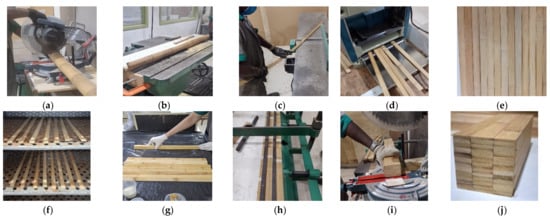
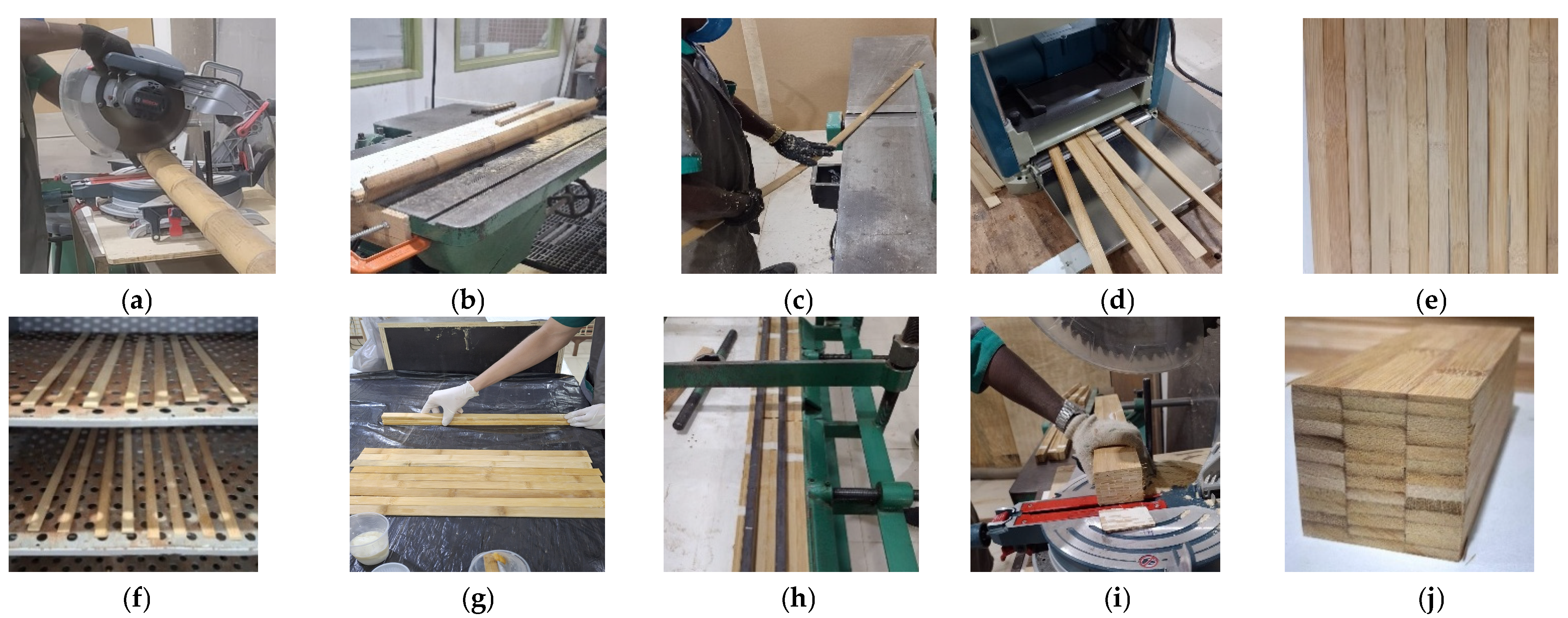
The bamboo culms were first cut transversally using a saw (Figure 1a), followed by longitudinal cutting with a table saw (Robert Bosch Power Tools GmbH, Leinfelden-Echterdingen, Germany) to obtain individual strips (Figure 1b). The internal diaphragms, nodes, and the outer wax-rich epidermal layer were removed using a planer-jointer from JF Solutions Industriais Ltd.a., Braço do Norte, Santa Catarina, Brazil (Figure 1c), and the strips were subsequently surfaced to a uniform thickness of 4 mm using a thickness planer, from Makita Corporation, Anjo, Aichi, Japan (model 2012NB) (Figure 1d).
Figure 1.
GLB manufacturing steps: (a) transverse culm cut; (b) longitudinal cut; (c) diaphragm removal; (d) surfacing; (e) strip conditioning; (f) adhesive application and pressing; (g) finishing; (h) rough specimens; (i) CNC routing; (j) finished specimens.
After surfacing, the bamboo strips were conditioned in an oven (SolidSteel, SSDcrd 480 L, Piracicaba, São Paulo, Brazil) at 100 °C for 48 h to reduce their moisture content and improve adhesive penetration prior to bonding (Figure 1f). This oven-conditioning step (100 °C, 48 h) and the subsequent cold-pressing step (1.5 MPa, 48 h) were adopted to bring the strip moisture content within the range required by ASTM D2559 [22] for the manufacture of structural glued laminated products prior to bonding, following the conditioning practice adopted in comparable bamboo GLB studies. Each adhesive was then applied to the strip surfaces at a spread rate of 300 g/m2 (Figure 1g), and the laminated assemblies were cold-pressed at a pressure of 1.5 MPa for 48 h (Figure 1h), with pressure controlled by means of a torque wrench, (Tramontina PRO, Carlos Barbosa, Rio Grande do Sul, Brazi) to allow complete adhesive curing. Finally, the cured GLB blocks were surfaced and cut into rough blanks, which were then machined by planing and/or CNC routing to the final dimensions required for each physical and mechanical test (Figure 1j), as described below.
2.3. Physical Characterization
2.3.1. Density and Moisture Content
The density and moisture content of the bamboo strips were determined in accordance with ASTM D2559 [22] and ISO 22156 [23], respectively. Ten strips (4 × 20 × 50 mm) were weighed under ambient conditions (23 ± 3 °C) to obtain the moist mass, and their dimensions were measured to determine the moist volume. The specimens were then oven-dried at 100 ± 3 °C for 48 h until constant mass was reached, after which the dry mass and dry volume were recorded. Density was calculated as the ratio between the oven-dry mass and the oven-dry volume, while moisture content was calculated as the ratio between the mass of water removed during drying and the oven-dry mass, expressed as a percentage.
2.3.2. Water Absorption
The water absorption behaviour of the GLB was evaluated following the procedure of ASTM D1037 [24], using five specimens (20 × 20 × 50 mm) per adhesive type. Specimens were first oven-dried at 100 ± 5 °C for 48 h to obtain the initial (dry) mass and were then fully immersed in water at room temperature. The specimen mass was recorded every 24 h to monitor moisture uptake over time, and the average absorption rate (k, in %/day) within each absorption regime was calculated as k = ΔA/Δt, where ΔA is the variation in water absorption (%) and Δt is the corresponding time interval (days). The boundaries between absorption regimes were not prescribed by the standard. They were identified from the absorption curves themselves, as the points at which the slope changed markedly and remained approximately constant thereafter, each regime being defined as the longest interval over which the uptake rate could be described by a single linear fit. This inductive criterion was adopted because the number of regimes differed between adhesives—two for PVA and UF and three for PUR—and no single prescribed partition would have described all three groups. For each adhesive group, the test was terminated either upon mass stabilization (variation below 1% between two consecutive measurements) or upon visible delamination of most of the specimens, whichever occurred first.
2.4. Mechanical Characterization
2.4.1. Compression Parallel and Perpendicular to the Grain
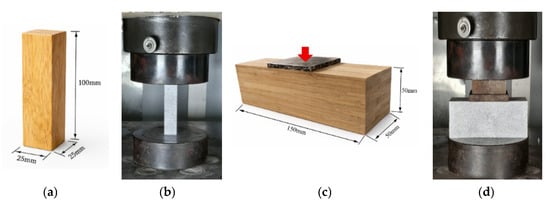
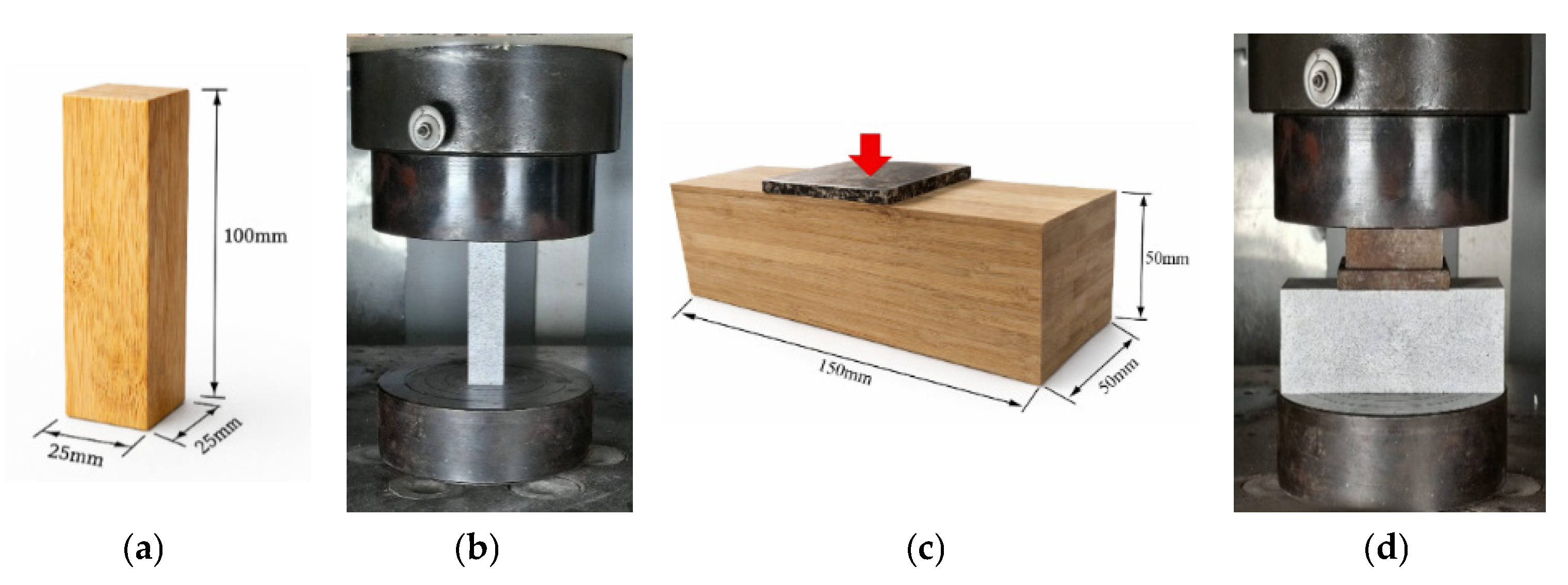
Compression tests were carried out according to ASTM D143 [20], using seven specimens per adhesive type, with dimensions of 25 × 25 × 100 mm for loading parallel to the fiber direction and 50 × 50 × 150 mm for loading perpendicular to the fiber direction (Figure 2) Each compression specimen was assembled from 5 bamboo strips (4 mm thick), resulting in 4 adhesive lines oriented parallel to the loading direction and from three groups of 13 bamboo strips glued together, which were subsequently bonded laterally, resulting in 12 glue lines between the strips and 2 glue lines between the faces of the groups for the ones oriented perpendicular to the loading.
Figure 2.
Compression test configurations: (a) parallel-to-grain specimen; (b) parallel-to-grain setup; (c) perpendicular-to-grain specimen; (d) perpendicular-to-grain setup. The red arrow indicates the applied load. The red arrow indicates the applied load.
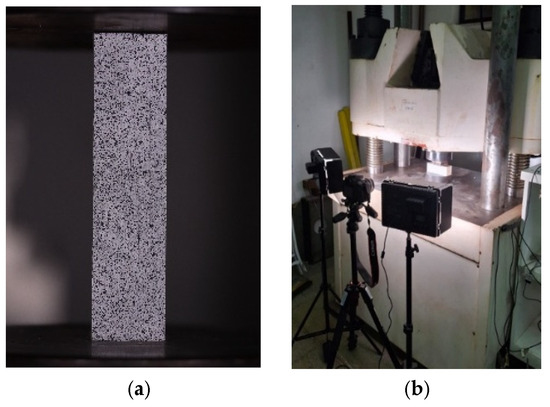
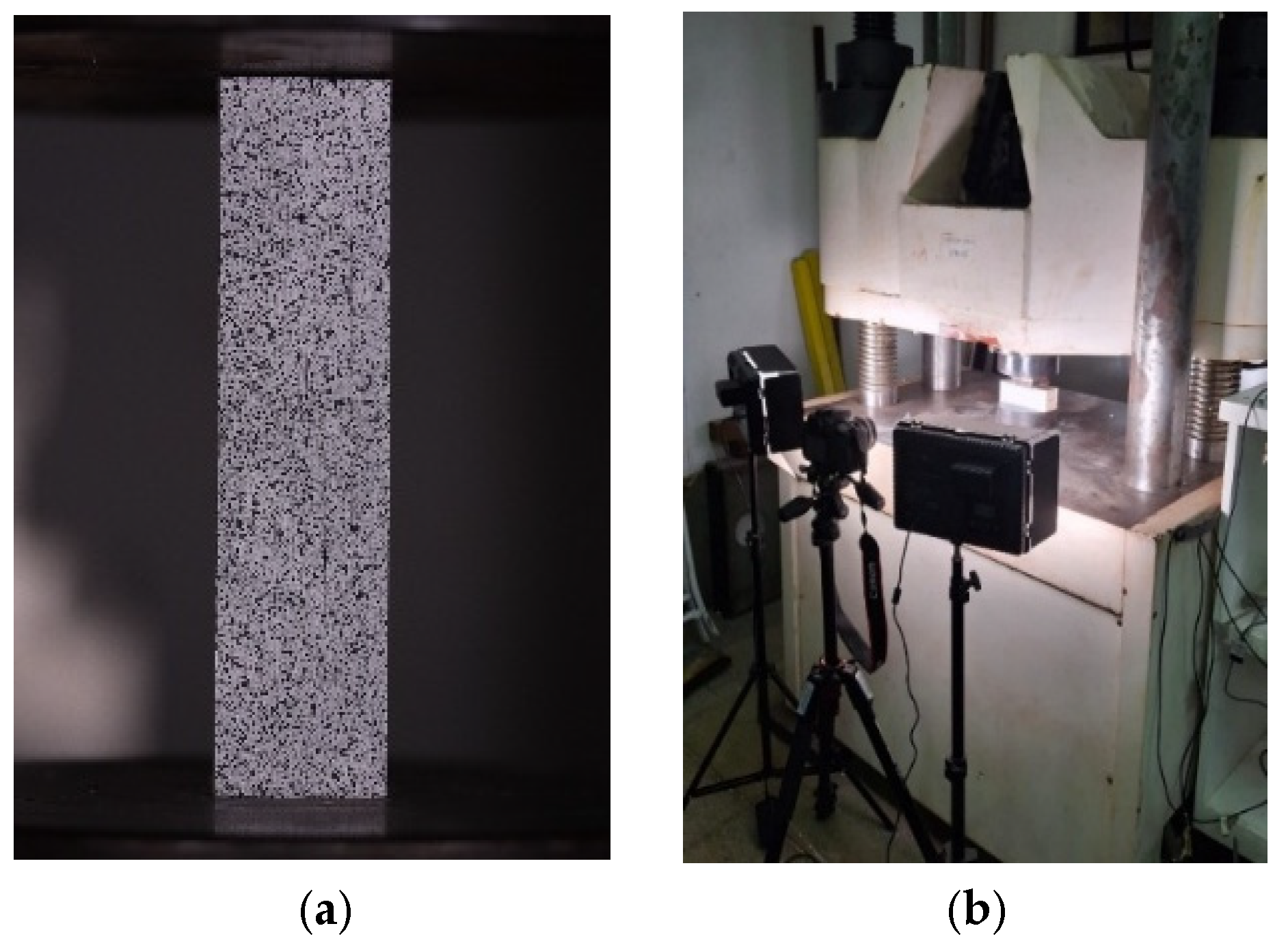
Tests were conducted on a 1000 kN Shimadzu UTM (Shimadzu Corporation, Kyoto, Japan) at crosshead speeds of 0.3 mm/min and 0.6 mm/min for the parallel and perpendicular configurations, respectively. Surface strain fields were monitored using DIC: specimens were prepared with a stochastic speckle pattern (white background with randomly applied black spray dots), and images were captured every 5 s using a Canon EOS 90D camera fitted with a 60 mm macro lens (Figure 3). The acquired images were processed in Zeiss Correlate 2026 software to obtain displacement and strain fields over the specimen surface. Full-field DIC monitoring was applied to the compression tests, parallel and perpendicular to the grain, and to direct tension perpendicular to the grain. In compression perpendicular to the grain, the response evolves through successive regimes, an initial quasi-elastic stage followed by progressive crushing and compaction of the parenchyma tissue, without a well-defined peak load, so the compressive strength must be identified from the transition between these regimes rather than from a rupture point [25]. DIC was therefore used to spatially resolve where and when strain localization initiates at the bond lines, providing an objective, full-field criterion to distinguish the change from one deformation regime to another, complementing the offset-based strength definition adopted for this loading mode [25]. In tension perpendicular to the grain, DIC was used to resolve the width and progression of the damage zone at the bond line, which distinguishes the failure mechanism of the three adhesives. In bending and shear, failure occurred at a clearly defined location identifiable from the specimen itself, and full-field strain mapping was not applied.
Figure 3.
DIC technique: (a) speckle pattern preparation and camera setup; (b) specimen under loading.
2.4.2. Direct Tension Parallel and Perpendicular to the Grain
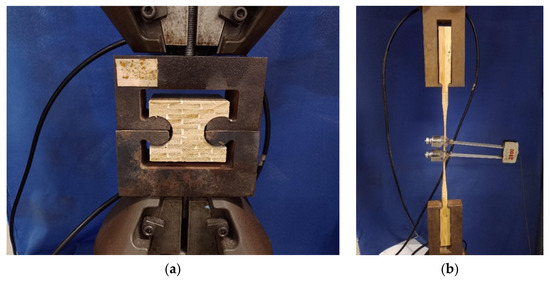
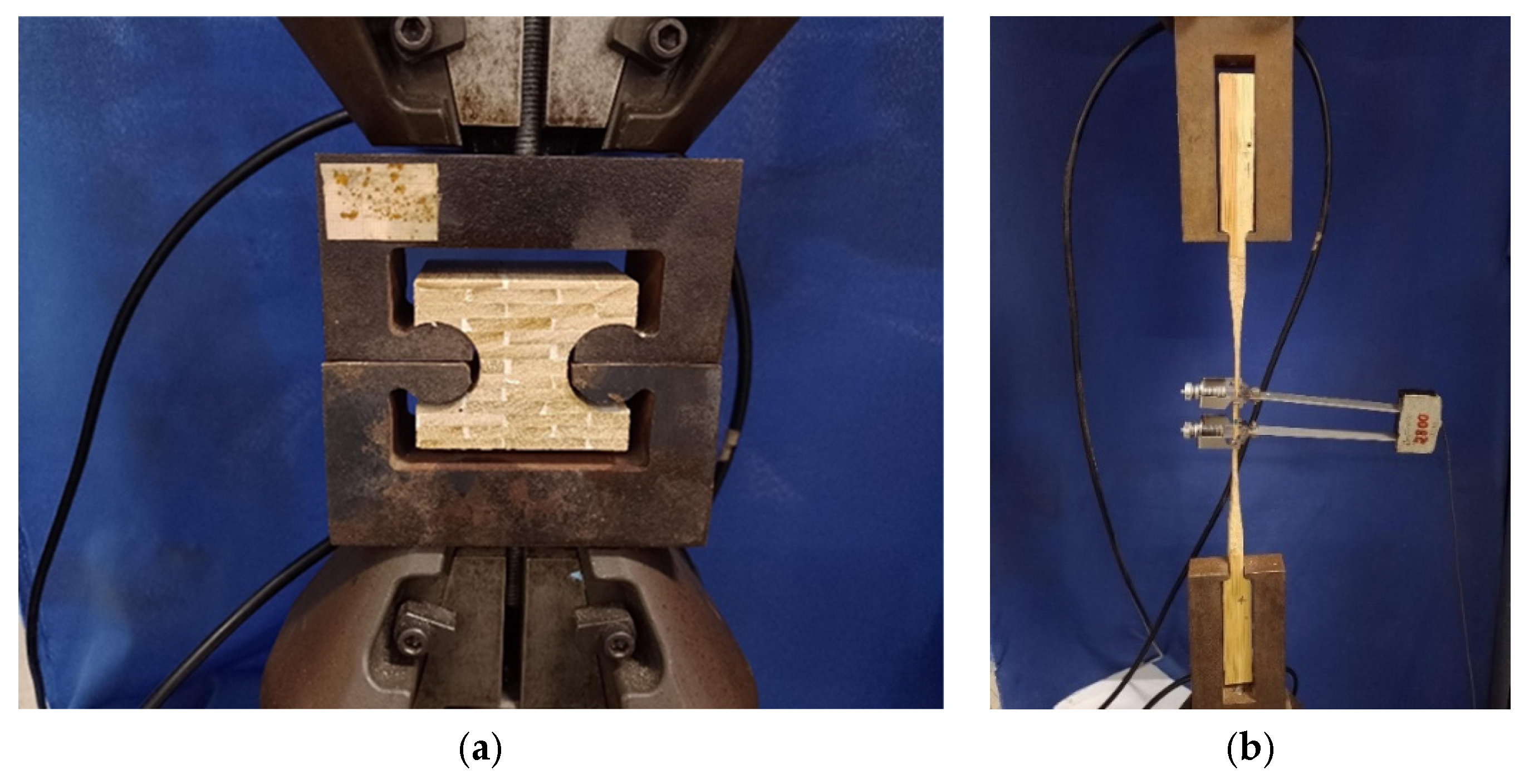
Direct tension tests parallel and perpendicular to the fiber direction were performed in accordance with ASTM D143 [20], using five specimens per adhesive type, with the bonded interface positioned at the reduced cross-section of the specimen. For the parallel-to-grain configuration, the specimen was machined to a reduced cross-section of 5 × 9.5 mm over a 63 mm gauge length, in accordance with ASTM D143 [20]; tensile stress was computed on this reduced section. Each tension specimen was assembled from three groups of 13 bamboo strips (4 mm thick) glued together, which, after, were bonded laterally, resulting in 12 glue lines between the strips and 2 glue lines between the faces of the groups for the ones oriented perpendicular to the loading and from two groups of 5 bamboo strips, that were glued together and also laterally, giving 4 and 2 glue lines for direct and lateral, respectively. Both configurations were tested on a 100 kN Shimadzu UTM (Shimadzu Corporation, Kyoto, Japan) at a crosshead speed of 0.6 mm/min. For the test parallel to the grain, a 25 mm clip- gauge (Shimadzu Corporation, Kyoto, Japan) was attached to the central region of the specimen to measure local displacement (Figure 4).
Figure 4.
Direct tension test setups: (a) perpendicular to the grain; (b) parallel to the grain (with 25 mm clip-gauge).
2.4.3. Three-Point Bending
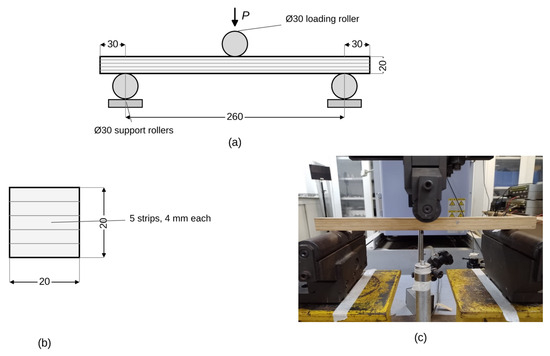
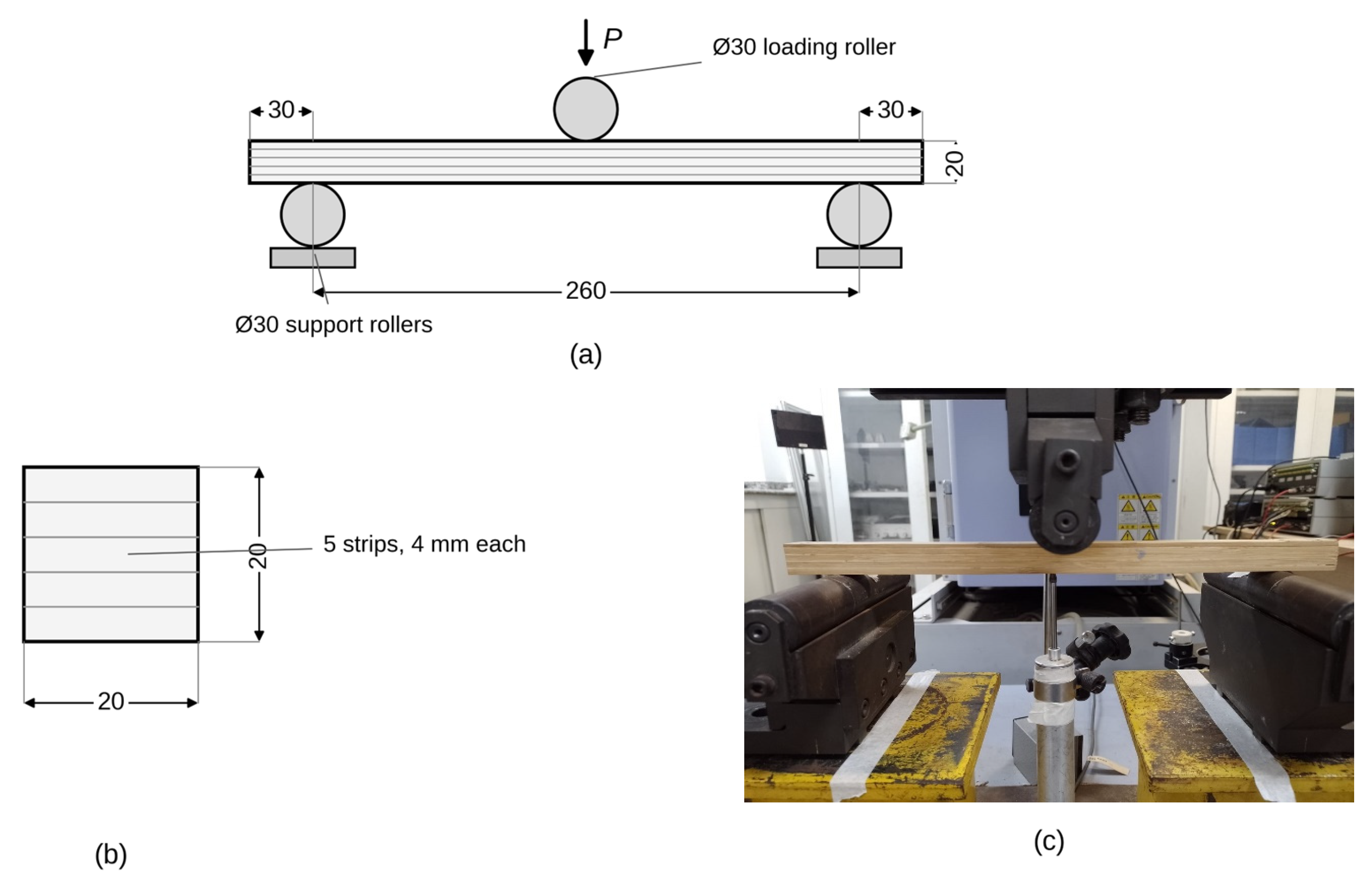
Three-point bending tests were carried out in accordance with ASTM D143 [20], using five specimens per adhesive type, with dimensions of 20 × 20 × 320 mm (height × width × length). Each specimen was assembled from five 4 mm thick bamboo strips, resulting in four adhesive lines through the specimen height. Tests were performed on a 100 kN Shimadzu UTM equipped with a linear variable displacement transducer (LVDT) from Kyowa Electronic Instruments Co., Ltd., Tokyo, Japan, applying a preload of 0.1 kN at a crosshead speed of 1.3 mm/min (Figure 5). The modulus of rupture (MOR) and the modulus of elasticity (MOE) were determined from the resulting load–displacement curves.
Figure 5.
Three-point bending test: (a) side view of the specimen and loading configuration, with a span of 260 mm and Ø30 mm loading and support rollers; (b) cross-section showing the five 4 mm strips; (c) test setup.
2.4.4. Shear Perpendicular to the Grain
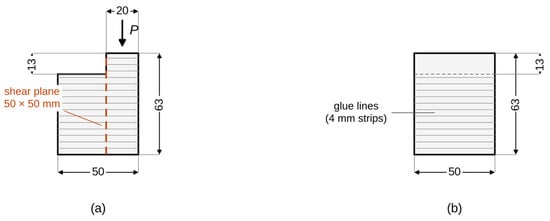
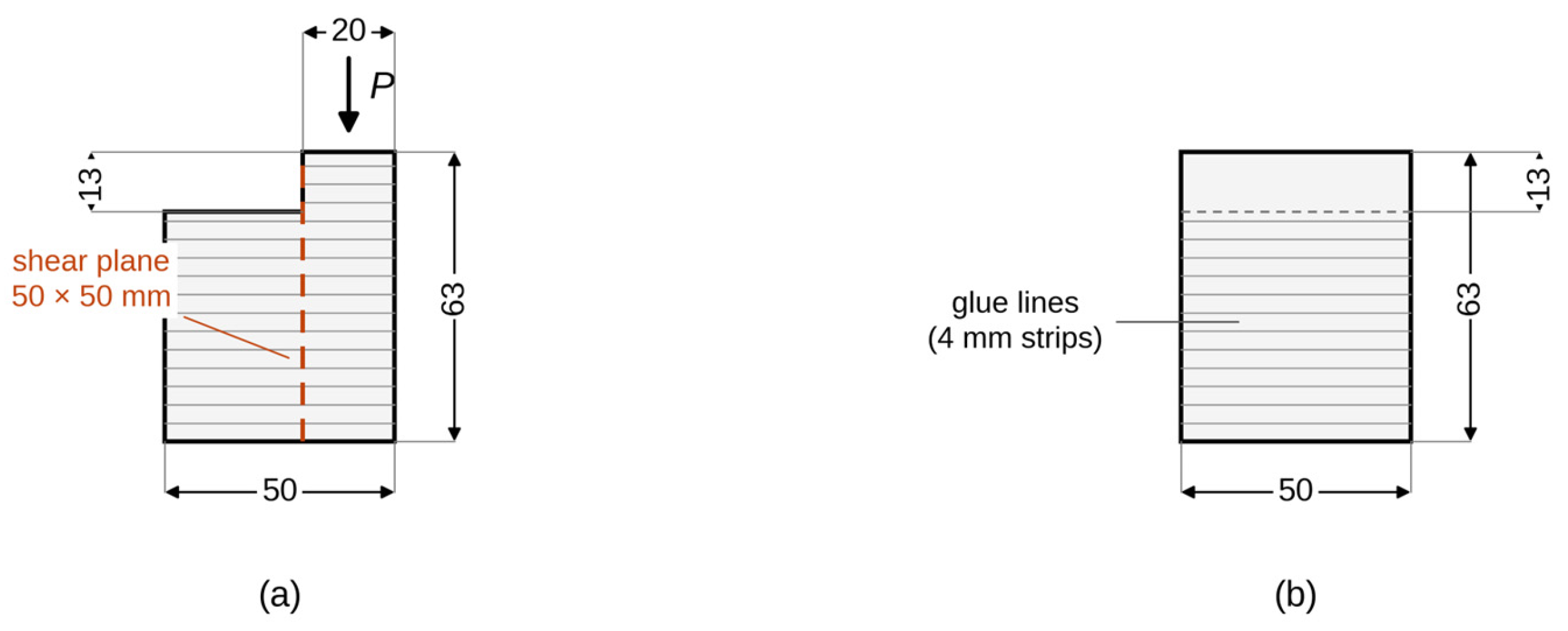
Shear tests perpendicular to the fiber direction were performed according to ASTM D143 [20], using five notched specimens per adhesive type, with dimensions of 63 × 50 × 50 mm (height × width × length) with a notch’s depth of 13 mm, as we can see in Figure 6. The load was applied through the upper notched face, so that the shear plane coincides with the ligament between the two notches and is oriented perpendicular to the fibre direction, crossing the glue lines. Tests were conducted on a 1000 kN Shimadzu UTM, applying a preload of 0.1 kN at a crosshead speed of 0.6 mm/min. To avoid damage to the shear loading fixture, the maximum crosshead displacement was limited to 14 mm. No specimen reached failure within this limit; the load recorded at 14 mm therefore corresponds to the displacement stop of the test rather than to a failure load. Accordingly, the shear strength was defined at the proportional limit, determined by the 0.5 mm offset method applied to the load–displacement curve, i.e., the intersection between the measured curve and the initial tangent displaced by 0.5 mm. The same rationale applies here as in compression perpendicular to the grain: in the absence of a rupture point, the strength must be identified from the transition between deformation regimes rather than from a peak load. Initial stiffness, taken as the slope of the initial tangent, and the energy absorbed up to the 14 mm limit, taken as the area under the load–displacement curve, were also determined.
Figure 6.
Shear test specimen, perpendicular to the grain: (a) front view showing the notched profile, the loading position and the shear plane; (b) side view showing the strips and the glue-line orientation.
2.5. Statistical Analysis
The experimental results for each property were submitted to a one-way analysis of variance (ANOVA) to evaluate the statistical significance of the adhesive type on the measured response, at a 95% confidence level. Prior to ANOVA, the normality of the data distribution was verified. When ANOVA indicated a statistically significant effect (p < 0.05), Tukey’s honestly significant difference (HSD) test was applied for pairwise comparisons between adhesive groups. For each mechanical test, individual force/stress–displacement (or strain) curves were obtained for every specimen; in figures reporting these curves (Figure 7 and Figure 8), thin lines show all individual specimens and the bold line denotes the pointwise mean of the group, computed at each displacement increment. Where DIC maps are presented alongside the curves (Figure 9), the bold line instead corresponds to the specimen shown in those maps, and the loading stages indicated on the curve correspond to the frames displayed; this specimen is identified in the caption and, where it does not belong to the statistical sample, this is stated explicitly. For shear perpendicular to the grain, the analysis of variance was performed on the shear stress at the proportional limit rather than on the load recorded at the displacement limit.
3. Results and Discussion
3.1. Physical Characterization
3.1.1. Density and Moisture Content
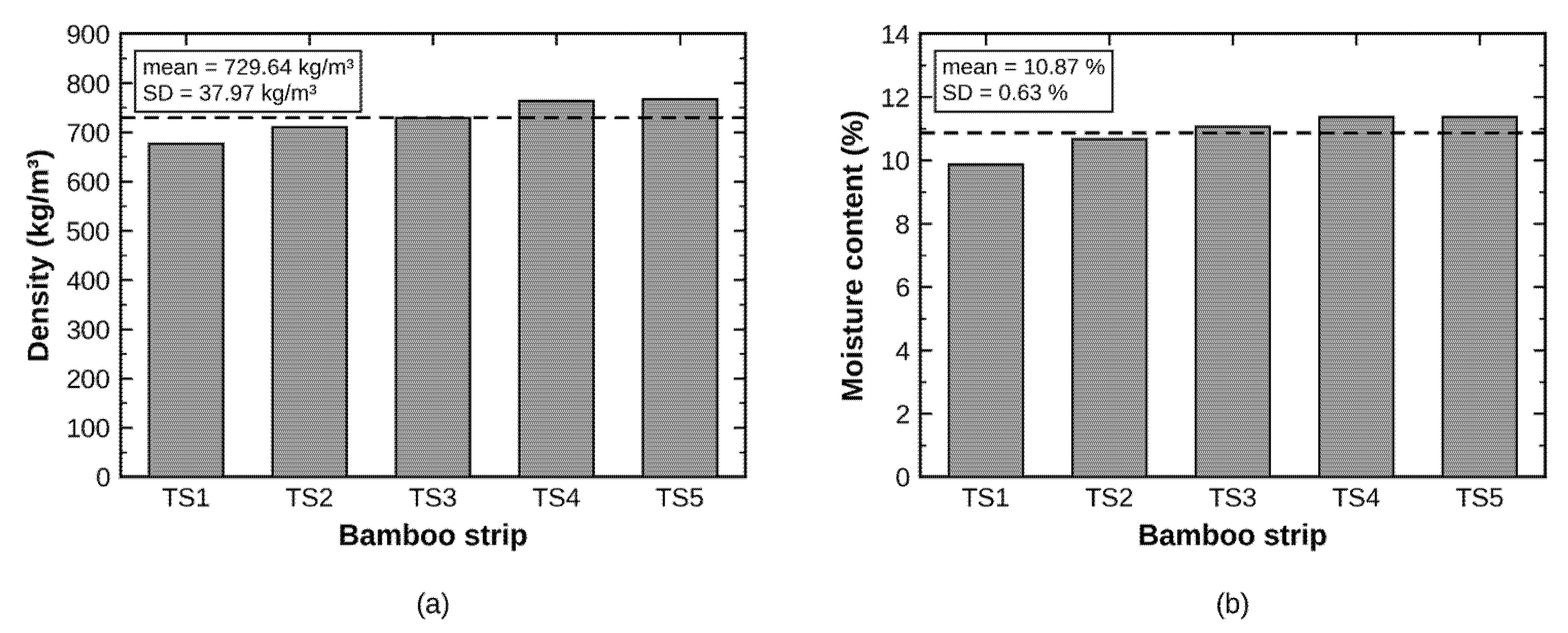
The bamboo strips presented an average density of 729.64 ± 37.97 kg/m3 and an average moisture content of 10.87 ± 0.63% (Figure 7). These values lie slightly above the range of 600–700 kg/m3 commonly reported for Phyllostachys pubescens (Moso) bamboo. Density and moisture content were determined on the same set of ten raw bamboo strips prior to adhesive bonding (five strips used for density and five for moisture content, denoted TS1–TS5 for each property in Figure 7); since these properties characterize the raw material common to all groups, rather than a variable that differs by adhesive type, they are reported here as descriptive statistics (mean ± SD) for a single population rather than compared across adhesive groups by ANOVA. The slightly higher density observed here may be associated with the disodium octaborate tetrahydrate treatment applied to the culms, which can increase the mass of the cell wall without a proportional increase in volume.
Figure 7.
Physical characterization of bamboo strips: (a) oven-dry density and (b) equilibrium moisture content of five individual strips (TS1–TS5). Dashed lines indicate group means.
3.1.2. Water Absorption
Figure 8 presents the saturation curves obtained for the three adhesive types, and Table 1 summarizes the average absorption rate (k) within each identified absorption regime. For all adhesives, an initial rapid-uptake regime (days 0–4, k ≈ 9.1–10.8%/day) was observed, attributed to the filling of accessible pore spaces left empty after oven-drying, followed by a transient regime of progressively decreasing absorption rate as these voids were filled.
Table 1.
Average water absorption rate (k, %/day) by absorption regime and total immersion duration for each adhesive type.
The test duration differed markedly between adhesive groups: specimens bonded with PVA reached delamination after 7 days, those bonded with UF after 12 days, while PUR-bonded specimens remained intact for the full 23-day immersion period and reached an additional, near-saturation regime (k ≈ 0.7%/day, days 16–23). At the end of the respective test periods, PUR-bonded specimens had absorbed 64.0% more water than PVA-bonded specimens and 34.1% more than UF-bonded specimens.
Figure 8.
Water absorption curves for GLB specimens bonded with (a) PVA, (b) UF, and (c) PUR adhesives. Colored regions indicate absorption regimes: rapid uptake (blue), transient (yellow), near-saturation (red), and test termination due to delamination (grey). Values of k indicate the average absorption rate (%/day) within each regime.
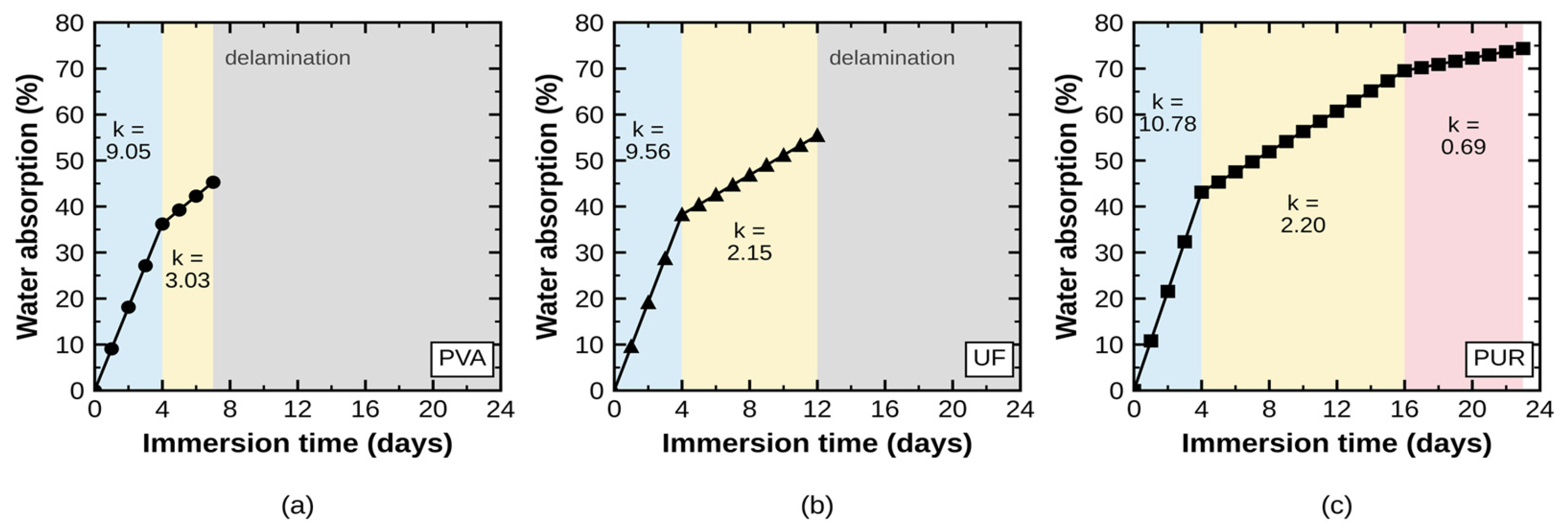
It is important to note that this result does not indicate that PUR is more hygroscopic than the other adhesives; rather, it reflects that the PUR bond line remained mechanically intact long enough for the bamboo substrate to approach its own moisture saturation, whereas the PVA and UF bond lines failed (delaminated) at the bamboo–adhesive interface before the substrate itself could reach a comparable moisture content. This behaviour is consistent with the chemical nature of the three adhesives: PVA is a cold-setting, water-based adhesive prone to softening and re-emulsification upon prolonged water exposure, UF is a thermosetting aminoplast susceptible to hydrolytic degradation of the methylene-ether crosslinks under moist conditions, whereas PUR is a moisture-curing, hydrophobic adhesive. This classification is corroborated by Jimenez and Ramos [12], who evaluated PVAc, UF, PUR, and phenol–formaldehyde (PF) adhesives for bamboo bonding and reported that PF and PUR are structural adhesives suitable for products exposed to wet conditions, whereas UF and PVAc are intended for interior, dry-use applications and present a risk of bond-line delamination under high humidity. In that study, PUR-bonded bamboo laminates also achieved the highest dry shear strength among the four adhesives evaluated, while PVAc-bonded specimens failed to meet the minimum wet shear strength and cohesive bamboo failure requirements, a pattern consistent with the early water-induced delamination of PVA-bonded GLB observed in the present study.
From a normative standpoint, EN 302-1 [26], EN 302-2 [27], and ASTM D2559 [22] classify adhesives for load-bearing timber structures based on shear strength retention and resistance to moisture and delamination. Although these standards were developed for wood-based products and no equivalent standard specific to GLB currently exists, they provide the closest available reference for wet-use suitability. Against these criteria, PVA and UF, which delaminated after 7 and 12 days of continuous immersion, respectively, would not be expected to qualify as structural, wet-use adhesives. PUR, which remained bonded throughout the 23-day immersion period, was the only adhesive evaluated whose performance was compatible with this category.
3.2. Mechanical Characterization
3.2.1. Compression Parallel and Perpendicular to the Grain
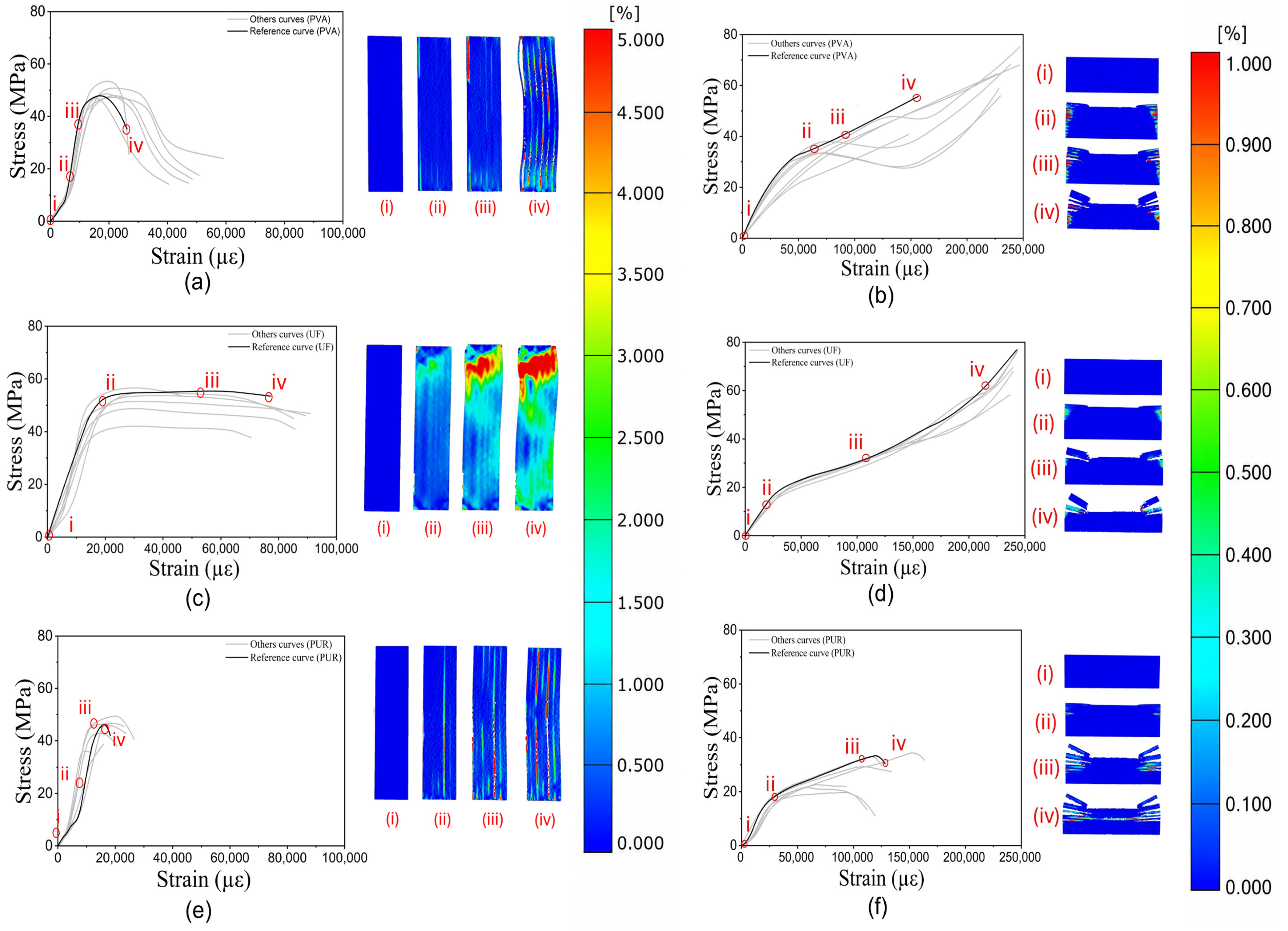
Table 2 summarizes the compressive strength (fc) and coefficient of variation (CoV) obtained for each adhesive, and Figure 9 presents the stress–strain curves together with the corresponding DIC strain fields.
Table 2.
Average compressive strength (fc) and coefficient of variation (CoV) for GLB bonded with PVA, UF, and PUR, tested parallel and perpendicular to the grain.
For compression parallel to the grain, UF-bonded specimens exhibited the highest average strength (52.06 MPa), followed by PVA (48.67 MPa) and PUR (43.74 MPa). The relatively low and similar CoV values for UF and PVA, together with the DIC fields, indicate a quasi-monolithic response in which load is transferred efficiently across the bond lines, so that failure is primarily governed by the compressive behaviour of the bamboo fibers themselves rather than by the adhesive. PUR-bonded specimens showed a markedly higher dispersion (CoV = 10.92%) and a stress–strain curve with a pronounced post-peak drop; the corresponding DIC maps revealed strain localized along longitudinal instability lines at the bond lines, indicating that, under parallel loading, the PUR bond line is comparatively more prone to local debonding. One-way ANOVA indicated a statistically significant effect of adhesive type on compressive strength parallel to the grain (F(2,18) = 7.274, p = 0.005), with a large effect size (ω2 = 0.374). Tukey’s HSD test located this effect in a single pair: UF exceeded PUR by 8.32 MPa (p = 0.004, 95% CI [2.74, 13.90]), whereas the differences between PVA and UF (p = 0.322) and between PVA and PUR (p = 0.118) were not significant. Because the PVA group departed from normality (Shapiro–Wilk, p = 0.009), the analysis was repeated using the Kruskal–Wallis test, which confirmed the result (H = 10.053, p = 0.007), as did the Alexander–Govern test (p = 0.023).
For compression perpendicular to the grain, the ranking was markedly different: PVA reached the highest strength (35.89 MPa), followed by UF (23.14 MPa) and PUR (18.72 MPa). DIC analysis showed that PVA-bonded specimens developed a stiff, quasi-monolithic response with stress concentrations confined to the peripheral contact zones, whereas PUR-bonded specimens exhibited markedly flattened stress–strain curves (indicative of early plastic/crushing behaviour) together with localized high-strain regions at the bond lines, consistent with the onset of interlaminar delamination under transverse loading. UF-bonded specimens displayed an intermediate, ductile response, with an extended yielding plateau and stable bond lines under perpendicular compression, allowing energy absorption prior to final failure.
Figure 9.
Stress–strain curves and DIC strain field maps for GLB under uniaxial compression: (a,c,e) parallel to the grain and (b,d,f) perpendicular to the grain, for PVA (a,b), UF (c,d), and PUR (e,f) adhesives. DIC maps show longitudinal strain distribution at four representative loading stages (i–iv).
Compared with values typically reported for GLB under compression parallel to the grain (60–80 MPa) [7,13], the strengths obtained in this study were somewhat lower, with UF approaching the lower bound of this range. Conversely, for compression perpendicular to the grain, where literature values are generally reported between 10 and 20 MPa [10,13], the results obtained here, particularly for PVA (35.89 MPa) and UF (23.14 MPa), were substantially higher, nearly doubling the upper bound reported in previous studies. This suggests that the manufacturing parameters adopted in this work (glue spread rate, pressing pressure and time, and strip conditioning) resulted in a particularly efficient bonded interface for transverse load transfer.
For GLB produced from the same bamboo species and tested under compression parallel to the grain, ref. [15] reported average strengths of 100.9 MPa (PVAc) and 97.6 MPa (PRF), with no statistically significant effect of adhesive type at a 95% confidence level. The values obtained in the present study (43.74–52.06 MPa) were considerably lower than these references. This discrepancy is unlikely to be explained by adhesive type alone, given that compression parallel to the grain was shown in the present study to be governed primarily by the bamboo fibers; more probable contributing factors include differences in specimen geometry, bamboo strip conditioning, and pressing parameters between the two studies. In that study the strips were 7.3 mm thick and pressed at 6.2 MPa, against 4 mm and 1.5 MPa here, and the compression specimens had a slenderness ratio of 1.8 against 4.0 in the present work; since the failure mode reported there is buckling of the strips, slenderness conditions the measured strength directly. The oven-dry densities, however, are essentially identical (733 kg/m3 against 729.64 kg/m3 here), indicating equivalent raw material.
3.2.2. Direct Tension Parallel and Perpendicular to the Grain
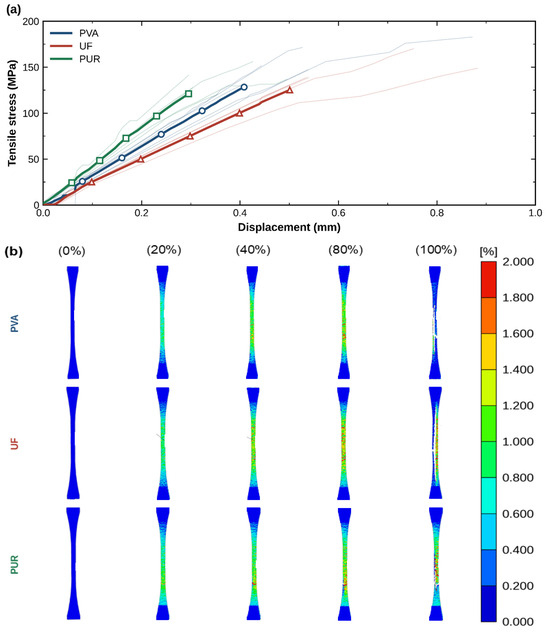
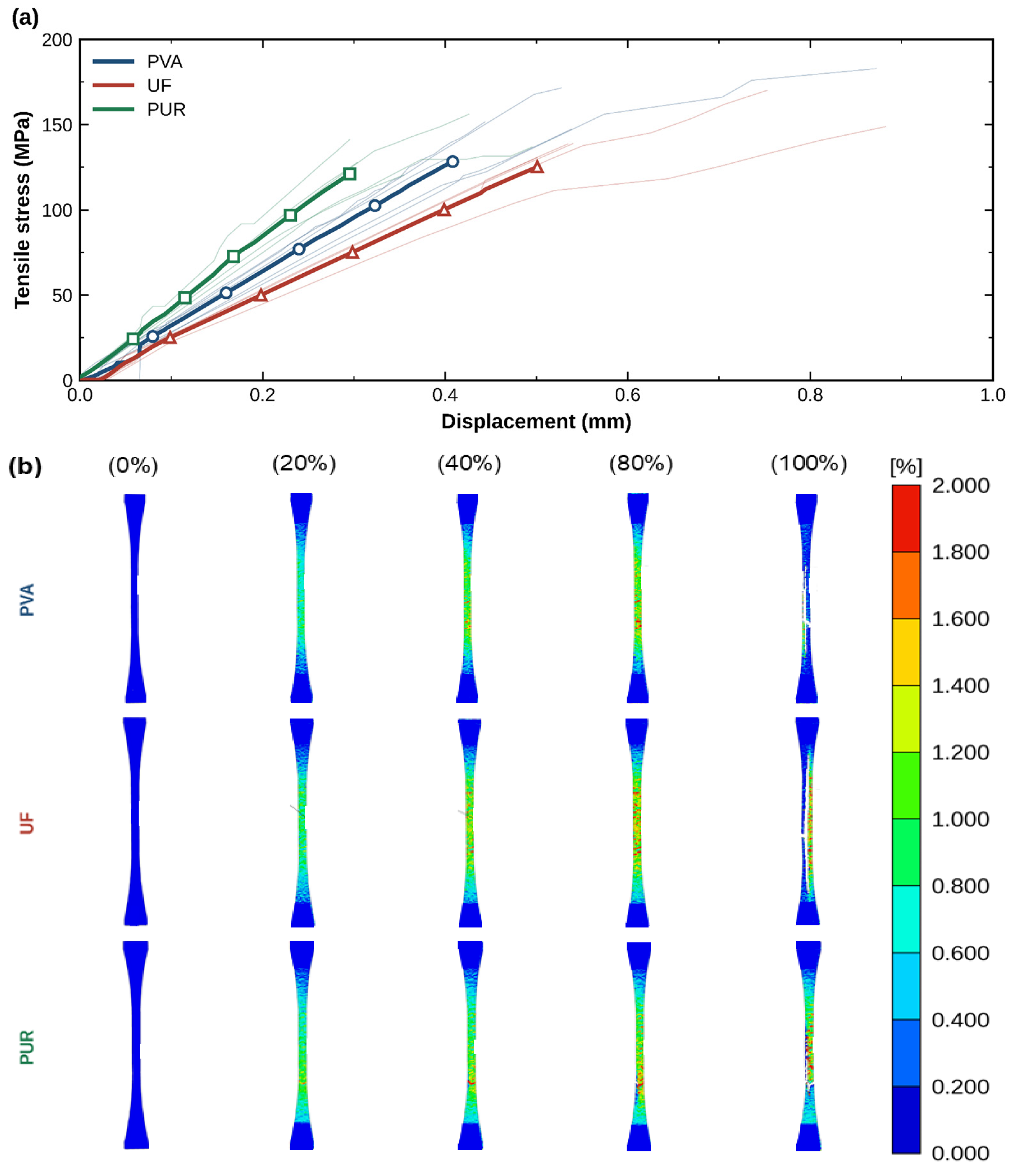
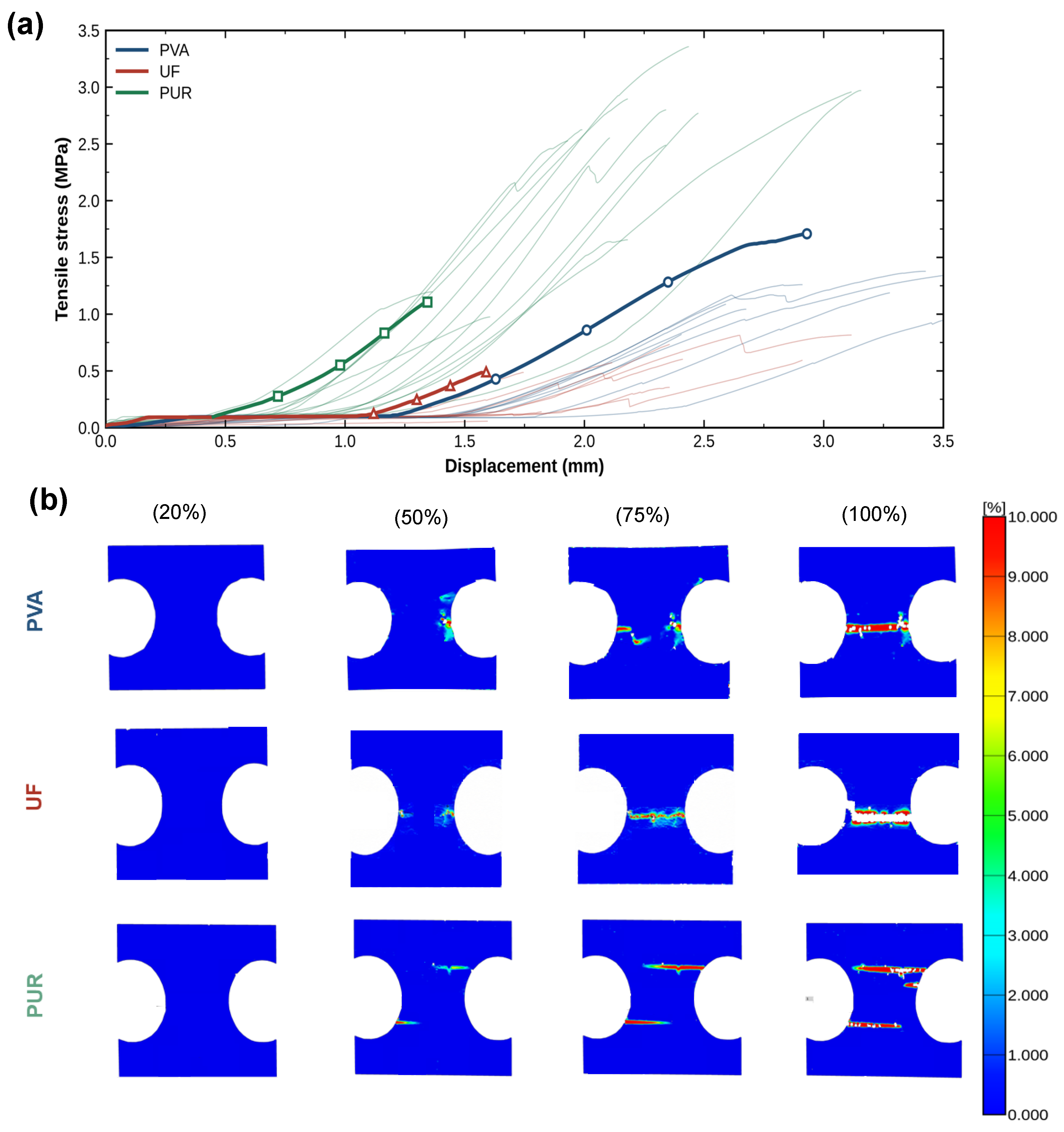
Figure 10 presents the stress–displacement curves and the corresponding DIC strain fields for the specimens tested in tension perpendicular to the grain. For all adhesive types, failure occurred along the glue line, confirming that this interface constitutes the most vulnerable region of the GLB under loading perpendicular to the bamboo fibers.
Figure 10.
Tensile response of GLB under direct tension parallel to the grain. (a) Stress–displacement curves for all specimens of the three adhesives; bold lines: group mean, with open symbols marking the five loading stages shown in (b). (b) DIC strain fields at 20%, 40%, 60%, 80% and 100% of the peak load. A common strain scale is used for all maps.
The average tensile strength perpendicular to the grain was 2.71 ± 0.28 MPa for PUR, 1.14 ± 0.18 MPa for PVA, and 0.56 ± 0.15 MPa for UF. PUR thus exceeded UF by approximately 384% and PVA by approximately 138%, while PVA exceeded UF by approximately 104%. One-way ANOVA indicated a statistically significant effect of adhesive type on this property (p < 0.001), and Tukey’s HSD test confirmed that all three pairwise comparisons were significant, establishing the ranking PUR > PVA > UF. These results demonstrate that, when the bond line itself is directly stressed, the adhesive type exerts a decisive influence on the mechanical response. It should be noted that this test configuration essentially measures the strength of the weakest element in the load path across the bond line. Since failure occurred at the glue line in every specimen (Figure 11), and not within the bamboo substrate, the results indicate that the adhesive itself, rather than the bamboo, was the limiting element in this loading direction for all three adhesive types, and that the observed differences in tensile strength (PUR > PVA > UF) reflect differences in the mechanical performance of the adhesive bond, including the cohesive properties of the cured adhesive and the adhesive–bamboo interfacial adhesion.
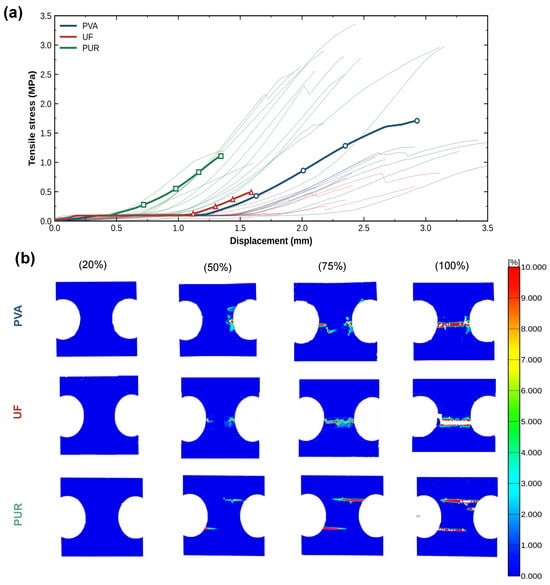
Figure 11.
Tensile response of GLB under direct tension perpendicular to the grain. (a) Stress–displacement curves for all specimens of the three adhesives; thin lines: individual specimens; bold lines: the specimen imaged by DIC, with open symbols marking the four loading stages shown in (b). This specimen was selected for the quality of its correlation pattern and is not included in the statistical analysis. (b) DIC longitudinal strain fields at 25%, 50%, 75% and 100% of the peak load, for PVA, UF and PUR. A common strain scale is used for all maps.
Failure of the specimens tested in tension parallel to the grain occurred by fibre rupture at the reduced cross-section rather than along the bond line, and Figure 10 presents the corresponding stress–displacement curves. The average tensile strength parallel to the grain was 157.0 ± 20.3 MPa for PVA, 145.4 ± 15.2 MPa for UF, and 136.5 ± 13.6 MPa for PUR, that is, PVA exceeded PUR by approximately 15.0% and UF exceeded PUR by approximately 6.5%, while PVA exceeded UF by approximately 8.0%. One-way ANOVA indicated no statistically significant effect of adhesive type on this property (F = 1.003, p = 0.393), and Tukey’s HSD test found no significant differences between any pair of adhesives. This indicates that, under loading parallel to the fiber direction, the mechanical response is governed predominantly by the bamboo fibers themselves, with the adhesive playing a secondary role, consistent with the compression-parallel results.
In this configuration, failure occurred within the bamboo fibres themselves rather than along the bond line, indicating that adhesion between adhesive and substrate was adequate for all three adhesives in this loading direction. Accordingly, the absence of statistically significant differences between adhesive types under tension parallel to the grain should not be interpreted as evidence of comparable adhesive performance in general, but rather as confirmation that all three adhesives are structurally suitable for bonding bamboo when loaded along the fibre direction, with the mechanical response being governed by the bamboo substrate rather than by the bond line under these conditions.
Compared with a previous study on PVA-bonded GLB tested in tension perpendicular to the grain, which reported an average strength of 4.44 MPa [17], the value obtained here for PVA (1.14 MPa) was considerably lower; this discrepancy may be related to differences in glue spread rate, pressing parameters, curing conditions, or bamboo strip characteristics between the two studies, and highlights the scarcity of directly comparable data for this test configuration. For phenol–formaldehyde-bonded GLB under natural and accelerated aging, reported tensile strengths were 14–25 MPa parallel to the grain and 0.3–1.1 MPa perpendicular to the grain. While the adhesive chemistry differs, the parallel-grain values reported for phenol–formaldehyde GLB were higher than those obtained here (136.5–157.0 MPa), whereas the perpendicular-grain range (0.3–1.1 MPa) is consistent with the value obtained for UF in this study (0.56 MPa) but lower than those obtained for PVA (1.14 MPa) and especially PUR (2.71 MPa).
3.2.3. Three-Point Bending
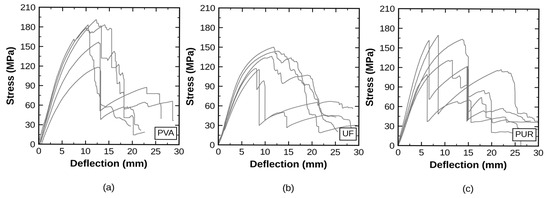
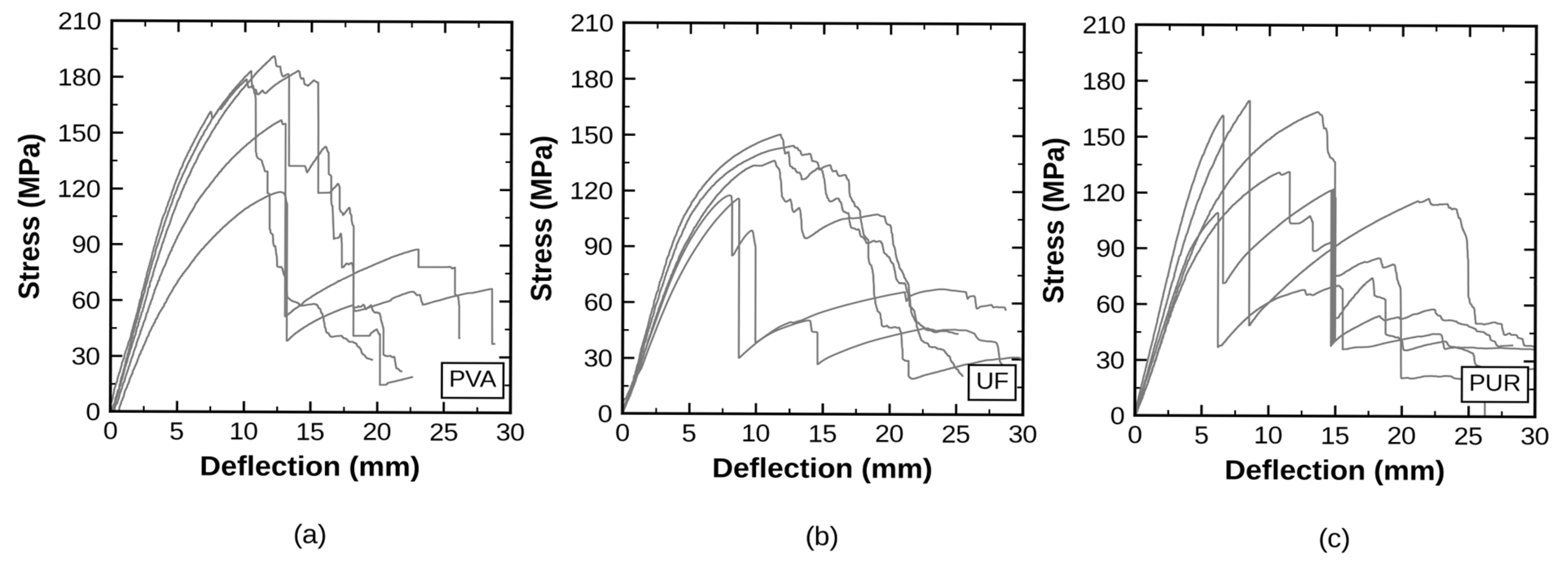
Table 3 presents the modulus of rupture (MOR) and modulus of elasticity (MOE) obtained for each adhesive, and Figure 12 shows the corresponding stress–deflection curves. PVA-bonded specimens reached the highest MOR (165.75 MPa), exceeding PUR (146.88 MPa) by approximately 12.8% and UF (132.77 MPa) by approximately 24.8%. Regarding MOE, PUR-bonded specimens achieved the highest value (13.76 GPa) exceeding PVA (12.91 GPa) by approximately 6.2% and UF (10.14 GPa) by approximately 26.3%. The average deflection at maximum load was approximately 25 mm for all three adhesive groups. One-way ANOVA indicated no statistically significant effect of adhesive type on either MOR or MOE (p > 0.05), suggesting that, as observed for the tension- and compression-parallel results, the flexural response of the GLB is primarily governed by the properties of the bamboo fibers. Given the sample size adopted (n = 5 per group), this result should be interpreted as an absence of a detectable adhesive effect within the resolution of the present dataset, rather than definitive proof of equivalence between adhesives under flexural loading.
Table 3.
Modulus of rupture (MOR) and modulus of elasticity (MOE) obtained in three-point bending tests for GLB bonded with PVA, UF, and PUR.
Figure 12.
Stress–deflection curves for GLB under three-point bending: (a) PVA; (b) UF; (c) PUR.
For unaged Moso bamboo GLB bonded with a phenolic adhesive, MOR of 109.71 MPa and MOE of 10.13 GPa have been reported [10]. Relative to these values, the MOR obtained in this study was higher by 50.4% (PVA), 36.9% (PUR), and 29.8% (UF), while the MOE was higher by 35.8% (PUR) and 27.4% (PVA), and essentially unchanged for UF (+0.1%). These comparisons suggest that the manufacturing process adopted in this study (particularly the strip conditioning and pressing parameters) produced GLB with flexural performance at the upper end of, or exceeding, values previously reported in the literature for Moso bamboo GLB.
3.2.4. Shear Perpendicular to the Grain
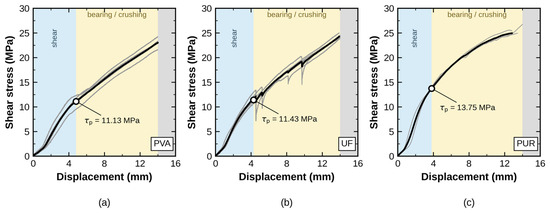
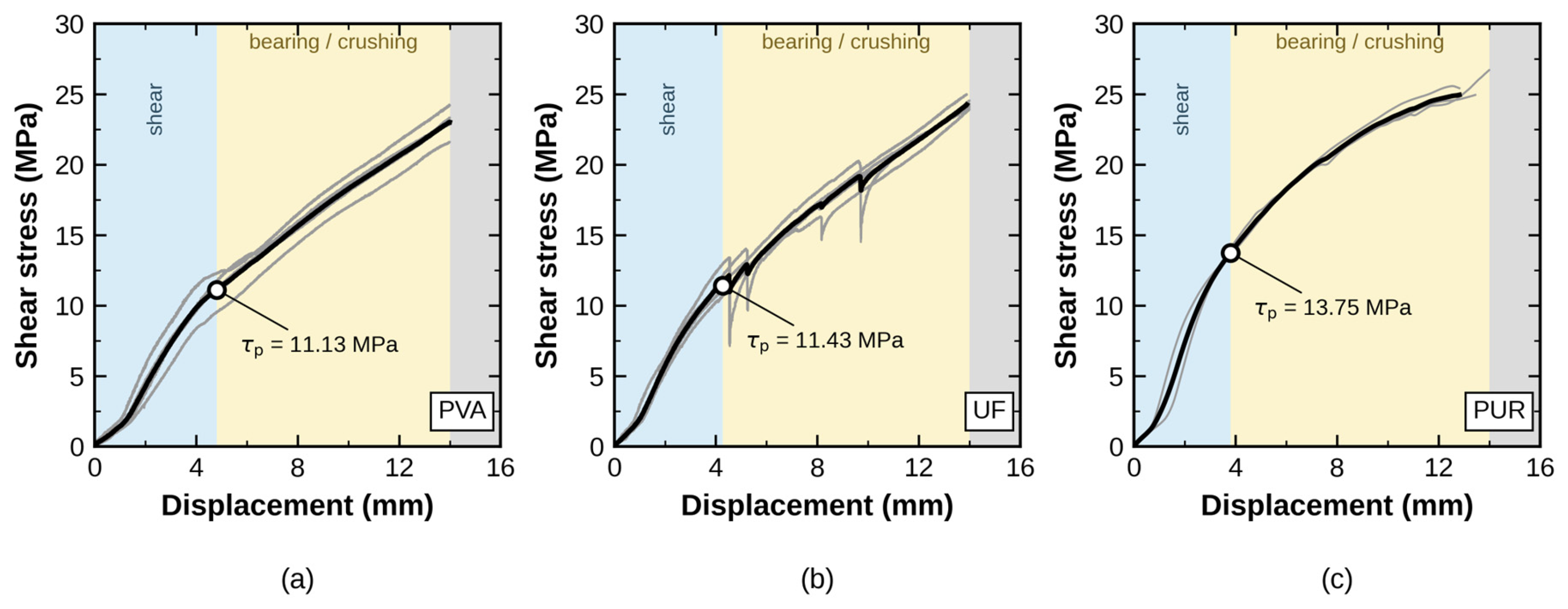
Table 4 presents the shear stress at the proportional limit, the initial stiffness and the energy absorbed up to the displacement limit for each adhesive, and Figure 13 shows the corresponding load–displacement curves. None of the specimens failed within the 14 mm displacement limit, and the curves reveal two distinct regimes separated by the proportional limit. Below it, the response is governed by the bond line: PUR reached the highest shear stress at the proportional limit (13.41 MPa), exceeding UF (11.99 MPa) by 11.8% and PVA (11.22 MPa) by 19.5%, and also showed by far the highest initial stiffness (13.58 kN/mm, against 8.34 and 7.61 kN/mm for UF and PVA). Above the proportional limit, the three adhesives converge and the response becomes governed by progressive bearing and crushing of the bamboo blocks rather than by the adhesive; at the 14 mm limit the difference between the best- and worst-performing adhesive falls to 11.6%, against 19.5% at the proportional limit.
Table 4.
Shear stress at the proportional limit, initial stiffness and absorbed energy obtained in shear tests perpendicular to the grain for GLB bonded with PVA, UF, and PUR.
Figure 13.
Shear stress–displacement curves for GLB under shear perpendicular to the grain: (a) PVA; (b) UF; (c) PUR. Bold line: pointwise mean of the group; thin lines: individual specimens. Open circles mark the proportional limit (0.5 mm offset), separating the shear-governed regime from the bearing- and crushing-governed regime. The dotted line at 14 mm is the displacement limit at which testing was stopped; no specimen failed before it.
The three adhesives differed markedly in the post-proportional-limit regime. PVA showed approximately linear hardening up to the displacement limit. UF exhibited isolated, abrupt load drops, with one event in four of the five specimens, of average amplitude 18.6% of the instantaneous load and occurring between 4.5 and 9.6 mm; these can be attributed to the high crosslink density and the absence of flexible functional groups in the cured UF network, resulting in a rigid polymer matrix with low fracture toughness and a tendency toward brittle crack propagation. PUR showed a continuous, progressively softening response without discrete drops, its tangent stiffness falling below 15% of the initial value at approximately 10.4 mm, and absorbed the highest energy up to the displacement limit (571.3 J against 503.2 J for UF and 463.9 J for PVA). This ordering is consistent with the behavior observed under tension perpendicular to the grain, where the more compliant PUR bond line developed a wider damage zone while UF localised in a narrow band at low stress, and supports a stiffness–toughness trade-off in the bond line as the governing mechanism.
Additional support for the adhesive-dependent shear response observed in this study can be found in [15], who reported a shear strength parallel to the GLB glue surface of 5.07 MPa for PVAc and 8.05 MPa for PRF i.e., the non-structural PVAc adhesive performed approximately 37% below the structural PRF adhesive. Although the test configuration differs from the perpendicular-to-grain shear test adopted in the present study, this finding reinforces the general trend observed here, in which adhesives classified as structural (PUR) outperformed non-structural adhesives (PVA, UF) when the bond line was directly subjected to shear.
The results of this study that were lower than those reported in the literature, particularly the compressive strength parallel to the grain for all adhesive types and the tensile strength parallel to the grain for PVA, do not affect the central comparison, since all adhesives were manufactured and tested under identical conditions. Therefore, the relative performance of PVA, UF, and PUR, rather than their absolute values, forms the basis for the conclusions regarding adhesive selection. Future studies should investigate the effect of strip conditioning temperature on fibre-parallel mechanical properties.
3.3. Sensitivity to Adhesive Type Across Loading Modes
The results above are more informative when read together than test by test. Quantifying, for each property, the ratio between the best- and worst-performing adhesive places the whole test programme on a single scale. Tensile strength parallel to the grain differs by only 1.15 between adhesives, followed by modulus of rupture (1.16), compressive strength parallel to the grain (1.19), shear stress at the proportional limit (1.20) and modulus of elasticity (1.36). At the opposite end, compressive strength perpendicular to the grain differs by 1.92 and tensile strength perpendicular to the grain by 4.84.
The ordering is not arbitrary. Sensitivity to adhesive type increases as the loading direction rotates from parallel to perpendicular to the bond plane, that is, as the load path shifts from being carried by the bamboo fibres to being carried across the glue lines. Under fibre-parallel loading the adhesive acts only to hold the laminae together and any adequate bond suffices; under transverse tension the bond line is itself the load path, and its intrinsic strength becomes the governing property.
The shear results occupy an intermediate and instructive position. The stress at the proportional limit varies by only 1.20 between adhesives, yet the initial stiffness of the joint varies by 1.78 (13.58 kN/mm for PUR against 7.61 kN/mm for PVA). The adhesive therefore governs how stiffly the joint responds and when damage initiates, while the load that the specimen ultimately sustains is limited by the bamboo blocks rather than by the bond. This distinction is consistent with the observation of De Lima et al. [15] that failure in GLB is ultimately limited by the bamboo rather than by the adhesive, and it explains why comparisons based on peak load alone tend to understate the influence of the adhesive.
For design, the practical consequence is that adhesive selection matters little where fibres carry the load, matters for joint stiffness and damage initiation under shear, and is decisive wherever the bond line is loaded in transverse tension or exposed to moisture.
3.4. Characteristic Values
Because the sample size per group is limited, mean values alone may overstate differences that would not survive the dispersion of the data. Characteristic values were therefore computed as the 5th percentile of a normal distribution (mean − 1.645 SD), the basis on which design values are derived in structural codes.
In three-point bending, the effect of dispersion is to compress the differences rather than to reverse them: the spread between the strongest and weakest adhesive falls from 24.8% between the means to 12.3% between the characteristic values (117.22 MPa for PVA, 107.22 MPa for UF and 104.36 MPa for PUR), and the ranking of PUR and UF exchanges, since the higher scatter of PUR offsets its higher mean. The same compression of differences occurs in tension parallel to the grain, where a 15.0% spread between the means falls to 8.3% between the characteristic values (123.6 MPa for PVA, 120.4 MPa for UF and 114.1 MPa for PUR).
This reinforces, on a design-relevant basis, the conclusion that fibre-governed properties are largely insensitive to adhesive type: the differences suggested by the means do not persist once dispersion is accounted for. Conversely, the properties governed by the bond line retain and even amplify their separation. In tension perpendicular to the grain the characteristic values are 2.25 MPa for PUR, 0.84 MPa for PVA and 0.31 MPa for UF, a spread of 618% against 384% between the means; in shear at the proportional limit the ordering is preserved (11.93, 10.62 and 9.66 MPa), with the spread increasing from 19.5% to 23.5%.
A secondary observation follows: UF is the most consistent of the three adhesives, showing the lowest coefficient of variation in most properties even where its mean is not the highest. For structural use, where characteristic rather than mean values govern, predictability is of comparable importance to average strength.
4. Conclusions
This study investigated the influence of three adhesive types (PVA, UF and PUR) on the physical and mechanical performance of GLB produced from Phyllostachys pubescens (Moso) bamboo. The following conclusions can be drawn. Sensitivity to adhesive type is not uniform across loading modes but varies systematically with the orientation of the load relative to the bond plane. Where the load is carried by the bamboo fibres, compression and tension parallel to the grain, and flexure, differences between adhesives did not exceed 25% and were largely absorbed by the scatter of the data. Where the load is carried across the bond line, the separation is decisive: in tension perpendicular to the grain the strongest and weakest adhesives differ by a factor of 4.8.
The three adhesives differ in the mechanism by which the bond line fails, not only in its strength. The compliant PUR bond line develops a wide damage zone and absorbs the highest energy, whereas the stiffer PVA and UF bond lines localise in narrow bands at low stress, UF failing through abrupt load drops. The same compliance that benefits PUR under transverse tension penalises it under transverse compression, where PVA reached the highest strength, a stiffness–toughness trade-off that reverses the adhesive ranking between the two loading signs on the same plane.
Adhesive type exerted a decisive influence on water resistance. PVA-bonded specimens delaminated after 7 days of immersion and UF after 12, while PUR remained intact throughout the 23-day test. The PVA tested corresponds to EN 204 class D2, not formulated for prolonged wet exposure; D3 and D4 formulations were outside the scope of this study, and this conclusion should be understood as specific to the formulations tested.
Adhesive selection for GLB should therefore be guided by both the dominant loading mode and the expected environmental exposure. PUR is the preferred candidate where the bond line carries load transversely or where moisture exposure is expected, pending confirmation by long-term aging tests; PVA suits dry indoor applications where flexural strength and transverse compressive stiffness govern; UF offers the most consistent behaviour of the three, with the lowest scatter in most properties, but the weakest bond line in transverse tension. Future work should address long-term durability under accelerated aging and the effect of spread rate and pressing parameters across a broader range of species.
Author Contributions
Conceptualization, T.S., B.G. and R.T.F.; methodology, T.S. and B.G.; validation, T.S. and B.G.; formal analysis, T.R., S.d.S., M.R., B.G. and T.S.; investigation, B.G., T.R., S.d.S. and M.R.; resources, R.T.F.; data curation, T.R., S.d.S., M.R., B.G. and T.S.; writing—original draft preparation, T.R., S.d.S., M.R., B.G. and T.S.; writing—review and editing, T.S., B.G. and R.T.F.; visualization, T.R., S.d.S. and M.R.; supervision, T.S., B.G. and R.T.F.; project administration, T.S., B.G. and R.T.F.; funding acquisition, R.T.F. All authors have read and agreed to the published version of the manuscript.
Funding
This research was funded by the Coordination for the Improvement of Higher Education Personnel (CAPES), the National Council for Scientific and Technological Development (CNPq), and the Carlos Chagas Filho Foundation for Research Support of the State of Rio de Janeiro (FAPERJ).
Data Availability Statement
The original contributions presented in this study are included in the article. Further inquiries can be directed to the corresponding author.
Conflicts of Interest
The authors declare no conflicts of interest.
Abbreviations
The following abbreviations are used in this manuscript:
| GLB | Glued Laminated Bamboo |
| PVA | Polyvinyl acetate |
| UF | Urea–formaldehyde |
| PUR | Polyurethane |
| MOR | Modulus of Rupture |
| MOE | Modulus of Elasticity |
References
- United Nations Environment Programme Global Alliance for Buildings and Construction. Not Just Another Brick in the Wall: The Solutions Exist-Scaling Them Will Build on Progress and Cut Emissions Fast. Global Status Report for Buildings and Construction 2024/2025; UN Environment Programme: Nairobi, Kenya, 2025. [Google Scholar]
- Pacheco-Torgal, F. An Introductory Overview of Bio-Based Construction Materials. In Advances in Bio-Based Materials for Construction and Energy Efficiency; Woodhead Publishing: Cambridge, UK, 2025; pp. 1–14. [Google Scholar]
- Einafshar, N.; El Mendili, Y. From Material to Member: A Structural Review on Bio-Based Construction Materials. CivilEng 2026, 7, 48. [Google Scholar] [CrossRef] [Scilit]
- Fitzgerald, A.; Proud, W.; Kandemir, A.; Murphy, R.J.; Jesson, D.A.; Trask, R.S.; Hamerton, I.; Longana, M.L. A Life Cycle Engineering Perspective on Biocomposites as a Solution for a Sustainable Recovery. Sustainability 2021, 13, 1160. [Google Scholar] [CrossRef] [Scilit]
- Lou, Z.; Zheng, Z.; Yan, N.; Jiang, X.; Zhang, X.; Chen, S.; Xu, R.; Liu, C.; Xu, L. Modification and Application of Bamboo-Based Materials: A Review-Part II: Application of Bamboo-Based Materials. Forests 2023, 14, 2266. [Google Scholar] [CrossRef] [Scilit]
- Liese, W.; Weiner, G. Ageing of Bamboo Culms. A Review. Wood Sci. Technol. 1996, 30, 77–89. [Google Scholar] [CrossRef] [Scilit]
- Kumar, D.; Mandal, A. Review on Manufacturing and Fundamental Aspects of Laminated Bamboo Products for Structural Applications. Constr. Build. Mater. 2022, 348, 128691. [Google Scholar] [CrossRef] [Scilit]
- Xu, P.; Tam, V.W.Y.; Li, H.; Zhu, J.; Xu, X. A Critical Review of Bamboo Construction Materials for Sustainability. Renew. Sustain. Energy Rev. 2025, 210, 115230. [Google Scholar] [CrossRef] [Scilit]
- da Cunha Gomes, B.M.; da Silva, N.A.; Saraiva, A.B.; Caldas, L.R.; Toledo Filho, R.D. Environmental and Mechanical Performance Assessment of Bamboo Culms and Strips for Structural Use: Evaluation of Phyllostachys pubescens and Dendrocalamus Giganteus Species. Constr. Build. Mater. 2022, 353, 129078. [Google Scholar] [CrossRef] [Scilit]
- Correal, J.F.; Echeverry, J.S.; Ramírez, F.; Yamín, L.E. Experimental Evaluation of Physical and Mechanical Properties of Glued Laminated Guadua Angustifolia Kunth. Constr. Build. Mater. 2014, 73, 105–112. [Google Scholar] [CrossRef] [Scilit]
- Sulastiningsih, I.M.; Trisatya, D.R.; Indrawan, D.A.; Malik, J.; Pari, R. Physical and Mechanical Properties of Glued Laminated Bamboo Lumber. J. Trop. For. Sci. 2021, 33, 290–297. [Google Scholar] [CrossRef] [Scilit]
- Jimenez, J.P., Jr.; Ramos, J.E.C. Glue-Bond Performance of Oil-Heat-Treated Bamboo Using Cold-Setting and Thermosetting Adhesives for Engineered Bamboo Applications. Adv. Bamboo Sci. 2025, 11, 100140. [Google Scholar] [CrossRef] [Scilit]
- Wang, X.; Yin, X.; Wang, Z.; Yuan, T.; Li, W.; He, S.; Sun, S.; Li, Y. The Effects of Humidity on the Bonding Performance of Glued Thermally Treated Bamboo. Ind. Crops Prod. 2024, 222, 120039. [Google Scholar] [CrossRef] [Scilit]
- Sewar, Y.; Amran, M.; Avudaiappan, S.; Gamil, Y.; Rashid, R.S.M. Bonding Strength Performance of Bamboo-Based Composite Materials: An in-Depth Insight for Sustainable Construction Applications. Heliyon 2024, 10, e32155. [Google Scholar] [CrossRef] [Scilit]
- Lima, D.M.; Júnior, H.C.L.; Medeiros, I.S. Physical and Mechanical Properties of Glued Laminated Bamboo. BioResources 2023, 18, 3522–3539. [Google Scholar] [CrossRef] [Scilit]
- Takeuchi, C.P.; Estrada, M.; Linero, D.L. Experimental and Numerical Modeling of Shear Behavior of Laminated Guadua Bamboo for Different Fiber Directions. Constr. Build. Mater. 2018, 177, 23–32. [Google Scholar] [CrossRef] [Scilit]
- Henriques, F.S.; Gomes, B.M.C.; Toledo Filho, R.D. Influência Da Espessura Das Lâminas No Comportamento Mecânico Do Bambu Laminado Colado. In Proceedings of the 4º Congresso Luso-Brasileiro Materiais de Construção Sustentáveis, Salvador, Brazil, 9–11 November 2022. [Google Scholar]
- Li, Z.; Xiao, D.; Wang, R. Strength Properties of Unidirectional Laminated Engineered Bamboo Boards under Off-Axis Tension and Compression Tests. Compos. Struct. 2023, 322, 117405. [Google Scholar] [CrossRef] [Scilit]
- Tinkler-Davies, B.; Shah, D.U. Digital Image Correlation Analysis of Laminated Bamboo under Transverse Compression. Mater. Lett. 2021, 283, 128883. [Google Scholar] [CrossRef] [Scilit]
- ASTM D143-25; Standard Test Methods for Small Clear Specimens of Timber. ASTM International: West Conshohocken, PA, USA, 2025.
- EN 204:2016; Classification of Thermoplastic Wood Adhesives for Non-Structural Applications. European Committee for Standardization: Brussels, Belgium, 2016.
- ASTM D2559-12a(2024); Standard Specification for Adhesives for Bonded Structural Wood Products for Use Under Exterior Exposure Conditions. ASTM International: West Conshohocken, PA, USA, 2024.
- ISO 22156:2021; Bamboo Structures—Bamboo Culms—Structural Design, 2nd ed. International Organization for Standardization: Geneva, Switzerland, 2021.
- ASTM D1037-12(2020); Standard Test Methods for Evaluating Properties of Wood-Base Fiber and Particle Panel Materials. ASTM International: West Conshohocken, PA, USA, 2020.
- Zhang, K.; Liu, Y.; Huang, D. Behavior of Glued Laminated Bamboo in Compression Perpendicular to the Grain at Elevated Temperature. Constr. Build. Mater. 2023, 409, 134081. [Google Scholar] [CrossRef] [Scilit]
- EN 302-1:2023; Adhesives for Load-Bearing Timber Structures—Test Methods—Part 1: Determination of Longitudinal Tensile Shear Strength. European Committee for Standardization: Brussels, Belgium, 2023.
- EN 302-2:2023; Adhesives for Load-Bearing Timber Structures—Test Methods—Part 2: Determination of Resistance to Delamination. European Committee for Standardization: Brussels, Belgium, 2023.

Disclaimer/Publisher’s Note: The statements, opinions and data contained in all publications are solely those of the individual author(s) and contributor(s) and not of MDPI and/or the editor(s). MDPI and/or the editor(s) disclaim responsibility for any injury to people or property resulting from any ideas, methods, instructions or products referred to in the content. |
© 2026 by the authors. Licensee MDPI, Basel, Switzerland. This article is an open access article distributed under the terms and conditions of the Creative Commons Attribution (CC BY) license.