


Abstract
The durability of alkali-activated materials (AAMs) in acidic environments is a key factor governing their suitability as sustainable alternatives to ordinary Portland cement (OPC). This study investigates the acid resistance of fly ash–slag alkali-activated mortars prepared with either seawater-based or distilled water-based activator solutions, thereby addressing the feasibility of substituting potable water in activator preparation. Eleven binder blends were tested, ranging from 100% fly ash (F100G0) to 100% ground granulated blast furnace slag (GGBS, F0G100) in 10% replacement increments, each prepared with both distilled-water (D-series) and seawater-based (M-series) activator solutions. Mortar cubes were exposed to hydrochloric acid (HCl) and sulphuric acid (H2SO4) after curing for 28, 60, 90, and 180 days. Durability was assessed through mass change, compressive strength retention, and ultrasonic pulse velocity (UPV), complemented by X-ray diffraction (XRD) analysis to elucidate mineralogical transformations. Results showed that acid resistance was governed primarily by binder composition: calcium-rich slag (C–A–S–H) systems deteriorated mainly by decalcification under acid exposure, whereas low-calcium fly ash (N–A–S–H) systems degraded more slowly by dealumination. Seawater activation did not significantly compromise acid resistance relative to distilled-water systems, with the two-activator series performing comparably under both HCl and H2SO4. Paired comparisons of the reported blend values showed small, age-dependent differences between the two-activator series: seawater activation modestly delayed strength loss under HCl at intermediate ages, while under H2SO4 it carried a small late-age penalty attributable to reaction of activator-derived chloride compounds with the acid; at most ages, the two series were statistically indistinguishable. X-ray diffraction showed essentially identical phase assemblages in the two series: no crystalline products formed under HCl, where an amorphous silica-rich residue accumulates on fly-ash-rich blends, whereas gypsum was the sole crystalline product under H2SO4, enhanced in seawater-activated fly-ash-rich blends. The findings clarify the role of marine ions in influencing acid degradation and provide guidance for designing sustainable binder systems for chloride- and sulphate-rich service environments. Overall, seawater is shown to be a viable substitute for potable water in activator preparation, retaining acid resistance comparable to distilled-water systems and supporting the development of more sustainable alkali-activated binders.
1. Introduction
Cement production is a major industrial contributor to climate change, accounting for nearly 8% of global anthropogenic CO2 emissions and more than 38 Gt released since 1928 [1]. India, the second-largest producer with about a 7% share, faces the dual challenge of meeting infrastructure demand while reducing the carbon intensity of its cement sector [1,2]. Beyond emissions, cement and concrete consume vast freshwater resources during mixing, curing, and aggregate washing. Conventional concrete production requires nearly 500 L of freshwater per cubic metre, translating to around 4 trillion L annually worldwide, which places acute stress on water-scarce regions [3,4]. It is estimated that concrete already accounts for ~9% of global industrial water withdrawals, with future demand projected at 590 to 710 km3 by 2050, nearly three-quarters of which will occur in regions already facing scarcity [5]. For India, where demand is projected to rise by nearly 90%, freshwater shortages amplify the urgency to explore alternative binder systems and non-potable water sources [5,6]. In this context, seawater, treated wastewater, and other substitutes, combined with supplementary cementitious materials, are seen as viable approaches to lowering both the carbon and water footprints of construction [3,6].
Research on alkali-activated materials (AAMs) predates modern geopolymer science, with foundational work by Glukhovsky and colleagues in the 1950s establishing the alkaline activation of aluminosilicate- and calcium-rich precursors and defining early alkaline and alkaline–alkaline earth binder systems [7]. Geopolymer science, later formalised by Davidovits in the 1970s, represents a specific subset of low-calcium aluminosilicate binders characterised by three-dimensional Si–O–Al polymeric frameworks formed under highly alkaline conditions [8]. Although AAMs and geopolymers share conceptual and chemical similarities, they are distinct systems: AAMs constitute a broader class of binders encompassing both N–A–S–H and C–(A)–S–H gel chemistries, whereas geopolymers refer primarily to the former. Recent perspectives emphasise the importance of recognising this distinction, noting that the historical development and scientific foundations of AAMs extend well beyond geopolymer science [9]. Unlike ordinary Portland cement (OPC), geopolymers do not depend on limestone calcination, and their low-temperature synthesis produces poly(sialate)-type frameworks with ceramic-like strength, chemical stability, and fire resistance [8]. Subsequent work systematised research on alkali-activated slags, fly ash, and calcined clays, highlighting their advantages in durability, rapid strength gain, and waste valorisation [10]. Later reviews consolidated the chemistry of low-calcium N–A–S–H gels and high-calcium C–(A)–S–H gels, showing how blended systems can balance performance and durability [11]. Experimental studies have demonstrated that optimised activator ratios, curing regimes, and fly ash–slag blends can achieve compressive strengths on par with or superior to OPC while maintaining lower permeability and better chemical stability [12,13,14]. Applications in pavements, precast blocks, and green buildings have further established their suitability as sustainable construction materials [14,15]. Broader reviews confirm that AAMs can achieve up to 80% reductions in CO2 emissions and significantly lower freshwater demand, placing them among the few proven technologies capable of decarbonizing construction [15,16].
However, the long-term adoption of AAMs hinges on their durability under aggressive environments. Studies show that their resistance depends strongly on precursor chemistry, activator design, and curing conditions. Blended FA/GGBS systems have shown enhanced resistance to acids, chlorides, and sulphates compared to OPC [17,18], while slag-rich mortars often achieve higher early strength but face greater losses under sulfuric acid attack [19,20]. Fly-ash-rich systems, in contrast, demonstrate superior stability and resistance to long-term deterioration [20,21]. Marine exposure studies confirm that chloride ingress is significantly reduced in slag-rich AAMs, meeting service-life requirements that OPC struggles to achieve [21,22,23]. Reduced sorptivity and water absorption, denser microstructures, and better resistance to magnesium sulphate have been repeatedly documented [23,24]. These behaviours originate in the calcium content of the precursor and the gel it forms. GGBS, being calcium-rich, produces calcium aluminosilicate hydrate, C–(A)–S–H, whose structural integrity depends on interlayer and framework calcium; under acid exposure, H+ exchanges for Ca2+ and the gel decalcifies, leaving a porous, dealuminated silica-rich residue [25,26,27]. Fly ash, being low in calcium, forms sodium aluminosilicate hydrate, N–A–S–H, a three-dimensional covalent framework holding little exchangeable calcium, which degrades primarily by slower dealumination and is correspondingly more acid-stable [26,28]. The distinction sharpens under sulphuric acid, where the calcium and reactive alumina of slag-rich systems supply the reactants for gypsum and ettringite, whose crystallisation generates expansive internal stress in addition to dissolution damage [28,29]. Experimental and microstructural investigations consistently demonstrate that properly designed blends, especially those with balanced FA–GGBS ratios, achieve strong durability across acid, sulphate, chloride, and marine exposures [23,30,31,32,33,34]. Review articles synthesise these findings, concluding that geopolymer concretes generally outperform OPC in aggressive conditions, with acid attack resistance remaining a critical parameter [35,36,37,38].
Although seawater-based alkali-activated binders have shown promising mechanical and chloride-related durability performance, their behaviour under acidic exposure has not been systematically established. This is a critical gap because structures located in marine and coastal regions such as sewage outfalls, desalination infrastructure, wastewater pipelines, and harbour installations may be simultaneously exposed to chlorides and acidic conditions generated by biogenic sulphuric acid, industrial effluents, or localised seawater acidification. Therefore, acid resistance becomes a key parameter governing the safe use of seawater-based AAMs. Marine ions are not inert in this context; in calcium- and alumina-bearing systems, chloride is bound onto layered double hydroxide phases such as chloride hydrotalcite and chloride-hydrocalumite, altering the aluminate and carbonate reservoir otherwise available for sulphate-bearing degradation products [39]. In fly-ash-rich systems, the calcium chloride formed during seawater activation can react with sulphuric acid to generate additional gypsum and hydrochloric acid, initiating a secondary attack within the matrix [40]. Both processes modify the dissolution and leaching pathways and the secondary phase assemblage relative to distilled-water systems. The other major seawater ions act through distinct pathways. Magnesium is not a protective ion in these systems: it migrates into the matrix, drives calcium and alkalis outward, and converts the aluminosilicate gel into low-strength magnesium (aluminium) silicate hydrate while forming brucite and hydrotalcite, all of which degrade the binding phases [24]. Sulphate may be partly consumed during early reaction, reducing the reactive aluminate later available for ettringite formation, while sodium supplements the activator alkalis and marginally raises pore-solution alkalinity. Because these ions compete for the same calcium and aluminate reservoirs that govern acid degradation, their net effect depends strongly on the FA–GGBS ratio examined in this study.
In parallel, amid growing concerns about freshwater scarcity, research has increasingly examined the use of seawater in AAM systems. A wide body of studies confirms that seawater does not fundamentally hinder alkali activation, though it modifies early reactivity, pore structures, and microstructural evolution in ways distinct from freshwater mixes [41,42,43]. Shi et al. [41] showed that seawater-mixed calcium silicate slag mortars had slightly lower early compressive strength and workability, but strengths converged with freshwater mixes by 28 days. Similar outcomes were observed in slag concretes with sea sand [42]. Fly ash-based pastes mixed with seawater have even shown higher strength and denser pore structures due to enhanced gel formation [43]. Slag–fly ash blends prepared with seawater activators exhibited improved chloride binding and refined pore structures, attributed to the formation of chloride-bearing phases such as hydrotalcite and Friedel’s salt [39,44,45]. Seawater mixed binders and hydrothermal curing further enhanced strength and durability, with several studies reporting long-term compressive strengths exceeding 70 MPa [46,47,48].
Durability evaluations under seawater and marine exposures demonstrate that seawater-based AAMs retain superior compressive strength and microstructural integrity compared with OPC, even though chloride ingress requires careful attention [49,50,51]. Seawater mixes have been reported to improve sulphate resistance and refine pore networks [39,45]. Two mechanisms are advanced. First, chloride-bearing phases such as Friedel’s salt and hydrotalcite, together with the general refinement of the pore structure, occupy pore volume and reduce connectivity, slowing the ingress of external sulphate [39,45]. Second, chloride competes with sulphate for reactive aluminate, consuming part of the aluminate reservoir before external sulphate can form expansive ettringite [39]. Both mechanisms act by limiting the ingress or reaction of external sulphate, and neither protects against strong mineral acids, where degradation is governed by bulk dissolution rather than ionic ingress; vulnerability to acid attack therefore persists [40]. Thermal performance tests up to 1000 °C show that seawater slag concretes experience greater shrinkage than OPC, but also superior spalling resistance [46]. Applications using seawater and sea sand in geopolymer mortars confirm that strengths remain comparable to OPC benchmarks [52,53,54], with hydrothermal curing further boosting performance [55]. Review studies synthesise these findings, emphasising that seawater-based AAMs consistently outperform OPC in chemical resistance, particularly when activator chemistry is optimised [35]. Recent experimental confirmation across multiple FA–GGBS blends demonstrate that seawater-based alkaline activators yield mechanical strength and mineralogical phase assemblages nearly identical to distilled water systems [56], establishing their feasibility as activating water, while their behaviour under aggressive acidic exposure remains to be established.
Despite this progress, three gaps remain. First, seawater has been studied almost exclusively as mixing or curing water. Its use as the solvent in the alkaline activator itself, where it interacts with the binder at the highest pH and the earliest stage of reaction, has received little attention. Second, durability assessment has focused largely on chloride ingress and marine or sulphate exposure, while resistance to strong mineral acids has not been systematically established for these systems. Third, previous studies have examined only one or two fixed compositions. Because the ion-specific mechanisms outlined above are expected to depend strongly on the FA–GGBS ratio, the absence of any study spanning a continuous compositional range leaves an important gap. The present study addresses all three by systematically evaluating the acid durability of unreinforced FA–GGBS alkali-activated mortars prepared with seawater- and distilled water-based activators across eleven binder blends. These ranged from 100% FA to 100% GGBS in 10% increments and were exposed to hydrochloric acid (HCl) and sulphuric acid (H2SO4) for up to 180 days. Durability was assessed using mass change, compressive strength retention, and ultrasonic pulse velocity (UPV), while degradation mechanisms were interpreted through X-ray diffraction (XRD) of representative slag-rich, balanced, and FA-rich binders.
2. Materials
2.1. Binder Materials
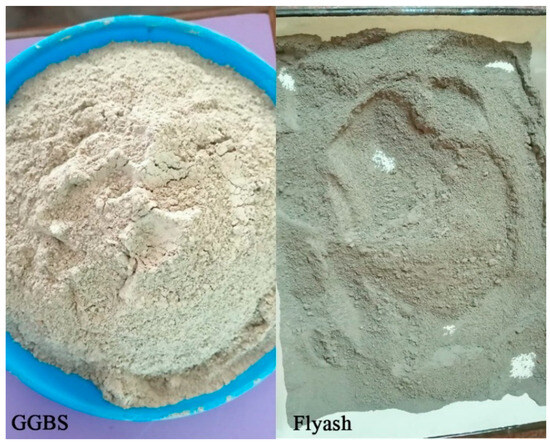
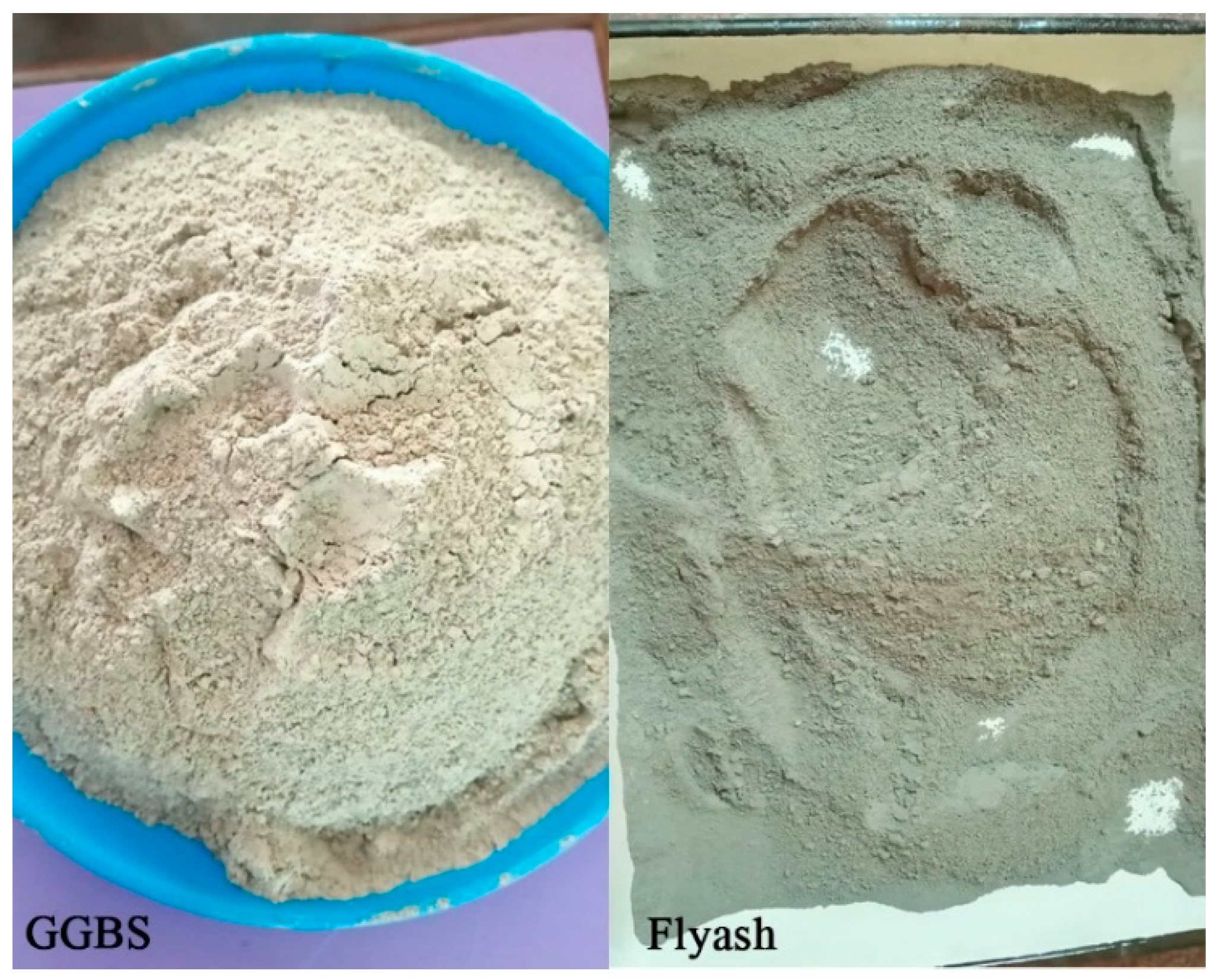
Two industrial by-products were employed as binders: Class F fly ash (FA) and ground granulated blast furnace slag (GGBS). FA was sourced from the Dr. Narla Tata Rao Thermal Power Plant, Kondapalli, Vijayawada, Andhra Pradesh, India, while GGBS was supplied by Astrra Chemicals, Chennai, Tamil Nadu, India. The FA was rich in silica and alumina, whereas GGBS contained predominantly calcium along with significant quantities of silica and magnesium. The specific gravities of FA and GGBS were 2.10 and 2.85, respectively. The GGBS had a certified fineness of 390 m2/kg with 97.1% passing 45 μm. The fly ash and GGBS used in the present study are shown in Figure 1.
Figure 1.
Binder materials: GGBS and Fly ash.
The chemical composition of the fly ash (FA) and ground granulated blast furnace slag (GGBS) was determined using X-ray fluorescence (XRF) and is reported in terms of oxide contents (wt.%) in Table 1. The fly ash was predominantly siliceous, containing high proportions of SiO2 and Al2O3 with comparatively low CaO, while the GGBS exhibited a calcium-rich chemistry characteristic of latent hydraulic materials. The fly ash satisfied the compositional requirements for class F (siliceous) fly ash, with SiO2 + Al2O3 + Fe2O3 of 92.3% and CaO of 1.4%. The XRF analysis of GGBS was carried out on a consignment from the preliminary phase of this research programme; the GGBS used for the specimens reported here was a separate consignment of the same grade.
Table 1.
Oxide composition of binder materials (wt.%).
2.2. Activator Solutions
The alkaline activators were prepared using sodium hydroxide (NaOH) and sodium silicate (Na2SiO3), both procured from Astrra Chemicals, Chennai, Tamil Nadu, India. Analytical-grade sodium hydroxide pellets with a purity of 98% were dissolved in either distilled water or natural seawater to obtain 12 M solutions, which were allowed to cool for at least 24 h prior to use. Distilled water was selected to avoid the influence of dissolved salts, while seawater-based mixes used natural seawater solely as the solvent. The activator composition of 12 M NaOH combined with sodium silicate containing 31.12% SiO2 and 14.20% Na2O (specific gravity 1.55, SiO2/Na2O ratio = 2.19) was calculated strictly from the analytical-grade chemicals added. The sodium silicate to sodium hydroxide ratio was maintained at 2.5 by weight, consistent with optimisation ranges reported for FA-GGBS alkali-activated systems where this proportion supports balanced workability, dissolution kinetics, and early gel formation. The activator modulus and Na2O contents were calculated solely from analytical-grade reagents; dissolved ions naturally present in seawater (Na+, Mg2+, Ca2+, K+, Cl−, SO42− and trace ions) were not included in molarity or modulus calculations and were instead considered part of the intrinsic ionic environment influencing reaction mechanisms.
Seawater was collected from the east coast region of Andhra Pradesh, India. The major ionic constituents, including sodium, magnesium, calcium, potassium, sulphate, phosphate, chlorides, and trace ions, were quantified according to IS 3025 series test methods [57]. The concentrations are presented in Table 2 in mg/L. Based on these measured ionic contents, the salinity of the seawater was approximately 21.7 g/L, which is consistent with natural coastal seawater influenced by river inflow and seasonal dilution. The measured pH of the seawater sample was 7.49.
Table 2.
Chemical composition of seawater (mg/L).
2.3. Fine Aggregate
River sand conforming to Zone II grading of IS 383:2016 [58] was used as the fine aggregate. It had a specific gravity of 2.65 and a fineness modulus of 2.81. The sand was oven-dried and sieved through a 4.75 mm IS sieve prior to use to ensure uniformity.
3. Experimental Programme
3.1. Mix Proportions and Specimen Preparation
A total of eleven binder combinations were prepared by varying the FA–GGBS ratio in 10% increments, ranging from F100G0 (100% FA) to F0G100 (100% GGBS). Mixes are designated FxGy, where x and y denote the fly ash and GGBS contents, respectively, expressed as percent by mass of total binder; the eleven blends were therefore F100G0, F90G10, F80G20, F70G30, F60G40, F50G50, F40G60, F30G70, F20G80, F10G90, and F0G100. Where the activator type is specified, the prefixes D and M denote activators prepared with distilled water and seawater, respectively, so that DF60G40 and MF60G40 refer to the same binder blend activated with distilled water and seawater. The binder-to-sand ratio was fixed at 1:1 by mass, and the activator-to-binder ratio was maintained at 0.45, consistent with optimisation practices commonly adopted for FA–GGBS geopolymer systems. Previous studies on blended binders activated with sodium hydroxide and sodium silicate have shown that an alkaline liquid-to-binder ratio of 0.45 provides an effective balance between workability, reaction kinetics, and the stability of the fresh mix [59]. In agreement with these observations, preliminary trials in the present study also indicated that a ratio of 0.45 offered adequate workability without segregation, while supporting uniform strength development across all fly ash–slag combinations [56]. In addition, the sodium silicate-to-sodium hydroxide ratio in the activator solution was fixed at 2.5 by weight. This proportion falls within the optimisation range reported for FA–GGBS alkali-activated systems, where sufficient silicate availability enhances precursor dissolution and early gel formation, while avoiding excessive viscosity or premature stiffening observed at higher ratios. The detailed mix proportions for all eleven fly ash–GGBS alkali-activated mortar mixtures are presented in Table 3.
Table 3.
Mix proportions of alkali-activated fly ash–GGBS mortar mixtures (per m3 of fresh mortar).
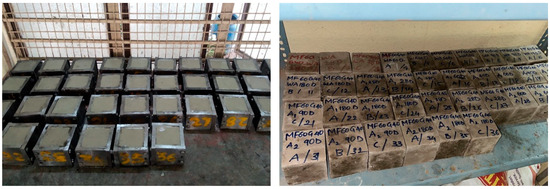
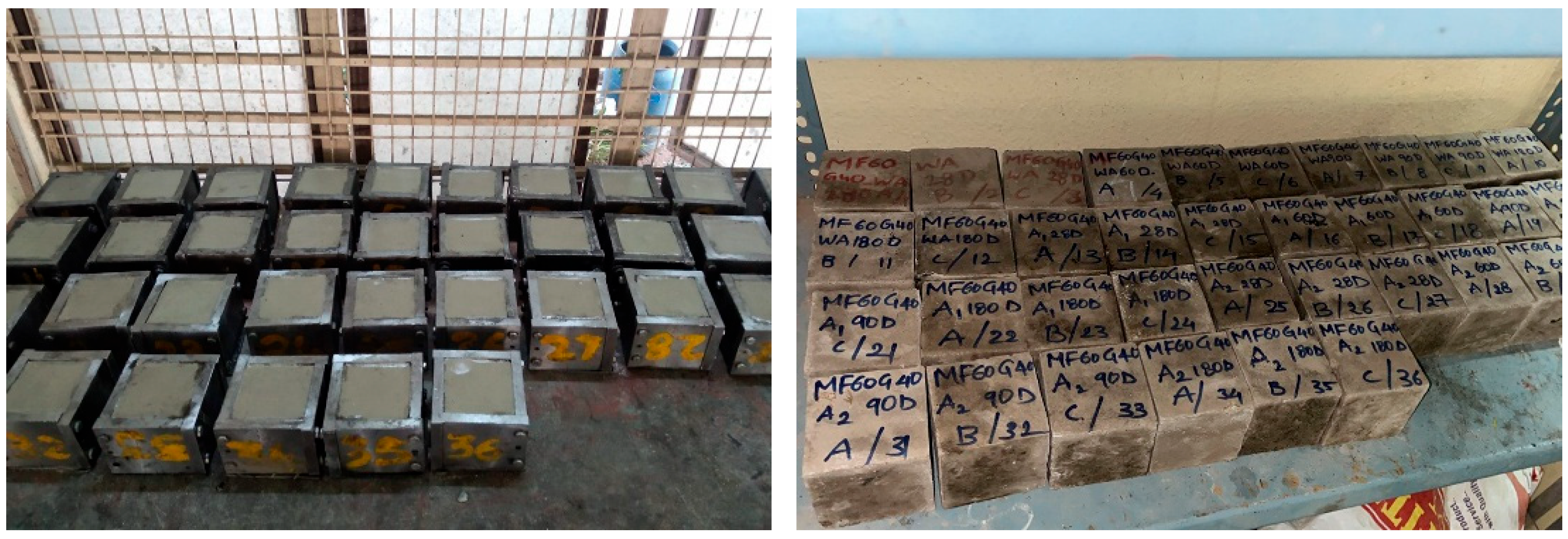
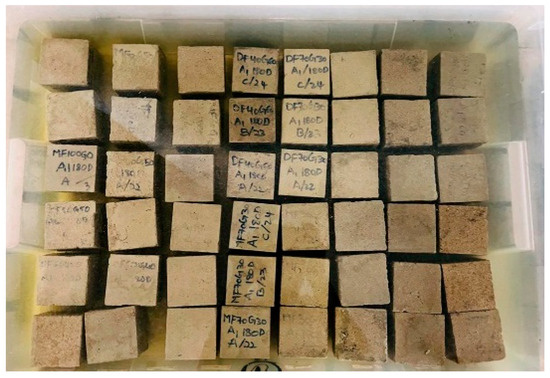
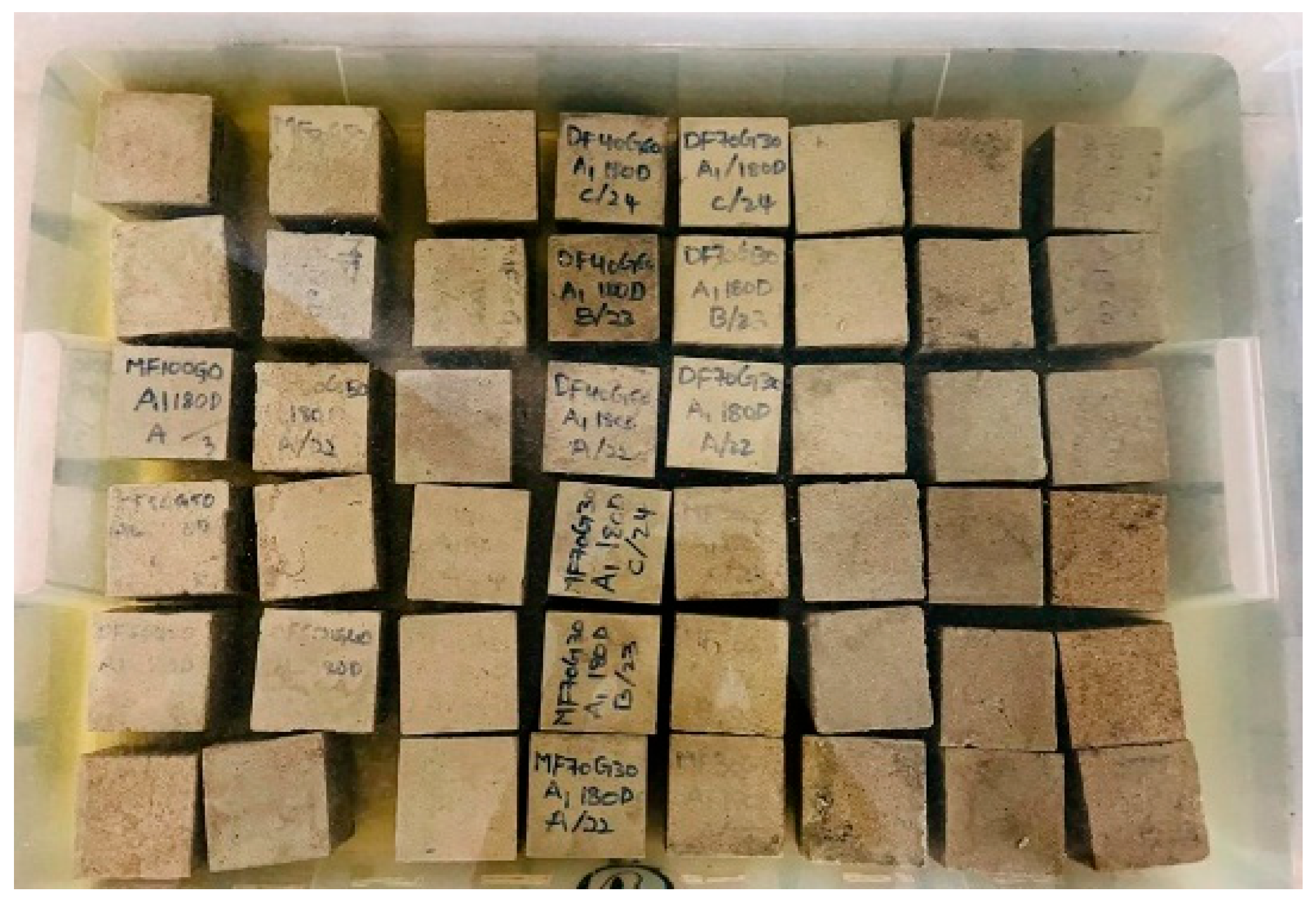
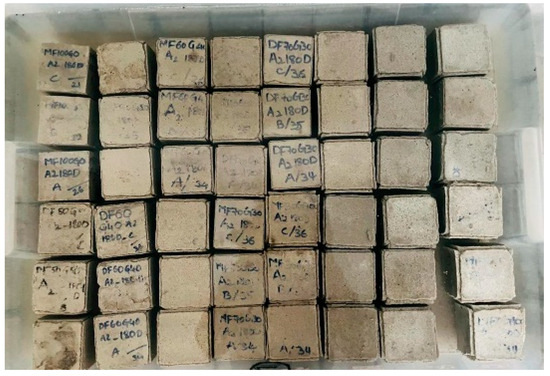
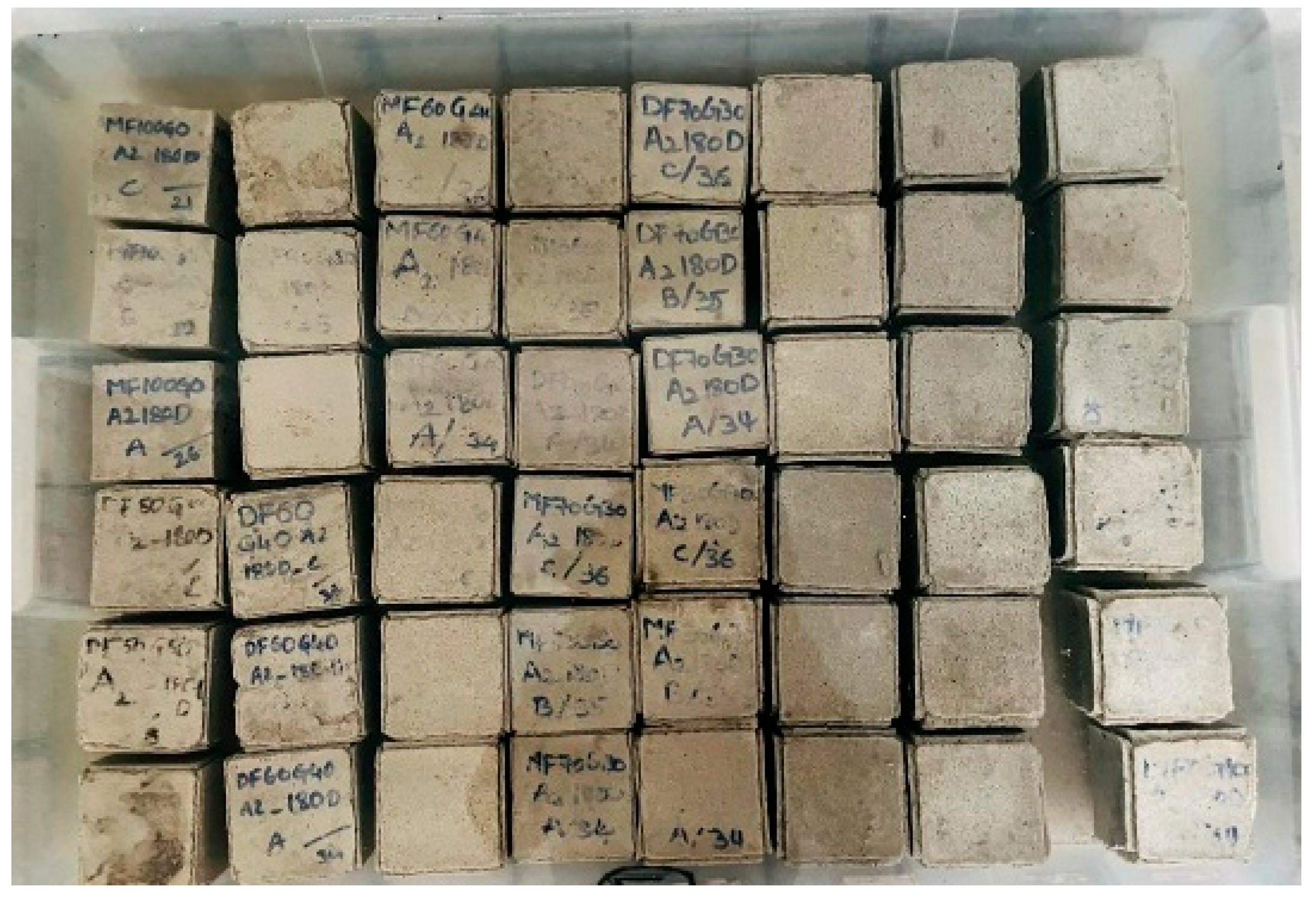
Dry binder and sand were first mixed for 3 min, followed by gradual addition of the pre-prepared activator solution. Mixing continued for an additional 10 min to ensure homogeneity. The fresh mortar was cast into 70.6 mm cube moulds, compacted on a vibrating table. Specimens were demoulded after 24 h and cured under ambient laboratory conditions until the designated test ages of 28, 60, 90, and 180 days. Laboratory temperature and relative humidity were not directly monitored; climatological records for the study period indicate monthly mean ambient temperatures of approximately 27–30 °C and monthly mean relative humidity of approximately 69–83%. For each binder blend, the D-series and M-series specimens were cast on the same day from the same batch of materials and cured alongside one another. Some of the mortar cube specimens prepared for immersion in acid are shown in Figure 2.
Figure 2.
Cube specimen for acid attack test.
For clarity of interpretation, the binder combinations were grouped into three categories based on FA–GGBS proportions: (i) GGBS-rich mixes (F0G100 to F30G70); (ii) balanced mixes (F40G60 to F60G40); and (iii) FA-rich mixes (F70G30 to F100G0). This classification was applied consistently to both distilled-water-activated (D-series) and seawater-activated (M-series) mixes and was used throughout the durability analysis to interpret the influence of calcium availability and activator chemistry.
3.2. Acid Exposure Regime
Durability was evaluated by immersing specimens in 5% hydrochloric acid (HCl) and 5% sulphuric acid (H2SO4) solutions. All mortar cubes were ambient air-cured for 28 days before being subjected to acid exposure. Separate sets of specimens were immersed in acid for 28, 60, 90, and 180 days, with corresponding control specimens maintained in ambient air for the same durations. Strength-loss and strength-retention values were therefore calculated with respect to their age-matched control specimens. The prepared 5% solutions exhibited initial pH values in the range of 0.1 to 0.6 for HCl and 1.2 to 1.8 for H2SO4, confirming that the specimens were exposed to highly acidic conditions. The observed pH ranges reflect the strong acidity of the reagents and the expected partial neutralisation and ionic interactions occurring during early immersion of alkali-activated mortars. The selection of a 5% acid concentration is consistent with established durability testing protocols for alkali-activated and cementitious materials, where concentrations in the 3 to 5% range are commonly used to simulate aggressive but experimentally manageable acidic conditions. During exposure, the acid concentration was monitored by periodically measuring the pH and comparing it with the expected ranges for freshly prepared 5% solutions. Early increases in pH, attributable to rapid leaching and neutralisation reactions, were used as indicators of acid consumption. To minimise concentration drift and maintain comparable exposure severity across all mixes, the acid solutions were renewed every 15 days. Figure 3 shows the mortar cubes immersed in hydrochloric acid solution, and Figure 4 shows the cubes immersed in sulphuric acid solution.
Figure 3.
Mortar cubes immersed in hydrochloric acid.
Figure 4.
Mortar cubes immersed in sulphuric acid.
Specimens were distributed across multiple containers for each acid type. All containers were filled from the same batch of freshly prepared solutions, renewed on the same schedule, and maintained under the same laboratory conditions. For each binder blend, the D-series and M-series specimens were exposed within the same container, so that each distilled-water and seawater pair shared an identical exposure environment. Within each container, specimens were arranged in a single layer with lateral spacing between adjacent cubes and between cubes and the container walls, giving free solution access to five faces of each cube; the base face rested on the container floor and was therefore not freely exposed. The solutions were stirred periodically to maintain uniform concentration and prevent localised depletion. As this arrangement was identical for all mixes and both series, it does not affect the comparative basis of the study, although absolute degradation rates may be marginally conservative relative to fully immersed conditions.
For each mix, three replicate specimens were tested under each condition. Mass change was recorded at each exposure interval (28, 60, 90, and 180 days) by measuring the oven-dried mass of the specimens before and after immersion using a digital balance with an accuracy of +/−0.01 g. Compressive strength tests were performed immediately after each exposure period using a calibrated compression testing machine (CTM) with a capacity of 2000 kN in accordance with IS 516 (Part 1/Sec 1):2021 [60]. The load was applied without shock and increased continuously at a constant stress rate of 14 N/mm2 per minute. All tests were carried out under ambient laboratory conditions. Mass change and compressive strength retention were determined for all combinations and all exposure durations.
3.3. Ultrasonic Pulse Velocity (UPV)
UPV tests were performed to assess internal quality and microstructural integrity before and after acid exposure. A digital pulse velocity apparatus fitted with 54 kHz transducers was used, following IS 516: Part 5: Sec 1: 2018 [61]. The measured pulse velocities were interpreted using the prescribed quality grading. Values above 4.40 km/s were classified as excellent, 3.75 to 4.40 km/s as good, 3.00 to 3.75 km/s as doubtful, and values below 3.00 km/s as poor. These classifications provided a non-destructive indicator of internal cracking, microstructural degradation, and loss of material integrity under acid exposure.
3.4. X-Ray Diffraction (XRD) Analysis
Post-exposure mineralogical characterisation was performed using XRD. Fragments from selected specimens representing slag-rich, balanced, and FA-rich binders were soaked in isopropyl alcohol to halt ongoing reactions by displacing the alkaline pore solution and stabilising the reaction products prior to drying. The samples were then oven-dried at 40 °C and ground into fine powder. Diffractograms were recorded on a PANalytical EMPYREAN diffractometer with Cu Kα radiation (λ = 1.5406 Å), operated at 40 kV and 30 mA, over a 2θ range of 5–70° with a step size of 0.02°. Phase identification was performed in Profex (version 5.6.1, open-source graphical user interface for BGMN; N. Döbelin, RMS Foundation, Bettlach, Switzerland) using ICDD reference data, with assignments accepted only where multiple reflections of a phase were observed. For semi-quantitative comparison, the heights of the diagnostic reflections were normalised to the quartz (101) reflection at 26.64° 2θ arising from the fine aggregate, which is present in all specimens and insoluble under both exposure environments. The position and area of the broad amorphous band between 15° and 45° 2θ were used to follow changes in the binder gel.
3.5. Statistical Analysis
For each binder blend, exposure condition, and age, three replicate cubes were tested, and representative values are reported for each blend. The influence of the activator water was assessed by paired comparisons of the reported blend values between the D- and M-series at each acid and exposure age, using paired t-tests across the eleven blends, with the Wilcoxon signed-rank test as a non-parametric check and Cohen’s dz as the effect size; these were computed in Python 3 using the SciPy statistical library. The mass-change and strength-loss charts presented in Section 4 were plotted in Microsoft Power BI Desktop (Microsoft Corporation, Redmond, WA, USA). Differences were considered significant at p < 0.05. Strength loss was computed relative to the age-matched control of the same blend and series.
4. Results
This section presents the durability performance of alkali-activated mortars under hydrochloric acid (HCl) and sulphuric acid (H2SO4) exposure. The results are organised according to mass change, compressive strength loss, ultrasonic pulse velocity (UPV), and X-ray diffraction (XRD) analysis. Trends are discussed with respect to binder chemistry (FA-GGBS ratio), type of activation water (D-series vs. M-series), and exposure duration (28, 60, 90 and 180 days).
4.1. Mass Change Characteristics Under Acid Exposure
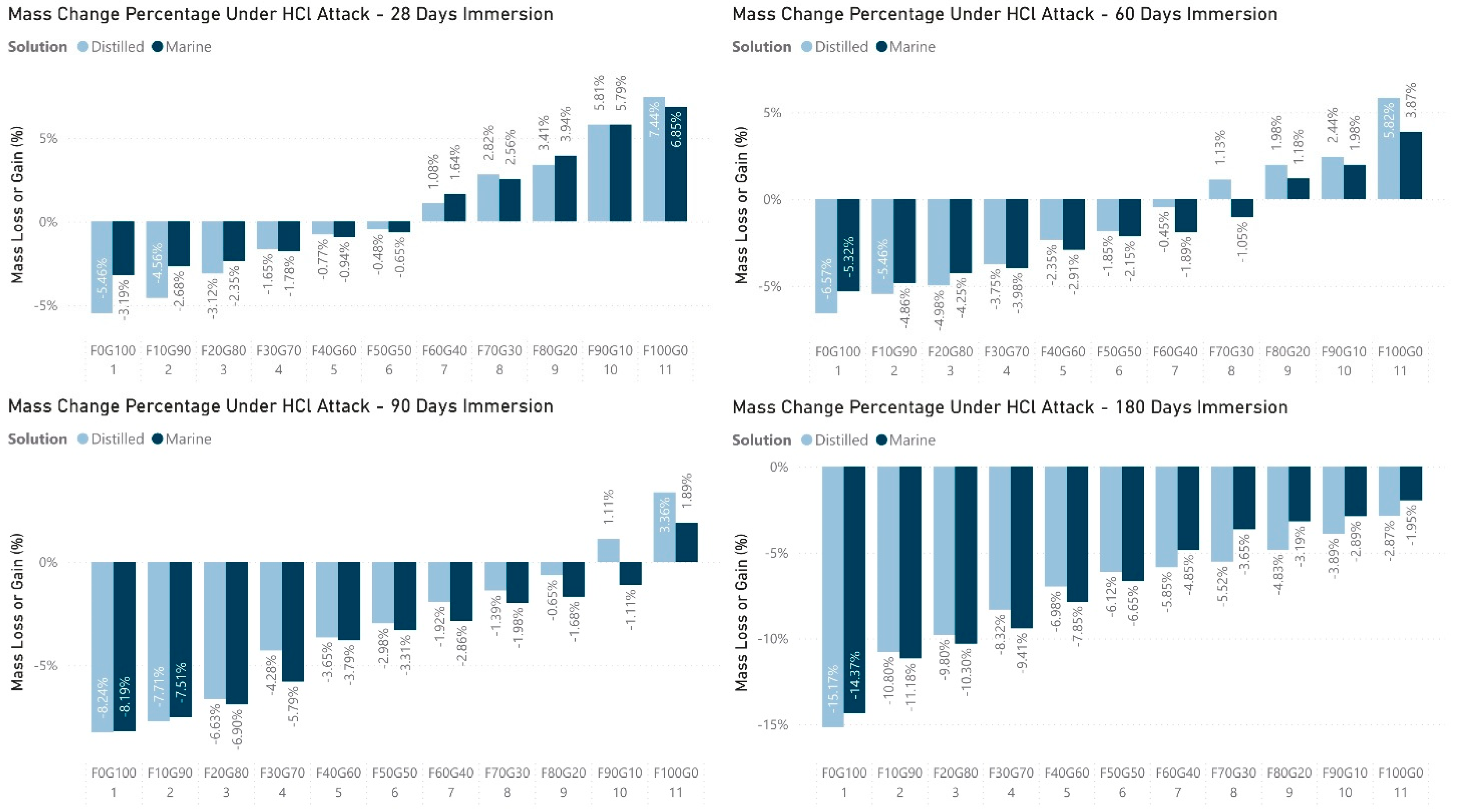
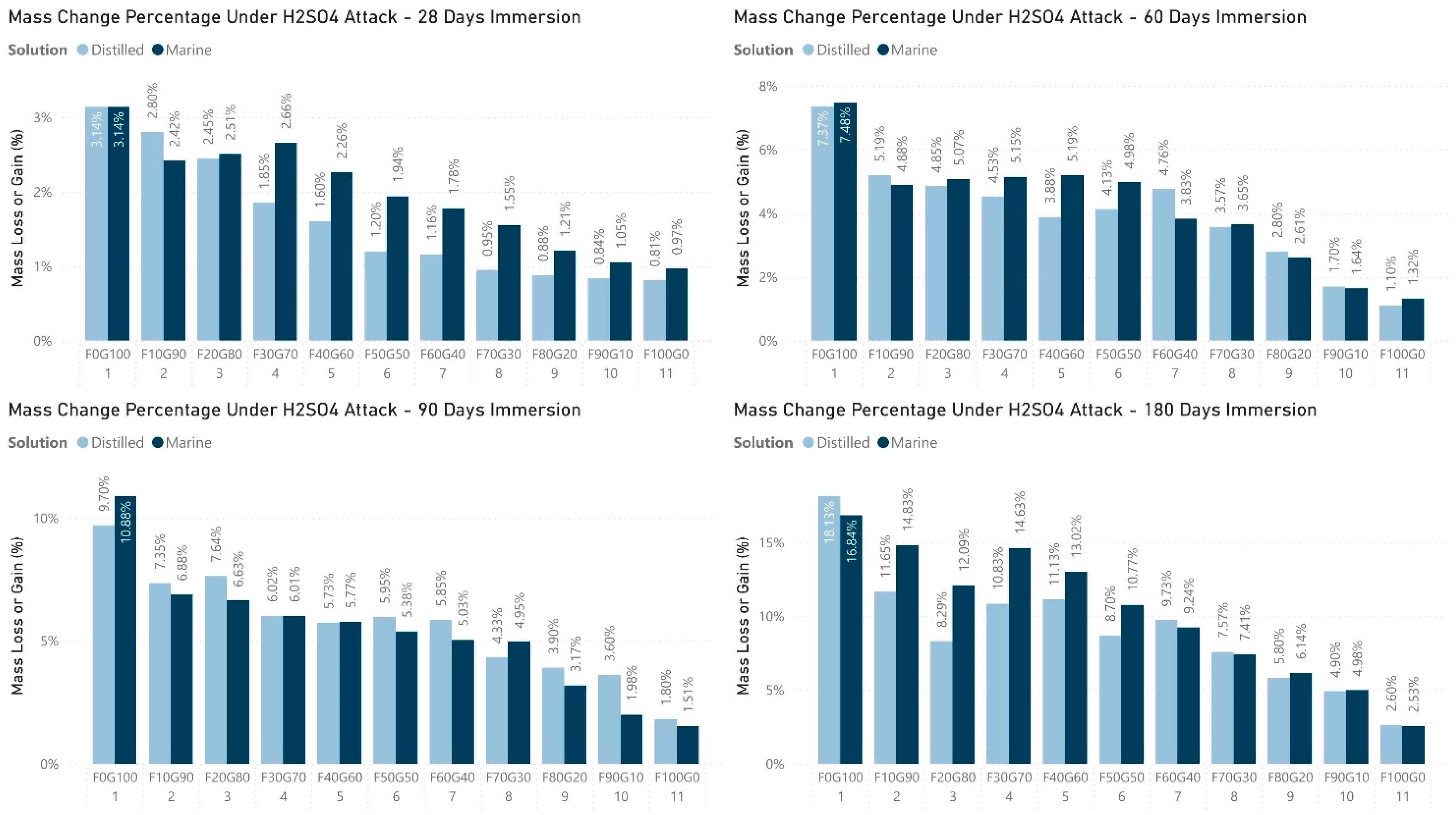
The mass change behaviour of the alkali-activated mortars under hydrochloric acid and sulphuric acid exposure is presented in Figure 5 and Figure 6, and the paired statistical comparison of both activator series is summarised in Table 4. Binder composition governed the following response: GGBS-rich blends lost mass progressively under HCl while FA-rich blends initially gained mass, and all blends gained mass under H2SO4. The influence of the activator water was small in absolute terms (paired mean differences within about 1.2 percentage points at all ages) and reached significance only at isolated ages: under HCl the two series differed significantly only at 90 days, when the mean mass change of the seawater series was slightly more negative (−3.75% versus −3.00%, p = 0.008), chiefly because its FA-rich blends had accumulated smaller surface-residue mass gains rather than because its slag-rich blends dissolved faster; under H2SO4, the seawater series gained slightly more mass at 28 days (p = 0.012) and marginally more at 180 days (p = 0.054). At the remaining ages, the paired differences were not statistically significant, so binder composition remained the dominant variable throughout.
Figure 5.
Mass change in the eleven blends after 28, 60, 90, and 180 days in 5% HCl, distilled water (D), and seawater (M) series (positive values indicate mass gain; negative values indicate mass loss).
Figure 6.
Mass change in the eleven blends after 28, 60, 90, and 180 days in 5% H2SO4, distilled water (D), and seawater (M) series (positive values indicate mass gain; negative values indicate mass loss).
Table 4.
Paired comparisons of the reported blend values between the distilled water (D) and seawater (M) series across the eleven blends: mean difference, 95% confidence interval, paired-t p-value, Cohen’s dz, and Wilcoxon p-value (n = 11 blends per comparison).
4.1.1. Mass Change Under Hydrochloric Acid Attack
During the first 28 days of HCl exposure, the GGBS-rich mortars exhibited the largest mass losses: DF0G100 lost 5.46%, DF10G90 4.56%, DF20G80 3.12%, and DF30G70 1.65%, while seawater-activated counterparts were slightly less affected (MF0G100 at 3.19%, MF10G90 at 2.68%, MF20G80 at 2.35%, and MF30G70 at 1.78%), an effect attributed to chloride-related densification of the near surface gel [62,63]. The balanced blends were nearly mass-neutral, ranging from −0.9% to +1.6% across both series. In contrast, the FA-rich mixes showed the following mass gains: DF70G30 +2.8%, DF80G20 +3.4%, DF90G10 +5.8%, and DF100G0 +7.4%, with comparable gains in the M-series (+2.6% to +6.85%), reflecting the formation of insoluble aluminosilicate layers that impeded acid ingress [40,64], identified by XRD as an amorphous, silica-rich residue (Section 4.4).
After 60 days, losses in the GGBS-rich group increased to 3.8–6.6% in the D-series and 4.0–5.3% in the M-series, and the balanced blends had turned to net losses of up to 2.9%. FA-rich mortars largely maintained gains (DF100G0 +5.8%, MF100G0 +3.9%), although MF70G30 had already become mass-neutral.
By 90 days, the loss front had advanced through the balanced group (losses of about 2–4%) and into the lower FA-rich blends, leaving only the highest-FA mixes with net gains (DF90G10 +1.1%, DF100G0 +3.4%; MF100G0 +1.9%).
At 180 days, all blends showed net mass losses of 8.3–15.2% in the GGBS-rich group (with the M-series slightly lower at 9.4–14.4%), 4.9–7.9% in the balanced group, and only 2.0–5.5% in the FA-rich group. The complete reversal of the earlier FA-rich mass gains reflects progressive consumption of the silica-rich surface residue: dissolution ultimately outpaces residue accumulation once the layer cracks or densifies (Section 4.4).
Overall, immersion in HCl produced steadily increasing mass loss in GGBS-rich mortars, moderate deterioration in balanced mixes, and mass retention or slight gains in FA-rich mortars. DF100G0 and MF100G0 consistently demonstrated the best resistance, retaining the highest mass at each exposure age [64].
4.1.2. Mass Change Under Sulphuric Acid Attack
Under 5% H2SO4 exposure, all mixes gained mass from the outset [29,36]. At 28 days, the GGBS-rich blends gained 1.9–3.1% (D-series) and 2.4–3.1% (M-series), the balanced blends 1.2–2.3%, and the FA-rich blends 0.8–1.6%, the gain scaling with the calcium available for sulphate precipitation. The early gain is attributed to sulphate uptake and amorphous or poorly crystalline precursors: crystalline gypsum was not yet detectable at 28 days, and ettringite is not stable at the pH of the exposure solution (Section 4.4).
By 60 days, gains reached 4.5–7.4% in the GGBS-rich group (4.9–7.5% in the M-series), 3.9–4.8% in the balanced blends, and 1.1–3.7% in the FA-rich blends.
At 90 days, accumulation continued, with the GGBS-rich blends at 6.0–9.7% (D) and 6.0–10.9% (M), balanced blends at 5.0–6.0%, and FA-rich blends at 1.5–5.0%.
At 180 days, the GGBS-rich mortars recorded the highest accumulation (8.3–18.1% D-series; 12.1–16.8% M-series), followed by the balanced blends (8.7–11.1% and 9.2–13.0%) and the FA-rich blends (2.6–7.6% and 2.5–7.4%). The seawater series gained slightly more overall at late ages (p = 0.054 at 180 days, Table 4), consistent with the greater sulphate interaction of its chloride-bearing matrix.
In summary, sulphate attack evolved from initial surface sealing to progressive internal damage. Mass gain increased throughout the exposure period, accelerating between 90 and 180 days as crystalline gypsum developed (Section 4.4), while expansive crystallisation progressively damaged the microstructure [36]. GGBS-rich binders exhibited the highest overall expansion, balanced binders showed intermediate behaviour, and FA-rich binders the least expansion. Seawater-activated mixes gained slightly more mass at early and late ages (significant at 28 days and marginal at 180 days, as in Table 4), consistent with an earlier onset of sulphate accumulation and, in the slag-rich blends, of surface spalling [62].
4.2. Strength Loss Characteristics Under Acid Exposure
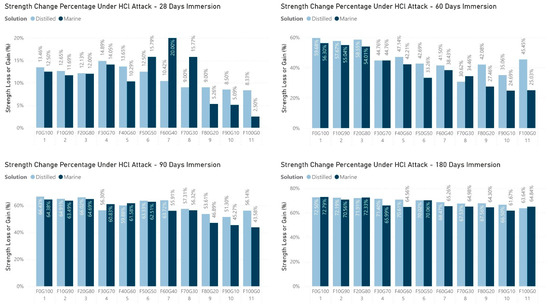
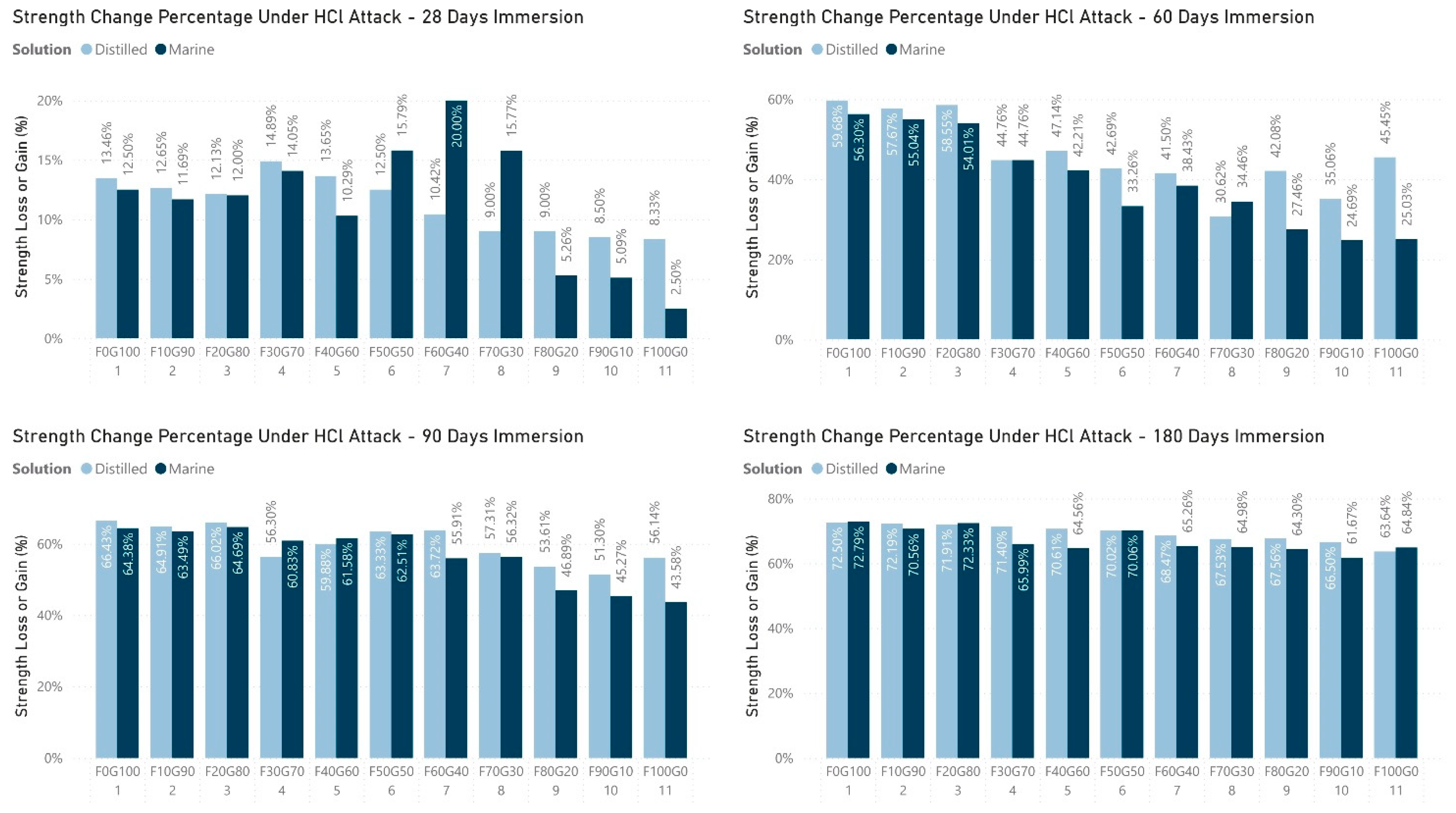
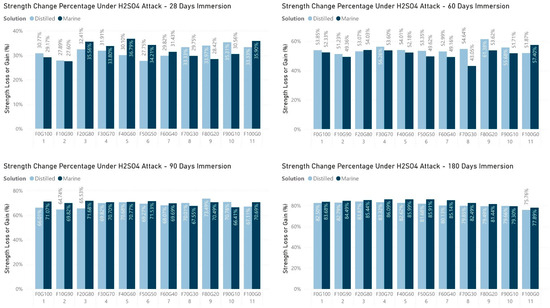
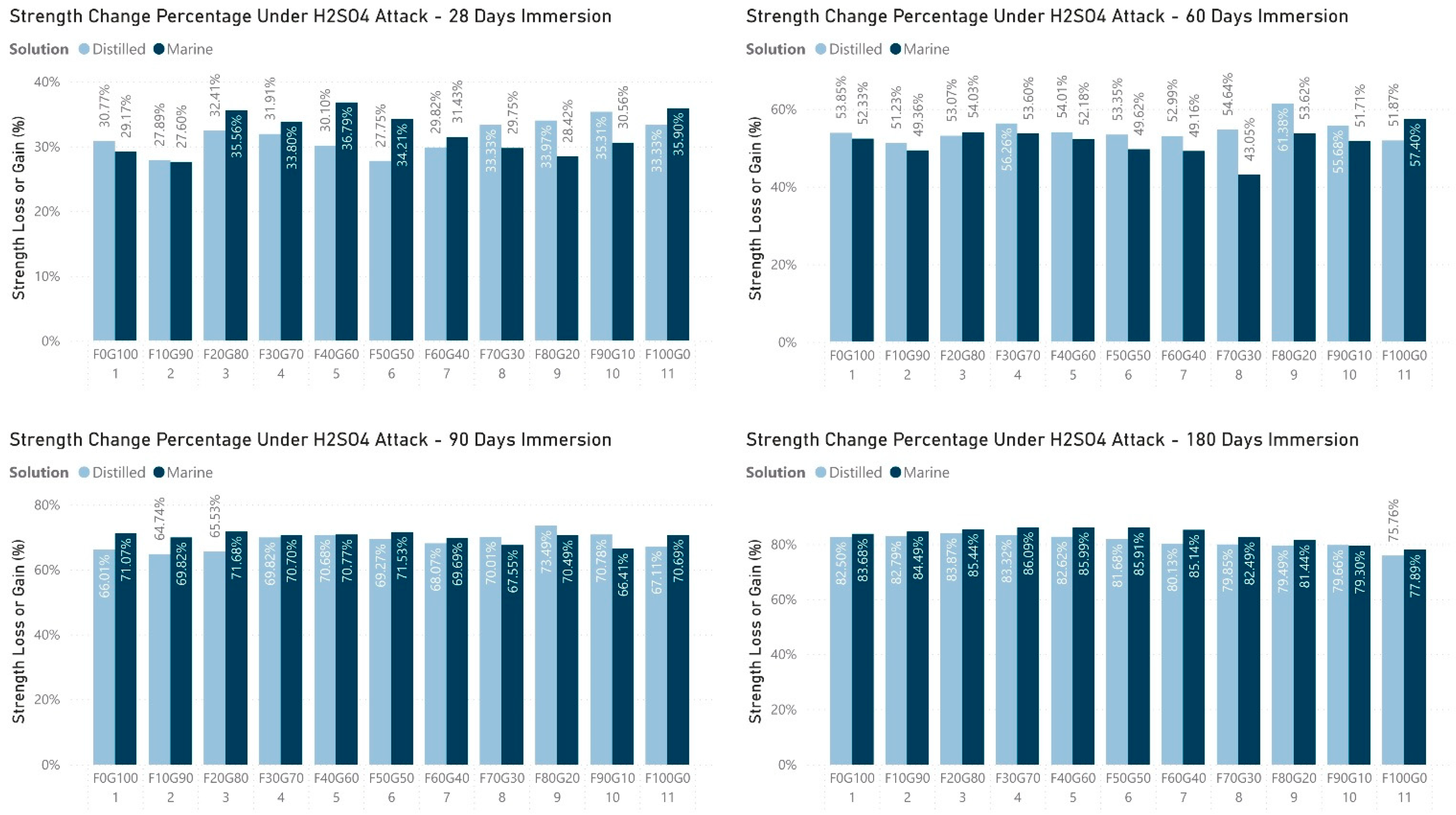
Three sets of mortar cubes were cast and air-cured for 28 days. One set served as the control (no acid), while the remaining two sets were immersed in 5% HCl and 5% H2SO4, respectively. After the initial 28-day curing period, specimens were exposed to their designated acid solutions for 28, 60, 90, and 180 days, with corresponding control specimens maintained in ambient air for the same total durations. Strength loss and retention at each exposure age were therefore calculated with respect to the age-matched control specimen, ensuring consistent comparison between distilled-water and seawater-activated mixes. Figure 7 illustrates the compressive strength variations under HCl exposure, and Figure 8 presents the corresponding trends under H2SO4 exposure.
Figure 7.
Compressive strength loss relative to age-matched controls after 28, 60, 90 and 180 days in 5% HCl (values indicate strength loss relative to age-matched control specimens; higher values indicate greater deterioration).
Figure 8.
Compressive strength loss relative to age-matched controls after 28, 60, 90, and 180 days in 5% H2SO4 (values indicate strength loss relative to age-matched control specimens; higher values indicate greater deterioration).
The influence of the activator water on strength retention was age-dependent (Table 4). Under HCl, the seawater series retained significantly more strength at 60 days (mean loss 39.6% versus 45.9%, p = 0.012) and marginally more at 90 days (p = 0.062), the advantage narrowing to 2.3 percentage points by 180 days (p = 0.014). Under H2SO4, the two series were statistically indistinguishable up to 90 days, after which the seawater series lost significantly more strength (83.4% versus 81.1% at 180 days, p < 0.001, and dz = −1.61). These paired comparisons across the eleven blends provide the statistical basis for the trends described below, within which binder composition remained the stronger variable at early and intermediate ages.
4.2.1. Strength Loss Under Hydrochloric Acid Attack
At 28 days of HCl exposure, strength losses were still modest and, in the D-series, increased with GGBS content (Figure 7): from 8.3% for the pure fly ash mix (DF100G0) and 9.0% for DF70G30–DF80G20 to 13.5% for the pure slag mix (DF0G100). In the M-series, the FA-rich blends were the least affected (2.5% for MF100G0 and 5.1–5.3% for MF80G20–MF90G10), while the balanced blends showed the largest early losses (15.8–20.0% for MF50G50–MF60G40). The low early losses of the seawater FA-rich blends are attributed to chloride-related densification of the near-surface gel [65]; as no crystalline chloride phases were detected by XRD at 180 days (Section 4.4), any such products are amorphous or transient.
By 60 days, deterioration had accelerated in all blends, with losses of 45–60% in the slag-rich D-series against 25–38% in the FA-rich M-series. The seawater series retained more strength on average (39.6% versus 45.9% mean loss, p = 0.012, as in Table 4), with the benefit being clearest in the FA-rich blends (MF100G0 25.0% versus DF100G0 45.5%).
At 90 days, as HCl leaching decalcified the primary gel, the compositional differences narrowed, and losses reached 44–66%. The seawater series remained marginally ahead (56.9% versus 59.9% mean loss, p = 0.062), with the largest remaining advantages again in the FA-rich blends (MF100G0 43.6% versus DF100G0 56.1%).
By 180 days, prolonged HCl attack overwhelmed both the secondary surface products and much of the primary gel network; the two series and all compositions converged at 62–73% loss (mean 67.0% for the M-series versus 69.3% for the D-series, p = 0.014). Strength loss thus progressed from about 2.5–20% at 28 days to 62–73% at 180 days, with the seawater series equal or slightly ahead at intermediate ages and binder composition governing the early-age response.
4.2.2. Strength Loss Under Sulphuric Acid Attack
At 28 days of H2SO4 immersion, all mixes had already lost 28–36% of strength (Figure 8), with no significant difference between the series (p = 0.65) and only a weak dependence on composition, indicating an early, generalised attack consistent with rapid sulphate uptake.
By 60 days, sustained sulphate ingress had raised losses to 43–61%; the D-series was marginally worse on average (54.4% versus 51.5%, p = 0.050), with the largest single loss in DF80G20 (61.4%).
At 90 days, extensive leaching and crystallisation had fractured both gel networks, with losses of 65–74% affecting the two series almost equally (p = 0.23).
By 180 days, deterioration was severe and universal (78–86% loss), and the seawater series was now significantly worse (83.4% versus 81.1% mean loss, p < 0.001, dz = −1.61, as in Table 4). This small but consistent late-age penalty is mechanistically coherent with the XRD finding that seawater-activated FA-rich blends retain markedly more gypsum (Section 4.4): chloride introduced by the seawater activator is converted by sulphuric acid to additional expansive gypsum, with release of HCl, in the secondary attack described by Siddique and Jang [40]. Strength loss under H2SO4 thus accelerated from about 30% at 28 days to 78–86% by 180 days, exceeding the corresponding HCl losses at every age.
4.2.3. Comparison
Overall, sulphuric acid caused faster and more severe strength loss than hydrochloric acid at all immersion ages, exceeding the HCl losses by about 14 percentage points on average at 180 days (paired across all series combinations, p < 0.001). Under HCl, seawater activation delayed mid-term degradation, significantly at 60 days and marginally at 90 days (Table 4), but the two series converged by 180 days; under H2SO4, the seawater series carried a small but statistically significant late-age penalty, consistent with chloride-derived gypsum formation (Section 4.4). Binder composition governed the early- and mid-term response, with FA-rich blends losing the least strength through 90 days under HCl, while prolonged exposure ultimately overwhelmed all compositions. From a practical perspective, seawater-activated mortars remain serviceable in chloride- and acid-exposed environments over short- and intermediate-exposure, but in sulphate-rich settings binder optimisation alone is insufficient and protective measures such as pH-buffering admixtures and protective surface coatings remain necessary.
4.3. Ultrasonic Pulse Velocity (UPV) Evaluation at 180 Days
Ultrasonic pulse velocity (UPV) testing was conducted to assess the internal quality and microstructural integrity of alkali-activated mortars before and after acidic exposure. The measured velocities were interpreted using the quality grading of IS 516 (Part 5/Sec 1): 2018 [61] described in Section 3.3. The observed UPV results of different combinations after immersion in acid solutions are presented in Table 5 along with UPV observed in respective control specimens.
Table 5.
Ultrasonic pulse velocity for various mortar mixes.
In the control condition, both D-series (distilled-water activator) and M-series (seawater activator) specimens recorded velocities of 4.17–6.17 km/s. Twenty of the twenty-two control specimens exceeded 4.40 km/s and are therefore graded as excellent, while DF90G10 (4.17 km/s) and MF80G20 (4.18 km/s) fell marginally into the good band, confirming sound microstructural quality with high density and continuity. Control velocities of the two series were comparable, with no consistent advantage for either activator across the eleven blends.
After immersion in hydrochloric acid, significant reductions in UPV were observed, particularly in GGBS-rich mixes. For instance, in F0G100, the velocity decreased from 5.85 km/s to 2.47 km/s in the D-series and from 6.17 km/s to 3.13 km/s in the M-series. Such reductions indicate severe microstructural deterioration due to calcium leaching and decalcification of C–(A)–S–H gels. However, the intermediate and FA-rich blends (e.g., F60G40, F70G30) retained relatively higher velocities, suggesting partial preservation of internal integrity due to the presence of aluminosilicate layers that restricted HCl ingress.
Differences between the seawater- and distilled-water-activated series after acid exposure were within the scatter of the method and showed no consistent pattern across the mixes, in line with the small and age-dependent differences established for mass change and strength loss (Table 4). UPV retention was governed primarily by binder composition, with the FA-rich mixes maintaining the most continuous pulse-transmission paths.
Exposure to H2SO4 further accentuated reductions in UPV, particularly in GGBS-rich mortars, where expansive gypsum formation produced extensive internal cracking. Mixes such as MF20G80 (0.68 km/s) and MF30G70 (0.59 km/s) exhibited markedly low velocities due to severe sulphate-induced expansion. In contrast, the FA-rich mixes F70G30 and F80G20 retained substantially higher velocities in both series (3.50–4.24 km/s), and MF100G0 retained the highest velocity of all (4.95 km/s), because their aluminosilicate-dominated matrices are less susceptible to sulphate-driven expansion and microcracking. Although seawater-activated FA-rich mixes also showed high UPV values, this behaviour is primarily governed by the inherent sulphate resistance of the aluminosilicate network rather than the activation water itself.
Overall, the UPV results corroborate the mass- and strength-based findings: deterioration was governed by binder composition and acid type, sulphate attack produced the most severe loss of internal continuity, and the activator water had no consistent influence on the retained pulse velocity.
4.4. XRD Analysis
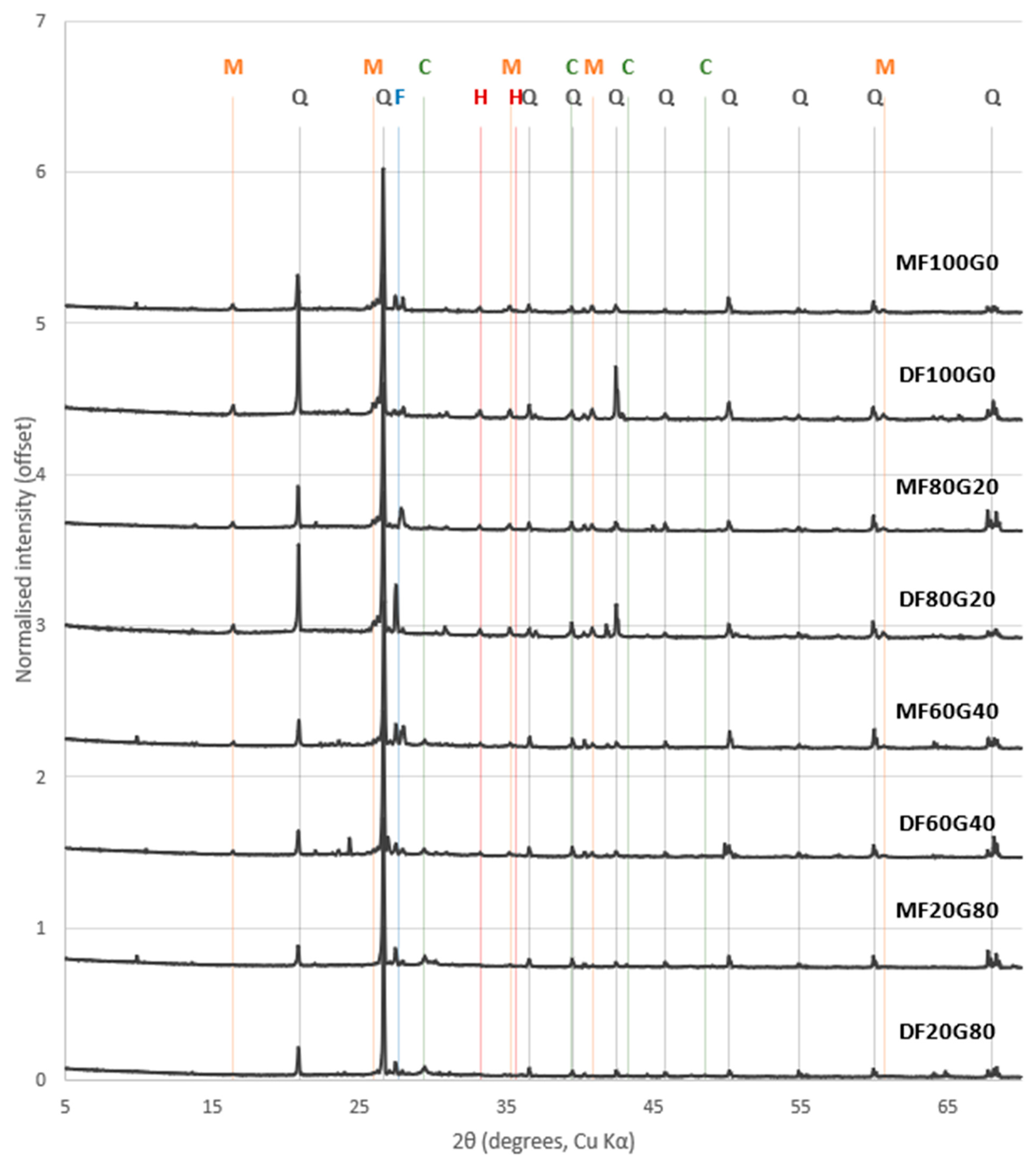
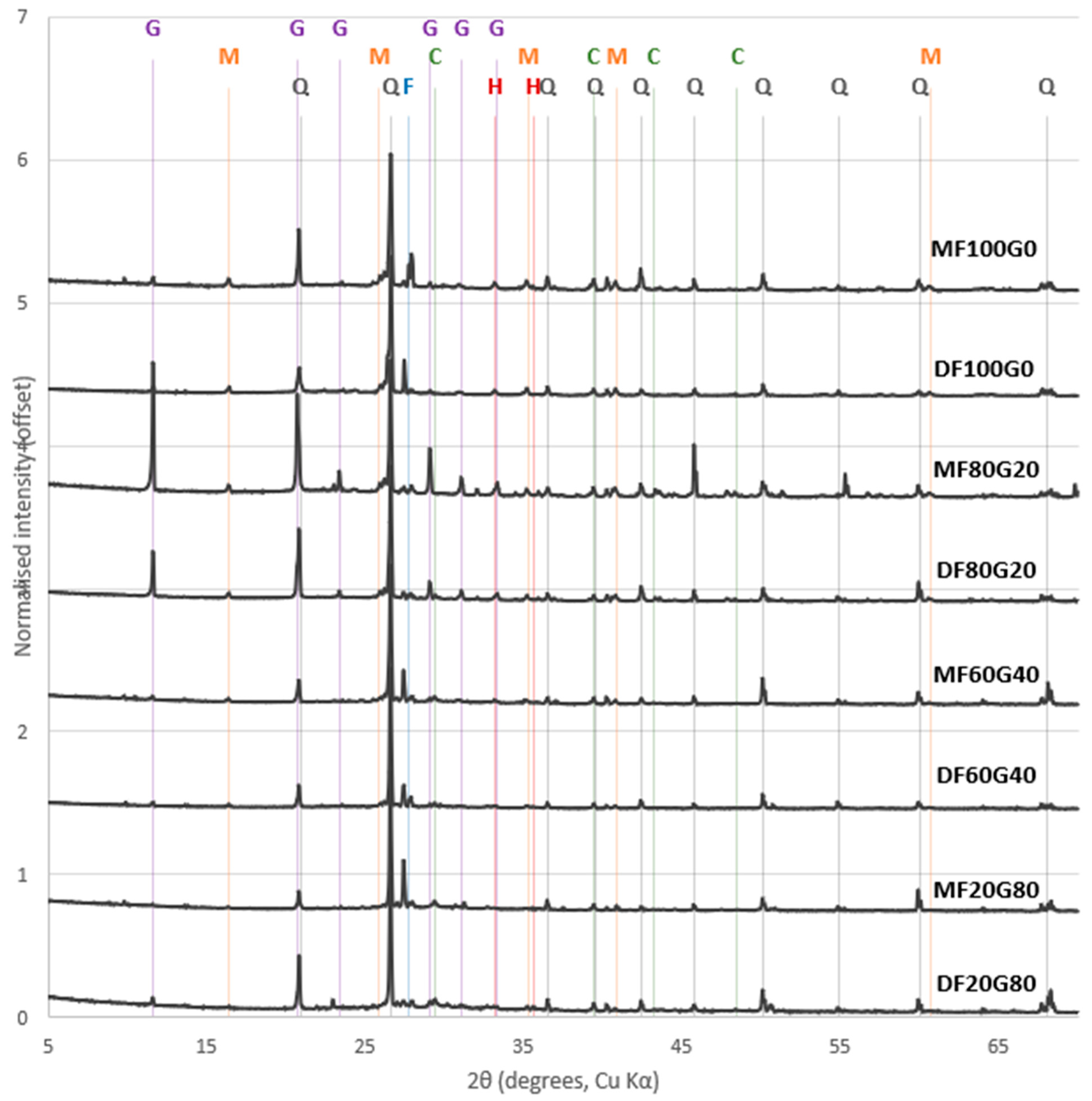
Figure 9 and Figure 10 present the diffractograms of the slag-rich (F20G80), balanced (F60G40) and fly-ash-rich (F80G20, F100G0) blends after 180 days of immersion in 5% HCl and 5% H2SO4 respectively, for both activator series, and Table 6 reports the peak-height ratios of the diagnostic reflections normalised to the quartz (101) reflection of the fine aggregate, together with the centroid of the amorphous gel band. Because the quartz of the fine aggregate is insoluble in both acids and present in equal proportion in all mixes, it provides a stable internal reference against which the evolution of the binder-related phases can be compared semi-quantitatively.
Figure 9.
XRD patterns after 180 days of immersion in 5% HCl for distilled-water (D)- and seawater (M)-activated blends (Q = quartz, M = mullite, F = alkali feldspar, C = calcite, H = hematite; intensities normalised to the quartz 26.64° reflection). No new crystalline phases are detected; all reflections correspond to aggregate and precursor relict phases and to carbonation calcite.
Figure 10.
XRD patterns after 180 days of immersion in 5% H2SO4 (G = gypsum; other markers as in Figure 9). Gypsum is the only new crystalline degradation product; note its full reflection set and its enhancement in the seawater-activated fly-ash-rich blends.
Table 6.
Peak-height ratios of the diagnostic reflections normalised to the quartz (101) reflection at 26.64° 2θ, and centroid of the amorphous gel band (15–45° 2θ), for 180-day specimens.
In all specimens, the crystalline assemblage is dominated by phases inherited from the raw materials: quartz and alkali feldspar from the river sand, and mullite, hematite and minor magnetite as relicts of the fly ash, whose normalised intensities scale consistently with the fly ash content of the blend (Table 6). Calcite, formed by atmospheric carbonation of the calcium-bearing gel during ambient curing, is present in the slag-rich and balanced blends. The binder itself appears as the broad amorphous band between 15° and 45° 2θ, whose centroid moves systematically from about 25° in F100G0 to about 29° in F20G80. This displacement tracks the transition from the N–A–S–H-dominated to the C–(A)–S–H-dominated gel and provides a quantitative mineralogical counterpart to the compositional grouping adopted in Section 3.1. In the unexposed state, the distilled-water and seawater series are indistinguishable in both phase assemblage and band position, confirming that seawater activation does not measurably alter the crystalline mineralogy of the hardened binders [56].
After 180 days in hydrochloric acid, no new crystalline phase was detected in any blend of either series (Figure 9). This observation is chemically consistent: The chloride salts of all leached cations (CaCl2, NaCl, and AlCl3) are highly soluble, so the products of HCl attack are exported to the solution rather than precipitated within the matrix, and degradation proceeds by dissolution alone. The diffractograms record this as a progressive loss of the binder contribution rather than as new reflections. In the slag-rich blends, the C–(A)–S–H band near 29° weakens while the relict aggregate reflections gain relative intensity, mirroring the decalcification-driven mass losses of Section 4.1.1. In the fly-ash-rich blends, the amorphous band instead grows and its centroid shifts from approximately 27° to approximately 24° (Table 6), towards the position characteristic of amorphous silica. This identifies the insoluble surface layer inferred from the mass gain of these mixes as an amorphous, dealuminated silica-rich residue, formed as H+ extracts aluminium and the charge-balancing sodium from the N–A–S–H framework while the siloxane skeleton survives [25,26,27,28]. Being amorphous, the residue generates no reflections of its own and is visible only through the growth and displacement of the gel band, which explains why it escapes conventional phase identification. Its continued accumulation at 180 days, alongside the declining net mass gain of Section 4.1.1, indicates that the later-age reversal reflects dissolution gradually outpacing residue formation once the layer cracks or densifies, rather than any change in mechanism.
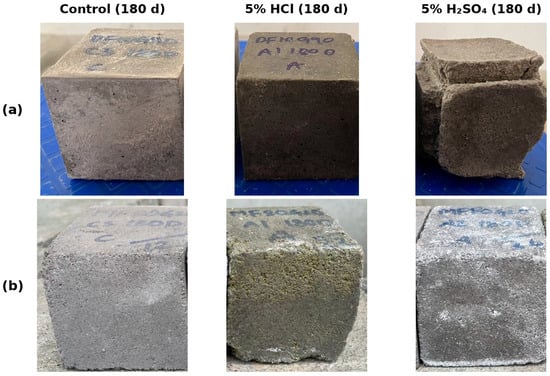
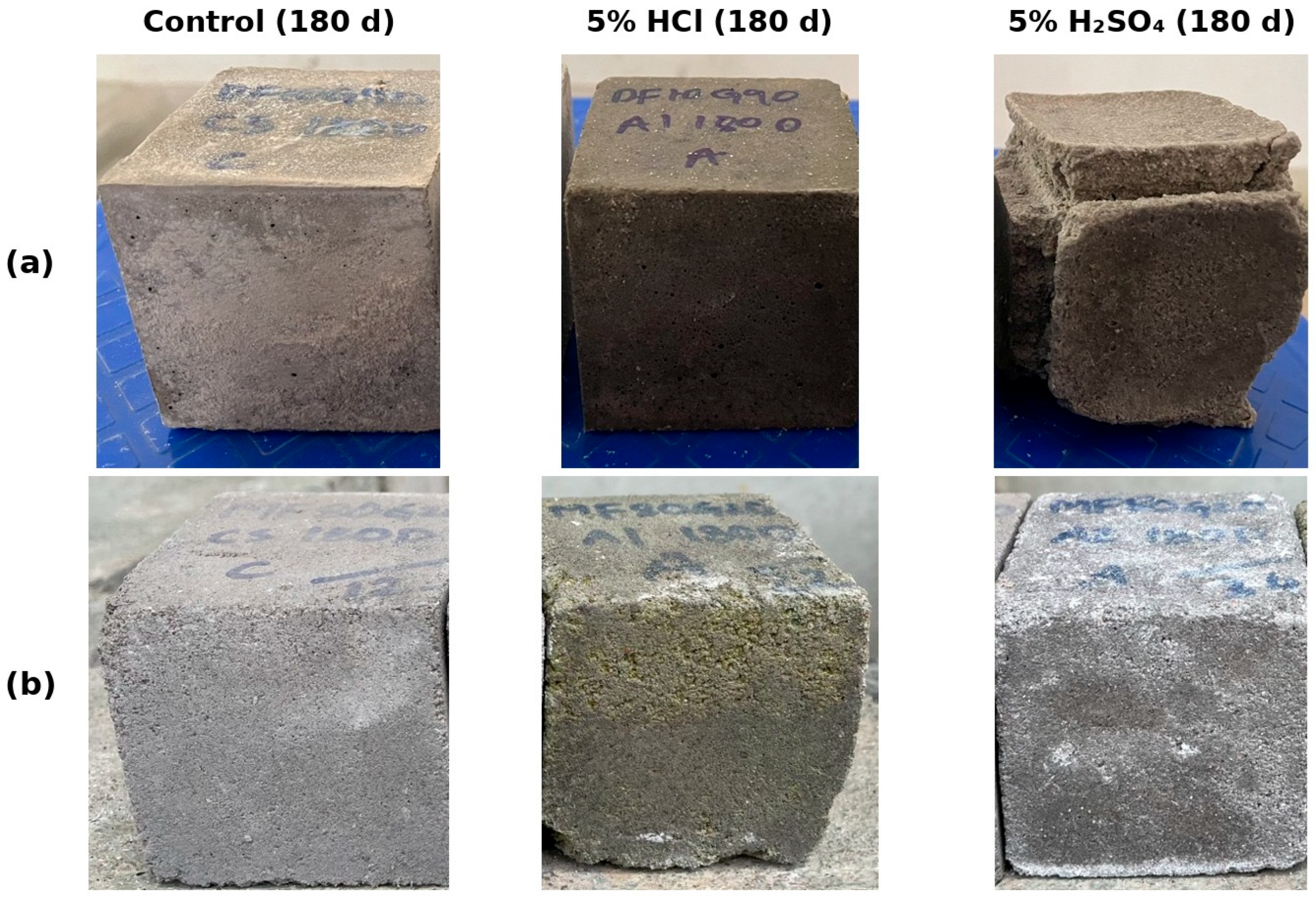
After 180 days in sulphuric acid, gypsum (CaSO4·2H2O) is the only new crystalline phase, identified by its complete reflection set (11.6°, 20.7°, 23.4°, 29.1°, 31.1° and 33.3° 2θ; Figure 10). Ettringite was not detected in any specimen; this is expected, since ettringite is unstable below pH ≈ 10.7 and gypsum is the stable calcium sulphate at the pH of the exposure solution [36,64]. Gypsum was below detection in every blend at 28 days and well developed by 180 days, showing that crystalline sulphate accumulation is a later-age phenomenon; the early mass gain of Section 4.1.2 is therefore attributed to solution uptake and amorphous or poorly crystalline sulphate precursors that subsequently ripen to gypsum. Notably, the retained gypsum at 180 days does not follow the calcium content of the binder (Table 6). The slag-rich blends, which generate the most calcium sulphate and expand the most, retain comparatively little gypsum in the analysed material because their degraded surface layers progressively spall into the bath, consistent with their severe UPV losses (Section 4.3) and the plateau of their mass-gain curves and the visible surface condition of the specimens after 180 days of exposure (Figure 11). The dimensionally stable fly-ash-rich matrices, by contrast, retain the precipitated gypsum in place, and it is here that the influence of the activator water becomes visible: the seawater series retains distinctly more gypsum than the distilled series (I11.6/I_quartz = 0.941 versus 0.327 for F80G20, and 0.057 versus 0.035 for F100G0). This enhancement is consistent with the secondary-attack mechanism of Siddique and Jang [40], in which chloride introduced by the seawater activator is stored in the low-calcium matrix as calcium chloride and converted to additional gypsum, with release of HCl, upon reaction with sulphuric acid. In the slag-rich blends, the trend reverses (0.012 versus 0.060 for F20G80), in line with the earlier onset of surface spalling observed for the seawater series in Section 4.1.2.
Figure 11.
Representative condition of specimens after 180 days of exposure: (a) slag-rich blend distilled water-activated blend DF10G90; (b) fly-ash-rich seawater-activated blend MF80G20. The slag-rich specimen shows severe expansion and surface spalling under H2SO4 and surface erosion under HCl, whereas the fly-ash-rich specimen remains dimensionally intact, with a white sulphate (gypsum) surface deposit under H2SO4.
Taken together, the XRD results resolve the durability behaviour into two distinct degradation pathways. Hydrochloric acid attacks both gel types by dissolution without crystalline reaction products, leaving in fly-ash-rich blends an amorphous silica-rich residue that constitutes the mass-gaining, ingress-limiting surface layer; sulphuric acid combines dissolution with in-situ precipitation of expansive gypsum, whose retention is governed by the mechanical integrity of the degraded layer rather than by the amount formed. Seawater activation changes neither pathway; its measurable influence is confined to the additional gypsum generated in fly-ash-rich blends through the chloride reservoir it introduces, and to the earlier spalling of slag-rich surfaces, both secondary effects superimposed on a phase assemblage otherwise identical to that of the distilled-water systems.
5. Discussion
The results are resolved into three findings. First, the degradation mechanism and rate are set by the binder chemistry. The calcium-rich C–(A)–S–H gel of slag-rich blends is attacked by proton exchange and decalcification; under HCl, the products are soluble and the matrix dissolves, which is why mass loss and UPV decline are most severe in these blends and why XRD detects no new crystalline phases. The low-calcium N–A–S–H framework degrades by slower dealumination, leaving an amorphous silica-rich residue that accounts for the early mass gain of FA-rich blends and limits ingress, so that FA-rich blends lose the least strength through 90 days; the reversal of their mass gain by 180 days marks the point at which dissolution overtakes residue formation. Under H2SO4, the same dissolution chemistry is compounded by in situ precipitation of gypsum, whose expansive growth cracks and spalls the degraded layer; the acceleration of deterioration between 90 and 180 days coincides with the appearance of crystalline gypsum in the diffractograms, and sulphuric acid exceeded hydrochloric acid by about 14 percentage points of strength loss at 180 days (p < 0.001).
Second, the activator water is a second-order but age-patterned variable. Under HCl, the seawater series retained significantly more strength at 60 days (Table 4), an advantage that had largely converged by 180 days, while its only significant mass-change difference, a slightly more negative mean at 90 days, stemmed chiefly from the smaller surface-residue gains of its FA-rich blends; under H2SO4, it carried a small but significant late-age penalty (p < 0.001 at 180 days). Both effects have a chloride origin rather than a magnesium one. The early benefit is attributed to chloride-related densification of the near-surface gel; since no crystalline chloride phases were detected at 180 days (Section 4.4), such products are amorphous or transient. The late sulphate penalty matches the XRD observation that seawater-activated FA-rich blends retain markedly more gypsum, formed by conversion of activator-derived calcium chloride with release of HCl in a secondary attack [40]. Magnesium, sometimes invoked as a buffering ion, is present at only about 800 mg/L in the seawater used, and the literature shows it degrades rather than protects alkali-activated binders [24].
Third, the practical window for these materials is set primarily by composition and exposure time. FA-rich and balanced blends offer the best strength retention through intermediate ages in acid-dominated service, slag-rich blends offer the highest absolute strength but the fastest relative degradation, and under sulphuric attack, no blend is immune once gypsum crystallisation is established. Seawater can replace distilled water in the activator with performance that is equal or modestly better at intermediate ages under HCl and only marginally worse at late ages under H2SO4, supporting its use where potable water is scarce, with protective measures advised for sulphate-rich service.
6. Conclusions
6.1. Acid Resistance and Mass Change
Under hydrochloric acid, GGBS-rich mortars exhibited the highest mass losses, driven by decalcification of C–(A)–S–H gels and dissolution of calcium-rich domains; differences between the two activator series were small, and the only significant mass-change difference (90 days, Table 4) reflected the smaller surface-residue mass gains of the seawater FA-rich blends rather than faster dissolution of their slag-rich counterparts. FA-rich mortars initially gained mass through precipitation of an insoluble, dealuminated silica-rich residue that restricted further ingress, the gains reversing by 180 days as dissolution outpaced residue formation. Under H2SO4, all mixes gained mass through sulphate uptake and later gypsum precipitation, with the seawater series gaining slightly more at early and late ages (Table 4).
6.2. Strength Retention Under Acid Attack
Strength retention was governed by binder composition and exposure duration, with an age-dependent influence of the activator water. Under HCl, the seawater series retained significantly more strength at 60 days, and the FA-rich blends were the most resistant through 90 days, before all compositions and both series converged at 62–73% loss by 180 days. Under H2SO4, deterioration was more severe at every age, culminating at 78–86% loss, with a small but statistically significant late-age penalty for the seawater series that is consistent with chloride-derived gypsum formation. Regardless of activation water, prolonged acid exposure ultimately overwhelmed all compositions.
6.3. Ultrasonic Pulse Velocity (UPV) Behaviour
UPV results corroborated the mass and strength findings. Velocities declined with exposure in proportion to the severity of attack, most sharply under H2SO4, where expansive gypsum formation disrupted internal continuity. Differences between the activator series were within the scatter of the method and showed no consistent pattern; retention was governed by binder composition, with FA-rich mixes maintaining the highest velocities after exposure.
6.4. Mineralogical Transformations (XRD)
XRD showed that the crystalline phase assemblage of the unexposed mortars is dominated by relict phases of the raw materials and is essentially identical for seawater- and distilled-water-activated systems. Under HCl, no new crystalline degradation products formed in either series; deterioration proceeded by dissolution, and in FA-rich blends, the amorphous band shifted towards the silica-gel position, identifying the protective surface layer as a dealuminated, silica-rich amorphous residue. Under H2SO4, gypsum was the sole crystalline degradation product, absent at 28 days and well-developed by 180 days, while ettringite was not detected at the low pH of exposure. Seawater activation increased the gypsum retained in FA-rich blends, consistent with a chloride-mediated secondary attack in which activator-derived calcium chloride reacts with sulphuric acid to form additional gypsum and was associated with earlier surface spalling in slag-rich blends.
6.5. Mass Gain Dynamics in Fly-Ash-Rich Mortars
FA-rich mortars (both D and M series) experienced net mass gain through intermediate ages due to aluminosilicate- and sulphate-based precipitation. Differences between the two series were small (Table 4); the surface layer is identified by XRD as an amorphous, dealuminated silica-rich residue (Section 4.4), whose eventual consumption explains the reversal of the gains by 180 days. These findings demonstrate that mass change must be interpreted alongside strength retention and phase evolution, as higher mass does not imply better durability.
6.6. Practical Implications
The results establish that seawater-activated mortars perform comparably to distilled-water mortars under acid exposure, with a modest mid-term advantage under HCl and a small late-age penalty under H2SO4, both of chloride origin. For acid-dominated service, FA-rich and balanced blends provide the best strength retention through intermediate ages, while GGBS-rich blends offer the highest absolute strength at the cost of the fastest relative degradation; in sulphate-rich environments, protective measures remain necessary for all blends. Overall, seawater can be used in alkaline activators without compromising the acid resistance of FA–GGBS alkali-activated mortars, supporting their application in coastal and industrial infrastructure where potable water is scarce.
7. Future Scope and Limitations
Particle size distribution of the fly ash was not determined. As both series used identical binder proportions by mass and the same fly ash source throughout, this does not affect the comparative basis of the study, but absolute reaction kinetics may differ for fly ash of different fineness.
Specimens were cured under ambient laboratory conditions rather than a controlled curing regime. As each D-series and M-series pair was cast on the same day and all specimens were held in the same environment, the comparative basis of the study is unaffected, although absolute performance values may differ under controlled or elevated-temperature curing.
This study was carried out under ambient laboratory conditions and did not account for combined environmental effects such as wet–dry cycling or freeze–thaw action, which may significantly influence long-term durability. Large-scale structural behaviour, crack development, and field-scale performance were also beyond the scope of this investigation.
The microstructural characterisation in this work was limited to XRD-based identification of crystalline degradation products. While XRD provided clear evidence of the major phases formed during acid exposure, complementary techniques such as SEM/EDS, TG/DTG and mercury intrusion porosimetry could further elucidate morphological evolution, gel decomposition, porosity and pore size distribution, and the distribution of degradation products. In addition, XRD was performed on single powder samples per condition, so the reported peak-intensity ratios are semi-quantitative; Rietveld refinement with an added internal standard would be required for absolute phase contents. Future studies incorporating these advanced characterisation tools would enable a more comprehensive understanding of reaction pathways in seawater- and distilled-water-activated alkali-activated mortars.
Future research should therefore focus on evaluating mortars under real environmental exposures, including variations in seawater chemistry and field-based durability validation. Further studies on the use of alternative admixtures, protective surface treatments, and reinforcement strategies are recommended to enhance the practical applicability of seawater-activated alkali-activated mortars in aggressive marine and sulphate-rich environments.
Author Contributions
T.V.K.R.B.: Writing—original draft, validation, investigation, and formal analysis. T.D.G.R.: Writing—review and editing, visualisation, supervision, methodology, and conceptualization. All authors have read and agreed to the published version of the manuscript.
Funding
This research received no external funding.
Data Availability Statement
The data supporting the findings of this study are available from the corresponding author, Tadicharla V. K. Ratna Bhanu, upon reasonable request.
Acknowledgments
The authors gratefully acknowledge Sri Vasavi Engineering College, Tadepalligudem, Andhra Pradesh, for providing laboratory facilities, and SRM University, Amaravati, Andhra Pradesh, for providing XRD testing facilities. Their support was essential for the successful completion of this study.
Conflicts of Interest
The authors declare no conflicts of interest.
References
- Andrew, R.M. Global CO2 Emissions from Cement Production, 1928–2018. Earth Syst. Sci. Data 2019, 11, 1675–1710. [Google Scholar] [CrossRef] [Scilit]
- Cheng, D.; Reiner, D.M.; Yang, F.; Cui, C.; Meng, J.; Shan, Y.; Liu, Y.; Tao, S.; Guan, D. Projecting Future Carbon Emissions from Cement Production in Developing Countries. Nat. Commun. 2023, 14, 8213. [Google Scholar] [CrossRef] [Scilit] [PubMed]
- Barbhuiya, S.; Kanavaris, F.; Das, B.B.; Idrees, M. Decarbonising Cement and Concrete Production: Strategies, Challenges and Pathways for Sustainable Development. J. Build. Eng. 2024, 86, 108861. [Google Scholar] [CrossRef] [Scilit]
- Sheikh Hassani, M.; Matos, J.C.; Zhang, Y.X.; Teixeira, E. Concrete Production with Domestic and Industrial Wastewaters—A Literature Review. Struct. Concr. 2023, 24, 5582–5599. [Google Scholar] [CrossRef] [Scilit]
- Miller, S.A.; Horvath, A.; Monteiro, P.J.M. Impacts of Booming Concrete Production on Water Resources Worldwide. Nat. Sustain. 2018, 1, 69–76. [Google Scholar] [CrossRef] [Scilit]
- Yousuf, S.; Shafigh, P.; Muda, Z.C.; Katman, H.Y.B.; Latif, A. Alternatives for Fresh Water in Cement-Based Materials: A Review. Water 2023, 15, 2828. [Google Scholar] [CrossRef] [Scilit]
- Krivenko, P. Why Alkaline Activation—60 Years of the Theory and Practice of Alkali-Activated Materials. J. Ceram. Sci. Technol. 2017, 8, 323–333. [Google Scholar] [CrossRef] [Scilit]
- Davidovits, J. GEOPOLYMERS Inorganic Polymeric New Materials. J. Therm. Anal. 1991, 37, 1633–1656. [Google Scholar]
- Kriven, W.M.; Leonelli, C.; Provis, J.L.; Boccaccini, A.R.; Attwell, C.; Ducman, V.S.; Ferone, C.; Rossignol, S.; Luukkonen, T.; van Deventer, J.S.J.; et al. Why Geopolymers and Alkali-Activated Materials Are Key Components of a Sustainable World: A Perspective Contribution. J. Am. Ceram. Soc. 2024, 107, 5159–5177. [Google Scholar] [CrossRef] [Scilit]
- Provis, J.L. Alkali-Activated Materials. Cem. Concr. Res. 2018, 114, 40–48. [Google Scholar] [CrossRef] [Scilit]
- Provis, J.L.; Bernal, S.A. Geopolymers and Related Alkali-Activated Materials. Annu. Rev. Mater. Res. 2014, 44, 299–327. [Google Scholar] [CrossRef] [Scilit]
- Singh, B.; Ishwarya, G.; Gupta, M.; Bhattacharyya, S.K. Bhattacharyaa Geopolymer Concrete: A Review of Some Recent Developments. Constr. Build. Mater. 2015, 85, 78–90. [Google Scholar] [CrossRef] [Scilit]
- Patil, S.; Joshi, D.; Mangla, D.; Savvidis, I. Recent Development in Geopolymer Concrete: A Review. Mater. Today Proc. 2023. [Google Scholar] [CrossRef] [Scilit]
- Shehata, N.; Mohamed, O.A.; Sayed, E.T.; Abdelkareem, M.A.; Olabi, A.G. Geopolymer Concrete as Green Building Materials: Recent Applications, Sustainable Development and Circular Economy Potentials. Sci. Total Environ. 2022, 836, 155577. [Google Scholar] [CrossRef] [Scilit] [PubMed]
- Bbosa, W.K.; Odongo, E.E. A Review of Sustainable Concrete Construction: Strategies, Advancements, and Future Directions. Eur. J. Theor. Appl. Sci. 2024, 2, 343–352. [Google Scholar] [CrossRef] [Scilit] [PubMed]
- Habert, G.; Miller, S.A.; John, V.M.; Provis, J.L.; Favier, A.; Horvath, A.; Scrivener, K.L. Environmental Impacts and Decarbonization Strategies in the Cement and Concrete Industries. Nat. Rev. Earth Environ. 2020, 1, 559–573. [Google Scholar] [CrossRef] [Scilit]
- John, S.K.; Nadir, Y.; Girija, K. Effect of Source Materials, Additives on the Mechanical Properties and Durability of Fly Ash and Fly Ash-Slag Geopolymer Mortar: A Review. Constr. Build. Mater. 2021, 280, 122443. [Google Scholar] [CrossRef] [Scilit]
- Albitar, M.; Mohamed Ali, M.S.; Visintin, P.; Drechsler, M. Durability Evaluation of Geopolymer and Conventional Concretes. Constr. Build. Mater. 2017, 136, 374–385. [Google Scholar] [CrossRef] [Scilit]
- Mallikarjuna Rao, G.; Venu, M.; Anil, Y.; Noolu, V. Durability Aspects of Geo-Polymer Mortar Using Single Alkaline Activator Solution. In Proceedings of the IOP Conference Series: Earth and Environmental Science; IOP Publishing Ltd.: Bristol, UK, 2022; Volume 982. [Google Scholar]
- Gopalakrishnan, R.; Chinnaraju, K. Durability of Ambient Cured Alumina Silicate Concrete Based on Slag/Fly Ash Blends against Sulfate Environment. Constr. Build. Mater. 2019, 204, 70–83. [Google Scholar] [CrossRef] [Scilit]
- Noushini, A.; Castel, A. Performance-Based Criteria to Assess the Suitability of Geopolymer Concrete in Marine Environments Using Modified ASTM C1202 and ASTM C1556 Methods. Mater. Struct./Mater. Constr. 2018, 51, 146. [Google Scholar] [CrossRef] [Scilit]
- Gunasekara, C.; Law, D.W.; Setunge, S. Long Term Permeation Properties of Different Fly Ash Geopolymer Concretes. Constr. Build. Mater. 2016, 124, 352–362. [Google Scholar] [CrossRef] [Scilit]
- Olivia, M.; Nikraz, H.R. Durability of Fly Ash Geopolymer Concrete in a Seawater Environment. In Proceedings of the Concrete 2011 Conference; The Concrete Institute of Australia: Crows Nest, Australia, 2011. [Google Scholar]
- Elyamany, H.E.; Abd Elmoaty, A.E.M.; Elshaboury, A.M. Magnesium Sulfate Resistance of Geopolymer Mortar. Constr. Build. Mater. 2018, 184, 111–127. [Google Scholar] [CrossRef] [Scilit]
- Bernal, S.A.; Provis, J.L. Durability of Alkali-Activated Materials: Progress and Perspectives. J. Am. Ceram. Soc. 2014, 97, 997–1008. [Google Scholar] [CrossRef] [Scilit]
- Lloyd, R.R.; Provis, J.L.; Van Deventer, J.S.J. Acid Resistance of Inorganic Polymer Binders. 1. Corrosion Rate. Mater. Struct./Mater. Constr. 2012, 45, 1–14. [Google Scholar] [CrossRef] [Scilit]
- Mellado-Romero, A.; Martín-Rodríguez, J.; Borrachero, M.V.; Soriano, L.; Monzó, J.M.; Payá, J. Acid Attack on Alkali-Activated Mortars: A Test Proposal. Constr. Build. Mater. 2024, 411, 134397. [Google Scholar] [CrossRef] [Scilit]
- Sun, K.; Ali, H.A.; Xuan, D.; Poon, C.S. Sulfuric Acid Resistance Behaviour of Alkali-Activated Slag and Waste Glass Powder Blended Precursors. Cem. Concr. Compos. 2024, 145, 105319. [Google Scholar] [CrossRef] [Scilit]
- Deb, P.S.; Sarker, P.K.; Nath, P. Sulphate Resistance of Slag Blended Fly Ash Based Geopolymer Concrete Applicability of FNS in Concrete View Project. In Proceedings of the 26th Biennial National Conference of the Concrete Institute of Australia, Gold Coast, Australia, 16–18 October 2013. [Google Scholar]
- Lavanya, G.; Jegan, J. Durability Study on High Calcium Fly Ash Based Geopolymer Concrete. Adv. Mater. Sci. Eng. 2015, 2015, 731056. [Google Scholar] [CrossRef] [Scilit]
- Khalil, M.G.; Elgabbas, F.; El-Feky, M.S.; El-Shafie, H. Performance of Geopolymer Mortar Cured under Ambient Temperature. Constr. Build. Mater. 2020, 242, 118090. [Google Scholar] [CrossRef] [Scilit]
- Hannanee Ahmad Zaidi, F.; Ahmad, R.; Mustafa Al Bakri Abdullah, M.; Faheem Mohd Tahir, M.; Yahya, Z.; Mastura Wan Ibrahim, W.; Syauqi Sauffi, A. Performance of Geopolymer Concrete When Exposed to Marine Environment. In Proceedings of the IOP Conference Series: Materials Science and Engineering; Institute of Physics Publishing: Bristol, UK; IOP Publishing: Bristol, UK, 2019; Volume 551. [Google Scholar]
- Kumar, S.; Maradani, L.S.R.; Mohapatra, A.K.; Pradhan, B. Effect of Mix Parameters on Chloride Content, Sulfate Ion Concentration, and Microstructure of Geopolymer Concrete. Constr. Build. Mater. 2024, 435, 136864. [Google Scholar] [CrossRef] [Scilit]
- Prusty, J.K.; Pradhan, B. Investigation on Effect of Precursor Materials and Sand-to-Binder Ratio on Strength Development, Acid Resistance and Microstructure Evolution of Geopolymer Mortar. Constr. Build. Mater. 2022, 346, 128501. [Google Scholar] [CrossRef] [Scilit]
- Alahmari, T.S.; Abdalla, T.A.; Rihan, M.A.M. Review of Recent Developments Regarding the Durability Performance of Eco-Friendly Geopolymer Concrete. Buildings 2023, 13, 3033. [Google Scholar] [CrossRef] [Scilit]
- Aiken, T.A.; Kwasny, J.; Sha, W.; Soutsos, M.N. Effect of Slag Content and Activator Dosage on the Resistance of Fly Ash Geopolymer Binders to Sulfuric Acid Attack. Cem. Concr. Res. 2018, 111, 23–40. [Google Scholar] [CrossRef] [Scilit]
- Teymouri, M.; Behfarnia, K.; Shabani, A. Mix Design Effects on the Durability of Alkali-Activated Slag Concrete in a Hydrochloric Acid Environment. Sustainability 2021, 13, 8096. [Google Scholar] [CrossRef] [Scilit]
- Omer, S.A.; Demirboga, R.; Khushefati, W.H. GGBFS Based Geopolymer Mortars Immersed in Sodium and Magnesium Sulfate Solutions and Sea Water. Int. J. Eng. Res. Technol. 2015, 4, 377–384. [Google Scholar]
- Jun, Y.; Kim, T.; Kim, J.H. Chloride-Bearing Characteristics of Alkali-Activated Slag Mixed with Seawater: Effect of Different Salinity Levels. Cem. Concr. Compos. 2020, 112, 103680. [Google Scholar] [CrossRef] [Scilit]
- Siddique, S.; Jang, J.G. Acid and Sulfate Resistance of Seawater Based Alkali Activated Fly Ash: A Sustainable and Durable Approach. Constr. Build. Mater. 2021, 281, 122601. [Google Scholar] [CrossRef] [Scilit]
- Shi, D.; Yao, Y.; Ye, J.; Zhang, W. Effects of Seawater on Mechanical Properties, Mineralogy and Microstructure of Calcium Silicate Slag-Based Alkali-Activated Materials. Constr. Build. Mater. 2019, 212, 569–577. [Google Scholar] [CrossRef] [Scilit]
- Yang, S.; Xu, J.; Zang, C.; Li, R.; Yang, Q.; Sun, S. Mechanical Properties of Alkali-Activated Slag Concrete Mixed by Seawater and Sea Sand. Constr. Build. Mater. 2019, 196, 395–410. [Google Scholar] [CrossRef] [Scilit]
- Siddique, S.; Jang, J.G. Mechanical Properties, Microstructure, and Chloride Content of Alkali-Activated Fly Ash Paste Made with Sea Water. Materials 2020, 13, 1467. [Google Scholar] [CrossRef] [Scilit] [PubMed]
- Zhang, B.; Zhu, H.; Shah, K.W.; Dong, Z.; Wu, J. Performance Evaluation and Microstructure Characterization of Seawater and Coral/Sea Sand Alkali-Activated Mortars. Constr. Build. Mater. 2020, 259, 120403. [Google Scholar] [CrossRef] [Scilit]
- Mengasini, L.; Mavroulidou, M.; Gunn, M.J. Alkali-Activated Concrete Mixes with Ground Granulated Blast Furnace Slag and Paper Sludge Ash in Seawater Environments. Sustain. Chem. Pharm. 2021, 20, 100380. [Google Scholar] [CrossRef] [Scilit]
- Li, Y.L.; Zhao, X.L.; Singh Raman, R.K.; Al-Saadi, S. Thermal and Mechanical Properties of Alkali-Activated Slag Paste, Mortar and Concrete Utilising Seawater and Sea Sand. Constr. Build. Mater. 2018, 159, 704–724. [Google Scholar] [CrossRef] [Scilit]
- Jun, Y.; Bae, Y.H.; Shin, T.Y.; Kim, J.H.; Yim, H.J. Alkali-Activated Slag Paste with Different Mixing Water: A Comparison Study of Early-Age Paste Using Electrical Resistivity. Materials 2020, 13, 2447. [Google Scholar] [CrossRef] [Scilit] [PubMed]
- Luhar, S.; Luhar, I. Application of Seawater and Sea Sand to Develop Geopolymer Composites. Int. J. Recent Technol. Eng. 2020, 8, 5625–5633. [Google Scholar] [CrossRef] [Scilit]
- Do, Q.M.; Bui, T.H.; Nguyen, H.T. Effects of Seawater Content in Alkaline Activators to Engineering Properties of Fly Ash-Based Geopolymer Concrete. In Proceedings of the Solid State Phenomena; Trans Tech Publications Ltd.: Wollerau, Switzerland, 2019; Volume 296, pp. 105–111. [Google Scholar]
- Jun, Y.; Kim, J.H.; Han, S.H.; Kim, T. Influence of Seawater on Alkali-Activated Slag Concrete. Mater. Struct./Mater. Constr. 2021, 54, 121. [Google Scholar] [CrossRef] [Scilit]
- Kang, C.; Kim, T. Pore and Strength Characteristics of Alkali-Activated Slag Paste with Seawater. Mag. Concr. Res. 2020, 72, 499–508. [Google Scholar] [CrossRef] [Scilit]
- Luukkonen, T.; Yliniemi, J.; Kinnunen, P.; Illikainen, M. Sustainable Batching Water Options for One-Part Alkali-Activated Slag Mortar: Sea Water and Reverse Osmosis Reject Water. PLoS ONE 2020, 15, e0242462. [Google Scholar] [CrossRef] [Scilit] [PubMed]
- Novia Halim, L.; Jaya Ekaputri, J. The Influence of Salt Water on Chloride Penetration in Geopolymer Concrete. MATEC Web Conf. 2017, 97, 01002. [Google Scholar] [CrossRef] [Scilit]
- Truc, T.T.; Minh, H.N.; Minh, D.Q. Fly Ash-Based Geopolymer Mortars Using Seawater and Sea Sand. Ceram. Silik. 2025, 69, 9–18. [Google Scholar] [CrossRef] [Scilit]
- Lv, W.; Sun, Z.; Su, Z. Study of Seawater Mixed One-Part Alkali Activated GGBFS-Fly Ash. Cem. Concr. Compos. 2020, 106, 103484. [Google Scholar] [CrossRef] [Scilit]
- Ratna Bhanu, T.V.; Gunneswara Rao, T. A Study of Fly-Ash and Slag Based Alkali Activated Binder Using Sea Water Based Alkaline Activator. J. Struct. Eng. 2023, 50, 283–294. [Google Scholar]
- IS 3025 (Part 2):2019; Methods of Sampling and Test (Physical and Chemical) for Water and Wastewater—Part 2: Determination of Selected Elements by Inductively Coupled Plasma Optical Emission Spectrometry (ICP-OES). Bureau of Indian Standards: New Delhi, India, 2019.
- IS 383:2016; Coarse and Fine Aggregate for Concrete—Specification, Third Revision. Bureau of Indian Standards: New Delhi, India, 2016.
- Mallikarjuna Rao, G.; Gunneswara Rao, T.D. Final Setting Time and Compressive Strength of Fly Ash and GGBS-Based Geopolymer Paste and Mortar. Arab. J. Sci. Eng. 2015, 40, 3067–3074. [Google Scholar] [CrossRef] [Scilit]
- IS 516 (Part 1/Sec 1):2021; Hardened Concrete—Methods of Test, Part 1: Testing of Strength of Hardened Concrete, Section 1: Compressive, Flexural and Split Tensile Strength, First Revision. Bureau of Indian Standards: New Delhi, India, 2021.
- IS 516 (Part 5/Sec 1):2018; Hardened Concrete—Methods of Test, Part 5: Non-Destructive Testing of Concrete, Section 1: Ultrasonic Pulse Velocity Testing, First Revision. Bureau of Indian Standards: New Delhi, India, 2018.
- Ren, J.; Sun, H.; Cao, K.; Ren, Z.; Zhou, B.; Wu, W.; Xing, F. Effects of Natural Seawater Mixing on the Properties of Alkali-Activated Slag Binders. Constr. Build. Mater. 2021, 294, 123601. [Google Scholar] [CrossRef] [Scilit]
- Rashad, A.M.; Khalil, M.H. An Investigation of Using Seawater as Mixing Water for Alkali-Activated Slag Pastes. Innov. Infrastruct. Solut. 2022, 7, 152. [Google Scholar] [CrossRef] [Scilit]
- Bakharev, T. Resistance of Geopolymer Materials to Acid Attack. Cem. Concr. Res. 2005, 35, 658–670. [Google Scholar] [CrossRef] [Scilit]
- Prusty, J.K.; Pradhan, B. Influence of Chloride Ions on Strength and Microstructure of Geopolymer Concrete Containing Fly Ash, and Blend of Fly Ash-GGBS. In Proceedings of the Materials Today: Proceedings; Elsevier Ltd.: Amsterdam, The Netherlands, 2022; Volume 65, pp. 925–932. [Google Scholar]

Disclaimer/Publisher’s Note: The statements, opinions and data contained in all publications are solely those of the individual author(s) and contributor(s) and not of MDPI and/or the editor(s). MDPI and/or the editor(s) disclaim responsibility for any injury to people or property resulting from any ideas, methods, instructions or products referred to in the content. |
© 2026 by the authors. Licensee MDPI, Basel, Switzerland. This article is an open access article distributed under the terms and conditions of the Creative Commons Attribution (CC BY) license.