


Abstract
Background/Objectives: The sit-to-stand task is widely used to assess functional performance after stroke; however, how upper-limb involvement is addressed methodologically during this transition remains unclear. This study aimed to map how upper-limb postural orientation has been considered, operationalised and controlled during sit-to-stand assessment in individuals after stroke, with particular attention to experimental protocols, assessment instruments, and biomechanical outcome measures. Methods: A scoping review was conducted in accordance with the Preferred Reporting Items for Systematic Reviews and Meta-Analyses extension for Scoping Reviews (PRISMA-ScR) guidelines, and the literature search was performed using PubMed, Web of Science, ScienceDirect and Google Scholar. Results: Across the 10 included studies, 264 unique individuals after stroke were assessed from eight independent samples (sample-weighted mean age: 60.2 years). Three studies shared the same participant cohort and were counted once in all aggregate figures. Most studies adopted cross-sectional observational designs (n = 7), and laboratory-based biomechanical settings were the most common assessment context (n = 6). Upper-limb conditions were explicitly reported in all studies but were predominantly constrained or standardised, most frequently with the arms crossed over the chest (n = 4). Only four studies compared different upper-limb conditions. Instrumented assessments primarily relied on 3D motion analysis systems and force platforms, whereas clinical assessments focused mainly on temporal performance measures. Comprehensive 3D analyses of upper-limb contribution and multi-segmental coordination remain scarce. Conclusions: This scoping review reveals limited and methodologically heterogeneous evidence on upper-limb involvement during sit-to-stand assessment after stroke, underscoring the need for greater methodological clarity and biomechanical characterisation.
1. Introduction
Movement is widely regarded as a fundamental aspect of human life, enabling exploration of the surrounding environment, integration into various contexts, and active participation in society [1,2,3]. From this standpoint, human movement can be regarded as a means of optimising functional performance and enriching individuals’ sensorimotor experience [4]. In the domain of physiotherapy, there is broad consensus that movement constitutes a pivotal component of professional identity and clinical practice [3,5,6]. This consensus underscores the importance of systematically observing and analysing movement during functional tasks [5], thereby reinforcing the importance of movement-based assessment and intervention in physiotherapy [3,5,6].
The human movement system (HMS) is conceptually defined as the interaction of multiple physiological systems, including the cardiovascular, pulmonary, endocrine, integumentary, musculoskeletal and nervous systems [2,6]. Collectively, these systems contribute to human movement [2,5,6]. Understanding movement performance, particularly during functional activities, is therefore fundamental for the development of movement diagnosis, which represents a core element of the therapeutic process in physiotherapy [1,3,4,7]. The inherent complexity of human movement highlights the need for structured and reproducible approaches to movement analysis.
Effective motor behaviour depends on the ability to organise and adjust the orientation of body segments in space, ensuring coordinated interaction between the body, the environment, the base of support and gravitational forces [7,8,9]. This capacity, commonly referred to as postural orientation [8,9,10], is an integral component of postural control (PC) and underpins functional independence in daily activities [3,11]. Transitional movements, such as the sit-to-stand (STS) task, place particularly high demands on postural organisation because they require continuous adaptation of the orientation and coordination of multiple-body segments [12,13,14,15]. The STS task is performed approximately sixty times per day on average [16] and is widely recognised as a relevant indicator of functional independence [12,17,18,19,20,21]. Moreover, the quality of STS performance has been associated with broader functional abilities, including attaining a standing posture, independent ambulation and effective interaction with the environment [12,22,23,24,25].
The importance of the STS task becomes even more evident in populations with impaired PC, such as individuals after stroke [17,26,27]. Central nervous system lesions have a substantial impact on movement organisation, affecting multiple aspects of motor performance and daily functioning [7]. In the domain of neurorehabilitation, the restoration of movement and enhancing performance are fundamental objectives. Movement analysis provides valuable insights that inform clinical reasoning and the formulation of therapeutic strategies [7,11]. Consequently, STS assessment is frequently incorporated into both clinical and research settings as a marker of functional independence and mobility in post-stroke populations [19,24,28].
From a biomechanical perspective, the STS transition requires coordinated intersegmental interactions between the upper body and lower limbs to displace the body’ s centre of mass forward and upward while maintaining stability over a reduced base of support [29,30]. This coordination involves the organisation of multibody segments, including the trunk and upper limbs, throughout the movement sequence [31]. Upper-limb movements contribute to a wide range of daily activities [32,33,34], and altered upper-limb and trunk coordination has been reported after stroke [33,34,35,36]. Furthermore, successful STS performance depends on effective bilateral coordination [32], requiring the coordinated contribution of both sides of the body [37]. This process may be compromised in the context of stroke-related impairments, as evidenced by the disruption of effective bilateral coordination [32,33].
Despite the relevance of upper-limb involvement during STS, biomechanical studies frequently control or restrict upper-limb use during task execution. Commonly adopted conditions include predefined arm positions, such as arms crossed over the chest or hands placed on the thighs. Although such constraints aim to standardise task execution, they may not reflect the natural movement behaviour observed in everyday contexts [17,32,33,38]. Allowing participants to use their upper limbs during STS through actions such as pushing, holding or reaching has been shown to alter trunk kinematics, weight transfer and momentum generation [29,33,39,40]. Furthermore, dual-task situations, which are common in both clinical and real-world environments, emphasise the need to better understand how upper-limb conditions are operationalised during STS assessment [17,32,33]. These considerations highlight the importance of critically examining the methodological choices underlying upper-limb control in STS research. Nevertheless, the implications of these control strategies for interpreting STS assessment outcomes remain insufficiently explored.
Previous reviews have synthesised the biomechanics of the STS task after stroke, primarily focusing on lower-limb and trunk biomechanics, movement performance, or rehabilitation outcomes [17,24,29]. However, to our knowledge, no previous review has specifically examined how upper-limb involvement has been operationalised, controlled, and reported as a methodological variable during STS assessment. Given the potential influence of upper-limb conditions on movement strategies, postural control, and biomechanical outcomes, a focused methodological synthesis is needed to improve the interpretability, comparability, and standardisation of future research.
Given the methodological diversity observed across biomechanical studies of the STS task in post-stroke populations, these issues highlight the need for greater methodological clarity regarding how upper-limb involvement is operationalised and reported in this context. Inconsistencies in experimental protocols, upper-limb conditions and the selection of biomechanical and kinematic outcome measures may influence the interpretation and comparability of findings across studies.
Therefore, this scoping review aimed to examine whether and how upper-limb involvement was considered, operationalised and controlled during STS assessment in individuals after stroke. Accordingly, the review was guided by the following overarching methodological question: to what extent, and in what ways, is upper-limb involvement addressed during STS assessment in post-stroke populations?
Specifically, this review sought to address the following methodological questions:
- Whether and how upper-limb involvement is operationalised and controlled during STS assessment?
- Which experimental protocols and task conditions are employed for STS assessment?
- Which biomechanical and kinematic variables are analysed under different upper-limb conditions?
- To what extent can methodological gaps and inconsistencies be identified in the consideration of upper-limb involvement and whole-body postural organisation across studies?
2. Materials and Methods
This scoping review aimed to identify, describe, and synthesise the methodological approaches used to assess upper-limb involvement during the STS task in individuals after stroke. It focused on experimental protocols, upper-limb conditions, and biomechanical and kinematic assessment methods, rather than on intervention effectiveness or clinical outcomes.
The present scoping review was conducted in accordance with the Preferred Reporting Items for Systematic Reviews and Meta-Analyses extension for Scoping Reviews (PRISMA-ScR) [41] and followed the methodological recommendations of the Joanna Briggs Institute (JBI) Manual for Evidence Synthesis (2024). The review protocol was prospectively registered on the Open Science Framework (OSF) (https://doi.org/10.17605/OSF.IO/MY9VH).
2.1. Eligibility Criteria
Eligibility criteria were defined a priori using the PCC framework, in accordance with the Joanna Briggs Institute (JBI) guidance (Table 1) [42].
Table 1.
Eligibility criteria according to the PCC framework.
Experimental and observational epidemiological studies published in English were eligible for inclusion. The language restriction was applied for feasibility reasons. Systematic, narrative and scoping reviews, qualitative or methodological study designs, conference proceedings, letters and editorials were excluded.
2.2. Data Sources and Search Strategy
Relevant studies were identified through a systematic search of the electronic databases PubMed, Web of Science and ScienceDirect (non-grey literature), and the scholarly search engine Google Scholar®, covering the period from database inception to December 2025. The searches were conducted between 18 and 20 December 2025.
The search strategy was structured using the Population—Concept—Context (PCC) framework to define the population of interest, the methodological focus on upper-limb consideration during STS assessment, and the assessment context. Search terms related to stroke, STS performance, upper-limb involvement, and biomechanical or kinematic analysis were combined and adapted according to the specific requirements of each database. The term “NOT reaching” was included only in the Google Scholar search strategy to reduce the retrieval of studies focused primarily on upper-limb reaching tasks, which were outside the scope of this review. The complete search strategies are presented in Table 2.
Table 2.
Search strategies applied across databases.
In addition to the database searches, the reference lists of original research articles and reviews on the topic were manually screened to identify further eligible studies. The literature search and study selection processes were conducted independently by three reviewers.
2.3. Data Extraction
The screening and study selection process was documented using a PRISMA flow diagram to ensure transparency and reproducibility of the review process.
Data extraction was performed independently by two reviewers (R.F. and L.P.) using a standardised charting table adapted from the JBI framework for scoping reviews. Disagreements were resolved through discussion and, where necessary, consultation with a third reviewer (S.S.).
Extracted data included general study characteristics, such as authors, year of publication, sample characteristics, and study aims, as well as methodological information directly related to the objectives of this review. Specifically, data were collected on participant characteristics, experimental settings and STS protocols, upper-limb conditions during task execution, the postural orientation of other body segments, and kinematic outcome measures.
The extracted information was synthesised in relation to the primary research question and the specific methodological objectives outlined in the Introduction.
2.4. Data Presentation
Extracted data were organised and reported using a structured narrative approach, aligned with predefined analytical domains that reflected the organisation of the accompanying tables. These domains included participant characteristics, experimental settings and STS protocols, upper-limb conditions and postural orientation during task execution, the postural orientation of other body segments, and the kinematic outcome measures analysed.
In addition, methodological gaps and limitations related to the consideration of upper-limb involvement during STS assessment were identified across the included studies.
Results were synthesised in relation to the primary research question and the specific objectives of the review. To support clarity and facilitate comparison, two detailed tables were provided (Table 3 and Table A1).
3. Results
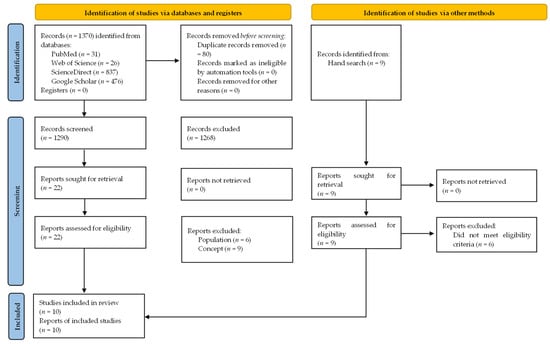
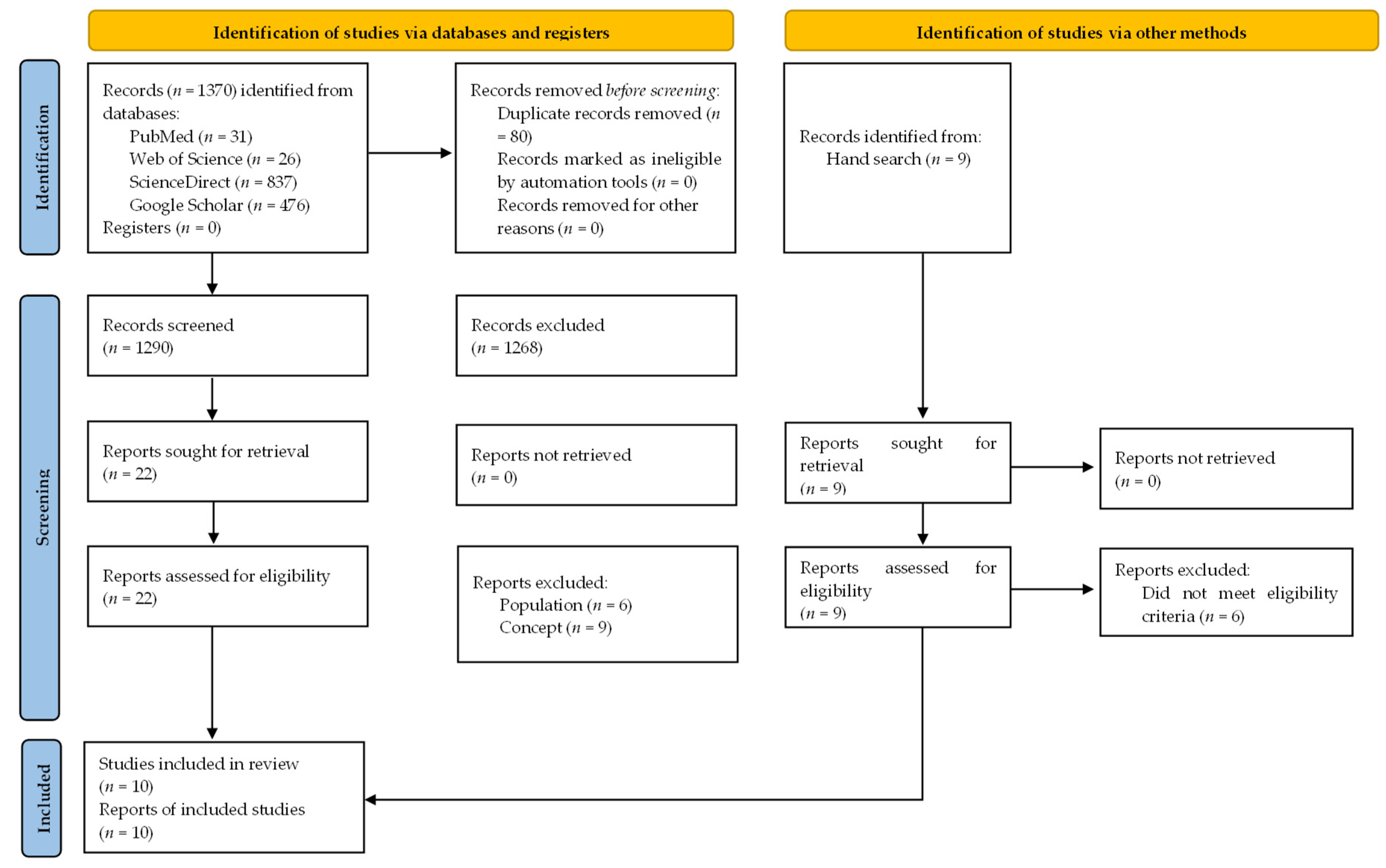
A total of 1370 records were identified through database searches, comprising 31 records from PubMed, 26 from Web of Science, 837 from ScienceDirect, and 476 from Google Scholar. Following the removal of 80 duplicate records, 1290 records remained for title and abstract screening.
After screening, 1268 records were excluded because they did not meet the predefined eligibility criteria. The full texts of 22 articles were subsequently assessed for eligibility. Of these, 15 articles were excluded based on the population criterion (n = 6) or the methodological concept of interest (n = 9). A summary of the primary reasons for exclusion is provided in Table A2 (Appendix A).
In parallel, nine additional records were identified through manual screening of the reference lists of relevant original articles and reviews. These records were independently evaluated by two reviewers using the same a priori eligibility criteria defined in the PCC framework. Following full-text assessment, three studies met all inclusion criteria and were included in the review.
Overall, ten studies were included in this scoping review. The study selection process is presented in Figure 1 (PRISMA flow diagram).
Figure 1.
PRISMA flow diagram illustrating the study selection process [41].
3.1. Study Designs and Contexts
The included studies comprised seven cross-sectional observational studies [43,44,45,46,47,48,49], one longitudinal observational cohort study [50], one quasi-experimental study [51], and one retrospective observational study [52].
Study contexts were classified according to the primary setting in which the STS assessment was conducted. Four studies were conducted in laboratory-based biomechanical settings [43,45,46,49], three in university-affiliated clinical research settings [44,47,48], one in a naturalistic clinical or home environment [50], and two in inpatient neurorehabilitation settings with integrated biomechanical assessment [51,52]. A summary of study designs and contexts is presented in Table A1.
3.2. Participant Characteristics
Three of the included studies, Silva et al. (2015) [46], Silva et al. (2017) [45] and Franco et al. (2021) [44], used the same participant cohort (n = 18 individuals after stroke; 13 males, 5 females; mean age 59.8 ± 9.98 years). These studies were therefore considered to represent a single independent sample in all aggregate calculations. Accordingly, across the ten included studies, eight independent samples assessed 264 unique individuals after stroke. The number of post-stroke participants per independent sample ranged from 7 [49] to 50 [50,52].
Of the 264 participants, sex was reported for 257: 186 were male and 71 were female. Sex was not reported by Galli et al. [49] (n = 7). The sample-weighted mean age across independent samples was 60.2 years.
Four independent samples included both individuals after stroke and matched non-disabled control participants [43,44,45,46,49,51], whereas the remaining four independent samples included only individuals after stroke [47,48,50,52]. Motojima et al. [52] compared two post-stroke subgroups (dependent versus independent) rather than including a non-disabled control group. Five independent samples included participants in the chronic phase after stroke, with time since stroke ranging from approximately 6.9 to 13 years [44,45,46,47,48]. Three independent samples included participants in the acute or subacute phase, with time since stroke ranging from 4 days to approximately 18 weeks [49,51,52]. One study did not report time since stroke [43]. In all studies, participants had experienced a single unilateral stroke. Stroke laterality was reported in seven studies [43,44,45,46,47,48,49,52], comprising 78 participants with right-hemisphere involvement and 98 with left-hemisphere involvement (total n = 176). Stroke laterality was not reported by Janssen et al. (2010) [50] or Yamasaki et al. (2025) [51]. Stroke subtype was specified in two studies [47,52]. Two studies assessed cognitive status using the Abbreviated Mental Test Score [47,48]. Additional clinical measures used for participant characterisation are detailed in Table A1.
3.3. Experimental Settings and Sit-to-Stand Protocols
All studies assessed the STS task from a seated starting position. Chair characteristics were reported variably. One study stated that participants used the chair most commonly available in their daily environment [50], whereas the remaining studies provided detailed descriptions of the chairs used, including information on armrests, backrests and seat height adjustment [43,44,45,46,47,48,49,51,52].
Five studies used standardised clinical tests, such as the five-times sit-to-stand test (5TSTS) [44,45,46,47,48], whereas two studies adopted a more naturalistic approach, allowing participants to perform the STS movement at a self-selected speed [49,50]. One study used a 30-s sit-to-stand test [43]. Several studies manipulated experimental conditions, including seat height and arm position [48], foot placement and arm position [47], and chair characteristics [44]. Detailed experimental protocols are summarised in Table 3.
Table 3.
Methodological characteristics of upper-limb involvement during STS assessment after stroke.
3.4. Methodological Approaches to Upper-Limb Involvement During STS Assessment
Based on how upper-limb involvement was operationalised during STS assessment, the included studies were classified into four methodological approaches. The most common involved restricting upper-limb contribution, with participants instructed to perform the task with their arms crossed over the chest to minimise compensatory arm use and standardise trunk and lower-limb biomechanics [44,45,46,49]. A second approach involved comparing different upper-limb conditions within the same experimental protocol to examine the influence of arm position or arm use on STS performance. These comparisons included different initial arm postures (e.g., arms crossed, hands on the thighs, hands alongside the trunk, or hands clasped to the chest) [43,47,48], as well as STS performance with and without arm assistance [50]. A third approach used a standardised upper-limb posture without manual support, instructing participants to keep their arms alongside the trunk throughout the task minimise voluntary upper-limb contribution while preserving a more natural posture [52]. Finally, one study investigated therapeutic handling during STS, while simultaneously minimising voluntary upper-limb assistance to isolate the effects of therapist-guided lower-limb facilitation on movement performance [51].
Overall, these methodological approaches demonstrated substantial heterogeneity in how upper-limb involvement was addressed across studies. Although restricting arm movement was the most frequently adopted strategy, the rationale and implementation of upper-limb conditions varied considerably, highlighting the absence of a standardised methodological framework for evaluating upper-limb involvement during STS after stroke. A detailed overview of upper-limb conditions is presented in Table 3.
3.5. Postural Orientation of Other Body Segments
The control or manipulation of the postural orientation of body segments other than the upper limbs was reported inconsistently across studies. Seven studies standardised or systematically manipulated the orientation of other body segments as an experimental condition [43,44,45,46,48,49,50]. One study examined two distinct foot placement conditions during STS assessment [47]. In addition, two studies used standardised positioning of the lower limbs and trunk segments to ensure consistent task execution, without explicitly manipulating these variables as experimental factors [51,52]. Details are presented in Table 3.
3.6. Assessment Instruments
A variety of laboratory-based and clinical instruments were used across the included studies to assess STS performance. Laboratory-based assessments were employed in six studies [43,45,46,49,51,52] and included three-dimensional (3D) motion capture systems, force platforms, seat pressure sensors and biomechanical analysis software. These instruments were used to quantify kinematic, kinetic and temporal parameters of the STS task under controlled experimental conditions.
Three-dimensional motion analysis systems were the most frequently used laboratory instruments [43,45,46,49,51,52], often combined with force platforms to identify seat-off events and compute joint kinematics and spatiotemporal variables [45,46,49,51,52]. More advanced computational approaches, including musculoskeletal modelling and inter-joint coordination analysis, were reported in a smaller number of studies [43,51].
Clinical assessment instruments were reported in seven studies [44,45,46,47,48,50,51]. These included standardised functional performance tests, such as the five-times sit-to-stand test [44,45,46,47,48], as well as clinical scales assessing motor function, trunk control and functional independence, including the Fugl–Meyer Motor Assessment, Trunk Impairment Scale, Motor Assessment Scale, Postural Assessment Scale for Stroke Patients and the Barthel Index [44,45,46,50]. In contrast, several studies relied exclusively on laboratory-derived outcome measures [43,49,51,52] and did not include clinical outcome measures in their analyses.
A detailed overview of laboratory and clinical assessment instruments is provided in Table 3.
3.7. Biomechanical and Kinematic Outcome Measures
All included studies reported temporal parameters related to STS performance, including total task duration [43,45,46,49,50,51,52], phase-specific durations [45,46,49], and rising speed under different upper-limb conditions [50]. In studies using the five-times sit-to-stand test, total completion time was the primary outcome measure [44,45,46,47,48].
Three studies reported joint kinematic variables, including shoulder and ankle joint ranges of motion [49], inter-joint coordination involving the hip, knee and ankle [43], and trunk kinematics during STS [45,46]. Two studies also examined advanced biomechanical outcomes, including peak trunk flexor momentum [46] and movement smoothness using spectral arc length metrics [51]. A summary of biomechanical and kinematic outcome measures is provided in Table 3.
4. Discussion
This scoping review synthesised evidence on whether and how upper-limb involvement has been considered, operationalised or controlled during STS assessment in individuals after stroke. By mapping participant characteristics, experimental settings and protocols, upper-limb and whole-body postural constraints, assessment instruments and biomechanical and kinematic outcome measures, the review provides an updated overview of current methodological approaches used to investigate upper-limb involvement in STS research. Rather than addressing intervention efficacy, the present findings highlight methodological patterns and inconsistencies that currently limit the interpretability, comparability and clinical applicability of the existing evidence. The review also proposes a methodological framework for classifying how upper-limb involvement has been operationalised during STS assessment, providing a structured basis for interpreting methodological heterogeneity and informing the design of future research.
Across the included studies, basic demographic variables such as age, sex and affected hemisphere were commonly reported. However, other clinically relevant characteristics—including time since stroke, stroke subtype, lesion location, comorbidities and premorbid lifestyle factors—were documented inconsistently [7,53,54]. Moreover, although stroke recovery is inherently multidimensional, the use of standardised clinical measures to characterise body function, activity limitations and participation restrictions varied substantially between studies [38,55].
The absence of comprehensive and standardised participant characterisation limits the interpretation of STS performance and constrains comparisons across studies. Adherence to established clinical research guidelines in stroke rehabilitation, which emphasise systematic reporting of demographic, clinical, and functional variables, is essential to improve the transparency and external validity of STS research [7,55]. In addition, although the inclusion of matched non-disabled control groups enables more meaningful interpretation of movement impairments and compensatory strategies [7,55], this approach was adopted in only four of the eight independent samples included in this review [43,44,45,46,49,51]. The remaining four independent samples included only individuals after stroke [47,48,50,52], with Motojima et al. [52] comparing dependent and independent post-stroke subgroups rather than including a non-disabled control group. This methodological variability should be considered when interpreting and comparing findings across studies.
Movement emerges from the dynamic interaction between the individual, the task and the environment [7,22]. Accordingly, STS performance is shaped by multiple determinants, including chair-related factors, participant characteristics and movement strategies such as trunk orientation, foot placement and arm movements [29,39]. The studies included in this review primarily manipulated task- and environment-related factors, particularly chair characteristics and movement constraints, whereas participant-related factors were addressed less consistently.
Five studies used the five-times sit-to-stand test, and one study used the 30-s sit-to-stand test; both are widely used as indicators of lower-limb functional capacity [13,19,56]. However, despite their sensitivity to changes in performance, these tests provide limited information on movement control, coordination and compensatory strategies [57]. STS is a multidimensional task involving the coordinated contribution of multiple body segments, including the trunk and upper limbs [32,48], and its assessment cannot be reduced to temporal performance outcomes alone.
Laboratory-based studies enabled more detailed biomechanical analyses but were frequently associated with highly constrained task protocols. Conversely, studies conducted in clinical environments tended to prioritise functional performance measures at the expense of detailed movement analysis. This methodological divergence highlights an ongoing gap between experimental control and ecological validity, which remains insufficiently addressed in current STS research [58,59].
Upper-limb postural orientation was explicitly described in all included studies; however, it was most often treated as a controlled or restricted variable rather than as an integral component of STS performance. In several studies, participants were instructed to perform the task with their arms crossed over their chests or with their hands on their thighs. Other studies adopted a single, standardised upper-limb posture without systematically testing its functional contribution. Although some studies aimed to capture more natural movement patterns, upper-limb use was frequently constrained. This approach contrasts with evidence suggesting that upper-limb position influences centre-of-mass displacement, balance regulation and trunk muscle activation during functional tasks [28,29,39,40,56]. From a rehabilitation perspective, constraining upper-limb use may reduce the ecological validity of STS assessment and obscure meaningful compensatory strategies, particularly in individuals after stroke, for whom upper-limb involvement may play a critical role in postural control and task execution [32,34].
The methodological classification proposed in this review further highlights the heterogeneity in how upper-limb involvement has been addressed during STS assessment. Four distinct methodological approaches were identified: restriction of upper-limb contribution; comparison of different upper-limb conditions, including functional arm assistance; adoption of a standardised upper-limb posture without manual support; and investigation of therapeutic handling while voluntary upper-limb assistance was minimised. These approaches reflect different assumptions about the role of the upper limbs during STS, ranging from treating them as a source of experimental variability to recognising them as active contributors to movement execution. Consequently, comparisons between studies should be interpreted with caution, as differences in upper-limb methodology may influence movement strategies and biomechanical outcomes independently of participant characteristics [17,19,39,40].
The absence of consensus regarding how upper-limb involvement should be addressed also limits methodological comparability across studies. Future investigations should therefore adopt clearly justified upper-limb conditions, explicitly report the rationale for arm positioning, and distinguish whether upper-limb use is restricted, permitted, or directly analysed as part of the task. Authors should also specify whether the paretic, non-paretic, or both upper limbs are involved during task execution, where appropriate, as this information is essential for interpreting compensatory strategies after stroke. Detailed reporting of chair characteristics, seat height adjustment, foot placement, and the initial posture of other body segments should also be considered essential methodological information. Such standardisation would improve reproducibility, facilitate comparisons across studies, and enhance the clinical interpretation of STS assessments [17,19,55].
The findings of this scoping review indicate that upper-limb postural orientation has been underexplored as an active contributor to STS strategies. Systematic assessment of upper-limb involvement has the potential to enhance clinical reasoning and support the identification of more targeted and functionally relevant rehabilitation strategies [17,19,60].
Beyond the constraints imposed on the upper limbs, the postural orientation of other body segments was not consistently controlled or reported. Most studies instructed participants to adopt symmetrical lower-limb positions at task initiation, yet only one study explicitly manipulated foot placement as an experimental condition [47]. The findings of that study, in line with the evidence from healthy populations, suggest that posterior foot placement may facilitate STS performance by reducing movement duration and muscular effort [47,61]. However, because foot placement was explicitly manipulated in only one study, its interaction with different upper-limb conditions remains largely unexplored.
Despite these observations, the systematic analysis of trunk, pelvis and upper-limb orientation remains limited. This is an underexplored area with important implications for understanding movement strategies, compensatory mechanisms and functional performance during STS transitions.
Considerable heterogeneity was observed in the assessment instruments and outcome measures used across studies. Laboratory-based investigations predominantly relied on 3D motion capture systems, force platforms and computational modelling to quantify kinematic and temporal parameters. In contrast, clinical studies primarily used functional performance tests and standardised clinical scales.
Temporal parameters, including total STS duration and phase-specific durations, were the most consistently reported outcomes. Fewer studies examined joint kinematics, inter-joint coordination or trunk dynamics, despite evidence supporting the value of kinematic and kinetic measures for distinguishing between restitution and compensation mechanisms after stroke [55]. Integrating biomechanical outcome measures may enhance the sensitivity of STS assessment and support more precise evaluation of rehabilitation outcomes and prognostic trajectories [17,19,28,62,63,64]. Future studies should therefore combine clinically feasible outcome measures with comprehensive biomechanical analyses to better characterise both functional performance and movement quality during STS more fully.
This scoping review has several limitations. The literature search was restricted to four databases, which may have resulted in the omission of relevant studies. Although complementary manual reference screening was undertaken, additional databases such as Scopus, Embase, CINAHL, PEDro, SPORTDiscus and the Cochrane Library were not searched; therefore, some relevant publications may not have been identified. Furthermore, the predefined search strategy may not have captured studies in which upper-limb positioning was described only in the Materials and Methods section Methods section rather than in the title, abstract, or keywords. Reviews were excluded to maintain a focus on primary research, potentially limiting broader contextual insights. In addition, reporting of key methodological and clinical variables was inconsistent across studies. As this review aimed to map methodological approaches, no formal appraisal of methodological quality was conducted. These limitations should be considered when interpreting the findings; however, they do not detract from the primary objective of this review, which was to map and synthesise the methodological approaches used to investigate upper-limb involvement during STS assessment after stroke.
Collectively, the findings of this scoping review reveal three interrelated methodological gaps in the current literature on STS assessment after stroke. First, there is a lack of three-dimensional biomechanical evidence specifically addressing the role of upper-limb involvement within the global organisation of movement. Second, the widespread use of constrained upper-limb conditions, often without explicit biomechanical or clinical justification, compromises comparability across studies and limits the interpretation of the reported outcomes. Third, the frequent reliance on highly standardised and restrictive task protocols raises concerns about ecological validity, particularly given the functional and adaptive role of the head–arms–trunk complex in regulating centre-of-mass displacement, momentum generation and postural stability during STS transitions.
Based on the evidence mapped in this review, future studies should adopt more transparent and standardised methodological reporting. At a minimum, investigators should explicitly report upper-limb position throughout the task, justify whether upper-limb use is restricted, permitted or analysed, specify the involvement of the paretic and non-paretic upper limbs where appropriate, and provide detailed descriptions of chair characteristics, seat height adjustment, foot placement and the initial posture of other body segments. These recommendations provide a practical methodological framework for improving the reproducibility, comparability and clinical translation of future STS research.
Addressing these gaps requires experimental approaches that explicitly contrast restricted and unconstrained upper-limb conditions under controlled biomechanical assessment, allowing the direct quantification of their effects on multibody segments and multiplanar coordination and movement organisation. Establishing this methodological foundation is a necessary step towards improving both the interpretability of STS research and its translational relevance to post-stroke rehabilitation.
5. Conclusions
This scoping review mapped how upper-limb involvement has been addressed during STS assessment in individuals after stroke, revealing a limited and methodologically heterogeneous body of evidence. Across the included studies, upper-limb postural orientation was frequently constrained or standardised during STS assessment, often without explicit biomechanical or clinical justification. Temporal parameters and selected joint kinematic variables were the most commonly reported outcomes, whereas comprehensive 3D analyses of upper-limb contribution and multisegmental coordination during STS transitions remain scarce.
The findings of this review highlight important methodological gaps, including limited consideration of upper-limb involvement as an active component of STS performance, restricted comparability across studies due to heterogeneous protocols, and potential threats to ecological validity arising from highly standardised and artificial task constraints. By synthesising these methodological patterns, this scoping review provides a structured framework for interpreting the existing evidence and identifying methodological priorities for future research.
Author Contributions
The research authors made the following contributions: Conceptualization, R.F., C.S., A.S. and J.P.V.-B.; Methodology, R.F., L.P. and S.S.; Validation, C.S., A.S. and J.P.V.-B.; Investigation, R.F. and L.P.; Writing—original draft preparation, R.F., LP., M.F. and S.S.; Writing—review and editing, R.F., L.P., M.F., C.S. and A.S. and J.P.V.-B.; Formal analysis, R.F., L.P., M.F., C.S., A.S., J.P.V.-B.; Visualization, R.F., C.S. and A.S.; Supervision, C.S., A.S. and J.P.V.-B. All authors have read and agreed to the published version of the manuscript.
Funding
This research was supported by Fundação para a Ciência e Tecnologia (FCT) under the support (DOI: https://doi.org/10.54499/UID/05210/2025).
Institutional Review Board Statement
Not applicable.
Informed Consent Statement
Not applicable.
Data Availability Statement
No new data were created or analyzed in this study. Data sharing is not applicable to this article.
Conflicts of Interest
The authors declare no conflicts of interest.
Abbreviations
The following abbreviations are used in this manuscript:
| HMS | Human Movement System |
| PC | Postural Control |
| STS | Sit to stand |
| JBI | Joanna Briggs Institute |
| OSF | Open Science Framework |
| PCC | Population—Concept—Context |
| 5TSTS | Five-times sit-to-stand |
Appendix A
Appendix A.1
Table A1.
Descriptive individual characteristics, aims/purpose and context of the included studies.
Appendix A.2
Table A2.
Reasons for exclusion following full-text assessment.
References
- Fisher, B.E. Beyond Limits: Unmasking Potential Through Movement Discovery. Phys. Ther. 2020, 100, 747–756. [Google Scholar] [CrossRef] [Scilit] [PubMed]
- Voight, M.L.; Hoogenboom, B.J. What is the movement system and why it is important? Int. J. Sports Phys. Ther. 2017, 12, 1–2. [Google Scholar] [CrossRef] [Scilit]
- Vaughan-Graham, J.; Patterson, K.; Zabjek, K.; Cott, C.A. Conceptualizing movement by expert Bobath instructors in neurological rehabilitation. J. Eval. Clin. Pract. 2017, 23, 1153–1163. [Google Scholar] [CrossRef] [Scilit] [PubMed]
- Saladin, L.; Voight, M. Introduction to the Movement System as the Foundation for Physical Therapist Practice Education and Research. Int. J. Sports Phys. Ther. 2017, 12, 858–861. [Google Scholar] [CrossRef] [Scilit]
- Hoogenboom, B.J.; Sulavik, M. The Movement System in Education. Int. J. Sports Phys. Ther. 2017, 12, 894–900. [Google Scholar] [CrossRef] [Scilit]
- Sahrmann, S. The how and why of the movement system as the identity of physical therapy. Int. J. Sports Phys. Ther. 2017, 12, 862–869. [Google Scholar] [CrossRef] [Scilit]
- Guccione, A.A.; Neville, B.T.; George, S.Z. Optimization of Movement: A Dynamical Systems Approach to Movement Systems as Emergent Phenomena. Phys. Ther. 2019, 99, 3–9. [Google Scholar] [PubMed]
- Shumway-Cook, A.; Woollacott, M.H. Motor Control: Translating Research into Clinical Practice; Wolters Kluwer: Philadelphia, PA, USA; Alphen aan den Rijn, The Netherlands, 2017. [Google Scholar]
- Horak, F.B. Postural orientation and equilibrium: What do we need to know about neural control of balance to prevent falls? Age Ageing 2006, 35, ii7–ii11. [Google Scholar] [CrossRef] [Scilit] [PubMed]
- Gjelsvik, B.E.B. The Bobath Concept in Adult Neurology; Thieme: Stuttgart, Germany, 2008. [Google Scholar]
- Beyaert, C.; Vasa, R.; Frykberg, G.E. Gait post-stroke: Pathophysiology and rehabilitation strategies. Neurophysiol. Clin. 2015, 45, 335–355. [Google Scholar] [CrossRef] [Scilit] [PubMed]
- Chandler, E.A.; Stone, T.; Pomeroy, V.M.; Clark, A.B.; Kerr, A.; Rowe, P.; Ugbolue, U.C.; Smith, J.; Hancock, N.J. Investigating the Relationships Between Three Important Functional Tasks Early After Stroke: Movement Characteristics of Sit-To-Stand, Sit-To-Walk, and Walking. Front. Neurol. 2021, 12, 660383. [Google Scholar] [CrossRef] [Scilit] [PubMed]
- Bhardwaj, S.; Khan, A.A.; Muzammil, M. Lower limb rehabilitation using multimodal measurement of sit-to-stand and stand-to-sit task. Disabil. Rehabil. Assist. Technol. 2021, 16, 438–445. [Google Scholar] [PubMed]
- Darwish, M.H.; Ahmed, S.; Ismail, M.E.-S.; Khalifa, H.A. Influence of pelvic inclination on sit to stand task in stroke patients. Egypt. J. Neurol. Psychiatry Neurosurg. 2019, 55, 89. [Google Scholar] [CrossRef] [Scilit]
- Kerr, A.; Clark, A.; Cooke, E.; Rowe, P.; Pomeroy, V. Functional strength training and movement performance therapy produce analogous improvement in sit-to-stand early after stroke: Early-phase randomised controlled trial. Physiotherapy 2017, 103, 259–265. [Google Scholar] [CrossRef] [Scilit] [PubMed]
- Dall, P.M.; Kerr, A. Frequency of the sit to stand task: An observational study of free-living adults. Appl. Ergon. 2010, 41, 58–61. [Google Scholar] [CrossRef] [Scilit] [PubMed]
- Kılınç, Ö.O.; De Ridder, R.; Kılınç, M.; Van Bladel, A. Trunk and lower extremity biomechanics during sit-to-stand after stroke: A systematic review. Ann. Phys. Rehabil. Med. 2023, 66, 101676. [Google Scholar] [CrossRef] [Scilit] [PubMed]
- Yang, N.; An, Q.; Kogami, H.; Yamakawa, H.; Tamura, Y.; Takahashi, K.; Kinomoto, M.; Yamasaki, H.; Itkonen, M.; Shibata-Alnajjar, F.; et al. Temporal Features of Muscle Synergies in Sit-to-Stand Motion Reflect the Motor Impairment of Post-Stroke Patients. IEEE Trans. Neural Syst. Rehabil. Eng. 2019, 27, 2118–2127. [Google Scholar] [CrossRef] [Scilit] [PubMed]
- Frykberg, G.E.; Häger, C.K. Movement analysis of sit-to-stand—Research informing clinical practice. Phys. Ther. Rev. 2015, 20, 156–167. [Google Scholar] [CrossRef] [Scilit]
- Camargos, A.C.R.; Rodrigues-de-Paula-Goulart, F.; Teixeira-Salmela, L.F. The effects of foot position on the performance of the sit-to-stand movement with chronic stroke subjects. Arch. Phys. Med. Rehabil. 2009, 90, 314–319. [Google Scholar] [CrossRef] [Scilit] [PubMed]
- Etnyre, B.; Thomas, D.Q. Event standardization of sit-to-stand movements. Phys. Ther. 2007, 87, 1651–1666. [Google Scholar] [CrossRef] [Scilit] [PubMed]
- Vaughan-Graham, J.; Patterson, K.; Brooks, D.; Zabjek, K.; Cott, C. Transitions sit to stand and stand to sit in persons post-stroke: Path of centre of mass, pelvic and limb loading—A pilot study. Clin. Biomech. 2019, 61, 22–30. [Google Scholar] [CrossRef] [Scilit] [PubMed]
- van Lummel, R.C.; Walgaard, S.; Maier, A.B.; Ainsworth, E.; Beek, P.J.; van Dieën, J.H. The Instrumented Sit-to-Stand Test (iSTS) Has Greater Clinical Relevance than the Manually Recorded Sit-to-Stand Test in Older Adults. PLoS ONE 2016, 11, e0157968. [Google Scholar] [CrossRef] [Scilit] [PubMed]
- Pollock, A.; Gray, C.; Culham, E.; Durward, B.R.; Langhorne, P. Interventions for improving sit-to-stand ability following stroke. Cochrane Database Syst. Rev. 2014, 2014, CD007232. [Google Scholar] [CrossRef] [Scilit] [PubMed]
- Brunt, D.; Greenberg, B.; Wankadia, S.; Trimble, M.A.; Shechtman, O. The effect of foot placement on sit to stand in healthy young subjects and patients with hemiplegia. Arch. Phys. Med. Rehabil. 2002, 83, 924–929. [Google Scholar] [CrossRef] [Scilit] [PubMed]
- Mohammadi, R.; Mirshoja, M.S. Sit-to-Stand Task in Stroke Survivors: A Review Study. Middle East J. Rehabil. Health Stud. 2018, 5, e66467. [Google Scholar]
- Verheyden, G.; Ruesen, C.; Gorissen, M.; Brumby, V.; Moran, R.; Burnett, M.; Ashburn, A. Postural alignment is altered in people with chronic stroke and related to motor and functional performance. J. Neurol. Phys. Ther. 2014, 38, 239–245. [Google Scholar] [CrossRef] [Scilit] [PubMed]
- O’Keeffe, C.; Gill, C.; Etzelmueller, M.; Taylor, C.; Hablani, S.; Reilly, R.B.; Fleming, N. Multimodal analysis of the biomechanical impact of knee angle on the Sit-to-Stand transition. Gait Posture 2023, 105, 125–131. [Google Scholar] [CrossRef] [Scilit] [PubMed]
- Boukadida, A.; Piotte, F.; Dehail, P.; Nadeau, S. Determinants of sit-to-stand tasks in individuals with hemiparesis post stroke: A review. Ann. Phys. Rehabil. Med. 2015, 58, 167–172. [Google Scholar] [CrossRef] [Scilit] [PubMed]
- Abdolrahmani, A. Coordination between Trunk and Ankle during Sit-to-stand Task in Healthy Young Subjects. J. Rehabil. Health Sci. 2015, 13, 1–5. [Google Scholar]
- Negrini, S.; Piovanelli, B.; Amici, C.; Cappellini, V.; Bovi, G.; Ferrarin, M.; Zaina, F.; Borboni, A. Trunk motion analysis: A systematic review from a clinical and methodological perspective. Eur. J. Phys. Rehabil. Med. 2016, 52, 583–592. [Google Scholar] [PubMed]
- Kantak, S.; Jax, S.; Wittenberg, G. Bimanual coordination: A missing piece of arm rehabilitation after stroke. Restor. Neurol. Neurosci. 2017, 35, 347–364. [Google Scholar] [CrossRef] [Scilit] [PubMed]
- Kantak, S.; McGrath, R.; Zahedi, N. Goal conceptualization and symmetry of arm movements affect bimanual coordination in individuals after stroke. Neurosci. Lett. 2016, 626, 86–93. [Google Scholar] [CrossRef] [Scilit] [PubMed]
- Kantak, S.S.; Zahedi, N.; McGrath, R.L. Task-Dependent Bimanual Coordination After Stroke: Relationship With Sensorimotor Impairments. Arch. Phys. Med. Rehabil. 2016, 97, 798–806. [Google Scholar] [CrossRef] [Scilit] [PubMed]
- Shaikh, T.; Goussev, V.; Feldman, A.G.; Levin, M.F. Arm-trunk coordination for beyond-the-reach movements in adults with stroke. Neurorehabilit. Neural Repair 2014, 28, 355–366. [Google Scholar] [CrossRef] [Scilit] [PubMed]
- Levin, M.F.; Michaelsen, S.M.; Cirstea, C.M.; Roby-Brami, A. Use of the trunk for reaching targets placed within and beyond the reach in adult hemiparesis. Exp. Brain Res. 2002, 143, 171–180. [Google Scholar] [CrossRef] [Scilit] [PubMed]
- Dietz, V.; Schrafl-Altermatt, M. Control of functional movements in healthy and post-stroke subjects: Role of neural interlimb coupling. Clin. Neurophysiol. 2016, 127, 2286–2293. [Google Scholar] [CrossRef] [Scilit] [PubMed]
- Kwakkel, G.; Stinear, C.; Essers, B.; Munoz-Novoa, M.; Branscheidt, M.; Cabanas-Valdés, R.; Lakičević, S.; Lampropoulou, S.; Luft, A.R.; Marque, P.; et al. Motor rehabilitation after stroke: European Stroke Organisation (ESO) consensus-based definition and guiding framework. Eur. Stroke J. 2023, 8, 880–894. [Google Scholar] [CrossRef] [Scilit] [PubMed]
- Janssen, W.G.; Bussmann, H.B.; Stam, H.J. Determinants of the sit-to-stand movement: A review. Phys. Ther. 2002, 82, 866–879. [Google Scholar] [CrossRef] [Scilit]
- Carr, J.H.; Gentile, A.M. The effect of arm movement on the biomechanics of standing up. Hum. Mov. Sci. 1994, 13, 175–193. [Google Scholar] [CrossRef] [Scilit]
- Tricco, A.C.; Lillie, E.; Zarin, W.; O’Brien, K.K.; Colquhoun, H.; Levac, D.; Moher, D.; Peters, M.D.J.; Horsley, T.; Weeks, L.; et al. PRISMA Extension for Scoping Reviews (PRISMA-ScR): Checklist and Explanation. Ann. Intern. Med. 2018, 169, 467–473. [Google Scholar] [CrossRef] [Scilit] [PubMed]
- Peters, M.D.J.; Marnie, C.; Tricco, A.C.; Pollock, D.; Munn, Z.; Alexander, L.; McInerney, P.; Godfrey, C.M.; Khalil, H. Updated methodological guidance for the conduct of scoping reviews. JBI Evid. Synth. 2020, 18, 2119–2126. [Google Scholar] [CrossRef] [Scilit] [PubMed]
- He, J.; Liu, D.; Hou, M.; Luo, A.; Wang, S.; Ma, Y. Analysis of inter-joint coordination during the sit-to-stand and stand-to-sit tasks in stroke patients with hemiplegia. BMC Sports Sci. Med. Rehabil. 2023, 15, 104. [Google Scholar] [CrossRef] [Scilit] [PubMed]
- Franco, J.; Quintino, L.F.; Faria, C.D. Five-repetition sit-to-Stand test among patients post-stroke and healthy-matched controls: The use of different chair types and number of trials. Physiother. Theory Pract. 2021, 37, 1419–1428. [Google Scholar] [CrossRef] [Scilit] [PubMed]
- Silva, P.F.d.S.; Quintino, L.F.; Franco, J.; Rodrigues-de-Paula, F.; Albuquerque de Araújo, P.; Faria, C.D.C.d.M. Trunk kinematics related to generation and transfer of the trunk flexor momentum are associated with sit-to-stand performance in chronic stroke survivors. NeuroRehabilitation 2017, 40, 57–67. [Google Scholar] [CrossRef] [Scilit] [PubMed]
- Silva, P.; Franco, J.; Gusmão, A.; Moura, J.; Teixeira-Salmela, L.; Faria, C. Trunk strength is associated with sit-to-stand performance in both stroke and healthy subjects. Eur. J. Phys. Rehabil. Med. 2015, 51, 717–724. [Google Scholar] [PubMed]
- Kwong, P.W.H.; Ng, S.S.M.; Chung, R.C.K.; Ng, G.Y.F. Foot placement and arm position affect the five times sit-to-stand test time of individuals with chronic stroke. BioMed Res. Int. 2014, 2014, 636530. [Google Scholar] [CrossRef] [Scilit] [PubMed]
- Ng, S.S.M.; Cheung, S.Y.; Lai, L.S.W.; Liu, A.S.L.; Ieong, S.H.I.; Fong, S.S.M. Association of seat height and arm position on the five times sit-to-stand test times of stroke survivors. BioMed Res. Int. 2013, 2013, 642362. [Google Scholar] [CrossRef] [Scilit] [PubMed]
- Galli, M.; Cimolin, V.; Crivellini, M.; Campanini, I. Quantitative analysis of sit to stand movement: Experimental set-up definition and application to healthy and hemiplegic adults. Gait Posture 2008, 28, 80–85. [Google Scholar] [CrossRef] [Scilit] [PubMed]
- Janssen, W.; Bussmann, J.; Selles, R.; Koudstaal, P.; Ribbers, G.; Stam, H. Recovery of the sit-to-stand movement after stroke: A longitudinal cohort study. Neurorehabil. Neural Repair 2010, 24, 763–769. [Google Scholar] [CrossRef] [Scilit] [PubMed]
- Yamasaki, H.R.; An, Q.; Takahashi, K.; Fujii, T.; Yang, N.; Itkonen, M.; Yokoyama, M.; Alnajjar, F.S.; Otomune, H.; Hattori, N.; et al. Evaluating the impact of the therapeutic handling on sit-to-stand movements post-stroke: Kinematic smoothness as a monitoring metric for recovery. J. Bodyw. Mov. Ther. 2025, 42, 620–628. [Google Scholar] [CrossRef] [Scilit] [PubMed]
- Motojima, N.; Yamamoto, S.; Kohno, T. Differences in kinetics and kinematics of sit-to-stand between independent and dependent post-stroke individuals. Clin. Biomech. 2025, 129, 106636. [Google Scholar] [CrossRef] [Scilit] [PubMed]
- Walker, M.F.; Hoffmann, T.C.; Brady, M.C.; Dean, C.M.; Eng, J.J.; Farrin, A.J.; Felix, C.; Forster, A.; Langhorne, P.; Lynch, E.A.; et al. Improving the development, monitoring and reporting of stroke rehabilitation research: Consensus-based core recommendations from the Stroke Recovery and Rehabilitation Roundtable. Int. J. Stroke 2017, 12, 472–479. [Google Scholar] [CrossRef] [Scilit] [PubMed]
- Pongmoragot, J.; Lee, D.S.; Park, T.H.; Fang, J.; Austin, P.C.; Saposnik, G. Stroke and Heart Failure: Clinical Features, Access to Care, and Outcomes. J. Stroke Cerebrovasc. Dis. 2016, 25, 1048–1056. [Google Scholar] [CrossRef] [Scilit] [PubMed]
- Kwakkel, G.; Lannin, N.A.; Borschmann, K.; English, C.; Ali, M.; Churilov, L.; Saposnik, G.; Winstein, C.; van Wegen, E.E.; Wolf, S.L.; et al. Standardized measurement of sensorimotor recovery in stroke trials: Consensus-based core recommendations from the Stroke Recovery and Rehabilitation Roundtable. Int. J. Stroke 2017, 12, 451–461. [Google Scholar] [CrossRef] [Scilit] [PubMed]
- Ng, S.S.; Kwong, P.W.; Chau, M.S.; Luk, I.C.; Wan, S.S.; Fong, S.S. Effect of arm position and foot placement on the five times sit-to-stand test completion times of female adults older than 50 years of age. J. Phys. Ther. Sci. 2015, 27, 1755–1759. [Google Scholar] [CrossRef] [Scilit] [PubMed]
- Howarth, S.J.; Hum, R.; Ead, L. A Kinematic Comparison Between Sit-to-Stand Movements and Individual Cycles of the 5-Cycle Sit-to-Stand Test. J. Manip. Physiol. Ther. 2021, 44, 487–496. [Google Scholar] [CrossRef] [Scilit] [PubMed]
- Quinn, L.; Riley, N.; Tyrell, C.M.; Judd, D.L.; Gill-Body, K.M.; Hedman, L.D.; Packel, A.; Brown, D.A.; Nabar, N.; Scheets, P. A Framework for Movement Analysis of Tasks: Recommendations from the Academy of Neurologic Physical Therapy’s Movement System Task Force. Phys. Ther. 2021, 101, pzab154. [Google Scholar] [CrossRef] [Scilit] [PubMed]
- Vaughan-Graham, J.; Cott, C. Phronesis: Practical wisdom the role of professional practice knowledge in the clinical reasoning of Bobath instructors. J. Eval. Clin. Pract. 2016, 23, 935–948. [Google Scholar] [CrossRef] [Scilit] [PubMed]
- Cavanaugh, J.T.; Kelty-Stephen, D.G.; Stergiou, N. Multifractality, Interactivity, and the Adaptive Capacity of the Human Movement System: A Perspective for Advancing the Conceptual Basis of Neurologic Physical Therapy. J. Neurol. Phys. Ther. 2017, 41, 245–251. [Google Scholar] [CrossRef] [Scilit] [PubMed]
- Kawagoe, S.; Tajima, N.; Chosa, E. Biomechanical analysis of effects of foot placement with varying chair height on the motion of standing up. J. Orthop. Sci. 2000, 5, 124–133. [Google Scholar] [CrossRef] [Scilit] [PubMed]
- Stevermer, C.A.; Gillette, J.C. Kinematic and Kinetic Indicators of Sit-to-Stand. J. Appl. Biomech. 2016, 32, 7–15. [Google Scholar] [CrossRef] [Scilit] [PubMed]
- Papa, E.; Cappozzo, A. Sit-to-stand motor strategies investigated in able-bodied young and elderly subjects. J. Biomech. 2000, 33, 1113–1122. [Google Scholar] [CrossRef] [Scilit] [PubMed]
- Scarborough, D.M.; Krebs, D.E.; Harris, B.A. Quadriceps muscle strength and dynamic stability in elderly persons. Gait Posture 1999, 10, 10–20. [Google Scholar] [CrossRef] [Scilit] [PubMed]

Disclaimer/Publisher’s Note: The statements, opinions and data contained in all publications are solely those of the individual author(s) and contributor(s) and not of MDPI and/or the editor(s). MDPI and/or the editor(s) disclaim responsibility for any injury to people or property resulting from any ideas, methods, instructions or products referred to in the content. |
© 2026 by the authors. Licensee MDPI, Basel, Switzerland. This article is an open access article distributed under the terms and conditions of the Creative Commons Attribution (CC BY) license.