


Abstract
Background/Objectives: Traditional biomechanical models describe human locomotion as an articulated chain of rigid segments with constrained degrees of freedom, primarily focusing on kinematic descriptions of movement. While this approach facilitates modelling and teaching, it may limit the representation of internal force transmission and dynamic interactions, particularly during transitional phases such as gait initiation. The objective of this article is to propose a conceptual framework, Unconstrained Segmental Biomechanics (USB), to reinterpret locomotor mechanics beyond rigid joint assumptions. Methods: An exploratory analysis of recent PubMed-indexed publications (2024) and commonly adopted educational references in sport science institutions was conducted to examine how locomotion is conceptually represented and to identify possible models analogous to the framework. The aim was to situate the framework within current modelling approaches rather than to provide a systematic literature evaluation. Results: The exploratory analysis provided an exploratory contextual impression that kinematic representations were more readily identifiable than conceptually analogous models explicitly addressing dynamic intersegmental force transmission. USB is presented as a conceptual framework generating testable biomechanical hypotheses concerning the temporal organisation of intersegmental force transmission during locomotor transitions, including the expectation that during gait initiation gluteus maximus activation precedes observable segmental displacement, that early CoP/GRF changes precede the visible step, and that trunk activation actively contributes to intersegmental force regulation during the transition. Conclusions: USB offers a conceptual framework that enriches the interpretation of gait initiation and locomotor transitions. Future empirical investigations will be necessary to test the biomechanical hypotheses generated by this framework and to evaluate its potential contribution to biomechanics research, education, and applied movement sciences.
1. Introduction
Traditional biomechanical models frequently represent human locomotion as an articulated chain of rigid segments with constrained joints. Although many contemporary approaches also incorporate kinetics, inverse dynamics, and musculoskeletal modelling, conceptually explicit descriptions of dynamic intersegmental force transmission during transitional movements such as gait initiation remain less prominent in schematic and teaching-oriented representations. Human movement is a highly complex phenomenon, resulting from the interaction between the musculoskeletal system, neurophysiological functions, and biomechanical principles governing its kinematics and dynamics [1]. Due to this complexity, mechanical or biomechanical models used to analyse movement have often employed theoretical simplifications to describe the real interactions between muscular and joint structures. These simplifications serve to reduce the system’s variability, thereby facilitating its study and modelling [2]. Among the most common simplifications in segmental mechanics is the representation of the human body as a system of rigid segments connected by joints, which are modelled as simplified kinematic constraints. These joints are frequently treated as fixed points or as having reduced degrees of freedom to simplify the equations of motion, while still maintaining a functional description of locomotion [3]. For example, in upper limb modelling, the shoulder is often considered a proximal fixed point, the elbow an intermediate hinge, and the wrist a mobile terminal point, neglecting the actual force distribution and variability of joint connections. While this idealisation simplifies biomechanical analysis and might enhance its usability, it may limit the interpretative representation of how forces are temporally organised and transmitted across interconnected segments [4]. A heuristic conceptual inspiration for the present work can be traced to the “Grocco model,” introduced in 2008 by De Bernardi in a technical manual written in Italian. Because this source did not develop within the peer-reviewed biomechanics literature, it is considered here only as an initial conceptual stimulus for the present theoretical reformulation. Building upon this initial inspiration, the present work introduces Unconstrained Segmental Biomechanics (USB) as a reformulated conceptual framework developed by the authors, enabling a combined interpretation of dynamic and kinematic interactions between articulated segmental units without fixed constraints [5]. At the present stage, USB is intended as a conceptual framework for interpreting segmental force transmission rather than as a fully formalised predictive biomechanical model. Nevertheless, the framework is intended to generate novel biomechanical hypotheses regarding the temporal organisation of intersegmental force transmission that may be empirically tested. The term refers to the basic unit of movement, conceived as a system composed of two jointed segments connected by a pivot and activated by an active muscle. Grocco units and their interactions are analysed without assuming fixed points, thus allowing a more realistic depiction of joint connections and the distribution of acting forces. Although this model is still a simplification, it is less restrictive and allows analysis of a greater number of forces involved in movement, thus offering a more accurate description of joint dynamics. Recent studies have shown that increasing the number of analysed variables improves the precision in describing various biomechanical phenomena, including the displacement of the body’s centre of mass [6], and performance evaluation [7]. In particular, the analysis of multiple variables could be especially useful in studying human gait, which, although widely documented, is often analysed using a limited number of parameters [8]. Gait is an essential motor function and is well-documented in the literature with considerable accuracy; however, the analysis is often based on kinematic parameters [9]. The integration of a broader set of biomechanical parameters could therefore enable a more detailed evaluation [10]. Traditionally, locomotion has been analysed through various theoretical models describing the so-called “gait cycle”, as a sequence of defined phases, each characterised by specific biomechanical and kinematic conditions [11,12]. These models conceptualise locomotion as a cyclical phenomenon, where the sequence of motor events regularly repeats and returns the system to its initial state after a defined period, governed by the principles of energy conservation and classical mechanics [13,14]. One of the internationally recognised models, used to teach gait kinematics in academic motor science programmes, is that proposed by Perry and Burnfield (2010) [15]. This model divides the gait cycle into eight main phases, each with distinct kinematic and dynamic conditions: initial contact (0%), loading response (10%), mid-stance (30%), terminal stance (50%), pre-swing (60%), initial swing (73%), mid-swing (87%), and terminal swing (100%). Here, the first phase of the gait cycle is identified as initial contact, the moment when the heel of the leading limb touches the ground [15]. This simplification aims to ensure applicability in academic teaching [16]; however, while widely used and effective, this simplification introduces a degree of abstraction that may limit the ability to interpret and explain the analysed phenomenon [17]. The use of less simplified models, such as the one proposed here, provides a more accurate representation, especially in locomotion, which, despite some cyclical features, is intrinsically non-stationary, characterised by dynamic variations that can support a deeper understanding of kinematics [18]. Specifically, beginning the analysis of locomotion from the discrete temporal phase of initial contact (0%) omits the gait initiation phase, and consequently allows for its omission while teaching it. Studying this phase separately, as a transition between two distinct states (static position and dynamic movement), is often simplified to the point where initial contact appears kinematically identical whether it follows terminal swing (100%) or initiates the gait itself [11,19]. This simplification, which considers only the foot–ground contact (phase 0%) in terms of spatial position, may be misleading if detached from the dynamic components of locomotion [20,21]. From the perspective of gait dynamics, these two conditions are not equivalent at all: at gait initiation, the momentum has not yet been generated, whereas in initial contact after terminal swing, the system already possesses pre-existing momentum [22]. In gait initiation, the body must overcome standing inertia, requiring the generation of acceleration, which is no longer needed to the same extent in subsequent steps, in accordance with Newton’s first law of motion, which states that a body at rest remains at rest unless acted upon by an external force [23]. Therefore, if the first step is not taught as an integral yet distinct part of locomotion analysis, one risks presenting a system as periodic merely because the initiation process that triggered it has been ignored, potentially creating comprehension difficulties for students [24]. Given the relevance of gait initiation as a transitional phase, an exploratory contextual observation of how locomotion is commonly presented in sport science education was included to situate the proposed conceptual framework within current pedagogical approaches. Graduates in motor sciences will eventually need to handle movement in real-world contexts, such as rehabilitation, motor education, or sport, where the highest degree of difficulty often lies in transitions between different motor states [25]. Thus, employing a model that examines both the unobservable causes of movement (dynamics) and the observable effects (kinematics) through the study of basic units and their interactions is proposed here as a conceptual framework to qualitatively interpret locomotor transitions. Furthermore, the inclusion of its unconstrained segmental mechanics highlights a more accurate representation of motor transitions. This methodological expansion could be particularly valuable in the teaching of biomechanics in motor science universities, as it is widely acknowledged that in-depth analysis of forces is fundamental to understanding mechanical responses in human movement [26]. In particular, the USB framework hypothesises that during gait initiation a reorganisation of internal intersegmental force transmission precedes the emergence of observable segmental displacement. This process may be indirectly inferred from the temporal relationship between muscular activation patterns (e.g., EMG onset), centre of pressure displacement, and the subsequent progression of body segments.
2. Literature and Educational Context
This section provides an exploratory contextualisation of the framework by briefly describing commonly adopted conceptual approaches to locomotion analysis in academic and scientific contexts. To contextualise the proposed framework within current teaching and research representations of locomotion, an exploratory international inquiry was conducted. The aim was not to provide a representative or inferential assessment, but to examine whether conceptually analogous explanatory models were readily identifiable in the sampled academic and scientific materials. For this purpose, the first twenty institutions listed in the Shanghai Ranking Global Ranking of Sport Science Schools and Departments (2024) were selected and contacted sequentially following the order of the ranking [27]. For each institution, the official university website was consulted to identify the department responsible for sport or movement sciences and the faculty members involved in biomechanics or locomotion-related teaching.
The choice of sample size (between 10 and 30 institutions) aligns with prior research discussing the use of similar sample ranges in comparative studies involving academic rankings [28,29]. Each selected university department specialising in movement science was contacted by email with a request to indicate the bibliographic references (books or articles) commonly used in teaching human locomotion within sport science programmes. When departmental contact addresses were not available, the request was directed to faculty members responsible for biomechanics or locomotion-related courses. Twelve institutions (60%) responded to this request (Appendix A). In cases where no response was received within approximately 7–10 days, a follow-up contact was attempted by telephone. Responses were received through email correspondence, telephone conversations, or through the provision of bibliographic lists by the contacted departments. When necessary, the referenced materials were retrieved through university library catalogues or directly provided by the institutions. Of these, three universities (25%) stated that they did not include locomotion in their academic curricula; three universities (25%) reported that their teaching was based on the model proposed by Perry and Burnfield (2010) [15]; and the remaining six universities (50%) indicated the use of various references, amounting to seven different textbooks [15]. In order to further analyse the theoretical foundations of locomotion education, all textbooks and teaching materials recommended by the academic programmes of the universities examined were incorporated into the core of bibliographic references. A total of 33 volumes were identified and studied. For each textbook, the table of contents and sections addressing gait, locomotion, or human walking were examined, and the relevant chapters were reviewed to identify how locomotion and gait mechanics were conceptually represented in the educational material. For each of them, the presence or absence of references to the “Grocco model” or comparable segmental causal models was qualitatively assessed. The examination focused on whether the chapters addressing gait or locomotion presented explanatory models describing causal relationships between body segments, the transmission of forces across articulated segments, or other dynamic frameworks used to interpret the mechanical generation of movement. The analysed textbooks are reported in Appendix B (Table A1). Of the 33 textbooks examined, none explicitly referred to the Grocco model, while 4 (12.1%) showed only partial treatment of concepts related to dynamic intersegmental force transmission or comparable segmental causal relationships. The remaining 29 (87.9%) did not present conceptually analogous explanatory frameworks in the sections addressing gait or locomotion. To contextualise the framework within a bounded sample of recent biomechanical literature, a structured exploratory search of the PubMed database (publications indexed in 2024) was conducted. This search was intended only to provide a contextual overview of recent representations of gait analysis and not to constitute a systematic review of the field. Articles were searched in 2024 using the following keywords: “gait”, “gait cycle”, “gait cycle analysis”, and “gait cycle analysis EMG”. Inclusion criteria were limited to human studies with free full-text availability and the following study designs: comparative studies, observational studies, randomised controlled trials, and validation studies. These terms were selected to cover a broad spectrum of gait-related research: “Gait” provided general insights into locomotor function across diverse populations and methodologies. “Gait cycle” focused the search on the biomechanical and temporal segmentation of walking, particularly the phases of stance and swing. “Gait cycle analysis” was used to retrieve studies that provided integrated descriptions of the gait cycle, often including both spatiotemporal and neuromechanical parameters. “Gait cycle analysis EMG” allowed for the inclusion of neuromuscular activation studies, essential for assessing the integration between motor control and biomechanical output. This combination of keywords was intended to capture both kinematic and electromyographic perspectives relevant to gait modelling, with the aim of identifying whether recent literature incorporates any dynamic segmental models similar to the Grocco model. The first analytical phase involved the qualitative examination of 301 articles identified through the structured search strategy. The initial search using the keyword “gait” yielded 6478 results in 2024. Progressive filters were subsequently applied to refine the dataset and ensure relevance. The dataset was then limited to: studies with human participants only and free availability of the full-text, obtaining 2195 results. Subsequently, to narrow the methodological field of application, the types of articles were selected: exploratory observation, evaluation study, observational study, randomised controlled clinical trial and validation study. The second analytical phase, focused specifically on the term “gait cycle,” followed the same filtering procedure. The initial search yielded 442 results, reduced to 157 after applying the human and free full-text filters. However, applying the same five filters by article type, only one study matched all criteria. Consequently, this phase was integrated into the broader gait-based screening and later expanded with “gait cycle analysis and gait cycle EMG analysis,” in a desire to integrate studies on neuromuscular control and kinematic segmentation in healthy subjects. The research focused on “gait cycle analysis” in 2024 produced 227 results and, following the previous selection, 13 studies, all of which were analysed qualitatively. The fourth phase, focused on “gait cycle analysis EMG” in 2024, returned 13 articles. After applying the same filters as the previous selections, a final sample of 2 studies was obtained and analysed. Within the sampled articles examined, kinematic and segment-based representations of gait appeared more readily identifiable than conceptually analogous models explicitly addressing internal intersegmental force transmission. In the same bounded sample, gait initiation and ground contact were frequently described separately rather than as parts of a single transition process [30]. In light of these observations, we wanted to analyse “gait initiation,” to identify studies that specifically deal with the onset of ambulation and to check whether its description was as a biomechanical and neuromotor event distinct from the gait cycle. The filtered search like the previous ones led to 14 results, among the filtered studies, only two explicitly describe gait initiation as a biomechanical event analysed separately from the standard gait cycle, suggesting a limited explicit treatment of gait initiation as a distinct biomechanical and educational construct (Table 1). Given the conceptual nature of the present work, the literature screening was not intended to be exhaustive, representative, or inferential, but only to provide an exploratory contextual overview of the sampled research and teaching materials.
Table 1.
Studies explicitly addressing gait initiation separately from the gait cycle.
3. Results
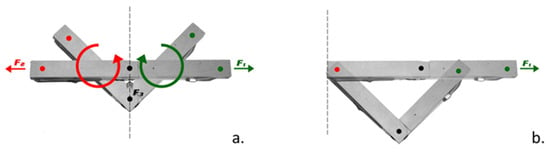
The framework presented here, which forms the foundation of the Sincrony movement education methodology, originates from the theoretical construct known as the “Grocco model” [5]. This original concept has been reformulated and extended into a structured framework referred to as USB. In its simplest form, a Grocco unit is conceptualised as a pair of jointed segments of equal length, connected by a pivot that functions as a simple hinge. Around this fulcrum, the two segments are free to rotate. Due to muscular contraction, the segment pair is subjected to two vector forces, F1 and F2, applied symmetrically near the free ends of each segment. For conceptual and didactic clarity in schematic illustrations, the internally generated force F1 may be visually indicated as P–F1 (push-related component), while the observable directional resultant associated with F2 may be indicated as S–F2. These labels refer to functional interpretations of the same force components and do not represent additional or distinct mechanical variables. F1 and F2 denote the mechanical components of force generated by a single muscular contraction and transmitted to the two articulated segments of the unit along their lines of insertion. Their decomposition into tangential and orthogonal directions contributes to segmental rotation and to the generation of an interaction resultant at the joint constraint, indicated as F3. The main components of these forces, tangential and orthogonal to each segment, generate both:
- a compressive stress along the segments, with a resultant F3 acting on the fulcrum, generated by the rotational interaction of the articulated segments.
- a resultant torque which, in the absence of other applied forces (isolated system), would induce opposing rotational movement of the segments, causing either opening or closing, depending on the direction of the applied force (Figure 1).
Figure 1.
Conceptual schematic representation of force interactions within a Grocco unit compared with a traditional rigid-segment biomechanical model. (a) In the Grocco unit representation, two articulated segments connected by a central pivot are subjected to tangentially oriented muscular force components (F1 and F2) applied near their distal ends. Their interaction generates a compressive resultant force (F3) at the pivot and opposing rotational moments. (b) In the traditional biomechanical representation, forces are typically modelled as acting perpendicularly to the lever arm, primarily generating torque around a fixed joint without explicitly emphasising compressive intersegmental force transmission.
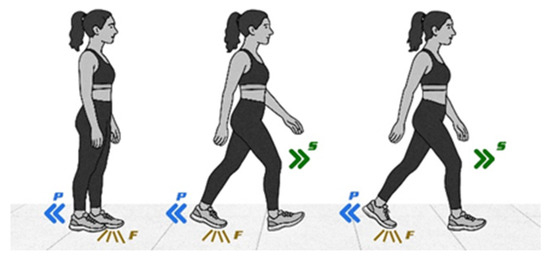
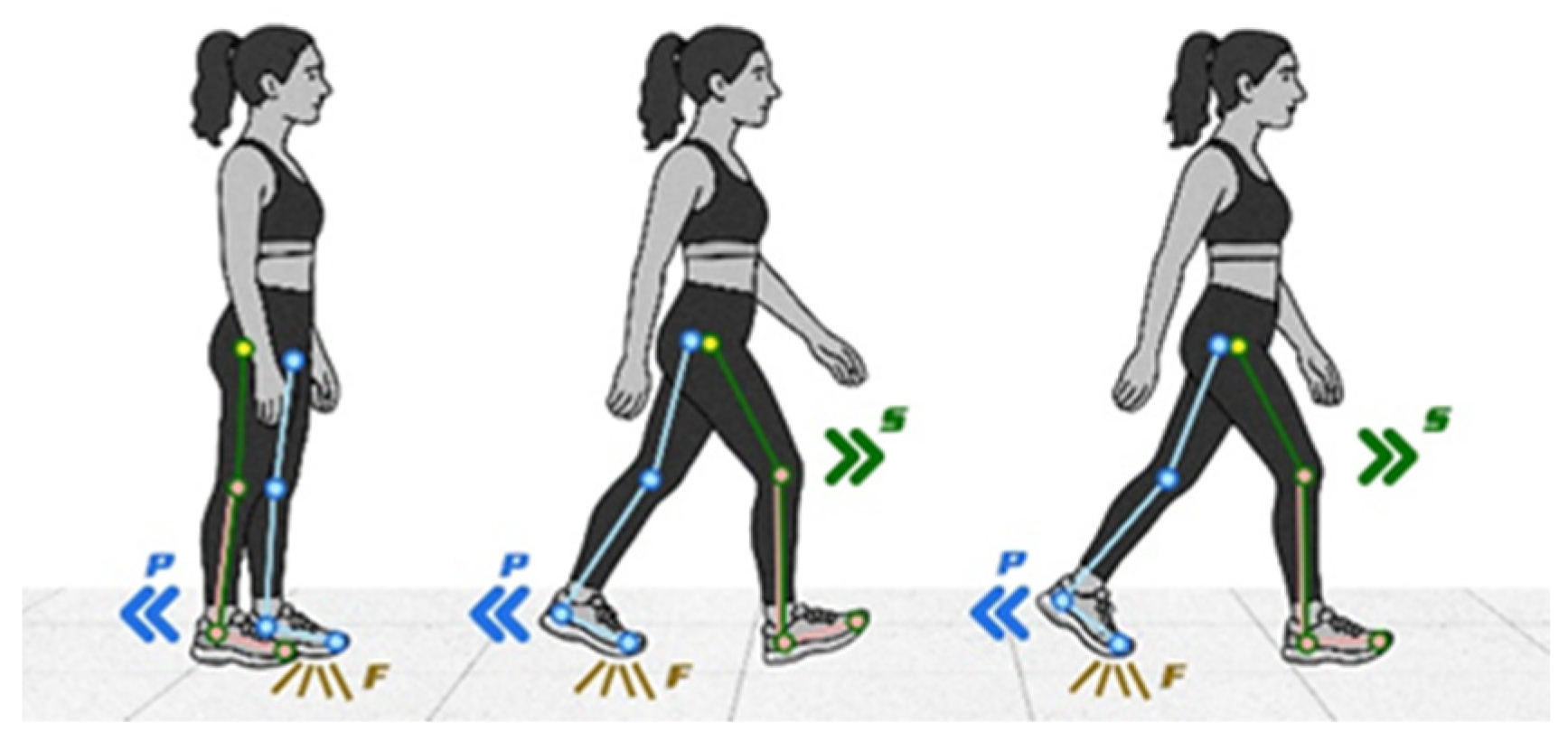
In practical terms, a Grocco unit is never truly an isolated system; it is always physically connected to at least one other system at one of its “free” ends. During movement, it thus exchanges forces with these systems. Similarly, in the case of the leg, the internal muscular forces acting within the Grocco unit are transmitted both to the environment (i.e., the ground, via the ankle joint) and to the torso (via the pelvis). This segmentally unconstrained mechanics allows for a more accurate and dynamic representation of transitional movements, such as those occurring between postural states or during movement initiation. Through the USB framework, human movement, and locomotion in particular can be interpreted as a sequence of Grocco units that are activated and interact over time. Although the behaviour of a single Grocco unit can always be traced back to the description provided above, what is observed in the system will depend on the timing of activation of each Grocco unit, as well as on the masses involved and the interconnection constraints (with their respective degrees of freedom). Therefore, the functioning of each unit is influenced by the behaviour of the adjacent units over time, as segmental units are defined functionally rather than as anatomically bounded mechanical subsystems. From this theoretical perspective, every action can thus be described according to at least two fundamental viewpoints: kinematic and dynamic. Through this still little-used paradigm, it becomes possible, for example, to carry out a dynamic–kinematic analysis of gait initiation: in this case, the dynamic action starts with the contraction of a primary motor muscle (gluteus), which exerts a pair of forces on the systems to which it is connected, in particular the Grocco unit and the torso. The Grocco unit, through the activation of the corresponding muscles (quadriceps and calf), will compensate for this force, transmitting it to the external environment (the floor) through force F1 (Figure 2), to which the environment will react, according to the principle of action and reaction (Newton’s third law), with an equal and opposite force (Appendix C).
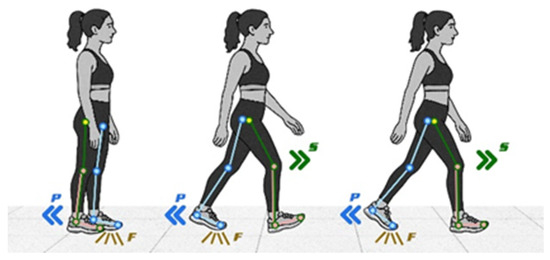
Figure 2.
Conceptual schematic representation of segmental force interactions during gait initiation. Blue arrows (P–F1) indicate internally generated push-related force components transmitted along the advancing lower limb toward the foot–ground interface. Green arrows (S–F2) represent the observable directional resultant associated with segmental displacement during step initiation. Brown lines (F) denote external interaction forces at the foot–ground contact (e.g., frictional components of the ground reaction force). The schematic illustrates the functional relationship between the trunk, pelvis, lower limb segments, and the ground during the transition from standing to locomotion.
The torso, in turn, must exert internal forces (through contraction of the abdominal muscles, for example) both as a reaction to the resultant forces at the point of connection with the Grocco unit (the joint between femur and pelvis), and to counter the inertia that would tend to keep it at rest. The force F3, in the forward direction, represents the resultant mechanical effect emerging from the interaction of forces transmitted across interconnected segmental units during gait initiation [31].
4. Discussion
The fundamental aspect of the Grocco model is its ability to analyse human movement by integrating all the forces involved. Specifically, the model describes, unlike traditional approaches used in motor sciences, how, through the Grocco unit, multiple movement effects can be explained. The model is simplified, since during the gait initiation phase multiple Grocco units act along time, but despite the simplification, it may still enhance students’ understanding of the variables under study (dynamics–kinematics). In fact, through this model, we can analyse some important characteristics of locomotion as visible outcomes of a complex system that is not fully observable.
The forward displacement of the hip (Figure 3) represents the visible effect of the Grocco unit, which results from the internal push transmitted along the limb (F1) and enables the transition from static to dynamic through the displacement of the CoM [32].
Figure 3.
Schematic representation of segmental force interactions in the Grocco model. Body segments are colour-coded to indicate their association with specific Grocco units; some segments may belong to multiple units simultaneously depending on the phase of the step and their biomechanical function. Adjacent segmental units share at least one segment, reflecting the continuous mechanical coupling along the kinetic chain. Blue arrows (P–F1) indicate internal muscular push transmitted through the limb, brown lines (F) represent frictional interaction with the ground, and green arrows (S–F2) indicate the visible resultant of the step. The resultant force (F3) is interpreted as the emergent result of the integrated action of these forces across interconnected segmental units. This simplified schematic supports the didactic interpretation of dynamic and kinematic variables in locomotion.
The push exerted through the foot (F1), which represents the non-visible component whose direction acts downward and backward, is further responsible for the advancement of the pelvis and thus the transition from static to dynamic through the displacement of the centre of mass (CoM). This displacement, emerging from the integrated action of intersegmental forces, is associated with CoM progression [33]. Hansen et al. demonstrated that, at the beginning of locomotion, the centre of pressure (CoP), the resulting point of the distribution of ground reaction forces (GRFs), shifts postero-laterally, creating a moment that allows the CoM to advance with controlled acceleration [34]. Recent studies have interpreted this finding as a biomechanical preparation intended to optimise the transition from the static phase to dynamic movement, but without attributing descriptive connections to phenomena that intersect with the actual dynamics of movement, generally describing it as anticipatory [35]. Through the Grocco model, however, we can integrate this observation by defining this distribution of CoP force as a described part of the expression of F1 on the ground, and generative in the process of the gait initiation phase, as well as anticipatory only in relation to the visible movement. More precisely, the trajectory of the CoP, reflecting the resultant vector of the forces exerted against the ground, can be interpreted as the observable effect of internal muscular forces transmitted through the limb (P–F1). This interpretation finds support in the literature, where the CoP has been associated with coordination between the musculoskeletal system and postural control, though without a clear explanation of the underlying reasons [36].
A further important analytical element that arises from these reflections, and from the described displacement, concerns the biomechanical concept of the “passenger” in locomotion. Traditionally, the term “passenger” identifies body structures, such as the trunk and head, which do not actively contribute to locomotion but are passively propelled by the lower limbs. Even according to conventional biomechanical analysis, during locomotion the trunk and head can be considered as passive structures being transported [37]. From the perspective of the Grocco model, this simplification can be reconsidered by viewing forces generated (F1–F2–F3) by different segmental units as dynamically interrelated. A student in a learning phase might therefore risk interpreting human movement as if it were a drawing, where real physical forces are not acting. The principle of inertia (Newton’s first law) dictates that, in the initial phase of locomotion, the trunk (due to its mass) naturally tends to maintain its state of inertia, remaining still with respect to the locomotor unit [37,38]. In order for the “passenger” element to also change its state of rest, an exchange of forces is therefore necessary between the lower Grocco unit, which constitutes the locomotor element, and the upper one. The resultant of these forces, transmitted through the action of the musculoskeletal system, is expressed in the figure as F2. Thus, as also suggested by the inverted pendulum model, the trunk, although not directly involved in generating the propulsive push, must still actively participate in maintaining balance and regulating the distribution of forces. The centre of mass (CoM) oscillates in a controlled manner thanks to the active interaction between the trunk and the movement of the lower limbs, optimising the system’s dynamic stability [38]. However, these models often describe the observable or measurable effects of locomotion, while the USB framework attempts to further emphasise the internal transmission of forces between segments, without considering the role and the way internal forces are generated and transmitted in movement. From this perspective, the Grocco model offers an additional interesting integration, describing the “passenger” as an “agent,” since the trunk and the head would remain kinematically behind the advancing lower limbs. To prevent this from occurring, further Grocco units and forces intervene within the system. These units are expected to contribute actively to intersegmental force regulation during gait initiation for the resistance of the mass through flexion movements, generated by muscular contractions, which are often not visible, as their main purpose is to keep the upper part of the body aligned with the lower limbs. This flexion is instead clearly visible, for example, in running, due to greater acceleration and increased dynamic forces acting on the system and may require greater trunk inclination as a compensatory adjustment. Applied to gait initiation, USB interprets the transition from standing to locomotion as a phase in which activation of the gluteus maximus precedes the first observable displacement of the pelvis, thigh, or advancing limb. In the same phase, the early postero-lateral shift in the centre of pressure and the initial ground reaction force pattern are interpreted as temporally associated with this internally generated force transmission and as preceding the visible step. This perspective also assigns an active role to trunk muscle activation in regulating intersegmental force transfer during the transition, rather than a purely passive transport function. Variations in gait speed or transition demands are therefore expected to modify the temporal relationship among gluteus maximus activation, centre of pressure displacement, trunk muscle activation, and the observable progression of body segments. In this context, F1, F2, and F3 are interpreted as conceptual force states whose empirical assessment requires synchronised EMG, force platform, and motion analysis measurements.
The present work reformulates the Grocco model into USB, a conceptual framework for analysing locomotion beyond rigid joint assumptions. Unlike forward dynamics musculoskeletal models, which aim to estimate net joint moments or simulate movement trajectories, the USB framework proposes a causal and temporally organised interpretation of how internally transmitted forces propagate across functional segmental units during motor transitions. The USB framework interprets movement as the temporally organised activation of functionally coordinated segmental units that may recur across locomotor cycles while remaining dynamically reconfigurable during motor transitions. Within this perspective, the USB framework should be interpreted as a schematic conceptual representation of hypothesised pathways of internal force transmission rather than as an anatomically resolved free-body force decomposition or a quantitatively validated biomechanical model. By describing limbs as articulated segments connected by non-fixed pivots, USB provides a dynamic–kinematic interpretation that is particularly relevant for gait initiation, usually reduced to a simple change in state in cyclical models [15]. Through the simultaneous involvement of forces F1, F2, and F3, USB therefore provides an additional dynamic–kinematic perspective for interpreting locomotor transitions and the internal transmission of forces across segmental units. In this perspective, USB should be interpreted as a conceptual framework capable of generating biomechanical hypotheses that may guide future experimental investigation. On an applied level, USB provides locomotion teaching by highlighting non-visible but active force interactions, thereby fostering a more comprehensive understanding of human movement [39,40]. Recent developments in wearable motion analysis technologies (e.g., smart insoles, inertial sensors and flexible sensing systems) allow the integration of dynamic and neuromuscular measurements alongside traditional kinematic analysis, offering potential experimental platforms for investigating the interactions described within the USB framework. Its conceptual structure supports conceptually rehabilitation strategies, wearable robotics, and sport performance analysis by clarifying the role of initial propulsive forces [41]. Nevertheless, empirical validation remains necessary to consolidate its pedagogical and scientific value.
5. Conclusions
This work presented USB as a conceptual framework for locomotion analysis, developed from the Grocco model. Using gait initiation as an example, USB is presented as a potentially more integrative dynamic–kinematic framework, highlighting the role of non-directly observable forces. The exploratory review of literature and teaching materials, limited to the sampled materials examined, did not readily identify analogous models explicitly addressing dynamic intersegmental force transmission. USB is therefore proposed as a conceptual framework to reconsider the foundations of teaching and research in sport sciences and to evaluate its potential implications in fields such as rehabilitation, wearable robotics, and sport performance analysis. The main conceptual contribution of the USB framework lies in proposing locomotor transitions as the result of temporally organised propagation of internal force states across functionally coordinated segmental units. A key direction for future research concerns the quantitative investigation of these hypothesised temporal relationships, particularly during gait initiation. If empirically supported, this perspective may have practical implications for movement education and rehabilitation by encouraging greater attention to proximal force generation and intersegmental coordination rather than focusing exclusively on distal kinematic outcomes. Future research is required to quantitatively formalise the framework and to experimentally test the biomechanical hypotheses derived from its conceptual interpretation.
Author Contributions
Conceptualization, A.F.; methodology, A.F. and A.G.; formal analysis, A.G. and A.A.; investigation, A.F.; writing—original draft preparation, A.F.; writing—review and editing, L.C. and S.T.; visualisation, A.F., L.C. and S.T.; supervision, L.C. and S.T.; project administration, A.F. All authors have read and agreed to the published version of the manuscript.
Funding
This research received no external funding.
Institutional Review Board Statement
Not applicable.
Informed Consent Statement
Not applicable.
Data Availability Statement
No new data were created or analyzed in this study.
Conflicts of Interest
The authors declare no conflicts of interest.
Abbreviations
| USB | Unconstrained Segmental Biomechanics |
| CoM | Centre of Mass |
| CoP | Centre of Pressure |
| GRF | Ground Reaction Force |
Appendix A. Institutions Contacted in the Exploratory Academic Inquiry
Twenty institutions included in the Shanghai Ranking Global Ranking of Sport Science Schools and Departments (2024) were contacted as part of the exploratory academic inquiry [27].
For transparency, institutions are reported using anonymised numerical identifiers together with their geographic area and response status.
- Institution 1 (Northern Europe)—Responded
- Institution 2 (Northern Europe)—Responded
- Institution 3 (Southern Europe)—Responded
- Institution 4 (Southern Europe)—Responded
- Institution 5 (Northern Europe)—No response
- Institution 6 (Western Europe)—Responded
- Institution 7 (Northern Europe)—No response
- Institution 8 (Northern Europe)—No response
- Institution 9 (Northern Europe)—No response
- Institution 10 (United Kingdom)—Responded
- Institution 11 (Australia)—Responded
- Institution 12 (Australia)—Responded
- Institution 13 (Southern Europe)—No response
- Institution 14 (Australia)—Responded
- Institution 15 (Belgium)—Responded
- Institution 16 (Northern Europe)—No response
- Institution 17 (Germany)—Responded
- Institution 18 (Northern Europe)—No response
- Institution 19 (Ireland/North America collaboration)—Responded
- Institution 20 (Australia)—No response
The inquiry consisted of a brief request asking departments or faculty members responsible for biomechanics or locomotion-related courses to indicate the main textbooks or scientific references commonly adopted in the teaching of human locomotion.
Appendix B
Table A1.
List of the 33 manuals analysed: absence of the Grocco model or equivalent segmental causal models.
Appendix C. Simplified Sequence of Segmental Events During Gait Initiation (Advancing Limb)
The following schematic sequence illustrates a simplified conceptual application of the USB framework during the initiation of locomotion, focusing on the advancing limb.
- Initial segmental preparation
A minimal external rotation of the advancing limb contributes to the initiation of pelvic rotation and prepares the segmental unit for movement.
- Leg flexion phase
A brief flexion of the leg occurs, preventing hyperextension of the limb.
- Posterior thigh extension and internal push
Shortly afterwards, the extension of the thigh occurs through the activation of the posterior muscular chain. This generates the internal push transmitted along the limb (P–F1). As the push propagates along the limb toward the contact with the ground, the ankle extends, initiating the mechanical conditions that lead to the rollover of the foot.
- Foot rollover and observable displacement
The interaction between the push transmitted through the limb and the frictional interaction with the ground contributes to the observable displacement of the pelvis and to the visible progression of the movement (S–F2).
References
- Hamill, J.; Knutzen, K.M.; Derrick, T. Biomechanical Basis of Human Movement, 5th ed.; Wolters Kluwer Health: Philadelphia, PA, USA, 2022. [Google Scholar]
- Nordin, M.; Frankel, V.H. Basic Biomechanics of the Musculoskeletal System, 4th ed.; Wolters Kluwer Health—Lippincott Williams & Wilkins: Philadelphia, PA, USA, 2012. [Google Scholar]
- Bartolo, E.; Giacomozzi, C.; Coppini, D.V.; Gatt, A. Analysis of the interplay between proximal lower limb and foot joint structures as a mechanical predictor of neuropathic ulceration. Gait Posture 2024, 114, 250–256. [Google Scholar] [CrossRef] [Scilit]
- Lu, T.; Chang, C. Biomechanics of human movement and its clinical applications. Kaohsiung J. Med. Sci. 2012, 28, S13–S25. [Google Scholar] [CrossRef] [Scilit]
- De Bernardi, F. Sincrony Teaching Movement (Illustrated); Red Edition: Milan, Italy, 2008. [Google Scholar]
- Raffalt, P.C.; Guul, M.K.; Nielsen, A.N.; Puthusserypady, S.; Alkjær, T. Economy, Movement Dynamics, and Muscle Activity of Human Walking at Different Speeds. Sci. Rep. 2017, 7, 43986. [Google Scholar] [CrossRef] [Scilit]
- Dhahbi, W. Advancing biomechanics: Enhancing sports performance, mitigating injury risks, and optimizing athlete rehabilitation. Front. Sports Act. Living 2025, 7, 1556024. [Google Scholar] [CrossRef] [Scilit]
- Sanchez-Ramirez, D.C.; Malfait, B.; Baert, I.; Van Der Leeden, M.; Van Dieën, J.; Lems, W.F.; Dekker, J.; Luyten, F.P.; Verschueren, S. Biomechanical and neuromuscular adaptations during the landing phase of a stepping-down task in patients with early or established knee osteoarthritis. Knee 2016, 23, 367–375. [Google Scholar] [CrossRef] [Scilit]
- Gastaldi, L.; Digo, E. Recent Advance and Application of Wearable Inertial Sensors in Motion Analysis. Sensors 2025, 25, 818. [Google Scholar] [CrossRef] [Scilit]
- Popper, K. The Logic of Scientific Discovery (Special Indian Edition); Routledge: London, UK, 2010. [Google Scholar]
- Hass, C.J.; Waddell, D.E.; Wolf, S.L.; Juncos, J.L.; Gregor, R.J. Gait initiation in older adults with postural instability. Clin. Biomech. 2008, 23, 743–753. [Google Scholar] [CrossRef] [Scilit]
- Zatsiorsky, V.M. Kinetics of Human Motion; Human Kinetics: Champaign, IL, USA, 2002. [Google Scholar]
- Frigo, C.A.; Favata, A.; Camuncoli, F.; Farinelli, V.; Kiekens, C.; Malfitano, C.; Palmisano, C.; Negrini, S. The Spine Lengthens During Walking in Healthy Participants, with Age-Related Changes in Kinematic Parameters. J. Clin. Med. 2025, 14, 209. [Google Scholar] [CrossRef] [Scilit]
- Nayfeh, A.H.; Balachandran, B. Applied Nonlinear Dynamics: Analytical, Computational, and Experimental Methods, 1st ed.; Wiley: Hoboken, NJ, USA, 2008. [Google Scholar]
- Perry, J.; Burnfield, J.M. Gait Analysis: Normal and Pathological Function, 2nd ed.; Slack: New York, NY, USA, 2010. [Google Scholar]
- Stergiou, N. Biomechanics and Gait Analysis; Academic Press: Cambridge, MA, USA, 2020. [Google Scholar]
- Chirimuuta, M. The Brain Abstracted: Simplification in the History and Philosophy of Neuroscience; The MIT Press: Cambridge, MA, USA, 2024. [Google Scholar]
- Scherpereel, K.; Molinaro, D.; Inan, O.; Shepherd, M.; Young, A. A human lower-limb biomechanics and wearable sensors dataset during cyclic and non-cyclic activities. Sci. Data 2023, 10, 924. [Google Scholar] [CrossRef] [Scilit]
- Pai, Y.C.; Maki, B.E.; Iqbal, K.; McIlroy, W.E.; Perry, S.D. Thresholds for step initiation induced by support-surface translation: A dynamic center-of-mass model provides much better prediction than a static model. J. Biomech. 2000, 33, 387–392. [Google Scholar] [CrossRef] [Scilit]
- Mira, R.M.; Molinari Tosatti, L.; Sacco, M.; Scano, A. Detailed characterization of physiological EMG activations and directional tuning of upper-limb and trunk muscles in point-to-point reaching movements. Curr. Res. Physiol. 2021, 4, 60–72. [Google Scholar] [CrossRef] [Scilit]
- Miscusi, M.; Serrao, M.; Conte, C.; Ippolito, G.; Marinozzi, F.; Bini, F.; Troise, S.; Forcato, S.; Trungu, S.; Ramieri, A.; et al. Spatial and temporal characteristics of the spine muscles activation during walking in patients with lumbar instability due to degenerative lumbar disk disease: Evaluation in pre-surgical setting. Hum. Mov. Sci. 2019, 66, 371–382. [Google Scholar] [CrossRef] [Scilit]
- Young-Shand, K.L.; Roy, P.C.; Dunbar, M.J.; Abidi, S.S.R.; Astephen Wilson, J.L. Gait biomechanics phenotypes among total knee arthroplasty candidates by machine learning cluster analysis. J. Orthop. Res. 2023, 41, 335–344. [Google Scholar] [CrossRef] [Scilit]
- Ditcharles, S.; Yiou, E.; Delafontaine, A.; Hamaoui, A. Short-Term Effects of Thoracic Spine Manipulation on the Biomechanical Organisation of Gait Initiation: A Randomized Pilot Study. Front. Hum. Neurosci. 2017, 11, 343. [Google Scholar] [CrossRef] [Scilit]
- Park, J.; Han, K. Quantifying Gait Asymmetry in Stroke Patients: A Statistical Parametric Mapping (SPM) Approach. Med. Sci. Monit. 2024, 31, 946754. [Google Scholar] [CrossRef] [Scilit]
- Diekfuss, J.A.; Bonnette, S.; Hogg, J.A.; Riehm, C.; Grooms, D.R.; Singh, H.; Anand, M.; Slutsky-Ganesh, A.B.; Wilkerson, G.B.; Myer, G.D. Practical Training Strategies to Apply Neuro-Mechanistic Motor Learning Principles to Facilitate Adaptations Towards Injury-Resistant Movement in Youth. J. Sci. Sport Exerc. 2021, 3, 3–16. [Google Scholar] [CrossRef] [Scilit]
- Halmenschlager, G.H.; Albarello, J.C.D.S.; Brandão, M.C.A.; Oliveira, L.F.D.; Matta, T.T.D. The shear modulus of the vastus lateralis muscle does not follow the passive residual torque enhancement in the knee extensors. J. Biomech. 2025, 182, 112567. [Google Scholar] [CrossRef] [Scilit]
- Docampo, D. Reproducibility of the Shanghai academic ranking of world universities results. Scientometrics 2013, 94, 567–587. [Google Scholar] [CrossRef] [Scilit]
- Drewes, T.; Michael, C. How do students choose a university? An analysis of applications to universities in Ontario, Canada. Res. High. Educ. 2006, 47, 781–800. [Google Scholar] [CrossRef] [Scilit]
- Tight, M. Higher Education Research: The Developing Field, 1st ed.; Zed Books: London, UK, 2018. [Google Scholar] [CrossRef] [Scilit]
- Reznick, E.; Embry, K.R.; Neuman, R.; Bolívar-Nieto, E.; Fey, N.P.; Gregg, R.D. Lower-limb kinematics and kinetics during continuously varying human locomotion. Sci. Data 2021, 8, 282. [Google Scholar] [CrossRef] [Scilit]
- Mizusawa, H.; Jono, Y.; Iwata, Y.; Kinoshita, A.; Hiraoka, K. Processes of anticipatory postural adjustment and step movement of gait initiation. Hum. Mov. Sci. 2017, 52, 1–16. [Google Scholar] [CrossRef] [Scilit]
- Yiou, E.; Caderby, T.; Delafontaine, A.; Fourcade, P.; Honeine, J.L. Balance control during gait initiation: State-of-the-art and research perspectives. World J. Orthop. 2017, 8, 815–828. [Google Scholar] [CrossRef] [Scilit]
- Jian, Y.; Winter, D.; Ishac, M.; Gilchrist, L. Trajectory of the body COG and COP during initiation and termination of gait. Gait Posture 1993, 1, 9–22. [Google Scholar] [CrossRef] [Scilit]
- Hansen, C.; LaRue, J.; Do, M.-C.; Latash, M.L. Postural Preparation to Stepping: Coupled Center of Pressure Shifts in the Anterior-Posterior and Medio-Lateral Directions. J. Hum. Kinet. 2016, 54, 5–14. [Google Scholar] [CrossRef] [Scilit]
- Vieira, M.F.; De Brito, A.A.; Lehnen, G.C.; Rodrigues, F.B. Center of pressure and center of mass behavior during gait initiation on inclined surfaces: A statistical parametric mapping analysis. J. Biomech. 2017, 56, 10–18. [Google Scholar] [CrossRef] [Scilit]
- Speedtsberg, M.B.; Christensen, S.B.; Andersen, K.K.; Bencke, J.; Jensen, B.R.; Curtis, D.J. Impaired postural control in children with developmental coordination disorder is related to less efficient central as well as peripheral control. Gait Posture 2017, 51, 1–6. [Google Scholar] [CrossRef] [Scilit]
- Winter, D. Human balance and posture control during standing and walking. Gait Posture 1995, 3, 193–214. [Google Scholar] [CrossRef] [Scilit]
- Hof, A.L.; Gazendam, M.G.J.; Sinke, W. E The condition for dynamic stability. J. Biomech. 2005, 38, 1–8. [Google Scholar] [CrossRef] [Scilit]
- Scanlon, D.; Beckey, A.; Wintle, J.; Hordvik, M. ‘Weak’ physical education teacher education practice: Co-constructing features of meaningful physical education with pre-service teachers. Sport Educ. Soc. 2024, 30, 527–542. [Google Scholar] [CrossRef] [Scilit]
- O’Brien, C.; Behan, S.; Taylor, J. Game ready: Pedagogical opportunities for proactive performance analysis in team sports. Sport Educ. Soc. 2024, 25, 348–358. [Google Scholar] [CrossRef] [Scilit]
- Sudo, D.; Hosokawa, M.; Maeda, Y. Kinematic effects of different gait speeds during gait initiation movement. J. Phys. Ther. Sci. 2021, 33, 857–861. [Google Scholar] [CrossRef] [Scilit] [PubMed]

Disclaimer/Publisher’s Note: The statements, opinions and data contained in all publications are solely those of the individual author(s) and contributor(s) and not of MDPI and/or the editor(s). MDPI and/or the editor(s) disclaim responsibility for any injury to people or property resulting from any ideas, methods, instructions or products referred to in the content. |
© 2026 by the authors. Licensee MDPI, Basel, Switzerland. This article is an open access article distributed under the terms and conditions of the Creative Commons Attribution (CC BY) license.