


Abstract
During August 2025, a single adult yellow-bellied watersnake, Nerodia erythrogaster transversa was found dead on the road in Montgomery County, Arkansas, USA, salvaged, and its feces examined for coccidian parasites. Fecal material from the rectum was placed in a vial of 2.5% potassium dichromate and examined by light microscopy. Partially sporulated oocysts were initially found and allowed to completely sporulate. The snake was found to be passing a new species of Eimeria. Oocysts of Eimeria speairsi sp. n. were ovoidal to spheroidal with a slightly rough bi-layered wall, measured (L × W) 28.0 × 18.2 µm, and had a length/width (L/W) ratio of 1.5; a micropyle, oocyst residuum, and polar granule was absent. Sporocysts are ellipsoidal and measured 13.7 × 8.6 µm, L/W ratio of 1.6; a flattened Stieda body was present but sub-Stieda and para-Stieda bodies were absent. The sporocyst residuum was composed of various-sized granules in a compact rounded or irregular mass, sometimes dispersed between the sporozoites. A 412 bp sequence of the SSU rRNA gene produced for E. speairsi sp. n. showed a relatively low level of similarity. The species description is based primarily on oocyst morphology and partial SSU rRNA sequence data from the single host snake. In addition, an updated summary of the coccidians of North American watersnakes is provided.
1. Introduction
There are currently 10 recognized species of nonvenomous North American watersnakes of the genus Nerodia [1]. They are endemic to the eastern and central USA and México; one species occurs in Cuba [2]. They occur in a variety of freshwater watersheds, including creeks, rivers, ponds, lakes, swamps, and lowland/upland streams. The primary diet of Nerodia spp. is fish and amphibians, but they will also consume crayfish, small reptiles and perhaps rodents that are found near aquatic sites.
One species, the plain-bellied watersnake, Nerodia erythrogaster is composed of two subspecies, the red-bellied watersnake, N. e. flavigaster and the yellow-bellied watersnake, N. e. transversa [1]. The latter ranges from the western United States through the central US and into northern México [2]. In Arkansas, this snake is mostly found statewide with sporadic records from the Ozark Highlands [3].
Duszynski and Upton [4] provided a summation on the coccidia of snakes of the world. The suborder Ophidia within the Class Reptilia currently includes over 3900 species of snakes [1], but relatively few of them (ca. 7%), have been reported with coccidians. Interestingly, N. e. transversa has been reported as the host of three species of coccidian parasites [see 4 for summary], including: Eimeria conanti McAllister and Upton, 1989, Eimeria hydrophis Wacha and Christiansen, 1974, and Eimeria sipedon Wacha and Christiansen, 1975, from specimens collected in Arkansas and Oklahoma [5,6,7,8,9]. Here, we provide a description of a new species of Eimeria, using morphological, mensural, and molecular data, as well as providing a summation of the coccidian parasites of North American watersnakes.
2. Materials and Methods
2.1. Sample Collection and Necropsy
On 30 August 2025, a single adult N. e. transversa (not measured) was found dead on the road (DOR) in Montgomery County, Arkansas, USA, and salvaged. Unfortunately, most of the specimen had apparently been visited by avian scavengers (potentially crows) and the majority of the gastrointestinal tract was missing; only a small portion of feces was present in the rectum. Unfortunately, no viable tissue was available for a histological study of endogenous development.
2.2. Morphological Characterization
The fecal sample was placed in an individual vial containing 2.5% (w/v) aqueous potassium dichromate (K2Cr2O7). It was transferred to a Petri dish containing a small layer of K2Cr2O7 at room temperature (23 C) for 48–72 h to allow for sporulation. After flotation in Sheather’s sugar solution (specific gravity = 1.30), the sample was examined again using an Olympus BX43 light microscope (Olympus Corporation, Center Valley, PA, USA). As sugar solutions tend to shrink to oocyst walls of snake coccidians, an additional wet mount sample was examined by light microscopy without flotation.
All morphological measurements are reported in micrometers (µm) with the means followed by the ranges in parentheses. Photographs were taken using Nomarski interference-contrast optics at ×1000 magnification. Oocysts were ca. 15 days old when measured and photographed.
Descriptions of oocysts and sporocysts follow the standard guidelines of Wilber et al. [10] including oocyst length (L) and width (W), their ranges and ratios (L/W), micropyle (M), oöcyst residuum (OR), polar granule(s) (PG), sporocyst length (L) and width (W), their ranges and ratio (L/W), sporocyst (SP), Stieda body (SB), subStieda body (SSB), paraStieda body (PSB), sporocyst residuum (SR), sporozoites (SZ) anterior (ARB) and posterior (PRB) refractile bodies, and nucleus (N).
Photovouchers of sporulated oocysts were accessioned into the Harold W. Manter Laboratory of Parasitology (HWML), University of Nebraska, Lincoln, NE, USA. Current common and scientific names of watersnakes follow Nicholson [11].
2.3. Molecular Characterization
Samples in potassium dichromate were centrifuged (16,100 rcf for 3 min) to produce a pellet and the supernatant was removed. The pellet then underwent extraction with a DNeasy Kit (Qiagen, Germantown, MD, USA), following the manufacturer’s instructions. To reduce inhibition, the extracted DNA was diluted 1:10 in nuclease free water and this dilution was used for the PCR amplification of the SSU rRNA gene with primers from Jinneman et al. [12]. The primers and diluted extracted DNA were added to a Platinum PCR SuperMix High Fidelity (Thermofisher, Memphis, TN, USA) master mix and underwent the following thermocycler parameters: 95 °C for 10 min; 40 cycles of 95 °C for 1 min, 50 °C for 1 min, and 72 °C for 2 min; ending with 72 °C for 10 min. Products were sequenced by Eurofins Genomics (Louisville, KY, USA) and chromatograms edited with Geneious 2021.1 (https://www.geneious.com (accessed on 1 December 2025)). The resulting sequence was BLAST (BLAST + 2.17.0) searched for similarity in GenBank (https://blast.ncbi.nlm.nih.gov/Blast.cgi (accessed on 1 December 2025)) and selected genetically similar species were downloaded for phylogenetic analysis. Toxoplasma gondii (AF158095.1) was selected as the outgroup. Sequences were aligned with CLUSTALW and Maximum Likelihood analyses were completed in Mega X [13] with the “use all sites” option selected. Bayesian Information Criterion (BIC) analysis identified the Tamura-Nei Model [14] with Gamma distribution (T93 + G) as the most appropriate. Analysis was completed with this model as well as 1000 bootstrap replications.
3. Results
Description of the New Species
Phylum Apicomplexa Levine, 1970
Class Conoidasida Levine, 1988
Subclass Coccidia Leuckart, 1879
Order Eucoccidiorida Léger and Duboscq, 1911
Suborder Eimeriorina Léger, 1911
Family Eimeriidae Minchin, 1903
Genus Eimeria Schneider, 1875
Figure 1.
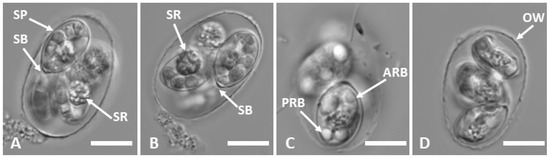
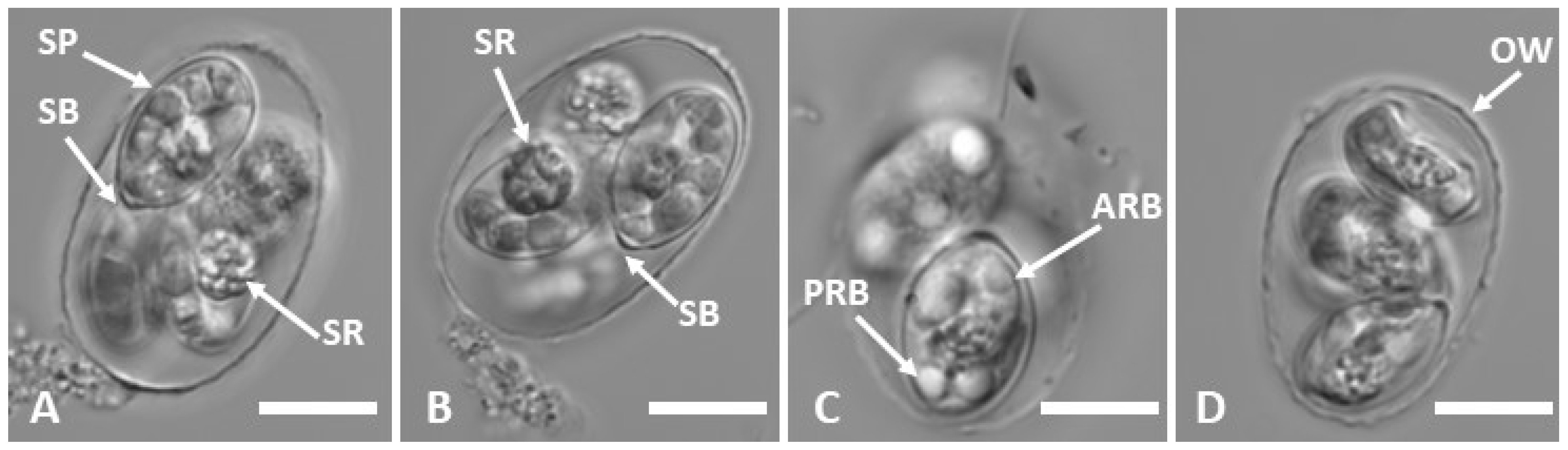
(A–D), photomicrographs of sporulated oocysts of Eimeria speairsi sp. n. from Nerodia erythrogaster transversa. (A) Oocyst showing Stieda body (SB), sporocyst (SP), and sporocyst residuum (SR). (B) Another oocyst showing SB and SR. (C) Oocyst showing anterior refractile body (ARB) and posterior refractile body (PRB). (D) oocyst showing slightly rough outer wall (OW). Scale bars = 10 µm.
Figure 2.
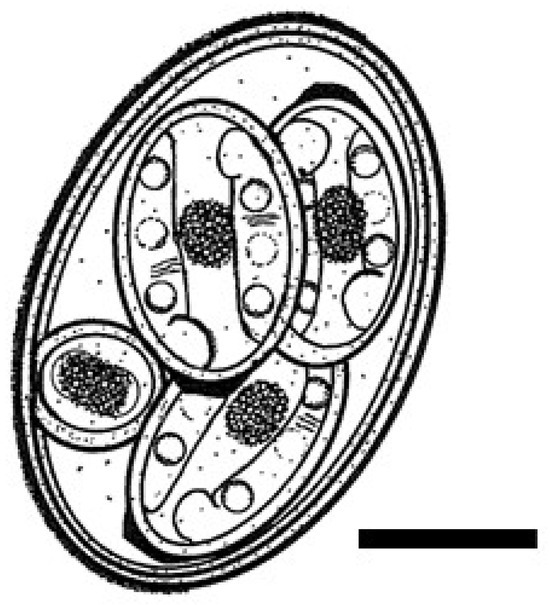
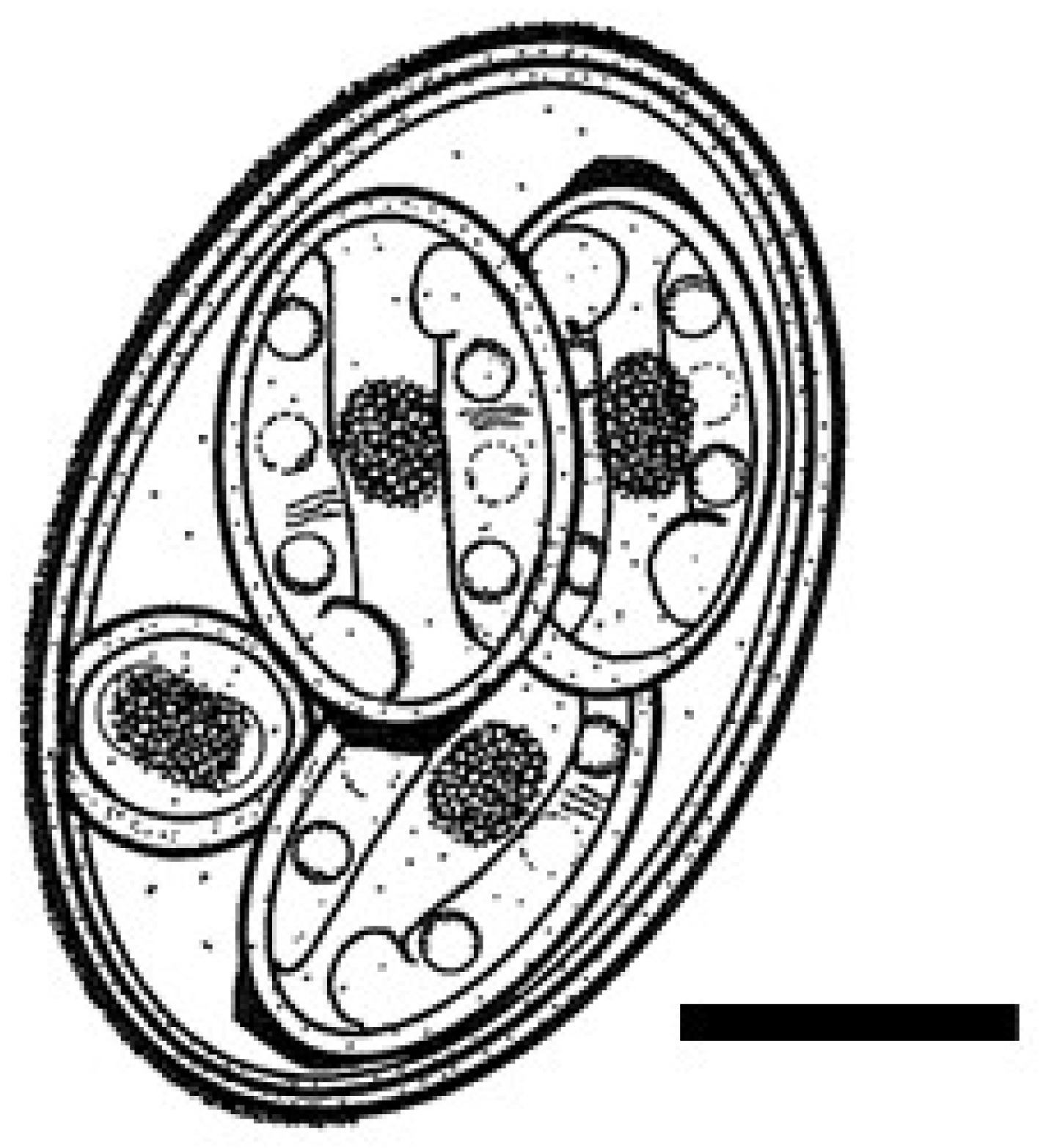
Composite line drawing of the sporulated oocyst of Eimeria speairsi sp. n. Scale bar = 10 µm.
ZooBank: To comply with the regulations set out in article 8.5 of the amended 2012 version of the International Code of Zoological Nomenclature [15], details of the new species have been submitted to ZooBank. The Life Science Identifier (LSID) for Eimeria speairsi sp. n. is urn:lsid:zoobank.org:act:110AAA1F-AFC2-4178-BB04-4071EA05CAA3.
Diagnosis-Oocysts are morphologically consistent with those of the genus Eimeria Schneider, 1875 [16].
Description: Oocysts (n = 30) are ovoidal to ellipsoidal with a bi-layered wall, and the outer wall is slightly rough, colorless, and of darker refractile quality than the inner; the inner layer is colorless; the wall wrinkles quickly even in diluted Sheather’s sugar solution. Oocysts measure (L × W) 28.0 (25–32) × 18.2 (16–20) µm, with a length/width (L/W) ratio of 1.5 (1.4–1.8); a micropyle, oocyst residuum, and polar granule were absent. Sporocysts (n = 30) were ellipsoidal and measured 13.7 (12–15) × 8.6 (7–9) µm, with a L/W ratio of 1.6 (1.4–1.8); a flattened Stieda body was present, 1.8 (1.5–2.0) µm wide, 0.8 (0.6–1.0) µm deep; sub-Stieda and para-Stieda bodies were absent. Sporocyst residuum was composed of various-sized granules in a compact rounded or irregular mass, sometimes dispersed between the SZ. Sporozoites vermiform (not measured) with striations at the anterior end, spheroidal ARB and PRB, and centrally located N.
Type host: Yellow-bellied watersnake, Nerodia erythrogaster transversa (Hallowell, 1852), adult DOR collected 30 August 2025, sex impossible to determine.
Type locality: USA: Arkansas: Montgomery County, just west of Black Springs off St. Hwy 8 (34°27′16″ N, 93°43′40″ W).
Prevalence: One of 1 (100%).
Sporulation: Endogenous. Oocysts were passed partially or fully sporulated.
Prepatent and patent periods: Unknown.
Site of infection: Unknown; oocysts were recovered from feces. Most of the gastrointestinal tract was missing from prior scavenger feeding.
Endogenous stages: Unknown.
Cross-transmission: Unknown.
Pathology: Unknown.
Material deposited: HWML 218134.
Gene Sequence: SSU rRNA gene (412 bp; PZ136069) was submitted to GenBank.
Etymology: The new species is named in honor of Dr. Richard K. (Dick) Speairs, Jr. (1920–2004) who founded the Ouachita Mountains Biological Station (OMBS) in 1962. It currently serves the needs of colleges and universities as a research and education center. The senior author (CTM) is on the Board of Governors of the OMBS and he used lab space at the facility to process the snake herein.
Remarks: We are unaware of any species of natricine coccidian described to date that has oocysts with slightly rough outer walls that the new species clearly possesses. In addition, the new species does not possess an oocyst residuum and/or a polar granule that is present in E. conanti McAllister and Upton, 1989, E. cyclopion McAllister, Upton, and Trauth, 1990, and/or E. tenuis Upton and McAllister, 1988 (Table 1). The only remotely similar eimerian in oocyst and sporocyst size to the new species is E. natricis Wacha and Christiansen, 1975; however, this coccidian possesses an average oocyst L/W (shape index) ratio of 1.8 (vs. 1.5 in the new species), an average sporocyst L/W ratio of 1.9 (vs. 1.6 in the new species), and a convex-shaped Stieda body (vs. flattened in the new species) (Table 1). All other natricine eimerians have oocysts that are considerably smaller in average length (<22.2 vs. 28.0 µm in the new species) (Table 1). The 412 bp sequence of the SSU rRNA gene produced for E. speairsi sp. n. (Accession PZ136069) showed a relatively low level of similarity, considering the conservative nature of the gene, to other species in GenBank with the top hit being a Schellackia sp. that infects the viviparous lizard, Zootoca vivipara (Lichtenstein) in Spain (MG775268.1; 97.97% similarity), a Schellackia sp. from Morocco (OQ843559; 97.72%), an Eimeriidae sp. from a red-eared slider, Trachemys scripta (Weid-Neuweid) in the USA (OP739494; 97.71%), Schellackia orientalis Telford, 1993 from an Asian grass lizard, Takydromus sexlineatus (Daudin) from Thailand (KC788221; 97.72%), Schellackia sp. from Z. vivipara in Spain (MG775269; 97.72%), Schellackia sp. from Iran (MN723847; 97.72%) and Eimeria arnyi from a prairie ringneck snake, Diadophis punctatus arnyi (Cope) in the USA (AY613853; 97.46%). All others shared <97.25% similarity. Phylogenetic analysis (Figure S1), not shown due to the extremely low bootstrap values for the nodes associated with E. speairsi sp. n. regardless of which type of Maximum Likelihood analysis (all sites, partial deletion, complete deletion) was selected, indicated this species appears to be part of an unidentified, at least molecularly, lineage of coccidian parasites. The combination of molecular, mensural, and morphological data supports the description of E. speairsi sp. n. as a novel species.
Table 1.
Comparison of the sporulated oocysts of Eimeria spp. from North American watersnakes (Nerodia) *. New species boldtype.
4. Discussion
The watersnake family Natricidae has in the past been considered to be a subfamily of Colubridae. However, here we treat it as a family following [20]. The family includes those within the genus Nerodia, a diverse taxon consisting of 10 species in the USA [1,11]. They are considered semiaquatic and can be found in or not far from a variety of watersheds where they feed primarily on fish and amphibians.
These snakes are relatively common hosts of coccidians, with seven (70%) of the species being reported previously as hosts of 12 eimerians [4], Table 1. Thus far, only three (25%) species of coccidians have been found in only one species of Nerodia while most others show little strict host specificity (Table 1). To date, three natricine species have not yet been reported as hosts, including the saltmarsh snake, Nerodia clarki (Baird and Girard), the Florida green watersnake, Nerodia floridana (Goff), and the brown watersnake, Nerodia taxispilota (Holbrook). We predict that future surveys on these taxa would likely yield new geographic distributional records for coccidians and the possibility of discovery of novel species.
Sequence data of the SSU rRNA gene for E. speairsi sp. n. found that the novel species was most similar to other apicomplexan species in the suborder Eimeriorina, notably Eimeria and Schellackia spp., known to infect a wide variety of terrestrial and aquatic reptiles. These findings support previous studies where Schellackia and Eimeria spp. from reptiles and amphibians were found to phylogenetically cluster despite belonging to separate families [21]. Herein, bootstrap support was very low for the cluster associated with E. speairsi sp. n, no matter which options were chosen for Maximum Likelihood analysis, so inferences cannot be made about the lineage of parasites found to be infecting the yellow-bellied watersnake other than this appears to be a unique and understudied lineage. Future work focusing on the coccidians, potentially including data from other genes (ITS, COI, etc.), infecting aquatic reptiles could help increase our knowledge and contribute toward a better taxonomic resolution of this understudied group of parasites.
5. Conclusions
We provide a description of a new species of Eimeria from a natricine snake from Arkansas, USA see [22]. The only other US states (all west of the Mississippi River) reported as geographic localities for these watersnake eimerians are Iowa, Oklahoma, and Texas (Table 1). This is the fourth time N. e. transversa has been reported to harbor an eimerian and the 12th eimerian species reported from this genus of North American snakes (Table 1). Morphological, molecular, and mensural data is provided to support our description.
Supplementary Materials
The following supporting information can be downloaded at: https://www.mdpi.com/article/10.3390/parasitologia6020020/s1, Figure S1: Maximum Likelihood analysis of SSU rRNA data for Eimeria speairsi sp. n. (bold type) and other genetically similar species downloaded from GenBank. All bootstrap values are shown.
Author Contributions
This study was designed by C.T.M. and J.A.H. Field collections were performed by C.T.M. Laboratory procedures for processing samples was performed by C.T.M. and J.A.H. Laboratory procedures for measurements and the isolation of oocysts was performed by J.A.H. J.A.H. prepared the photomicrographs in Figure 1. The line drawing (Figure 2) was prepared by C.T.M. The molecular analysis and Figure S1 was performed by E.M.L. All authors have read and agreed to the published version of the manuscript.
Funding
This research received no external funding.
Institutional Review Board Statement
Not applicable.
Informed Consent Statement
Not applicable.
Data Availability Statement
The data presented in this study are available within the article.
Acknowledgments
The Arkansas Game and Fish Commission issued Scientific Collecting Permit no. 032820232 to C.T.M. Scott L. Gardner and Gábor R. Racz (HWML) are acknowledged for expert curatorial assistance. We thank Jeffrey G. Pittman and Larry Raymond (OMBS) for providing gratis housing and laboratory space. Usage of trade names does not imply endorsement by the U.S. Government. The findings and conclusions in this article are those of the authors and do not necessarily represent the views of the U.S. Fish and Wildlife Service.
Conflicts of Interest
The authors declare no conflicts of interest.
References
- Uetz, P.; Freed, P.; Aguilar, R.; Reyes, F.; Kudera, J.; Hosek, J. (Eds.) The Reptile Database. 2026. Available online: www.reptile-database.org (accessed on 28 January 2026).
- Powell, R.; Conant, R.; Collins, J.T. Peterson Field Guide to Reptiles and Amphibians; Houghton Mifflin Harcourt: Boston, MA, USA, 2016. [Google Scholar]
- Trauth, S.E.; Robison, H.W.; Plummer, M.V. The Amphibians and Reptiles of Arkansas; University of Arkansas Press: Fayetteville, AR, USA, 2004. [Google Scholar]
- Duszynski, D.W.; Upton, S.J. The Biology of the Coccidia (Apicomplexa) of Snakes of the World. A Scholarly Handbook for Identification and Treatment. 2009. Available online: http://www.CreateSpace.com (accessed on 1 December 2025).
- Wacha, R.S.; Christiansen, J.L. Systematics of the eimerian parasites from North American snakes of the family Colubridae, and their prevalence in colubrids of Iowa. J. Protozool. 1974, 21, 483–489. [Google Scholar] [CrossRef] [Scilit] [PubMed]
- Wacha, R.S.; Christiansen, J.L. Two new species of Eimeria from colubrid snakes in Iowa. J. Protozool. 1975, 22, 453–454. [Google Scholar] [CrossRef] [Scilit] [PubMed]
- McAllister, C.T.; Upton, S.J. Coccidian parasites (Apicomplexa: Eimeriidae) of Nerodia spp. (Serpentes: Colubridae), with a description of a new species of Eimeria. J. Protozool. 1974, 36, 271–274. [Google Scholar] [CrossRef] [Scilit]
- McAllister, C.T.; Upton, S.J.; Trauth, S.E.; Dixon, J.R. Coccidian parasites (Apicomplexa) from snakes in the southcentral and southwestern United States: New host and geographic records. J. Parasitol. 1995, 81, 63–68. [Google Scholar] [CrossRef] [Scilit] [PubMed]
- McAllister, C.T.; Hnida, J.H. First report of Eimeria hydrophis (Apicomplexa: Eimeriidae) from plain-bellied watersnake, Nerodia erythrogaster (Serpentes: Colubridae: Natricinae), from Oklahoma. Proc. Okla. Acad. Sci. 2020, 100, 72–76. [Google Scholar]
- Wilber, P.G.; Duszynski, D.W.; Upton, S.J.; Seville, R.S.; Corliss, J.O. A revision of the taxonomy and nomenclature of the Eimeria spp. (Apicomplexa: Eimeriidae) from rodents in the Tribe Marmotini (Sciuridae). Syst. Parasitol. 1998, 39, 113–135. [Google Scholar] [CrossRef] [Scilit]
- Nicholson, K.E. (Ed.) Scientific and Standard English Names of Amphibians and Reptiles of North America North of Mexico, with Comments Regarding Confidence in Our Understanding, 9th ed.; Society for the Study of Amphibians and Reptiles: Lawrence, KS, USA, 2025; 87p. [Google Scholar]
- Jinneman, K.C.; Wetherington, J.H.; Hill, W.E.; Omiescinski, C.J.; Adams, A.M.; Johnson, J.M.; Tenge, B.J.; Dang, N.L.; Wekell, M.M. An oligonucleotide-ligation assay for the differentiation between Cyclospora and Eimeria spp. polymerase chain reaction amplification products. J. Food Prot. 1999, 62, 682–685. [Google Scholar] [CrossRef] [Scilit]
- Kumar, S.; Stecher, G.; Li, M.; Knyaz, C.; Tamura, K. MEGA X: Molecular Evolutionary Genetics Analysis across computing platforms. Mol. Biol. Evol. 2018, 35, 1547–1549. [Google Scholar] [CrossRef] [Scilit]
- Tamura, K.; Nei, M. Estimation of the number of nucleotide substitutions in the control region of mitochondrial DNA in humans and chimpanzees. Mol. Biol. Evol. 1993, 10, 512–526. [Google Scholar] [CrossRef] [Scilit] [PubMed]
- ICZN (International Commission on Zoological Nomenclature). Declaration 45—Addition of recommendations to Article 73 and of the term “specimen, preserved” to the glossary. Bull. Zool. Nomencl. 2017, 73, 96–97. [Google Scholar] [CrossRef] [Scilit]
- Duszynski, D.W.; Upton, S.J. Enteric protozoans: Cyclospora, Eimeria, Isospora and Cryptosporidium (Cryptosporidiidae) spp. In Chapter 6, Parasitic Diseases of Wild Mammals, 2nd ed.; Samuel, M.W., Pybus, M.J., Kocan, A.A., Eds.; Iowa State University Press: Ames, IA, USA, 2001; pp. 416–459. [Google Scholar]
- McAllister, C.T.; Upton, S.J.; Trauth, S.E. A new species of Eimeria (Apicomplexa: Eimeriidae) from the green water snake, Nerodia cyclopion (Reptilia: Serpentes), in Arkansas. Trans. Amer. Microsc. Soc. 1990, 109, 69–73. [Google Scholar] [CrossRef] [Scilit]
- Upton, S.J.; McAllister, C.T. Three new species of Eimeria (Apicomplexa: Eimeriidae) from Nerodia rhombifera (Serpentes: Colubridae) from Texas. J. Protozool. 1988, 35, 511–513. [Google Scholar] [CrossRef] [Scilit]
- Upton, S.J.; McAllister, C.T. The Eimeria (Apicomplexa: Eimeriidae) of Serpentes, with descriptions of three new species from colubrid snakes. Can. J. Zool. 1990, 68, 855–864. [Google Scholar] [CrossRef] [Scilit]
- Zaher, H.; Murphy, R.W.; Arredondo, J.C.; Graboski, R.; Machado-Filho, P.R.; Mahlow, K.; Montingelli, G.G.; Bottallo Quadros, A.; Orlov, N.L.; Wilkinson, M.; et al. Large-scale molecular phylogeny, morphology, divergence-time estimation, and the fossil record of advanced caenophidian snakes (Squamata: Serpentes). PLoS ONE 2019, 14, e0217959. [Google Scholar]
- Megía-Palma, R.; Martínez, J.; Merino, S. Phylogenetic analysis based on 18S rRNA gene sequences of Schellackia parasites (Apicomplexa: Lankesterellidae) reveals their close relationship to the genus Eimeria. Parasitology 2013, 140, 1149–1157. [Google Scholar] [CrossRef] [Scilit] [PubMed]
- McAllister, C.T.; Motriuk-Smith, D.; Seville, R.S.; Connior, M.B.; Trauth, S.E.; Robison, H.W. Coccidian parasites (Apicomplexa: Eimeriidae) of Arkansas herpetofauna: A summary with two new state records. J. Ark. Acad. Sci. 2017, 71, 143–152. [Google Scholar] [CrossRef] [Scilit] [PubMed]

Disclaimer/Publisher’s Note: The statements, opinions and data contained in all publications are solely those of the individual author(s) and contributor(s) and not of MDPI and/or the editor(s). MDPI and/or the editor(s) disclaim responsibility for any injury to people or property resulting from any ideas, methods, instructions or products referred to in the content. |
© 2026 by the authors. Licensee MDPI, Basel, Switzerland. This article is an open access article distributed under the terms and conditions of the Creative Commons Attribution (CC BY) license.