
Brief Report

Mosquito (Diptera: Culicidae) Assemblages in Urban Recreational Interdunal Lagoons of Veracruz, Mexico

by
Luis A. Ortíz Carbajal
1,
Jose L. Bravo Ramos
1,2,*,
Sergio Ibáñez-Bernal
3 and
Dora Romero Salas
4,*
1
Facultad de Bioanálisis, Región Veracruz, Universidad Veracruzana, Veracruz 91700, Mexico
2
Facultad de Medicina, Región Veracruz, Universidad Veracruzana, Veracruz 91700, Mexico
3
Instituto de Ecología, A.C., Xalapa 91073, Mexico
4
Laboratorio de Parasitología, Rancho “Torreón del Molino”, Facultad de Medicina Veterinaria y Zootecnia, Universidad Veracruzana, Veracruz 91697, Mexico
*
Authors to whom correspondence should be addressed.
Parasitologia 2026, 6(2), 21; https://doi.org/10.3390/parasitologia6020021
Submission received: 31 January 2026 / Revised: 7 April 2026 / Accepted: 8 April 2026 / Published: 15 April 2026

Abstract

Urban coastal wetlands constitute important ecological interfaces where human activities, wildlife, and arthropod vectors interact, potentially increasing the risk of pathogen transmission. In the city of Veracruz, Mexico, several interdunal lagoons have been incorporated into urban areas and are intensively used for recreational activities; however, information on their mosquito fauna remains limited. This study aimed to characterize mosquito species composition, abundance, and diversity in three urban recreational interdunal lagoons in Veracruz. Adult mosquitoes were collected weekly during the rainy season (June–September) 2023 using CDC light traps. Specimens were identified based on morphological characters using standard taxonomic keys, including genitalia dissections for male specimens when necessary. Species richness, sampling completeness, and community structure were evaluated using non-parametric richness estimators, diversity indices, species accumulation curves, and similarity analyses. A total of 1465 adult mosquitoes belonging to 11 species and five genera were collected. Mosquito assemblages were characterized by low species richness and a marked dominance of Culex panocossa and Culex quinquefasciatus across all lagoons. Diversity indices were low, and species composition showed a high degree of similarity among sites. Notably, Uranotaenia apicalis was recorded for the first time in the state of Veracruz, expanding its known geographical distribution. These findings indicate that urban interdunal lagoons support simplified mosquito communities dominated by disturbance-tolerant species, highlighting their potential epidemiological relevance and the need for targeted vector surveillance in urban coastal environments.

1. Introduction

Urban coastal ecosystems are dynamic socioecological interfaces where natural processes and human activities converge [1]. Among them, interdunal lagoons are transitional habitats formed within coastal dune systems and characterized by shallow waters, fluctuating hydrological regimes, emergent vegetation, and variable salinity [2,3,4]. In the city of Veracruz, Mexico, several of these lagoons have been incorporated into urban areas and adapted for recreational and sports activities, resulting in frequent human exposure, particularly during the rainy season when environmental conditions favor mosquito proliferation [5]. Interdunal lagoons provide suitable breeding habitats for diverse mosquito species due to the presence of stagnant water, organic matter, and aquatic vegetation [6,7]. At the same time, these environments support resident and migratory birds, small mammals, reptiles, and domestic animals, contributing to complex ecological communities [8]. This spatial overlap between wildlife hosts, mosquito populations, and humans creates ecological interfaces that may facilitate pathogen transmission within a One Health perspective [9].
Mosquitoes (Diptera: Culicidae) are among the most important arthropod vectors of zoonotic pathogens worldwide. Species of the genera Aedes, Culex, and Anopheles can transmit viruses and parasites of medical and veterinary importance, including dengue viruses, West Nile virus, Venezuelan equine encephalitis virus, and Dirofilaria spp. [10,11]. Mosquito-borne diseases represent a persistent public health concern in Mexico, particularly in tropical coastal regions such as Veracruz State, where dengue transmission occurs annually with recurrent seasonal outbreaks. Epidemiological surveillance indicates that dengue incidence increases markedly during the rainy season (June–November), coinciding with environmental conditions that favor mosquito population growth [12]. Veracruz has consistently ranked among the Mexican states reporting the highest dengue burden, with incidence rates frequently exceeding 100 cases per 100,000 inhabitants during epidemic years [13].
In addition to the dengue virus, mosquito-borne pathogens such as West Nile virus have been detected in the Gulf coastal region of Mexico through serological evidence in zoological animals, indicating enzootic transmission cycles involving Culex mosquitoes [14]. Venezuelan equine encephalitis virus has also been historically reported in eastern Mexico and is associated with coastal and wetland ecosystems where mosquito–vertebrate interactions occur [15]. These epidemiological patterns highlight the importance of understanding mosquito assemblages inhabiting urban wetlands that may contribute to vector persistence and seasonal transmission dynamics. Urbanization and environmental modification can alter mosquito community composition, often favoring species adapted to anthropogenic habitats, some of which may act as bridge vectors between wildlife and human populations [16].
Despite the ecological importance of mosquitoes, information about their diversity in urban recreational systems of Veracruz remains scarce. This lack of baseline entomological data limits the development of locally adapted evidence-based vector surveillance and control strategies [17]. To generate baseline data, this study aimed to identify mosquito species present in urban recreational interdunal lagoons in Veracruz, Mexico.

2. Materials and Methods

2.1. Study Area

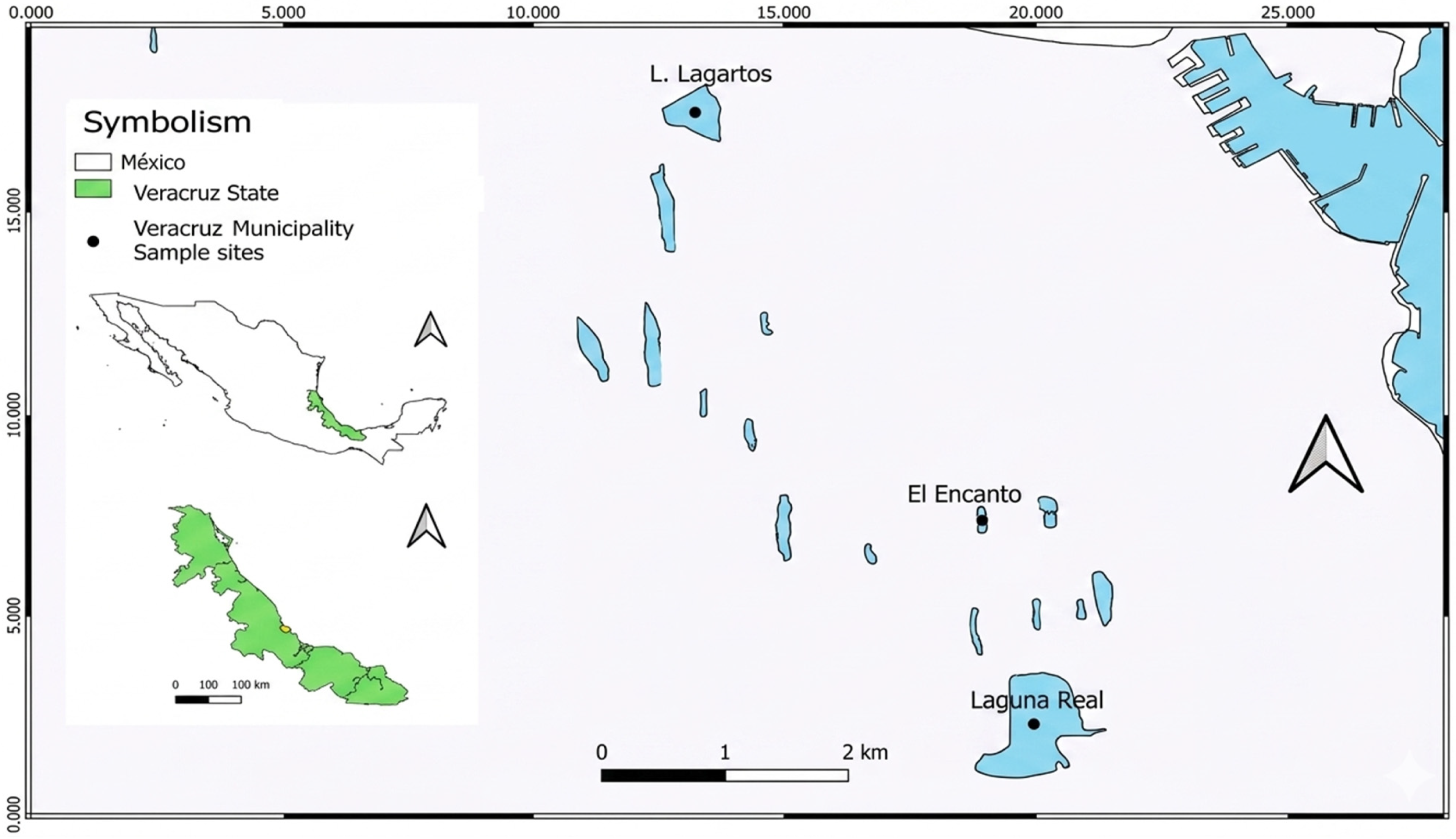
The study was conducted in three interdunal lagoons located within the municipality of Veracruz, Mexico: Lagartos Lagoon (19°12′24.40″ N, 96°10′40.31″ W), Real Lagoon (19°08′52.61″ N, 96°09′06.12″ W), and El Encanto Lagoon (19°10′04.47″ N, 96°09′20.29″ W) (Figure 1). These sites were selected based on their relatively large surface area, high surrounding human population density, and recreational land-use characteristics, following the ecological description criteria included in the Ramsar Wetlands Information Sheet (RIS) used for the characterization of wetlands of international importance [18]. The studied lagoons correspond to coastal freshwater interdunal systems formed within Gulf of Mexico dune fields and are classified as inland wetlands under the Ramsar wetland typology. Lagartos Lagoon covers approximately 18 ha, Real Lagoon 22 ha, and El Encanto Lagoon nearly 15 ha. All lagoons are shallow water bodies surrounded by urban infrastructure and public recreational areas.
The region exhibits a tropical sub-humid climate characterized by a mean annual temperature of 24.5 ± 1.8 °C, average annual precipitation of 1710 ± 210 mm, and relative humidity of 79 ± 5% [19]. The climatic regime includes a dry season extending from February to May and a rainy season occurring between June and October, followed by a transitional northerly wind season, locally known as “nortes”, from November to January. Emergent and semi-aquatic macrophytes, including Typha domingensis, Cyperus spp., and floating vegetation patches typical of coastal freshwater wetlands, dominate the vegetation surrounding the lagoons. Anthropogenic activities vary among sites and include walking trails, sport fishing, small recreational boating, and shoreline modification associated with urban expansion. Consequently, the lagoons are influenced by varying degrees of human activity linked primarily to recreation and surrounding urban development.

2.2. Mosquito Collection and Identification

Adult mosquitoes were collected weekly during the rainy season (June–September) 2023. Three CDC ultraviolet light traps (John W. Hock Company, Gainesville, FL, USA) were available for the study, one assigned to each lagoon. However, sampling was not conducted simultaneously across lagoons. Instead, a rotational sampling design was implemented, whereby only one lagoon was sampled per week. In the study area, residential houses were located approximately 5–7 m from the lagoon margins. Each lagoon was therefore sampled on separate weeks throughout the study period, maintaining consistent trap placement and operating conditions to ensure comparability among sites. Although sampling was not simultaneous, environmental conditions during the rainy season were relatively stable, allowing for meaningful comparisons of mosquito assemblages among lagoons. The traps were placed approximately 5 m from the lagoon margin and about 1 m above ground level. The trap locations were maintained at the same positions throughout the study period to standardize sampling effort. The traps operated from 19:00 to 07:00 h and was positioned in shaded areas near vegetation to maximize capture efficiency of host-seeking mosquitoes.
Collected specimens were transported to the Parasitology Laboratory of the Diagnostic Unit at “Torreón del Molino” Ranch, Faculty of Veterinary Medicine, Universidad Veracruzana. Mosquitoes were euthanized by freezing and subsequently mounted on entomological pins following standard entomological procedures. Species identification was performed under a stereomicroscope (Nikon Corporation, Tokyo, Japan; model SMZ800N) using standard morphological taxonomic keys for Neotropical Culicidae [20,21,22,23]. For male specimens, genitalia dissections were conducted following established protocols [24], with minor modifications. The abdomens were detached and cleared in a warm 10% potassium hydroxide (KOH) solution (Sigma-Aldrich, St. Louis, MO, USA) to remove soft tissues and facilitate visualization of sclerotized structures. Specimens were subsequently rinsed in distilled water and dissected under a stereomicroscope to isolate terminalia. Genital structures were examined based on diagnostic morphological characters, including gonocoxites, gonostyli, parameres, and the aedeagus, using available taxonomic keys and original species descriptions. Dissected genitalia were temporarily mounted in glycerin (Merck, Darmstadt, Germany) for examination and later preserved in microvials associated with the corresponding voucher specimens [24].

2.3. Data Analysis

Total and relative abundances were calculated for each species and each site. Sampling completeness and expected species richness were estimated using the non-parametric Chao1 estimator with EstimateS v9.1.0 (University of Connecticut, Storrs, CT, USA) [25]. Species accumulation curves (interpolation and extrapolation) with 95% confidence intervals were generated using the online iNEXT tool (National Tsing Hua University, Hsinchu, Taiwan) [26]. Alpha diversity was assessed using the Shannon–Wiener index (H′) and Simpson’s dominance index (Ds) [27,28]. Beta diversity among lagoons was evaluated using the Jaccard similarity coefficient (Ij) [29]. Rank–abundance curves were constructed to visualize community structure and species dominance patterns [30].

3. Results

A total of 1465 adult mosquitoes were collected from the three interdunal lagoons sampled. The specimens belonged to two subfamilies (Anophelinae and Culicinae), five genera, seven subgenera, and eleven species of Culicidae. Representative specimens of the collected species are provided in the Supplementary Materials (Figures S1–S6).

3.1. Species Composition and Sex Structure

The composition of mosquito species and the distribution of male and female specimens collected in the interdunal lagoons are presented in Table 1.
The genus Culex was the most diverse culicid group, accounting for the highest proportion of collected specimens, with Culex (Melanoconion) panocossa being the dominant species (n = 883), followed by Culex (Culex) quinquefasciatus (n = 220). Female mosquitoes predominated in all sampling sites, representing the majority of individuals collected. Real Lagoon exhibited the highest species richness, whereas Lagartos Lagoon had the highest total abundance of individuals. Medically important species such as Aedes aegypti, Anopheles albimanus, and Culex nigripalpus were also recorded, highlighting the potential epidemiological relevance of these interdunal ecosystems.

3.2. Sampling Effort and Species Richness Estimation

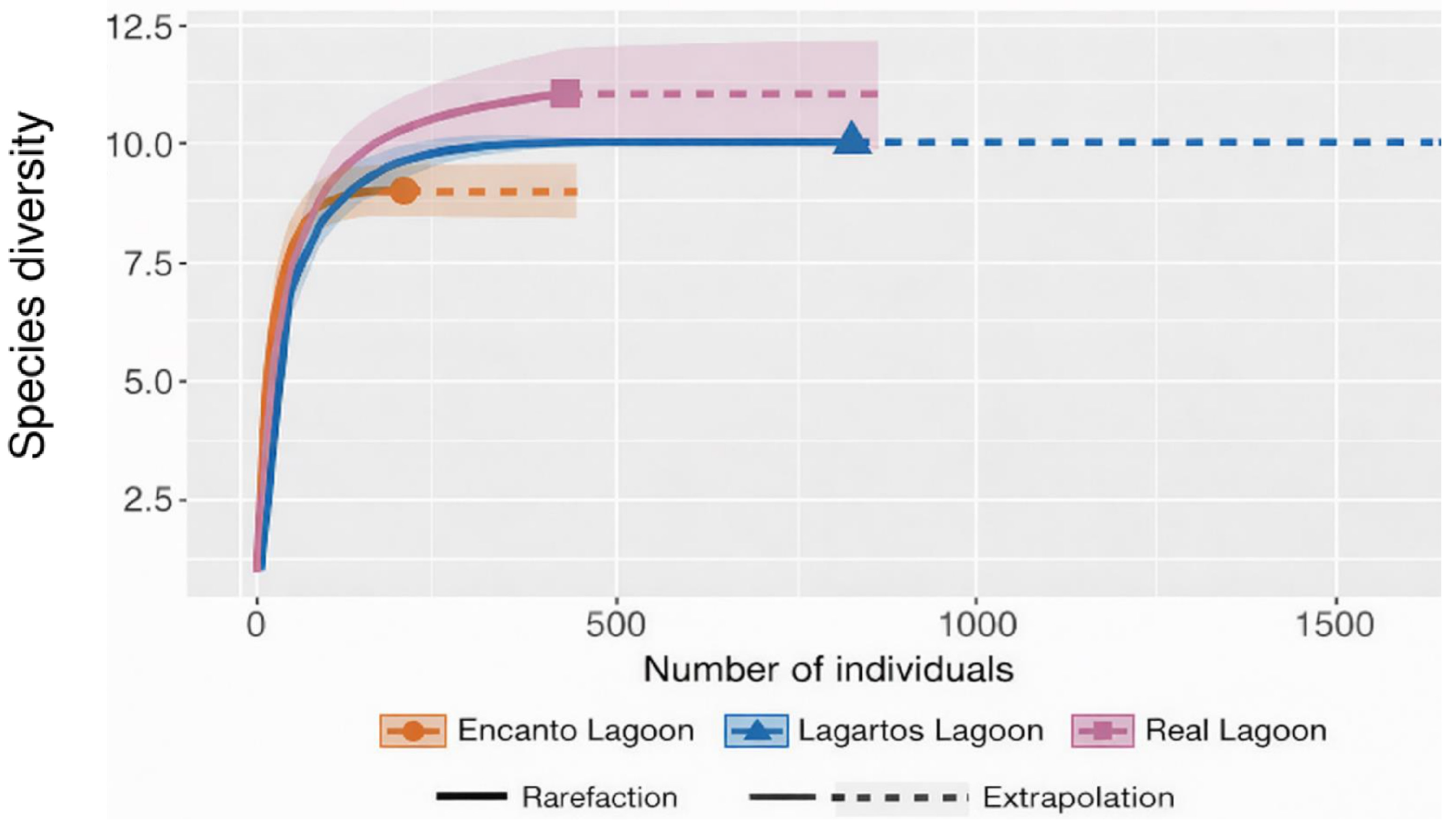
Species accumulation curves based on individual-based rarefaction and extrapolation approached an asymptote for all three lagoons, indicating that the sampling effort was sufficient to characterize the local mosquito fauna active between 19:00 and 07:00 h and attracted to CDC light traps (Figure 2). The non-parametric Chao1 estimator suggested low expected species richness at each site, with observed richness values closely matching the estimated values. These results confirm that mosquito diversity within the collection method described above in the studied lagoons is relatively low.

3.3. Community Structure and Diversity Patterns

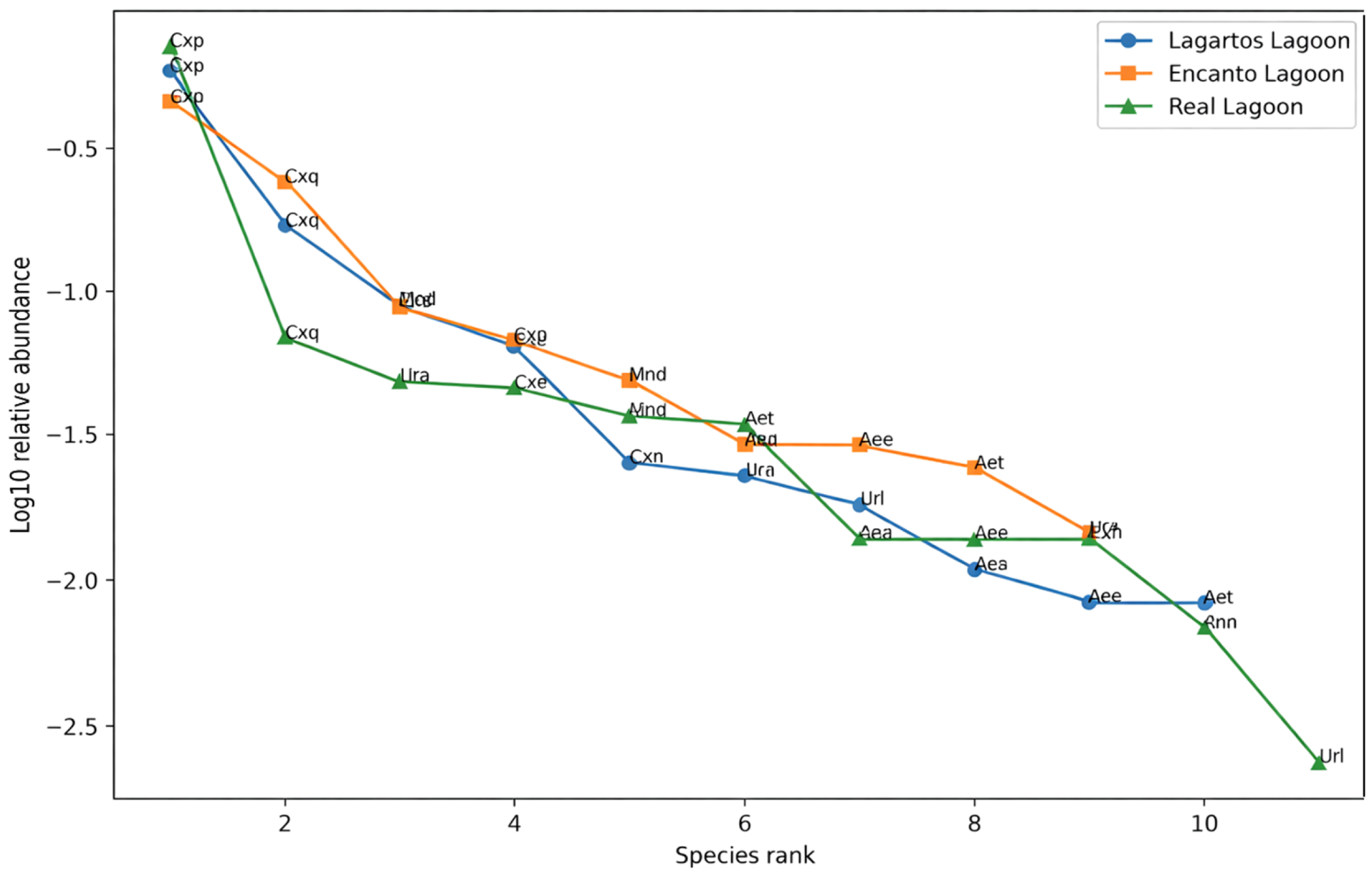
Rank–abundance curves showed that Real Lagoon exhibited the highest species richness among the three studied lagoons. Across all sites, mosquito assemblages were strongly dominated by Cx. panocossa, followed by Cx. quinquefasciatus (Figure 3).
Overall mosquito diversity, as estimated by the Shannon–Wiener index (H′), was low in the three lagoons. El Encanto Lagoon presented the highest diversity value (H′ = 1.60), whereas Real Lagoon showed the lowest diversity (H′ = 1.18). Dominance patterns, estimated using Simpson’s index (Ds), indicated that El Encanto Lagoon had the lowest dominance (Ds = 0.28), while Real Lagoon exhibited the highest dominance (Ds = 0.52). Beta diversity analysis based on the Jaccard similarity coefficient revealed a high degree of similarity among lagoons. Lagartos Lagoon and El Encanto Lagoon shared 90% of the recorded species, as did Lagartos Lagoon and Real Lagoon, whereas El Encanto Lagoon and Real Lagoon shared 80% of the species. Among the species identified, Uranotaenia apicalis was recorded for the first time in the state of Veracruz.

4. Discussion

The present study provides a comprehensive faunistic characterization of mosquito assemblages collected at night time with CDC light traps and associated with interdune lagoons located in an urbanized coastal environment of Veracruz, Mexico. This study was limited to adult mosquito collections conducted during the rainy season, which may underestimate species active during other seasons or with weak phototactic responses. Larval sampling was not included in the present study due to logistical constraints and restricted access to some lagoon margins during peak recreational use. Within the above limitations, the results reveal a mosquito community structure characterized by low species richness and strong dominance by a small number of taxa, a pattern that has been consistently associated with anthropogenically disturbed wetlands in tropical and subtropical regions [31,32]. If confirmed by larval sampling, these results suggest that the pronounced dominance of Cx. panocossa observed across all sampled lagoons represents a key ecological pattern. This species has been previously reported as highly adaptable to disturbed wetland environments, particularly those characterized by increased organic matter, eutrophication, and dense aquatic vegetation [31,32]. Such conditions favor larval development by providing both refuge from predators and abundant nutritional resources [33]. The predominance of Cx. panocossa therefore suggests that the studied lagoons, especially those with higher human pressure, exhibit ecological characteristics associated with environmental degradation [34,35]. Similarly, the high abundance of Cx. quinquefasciatus supports the influence of anthropogenic disturbance on mosquito community composition. This species is widely recognized as a synanthropic mosquito species strongly associated with urban and peri-urban habitats, where it exploits polluted or organically enriched water bodies for breeding [34]. The probable co-dominance of Cx. panocossa and Cx. quinquefasciatus is consistent with patterns observed in other disturbed ecosystems, where generalist species with broad ecological tolerances outcompete more specialized taxa [36]. In addition to the dominant Culex species, mosquitoes of the genera Aedes, Anopheles, and Mansonia were recorded at low relative abundances. Although CDC light traps are widely used for sampling nocturnal mosquitoes, some genera such as Aedes and Mansonia are primarily active during crepuscular or diurnal periods, which may lead to their underrepresentation in night collections. Additionally, some Anopheles species may exhibit limited attraction to light traps. However, these patterns are species-specific and should be interpreted with caution, as individuals of all three genera were collected in this study, albeit in low numbers [21,22]. The detection of a few Ae. aegypti likely reflects occasional dispersal from surrounding urban areas rather than stable populations within interdunal lagoons, whereas Aedes taeniorhynchus and Aedes epacticus are more closely associated with coastal and semi-natural environments. Anopheles albimanus was recorded sporadically, consistent with its preference for freshwater habitats with emergent vegetation. The presence of Mansonia dyari, whose larvae depend on aquatic macrophytes, indicates the persistence of vegetated microhabitats despite ongoing urban disturbance. Although numerically limited, these taxa contribute to the ecological heterogeneity of interdunal lagoons and support the need for comprehensive mosquito surveillance in urban-adjacent wetlands [22].
Species richness across the three lagoons was relatively low, supporting the hypothesis that land-use change and anthropogenic pressure negatively affect mosquito diversity in interdune lagoon systems. Previous studies in Mexico have shown that less disturbed habitats tend to support higher mosquito diversity, whereas urbanized or modified landscapes exhibit reduced richness and increased dominance [17,32]. Real Lagoon exhibited the highest observed species richness; however, diversity indices were lower compared to El Encanto Lagoon due to the strong dominance of a few species, particularly Cx. panocossa. This pattern likely reflects its comparatively lower degree of human disturbance and greater habitat heterogeneity. Reduced anthropogenic impact may allow the persistence of species with narrower ecological requirements, leading to increased evenness and richness.
Rarefaction and extrapolation analyses indicated that sampling effort was sufficient to adequately characterize the mosquito fauna specifically attracted to CDC light traps at nighttime, as species accumulation curves approached asymptotic behavior and Chao1 estimates suggested only a limited number of undetected species. This supports the conclusion that the observed low richness is not an artifact of insufficient sampling but rather reflects genuine ecological conditions within these systems. The high similarity in species composition among lagoons suggests the presence of a largely shared regional species pool, likely facilitated by the geographic proximity of the sites and the dispersal capacity of adult mosquitoes [37,38]. Nonetheless, differences in relative abundance among lagoons may indicate that local environmental conditions and disturbance intensity play a crucial role in structuring mosquito populations [39].
From a medical and veterinary perspective, the dominance of Culex species is of particular concern. Species within this genus are known to function as bridge vectors, facilitating the transmission of pathogens between wildlife reservoirs and human or domestic animal populations [15,39]. In coastal Veracruz, where climatic conditions such as high temperature, humidity, and seasonal rainfall favor mosquito survival, interdune lagoons located at urban–natural interfaces may act as focal points for pathogen maintenance and spillover.
The detection of Ur. apicalis represents a new state record for Veracruz and highlights the importance of localized faunistic surveys, even in environments subject to human disturbance. Although species of the genus Uranotaenia are generally considered of limited medical relevance due to their feeding preferences, their presence contributes to a more complete understanding of regional mosquito biodiversity and ecological complexity [20]. Such records are essential for refining distribution maps and establishing baseline data for long-term monitoring programs.
Species identification was based solely on morphological characters, limiting resolution within cryptic species complexes. Additionally, environmental variables and pathogen presence were not assessed, restricting direct evaluation of habitat–mosquito relationships and epidemiological risk.

5. Conclusions

Interdunal lagoons in Veracruz function as simplified mosquito ecosystems dominated by disturbance-tolerant Culex species, with low overall species richness but potential epidemiological relevance due to the presence of competent vectors. The consistent assemblage structure across lagoons suggests strong environmental filtering in urban coastal wetlands. The record of Ur. apicalis expands its known distribution in Mexico. These findings provide a baseline for vector surveillance and highlight the need for integrative studies to better assess disease transmission risk in these environments.

Supplementary Materials

The following supporting information can be downloaded at: https://www.mdpi.com/article/10.3390/parasitologia6020021/s1. Figure S1: (A) Cx. panocossa (Female). (B) Terminalia de Cx. panocossa (Male); Figure S2: (A) Cx. quinquefasciatus (Female). (B) Terminalia de Cx. Quinquefasciatus; Figure S3: (A) Cx. erraticus (Female). (B) Cx. nigripalpus (Female). (C) Ma. Dyari (Female); Figure S4: (A) An. albimanus (Female). (B) Ae. aegypti (Female); Figure S5: (A) Ae. epacticus (Female). (B) Ae. taeniorhynchus (Female); Figure S6: (A) Ur. apicalis (Female). (B) Ur. lowi (Female).

Author Contributions

Conceptualization, data curation, formal analysis, methodology, and writing—review and editing, L.A.O.C.; formal analysis and writing—review and editing, J.L.B.R.; resources, S.I.-B.; validation and formal analysis, D.R.S. All authors have read and agreed to the published version of the manuscript.

Funding

This research received no external funding.

Institutional Review Board Statement

Not applicable.

Informed Consent Statement

Not applicable.

Data Availability Statement

The original contributions presented in this study are included in the article. Further inquiries can be directed to the corresponding authors.

Acknowledgments

L.A.O.C. acknowledges SECIHTI for the scholarship granted to pursue a Master’s degree in Animal Science, from which this manuscript was derived (CVU: 1227591).

Conflicts of Interest

The authors declare no conflicts of interest.

References

  1. Alongi, D.M.; Trott, L.A.; Wattayakorn, G.; Clough, B.F. Nutrient cycling and organic matter dynamics in coastal sediments of a tropical mangrove estuary. Estuar. Coast. Shelf Sci. 2011, 94, 327–336. [Google Scholar] [CrossRef]
  2. Martínez, M.L.; Psuty, N.P.; Lubke, R.A. A perspective on coastal dunes. In Coastal Dunes; Martínez, M.L., Psuty, N.P., Eds.; Springer: Berlin/Heidelberg, Germany, 2008; Volume 171, pp. 3–10. [Google Scholar] [CrossRef]
  3. Hesp, P.A. Coastal dunes in the tropics and temperate regions: Location, formation, morphology and vegetation processes. In Coastal Dunes; Martínez, M.L., Psuty, N.P., Eds.; Springer: Berlin/Heidelberg, Germany, 2008; Volume 171, pp. 29–45. [Google Scholar] [CrossRef]
  4. Mendelssohn, I.A.; Byrnes, M.R.; Kneib, R.T.; Vittor, B.A. Coastal habitats of the Gulf of Mexico. In Habitats and Biota of the Gulf of Mexico: Before the Deepwater Horizon Oil Spill; Ward, C., Ed.; Springer: New York, NY, USA, 2017; pp. 229–269. [Google Scholar] [CrossRef]
  5. Moreno-Casasola, P.; López-Rosas, H.; Infante-Mata, D.; Peralta, L.A.; Travieso-Bello, A.C.; Warner, B.G. Environmental and anthropogenic factors associated with coastal wetland differentiation in La Mancha, Veracruz, Mexico. Plant Ecol. 2009, 200, 37–52. [Google Scholar] [CrossRef]
  6. Botello, G.; Hurtado, L.A.; Barreto, R.E.; Rubio-Palis, Y. Immature mosquitoes in agricultural wetlands of the coastal savanna of Venezuela: Relationships with landscape and environmental habitat characteristics. Ecol. Indic. 2013, 34, 304–312. [Google Scholar] [CrossRef]
  7. Dale, P.E.R.; Knight, J.M. Wetlands and mosquitoes: A review. Wetl. Ecol. Manag. 2008, 16, 255–276. [Google Scholar] [CrossRef]
  8. Yu, X.; Mingjue, E.; Sun, M.; Xue, Z.; Lu, X.; Jiang, M.; Zou, Y. Wetland recreational agriculture: Balancing wetland conservation and agro-development. Environ. Sci. Policy 2018, 87, 11–17. [Google Scholar] [CrossRef]
  9. Keesing, F.; Belden, L.K.; Daszak, P.; Dobson, A.; Harvell, C.D.; Holt, R.D.; Hudson, P.; Jolles, A.; Jones, K.E.; Mitchell, C.E.; et al. Impacts of biodiversity on the emergence and transmission of infectious diseases. Nature 2010, 468, 647–652. [Google Scholar] [CrossRef]
  10. Destoumieux-Garzón, D.; Mavingui, P.; Boetsch, G.; Boissier, J.; Darriet, F.; Duboz, P.; Fritsch, C.; Giraudoux, P.; Le Roux, F.; Morand, S.; et al. The One Health Concept: 10 Years Old and a Long Road Ahead. Front. Vet. Sci. 2018, 5, 14. [Google Scholar] [CrossRef]
  11. Weaver, S.C.; Reisen, W.K. Present and future arboviral threats. Antivir. Res. 2010, 85, 328–345. [Google Scholar] [CrossRef]
  12. Lozano-Fuentes, S.; Hayden, M.H.; Welsh-Rodriguez, C.; Ochoa-Martinez, C.; Tapia-Santos, B.; Kobylinski, K.C.; Uejio, C.K.; Zielinski-Gutierrez, E.; Delle Monache, L.; Monaghan, A.J.; et al. The dengue virus mosquito vector Aedes aegypti at high elevation in Mexico. Am. J. Trop. Med. Hyg. 2012, 87, 902–909. [Google Scholar] [CrossRef]
  13. Secretaría de Salud. Panorama Epidemiológico de Dengue, México, 2023. Dirección General de Epidemiología. Available online: https://www.gob.mx/salud/documentos/panorama-epidemiologico-de-dengue-2023 (accessed on 24 February 2026).
  14. Hidalgo-Martínez, A.; Puerto, F.I.; Farfán-Ale, J.A.; García-Rejón, J.E.; Rosado-Paredes, E.P.; Méndez-Galván, J.F.; Flores-Olvera, R.; Tun-Ku, I.; Ramos, C. Prevalencia de infección por el virus del Nilo occidental en dos zoológicos del estado de Tabasco. Salud Publica Mex. 2008, 50, 76–85. [Google Scholar] [CrossRef][Green Version]
  15. Adams, A.P.; Navarro-Lopez, R.; Ramirez-Aguilar, F.J.; Lopez-Gonzalez, I.; Leal, G.; Flores-Mayorga, J.M.; Travassos da Rosa, A.P.A.; Saxton-Shaw, K.D.; Singh, A.J.; Borland, E.M.; et al. Venezuelan equine encephalitis virus activity in the Gulf Coast region of Mexico, 2003–2010. PLoS Negl. Trop. Dis. 2012, 6, e1875. [Google Scholar] [CrossRef]
  16. LaDeau, S.L.; Allan, B.F.; Leisnham, P.T.; Levy, M.Z. The ecological foundations of transmission potential and vector-borne disease in urban landscapes. Funct. Ecol. 2015, 29, 889–901. [Google Scholar] [CrossRef]
  17. Vázquez-Marroquín, R.; Castañeda-Rivero, F.R.; Chan-Chable, R.J.; de la Cruz-Ramos, J.M.; Espinoza-González, C.A.; Ortega-Morales, A.I. Diversidad y distribución de mosquitos (Diptera: Culicidae) en la frontera México–Guatemala. Rev. Mex. Biodivers. 2023, 94, e944063. [Google Scholar] [CrossRef]
  18. Ramsar Convention Secretariat. Information Sheet on Ramsar Wetlands (RIS): Strategic Framework and Guidelines for the Future Development of the List of Wetlands of International Importance; Ramsar Convention Secretariat: Gland, Switzerland, 2012; Available online: https://rsis.ramsar.org/RISapp/StatDoc/strategic_framework_en.pdf (accessed on 24 February 2026).
  19. Comisión Nacional del Agua (CONAGUA). Climate Normals of Veracruz State 1991–2020. Available online: https://smn.conagua.gob.mx/es/climatologia/informacion-climatologica/normales-climatologicas-por-estado?estado=ver (accessed on 24 February 2026).
  20. Beltrán-Aguilar, A.; Ibáñez-Bernal, S.; Mendoza-Palmero, F.; Sandoval-Ruiz, C.; Hernández-Xoliot, R. Taxonomía y distribución de los anofelinos en el estado de Veracruz, México (Diptera: Culicidae, Anophelinae). Acta Zool. Mex. 2011, 27, 601–755. [Google Scholar] [CrossRef]
  21. Darsie, R.F., Jr.; Ward, R.A. Identification and Geographical Distribution of the Mosquitoes of North America, North of Mexico; University Press of Florida: Gainesville, FL, USA, 2005. [Google Scholar]
  22. Carpenter, S.J.; LaCasse, W.J. Mosquitoes of North America (North of Mexico); University of California Press: Berkeley, CA, USA, 1955. [Google Scholar]
  23. Wilkerson, R.; Strickman, D.; Fernández-Salas, I. Clave Ilustrada Para la Identificación de Hembras de Mosquitos Anofelinos de México y Centro América; Centro de Investigación de Paludismo, Secretaría de Salud: Chiapas, Mexico, 1993. [Google Scholar]
  24. Ibáñez-Bernal, S. Illustrated key for the identification of females of Lutzomyia França (Diptera: Psychodidae: Phlebotominae) from Mexico. Folia Entomol. Mex. 2005, 44, 195–212. [Google Scholar]
  25. Chao, A. Nonparametric estimation of the number of classes in a population. Scand. J. Stat. 1984, 11, 265–270. [Google Scholar]
  26. Hsieh, T.C.; Ma, K.H.; Chao, A. iNEXT: An R package for rarefaction and extrapolation of species diversity. Methods Ecol. Evol. 2016, 7, 1451–1456. [Google Scholar] [CrossRef]
  27. Shannon, C.E. A mathematical theory of communication. Bell Syst. Tech. J. 1948, 27, 379–423. [Google Scholar] [CrossRef]
  28. Simpson, E.H. Measurement of diversity. Nature 1949, 163, 688. [Google Scholar] [CrossRef]
  29. Jaccard, P. Étude comparative de la distribution florale dans une portion des Alpes et des Jura. Bull. Soc. Vaud. Sci. Nat. 1901, 37, 547–579. [Google Scholar] [CrossRef]
  30. Whittaker, R.H. Dominance and diversity in land plant communities. Science 1965, 147, 250–260. [Google Scholar] [CrossRef] [PubMed]
  31. Loaiza, J.R.; Dutari, L.C.; Rovira, J.R.; Sanjur, O.I.; Laporta, G.Z.; Pecor, J.; Foley, D.H.; Eastwood, G.; Kramer, L.D.; Radtke, M.; et al. Disturbance and mosquito diversity in the lowland tropical rainforest of central Panama. Sci. Rep. 2017, 7, 7248. [Google Scholar] [CrossRef] [PubMed]
  32. Orta-Pineda, G.; Abella-Medrano, C.A.; Suzán, G.; Serrano-Villagrana, A.; Ojeda-Flores, R. Effects of landscape anthropization on sylvatic mosquito assemblages in a rainforest in Chiapas, Mexico. Acta Trop. 2021, 216, 105849. [Google Scholar] [CrossRef] [PubMed]
  33. Cardo, M.V.; Vezzani, D.; Carbajo, A.E. The role of the landscape in structuring immature mosquito assemblages in wetlands. Wetl. Ecol. Manag. 2013, 21, 55–70. [Google Scholar] [CrossRef]
  34. Agha, S.B.; Tchouassi, D.P. Urbanization of Aedes mosquito populations and evolution of arboviral disease risk in Africa. Curr. Opin. Insect Sci. 2022, 54, 100988. [Google Scholar] [CrossRef]
  35. Ryan, S.J.; Carlson, C.J.; Mordecai, E.A.; Johnson, L.R. Global expansion and redistribution of Aedes-borne virus transmission risk with climate change. PLoS Negl. Trop. Dis. 2019, 13, e0007213. [Google Scholar] [CrossRef]
  36. McKinney, M.L. Urbanization, biodiversity, and conservation. BioScience 2002, 52, 883–890. [Google Scholar] [CrossRef]
  37. Abbasi, E. Global expansion of Aedes mosquitoes and their role in the transboundary spread of emerging arboviral diseases: A comprehensive review. IJID One Health 2025, 6, 100058. [Google Scholar] [CrossRef]
  38. Perrin, A.; Glaizot, O.; Christe, P. Worldwide impacts of landscape anthropization on mosquito abundance and diversity: A meta-analysis. Glob. Chang. Biol. 2022, 28, 6857–6871. [Google Scholar] [CrossRef]
  39. Borremans, B.; Faust, C.L.; Manlove, K.R.; Sokolow, S.H.; Lloyd-Smith, J.O. Cross-species pathogen spillover across ecosystem boundaries: Mechanisms and theory. Philos. Trans. R. Soc. B Biol. Sci. 2019, 374, 20180344. [Google Scholar] [CrossRef]
Figure 1. Study area showing the location of the three interdunal lagoons sampled in the municipality of Veracruz, Mexico.
Parasitologia 06 00021 g001
Figure 2. Sample-size–based rarefaction and extrapolation curves showing mosquito species richness in each interdunal lagoon as a function of sampling effort.
Parasitologia 06 00021 g002
Figure 3. Rank–abundance curves of mosquito assemblages recorded in three urban interdunal lagoons in Veracruz, Mexico. Species are ordered from highest to lowest relative abundance along the x-axis. The y-axis represents log10-transformed relative abundance values. Curve length reflects species richness, whereas slope indicates community evenness and dominance structure. Species names corresponding to each code are provided as follows: Aee = Aedes (Ochlerotatus) epacticus; Aet = Aedes (Ochlerotatus) taeniorhynchus; Aea = Aedes (Stegomyia) aegypti; Ana = Anopheles (Nyssorhynchus) albimanus; Cxn = Culex (Culex) nigripalpus; Cxq = Culex (Culex) quinquefasciatus; Cxe = Culex (Melanoconion) erraticus; Cxp = Culex (Melanoconion) panocossa; Mnd = Mansonia (Mansonia) dyari; Ura = Uranotaenia (Uranotaenia) apicalis; Url = Uranotaenia (Uranotaenia) lowii.
Parasitologia 06 00021 g003
Table 1. Total mosquito individuals, listed by species and sex, collected with CDC light traps at night time across the three interdunal lagoons studied.
CodeSpeciesLagartos LagoonEncanto LagoonReal LagoonTotal
MFMFMF
Genus Aedes
AeeAedes (Ochlerotatus) epacticus25424219
AetAedes (Ochlerotatus) taeniorhynchus071421327
AeaAedes (Stegomyia) aegypti27241521
Genus Anopheles
AnaAnopheles (Nyssorhynchus) albimanus0000123
Genus Culex
CxnCulex (Culex) nigripalpus2191130641
CxqCulex (Culex) quinquefasciatus301119401218220
CxeCulex (Melanoconion) erraticus25231502092
CxpCulex (Melanoconion) panocossa3944339015293883
Genus Mansonia
MndMansonia (Mansonia) dyari27219313100
Genus Uranotaenia
UraUranotaenia (Uranotaenia) apicalis2172121943
UrlUranotaenia (Uranotaenia) lowii015000116
Total8174826178403921465
Disclaimer/Publisher’s Note: The statements, opinions and data contained in all publications are solely those of the individual author(s) and contributor(s) and not of MDPI and/or the editor(s). MDPI and/or the editor(s) disclaim responsibility for any injury to people or property resulting from any ideas, methods, instructions or products referred to in the content.