1. Introduction
The frontal sinus is a mucosa-lined pneumatic cavity located between the internal and external tables of the frontal bone. Its development begins during fetal life through pneumatization, reaching the frontal bone around the second year of life [
1]. Radiographically, the sinus becomes visible between the ages of five and six, with marked vertical expansion during the pubertal growth spurt [
2]. In most individuals, sinus growth ceases by the age of 20 [
1,
3,
4,
5], although some studies suggest earlier maturation around 12 years of age [
6,
7]. Because the left and right frontal sinus lobes develop independently, marked asymmetries are common, including differences in lobulation, septal deviation, and sinus extension. Complete or unilateral agenesis occurs in less than 15% of the population [
1,
8,
9].
In adults, the frontal sinus typically appears as two irregular and asymmetric cavities separated by a thin bony septum, projecting posteriorly and laterally. In some cases, the sinus extends into the supraorbital region, and in rare instances, this may be its only anatomical expression. Morphological variations include duplications, incomplete septations, or even the presence of multiple lobes, with some reports describing up to five sinus chambers [
8,
10,
11]. In adulthood, frontal sinus morphology is generally considered stable, with only minor changes associated with trauma, pathological processes, or age-related bone remodeling [
8,
12]. Consequently, the frontal sinus represents a highly individualizing anatomical structure, particularly valuable in forensic contexts involving decomposition, carbonization, or skeletal remains, where traditional methods of identification may be limited or inapplicable [
13,
14,
15,
16].
Since the pioneering radiographic classification studies of Yoshino et al., subsequent investigations have supported the forensic utility of frontal sinus morphology as a complementary method of identification when
ante mortem imaging is available [
17]. Later studies further demonstrated that frontal sinus patterns may provide sufficient discriminatory value for positive identification, especially when combined with other biological and contextual evidence [
1,
15]. Accordingly, frontal sinus radiography remains a relevant resource in forensic anthropology and medicolegal investigations [
18].
Despite its recognized forensic value, the frontal sinus is not a static structure throughout life. Its pneumatization begins in early childhood, accelerates during puberty, and may continue through late adolescence until adult morphology is reached. During this period, progressive remodeling may alter sinus dimensions, contour configuration, septal arrangement, and lobulation pattern, resulting in age-related morphological variability [
1,
4]. Studies on craniofacial development have demonstrated that frontal sinus growth is closely associated with somatic and skeletal maturation rather than chronological age alone [
4,
5].
Moore and Ross reported that frontal sinus development may be useful in juvenile age estimation, emphasizing that substantial morphological change can still occur during adolescence and early adulthood [
19]. Likewise, longitudinal growth studies have suggested that frontal sinus maturation parallels pubertal growth patterns and may remain incomplete in younger individuals [
5,
20]. These findings indicate that radiographic appearances observed in adolescents may not yet represent the stable anatomical morphology expected in fully mature adults [
5,
17,
21].
Although the forensic literature has traditionally emphasized the uniqueness and relative stability of frontal sinus morphology in adults, comparatively limited attention has been given to the reliability of this method when
ante mortem and
post mortem images are separated by active developmental stages. This issue is particularly relevant in adolescents and young adults, in whom ongoing biological maturation may substantially affect radiographic comparability and increase the risk of misinterpretation [
22].
Despite its recognized individualizing potential, the application of frontal sinus morphology for identification may be limited in younger individuals, particularly during periods of active development [
3,
4]. Changes occurring throughout adolescence may significantly alter sinus configuration, including expansion, increased lobulation, and modification of contour patterns [
23]. These developmental transformations may compromise the reliability of comparative analyses between
intra vitam (IV) and
post mortem (PM) images when examinations are separated by critical stages of biological maturation.
In addition to biological development, the forensic comparison of frontal sinus images is influenced by technical factors related to radiographic acquisition. Variations in head positioning, beam angulation, magnification, and projection type may alter the apparent morphology of the sinus, potentially affecting contour interpretation and metric assessment. For this reason, reproducibility of imaging conditions is a critical requirement in frontal sinus identification studies.
Among conventional projections, the Caldwell view has traditionally been regarded as the standard radiographic approach for frontal sinus evaluation because it provides favorable visualization of the frontal region with reduced superimposition of adjacent cranial structures [
24]. Nevertheless, even within the same projection, subtle differences in cranial orientation may influence the apparent outline of the sinus. Butaric et al. demonstrated that cranial positioning can significantly affect frontal sinus outline analyses, particularly in height-related variables, emphasizing the importance of standardized acquisition protocols [
3].
These methodological considerations become especially relevant when comparing
ante mortem radiographs obtained years earlier under clinical conditions with
post mortem images acquired for forensic purposes [
24]. Previous studies have shown that
post mortem computed tomography and reconstructed radiographic images may be useful alternatives for identification when conventional comparability is limited [
1,
15,
17,
25]. Although frontal sinus comparison has been widely reported in adult forensic identification, few studies have specifically evaluated longitudinal
intra vitam–post mortem comparisons across active developmental stages in the same individual [
26].
Historically, morphological comparison of the frontal sinuses has relied on manual, visual, or metric approaches using radiographs or tomographic images. More recently, advances in data science and image analysis have introduced computational tools for segmentation and quantitative assessment of paranasal sinuses. These approaches enable the extraction of morphological features such as area, shape, and asymmetry with increased objectivity and reproducibility [
1,
15,
25,
27,
28]. However, the performance and interpretability of such methods depend on the biological stability of the anatomical structures being analyzed, which may vary according to age and developmental stage [
1,
26].
Considering these aspects, the present study describes a forensic case report involving longitudinal comparison of frontal sinus morphology between intra vitam and post mortem radiographs obtained at two distinct stages of biological maturation (14 and 21 years of age) in the same individual. To the best of our knowledge, few published reports have examined longitudinal intra vitam–post mortem frontal sinus comparison across active developmental stages in the same individual.
By integrating developmental, technical, and forensic perspectives, this report aims to examine the limitations of frontal sinus identification during periods of ongoing maturation and to highlight the potential risk of erroneous exclusion when age-related changes are not adequately considered. This case report was prepared in accordance with the CARE guidelines.
2. Case Report
The present case concerns the discovery of partially skeletonized human remains, located in a rural area of a municipality in Minas Gerais, Brazil. The remains were referred to the Forensic Medical Institute (IML) in the state capital for anthropological evaluation, radiographic analysis, and estimation of the cause of death.
Preliminary investigative information indicated the recent disappearance of a 21-year-old male, with a reported height of 175 cm and weight of 58 kg, who had been missing for 12 days prior to discovery. The individual was experiencing homelessness, had no fixed residence, and was known to use psychoactive substances, including alcohol and illicit drugs. He also had prior contact with the criminal justice system. Identifying tattoos were reported but are not described here to preserve confidentiality.
Upon arrival at the forensic unit, the body was in an advanced stage of decomposition. Male external genitalia were partially preserved, and the right hand retained dermatoglyphic patterns due to mummification. Skeletal exposure predominated in the skull, upper limbs, and anterior lower limbs, whereas the posterior lower limbs and pelvic region were predominantly in a liquefactive stage. The remaining viscera were reduced to a decomposed mass with complete loss of original architecture. Notably, the right wrist was bound with a synthetic fabric cord, suggesting a possible restraint mechanism.
Post mortem radiographs were obtained at two stages: initially before autopsy and anthropological preparation, and subsequently after skeletal preparation and skull reconstruction. The preliminary radiological examination revealed two high-density metallic objects within the skull. One projectile (P1) was embedded in the pars basilaris of the occipital bone, while a metallic fragment (F2) was located within the cranial cavity.
The second radiological examination was performed specifically for comparative purposes, using the intra vitam radiographs as a reference to reproduce, as closely as possible, the same projection, angulation, positioning, and approximate radiographic parameters, with particular emphasis on the Caldwell projection.
The skeletal elements selected for preparation and detailed analysis included the skull, mandible, both clavicles, and the fourth rib. Reconstruction using thermoplastic adhesive allowed evaluation of anatomical features and fracture patterns.
A defect in the right mandible (E1), measuring 50 mm by 27 mm, was identified as the presumed entry site of projectile P1. A secondary elliptical defect (E1′) was observed in the occipital region, measuring 8 mm in diameter, corresponding to the location where projectile P1 was recovered. The associated fracture pattern suggested a bottom-to-top, front-to-back, and right-to-left trajectory, consistent with a gutter-type wound. Internally, the mandible exhibited a horizontal fracture measuring 70 mm, and the cranial base showed a 23 mm fracture involving the region of the sella turcica.
Additionally, a depressed fracture (E2) was identified in the left frontal bone, associated with fragment F2, whose trajectory was estimated as tangential, following a front-to-back and bottom-to-top direction. The depressed fracture of the left frontal bone was located outside the frontal sinus region used for morphological comparison and did not involve the delineated frontal sinus contours. Therefore, it was not considered to have altered the sinus morphology assessed in this study.
Sex was determined as male based primarily on the presence of preserved male external genitalia. Estimation of age at death was based on two independent methods. Complete epiphyseal fusion of long bones, combined with unfused medial clavicular epiphyses, suggested an age range between 20 and 25 years [
29]. This estimate was supported by analysis of the fourth rib, classified as Phase 1 according to the Iscan method [
30], typically associated with individuals aged 17 to 23 years, with peak frequency between 19 and 21 years [
31]. These findings are consistent with the reported age of the missing individual (21 years).
Stature estimation was performed using the regression equation proposed by Albanese et al. (2016), based on the physiological length of the right femur (479 mm), which was selected because it is not dependent on sex, age, or geographic origin [
32]. The estimated height was calculated as 174.66 cm (±4.624 cm), closely matching the reported stature of 175 cm. The
post mortem interval was estimated to be greater than seven days based on the advanced decomposition stage, including partial skeletonization, areas of mummification, liquefactive changes, and loss of soft tissue architecture. However, PMI estimation in surface remains is inherently limited by environmental and contextual variables, which were not fully available in this case. This was consistent with the reported 12-day disappearance interval.
Two ballistic elements—a 0.38 SPL projectile and a metallic fragment—were recovered. Based on the ballistic findings, fracture trajectories, and macroscopic characteristics compatible with perimortem trauma, the cause of death was attributed to perforating cranial trauma firearm injury.
A chronological summary of the relevant events was incorporated into the case description, including the
intra vitam radiological examination, disappearance interval, recovery of remains,
post mortem examination, anthropological analysis, radiological comparison, and final identification (
Table 1).
3. Identification Process
3.1. The Intra Vitam Radiological Documentation
The intra vitam radiological documentation was received at the Forensic Laboratory in a sealed white envelope bearing the name of the hospital where the examination had been performed, the date, and the individual’s identification. The envelope contained two radiographic films acquired in three projections (Caldwell, Waters, and Hirtz), all displaying identifying information, including the individual’s name, date of birth, and date of examination (14 years old).
The clinical indication for the intra vitam radiographs was not available in the documentation. However, no radiographic evidence of frontal sinus trauma, destructive pathology, surgical intervention, or gross sinus alteration was observed in the images used for comparison. The radiographs presented adequate quality for anatomical and comparative analysis, allowing for evaluation of frontal sinus morphology at 14 years of age, corresponding to a period of active somatic development.
3.2. The Post Mortem Radiological Documentation
Based on the IV radiological documentation, a PM radiological examination of the skull was performed with the aim of reproducing, as closely as possible, the projection plane, angulation, and approximate proportions observed in the original IV images. Efforts were made to achieve comparable positioning and angulation between intra vitam and post mortem radiographs.
The PM radiographic examination was carried out using a compact digital radiography system (Philips VMI DR), replicating the three projections available in the IV documentation (Caldwell, Waters, and Hirtz). Given the focus of the present study on the frontal sinus, particular emphasis was placed on the Caldwell projection to maximize comparability.
3.3. The Radiological Comparison
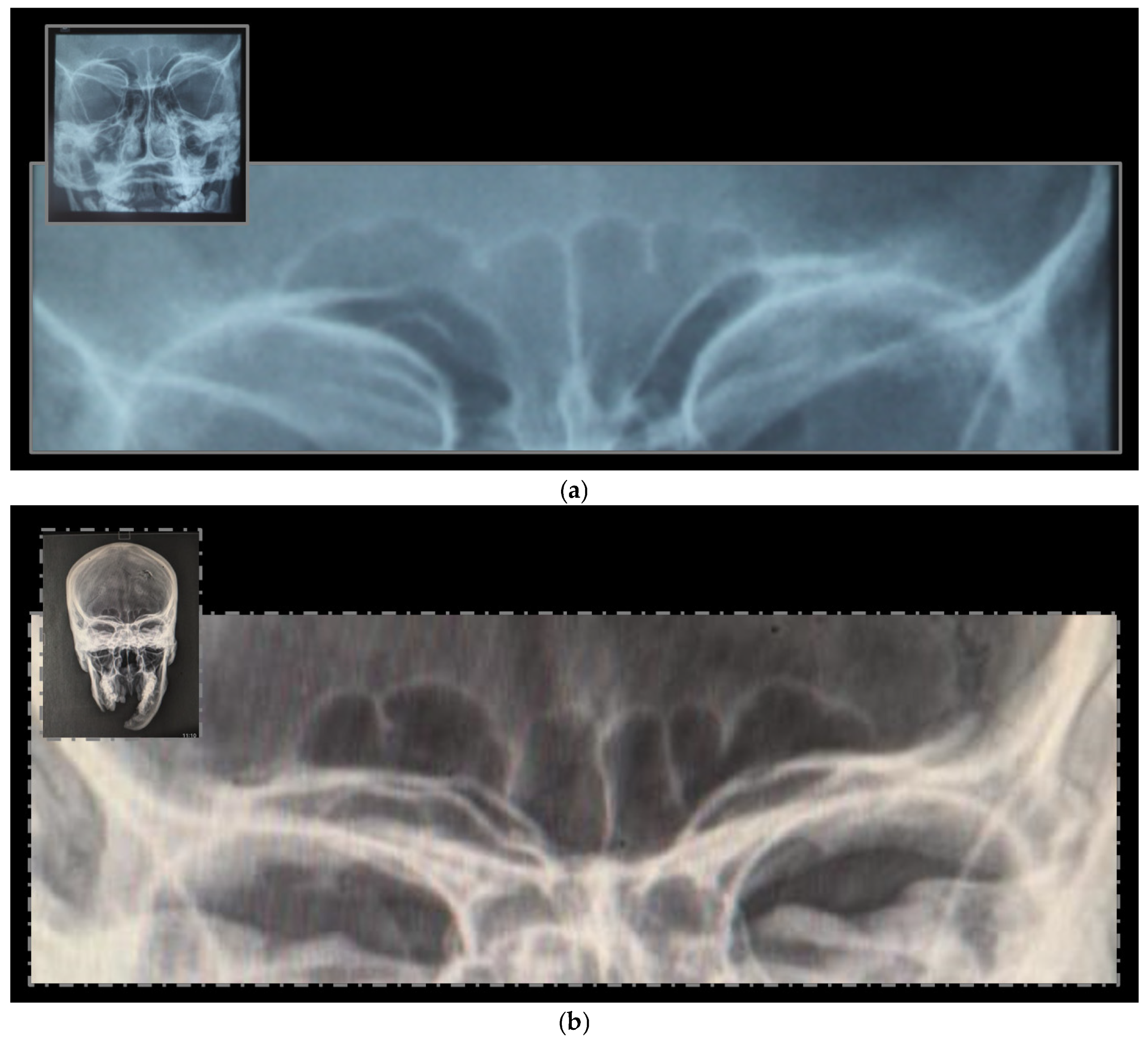
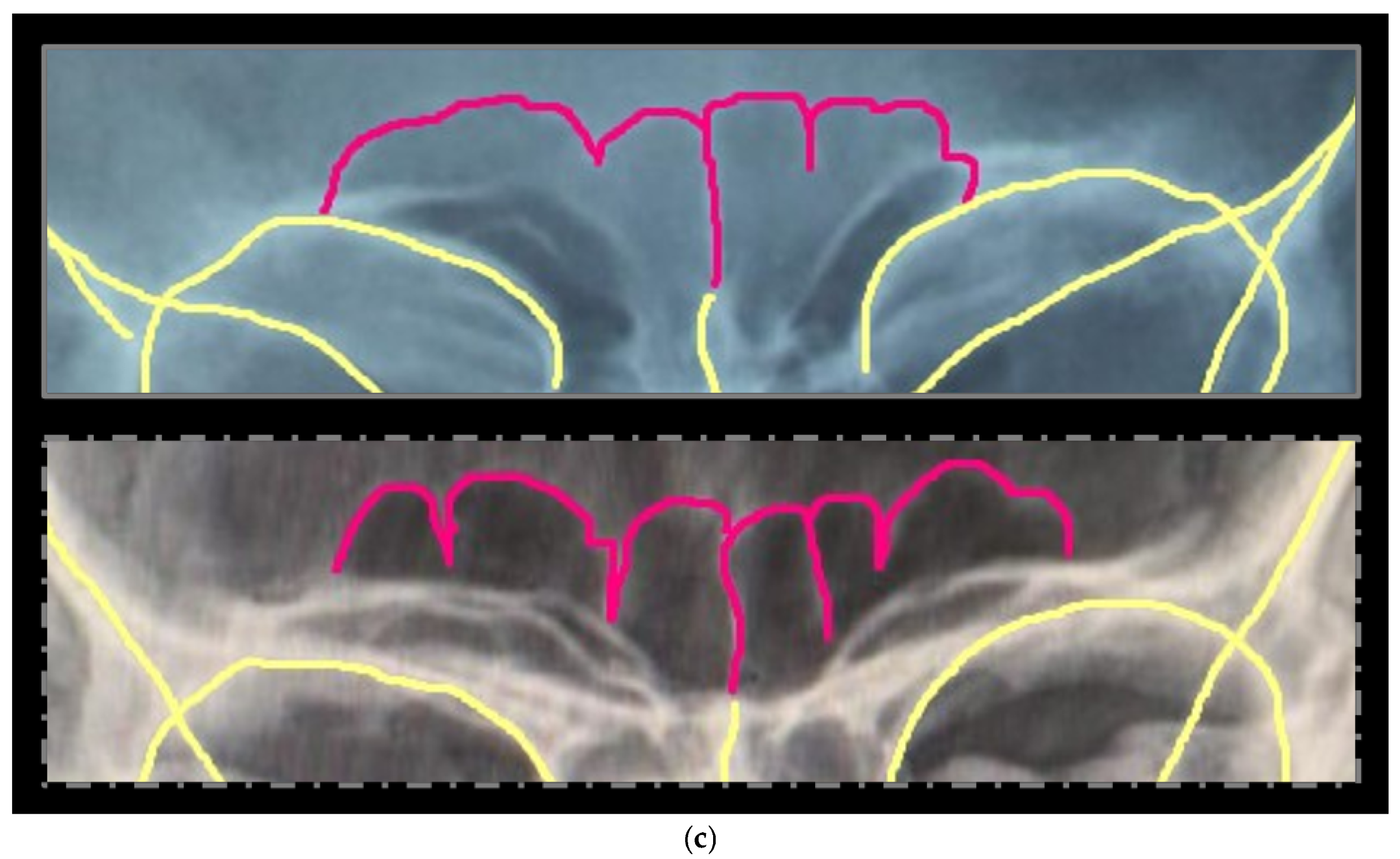
The frontal sinus region was manually delineated on both IV and PM Caldwell radiographs using Microsoft PowerPoint, version 2604. The delineated images were exported and analyzed using Fiji/ImageJ software, version 1.54r, for two-dimensional morphometric assessment (
Figure 1).
The delineated contours were then used for two-dimensional comparative measurements. Maximum width was defined as the greatest horizontal distance between the lateral limits of the manually delineated frontal sinus contour, and maximum height as the greatest vertical distance between its inferior and superior limits. Bounding box area was calculated as the area of the smallest rectangle enclosing the entire contour, obtained by multiplying maximum width by maximum height.
All measurements were expressed in pixels and used only as comparative indices between the two radiographs, rather than as calibrated anatomical measurements, because the intra vitam radiograph did not include a metric scale. The delineations and measurements were reviewed by the authors for anatomical plausibility and consistency.
The frontal sinus contours were manually delineated using Microsoft PowerPoint, version 2604, and the resulting images were analyzed using Fiji/ImageJ software, version 1.54r, to obtain software-assisted two-dimensional morphometric measurements. The delineations and measurements were reviewed by the authors for anatomical consistency. No independently trained or externally validated artificial intelligence model was applied.
3.4. The Conclusion of Radiological Comparison
Software-assisted comparison of the manually delineated frontal sinus contours demonstrated an increase in both transverse and vertical dimensions between the
intra vitam image obtained at 14 years of age and the
post mortem image obtained at 21 years (
Table 2). The maximum contour width increased from 249 to 280 pixels, corresponding to an increase of approximately 12.4%, while the maximum contour height increased from 74 to 89 pixels, corresponding to an increase of approximately 20.3%. The bounding box area increased from 18,426 to 24,920 pixels
2, representing an increase of approximately 35.2%.
Qualitative comparison demonstrated preservation of the general anatomical configuration, including bilateral distribution and an approximately central intersinus septum. However, the post mortem image showed greater contour complexity, increased lobulation, superior extension, and mild lateral expansion when compared with the intra vitam image.
Frontal sinus comparison was based on both qualitative and quantitative criteria. Qualitative criteria included general configuration, bilateral distribution, intersinus septum position, contour morphology, lobulation pattern, superior and lateral extension, and symmetry. Quantitative parameters included maximum width, maximum height, and bounding box area of the manually delineated contours.
A positive identification based on frontal sinus morphology would require substantial concordance of stable individualizing features, with any differences being explainable by projection, image quality, or minor technical variation. In the present case, although some degree of global anatomical correspondence was observed, the degree of discrepancy in lobulation pattern, contour complexity, and sinus expansion was considered insufficient to support identification based on frontal sinus comparison alone, particularly given the developmental interval between the images.
3.5. The Identification of the Individual
Despite advanced decomposition, mummification of the right hand preserved dermatoglyphic ridge detail. The right thumbprint obtained from the cadaver was compared with the corresponding fingerprint from the presumed individual, demonstrating concordance in classification and the presence of matching characteristic points, including agreement in the form, direction, and orientation of the ridge patterns.
These findings allowed for the unequivocal conclusion that both impressions belonged to the same individual.
4. Discussion
The present case appears to represent a uncommon documented example in which frontal sinus morphology was compared longitudinally between adolescence and early adulthood in the same individual using
intra vitam and
post mortem radiographs [
16,
33,
34,
35]. This design provides an opportunity to examine the practical limitations of applying assumptions of adult morphological stability to younger individuals. Although the general anatomical configuration of the frontal sinus was preserved, substantial changes were observed in contour complexity, lobulation pattern, superior extension, and overall dimensions. These findings suggest that marked morphological variation may occur during late developmental stages, potentially reducing the reliability of frontal sinus comparison when images are separated by critical periods of biological maturation.
The temporal interval examined in this case corresponds to a critical stage of craniofacial maturation, during which frontal sinus growth and remodeling may still be ongoing. Frontal sinus pneumatization begins in childhood, accelerates during puberty, and may continue through late adolescence until adult morphology is achieved [
5,
19,
22]. Consequently, changes in size, contour irregularity, septal arrangement, and lobulation pattern may occur during this period [
17,
18,
26]. The increase in sinus dimensions and morphological complexity observed in the present case is therefore consistent with expected post-pubertal developmental patterns rather than necessarily indicating non-correspondence between images.
Previous studies have emphasized the usefulness of frontal sinus morphology for forensic identification, particularly in adult individuals, where relative structural stability is generally assumed [
15,
24]. However, developmental studies have shown that maturation of the frontal sinus may remain incomplete in adolescents and young adults, indicating that age must be considered when interpreting radiographic comparisons [
5,
11,
19,
22]. The present findings reinforce the notion that adult-based assumptions of long-term morphological stability should be applied with caution in younger age groups [
3,
26].
In addition to developmental change, technical factors must be considered when interpreting frontal sinus comparisons. Variations in head positioning, beam angulation, magnification, image quality, and projection type may alter the apparent outline of the sinus and influence both qualitative and metric assessments [
35,
36,
37]. For this reason, the reproducibility of radiographic conditions is a central methodological requirement in studies based on frontal sinus morphology.
In the present case, particular emphasis was placed on reproducing the Caldwell projection, which is traditionally regarded as the most suitable conventional view for frontal sinus evaluation because it minimizes superimposition of adjacent cranial structures and facilitates visualization of sinus contours and septa. Nevertheless, even when the same projection is used, subtle differences in cranial orientation may still affect the apparent morphology of the sinus. Previous outline-analysis studies have demonstrated that positional changes may significantly influence some variables, especially vertical dimensions [
36].
These considerations indicate that radiographic divergence may result from both biological and technical sources. However, because comparable projections were intentionally used in the present case and the observed changes involved not only dimensions but also increased lobulation and contour complexity, developmental remodeling is a more plausible explanation than technical artifact alone.
From a forensic perspective, the present findings have important practical implications. Frontal sinus comparison is frequently regarded as a useful adjunctive method of identification, particularly when remains are decomposed, burned, or skeletonized and conventional visual recognition is not feasible [
24]. However, the current case demonstrates that morphological differences observed between
intra vitam and
post mortem images in younger individuals should not be interpreted automatically as evidence of non-correspondence.
In adolescents and young adults, radiographic divergence may reflect normal developmental remodeling rather than exclusionary findings. Failure to consider this possibility may lead to erroneous exclusion of a true match, potentially delaying or compromising the identification process. This issue is especially relevant in medicolegal contexts involving missing persons, where timely and accurate identification carries legal, humanitarian, and investigative significance [
38].
Accordingly, frontal sinus analysis in younger age groups should be interpreted within a multidisciplinary framework that integrates biological profile estimation, contextual information, and, whenever available, more definitive comparative methods such as friction ridge examination, odontology, genetics, or other validated identifiers.
The software-assisted two-dimensional morphometric analysis used in this study provided objective support for the qualitative assessment by enabling quantitative comparison of contour dimensions and overall frontal sinus expansion. Although the contours were manually delineated, digital measurements allowed for a more standardized comparison of maximum width, maximum height, and bounding box area between the intra vitam and post mortem radiographs. This approach may reduce purely subjective interpretation and complement traditional expert-based visual analysis. Nevertheless, such measurements remain dependent on image quality, contour delineation, projection comparability, and, fundamentally, the biological stability of the anatomical structure being analyzed. Therefore, quantitative image-based measurements should be interpreted as adjunctive rather than definitive evidence in forensic identification.
This study has limitations inherent to a single-case design and should not be interpreted as establishing universal age thresholds for frontal sinus stability. Individual variation in growth patterns, sex-related differences, genetics, health conditions, and environmental influences may affect sinus development [
5,
19]. In addition, the use of historical clinical radiographs limits control over original acquisition parameters, as commonly occurs in real forensic scenarios.
Despite these limitations, the present report highlights an underexplored issue of practical relevance and supports the need for further research. Future investigations involving larger longitudinal samples, serial imaging across adolescence, and integration of radiological, anthropological, and computational methods may help establish age-sensitive standards for frontal sinus comparison, thereby improving the reliability of this technique in human identification.
5. Conclusions
This case demonstrates that frontal sinus morphology, although widely recognized as a valuable adjunctive tool for human identification, may present important limitations when applied across periods of active biological development. Comparison between intra vitam and post mortem radiographs obtained at 14 and 21 years of age revealed substantial morphological changes, including increased lobulation, contour complexity, and sinus expansion.
These findings indicate that frontal sinus analysis alone was not reliable for identification in this case, as the observed differences were more consistent with developmental remodeling than with simple non-correspondence. Positive identification was achieved through fingerprint analysis, reinforcing the importance of a multidisciplinary approach in forensic practice.
Therefore, frontal sinus comparison in adolescents and young adults should be interpreted with caution, particularly when intra vitam and post mortem images are separated by critical stages of biological maturation. Age-related developmental changes must be considered to reduce the risk of erroneous exclusion and to improve the reliability of frontal sinus analysis in forensic identification.
Author Contributions
Conceptualization, Y.V.L. and A.C.R.; methodology, Y.V.L., R.M.A. and F.B.P.; software, Y.V.L.; validation, Y.V.L., R.M.A. and F.B.P.; formal analysis, Y.V.L.; investigation, Y.V.L.; resources, A.R.F. and A.C.R.; data curation, Y.V.L.; writing—original draft preparation, Y.V.L.; writing—review and editing, Y.V.L., R.M.A., F.B.P., A.R.F. and A.C.R.; visualization, Y.V.L.; supervision, A.R.F. and A.C.R.; project administration, Y.V.L. All authors have read and agreed to the published version of the manuscript.
Funding
This research received no external funding.
Institutional Review Board Statement
This study was conducted in accordance with the Declaration of Helsinki and approved by the Research Ethics Committee of Faculdade Ciências Médicas de Minas Gerais (protocol code 8.270.333; date of approval: 10 March 2026).
Informed Consent Statement
Patient consent was waived, as approved by the Research Ethics Committee of Faculdade Ciências Médicas de Minas Gerais (protocol code 8.270.333), in accordance with Brazilian ethical regulations (CNS Resolutions 466/2012 and 510/2016).
Data Availability Statement
The data supporting the findings of this study are not publicly available due to privacy and ethical restrictions related to forensic casework but may be available from the corresponding author upon reasonable request and with permission from the relevant authorities.
Acknowledgments
The authors would like to thank the Instituto Médico Legal André Roquette, Polícia Civil de Minas Gerais, Superintendência de Polícia Civil de Minas Gerais, and Faculdade Ciências Médicas de Minas Gerais.
Conflicts of Interest
The authors declare no conflicts of interest.
Abbreviations
The following abbreviations are used in this manuscript:
| PM | post mortem |
| IV | intra vitam |
| IMLAR—BH | Instituto Médico Legal Dr. André Roquette—Belo Horizonte, Minas Gerais, Brazil |
| FCMMG | Faculdade Ciências Médicas de Minas Gerais, Brazil |
| UNICAMP | Piracicaba Dental School, State University of Campinas, São Paulo, Brazil |
References
- Christensen, A.M.; Hatch, G.M. Advances in the Use of Frontal Sinuses for Human Identification. In New Perspectives in Forensic Human Skeletal Identification; Elsevier: Amsterdam, The Netherlands, 2018; pp. 227–240. [Google Scholar] [CrossRef]
- Swischuk, L.E. The normal pediatric skull variations and artefacts. Radiol. Clin. N. Am. 1972, 10, 277–290. [Google Scholar] [CrossRef]
- Butaric, L.N.; Campbell, J.L.; Fischer, K.M.; Garvin, H.M. Ontogenetic patterns in human frontal sinus shape: A longitudinal study using elliptical Fourier analysis. J. Anat. 2022, 241, 195–210. [Google Scholar] [CrossRef]
- Fatu, C.; Puisoru, M.; Rotaru, M.; Truta, A.M. Morphometric evaluation of the frontal sinus in relation to age. Ann. Anat.—Anat. Anz. 2006, 188, 275–280. [Google Scholar] [CrossRef] [PubMed]
- Ruf, S.; Pancherz, H. Development of the frontal sinus in relation to somatic and skeletal maturity. A cephalometric roentgenographic study at puberty. Eur. J. Orthod. 1996, 18, 491–497. [Google Scholar] [CrossRef] [PubMed]
- Silva, R.F.D.; Pinto, R.N.; Ferreira, G.M.; Daruge Júnior, E. Importância das radiografias de seio frontal para a identificação humana. Rev. Bras. Otorrinolaringol. 2008, 74, 798. [Google Scholar] [CrossRef]
- Montovani, J.C.; Nogueira, E.A.; Ferreira, F.D.; Lima Neto, A.C.; Nakajima, V. Cirurgia das fraturas do seio frontal: Estudo epidemiológico e análise de técnicas. Rev. Bras. Otorrinolaringol. 2006, 72, 204–209. [Google Scholar] [CrossRef][Green Version]
- Nouraei, S.A.R.; Elisay, A.R.; Dimarco, A.; Abdi, R.; Majidi, H.; Madani, S.A.; Andrews, P.J. Variations in paranasal sinus anatomy: Implications for the pathophysiology of chronic rhinosinusitis and safety of endoscopic sinus surgery. J. Otolaryngol. Head. Neck Surg. 2009, 38, 32–37. [Google Scholar] [PubMed]
- Shamlou, A.A.; Tallman, S.D. Frontal Sinus Morphological and Dimensional Variation as Seen on Computed Tomography Scans. Biology 2022, 11, 1145. [Google Scholar] [CrossRef]
- Howser, L.A.; Jones, A.J.; Sreenath, S.B.; Ting, J.Y.; Illing, E.A. Frontal Sinus Anatomy Variations in Race and Sex Using the International Frontal Sinus Anatomy Classification. Ear Nose Throat J. 2026, 105, 119–126. [Google Scholar] [CrossRef]
- Zimmerman, R.A. Skull Development and Abnormalities. In Neuroimaging; Zimmerman, R.A., Gibby, W.A., Carmody, R.F., Eds.; Springer: New York, NY, USA, 2000; pp. 457–489. [Google Scholar] [CrossRef]
- Papadopoulou, A.M.; Bakogiannis, N.; Skrapari, I.; Bakoyiannis, C. Anatomical Variations of the Sinonasal Area and Their Clinical Impact on Sinus Pathology: A Systematic Review. Int. Arch. Otorhinolaryngol. 2022, 26, e491–e4918. [Google Scholar] [CrossRef]
- Caplova, Z.; Obertova, Z.; Gibelli, D.M.; De Angelis, D.; Mazzarelli, D.; Sforza, C.; Cattaneo, C. Personal Identification of Deceased Persons: An Overview of the Current Methods Based on Physical Appearance. J. Forensic Sci. 2018, 63, 662–671. [Google Scholar] [CrossRef]
- Lemos, Y.V.; Furtado, A.N.; Lima, A.Z.; Dionísio, A.S.; Araújo, R.M.; Cunha, E. Human identification by medical findings in a forensic anthropology context. Forensic Sci. Res. 2024, 9, owae041. [Google Scholar] [CrossRef]
- Quatrehomme, G.; Fronty, P.; Sapanet, M.; Grévin, G.; Bailet, P.; Ollier, A. Identification by frontal sinus pattern in forensic anthropology. Forensic Sci. Int. 1996, 83, 147–153. [Google Scholar] [CrossRef] [PubMed]
- Prado, F.B.; Freire, A.R.; Rondon, B.C.S.; Costa, S.T.; Rossi, A.C.; Daruge Júnior, E. Analysis of the frontal sinus morphology and the titanium plates shape in skull fracture for human identification. Int. J. Odontostomatol. 2016, 10, 303–308. [Google Scholar] [CrossRef]
- Yoshino, M.; Miyasaka, S.; Sato, H.; Seta, S. Classification system of frontal sinus patterns by radiography. Its application to identification of unknown skeletal remains. Forensic Sci. Int. 1987, 34, 289–299. [Google Scholar] [CrossRef]
- Da Silva, R.F.; Prado, F.B.; Caputo, I.G.C.; Devito, K.L.; Botelho, T.D.L.; Júnior, E.D. The forensic importance of frontal sinus radiographs. J. Forensic Leg. Med. 2009, 16, 18–23. [Google Scholar] [CrossRef]
- Moore, K.; Ross, A. Frontal Sinus Development and Juvenile Age Estimation. Anat. Rec. 2017, 300, 1609–1617. [Google Scholar] [CrossRef] [PubMed]
- Sawada, M.; Yamada, H.; Higashino, M.; Abe, S.; Tanaka, E. Volumetric Assessment of the Frontal Sinus in Female Adolescents and Its Relationship with Craniofacial Morphology and Orthodontic Treatment: A Pilot Study. Int. J. Environ. Res. Public Health 2022, 19, 7287. [Google Scholar] [CrossRef]
- Karakas, S.; Kavaklı, A. Morphometric examination of the paranasal sinuses and mastoid air cells using computed tomography. Ann. Saudi Med. 2005, 25, 41–45. [Google Scholar] [CrossRef] [PubMed]
- Park, I.H.; Song, J.S.; Choi, H.; Kim, T.H.; Hoon, S.; Lee, S.H.; Lee, H.M. Volumetric study in the development of paranasal sinuses by CT imaging in Asian: A Pilot study. Int. J. Pediatr. Otorhinolaryngol. 2010, 74, 1347–1350. [Google Scholar] [CrossRef]
- Yun, I.S.; Kim, Y.O.; Lee, S.K.; Rah, D.K. Three-Dimensional Computed Tomographic Analysis of Frontal Sinus in Asians. J. Craniofac. Surg. 2011, 22, 462–467. [Google Scholar] [CrossRef]
- Pereira, J.G.D.; Santos, J.B.S.; Sousa, S.P.D.; Franco, A.; Silva, R.H.A. Frontal sinuses as tools for human identification: A systematic review of imaging methods. Dentomaxillofac. Radiol. 2021, 50, 20200599. [Google Scholar] [CrossRef] [PubMed]
- Nambiar, P.; Naidu, M.D.K.; Subramaniam, K. Anatomical variability of the frontal sinuses and their application in forensic identification. Clin. Anat. 1999, 12, 16–19. [Google Scholar] [CrossRef]
- Abdulrazak, N.; Butaric, L.N.; Garvin, H.M. Age-Related Changes to Frontal Sinus Traits and Implications for Forensic Identification. Forensic Anthr. 2023, 16, 192. [Google Scholar] [CrossRef]
- Riepert, T.; Ulmcke, D.; Schweden, F.; Nafe, B. Identification of unknown dead bodies by X-ray image comparison of the skull using the X-ray simulation program FoXSIS. Forensic Sci. Int. 2001, 117, 89–98. [Google Scholar] [CrossRef] [PubMed]
- Cameriere, R.; Ferrante, L.; Molleson, T.; Brown, B. Frontal Sinus Accuracy in Identification as Measured by False Positives in Kin Groups. J. Forensic Sci. 2008, 53, 1280–1282. [Google Scholar] [CrossRef] [PubMed]
- Buckley, M.B.; Clark, K.R. Forensic Age Estimation Using the Medial Clavicular Epiphysis: A Study Review. Radiol. Technol. 2017, 88, 482–498. [Google Scholar] [PubMed]
- Işcan, M.Y.; Loth, S.R.; Wright, R.K. Racial variation in the sternal extremity of the rib and its effect on age determination. J. Forensic Sci. 1987, 32, 452–466. [Google Scholar] [CrossRef] [PubMed]
- De Mendonça, M.C. Estimation of height from the length of long bones in a Portuguese adult population. Am. J. Phys. Anthr. 2000, 112, 39–48. [Google Scholar] [CrossRef]
- Albanese, J.; Tuck, A.; Gomes, J.; Cardoso, H.F.V. An alternative approach for estimating stature from long bones that is not population- or group-specific. Forensic Sci. Int. 2016, 259, 59–68. [Google Scholar] [CrossRef]
- Silva, R.F.; Rodrigues, L.G.; Manica, S.; Franco, R.P.A.V.; Franco, A. Human identification established by the analysis of frontal sinus seen in anteroposterior skull radiographs using the mento-naso technique—A forensic case report. Rev. Bras. Odontol. Leg. 2019, 6, 62–66. [Google Scholar] [CrossRef]
- Falguera, J.R.; Falguera, F.P.S.; Marana, A.N. Frontal sinus recognition for human identification. In Proceedings of the Biometric Technology for Human Identification V, Orlando, FL, USA, 17 March 2008; Vijaya Kumar, B.V.K., Prabhakar, S., Ross, A.A., Eds.; SPIE: Bellingham, WA, USA, 2008; Volume 69440S. [Google Scholar] [CrossRef]
- Pfaeffli, M.; Vock, P.; Dirnhofer, R.; Braun, M.; Bolliger, S.A.; Thali, M.J. Post-mortem radiological CT identification based on classical ante-mortem X-ray examinations. Forensic Sci. Int. 2007, 171, 111–117. [Google Scholar] [CrossRef]
- Butaric, L.N.; Richman, A.; Garvin, H.M. The Effects of Cranial Orientation on Forensic Frontal Sinus Identification as Assessed by Outline Analyses. Biology 2022, 11, 62. [Google Scholar] [CrossRef] [PubMed]
- Ebrahimnejad, H.; Zarch, S.H.H.; Langaroodi, A.J. Diagnostic Efficacy of Digital Waters’ and Caldwell’s Radiographic Views for Evaluation of Sinonasal Area. J. Dent. 2016, 13, 357–364. [Google Scholar] [PubMed] [PubMed Central]
- De Boer, H.H.; Blau, S.; Delabarde, T.; Hackman, L. The role of forensic anthropology in disaster victim identification (DVI): Recent developments and future prospects. Forensic Sci. Res. 2019, 4, 303–315. [Google Scholar] [CrossRef]
| Disclaimer/Publisher’s Note: The statements, opinions and data contained in all publications are solely those of the individual author(s) and contributor(s) and not of MDPI and/or the editor(s). MDPI and/or the editor(s) disclaim responsibility for any injury to people or property resulting from any ideas, methods, instructions or products referred to in the content. |





 ,
,