


Abstract
We report fungal species used as food sources by mycophagous scarab beetles, with special emphasis on Phanaeus MacLeay, 1819, and confirm that Phanaeus zapotecus Edmonds, 2006 and Phanaeus bravoensis Moctezuma, Sánchez-Huerta & Halffter, 2017 are mycophagous. Mycophagy is confirmed in the P. endymion and P. tridens species groups. We propose a vicariant speciation process for the mycophagous species of the P. endymion species group (P. halffterorum Edmonds, 1979; P. zapotecus; and P. bravoensis) in the mountains of central Mexico, driven by competition, glaciation-induced climatic change, biome and faunal shifts, and access to a new food resource (fleshy fungi) in a new environment (pine–oak forest). We reiterate the revalidation of Phanaeus dionysius Kohlmann, Arriaga-Jiménez & Rös, 2018 as a distinct species and confirm its coprophagous habits. Based on morphological characteristics, we establish the Phanaeus halffterorum species complex within the Phanaeus endymion species -group.
1. Introduction
Several species of Geotrupidae and Scarabaeidae (Scarabaeinae and Aphodiinae) have been collected in fungi in Mexico. This behavior has been poorly studied, and one of the earliest general studies on this subject is that of Navarrete-Heredia & Galindo-Miranda [1], conducted in the central Mexican state of Morelos in cloud and pine–oak forests. They reported Liatongus rhinocerulus (Bates, 1889), Onthophagus mariozuninoi Delgado, Navarrete & Blackaller-Bages, 1993, and O. navarretorum Delgado & Capistrán, 1996 in decomposing fungi. Zunino [2] transferred Oniticellus rhinocerulus to Liatongus; this was later confirmed in a phylogenetic analysis of the Oniticellini by Philips [3]. Accordingly, records of mycophagy for this species should be attributed to Liatongus Reitter, 1893, rather than Oniticellus Dejean, 1821 [4].
A second study, carried out by Anduaga [5] in the northern Mexican state of Durango, reported the following mycophagous taxa: Aphodius sp., Ceratotrupes bolivari Halffter & Martínez, 1962, Copris sierrensis Matthews, 1961, Liatongus rhinocerulus; Onthophagus cochisus Brown, 1929, and O. fuscus Boucomont, 1932. Anduaga [5] also reported the following macromycete genera as food sources: Amanita Pers., 1797, Boletus L. (1753), Hypomyces (Fr.) Tul. & C. Tul. (1860), Lactarius Pers., 1797, Ramaria Fr. ex Bonord. (1851), Russula Pers., 1797, and Suillus Gray, 1821.
Another general study was undertaken by Navarrete-Heredia & Quiroz-Rocha [6] in the central Mexican state of Morelos in cloud and pine-oak forests, reporting L. rhinocerulus and O. mariozuninoi as mycophages. Later, Sánchez-Hernández et al. [7] conducted a study in the southern Mexican state of Chiapas using traps baited with fermented Agaricus bisporus (Lange) Imbach, 1946. They collected 27 beetle species belonging to the families Scarabaeidae, Silphidae, and Staphylinidae. Among the Scarabaeidae, twelve species were recorded belonging to the following genera: Canthidium Erichson, 1847 (1), Canthon Hoffmannsegg, 1817 (3), Onthophagus Latreille, 1802 (4), Phanaeus MacLeay, 1819 (1), Uroxys Westwood 1842 (3), with the most common being Phanaeus chiapanecus Moctezuma & Halffter, 2021; Onthophagus anthracinus Harold, 1873; and Canthidium pseudopuncticolle Solís & Kohlmann, 2006.
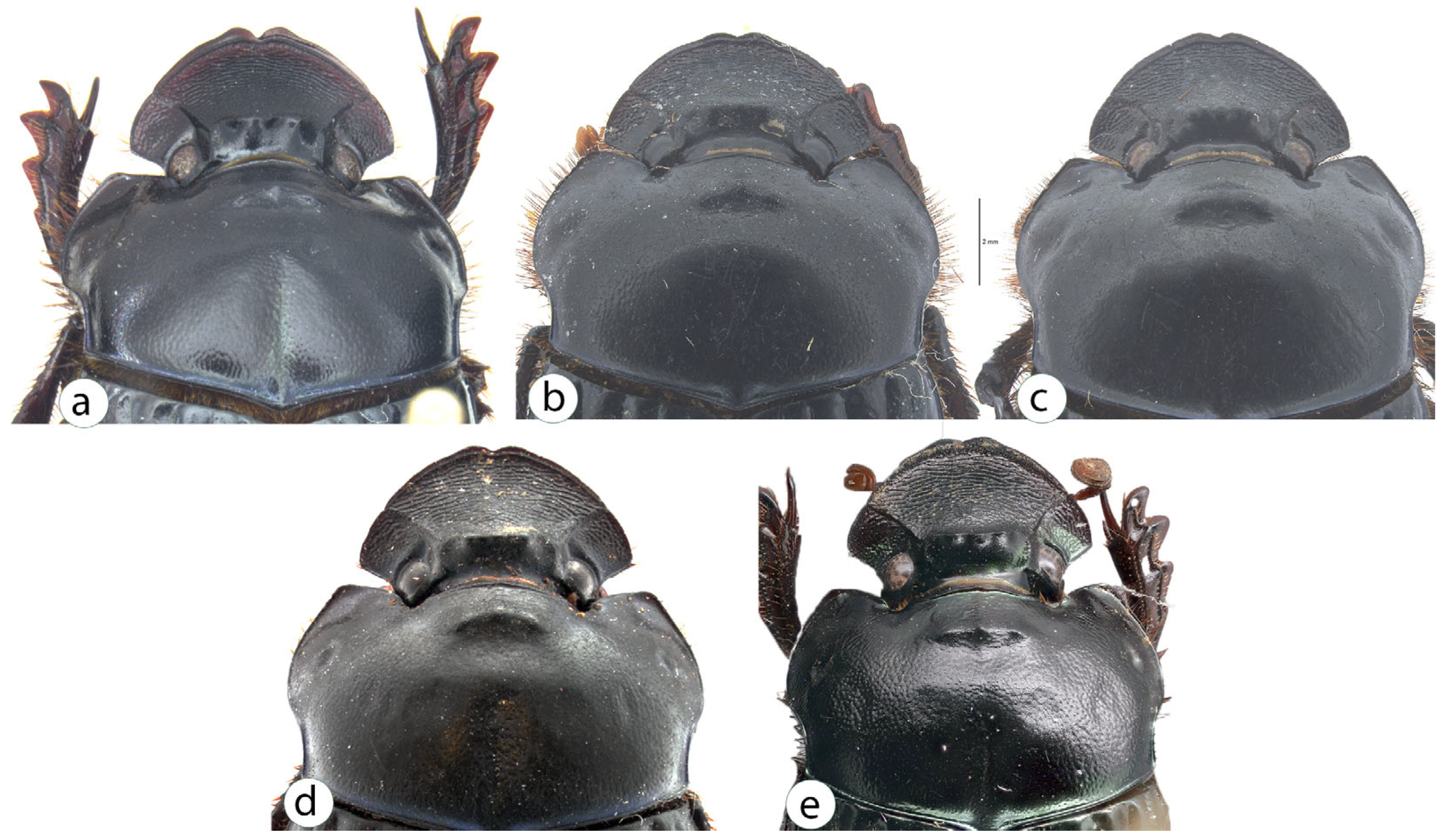
Of particular note is the paper by Hinton [8], who first reported Phanaeus associated with decomposing fungi. He recorded collecting Phanaeus endymion Harold, 1863 and P. daphnis Harold, 1863 in July 1932 at Temascaltepec. Hinton [8] (p. 130) produced a fine line drawing of what he identified as P. endymion, but which in fact corresponds to P. halffterorum Edmonds, 1979 (Figure 1c). Edmonds [9] confirmed that P. halffterorum builds nests with fungi, this fact being later reconfirmed by Delgado-Castillo & Navarrete-Heredia [10]. Hinton [8] also noted that despite collecting extensively in the Temascaltepec area between 1932 and 1934, he always found Phanaeus mexicanus Harold, 1863 and Phanaeus palliatus Sturm, 1843 exclusively in dung and never in fungi.
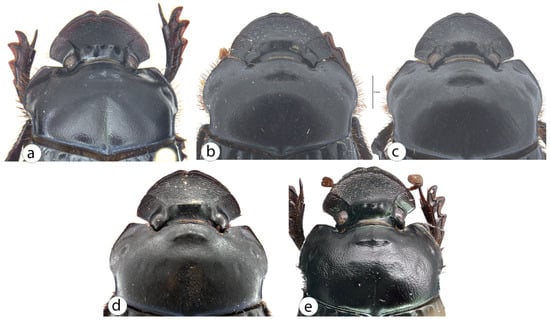
Figure 1.
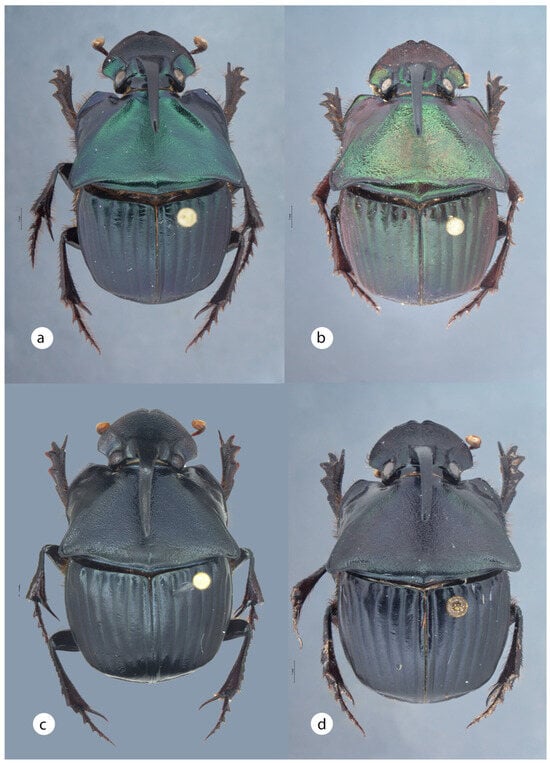
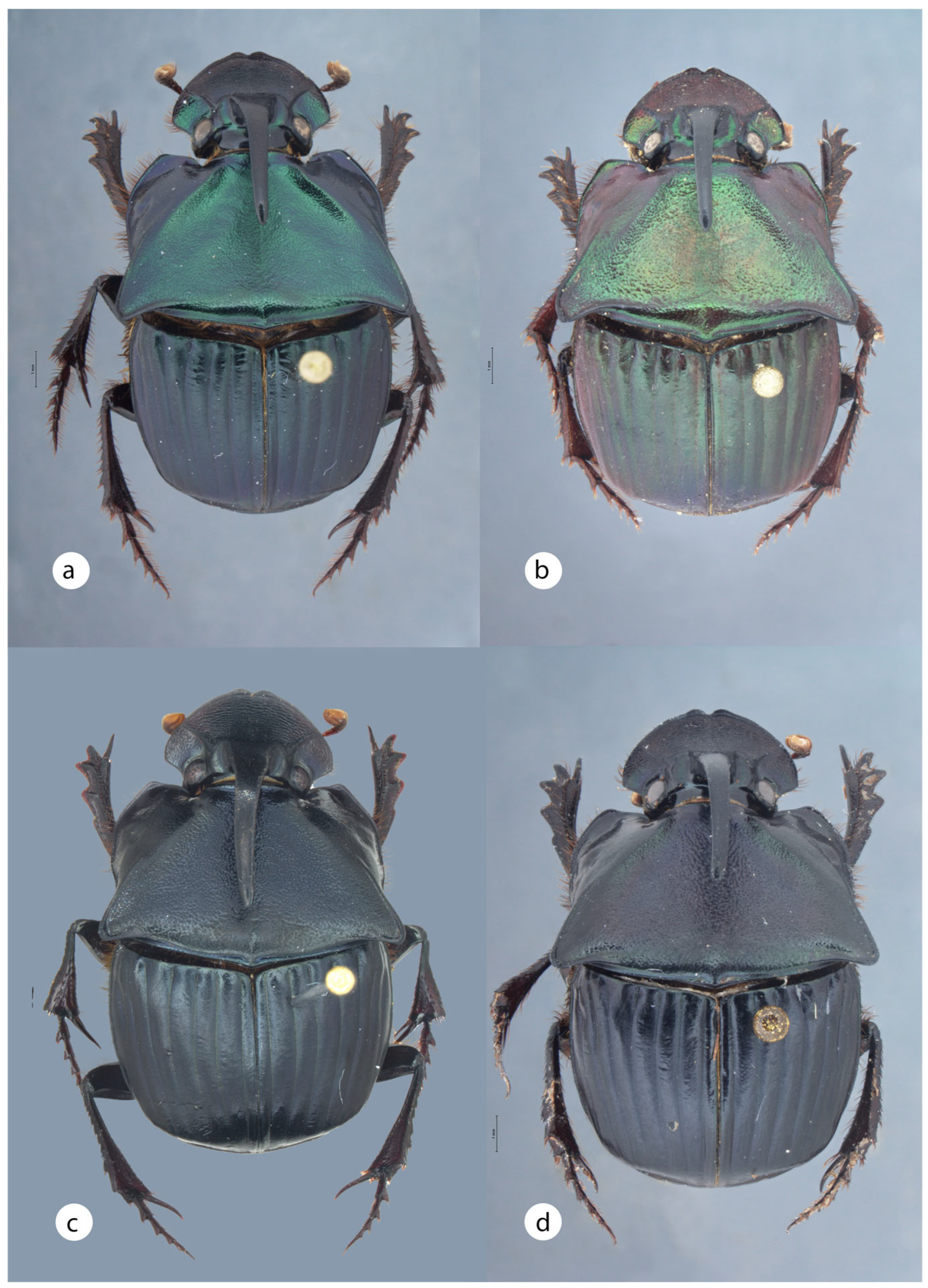
Phanaeus halffterorum species complex. (a) P. bravoensis holotype (Chilpancingo de los Bravo, Guerrero). (b) P. halffterorum (Temascaltepec, Estado de Mexico). (c) P. dionysius holotype (San Pablo Etla, Oaxaca). (d) P. zapotecus (Sola de Vega, Oaxaca).
Edmonds [11] described Phanaeus zapotecus (Figure 1a) from Sola de Vega, Oaxaca, collected in a seasonally dry pine–oak forest with junipers. The specimens were first collected by Henry & Anne Howden in 1979 on a toadstool and later by Daniel Curoe in 2005 in fungi-baited traps. Twenty years elapsed before P. zapotecus was collected again, in 2025, at the same locality by us.
A synthesis of Mexican dung beetle species reported to feed on fungi is provided in Table 1.
Table 1.
Mexican species of Geotrupidae * and Scarabaeidae (Scarabaeinae and Aphodiinae **) reported as feeding on fungi.
The present work presents new data and comments on three mycophagous species of Phanaeus, as well as behavioral and biological aspects of the P. zapotecus nest. Additionally, we revalidate P. dionysius to its original species status and establish the Phanaeus halffterorum species complex within the Phanaeus endymion species group [13,14].
2. Materials and Methods
The following entomological collections were consulted:
CEMT = Coleção Entomológica de Mato Grosso Eurides Furtado, Instituto de Biociências—UFMT, Cuiabá, Brazil;
CMN = Canadian Museum of Nature, Gatineau, Québec, Canada;
CNIN = Colección Nacional de Insectos, Universidad Nacional Autónoma de México, Mexico City, Mexico;
EMAC = Eder F. Mora-Aguilar Collection, Xalapa, Veracruz, Mexico;
IEXA = Colección Entomológica “Dr. Miguel Ángel Morón Ríos”, Instituto de Ecología, A.C., Xalapa, Veracruz, Mexico;
JBBC = Julián Blackaller Bages Collection, La Paz, Baja California Sur, Mexico;
LLDC = Luis Leonardo Delgado Collection, Xalapa, Veracruz, México;
TAMUIC = Texas A&M University Insect Collection, Texas, USA.
Photography: CEMT. Photographs of the species were taken using the Leica motorized stereomicroscope system model M205C with image capture system MC190 HD (v3.0). (Leica Camera and Leica Microsystems, Cuibá, Brazil).
CMN. Photographs were taken with a Leica Z16 APOA stereoscope and an attached Leica DMC 5400 camera. Photographs were processed and stacked using the Leica LAS EZ 4.13 imaging software (v4.9). (Leica Camera and Leica Microsystems, Gatineau, QC, Canada).
CNIN. An AXIO Zoom V16 microscope coupled with the AxioCam MRc5 imaging software (vpro-2012) were used. (Carl Zeiss AG, Mexico-City, Mexico).
IEXA. A Nikon SMZ25 stereoscope and a DS-Fi2 camera coupled with the Nikon NIS-Elements Imaging software (v5.0) were used. (Nikon Instruments Inc., Xalapa, Mexico).
TAMUIC. Photographs were prepared using a Leica EZ 4 W stereoscope with an attached Leica ICC 50 W Wi-Fi-capable digital camera using the Leica Microsystems Flexacam C1 photographic program (v1.02). Photographs were stacked using the Helicon focus program (v8.0.2). (Leica Camera, Leica Microsystems, and HeliconSoft, College Station, TX, USA).
Material examined: We revised 79 specimens of four species of the Phanaeus endymion species group (Figure 1 and Figure 2). Phanaeus bravoensis (48): Holotype (1 ♂, IEXA) and forty-seven specimens (2 ♂♂, 4 ♀♀ LLDC; 1♂, 2 ♀♀ EMAC; 23 ♂♂, 15 ♀♀ JBBC). Phanaeus dionysius (8): Holotype (1 ♂, IEXA), allotype (1 ♀, IEXA), and six paratypes (1 ♂, 1 ♀ IEXA; 1 ♂, 1 ♀ CEMT; 1 ♂, 1 ♀ JBBC). Phanaeus halffterorum (10): One paratype (1 ♂ IEXA), and nine specimens (1 ♂ IEXA; 5 ♂♂, 2 ♀♀ JBBC; 1 ♂ EMAC). Phanaeus zapotecus (13): six paratypes (1 ♂, 1 ♀ CEMT; 1 ♀ CMN; 1 ♂, 1 ♀ CNIN; 1 ♀ TAMUIC) and seven topotype specimens (3 ♂♂, 4 ♀♀, in the process of being integrated into IEXA).
Figure 2.
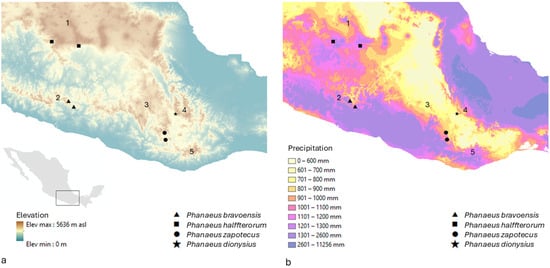
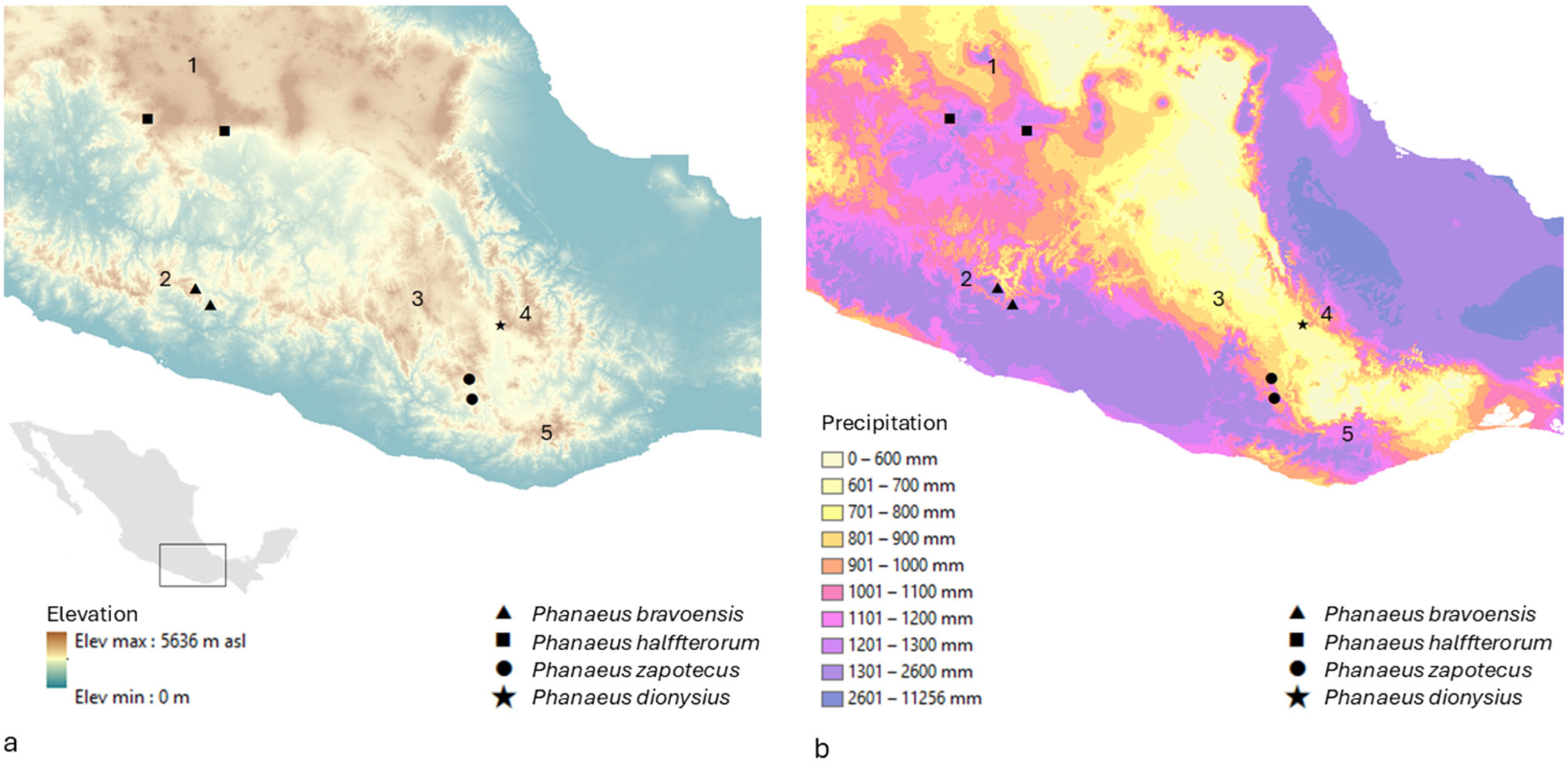
Distribution map of the Phanaeus halffterorum species complex. (a) Elevation. (b) Precipitation. 1 Trans-Mexican Volcanic Belt. 2 Sierra del Alquitrán. 3 Mixteca. 4 Sierra Norte de Oaxaca. 5 Sierra Sur de Oaxaca (2 and 5 form part of the physiographic region Coastal Cordillera, 2–5 are often categorized as part of the biogeographic region of the Sierra Madre del Sur).
Sampling: Phanaeus zapotecus specimens were collected between 13 and 15 September 2025 in the same area described by Daniel Curoe [11] near Sola de Vega, Oaxaca. Fungi were examined for typical signs of use by Phanaeus beetles. Sampling was conducted primarily during daylight hours; additional sampling was made at dawn. Eight pitfall traps with Suillus and Lactarius were installed, complemented by traps baited with human excrement.
3. Results
3.1. Phanaeus (Notiophanaeus) halffterorum
The first strict mycophagous scarab reported from Mexico was Phanaeus halffterorum [9], described from pine–oak forests in several localities of the municipality of Temascaltepec, State of Mexico. Although Edmonds did not specify the fungal hosts, B.K., who participated in the collecting expedition, recalls collecting the species in Boletus and Lactarius. Edmonds [9] also reported Liatongus rhinocerulus, Ateuchus sp., and Onthophagus sp. from fungi in the same localities. Julián Blackaller (pers. comm.) collected this species in Colonia del Bosque near Cuernavaca, Morelos, in a pine–oak forest at approximately 2000 m.
This species has never been collected in animal excrement (cattle, donkey, horse, human, or swine) or in carrion-baited pitfall traps [9]. Although nests have not been found in the wild, Edmonds successfully reared two pairs using commercial mushrooms, recovering five brood balls that yielded eggs and third-instar larvae. Nesting behavior and larval morphology agree with those of other Phanaeus species [15,16,17].
3.2. Phanaeus (Notiophanaeus) bravoensis
According to Moctezuma et al. [18], who described Phanaeus bravoensis from specimens previously thought to be P. halffterorum, this species has been collected in carrion- and dung-baited traps. Nevertheless, after carefully reviewing the evidence, P. bravoensis has to be considered a strict mycophage. Delgado Castillo [12] studied the dung beetle fauna of the municipality of Chilpancingo de los Bravo, Guerrero, in the Sierra Madre del Sur, where P. bravoensis is endemic (cited as P. halffterorum). He never collected P. bravoensis in carrion-, dung-, or fruit-baited traps, nor directly on these substrates in the field. Specimens were collected between June and November at light traps (3 ♂♂, 2 ♀♀) or with permanent carrion-baited traps (2 ♂♂, NTP-80) [19]. Delgado Castillo [12] suggested that beetles were attracted to the carrion-baited traps by the acidulated alcohol used in the trap, which smelled similar to decomposing fungi.
Julián Blackaller (pers. comm.) has collected in this area for the past twenty years and has obtained approximately 80 specimens of P. bravoensis in fungi or in galleries below them. During collecting campaigns (June–August, 2009–2013) in San Roque, Sierra del Alquitrán, Guerrero, he collected Liatongus rhinocerulus, Phanaeus bravoensis, Onthophagus sp., and Onthotrupes guerreroensis (Howden, 1964) feeding on Amanita (caesarea complex) and Suillus. He observed P. bravoensis flying at dawn and dusk and repeatedly found pairs constructing nests and brood balls using Suillus and other fungi. He has neither collected nor observed P. bravoensis feeding or nesting with carrion or dung. A single specimen was collected in a fermenting banana–guava trap, likely attracted by alcoholic odors resembling decomposing fungi. These observations confirm P. bravoensis as strictly mycophagous, together with P. halffterorum and P. zapotecus.
3.3. Phanaeus (Notiophanaeus) zapotecus
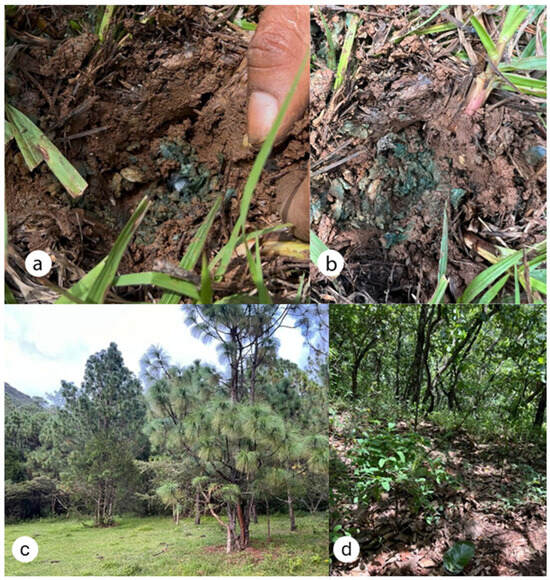
Phanaeus zapotecus was found feeding on Lactarius indigo (Schwein.) Fr. 1838 and Suillus granulatus (L.) Roussel, 1796. It was also observed constructing a nest (14 September 2025) using L. indigo (Figure 3a,b) in a seasonally dry pine–oak forest with junipers (Figure 3c). The chamber contained a male and a female surrounded by fungal material. Henry & Anne Howden reported collecting this species on toadstools, a term typically applied to poisonous Amanita species, suggesting that P. zapotecus may also exploit Amanita.
Figure 3.
(a) Underground chamber with male P. zapotecus. Blue color is a mass of Lactarius indigo filling the ground chamber. (b) Fungus-filled underground chamber. (c) Sola de Vega. Seasonally dry pine–oak forest with junipers where Phanaeus zapotecus was collected. (d) San Pablo Etla. Deciduous oak–scrub forest where Phanaeus dionysius was collected.
Specimens were collected at forest edges rather than inside the forest and were observed and captured flying at dusk. The human dung-baited traps placed nearby failed to collect P. zapotecus (capturing only Phanaeus damocles Harold, 1963 instead). Other species collected in Hygrophorus russula (Schaff.) Kauffman (1918) at the same locality included Liatongus rhinocerulus and Onthophagus sp. A notable observation was the rapid color change of a male P. zapotecus from green to dark upon having been collected in a fungus nest chamber (2025, M.R. near Sola de Vega) and then being exposed to air, a phenomenon also observed in Onthotrupes pecki (Howden, 1974) in 2017 by B.K. [20].
3.4. Revalidation of Phanaeus (Notiophanaeus) dionysius
Phanaeus (Notiophanaeus) dionysius Kohlmann, Arriaga-Jiménez & Rös, 2018 [20] (p. 67).
Phanaeus (Notiophanaeus) zapotecus Edmonds, 2006 (new synonymy by Moctezuma & Halffter [21] (p. 47).
Phanaeus (Notiophanaeus) dionysius Kohlmann, Arriaga-Jiménez & Rös, 2018 (restoration of species status by Kohlmann et al. [22] (p. 21).
Phanaeus (Notiophanaeus) zapotecus Edmonds, 2006 (synonymy revalidated by Moctezuma [23] (p. 60).
Phanaeus (Notiophanaeus) dionysius Kohlmann, Arriaga-Jiménez & Rös, 2018 (reiteration of species status revalidation).
In 2018, Kohlmann et al. [20] described Phanaeus dionysius from Oaxaca. In 2021, Moctezuma & Halffter [21] synonymized this species with Phanaeus zapotecus Edmonds, 2006, based mainly on variation in external morphology and the endophallite. In 2023, Kohlmann et al. [22] restored the species status of P. dionysius. Subsequently, in 2025, Moctezuma [23] again synonymized P. dionysius with P. zapotecus, based on the female pronotal central tubercle and other morphological characters. The holotype male and three paratypes (one male, two females) of P. zapotecus were deposited in the IEXA insect collection [11] and could not be located for taxonomic comparisons (as was also reported by Moctezuma & Halffter [21]). Here, we reiterate the revalidation of Phanaeus dionysius to species status for the following reasons:
Holotype. Kohlmann et al. [20] (fig. 2a, b) illustrated a fully developed male, and Kohlmann et al. [22] (fig. 2) presented the fully developed male holotype and the female allotype. These individuals were stored in the IEXA in 2018, where they have remained until today. All type material was re-examined for the present study and matched the original illustrations in every respect. Nevertheless, Moctezuma & Halffter [21] and Moctezuma [23] reported the holotype as a minor male and therefore unreliable for species diagnosis. The basis for their claim is unclear.
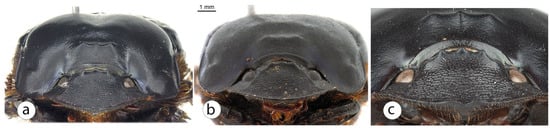
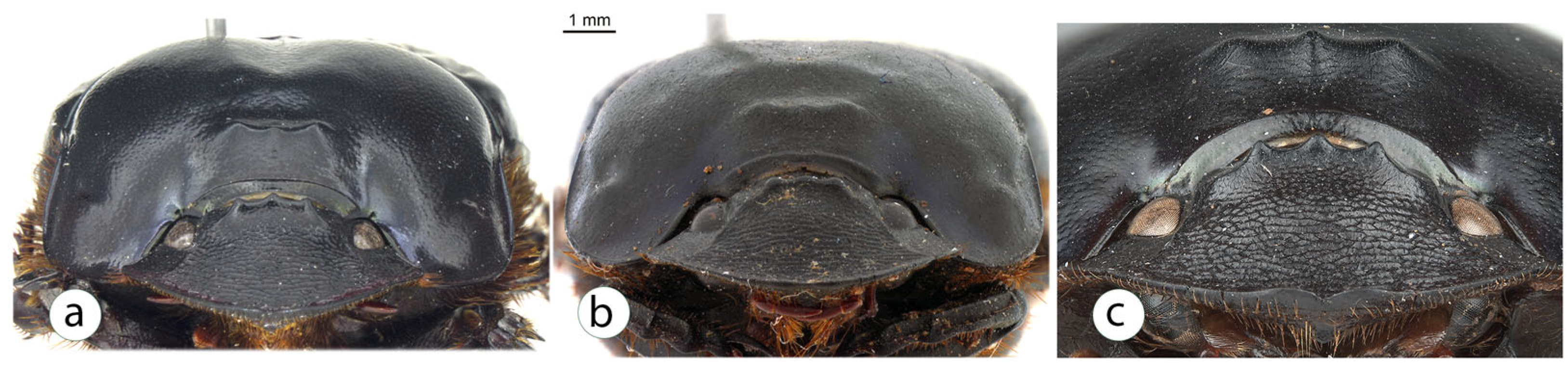
Female head tubercles. For specimens of P. dionysius, the lateral tubercles are separated, in frontal view, from the central tubercle by more than the width of their base (Figure 4a). In specimens of P. zapotecus, the lateral tubercles are separated by one width of the tubercle base from the central tubercle (Figure 4b,c).
Figure 4.
Female head tubercles. (a) Phanaeus dionysius allotype, IEXA. (b) Phanaeus zapotecus paratype, CNIN. (c) Phanaeus zapotecus paratype, CMN.
Female central pronotal tubercles. In P. dionysius, the central tubercles are well developed (Figure 5a), whereas in P. zapotecus they range from nearly effaced to slightly developed (Figure 5b–e). Moreover, pronotal tubercles seem to be united on their bases in frontal view in P. dionysius (Figure 4a), whereas in the case of P. zapotecus the tubercles are independent and separated in frontal view (Figure 4b,c). These differences have been interpreted as population-level variation by Moctezuma [23] (p. 60), but they are geographically separated: P. dionysius occurs in the Sierra Norte, whereas P. zapotecus occurs in the Sierra Sur of Oaxaca.
Figure 5.
Female central pronotal tubercles. (a) Phanaeus dionysius allotype, IEXA. (b) Phanaeus zapotecus paratype, CEMT. (c) Phanaeus zapotecus, CEMT. (d) Phanaeus zapotecus paratype, CNIN. (e) Phanaeus zapotecus paratype, TAMUIC.
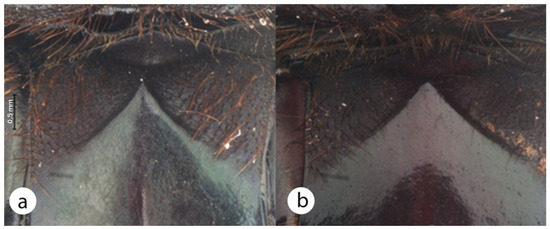
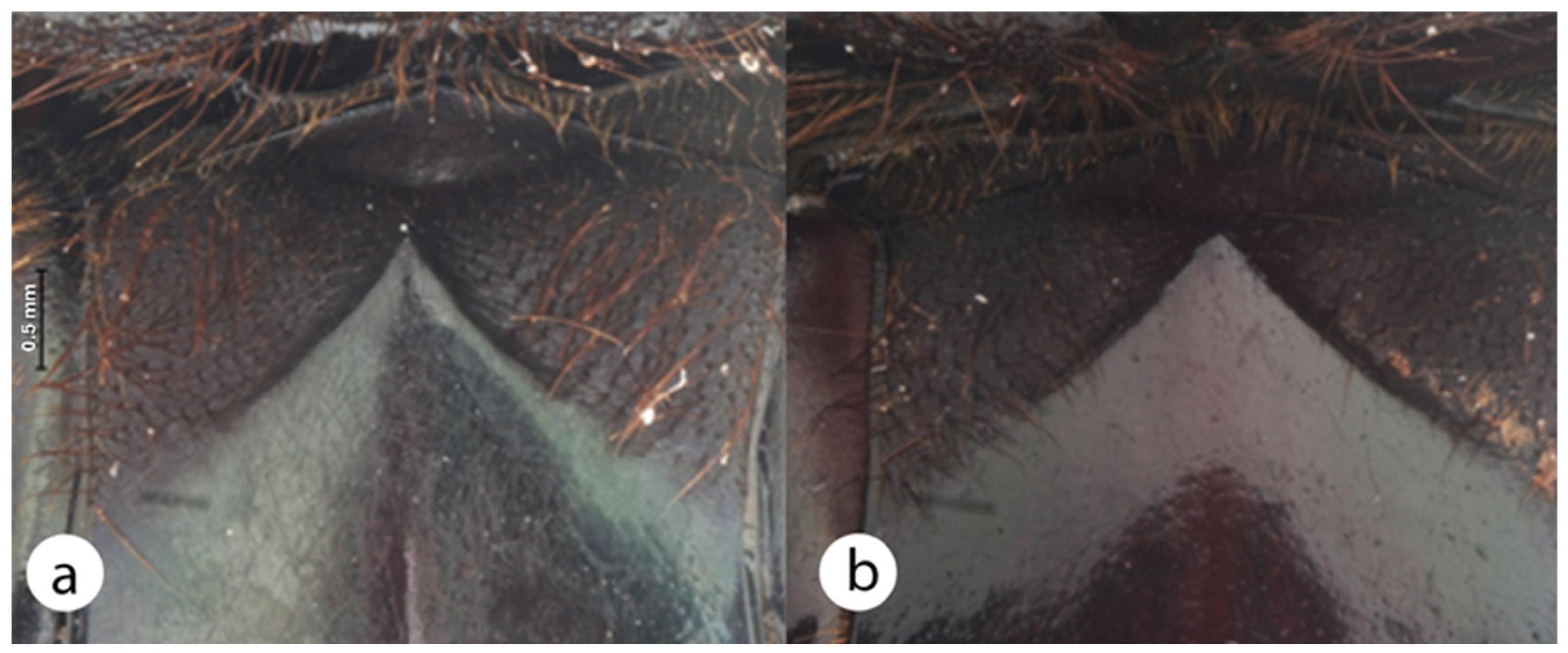
Major male metasternum. The metasternum is slender and more pointed apically in P. dionysius (Figure 6a), whereas it is broadly shaped in P. zapotecus (Figure 6b). Females and minor males tend to have a slender metasternum.
Figure 6.
Metasternal apex. (a) Phanaeus dionysius male holotype, IEXA. (b) Phanaeus zapotecus male, IEXA.
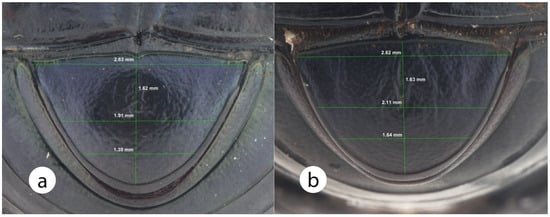
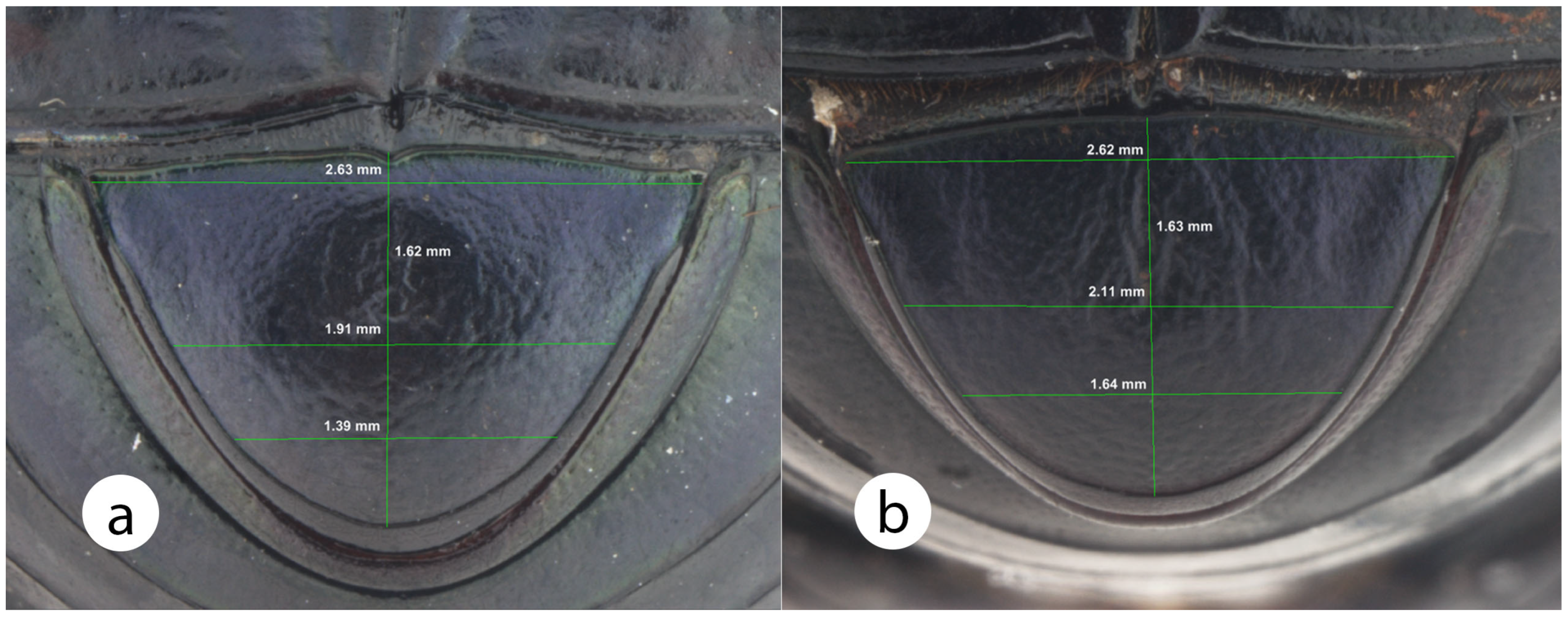
Major male pygidium. The pygidium shows a similar length-to-basal width ratio in both species (0.61 vs. 0.62). However, in P. zapotecus the pygidium is broader in the central and apical regions (1.63/2.11 = 0.77; 1.63/1.64 = 0.99; Figure 7b) than in P. dionysius (1.62/1.91 = 0.85; 1.62/1.39 = 1.16; Figure 7a). Moctezuma & Halffter [21] (p. 41, fig. 14 D, E) presented this photographic comparison in their publication, curiously without commenting on it.
Figure 7.
Pygidium. (a) Phanaeus dionysius male holotype, IEXA. (b) Phanaeus zapotecus male, IEXA.
Aedeagus morphology. Differences in the morphology of the aedeagus between the two species were documented in the original description [20] (2018: figs. 3b–e) but were dismissed by Moctezuma & Halffter [21] and Moctezuma [23] as “not taxonomically informative for separating species.” This dismissal contrasts with Moctezuma & Halffter’s [21] own acknowledgment that aedeagal morphology has been considered taxonomically important by previous authors [13,24,25,26,27]. Moctezuma & Halffter [21] further indicated that male genital structures are homogeneous in the P. amethystinus (except P. genieri), P. tridens, P. quadridens, and P. vindex species groups, but not in the P. endymion species group. In agreement with these studies, we consider aedeagal differences to be valid and taxonomically significant.
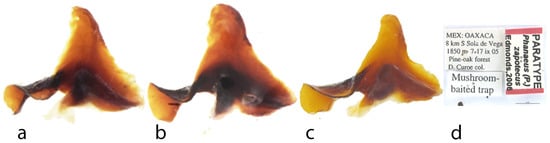
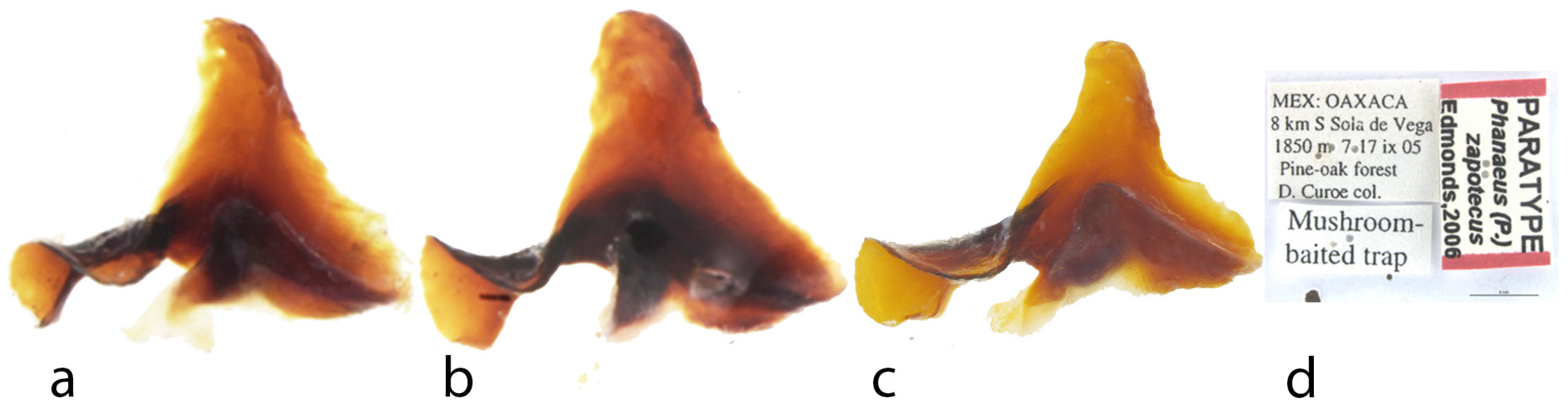
Endophallite. Moctezuma & Halffter [21] (p. 48) stated that the endophallites of both species are identical. We regard this as a misrepresentation. Although similar, as expected for vicariant species, they are clearly different, as shown in Figure 8. In P. dionysius, the left lobe is smaller, and the bridge connecting it to the right lobe is more twisted (Figure 8a) than in P. zapotecus (Figure 8b,c).
Figure 8.
Endophallite. (a) Phanaeus dionyisius holotype, IEXA. (b) Phanaeus zapotecus, IEXA. (c) Phanaeus zapotecus paratype endophallite, CEMT. (d) Phanaeus zapotecus paratype label, CEMT.
Distribution prediction map. A distribution prediction map for P. zapotecus was presented by Moctezuma [23] based on Lizardo et al. [28], using only three collection localities. At least five localities are generally required to produce reliable species distribution models, although fewer are sometimes accepted when data are scarce (Lizardo, pers. comm.). However, Sampaio and Cavalcante [29], in a study of the Caatinga biome in Brazil using MaxEnt, estimated the required minimum number of species records at 17 for species with narrow distributions. One of the three localities used [28] actually corresponds to P. dionysius, so the model for P. zapotecus is effectively based on only two localities separated by approximately 19 km. Incorporating the locality of P. dionysius into the model, therefore, constitutes circular reasoning. Consequently, the distribution map presented by Moctezuma [23] (fig. 10) lacks predictive power and cannot, as argued by Moctezuma [23] (p. 63), be invoked in opposition to the geographical isolation hypothesis proposed by Kohlmann et al. [20,22].
Ecology. Moctezuma & Halffter [21] did not address the biological, distributional, and ecological differences between the two species. Moctezuma [23] treated the distribution prediction map as an ecological and geographical argument supporting the presence of P. zapotecus across several mountain ranges from the Sierra Sur to the Sierra Norte. However, P. zapotecus is restricted to the Sierra Sur, inhabits an evergreen, seasonally dry pine–oak forest with junipers, and feeds exclusively on macromycetes (Figure 8b), whereas P. dionysius is restricted to the Sierra Norte, inhabits a deciduous oak–scrub forest (Figure 8a), and feeds exclusively on dung. Photographs of the two habitats clearly illustrate their pronounced ecological differences (Figure 3c,d).
The importance of distribution and ecology as species delimiters is well established and was emphasized by Moctezuma & Halffter [21] in their study of the P. tridens species group, where vicariant distributions were primarily driven by geography (mountain barriers) and ecology (dry forests, humid forests, temperate mountains). Similarly, Janzen et al. [30] demonstrated in Lepidoptera that cryptic skipper butterfly species can be distinguished by larval coloration, host plants, and ecology despite showing less than 2% COI divergence, suggesting that many cryptic species can only be separated using ecological and biological traits.
Food preferences. Moctezuma [23] (p. 62) suggested that the differing food preferences of P. dionysius and P. zapotecus may result from sampling artifacts and cited three Phanaeus species that facultatively exploit macromycetes, dung, and carrion. This situation does not apply here. Edmonds [11] (p. 35) reported that Daniel Curoe collected 79 specimens of P. zapotecus in July, September, and October using fungi-baited and interception traps, but none in human dung or decomposing squid traps. Henry & Anne Howden also collected two specimens on toadstools at 1850 m asl. This stenophagy was again confirmed during our 2025 collecting campaign, which also documented for the first time underground chambers filled with fungi constructed by pairs of P. zapotecus.
In contrast, our collections of P. dionysius in 2017 and 2025 at 1950 to 1980 m asl at San Pablo Etla, Oaxaca, yielded specimens exclusively from human dung-baited traps in April and June, with none collected in late September or from carrion- or fungi-baited traps. The same oak–scrub forest also harbors P. damocles, which responds to human dung and flies diurnally. Notably, we observed neither Lactarius nor Suillus species in this forest (even though in 2025 we visited Etla only one week after sampling P. zapotecus in Sola de Vega). This does not rule out their presence, but their apparently much lower abundance—together with the drier climate at this site (Figure 2) and stronger seasonality—may explain why fungal exploitation was never successfully developed in P. dionysius.
Above the collecting locality of P. dionysius, a pine–oak forest begins at approximately 2250 m a.s.l. Collecting in this forest yielded no Phanaeus species associated with fleshy fungi; instead, P. damocles was attracted to human, cattle, and horse dung. These observations support the conclusion that P. dionysius is restricted to the strongly deciduous oak–scrub forest at the base of the internal dry slope of the Sierra Norte facing the Oaxaca Valley.
Additionally, it is known that diet strongly influences gut bacterial composition across dung beetle species; thus, gut microbiomes are essential for exploiting specialized diets [31]. It has been found that mycophages have different gut microbiomes from coprophagous species, e.g., mycophages have a greater relative abundance of Lactobacillales and Tisierellales bacteria than coprophage dung beetles [31]. A similar situation can be expected to occur between P. dionysius and P. zapotecus.
4. Discussion
Although P. dionysius and P. zapotecus probably represent vicariant taxa [20], they do not appear to follow a Phylogenetic Niche Conservatism (PNC) tendency. Phanaeus dionysius inhabits deciduous oak–scrub forests (Figure 3d), whereas P. zapotecus inhabits pine–oak forests with junipers (Figure 3c). As an illustration, it has been estimated that biome stasis at speciation outweighs biome shifts by a ratio of more than 25:1, based on inferred ancestral biomes for an ecologically diverse sample of more than 11,000 plant species from across the Southern Hemisphere [32]. Given that the Phanaeus endymion species group includes scarab mycophages inhabiting pine–oak forests, this suggests that this Neotropical Phanaeus lineage [13,14,33] has modified its evolutionary inertia by rapidly adjusting biome preferences and exploiting new feeding opportunities. This species group exhibits an adaptive shift from coprophagous habits to mycophagy when departing from its original Neotropical biomes and colonizing forests of Nearctic origin.
Gillett & Toussaint [34] estimated the origin of the P. endymion species group stem at approximately 22 Ma (28–15 Ma), while crown group estimates suggest a temporal range of 21–4.25 Ma. However, the origin of P. bravoensis, P. dionysius, P. halffterorum, and P. zapotecus was probably much more recent, based on their close morphological affinities and the evolutionary model presented below (Figure 2). Edmonds [9] (p. 104) also stated that “… P. halffterorum can be interpreted as the product of relatively recent speciation …”. Gillett & Toussaint [34] (p. 16) likewise suggested that recent speciation processes may have driven the extant diversification of the P. endymion species group. Another study of a group of vicariant dung beetle species—Onthotrupes nuntiatus (Kohlmann & Arriaga-Jiménez, 2020), O. pecki (Howden, 1974), and O. viridiobscurus (Jekel, 1866)—distributed across the same mountain systems in Oaxaca suggests that speciation occurred during the last local glacial maximum (LLGM; 21–17.5 ka), when climate-driven altitudinal biome shifts took place [35]. Additional examples of this distributional pattern have been observed between Canthidium quercetorum (Kohlmann, Arriaga-Jiménez & Rös 2018) and C. howdeni (Kohlmann and Solís 2006), closely related species separated by the Central Valleys of the Oaxaca plateau [36].
Moctezuma [23], in his rebuttal regarding feeding preferences, indicated that Phanaeus chiapanecus Moctezuma & Halffter, 2021; P. edmondsi Moctezuma, Deloya & Halffter, 2019; and P. huichol Moctezuma, Sánchez-Huerta & Halffter, 2017 are attracted to fungi as well as to dung and carrion. These three species are primarily distributed in tropical and subtropical dry broadleaf forests and only marginally enter tropical and subtropical coniferous forests [28]. This may explain why P. bravoensis, P. halffterorum, and P. zapotecus, which are strict mycophages, are distributed in pine–oak forests. This forest type is rich in large fleshy mushrooms, representing a novel and readily available food resource during the rainy season. Concomitantly, dung characteristics may also play a role. In Nearctic forests, dung produced by herbivorous mammals tends to be hard, dry, and pellet-like (e.g., deer, rabbits, squirrels), and is thus possibly less attractive, whereas in tropical regions, dung is typically soft, humid, and pat-like (e.g., monkeys, peccaries, tapirs). Further, big, fleshy fungi somewhat resemble the physical characteristics of dung found in the Neotropics. The distribution and feeding preferences of these three Phanaeus species may therefore reflect a recent ecological adaptation from Neotropical dung-based resources to fungi.
Coincident with these factors is the extinction of the North American megafauna. This mass extinction event, centered around 11,000 years ago at the end of the Pleistocene, resulted in the loss of approximately 32 large mammal genera (72%) over a span of roughly 2000 years [37]. This extinction likely caused a substantial reduction in food resources for dung beetles. Although rarely considered as a major factor shaping dung beetle evolution in the Americas, its impact must have been profound. Schweiger & Svenning [38], in a study of European megafaunal loss, concluded that mammal community downsizing is associated with a synchronous decline in dung beetle communities over broad spatial and temporal scales. According to these authors, the later availability of domesticated megafauna associated with human agricultural expansion did not compensate for the loss of wild megafauna.
Furthermore, a significant proportion of the late Quaternary dung beetle fauna is likely extinct, including two of the six species recorded from the La Brea tar pits in California, Copris pristinus Pierce, 1946 and Onthophagus everestae Pierce, 1946 [39,40]. Tarasov et al. [41] also included Phanaeus labreae (Pierce, 1946) Miller, Gordon & Howden, 1981 as a fossil species from the Upper Pleistocene (68–4 ka). Another extinct Phanaeus species is P. violetae Zunino, 2013 from the Upper Pleistocene of the Ecuadorian Andes (35–10 ka) [42]. The extinction of Phanaeus species during megafaunal collapse is therefore well documented. Galetti et al. [43] (p. 850) suggested that “the use of non-faecal food resources may have rescued some dung beetles from megafauna co-extinction because many dung beetles are generalist users of dung resources”. Such a shift in food use may explain the origin of mycophagous Phanaeus.
These biogeographical and ecological considerations suggest the following speciation scenario. In both sister-species pairs (bravoensis–halffterorum and zapotecus–dionysius), a common ancestral species may have inhabited lowland areas of the Mexican Central Pacific basins: the Balsas River Depression in the first case and the Central Valleys of Oaxaca in the second. These four species are morphologically distinct from all other members of the P. endymion species group based on the strongly developed posterior pronotal angles of major males, which are directed posterolaterally and slightly upturned apically (Figure 1), thereby defining the Phanaeus halffterorum species complex. It is likely that the ancestral species possessed these characters. During the LLGM [20,35,44], ancestral populations ascended into surrounding mountain systems, became geographically isolated, and underwent vicariant speciation as climates warmed. Thus, P. bravoensis (1770–2150 m) and P. zapotecus (1850–2150 m) differentiated in the Sierra Madre del Sur, whereas P. halffterorum (1860–2360 m) and P. dionysius (1970–2220 m) differentiated in the Trans-Mexican Volcanic Belt and the Sierra Norte de Oaxaca, respectively (Figure 2a). Phanaeus dionysius maintained the phylogenetic niche conservatism of the species of the P. endymion species group living along the Pacific slope; it retained the original coprophagous habits and deciduous broadleaf tropical–subtropical forest abode. According to Lizardo et al. [28], P. halffterorum, P. dionysius, and P. zapotecus have the highest, third, and fourth highest altitudinal distribution, respectively, of all Phanaeus. Additionally, undiscovered species may exist in other sectors of these mountain systems.
Other factors may have contributed to this LLGM-driven scenario. Upward range shifts could also have been facilitated by interspecific competition. The lower portions of both geographic depressions are currently occupied by species of the P. tridens species group, which are similar in size to members of the P. endymion group and thus likely competitors [45]. In the Balsas River Depression, P. daphnis (260–2300 m) occurs, whereas P. nimrod Harold, 1863 (1450–1780 m) occupies the Oaxaca Central Valleys. Competition with these species may have promoted the climatically driven ascent and vicariant speciation of the ancestor of the P. halffterorum species complex. In summary, climate change, competition, megafaunal extinction, and the availability of a new, abundant, and seasonally stable food source in a novel biome may together have mediated the vicariant speciation of these two species pairs.
5. Conclusions
The number of known strictly mycophagous Phanaeus species has increased from one to three. This paper reports for the first time the use of fungi for food provisioning and nest building by P. bravoensis and P. zapotecus. Both species appear to be active at dawn and dusk. Mycophagy appears to be a widespread feeding strategy among Scarabaeinae in Mexico, particularly in pine–oak forests, and at least the Phanaeus endymion and P. tridens species groups utilize fungi as a food resource. Within the P. endymion species group, mycophagous behavior appears to be associated with species whose distributions are centered in pine–oak forests. These forests provide an abundant and stable food resource during the rainy season through the availability of large, fleshy fungi (Amanita, Boletus, Hygrophorus, Lactarius, Russula, Suillus). Another factor potentially promoting the shift in feeding preferences is the change from soft, humid, pat-like dung typical of tropical forests to the hard, dry, pellet-like dung common in Nearctic forests, which may be less suitable for beetles of Neotropical origin. The vicariant speciation of these mycophagous species thus appears to be the result of combined effects of competition, climate change during the last local glaciation, megafaunal extinction, and ecological opportunity, and therefore represents a relatively recent evolutionary event. Finally, we propose that arguments for synonymizing species names be based on morphological and other comparisons supported by photographic documentation of the structures being compared, in order to avoid potentially contentious actions.
Author Contributions
Conceptualization, B.K. and M.R.; methodology, B.K., M.R., E.F.M.-A., P.A.G.-V., C.R.-P., B.R.B. and A.D.-R.; software, E.F.M.-A., M.R. and B.R.B.; validation, B.K., M.R. and E.F.M.-A.; formal analysis, B.K., M.R., E.F.M.-A. and P.A.G.-V.; research, B.K., M.R., E.F.M.-A. and P.A.G.-V.; resources, M.R.; data curation, B.K., M.R., E.F.M.-A. and P.A.G.-V.; writing—original draft preparation, B.K. and M.R.; writing—review and editing, B.K., M.R., E.F.M.-A., P.A.G.-V., C.R.-P. and A.D.-R.; visualization, E.F.M.-A., B.R.B. and M.R.; supervision, B.K. and M.R.; project administration, M.R. and P.A.G.-V.; funding acquisition, M.R. and P.A.G.-V. All authors have read and agreed to the published version of the manuscript.
Funding
This research was funded by SECIHTI Mexico, grant number CBF2023-2024-3006.
Data Availability Statement
Data supporting reported results can be found in the cited collections and directly with the authors.
Acknowledgments
We extend heartfelt thanks to William David Edmonds for having reviewed the present text, as well as two anonymous reviewers and the editor. We thank Julián Blackaller for sharing his extensive field observations on Phanaeus bravoensis and for providing photographs of P. bravoensis, P. dionysius, and P. halffterorum from his personal collection. We are grateful to César Kevin Pérez for identifying the fungi. We are thankful to Fernando Vaz de Mello for photographs from the Coleção Entomológica de Mato Grosso Eurides Furtado, (CEMT), Cuiabá, Brazil. We are also in debt with François Génier from the Canadian Museum of Nature, Gatineau, Canada, and Mario Cupello from the Texas A & M Insect Collection, College Station, USA, for taking photographs. We are very grateful to Viridiana Vega of the IEXA Insect Collection “Dr. Miguel Ángel Morón Ríos” (Xalapa, Mexico) for her invaluable assistance in facilitating BK’s study of specimens. We extend our sincere thanks to Francisco Armendariz Toledano, Edwin Ariza, and Julián Alexander of the National Insect Collection (CNIN), Institute of Biology, UNAM, Mexico, for their support during BK’s visit. We also thank Camila Alcántara Pereira da Silva, technician of the Biodiversity II (LANABIO) Photography and Microscopy Laboratory from the National Autonomous University of Mexico, for allowing us to use the photographic equipment. We thank the Ministry of Environment and Natural Resources (SEMARNAT) for granting the scientific collection permit No. SPARN/DGVS/04809/24. Finally, we thank Viridiana Lizardo for enlightening discussions on climatically based distribution prediction processes.
Conflicts of Interest
The authors declare no conflicts of interest. The BioAlfa Barcoding Project had no role in this study and did not provide any funding.
References
- Navarrete-Heredia, J.L.; Galindo-Miranda, N.E. Escarabajos asociados a Basidiomycetes en San José de Los Laureles, Morelos, México (Coleoptera: Scarabaeidae). Folia Entomol. Mex. 1997, 99, 1–16. [Google Scholar]
- Zunino, M. Aspectos taxonómicos y biogeográficos del poblamiento americano de Oniticellini. Zool. Neotrop. 1982, 1, 1083–1089. [Google Scholar]
- Philips, T.K. Phylogeny of the Oniticellini and Onthophagini dung beetles from morphological evidence. ZooKeys 2016, 579, 7–57. [Google Scholar] [CrossRef] [Scilit] [PubMed]
- Hernández, B.; Rivera-Rodríguez, D.M.; Deloya, C.; Vásquez-Bolaños, M.; Navarrete-Heredia, J.L. Species richness and ecogeographic patterns of Scarabaeinae (Coleoptera: Scarabaeidae) in Jalisco, Mexico. J. Insect Biodivers. 2026, 81, 11–32. [Google Scholar] [CrossRef] [Scilit]
- Anduaga, S. Escarabajos coprófagos (Coleoptera: Scarabaeoidea) asociados a hongos en la Sierra Madre Occidental, Durango, México: Con una compilación de las especies micetófagas. Acta Zool. Mex. 2000, 80, 119–130. [Google Scholar] [CrossRef] [Scilit]
- Navarrete-Heredia, J.L.; Quiroz-Rocha, G.A. Necrophilous beetles (Coleoptera: Scarabaeidae and Silphidae) of San José de los Laureles, Morelos, Mexico. Folia Entomol. Mex. 2000, 109, 1–14. [Google Scholar]
- Sánchez-Hernández, G.; Chamé-Vázquez, E.R.; Gómez, B. Diversidad de escarabajos micetófilos a lo largo de un gradiente altitudinal de la región central de Chiapas, México. Acta Zool. Mex. 2023, 39, 1–15. [Google Scholar] [CrossRef] [Scilit]
- Hinton, H.E. Anotaciones acerca de las costumbres micetofágicas de dos especies de Phanaeus. An. Inst. Biol. 1935, 6, 129–130. [Google Scholar]
- Edmonds, W.D. A new species of Phanaeus from Mexico (Coleoptera: Scarabaeidae). Pan-Pac. Entomol. 1979, 55, 99–105. [Google Scholar]
- Delgado-Castillo, L.L.; Navarrete-Heredia, J.L. Coleópteros micetobiontes (Insecta: Coleoptera). In La Biodiversidad en Veracruz. Estudio de Estado; CONABIO: Mexico City, Mexico, 2011; Volume 2, pp. 457–467. [Google Scholar]
- Edmonds, W.D. A new species of Phanaeus MacLeay (Coleoptera: Scarabaeidae: Scarabaeinae: Phanaeini) from Oaxaca, Mexico. Zootaxa 2006, 1171, 31–37. [Google Scholar] [CrossRef] [Scilit]
- Delgado-Castillo, L.L. Fauna de coleópteros lamellicornios de Acahuizotla, Guerrero, México. Bachelor’s Thesis, Universidad Nacional Autónoma de México, Mexico City, Mexico, 1989. [Google Scholar]
- Edmonds, W.D. Revision of Phanaeus MacLeay, a New World genus of Scarabaeinae dung beetles (Coleoptera: Scarabaeidae). Contrib. Sci. 1994, 443, 1–105. [Google Scholar] [CrossRef] [Scilit]
- Edmonds, W.D.; Zídek, J. Taxonomy of Phanaeus revisited: Revised keys to and comments on species of the New World dung beetle genus Phanaeus MacLeay, 1819 (Coleoptera: Scarabaeidae: Scarabaeinae: Phanaeini). Insecta Mundi 2012, 274, 1–108. [Google Scholar]
- Halffter, G.; Matthews, E.G. The natural history of dung beetles of the subfamily Scarabaeinae (Coleoptera: Scarabaeidae). Folia Entomol. Mex. 1966, 12–14, 1–312. [Google Scholar]
- Halffter, G. Evolution of nidification in the Scarabaeinae (Coleoptera: Scarabaeidae). Quaest. Entomol. 1977, 13, 231–253. [Google Scholar]
- Edmonds, W.D.; Halffter, G. Taxonomic review of immature dung beetles of the subfamily Scarabaeinae (Coleoptera: Scarabaeidae). Syst. Entomol. 1978, 3, 301–331. [Google Scholar] [CrossRef] [Scilit]
- Moctezuma, V.; Sánchez-Huerta, J.L.; Halffter, G. Two new species of the Phanaeus endymion species group. ZooKeys 2017, 702, 113–135. [Google Scholar] [CrossRef] [Scilit]
- Morón, M.A.; Terrón, R. Distribución altitudinal y estacional de los insectos necrófilos en la Sierra del Norte de Hidalgo. Acta Zool. Mex. 1984, 5, 1–47. [Google Scholar]
- Kohlmann, B.; Arriaga-Jiménez, A.; Rös, M. Dung beetle vicariant speciation in the mountains of Oaxaca, Mexico. ZooKeys 2018, 743, 67–93. [Google Scholar] [CrossRef] [Scilit]
- Kohlmann, B.; Arriaga-Jiménez, A.; Mora-Aguilar, E.F. An annotated checklist of the dung beetles of Oaxaca, Mexico. Insecta Mundi 2023, 981, 1–34. [Google Scholar]
- Moctezuma, V.; Halffter, G. Taxonomic revision of the Phanaeus endymion species group. Eur. J. Taxon. 2021, 747, 1–71. [Google Scholar] [CrossRef] [Scilit]
- Moctezuma, V. Taxonomic and nomenclatural issues revisited in the New World Scarabaeinae dung beetles. J. Insect Biodivers. 2025, 62, 55–66. [Google Scholar] [CrossRef] [Scilit]
- Arnaud, P. Phanaeini. Les Coléoptères du Monde; Hillside Books: Canterbury, UK, 2002. [Google Scholar]
- Price, D.L. A phylogenetic analysis of the dung beetle genus Phanaeus. Insect Syst. Evol. 2007, 38, 1–18. [Google Scholar] [CrossRef] [Scilit]
- Moctezuma, V.; Halffter, G. A new species of Phanaeus MacLeay from Los Chimalapas, Oaxaca, Mexico. Coleopt. Bull. 2017, 71, 47–56. [Google Scholar] [CrossRef] [Scilit]
- Moctezuma, V.; Deloya, C.; Sánchez-Huerta, J.L.; Halffter, G. A new species of the Phanaeus endymion species group. Ann. Soc. Entomol. Fr. 2019, 55, 249–254. [Google Scholar] [CrossRef] [Scilit]
- Lizardo, V.; Moctezuma, V.; Escobar, F. Distribution, regionalization, and diversity of the dung beetle genus Phanaeus. Zootaxa 2022, 5213, 546–568. [Google Scholar] [CrossRef] [Scilit]
- Sampaio, A.C.P.; Cavalcante, A.M.B. Accurate species distribution models: Minimum required number of specimen records in the Caatinga biome. An. Acad. Bras. Ciências 2023, 95, e20201421. [Google Scholar] [CrossRef] [Scilit]
- Janzen, D.H.; Hallwachs, W.; Burns, J.M.; Hajibabaei, M.; Bertrand, C.; Hebert, P.D.N. Reading the complex skipper butterfly fauna of one tropical place. PLoS ONE 2011, 6, e19874. [Google Scholar] [CrossRef] [Scilit]
- de Beer, J.C.; Alayande, K.A.; Pirk, C.W.W.; Adeleke, R.A.; Sole, C.L. Dietary specialisation shapes gut bacterial diversity in dung beetles. Environ. Microbiol. Rep. 2026, 18, e70317. [Google Scholar] [CrossRef] [Scilit]
- Crisp, M.D.; Arroyo, M.T.K.; Cook, L.G.; Gandolfo, M.A.; Jordan, G.J.; McGlone, M.S.; Weston, P.H.; Westoby, M.; Wilf, P.; Linder, H.P. Phylogenetic biome conservatism on a global scale. Nature 2009, 458, 754–756. [Google Scholar] [CrossRef] [Scilit]
- Edmonds, W.D. Comparative skeletal morphology, systematics and evolution of the Phanaeine dung beetles (Coleoptera: Scarabaeidae). Univ. Kans. Sci. Bull. 1972, 49, 731–874. [Google Scholar]
- Gillett, C.P.D.T.; Toussaint, E.F.A. Macroevolution and shifts in the feeding biology of the New World scarab beetle tribe Phanaeini. Biol. J. Linn. Soc. 2020, 130, 661–682. [Google Scholar] [CrossRef] [Scilit]
- Arriaga-Jiménez, A.; Kohlmann, B.; Vázquez-Selem, L.; Umaña, Y.; Rös, M. Past and future sky-island dynamics of tropical mountains. Holocene 2020, 30, 1462–1470. [Google Scholar] [CrossRef] [Scilit]
- Kohlmann, B.; Arriaga-Jimenez, A.; Rös, M. An unusual new species of Canthidium (Coleoptera: Scarabaeidae: Scarabaeinae) from Oaxaca, Mexico. Zootaxa 2018, 4378, 273–278. [Google Scholar] [CrossRef] [Scilit] [PubMed]
- Johnson, W.H. Pleistocene Epoch. Encycl. Br. 2025. Available online: https://www.britannica.com/science/Pleistocene-Epoch (accessed on 20 December 2025).
- Schweiger, A.H.; Svenning, J.-C. Down-sizing of dung beetle assemblages over the last 53,000 years. Oikos 2018, 127, 1243–1250. [Google Scholar] [CrossRef] [Scilit]
- Miller, S.E. Late Quaternary insects of Rancho La Brea and McKittrick, California. Quat. Res. 1983, 20, 90–104. [Google Scholar] [CrossRef] [Scilit]
- O’Keefe, F.R.; Fed, E.V.; Harris, J.M. Compilation, calibration, and synthesis of faunal and floral radiocarbon dates. Contrib. Sci. 2009, 518, 1–16. [Google Scholar] [CrossRef] [Scilit]
- Tarasov, S.; Vaz-de-Mello, F.Z.; Krell, F.-T.; Dimitrov, D. A review and phylogeny of Scarabaeine dung beetle fossils. PeerJ 2016, 4, e1988. [Google Scholar] [CrossRef] [Scilit]
- Clapperton, C. Quaternary Geology and Geomorphology of South America; Elsevier: Amsterdam, The Netherlands, 1993. [Google Scholar]
- Galetti, M.; Moleón, M.; Jordano, P.; Pires, M.M.; Guimarães, P.R.; Pape, T.; Nichols, E.; Hansen, D.; Olesen, J.M.; Munk, M. Ecological and evolutionary legacy of megafauna extinctions. Biol. Rev. 2018, 93, 845–862. [Google Scholar] [CrossRef] [Scilit]
- Kohlmann, B.; Arriaga-Jiménez, A.; Salomão, R.P. Rapoport’s Rule and the effect of the last glaciation upon elevational range size: An analysis using a dung beetle model (Coleoptera: Scarabaeidae: Onthophagus) in Mexican tropical mountains. Holocene 2021, 32, 208–219. [Google Scholar] [CrossRef] [Scilit]
- Kohlmann, B. Dung beetles in subtropical North America. In Dung Beetle Ecology; Princeton University Press: Princeton, NJ, USA, 1991; pp. 116–132. [Google Scholar]

Disclaimer/Publisher’s Note: The statements, opinions and data contained in all publications are solely those of the individual author(s) and contributor(s) and not of MDPI and/or the editor(s). MDPI and/or the editor(s) disclaim responsibility for any injury to people or property resulting from any ideas, methods, instructions or products referred to in the content. |
© 2026 by the authors. Licensee MDPI, Basel, Switzerland. This article is an open access article distributed under the terms and conditions of the Creative Commons Attribution (CC BY) license.