Article

A HF-Free Synthesis Method for High-Luminescent Efficiency Narrow-Bandgap Red Phosphor K3AlF6: Mn4+ with NH4HF2 as the Molten Salt


1
College of Rare Earth, Jiangxi University of Science and Technology, Ganzhou 341000, China
2
National Rare Earth Functional Materials Innovation Center, Guorui Kechuang Rare Earth Functional Materials (Ganzhou) Co., Ltd., Ganzhou 341100, China
3
School of Physical Science and Technology, Lingnan Normal University, Zhanjiang 524048, China
*
Authors to whom correspondence should be addressed.
Solids 2025, 6(4), 66; https://doi.org/10.3390/solids6040066 (registering DOI)
Submission received: 6 November 2025 / Revised: 26 November 2025 / Accepted: 28 November 2025 / Published: 1 December 2025

Abstract

Mn4+-doped fluoride red phosphors are widely used in white LED lighting and display applications due to their excellent luminescent properties. However, their synthesis relies heavily on highly toxic aqueous hydrofluoric acid, which not only causes severe environmental and soil/water pollution but also makes it difficult to control the microstructure of the products due to the rapid reaction rate. In this study, low-melting-point NH4HF2 was used as the molten salt, with KMnO4 and MnF2 as manganese sources, to synthesize the red phosphor K3AlF6: Mn4+ via the molten salt method. After the reaction, impurities such as NH4HF2 were removed by washing with a dilute H2O2 solution. The microstructure, photoluminescence properties, thermal quenching behavior, and application in warm white light-emitting diodes (W-LEDs) of the K3AlF6: Mn4+ phosphors were investigated. The results indicate that the phosphors prepared by this method consist of a single pure phase. By adjusting the molten salt content, the morphology of the product can be transformed from nanoparticle-like to nanorod-like structures. All products exhibit the characteristic red emission of Mn4+ under blue and violet light excitation, with the optimally doped sample achieving an internal quantum efficiency (IQE) of 69% under blue light excitation. The combination of the obtained K3AlF6: Mn4+ with the yellow phosphor YAG enabled the fabrication of W-LEDs. These W-LEDs achieved a color rendering index (Ra) of 86.8, a luminous efficacy (LE) of 77 lm/W, and a correlated color temperature (CCT) of 3690 K, along with excellent color stability under operating conditions.

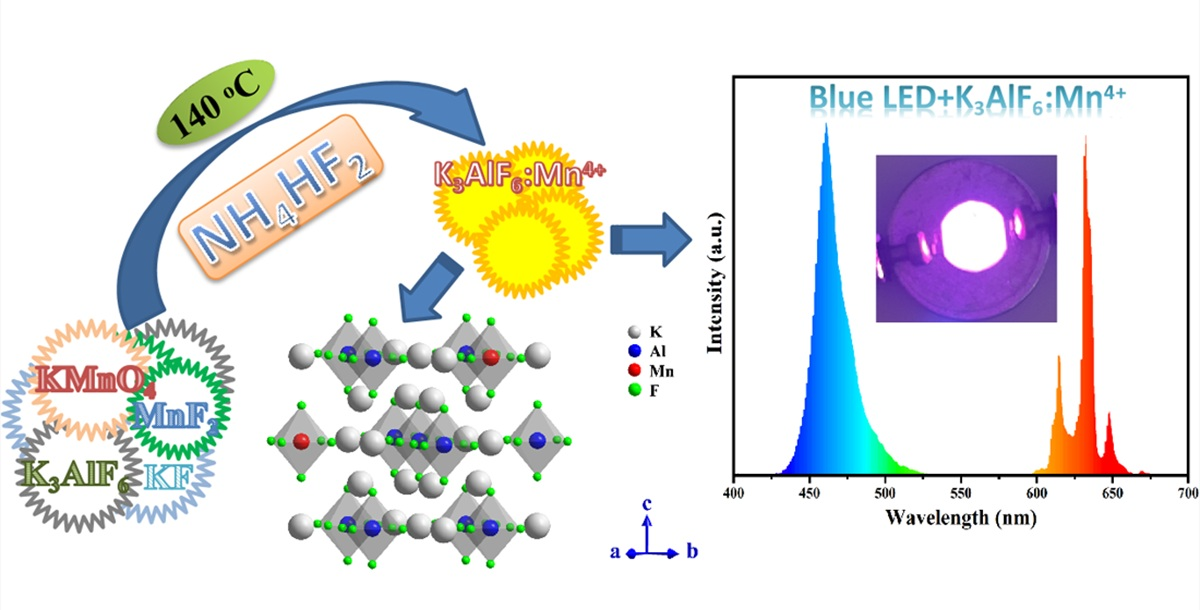
Graphical Abstract

1. Introduction

Due to the spin-allowed 4A2g4T2g transition and the electric dipole-forbidden 2Eg4A2g transition of Mn4+ ions, the Mn4+-doped phosphors exhibit broad excitation bands and narrow red emission bands [1,2,3]. Among them, Mn4+-doped fluoride red phosphors possess narrow emission bands, high quantum efficiency, and excellent thermal stability has attracted much attention [4,5,6]. These characteristics make them particularly attractive for effectively addressing the red deficiency in commercial W-LEDs, garnering significant research interest for their potential application as red-emitting components in blue-light-excited W-LEDs [7,8,9,10].
The ionic radii of Mn4+ and Al3+ are 0.53 Å and 0.54 Å, respectively. This similarity in ionic radius enables Mn4+ ions to readily substitute for Al3+ ions in fluoride matrices, facilitating the preparation of Mn4+-doped hexafluoroaluminates (with a general formula of M3AlF6: Mn4+, where M = Li, Na, K) [11]. Compared to K2SiF6: Mn4+ and other Mn4+-doped fluorides, M3AlF6: Mn4+ phosphors exhibit several potential advantages [7,12,13]. Firstly, M3AlF6 possesses a melting point exceeding 1000 °C, whereas K2SiF6 begins to decompose at 350 °C, resulting in superior thermal stability for M3AlF6. Secondly, M3AlF6 has lower water solubility compared to K2SiF6 and K2TiF6, leading to higher chemical stability for M3AlF6: Mn4+ under high-humidity conditions. Thirdly, M3AlF6 has long been used as a common chemical solvent for the industrial extraction of aluminum from bauxite and is already produced on a large scale worldwide, which facilitates the low-cost, mass production of M3AlF6: Mn4+. Consequently, the synthesis and luminescent properties of M3AlF6: Mn4+ phosphors have attracted extensive research interest in recent years, such as Na3AlF6: Mn4+ [14], K3AlF6: Mn4+ [12], K2NaAlF6: Mn4+ [15], K2LiAlF6: Mn4+ [16], Cs3AlF6: Mn4+ [17], and A2BAlF6: Mn4+ (where A = Rb, Cs; B = K, Rb) [18].
Several synthetic methods have been established for the preparation of M3AlF6: Mn4+ luminescent materials. For instance, Song et al. successfully synthesized Na3AlF6: Mn4+ phosphors via a co-precipitation route [19], while other researchers have produced K3AlF6: Mn4+ and K2NaAlF6: Mn4+ using techniques such as ion exchange and high-temperature solid-state reactions [20,21]. Nevertheless, the synthesis of these fluoride materials still predominantly depends on highly toxic hydrofluoric acid (HF) solutions, underscoring the pressing demand for greener and safer synthetic strategies [14]. Additionally, in concentrated HF aqueous media, ionic fluorides are prone to rapid nucleation and particle agglomeration, which complicates the control over phosphor particle size and dispersion [22]. To circumvent the use of hazardous HF liquids and F2 gas, various HF-free approaches have been explored for synthesizing Mn4+-doped fluoride red phosphors. These include hydrothermal, microwave-assisted, ionothermal reaction, co-precipitation, solid-state reaction, and organic-solvent-assisted methods [23,24,25,26,27,28,29]. Such strategies typically employ less toxic acids and precursors and offer benefits such as shortened reaction duration, high product yields, and the possibility of extending the synthesis to oxyfluoride compositions. However, these alternative techniques also present certain drawbacks, including the frequent need for high-temperature and high-pressure conditions, limited quantum efficiency, relatively small particle size, difficulties in regulating size distribution, the necessity of specific atmospheres for preparation, and challenges in large-scale production [30]. Consequently, the pursuit of more efficient and controllable HF-free synthesis routes continues to be a significant focus in this research field.
In our earlier research, we successfully applied a molten salt method using solid NH4HF2 as both the fluorine source and reaction medium to synthesize particulate K2SiF6: Mn4+ red phosphors with particle sizes around 15 μm [31]. This approach entirely eliminates the need for HF solutions or gaseous F2, which are commonly used in conventional syntheses, thereby mitigating safety hazards and equipment corrosion and aligning with green chemistry principles. To further explore the versatility of the molten salt method in preparing Mn4+-doped fluorides and the corresponding material characteristics, this work extends the strategy to synthesize K3AlF6: Mn4+ phosphors using NH4HF2 as the molten salt medium along with precursors such as K3AlF6, KMnO4 and MnF2. Upon heating, NH4HF2 melts and participates in fluorination reactions with the starting materials at solid–liquid interfaces, yielding an intermediate [MnF6]2− species. This intermediate subsequently incorporates into the host lattice by partially replacing Al3+ in [AlF6]2− units, leading to the formation of phase-pure K3AlF6: Mn4+. Additionally, the K3AlF6 present in the system undergoes dissolution and recrystallization within the molten salt, promoting improved crystallinity and morphological uniformity in the final product. Experimental evidence shows that this technique directly yields rod-like microcrystalline K3AlF6: Mn4+. By tuning synthesis parameters such as the molten salt ratio, reaction temperature, and holding time, the product morphology can be effectively modulated. The overall procedure, based on straightforward solid-state mixing and annealing, constitutes a typical “one-pot” synthesis. It offers notable benefits including operational simplicity, high reproducibility, and minimal equipment demands, rendering it well-suited for large-scale continuous production. This methodology also opens a new avenue for the green and efficient synthesis of other Mn4+-doped fluoride phosphors.

2. Materials and Methods

2.1. Sample Preparation

The raw materials KF (99.9%, Aladdin®, Shanghai, China), K3AlF6 (99.99%, Aladdin®, Shanghai), KMnO4 (AR, Xilong®, Ganzhou, China), MnF2 (99.99%, Aladdin®, Shanghai, China), and NH4HF2 (99%, Aladdin®, Shanghai, China) were all purchased and used directly without further purification. Since KMnO4 and MnF2 undergo the following reaction in the NH4HF2 molten salt:
2KMnO4 + 3MnF2 + 16H+ + 24F → 5MnF62− + 2K+ + 8H2O
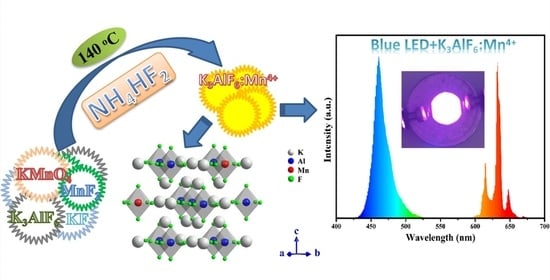
The molar ratio of KMnO4 to MnF2 to KF was maintained at 2:3:8 during the batching process. The specific experimental procedure is as follows: 10 mmol of K3AlF6, x mmol of NH4HF2 (x = 10, 20, 30, 40, 50, 70), y mmol of KMnO4, 1.5y mmol of MnF2 and 4y mmol of KF (y = 0.25, 0.5, 1, 2, 3) were weighed. The weighed raw materials were thoroughly ground and homogenized in an agate mortar, then transferred into a lidded corundum crucible. The crucible was subsequently placed in a drying oven and reacted at a specified temperature for 12 h. After the reaction was complete, the system was allowed to cool naturally to room temperature. The product was then collected and washed three times with a 20 wt% aqueous H2O2 solution. Finally, the product was dried at 60 °C to obtain the K3AlF6: Mn4+ phosphor. A schematic diagram of the sample synthesis process is shown in Figure 1. To facilitate sample identification, the sample codes and their corresponding experimental parameters are listed in Table 1.

2.2. Properties Characterization

The phase identification of all samples was carried out using an X-ray powder diffractometer (XRD, Bruker D8 Advanced, Karlsruhe, Germany) with Cu Kα radiation (λ = 1.54056 Å). The morphology and elemental composition of the synthesized samples were examined by scanning electron microscopy (SEM, MLA650F, Hillsboro, OR, USA) equipped with an energy-dispersive spectrometer. Surface elemental information of the samples was detected by X-ray photoelectron spectroscopy (XPS, PHI 5000 VersaProbe III, Chigasaki, Japan). The Mn4+ ion concentration in the K3AlF6: Mn4+ phosphors was determined using inductively coupled plasma optical emission spectrometry (ICP, Agilent Varian 720, Wilmington, DE, USA). The photoluminescence properties and IQE of the phosphors at room temperature were measured with a fluorescence spectrometer (Edinburgh Instruments®, FLS 980, Edinburgh, UK) equipped with a 450 W xenon lamp as the excitation source. The temperature-dependent luminescence characteristics (25–200 °C) of the optimal sample were tested using an EX-1000 thermal quenching analysis system (Everfine®, EX-1000, Hangzhou, China).

2.3. Device Fabrication and Performance Measurements

The W-LED was fabricated using a commercial sapphire-based InGaN chip (1 W power, ~455 nm, supplied by San’an Optoelectronics Co., Ltd.®, Xiamen, China), commercial yellow phosphor Y3Al5O12: Ce3+ (YAG, provided by Yantai Shield®, Yantai, China), and the K3AlF6: Mn4+ red phosphor synthesized in this study. The mass ratio of red phosphor to yellow phosphor was maintained at 6:1, while the mass ratio of the phosphor mixture to UV-curable resin was 1:1. The phosphor blend and resin were thoroughly mixed and then coated onto the surface of the LED chip. After UV irradiation curing, the W-LED device was completed. The photo-electronic performance of the fabricated device was measured using a HAAS-2000 high-accuracy array spectroradiometer (Everfine®, Hangzhou, China).

3. Results and Discussion

3.1. Structural and Morphological Properties

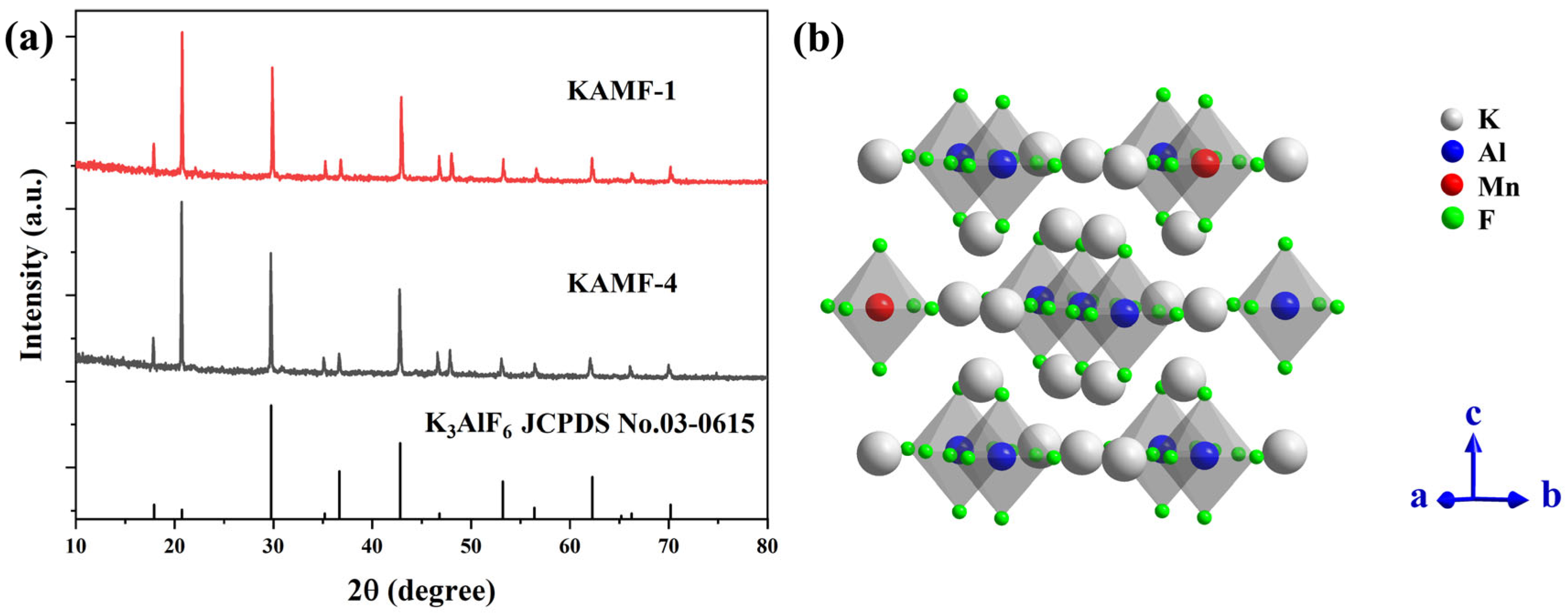
Figure 2a shows the XRD patterns of samples KAMF-1 and KAMF-4 along with their corresponding standard diffraction cards. All diffraction peaks in Figure 2a match the standard data of pure cubic K3AlF6 (JCPDS 03-0615, a = b = c = 8.45676 Å, α = β = γ = 90.0°, V = 604.8 Å3). Furthermore, no additional diffraction peaks related to Mn compounds were observed in Figure 2a, indicating that Mn4+ ions (coordination number CN = 6, ionic radius r = 0.54 Å) either occupy the octahedral sites of Al3+ (CN = 6, r = 0.53 Å) or were removed during the sample washing process. The crystal structure corresponding to KAMF-4 is illustrated in Figure 2b. It can be observed that the crystal contains octahedra centered on Al3+ ions, where each Al3+ coordinates with six F ions to form regular AlF63− octahedra. Due to the nearly identical ionic radii of Mn4+ (0.54 Å) and Al3+ (0.53 Å), despite their different valence states, Mn4+ can readily substitute Al3+ at the octahedral centers and coordinate with F ions to form stable MnF62− octahedra. This structural compatibility facilitates narrow-band red emission under blue light excitation.
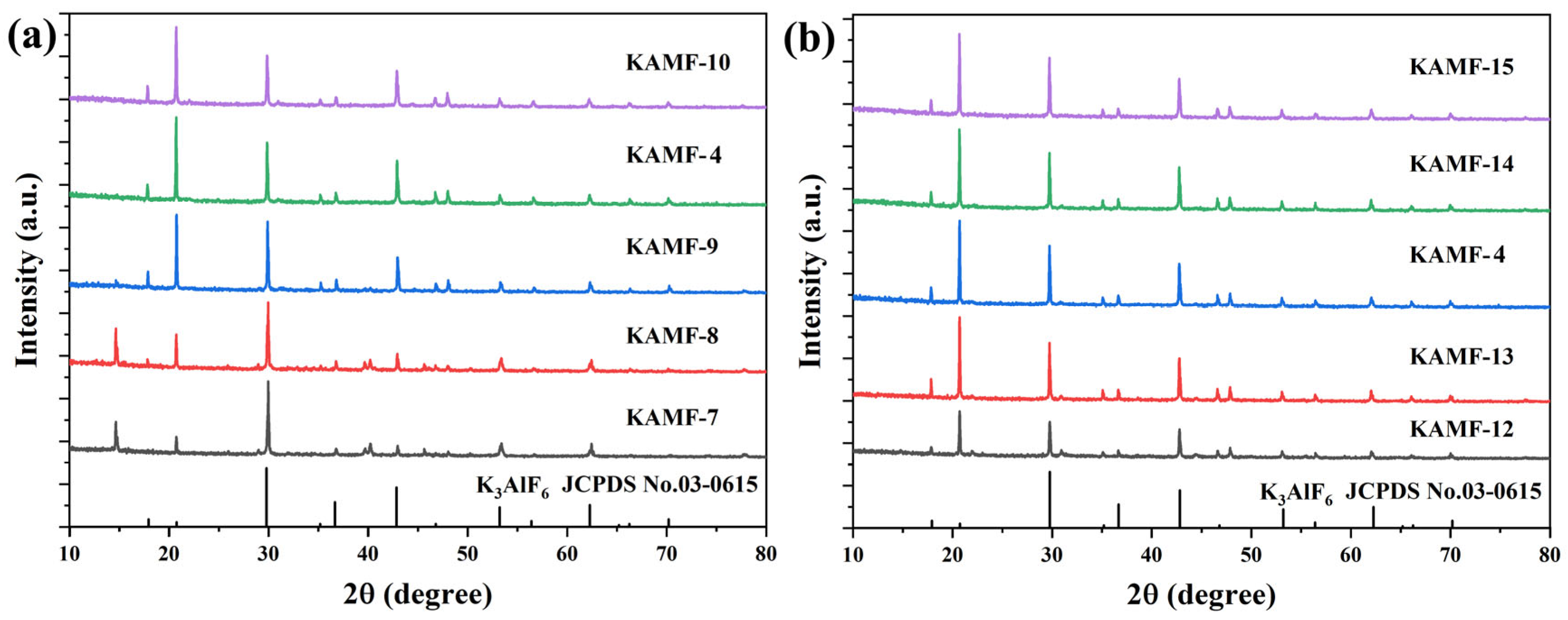
Figure 3 presents the XRD patterns of the samples synthesized under varying reaction temperatures and NH4HF2 molten salt contents. When the reaction was carried out at 140 °C with 10 mmol of NH4HF2, the XRD pattern of sample KAMF-7 displayed impurity peaks at 2θ = 14.6°, 39.7°, 40.3°, and 45.8°, indicating an incomplete reaction between KMnO4 and MnF2. As the NH4HF2 content increased, the impurity peaks progressively diminished. With 40 mmol of NH4HF2, all diffraction peaks could be indexed to a pure K3AlF6 phase (Figure 3a), suggesting complete consumption of the precursors. At this stage, Mn ions were either incorporated into the crystal lattice by substituting Al3+ or removed during the washing step. Further increasing the NH4HF2 amount did not induce any structural changes. In Figure 3b, with fixed amounts of NH4HF2 (40 mmol), KMnO4 (1 mmol), and MnF2 (1.5 mmol), the reaction temperature was varied from 120 to 180 °C. At 120 °C, the XRD pattern of the sample KAMF-12 showed weak impurity peaks at 2θ = 21°, 22°, and 31°, which can be attributed to the insufficient melting of NH4HF2 (melting point ≈125 °C) at this temperature, hindering the complete reaction. When the temperature exceeded the melting point of NH4HF2, all the resulting products formed a pure K3AlF6 phase.
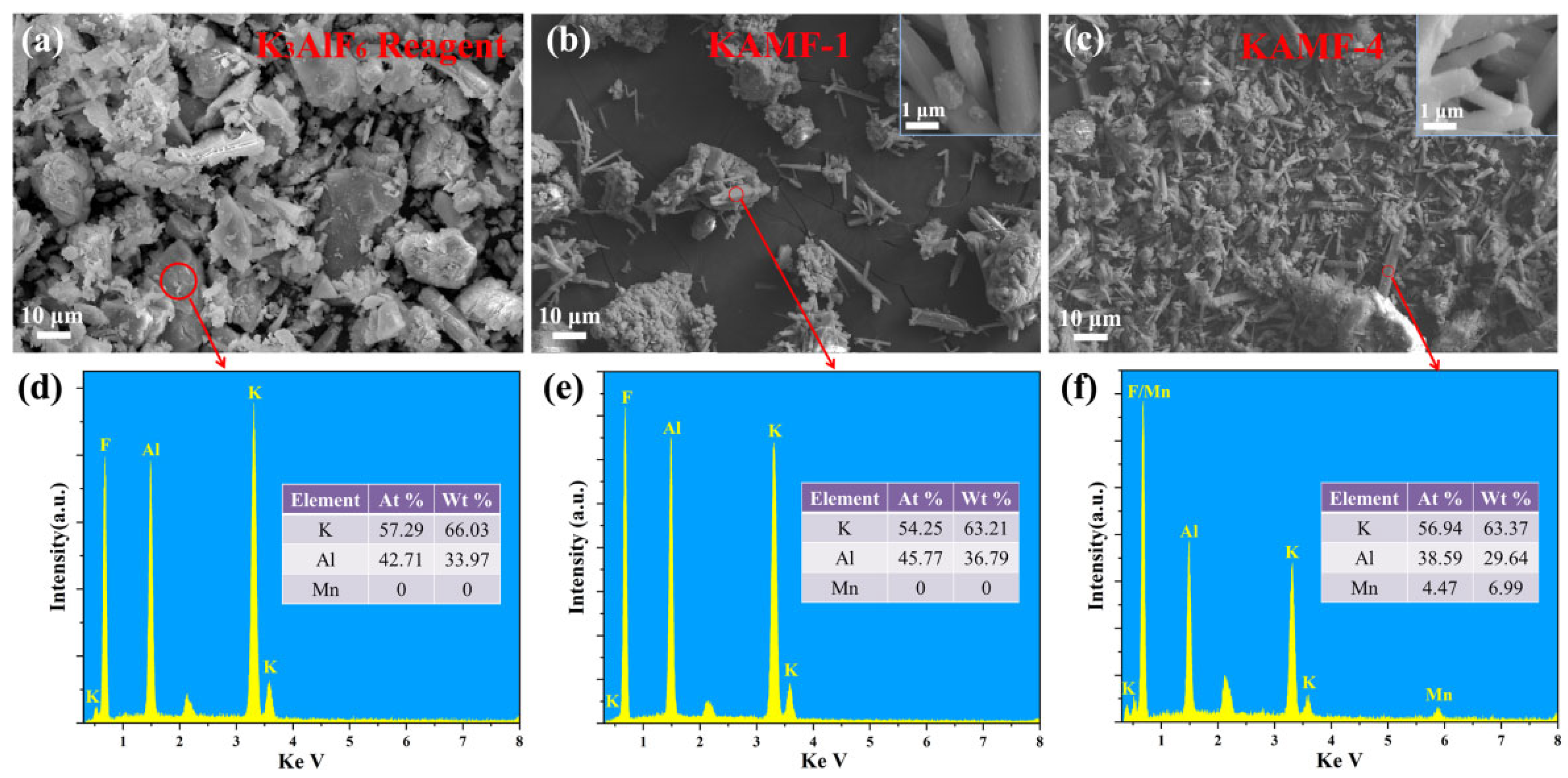
Figure 4a–c show the SEM images of the K3AlF6 raw material, KAMF-1, and KAMF-4, respectively, while Figure 4d–f present the corresponding energy-dispersive spectrometer (EDS) spectra of the regions marked by circles in the SEM images. The images reveal that the K3AlF6 raw material consists of bulk particles larger than 10 μm (Figure 4a). After being maintained in the NH4HF2 molten salt for a period, the microstructure of the K3AlF6 raw material transformed from large particles into aggregates of numerous small particles with the formation of multiple rod-like structures (Figure 4b). This indicates that the K3AlF6 raw material underwent dissolution and recrystallization during the experimental process, which is favorable for Mn4+ substitution into the K3AlF6 lattice by replacing Al3+ [19]. As shown in Figure 4c, the addition of KMnO4 and MnF2 did not significantly alter the morphology of the sample, suggesting that these additives have limited influence on the morphological evolution of K3AlF6. The EDS data in Figure 4f demonstrate that the short rod-shaped samples contain a small amount of Mn atoms, indicating that Mn4+ has most likely substituted for part of the Al3+ and incorporated into the K3AlF6 crystal lattice.
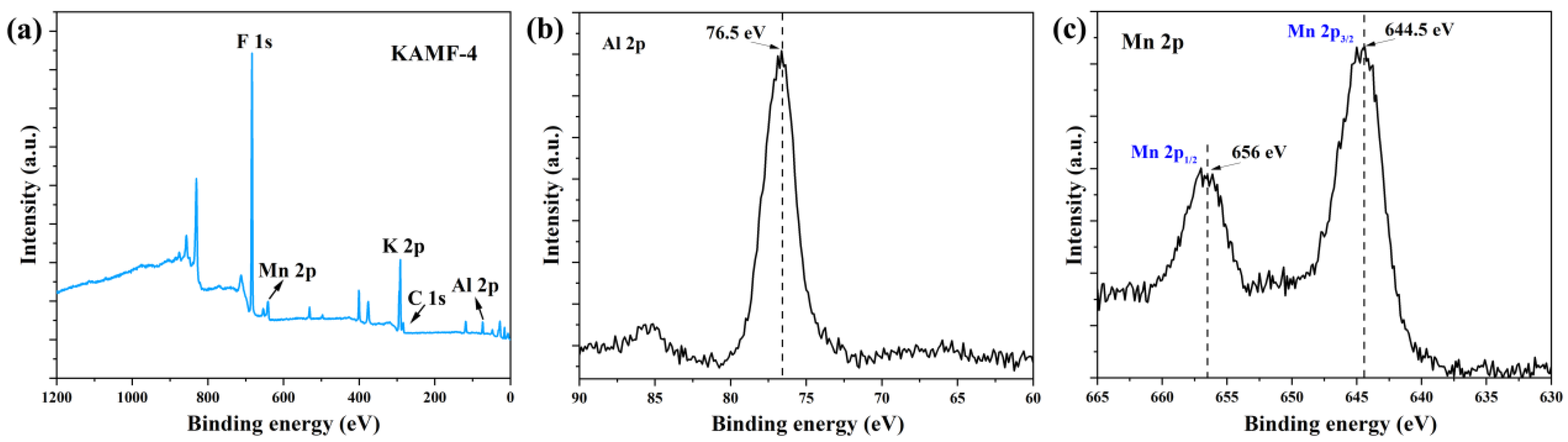
In order to further investigate whether the obtained products contain Mn4+, the XPS spectrum of sample KAMF-4 was measured as shown in Figure 5. Figure 5a clearly demonstrates the presence of K, F, Al and Mn elements in the sample, where the C element is adventitious carbon introduced by the instrument itself for binding energy calibration. Figure 5b and Figure 5c show the high-resolution XPS spectra of Al 2p and Mn 2p, respectively. In Figure 5b, the peak at 76.5 eV corresponds to Al 2p in the trivalent oxidation state. The two peaks at 644.5 eV and 656 eV in Figure 5c are attributed to the paired Mn 2p1/2 and Mn 2p3/2 signals from the Mn element [32,33]. The binding energy difference of 11.5 eV between these two peaks is consistent with reported XPS values for Mn4+ [11].
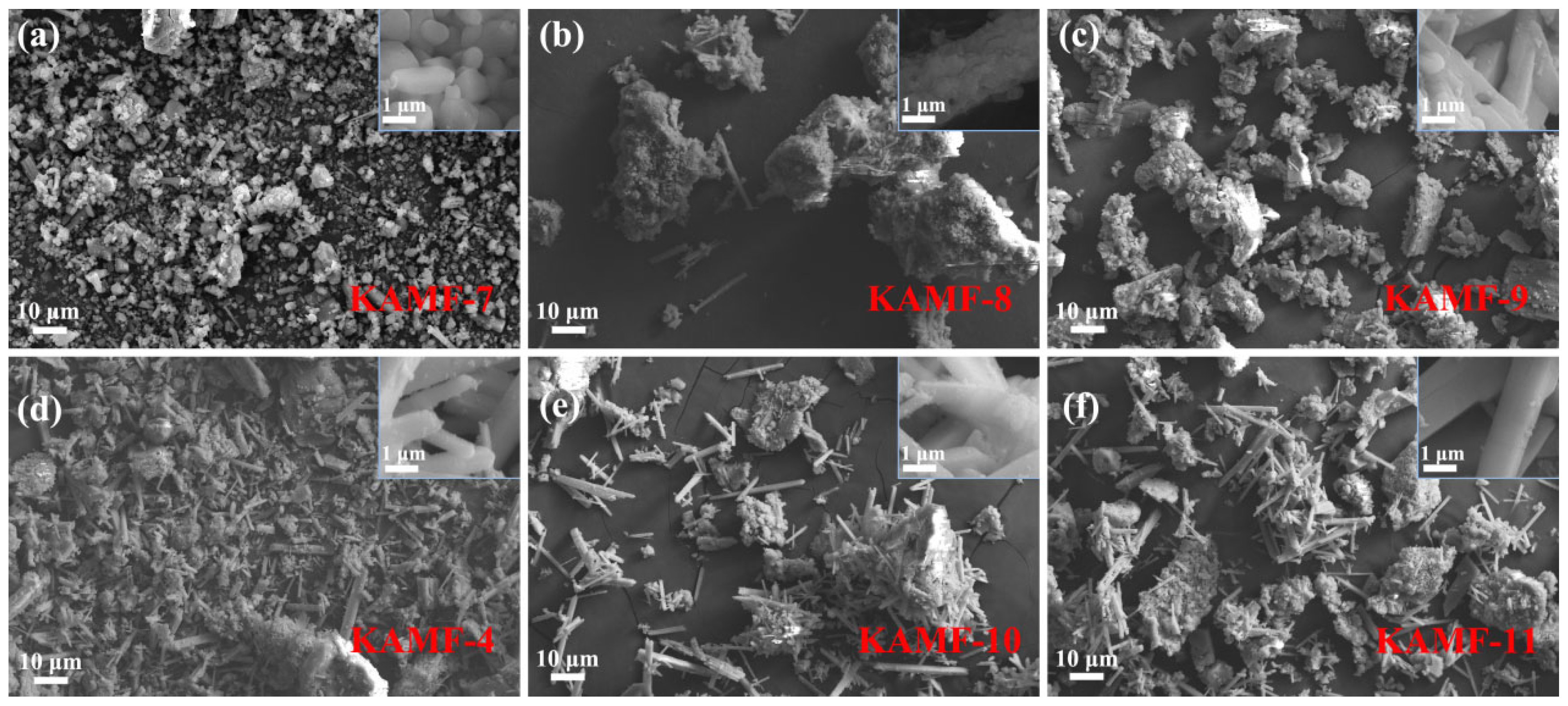
Based on the aforementioned test results, it was determined that the molten salt NH4HF2 is the primary factor influencing the microstructure of the K3AlF6 raw material. To further analyze the regulatory effect of the molten salt on the sample morphology, SEM images of samples KAMF-7, KAMF-8, KAMF-9, KAMF-4, KAMF-10, and KAMF-11 were examined, as shown in Figure 6. When the amount of NH4HF2 added was 10 mmol (molar ratio to K3AlF6 of 1:1), the sample transformed from the large particles of the K3AlF6 raw material into finer particles (Figure 4a and Figure 6a), with a small number of rod-like structures observed. Further increasing the molten salt content to 20 mmol resulted in the agglomeration of fine particles and the formation of more rod-like samples (Figure 6b). The inset clearly shows that the rod-like structures are composed of aggregated fine particles. An increase in molten salt content further raised the proportion of rod-like structures (Figure 6c). When the molten salt content reached 40 mmol, the microstructure of the sample was predominantly composed of rod-like structures (Figure 6d). The inset clearly reveals that the nanorods are independent of each other, with their surfaces covered by fine particles. Continuing to increase the NH4HF2 content to 50 mmol and 70 mmol did not result in significant changes in the sample morphology, aside from smoother surfaces of the rods (Figure 6e,f). These results indicate that the addition of the molten salt plays a significant regulatory role in the microstructure of K3AlF6.
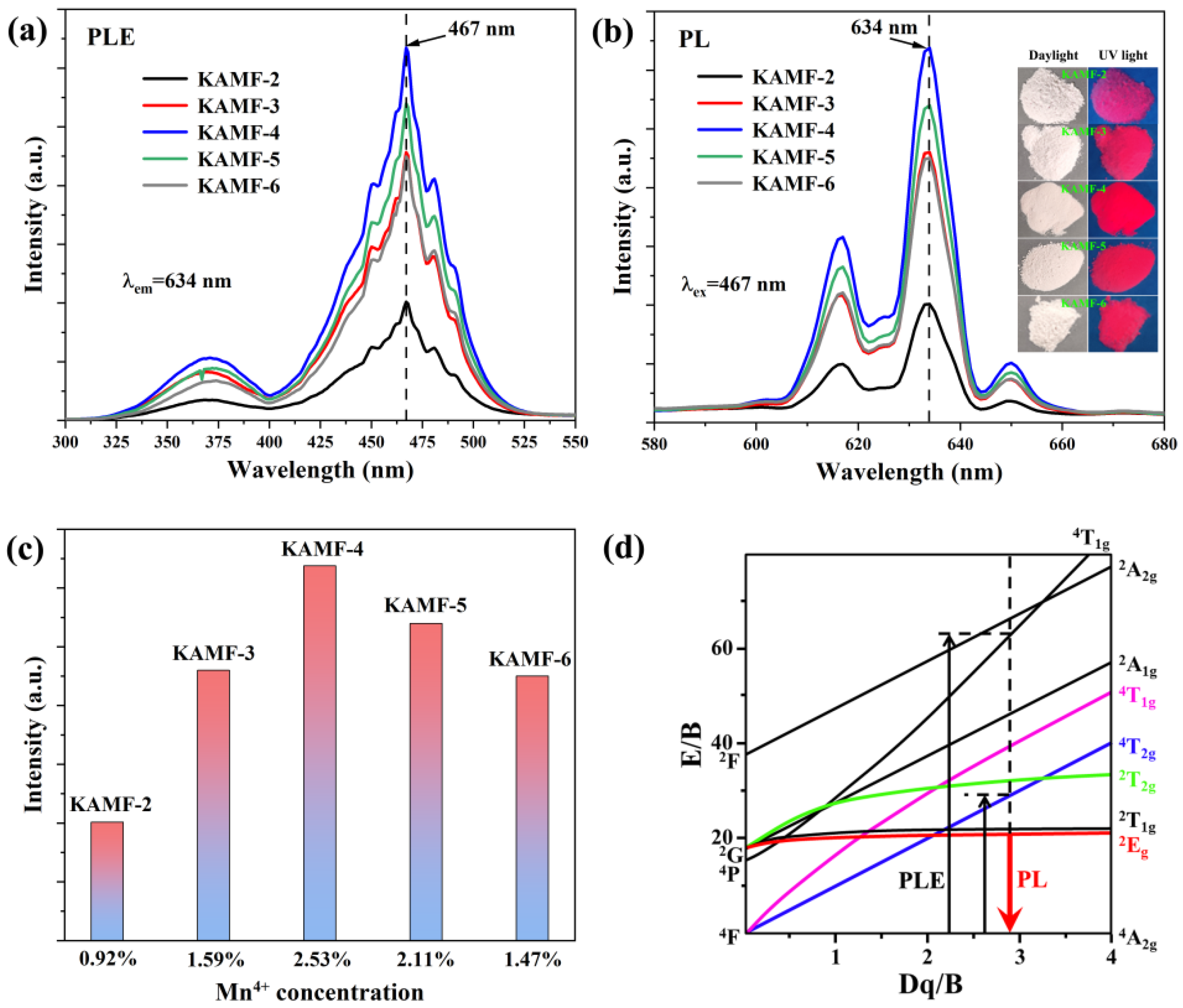
The concentration of luminescent centers (Mn4+) plays a critical role in determining the luminescent performance of phosphor materials. To quantify the actual Mn4+ content in the synthesized samples, inductively coupled plasma (ICP) analysis was conducted on samples KAMF-2 to KAMF-6, with the results presented in Table 2. Since the molar ratio of KMnO4 to MnF2 was fixed at 2:3, only the ratio of KMnO4 to K3AlF3 is provided. The data reveal that as the molar ratio of KMnO4 to K3AlF6 increases from 2.5:100 to 10:100, the Mn4+ concentration rises from 0.92 at% to 2.53 at%. This suggests that only a limited portion of the manganese species generated during the molten salt reaction is successfully incorporated into the K3AlF6 host lattice, while the majority—present as Mn2+, Mn3+, or unreacted KMnO4—is removed during washing. Moreover, merely increasing the KMnO4 content does not effectively enhance the Mn4+ doping level; in fact, excess KMnO4 may even suppress Mn4+ incorporation. It is also important to note that not only the amount of KMnO4 but also the NH4HF2 molten salt content and the reaction temperature significantly influence the resulting Mn4+ concentration. As illustrated in Table S1, both insufficient NH4HF2 and excessively low reaction temperatures hinder the precursor reaction, consistent with the XRD trends in Figure 3. Conversely, overly high amounts of NH4HF2 or excessively elevated temperatures also lead to a reduction in Mn4+ incorporation. The underlying mechanisms for these phenomena warrant further study. In summary, the experimental results confirm that the optimal KMnO4 concentration is 10 mol% relative to the K3AlF6 precursor.

3.2. Optical Properties

Figure 7a,b present the excitation and emission spectra of samples KAMF-2 to KAMF-6 at room temperature. As shown in Figure 7a, monitoring the red emission at 634 nm, all samples exhibit two broad excitation bands within the ultraviolet (UV) to blue spectral region, centered at 370 nm and 467 nm, respectively. These excitation bands correspond to the 4A2g4T1g and 4A2g4T2g transitions of the Mn4+ ions. Under 467 nm blue light excitation, all samples display narrow red emission lines around 634 nm (Figure 7b). These emission lines lie within the spectral range where the eye’s sensitivity remains relatively high, which is beneficial for practical applications. These red emission lines are attributed to the spin- and parity-forbidden 2Eg4A2g transition of the Mn4+ ions. The inset in Figure 7b shows digital photographs of the samples under natural light and 365 nm UV lamp irradiation, demonstrating that all samples emit bright red light under blue-violet excitation. Figure 7c shows the relative intensities of the different samples at 634 nm. It can be observed that sample KAMF-4 exhibits the strongest emission intensity due to its highest Mn4+ doping concentration. Figure 7d depicts the Tanabe–Sugano energy level diagram for the Mn4+ ion in an octahedral crystal field. In the K3AlF6 host with a strong crystal field, the 2E energy level of Mn4+ is the most stable excited state. Upon UV or blue light excitation, electrons are excited from the 4A2g ground state to the 4T1g and 4T2g excited states, subsequently relax non-radiatively to the 2Eg level, and finally return to the ground state, emitting red light centered near 634 nm. To evaluate the luminescence efficiency, the internal quantum efficiency (IQE) of the KAMF-4 phosphor was measured using an integrating sphere. The results show that under 467 nm excitation, the KAMF-4 phosphor achieves an IQE value of 69%.
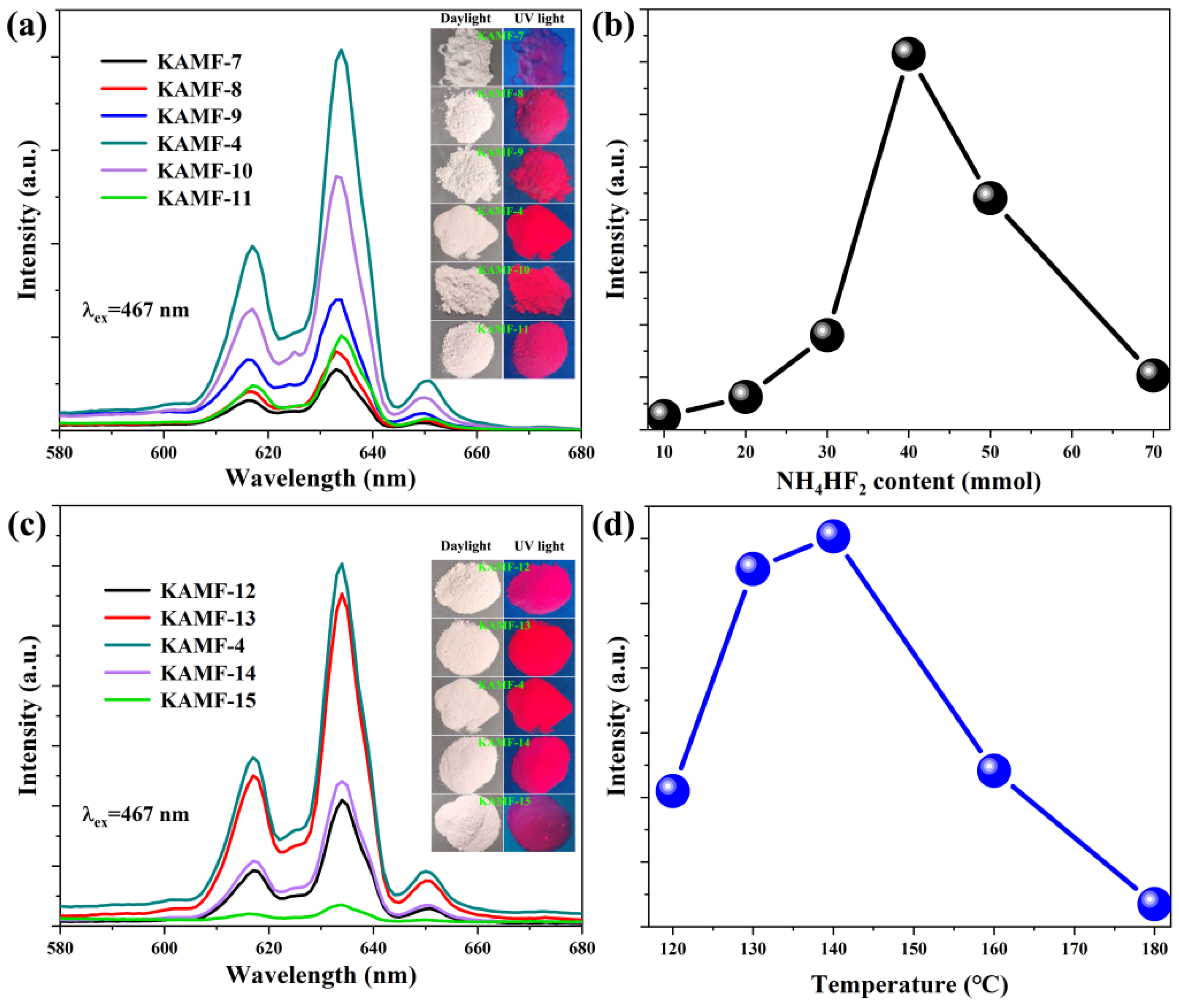
Figure 8a shows the PL spectra of samples synthesized with different NH4HF2 molten salt contents at 140 °C, demonstrating the influence of molten salt content on the spectral characteristics. Similarly to the results shown in Figure 7b, all samples exhibit narrow-band emission spectra with the main peak centered at 634 nm. As the molten salt content increases, all samples maintain identical spectral profiles while showing variations in emission intensity. The inset displays digital photographs of the samples under ambient light and a 365 nm UV lamp. Figure 8b illustrates the correlation between relative intensity at 634 nm and molten salt content. The luminescence intensity initially increases and then decreases with rising molten salt content, which is attributed to varying concentrations of Mn4+ ions incorporated into the K3AlF6 host under different molten salt conditions. A similar trend is observed in the luminescence properties of samples prepared at different reaction temperatures. As shown in Figure 8c, when the reaction temperature varies from 120 °C to 180 °C, all samples maintain similar spectral shapes but exhibit significant differences in emission intensity, resulting from the thermal instability of K2MnF6 at elevated temperatures. In summary, the optimal synthesis parameters are determined to be an NH4HF2 to K3AlF6 molar ratio of 4:1 and a reaction temperature of 140 °C.
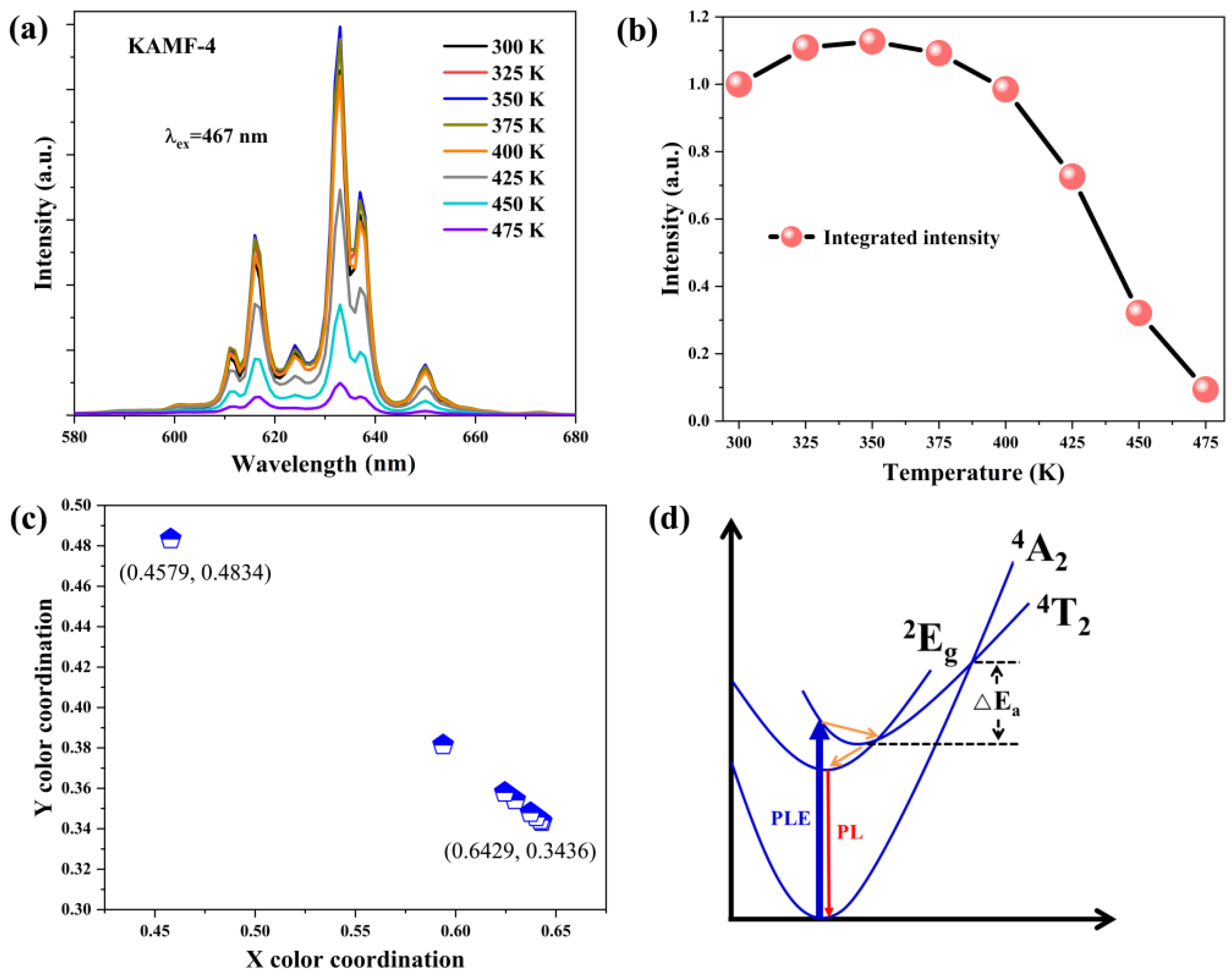
The thermal effects during the LED packaging and usage processes typically lead to reduced luminescence of the phosphors coated on the surface, making it essential to evaluate the thermal stability of the samples. Figure 9 presents the thermal quenching behavior of sample KAMF-4 within the temperature range of 25 °C to 200 °C. The results indicate that the red emission intensity of the sample initially experiences a brief enhancement before progressively decreasing as the temperature rises (Figure 9a). The normalized integrated intensity of Mn4+ luminescence, shown in Figure 9b, demonstrates that the sample retains 72% of its initial intensity (measured at 25 °C) when heated to 150 °C. Both thermal quenching and thermal degradation can cause shifts in color coordinates and reduce luminous efficiency. Figure 9c illustrates the variation trend of CIE coordinates as the sample temperature increases from 25 °C to 200 °C. The thermal quenching of emission intensity can be explained by the configuration coordinate diagram depicted in Figure 9d. Under blue light excitation, electrons of Mn4+ transition from the ground state curve (4A2g) to the excited state curve (4T2g), following the process indicated by the arrows in the diagram. At lower temperatures, most electrons return to the ground state, generating red emission. As the temperature rises, the electrons in the excited state will gain more energy and become more active. When this energy exceeds the activation energy (ΔEa), electrons pass through the crossing point, dissipate energy via lattice vibrations, and return to the ground state non-radiatively. The probability of this thermally activated non-radiative transition is highly dependent on temperature. The higher the temperature, the more excited electrons are activated, consequently leading to reduced emission intensity.

3.3. Device Performance

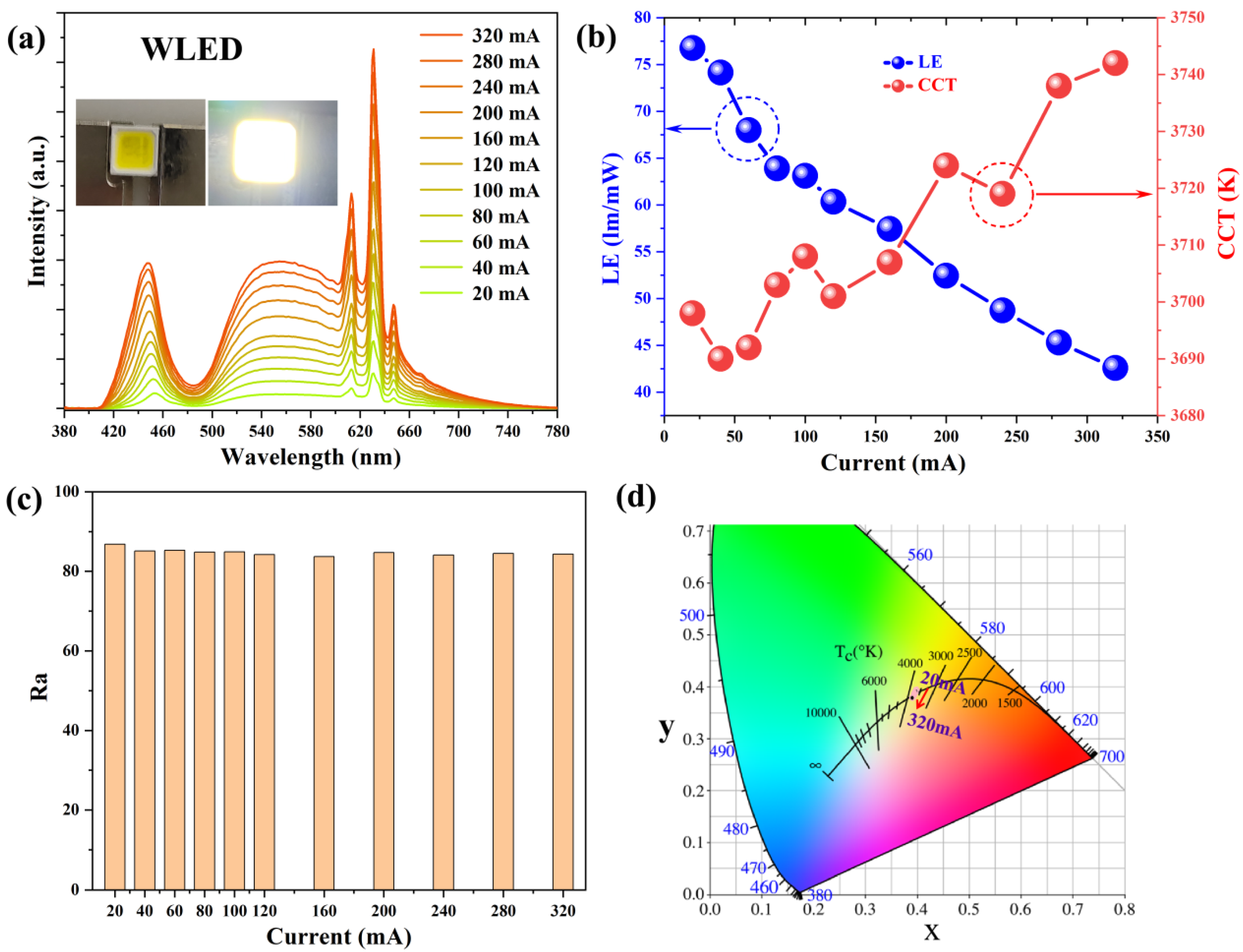
To evaluate the potential application of the sample in W-LEDs, we fabricated a warm white W-LED by integrating KAMF-4, YAG, and a blue LED chip. The current-dependent device performance was investigated under driving currents ranging from 20 mA to 320 mA, as shown in Figure 10. The results demonstrate that the electroluminescence (EL) spectral shape remains stable without saturation as the driving current increases (Figure 10a). The inset shows digital photographs of the device under ambient light and when powered by 20 mA current. The luminous efficacy (LE) gradually decreased from 77 lm/W at 20 mA to 43 lm/W at 320 mA, primarily due to the efficiency drop of the blue LED chip. Meanwhile, the correlated color temperature (CCT) increases marginally from 3703 K to 3742 K, representing only a 1% change (Figure 10b). As the current rises from 20 mA to 320 mA, the color rendering index (Ra) shows a slight decrease from 86.8 to 84.3 (Figure 10c). Consequently, the chromaticity coordinates shift by Δx = 0.0075 and Δy = 0.017, yet the device continues to emit high-quality warm white light close to the black-body radiation locus (Figure 10d). The key photometric parameters of the device at 20 mA driving current are as follows: CCT is 3690 K, Ra is 86.8, and LE is 77 lm/W. The chromaticity coordinates of this warm white light are (0.3981, 0.3951), positioned on the black-body curve. The relatively low luminous efficacy is attributed to the limited Mn4+ doping concentration (2.53 at%). Further optimization of experimental parameters to enhance the Mn4+ doping level is required to meet commercial application standards.

4. Conclusions

In summary, this study demonstrates for the first time the HF-free synthesis of K3AlF6: Mn4+ red phosphor by employing NH4HF2 as the molten salt, with KMnO4 and MnF2 serving as manganese sources. The NH4HF2 molten salt not only provided an acidic environment, facilitating the reaction between KMnO4 and MnF2 to form Mn4+ but also promoted the dissolution and recrystallization of K3AlF6. The content of the NH4HF2 was identified as a key factor governing the resulting microstructure, leading to either granular or nanorod-like morphology. The presence of Mn in the samples was confirmed by EDS, XPS, and ICP analyses, while the characteristic emission spectrum of Mn4+ further verified its successful incorporation. The optimal process conditions for the product were determined as follows: NH4HF2 and KMnO4 additions at 400 mol% and 10 mol% relative to the K3AlF6 raw material, respectively, with a reaction temperature of 140 °C. Under blue-violet excitation, the resulting samples exhibited a narrow-band red emission centered at 634 nm, with CIE color coordinates of (0.6871, 0.3128). The K3AlF6: Mn4+ sample with optimal doping concentration (2.53 at%) exhibits a room-temperature quantum efficiency of 69%, while retaining 72% of its initial luminescence intensity at 150 °C. The W-LED fabricated using K3AlF6: Mn4+ (2.53 at%) as the red light component achieves a color rendering index of 86.8, a luminous efficacy of 77 lm/W, and a correlated color temperature of 3690 K, while demonstrating excellent color stability during operation. Despite its suitability for large-scale production, the NH4HF2-based molten salt synthesis of K3AlF6: Mn4+ still requires further optimization to achieve finer morphological control and higher Mn4+ doping levels, both essential for advancing the luminescence performance of the material.

Supplementary Materials

The following supporting information can be downloaded at: https://www.mdpi.com/article/10.3390/solids6040066/s1, Table S1. ICP results of Mn4+ actual doped concentration of samples; Figure S1. (a) SEM of KAMF-4 and (b–d) the EDS spectrum corresponding to the marked area in the SEM image.

Author Contributions

Conceptualization, C.L. and L.Z.; methodology, C.L. and F.Z.; software, C.L. and F.Z.; validation, F.Z. and W.X.; formal analysis, C.L. and W.X.; investigation, C.L., F.Z. and W.X.; resources, C.L. and L.Z.; data curation, C.L. and F.Z.; writing—original draft preparation, C.L.; writing—review and editing, C.L. and L.Z.; visualization, C.L.; supervision, C.L. and L.Z.; project administration, L.Z.; funding acquisition, C.L. and L.Z. All authors have read and agreed to the published version of the manuscript.

Funding

This research was funded by the National Natural Science Foundation of China, grant number 21701067; Jiangxi Provincial Natural Science Foundation, grant numbers. 20242BAB25220 and 20171BBB216016.

Data Availability Statement

The original contributions presented in this study are included in the article.

Acknowledgments

This research was conducted using the equipment of the Jiangxi University of Science and Technology: School of Materials Science and Engineering, Center for Analysis and Testing.

Conflicts of Interest

Authors Chenxing Liao, and Liaolin Zhang were employed by the company Guorui Kechuang Rare Earth Functional Materials (Ganzhou) Co., Ltd. The remaining authors declare that the research was conducted in the absence of any commercial or financial relationships that could be construed as a potential conflict of interest.

References

  1. Cao, R.; Wang, W.; Zhang, J.; Jiang, S.; Chen, Z.; Li, W.; Yu, X. Compounds. Synthesis and luminescence properties of Li2SnO3: Mn4+ red-emitting phosphor for solid-state lighting. J. Alloys Compd. 2017, 704, 124–130. [Google Scholar] [CrossRef]
  2. Li, C.; Fang, Z.; Yan, Y.; Li, H.; Luo, X.; Wang, X.; Zhou, P. Study on the Performance of Deep Red to Near-Infrared pc-LEDs by the Simulation Method Considering the Distribution of Phosphor Particles. Micromachines 2024, 15, 1035. [Google Scholar] [CrossRef]
  3. Liao, C.; Cai, H.; Dai, D.; Zhang, L. Low-Temperature Synthesis and Photoluminescence Properties of Mg2TiO4: Mn4+ Phosphor Prepared by Solid-State Reaction Methods Assisted by LiCl Flux. Solids 2025, 6, 53. [Google Scholar] [CrossRef]
  4. Deng, T.; Song, E.; Zhou, Y.; Chen, J.; Cheng, Y.; Yuan, J.; Fan, T. The use of a single ammonium acidic salt towards simple green co-precipitation synthesis for Mn4+-activated fluorides. Dalton Trans. 2020, 49, 5823–5831. [Google Scholar] [CrossRef]
  5. Lian, H.; Huang, Q.; Chen, Y.; Li, K.; Liang, S.; Shang, M.; Liu, M.; Lin, J. Resonance Emission Enhancement (REE) for Narrow Band Red-Emitting A2GeF6:Mn4+ (A = Na, K, Rb, Cs) Phosphors Synthesized via a Precipitation–Cation Exchange Route. Inorg. Chem. 2017, 56, 11900–11910. [Google Scholar] [CrossRef] [PubMed]
  6. Wang, Z.; Yang, Z.; Wang, N.; Zhou, Q.; Zhou, J.; Ma, L.; Wang, X.; Xu, Y.; Brik, M.; Dramićanin, M. Single-Crystal Red Phosphors: Enhanced Optical Efficiency and Improved Chemical Stability for wLEDs. Adv. Opt. Mater. 2019, 8, 1901512. [Google Scholar] [CrossRef]
  7. Yang, C.; Tan, Y.; Li, Z.; Liang, S.; Guan, X.-H.; Yang, Z.-J.; Lian, S.; Zhou, W. Modulating luminescence of K3AlF6:Mn4+ NCs via charge compensation and localized surface plasmon resonance effect. Sci. China Mater. 2025, 68, 1047–1056. [Google Scholar] [CrossRef]
  8. Senden, T.; Geitenbeek, R.; Meijerink, A. Co-precipitation synthesis and optical properties of Mn4+-doped hexafluoroaluminate w-LED phosphors. Materials 2017, 10, 1322. [Google Scholar] [CrossRef]
  9. He, S.; Xu, F.; Wu, D.; Wang, Z.; Peng, J.; Ye, X. Engineering. Effects of introducing cations on the luminescence performance of CsPF6: Mn4+ phosphor. Nonferr. Met. Sci. Eng. 2020, 11, 111–117. [Google Scholar]
  10. Deng, T.; Song, E.; Zhou, Y.; Wang, L.; Ye, S.; Zhang, Q. Stable narrowband red phosphor K3GaF6: Mn4+ derived from hydrous K2GaF5 (H2O) and K2MnF6. J. Mater. Chem. C 2017, 5, 9588–9596. [Google Scholar] [CrossRef]
  11. Rui, K.; Wen, Z.; Lu, Y.; Jin, J.; Shen, C. One-Step Solvothermal Synthesis of Nanostructured Manganese Fluoride as an Anode for Rechargeable Lithium-Ion Batteries and Insights into the Conversion Mechanism. Adv. Energy Mater. 2014, 5, 1401716. [Google Scholar] [CrossRef]
  12. Hung, N.; Tung, D.; Dat, L. Synthesis and Waterproofness Improvement of K3AlF6:Mn4+ Phosphor for Warm White Light-emitting Diodes. VNU J. Sci. Math.—Phys. 2021, 37, 101–108. [Google Scholar] [CrossRef]
  13. King, G.; Abakumov, A.; Woodward, P.; Llobet, A.; Tsirlin, A.; Batuk, D.; Antipov, E. The high-temperature polymorphs of K3AlF6. Inorg. Chem. 2011, 50, 7792–7801. [Google Scholar] [CrossRef] [PubMed]
  14. Xu, Y.; Su, H.; Gao, Y.; Zhang, S.; Li, L.; Hong, F.; Xu, Y.; Yu, D.; Lin, H. A red-emitting phosphor Na3AlF6: Mn4+: Green synthesis, optical characteristics, thermal stability and application in high-performance warm WLED. J. Solid State Chem. 2024, 340, 125016. [Google Scholar] [CrossRef]
  15. Yi, X.; Li, R.; Zhu, H.; Gao, J.; You, W.; Gong, Z.; Guo, W.; Chen, X. K2NaAlF6: Mn4+ red phosphor: Room-temperature synthesis and electronic/vibronic structures. J. Mater. Chem. C 2018, 6, 2069–2076. [Google Scholar] [CrossRef]
  16. Qiang, J.; Ruan, H.; Wang, L.; Wang, T.; Lei, J.; Liao, S.; Li, S. Luminescence enhancement of K2LiAlF6: Mn4+ phosphors by Zn2+-mediated charge compensation for fast-response backlighting applications. Inorg. Chem. 2023, 62, 14344–14354. [Google Scholar] [CrossRef]
  17. Ming, H.; Zhang, J.; Liu, L.; Peng, J.; Du, F.; Ye, X. Technology. Luminescent properties of a Cs3AlF6: Mn4+ red phosphor for warm white light-emitting diodes. J. Solid State Sci. Technol. 2018, 7, R149. [Google Scholar] [CrossRef]
  18. Deng, T.; Song, E.; Zhou, Y.; Wang, L.; Zhang, Q. Tailoring photoluminescence stability in double perovskite red phosphors A2BAlF6: Mn4+ (A=Rb, Cs; B=K, Rb) via neighboring-cation modulation. J. Mater. Chem. C 2017, 5, 12422–12429. [Google Scholar] [CrossRef]
  19. Song, E.; Wang, J.; Shi, J.; Deng, T.; Ye, S.; Peng, M.; Wang, J.; Wondraczek, L.; Zhang, Q. Highly Efficient and Thermally Stable K3AlF6:Mn4+ as a Red Phosphor for Ultra-High-Performance Warm White Light-Emitting Diodes. ACS Appl. Mater. Interfaces 2017, 9, 8805–8812. [Google Scholar] [CrossRef]
  20. Wang, Z.; Ji, H. Advances in valence state analysis of manganese in Mn4+-activated red phosphors for white LEDs. Chin. J. Lumin. 2020, 41, 1195–1213. [Google Scholar] [CrossRef]
  21. Liu, Y.; Wang, T.; Zhang, X.; Cao, C.; Yang, L.; Huang, Y.; Liao, S.; Zhang, H. Synthesis, luminescence properties and nephelauxetic effect of nano stick phosphors K3AlF6: Mn4+ for warm white LED. J. Mater. Sci. Mater. Electron. 2019, 30, 1870–1877. [Google Scholar] [CrossRef]
  22. Tuyet, D.; Hong, V.; Bondzior, B.; Dereń, P.; Velpula, R.; Trung Nguyen, H.; Tuyen, L.; Hung, N.; Nguyen, H. Deep red fluoride dots-in-nanoparticles for high color quality micro white light-emitting diodes. Opt. Express 2020, 28, 26189–26199. [Google Scholar] [CrossRef] [PubMed]
  23. Huang, L.; Zhu, Y.; Zhang, X.; Zou, R.; Pan, F.; Wang, J.; Wu, M. HF-free hydrothermal route for synthesis of highly efficient narrow-band red emitting phosphor K2Si1-x F6: X Mn4+ for warm white light-emitting diodes. Chem. Mater. 2016, 28, 1495–1502. [Google Scholar] [CrossRef]
  24. Olchowka, J.; Suta, M.; Wickleder, C. Green synthesis of A2SiF6 (A= Li, Cs) nanoparticles using ionic liquids as solvents and as fluorine sources: A simple approach without HF. Chem.–A Eur. J. 2017, 23, 12092–12095. [Google Scholar] [CrossRef] [PubMed]
  25. Ha, J.; Novitskaya, E.; Lam, N.; Sanchez, M.; Kim, Y.; Li, Z.; Im, W.; Graeve, O.; McKittrick, J. Synthesis of Mn4+ activated Na2SiF6 red-emitting phosphors using an ionic liquid. J. Lumin. 2020, 218, 116835. [Google Scholar] [CrossRef]
  26. Luo, X.; Hou, Z.; Zhou, T.; Xie, R. A universal HF-free synthetic method to highly efficient narrow-band red-emitting A2XF6: Mn4+ (A= K, Na, Rb, Cs; X= Si, Ge, Ti) phosphors. J. Am. Ceram. Soc. 2020, 103, 1018–1026. [Google Scholar] [CrossRef]
  27. Hou, Z.; Tang, X.; Luo, X.; Zhou, T.; Zhang, L.; Xie, R. A green synthetic route to the highly efficient K2SiF6: Mn4+ narrow-band red phosphor for warm white light-emitting diodes. J. Mater. Chem. C 2018, 6, 2741–2746. [Google Scholar] [CrossRef]
  28. Stoll, C.; Bandemehr, J.; Kraus, F.; Seibald, M.; Baumann, D.; Schmidberger, M.; Huppertz, H. HF-free synthesis of Li2SiF6: Mn4+: A red-emitting phosphor. Inorg. Chem. 2019, 58, 5518–5523. [Google Scholar] [CrossRef]
  29. Noh, M.; Yoon, D.; Kim, C.; Lee, S. Organic solvent-assisted synthesis of the K3SiF7: Mn4+ red phosphor with improved morphology and stability. J. Mater. Chem. C 2019, 7, 15014–15020. [Google Scholar] [CrossRef]
  30. Kim, Y.; Ha, J.; Im, W. Towards green synthesis of Mn4+-doped fluoride phosphors: A review. J. Mater. Res. Technol. 2021, 11, 181–195. [Google Scholar] [CrossRef]
  31. Wu, Q.; Liao, C.; Pan, J.; Ye, X.; You, W.; Xia, L. HF-free molten salt route for synthesis of highly efficient and water-resistant K2SiF6: Mn4+ for warm white LED. J. Am. Ceram. Soc. 2020, 103, 6901–6912. [Google Scholar] [CrossRef]
  32. Ilton, E.; Post, J.; Heaney, P.; Ling, F.; Kerisit, S. XPS determination of Mn oxidation states in Mn (hydr) oxides. Appl. Surf. Sci. 2016, 366, 475–485. [Google Scholar] [CrossRef]
  33. Zeng, Y.; Xu, J.; Wang, Y.; Li, S.; Luan, D.; Lou, X. Formation of CuMn Prussian blue analog double-shelled nanoboxes toward long-life Zn-ion batteries. Angew. Chem. Int. Ed. 2022, 61, e202212031. [Google Scholar] [CrossRef]

Figure 1. The process schematic for synthesizing K3AlF6: Mn4+ using the NH4HF2 molten salt method, and the digital photograph of the product under natural light.
Solids 06 00066 g001
Figure 2. (a) XRD patterns of the samples KAMF-1 and KAMF-4 and (b) the crystal structure diagram of K3Al1−xMnxF6.
Solids 06 00066 g002
Figure 3. XRD patterns of the samples obtained (a) at 140 °C as a function of NH4HF2 content (from 10 to 50 mmol) and (b) at different reaction temperatures ranging from 120 to 180 °C with 40 mmol NH4HF2.
Solids 06 00066 g003
Figure 4. (ac) SEM of K3AlF6 reagent, KAMF-1 and KAMF-4; (df) the EDS spectrum corresponding to the marked area in the SEM image.
Solids 06 00066 g004
Figure 5. XPS survey spectra (a) and high-resolution XPS spectra of Al 2p (b) and Mn 2p (c) for KAMF-4.
Solids 06 00066 g005
Figure 6. SEM images of samples KAMF-7 (a), KAMF-8 (b), KAMF-9 (c), KAMF-4 (d), KAMF-10 (e) and KAMF-11 (f).
Solids 06 00066 g006
Figure 7. (a) PLE spectra monitored at 634 nm, (b) PL emission spectra excited at 467 nm excitation of KMAF-2 to KMAF-6 phosphors, the illustration shows the photographs of the sample KAMF-2 to KAMF-6 under daylight and UV light (365 nm). (c) Relevant integrated intensity of phosphors. (d) Tanabe-Sugano energy-level diagram for Mn4+ (d3) electron configuration in the octahedral site of K3AlF6 host.
Solids 06 00066 g007
Figure 8. PL spectra under 467 nm excitation for investigating the effects of (a) NH4HF2 amount (10, 20, 30, 40, 50 and 70 mmol) at 140 °C and (c) reaction temperature (120, 130, 140, 160 and 180 °C) with 40 mmol NH4HF2, the illustration shows the photographs of the sample KAMF-7 to KAMF-15 under daylight and UV light (365 nm). (b,d) are the corresponding plots of emission intensity at 634 nm as a function of NH4HF2 content and sintering temperature, respectively.
Solids 06 00066 g008
Figure 9. (a) The emission spectra of sample KAMF-4 as a function of temperature from 25 °C to 200 °C; (b) the integrated intensity and (c) CIE of sample KAMF-4 corresponding to different temperature from 25 °C to 200 °C. (d) Configuration coordinate diagram of the ground state and excited state of Mn4+.
Solids 06 00066 g009
Figure 10. Drive current dependent photoelectric properties of the fabricated warm W-LED in the range of 20–320 mA: (a) EL spectra, the illustration shows the photographs of the as-fabricated red LED device and the lighted one under a 20 mA driving currents; (b) CCT and efficacy; (c) Ra; (d) CIE chromaticity coordinates.
Solids 06 00066 g010
Table 1. The number and corresponding preparation process of samples.
No.K3AlF6 (mmol)KMnO4 (mmol)MnF2 (mmol)NH4HF2 (mmol)Reaction Temperature (°C)
KAMF-1100040140
KAMF-2100.250.37540140
KAMF-3100.50.7540140
KAMF-41011.540140
KAMF-5102340140
KAMF-61034.540140
KAMF-71011.510140
KAMF-81011.520140
KAMF-91011.530140
KAMF-101011.550140
KAMF-111011.570140
KAMF-121011.540120
KAMF-131011.540130
KAMF-141011.540160
KAMF-151011.540180
Table 2. ICP results of Mn4+ actual doped concentration of samples.
No.Mole Ratio of KMnO4 to K3AlF6Mn4+ Concentration (at%)
KAMF-22.5:1000.92
KAMF-35:1001.59
KAMF-410:1002.53
KAMF-520:1002.11
KAMF-630:1001.47
Disclaimer/Publisher’s Note: The statements, opinions and data contained in all publications are solely those of the individual author(s) and contributor(s) and not of MDPI and/or the editor(s). MDPI and/or the editor(s) disclaim responsibility for any injury to people or property resulting from any ideas, methods, instructions or products referred to in the content.