


Abstract
Acute myeloid leukemia (AML) is predominantly a disease of older adults, with a median age at diagnosis of 68–72 years. Management in this population is complicated by adverse cytogenetic and molecular features, higher rates of secondary disease, and patient-specific factors such as comorbidity and frailty. This narrative review synthesizes the current evidence on risk stratification and treatment of AML in adults aged 60 years and older, with dedicated attention to patients aged 60–75 (“fit” older adults) and those older than 75, including octogenarians. The VIALE-A trial established venetoclax plus azacitidine as standard of care for patients ineligible for intensive chemotherapy (composite complete remission 66.4%; median overall survival 14.7 vs. 9.6 months with azacitidine alone). For fit adults aged 60–75, the choice between intensive chemotherapy and venetoclax-based regimens remains under active investigation, with emerging randomized data suggesting comparable outcomes and a possible advantage for venetoclax-based approaches in adverse-risk disease. Risk stratification has evolved beyond the 2022 European LeukemiaNet (ELN) classification, which was developed in intensively treated cohorts; the 2024 ELN genetic risk classification for less-intensive therapy now provides a framework specific to this population. TP53-mutated AML, including multi-hit disease, remains the dominant unmet need across all treatment modalities. Advances in reduced-intensity conditioning have expanded transplant eligibility into the seventh and eighth decades, and molecularly targeted approaches, including FLT3, IDH1/2, and menin inhibitors, are reshaping frontline and relapsed/refractory therapy. This review covers epidemiology, risk stratification, treatment stratified by age, fitness, and genetic subgroup, the role of transplantation and maintenance therapy, and the limitations of the current evidence base for this heterogeneous population.
1. Introduction
This is a narrative review synthesizing the published literature, major cooperative-group trials, and recent conference proceedings on the management of acute myeloid leukemia (AML) in older adults. Throughout this review, “older AML” refers broadly to patients aged 60 years and above, the age range in which incidence rises sharply, and adverse disease biology predominates. Because this population is highly heterogeneous, we distinguish where evidence permits between patients aged 60–75 years who are considered physiologically fit, and patients older than 75 years, including octogenarians and nonagenarians, for whom the evidence base, treatment tolerance, and goals of care differ substantially and are addressed in dedicated sections below.
Literature Search Strategy
We searched PubMed/MEDLINE, Embase, and ClinicalTrials.gov from January 2000 to July 2026, supplemented by abstracts from the American Society of Hematology (ASH) and European Hematology Association (EHA) annual meetings for 2024–2026. Search terms combined “acute myeloid leukemia,” “older,” “elderly,” “venetoclax,” “ELN,” “TP53,” “menin inhibitor,” “FLT3,” “IDH,” “transplant,” and “maintenance.” We prioritized randomized controlled trials, pivotal registration trials, and consensus guideline statements (e.g., ELN 2022 and 2024); where randomized data were unavailable, as is frequently the case in patients older than 75, we included large multicenter retrospective and real-world cohorts, explicitly identified as such in the text. Reference lists of key reviews were hand-searched for additional sources. Given the pace of change in this field, we prioritized the most recent available data (2024–2026) when multiple studies addressed the same question, while retaining foundational trials that established current standards of care. As a narrative rather than systematic review, formal quality appraisal (e.g., GRADE) and meta-analytic pooling were not performed; this and other limitations of our approach are discussed in Section 8.
AML is predominantly a disease of older adults, with a median age at diagnosis of approximately 68–72 years and more than 60% of cases occurring in patients older than 60 years [1,2]. Outcomes in older patients remain poor, with population-based studies demonstrating 5-year overall survival of less than 10–15% in patients aged 65 and older, and survival that declines further with each subsequent decade of life [3]. This disparity reflects a complex interplay between adverse disease biology and patient-related factors that together limit both the effectiveness and tolerability of therapy.
Biologically, AML in older adults is characterized by a higher prevalence of adverse cytogenetic and molecular features, including complex and monosomal karyotypes and mutations in TP53, RUNX1, ASXL1, and genes involved in epigenetic regulation, all associated with chemoresistance and inferior survival [4,5,6]. Favorable-risk molecular profiles are correspondingly less common with increasing age. Older patients are also more likely to develop secondary AML, either following prior cytotoxic therapy or evolving from antecedent myelodysplastic syndrome, both associated with particularly poor prognosis [7].
Patient-related factors further contribute to inferior outcomes. Older adults frequently present with comorbidities, reduced organ reserve, and varying degrees of frailty that affect treatment tolerance and increase treatment-related mortality [8,9]. Chronological age alone is an inadequate determinant of treatment eligibility: studies incorporating geriatric assessment show that functional status, cognition, and physical performance are more predictive of outcome than age alone [9,10].
The therapeutic landscape has evolved substantially over the past decade with the incorporation of the BCL-2 inhibitor venetoclax into frontline regimens, the development of targeted therapies against specific molecular abnormalities, and expanded use of reduced-intensity conditioning for allogeneic transplantation [11,12,13,14]. Despite these advances, major challenges remain, foremost among them the lack of a standardized, biologically informed framework for treatment selection that moves beyond a binary “fit/unfit” classification, particularly for the 60–75-year age group in which decisions are often individualized and not guided by robust comparative data [8].
In this review, we provide a comprehensive overview of AML in older adults, covering epidemiology and disease biology, risk stratification (including the ELN 2022 and 2024 frameworks), treatment approaches organized by fitness and genetic subgroup, special considerations for fit patients aged 60–75, the role of allogeneic transplantation, maintenance therapy, and the limitations of the current evidence base.
2. Epidemiology
AML incidence rises exponentially across advancing decades of life, from fewer than 2 cases per 100,000 individuals in younger adults to more than 15–20 cases per 100,000 in those older than 70 years, with incidence peaking around age 80–85 before declining slightly in the very old [15,16]. Older adults now represent the majority of newly diagnosed AML cases, and this burden is expected to increase with global population aging [16].
Large registry and population-based studies consistently report 5-year overall survival below 10–15% in patients aged 65 and older, a disparity that persists even after controlling for treatment intensity, underscoring the central role of disease biology [17]. Contemporary U.S. population-based data confirm that survival gains achieved over the past two decades have been substantially smaller in older age groups than in younger patients, and further diminish beyond age 75 [18].
Favorable-risk cytogenetic abnormalities, including core-binding-factor leukemias, are progressively less common with age, while adverse features such as complex karyotype (≥3 chromosomal abnormalities) and monosomal karyotype are markedly enriched in older populations [19,20]. At the molecular level, mutations in genes governing epigenetic regulation and clonal hematopoiesis (DNMT3A, TET2, ASXL1) are significantly more prevalent with age [4,21], as are TP53 mutations, which are strongly associated with complex karyotype, genomic instability, primary refractory disease, and extremely poor survival [6,22]. Conversely, favorable mutations such as NPM1 without FLT3-ITD are less common in older patients.
Clonal hematopoiesis of indeterminate potential (CHIP) provides important insight into the pathogenesis of AML in aging populations, being detected in approximately 10–20% of individuals over age 70 and representing a substrate from which additional mutations can accumulate, leading to clonal expansion and eventual leukemic transformation [21]. Aging is independently associated with functional changes in hematopoietic stem and progenitor cells, including epigenetic dysregulation, impaired differentiation, and a bias toward myeloid output, all of which further promote leukemogenesis [21].
Secondary AML, including therapy-related AML and AML evolving from antecedent myelodysplastic syndrome, is more common in older adults and represents a particularly high-risk subgroup, typically associated with complex cytogenetics and TP53 mutations [7,19]. Leukemic blasts in older patients also more often exhibit intrinsic resistance mechanisms, including multidrug-resistance protein expression and altered apoptotic signaling, which limit the effectiveness of standard induction regimens [23].
Collectively, these features indicate that AML in older adults is not simply the same disease observed in younger patients, but a biologically distinct entity that requires tailored approaches to risk stratification and therapy.
3. Initial Assessment and Risk Stratification
Initial evaluation of older AML patients requires an integrated approach considering both disease- and patient-related factors. Unlike younger populations, where treatment pathways are relatively standardized, decision-making in older adults is individualized and depends on the interplay of disease biology, physiologic fitness, comorbidities, and patient preference.
3.1. Fitness Assessment
Fitness for therapy has historically been assessed using performance status and organ function alone; these measures are insufficient to capture the complexity of aging. The Ferrara criteria define unfitness for intensive chemotherapy using cardiac, pulmonary, hepatic, and renal parameters [8], but dichotomize patients into “fit” and “unfit” categories and do not capture the continuum of physiologic reserve. Comprehensive geriatric assessment (CGA), incorporating functional status, cognition, comorbidity burden, nutritional status, and social support, is a more robust alternative; impairments identified through CGA are independently associated with increased chemotherapy toxicity and inferior survival. Klepin et al. found that impaired physical performance was associated with significantly worse overall survival (HR 1.7; p = 0.02) and increased treatment-related toxicity [24]. Despite this evidence, CGA remains underutilized in routine practice owing to time and resource constraints. Table 1 summarizes the principal fitness-assessment tools in current use.
Table 1.
Fitness assessment tools in older AML. ECOG, Eastern Cooperative Oncology Group; HCT-CI, Hematopoietic Cell Transplantation-specific Comorbidity Index; SIE-SIES-GITMO, Societa Italiana di Ematologia–Societa Italiana di Ematologia Sperimentale–Gruppo Italiano Trapianto di Midollo Osseo.
3.2. Molecular and Cytogenetic Risk Stratification: ELN 2022
The European LeukemiaNet (ELN) 2022 classification, which superseded the original 2017 ELN framework [26], categorizes patients into favorable, intermediate, and adverse-risk groups based on cytogenetic abnormalities and recurrent gene mutations (Table 2) [1]. This framework, however, was derived from and validated primarily in cohorts treated with intensive chemotherapy; older adults are disproportionately represented in adverse-risk categories, reducing its discriminatory power in this population, and outcomes with venetoclax-based therapy appear to be less tightly linked to ELN-2022 risk than outcomes with conventional chemotherapy [27,28].
Table 2.
ELN 2022 risk stratification and its clinical application in older adults.
3.3. The 2024 ELN Genetic Risk Classification for Less-Intensive Therapy
Because ELN 2022 was not designed for patients receiving lower-intensity regimens, Döhner et al. published a dedicated 2024 ELN genetic risk classification specifically for adults with AML treated with less-intensive, non-intensive-chemotherapy approaches such as venetoclax plus a hypomethylating agent [28]. This framework reclassifies several molecular subgroups relative to ELN 2022; most notably, it highlights RAS-pathway mutations (NRAS, KRAS, and related signaling mutations such as PTPN11, CBL, and NF1) as an independent adverse-risk marker in the venetoclax-treated setting, a signal not captured by ELN 2022. Validation cohorts across U.S. academic centers and U.K. NHS hospitals have confirmed the prognostic separation achieved by ELN 2024 among venetoclax plus hypomethylating-agent-treated patients and have further suggested that IDH1-mutated AML without co-occurring signaling mutations may behave more favorably than previously appreciated [28]. Given that most patients older than 75 receive lower-intensity therapy, ELN 2024 is likely to become the preferred stratification framework for this age group and is summarized alongside ELN 2022 in Table 2 for reference.
3.4. Measurable Residual Disease
A key limitation of static, baseline risk-stratification systems is their inability to capture dynamic treatment response. Measurable residual disease (MRD) has emerged as one of the most powerful prognostic markers in AML, with multiple studies demonstrating that MRD positivity after induction or consolidation, and prior to allogeneic transplantation, is strongly and independently associated with increased relapse risk and inferior overall survival [29]. Incorporation of MRD into risk-adapted treatment algorithms represents an important shift toward dynamic, response-adapted care, though challenges remain in standardizing detection methods and thresholds across platforms.
Existing prognostic models are further limited by their derivation from clinical trial populations, which tend to be fitter and less comorbid than real-world patients, and by underrepresentation of the oldest and most frail patients. Risk stratification in older AML therefore cannot rely on any single tool; it requires an integrated approach combining molecular and cytogenetic data, fitness and geriatric assessment, and dynamic evaluation of treatment response.
4. Treatment Approaches by Age, Fitness, and Genetic Markers
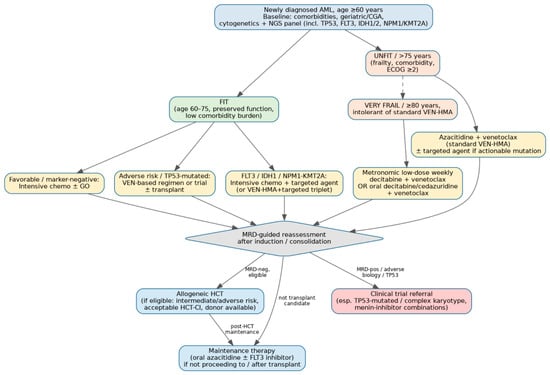
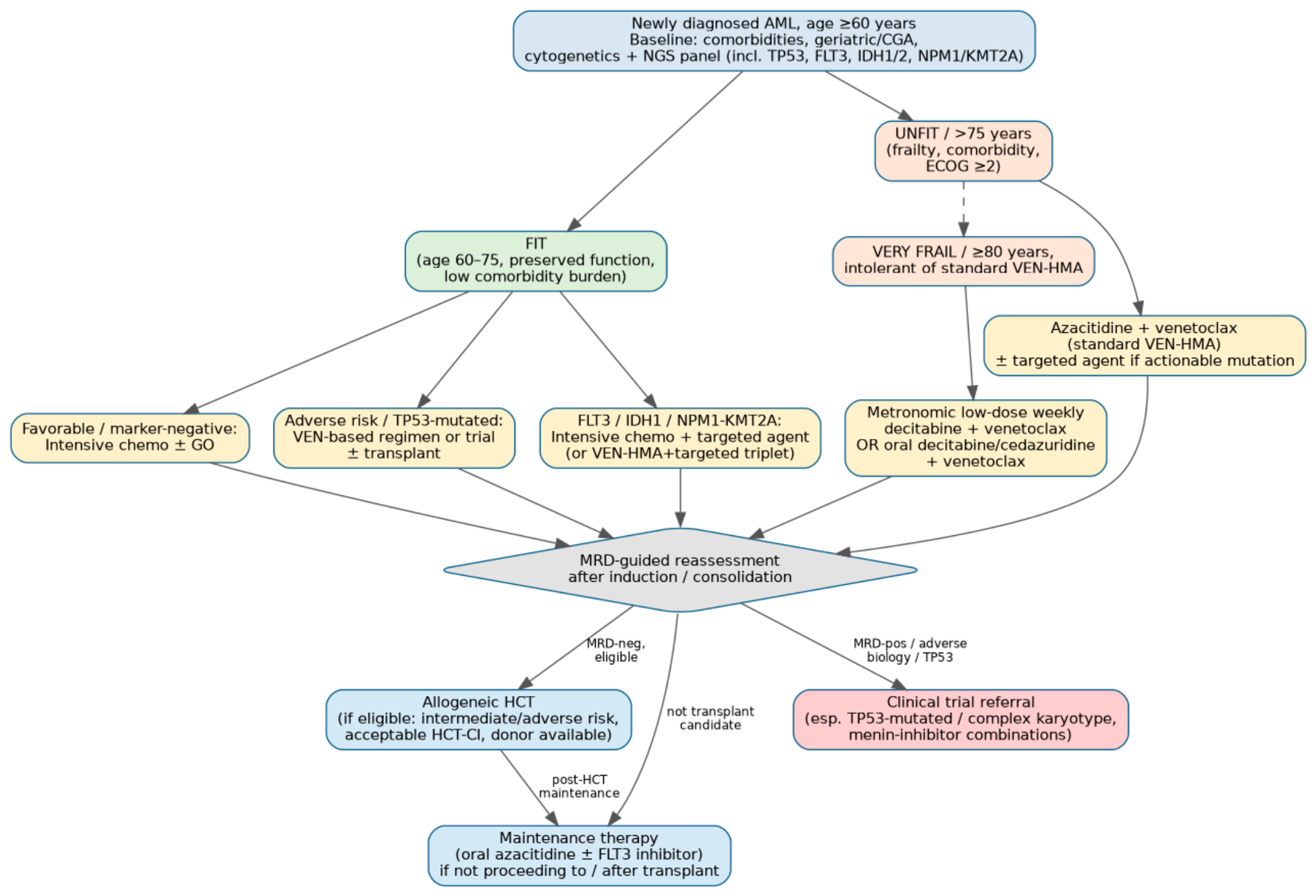
Management of older AML is guided primarily by the interplay of disease biology and patient fitness. Patients are broadly categorized as candidates for intensive therapy versus those better suited to lower-intensity approaches, though this distinction represents a continuum rather than a binary classification. This section first outlines the two broad treatment pathways, then addresses treatment selection within specific molecular subgroups, reflecting the growing recognition that genetic biology, not fitness or age alone, increasingly determines optimal therapy. Figure 1 summarizes an integrated treatment decision algorithm incorporating baseline assessment, fitness, molecular risk, and dynamic response.
Figure 1.
Integrated treatment decision algorithm for older adults with AML, incorporating baseline assessment (comorbidities, geriatric assessment, cytogenetic/molecular risk), fitness-stratified treatment pathways, MRD-guided reassessment, allogeneic transplantation, maintenance, and clinical trial referral for adverse-risk/TP53-mutated disease. CGA, comprehensive geriatric assessment; GO, gemtuzumab ozogamicin; HCT, hematopoietic cell transplantation; MRD, measurable residual disease; VEN-HMA, venetoclax plus hypomethylating agent.
4.1. Intensive Chemotherapy in Fit Patients
For patients deemed fit for intensive therapy, typically aged 60–75 with preserved functional status and limited comorbidity, induction with cytarabine and an anthracycline (“7 + 3”) remains a standard approach, achieving complete remission in approximately 50–70% of selected older patients [7]. Treatment-related toxicity and early mortality nonetheless remain substantially higher than in younger cohorts, and attempts to improve outcomes through anthracycline dose-intensification have not consistently translated into a clear survival benefit in older patients in randomized testing.
Liposomal daunorubicin/cytarabine (CPX-351) is preferred for therapy-related AML or AML with myelodysplasia-related changes: in a randomized phase III trial, CPX-351 improved overall survival compared with conventional 7 + 3 (median OS 9.56 vs. 5.95 months; HR 0.69; p = 0.003) and remission rates (CR/CRi 47.7% vs. 33.3%; p = 0.016), with improved post-transplant outcomes as well [7]. In favorable-risk disease, particularly core-binding-factor AML, the addition of gemtuzumab ozogamicin to intensive induction has demonstrated an overall survival benefit and remains a standard component of therapy in fit patients regardless of age [30].
4.2. Lower-Intensity Therapy: Venetoclax-Based Regimens
For patients who are not candidates for intensive chemotherapy, typically those older than 75 or with significant comorbidity or frailty, the combination of a hypomethylating agent with venetoclax has transformed outcomes. In the pivotal VIALE-A trial, azacitidine plus venetoclax significantly improved composite complete remission (66.4% vs. 28.3%; p < 0.001) and median overall survival (14.7 vs. 9.6 months; HR 0.66; p < 0.001) compared with azacitidine alone (Table 3), with durability of benefit confirmed on updated analysis across age and frailty subgroups [11]. Prolonged myelosuppression and infectious complications remain the principal challenges of venetoclax-based therapy; dose modifications, including shortened venetoclax exposure per cycle, are frequently required, particularly in patients with limited baseline marrow reserve.
Table 3.
Treatment approaches by fitness, age, and molecular risk.
4.3. FLT3-Mutated AML
FLT3 mutations occur in approximately 25–30% of AML and confer an adverse prognosis if untreated with a targeted agent. In fit patients, the RATIFY trial demonstrated improved overall survival with the addition of midostaurin to intensive induction (HR 0.78; p = 0.009) [33]. The QuANTUM-First trial showed that adding the second-generation FLT3 inhibitor quizartinib to intensive therapy followed by maintenance improved overall survival compared with placebo (median OS 31.9 vs. 15.1 months; HR 0.78; p = 0.032); this trial notably included patients up to age 75, providing direct evidence in the older fit population [34,35]. In the relapsed/refractory setting, gilteritinib improved survival compared with salvage chemotherapy (ADMIRAL trial; median OS 9.3 vs. 5.6 months; HR 0.64; p < 0.001). For unfit or older patients, triplet regimens combining a hypomethylating agent, venetoclax, and a FLT3 inhibitor (e.g., gilteritinib) have produced high composite remission rates (approaching 100%) and MRD negativity exceeding 90% in early-phase studies, with 3-year overall survival approaching 45–50%, although outcomes remain influenced by co-occurring RAS-pathway mutations [36,37,38].
4.4. IDH1- and IDH2-Mutated AML
IDH1 mutations occur in roughly 6–10% of AML and are enriched with age. In the AGILE trial, ivosidenib plus azacitidine significantly improved event-free and overall survival compared with azacitidine alone (median OS 24.0 vs. 7.9 months; HR 0.44; p < 0.001) in patients ineligible for intensive chemotherapy [13]. As noted in Section 3.3, IDH1-mutated AML without co-occurring signaling mutations may carry a more favorable prognosis under ELN 2024 than previously recognized under ELN 2022, reinforcing the value of comprehensive molecular profiling before treatment selection [28]. IDH2 inhibitors (enasidenib) have shown activity in the relapsed/refractory setting, though with generally more modest single-agent response rates than IDH1-directed therapy.
4.5. NPM1-Mutated and KMT2A-Rearranged AML: Menin Inhibitors
NPM1 mutations and KMT2A rearrangements together account for approximately 40% of AML cases and share dependence on the menin–KMT2A protein–protein interaction, making menin inhibition a broadly applicable targeted strategy [39]. Two menin inhibitors are now FDA-approved: revumenib was approved in November 2024 for relapsed/refractory KMT2A-rearranged acute leukemia and, based on the phase 2 portion of the AUGMENT-101 trial, received a second approval in October 2025 for relapsed/refractory NPM1-mutated AML (composite CR/CRh rate approximately 23–26%; median duration of response 4.5–4.7 months) [40,41,42]; and ziftomenib was subsequently approved in November 2025 for relapsed/refractory NPM1-mutated AML lacking satisfactory alternatives, based on the KO-MEN-001/KOMET-001 trial (CR/CRh rate 21.4%; median duration of response approximately 5 months) [43,44]. As monotherapy, menin inhibitors as a class produce overall response rates of roughly 40–60%, with a class-defining toxicity of differentiation syndrome requiring standardized monitoring, corticosteroids, and, in severe cases, temporary drug holds.
Early-phase studies combining menin inhibitors with venetoclax and hypomethylating agents have produced striking response rates and deep, MRD-negative remissions in newly diagnosed NPM1-mutated and KMT2A-rearranged AML, suggesting that triplet menin-inhibitor-based strategies may become a frontline approach in these molecular subsets, including in older patients [45]. Resistance, most often mediated by acquired MEN1 mutations, develops in a substantial proportion of responders, and sequencing strategies among menin inhibitors with differing resistance profiles are under active investigation. Given the rapid expansion of approved indications for this drug class since 2024, menin inhibitors represent one of the most consequential recent advances in the molecularly defined treatment of older AML.
4.6. TP53-Mutated AML and Complex Karyotype
TP53-mutated AML remains the most significant unmet need in AML across all age groups and treatment modalities, and is markedly enriched in older patients and those with therapy-related or secondary disease [6,46]. TP53 mutations are identified in approximately 5–15% of AML overall, are closely associated with complex karyotype and genomic instability, and confer low complete remission rates, high rates of primary refractory disease, and short response duration. Contemporary real-world data confirm that outcomes remain dismal irrespective of first-line modality: in a large U.S. real-world cohort of patients with TP53-mutated AML or 17p deletion, survival remained very poor regardless of whether patients received intensive chemotherapy, hypomethylating agents, or venetoclax-based combinations, and investigational therapies remained substantially underutilized outside academic centers [47]. Complex and monosomal karyotype AML, which frequently co-occur with TP53 mutations, similarly confer extremely poor prognosis; in a landmark analysis, monosomal karyotype AML was associated with a 4-year overall survival below 5%, compared with approximately 20–30% in patients without monosomal abnormalities (p < 0.001) [20].
An important and increasingly recognized distinction within TP53-mutated AML is allelic state. TP53 alterations may be mono-allelic (“single-hit,” often reflecting background clonal hematopoiesis) or multi-allelic/“multi-hit” (biallelic mutation, or mutation with concurrent deletion or copy-neutral loss of heterozygosity of the second allele), the latter reflecting true biallelic inactivation of the tumor-suppressor gene. In myelodysplastic syndromes, multi-hit TP53 state is strongly and independently associated with complex karyotype, high-risk presentation, and markedly inferior survival, whereas mono-allelic (single-hit) disease behaves similarly to TP53 wild-type disease; this distinction underpins the current WHO and ICC diagnostic criteria for TP53-mutated myeloid neoplasms [48]. In AML specifically, however, the prognostic separation between multi-hit and single-hit states appears to be attenuated: a large multicenter analysis from the Consortium on Myeloid Malignancies and Neoplastic Diseases (COMMAND) found that allelic state did not clearly stratify outcomes among patients with AML or high-risk MDS with excess blasts, suggesting that once disease has progressed to overt AML, the prognostic weight of TP53 mutation itself, largely independent of allelic configuration, dominates clinical behavior [49]. Variant allele frequency (VAF) may retain more discriminating prognostic value than allelic state alone in this setting.
Lower-intensity approaches combining hypomethylating agents with venetoclax have improved response rates relative to historical therapy, but durability in TP53-mutated disease remains poor, with median overall survival typically under 7–8 months despite initial response [27]. The role of allogeneic transplantation in TP53-mutated AML remains controversial: while transplantation offers the only realistic prospect of long-term disease control, relapse rates are high, particularly with persistent MRD, and selected patients achieving MRD-negative remission may still derive meaningful benefit.
Two agents specifically developed to restore or exploit loss of TP53 function have shown early clinical promise and merit discussion. Eprenetapopt (APR-246), a small molecule designed to restore wild-type p53 conformation and function, produced encouraging response rates in early-phase combination with azacitidine, though the subsequent phase III trial did not demonstrate a significant improvement in complete remission compared with azacitidine alone (p = 0.13), illustrating the difficulty of translating biologic rationale into confirmed clinical benefit [50]. Magrolimab, a CD47-directed antibody blocking the “don’t eat me” signal exploited by TP53-mutated leukemic cells, showed composite response rates exceeding 60% in early-phase combination with azacitidine in TP53-mutated AML, though subsequent larger studies yielded more modest results and the agent remains investigational [51]. Beyond these two representative examples, a broader range of targeted and immunotherapeutic strategies in TP53-mutated AML, several of which have not met their primary endpoints in randomized testing, is summarized in Table 4 rather than discussed individually, in the interest of concision.
Table 4.
Selected negative or discontinued targeted and immunotherapeutic trials in TP53-mutated AML.
Cellular therapies, including CAR T-cell and NK-cell approaches, are also under investigation in TP53-mutated AML, but face unique challenges: TP53 deficiency has been associated with an immunosuppressive tumor microenvironment and increased expression of immune checkpoint and exhaustion markers, potentially limiting the efficacy of immune-based strategies without additional modification [56,57]. γδ T-cell-activating agents represent an alternative immune approach with early promise in this population: in the phase 1/2 EVICTION trial, the anti-BTN3A antibody ICT01 combined with azacitidine and venetoclax in older or unfit patients with newly diagnosed AML, including adverse-risk and TP53-mutated disease, produced composite remission rates exceeding 80% with encouraging early survival signals and low early mortality [58,59]. Metabolic vulnerabilities specific to TP53-deficient leukemic cells, including altered glycolytic and mevalonate-pathway dependencies, represent an additional, earlier-stage avenue of investigation [60,61].
An important conceptual issue in TP53-mutated AML is the frequent discordance between morphologic remission and meaningful clinical benefit: patients may achieve remission by conventional criteria while harboring persistent molecular disease that leads to rapid relapse. This has driven increasing emphasis on MRD and duration of response, rather than remission rate alone, as clinically meaningful endpoints in both practice and trial design. Given the limited efficacy of available therapies and high toxicity burden, particularly in older and frail patients, early and explicit discussion of goals of care is an essential component of management in this subgroup.
4.7. Marker-Negative (“Triple-Negative”) AML
A clinically important but frequently overlooked subgroup comprises patients whose leukemic blasts lack FLT3, IDH1/2, NPM1, and KMT2A rearrangement and TP53 alterations (so-called marker-negative AML) for whom no molecularly targeted agent is currently approved. This group is heterogeneous, spanning both core-binding-factor and cytogenetically normal, intermediate-risk disease without a targetable co-mutation. In the absence of a specific target, treatment selection for marker-negative AML continues to rely on the general fitness-based framework outlined in Section 4.1 and Section 4.2: intensive chemotherapy for fit patients with favorable- or intermediate-risk disease, and venetoclax-based combinations for unfit or older patients, guided by ELN cytogenetic risk and dynamic MRD assessment rather than by a specific molecular target. This subgroup is an important focus of ongoing biomarker-discovery efforts, as it currently derives the least benefit from the past decade’s expansion of targeted therapy.
4.8. Low-Intensity Options for the Very Elderly: Metronomic and Oral Regimens
Even standard-dose venetoclax plus hypomethylating agent therapy can be poorly tolerated by the oldest and most frail patients, owing to prolonged, cumulative myelosuppression. Two strategies specifically aimed at improving tolerability in this subgroup have emerging supportive data and merit dedicated discussion given the age focus of this review.
First, a metronomic, low-dose weekly regimen of decitabine plus venetoclax, in which decitabine is dosed at a minimally biologically effective, non-cytotoxic level and administered weekly rather than as a 5-to-7-day block, has shown favorable tolerability with preserved efficacy in a racially and socioeconomically diverse, older real-world cohort (median overall survival 16.1 months across the cohort, and 11.3 months among patients with TP53-mutated disease), with few dose reductions or treatment interruptions compared with historical experience with standard dosing schedules [32]. Because this schedule minimizes cumulative cytopenias, early experience suggests it is feasible even in patients well into their eighties, an age group in which standard-schedule VEN-HMA is often not tolerated for a full cycle.
Second, a fully oral regimen combining decitabine/cedazuridine (an oral formulation with pharmacokinetic exposure equivalent to intravenous decitabine) with oral venetoclax offers an outpatient-friendly alternative that avoids repeated infusion visits. Long-term follow-up of this regimen in older or unfit patients with newly diagnosed AML (median age 79 years, including substantial representation of secondary AML) demonstrated an overall response rate of 75% in de novo AML and 58% in secondary AML, with MRD negativity in more than half of responders; median overall survival was 12.7 months in de novo AML versus 7.2 months in secondary AML (p = 0.61), reinforcing that secondary AML biology, rather than treatment tolerability, remains the dominant driver of outcome in this setting [31]. This oral decitabine/cedazuridine plus venetoclax combination received FDA approval in May 2026 for newly diagnosed AML in adults aged 75 years or older, or with comorbidities precluding intensive induction, and represents a practical option for reducing treatment burden in the oldest patients.
5. Special Considerations in Fit Patients Aged 60–75
Patients aged 60–75 occupy a clinical space between younger, unambiguously fit patients and older adults who are unequivocally unfit for intensive therapy. This group is often considered “fit” by conventional criteria yet exhibits substantial heterogeneity in physiologic reserve, and therapeutic decision-making remains highly individualized and inadequately guided by existing frameworks.
Historically, intensive chemotherapy has been standard for fit patients in this range, offering durable remission and a pathway to transplantation, though outcomes remain inferior to younger patients owing to both adverse biology and increased treatment-related toxicity [62]. The emergence of venetoclax-based regimens, with high response rates and improved tolerability, has raised the question of whether lower-intensity therapy may be an appropriate alternative even in patients traditionally considered fit. Subgroup analyses of VIALE-A suggest consistent benefit across age groups, including those younger than 75 [11], though direct randomized comparison with intensive chemotherapy in fit patients has been lacking until recently.
Retrospective data support at least comparable outcomes with venetoclax-based therapy in certain high-risk subgroups: in one multicenter analysis, outcomes with venetoclax-based regimens in patients aged 60–75 were comparable to intensive chemotherapy among patients with adverse cytogenetics or secondary AML [63], though selection bias limits firm conclusions. A retrospective comparison of venetoclax combined with intensive chemotherapy (CLIA-VEN) versus conventional 7 + 3 in a younger, high-risk cohort (median age 54 years) demonstrated significantly higher composite remission (90% vs. 54.8%; p = 0.002) and MRD-negative remission (93.8% vs. 40.9%; p < 0.001) without increased toxicity, and improved overall survival after propensity-score adjustment (p = 0.002) [64]; a separate phase Ib study combining venetoclax with a modified intensive “5 + 2” backbone (CAVEAT) reported comparable feasibility and encouraging response rates in patients up to age 75 [65]. Together, these findings suggest venetoclax-intensive chemotherapy combinations may enhance depth of response without added early toxicity, though these cohorts were on average younger than the population of primary interest here.
The first prospective randomized data directly addressing this question in fit older adults were presented at ASH 2025: a multicenter phase II trial (NCT06066242) [66] randomized patients aged 60–75 with newly diagnosed AML to standard 7 + 3, azacitidine plus venetoclax, or a modified intensive regimen incorporating venetoclax. Among 91 evaluable patients, composite remission rates were similar across arms (40.6% for 7 + 3, 60.9% for azacitidine/venetoclax, 61.8% for the venetoclax-containing intensive regimen; p = 0.313), and no significant differences in event-free, relapse-free, or overall survival were observed at a median follow-up of 12.5 months. However, a subgroup analysis revealed a striking benefit of azacitidine/venetoclax specifically in patients with adverse-risk disease, including higher 1-year event-free survival (59.3% vs. 17.9%; p = 0.005), relapse-free survival (65.0% vs. 17.3%; p = 0.043), and overall survival (71.3% vs. 25.7%; p = 0.012) compared with 7 + 3, with no significant difference in favorable- or intermediate-risk subgroups [66]. These findings reinforce that disease biology, rather than fitness alone, may be the more important determinant of optimal frontline therapy in this population.
Beyond induction, consolidation and maintenance strategies also require age-adapted modification. High-dose cytarabine consolidation carries a significantly increased risk of neurotoxicity in patients aged 60 and older or with renal impairment, and is generally avoided in favor of intermediate-dose regimens [67]. A retrospective analysis of 796 patients older than 60 from the DATAML and SAL registries found that mini-consolidation was associated with longer relapse-free survival than intermediate-dose cytarabine (18 vs. 12 months; p = 0.0064), without a significant difference in overall survival [67], findings broadly consistent with other consolidation strategies evaluated specifically in elderly AML populations [68].
Treatment-related mortality remains a major concern in fit older patients receiving intensive chemotherapy; risk factors for early death include advanced age, impaired performance status, adverse cytogenetics, secondary AML, renal dysfunction, and elevated presenting leukocyte count [69]. Mitigation strategies include careful patient selection, optimized supportive care, and a lower threshold for lower-intensity regimens in patients at elevated risk of treatment-related complications.
Finally, choice of induction strategy has direct implications for subsequent transplantation. In multicenter analyses, patients aged 60–75 receiving venetoclax/azacitidine prior to transplant achieved comparable overall and relapse-free survival to those receiving intensive chemotherapy (12-month OS 63% vs. 70%; RFS 58% vs. 54%), despite higher-risk disease in the venetoclax-treated group, with non-relapse mortality of 19.1% vs. 11.8% [70]. Achieving MRD negativity prior to transplantation, regardless of induction approach, remains the strongest determinant of favorable post-transplant outcome; for patients who remain MRD-positive, additional therapy, a change in treatment modality, or post-transplant maintenance are increasingly considered as part of a dynamic, response-adapted approach.
In summary, the optimal treatment approach for fit patients aged 60–75 remains uncertain and requires an individualized assessment incorporating disease biology, patient fitness, treatment goals, and preference, pending further prospective comparative data.
6. Role of Allogeneic Hematopoietic Cell Transplantation
Allogeneic hematopoietic cell transplantation (allo-HCT) remains the most effective potentially curative therapy for AML and plays a central role in the management of older adults with intermediate- and adverse-risk disease. Advances in conditioning regimens, supportive care, and donor selection have substantially expanded its applicability, allowing transplantation to be considered in selected patients well into their seventh and even eighth decades of life.
A central paradigm shift has been the recognition that chronological age alone should not preclude consideration of allo-HCT; outcomes are driven more by disease biology, comorbidity burden, and functional status. In a Center for International Blood and Marrow Transplant Research (CIBMTR) analysis, patients aged ≥60 undergoing allo-HCT had 3-year overall survival approaching 40–45% [71]. Muffly et al. similarly reported improved outcomes in older patients over successive treatment eras, reflecting advances in transplant practice more broadly (3-year OS approximately 39%; p < 0.001 for improvement over time) [14].
The Hematopoietic Cell Transplantation-specific Comorbidity Index (HCT-CI) is widely used to estimate non-relapse mortality risk, with higher scores associated with significantly increased treatment-related mortality and inferior survival [25]; like other clinical tools, however, HCT-CI does not fully capture frailty or functional impairment, and integration of geriatric assessment into transplant evaluation, though proposed, remains inconsistently implemented.
Reduced-intensity conditioning (RIC) has become the standard approach in older adults given the excess toxicity of myeloablative conditioning (MAC) in this population. In a randomized comparison, MAC was associated with lower relapse rates but higher non-relapse mortality, resulting in no significant difference in overall survival between approaches (p = 0.49) [72]. Measurable residual disease prior to transplantation remains one of the most important predictors of post-transplant outcome: in a study by Walter et al., MRD-positive patients had markedly worse 3-year overall survival than MRD-negative patients (26% vs. 73%; p < 0.001) [29], findings that have led to increasing use of MRD to guide transplant timing, conditioning intensity, and post-transplant strategy.
Venetoclax-based induction has also influenced transplant paradigms in older AML: these regimens can achieve high response rates and MRD negativity with less toxicity than intensive chemotherapy, enabling more older patients to proceed to transplantation, with emerging data suggesting comparable post-transplant outcomes to intensive chemotherapy-based induction, although prospective randomized data remain limited [73].
Relapse remains the leading cause of treatment failure after allo-HCT, particularly in adverse-risk disease, and post-transplant maintenance has become an area of active investigation. In FLT3-mutated AML, sorafenib maintenance improved relapse-free survival (HR 0.39; p = 0.013) and overall survival (HR 0.48; p = 0.012) compared with placebo in a randomized study [74], with similar benefit confirmed in an independent randomized trial of sorafenib maintenance after transplant [75]; the role of other FLT3 inhibitors in this setting remains an area of active study. Additional strategies to reduce relapse include hypomethylating-agent maintenance and early or MRD-guided donor lymphocyte infusion, which must be balanced against the risk of graft-versus-host disease.
In summary, allo-HCT is an increasingly feasible and potentially curative option for selected older patients with AML. Optimal patient selection, integration of MRD into decision-making, and the role of novel targeted and post-transplant maintenance therapies remain active areas of investigation.
7. Maintenance Therapy
Maintenance therapy has emerged as a critical component of AML management in older patients, particularly those who are not candidates for allogeneic transplantation. The QUAZAR AML-001 trial established oral azacitidine as a standard maintenance option in this setting: in this randomized phase III study, oral azacitidine significantly improved overall survival (24.7 vs. 14.8 months; p < 0.001) and relapse-free survival (10.2 vs. 4.8 months; p < 0.001) compared with placebo in patients aged 55 and older in remission following intensive chemotherapy [12]. Oral azacitidine also prolonged the duration of MRD negativity and increased conversion from MRD-positive to MRD-negative status (37% vs. 19%) [76], supporting its role as a disease-modifying, rather than purely surveillance, maintenance strategy; benefit was observed across subgroups, including patients with adverse-risk features and AML with myelodysplasia-related changes [77].
For patients with FLT3-mutated AML, maintenance incorporating FLT3 inhibitors has further improved outcomes. As noted in Section 4.3, the QuANTUM-First trial demonstrated that quizartinib maintenance following intensive induction significantly improved overall survival compared with placebo (median OS 31.9 vs. 15.1 months; HR 0.78; p = 0.032), including patients up to age 75; post hoc analysis found that both quizartinib maintenance and allogeneic transplantation in first remission were independently associated with improved survival (HR 0.553 and HR 0.527, respectively; both p = 0.003) [34,35]. Midostaurin-based maintenance has similarly demonstrated improved event-free survival in older patients, although delivery of maintenance therapy remains logistically challenging in this population [33].
Taken together, maintenance therapy (whether with oral azacitidine after intensive chemotherapy, FLT3-inhibitor maintenance in FLT3-mutated disease, or post-transplant strategies discussed in Section 6) represents one of the most consistently beneficial and broadly applicable interventions across the treatment continuum for older adults with AML and should be actively considered for all patients achieving remission who are not proceeding to, or who have completed, transplantation.
8. Limitations of This Review
Several limitations of the evidence base, and of this review itself, should be acknowledged. First, this is a narrative rather than a systematic review; source selection, while guided by the explicit search strategy in the Literature Search Strategy section, was not governed by a pre-registered protocol, formal quality appraisal (e.g., GRADE), or meta-analytic synthesis, and is therefore subject to selection and emphasis bias inherent to narrative synthesis.
Second, much of the evidence specific to older adults with AML (and particularly to patients older than 75, octogenarians, and nonagenarians) derives from retrospective, single- or multi-institutional real-world cohorts rather than randomized controlled trials. This is true for outcomes in the very elderly generally—for TP53-mutated AML specifically—and for several of the age-tailored regimens discussed in Section 4.8. Retrospective data are subject to selection bias (fitter patients are preferentially selected for aggressive treatment and for study inclusion), lack of standardized comparator arms, and variable follow-up; conclusions drawn from such data should be regarded as hypothesis-generating rather than definitive.
Third, pivotal randomized trials establishing current standards of care (including VIALE-A, AGILE, and QuANTUM-First) enrolled patients who, despite being labeled “older” or “unfit,” were generally fitter and had fewer comorbidities than unselected real-world older populations; the oldest and most frail patients remain systematically underrepresented in registration trials, limiting generalizability of trial-derived efficacy and toxicity estimates to routine practice.
Fourth, the evidence base in this field is evolving rapidly: several therapies discussed in this review, including both approved menin inhibitors and the oral decitabine/cedazuridine plus venetoclax combination, received regulatory approval only within the past 12–18 months at the time of writing, and additional maturation of follow-up, real-world confirmatory data, and head-to-head comparative studies should be anticipated to refine, and in some cases revise, the treatment recommendations summarized here.
Finally, while we have attempted to define “older AML” explicitly and to address patients aged 60–75 and older than 75 in dedicated sections, the underlying literature does not use consistent age cut-off points across studies, complicating direct comparison of outcomes and treatment recommendations across the age spectrum discussed in this review. Beyond disease-directed therapy, integration of geriatric co-management, nutritional support, and early palliative or supportive care remains inconsistently studied and implemented across centers, and represents an important complementary priority alongside the pharmacologic advances discussed throughout this review [78].
9. Conclusions
AML in older adults represents a complex and heterogeneous disease in which outcomes are determined by the interplay of disease biology and patient fitness. Therapeutic advances, including venetoclax-based regimens, an expanding array of molecularly targeted agents (FLT3, IDH1/2, and menin inhibitors), and improved transplant strategies, have broadened treatment options and improved outcomes in selected patients, but substantial challenges remain, particularly for TP53-mutated disease and for the oldest and most frail patients.
This review highlights the limitations of frameworks that rely on chronological age and binary fitness classification, and instead emphasizes an integrated approach incorporating molecular risk (including the 2024 ELN classification for less-intensive therapy), physiologic reserve, and dynamic treatment response. Patients aged 60–75 represent a particularly important population in whom the optimal approach remains uncertain and must be individualized pending further prospective comparative data.
Emerging evidence suggests that venetoclax-based regimens may offer comparable efficacy to intensive chemotherapy in selected patients, particularly those with adverse-risk disease, while providing improved tolerability; intensive chemotherapy continues to play an essential role in patients with favorable-risk disease and as a pathway to curative transplantation. For the oldest and most frail patients, metronomic and oral low-intensity regimens now offer additional options previously unavailable to this group.
Integration of measurable residual disease into clinical decision-making, further refinement of risk stratification models, and development of effective therapies for TP53-mutated and marker-negative disease represent key priorities for future research. In parallel, greater emphasis on geriatric assessment, patient-centered outcomes, and inclusion of older and frail patients in prospective trials will be essential to generating evidence that is directly applicable to routine clinical practice.
Author Contributions
Conceptualization: A.S.M. and S.E.; Methodology: A.S.M., S.D. and S.R.; Literature search and data curation: S.D., S.R., M.B., S.A. and M.J.; Writing—original draft preparation: A.S.M., S.D., S.R., M.B., S.A., M.J., M.A.S. and T.D.; Writing—review and editing: A.S.M., M.A.S., T.D. and S.E.; Supervision: S.E.; Project administration: A.S.M. All authors have read and agreed to the published version of the manuscript.
Funding
This research received no specific grant from any funding agency in the public, commercial, or not-for-profit sectors.
Data Availability Statement
No new data were created or analyzed in this study. Data sharing is not applicable to this article.
Conflicts of Interest
The authors declare no conflicts of interest.
References
- Döhner, H.; Wei, A.H.; Appelbaum, F.R.; Craddock, C.; DiNardo, C.D.; Dombret, H.; Ebert, B.L.; Fenaux, P.; Godley, L.A.; Hasserjian, R.P.; et al. Diagnosis and management of AML in adults: 2022 ELN recommendations. Blood 2022, 140, 1345–1377. [Google Scholar] [CrossRef] [Scilit] [PubMed]
- Howlader, N.; Noone, A.M.; Krapcho, M.; Miller, D.; Brest, A.; Yu, M.; Ruhl, J.; Tatalovich, Z.; Mariotto, A.; Lewis, D.R.; et al. SEER Cancer Statistics Review, 1975–2018; National Cancer Institute: Bethesda, MD, USA, 2021.
- National Cancer Institute. Cancer Stat Facts: Acute Myeloid Leukemia (AML); National Cancer Institute: Bethesda, MD, USA. Available online: https://seer.cancer.gov/statfacts/html/amyl.html (accessed on 24 August 2026).
- Papaemmanuil, E.; Gerstung, M.; Bullinger, L.; Gaidzik, V.I.; Paschka, P.; Roberts, N.D.; Potter, N.E.; Heuser, M.; Thol, F.; Bolli, N.; et al. Genomic classification and prognosis in AML. N. Engl. J. Med. 2016, 374, 2209–2221. [Google Scholar] [CrossRef] [Scilit] [PubMed]
- Short, N.J.; Rytting, M.E.; Cortes, J.E. Acute myeloid leukaemia. Lancet 2018, 392, 593–606. [Google Scholar] [CrossRef] [Scilit] [PubMed]
- Hunter, A.M.; Sallman, D.A. Current status and new treatment approaches in TP53 mutated AML. Best Pract. Res. Clin. Haematol. 2019, 32, 134–144. [Google Scholar] [CrossRef] [Scilit] [PubMed]
- Lancet, J.E.; Uy, G.L.; Cortes, J.E.; Newell, L.F.; Lin, T.L.; Ritchie, E.K.; Stuart, R.K.; Strickland, S.A.; Hogge, D.; Solomon, S.R.; et al. CPX-351 (cytarabine and daunorubicin) Liposome for Injection Versus Conventional Cytarabine Plus Daunorubicin in Older Patients with Newly Diagnosed Secondary Acute Myeloid Leukemia. J. Clin. Oncol. 2018, 36, 2684–2692. [Google Scholar] [CrossRef] [Scilit] [PubMed]
- Ferrara, F.; Barosi, G.; Venditti, A.; Angelucci, E.; Gobbi, M.; Pane, F.; Tosi, P.; Zinzani, P.; Tura, S. Consensus-based definition of unfitness to intensive chemotherapy in AML. Leukemia 2013, 27, 997–999. [Google Scholar] [CrossRef] [Scilit] [PubMed]
- Klepin, H.D.; Rao, A.V.; Pardee, T.S. Acute myeloid leukemia and myelodysplastic syndromes in older adults. J. Clin. Oncol. 2014, 32, 2541–2552. [Google Scholar] [CrossRef] [Scilit] [PubMed]
- Mohile, S.G.; Dale, W.; Somerfield, M.R.; Schonberg, M.A.; Boyd, C.M.; Burhenn, P.S.; Canin, B.; Cohen, H.J.; Holmes, H.M.; Hopkins, J.O.; et al. Practical assessment and management of vulnerabilities in older patients receiving chemotherapy. J. Clin. Oncol. 2018, 36, 2326–2347. [Google Scholar] [CrossRef] [Scilit] [PubMed]
- DiNardo, C.D.; Jonas, B.A.; Pullarkat, V.; Thirman, M.J.; Garcia, J.S.; Wei, A.H.; Konopleva, M.; Döhner, H.; Letai, A.; Fenaux, P.; et al. Azacitidine and venetoclax in previously untreated AML. N. Engl. J. Med. 2020, 383, 617–629. [Google Scholar] [CrossRef] [Scilit] [PubMed]
- Wei, A.H.; Döhner, H.; Pocock, C.; Montesinos, P.; Afanasyev, B.; Dombret, H.; Ravandi, F.; Sayar, H.; Jang, J.H.; Porkka, K.; et al. Oral azacitidine maintenance therapy for AML in first remission. N. Engl. J. Med. 2020, 383, 2526–2537. [Google Scholar] [CrossRef] [Scilit] [PubMed]
- Montesinos, P.; Recher, C.; Vives, S.; Zarzycka, E.; Wang, J.X.; Bertani, G.; Heuser, M.; Calado, R.T.; Schuh, A.C.; Yeh, S.-P.; et al. Ivosidenib plus azacitidine in IDH1-mutated AML. N. Engl. J. Med. 2022, 386, 1519–1531. [Google Scholar] [PubMed]
- Muffly, L.; Pasquini, M.C.; Martens, M.; Brazauskas, R.; Zhu, X.; Adekola, K.; Aljurf, M.; Ballen, K.K.; Bajel, A.; Baron, F.; et al. Increasing use of allogeneic hematopoietic cell transplantation in patients aged ≥60 years with AML. Blood 2017, 130, 1156–1164. [Google Scholar] [CrossRef] [Scilit] [PubMed]
- Juliusson, G.; Lazarevic, V.; Hörstedt, A.S.; Hagberg, O.; Höglund, M.; Swedish Acute Leukemia Registry Group. Acute myeloid leukemia in the real world: Why population-based registries are needed. Blood 2012, 119, 3890–3899. [Google Scholar] [CrossRef] [Scilit] [PubMed]
- Global Burden of Disease Cancer Collaboration. Global cancer statistics and trends. Lancet Haematol. 2020, 7, e433–e444.
- Pollyea, D.A.; Kohrt, H.E.; Medeiros, B.C. Acute myeloid leukemia in the elderly: A review. Br. J. Haematol. 2011, 152, 524–542. [Google Scholar] [CrossRef] [Scilit] [PubMed]
- Linet, M.S.; Curtis, R.E.; Schonfeld, S.J.; Vo, J.B.; Morton, L.M.; Dores, G.M. Survival of adult AML patients treated with chemotherapy in the U.S. population by age, race and ethnicity, sex, calendar-year period, and AML subgroup, 2001–2019. EClinicalMedicine 2024, 71, 102549. [Google Scholar] [CrossRef] [Scilit] [PubMed]
- Grimwade, D.; Hills, R.K.; Moorman, A.V.; Walker, H.; Chatters, S.; Goldstone, A.H.; Wheatley, K.; Harrison, C.J.; Burnett, A.K.; National Cancer Research Institute Adult Leukaemia Working Group. Refinement of cytogenetic classification in AML. Blood 2010, 116, 354–365. [Google Scholar] [CrossRef] [Scilit] [PubMed]
- Breems, D.A.; Van Putten, W.L.J.; De Greef, G.E.; Van Zelderen-Bhola, S.L.; Gerssen-Schoorl, K.B.; Mellink, C.H.M.; Kluin-Nelemans, H.C.; Beverloo, H.B.; Verhoef, G.E.; Löwenberg, B.; et al. Monosomal Karyotype in Acute Myeloid Leukemia: A Better Indicator of Poor Prognosis Than a Complex Karyotype. J. Clin. Oncol. 2008, 26, 4791–4797. [Google Scholar] [CrossRef] [Scilit] [PubMed]
- Jaiswal, S.; Fontanillas, P.; Flannick, J.; Manning, A.; Grauman, P.V.; Mar, B.G.; Lindsley, R.C.; Mermel, C.H.; Burtt, N.; Chavez, A.; et al. Age-Related Clonal Hematopoiesis Associated with Adverse Outcomes. N. Engl. J. Med. 2014, 371, 2488–2498. [Google Scholar] [CrossRef] [Scilit] [PubMed]
- Rucker, F.G.; Schlenk, R.F.; Bullinger, L.; Kayser, S.; Teleanu, V.; Kett, H.; Habdank, M.; Späth, D.; Müller-Thomas, C.; Biermann, K.; et al. TP53 alterations in acute myeloid leukemia with complex karyotype correlate with specific copy number alterations, monosomal karyotype, and dismal outcome. Blood 2012, 119, 2114–2121. [Google Scholar] [CrossRef] [Scilit] [PubMed]
- Leith, C.P.; Kopecky, K.J.; Chen, I.M.; Eijdems, L.; Slovak, M.L.; McConnell, T.S.; Head, D.R.; Weick, J.K.; Grever, M.R.; Appelbaum, F.R.; et al. Frequency and clinical significance of the expression of the multidrug resistance proteins MDR1/P-glycoprotein, MRP1, and LRP in acute myeloid leukemia: A Southwest Oncology Group Study. Blood 1999, 94, 1086–1099. [Google Scholar] [PubMed]
- Klepin, H.D.; Geiger, A.M.; Tooze, J.A.; Kritchevsky, S.B.; Williamson, J.D.; Pardee, T.S.; Ellis, L.R.; Powell, B.L. Geriatric assessment predicts survival in older AML patients. Blood 2013, 121, 4287–4294. [Google Scholar] [CrossRef] [Scilit] [PubMed]
- Sorror, M.L.; Maris, M.B.; Storb, R.; Baron, F.; Sandmaier, B.M.; Maloney, D.G.; Storer, B. Hematopoietic cell transplantation (HCT)-specific comorbidity index: A new tool for risk assessment before allogeneic HCT. Blood 2005, 106, 2912–2919. [Google Scholar] [CrossRef] [Scilit] [PubMed]
- Döhner, H.; Estey, E.; Grimwade, D.; Amadori, S.; Appelbaum, F.R.; Büchner, T.; Dombret, H.; Ebert, B.L.; Fenaux, P.; Larson, R.A.; et al. Diagnosis and management of AML in adults: 2017 ELN recommendations from an international expert panel. Blood 2017, 129, 424–447. [Google Scholar] [CrossRef] [Scilit] [PubMed]
- DiNardo, C.D.; Tiong, I.S.; Quaglieri, A.; MacRaild, S.; Loghavi, S.; Brown, F.C.; Thijssen, R.; Pomilio, G.; Ivey, A.; Salmon, J.M.; et al. Outcomes in TP53-mutated AML treated with venetoclax-based regimens. Blood 2020, 135, 791–803. [Google Scholar] [PubMed]
- Döhner, H.; DiNardo, C.D.; Appelbaum, F.R.; Amadori, S.; Dombret, H.; Fenaux, P.; Gaidzik, V.I.; Ossenkoppele, G.J.; Pratz, K.W.; Roboz, G.J.; et al. Genetic risk classification for adults with AML receiving less-intensive therapies: The 2024 ELN recommendations. Blood 2024, 144, 2169–2173. [Google Scholar] [CrossRef] [Scilit] [PubMed]
- Walter, R.B.; Gooley, T.A.; Wood, B.L.; Milano, F.; Fang, M.; Sorror, M.L.; Gyurkocza, B.; Storer, B.E.; Pagel, J.M.; Delaney, C.; et al. Impact of Pretransplantation Minimal Residual Disease, As Detected by Multiparametric Flow Cytometry, on Outcome of Myeloablative Hematopoietic Cell Transplantation for Acute Myeloid Leukemia. J. Clin. Oncol. 2011, 29, 1190–1197. [Google Scholar] [CrossRef] [Scilit] [PubMed]
- Burnett, A.K.; Russell, N.H.; Hills, R.K.; Kell, J.; Freeman, S.; Kjeldsen, L.; Hunter, A.E.; Yin, J.; Craddock, C.F.; Dufva, I.H.; et al. Addition of Gemtuzumab Ozogamicin to Induction Chemotherapy Improves Survival in Older Patients with Acute Myeloid Leukemia. J. Clin. Oncol. 2012, 30, 3924–3931. [Google Scholar] [CrossRef] [Scilit] [PubMed]
- Htut, T.W.; Kekedjian, J.; Short, N.; Bazinet, A.; Alvarado, Y.; Bataller, A.; Issa, G.; Borthakur, G.; Maiti, A.; Yilmaz, M.; et al. Long-term follow-up of oral decitabine/cedazuridine plus venetoclax for older or unfit patients with newly diagnosed acute myeloid leukemia. Haematologica 2026. [Google Scholar] [CrossRef] [Scilit] [PubMed]
- Goldfinger, M.; Mantzaris, I.; Shastri, A.; Saunthararajah, Y.; Gritsman, K.; Sica, R.A.; Kornblum, N.; Shah, N.; Levitz, D.; Rockwell, B.; et al. A weekly low-dose regimen of decitabine and venetoclax is efficacious and less myelotoxic in a racially diverse cohort. Blood 2024, 144, 2360–2363. [Google Scholar] [CrossRef] [Scilit] [PubMed]
- Döhner, H.; Weber, D.; Krzykalla, J.; Fiedler, W.; Wulf, G.; Salih, H.; Lübbert, M.; Kühn, M.W.M.; Schroeder, T.; Salwender, H.; et al. Midostaurin plus intensive chemotherapy for younger and older patients with AML and FLT3 internal tandem duplications. Blood Adv. 2022, 6, 5345–5355. [Google Scholar] [CrossRef] [Scilit] [PubMed]
- Erba, H.P.; Montesinos, P.; Kim, H.-J.; Patkowska, E.; Vrhovac, R.; Žák, P.; Wang, P.-N.; Mitov, T.; Hanyok, J.; Mostafa Kamel, Y.; et al. Quizartinib plus chemotherapy in newly diagnosed patients with FLT3-internal-tandem-duplication-positive acute myeloid leukaemia (QuANTUM-First): A randomised, double-blind, placebo-controlled, phase 3 trial. Lancet 2023, 401, 1571–1583. [Google Scholar] [CrossRef] [Scilit] [PubMed]
- Schlenk, R.F.; Montesinos, P.; Kim, H.-J.; Romero-Aguilar, A.; Vrhovac, R.; Patkowska, E.; Žák, P.; Wang, P.-N.; Hanyok, J.; Liu, L.; et al. Impact of hematopoietic cell transplantation and quizartinib in newly diagnosed patients with acute myeloid leukemia and FMS-like tyrosine kinase 3-internal tandem duplications in the QuANTUM-First trial. Haematologica 2025, 110, 2024–2039. [Google Scholar] [CrossRef] [Scilit] [PubMed]
- Short, N.J.; Daver, N.; DiNardo, C.D.; Kadia, T.; Nasr, L.F.; MacAron, W.; Yilmaz, M.; Borthakur, G.; Montalban-Bravo, G.; Garcia-Manero, G.; et al. Azacitidine, Venetoclax, and Gilteritinib in Newly Diagnosed and Relapsed or Refractory FLT3-Mutated AML. J. Clin. Oncol. 2024, 42, 1499–1508. [Google Scholar] [CrossRef] [Scilit] [PubMed]
- Perl, A.E.; Larson, R.A.; Podoltsev, N.A.; Strickland, S.; Wang, E.S.; Atallah, E.; Schiller, G.J.; Martinelli, G.; Neubauer, A.; Sierra, J.; et al. Follow-up of patients with R/R FLT3-mutation–positive AML treated with gilteritinib in the phase 3 ADMIRAL trial. Blood 2022, 139, 3366–3375. [Google Scholar] [CrossRef] [Scilit] [PubMed]
- Atluri, H.; Abaza, Y.; Altman, J.K. Targeted triplet therapies incorporating FLT3 or IDH inhibitors: Ready for prime time? Hematol. (Am. Soc. Hematol. Educ. Program) 2025, 2025, 592–598. [Google Scholar] [CrossRef] [Scilit] [PubMed]
- Swaminathan, M.; Bourgeois, W.; Armstrong, S.A.; Wang, E.S. Menin inhibitors in acute myeloid leukemia—What does the future hold? Cancer J. 2022, 28, 62–66. [Google Scholar] [CrossRef] [Scilit] [PubMed]
- Issa, G.C.; Aldoss, I.; Thirman, M.J.; DiPersio, J.; Arellano, M.; Blachly, J.S.; Mannis, G.N.; Perl, A.; Dickens, D.S.; McMahon, C.M.; et al. Menin Inhibition with Revumenib for KMT2A-Rearranged Relapsed or Refractory Acute Leukemia (AUGMENT-101). J. Clin. Oncol. 2025, 43, 75–84. [Google Scholar] [CrossRef] [Scilit] [PubMed]
- Arellano, M.L.; Thirman, M.J.; DiPersio, J.F.; Heiblig, M.; Stein, E.M.; Schuh, A.C.; Žučenka, A.; de Botton, S.; Grove, C.S.; Mannis, G.N.; et al. Menin inhibition with revumenib for NPM1-mutated relapsed or refractory acute myeloid leukemia: The AUGMENT-101 study. Blood 2025, 146, 1065–1077. [Google Scholar] [CrossRef] [Scilit] [PubMed]
- U.S. Food and Drug Administration. FDA Approves Revumenib for Relapsed or Refractory Acute Leukemia with a KMT2A Translocation. 15 November 2024. Available online: https://www.fda.gov/drugs/resources-information-approved-drugs/fda-approves-revumenib-relapsed-or-refractory-acute-leukemia-kmt2a-translocation (accessed on 24 August 2026).
- Wang, E.S.; Montesinos, P.; Foran, J.; Erba, H.P.; Rodríguez-Arbolí, E.; Fedorov, K.; Heiblig, M.; Heidel, F.H.; Altman, J.K.; Baer, M.R.; et al. Ziftomenib in relapsed/refractory NPM1-mutated AML (KOMET-001). J. Clin. Oncol. 2025, 43, 3381–3390. [Google Scholar] [PubMed]
- U.S. Food and Drug Administration. FDA Approves Ziftomenib for Relapsed or Refractory Acute Myeloid Leukemia with a NPM1 Mutation. 13 November 2025. Available online: https://www.fda.gov/drugs/resources-information-approved-drugs/fda-approves-ziftomenib-relapsed-or-refractory-acute-myeloid-leukemia-npm1-mutation (accessed on 24 August 2026).
- Zeidner, J.F.; Lin, T.L.; Welkie, R.L.; Curran, E.; Koenig, K.; Stock, W.; Madanat, Y.F.; Swords, R.; Baer, M.R.; Blum, W.; et al. Azacitidine, venetoclax, and revumenib for newly diagnosed NPM1-mutated or KMT2A-rearranged AML. J. Clin. Oncol. 2025, 43, 2606–2615. [Google Scholar] [CrossRef] [Scilit] [PubMed]
- Shahzad, M.; Amin, M.K.; Daver, N.G.; Shah, M.V.; Hiwase, D.; Arber, D.A.; Kharfan-Dabaja, M.A.; Badar, T. What have we learned about TP53-mutated acute myeloid leukemia? Blood Cancer J. 2024, 14, 1–9. [Google Scholar] [CrossRef] [Scilit] [PubMed]
- Bystrom, R.; Fernandes, L.L.; Wynne, J.; Pulte, D.; Hansen, E.; Belli, A.J.; Barcellos, A.; Zettler, C.M.; Vallejo, J.; Gu, W.; et al. Real-world outcomes and treatment patterns in patients with acute myeloid leukemia and TP53 gene mutation or 17p deletion. Am. J. Hematol. 2026, 101, 606–611. [Google Scholar] [CrossRef] [Scilit] [PubMed]
- Bernard, E.; Nannya, Y.; Hasserjian, R.P.; Devlin, S.M.; Tuechler, H.; Medina-Martinez, J.S.; Yoshizato, T.; Shiozawa, Y.; Saiki, R.; Malcovati, L.; et al. Implications of TP53 allelic state for genome stability, clinical presentation and outcomes in myelodysplastic syndromes. Nat. Med. 2020, 26, 1549–1556. [Google Scholar] [CrossRef] [Scilit] [PubMed]
- Badar, T.; Nanaa, A.; Atallah, E.; Shallis, R.M.; Craver, E.C.; Li, Z.; Goldberg, A.D.; Saliba, A.N.; Patel, A.; Bewersdorf, J.P.; et al. Prognostic impact of ‘multi-hit’ versus ‘single-hit’ TP53 alteration in patients with acute myeloid leukemia: Results from the Consortium on Myeloid Malignancies and Neoplastic Diseases (COMMAND). Haematologica 2024, 109, 3533–3542. [Google Scholar] [CrossRef] [Scilit] [PubMed]
- Sallman, D.A.; DeZern, A.E.; Garcia-Manero, G.; Steensma, D.P.; Roboz, G.J.; Sekeres, M.A.; Cluzeau, T.; Sweet, K.L.; McLemore, A.; McGraw, K.L.; et al. Eprenetapopt (APR-246) and Azacitidine in TP53-Mutant Myelodysplastic Syndromes. J. Clin. Oncol. 2021, 39, 1584–1594. [Google Scholar] [CrossRef] [Scilit] [PubMed]
- Daver, N.; Vyas, P.; Kambhampati, S.; Al Malki, M.M.; Larson, R.A.; Asch, A.S.; Mannis, G.; Chai-Ho, W.; Tanaka, T.N.; Bradley, T.J.; et al. Tolerability and Efficacy of the Anticluster of Differentiation 47 Antibody Magrolimab Combined with Azacitidine in Patients with Previously Untreated AML: Phase Ib results. J. Clin. Oncol. 2023, 41, 4893–4904. [Google Scholar] [CrossRef] [Scilit] [PubMed]
- Brunner, A.M.; Esteve, J.; Porkka, K.; Knapper, S.; Traer, E.; Scholl, S.; Garcia-Manero, G.; Vey, N.; Wermke, M.; Janssen, J.J.W.M.; et al. Phase Ib study of sabatolimab (MBG453), a novel immunotherapy targeting TIM-3 antibody, in combination with decitabine or azacitidine in high- or very high-risk myelodysplastic syndromes. Am. J. Hematol. 2024, 99, E32–E36. [Google Scholar] [CrossRef] [Scilit] [PubMed]
- Zeidan, A.M.; Ando, K.; Rauzy, O.; Turgut, M.; Wang, M.-C.; Cairoli, R.; Hou, H.-A.; Kwong, Y.-L.; Arnan, M.; Meers, S.; et al. Sabatolimab plus hypomethylating agents in previously untreated patients with higher-risk myelodysplastic syndromes (STIMULUS-MDS1): A randomised, double-blind, placebo-controlled, phase 2 trial. Lancet Haematol. 2024, 11, e38–e50. [Google Scholar] [CrossRef] [Scilit] [PubMed]
- Daver, N.; Dail, M.; Garcia, J.S.; Jonas, B.A.; Yee, K.W.L.; Kelly, K.R.; Vey, N.; Assouline, S.; Roboz, G.J.; Paolini, S.; et al. Venetoclax and idasanutlin in relapsed/refractory AML: A nonrandomized, open-label phase 1b trial. Blood 2023, 141, 1265–1276. [Google Scholar] [CrossRef] [Scilit] [PubMed]
- Andreeff, M.; Kelly, K.R.; Yee, K.; Assouline, S.; Strair, R.; Popplewell, L.; Bowen, D.; Martinelli, G.; Drummond, M.W.; Vyas, P.; et al. Results of the phase I trial of RG7112 in AML, a Small-Molecule MDM2 Antagonist in Leukemia. Clin. Cancer Res. 2016, 22, 868–876. [Google Scholar] [CrossRef] [Scilit] [PubMed]
- Majzner, R.G.; Mackall, C.L. Tumor Antigen Escape from CAR T-cell Therapy. Cancer Discov. 2018, 8, 1219–1226. [Google Scholar] [CrossRef] [Scilit] [PubMed]
- Xu, J.; Niu, T. Natural killer cell-based immunotherapy for acute myeloid leukemia. J. Hematol. Oncol. 2020, 13, 167. [Google Scholar] [CrossRef] [Scilit] [PubMed]
- Maiti, A.; Dumas, P.Y.; Peterlin, P.; Morillo, D.; Torregrosa, J.; Koller, P.B.; Mairesse, M.; Brune, P.; Valentin, E.; De Gassart, A.; et al. ICT01, an Investigational γ9δ2 T Cell Activator, Added to Azacitidine-Venetoclax Achieves Frequent and Early Complete Remissions in Adults with AML Unfit for Intensive Induction Chemotherapy: Interim Results from the Ongoing Open-Label, Randomized Phase 1 Study EVICTION. Blood 2024, 144, 2876. [Google Scholar] [CrossRef] [Scilit]
- Garciaz, S.; Dumas, P.Y.; Peterlin, P.; Morillo, D.; Diaz, J.M.T.; Ulrickson, M.; Penedo, A.; De Gassart, A.; Valentin, E.; Mairesse, M.; et al. Γ9δ2 T-cell activation with ICT01 and azacitidine-venetoclax induces high rates of remission and overall survival in newly diagnosed AML: Results from the phase 1/2 EVICTION study. Blood 2025, 146, 652. [Google Scholar] [CrossRef] [Scilit]
- Skuli, S.J.; Bakayoko, A.; Kruidenier, M.; Manning, B.; Pammer, P.; Salimov, A.; Riley, O.; Brake-Sillá, G.; Dopkin, D.; Bowman, M.; et al. Chemoresistance of TP53 mutant acute myeloid leukemia requires the mevalonate byproduct, geranylgeranyl pyrophosphate, for induction of an adaptive stress response. Leukemia 2025, 39, 2087–2098. [Google Scholar] [CrossRef] [Scilit] [PubMed]
- Farge, T.; Saland, E.; de Toni, F.; Aroua, N.; Hosseini, M.; Perry, R.; Bosc, C.; Sugita, M.; Stuani, L.; Fraisse, M.; et al. Chemotherapy-Resistant Human Acute Myeloid Leukemia Cells Are Not Enriched for Leukemic Stem Cells but Require Oxidative Metabolism. Cancer Discov. 2017, 7, 716–735. [Google Scholar] [CrossRef] [Scilit] [PubMed]
- Juliusson, G.; Antunovic, P.; Derolf, Å.; Lehmann, S.; Möllgård, L.; Stockelberg, D.; Tidefelt, U.; Wahlin, A.; Höglund, M. Age and acute myeloid leukemia: Real world data on decision to treat and outcomes from the Swedish Acute Leukemia Registry. Blood 2009, 113, 4179–4187. [Google Scholar] [CrossRef] [Scilit] [PubMed]
- Shimony, S.; Bewersdorf, J.P.; Shallis, R.M.; Liu, Y.; Schaefer, E.J.; Zeidan, A.M.; Goldberg, A.D.; Stein, E.M.; Marcucci, G.; Lindsley, R.C.; et al. Hypomethylating agents plus venetoclax compared with intensive induction chemotherapy regimens in molecularly defined secondary AML. Leukemia 2024, 38, 762–768. [Google Scholar] [CrossRef] [Scilit] [PubMed]
- Lee, B.J.; Griffin, S.P.; Doh, J.; Quach, A.; Sun, Y.; Chumnumsiriwath, P.; Ciurea, S.O.; Ramos-Perez, J.; Bellman, P.; Jeyakumar, D.; et al. Venetoclax combined with cladribine, idarubicin, cytarabine (CLIA-VEN) results in higher remission rates over conventional 7 + 3 chemotherapy without increased toxicity in newly diagnosed acute myeloid leukaemia. Br. J. Haematol. 2026, 208, 570–578. [Google Scholar] [CrossRef] [Scilit] [PubMed]
- Chua, C.C.; Roberts, A.W.; Reynolds, J.; Fong, C.Y.; Ting, S.B.; Salmon, J.M.; MacRaild, S.; Ivey, A.; Tiong, I.S.; Fleming, S.; et al. Chemotherapy and Venetoclax in Elderly Acute Myeloid Leukemia Trial (CAVEAT): A phase Ib dose-escalation study of venetoclax combined with modified intensive chemotherapy. J. Clin. Oncol. 2020, 38, 3506–3517. [Google Scholar] [CrossRef] [Scilit] [PubMed]
- Fang, Q.; Li, F.; Liao, A.; Yin, Q.; Yang, L.; Xu, L.; Yin, Q.; Yang, L.; Xu, L.; Ma, J.; et al. Venetoclax-based regimens versus intensive chemotherapy in fit older adults with newly diagnosed acute myeloid leukemia (AML): A multicenter, prospective, randomized phase II trial. Blood 2025, 146, 650. [Google Scholar] [CrossRef] [Scilit]
- Récher, C.; Dumas, P.-Y.; Bérard, E.; Tavitian, S.; Leguay, T.; Galtier, J.; Alric, C.; Bidet, A.; Delabesse, E.; Rieu, J.B.; et al. Mini-consolidations or intermediate-dose cytarabine for the post-remission therapy of AML patients over 60. A retrospective study from the DATAML and SAL registries. Am. J. Hematol. 2025, 100, 23–32. [Google Scholar] [CrossRef] [Scilit] [PubMed]
- Weigert, N.; Rowe, J.M.; Lazarus, H.M.; Yisraeli Salman, M. Consolidation in AML: Abundant opinion and much unknown. Blood Rev. 2022, 51, 100873. [Google Scholar] [CrossRef] [Scilit] [PubMed]
- Walter, R.B.; Othus, M.; Borthakur, G.; Ravandi, F.; Cortes, J.E.; Pierce, S.A.; Appelbaum, F.R.; Kantarjian, H.A.; Estey, E.H. Prediction of early death after AML induction therapy. J. Clin. Oncol. 2011, 29, 4417–4423. [Google Scholar] [CrossRef] [Scilit] [PubMed]
- Pasvolsky, O.; Shimony, S.; Ram, R.; Shimoni, A.; Shargian-Alon, L.; Avni, B.; Wolach, O.; Shochat, T.; Yerushalmi, R.; Amit, O.; et al. Allogeneic hematopoietic cell transplantation for acute myeloid leukemia in first complete remission after 5-azacitidine and venetoclax: A multicenter retrospective study. Ann. Hematol. 2022, 101, 379–387. [Google Scholar] [CrossRef] [Scilit] [PubMed]
- McClune, B.L.; Weisdorf, D.J.; Pedersen, T.L.; Tunes da Silva, G.; Tallman, M.S.; Sierra, J.; Dipersio, J.; Keating, A.; Gale, R.P.; George, B.; et al. Effect of age on outcome of reduced-intensity hematopoietic cell transplantation for older patients with acute myeloid leukemia in first complete remission or with myelodysplastic syndrome. J. Clin. Oncol. 2010, 28, 1878–1887. [Google Scholar] [CrossRef] [Scilit] [PubMed]
- Scott, B.L.; Pasquini, M.C.; Logan, B.R.; Wu, J.; Devine, S.M.; Porter, D.L.; Maziarz, R.T.; Warlick, E.D.; Fernandez, H.F.; Alyea, E.P.; et al. Myeloablative Versus Reduced-Intensity Hematopoietic Cell Transplantation for Acute Myeloid Leukemia and Myelodysplastic Syndromes. J. Clin. Oncol. 2017, 35, 1154–1161. [Google Scholar] [CrossRef] [Scilit] [PubMed]
- Pratz, K.W.; DiNardo, C.D.; Arellano, M.; Thirman, M.J.; Pullarkat, V.; Becker, P.S.; Smith, B.D.; Zhang, M.; Miu, K.; Potluri, J.; et al. Long-Term Outcomes of Stem Cell Transplant in Older Patients with Acute Myeloid Leukemia Treated with Venetoclax-Based Therapies. Am. J. Hematol. 2026, 101, e70204. [Google Scholar] [CrossRef] [Scilit] [PubMed]
- Xuan, L.; Wang, Y.; Huang, F.; Fan, Z.; Xu, Y.; Sun, J.; Xu, N.; Deng, L.; Li, X.; Liang, X.; et al. Sorafenib maintenance in patients with FLT3-ITD acute myeloid leukaemia undergoing allogeneic haematopoietic stem-cell transplantation: An open-label, multicentre, randomised phase 3 trial. Lancet Oncol. 2020, 21, 1201–1212. [Google Scholar] [CrossRef] [Scilit] [PubMed]
- Burchert, A.; Bug, G.; Fritz, L.V.; Finke, J.; Stelljes, M.; Röllig, C.; Wollmer, E.; Wäsch, R.; Bornhäuser, M.; Berg, T.; et al. Sorafenib maintenance after allogeneic hematopoietic stem cell transplantation for acute myeloid leukemia with FLT3-internal tandem duplication mutation (SORMAIN). J. Clin. Oncol. 2020, 38, 2993–3002. [Google Scholar] [CrossRef] [Scilit] [PubMed]
- Roboz, G.J.; Ravandi, F.; Wei, A.H.; Dombret, H.; Thol, F.; Voso, M.T.; Schuh, A.C.; Porkka, K.; La Torre, I.; Skikne, B.; et al. Oral azacitidine prolongs survival of patients with AML in remission independently of measurable residual disease status. Blood 2022, 139, 2145–2155. [Google Scholar] [CrossRef] [Scilit] [PubMed]
- Voso, M.T.; de Botton, S.; Pfeilstöcker, M.; Figuera Alvarez, A.; Wang, K.; See, W.L.; Ugidos Guerrero, M.; Lopes de Menezes, D.; Petrlik, E.; Prebet, T.; et al. Oral azacitidine maintenance therapy for patients with acute myeloid leukaemia and myelodysplasia-related changes: Post hoc analysis of the QUAZAR AML-001 trial. Br. J. Haematol. 2025, 208, 746–751. [Google Scholar] [CrossRef] [Scilit] [PubMed]
- Nipp, R.D.; Subbiah, I.M.; Loscalzo, M. Convergence of Geriatrics and Palliative Care to Deliver Personalized Supportive Care for Older Adults with Cancer. J. Clin. Oncol. 2021, 39, 2185–2194. [Google Scholar] [CrossRef] [Scilit] [PubMed]

Disclaimer/Publisher’s Note: The statements, opinions and data contained in all publications are solely those of the individual author(s) and contributor(s) and not of MDPI and/or the editor(s). MDPI and/or the editor(s) disclaim responsibility for any injury to people or property resulting from any ideas, methods, instructions or products referred to in the content. |
© 2026 by the authors. Licensee MDPI, Basel, Switzerland. This article is an open access article distributed under the terms and conditions of the Creative Commons Attribution (CC BY) license.