


Skip to Content

BioTech, Volume 9, Issue 4

2020 December - 7 articles

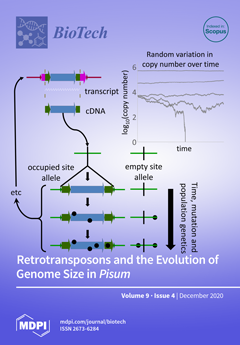
Cover Story: Transcripts are initiated in the 5′ and terminated at the 3′ LTR (green and purple). Reverse transcription, generates a cDNA which is inserted into genomic DNA with a short target site duplication (small arrow), leaving the allelic site unaffected. These two alleles, the occupied and empty site accumulate point mutations (illustrated as black dots). The evolutionary fate of these alleles depends on genetic drift and selection. With strong negative selection the occupied site will be lost quickly. Strong positive selection would cause the occupied site allele frequency to increase rapidly. Most extant insertions are selectively neutral, or nearly so and their fate is dependent on random variation (genetic drift) as illustrated in the graph. There are two stable frequencies for neutral alleles, when they are lost and when they are fixed: these alleles follow the famous U-shaped distribution of the Neutral Theory. View this paper
  • Issues are regarded as officially published after their release is announced to the table of contents alert mailing list .
  • You may sign up for email alerts to receive table of contents of newly released issues.
  • PDF is the official format for papers published in both, html and pdf forms. To view the papers in pdf format, click on the "PDF Full-text" link, and use the free Adobe Reader to open them.

Articles (7)

  • Feature Paper
  • Article
  • Open Access
4 Citations
3,820 Views
17 Pages

Retrotransposons and the Evolution of Genome Size in Pisum

  • T. H. Noel Ellis and
  • Alexander V. Vershinin

26 November 2020

Here we investigate the plant population genetics of retrotransposon insertion sites in pea to find out whether genetic drift and the neutral theory of molecular evolution can account for their abundance in the pea genome. (1) We asked whether two co...

  • Commentary
  • Open Access
23 Citations
5,266 Views
6 Pages

The Future of Biobanking: What Is Next?

  • Luciana Caenazzo and
  • Pamela Tozzo

23 November 2020

Biobanks are an extraordinary tool for research and scientific progress. Since their origin, the debate on the main technical, regulatory and ethical aspects has not stopped. The future of biobanks should take into account many factors: the need to i...

  • Review
  • Open Access
3 Citations
3,971 Views
8 Pages

11 November 2020

The RNF6 gene encodes Ring Finger Protein 6 (RNF6), which functions as a ubiquitin ligase. Its functions are not entirely known, but research shows that it is involved in human cancer development. Initially, this gene was considered to be a tumor sup...

  • Feature Paper
  • Article
  • Open Access
10 Citations
5,496 Views
15 Pages

27 October 2020

Acalymma vittatum (F.), the striped cucumber beetle, is an important pest of cucurbit crops in the contintental United States, damaging plants through both direct feeding and vectoring of a bacterial wilt pathogen. Besides providing basic biological...

  • Review
  • Open Access
4,336 Views
15 Pages

Metabolomics Community in Russia: History of Development, Key Participants, and Results

  • Elena E. Balashova,
  • Dmitry L. Maslov and
  • Oxana P. Trifonova

25 October 2020

Metabolomics is the latest trend in the “-omics” sciences, of which technologies are widely used today in all life sciences. Metabolomics gave impetus to the description of biochemical processes that occur in many organisms, search for ne...

  • Article
  • Open Access
5 Citations
5,861 Views
23 Pages

Transcriptomics of the Rooibos (Aspalathus linearis) Species Complex

  • Emily Amor Stander,
  • Wesley Williams,
  • Yamkela Mgwatyu,
  • Peter van Heusden,
  • Fanie Rautenbach,
  • Jeanine Marnewick,
  • Marilize Le Roes-Hill and
  • Uljana Hesse

23 September 2020

Rooibos (Aspalathus linearis), widely known as a herbal tea, is endemic to the Cape Floristic Region of South Africa (SA). It produces a wide range of phenolic compounds that have been associated with diverse health promoting properties of the plant....

Get Alerted

Add your email address to receive forthcoming issues of this journal.

XFacebookLinkedIn
BioTech - ISSN 2673-6284