Article

Digital Monitoring of Threatened Avifauna in Morocco: Insights from Social Media

1
Laboratory of Functional Ecology and Environmental Engineering, Faculty of Sciences and Technology, Sidi Mohamed Ben Abdellah University (USMBA), Fez 30050, Morocco
2
Bio-Resources, Environment and Health, Department of Biology, Faculty of Sciences and Technologies Errachidia, Moulay Ismail University of Meknes, Errachidia 52000, Morocco
3
Laboratory for Water Sciences, Microbial Biotechnologies and Sustainability of Natural Resources, Faculty of Sciences Semlalia, Cadi Ayyad University, Marrakech 40000, Morocco
4
Laboratory of Scientific Innovation in Sustainability, Environment, Education, and Health in the AI Era (LSISEEHAI), Normal School of Education, Sidi Mohamed Ben Abdellah University, Fez 30000, Morocco
*
Author to whom correspondence should be addressed.
Birds 2026, 7(3), 42; https://doi.org/10.3390/birds7030042
Submission received: 1 June 2026 / Revised: 3 July 2026 / Accepted: 7 July 2026 / Published: 9 July 2026

Simple Summary

Threatened and rare birds are difficult to monitor because field surveys are often costly and time-consuming. This study examined whether social media could help document these birds in Morocco from 2015 to 2025. Public posts, photos, videos, and ornithological sources were analyzed to identify species records, observation periods, habitats, and reported threats. The results showed that social media, especially Facebook and photographs, can provide useful information, mainly on adult birds and spring observations. This approach can complement field surveys and support conservation planning.

Abstract

This study evaluated social media platforms as complementary tools for monitoring threatened and rare bird species in Morocco from 2015 to 2025. Records were extracted from groups, pages, videos, photographs, and ornithological publications based on Facebook, Instagram, TikTok, X, LinkedIn, Telegram platforms. Multi-language and validation criteria were used to standardize records, and then data were analyzed and mapped to assess spatio-temporal dynamics, habitat preferences, and threatening factors. Results revealed significant interspecific differences (p < 0.001), with dominance of Streptopelia turtur arenicola (250 ± 48.35 records), followed by Geronticus eremita and Chersophilus duponti (222.15 ± 26.58 and 222 ± 59.31 records), Acrocephalus paludicola, and Chlamydotis undulata. Adults dominated records (851.54 ± 364.70 records), while eggs and chicks were weakly recorded. Records were mostly photographs and were from Facebook. Digital records were higher in March and April. Spatial records highlighted ecological specialization, G. eremita in Souss Massa and C. undulata in southeastern desert ecosystems. Results showed associations with steppes, riparian, agricultural, and semi-desert mosaics depending on recorded species. Predation (50 ± 3.54 records) and hunting (49 ± 13.44 records) were the main affecting factors, particularly in S. t. turtur (22.22% and 52.38% of records) and C. undulata (31.25% and 62.5%). The identified habitats and threats provide actionable indicators for prioritizing protection, monitoring, and targeted mitigation measures. These findings show that social media can support passive citizen-science and contribute to conservation planning and large-scale ecological monitoring of threatened avifauna. However, future research needs to combine field and digital investigations to reduce biases and present a more comprehensive picture of threatened birds.

1. Introduction

The history and evolution of social media are closely intertwined with the development of the internet, progressing from early web-based communication platforms to highly interactive, data-driven ecosystems that facilitate online global connectivity [1]. Initially characterized by static information exchange, social media platforms evolved into dynamic environments integrating user-generated content, algorithmic curation, and multimedia interaction, as evidenced by the transformation of platforms such as Twitter into complex socio-technical systems [2]. This evolution has significantly enhanced the mechanisms of information diffusion, enabling rapid dissemination through network structures influenced by user behavior, social bots, and sentiment interactions [3,4]. Recent studies highlight that information spread on social media can be modeled using epidemiological approaches, reflecting its viral and scalable nature [5]. Equally, social media platforms can monitor and map wild species such as the Mediterranean monk seal (Monachus monachus), in Porto Santo and Madeira, Portugal [6]. The recorded digital data were then used to model the spatial distribution in a highly human-habituated area. Beyond communication, social media has become an essential tool in scientific research, supporting knowledge exchange, academic collaboration, and educational outreach, particularly in specialized fields such as medicine [7], conservation [8], and ornithology [9]. In the ornithology field, Spennemann, [10] used Facebook to monitor bird species that feed on the nectar or seeds of Strelitzia reginae and S. nicolai in Australia. These demonstrate the capacity of social platforms to monitor specialized species and the feeding behaviour of birds. However, more attention needs to be paid to research methodology biases [10].
Social media platforms have emerged as valuable complementary tools for biodiversity monitoring, providing large volumes of user-generated data that can support ecological and conservation research at broad spatial and temporal scales [11,12]. Platforms such as Facebook, Instagram, TikTok, Flickr, Twitter (X), and YouTube allow researchers to access photographs, videos, comments, and georeferenced observations that document species occurrence, behavior, habitat use, and human–wildlife interactions [11]. In ornithological studies, social media data have been successfully applied to monitor bird diversity, distributional dynamics, habitat preferences, migration phenology, breeding activity, and conservation threats affecting both common and endangered species [13,14]. Recent investigations have demonstrated the usefulness of these platforms for assessing bird behavior and population trends through crowdsourced observations [10], while also identifying anthropogenic pressures such as illegal trade, hunting, and habitat disturbance [15]. Furthermore, the integration of social media records enables the simultaneous evaluation of ecological preferences, spatial distribution patterns, temporal fluctuations, and impacting factors across multiple species. Nevertheless, social media data presents important methodological limitations. Records are often concentrated in accessible and highly populated areas, generating geographical and taxonomic biases, while species detectability depends on observer interest and platform popularity [16]. In addition, algorithm-driven content visibility may influence data availability and representativeness [17]. Consequently, social media observations should be considered complementary rather than substitutes for standardized field surveys and long-term ecological monitoring programs.
Social media has become an influential tool in the conservation of threatened species, offering innovative approaches for tracking biodiversity, raising awareness, and supporting conservation planning. User-generated content, including geotagged images and observations, provides valuable ecological data that can complement traditional monitoring methods, enabling researchers to map species distributions and detect population trends in an online manner, and then use the data to define threatening factors [18,19]. Additionally, social media platforms play a crucial role in awareness and sensitization campaigns by disseminating conservation messages to broad audiences, fostering public engagement, and influencing pro-environmental behaviors [20,21]. These platforms also facilitate communication among scientists, policymakers, and local communities, enhancing collaborative conservation planning and decision-making processes. However, the effectiveness of such initiatives may be uneven, as social media attention often reflects taxonomic biases, favoring charismatic species over less visible taxa [22]. Furthermore, while social media can aid conservation, it may also pose risks, such as promoting wildlife exploitation or illegal trade through online networks [23], and unintentionally encouraging harmful human–wildlife interactions [24]. Nevertheless, social media-derived biodiversity data should be interpreted cautiously, as records are often biased toward human-accessible locations, uneven observer effort, and species with higher detectability or public interest, potentially influencing perceived distribution patterns and ecological inferences. Despite these challenges, when used responsibly, social media represents a powerful and cost-effective tool for integrating public participation into conservation strategies, improving data availability, and strengthening global efforts to protect endangered species [25]. In fact, online data are easily accessible (groups, accounts, etc.), target a wide range of scales (travel of citizens, nomads, explorers), and have long-term availability, which is not easy by field research that requires institutional investment.
Social media platforms and region-specific networks have become increasingly important tools for biodiversity conservation by generating large volumes of digital ecological information [26,27]. These platforms facilitate the identification of threatening factors affecting wildlife. For example, social media records have documented illegal hunting of migratory birds, disturbance of breeding colonies, habitat degradation, wildlife trade, road mortality, and predation events involving threatened species [18,28]. Such digital observations provide digital and georeferenced information that can support conservation planning by identifying priority areas, monitoring emerging threats, detecting changes in species distributions, and guiding adaptive management strategies [18,29]. Moreover, digital approaches are particularly valuable in developing countries where financial resources, technical infrastructure, and field-survey capacity are often limited. By exploiting freely available online data, conservation practitioners can reduce logistical costs while expanding spatial and temporal monitoring coverage [30]. However, their dual role requires careful management, as they may simultaneously present biases in data collection (loss of microhabitat details and surrounding climatic conditions) and facilitate harmful activities. Overall, social media constitutes a valuable tool for integrating citizen science, improving biodiversity monitoring, and strengthening evidence-based conservation planning in combination with field research [31].
Morocco is recognized as one of the major biodiversity hotspots of the Mediterranean region, encompassing a remarkable diversity of ecosystems ranging from Atlantic and Mediterranean coasts, wetlands, forests, steppes, mountains, and desert landscapes to oasis environments [32,33]. This ecological heterogeneity supports rich plant communities, including diverse wetland and terrestrial floras that provide essential food resources, nesting substrates, shelter, and migration stopovers for numerous animal species, particularly birds [34,35]. Moroccan avifauna includes a wide range of resident, migratory, and globally threatened species inhabiting wetlands, forests, steppes, and arid ecosystems [36,37]. Notable threatened birds include the Northern Bald Ibis (Geronticus eremita), African houbara (Chlamydotis undulata), Dupont’s Lark (Chersophilus duponti), Marbled duck (Marmaronetta angustirostris), Ferruginous Duck (Aythya nyroca), and North African Turtle Dove (Streptopelia turtur arenicola), whose populations are affected by habitat degradation, water scarcity, agricultural intensification, climate change, hunting pressure, predation, and human disturbance [38,39,40]. Nevertheless, most Moroccan ornithological investigations have focused on relatively abundant or easily detectable species such as the European Turtle Dove [41,42,43] and Eurasian Coot (Fulica atra) [44,45], and have relied almost exclusively on conventional field surveys [46]. Consequently, rare, elusive, and highly threatened birds remain insufficiently documented. In this context, digital tools, particularly social media and other citizen-generated data sources, offer promising complementary approaches for monitoring poorly known species [47], expanding spatial coverage [14], reducing logistical constraints, and supporting conservation decision-making at national scales [48].
In this context, the present study introduces a novel methodological framework based on the integration of multi-lingual and multi-platform social media data for biodiversity assessment, particularly in Morocco, where all previous studies were based on field investigations. The species selected represent diverse ecological guilds and conservation statuses, reflecting Morocco’s importance as a breeding, wintering, and migratory refuge. The North African turtle dove (Streptopelia turtur arenicola) was included as a reference species because its ecology, distribution, and population dynamics have been extensively documented through field-based research in Morocco, allowing comparisons between conventional survey results and social media-derived observations. In contrast, the Northern bald ibis (Geronticus eremita), African houbara (Chlamydotis undulata), Dupont’s lark (Chersophilus duponti), and Aquatic warbler (Acrocephalus paludicola) remain relatively understudied, particularly regarding large-scale monitoring, population trends, behavioral ecology, and threat assessment. Consequently, these species provide an ideal framework for evaluating the potential of digital data sources to complement traditional field surveys, fill important knowledge gaps, improve spatial and temporal coverage, and support the conservation of rare and threatened bird species.
By combining structured keyword searches across Arabic, French, English, and Spanish (the most used languages in Morocco) with systematic data extraction from diverse digital sources (e.g., observers, groups, and institutional platforms), this approach enhances the spatial and temporal resolution of species occurrence data. The innovation of this methodology lies in its ability to merge ecological indicators (e.g., behavior, reproduction) with anthropogenic pressure variables (e.g., hunting, mortality), thereby providing a more comprehensive understanding of species status within dynamic socio-ecological systems. Furthermore, the study leverages citizen-generated content as a complementary data source, offering a cost-effective and scalable alternative to traditional field surveys. This integrative framework not only advances methodological practices in conservation science but also contributes to evidence-based planning, awareness, and decision-making in arid and semi-arid regions.

2. Materials and Methods

2.1. Animal Species

The selected species represent emblematic threatened bird taxa in Morocco [49], encompassing a broad range of ecological niches, habitat requirements, and conservation challenges. The North African turtle dove (Streptopelia turtur arenicola), classified as Vulnerable, remains widely distributed across Moroccan agroecosystems as both a breeding and migratory species. However, its populations have experienced substantial declines owing to habitat loss, agricultural intensification, reduced food availability, and hunting pressure [50,51]. In contrast, the Northern bald ibis (Geronticus eremita), listed as Endangered globally, persists in Morocco through one of the last viable wild populations worldwide, primarily located along the Atlantic coast. Intensive conservation measures have contributed to population stabilization, making this species a flagship example of successful conservation intervention [52,53].
The North African African houbara (Chlamydotis undulata) inhabits arid and semi-arid steppe ecosystems in eastern Morocco and remains highly threatened by overhunting, habitat degradation, and human disturbance, despite ongoing captive-breeding and reintroduction programs aimed at reinforcing wild populations [54,55]. Likewise, Dupont’s lark (Chersophilus duponti) is a rare and highly localized steppe specialist characterized by fragmented populations and a high sensitivity to habitat degradation, overgrazing, land-use change, and climatic variability [56,57]. The aquatic warbler (Acrocephalus paludicola), one of Europe’s most threatened passerines, occurs in Morocco as a wintering migrant associated with wetland habitats, where it is affected by habitat loss, wetland degradation, and environmental changes occurring along its migratory flyway [58,59].
Collectively, these species illustrate the ecological significance of Morocco as a key refuge for both resident and migratory avifauna. Their contrasting ecological requirements, conservation statuses, and threat profiles provide a valuable framework for assessing species representation and conservation-related information within social media platforms, while highlighting the need for integrated and evidence-based conservation strategies.

2.2. Research Platforms

Data collection in Morocco was conducted across a diverse set of social media platforms, including Instagram, Facebook, TikTok, Telegram, X, and LinkedIn, ensuring comprehensive coverage of both informal and professional communication channels. These platforms were selected for their high user engagement and capacity to generate online, user-driven biodiversity data. Searches were systematically performed using platform-specific engines, hashtags, and multilingual keywords, enabling the identification of relevant content such as species observations, images, and videos. This multi-platform approach enhances data diversity, improves detection of species occurrences, and strengthens the reliability of social media as a complementary tool for conservation research.

2.3. Research Approach

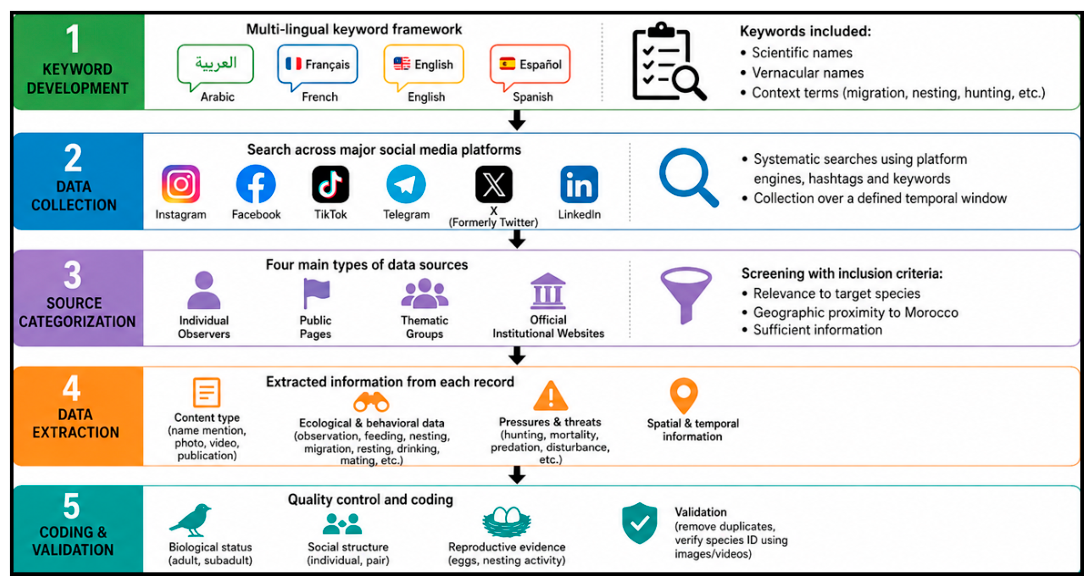
The methodology adopted for this study in Morocco is based on a multi-lingual, multi-platform approach to assess the presence and conservation-related information of selected threatened bird species, namely Streptopelia turtur arenicola, Geronticus eremita, Chlamydotis undulata, Chersophilus duponti, and Acrocephalus paludicola. A structured keyword framework was developed in four major research languages (Arabic, French, English, and Spanish) to capture the linguistic diversity of online content. Keywords included scientific names, vernacular names, and context-specific terms (e.g., “migration,” “nesting,” “hunting”). Examples included Streptopelia turtur, turtle dove, tourterelle des bois, اليمامة المطوقة, migration, nesting, breeding, hunting, poaching, predation, mortality, conservation, and equivalent multilingual expressions. Similar search combinations were applied to Geronticus eremita, Chlamydotis undulata, Chersophilus duponti, and Acrocephalus paludicola, using both species-specific and threat-related hashtags (e.g., #TurtleDove, #NorthernBaldIbis, #Houbara, #DupontsLark, #AquaticWarbler, #BirdConservation, #Migration, #Hunting). Search covered content published between January 2015 and March 2025. Data collection (extraction) was done from January to April 2026, with manual research to verify the content of records by our team of ornithologists. Screening followed a three-step procedure: (i) preliminary retrieval through keywords and hashtags, (ii) verification of species identity using textual descriptions and available photographs or videos, and (iii) assessment of geographic relevance to Morocco. Records were excluded when species identification was uncertain, locality information was absent, content was duplicated across platforms, or posts were unrelated to the target taxa. Three temporal variables were recorded separately whenever available: observation date (date of species occurrence), publication date (date of online posting), and data extraction date (date of retrieval by researchers), thereby distinguishing biological observations from digital publication and sampling processes.
Data sources were categorized into four main types: individual observers, public pages, thematic groups, and official institutional websites. Each retrieved record was screened against predefined inclusion criteria. Extracted data included the type of content (species name mention, photo, video, or publication), as well as ecological and behavioral information (e.g., observation, feeding, nesting, migration, resting, drinking, mating). Additional variables related to anthropogenic and natural pressures were recorded, including hunting, mortality, predation, and other disturbance factors. These parameters were extracted from photographs, videos, captions accompanying posts, audio recordings, observer descriptions, and interactions between content creators and followers across social media platforms. Evidence of mortality, hunting, trapping, injury, illegal capture, nest disturbance, and trade was recorded when clearly visible in images or videos or explicitly mentioned in accompanying text or comments. Publications with ambiguous, unverifiable, or insufficient information were excluded to ensure data reliability. This classification enabled a comprehensive assessment of both species’ occurrence and associated threats within digital environments.
To enhance analytical robustness, all records were further coded according to biological status indicators, including life stage (adult, subadult), social structure (individual, pair), and reproductive evidence (eggs, nesting activity). Data validation involved cross-checking duplicate entries and verifying species identification, where possible via image or video content. Quantitative analyses included frequency distributions, cross-tabulations between platforms and species, and comparisons across languages and content types. This integrative methodological framework allows for the evaluation of social media as a complementary tool for biodiversity monitoring, conservation awareness, and decision-making, particularly in data-limited contexts such as arid and semi-arid regions of Morocco (Figure 1).

2.4. Data Clearance and Validation

To improve data quality and reduce potential biases associated with social media datasets, all retrieved records underwent a multi-step cleaning procedure before analysis. First, duplicate records originating from reposts, shared content, or multiple appearances of the same observation across platforms were identified and removed. Records lacking sufficient information for species identification, geographic attribution to Morocco, or ecological interpretation were excluded.
Data validation was performed through manual verification of species identity whenever photographs or videos were available. Records based solely on textual descriptions were retained only when species names were explicitly stated and consistent with known distributions. Nevertheless, social media data remains subject to observer effort, detectability, and accessibility biases, as observations are more likely to originate from human-accessible areas and conspicuous species. Consequently, the results should be interpreted as indicators of ecological patterns rather than precise estimates of population size or distribution.

2.5. Data Organization and Analysis

All data extracted from social media platforms were organized and standardized using Microsoft Excel before statistical processing. Quantitative variables related to species occurrence, temporal variation, habitat use, behavioral activities, observation forms, and platform contribution were expressed as mean ± standard deviation of digital records. Data was grouped by months for each year to avoid the interference of sampling efforts, opportunistic data, and non-normal distribution of variables. One-way analysis of variance (ANOVA) was performed to compare differences among species, observation categories, social media platforms, habitat types, behavioral activities, and temporal records. When significant differences were detected (p < 0.05), Tukey’s post hoc test was applied to identify homogeneous and heterogeneous groups among variables. Multivariate relationships between bird species and ecological or observational parameters were investigated using Correspondence Analysis (CA). In these analyses, bird species represented dependent variables, whereas habitats, behavioral activities, temporal categories, observation forms, and platform characteristics constituted the independent variables. The CA results were visualized in two-dimensional plots, allowing the identification of ecological associations, segregation patterns, and gradients of habitat specialization among the studied threatened avifauna.

2.6. Mapping of Bird Species

The spatial distribution of bird species was mapped using ArcGIS 10.x software to visualize regional patterns of occurrence across Morocco. The cartographic background was based on the World Imagery basemap provided by Esri (sources: Esri, Vantor, and Earthstar Geographics), which offers high-resolution satellite imagery suitable for ecological and biodiversity studies. Administrative boundaries corresponding to the Moroccan regions were used as the primary spatial units of analysis, allowing standardized comparisons among territories.
Five bird species were selected for mapping: Streptopelia turtur arenicola, Geronticus eremita, Chlamydotis undulata, Chersophilus duponti, and Acrocephalus paludicola. Geographic coordinates were extracted from embedded geotags, location labels, place names mentioned in captions or comments, and recognizable landmarks visible in images or videos. When necessary, locations were verified and georeferenced using online mapping tools to ensure spatial accuracy and consistency. For each administrative region, the percentage of observations was calculated by dividing the number of records for a given species within the region by the total number of observations recorded for that species across Morocco.
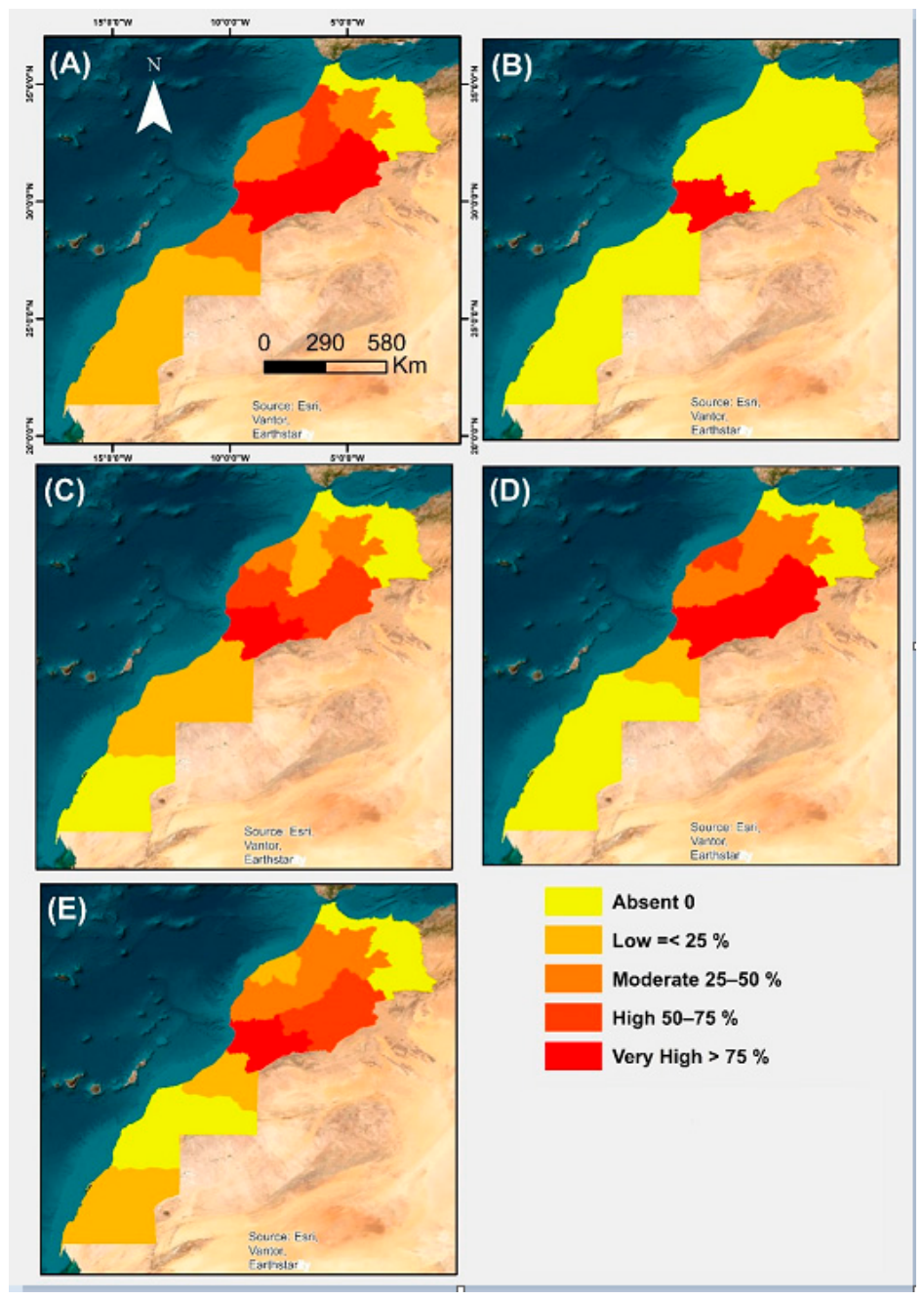
The resulting digital records were linked to the regional vector layer through an attribute joint based on a common regional identifier. To facilitate comparisons among species, a standardized classification scheme was applied using five categories: absent (0%), low (≤25%), moderate (25–50%), high (50–75%), and very high (>75%). These percentages were calculated as the proportion of records occurring within each region relative to the total number of records for a given species. Consequently, the assigned percentage classes represent the relative abundance and spatial concentration of digital records in each mapped region rather than actual population abundance, thereby facilitating the visualization and comparison of species occurrence patterns across Morocco. A graduated color scale ranging from yellow (absence) to red (very high occurrence) was used to represent increasing observation intensity. All maps were produced using the WGS 84 geographic coordinate system and included identical cartographic elements, namely a north arrow, geographic grid, and scale bar. The five individual species maps were subsequently assembled into a single composite figure with a common legend to ensure visual consistency and facilitate interspecific comparisons.

3. Results and Discussion

3.1. Records for Species

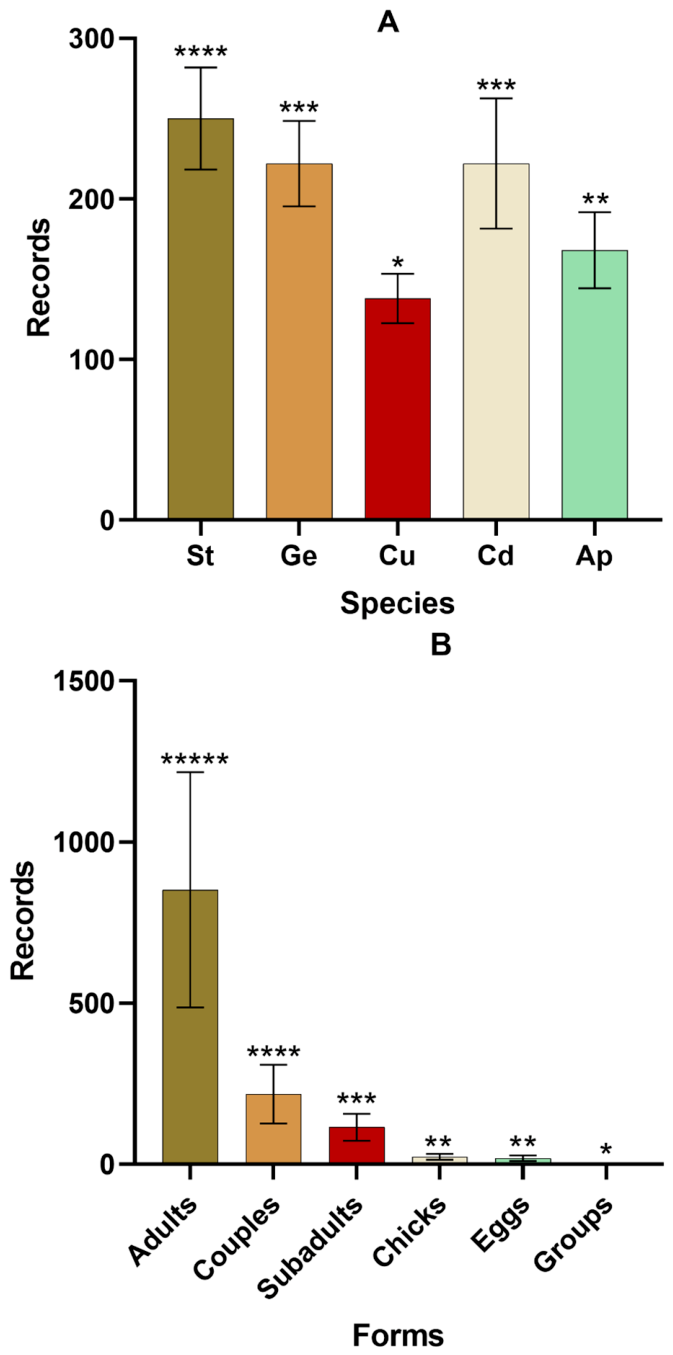
The distribution of total records (2015–2025) among the studied avian species was analysed with One-way ANOVA (Figure 2A) and revealed significant differences in the number of records among species (p < 0.001). Streptopelia turtur arenicola exhibited the highest number of records (250 ± 48.35), followed by Geronticus eremita (222 ± 47.99 records) and Chersophilus duponti (222 ± 59.31 records). Acrocephalus paludicola was represented by 168 ± 25.23 records, whereas Chlamydotis undulata showed the lowest representation, with only 138 ± 20.81 records.
Adult individuals were overwhelmingly predominant, accounting for 851.54 ± 364.70 records and significantly exceeding all other categories (p < 0.001) (Figure 2B). Records of breeding pairs were considerably lower (217.36 ± 90.88), followed by subadults (114.64 ± 41.77 records). In contrast, chicks (22.71 ± 9.13 records) and eggs (18.92 ± 8.41 records) were infrequently recorded, indicating limited representation of early life stages. Group observations were exceptionally rare, averaging only 1.45 ± 0.50 records per species.
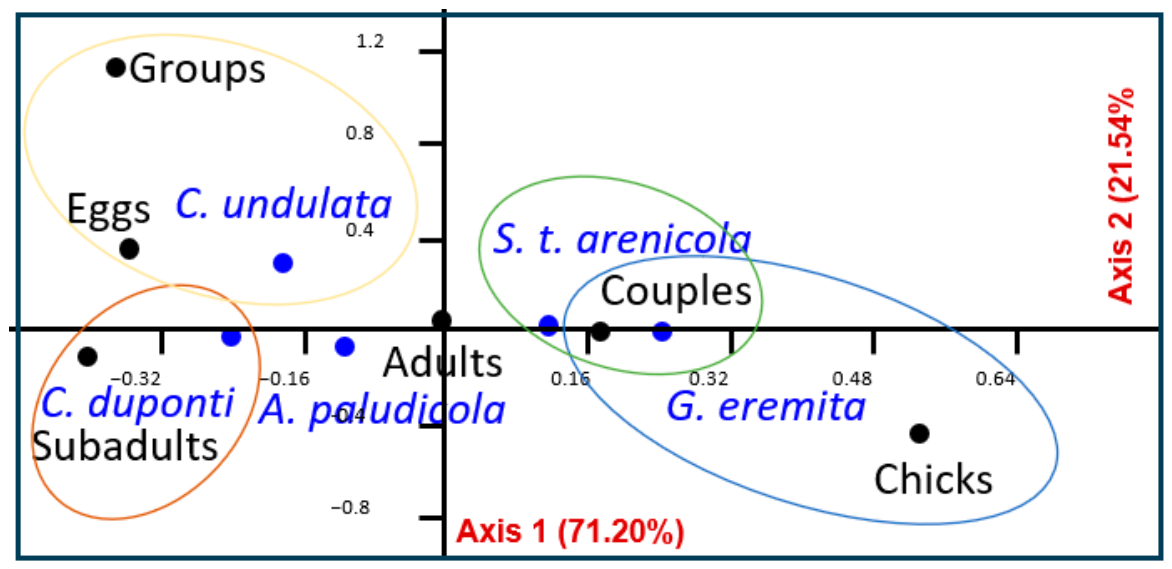
The Correspondence Analysis 2D plot (>62% of variance) presents the correspondence between bird species and observed forms. In terms of species, S. t. arenicola shows dominance of adults, followed by couples (Figure 3). Further, in G. eremita, adults and couples were the principal observed birds, followed by chicks. Moreover, C. duponti records are mostly in adults, followed by notable Subadults. In contrast, A. paludicola includes mostly adults. Finally, C. undulata was mostly in subadults and eggs, and a single group.
It should be emphasized that these patterns reflect the frequency of social media observations in human-accessible and digitally connected environments rather than actual population structure or abundance. Therefore, differences among species and life stages may partly result from observer preferences, species detectability, and reporting biases.
The present results revealed marked interspecific differences in the observed birds’ structure derived from social media records. Streptopelia turtur turtur showed the highest digital records, dominated by adults and breeding pairs, complementing Moroccan population assessments conducted by Mansouri et al. [60] and breeding studies in olive groves reported by Squalli et al. [61]. Similarly, Geronticus eremita records were largely represented by adults and couples, complemented by the breeding colony structure described by Bowden et al. [52] and Schenker et al. [62] in Souss Massa. Further, Chersophilus duponti also exhibited high adult occurrence, in agreement with Moroccan distribution surveys reported by Garcia et al. [57], while Chlamydotis undulata remained weakly represented, reflecting its fragmented desert populations previously highlighted by Hingrat et al. [63]. In contrast, quantitative population estimates remain extremely limited in Morocco for A. paludicola, C. duponti, and C. undulata in previous papers, unlike the relatively well-documented turtle dove populations. Therefore, this study is the first to evaluate the structure and age of birds among A. paludicola, C. duponti, and C. undulata in Moroccan and northwest African ecosystems.
The predominance of adults compared with eggs and chicks likely reflects the higher detectability and photographic accessibility of mature individuals on digital platforms. These findings demonstrate the growing value of social media as an innovative passive-monitoring tool capable of documenting population size, breeding pairs, age structure, reproductive activity, and spatial occurrence of threatened and rare bird species. Moreover, platforms such as Facebook, Instagram, and TikTok provide large-scale temporal datasets that can substantially complement conventional ornithological surveys and conservation monitoring programs.

3.2. Temporal Dimension

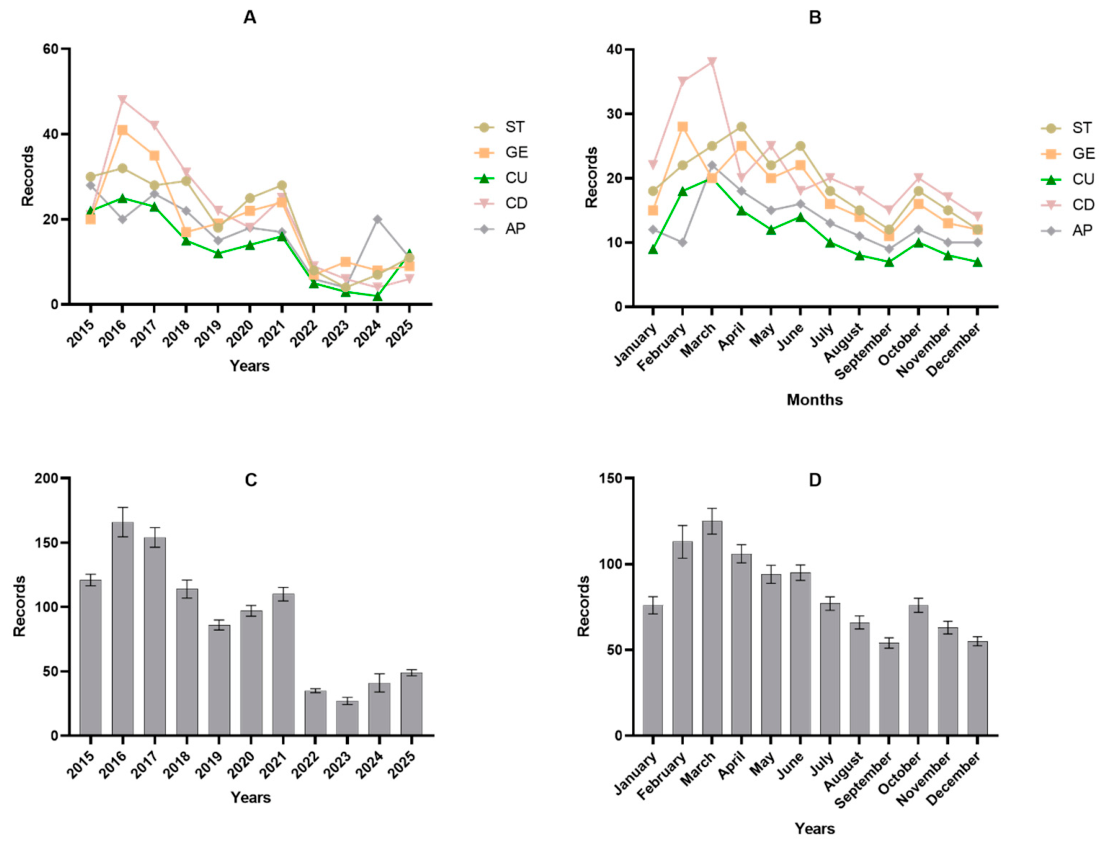
Bird records exhibited pronounced temporal fluctuations between 2015 and 2025, with patterns varying among species. Streptopelia turtur arenicola remained relatively stable until 2021, followed by a marked decline during 2022–2023 and a slight recovery by 2025 (Figure 4A). Similarly, Geronticus eremita reached a pronounced peak of digital records in 2016–2017 before undergoing a gradual decline. In contrast, Chlamydotis undulata displayed a consistent downward trend, followed by a recovery in 2025. Chersophilus duponti showed the highest digital records during the early years of the study period but experienced substantial declines thereafter. Finally, Acrocephalus paludicola exhibited moderate fluctuations, with a notable increase in digital records during 2024.
In terms of months (Figure 4B), Streptopelia turtur arenicola peaked during spring and early summer, especially April and June. Additionally, Geronticus eremita showed the highest abundance in February and April. On the other hand, Chlamydotis undulata reached its maximum record in March, then declined steadily. Chersophilus duponti dominated the winter–spring months, peaking strongly in March. Lastly, Acrocephalus paludicola displayed moderate fluctuations, with the greatest abundance during March and April.
Total bird records reached maximum values in 2016 (166 ± 11.43 records), followed by 2017 (154 ± 7.66 records), indicating peak abundance and variability. Minimum values occurred during 2022 (35 ± 1.58 records) and 2023 (27 ± 2.79 records) (Figure 4C). Monthly bird records were highest in March (125 ± 7.55 records) and February (113 ± 9.53 records). In contrast, the lowest totals occurred in September (54 ± 3.03) and December (55 ± 2.65 records) (Figure 4D).
Temporal patterns extracted from social media records revealed pronounced interannual and seasonal fluctuations among the studied threatened avifauna. European turtle dove showed peak observations during spring and early summer, particularly in April and June, which closely aligns with migration and breeding chronologies previously documented in North Africa by Mansouri et al. [60,64,65] and migration timing analyses by Marx et al. [66]. The marked decline recorded during 2022–2023 may reflect ongoing population reductions associated with habitat degradation and hunting pressure. However, precise migration dates remained poorly represented in social media records, likely due to the short duration and low detectability of migratory passages. African houbara reached maximum abundance during March, corroborating reproductive and display periods reported by Saint Jalme et al. [67] and Hingrat et al. [63]. Similarly, Dupont’s lark peaked during late winter and spring, consistent with breeding dispersal patterns described by Perez-Granados et al. [68]. Aquatic warbler exhibited spring resurgence, supporting migratory observations from West Africa and Portugal [58,59].
Despite the importance of previous studies in clarifying time variables of study species, they rely on short-term field observations [65,69,70,71,72], while these findings show that long-term records (2015–2025) provide a unique and continuous temporal resolution of A. paludicola, C. duponti, and C. undulata in the northwest African range, enabling simultaneous detection of interannual declines and seasonal peaks.
These findings also demonstrated the scientific value of social media datasets for reconstructing the chronology of observations, seasonal occurrence, breeding periods, and migration dynamics of rare and endangered bird species in Morocco, while highlighting the growing capacity of digital platforms to complement conventional ornithological monitoring. Ultimately, these temporal and monthly variations primarily reflect reporting effort, observer activity, and the accessibility of human-inhabited environments rather than true demographic or ecological changes in species. Consequently, observed peaks and declines across species should be interpreted as indicators of social media detectability and engagement biases, not population dynamics in the field.

3.3. Media Platforms

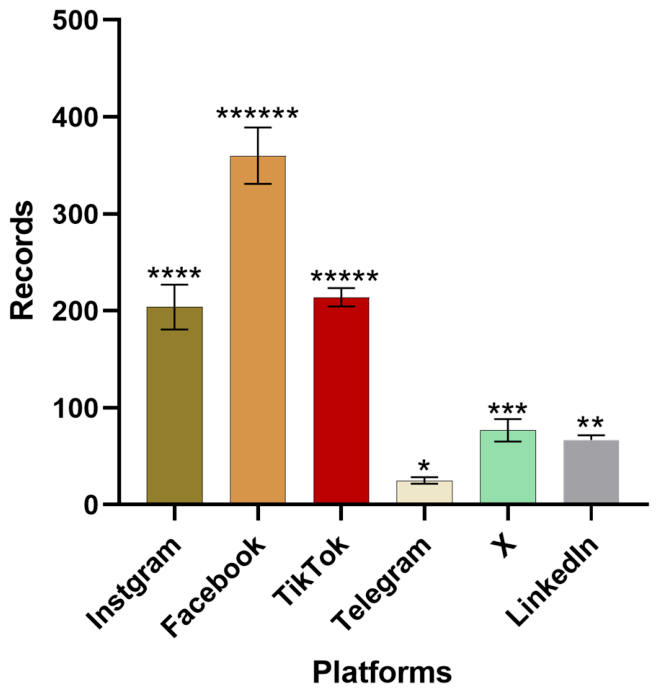
Records of the surveyed avian species across social media platforms were analysed with One-way ANOVA (Figure 5) and revealed significant differences in the number of records among platforms (p < 0.001). Facebook accounted for the highest number of records (360 ± 29.04), followed by TikTok (214 ± 9.42 records) and Instagram (204 ± 23.05 records). Additionally, X contributed 77 ± 11.56 records, whereas LinkedIn yielded 67 ± 4.67 records. In contrast, Telegram exhibited the lowest representation, with only 25 ± 3.39 records.
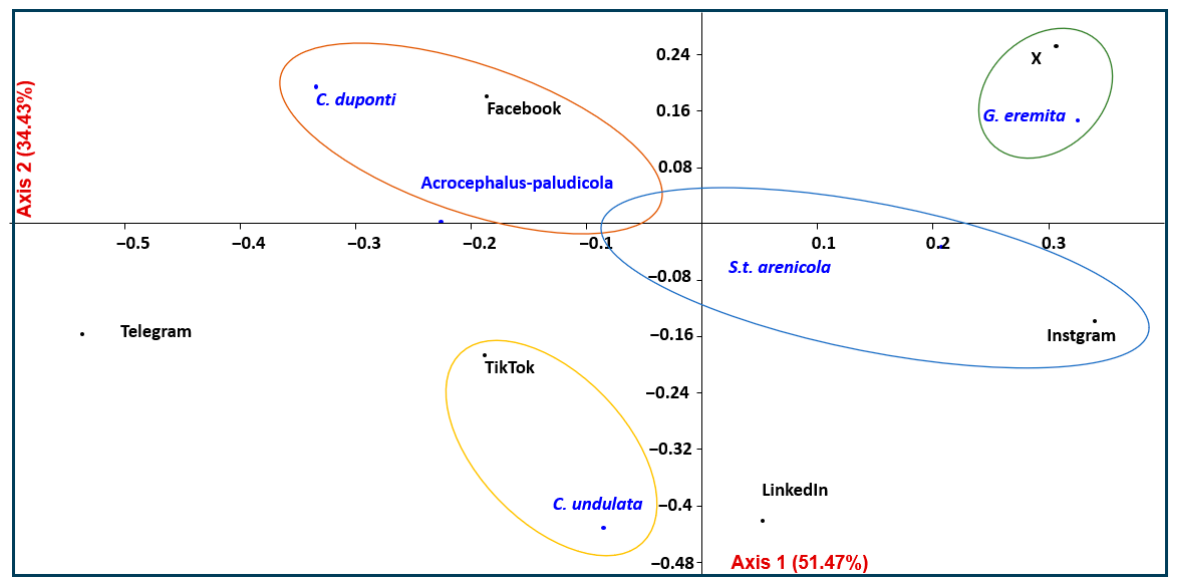
The Correspondence Analysis 2D plot (>90% of variance) presents the correspondence between bird species and recording platforms (Figure 6). In terms of species, Streptopelia turtur arenicola shows dominance on Facebook, followed by Instagram and TikTok. In Geronticus eremita, Facebook and Instagram were the principal platforms. Further, Chersophilus duponti records are mostly on Facebook. Acrocephalus paludicola was mostly recorded on Facebook, followed by TikTok and Instagram. Finally, Chlamydotis undulata birds were mostly recorded on TikTok.
The distribution of avian observations across social media platforms demonstrated the predominance of Facebook as the principal source of biodiversity records, particularly for Dupont’s lark and European turtle dove. This pattern likely reflects the extensive use of Facebook groups and birdwatching communities for sharing wildlife observations and photographs. Similar trends were reported by Cavalli et al. [73] and Spennemann [10], who emphasized the effectiveness of Facebook for crowdsourcing ornithological information. The high contribution of TikTok and Instagram, especially for African houbara and Northern bald ibis, may be explained by the increasing popularity of visual multimedia content, facilitating species detection and dissemination. Comparable findings from Flickr, eBird, and iNaturalist datasets demonstrated that image-based platforms substantially improve species identification reliability [74]. Moreover, O’Neill et al. [14] highlighted the capacity of social media and citizen-science platforms to monitor spatial distribution changes in threatened fauna over broad geographic scales. The recurrent detection of rare species such as the Aquatic warbler confirms the growing ecological value of social platforms as complementary monitoring systems capable of documenting occurrence, habitat occupancy, and behavioral ecology in regions where conventional surveys remain limited. Collectively, these findings indicate that recorded occurrences are strongly shaped by platform-specific user behavior and visibility rather than true species abundance or ecological distribution patterns. Consequently, social media-derived records primarily reflect human engagement biases and platform accessibility, which should be considered when interpreting interspecific differences across digital sources.

3.4. Source of Records

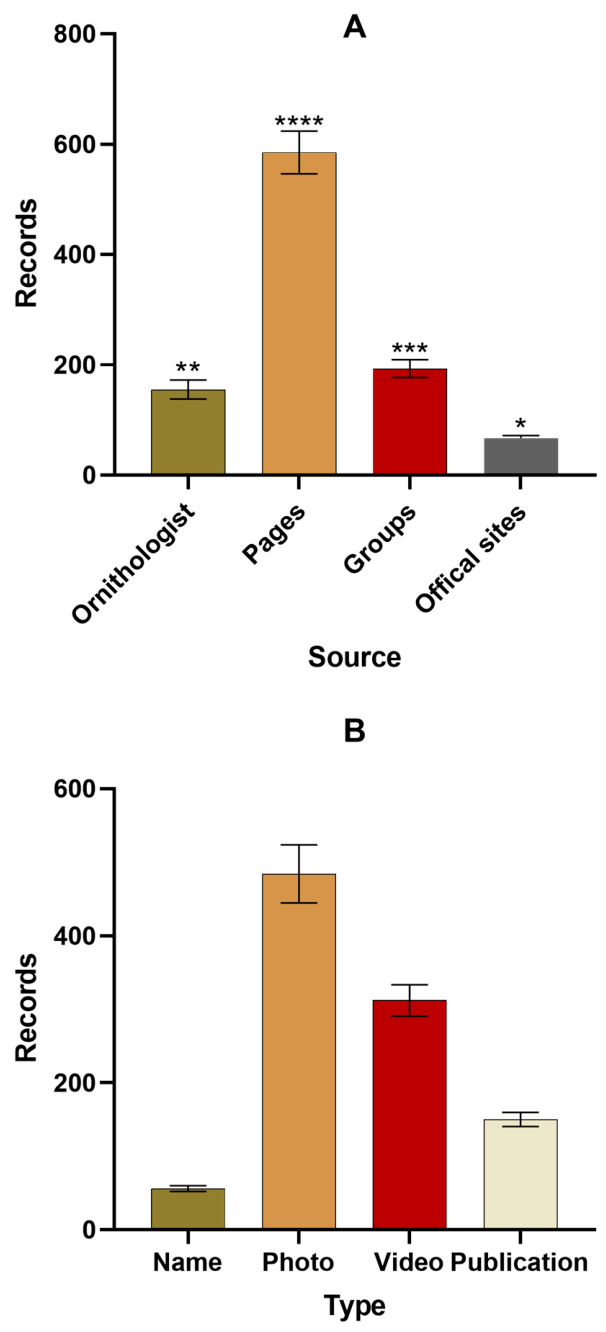
Recorded results for surveyed avian species according to data sources on social media platforms show that Pages record the highest total with 585 ± 38.75 records, followed by groups and ornithologists with 193 ± 16.12 and 155 ± 17.03 records, respectively (p < 0.001) (Figure 7A). In contrast, official sites were recorded 67 ± 4.72 times, representing the lowest contribution among data sources. The type of records was significantly variable (p < 0.01) (Figure 7B). Photos were the most dominant with 48.4%, followed by videos with 31.2%. In contrast, publications and names of the species were the lowest recorded, with 15% and 5.6%, respectively.
In terms of species, Streptopelia turtur arenicola is dominant on pages, followed by groups, ornithologists (35), and official sites. In Geronticus eremita, pages and ornithologists were the principal sources. Further, Chersophilus duponti was recorded mostly in pages and groups. Further, Acrocephalus paludicola was mostly recorded on pages and groups. Finally, Chlamydotis undulata was mostly recorded in pages, followed by groups and ornithologists.
These patterns suggest that avian occurrence data are primarily driven by informal social media pages, with structured scientific or official sources contributing relatively little to the overall dataset. Consequently, observed species distributions and recording frequencies largely reflect user-generated content bias, emphasizing the need for cautious ecological interpretation.
Social media platforms generated substantial biodiversity information, with Pages representing the dominant source of avian observations, particularly for European turtle dove, Dupont’s lark, and Northern bald ibis. Photos and videos constituted the principal post formats, reflecting the strong visual detectability of bird species and facilitating taxonomic validation. Similar trends were reported in Facebook-based ornithological surveys and citizen-science approaches by Cavalli et al. [73], Spennemann [10], and Shaw et al. [75]. The predominance of multimedia records corroborates findings from Flickr, eBird, and iNaturalist analyses, where images considerably improved species identification reliability [74].

3.5. Spatial Distribution

The geographical distribution of digital records in the studied bird species reveals marked spatial heterogeneity across Moroccan ecosystems, reflecting species-specific ecological preferences and habitat specialization (Figure 8). European turtle dove was broadly distributed, with its highest digital abundance recorded in the Anti-Atlas and Taroudant region, followed by Rabat, Casablanca, and northern areas. Northern bald ibis showed a highly localized distribution, being concentrated almost exclusively in Souss Massa, particularly in Tamri and Oued Massa, confirming the ecological importance of these coastal habitats for this endangered species. African houbara was digitally dominant in Merzouga and the South-East region, indicating its preference for arid and desert landscapes. Dupont’s lark reached its maximum abundance in the Middle and High Atlas, whereas the Aquatic warbler was primarily concentrated in Rabat, Casablanca, and northern wetlands, highlighting the significance of northern humid ecosystems for migratory and wetland-dependent avifauna.
The spatial distribution patterns derived from social media records revealed strong ecological differentiation among threatened Moroccan avifauna. European turtle dove showed broad distribution across Anti-Atlas, Taroudant, and northern urbanized regions, corroborating Moroccan findings reported by Mansouri et al. [50], Squalli et al. [61], and Eddajjani et al. [41], which highlighted the species’ adaptability to agricultural and peri-urban habitats. Northern bald ibis was almost exclusively concentrated in Souss Massa and Tamri, consistent with the historical and current distribution described by Bowden et al. [52], Schenker et al. [62], and Znari [76]. African houbara predominated in Merzouga and southeastern arid zones, confirming observations from Eastern Morocco reported by Hingrat et al. [63] and Le Cuziat et al. [54]. Similarly, Dupont’s lark remained associated with steppe and mountainous ecosystems, in agreement with [57,68]. Aquatic warbler was mainly restricted to northern wetlands, corroborating the West African wintering distributions documented by [58,77]. Compared to field-based studies, characterized by a limited geographical range, these findings reported new areas where these species had never been documented. This permitted the first map of A. paludicola, C. duponti, and C. undulata distribution in Morocco.

3.6. Activities of Records

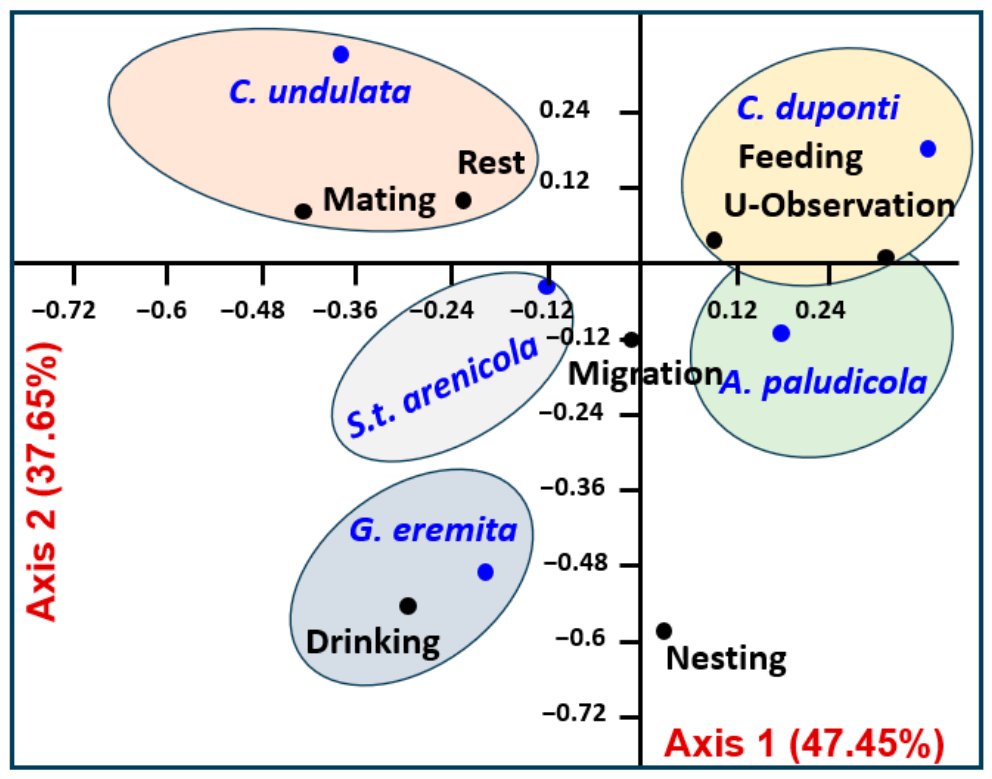
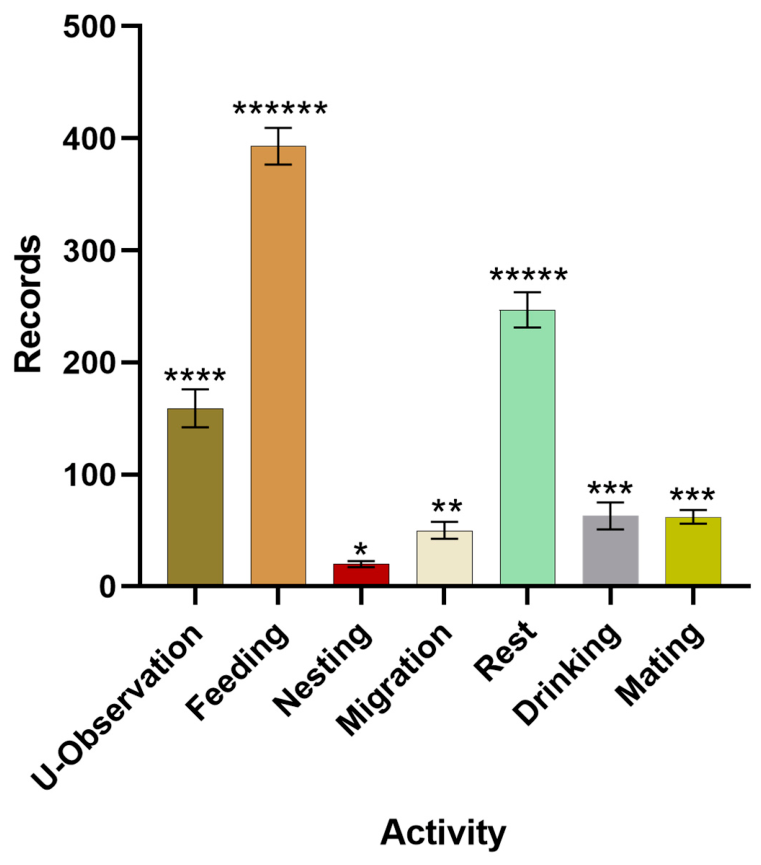
One-way ANOVA revealed significant differences among activity categories (p < 0.001) (Figure 9). Feeding was the most frequently recorded activity (393 ± 16.32), followed by resting (247 ± 15.68 records) and unidentified observations (159 ± 16.89 records). Drinking and mating were recorded in 63 ± 12.01 and 62 ± 6.07 records, respectively, while migration accounted for 50 ± 7.48 records. In contrast, nesting was the least frequently documented activity, with only 20 ± 2.71 records.
Correspondence Analysis (2D plot with total variance >75%) between birds and captured activity from platforms showed a clear association between species and digitally recorded activities (Figure 10). Streptopelia turtur arenicola and Acrocephalus paludicola were mostly observed during migration. Further, Geronticus eremita was mostly observed near aquatic systems for drinking water. Chersophilus duponti records were mostly in feeding, and a significant number of records were unidentified. In contrast, Chlamydotis undulata was mostly recorded during mating and resting.
Based on a deep literature review, this study is the first to evaluate these activity budgets, particularly for A. paludicola, C. duponti, and C. undulata, revealing statistically robust differences in behavior frequencies and providing a novel, scalable proxy for comparative behavioral ecology in human-accessible landscapes. The predominance of feeding activity among digital records confirms its central ecological and behavioral importance in avian daily life, as feeding behavior directly influences survival, energy balance, and reproductive success [78,79]. High frequencies of resting observations may reflect energy conservation strategies associated with thermoregulation and habitat use. Conversely, the limited records of nesting and mating likely result from their seasonal and discreet nature. Drinking observations further emphasize the physiological importance of water acquisition in birds, particularly under arid conditions [14,80].
Behavioral observations extracted from social media platforms revealed feeding as the dominant activity across all studied species, particularly in Dupont’s lark (100 records), Northern bald ibis (85), and European turtle dove (76). These findings are consistent with previous ecological studies highlighting intensive foraging behavior in turtle doves during breeding periods [81,82] and the importance of feeding ecology in ibis conservation programs [83]. Resting and mating behaviors observed in the African houbara corroborate behavioral patterns reported under semi-desert conditions [63,84]. The low frequency of nesting records reflects the cryptic nature of reproductive behavior in threatened avifauna.
These activity-based records likely reflect the differential detectability of behaviors on social media, where conspicuous actions such as feeding and resting are more frequently documented than cryptic processes like nesting. Consequently, observed behavioral patterns should be interpreted as representation biases of online visibility rather than comprehensive ethological profiles of the studied species. However, these results demonstrate the considerable potential of social media platforms as complementary tools for monitoring behavioral ecology, habitat use, and activity rhythms of rare and endangered bird species across broad geographic scales.

3.7. Recording Habitats

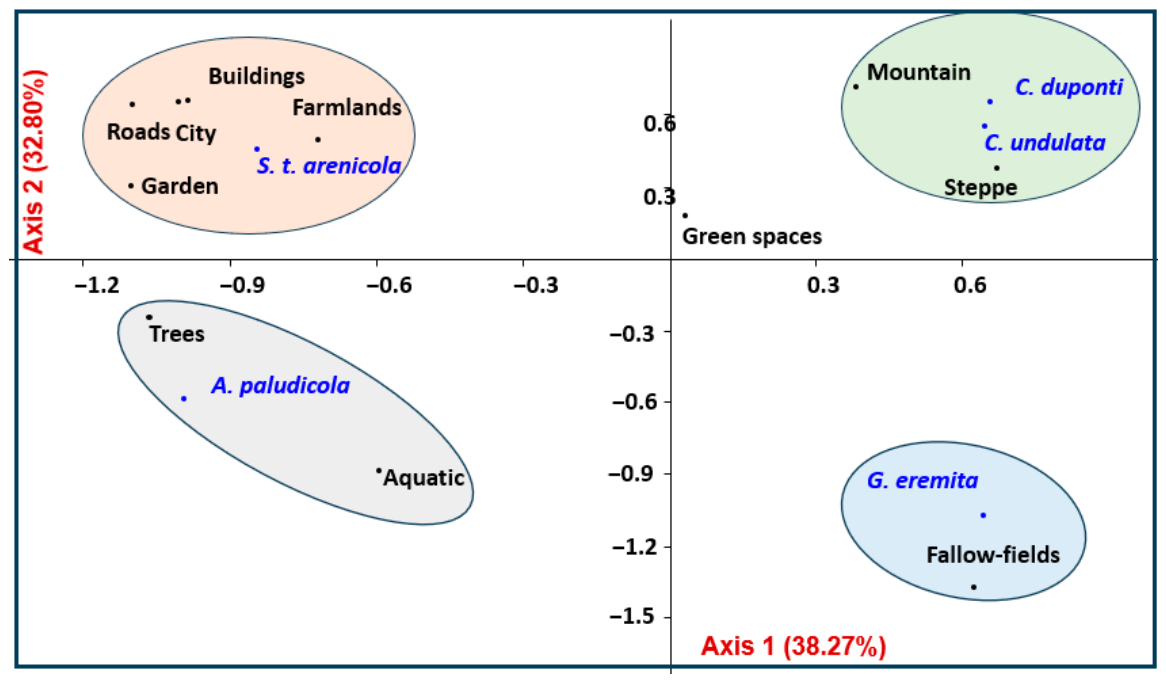
In terms of occurrence habitat use (Figure 11), Streptopelia turtur arenicola shows dominance in Farmlands and Trees, followed by cities, roads, gardens, and farmlands. Further, Geronticus eremita is mainly associated with Fallow fields. In contrast, Chlamydotis undulata and Chersophilus duponti are strongly linked to steppes and mountains. On the other hand, Acrocephalus paludicola is mainly associated with trees and aquatic habitats, indicating strong segregation toward arboreal–riparian feeding zones. These results were presented in two axes with variance estimated at 71.07%. This indicates the credibility (volume of data) of the results represented next to the axes.
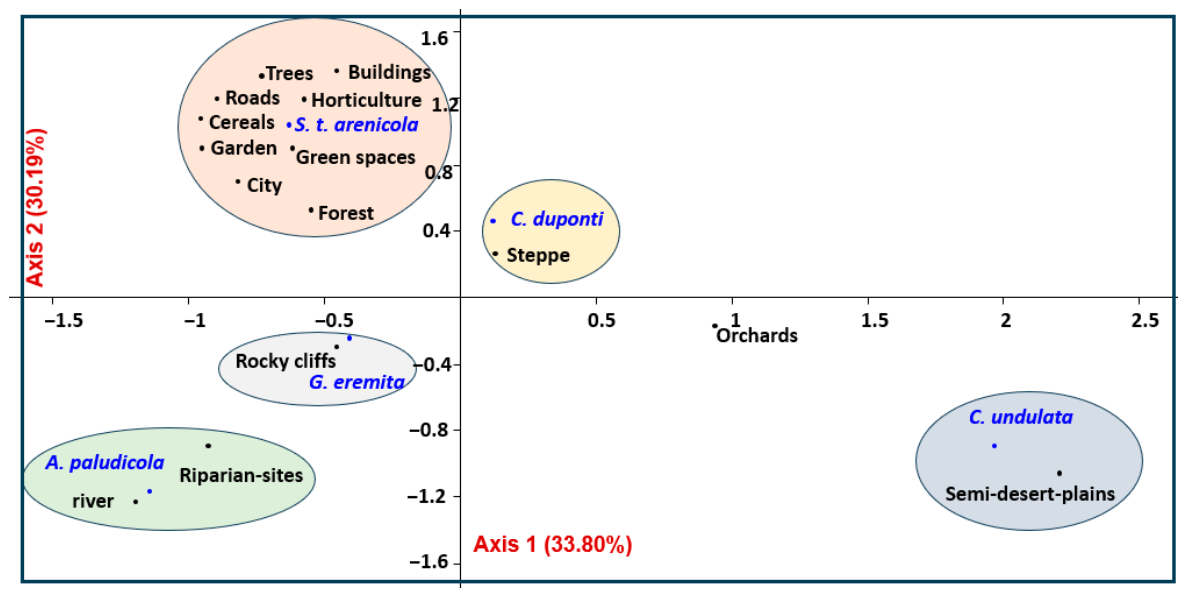
In terms of feeding habitat preference (Figure 12), digital records demonstrated that Streptopelia turtur arenicola is mainly associated with cereals and green spaces, followed by cities, steppes, trees, forests, gardens, roads, riparian sites, orchards, horticulture, and buildings. Further, Geronticus eremita is strongly linked to rocky cliffs. On the other hand, Chlamydotis undulata is strictly associated with semi-desert plains, with minor occurrences in steppes. Moreover, Chersophilus duponti prefers steppes. In contrast, Acrocephalus paludicola is predominantly linked to river and riparian sites. These results were presented on two axes with a variance estimated at 63.99%, which indicates the credibility of the results represented.
This study evaluated large-scale habitat use among the studied species compared to field studies concentrated on limited space and habitats. The habitat-use patterns derived from social media observations revealed pronounced ecological specialization and spatial segregation among the studied threatened avifauna. Digital records of the European turtle dove exhibited broad habitat use, being mainly associated with farmlands, cereals, and trees, complementing the observations from Spain [85,86], Greece [87], Italy [88], and Morocco [50,61], where agricultural mosaics and olive groves represent essential breeding habitats. Digital records of Northern bald ibis showed that the birds were strongly linked to fallow fields, rocky cliffs, and steppe habitats, which is in agreement with field ecological studies conducted in Morocco and Syria [52,62,89,90]. African houbara showed a strict affinity for semi-desert plains and steppes, confirming patterns previously reported in Eastern Morocco, the Canary Islands, and Tunisia [63,91,92]. Similarly, Dupont’s lark was predominantly associated with steppe ecosystems, consistent with findings from Morocco, Tunisia, and Iberia [57,93,94]. Aquatic warbler displayed strong riparian specialization, corroborating studies from West African wintering grounds [58,77]. These findings highlight the growing scientific value of social media platforms as complementary biodiversity-monitoring tools capable of documenting habitat preferences, distributional shifts, and ecological requirements of rare and endangered species across large geographic scales. However, given that the data originate from social media observations, the results likely emphasize human-accessible habitats, potentially underrepresenting more remote ecological niches.

3.8. Pressure Factors

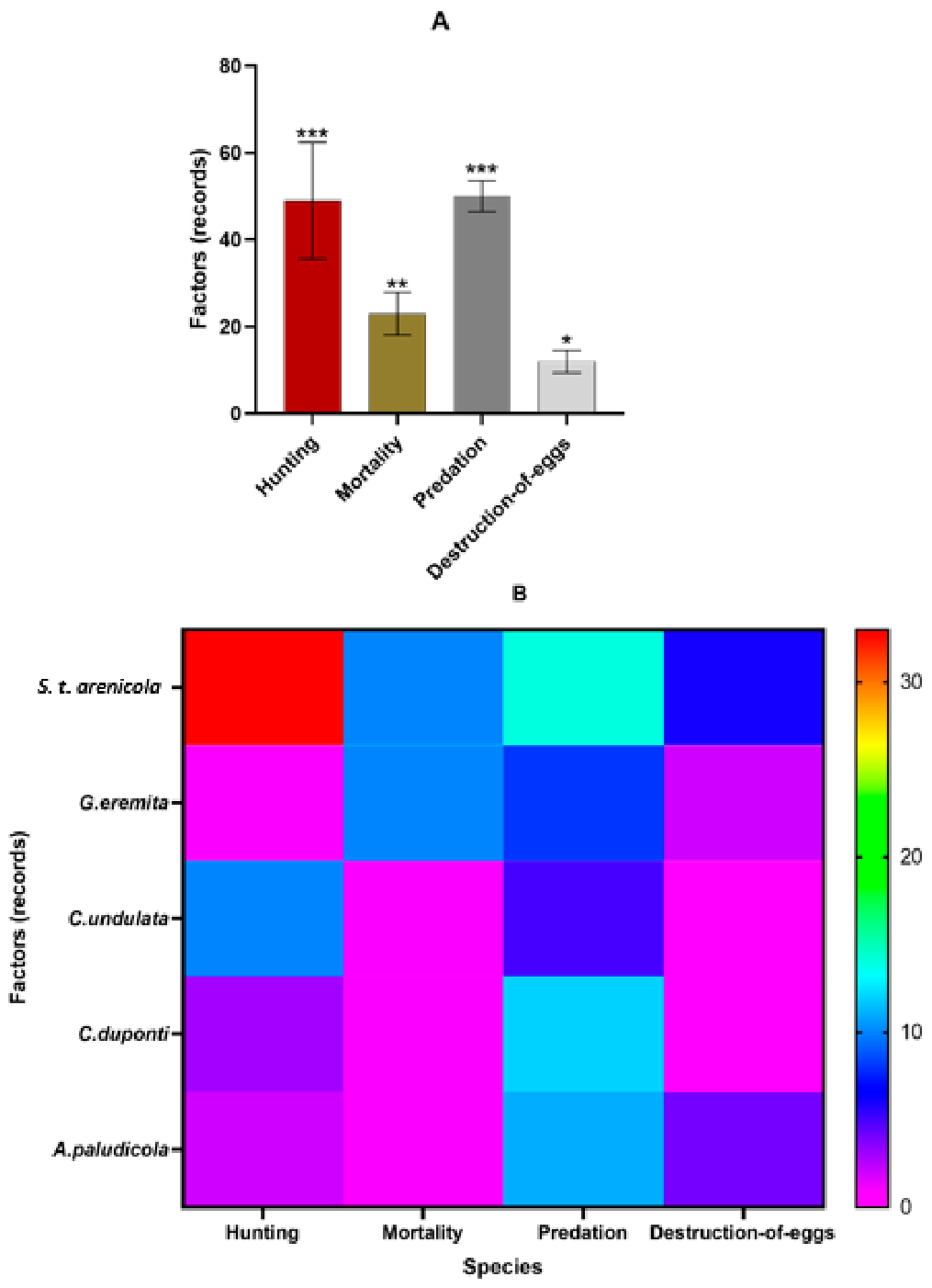
Results show that predation (50 ± 3.54 records) and hunting (49 ± 13.44 records) were the most frequently documented threat factors affecting the studied bird species (Figure 13A). In contrast, mortality (23 ± 4.93 records) and egg destruction (12 ± 2.61 records) were recorded less frequently. However, the relative importance of these threats varied among species (Figure 13B). For Streptopelia turtur arenicola, hunting was the predominant threat (52.38% of records), followed by predation (22.22%) and mortality (15.87%). In Geronticus eremita, mortality and predation were the most frequently reported threats, accounting for 47.62% and 38.10% of records, respectively. In Chlamydotis undulata, hunting (62.50% of records) and predation (31.25% of records) were the dominant threat factors. For both Chersophilus duponti and Acrocephalus paludicola, predation represented the principal threat, comprising more than 78% of all recorded cases.
Unlike previous Moroccan research that has rarely quantified or comparatively assessed anthropogenic and ecological threats beyond well-studied species such as turtle doves [51,95] and northern bald ibis [52,96], these results uniquely identify and rank multi-species threat drivers, revealing species-specific vulnerability profiles, thereby providing a novel, scalable framework for conservation risk inference across poorly documented avifauna.
The results of this study revealed that predation and hunting constitute the most significant threats affecting the bird species studied, whereas mortality and egg destruction showed comparatively lower impacts. Firstly, these patterns likely reflect bias toward human-visible events in accessible areas, suggesting that actual ecological impacts in less monitored habitats may be underrepresented. Second, these findings confirm that anthropogenic pressures and natural predation remain among the principal drivers of avifaunal decline and biodiversity loss in Mediterranean ecosystems [97,98]. Species-specific differences were nevertheless evident. In Streptopelia turtur arenicola, hunting represented the dominant threat, corroborating previous studies conducted in Morocco that highlighted unsustainable hunting pressure, agricultural intensification, and predation as major causes of reproductive decline and population reduction [95,99]. For Geronticus eremita, mortality and predation were the most critical pressures, consistent with [62] and [100], who emphasized the vulnerability of this endangered species to habitat degradation, climatic stress, and human-induced mortality. Similarly, hunting and predation were the main pressures recorded for Chlamydotis undulata, supporting the observations of [101] concerning anthropogenic disturbance and habitat alteration. In Chersophilus duponti and Acrocephalus paludicola, the predominance of predation aligns with studies demonstrating the extreme sensitivity of these threatened steppe and wetland birds to ecological disturbances and habitat fragmentation [68,102,103].
Furthermore, the present study demonstrates the growing importance of social media as an effective source of biodiversity information and documentation of threatening factors affecting birds in a complementary way with field investigations. Recent investigations confirmed that social media platforms can provide valuable ecological records, detect anthropogenic pressures, and support conservation planning through citizen-generated observations [18,20,104]. In addition, social networks have become increasingly useful for documenting bird interactions with environmental threats and human activities [105]. Consequently, this study contributes significantly to the conservation knowledge of Moroccan avifauna by providing digital data of species-specific pressures, promoting participatory biodiversity monitoring, and supporting future conservation strategies for threatened bird species in Morocco [40,106].

3.9. Conservation Implications

The findings highlight the considerable potential of social media as a citizen-science tool for the conservation of threatened bird species in Morocco. By facilitating the rapid collection and dissemination of occurrence records, social media strengthens collaboration between researchers, conservation organizations, ornithologists, and the general public. The spatial distribution patterns identified through these platforms provide valuable information for prioritizing conservation actions in key ecosystems, including wetlands used by Acrocephalus paludicola, coastal habitats occupied by Geronticus eremita, steppes supporting Chersophilus duponti, and semi-desert landscapes preferred by Chlamydotis undulata. Such information can be used to establish measurable conservation targets, including habitat protection, restoration programs, and long-term monitoring of population trends.
The predominance of predation and hunting among the recorded threats further demonstrates the capacity of social media to identify conservation priorities and support mitigation measures. Monitoring posts and shared observations can help locate threat hotspots, evaluate temporal changes in pressures, and guide actions such as seasonal hunting restrictions, nest protection initiatives, and strengthened surveillance in vulnerable habitats. Previous studies have shown that social media campaigns can increase public engagement, conservation funding, and policy support for threatened species, resulting in measurable improvements in conservation outcomes [20].
Nevertheless, responsible management of online content remains essential. Social media monitoring has successfully revealed illegal wildlife trade networks and the promotion of wildlife as pets, supporting awareness campaigns and law-enforcement interventions [23,24]. For the studied bird species, integrating social media surveillance into conservation programs could help detect illegal capture, trafficking, and commercialization while providing measurable indicators of reporting frequency, public participation, threat occurrence, and management effectiveness.
And for the limits, despite the broad coverage provided by social media platforms, several methodological limitations should be acknowledged. First, the dataset relies on opportunistic observations generated by users rather than standardized field surveys, which may introduce spatial, temporal, and taxonomic biases. Areas with higher internet connectivity, tourism activity, or birdwatching communities are likely to be overrepresented, whereas remote regions may remain underreported. In addition, species identification based on photographs, videos, or textual descriptions may occasionally be inaccurate, particularly for rare or morphologically similar species. The unequal popularity and accessibility of social media platforms may also influence the volume and distribution of records [16,107].
Furthermore, the study does not account for variations in observation effort among users, platforms, or years, which may affect the interpretation of temporal trends and species occurrence patterns. The use of regional percentages as a proxy for distribution reflects reporting intensity rather than actual population abundance. Although duplicate screening and content verification were applied, some records may contain incomplete metadata or imprecise geographic information. Consequently, the findings should be considered complementary to conventional monitoring programs rather than a substitute for systematic ecological surveys and long-term field-based assessments.

4. Conclusions

This study investigated the potential of social media platforms as complementary ecological monitoring tools for threatened and rare bird species in Morocco. By analyzing digital records collected between 2015 and 2025 from multiple digital platforms, the study assessed species occurrence, temporal dynamics, habitat preferences, behavioral activities, spatial distribution, and observed population structure of Streptopelia turtur arenicola, Geronticus eremita, Chlamydotis undulata, Chersophilus duponti, and Acrocephalus paludicola. The results revealed significant interspecific differences, with the European turtle dove recording the highest abundance, while adults represented the dominant observed category across all species. Strong ecological specialization was evident, with species associated with coastal, steppe, desert, and wetland habitats. Temporal analyses revealed spring peaks linked to migration and breeding. Facebook, TikTok, Instagram, photographs, and videos were the main data sources. These findings highlight the growing value of social media for biodiversity monitoring and documenting threats affecting bird species.
The study highlights the novelty and scientific relevance of social media as a passive citizen-science approach capable of generating large-scale ecological datasets for poorly monitored avifauna. These findings have important implications for biodiversity conservation, ecological surveillance, and adaptive management strategies in Morocco. The identified distribution patterns, habitat preferences, and threat factors provide practical guidance for prioritizing conservation actions in wetlands, steppes, coastal habitats, and semi-desert ecosystems that support threatened bird populations. Moreover, the integration of social media monitoring into conservation programs may strengthen early detection of hunting pressure, predation hotspots, and illegal wildlife trafficking while enhancing collaboration between scientists, conservation practitioners, and citizen observers for more effective and measurable biodiversity management. Nevertheless, the study remains limited by unequal sampling effort, observer bias, and incomplete geographic coverage related to social media platforms. Future research should integrate artificial intelligence, geospatial modeling, remote sensing, and standardized validation protocols to improve the reliability and predictive capacity of digital biodiversity monitoring systems.

Author Contributions

Conceptualization, A.E.A., I.M., Y.D. and L.E.G.; methodology, A.E.A., I.M., Y.D. and W.S.; validation, A.E.A. and L.E.G.; formal analysis, I.M. and W.S.; investigation, A.E.A. and Y.D.; writing—original draft preparation, A.E.A., I.M. and Y.D.; writing—review and editing, W.S. and L.E.G.; visualization and supervision, A.E.A., W.S. and L.E.G. All authors have read and agreed to the published version of the manuscript.

Funding

This research received no external funding.

Institutional Review Board Statement

Not applicable.

Informed Consent Statement

Not applicable.

Data Availability Statement

The original contributions presented in this study are included in the article. Further inquiries can be directed to the corresponding author.

Conflicts of Interest

The authors declare no conflicts of interest.

References

  1. de Castro, C.A. The Evolution of the Internet and Social Media: A Literature Review. Int. J. E-Educ. E-Bus. E-Manag. E-Learn. 2022, 12, 30–41. [Google Scholar] [CrossRef] [Scilit]
  2. Scolari, C.A. The Evolution of Twitter: An Entangled History of Intermedia Relationships. Int. J. Commun. 2025, 19, 23. [Google Scholar]
  3. Cai, M.; Luo, H.; Meng, X.; Cui, Y.; Wang, W. Network Distribution and Sentiment Interaction: Information Diffusion Mechanisms between Social Bots and Human Users on Social Media. Inf. Process. Manag. 2023, 60, 103197. [Google Scholar] [CrossRef] [Scilit]
  4. Zhang, L.; Li, D.; Boncella, R.J. Research on Influencing Factors of Information Diffusion in Online Social Networks under Different Themes. Electron. Libr. 2021, 39, 732–748. [Google Scholar] [CrossRef] [Scilit]
  5. Conte, D.; Iscaro, S.; Paternoster, B. Predicting Information Diffusion on Social Media Using an Epidemiological Approach. In Proceedings of the Computational Science and Its Applications—ICCSA 2025 Workshops; Gervasi, O., Murgante, B., Garau, C., Karaca, Y., Faginas Lago, M.N., Scorza, F., Braga, A.C., Eds.; Springer: Cham, Switzerland, 2026; pp. 208–224. [Google Scholar]
  6. Castro, A.; Capinha, C. News and Social Media in Mapping the Endangered Mediterranean Monk Seal: Exceptional Data Gains but Persistent Bias. Endanger. Species Res. 2026, 59, esr01475. [Google Scholar] [CrossRef] [Scilit]
  7. Shankar, M.; Sparks, M.A. The Evolution of Social Media in Nephrology Education: A Mini-Review. Front. Nephrol. 2023, 3, 1123969. [Google Scholar] [CrossRef] [Scilit] [PubMed]
  8. Dehm, J.; Samson, K.; Bishwa, D.; Brown, K.T. Social Media as a Tool for Documenting Endangered and Difficult to Monitor Marine Species in Pacific Island Countries with Evidence from Fiji. Discov. Oceans 2025, 2, 39. [Google Scholar] [CrossRef] [Scilit]
  9. Saito, K.; Nakamura, K.; Ueta, M.; Kurosawa, R.; Fujiwara, A.; Kobayashi, H.H.; Nakayama, M.; Toko, A.; Nagahama, K. Utilizing the Cyberforest Live Sound System with Social Media to Remotely Conduct Woodland Bird Censuses in Central Japan. Ambio 2015, 44, 572–583. [Google Scholar] [CrossRef] [Scilit] [PubMed]
  10. Spennemann, D.H.R. Birding via Facebook—Methodological Considerations When Crowdsourcing Observations of Bird Behavior via Social Media. Birds 2025, 6, 39. [Google Scholar] [CrossRef] [Scilit]
  11. Chamberlain, J. Chapter Five—Using Social Media for Biomonitoring: How Facebook, Twitter, Flickr and Other Social Networking Platforms Can Provide Large-Scale Biodiversity Data. In Next Generation Biomonitoring: Part 2; Bohan, D.A., Dumbrell, A.J., Woodward, G., Jackson, M., Eds.; Advances in Ecological Research; Academic Press: London, UK, 2018; Volume 59, pp. 133–168. [Google Scholar]
  12. Otero, P.; Velasco, E.; Valeiras, J. Surveillance of Coastal Biodiversity through Social Network Monitoring. Ecol. Inform. 2024, 80, 102515. [Google Scholar] [CrossRef] [Scilit]
  13. Hausmann, A.; Toivonen, T.; Fink, C.; Heikinheimo, V.; Tenkanen, H.; Butchart, S.H.M.; Brooks, T.M.; Di Minin, E. Assessing Global Popularity and Threats to Important Bird and Biodiversity Areas Using Social Media Data. Sci. Total Environ. 2019, 683, 617–623. [Google Scholar] [CrossRef] [Scilit] [PubMed]
  14. O’Neill, D.; Häkkinen, H.; Neumann, J.; Shaffrey, L.; Cheffings, C.; Norris, K.; Pettorelli, N. Investigating the Potential of Social Media and Citizen Science Data to Track Changes in Species’ Distributions. Ecol. Evol. 2023, 13, e10063. [Google Scholar] [CrossRef] [Scilit] [PubMed]
  15. Elkhouri-Vidarte, N.; Díaz, M.; Martín-Torrijos, L.; Gamero, M.B.; Rubio, A.C. The Bird Trade in Spanish Social Media: Popularity and Potential Negative Consequences. Ardeola 2023, 71, 3–18. [Google Scholar] [CrossRef] [Scilit]
  16. Mondal, S.; Rehena, Z. Challenges and Limitations of Social Data Analysis Approaches. In Internet of Things Based Smart Healthcare: Intelligent and Secure Solutions Applying Machine Learning Techniques; Biswas, S., Chowdhury, C., Acharya, B., Liu, C.-M., Eds.; Springer: Singapore, 2022; pp. 307–323. [Google Scholar]
  17. Greene, T.; Martens, D.; Shmueli, G. Barriers to Academic Data Science Research in the New Realm of Algorithmic Behaviour Modification by Digital Platforms. Nat. Mach. Intell. 2022, 4, 323–330. [Google Scholar] [CrossRef] [Scilit]
  18. Chowdhury, S.; Fuller, R.A.; Ahmed, S.; Alam, S.; Callaghan, C.T.; Das, P.; Correia, R.A.; Di Marco, M.; Di Minin, E.; Jarić, I.; et al. Using Social Media Records to Inform Conservation Planning. Conserv. Biol. 2024, 38, e14161. [Google Scholar] [CrossRef] [Scilit] [PubMed]
  19. Ghermandi, A.; Langemeyer, J.; Berkel, D.V.; Calcagni, F.; Depietri, Y.; Vigl, L.E.; Fox, N.; Havinga, I.; Jäger, H.; Kaiser, N.; et al. Social Media Data for Environmental Sustainability: A Critical Review of Opportunities, Threats, and Ethical Use. One Earth 2023, 6, 236–250. [Google Scholar] [CrossRef] [Scilit]
  20. Bergman, J.N.; Buxton, R.T.; Lin, H.-Y.; Lenda, M.; Attinello, K.; Hajdasz, A.C.; Rivest, S.A.; Tran Nguyen, T.; Cooke, S.J.; Bennett, J.R. Evaluating the Benefits and Risks of Social Media for Wildlife Conservation. Facets 2022, 7, 360–397. [Google Scholar] [CrossRef] [Scilit]
  21. Chauhan, S.S.; Nandha, A.; Sardana, S. The Role of Social Networks in the Conservation of Endangered Species from a Behavioral Ecology Perspective. J. Anim. Environ. 2025, 17, 751–762. [Google Scholar] [CrossRef] [Scilit]
  22. Forster, C.Y.; Hochuli, D.F.; Keith, R.J.; Latty, T.; White, T.E.; Middleton, E.J.T. Social Media Conservation Messaging Mirrors Age-Old Taxonomic Biases in Public Domain. Austral Ecol. 2023, 48, 687–698. [Google Scholar] [CrossRef] [Scilit]
  23. Wyatt, T.; Miralles, O.; Massé, F.; Lima, R.; da Costa, T.V.; Giovanini, D. Wildlife Trafficking via Social Media in Brazil. Biol. Conserv. 2022, 265, 109420. [Google Scholar] [CrossRef] [Scilit]
  24. Nunes, V.F.; Lopes, P.F.M.; Ferreira, R.G. Capuchinmonkeys on Social Media: A Threat for Species Conservation. Anthrozoös 2023, 36, 665–683. [Google Scholar] [CrossRef] [Scilit]
  25. Hammond, N.L.; Dickman, A.; Biggs, D. Examining Attention given to Threats to Elephant Conservation on Social Media. Conserv. Sci. Pract. 2022, 4, e12785. [Google Scholar] [CrossRef] [Scilit]
  26. Büscher, B. Nature 2.0: Exploring and Theorizing the Links between New Media and Nature Conservation. New Media Soc. 2016, 18, 726–743. [Google Scholar] [CrossRef] [Scilit]
  27. Aravind, N.A. Potential of Social Network and Internet Media for Biodiversity Mapping and Conservation. Curr. Sci. 2013, 105, 291–293. [Google Scholar]
  28. Wu, Y.; Xie, L.; Yuan, Z.; Jiang, S.; Liu, W.; Sheng, H. Investigating Public Biodiversity Conservation Awareness Based on the Propagation of Wildlife-Related Incidents on the Sina Weibo Social Media Platform. Environ. Res. Lett. 2020, 15, 094082. [Google Scholar] [CrossRef] [Scilit]
  29. Fox, N.; Di Minin, E.; Carter, N.; Tomkins, S.; Van Berkel, D. Artificial Intelligence and Crowdsourced Social Media Data for Biodiversity Monitoring and Conservation. In Proceedings of the Advancements in Architectural, Engineering, and Construction Research and Practice; Olanrewaju, A., Bruno, S., Eds.; Springer: Cham, Switzerland, 2024; pp. 43–50. [Google Scholar]
  30. Bires, Z.; Raj, S. Social Media as a Pathway to Environmental Conservation in Protected Areas: A Case Study on Lake Tana Biosphere Reserve. J. Cult. Herit. Manag. Sustain. Dev. 2020, 11, 457–470. [Google Scholar] [CrossRef] [Scilit]
  31. Davies, A.; Nuno, A.; Hinsley, A.; Martin, R.O. Live Wild Bird Exports from West Africa: Insights into Recent Trade from Monitoring Social Media. Bird Conserv. Int. 2022, 32, 559–572. [Google Scholar] [CrossRef] [Scilit]
  32. Menioui, M. Biological Diversity in Morocco. In Global Biodiversity; Apple Academic Press: Palm Bay, FL, USA, 2018; pp. 133–171. [Google Scholar]
  33. Arabi, M.; Mechkirrou, L.; Malki, M.E.; Alaoui, K.; Chaieb, A.; Maaroufi, F.; Karmich, S. Overview of Ecological Dynamics in Morocco—Biodiversity, Water Scarcity, Climate Change, Anthropogenic Pressures, and Energy Resources—Navigating Towards Ecosolutions and Sustainable Development. In E3S Web of Conferences; EDP Sciences: Les Ulis, France, 2024; Volume 527, p. 01001. [Google Scholar] [CrossRef] [Scilit]
  34. Ennabili, A.; Libiad, M.; El Haissoufi, M.; Khabbach, A.; Bennas, N. Biodiversity, Change, and Use of Moroccan Wetlands. In Wetlands of Tropical and Subtropical Asia and Africa; John Wiley & Sons, Ltd.: Hoboken, NJ, USA, 2025; pp. 265–296. [Google Scholar]
  35. Khabbach, A.; Libiad, M.; Ennabili, A. An Updated Checklist of the Wetland Vascular Flora from Morocco. Moroc. J. Biol. 2020, 17, 1–35. [Google Scholar]
  36. Cherkaoui, S.I.; Hanane, S.; Magri, N. Factors Influencing Species-Richness of Breeding Waterbirds in Moroccan IBA and Ramsar Wetlands: A Macroecological Approach. Wetlands 2015, 35, 913–922. [Google Scholar] [CrossRef] [Scilit]
  37. Mansouri, I.; Squalli, W.; El Agy, A.; Ben Hichou, B.; El Hassani, A.; El Ghadraoui, L.; Dakki, M. Avifauna Diversity in the Gate between Humid Atlas and Saharan Desert: Midelt Province, Morocco. Int. J. Zool. 2021, 2021, 5557921. [Google Scholar] [CrossRef] [Scilit]
  38. Garcia, L.; Celette, F.; Gary, C.; Ripoche, A.; Valdés-Gómez, H.; Metay, A. Management of Service Crops for the Provision of Ecosystem Services in Vineyards: A Review. Agric. Ecosyst. Environ. 2018, 251, 158–170. [Google Scholar] [CrossRef] [Scilit]
  39. Alonso, J.C.; Palacín, C.; Onrubia, A.; Aboulouafae, R.; Amezian, M.; El Idrissi Essougrati, A.; El Khamlichi, R.; Noaman, M. Alarming Decline and Range Reduction of the Highly Threatened Great Bustard Otis Tarda in Morocco. Ostrich 2016, 87, 277–280. [Google Scholar] [CrossRef] [Scilit]
  40. Ouassou, A.; Dakki, M.; El Agbani, M.-A.; Qninba, A.; El Hamoumi, R. Distribution and Numbers of Three Globally Threatened Waterbird Species Wintering in Morocco: The Common Pochard, Marbled Teal, and White-Headed Duck. Int. J. Zool. 2021, 2021, e8846203. [Google Scholar] [CrossRef] [Scilit]
  41. Eddajjani, A.; Hanane, S.; Kandry, A.E.; Qninba, A. An Unexpected Presence in Urban Environment: Factors Governing Occurrence of the Vulnerable European Turtle-Dove (Streptopelia turtur) in the City of Rabat, Morocco. Urban Ecosyst. 2022, 25, 1339–1351. [Google Scholar] [CrossRef] [Scilit]
  42. Mounir, M.; Mansouri, I.; Squalli, W.; Hammada, S.; Dakki, M. Spatial and Temporal Monitoring of North African Turtle Doves Streptopelia turtur Arenicola (Hartert, EJO, 1894): First Migrants Arrive Early and Select Nesting Trees next to Foraging Resources While Second Breeders’ Wave Breed around Earlier Nests. Int. J. Zool. 2023, 2023, 8863486. [Google Scholar] [CrossRef] [Scilit]
  43. Hanane, S.; Bouaamama, M.; Bougnous, A.; Hajjaj, D.; Mihoubi, H. Contrasting Occurrence Patterns in the European Turtle Dove (Streptopelia turtur) in Managed and Unmanaged Hunting Forest Estates: Does Human Presence Matter? Biologia 2023, 78, 2107–2117. [Google Scholar] [CrossRef] [Scilit]
  44. Squalli, W.; Mansouri, I.; Dakki, M.; Fadil, F. Nesting Habitat and Breeding Success of Fulica Atra in Tree Wetlands in Fez’s Region, Central Morocco. J. Anim. Behav. Biometeorol. 2020, 8, 282–287. [Google Scholar] [CrossRef] [Scilit]
  45. Salai, K.; Mansouri, I.; Squalli, W.; Hassani, A.; Dakki, M.; Zine, N. Nesting Features and Breeding Chronology of the Crested Coot (Fulica cristata) in Two North African High Altitude Wetlands. J. Anim. Behav. Biometeorol. 2021, 9, 2129. [Google Scholar] [CrossRef] [Scilit]
  46. Squalli, W.; Mansouri, I.; Douini, I.; Achiban, H.; Saghrouchni, H.; El Agy, A.; Fadil, F.; Wink, M.; Dakki, M. Diversity and Population Sizes of Wintering Waterbirds in the Wetlands of the Saïss–Middle Atlas Region (North–Central Morocco): Main Survival Factors and Evaluation of Habitat Loss. Animals 2024, 14, 1352. [Google Scholar] [CrossRef] [Scilit] [PubMed]
  47. Forti, L.R.; da Silva, J.L.C.; Ferreira, E.A.; Szabo, J.K. The Implications of Estimating Rarity in Brazilian Reptiles from GBIF Data Based on Contributions from Citizen Science versus Research Institutions. Integr. Conserv. 2024, 3, 112–126. [Google Scholar] [CrossRef] [Scilit]
  48. Kwon, H.; Seo, B.; Kim, J.; Lee, H. Crowdsourced Indicators of Flora and Fauna Species: Comparisons Between iNaturalist Records and Field Observations. Land 2025, 14, 169. [Google Scholar] [CrossRef] [Scilit]
  49. The IUCN Red List of Threatened Species. Available online: https://www.iucnredlist.org/en (accessed on 26 June 2026).
  50. Mansouri, I.; Squalli, W.; El Agy, A.; Salai, K.E.; Bouayad, K.; Benhichou, B.; El Hassani, A.; El Ghadraoui, L.; Dakki, M. Analysis of Moroccan Breeding and Wintering Population of the Vulnerable European Turtle Dove Streptopelia turtur: Breeding Habitats, Wintering Sites and Governing Factors. Sci. Afr. 2022, 15, e01110. [Google Scholar] [CrossRef] [Scilit]
  51. Hanane, S. The European Turtle-Dove Streptopelia turtur in Northwest Africa: A Review of Current Knowledge and Priorities for Future Research. Ardeola 2017, 64, 273–287. [Google Scholar] [CrossRef] [Scilit]
  52. Bowden, C.G.R.; Smith, K.W.; Bekkay, M.E.; Oubrou, W.; Aghnaj, A.; Jimenez-Armesto, M. Contribution of Research to Conservation Action for the Northern Bald Ibis Geronticus eremita in Morocco. Bird Conserv. Int. 2008, 18, S74–S90. [Google Scholar] [CrossRef] [Scilit]
  53. Böhm, C.; Bowden, C.G.R.; Seddon, P.J.; Hatipoğlu, T.; Oubrou, W.; Bekkay, M.E.; Quevedo, M.A.; Fritz, J.; Yeniyurt, C.; Lopez, J.M.; et al. The Northern Bald Ibis Geronticus eremita: History, Current Status and Future Perspectives. Oryx 2021, 55, 934–946. [Google Scholar] [CrossRef] [Scilit]
  54. Cuziat, J.L.; Lacroix, F.; Roche, P.; Vidal, E.; Médail, F.; Orhant, N.; Béranger, P.M. Landscape and Human Influences on the Distribution of the Endangered North African Houbara Bustard (Chlamydotis undulata undulata) in Eastern Morocco. Anim. Conserv. Forum 2005, 8, 143–152. [Google Scholar] [CrossRef] [Scilit]
  55. Rabier, R.; Robert, A.; Lacroix, F.; Lesobre, L. Genetic Assessment of a Conservation Breeding Program of the Houbara Bustard (Chlamydotis undulata undulata) in Morocco, Based on Pedigree and Molecular Analyses. Zoo Biol. 2020, 39, 422–435. [Google Scholar] [CrossRef] [Scilit] [PubMed]
  56. Bustillo-de la Rosa, D.; Calero-Riestra, M.; Pérez-Granados, C.; Mereu, S.; Morales, M.B.; Traba, J.; López-Iborra, G.M.; Barrero, A.; Gómez-Catasús, J.; Reverter, M.; et al. Leukocyte Profile Variation in Dupont’s Lark (Chersophilus duponti) in Spain and Morocco. J. Ornithol. 2022, 163, 539–551. [Google Scholar] [CrossRef] [Scilit]
  57. Garcia, J.T.; Suárez, F.; Garza, V.; Justribo, J.H.; Oñate, J.J.; Hervás, I.; Calero, M.; de la Morena, E.L.G. Assessing the Distribution, Habitat, and Population Size of the Threatened Dupont’s Lark Chersophilus duponti in Morocco: Lessons for Conservation. Oryx 2008, 42, 592–599. [Google Scholar]
  58. Flade, M.; Diop, I.; Haase, M.; Le Nevé, A.; Oppel, S.; Tegetmeyer, C.; Vogel, A.; Salewski, V. Distribution, Ecology and Threat Status of the Aquatic Warblers Acrocephalus paludicola Wintering in West Africa. J. Ornithol. 2011, 152, 129–140. [Google Scholar] [CrossRef] [Scilit]
  59. Neto, J.M.; Pérez-Rodríguez, A.; Haase, M.; Flade, M.; Bensch, S. Prevalence and Diversity of Plasmodium and Haemoproteus Parasites in the Globally-Threatened Aquatic Warbler Acrocephalus paludicola. Parasitology 2015, 142, 1183–1189. [Google Scholar] [CrossRef] [Scilit] [PubMed]
  60. Mansouri, I.; Squalli, W.; Nefla, A.; Mounir, M.; Achiban, H.; Abdelwahab, C.; Hmidani, M.; El Ghadraoui, L.; Dakki, M. Timing of Migration Dates and Detection of First Wintering Sites for the Turtle Dove in Northwest Africa. Afr. J. Ecol. 2023, 61, 153–162. [Google Scholar] [CrossRef] [Scilit]
  61. Squalli, W.; Wink, M.; Mansouri, I.; Fadil, F.; Dakki, M. High Density and Successful Breeding of Turtle Doves Streptopelia turtur in Moroccan Olive Groves. PeerJ 2022, 10, e14375. [Google Scholar] [CrossRef] [Scilit] [PubMed]
  62. Schenker, A.; Cahenzli, F.; Gutbrod, K.G.; Thevenot, M.; Erhardt, A. The Northern Bald Ibis Geronticus eremita in Morocco since 1900: Analysis of Ecological Requirements. Bird Conserv. Int. 2020, 30, 117–138. [Google Scholar] [CrossRef] [Scilit]
  63. Hingrat, Y.; Saint Jalme, M.; Ysnel, F.; Le Nuz, E.; Lacroix, F. Habitat Use and Mating System of the Houbara Bustard (Chlamydotis undulata undulata) in a Semi-Desertic Area of North Africa: Implications for Conservation. J. Ornithol. 2007, 148, 39–52. [Google Scholar] [CrossRef] [Scilit]
  64. Mansouri, I.; Mounir, M.; Squalli, W.; Elhanafi, L.; Dakki, M.; El Ghadraoui, L. Migratory Dates, Breeding Phenology, and Reproductive Success of European Turtle Doves between Lowlands and Highest Breeding Habitats in North Africa. Int. J. Zool. 2020, 2020, 8816577. [Google Scholar] [CrossRef] [Scilit]
  65. Mansouri, I.; Ousaaid, D.; Squalli, W.; El Agy, A.; EL-Hassani, A.; Mounir, M.; Elghadraoui, L.; Dakki, M. New Data on Migration Time, Breeding Phenology, and Breeding Success of European Turtle Doves in Their Highest Breeding Habitats in North Africa. Int. J. Zool. 2021, 2021, 6629285. [Google Scholar] [CrossRef] [Scilit]
  66. Marx, M.; Korner-Nievergelt, F.; Quillfeldt, P. Analysis of Ring Recoveries of European Turtle Doves Streptopelia turtur—Flyways, Migration Timing and Origin Areas of Hunted Birds. Acta Ornithol. 2016, 51, 55–70. [Google Scholar] [CrossRef] [Scilit]
  67. Saint Jalme, M.; Williams, J.; Mickaelian, I.; Paillat, P. Seasonal Variation of LH, Sex Steroids, Body Mass, Molt, Display, and Laying in Two Subspecies of Houbara Bustard, Chlamydotis undulata macqueenii and Chlamydotis undulata undulata, Housed in Outdoor Cages under Natural Conditions. Gen. Comp. Endocrinol. 1996, 102, 102–112. [Google Scholar] [CrossRef] [Scilit] [PubMed]
  68. Pérez-Granados, C.; Sáez-Gómez, P.; López-Iborra, G.M. Breeding Dispersal Movements of Dupont’s Lark Chersophilus duponti in Fragmented Landscape. Bird Conserv. Int. 2022, 32, 53–63. [Google Scholar] [CrossRef] [Scilit]
  69. Pérez-Granados, C.; López-Iborra, G.M.; Seoane, J. A Multi-Scale Analysis of Habitat Selection in Peripheral Populations of the Endangered Dupont’s Lark Chersophilus duponti. Bird Conserv. Int. 2017, 27, 398–413. [Google Scholar] [CrossRef] [Scilit]
  70. Hingrat, Y.; Jalme, M.S.; Ysnel, F.; Lacroix, F.; Seabury, J.; Rautureau, P. Relationships between Home-Range Size, Sex and Season with Reference to the Mating System of the Houbara Bustard Chlamydotis undulata undulata. Ibis 2004, 146, 314–322. [Google Scholar] [CrossRef] [Scilit]
  71. Browne, S.J.; Aebischer, N.J. Temporal Changes in the Migration Phenology of Turtle Doves Streptopelia turtur in Britain, Based on Sightings from Coastal Bird Observatories. J. Avian Biol. 2003, 34, 65–71. [Google Scholar] [CrossRef] [Scilit]
  72. Flade, M.; Lisovski, S.; Eigirdas, V.; Giessing, B.; Jiguet, F.; Keišs, O.; Nemtchinov, M. Migration Routes and Wintering Sites of the Aquatic Warblers Acrocephalus paludicola Breeding in Lithuania and North Belarus. bioRxiv 2023. [Google Scholar] [CrossRef] [Scilit]
  73. Cavalli, M.; Baladrón, A.V.; Isacch, J.P.; Bó, M.S.; Martínez, G. Social Networks and Ornithology Studies: An Innovative Method for Rapidly Accessing Data on Conspicuous Bird Species. Biodivers. Conserv. 2014, 23, 2127–2134. [Google Scholar] [CrossRef] [Scilit]
  74. Hartmann, M.C.; Schott, M.; Dsouza, A.; Metz, Y.; Volpi, M.; Purves, R.S. A Text and Image Analysis Workflow Using Citizen Science Data to Extract Relevant Social Media Records: Combining Red Kite Observations from Flickr, eBird and iNaturalist. Ecol. Inform. 2022, 71, 101782. [Google Scholar] [CrossRef] [Scilit]
  75. Shaw, E.L.; Surry, D.; Green, A. The Use of Social Media and Citizen Science to Identify, Track, and Report Birds. Procedia-Soc. Behav. Sci. 2015, 167, 103–108. [Google Scholar] [CrossRef] [Scilit]
  76. Aourir, M.; Bousadik, H.; El Bekkay, M.; Oubrou, W.; Znari, M.; Qninba, A. New Breeding Sites of the Critically Endangered Northern Bald Ibis Geronticus eremita on the Moroccan Atlantic Coast. Int. J. Avian Wildl. Biol. 2017, 2, 77–80. [Google Scholar] [CrossRef] [Scilit]
  77. Schäffer, N.; Walther, B.A.; Gutteridge, K.; Rahbek, C. The African Migration and Wintering Grounds of the Aquatic Warbler Acrocephalus paludicola. Bird Conserv. Int. 2006, 16, 33–56. [Google Scholar] [CrossRef] [Scilit]
  78. Quan, R.; Li, H.; Wang, B.; Goodale, E. The Relationship between Defecation and Feeding in Nestling Birds: Observational and Experimental Evidence. Front. Zool. 2015, 12, 21. [Google Scholar] [CrossRef] [Scilit] [PubMed]
  79. Nicolson, S.W.; Fleming, P.A. Drinking Problems on a ‘Simple’ Diet: Physiological Convergence in Nectar-Feeding Birds. J. Exp. Biol. 2014, 217, 1015–1023. [Google Scholar] [CrossRef] [Scilit] [PubMed]
  80. Ward, L.; Henry, L. The Behavioural Biology of Flightless Birds. In The Behavioural Biology of Zoo Animals; CRC Press: Boca Raton, FL, USA, 2022. [Google Scholar]
  81. Mansouri, I.; Al-Sadoon, M.K.; Rochdi, M.; Paray, B.A.; Dakki, M.; Elghadraoui, L. Diversity of Feeding Habitats and Diet Composition in the Turtle Doves Streptopelia turtur to Buffer Loss and Modification of Natural Habitats during Breeding Season. Saudi J. Biol. Sci. 2019, 26, 957–962. [Google Scholar] [CrossRef] [Scilit] [PubMed]
  82. Mansouri, I.; El Hassani, A.; El Agy, A.; Squalli, W.; Mounir, M.; Assouguem, A.; Salai, K.E.; El Ghadraoui, L.; Dakki, M. Foraging Efforts and Behaviour of the European Turtle Doves (Streptopelia turtur) during the Breeding Season. J. Anim. Behav. Biometeorol. 2021, 9, 2128. [Google Scholar] [CrossRef] [Scilit]
  83. Puehringer-Sturmayr, V.; Loretto, M.-C.A.; Hemetsberger, J.; Czerny, T.; Gschwandegger, J.; Leitsberger, M.; Kotrschal, K.; Frigerio, D. Effects of Bio-Loggers on Behaviour and Corticosterone Metabolites of Northern Bald Ibises (Geronticus eremita) in the Field and in Captivity. Anim. Biotelemetry 2020, 8, 2. [Google Scholar] [CrossRef] [Scilit]
  84. Jacquet, J.-M.; Launay, F. Diurnal Behavioural Patterns in the Houbara Bustard (Chlamydotis undulata) in Captivity: Effects of Temperature and Daylength. Appl. Anim. Behav. Sci. 1997, 55, 137–151. [Google Scholar] [CrossRef] [Scilit]
  85. Buruaga, M.S.D.; Onrubia, A.; Fernández-García, J.M.; Campos, M.Á.; Canales, F.; Unamuno, J.M. Breeding Habitat Use and Conservation Status of the Turtle Dove Streptopelia turtur in Northern Spain. Ardeola 2013, 59, 291–300. [Google Scholar] [CrossRef] [Scilit]
  86. Estrada, A.; Moreno-Zarate, L.; Delibes-Mateos, M.; Arroyo, B. Relationships between Land-Use Changes and Population Declines of the European Turtle Dove Streptopelia turtur in Spain and France. Ardeola 2024, 71, 337–357. [Google Scholar] [CrossRef] [Scilit]
  87. Thoma, C.T.; Makridou, K.N.; Bakaloudis, D.E. Breeding Habitat Suitability Modeling to Inform Management Practices for the European Turtle Dove (Streptopelia turtur) in NE Greece. Ecologies 2025, 6, 25. [Google Scholar] [CrossRef] [Scilit]
  88. Tarricone, S.; La Gioia, G.; Colonna, M.A.; De Vito, N.; Lacitignola, M.; Gerardi, D.; Chiatante, G.; Campanile, D.; Fortunato, M.; Ragni, M. Potential Distribution, Density and Abundance Estimate of the European Turtle Dove Streptopelia turtur (Linnaeus, 1758) in Apulia. Birds 2026, 7, 20. [Google Scholar] [CrossRef] [Scilit]
  89. Serra, J.; Font, X.; Ivanova, M. Creating Shared Value in Destination Management Organisations: The Case of Turisme de Barcelona. J. Destin. Mark. Manag. 2017, 6, 385–395. [Google Scholar] [CrossRef] [Scilit]
  90. Serra, G.; Abdallah, M.S.; al Qaim, G. Feeding Ecology and Behaviour of the Last Known Surviving Oriental Northern Bald Ibises, Geronticus eremita (Linnaeus, 1758), at Their Breeding Quarters in Syria. Zool. Middle East 2008, 43, 55–68. [Google Scholar] [CrossRef] [Scilit]
  91. Carrascal, L.M.; Palomino, D.; Seoane, J.; Alonso, C.L. Habitat Use and Population Density of the Houbara Bustard Chlamydotis undulata in Fuerteventura (Canary Islands) Abstract. Afr. J. Ecol. 2008, 46, 291–302. [Google Scholar] [CrossRef] [Scilit]
  92. Chammem, M.; Jarray, M.; Khorchani, T. Spatial Distribution of Male Display Sites in a North African Population of Houbara Bustard Chlamydotis undulata undulata. Ostrich 2018, 89, 355–362. [Google Scholar] [CrossRef] [Scilit]
  93. Seoane, J.; Justribó, J.H.; García, F.; Retamar, J.; Rabadán, C.; Atienza, J.C. Habitat-Suitability Modelling to Assess the Effects of Land-Use Changes on Dupont’s Lark Chersophilus duponti: A Case Study in the Layna Important Bird Area. Biol. Conserv. 2006, 128, 241–252. [Google Scholar] [CrossRef] [Scilit]
  94. Viñuela, J.; García, J.T.; Suárez, F. Marked Range Regression and Possible Alteration of Distribution of the Dupont’s Lark Chersophilus duponti in Tunisia: Conservation Consequences of Vanishing Alfa Grass Stipa Tenacissima steppes in North Africa. Diversity 2023, 15, 549. [Google Scholar] [CrossRef] [Scilit]
  95. Mansouri, I.; Ousaaid, D.; Squalli, W.; Sqalli, H.; El Ghadraoui, L.; Dakki, M. The Turtle Dove (Streptopelia turtur) in Midelt Plain, Morocco: Nesting Preferences and Breeding Success versus the Impact of Predation and Agricultural Practices. J. Anim. Behav. Biometeorol. 2020, 8, 206–214. [Google Scholar] [CrossRef] [Scilit]
  96. Cuttelod, A.; García, N.; Malak, D.A.; Temple, H.J.; Katariya, V. The Mediterranean: A Biodiversity Hotspot under Threat. In Wildlife in a Changing World—An Analysis of the 2008 IUCN Red List of Threatened Specie; IUCN: Gland, Switzerland, 2009; Volume 89, pp. 1–4. [Google Scholar]
  97. Bateman, B.L.; Taylor, L.; Wilsey, C.; Wu, J.; LeBaron, G.S.; Langham, G. Risk to North American Birds from Climate Change-Related Threats. Conserv. Sci. Pract. 2020, 2, e243. [Google Scholar] [CrossRef] [Scilit]
  98. Bouregbi, I.; Bensakhri, Z.; Zebsa, R.; Zouaimia, A.; Bensouilah, S.; Bouteraa, O.; Khelifa, R.; Ouakid, M.L.; Mahdjoub, H.; Houhamdi, M. Threatened Birds in a Changing Mediterranean Wetland: Long-Term Trends and Climate-Driven Threats. Life 2025, 15, 892. [Google Scholar] [CrossRef] [Scilit] [PubMed]
  99. Squalli, W.; Mansouri, I.; Ousaaid, D.; Hmidani, M.; Achiban, H.; Fadil, F.; Dakki, M. New Data on Breeding Strategies and Reproductive Success of the Globally Threatened Turtle Dove Co-Occurring with the “Competitive” Collared Dove and the “Predatory” Maghreb Magpie in Olive Orchards. Int. J. Zool. 2022, 2022, 2864178. [Google Scholar] [CrossRef] [Scilit]
  100. El Fallah, K.; Ouhakki, H.; Belghyti, D.; Charafi, J. Geo-AI Approach Integrating MaxEnt and Google Earth Engine for Modeling the Distribution of the Northern Bald Ibis (Geronticus eremita), a Species Threatened with Extinction, in Morocco. Remote Sens. Appl. Soc. Environ. 2026, 41, 101953. [Google Scholar] [CrossRef] [Scilit]
  101. Geary, M.; Cooper, J.R.; Collar, N.J. Anthropogenic Influences on Habitat Use by African Houbaras Chlamydotis Undulata on Lanzarote, Canary Islands. J. Nat. Conserv. 2022, 68, 126231. [Google Scholar] [CrossRef] [Scilit]
  102. García-Antón, A.; Traba, J. Population Viability Analysis of the Endangered Dupont’s Lark Chersophilus duponti in Spain. Sci. Rep. 2021, 11, 19947. [Google Scholar] [CrossRef] [Scilit] [PubMed]
  103. Reverter, M.; Santos-Torres, A.; Pérez-Granados, C.; Barrero, A.; Bustillo-de la Rosa, D.; Gómez-Catasús, J.; Hervás, I.; Zurdo, J.; Traba, J. Steppe Restoration: Lessons Learned for the Conservation of the Threatened Dupont’s Lark (Chersophilus duponti). Discov. Conserv. 2025, 2, 36. [Google Scholar] [CrossRef] [Scilit]
  104. Chowdhury, S.; Aich, U.; Rokonuzzaman, M.; Alam, S.; Das, P.; Siddika, A.; Ahmed, S.; Labi, M.M.; Marco, M.D.; Fuller, R.A.; et al. Increasing Biodiversity Knowledge through Social Media: A Case Study from Tropical Bangladesh. BioScience 2023, 73, 453–459. [Google Scholar] [CrossRef] [Scilit] [PubMed]
  105. Ayala, F.; Vizcarra, J.K.; Castillo-Morales, K.; Torres-Zevallos, U.; Cordero-Maldonado, C.; Ampuero-Merino, L.; Herrera-Peralta, K.; De-la-Torre, G.E.; Angulo, F.; Cárdenas-Alayza, S. From Social Networks to Bird Enthusiasts: Reporting Interactions between Plastic Waste and Birds in Peru. Environ. Conserv. 2023, 50, 136–141. [Google Scholar] [CrossRef] [Scilit]
  106. Squalli, W.; Mansouri, I.; Douini, I.; Achiban, H.; Fadil, F.; Dakki, M.; Wink, M. Diversity of Avian Species in Peri-Urban Landscapes Surrounding Fez in Morocco: Species Richness, Breeding Populations, and Evaluation of Menacing Factors. Diversity 2022, 14, 945. [Google Scholar] [CrossRef] [Scilit]
  107. Dylewski, Ł.; Mikula, P.; Tryjanowski, P.; Morelli, F.; Yosef, R. Social Media and Scientific Research Are Complementary—YouTube and Shrikes as a Case Study. Sci. Nat. 2017, 104, 48. [Google Scholar] [CrossRef] [Scilit] [PubMed]
Figure 1. Research design, data collection, extraction, and validation.
Birds 07 00042 g001
Figure 2. Recorded species (A) and their observed forms (B) from platforms between 2015 and 2025 (AP: Acrocephalus paludicola; CD: Chersophilus duponti; CU: Chlamydotis undulata; ST: Streptopelia turtur arenicola) (* denotes statistical difference (ANOVA and Post Hoc tests): ***** > **** > *** > ** > *).
Birds 07 00042 g002
Figure 3. Correspondence Analysis (2D plot) of associations between recorded species and observed forms.
Birds 07 00042 g003
Figure 4. Variations in records during the sampled period ((A): Records per year for each species; (B): Monthly variation in records; (C): Total records per year; and (D): Monthly variation in total records) (AP: Acrocephalus paludicola; CD: Chersophilus duponti; CU: Chlamydotis undulata; ST: Streptopelia turtur arenicola).
Birds 07 00042 g004
Figure 5. Records for studied species from social media platforms (* denotes statistical difference (ANOVA and Post Hoc tests): ****** > ***** > **** > *** > ** > *).
Birds 07 00042 g005
Figure 6. Correspondence Analysis (2D plot) of the correspondence between bird species and sampled platforms.
Birds 07 00042 g006
Figure 7. Source of data (A) and type of observation (B) recorded from platforms (* denotes statistically different at p < 0.05: **** > *** > ** > *).
Birds 07 00042 g007
Figure 8. Maps showing the geographical ranges of the studied species in Morocco based on digital records. (A): Streptopelia turtur arenicola; (B): Geronticus eremita; (C): Chlamydotis undulata; (D): Chersophilus duponti; (E): Acrocephalus paludicola. These spatial patterns of our results should be interpreted cautiously, as they are likely influenced by uneven human reporting effort across regions rather than solely by true ecological abundance. Therefore, the apparent regional concentrations may partially reflect accessibility and visibility biases inherent to social media-derived observations. However, these findings emphasize the growing scientific relevance of social media platforms as complementary biodiversity-monitoring tools capable of complementing field research, mainly for delimiting the geographical distribution and habitat occupancy of rare and endangered bird species at large spatial scales.
Birds 07 00042 g008
Figure 9. Recorded activities of bird species (digital records) from social platforms from 2015 to 2025 (* denotes statistical difference (ANOVA and Post Hoc tests): ****** > ***** > **** > *** > ** > *) (U-observation: unidentified observation).
Birds 07 00042 g009
Figure 10. Correspondence Analysis (2D plot) showing the association between birds and captured activity from platforms.
Birds 07 00042 g010
Figure 11. Preferences of species studied toward occurrence habitats analyzed with CA (2D plot).
Birds 07 00042 g011
Figure 12. Preferences of species studied toward feeding habitats analyzed with CA (2D plot).
Birds 07 00042 g012
Figure 13. Factors impacting studied species ((A): Comparison between factors; (B): Between species) (* denotes statistically different at p < 0.05: *** > ** > *).
Birds 07 00042 g013
Disclaimer/Publisher’s Note: The statements, opinions and data contained in all publications are solely those of the individual author(s) and contributor(s) and not of MDPI and/or the editor(s). MDPI and/or the editor(s) disclaim responsibility for any injury to people or property resulting from any ideas, methods, instructions or products referred to in the content.