
First Decade of European Starling in Brazil: Spatial Distribution, Expansion Rates and Insights of Nesting Biology
 ,
,  , , , and
Simple Summary
Abstract
1. Introduction
2. Materials and Methods
2.1. Data Collection
2.2. Statistical and Spatial Analyses
3. Results
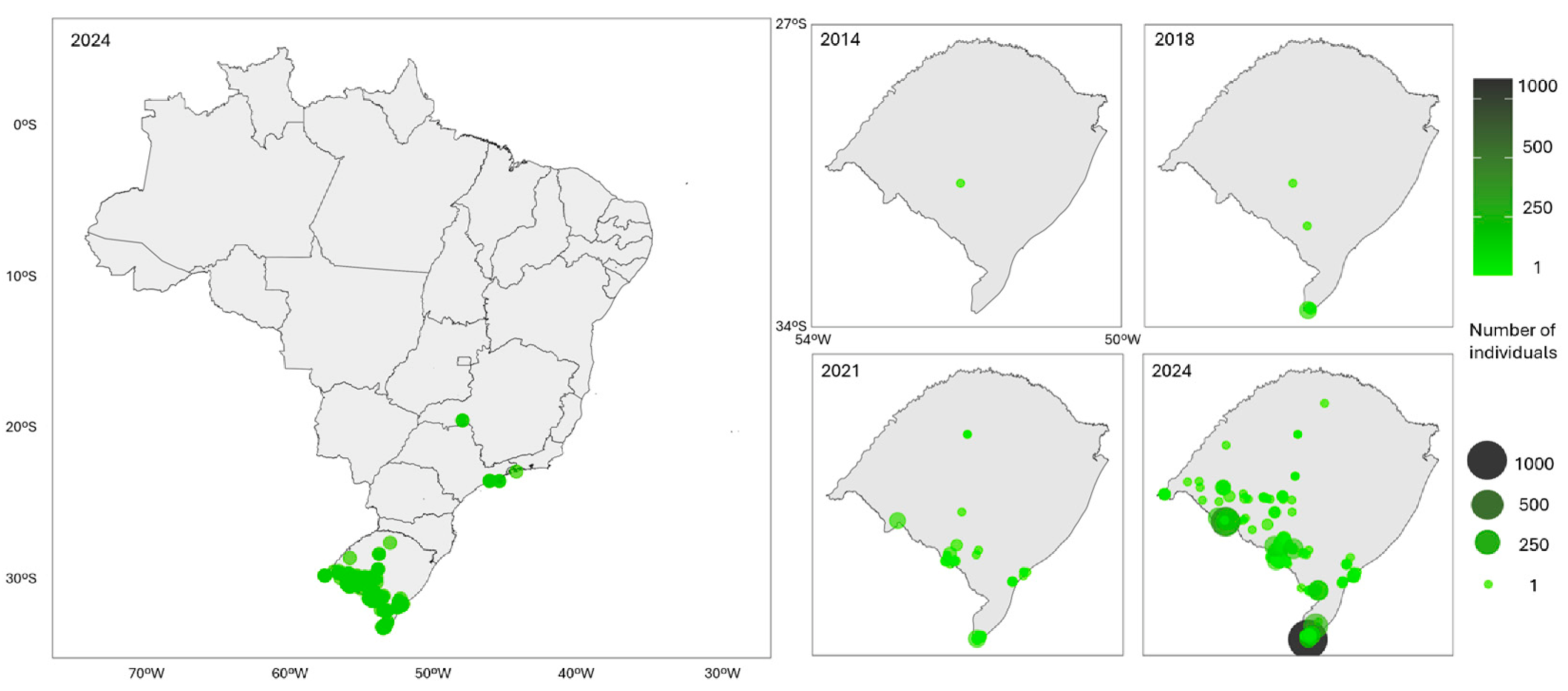
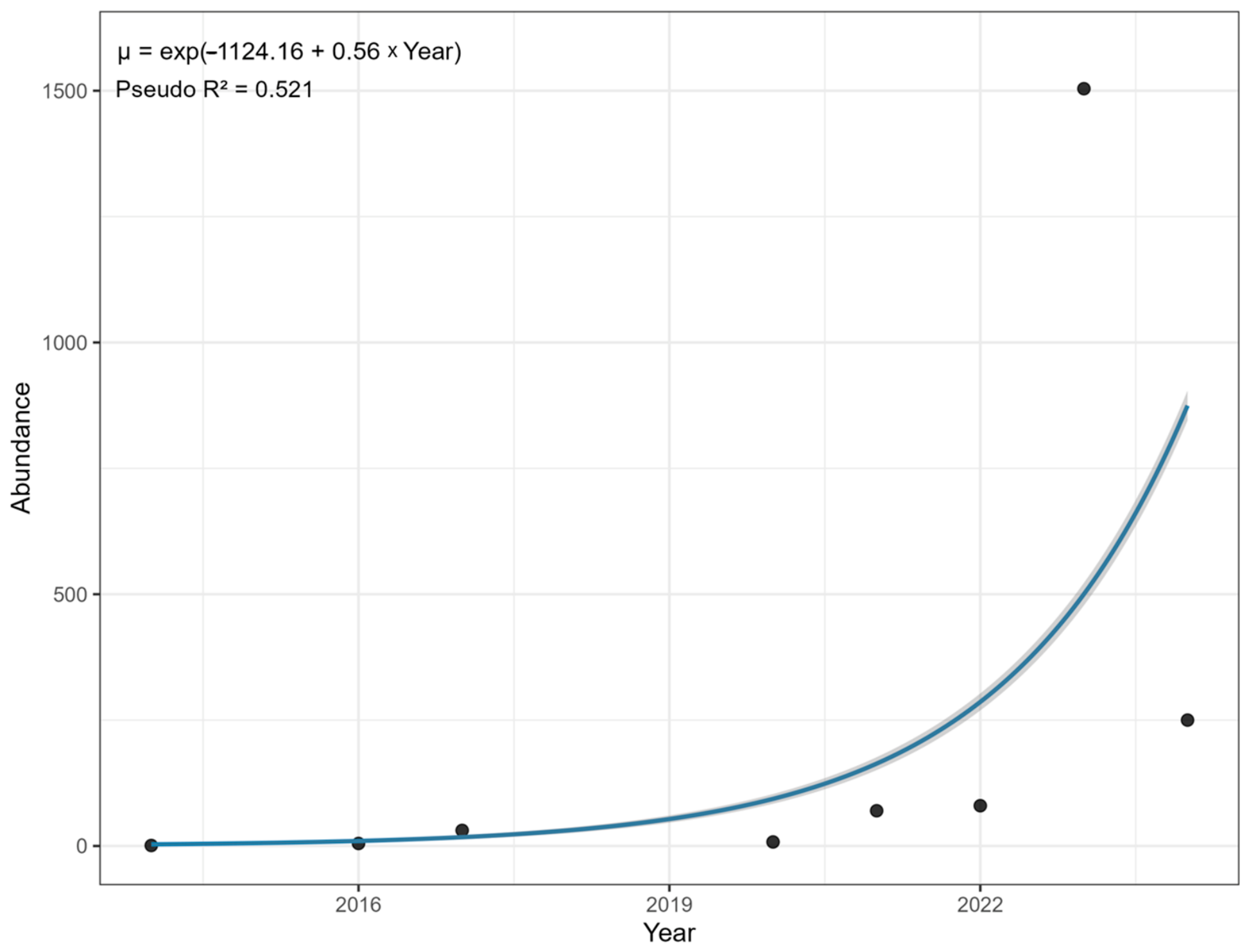
3.1. Species Expansion in Brazil
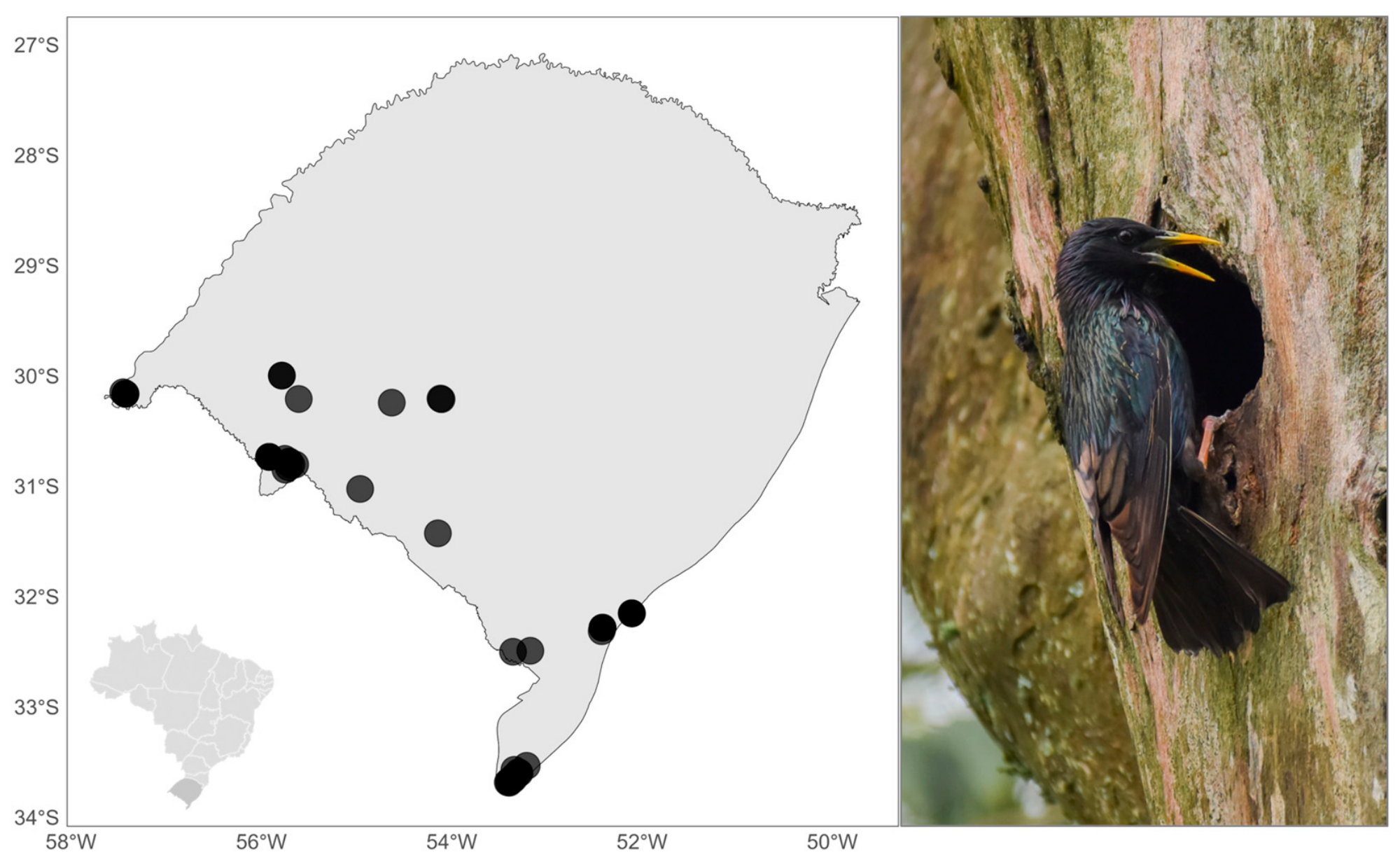
3.2. Breeding Ecology
4. Discussion
5. Conclusions
Author Contributions
Funding
Institutional Review Board Statement
Informed Consent Statement
Data Availability Statement
Acknowledgments
Conflicts of Interest
Abbreviations
| EOR | Estimated occupied range |
References
- Vitousek, P.M.; D’antonio, C.M.; Loope, L.L.; West Brooks, R. Biological invasions as global environmental change. Am. Sci. 1996, 84, 468–478. [Google Scholar]
- Wilcove, D.S.; Rothstein, D.; Dubow, J.; Phillips, A.; Losos, E. Quantifying threats to imperiled species in the United States. BioScience 1998, 48, 607–615. [Google Scholar] [CrossRef] [Scilit]
- Lowe, S.; Browne, M.; Boudjelas, S.; De Poorter, M. 100 of the World’s Worst Invasive Alien Species: A Selection from the Global Invasive Species Database; Species Survival Commission, World Conservation Union (IUCN): Auckland, New Zealand, 2000. [Google Scholar]
- Craig, A.J.; Feare, C.J. Family Sturnidae (starlings). In Handbook of the Birds of the World; del Hoyo, J., Elliot, A., Christie, D.A., Eds.; Lynx Edicions: Barcelona, Spain, 2009; Volume 14, pp. 654–758. [Google Scholar]
- BirdLife International. Available online: https://datazone.birdlife.org/species/factsheet/common-starling-sturnus-vulgaris (accessed on 29 April 2026).
- Koenig, W.D. European starlings and their effect on native cavity-nesting birds. Conserv. Biol. 2003, 17, 1134–1140. [Google Scholar] [CrossRef] [Scilit]
- Pimentel, D.; Lach, L.; Zuniga, R.; Morrison, D. Environmental and economic costs of nonindigenous species in the United States. BioScience 2000, 50, 53–65. [Google Scholar] [CrossRef] [Scilit]
- Linz, G.M.; Homan, H.J.; Gaulker, S.M.; Penry, L.B.; Bleier, W.J. European starlings: A review of an invasive species with far-reaching impacts. Manag. Vertebr. Invasive Species 2007, 24, 378–386. [Google Scholar]
- Peris, S.; Soave, G.; Camperi, A.; Darrieu, C.; Aramburu, R. Range expansion of the European Starling Sturnus vulgaris in Argentina. Ardeola 2005, 52, 359–364. [Google Scholar]
- Cadotte, M.W.; Yasui, S.L.E.; Livingstone, S.; Macivor, J.S. Are urban systems beneficial, detrimental, or indifferent for biological invasion? Biol. Invasions 2017, 19, 3489–3503. [Google Scholar] [CrossRef] [Scilit]
- Lockwood, J.L.; Passy, Y.; Acubur, R. The role of propagule pressure in explaining species invasions. Trends Ecol. Evol. 2005, 20, 223–228. [Google Scholar] [CrossRef] [Scilit] [PubMed]
- Zufiaurre, E.; Abba, A.; Bilenca, D.; Codesido, M. Role of landscape elements on recent distributional expansion of European starlings (Sturnus vulgaris) in agroecosystems of the Pampas, Argentina. Wilson J. Ornithol. 2016, 128, 306–313. [Google Scholar] [CrossRef] [Scilit]
- Di Giacomo, G.; Giacomo, I.; Abasas, M. Nuevos registros de Sturnus vulgaris y Acridotheres cristatellus en Buenos Aires. Nuestras Aves 1993, 29, 32–33. [Google Scholar]
- Ifran, N.R.; Fiorini, V.D. European Starling (Sturnus vulgaris): Population density and interactions with native species in Buenos Aires urban parks. Ornitol. Neotrop. 2010, 21, 507–518. [Google Scholar]
- Rizzo, F. Utilización de nidos de Hornero (Furnarius rufus) por el Estornino Pinto (Sturnus vulgaris). Nuestras Aves 2010, 55, 33–35. [Google Scholar] [CrossRef] [Scilit]
- Ibañez, L.M. Invasión del Estornino Pinto Sturnus vulgaris en el Noreste de la Provincia de Buenos Aires: Análisis de la Competencia con Aves Nativas y Potencialidad Como Transmisor de Parásitos. Doctoral Thesis, Universidad Nacional de La Plata, La Plata, Argentina, 2015. [Google Scholar] [CrossRef] [Scilit]
- Feare, C.J. The Starling; Oxford University Press: New York, NY, USA, 1984. [Google Scholar]
- Clergeau, P.; Quenot, F. Roost selection flexibility of European starlings’ aids invasion of urban landscape. Landsc. Urban Plan. 2007, 80, 56. [Google Scholar] [CrossRef] [Scilit]
- Bozzo, F.; Tarricone, S.; Petrontino, A.; Cagnetta, P.; Maringelli, L.; La Gioia, F.; Fuccii, V.; Ragni, M. Quantification of the Starling population, estimation and mapping of the damage to olive crops in the Apulia region. Animals 2021, 11, 11–19. [Google Scholar] [CrossRef] [Scilit] [PubMed]
- Symonds, A.E.J. The counting of starlings at country roosts. Bird Study 1961, 8, 185–193. [Google Scholar] [CrossRef] [Scilit]
- Stewart, P.A. Estimating numbers in a roosting congregation of blackbirds and starlings. Auk 1973, 90, 353–358. [Google Scholar] [CrossRef] [Scilit]
- Pérez, J. Estornino Pinto en la Capital Federal. Nuestras Aves 1988, 17, 14. [Google Scholar]
- Schmidtutz, C.; Aguilán, C. Nidificación del estornino pinto. Nuestras Aves 1988, 17, 14. [Google Scholar] [CrossRef] [Scilit]
- Codesido, M.; Drozd, A. Alien birds in Argentina: Pathways, characteristics and ecological roles. Biol. Invasions 2021, 23, 1329–1338. [Google Scholar] [CrossRef] [Scilit]
- Mazzulla, J. Primeros registros de Estornino Pinto Sturnus vulgaris (Linnaeus 1758) en Uruguay. Novid. Ornitol. 2013, 3, 13–17. [Google Scholar]
- Silva, F.C.; Da Pinto, J.M.; Mäder, A.; De Souza, V.A.T. First records of european starling Sturnus vulgaris in Brazil. Rev. Bras. Ornitol. 2017, 25, 297–298. [Google Scholar] [CrossRef] [Scilit]
- Collares, J.E.R. Os avanços da botânica no início do século XXI: Morfologia, fisiologia, taxonomia, ecologia e genética. In Congresso Nacional de Botânica; Sociedade Botânica do Brasil: Gramado, Brazil, 2006. [Google Scholar]
- Pillar, V.D.; Müller, S.C.; Castilhos, Z.D.S.; Jacques, A.V.A. Campos Sulinos: Conservação e uso Sustentável da Biodiversidade; Ministério do Meio Ambiente: Brasília, Brazil, 2009; p. 403. [Google Scholar]
- Rovedder, A.P.M. Bioma Pampa: Relações solo-vegetação e experiências de restauração. In Proceedings of the Anais do LXIV Congresso Nacional de Botânica e XXXIII ERBOT Encontro Regional de Botânicos MG, BA e ES, Belo Horizonte, Brazil, 10–15 November 2013. [Google Scholar]
- Ministério do Meio Ambiente MMA Biodiversidade Brasileira. Available online: http://www.camara.gov.br/internet/comissao/index/perm/capr/mapa.pdf (accessed on 14 January 2025).
- Bilenca, D.; Miñarro, F. Identificación de Áreas Valiosas de Pastizal (APVs) en las Pampas y Campos de Argentina, Uruguay y sur de Brasil; Fundación Vida Silvestre Argentina: Buenos Aires, Argentina, 2004. [Google Scholar]
- Backes, P. Lutzenberger e a Paisagem, Porto Alegre; Paisagem do Sul: Porto Alegre, Brazil, 2005; p. 208. [Google Scholar]
- Behling, H.; Jeske-Pieruschka, V.; Schüler, L.; Pillar, V.D.P. Dinâmica dos Campos no sul do Brasil Durante o Quaternário Tardio. In Campos Sulinos—Conservação e uso Sustentável da Biodiversidade; Pillar, V.P., Müller, S.C., Souza, Z.M., Jaques, A.V.A., Eds.; Ministério do Meio Ambiente: Brasília, Brazil, 2009; p. 408. [Google Scholar]
- Bencke, G.A. Diversidade e conservação da fauna dos campos do sul do Brasil. In Campos Sulinos—Conservação e uso Sustentável da Biodiversidade; Pillar, V.P., Müller, S.C., Castilhos, Z.M.S., Jacques, A.V.A., Eds.; Ministério do Meio Ambiente: Brasília, Brasil, 2009; pp. 101–121. [Google Scholar]
- Andrade, B.O.; Dröse, W.; De Aguiar, C.A.; Aires, E.T.; Alvares, D.J.; Barbieri, R.L.; De Carvalho, C.J.B.; Bartz, M.; Becker, F.G.; Bencke, G.A.; et al. 12,500 + and counting: Biodiversity of the Brazilian Pampa. Front. Biogeogr. 2023, 15, e59288. [Google Scholar] [CrossRef] [Scilit]
- Bristot, A. Planalto das Araucárias—Um ecossistema em perigo de extinção? Agroecol. Desenvolv. Rural Sustent. 2001, 4, 24–31. [Google Scholar]
- MapBiomas. Coleção da Série Anual de Mapas de Cobertura e Uso da Terra do Brasil. Available online: https://brasil.mapbiomas.org/estatisticas/ (accessed on 12 March 2025).
- Saraiva, D.; Torchelsen, F.P.; Overbeck, G.E.; Müller, S.C.; Hasenack, H.; Urruth, L.M.; da Silva, C.R. Ameaça silenciosa: Análise histórica e tendências futuras da supressão dos campos naturais do bioma Pampa pela expansão agrícola. Bio Diverso 2025, 5e1. [Google Scholar]
- R Core Team. R: A Language and Environment for Statistical Computing; R Foundation for Statistical Computing: Vienna, Austria, 2024; Available online: https://www.R-project.org/ (accessed on 12 March 2025).
- Wickham, H.; Bryan, J. readxl: Read Excel Files. R Package Version 1.4.3. 2023. Available online: https://CRAN.R-project.org/package=readxl (accessed on 12 March 2025).
- Wickham, H.; François, R.; Henry, L.; Müller, K.; Vaughan, D. dplyr: A Grammar of Data Manipulation. R Package Version 1.1.4. 1998. Available online: https://CRAN.R-project.org/package=dplyr (accessed on 12 March 2025).
- Pebesma, E. Simple Features for R: Standardized Support for Spatial Vector Data. R J. 2018, 10, 439–446. [Google Scholar] [CrossRef] [Scilit]
- IUCN. Guidelines for Using the IUCN Red List Categories and Criteria. Version 15.1. Prepared by the Standards and Petitions Committee. Available online: https://www.iucnredlist.org/resources/redlistguidelines (accessed on 12 March 2025).
- Pateiro-López, B.; Rodríguez-Casal, A. Generalizing the Convex Hull of a Sample: The R Package alphahull. J. Stat. Softw. 2010, 34, 1–28. [Google Scholar] [CrossRef] [Scilit]
- IBGE Mapa de Biomas e Sistema Costeiro Marinho do Brasil. Available online: https://biblioteca.ibge.gov.br/index.php/biblioteca-catalogo?view=detalhes&id=2101676 (accessed on 12 March 2025).
- Van den Bosch, F.; Hengeveld, R.; Metz, J.A. Analysing the velocity of animal expansion. J. Biogeogr. 1992, 19, 135–150. [Google Scholar] [CrossRef] [Scilit]
- Palacio, F.X.; Ibañez, L.M.; Maragliano, R.E.; Montalti, D. Uso del paisaje urbano por el Estornino Pinto (Sturnus vulgaris) durante las etapas reproductiva y no reproductiva. El Hornero 2022, 37, 16. [Google Scholar] [CrossRef] [Scilit]
- Di Sallo, F.G.; Segura, L.N. Nidificación del Estornino Pinto (Sturnus vulgaris) en un nido de Leñatero (Anumbius annumbi) en el noreste de la provincia de Buenos Aires, Argentina. Nuestras Aves 2014, 59, 13–14. [Google Scholar] [CrossRef] [Scilit]
- Chow, J. Sturnus vulgaris. Animal Diversity Web. 2000. Available online: http://animaldiversity.ummz.umich.edu/accounts/Sturnus_vulgaris/ (accessed on 14 January 2025).
- Ruda Veja, M. Fotografías curiosas y novedades de silvestres. Nuestras Aves 2004, 47, 5–7. [Google Scholar]
- Gómez De Silva, H.; Oliveras De Ita, A.; Legorreta, R.A.M. Vertebrados Superiores Exóticos de México: Diversidad, Distribución y Efectos Potenciales; Instituto de Ecología da Universidad Nacional Autónoma de México: Ciudad de México, Mexico, 2005. [Google Scholar]
- Girini, J.M.; Palacio, F.X.; Del Huerto, M.D.C.; Kuzmanich, N. Selección de dormideros por el Estornino Pinto (Sturnus vulgaris) en La Plata, Buenos Aires, Argentina. El Hornero 2014, 29, 23–28. [Google Scholar] [CrossRef] [Scilit]
- Klavins, J.; Álvarez, D. El Estornino Pinto (Sturnus vulgaris) en la provincia de Córdoba, Argentina. Nuestras Aves 2012, 57, 27–29. [Google Scholar] [CrossRef] [Scilit]
- Zanotti, M. Presencia del Estornino Pinto (Sturnus vulgaris) en la provincia de Mendoza, Argentina. Nuestras Aves 2013, 58, 5–7. [Google Scholar] [CrossRef] [Scilit]
- Conover, M.R.; Dolbeer, R.A. Use of decoy traps to protect blueberries from juvenile European starlings. Hum.-Wildl. Confl. 2007, 2, 265–270. [Google Scholar]
- Knittle, C.E.; Guarino, J.L. Reducing a local population of starlings with nest-box traps. Bird Control Semin. Proc. 1976, 7, 65–66. [Google Scholar]
- Weber, W.J. Health Hazards from pigeons, starlings and English sparrows. In Diseases and Parasites Associated with Pigeons, Domestic Animals, Includes Suggestions for Bird Control; Thomson Publications: New York, NY, USA, 1979; p. 138. [Google Scholar]


Disclaimer/Publisher’s Note: The statements, opinions and data contained in all publications are solely those of the individual author(s) and contributor(s) and not of MDPI and/or the editor(s). MDPI and/or the editor(s) disclaim responsibility for any injury to people or property resulting from any ideas, methods, instructions or products referred to in the content. |
© 2026 by the authors. Licensee MDPI, Basel, Switzerland. This article is an open access article distributed under the terms and conditions of the Creative Commons Attribution (CC BY) license.
Share and Cite
Dias, J.P.S.; Blanco, G.; Velloso, J.R.P.; Marques, L.L.; Machado-Teixeira, F.; Aguiar, C.A.d.; Kasper, C.B. First Decade of European Starling in Brazil: Spatial Distribution, Expansion Rates and Insights of Nesting Biology. Birds 2026, 7, 43. https://doi.org/10.3390/birds7030043
Dias JPS, Blanco G, Velloso JRP, Marques LL, Machado-Teixeira F, Aguiar CAd, Kasper CB. First Decade of European Starling in Brazil: Spatial Distribution, Expansion Rates and Insights of Nesting Biology. Birds. 2026; 7(3):43. https://doi.org/10.3390/birds7030043
Chicago/Turabian StyleDias, José Paulo Souto, Guillermo Blanco, Jorge Renato Pinheiro Velloso, Luciano Lopes Marques, Fernanda Machado-Teixeira, Cassiana Alves de Aguiar, and Carlos Benhur Kasper. 2026. "First Decade of European Starling in Brazil: Spatial Distribution, Expansion Rates and Insights of Nesting Biology" Birds 7, no. 3: 43. https://doi.org/10.3390/birds7030043
APA StyleDias, J. P. S., Blanco, G., Velloso, J. R. P., Marques, L. L., Machado-Teixeira, F., Aguiar, C. A. d., & Kasper, C. B. (2026). First Decade of European Starling in Brazil: Spatial Distribution, Expansion Rates and Insights of Nesting Biology. Birds, 7(3), 43. https://doi.org/10.3390/birds7030043