


Abstract
Mosquito control is a critical operational requirement for tropical resort islands, where guest comfort, staff wellbeing, and public health depend on effective management of biting insects. In many island tourism destinations, including the Maldives, mosquito control programs rely heavily on routine insecticide space spraying (fogging or misting). While such interventions can temporarily reduce adult mosquito abundance, their effects are often short-lived. High-frequency applications are therefore common practice but may create risks for human health, biodiversity, and fragile island ecosystems. Here, we examine how mosquito control in the Maldivian tourism and hospitality sector could transition from pesticide-dependent approaches toward ecological mosquito management practices. Drawing on operational experience from fourteen Maldivian resort islands and current knowledge of mosquito ecology, we compare conventional insecticide-based control with alternative approaches including surveillance-based management, larval habitat reduction or modification, biological control, mass trapping of mosquitoes, or combinations thereof. The geographically bounded nature of resort islands, combined with centralized management and strong sustainability commitments within the tourism sector, creates unusually favorable conditions for implementing integrated mosquito management strategies. We propose a practical transition framework that prioritizes monitoring, habitat management, and sustained population suppression while reducing or eliminating routine insecticide applications. Importantly, our operational experience demonstrates that implementation can be simple and practical, requiring only modest adjustments to existing resort operations. Such approaches can improve guest and staff safety, protect island biodiversity, reduce dependence on chemical pesticides, minimize the noise, olfactory and visual disturbances associated with routine fogging and mist-blower operations, and strengthen the environmental sustainability credentials of tropical tourism destinations.
1. Introduction
Tourism represents the dominant economic sector of the Maldives and forms the backbone of the country’s national economy (Ministry of Tourism, 2023).1 Since the opening of the first resort island in 1972, the country has developed into one of the world’s most recognizable tropical tourism destinations, characterized by small resort islands, coral reef ecosystems, and high-end hospitality infrastructure. Tourism contributes roughly 21% of national gross domestic product and accounts for the majority of foreign exchange earnings (World Bank, 2024). As of the mid-2020s, approximately 175–180 resort islands are in operation across the country, forming the core of the tourism product (Ministry of Tourism & Environment, 2025).
The Maldives currently receives more than two million international visitors annually (Ministry of Tourism & Environment, 2025), despite a small total land area of approximately 298 km2. This, therefore, represents one of the most spatially concentrated tourism systems in the world. Individual resort islands are typically small, often ranging between 5 and 50 hectares, and are distributed across a chain of approximately 1200 coral islands grouped into 26 atolls. Their small spatial scale means that tourism, environmental management, and ecosystem conservation are intimately linked.
Oceanic islands are globally recognized as biodiversity hotspots but are also among the ecosystems most vulnerable to human disturbance. In the Maldives, resort development has been shown to significantly reduce terrestrial invertebrate diversity compared with uninhabited islands, emphasizing the need to minimize additional anthropogenic pressures (Steibl et al., 2021), including routine broad-spectrum insecticide applications, as part of sustainable tourism management.
Maintaining a comfortable outdoor environment is a central operational requirement for resort management in these destinations. Mosquitoes represent one of the most significant nuisance insects affecting guest experience, staff wellbeing, and outdoor hospitality activities such as dining, recreation, and beach use.
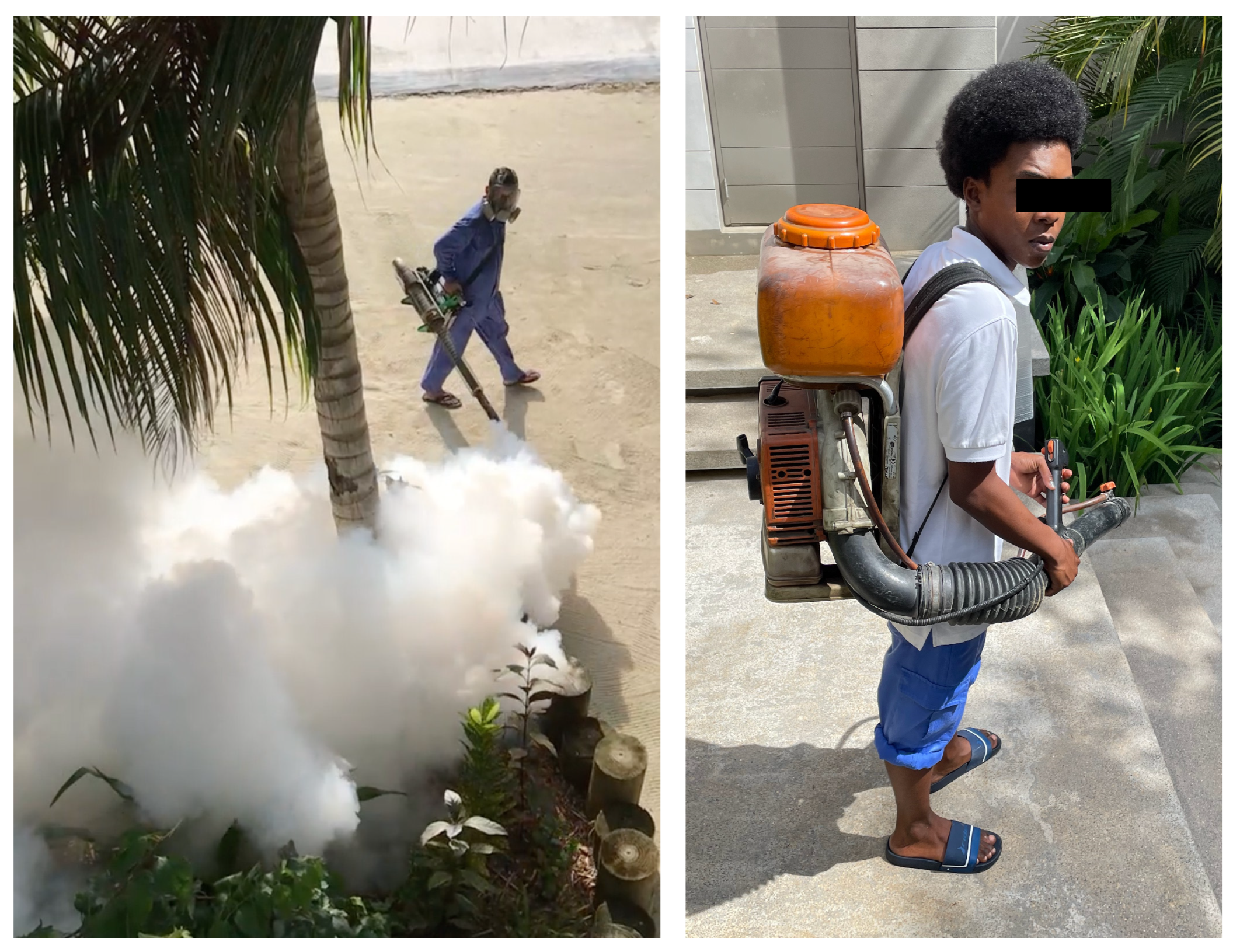
Recent epidemiological trends underscore the urgency of re-evaluating mosquito control practices in the Maldives. Dengue cases surged in early 2026, increasing from 76 to 428 cases between February 2025 and February 2026, and from 60 to 535 cases in March over the same period—more than a five- to eight-fold rise (Shafeeq, 2026). Although these surveillance data primarily reflect transmission on inhabited islands rather than resort islands, they highlight the country’s continued vulnerability to dengue. Inhabited islands are particularly prone to outbreaks because of higher population densities, abundant domestic breeding sites, and largely reactive mosquito control, with interventions typically implemented only after outbreaks occur rather than as part of routine preventive vector management. While such interventions can provide short-term relief, their limited impact on underlying mosquito population dynamics constrains their effectiveness for disease prevention. In a highly connected, tourism-dependent setting, continued reliance on reactive, short-lived control measures may therefore be insufficient to mitigate outbreak risk, highlighting the need for more sustained, population-level suppression strategies. Yet, most Maldivian islands continue to rely heavily on routine insecticide-based interventions, such as thermal fogging, ultra-low-volume (ULV) aerosol spraying, and backpack misting of vegetation (Figure 1). Although insecticide spraying can produce rapid reductions in adult mosquito abundance, these effects are typically short-lived because such interventions target only flying adult mosquitoes while leaving immature stages and indoor resting adult mosquitoes largely unaffected (Reiter & Gubler, 1997). Consequently, repeated applications are often required to maintain low nuisance levels (Knols et al., 2026). In small island ecosystems, however, frequent insecticide use raises concerns regarding potential impacts on non-target organisms, occupational exposure of staff, and contamination of sensitive reef environments that surround most resort islands (Lee et al., 2020; DeLorenzo & Fulton, 2012; Chrustek et al., 2018).
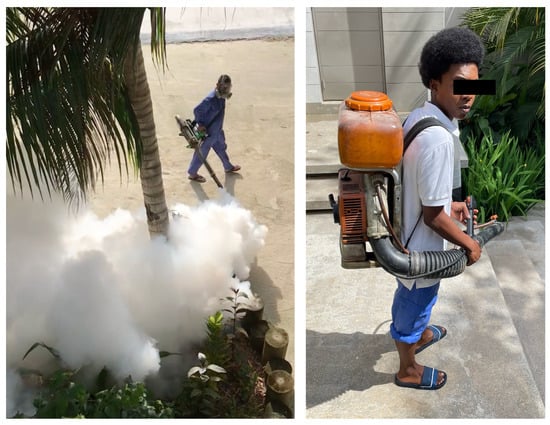
Figure 1.
Common chemical mosquito control methods used in the Maldives. (Left): Thermal fogging. (Right): Backpack misting (photo credit: BGJK).
At the same time, the geographic characteristics of Maldivian islands may create unusually favorable conditions for alternative mosquito management approaches. Many mosquito species associated with human environments, including container-breeding Asian tiger (Aedes albopictus) mosquitoes, typically disperse only 200–300 m during their lifetime (Marini et al., 2010), with maximum dispersal distances rarely exceeding a kilometer (Vavassori et al., 2019). Given the small spatial scale of most resort islands, entire mosquito populations may therefore be contained within the boundaries of a single island. In effect, resort islands function as spatially bounded ecological systems in which immigration is limited, and island-wide mosquito control strategies can therefore influence the entire mosquito population (Epple et al., 2026).
These characteristics suggest that mosquito control in Maldivian tourism environments may benefit from approaches that focus on sustained ecological suppression rather than repeated short-term knockdown through spraying (Jahir et al., 2022; Knols et al., 2023; Knols et al., 2026). Integrated mosquito management strategies combining surveillance, larval habitat reduction, biological control, and continuous removal of host-seeking mosquitoes may therefore offer a pathway toward effective mosquito suppression while reducing reliance on routine insecticide applications (World Health Organization, 2012); an approach promoted by the Maldivian government (Box 1).
Box 1. National Policy Context: Pesticide Use and Mosquito Control in the Maldives.
The Government of the Maldives recognizes dengue and other mosquito-borne diseases as significant public health concerns and supports the use of insecticides, including space spraying (fogging), for outbreak response and routine mosquito control. Thermal and ultra-low volume (ULV) fogging are therefore widely implemented across inhabited and resort islands.
At the same time, national policy frameworks emphasize sound chemical management and the need to minimize risks to human health and the environment. The National Chemical Profile of the Maldives highlights the importance of reducing adverse impacts of pesticide use in ecologically sensitive island systems. In 2015, it stated that ‘ULV spraying of malathion and deltamethrin fogging is only advised during dengue outbreaks with permission from the Health Protection Agency, however, continuous use of these chemicals is practiced in many of the islands’ (Ministry of Environment & Energy, 2015). Concerns regarding insecticide resistance associated with repeated chemical use are also acknowledged in health assessments.
Mosquito control policy is aligned with Integrated Vector Management (IVM) principles promoted by the World Health Organization (WHO), which prioritize environmental management, source reduction, and the judicious use of insecticides (World Health Organization, 2012). Within this framework, space spraying is considered a supplementary tool, primarily intended for short-term reduction in adult mosquito populations rather than sustained control. The WHO Country Cooperation Strategy for the Maldives (2024–2029) identifies environmental health as a key priority area, including actions to reduce exposure to harmful chemicals and promote safer alternatives (World Health Organization, 2024). Given that, over the period 2017–2021, 9% of all pesticide imports were used in the tourist sector (United Nations Development Programme, 2022), the role of tourism in this search for alternatives is substantial.
Together, these policy elements indicate that while fogging remains an accepted operational practice, there is a clear policy direction toward reducing reliance on routine insecticide applications and strengthening integrated, prevention-based mosquito control strategies.
Importantly, the transition toward ecological mosquito management should not be viewed as a theoretical aspiration. Over the past seven years, practical implementation of surveillance, larval source management, and mass trapping has been undertaken on fourteen resort islands in the Maldives, demonstrating that substantial reductions in mosquito populations can be achieved with relatively simple operational procedures (Jahir et al., 2022). These experiences suggest that many of the elements described in this paper can be integrated into existing resort management systems without major organizational changes or specialist entomological expertise. As such, Maldivian resorts have already been shown to be particularly well positioned to lead the transition from pesticide-dependent mosquito control toward more sustainable, evidence-based approaches.
Rather than presenting new experimental data, this Perspective synthesizes operational experience gained over seven years on fourteen Maldivian resort islands together with previously published empirical evidence to propose a practical transition framework that can guide resort operators from routine insecticide use toward surveillance-based, sustainable mosquito management. Such a transition can improve guest experience and staff safety while protecting biodiversity and strengthening the environmental sustainability of Maldivian island tourism.
2. Mosquito Control in Tropical Resort Tourism: Operational Practices, Limitations, and Island Ecology
Maintaining mosquito-free outdoor environments is an operational priority for tropical resort destinations. In island tourism systems such as the Maldives, much of the guest experience takes place outdoors through beachfront dining, evening events, spa treatments, and recreational activities. Even moderate mosquito nuisance can therefore negatively affect visitor comfort and satisfaction. Resort operators consequently implement mosquito control programs designed to reduce biting pressure in areas used by guests and staff, in the Maldives typically island-wide.
Across tropical tourism destinations, mosquito control programs commonly rely on adulticidal insecticide applications. In the Maldives, typical interventions include thermal fogging, ultra-low-volume (ULV) aerosol spraying, and backpack misting of vegetation and landscaped areas. These treatments are usually applied during early morning or evening hours when mosquito activity is highest and may be repeated on regular schedules ranging from once per week to several times per week (or even daily) depending on perceived mosquito abundance and guest complaints (Knols et al., 2026). The operational appeal of these interventions lies in their simplicity and immediacy: spraying can produce visible knockdown of flying mosquitoes within minutes, creating the impression of rapid control.
However, despite their operational convenience, insecticide-based interventions often provide only temporary reductions in mosquito abundance. Aerosolized insecticides primarily affect mosquitoes that are actively flying during the treatment period. Individuals resting deep inside vegetation or sheltered (indoor) structures remain unaffected, while immature stages developing in water-holding containers continue to emerge after spraying. As a result, mosquito populations frequently recover within days following treatment. In environments where larval habitats remain available, adult mosquito populations can therefore be rapidly replenished, creating a cycle in which repeated spraying becomes routine operational practice.
Considering that it is difficult to get precise data on the frequency of insecticide application, we conducted a search of TripAdvisor. Of 100 Maldivian resorts examined (55% of all resort islands), 37 contained explicit statements specifying a spraying frequency and were included; the remaining resorts either had no mention of spraying or used non-quantified terms (e.g., ‘regular fogging’) and were excluded. Thus, explicit spraying frequency information was available for approximately 21% of all operational Maldivian resort islands nationwide (37 of ~180). For each of these resorts, publicly available reviews and Q&A content were screened using the keywords ‘fogging’, ‘misting’, ‘spraying’, or ‘fumigation’. Only statements explicitly mentioning a frequency (e.g., ‘twice a day,’ ‘once a week,’ etc.) were included. Although this data reflects reviewer-reported operational practices at the time of posting and does not constitute independently verified resort policy, it was found that 70% of the resorts spray at least once per day, and 100% at least once per week. Spraying frequency is therefore very high in the Maldives and contradicts World Health Organization (WHO) policy that recommends space spraying only in situations of high risk in disease epidemiological terms.
Frequent insecticide use raises several additional concerns in small island ecosystems. First, repeated chemical applications may increase occupational exposure risks for pest control personnel responsible for spraying activities as well as guests/resort staff. Second, insecticides may affect non-target organisms, including pollinating insects and other beneficial arthropods that contribute to island ecosystem functioning (Box 2). Third, because Maldivian resort islands are typically surrounded by coral reef lagoons, concerns have been raised regarding the potential for insecticide drift or runoff to enter adjacent marine environments. Coral reef ecosystems and lagoon habitats are particularly sensitive to chemical contamination, and maintaining environmental integrity is central to the tourism value of the destination. Fourth, the visible aerosol clouds, noise generated by spraying equipment, and noticeable chemical odors associated with insecticide applications can detract from the tranquil atmosphere that forms a core component of the luxury resort experience and may reduce guest satisfaction. Fifth, prolonged and frequent use of insecticides results in mosquitoes becoming resistant, necessitating a switch to more expensive chemicals or more frequent applications.
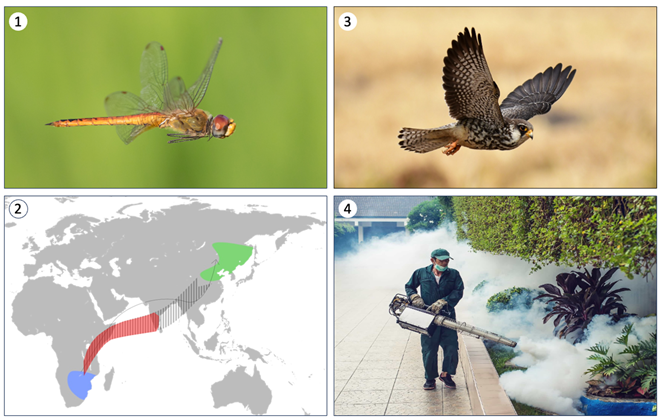
Box 2. Pesticide Spraying in the Maldives Affects a Transcontinental Insect/Bird Migratory System.
The Maldives lie within a major aerial migration corridor linking South Asia, the Indian Ocean, and East Africa. Each year, large numbers of migratory insects move across this region in association with seasonal monsoon winds. Among the most conspicuous of these migrants is the Globe Skimmer dragonfly (Pantala flavescens; panel 1), a species known to undertake multi-generational movements spanning sixteen thousand (!) kilometers across the Indian Ocean basin (panel 2) (Anderson, 2009; Hobson et al., 2012). Massive swarms of these dragonflies are frequently observed on Maldivian islands during the northeast monsoon (October–November), indicating that the archipelago lies directly along this migration route. These insect movements form part of a broader aerial food web. Migratory insectivorous birds such as the Amur falcon (Falco amurensis; panel 3) travel along the same monsoon-driven corridor between Asia (green area) and Africa (blue area) and feed extensively on flying insects, including dragonflies, during migration (red area). The migration of insects therefore represents not only a movement of species but also a large seasonal transfer of biomass and energy across continents. Because the Maldives consist of a narrow chain of islands located centrally within this migration corridor, they function as a temporary stopover or concentration point where migratory insects descend from high-altitude winds. Under such conditions, insecticide space spraying (panel 4) across multiple islands influences a disproportionate share of the migrating population. Thus, routine broad-spectrum spraying in the Maldives may reduce migrating insects such as the Globe Skimmer, potentially lowering food availability for insectivorous migrants like the Amur falcon and weakening natural insect control in their breeding regions. Reducing reliance on routine insecticide spraying and adopting more targeted mosquito control approaches may therefore not only benefit local biodiversity within the Maldives but also help safeguard a migratory system that connects ecological processes across Asia, Africa, and the Indian Ocean.
Our survey of mosquitoes on Kunfunadhoo island (Baa atoll; Soneva Fushi resort), in 2019, showed that twenty years of frequent spraying with synthetic pyrethroid insecticides had resulted in near-complete resistance (only 20% of exposed mosquitoes succumbed 1–24 h after insecticide exposure in standardized WHO test kits) (Jahir et al., 2022). The ecological characteristics of mosquito populations on resort islands further complicate reliance on routine insecticide spraying. Many nuisance mosquito species associated with human environments, particularly container-breeding Aedes mosquitoes, develop in small water-holding containers such as drainage structures and septic tanks, ornamental containers or plant saucers, construction materials (e.g., buckets, tarpaulins, galvanized iron pipes), and natural receptacles (empty coconut shells, coconut boats, leaf axils, tree ponds, etc.). These habitats are often abundant in landscaped resort environments where irrigation systems, vegetation, and infrastructure create numerous opportunities for standing water accumulation.
Importantly, many mosquito species display limited dispersal behavior. Studies of container-breeding Aedes mosquitoes frequently report average dispersal distances of approximately 100–200 m, with maximum movement distances rarely exceeding several hundred meters. Given the small spatial scale of most Maldivian resort islands, these dispersal distances mean that the entire island environment often falls within the flight range of local mosquito populations. In many cases, surrounding ocean waters act as natural barriers that limit immigration of mosquitoes from neighboring islands.
These characteristics suggest that mosquito populations on resort islands largely function as isolated ecological systems. Unlike large mainland environments where continuous influx can replenish mosquito populations, small islands may offer opportunities for coordinated island-wide control strategies capable of influencing the entire mosquito population. Centralized management of resort operations further strengthens this potential. Landscaping, waste management, infrastructure maintenance, and environmental management are typically coordinated by resort engineering or sustainability teams, allowing interventions to be implemented across the entire island landscape.
Taken together, these operational and ecological factors highlight both the importance and the limitations of current mosquito control practices in Maldivian resort islands. While routine insecticide spraying remains widely used to provide immediate relief from nuisance mosquitoes, the bounded spatial scale and ecological characteristics of resort islands suggest that alternative approaches focusing on sustained mosquito suppression may offer significant advantages. These considerations provide the foundation for exploring ecological mosquito management strategies that could reduce reliance on routine pesticide use while maintaining effective control of mosquito nuisance.
3. Toward a Transition Framework for Maldivian Resorts
Despite growing awareness of the limitations of routine insecticide-based mosquito control, operational practices across Maldivian resort islands have remained largely unchanged for decades. Thermal fogging, ULV spraying, and misting continue to form the backbone of mosquito control programs, often implemented at high frequency and across entire islands. These approaches have become deeply embedded in resort operations, not necessarily because they represent the most effective long-term solution, but because they are well established, operationally simple, and widely accepted within the industry.
A key factor contributing to this persistence is that mosquito control on most resort islands is outsourced to third-party pest control providers. A relatively small number of companies dominate this sector in the Maldives, supplying both the technical expertise and operational capacity required to conduct routine spraying. While this model ensures continuity of service, it also tends to reinforce existing practices. Pest control contracts are typically structured around regular service delivery (e.g., scheduled fogging) rather than outcome-based performance metrics such as sustained mosquito suppression. As a result, innovation and adaptation of alternative control strategies have been limited.
Importantly, the continued reliance on conventional spraying practices should not be interpreted as a lack of willingness among resort operators to change. On the contrary, many resorts express increasing concern about the environmental, health, and reputational implications of frequent insecticide use, particularly in a destination that markets itself on pristine natural environments and sustainability. However, most resort management teams lack the technical expertise and operational guidance required to implement alternative mosquito control approaches. In practice, this creates a situation in which resorts recognize the need for change but do not know where or how to begin.
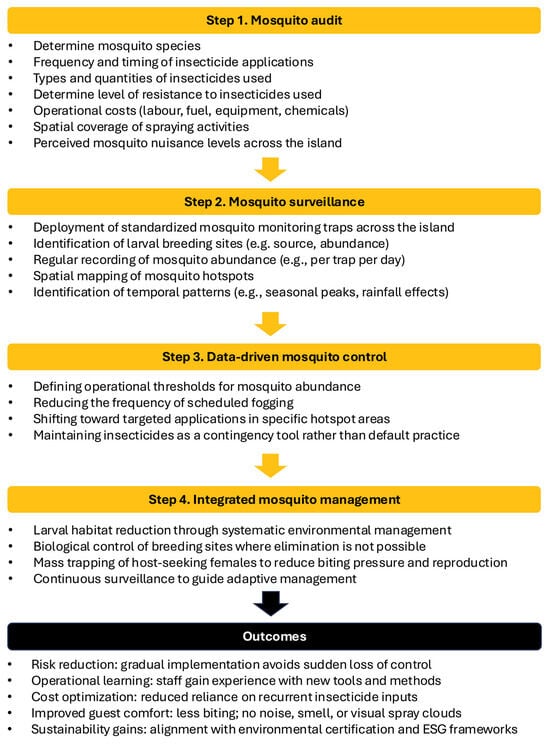
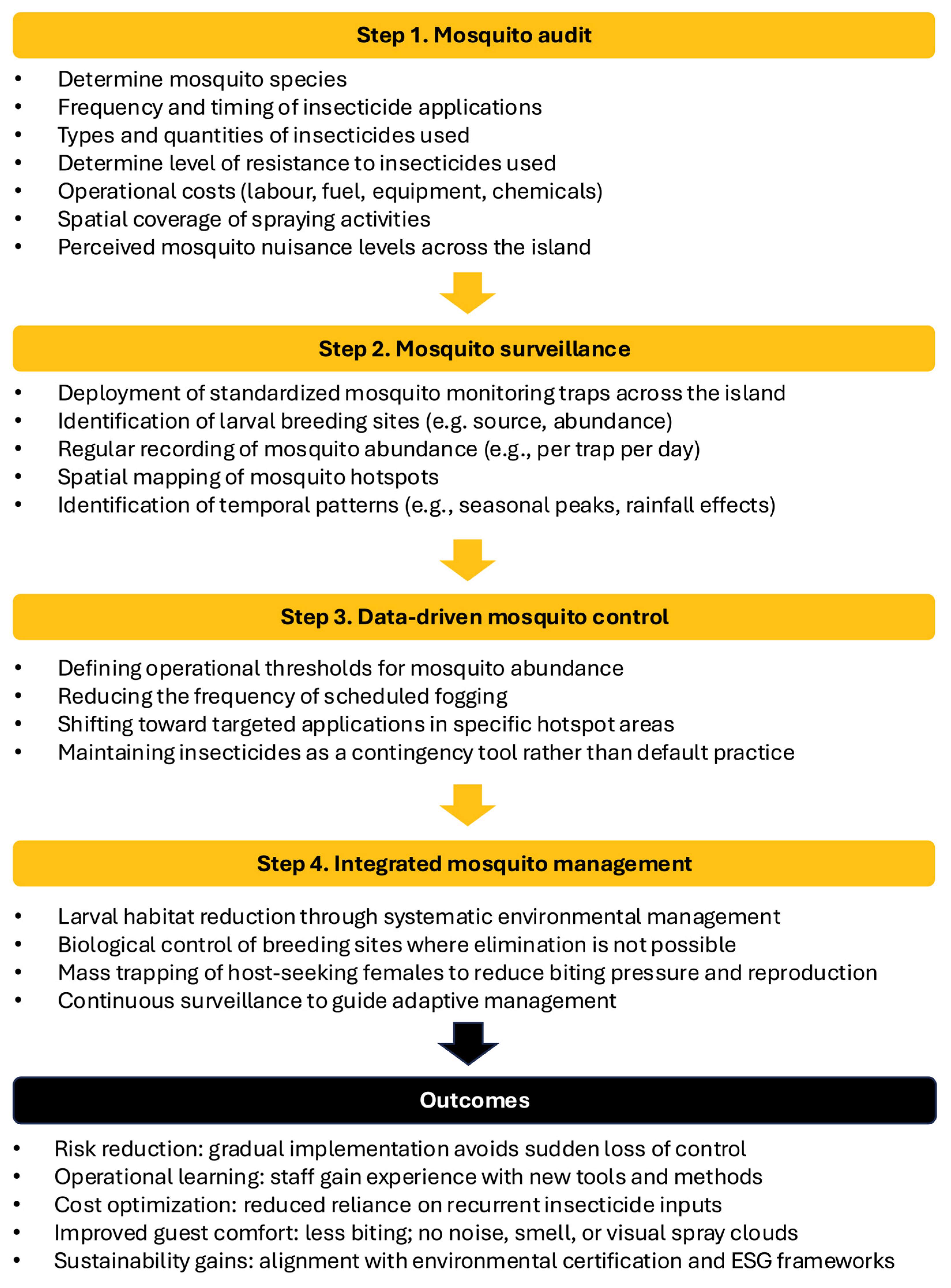
In this context, the transition framework presented in this study (Figure 2) is intended as a practical entry point for change. Rather than proposing a complete overhaul of existing systems, the framework provides a stepwise approach that begins with understanding current practices and gradually introduces elements of ecological mosquito management. The first steps, i.e., auditing existing control measures and implementing basic surveillance, are designed to generate insight into what is actually happening on a given island, including mosquito dynamics, intervention effectiveness, and operational inefficiencies.
Figure 2.
Conceptual framework for transitioning from routine insecticide-based mosquito control to integrated ecological mosquito management. The process involves four sequential phases: (1) Auditing current practices, (2) Implementing surveillance systems, (3) Reducing routine spraying through threshold-based interventions, and (4) Adopting integrated ecological mosquito management combining habitat reduction, biological control, mass trapping, and targeted interventions.
Crucially, this process also creates an opportunity to initiate a constructive dialogue between resort management and pest control providers. By shifting the focus from routine service delivery to measurable outcomes and evidence-based decision-making, the framework encourages both parties to jointly evaluate current practices and explore improvements. This collaborative approach is essential, as successful transition toward ecological mosquito management will require not only technical adjustments but also changes in operational mindset, contractual arrangements, and performance indicators.
In this sense, the transition framework should not be viewed merely as a technical tool, but as a facilitator of change within the tourism sector. By providing structure, transparency, and a common language for discussing mosquito control, it enables resorts and service providers to move beyond routine spraying toward more sustainable, effective, and adaptive mosquito management strategies.
The transition framework shown in Figure 2 is based on operational experience accumulated over 7 years on 14 Maldivian resort islands and synthesizes evidence from our previously published field studies. Conceptually, the framework builds upon the principles of Integrated Vector Management (IVM) by combining surveillance, environmental management, biological control, targeted interventions, and continuous evaluation within an adaptive management approach. The published evidence underpinning each component of the framework is summarized in Supplementary Table S1.
3.1. Mosquito Audit
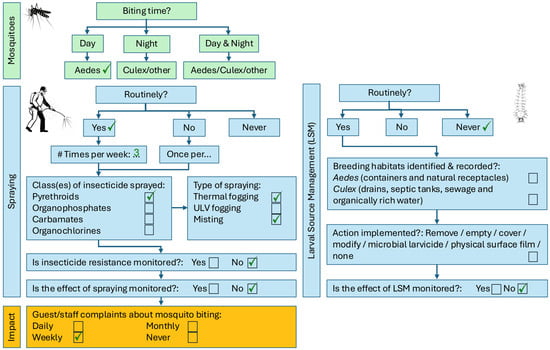
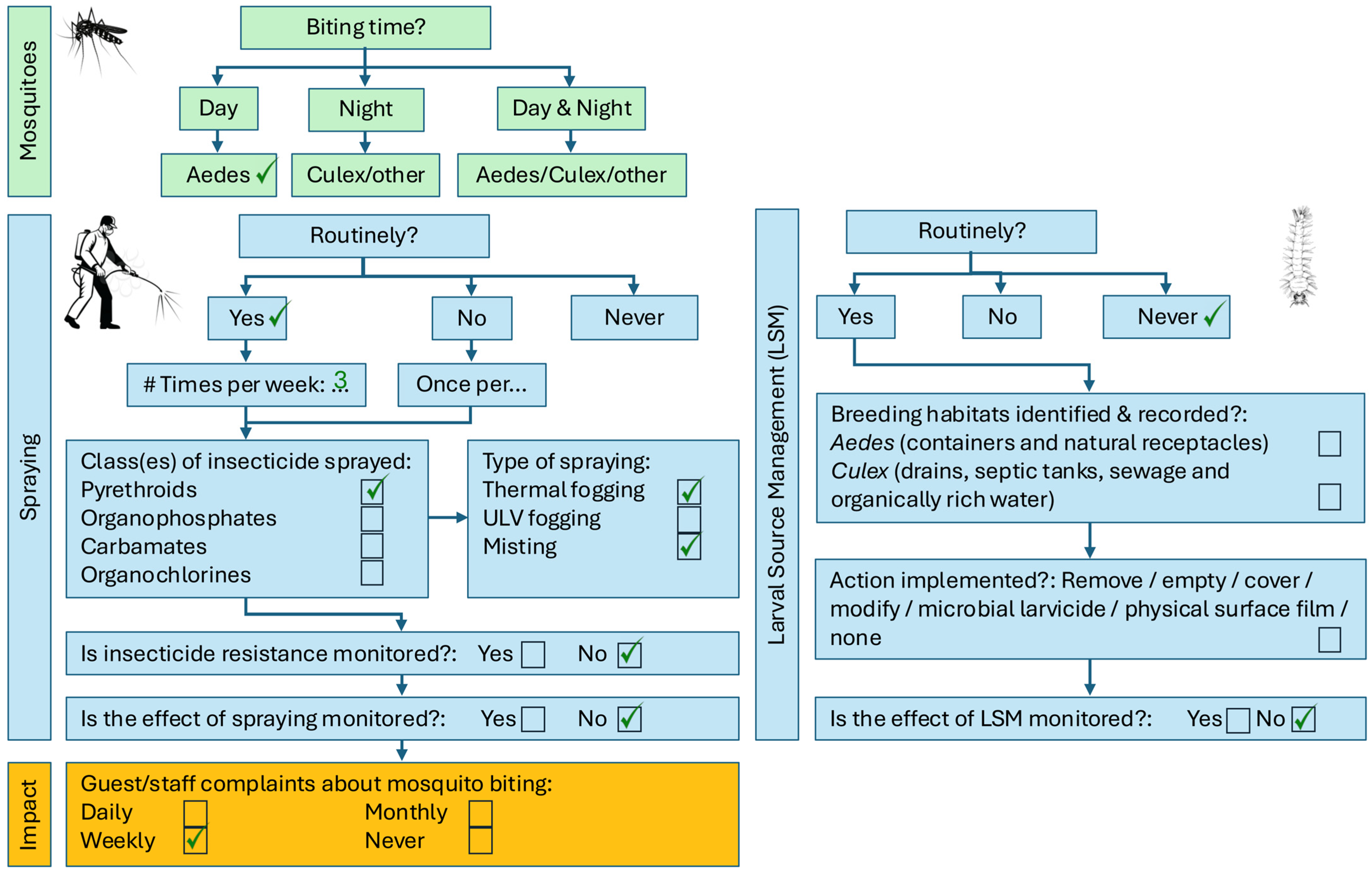
The first step in the transition framework is a systematic mosquito audit, which provides a structured assessment of current mosquito control practices and their effectiveness. For most resorts, this represents a critical starting point, as control activities are often implemented without detailed understanding of mosquito ecology or intervention outcomes. The audit therefore establishes a baseline of both the mosquito problem and the operational response. A practical entry point for this process is provided in Figure 3, which outlines a simple flowchart guiding users through key diagnostic questions. This tool allows resort managers and pest control providers to rapidly assess biting patterns, current spraying practices, insecticide use, and existing monitoring, and can serve as a straightforward starting point for understanding the current situation on an island.
Figure 3.
Operational mosquito audit flowchart for resort islands. The framework guides users through key questions on mosquito biting patterns, current spraying practices, insecticide use, larval source management practices, monitoring, and complaints to assess control performance. In this hypothetical case (ticked boxes), the resort has Aedes mosquitoes; it uses thermal fogging and misting with pyrethroids 3× per week, never applies larval source management, and is not monitoring resistance or the outcome of these measures but faces weekly complaints. A scenario like this would hint at the existence of insecticide resistance, which should be measured as a follow up.
The audit focuses on three core elements: (i) when mosquitoes bite (day vs. night, indicating likely mosquito species), (ii) how control is currently implemented (frequency, method, and type of insecticide use), and (iii) whether effectiveness is measured, including monitoring of mosquito abundance, insecticide resistance, and complaint levels. In many cases, this process reveals a strong reliance on routine spraying combined with limited or absent evaluation of outcomes. By linking mosquito activity, control practices, and perceived nuisance, the audit provides a transparent overview of system performance and highlights mismatches between intervention strategies and mosquito ecology. Importantly, it also creates a shared basis for discussion between resort management and pest control providers.
As such, the mosquito audit forms the foundation for the next step, i.e., surveillance, by identifying information gaps and establishing quantitative monitoring. It enables a shift from routine, perception-based control toward data-driven mosquito management.
Most resorts have been spraying since their opening, often for many years, and the most used class of insecticides are the so-called synthetic pyrethroids. This is therefore also the class of insecticides against which resistance in mosquito populations is most prevalent. Although policy in the Maldives prescribes that users should monitor resistance from time to time (e.g., annually), this hardly if ever occurs. As a result, resorts have no idea if spraying remains effective. Several insecticide resistance (CDC bottle or WHO tube) assays have been developed, and test kits can be ordered (online) and used in resorts with minimal training (Centers for Disease Control and Prevention, 2026; World Health Organization, 2026a). As a first step, resorts should incorporate in their contracts with pest control providers that they obtain these test kits and conduct these assays annually.
3.2. Surveillance
The next step is the establishment of basic surveillance systems to quantify mosquito abundance and guide decision-making. Surveillance shifts mosquito control from a perception-driven activity to a data-informed process, allowing resorts to understand mosquito population dynamics and evaluate intervention effectiveness.
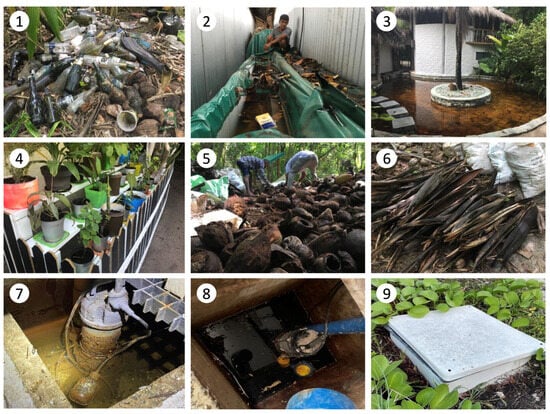
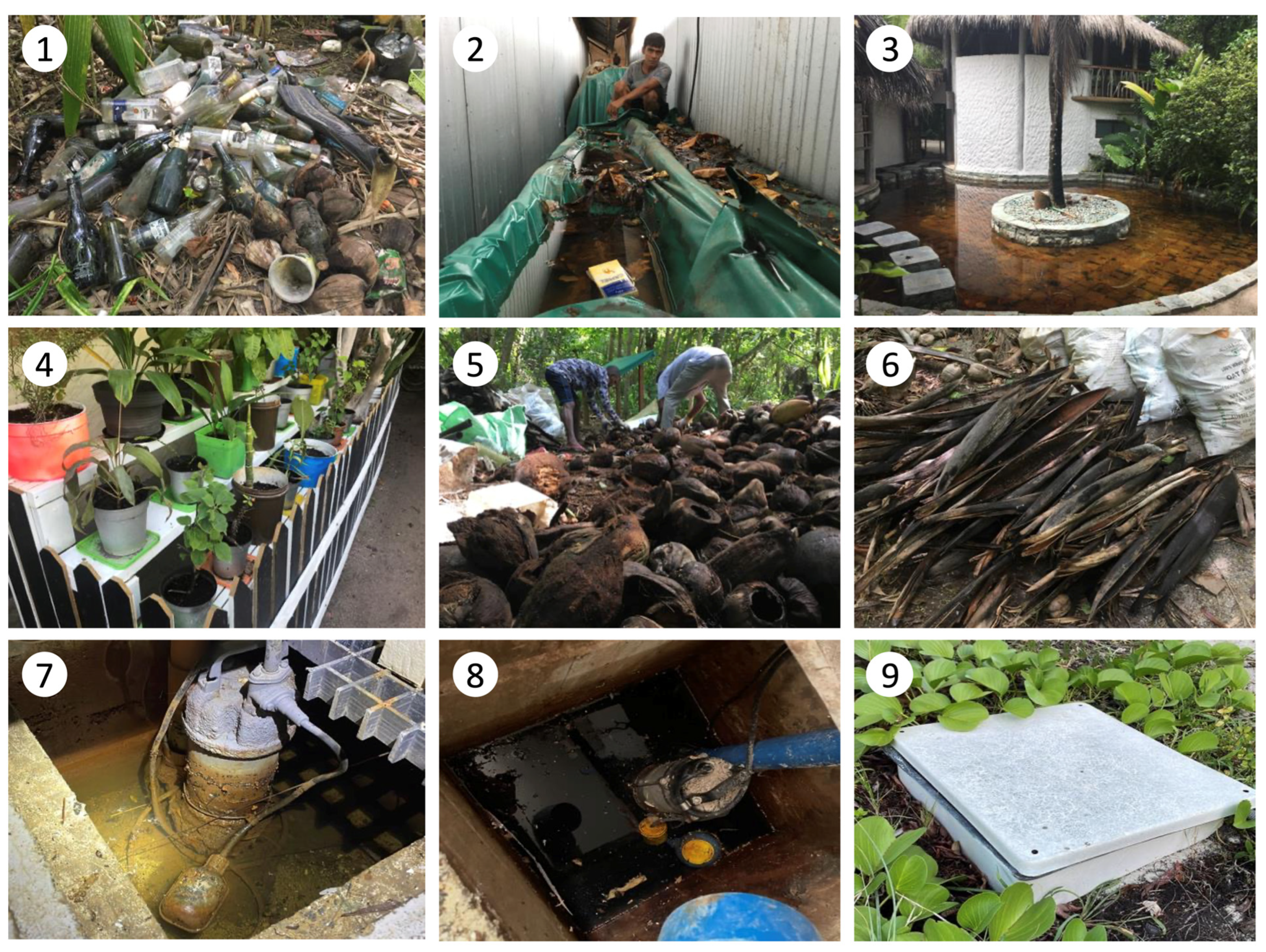
A key consideration is that different mosquito groups occupy distinct larval habitats. Aedes mosquitoes breed in small, clean, rain-filled containers such as buckets, gutters, tarpaulins, and natural sites like tree holes and coconut shells, whereas Culex mosquitoes prefer organically rich, more permanent water bodies, including septic tanks, sewage treatment plants, soak pits, and drainage systems (Figure 4). Due to the highly permeable coral sandy soils of Maldivian islands, rainwater rapidly infiltrates the ground, meaning that temporary puddles rarely persist long enough for mosquito development. As a result, breeding is largely confined to practically anything that holds rainwater and engineered water systems for a minimum of 1–2 weeks (i.e., the development time from egg to adult mosquito).
Figure 4.
Examples of typical Aedes breeding sites: (1) Trash that can hold water (e.g., bottles or tin cans), (2) tarpaulins used in construction, (3) temporarily abandoned ponds or pools, (4) saucers under flower/plant pots, (5) empty coconuts, (6) coconut boats. Sewage and drainage systems (7,8) or incomplete covered septic tanks (9) create ideal Culex breeding sites.
Monitoring Aedes populations is further complicated by their desiccation-resistant eggs, which can survive dry conditions for up to five months (Jahir et al., 2022) and hatch after rainfall. Surveillance must therefore capture both current abundance and the potential for rapid population resurgence.
In practice, surveillance can be implemented using standardized odor-baited mosquito traps deployed at approximately 1–2 traps per hectare, placed in representative locations across the island. Regular (e.g., twice weekly) monitoring provides data on mosquito densities, spatial variation, and temporal trends. These data enable resorts to move from routine spraying to threshold-based interventions, targeting control efforts where and when they are needed. Surveillance thus provides the analytical foundation for ecological mosquito management, linking the initial audit to more targeted, effective, and sustainable control strategies. Moreover, climate change may alter mosquito breeding dynamics through changes in temperature, rainfall, and extreme weather events. This further emphasizes the value of surveillance-based mosquito management, which allows resorts to adapt interventions to changing ecological conditions while reducing unnecessary pesticide use.
3.3. Data-Driven Mosquito Control
With surveillance in place, the next step is to shift from routine, schedule-based spraying to threshold-based control. In most resorts, insecticide applications are conducted at fixed intervals regardless of mosquito abundance. Surveillance data now allow interventions to be triggered by measured increases in mosquito density, rather than by habit or perception.
Operationally, this involves defining simple action thresholds based on trap catches (e.g., mosquitoes per trap per day) and complaint levels. When values remain below threshold, routine spraying can be reduced or paused; when thresholds are exceeded, targeted interventions are implemented in identified hotspots. This approach focuses effort where it is most needed and avoids blanket island-wide treatments. Threshold-based control also enables spatial targeting. Trap data typically reveal heterogeneity across the island. Interventions can therefore be directed to these locations using appropriate measures (e.g., localized larval control, source reduction, or limited spraying), improving efficacy while reducing chemical input.
A key advantage of this approach is the potential for substantial cost savings. Routine spraying programs involve recurring expenses for insecticides, fuel, equipment use, and labor, often applied multiple times per week. By replacing fixed schedules with interventions only when thresholds are exceeded, resorts can significantly reduce the frequency of applications and associated operational costs (Knols et al., 2026). These savings can be considerable, particularly on islands where spraying is currently conducted daily or several times per week and can help offset investments in surveillance and alternative control measures.
Reduced spraying also has important implications for insecticide resistance management. Frequent and repeated use of the same classes of insecticides exerts strong selection pressure on mosquito populations, accelerating the development of resistance. By limiting insecticide applications to situations where they are truly needed, threshold-based control can reduce this selection pressure and delay the build-up of resistance, thereby preserving the effectiveness of available products over longer periods.
Importantly, insecticides are retained as a contingency tool, not a default. Short-term, localized spraying may be justified during spikes in abundance or elevated public health risk but is guided by surveillance and followed by evaluation of impact. Over time, this reduces overall insecticide use, lowers exposure risks, and mitigates resistance development.
Implementing threshold-based control requires operational alignment between resort management and pest control providers, including agreement on thresholds, reporting frequency, and response protocols. In this way, surveillance data are translated into actionable decisions, forming the bridge to fully integrated ecological mosquito management in the next step.
3.4. Integrated Mosquito Management
The final step in the transition framework is the implementation of integrated ecological mosquito management, in which reliance on routine insecticide use is minimized and, ultimately, replaced by pesticide-free approaches. In the context of sustainability (particularly in a tourism destination built on environmental quality) long-term mosquito control should aim to move away from chemical dependence and toward methods that deliver effective suppression without recurring pesticide inputs.
A central component of this strategy is larval source management, comprising interventions that prevent the emergence of adult mosquitoes by managing larval habitats through environmental modification, environmental manipulation, larviciding, biological control, and, for container-breeding species such as Aedes, container and waste management (World Health Organization, 2026b). Because mosquito breeding on Maldivian resort islands is largely confined to artificial containers and engineered water systems, many breeding sites can be identified, geo-referenced, visited and managed through routine operations. Water-holding containers should be emptied, inverted, covered, modified, or removed; roof gutters and drains should be cleared; septic tanks and service openings should be sealed; and construction materials should be stored so that they cannot collect rainwater. Regular inspections and maintenance of drainage systems can be performed by housekeeping, gardening, landscaping, engineering, and waste management staff. Organizing these activities through periodic island-wide cleanup days can substantially reduce mosquito breeding while strengthening staff awareness and engagement.
Where breeding sites cannot be eliminated (e.g., gutters, concrete basins, septic tanks, water treatment facilities), biological larval control provides an effective and environmentally selective option. Commercially available microbial larvicides such as Bacillus thuringiensis israelensis (Bti) and monomolecular surface films are both recommended within World Health Organization (WHO) integrated vector management frameworks as targeted tools for controlling mosquito larvae while minimizing non-target impacts (World Health Organization, 2026c). These interventions are particularly useful for managing persistent water bodies such as drainage systems, septic tanks, or sewage treatment facilities where complete removal of standing water is not feasible.
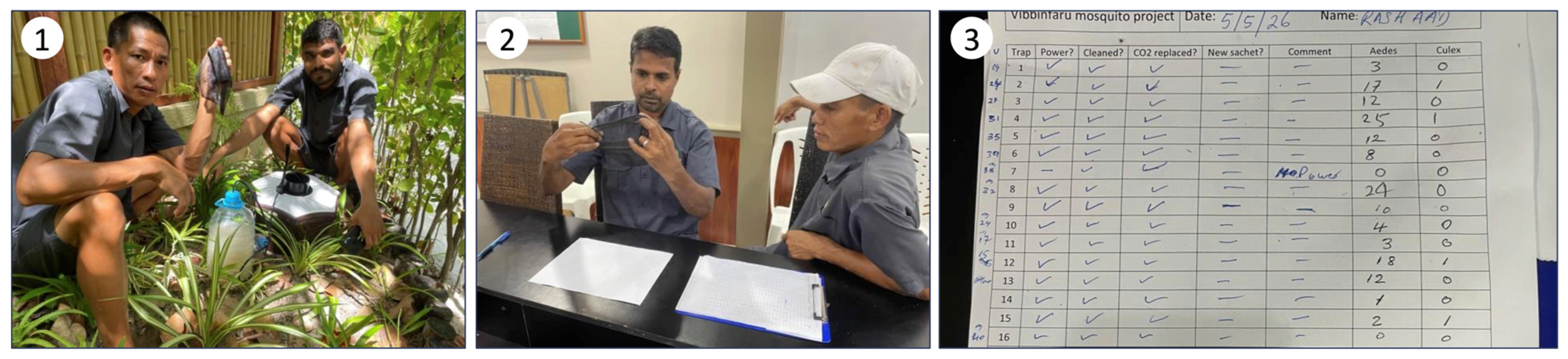
In parallel with larval control, sustained suppression of adult mosquito populations can be achieved through mass trapping of host-seeking females. Odor-baited traps continuously remove mosquitoes from the population, reducing both biting pressure and reproductive output. Based on our operational experience on 14 Maldivian islands, deployment at 6–10 traps per hectare can achieve substantial population reductions or even operational elimination when applied across entire islands. At these densities, trapping functions as a continuous removal mechanism, in contrast to the intermittent and short-lived effects of spraying. Mosquito populations have been reduced to less than 10% of baseline density, often within months, in all these islands (for details of 4 islands, see Table 1), and in some mosquitoes have been eliminated altogether (Jahir et al., 2022; Knols et al., 2026; Epple et al., 2026; Figure 5). From an economic perspective, mass trapping compares favorably with routine insecticide-based control. While trapping requires an initial investment in equipment and servicing, recent analyses indicate that trap-based systems can be cost-competitive with or cheaper than frequent fogging, particularly where spraying is conducted multiple times per week (Knols et al., 2026). Unlike fogging, which entails recurring costs for chemicals, fuel, and labor, trapping offers a more stable cost structure while eliminating the need for continuous pesticide input.
Table 1.
Outcome of integrated mosquito control on four Maldivian islands using mosquito traps and larval source management (LSM).
Figure 5.
Traps (1), baited with mosquito attractants, have become an effective and economic alternative for insecticide spraying in the Maldives. Resort staff (1,2) can be trained in trap deployment, maintenance, mosquito identification and record keeping (3), which enables data-driven mosquito management in line with the proposed transition framework (Figure 2).
Within this framework, insecticides are no longer a routine tool but are phased out or reserved only for exceptional circumstances, such as outbreak response. Beyond reducing pesticide use, the long-term sustainability of mosquito management depends on operational and economic feasibility. Surveillance, larval habitat management, and trap servicing can largely be integrated into routine resort operations following appropriate staff training. Although initial investments are required, these may be offset by reduced expenditure on insecticides and routine spraying, while decreasing dependence on external pest control providers. The long-term objective is to achieve effective mosquito suppression through non-chemical, system-based interventions that are inherently sustainable.
Together, larval source management, WHO-recommended biological larvicides, and mass trapping provide a robust, scalable, and environmentally aligned alternative to routine insecticide spraying. In the setting of Maldivian resort islands (where mosquito populations are spatially bounded and operations are centrally managed) these approaches offer a realistic pathway toward pesticide-free mosquito control, supporting both ecological integrity and the sustainability ambitions of the tourism sector.
4. Implementing the Framework
The greatest challenge facing the transition toward sustainable mosquito management is not the availability of alternative technologies or ecological knowledge, but taking the first step. Resort operators may perceive the shift away from routine insecticide spraying as complex or risky, particularly when current practices have been in place for decades and are embedded within existing pest control contracts. Yet the transition framework presented here is deliberately designed as a gradual process in which each component builds upon the previous one. Our experience has shown that implementation of this process is rather simple (Box 3). Resorts do not need to abandon existing practices overnight; instead, they can begin by auditing current operations, introducing surveillance, and progressively adopting evidence-based interventions that reduce reliance on routine pesticide applications.
Box 3. From Framework to Practice: A Simple Operational Model for Resort Islands.
Although the transition framework presented in this paper may appear comprehensive, its practical implementation is remarkably straightforward. Our experience on 14 resort islands in the Maldives, where we use so-called ‘Mosquitaire’ mosquito traps (Biogents AG, Regensburg, Germany) that are robust and operate continuously and effectively under local conditions for 5–7 years, has shown that sustainable mosquito management does not require a dedicated scientific team or complex infrastructure. Instead, it builds largely on existing resort operations and staff. Resort staff can be trained within a single day to service Mosquitaire traps, identify the major mosquito groups (Aedes or Culex), record trap catches, and recognize common breeding sites. Traps serve a dual purpose: they provide continuous mosquito surveillance while simultaneously suppressing mosquito populations. These activities are easily integrated into the daily routines of engineering, landscaping, housekeeping, or sustainability departments. The next step is the gradual deployment of mass-trapping stations across the island (6–10 traps per hectare; a 2–3 person team can install 30–50 traps per day), replacing routine insecticide spraying with continuous removal of host-seeking mosquitoes. Trap maintenance consists primarily of replacing attractants and refreshing a simple sugar-and-yeast CO2 mixture at regular intervals; tasks that require minimal technical expertise. Trap catches are recorded twice weekly, providing an objective measure of mosquito abundance and allowing management to evaluate trends over time. Larval source management is incorporated into normal maintenance activities. During routine inspections or scheduled island clean-up days, staff remove water-holding containers, clear gutters, inspect construction materials, empty flower-pot saucers, and identify drainage systems or septic tanks that require treatment with biological larvicides. In this way, mosquito control becomes a shared responsibility rather than the exclusive domain of an external pest control contractor. Importantly, resorts do not need to abandon spraying immediately. Most operations begin by introducing surveillance while maintaining existing practices. As mosquito populations decline and confidence in the new system grows, spraying frequency can be progressively reduced and ultimately restricted to exceptional situations such as disease outbreaks or unexpected population spikes. Our operational experience demonstrates that this transition is practical, affordable, and readily managed by resort personnel. Rather than representing a complex scientific exercise, ecological mosquito management becomes a routine component of island operations, similar to waste management, landscaping, reef conservation, or energy efficiency programs. The result is a simpler, data-driven mosquito control system that reduces pesticide use while improving guest comfort, protecting biodiversity, and strengthening the sustainability credentials of the resort.
Importantly, this transition aligns closely with the broader sustainability ambitions of the Maldivian tourism sector. Many resorts have invested heavily in renewable energy, waste reduction, reef restoration, marine conservation, and the elimination of single-use plastics, recognizing that environmental stewardship has become an essential component of their brand identity (Galli et al., 2025). Extending these efforts to mosquito management represents a logical next step. Replacing routine chemical spraying with ecological mosquito management demonstrates a commitment to protecting biodiversity, reducing chemical inputs, and preserving the fragile terrestrial and marine ecosystems upon which the tourism product ultimately depends.
Such a transition is also likely to resonate with changing guest expectations. Modern travelers increasingly seek authentic and environmentally responsible destinations (Baena & Cerviño, 2024) and are becoming more aware of the ecological and potential health implications of frequent pesticide use. Guests increasingly question routine fogging and misting practices, particularly when these occur in areas used for outdoor dining, recreation, or wellness activities. A resort that can transparently communicate that mosquito management is based on surveillance, habitat management, biological control, and continuous suppression rather than repeated chemical applications offers a sustainability narrative that is both credible and distinctive. In this sense, ecological mosquito management should not be viewed merely as an operational necessity but as a value proposition that reinforces guest confidence and strengthens brand reputation.
Implementation of the framework is equally consistent with national and international policy objectives. The Government of the Maldives promotes sound chemical management and recognizes the importance of minimizing unnecessary pesticide use in environmentally sensitive island ecosystems (Ministry of Environment & Energy, 2015), while the World Health Organization advocates Integrated Vector Management approaches in which insecticides serve as supplementary rather than routine interventions (World Health Organization, 2012). The framework presented here translates these policy ambitions into practical operational steps that can be implemented by resort management and pest control providers alike.
Finally, successful implementation depends on collaboration rather than replacement. Resort management, sustainability departments, engineering teams, housekeeping staff, and pest control providers each contribute complementary expertise and operational capacity. By establishing shared objectives, monitoring mosquito populations, evaluating interventions, and continuously adapting management practices, resorts can create an evidence-based mosquito management system that is both effective and sustainable. The transition therefore represents more than a change in mosquito control techniques; it reflects a broader shift toward adaptive environmental management in which guest comfort, public health, biodiversity conservation, and sustainability objectives are mutually reinforcing rather than competing priorities.
5. Limitations and Future Perspectives
The transition framework presented here is intended as a practical guide rather than a prescriptive solution applicable to all tropical islands. Its implementation should be adapted to local ecological and operational conditions, including island size, infrastructure, mosquito species composition, and proximity to neighbouring islands that may facilitate mosquito immigration. Continued surveillance and adaptive management therefore remain essential components of successful implementation. Furthermore, this framework is based on operational experience gained on Maldivian resort islands and synthesizes evidence from previously published studies rather than a controlled comparative trial. Future research should evaluate the framework across a wider range of island settings, quantify long-term ecological and economic outcomes, and further assess its applicability to other tropical tourism destinations.
6. Conclusions
Mosquito control on Maldivian resort islands can move beyond routine insecticide spraying toward a more sustainable and effective model based on surveillance, ecological understanding, and integrated management. The transition framework presented here offers a practical, stepwise approach that enables resorts to progressively reduce pesticide dependence while maintaining guest comfort and protecting public health. Importantly, our operational experience on fourteen Maldivian resort islands demonstrates that implementation can be straightforward, relying largely on existing resort staff and operational procedures rather than specialist expertise. By combining mosquito audits, data-driven decision making, larval source management, biological control, and mass trapping, resorts can align mosquito management with their broader sustainability ambitions, meet growing guest expectations for environmentally responsible practices, enhance guest comfort by reducing the visual, auditory, and olfactory disturbances associated with routine fogging and mist-blower operations, and support national and WHO policies promoting reduced chemical use. Importantly, the proposed framework is not only environmentally sustainable but also operationally practical and economically viable, as it integrates mosquito management into routine resort maintenance while reducing long-term dependence on recurrent pesticide applications. The opportunity now exists for the tourism sector to redefine mosquito control as an integral component of sustainable hospitality rather than a routine chemical intervention, and to demonstrate that effective mosquito management and environmental stewardship can go hand in hand.
Supplementary Materials
The following supporting information can be downloaded at: https://www.mdpi.com/article/10.3390/tourhosp7080229/s1, Supplementary Table S1: Published evidence underpinning the proposed transition framework for sustainable mosquito management on Maldivian resort islands.
Author Contributions
The conceptualization and framework development was based on discussions between all authors; writing—original draft preparation, B.G.J.K. and M.G.; manuscript review and editing by all authors. All authors have read and agreed to the published version of the manuscript.
Funding
This study was funded by the European Union under the grant No. 101086257 (INOVEC Project). Views and opinions expressed are however those of the authors only and do not necessarily reflect those of the European Union or the European Research Executive Agency (REA). Neither the European Union nor the European Research Executive Agency (REA) can be held responsible for them.
Institutional Review Board Statement
Not applicable.
Informed Consent Statement
Not applicable.
Data Availability Statement
No new data were created or analyzed in this study. Data sharing is not applicable to this article.
Acknowledgments
During the preparation of this manuscript/study, the authors used ChatGPT (version 5.2) for the purposes of reference source location and text editing. All authors have reviewed and edited the output and take full responsibility for the content of this publication.
Conflicts of Interest
B.G.J.K. directs K&S Holding BV, which is the exclusive distributor of Biogents AG products in the Maldives, Seychelles, and St. Vincent and the Grenadines. In addition, B.G.J.K. provides consultancy services to resort islands on mosquito management, including the planning and installation of trapping operations, staff training, and support with mosquito surveillance, data collection, and data analysis. M.G. directs Biogents AG (Regensburg, Germany), which develops, manufactures, and commercializes mosquito traps worldwide. All other authors have no competing interests.
Note
| 1 | For current names of Maldivian Ministries, see President’s Office, Republic of Maldives (2026). |
References
- Anderson, R. C. (2009). Do dragonflies migrate across the western Indian ocean? Journal of Tropical Ecology, 25, 347–358. [Google Scholar] [CrossRef] [Scilit]
- Baena, V., & Cerviño, J. (2024). Tourism in the era of social responsibility and sustainability: Understanding international tourists’ destination choices. Sustainability, 16, 8509. [Google Scholar] [CrossRef] [Scilit]
- Centers for Disease Control and Prevention. (2026). CDC bottle assay. Available online: https://www.cdc.gov/mosquitoes/php/insecticide-resistance/cdc-bottle-bioassay.html (accessed on 4 May 2026).
- Chrustek, A., Hołyńska-Iwan, I., Dziembowska, I., Bogusiewicz, J., Wróblewski, M., Cwynar, A., & Olszewska-Słonina, D. (2018). Current research on the safety of pyrethroids used as insecticides. Medicina, 54(4), 61. [Google Scholar] [CrossRef] [Scilit] [PubMed]
- DeLorenzo, M. E., & Fulton, M. H. (2012). Comparative risk assessment of permethrin, chlorothalonil, and diuron to coastal aquatic species. Marine Pollution Bulletin, 64(7), 1291–1299. [Google Scholar] [CrossRef] [Scilit] [PubMed]
- Epple, M., Rose, A., Geier, M., & Knols, B. G. J. (2026). Evidence for threshold-like dynamics in aedes mosquito populations under sustained mass trapping on tropical islands. Insects, 17(5), 472. [Google Scholar] [CrossRef] [Scilit] [PubMed]
- Galli, P., Concari, E., Cerini, D., Scuderi, E., Doni, F., Mohamed, S., Zitouni, M. S., Al Ahmad, H., & Gabbiadini, A. (2025). From stars to sustainability: An integrated analysis of sustainable practices and environmental policies in Maldives resorts. Sustainability, 17, 5191. [Google Scholar] [CrossRef] [Scilit]
- Hobson, K. A., Anderson, R. C., Soto, D. X., & Wassenaar, L. I. (2012). Isotopic evidence that dragonflies (Pantala flavescens) migrating through the Maldives come from the northern Indian subcontinent. PLoS ONE, 7, e52594. [Google Scholar] [CrossRef] [Scilit] [PubMed]
- Jahir, A., Kahamba, N. F., Knols, T. O., Jackson, G., Patty, N. F. A., Shivdasani, S., Okumu, F. O., & Knols, B. G. J. (2022). Mass trapping and larval source management for mosquito elimination on small Maldivian islands. Insects, 13(9), 805. [Google Scholar] [CrossRef] [Scilit] [PubMed]
- Knols, B. G. J., Posada, A., Sison, M. J., Knols, J. M. H., Patty, N. F. A., & Jahir, A. (2023). Rapid elimination of Aedes aegypti and Culex quinquefasciatus mosquitoes from Puerco Island, Palawan, Philippines with odor-baited traps. Insects, 14(9), 730. [Google Scholar] [CrossRef] [Scilit] [PubMed]
- Knols, B. G. J., Siddiqui, N., Jahir, A., & Geier, M. (2026). From transient knockdown to density-driven collapse: A mechanistic comparison of adult mosquito control by space spraying and mass trapping in Maldivian islands. Insects, 17(5), 471. [Google Scholar] [CrossRef] [Scilit] [PubMed]
- Lee, N. S. M., Clements, G. R., Ting, A. S. Y., Wong, Z. H., & Yek, S. H. (2020). Persistent mosquito fogging can be detrimental to non-target invertebrates in an urban tropical forest. PeerJ, 8, e10033. [Google Scholar] [CrossRef] [Scilit] [PubMed]
- Marini, F., Caputo, B., Pombi, M., Tarsitani, G., & della Torre, A. (2010). Study of Aedes albopictus dispersal in Rome, Italy, using sticky traps in mark-release-recapture experiments. Medical and Veterinary Entomology, 24(4), 361–368. [Google Scholar] [CrossRef] [Scilit] [PubMed]
- Ministry of Environment & Energy. (2015). Maldives national chemical profile. Government of Maldives.
- Ministry of Tourism. (2023). Maldives fifth tourism master plan 2023–2027. Government of Maldives. Available online: https://www.tourism.gov.mv/en/downloads/master_plan (accessed on 3 May 2026).
- Ministry of Tourism & Environment. (2025). Maldives tourism yearbook 2025. Government of Maldives. Available online: https://www.tourism.gov.mv/en/statistics/annual (accessed on 3 May 2026).
- President’s Office, Republic of Maldives. (2026). President restructures cabinet to 15 members, with 12 newly appointed Ministers sworn in. 14 April 2026, Ref. 2026-209. Available online: https://presidency.gov.mv/Press/Article/36471 (accessed on 21 July 2026).
- Reiter, P., & Gubler, D. J. (1997). Surveillance and control of urban dengue vectors. In D. J. Gubler, & G. Kuno (Eds.), Dengue and dengue hemorrhagic fever (pp. 425–462). CAB International. [Google Scholar]
- Shafeeq, U. S. (2026). Dengue in Maldives: The spike in cases and what is being done to combat it (Edition.mv 2026). Available online: https://edition.mv/dengue/50169 (accessed on 3 May 2026).
- Steibl, S., Franke, J., & Laforsch, C. (2021). Tourism and urban development as drivers for invertebrate diversity loss on tropical islands. Royal Society Open Science, 8, 210411. [Google Scholar] [CrossRef] [Scilit] [PubMed]
- United Nations Development Programme. (2022). Baseline assessment on national use of chemicals and associated risks 2022. Available online: https://www.undp.org/maldives/publications/baseline-assessment-national-use-chemicals-and-associated-risks-2022 (accessed on 3 May 2026).
- Vavassori, L., Saddler, A., & Müller, P. (2019). Active dispersal of Aedes albopictus: A mark-release-recapture study using self-marking units. Parasites and Vectors, 12(1), 583. [Google Scholar] [CrossRef] [Scilit] [PubMed]
- World Bank. (2024). Maldives overview. World Bank. Available online: https://www.worldbank.org/ext/en/country/maldives (accessed on 3 May 2026).
- World Health Organization. (2012). Handbook for integrated vector management. World Health Organization. Available online: https://www.who.int/publications/i/item/9789241502801 (accessed on 3 May 2026).
- World Health Organization. (2024). Country cooperation strategy, Maldives: 2024–2029. World Health Organization. Available online: https://www.who.int/publications/i/item/9789290229674 (accessed on 3 May 2026).
- World Health Organization. (2026a). Insecticide resistance. Available online: https://cdn.who.int/media/docs/default-source/ntds/vector-ecology-mangement/catalogue_who-test-kits_29apr2024.pdf?sfvrsn=6782537a_36 (accessed on 2 August 2026).
- World Health Organization. (2026b). Operational manual on larval source management: Control of Anopheles and Aedes mosquito vectors. Available online: https://www.who.int/publications/i/item/9789240123212 (accessed on 21 July 2026).
- World Health Organization. (2026c). Vector control product list. WHO Prequalification Unit. Available online: https://extranet.who.int/prequal/vector-control-products/prequalified-product-list (accessed on 21 July 2026).

Disclaimer/Publisher’s Note: The statements, opinions and data contained in all publications are solely those of the individual author(s) and contributor(s) and not of MDPI and/or the editor(s). MDPI and/or the editor(s) disclaim responsibility for any injury to people or property resulting from any ideas, methods, instructions or products referred to in the content. |
© 2026 by the authors. Licensee MDPI, Basel, Switzerland. This article is an open access article distributed under the terms and conditions of the Creative Commons Attribution (CC BY) license.