


Abstract
Resilience in cruise tourism has been particularly important in recent years and especially after crises such as the financial crisis (2011–2013), in addition to the COVID-19 pandemic (2020–2021). The role of cruise ports is not limited only to the operation of the transport service, but also includes shaping their competitive position, as well as their ability to maintain and recover cruise demand in times of crisis, while contributing to the long-term sustainability of tourism. This study analyzes the resilience of passenger demand in eight Greek cruise ports during the period 2010–2024, examining the stability and recovery of passenger traffic through two composite indicators, the Project Management Index (PMI) and the Multimodal Access Index (MAI). Panel data were used with the passenger traffic as the dependent variable and the PMI and MAI as independent variables. The results show that multimodality plays the most important role for the resilience of cruise demand as it enhances the stability and recovery of cruise passenger demand while the pandemic had a negative impact. The contribution of the study lies in the quantitative mapping of the resilience of cruise ports, which is part of the framework of sustainable tourism development, offering useful tools for policy-making and strategic planning of cruise ports’ connectivity.
Keywords:
cruise tourism; cruise ports; resilience; crisis; multimodality; accessibility; project management 1. Introduction
The dynamic expansion of cruise tourism is accompanied by a set of complex challenges, which make it necessary to strengthen the resilience of the sector, in order to be able to respond effectively to crises and sudden disruptions and maintain its long-term sustainability. In this study, sustainability refers to the long-term ability of cruise ports to support tourism activity, balancing economic, social and environmental pressures. In this light, resilience acts as a strategic advantage, enabling the adoption of innovative operational practices and, therefore, is not described only in emergency management (Traskevich & Fontanari, 2021). At the same time, multimodal connectivity directly affects the operational efficiency of ports and their ability to recover demand after periods of crisis.
The concept of resilience exists in the literature and is referred to through different approaches each time. It is the ability of a system to return to a state of equilibrium after a crisis and is a dynamic and evolutionary process that includes the phases of development, maturity, crisis and renewal (Folke et al., 2001; Holling, 2001; Darnhofer et al., 2010). In multimodal transport systems, resilience has become an important and fundamental issue in both research and management, as ports play the very important role of central hubs. In recent years, after all the successive crises that have occurred, the vulnerability of transport networks has been demonstrated, as well as the need for integrated operational strategies. In this research, resilience is referred to as the ability of cruise passenger demand to be maintained and restored after exogenous shocks affecting cruise ports. In this study, resilience is approached mainly from the perspective of economic resilience, i.e., the ability to maintain and recover passenger demand after exogenous shocks, while elements of port adaptability to changing conditions are also recognized.
Cruise ports operate in a highly competitive environment, as they are hubs connecting destinations and are exposed to fluctuations in passenger demand. Despite significant progress in recent years, the literature continues to focus mainly on cargo ports and less on cruise ports (Guerrero & Rodrigue, 2014). Cruise ports are showing dynamics and typical examples are Greek ports such as the port of Piraeus, which recorded a 5% increase in revenue in 2024 and a 15.5% increase in cruise activity (SupplyChain, 2025). On the other hand, all the main Greek cruise ports are those that most reflect the impact of the economic crisis and the pandemic, as well as the recovery process of recent years. In this context, the role of strategic management is extremely critical for stakeholders and partners to further strengthen the resilience of cruise ports.
Given that the resilience of cruise passenger demand is influenced, on the one hand, by the management and quality of port infrastructure and, on the other, by the degree of integration of ports into wider multimodal transport networks, this study attempts to fill the existing research gaps through the development of two composite indicators that capture these dimensions, the Project Management Index (PMI) and the Multimodal Access Index (MAI). The two indicators are designed to capture complementary but distinct dimensions of cruise port resilience: on the one hand, the management and quality of infrastructure, and on the other hand, the degree of multimodal protection and connectivity with wider transport networks.
Using panel data from Greek ports for the period 2010–2024, these indicators allow for the quantification of resilience, shedding light on the role of multimodality, infrastructure constraints and the impact of exogenous shocks. This is, to the best of the author’s knowledge, the first empirical econometric analysis that systematically focuses on the resilience of cruise ports, linking functionality, sustainability and adaptability. The remainder of the paper presents the literature review, methodology, results, discussion, conclusions and implications.
2. Literature Review
2.1. Resilience in Cruise Ports
The resilience of cruise ports has emerged as a critical issue, and successive crises, such as the COVID-19 pandemic, economic turmoil and geopolitical tensions, have revealed the limits of traditional management approaches in this sector. Unlike other port systems, cruise ports operate as complex tourism hubs, where the transport function, the visitor experience and the relationship with the destination coexist, making resilience particularly multidimensional. In the relevant literature, the resilience of cruise ports is approached as a dynamic system that integrates infrastructure management, collaboration between stakeholders and the ability to adapt in a timely manner to exogenous shocks (Chen et al., 2025). At the same time, the literature highlights that an excessive focus on purely technological solutions may overlook critical social and institutional dimensions that directly affect the operation, resilience and long-term sustainability of cruise ports.
At the operational level, the resilience of cruise ports is approached through a set of protective, adaptive and corrective strategies, which include both physical infrastructure and organizational and administrative processes (Gu et al., 2025). In this context, issues such as cybersecurity and the increasing digital dependence of port operations acquire particular relevance for cruise ports, given the high degree of automation and interconnection that characterizes them (Tsoulfas, 2025). Although hybrid and multi-level resilience models have been proposed (Gu & Liu, 2023), their application specifically to cruise ports remains limited.
Since 2019, research on the resilience of cruise ports has expanded, examining climate risks (Z. Yang et al., 2025) and the place of cruise ports within broader transport networks. Studies focusing on the structure and hierarchy of hubs (Nair et al., 2010; Dui et al., 2021; He et al., 2022; Liao et al., 2023) highlight that resilience depends on connectivity and robustness of transport networks. A common conclusion is that the resilience of cruise ports is a continuous process of adaptation and not a static property. Despite the growing attention, the literature specifically dealing with the sustainability and resilience of cruise ports remains fragmented (Pallis & Papachristou, 2020). Previous studies indirectly link resilience to cruise demand, social responsibility, competitiveness and port infrastructure (Rodrigue & Notteboom, 2013; Papathanassis, 2017; Papadopoulou, 2020; Tsiotas, 2021). Other works highlight the importance of different forms of itineraries for the resilience of cruise ports (Vicente-Cera et al., 2020) or focus on their spatial dimension (Rosa-Jiménez et al., 2018), remaining however at a mainly qualitative level.
The debate on the sustainability of cruise ports has intensified particularly after the COVID-19 pandemic. Studies highlight the need for adaptive practices in the operation of cruise ports (Kulkov et al., 2023), while others highlight the demands of the “all-inclusive” model in terms of port city congestion, environmental degradation and low local added value (Hoarau-Heemstra et al., 2023). At the same time, interventions are proposed regarding flow management, land use and equitable distribution of costs and benefits between ports and destinations (Papathanassis, 2023).
Finally, landscape protection and integrated spatial planning linking maritime and terrestrial policies are considered crucial for the long-term sustainability of cruise ports and port cities (Rempis et al., 2019). However, the lack of coordinated policies makes interventions fragmented, highlighting the need for more integrated and measurable resilience approaches, specifically tailored to cruise ports.
2.2. The Resilience of Cruise Ports During Crises
The resilience of cruise ports during crises is directly linked to the way crisis management mechanisms are organized and operated. In contrast to general approaches to tourism, cruise ports are called upon to simultaneously manage demand shocks, operational constraints, security issues and health risks, making crisis management a critical element of their overall resilience (Chrysafis et al., 2023, 2024). Project management in the international literature is a long-term and constantly evolving process that takes place in interconnected phases of preparation, response and recovery and is not limited to isolated interventions. Models based on the logic of the crisis life cycle point out that effective management does not depend solely on the immediate reaction to the event, but mainly on the degree of preparation before its occurrence and on the ability to adapt and the organizational learning that follows (Ketter, 2022; Chrysafis et al., 2023). This approach, in the case of cruise ports, is particularly important, as crises affect not only their performance, but also the reputation of the destinations in which the ports are located, as well as their position in the wider transport and tourism network (Papadopoulou, 2022).
A very important element of the international literature is the importance of strategic crisis management models that are treated as long-term planning models. In the cruise port sector, crisis management is particularly important as it requires systematic coordination between many parties, such as port authorities, tourism organizations, private providers and transport operators, and at the same time integrates project and infrastructure planning. Furthermore, crisis management models have as a reference the experiences from previous crises and the integration of these experiences enhances the ability of cruise ports to adapt more easily to future crises (Chrysafis et al., 2022, 2023). In the present research, this dimension is approached in a complementary way in the attempt to capture the dynamics of resilience.
At the operational level, crisis management policies in cruise ports include mechanisms for communicating with stakeholders, developing operational plans, using digital and technological tools, and various actions to measure risk. However, the implementation of the aforementioned practices is often dysfunctional, especially in smaller cruise ports that are not familiar with adopting preventive practices (Paapa & Nguthi, 2025). Research interest in the resilience of cruise ports, especially after the COVID-19 pandemic, has intensified, although it remains mainly at an empirical level. The research focuses mainly on large cruise companies, reporting a sharp decline in productivity during the pandemic, but also a gradual recovery through various technological approaches (Li et al., 2024). This process raises questions about the applicability of these practices to cruise ports of different scales and institutional and administrative capacity. At the same time, Lin et al. (2023) highlight the very critical role of technology in crisis management in ports through approaches such as Fuzzy DEMATEL and ANP.
At the network level, the resilience of cruise ports is shaped by their position in international and regional transport systems, but also by their importance as regional hubs. The functioning of critical hubs can accelerate or slow down recovery in times of crisis (Poo et al., 2023), while simply returning to the pre-crisis situation is now considered insufficient. Instead, a “bounce-forward” approach is proposed, which links crisis management with institutional strengthening, natural capital protection and strategic transformation of cruise ports (Yozell, 2022; Ketter, 2022). Empirical literature also shows that crises have differentiated impacts at local and national levels. In Greece, resilience is recorded in arrivals but not necessarily in employment and GDP (Karoulia et al., 2015), while studies highlight the need for combined policies on taxation, licensing and environmental responsibility of ports (Agiomirgianakis & Sfakianakis, 2022). At the destination level, reputation management and the institutional organization of DMOs emerge as crucial for supporting cruise ports in times of crisis (Constantoglou & Prinitis, 2020). Overall, the literature converges on the fact that crises act as learning catalysts for cruise ports, with resilience being linked to the integration of life-cycle-based crisis management strategies and learning models into long-term policies and practices (Chrysafis et al., 2023). However, the issue of quantitatively assessing the resilience of cruise ports during successive crises remains open.
2.3. Multimodality and Accessibility as Resilience Factors of Cruise Ports
Multimodality and accessibility are emerging internationally as critical factors for the resilience of cruise ports, as they directly affect the ability to maintain passenger traffic and operational continuity in times of disruption. In the context of cruising, multimodality refers to the ability of ports to function as interconnection hubs between maritime and land transport networks, facilitating the seamless passenger movement across transport modes. Studies on port and transport networks show that the existence of alternative access modes reduces the vulnerability of nodes and their ability to absorb or cope with disturbances (Dui et al., 2021). According to Gu et al. (2025), multimodality is a key building block of resilience, as it allows the maintenance of transport flows even in cases where an individual subsystem is out of service. In the cruise port environment, multimodal accessibility goes beyond the narrow technical dimension of infrastructure and acquires a strategic character, directly affecting connectivity, the continuity of port operations and the ability to adapt to disruptions.
Cruise ports act as hubs connecting maritime transport with land networks, tourism service providers and local communities. In this context, improving infrastructure and travel options strengthens the competitive position of cruise ports, contributing to facilitating the spatial distribution of tourist flows in a destination and reducing traffic congestion. The distinction between ports that function as home ports and those that function as transit ports highlights the differences in the operational capacity of ports. The former focus on managing high volumes of passenger traffic, while the latter focus on connecting cruise ports with local communities. According to Santos et al. (2019), closer integration of cruise ports into regional development planning and collaboration with local stakeholders reduces dependence on large operators and enhances the long-term resilience of ports.
The literature confirms that a critical factor for the resilience of cruise ports is connectivity. Vicente-Cera et al. (2020) report that ports with a high level of accessibility are more adaptable to different shocks, while those with limited access options are more vulnerable to shocks. Studies in the Mediterranean show that large ports are more resilient as they are integrated into multimodal networks compared to island destinations where there is a lack of alternative modes of access to them, which limits adaptability and recovery potential. Another study points out that spatial differentiation in strategic choices and policies is not only due to physical constraints, but also to institutional, economic and administrative factors (Rosa-Jiménez et al., 2018).
Multimodality has important social dimensions as it reduces dependence on a single network, contributes to improving the competitiveness of cruise ports and enhances the coherence of the system (Sakib et al., 2018; Tavafi et al., 2025). Access to reliable public transport, as well as sustainable mobility, i.e., transport systems that ensure economically, socially and environmentally balanced access, require spatial planning and infrastructure that reduce travel costs for residents and socially vulnerable groups (Rosa-Jiménez et al., 2023). In this light, the use of digital platforms can play a very important and supportive role as it can improve transparency, navigation and social inclusion (Achillas et al., 2024).
At a regional scale, studies on the Mediterranean show that effective multimodality remains limited despite the existence of transport options, with a few exceptions such as the case of Venice (Polydoropoulou et al., 2025). This finding highlights the structural problems of existing accessibility systems, while also reinforcing the importance of interventions to enhance the resilience of cruise ports. The vulnerability of ports to crises and various exogenous shocks increases as there is limited regulation of access modes, which is consistent with the OECD (2025) guidelines that emphasize the need for systematic monitoring of resilience, especially in countries that are highly dependent on cruise tourism.
Overall, the literature converges on the fact that multimodality and accessibility are not secondary port infrastructures, but strategic levers that shape the resilience of cruise ports. Despite the theoretical framework, there remains limited quantitative assessment of the degree of multimodal access and its contribution to the resilience of cruise ports, especially over time and under successive crises. This research gap highlights the need to develop composite indicators that capture in a systematic and comparative way the multimodal effort and functional connectivity of cruise ports.
In summary, the existing literature has highlighted the importance of port infrastructure, organizational capacity and multimodality for the operation and resilience of ports (Notteboom et al., 2021b). However, empirical investigation of how factors specifically affect the stability and resilience of passenger demand in cruise tourism remains limited, especially in a diachronic context and under conditions of exogenous crises (Gössling et al., 2020). Furthermore, the literature recognizes that the relationships between passenger traffic, investment and accessibility can be bidirectional, without systematically investigating the influence of pre-existing structural and operational characteristics of ports in measuring the negative impacts of crises on demand. These research gaps lead to the formulation of the hypotheses that are empirically examined below.
3. Methodology
3.1. Data
The present research is based on data from key Greek cruise ports (Piraeus, Thessaloniki, Heraklion, Rhodes, Santorini, Corfu, Mykonos and Volos) for the period 2010–2024. The selection of these ports is justified by their central role in the Greek cruise network, as they account for the majority of total passenger traffic and represent both mainland and island Greece. At the same time, they include both home ports and transit ports, allowing for the comparison of different operational and spatial patterns. The data were obtained from the Hellenic Ports Association (2025) and include operational variables, such as the number of cruise ships and passenger arrivals, as well as structural characteristics of the cruise ports related to their operational capacity and resilience. Specifically, it takes into account the infrastructure elements, accessibility to different modes of transport and geographical characteristics that affect the operational performance of cruise ports and their ability to maintain and recover passenger traffic in times of crisis. The creation of a longitudinal data panel for the period 2010–2024 makes it possible to analyze the behavior of cruise ports under conditions of successive exogenous shocks, as well as to assess the role of infrastructure and multimodal accessibility in shaping their resilience.
In the context of this study, the number of cruise passengers is used as an indicator of demand resilience and not of the overall systemic resilience of ports. Specifically, this indicator captures the ability to maintain and recover demand for cruise services in periods of exogenous shocks, without attempting to measure all the operational, technical or institutional dimensions of port resilience. Although resilience can be captured through multiple indicators, such as the speed of recovery or the variability of flows, this study focuses specifically on the demand dimension, using passenger traffic as a comparable and over time available indicator, which incorporates both the maintenance and recovery of activity after crises.
3.2. Theoretical Foundation and Construction Process of the PMI and MAI Indices
Overall, the PMI and MAI indicators capture two distinct but complementary dimensions of cruise ports that are directly linked to the ability to maintain and recover passenger demand. These indicators were chosen because they capture key structural and operational characteristics that influence the ability of ports to respond to periods of crisis. The selection of the PMI and MAI indicators was guided by the contemporary literature on port resilience, and adapted to the purpose of this specific research, which is to capture the resilience of demand in cruise tourism (Rose, 2007; Martin, 2012; Notteboom et al., 2021a). The PMI (Project Management Index) contains variables that express the readiness of cruise ports from both an administrative and an infrastructure perspective. They are dimensions that are linked to the ability to maintain operational continuity and adaptability in periods of crisis. In addition, the PMI index includes variables related to investments in port projects as well as infrastructure upgrades that lead to the port’s ability to plan and implement infrastructure projects. These variables aim to capture the key dimension of resilience related to organizational and structural readiness and precedes demand. The construction of the PMI index was based on standardized variables and equal weights in order to avoid arbitrary weighting and to ensure comparability between ports over time.
Correspondingly, the MAI (Multimodal Accessibility Index) index captures the functional accessibility of cruise ports and the degree of their multimodal connection to wider transport networks (Tahmasbi et al., 2024; Y. Yang et al., 2025). The index includes variables related to the accessibility of ports by different modes of transport, as well as their connectivity to key transport hubs. These dimensions do not aim to measure the overall performance of the transport system, but to capture a critical dimension of resilience that concerns the stability and maintenance of tourism demand in times of disruption. Multimodal accessibility acts as a mechanism to reduce dependence on individual modes of transport and enhances the flexibility of passenger flows, especially in times of crisis. The construction of the MAI index was based, as in the case of the PMI, on standardized variables and equal weights, in order to avoid arbitrary weighting and to ensure comparability between ports and over time.
These two dimensions are considered critical, as they directly affect the ability of ports to maintain stable passenger flows and limit their vulnerability in times of disruption. At the same time, organizational and infrastructural readiness, combined with multimodal accessibility, facilitate a faster recovery of demand after periods of crisis, enhancing the overall adaptability of cruise ports. In this way, the two indicators capture key factors associated with the maintenance and recovery of passenger demand in changing conditions. They do not aim to fully capture all dimensions of port resilience, but provide comparable indicators of key factors influencing demand. The individual variables were normalized to be comparable across ports and over time, and then combined into a composite index. The use of equal weights was chosen to avoid arbitrary weighting and to ensure transparency in the construction of the indicators.
For reasons of transparency and reproducibility of the analysis, the individual variables used to construct the PMI and MAI indices, along with the data sources and their measurement method, are presented in Table 1.
Table 1.
Variables used in the construction of PMI and MAI indices.
All variables were normalized before the composition of the indices in order to be comparable between ports and over time. They were then combined into composite indices using equal weights, in order to ensure the transparency and comparability of the methodology. Higher values of the PMI index are interpreted as greater organizational and infrastructural readiness of the ports, while higher values of the MAI index indicate an increased degree of multimodal accessibility and connectivity with wider transport networks.
Although some variables, such as the operation of a port as a homeport, change with less frequency over time, their inclusion in the MAI index is considered important, as they capture structural characteristics that affect the diachronic functional connectivity and the role of ports in the cruise network. In addition, the composite MAI index changes over time due to the evolution of the remaining accessibility variables, allowing its use in the context of panel fixed effects estimates.
3.3. Panel Data Analysis
The dependent variable of the analysis is cruise passenger arrival registrations as an empirical proxy for the resilience of cruise passenger demand. The main independent variables are the PMI and MAI indices, while the model incorporates dummy variables that capture exogenous shocks that enable the operation and performance of cruise tourism during the period under consideration.
In order to capture in a measurable way, the complex dimensions related to the resilience of cruise ports, two composite indicators were developed, the Project Management Index (PMI) and the Multimodal Access Index (MAI). The PMI was constructed by standardizing (z-scores) variables that capture the management and capacity of cruise port infrastructure, such as the number and upgrades of berths, the existence of specialized port facilities for cruise ships, as well as investments in port projects. This specific indicator aims to capture the ability of cruise ports to plan, implement and support projects and infrastructure that enhance their operational continuity and, by extension, their ability to maintain and recover cruise passenger demand in times of crisis.
The MAI index was constructed by standardizing (z-scores) variables that capture the multimodal accessibility of cruise ports. It captures the extent to which ports are integrated into wider transport systems and have alternative access options. This index aims to systematically capture the functional connectivity of ports, which is recognized in the international literature as a determining factor for their ability to withstand and recover from exogenous shocks. These variables include the distance from the nearest airport, the existence and quality of fixed-track connections (metro or rail line), access to urban and intercity transport, as well as the functional role of the port in the cruise network (base port or port of call), which affects the relative and intensity of land transport connectivity.
The standardization of the variables ensures their comparability on a common scale and allows the synthesis of indicators that capture distinct but complementary dimensions of the resilience of cruise ports. Specifically, the PMI focuses on the managerial and infrastructural dimension of resilience, while the MAI captures the functional and spatial dimensions of multimodal protection, which are empirically examined in the following analysis. Fixed-effect panel data models were used to estimate the effects of the independent variables on cruise passenger demand resilience. This approach allows for control of unobserved, time-constant characteristics of each port, which can affect both its performance and the explanatory variables of the analysis. In the case of cruise ports, such characteristics include the geographical location, the physical and historical characteristics of the port, its institutional and administrative role, as well as its long-term integration into the cruise network. These characteristics remain largely constant over the period under consideration but substantially affect the operational performance and behavior of the ports.
The use of fixed effects allows for the comparison of each port with itself over time, isolating the effects of changes in infrastructure, multimodal effort, and exogenous shocks. In this way, the analysis focuses on the dynamic dimension of resilience, i.e., the ability of cruise ports to adapt and adapt under changing conditions, rather than on static differences between ports. The use of panel data models allows for the simultaneous exploitation of the longitudinal and cross-sectional dimensions of the data, offering significant advantages over simple longitudinal or cross-sectional approaches (Hsiao, 2003; Wooldridge, 2010). According to the relevant literature, models that increase the information incorporated in the estimation improve the performance of the parameters and the control of unobserved heterogeneity between the units of analysis.
In the present study, the use of fixed effects was deemed more appropriate, given that the sample includes specific and non-randomly selected cruise ports in Greece, which have particular geographical, operational and institutional characteristics that remain largely stable over time. These characteristics, although not directly observable or measurable, may affect both the performance of the ports and the main explanatory variables of the analysis. As noted in the international economic literature, fixed effects models are appropriate when unobserved, time-constant factors are correlated with the independent variables, as the isolation of the net effect of diachronic changes. (Baltagi, 2021; Wooldridge, 2010). In this way, the analysis focuses on the behavior of each cruise port over time, limiting biases that could arise from uncontrolled structural differences between ports. For these reasons, the adopted panel data methodology with fixed effects is considered appropriate for the empirical investigation of the resilience of cruise ports, as it allows the analysis of their dynamic adaptation in periods of successive crises and changing infrastructural and transport conditions.
The general form of the model is:
where,
ln(pax) expresses the logarithm of the number of cruise passengers in the port, is the port, is the year, is the constant term of the model, φ1–φ3 the parameters to be estimated, represents port fixed effects, represents year fixed effects and is the error.
To reduce potential multicollinearity problems, the variables participating in the interaction terms were normalized before creating the relevant terms.
The analysis included four specific dummy variables to capture exogenous shocks, the COVID-19 (2020–2021) and the financial crises (2011–2013). In this way, it is assessed whether the PMI and MAI indices can mitigate the negative effects of crises on passenger arrivals. The crisis dummy variables are introduced to capture specific exogenous shocks that affected cruise demand, while the year fixed effects control for general time changes that affect all ports. This avoids temporal overlap and ensures a clear interpretation of the individual effects.
In the empirical model, the PMI and MAI indices are introduced as explanatory variables in order to assess the extent to which the organizational and infrastructural readiness, as well as the multimodal accessibility of ports, affect the maintenance and recovery of passenger demand in times of crisis. Higher values of the indices are interpreted as an enhanced capacity to maintain demand and a faster recovery of passenger demand after disruptions.
Based on theoretical and empirical literature, the organizational and infrastructural readiness of ports, as well as multimodal accessibility, are expected to positively affect the stability and recovery of passenger demand, especially in times of crisis (Rose, 2007; Martin, 2012; Notteboom et al., 2021a). Furthermore, the combined presence of these factors is estimated to further enhance the ability of ports to adapt to exogenous shocks.
Furthermore, the possible complementary effect of organizational and infrastructural readiness with multimodal accessibility is examined, as ports that have both adequate infrastructure and a high degree of connectivity are expected to adapt more effectively to disruption conditions. At the same time, the investigation of interactions between indicators and crisis periods allows the assessment of whether the structural and operational capabilities of ports mitigate the negative effects of exogenous shocks on demand.
Based on the above theoretical and empirical evidence, the following research hypotheses are formulated.
H1.
Project Management enhances passenger demand resilience and passenger traffic of Greek cruise ports.
H2.
Multimodality increases passenger demand resilience in times of crisis.
H3.
The combined action of Project Management and multimodality enhances passenger traffic more than the factors alone.
H4.
Exogenous shocks reduce passenger traffic, but the negative impact is smaller in ports with high Project Management and multimodality.
4. Results
This section presents the results of the econometric analysis, which was based on panel data models with fixed effects and corrected standard errors per port (clustered by port). The presentation follows the structure of the four hypotheses posed in the previous section, in order to systematically answer each hypothesis. For each hypothesis, the corresponding estimation table is first presented, followed by the analysis and interpretation of the results.
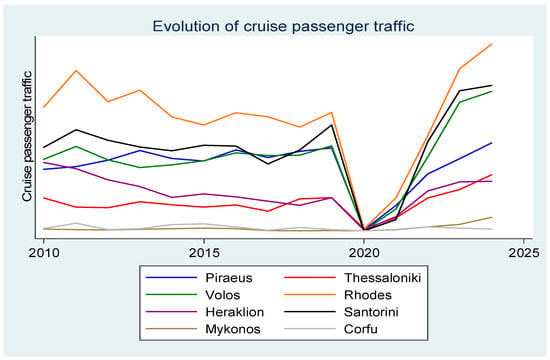
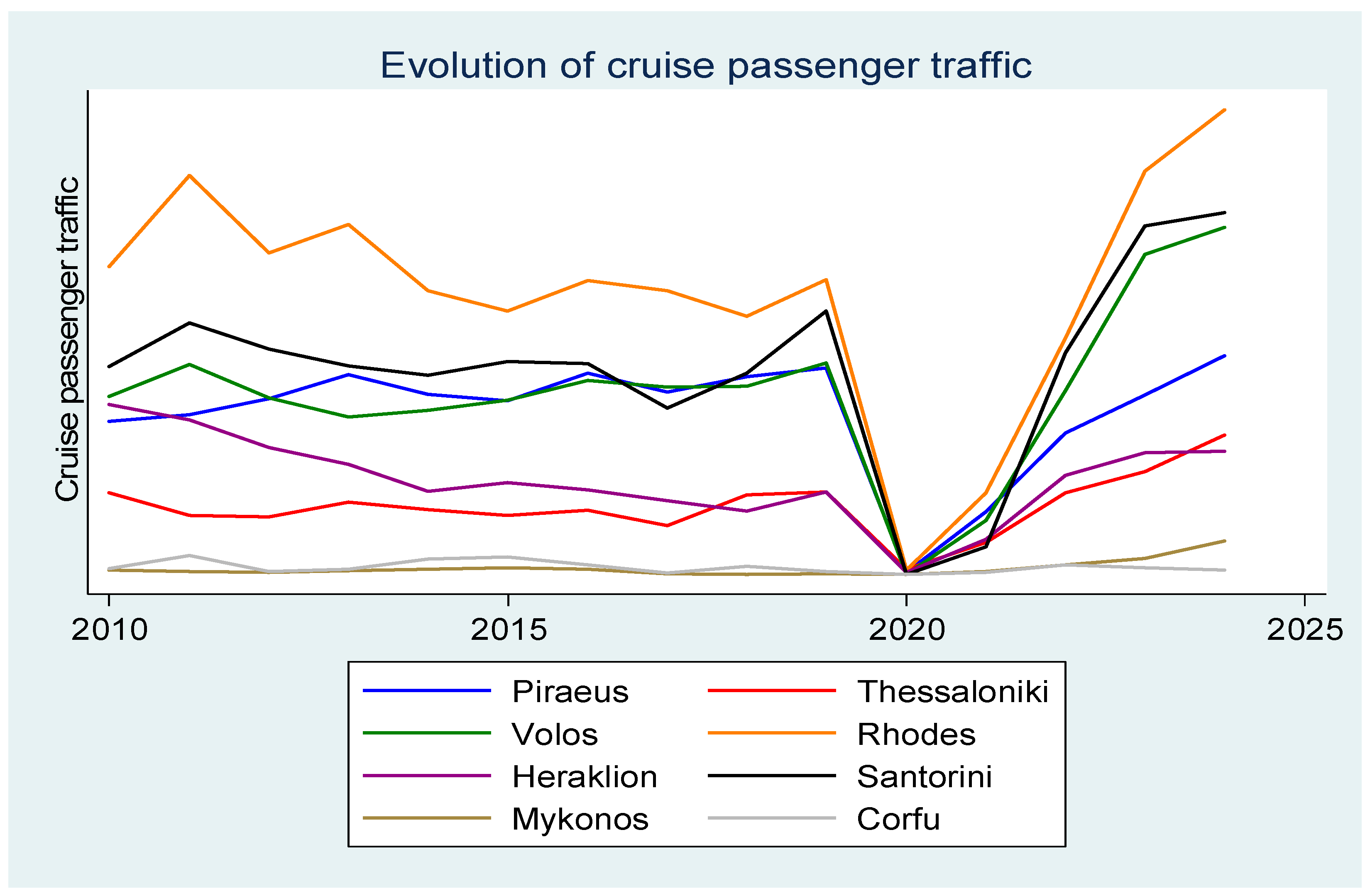
Before analyzing the hypotheses, the evolution of passenger traffic in Greek cruise ports is presented in Figure 1, where the declines during the financial crisis (2011–2013) and the COVID-19 pandemic (2020–2021) are evident. Prior to the analysis of the data, it is important to mention that the logarithm (lnpax) is introduced to reduce heteroscedasticity, so that the coefficients can be interpreted as percentage changes in passenger traffic.
Figure 1.
Evolution of cruise passenger traffic 2010–2024.
Hypothesis 1 (H1)
To estimate the impact of investment and project management (PMI) on cruise port performance, a panel data analysis with Fixed Effects (FE) was applied. This method controls for all fixed, unobservable characteristics of each port and allows the isolation of intra-temporal effects. In the first stage of the analysis (Table 2), the impact of the PMI on passenger traffic was estimated using panel fixed effects regression with time dummy variables. This approach allows for the isolation of temporal changes within each port.
Table 2.
Panel fixed effect estimates for the impact of the Project Management Index (PMI) on cruise port passenger traffic.
The results in Table 2 show that the PMI has a positive but non-statistically significant effect on passenger traffic. In contrast, the years 2020 and 2021 show strongly negative and statistically significant effects, attributed to the COVID-19 pandemic, while 2023 records a positive and significant recovery. The high R2 within ports (0.828) shows that the model explains the variation satisfactorily. The PMI has a positive but non-statistically significant effect on passenger traffic; therefore, H1 is not supported in the basic model.
The estimated equation resulting from the results of H1 is as follows:
Hypothesis 2 (H2)
To assess the multimodality of each port, a composite Multimodal Access Index (MAI) was constructed. This index combines three main dimensions:
Proximity to an airport (airport_dist_km), with the scale reversed so that a shorter distance corresponds to a higher value of the index.
Access to a rail or metro network (rail_metro_access), as a binary variable (0/1).
Homeporting status (homeport), as a binary variable (0/1).
The individual variables were standardized via z-scores to make them comparable with each other, and the composite index was derived from the average of these standardized values. Thus, higher MAI values reflect better multimodal access and therefore a higher ability of the port to function as a resilient transport hub (Table 3).
Table 3.
Panel fixed effects estimates for the impact of the Multimodal Access Index (MAI) on cruise port passenger traffic.
The results show that multimodality has a strong and statistically significant positive effect on passenger traffic (coef. = 1.932, p < 0.001). This means that ports with high multimodal connectivity show greater resilience in times of crisis, while the years 2020 and 2021 still record significant negative impacts due to the COVID-19 pandemic. The MAI index has a strong and statistically significant positive effect, therefore H2 is supported.
The estimated equation resulting from the results of H2 is as follows:
Hypothesis 3 (H3)
The third hypothesis (Table 4) tested whether there is a complementary effect between PMI and MAI. The results show that MAI remains strongly positive and significant, while PMI and the PMI × MAI interaction term are non-significant. Therefore, H3 is not supported, indicating that multimodality and infrastructure operate independently and do not reinforce each other (Table 4).
Table 4.
Results of fixed effect estimation for the interaction of PMI and MAI on passenger traffic.
The estimated equation resulting from the results of H3 is as follows:
Hypothesis 4 (H4)
For the fourth hypothesis 4 (Table 5), the impact of the COVID-19 pandemic and the role of the PMI and MAI indicators were examined. The results show that the COVID-19 variable has a strong negative and statistically significant effect (coef. = −1.478, p < 0.001), reflecting the dramatic decrease in passenger traffic in 2020–2021. The MAI index remains positive and significant (coef. = 1.589, p = 0.003), while the PMI shows a positive and marginally significant effect (p ≈ 0.05). However, the interaction terms COVID-19 × PMI and COVID-19 × MAI are not statistically significant, indicating that neither infrastructure nor multimodality were able to substantially mitigate the effects of the pandemic. Therefore, H4 is not supported. Although multimodality generally improves port performance, the COVID-19 shock outweighed any potential moderating effect (Table 5).
Table 5.
Results of fixed effects estimation for the impact of COVID-19 on passenger traffic and the moderating role of PMI and MAI.
The estimated equation resulting from the results of H4 is as follows:
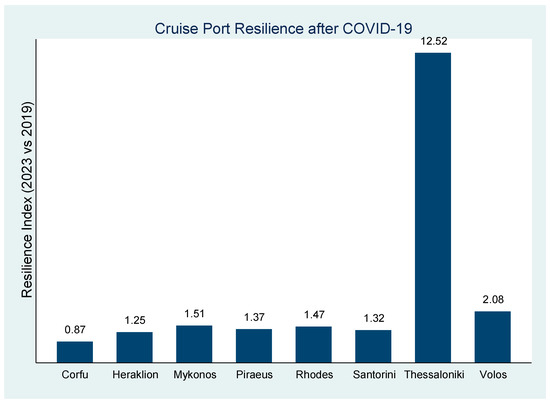
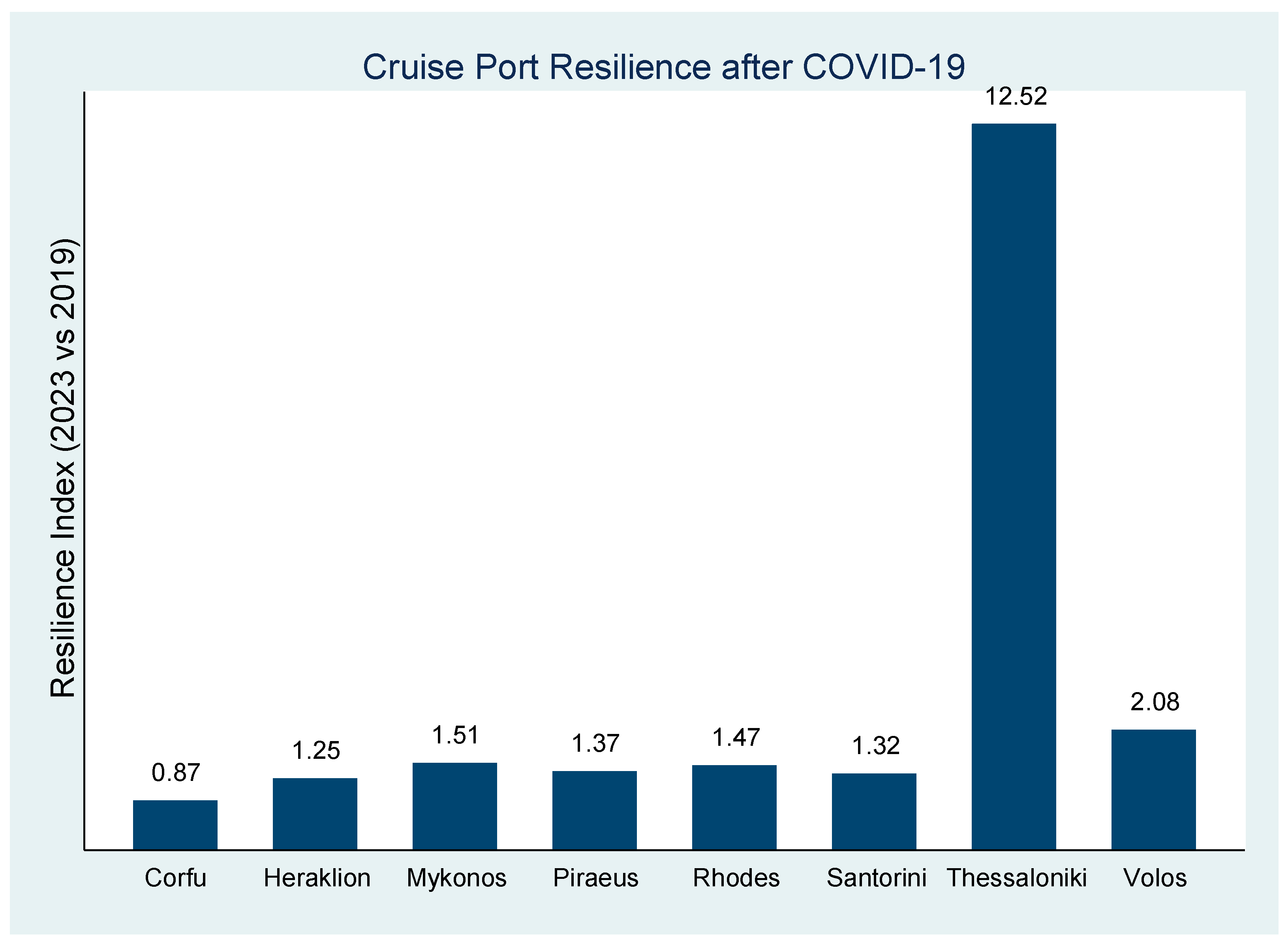
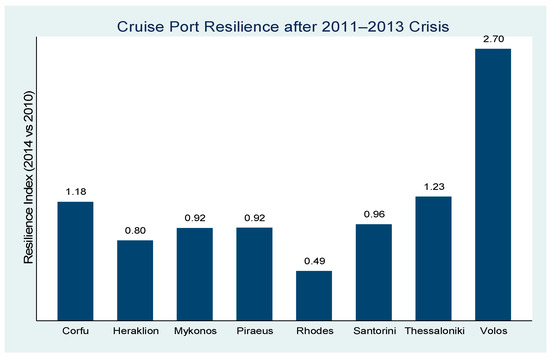
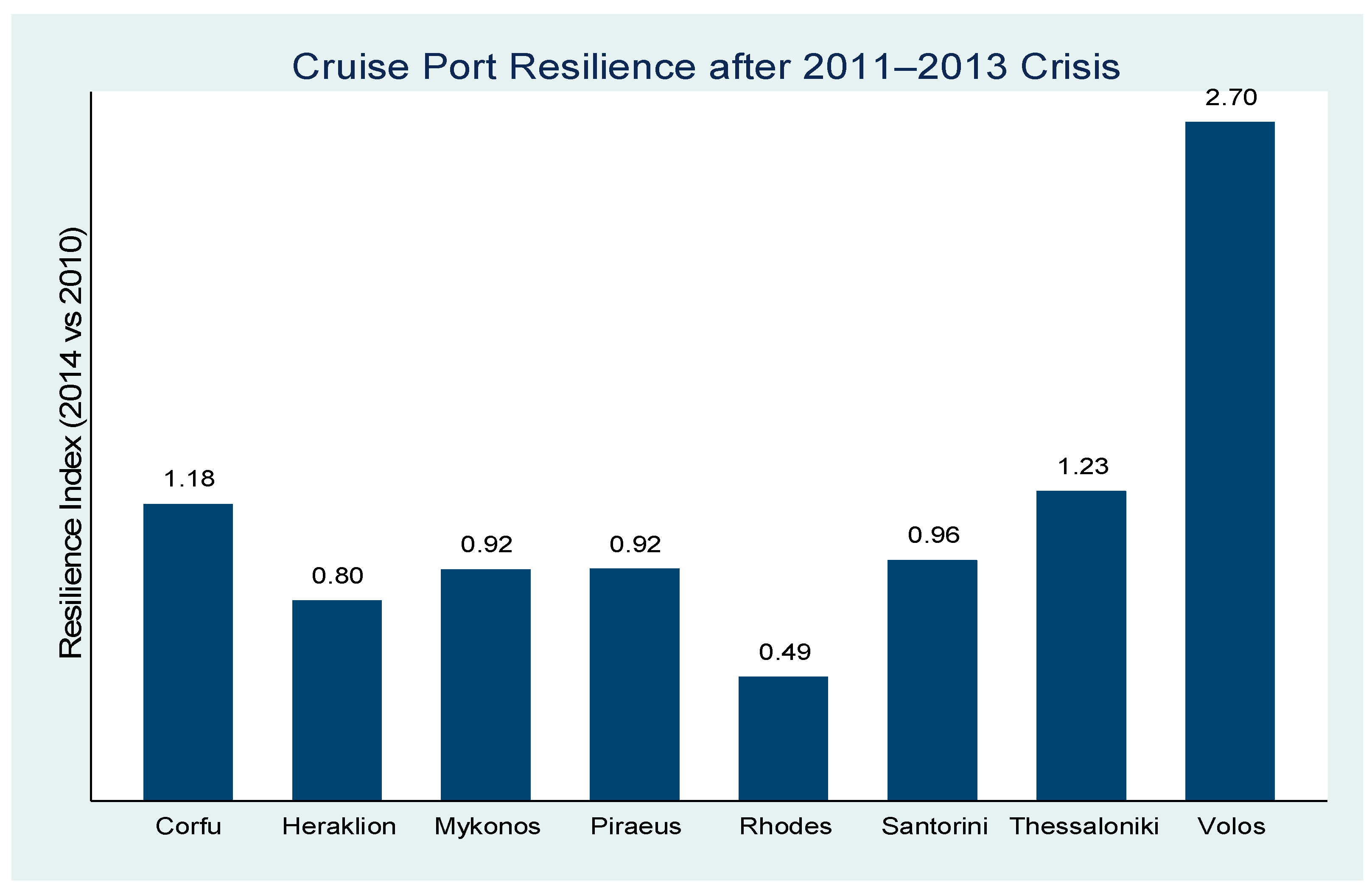
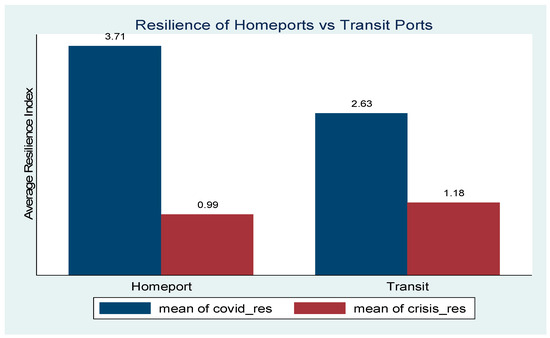
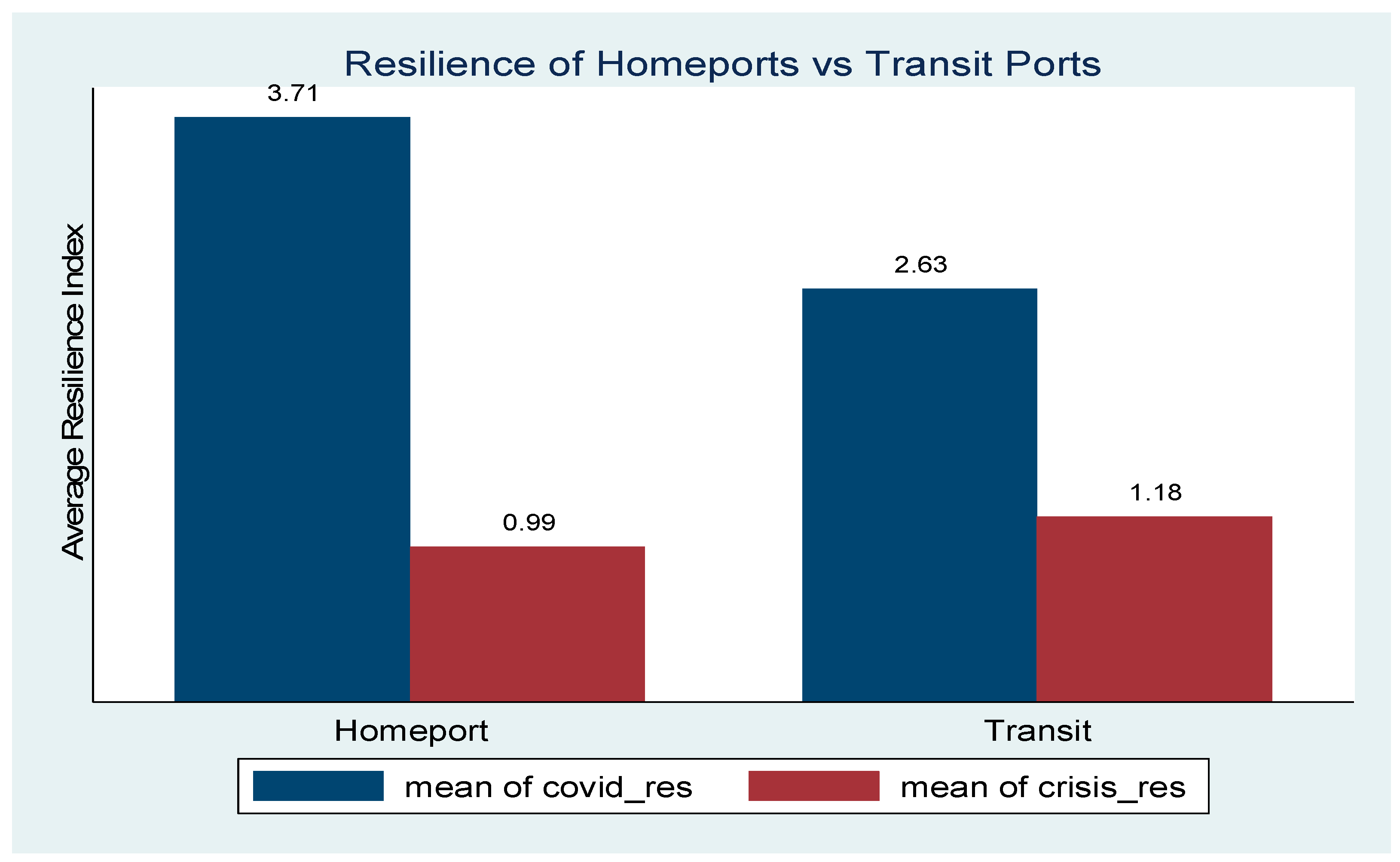
The resilience of cruise after the pandemic is illustrated in the figure below (Figure 2). For methodological clarity, the resilience index used in the following charts is calculated as the ratio of post-crisis passenger traffic to pre-crisis passenger traffic. Specifically, for the COVID-19 crisis the index is defined as the ratio of 2023 passenger traffic to 2019 passenger traffic, while for the economic crisis the index is calculated as the ratio of 2014 passenger traffic to 2010 passenger traffic. Index values greater than unity indicate a full or even exceedance of pre-crisis traffic, values close to unity indicate a return to pre-crisis levels, while values less than unity indicate a partial or insufficient recovery.
Figure 2.
Cruise port resilience after COVID-19.
It is evident that Thessaloniki showed great recovery probably due to the low base in 2019. Following, Volos shows an impressive increase. Mykonos, Rhodes, Piraeus, Santorini and Heraklion were the next ports to recover from the pandemic quickly whereas Corfu showed weaker resilience. The impact of the 2011–2013 financial crisis and the possible moderating role of the PMI and MAI indices were then examined (Table 6).
Table 6.
Results of fixed effects estimation for the impact of the 2011–2013 financial crisis on passenger traffic and the moderating role of PMI and MAI.
The results show that the variable crisis 2011–2013 has no statistically significant effect on passenger traffic, which suggests that this crisis did not substantially affect the cruise market. The MAI index remains strongly positive and significant (coef. = 1.929, p < 0.001), confirming the crucial role of multimodality in the overall performance of ports. However, the interaction terms Crisis 2011–2013 × PMI and Crisis 2011–2013 × MAI are not statistically significant, indicating that neither infrastructure nor multimodality acted as mitigation mechanisms. Overall, the findings demonstrate that H4 is not supported in the case of the 2011–2013 crisis.
The estimated equation resulting from the results of H4 is as follows:
The resilience of cruise after the 2011 financial crisis is illustrated in the figure below (Figure 3).
Figure 3.
Cruise port resilience after the crisis.
It is evident that Volos shows an impressive increase and arrivals essentially skyrocketed after the crisis. Thessaloniki showed a greater recovery probably due to the low base in 2010 and Corfu also recovered quickly. Rhodes seems to be less resilient to the crisis and shows a large decline that was not compensated for in the following years, while Santorini recovered almost completely and Heraklion showed weaker resilience. Finally, Piraeus and Mykonos showed a significant decrease, while they did not fully recover after the financial crisis.
Figure 4 presents the average resilience of Greek cruise ports by port category. The results show that homeports showed higher resilience during the COVID-19 pandemic (3.71) compared to transit ports (2.63), suggesting that their multimodality and functional role contributed to a faster recovery. In contrast, during the financial crisis, the resilience of homeports (0.99) was slightly lower than that of transit ports (1.18), indicating that economic shocks affected ports that depend on homeport functions more.
Figure 4.
Resilience of homeports vs. transit ports.
In 2019, the pandemic had a strongly negative and statistically significant impact, while the 2011–2013 crisis did not significantly affect passenger traffic at cruise ports. The PMI and MAI indices maintain positive signs; however, their interactions with the crises are not statistically significant. Therefore, H4 is not supported: infrastructure investments and multimodality improve overall performance but did not act as direct mitigation mechanisms during severe exogenous shocks.
Robustness Checks
To ensure the reliability and robustness of the results, additional econometric tests were performed. Initially, the Hausman test was applied, which did not reveal statistically significant differences between the fixed and random effects models (p = 0.975). However, given that the analysis focuses on specific cruise ports and not on a random sample, and that unobserved geographical, operational and institutional specificities of the ports are critical and may be associated with the explanatory variables, the fixed effects approach was adopted, in line with the relevant econometric literature (Hsiao, 2003; Wooldridge, 2010; Baltagi, 2021). Subsequently, the Pesaran test of cross-sectional dependence showed the existence of cross-sectional correlation between the ports (p = 0.017), which necessitates the use of robust standard errors. For this reason, the basic models were re-estimated using Driscoll–Kraay standard errors, which are robust to heteroscedasticity, autocorrelation and cross-sectional dependence. The results remained qualitatively unchanged in terms of the signs and statistical significance levels of the basic variables.
In addition, the analysis was repeated using an alternative dependent variable (ln_util_pax), with the main results being held constant. The Multimodal Access Index (MAI) continued to show a positive and highly statistically significant relationship with cruise port passenger traffic. Finally, a sensitivity analysis was performed by re-estimating the model without the interaction term between the PMI and MAI indices, using Driscoll-Kraay standard errors. The results remained qualitatively unchanged, with the Multimodal Access Index (MAI) maintaining a positive and highly statistically significant effect on passenger traffic (coefficient ≈ 1.91, p < 0.01), confirming that the main findings are not driven by the confounding variable and further strengthening the robustness of the conclusions.
5. Discussion
Cruise resilience is emerging as a process of learning and adaptation to crises, such as COVID-19, economic and geopolitical upheavals. Chen et al. (2025) consider it as a multidimensional system based on digitalization and collaboration, although excessive technological emphasis can downplay social and institutional factors. The results show that infrastructure investment (PMI) is not consistently statistically significant, suggesting that infrastructure alone does not ensure demand in crises. In agreement with Gu and Liu (2023), infrastructure performs best when combined with multimodal connectivity, while Tsoulfas (2025) highlights the importance of institutional and organizational factors, such as cybersecurity.
Despite the fragmentation of the literature (Rodrigue & Notteboom, 2013; Papathanassis, 2017; Tsiotas, 2021; Papadopoulou, 2020), this study contributes through the PMI and MAI indicators to quantify the resilience of demand. In agreement with Vicente-Cera et al. (2020), connectivity is associated with greater adaptability, as the MAI index appears consistently positive and significant. At the same time, the spatial approach of Rosa-Jiménez et al. (2018) is extended, showing that multimodal connectivity is associated with higher passenger traffic and faster recovery.
The findings highlight the limits of infrastructure when not integrated into a broader functional context. As Rempis et al. (2019) note, spatial planning and landscape protection are crucial, while here it is found that port infrastructure (PMI) alone is not sufficient to sustain demand. Investments pay off more when accompanied by improvements in connectivity and spatial planning, in line with Hoarau-Heemstra et al. (2023), while contributing to a balanced distribution and better functionality of destinations and ports.
Papathanassis (2023) emphasizes the importance of fair cost sharing, an element linked to sustainability, while the results show that multimodal effort enhances visitor experience, passenger activity and the interconnection of ports with the local economy. Subsequently, sustainable development requires a combination of functional connectivity and adequate infrastructure. Multimodality emerges as a critical factor of resilience (Sakib et al., 2018; Polydoropoulou et al., 2025), as well as higher access with higher passenger traffic. At the same time, Rosa-Jiménez et al. (2023) highlight the role of sustainable transport, while Achillas et al. (2024) show that information and digitalization enhance the social dimension of multimodality.
Finally, the non-significant effect of the PMI × MAI term shows that infrastructure and multimodality do not work complementary without coordinated policies. As Paapa and Nguthi (2025) note, many businesses still react reactively to crises, which is indirectly confirmed, as neither infrastructure nor multimodality fully absorbed the shocks of the pandemic. In agreement with Ketter (2022) and Liu et al. (2016), communication and risk perception management remain critical, while Karoulia et al. (2015) show a corresponding pattern of arrival resilience but not economic contribution, similar to the present findings.
Although the interaction terms do not appear statistically significant in all estimates, their inclusion in the model allows for the exploration of possible complementary effects between infrastructure, accessibility and periods of crisis. The finding that these effects are not always strong suggests that demand resilience may depend more on individual structural features than on their combined effect, which is an interesting direction for future research.
The findings are consistent with Agiomirgianakis and Sfakianakis (2022), who emphasize the need to strengthen governance, and with Constantoglou and Prinitis (2020), who highlight the role of state preparedness, while Vouloutidou et al. (2020) show that demand diversification acts as a compensation mechanism in times of crisis, the euro agreeing with the stability and recovery of cruise demand. Overall, the resilience of cruise ports is linked to multimodal connectivity, effective communication and strategic diversification, while individual infrastructure investments are not sufficient. Further integration of Greek ports into multimodal networks, with institutional and social support, can enhance the sustainable development of destinations.
The results show that, although organizational and infrastructural readiness is an important factor of operational adaptability, its effect on maintaining passenger demand does not appear statistically strong in all estimates. In contrast, multimodal accessibility appears more consistently associated with demand recovery, suggesting that policies to enhance connectivity may have a more significant short-term impact in times of crisis.
The study contributes theoretically to the literature by proposing a quantitative way to capture the resilience of passenger demand in cruise ports, highlighting the role of organizational readiness and multimodal accessibility. At the same time, the findings provide practical guidance for port managers and policymakers, indicating that investments in infrastructure, administrative capacity and multimodal connections can enhance the ability to maintain and recover passenger activity faster in times of crisis.
6. Conclusions
The study empirically investigated the resilience of passenger demand in Greek cruise ports (2010–2024), examining the role of organizational and infrastructural readiness (PMI) and multimodal accessibility (MAI) in successive crises. The results show that multimodal accessibility is a stable factor in maintaining and recovering passenger traffic, while infrastructure investments (PMI) do not appear statistically significant in most models. The study contributes to the literature by proposing an empirical framework for measuring resilience through composite indicators that incorporate organizational, infrastructural and spatial dimensions, showing that functional connectivity and the integration of ports into wider transport networks. affect demand stability more than individual infrastructure investments.
At a practical level, the findings suggest that strengthening the interconnection of ports with different modes of transport can stabilize passenger activity in times of crisis, without negating the importance of infrastructure, but the need for a combination of infrastructure, connectivity and appropriate institutional practices is highlighted. The crisis also shows that resilience varies over time: the 2011–2013 crisis did not significantly increase traffic, while the COVID-19 pandemic caused a global collapse regardless of the level of infrastructure, revealing the limits of resilience to systemic crises. The resilience of cruise demand emerges as a dynamic process of interaction of spatial, transport and socio-economic factors, where multimodal effort supports stability and recovery, while infrastructure alone is not sufficient in periods of intense disruption.
Overall, the research findings show that multimodal port accessibility is more consistently associated with the maintenance and recovery of passenger demand in times of crisis, while organizational and infrastructural readiness does not always appear statistically strong in all estimates. The results suggest that enhancing port connectivity and accessibility can contribute to reducing the vulnerability of demand to exogenous shocks, without underestimating the role of investments in infrastructure and administrative capacities. At the same time, the present study focuses on demand resilience and not on the overall systemic resilience of ports, which is a limitation of the analysis. Future research could incorporate additional indicators of operational or institutional resilience, as well as examine different geographical contexts.
7. Implications, Limitations and Future Research Directions
The results of this study indicate that multimodal accessibility is a critical factor in the stability and recovery of passenger demand in cruise tourism, especially in times of disruption. Strengthening the interconnection of ports with air, road and urban transport networks seems to contribute to reducing the vulnerability of destinations, allowing for greater flexibility in the management of flows and faster adaptation after crises. Therefore, cruise port development strategies could focus not only on the expansion or upgrade of port infrastructure, but also on their functional integration into wider transport and tourism service networks.
At the same time, the findings show that investments in port infrastructure, although necessary for the operation of ports, do not appear by themselves as a sufficient factor in enhancing the resilience of demand in times of intense crises. This suggests that the effectiveness of investments depends to a large extent on the extent to which they are accompanied by appropriate spatial planning, institutional cooperation and operational connectivity. Consequently, cruise resilience appears to be shaped more as a result of combined interventions than as a product of individual investments.
The above conclusions, however, should be interpreted in light of some limitations of the study. First, resilience is approached through the resilience of passenger demand and not through an overall capture of the systemic resilience of ports, which would require the incorporation of additional operational, institutional and technical parameters. Furthermore, the analysis focuses on key Greek cruise ports, which limits the possibility of direct generalization of the results to different geographical and institutional environments.
Furthermore, this study adopts a unidirectional approach, examining the impact of organizational, infrastructural and transport characteristics on demand. While the literature acknowledges the existence of possible bidirectional relationships, where increased demand can enhance investment and accessibility, this analysis focuses on how pre-existing characteristics influence demand. Exploring endogenous or concurrent relationships between these variables is an important direction for future research.
Future studies could also extend the analysis by incorporating alternative resilience indicators, such as the speed of recovery, the variability of flows or the institutional and digital readiness of ports, as well as examining the behavior of ports in different international cruise networks. Comparing different spatial and institutional contexts could contribute to a better understanding of the mechanisms that enhance or limit the resilience of demand at a global level.
Funding
This research received no external funding.
Institutional Review Board Statement
Not applicable.
Informed Consent Statement
Not applicable.
Data Availability Statement
The data supporting the findings of this study are publicly available from the Hellenic Ports Association website.
Conflicts of Interest
The author declares no conflicts of interest.
Appendix A
Table A1.
Panel fixed effect estimates for the impact of the Project Management Index (PMI) on cruise port passenger traffic.
Appendix B
Table A2.
Panel fixed effect estimates for the impact of the Multimodal Access Index (MAI) on cruise port passenger traffic.
Appendix C
Table A3.
Results of fixed effect estimation for the interaction of PMI and MAI on passenger traffic.
Appendix D
Table A4.
Results of fixed effects estimation for the impact of COVID-19 on passenger traffic and the moderating role of PMI and MAI.
References
- Achillas, C., Aidonis, D., Tsampoulatidis, I., Folinas, D., Kostavelis, I., Tsolakis, N., Triantafyllou, D., Vlachokostas, C., Kelemis, A., & Dimou, V. (2024). Empowering tourism accessibility: A digital revolution in Pieria, Greece. Applied Sciences, 14(23), 11136. [Google Scholar] [CrossRef] [Scilit]
- Agiomirgianakis, G. M., & Sfakianakis, G. (2022). The resilience of the Greek tourism sector ensures growth prospects for the Greek economy: A note. Modern Economy, 13(6), 826–832. [Google Scholar] [CrossRef]
- Baltagi, B. H. (2021). Econometric analysis of panel data. In Springer texts in business and economics. Springer. [Google Scholar] [CrossRef] [Scilit]
- Chen, X., Chu, L., Wang, M., & Chen, Q. (2025). A framework for understanding the path to achieve high resilience of maritime supply chain. Scientific Reports, 15(1), 2472. [Google Scholar] [CrossRef] [Scilit]
- Chrysafis, K. A., Papadopoulou, G. C., & Theotokas, I. N. (2024). Measuring financial performance through operating business efficiency in the global cruise industry: A fuzzy benchmarking study on the “big three”. Tourism Management, 100, 104830. [Google Scholar] [CrossRef] [Scilit]
- Chrysafis, K. A., Theotokas, I. N., & Lagoudis, I. N. (2022). Managing fuel price variability for ship operations through contracts using fuzzy TOPSIS. Research in Transportation Business and Management, 43, 100778. [Google Scholar] [CrossRef] [Scilit]
- Chrysafis, K. A., Theotokas, I. N., & Papadopoulou, G. C. (2023). An interdisciplinary crisis management approach based on day-to-day business operations and project delivering for typical cruise companies. International Journal of Decision Sciences Risk and Management, 11(1/2/3/4), 23–42. [Google Scholar] [CrossRef] [Scilit]
- Constantoglou, M., & Prinitis, M. (2020). Tourism destination crisis management: The case study of Lesvos Island, Greece. Journal on Tourism and Sustainability, 3(2), 14–31. Available online: https://journal.ontourism.academy/index.php/jots/article/view/80 (accessed on 21 October 2025).
- Darnhofer, I., Fairweather, J., & Moller, H. (2010). Assessing a farm’s sustainability: Insights from resilience thinking. International Journal of Agricultural Sustainability, 8(3), 186–198. [Google Scholar] [CrossRef] [Scilit]
- Dui, H., Zheng, X., & Wu, S. (2021). Resilience analysis of maritime transportation systems based on importance measures. Reliability Engineering and System Safety, 209, 107461. [Google Scholar] [CrossRef] [Scilit]
- Folke, C., Colding, J., & Berkes, F. (2001). Synthesis: Building resilience and adaptive capacity in social–ecological systems. In Cambridge University Press eBooks (pp. 352–387). Cambridge University Press. [Google Scholar] [CrossRef] [Scilit]
- Gössling, S., Scott, D., & Hall, C. M. (2020). Pandemics, tourism and global change: A rapid assessment of COVID-19. Journal of Sustainable Tourism, 29(1), 1–20. [Google Scholar] [CrossRef] [Scilit]
- Gu, B., Chen, J., Haralambides, H., & Liu, J. (2025). A novel method of assessing port resilience and its positive ramifications. Maritime Policy and Management, 52, 642–665. [Google Scholar] [CrossRef] [Scilit]
- Gu, B., & Liu, J. (2023). Port resilience analysis based on the HHM-FCM approach under COVID-19. Ocean and Coastal Management, 243, 106741. [Google Scholar] [CrossRef] [Scilit]
- Guerrero, D., & Rodrigue, J. (2014). The waves of containerization: Shifts in global maritime transportation. Journal of Transport Geography, 34, 151–164. [Google Scholar] [CrossRef] [Scilit]
- He, Y., Yang, Y., Wang, M., & Zhang, X. (2022). Resilience analysis of container port shipping network structure: The case of China. Sustainability, 14(15), 9489. [Google Scholar] [CrossRef] [Scilit]
- Hellenic Ports Association. (2025). Available online: https://elime.gr/en/krouaziera/ (accessed on 25 August 2025).
- Hoarau-Heemstra, H., Wigger, K., Olsen, J., & James, L. (2023). Cruise tourism destinations: Practices, consequences and the road to sustainability. Journal of Destination Marketing and Management, 30, 100820. [Google Scholar] [CrossRef] [Scilit]
- Holling, C. S. (2001). Understanding the complexity of economic, ecological, and social systems. Ecosystems, 4(5), 390–405. [Google Scholar] [CrossRef] [Scilit]
- Hsiao, C. (2003). Analysis of panel data. Cambridge University Press. [Google Scholar] [CrossRef] [Scilit]
- Karoulia, S., Gaki, E., & Kostopoulou, S. (2015). Assessing resilience in tourism: The case of Greece. In Proceedings of the 55th Congress of the European Regional Science Association: “World Renaissance: Changing Roles for People and Places”, Lisbon, Portugal, August 25–28. European Regional Science Association (ERSA). [Google Scholar]
- Ketter, E. (2022). Bouncing back or bouncing forward? Tourism destinations’ crisis resilience and crisis management tactics. European Journal of Tourism Research, 31, 3103. [Google Scholar] [CrossRef] [Scilit]
- Kulkov, I., Hellström, M., Tsvetkova, A., & Malmberg, J. (2023). Sustainable cruise tourism: Systematic literature review and future research areas. Sustainability, 15(10), 8335. [Google Scholar] [CrossRef] [Scilit]
- Li, H., Hu, S., Wu, X., & Tong, H. (2024). The resilience measurement of cruise operation under the impact of the epidemic. Transportation Research Part D Transport and Environment, 130, 104192. [Google Scholar] [CrossRef] [Scilit]
- Liao, R., Liu, W., & Yuan, Y. (2023). Resilience improvement and risk management of multimodal transport logistics in the Post-COVID-19 era: The case of TIR-Based Sea–Road multimodal transport logistics. Sustainability, 15(7), 6041. [Google Scholar] [CrossRef] [Scilit]
- Lin, Y., Tsai, F., Bui, T., & Kurrahman, T. (2023). Building a cruise industry resilience hierarchical structure for sustainable cruise port cities. Maritime Policy and Management, 52, 18–54. [Google Scholar] [CrossRef] [Scilit]
- Liu, B., Pennington-Gray, L., & Krieger, J. (2016). Tourism crisis management: Can the extended parallel process model be used to understand crisis responses in the cruise industry? Tourism Management, 55, 310–321. [Google Scholar] [CrossRef] [Scilit]
- Martin, R. (2012). Regional economic resilience, hysteresis and recessionary shocks. Journal of Economic Geography, 12(1), 1–32. [Google Scholar] [CrossRef] [Scilit]
- Nair, R., Avetisyan, H., & Miller-Hooks, E. (2010). Resilience framework for ports and other intermodal components. Transportation Research Record Journal of the Transportation Research Board, 2166(1), 54–65. [Google Scholar] [CrossRef] [Scilit]
- Notteboom, T., Pallis, A., & Rodrigue, J. (2021a). Port economics, management and policy. Routledge. [Google Scholar] [CrossRef] [Scilit]
- Notteboom, T., Pallis, T., & Rodrigue, J. (2021b). Disruptions and resilience in global container shipping and ports: The COVID-19 pandemic versus the 2008–2009 financial crisis. Maritime Economics & Logistics, 23(2), 179–210. [Google Scholar] [CrossRef] [Scilit]
- OECD. (2025). Strengthening the evidence base for a sustainable tourism future in Greece: A tailored set of sustainability indicators. OECD Tourism Papers, No. 2025/04. OECD Publishing. [Google Scholar] [CrossRef] [Scilit]
- Paapa, C., & Nguthi, S. K. (2025). Crisis management and resilience in hospitality and tourism consulting. African Journal of Tourism and Hospitality Management, 4(1), 246–259. [Google Scholar] [CrossRef] [Scilit]
- Pallis, A. A., & Papachristou, A. A. (2020). European cruise ports: Challenges since the pre-pandemic era. Transport Reviews, 41(3), 352–373. [Google Scholar] [CrossRef] [Scilit]
- Papadopoulou, G. (2020). Motivational attributes and factors affecting spending of cruisers in the Greek Islands. Journal of Environmental Management and Tourism, 11(6), 1301. [Google Scholar] [CrossRef] [Scilit]
- Papadopoulou, G. (2022). The economic development of tourism in the United Arab Emirates. In Emerald publishing limited eBooks (pp. 111–123). Emerald Publishing Limited. [Google Scholar] [CrossRef] [Scilit]
- Papathanassis, A. (2017). Cruise tourism management: State of the art. Tourism Review, 72(1), 104–119. [Google Scholar] [CrossRef] [Scilit]
- Papathanassis, A. (2023). A decade of ‘blue tourism’ sustainability research: Exploring the impact of cruise tourism on coastal areas. Cambridge Prisms Coastal Futures, 1, e12. [Google Scholar] [CrossRef] [Scilit]
- Polydoropoulou, A., Velegrakis, A., Papaioannou, G., Karakikes, I., Bouhouras, E., Thanopoulou, H., Chatzistratis, D., Monioudi, I., Moschopoulos, K., & Chatzipavlis, A. (2025). A composite port resilience index focused on climate-related hazards: Results from Greek ports’ living-labs. Maritime Transport Research, 9, 100136. [Google Scholar] [CrossRef] [Scilit]
- Poo, M. C., Yang, Z., & Lau, Y. (2023). Vulnerability analysis of cruise shipping in ASEAN countries facing COVID-19 pandemic. Ocean and Coastal Management, 248, 106919. [Google Scholar] [CrossRef] [Scilit]
- Rempis, N., Tsilimigkas, G., & Pavlogeorgatos, G. (2019). Cruise tourism and coastal cities landscape. Evidence from Crete Island, Greece. In A. Gospodini (Ed.), Proceedings of the international conference on changing cities IV: Spatial, design, landscape and socioeconomics dimensions (pp. 387–396). Department of Planning and Regional Development, University of Thessaly Laboratory of Urban Morphology and Design. [Google Scholar]
- Rodrigue, J., & Notteboom, T. (2013). The geography of cruises: Itineraries, not destinations. Applied Geography, 38, 31–42. [Google Scholar] [CrossRef] [Scilit]
- Rosa-Jiménez, C., Gutiérrez-Coronil, S., Márquez-Ballesteros, M. J., & García-Moreno, A. E. (2023). Relating spatial quality of public transportation and the most visited museums: Revisiting sustainable mobility of waterfronts and historic centers in international cruise destinations. Sustainability, 15(3), 2066. [Google Scholar] [CrossRef] [Scilit]
- Rosa-Jiménez, C., Perea-Medina, B., Andrade, M. J., & Nebot, N. (2018). An examination of the territorial imbalance of the cruising activity in the main Mediterranean port destinations: Effects on sustainable transport. Journal of Transport Geography, 68, 94–101. [Google Scholar] [CrossRef] [Scilit]
- Rose, A. (2007). Economic resilience to natural and man-made disasters: Multidisciplinary origins and contextual dimensions. Environmental Hazards, 7(4), 383–398. [Google Scholar] [CrossRef] [Scilit]
- Sakib, N., Appiotti, F., Magni, F., Maragno, D., Innocenti, A., Gissi, E., & Musco, F. (2018). Addressing the passenger transport and accessibility enablers for sustainable development. Sustainability, 10(4), 903. [Google Scholar] [CrossRef] [Scilit]
- Santos, M., Radicchi, E., & Zagnoli, P. (2019). Port’s role as a determinant of cruise destination socio-economic sustainability. Sustainability, 11(17), 4542. [Google Scholar] [CrossRef] [Scilit]
- SupplyChain. (2025). The port of Piraeus demonstrated strong resilience in 2024 despite the crisis in the Red Sea. Available online: https://www.supply-chain.gr/%CE%B9%CF%83%CF%87%CF%85%CF%81%CE%AE-%CE%B1%CE%BD%CE%B8%CE%B5%CE%BA%CF%84%CE%B9%CE%BA%CF%8C%CF%84%CE%B7%CF%84%CE%B1-%CE%B5%CF%80%CE%AD%CE%B4%CE%B5%CE%B9%CE%BE%CE%B5-%CF%84%CE%BF-%CE%BB%CE%B9%CE%BC/ (accessed on 20 August 2025).
- Tahmasbi, B., Hajian, P., Tahmasbi, F., & He, Q. (2024). Measuring integrated accessibility for sustainable mobility: A fuzzy set approach case study. Computational Urban Science, 4(1), 35. [Google Scholar] [CrossRef] [Scilit]
- Tavafi, F., Delclòs-Alió, X., & Gutiérrez, A. (2025). Mobility patterns and spatial behavior of cruise passengers visiting Barcelona. Tourism and Hospitality, 6(2), 59. [Google Scholar] [CrossRef] [Scilit]
- Traskevich, A., & Fontanari, M. (2021). Tourism potentials in post-COVID-19: The concept of destination resilience for advanced sustainable management in tourism. Tourism Planning and Development, 20(1), 12–36. [Google Scholar] [CrossRef] [Scilit]
- Tsiotas, D. (2021). Drawing indicators of economic performance from network topology: The case of the interregional road transportation in Greece. Research in Transportation Economics, 90, 101004. [Google Scholar] [CrossRef] [Scilit]
- Tsoulfas, G. T. (2025). Port resilience: A systematic literature review. Maritime Economics and Logistics. [Google Scholar] [CrossRef] [Scilit]
- Vicente-Cera, I., Acevedo-Merino, A., Nebot, E., & López-Ramírez, J. A. (2020). Analyzing cruise ship itineraries patterns and vessels diversity in ports of the European maritime region: A hierarchical clustering approach. Journal of Transport Geography, 85, 102731. [Google Scholar] [CrossRef] [Scilit]
- Vouloutidou, G., Kostas, A., & Tsoukalidis, I. (2020, May 29–31). Local tourism and economic crisis. The case of the region of Eastern Macedonia and Thrace. 12th International Conference EBEEC 2020—Economies of the Balkan and Eastern European Countries, Opatija, Croatia. [Google Scholar]
- Wooldridge, J. M. (2010). Econometric analysis of cross section and panel data. The MIT Press. Available online: http://www.jstor.org/stable/j.ctt5hhcfr (accessed on 18 August 2025).
- Yang, Y., Huang, H., Li, G., Han, B., Yuan, Z., & Ma, H. (2025). A systematic review of resilience assessment and enhancement of urban integrated transportation networks. Journal of Transport Geography, 129, 104420. [Google Scholar] [CrossRef] [Scilit]
- Yang, Z., Lau, Y., Poo, M. C., Yin, J., & Yang, Z. (2025). Port resilience to climate change in the Greater Bay Area. Transportation Research Part D Transport and Environment, 142, 104681. [Google Scholar] [CrossRef] [Scilit]
- Yozell, S. (2022). Resilience: Ensuring a future for coastal and marine tourism. Stimson Center. Available online: https://www.stimson.org/2022/resilience-ensuring-a-future-for-coastal-and-marine-tourism/ (accessed on 12 September 2025).

Disclaimer/Publisher’s Note: The statements, opinions and data contained in all publications are solely those of the individual author(s) and contributor(s) and not of MDPI and/or the editor(s). MDPI and/or the editor(s) disclaim responsibility for any injury to people or property resulting from any ideas, methods, instructions or products referred to in the content. |
© 2026 by the author. Licensee MDPI, Basel, Switzerland. This article is an open access article distributed under the terms and conditions of the Creative Commons Attribution (CC BY) license.