
Immersive Journalism and the Shift to the Metaverse: A Bibliometric and NLP Analysis with Projections to 2030


Abstract
1. Introduction
2. Literature Review
2.1. Immersive Journalism as an Emerging Field of Research
2.2. The Metaverse: The New Horizon of Immersive Media
3. Materials and Methods
- (1)
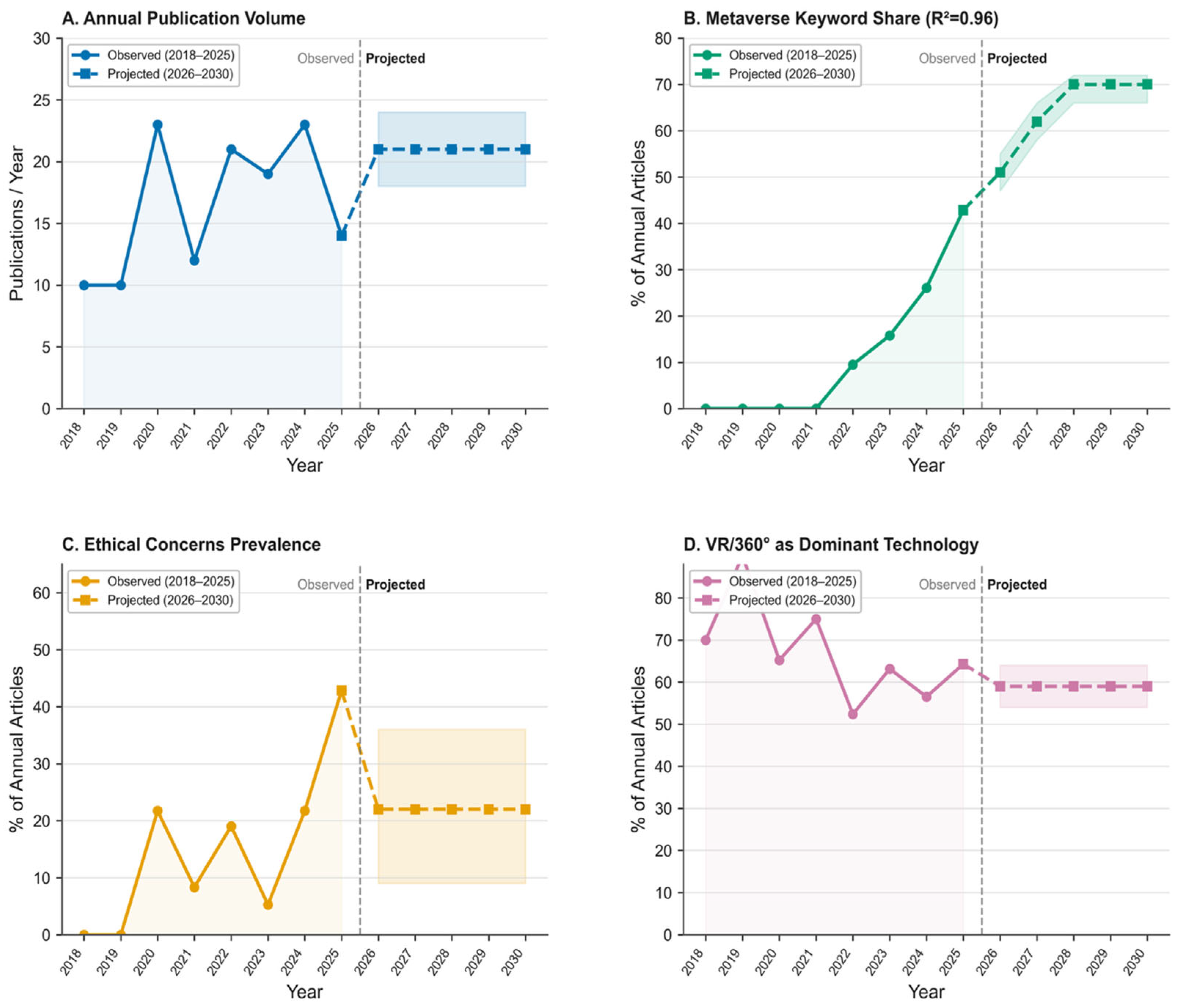
- for publication volume, the 2022–2024 moving average (±1 SD uncertainty band, computed over 2022–2025):
- (2)
- for metaverse keyword share—measured independently of the Metaverse Proximity Score, solely through the percentage of articles containing metaverse-proximate terminology in author-assigned keywords—the linear regression slope for the 2022–2025 period (β = +11 pp/year, R2 = 0.96), capped at a 70% keyword saturation threshold for 2030:
- (3)
- For the prevalence of ethical concerns, a fixed band based on the 2022–2025 mean ±1 SD-given that the 2025 value (43%) constituted an outlier peak exceeding the upper boundary of the band (36%)—the projection was initiated from 2026 onward, with a mean-reversion expectation duly noted:
- (4)
- for the share of VR/360° technology, a fixed band based on the 2022–2025 mean ±1 SD:
4. Results
4.1. Structural and Historical Dynamics of the Field: Growth, Geography, and Power
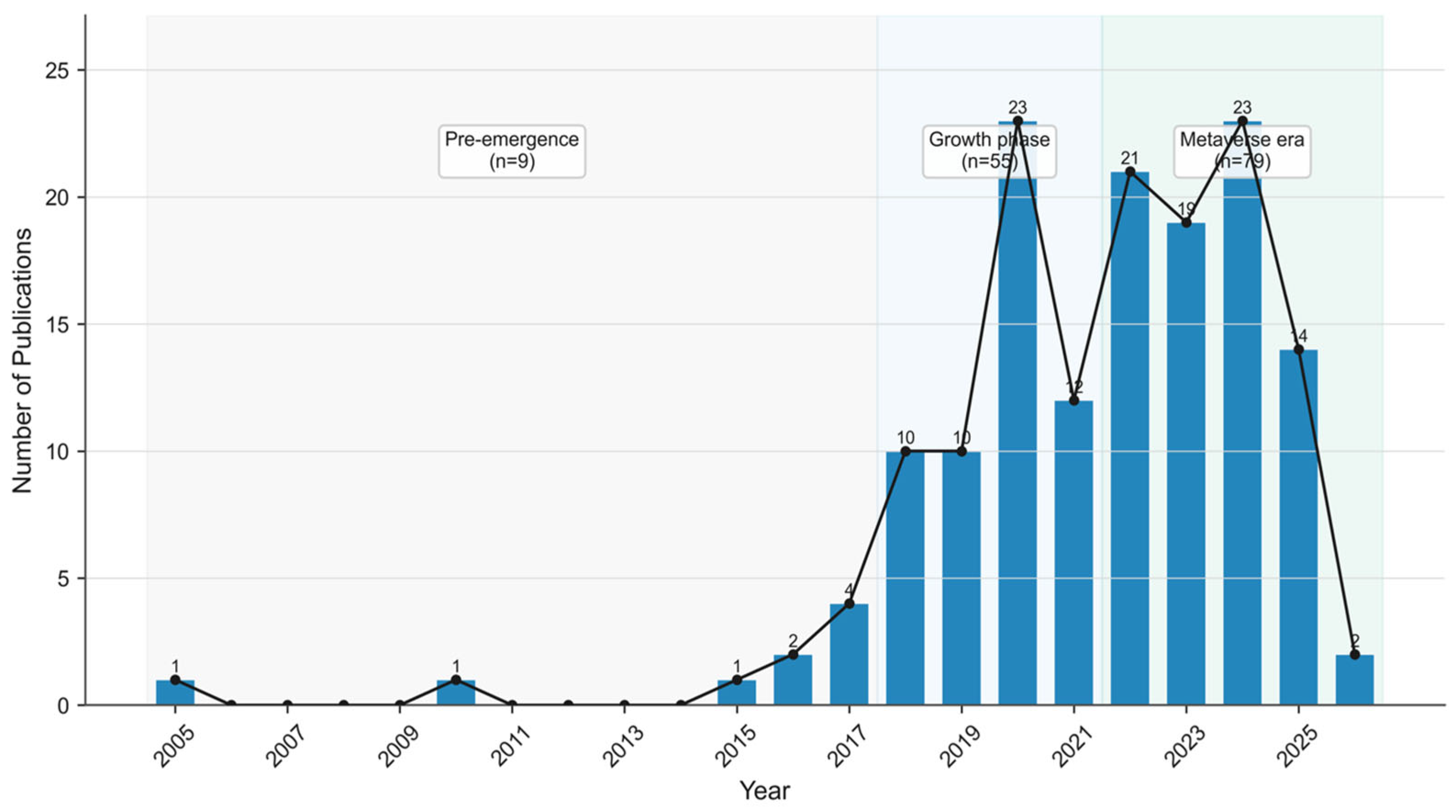
4.1.1. The Development of the Literature and the Transformation of the Field
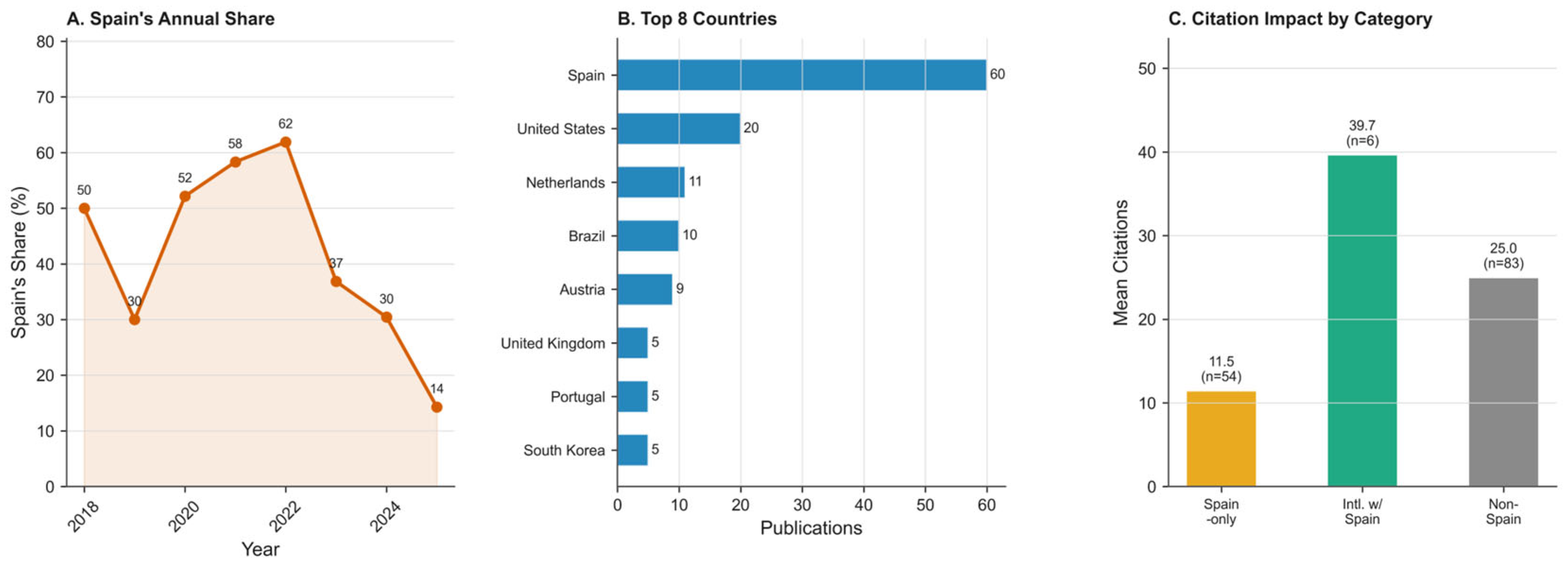
4.1.2. Geographic Concentration: Spanish Dominance, Global Distribution, and the Citation Advantage of International Collaboration
4.2. Mapping the Conceptual Terrain: A Literature Evolving Toward the Metaverse
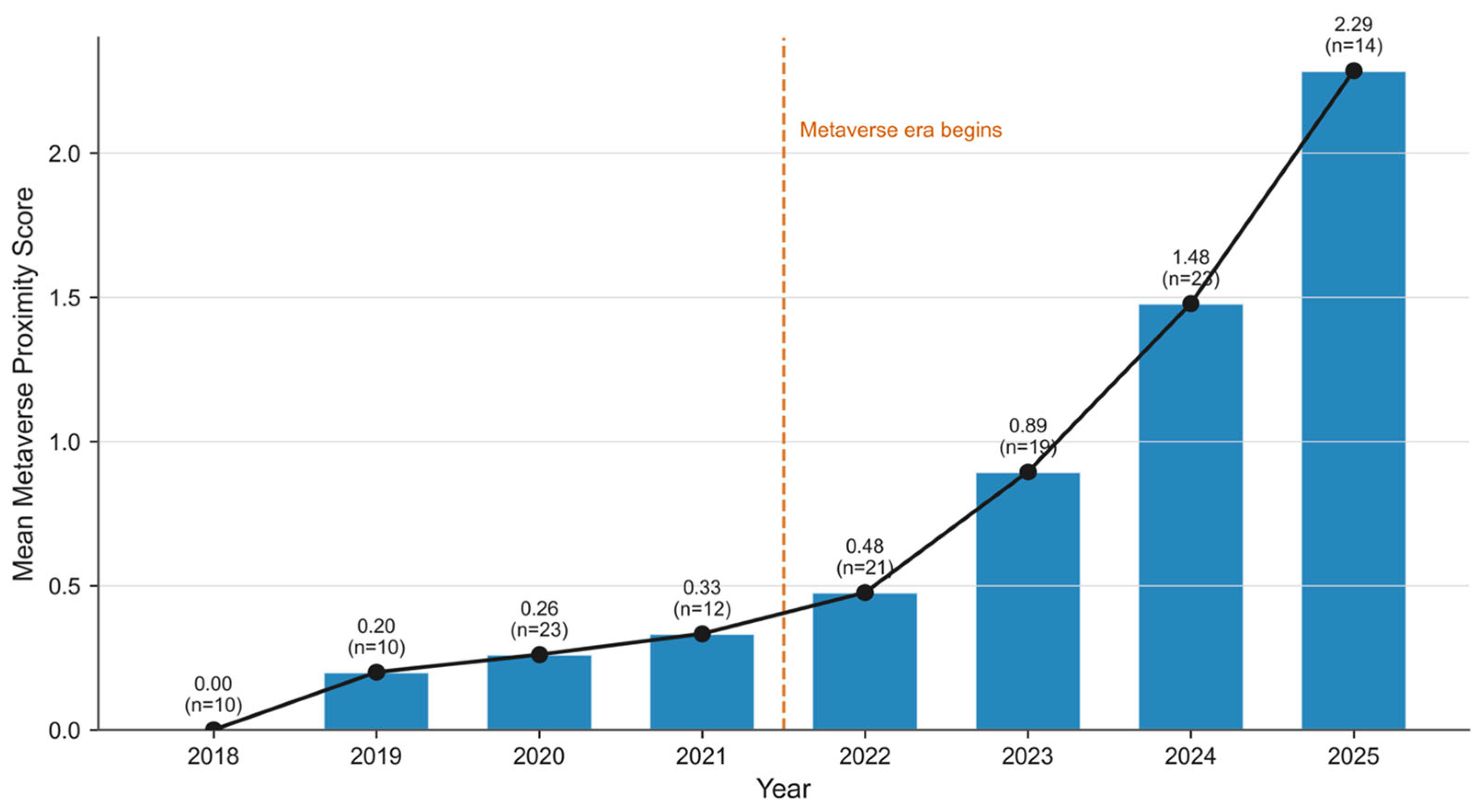
4.2.1. The Metaverse Proximity Score: The Temporal Trajectory of Metaverse-Oriented Conceptual Change
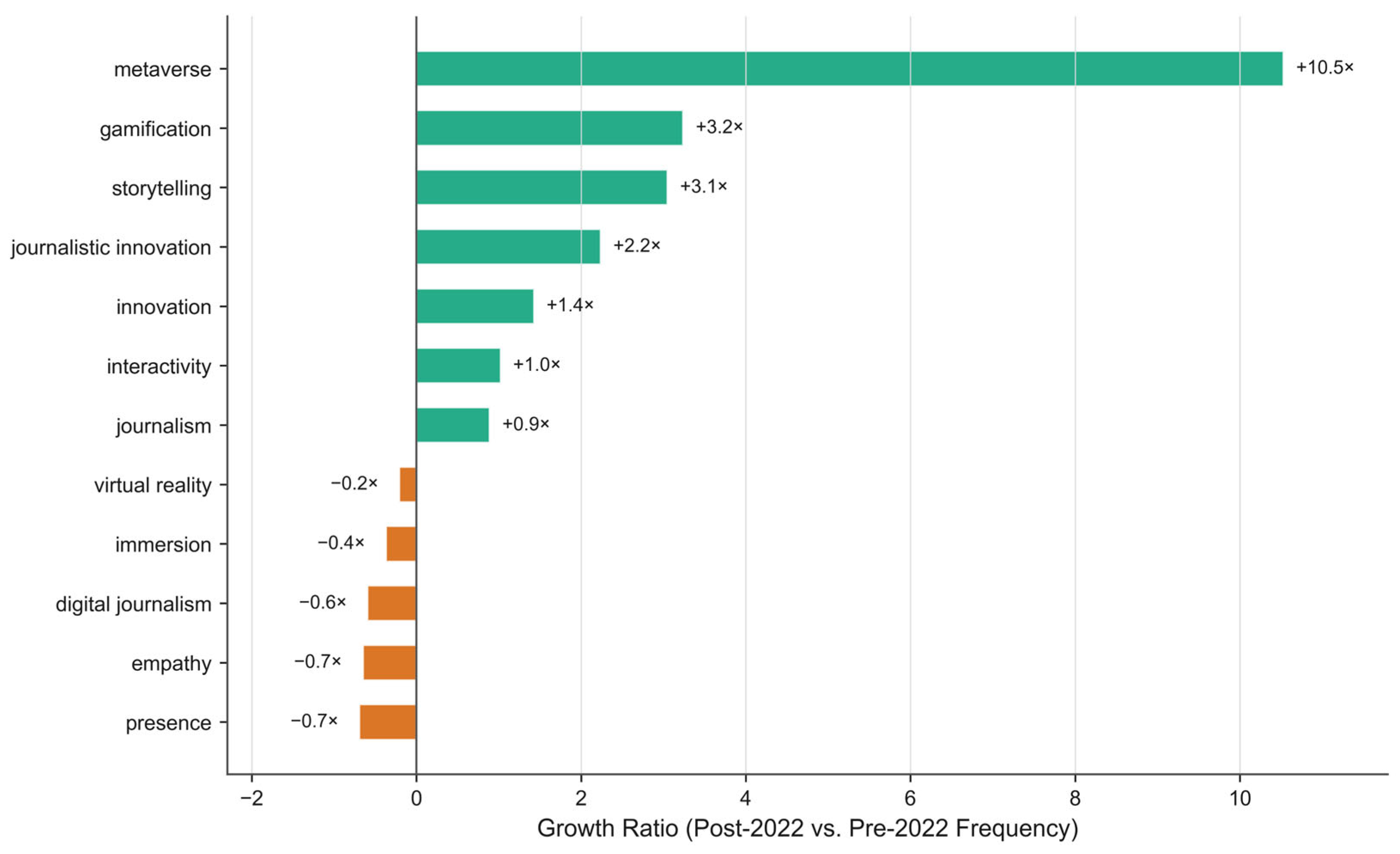
4.2.2. Keyword Growth Rates: Rising and Declining Themes
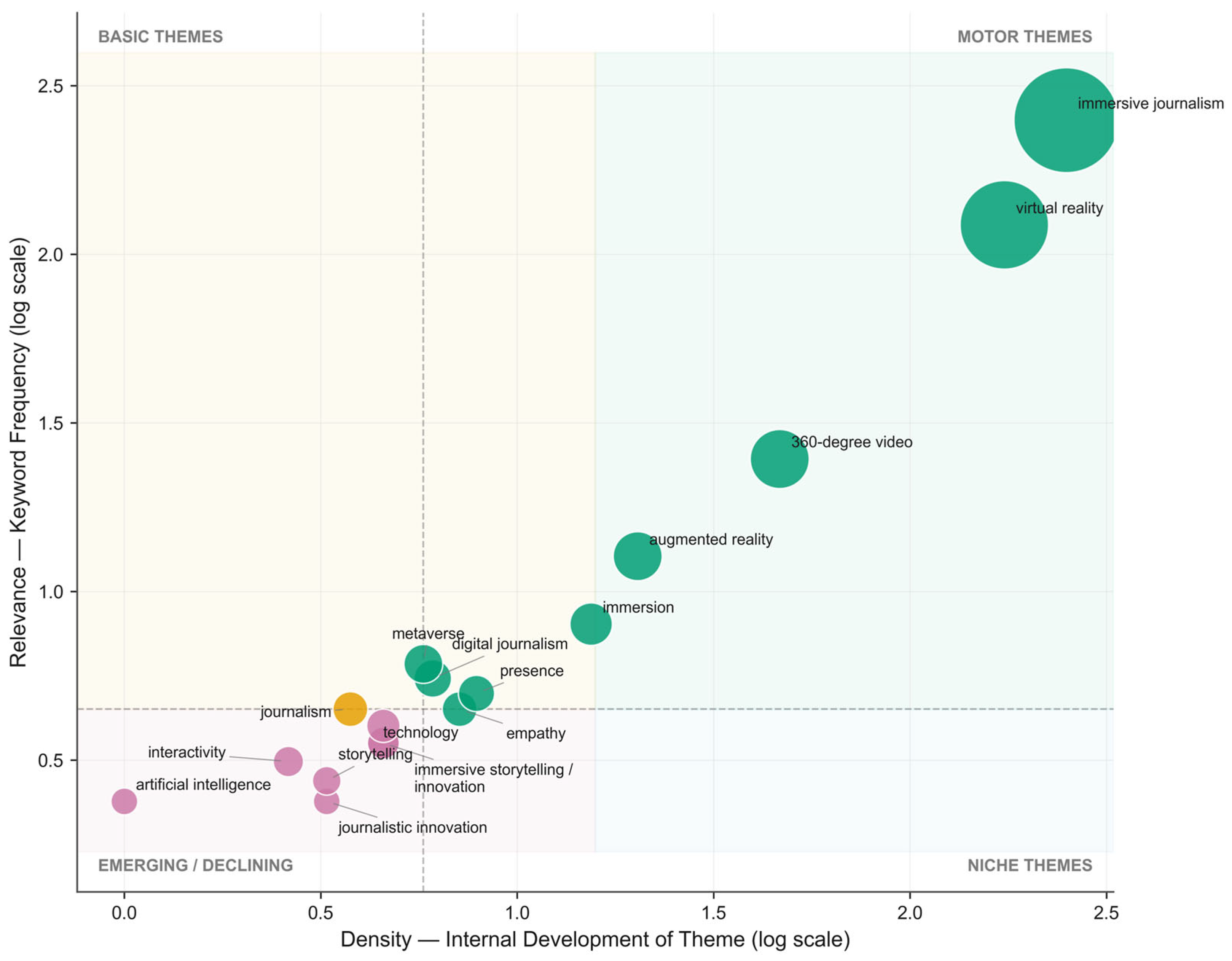
4.2.3. Thematic Map: The Strategic Positioning of Research Topics
4.3. Where Is Journalism Heading: Empathy, Ethics, and the Measurement of Impact
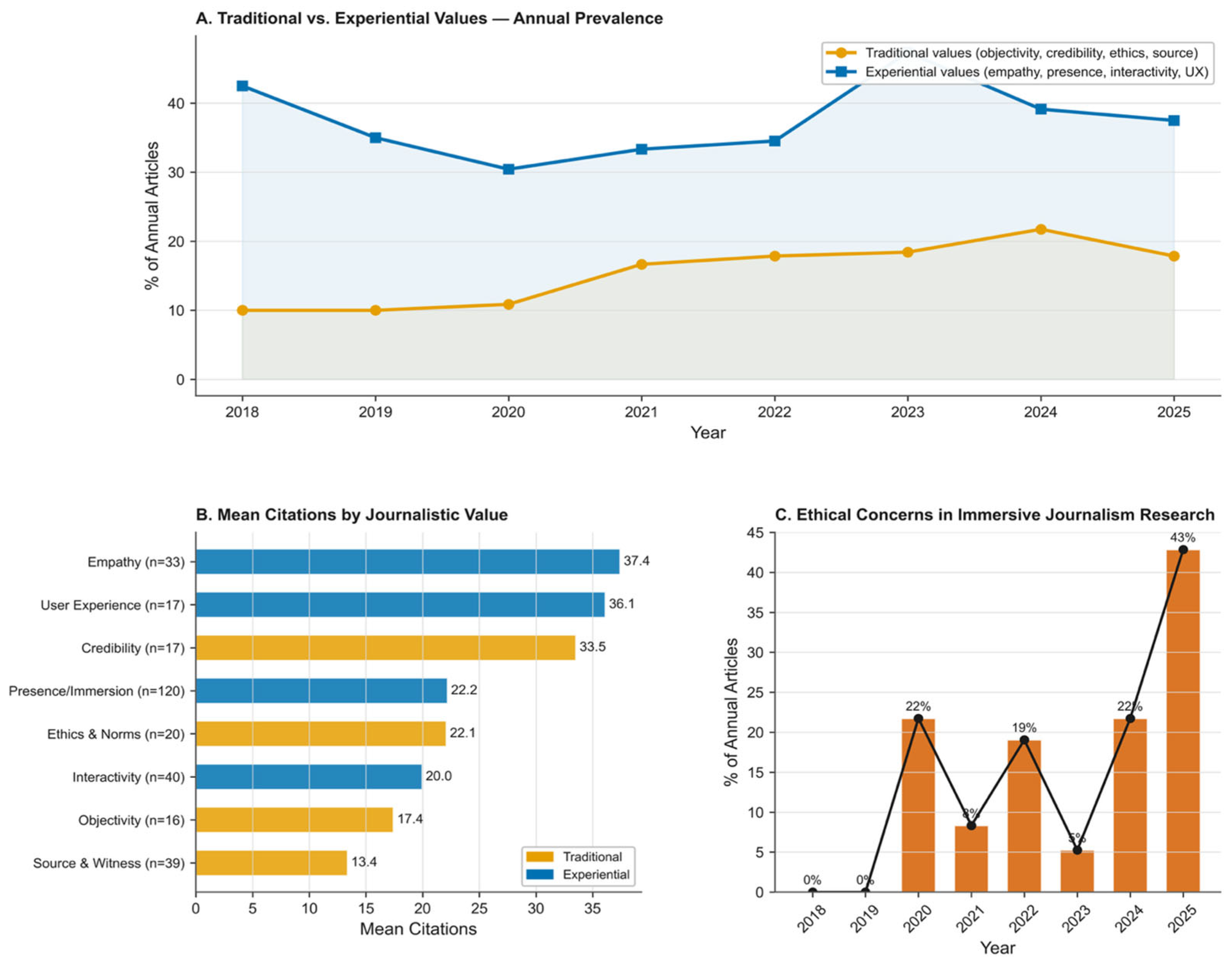
4.3.1. The Empathy Paradox and the Transformation of Journalistic Values
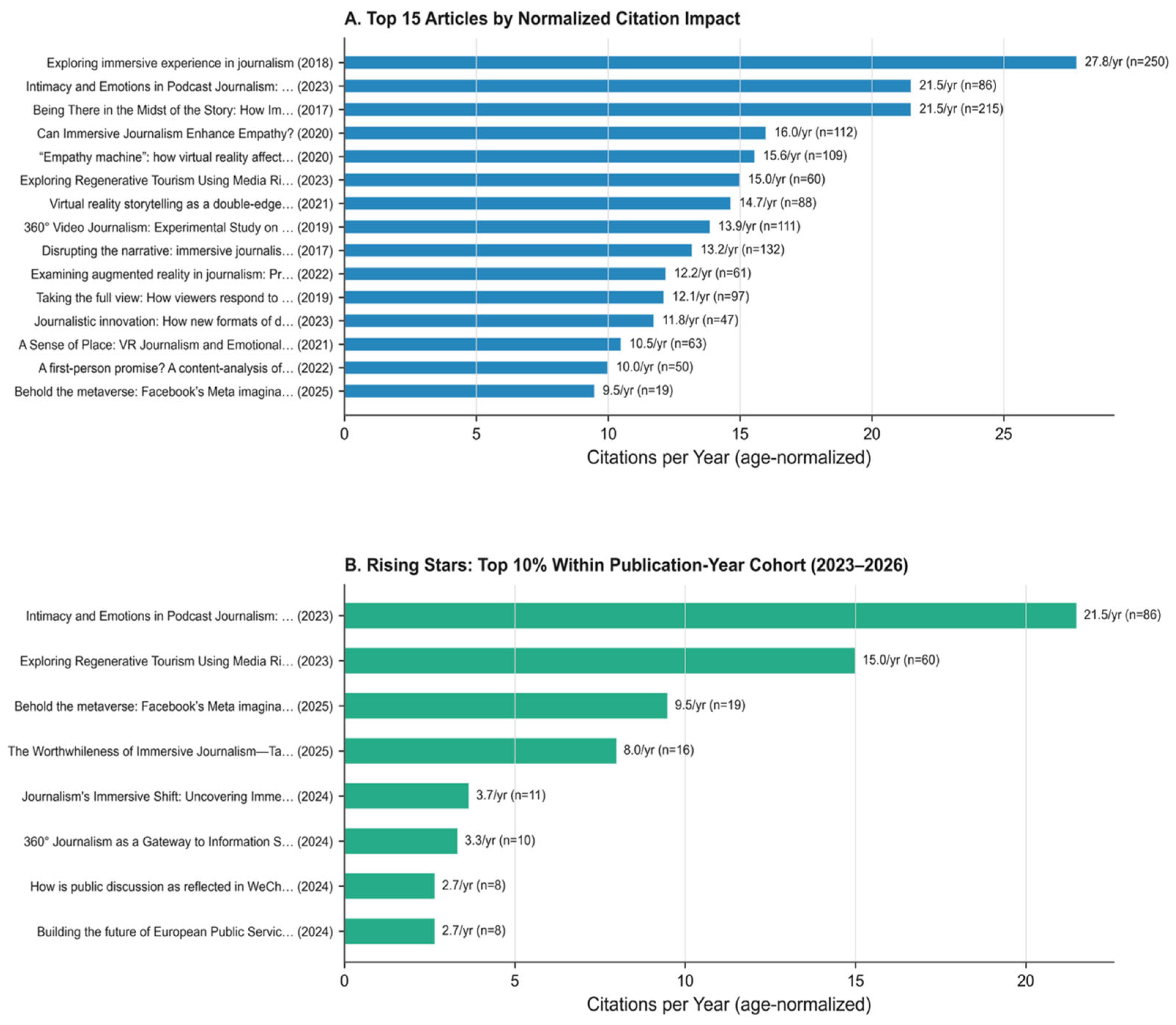
4.3.2. Citation Impact: Time-Adjusted Measurement
4.4. Forward-Looking Projections for Immersive Journalism Research, 2026–2030
The Near-Term Trajectory of the Research Agenda (2026–2030)
5. Discussion
Limitations
6. Conclusions
Author Contributions
Funding
Institutional Review Board Statement
Informed Consent Statement
Data Availability Statement
Conflicts of Interest
References
- Aitamurto, T., Aymerich-Franch, L., Saldivar, J., Kircos, C., Sadeghi, Y., & Sakshuwong, S. (2022). Examining augmented reality in journalism: Presence, knowledge gain, and perceived visual authenticity. New Media & Society, 24(6), 1281–1302. [Google Scholar] [CrossRef] [Scilit]
- Alpsoy, İ. (2026). Sürükleyici gazetecilik üzerine WOS’ta bibliyometrik bir analiz. Social Sciences Studies Journal (SSSJournal), 12(2), 232–243. [Google Scholar] [CrossRef]
- Arık, M. A., Karaduman, M., Karaduman, S., Karakaya, Ç., Sümer, F. E., & Demir, Z. G. (2024). An examination of immersive journalism by bibliometric analysis from 1999 to 2023. Heliyon, 10(14), e34263. [Google Scholar] [CrossRef] [Scilit] [PubMed]
- Baía Reis, A., & Coelho, A. F. V. C. C. (2018). Virtual reality and journalism: A gateway to conceptualizing immersive journalism. Digital Journalism, 6(8), 1090–1100. [Google Scholar] [CrossRef] [Scilit]
- Ball, M. (2022). The metaverse and how it will revolutionize everything. Liveright Publishing. [Google Scholar]
- Barreda-Ángeles, M., Aleix-Guillaume, S., & Pereda-Baños, A. (2021). Virtual reality storytelling as a double-edged sword: Immersive presentation of nonfiction 360–video is associated with impaired cognitive information processing. Communication Monographs, 88(2), 154–173. [Google Scholar] [CrossRef] [Scilit]
- Belt, D., & South, J. (2016). Slow journalism and the ‘Out of Eden walk’. Digital Journalism, 4(4), 547–562. [Google Scholar] [CrossRef] [Scilit]
- Brennen, B., & Dela Cerna, E. (2010). Journalism in second life. Journalism Studies, 11(4), 546–554. [Google Scholar] [CrossRef] [Scilit]
- Cheng, K., & Verboord, M. (2025). The diffusion of immersive journalism as media innovation from media professionals’ perspectives. Journalism, 26(12), 2712–2728. [Google Scholar] [CrossRef] [Scilit]
- Cobo, M. J., López-Herrera, A. G., Herrera-Viedma, E., & Herrera, F. (2011). Science mapping software tools: Review, analysis, and cooperative study among tools. Journal of the American Society for Information Science and Technology, 62(7), 1382–1402. [Google Scholar] [CrossRef] [Scilit]
- De la Casa, J. M. H., & Bautista, B. S. (2023). From the 360 photo to the metaverse: Conceptual and technical evolution of virtual and immersive journalism from Spain. Brazilian Journalism Research, 19(2), e1562. [Google Scholar] [CrossRef] [Scilit]
- De la Peña, N., Weil, P., Llobera, J., Spanlang, B., Friedman, D., Sanchez-Vives, M. V., & Slater, M. (2010). Immersive journalism: Immersive virtual reality for the first-person experience of news. Presence, 19(4), 291–301. [Google Scholar] [CrossRef] [Scilit]
- Domínguez-Martín, E. (2015). Periodismo inmersivo o cómo la realidad virtual y el videojuego influyen en la interfaz e interactividad del relato de actualidad. El Profesional de la Información, 24(4), 413–423. [Google Scholar] [CrossRef] [Scilit]
- Donthu, N., Kumar, S., Mukherjee, D., Pandey, N., & Lim, W. M. (2021). How to conduct a bibliometric analysis: An overview and guidelines. Journal of Business Research, 133, 285–296. [Google Scholar] [CrossRef] [Scilit]
- Doyle, P., Gelman, M., & Gill, S. (2016). Viewing the future? Virtual reality in journalism. Knight Foundation. Available online: https://knightfoundation.org/articles/research/vrjournalism/ (accessed on 12 August 2026).
- Eskiadi, I. G., & Panagiotou, N. (2026). Virtual production in news media: Transforming storytelling, audience engagement, and ethical practices in the digital age. Convergence, 32(2), 390–409. [Google Scholar] [CrossRef] [Scilit]
- Falandes, C. G., & Renó, D. P. (2023). Documentary poetics in 360 degrees: Perspectives on non-fiction spherical narrative models. Brazilian Journalism Research, 19(2), e1555. [Google Scholar] [CrossRef] [Scilit]
- Fonseca, A. dos A., Lima, L., & Barbosa, S. (2026). The body and its place in immersive journalism. Journalism Studies, 27(5), 743–760. [Google Scholar] [CrossRef] [Scilit]
- Gallego Abellán, R., Teruel Piñol, C. T., & Slater, M. (2024). Immersive documentary journalism: Exploring the impact of 360° virtual reality compared with a 2D screen display on the responses of people toward undocumented young migrants to Spain. Frontiers in Communication, 9, 1474524. [Google Scholar] [CrossRef] [Scilit]
- Greber, H. (2024). The effect of interactivity in immersive journalism on participating in the media and through the media. Journalism & Mass Communication Quarterly. Advance online publication. [Google Scholar] [CrossRef] [Scilit]
- Heath, D. R. (2023). The metaverse and how it will revolutionize everything [Review of the book the metaverse and how it will revolutionize everything, by M. Ball]. Journal of Information Technology Case and Application Research, 25(1), 98–101. [Google Scholar] [CrossRef] [Scilit]
- Hendriks Vettehen, P., Wiltink, D., Maite, H., Schaap, G., & Ketelaar, P. (2019). Taking the full view: How viewers respond to 360-degree video news. Computers in Human Behavior, 91, 24–32. [Google Scholar] [CrossRef] [Scilit]
- Herrera Damas, S., & Benítez de Gracia, M. J. (2022). Sürükleyici gazetecilik: Uzmanların bakış açısından avantajları, dezavantajları ve zorlukları. Gazetecilik ve Medya, 3(2), 330–347. [Google Scholar] [CrossRef] [Scilit]
- Jones, S. (2017). Disrupting the narrative: Immersive journalism in virtual reality. Journal of Media Practice, 18(2–3), 171–185. [Google Scholar] [CrossRef] [Scilit]
- Kang, S., O’Brien, E., Villarreal, A., Lee, W., & Mahood, C. (2019). Immersive journalism and telepresence. Digital Journalism, 7(2), 294–313. [Google Scholar] [CrossRef] [Scilit]
- Koçak, D. (2023). Web 1.0’dan Web 3.0’a metaverse’ün gelişimi ve sunduğu fırsatlar. Yeni Medya Elektronik Dergisi, 7(2), 97–113. Available online: https://izlik.org/JA42WL37JT (accessed on 12 August 2026).
- López-García, X., Rodríguez-Vázquez, A., & Pereira-Fariña, X. (2017). Technological skills and new professional profiles: Present challenges for journalism. [Competencias tecnológicas y nuevos perfiles profesionales: Desafíos del periodismo actual]. Comunicar, 53, 81–90. [Google Scholar] [CrossRef] [Scilit]
- Lucia, B., Vetter, M. E., & Aduboufur, I. K. (2025). Behold the metaverse: Facebook’s Meta imaginary and the circulation of elite discourse. New Media & Society, 27(2), 790–807. [Google Scholar] [CrossRef] [Scilit]
- Olausson, U., & Engström, A. (2025). ‘The road to the metaverse is not a straight one’: Social representations of virtual reality in the news media. Convergence, 31(4), 1288–1305. [Google Scholar] [CrossRef] [Scilit]
- Pérez-Seijo, S. (2021). Uso del vídeo 360° por los medios nativos digitales. Análisis exploratorio de los primeros pasos en el ecosistema periodístico español. Profesional de la İnformación, 30(3), e300304. [Google Scholar] [CrossRef] [Scilit]
- Sanchez-Acedo, A., Carbonell-Alcocer, A., Gertrudix, M., & Rubio-Tamayo, J. L. (2023). Metaverse and Extended Realities in Immersive Journalism: A Systematic Literature Review. Multimodal Technologies and Interaction, 7(10), 96. [Google Scholar] [CrossRef] [Scilit]
- Sánchez Laws, A. L. (2020). Can immersive journalism enhance empathy? Digital Journalism, 8(2), 213–228. [Google Scholar] [CrossRef] [Scilit]
- Shin, D., & Biocca, F. (2018). Exploring immersive experience in journalism. New Media & Society, 20(8), 2800–2823. [Google Scholar] [CrossRef] [Scilit]
- Soler-Adillon, J. (2022). Experimenting with non-fiction VR storytelling: Micronarrative, abstraction and interactive navigation. The case of In Pieces VR. Digital Creativity, 33(4), 349–364. [Google Scholar] [CrossRef] [Scilit]
- Stephenson, N. (1992). Snow crash. Bantam Books. [Google Scholar]
- Sundar, S. S., Kang, J., & Oprean, D. (2017). Being there in the midst of the story: How immersive journalism affects our perceptions and cognitions. Cyberpsychology, Behavior, and Social Networking, 20(11), 672–682. [Google Scholar] [CrossRef] [Scilit] [PubMed]
- Toursel, A., & Useille, P. (2019). Immersive journalism, a ‘new frontier’ of information experience? Brazilian Journalism Research, 15(2), 336–357. [Google Scholar] [CrossRef] [Scilit]
- Van Damme, K., All, A., De Marez, L., & Van Leuven, S. (2019). 360° Video journalism: Experimental study on the effect of immersion on news experience and distant suffering. Journalism Studies, 20(14), 2053–2076. [Google Scholar] [CrossRef] [Scilit]
- Welskop, W. (2025). Sürükleyici gazetecilik: Bir bibliyometrik analiz. Medya Çalışmaları, 26(4), 282–296. [Google Scholar] [CrossRef] [Scilit]
- Wilson, T., & Tan, H. P. (2005). Less tangible ways of reading: A ludic surfing of online Western news sites. Information, Community & Society, 8(3), 394–416. [Google Scholar] [CrossRef] [Scilit]
- Yunju, K., & Heejun, L. (2022). User acceptance of 360-degree video news: An integrated model of extended TAM and U&G perspectives. Communication Research and Practice, 8(4), 327–346. [Google Scholar] [CrossRef] [Scilit]
- Zeren, D., & Güler, G. (2022). Metaverse ve pazarlama. Orion Akademi. [Google Scholar]
- Zhou, Y. (2024). Navigating constraints: News values and journalistic role performance in Chinese state media VR news. Frontiers in Communication, 9, 1480659. [Google Scholar] [CrossRef] [Scilit]




Disclaimer/Publisher’s Note: The statements, opinions and data contained in all publications are solely those of the individual author(s) and contributor(s) and not of MDPI and/or the editor(s). MDPI and/or the editor(s) disclaim responsibility for any injury to people or property resulting from any ideas, methods, instructions or products referred to in the content. |
© 2026 by the authors. Licensee MDPI, Basel, Switzerland. This article is an open access article distributed under the terms and conditions of the Creative Commons Attribution (CC BY) license.
Share and Cite
Köse, H.; Balcı Aydoğan, B. Immersive Journalism and the Shift to the Metaverse: A Bibliometric and NLP Analysis with Projections to 2030. Journal. Media 2026, 7, 193. https://doi.org/10.3390/journalmedia7030193
Köse H, Balcı Aydoğan B. Immersive Journalism and the Shift to the Metaverse: A Bibliometric and NLP Analysis with Projections to 2030. Journalism and Media. 2026; 7(3):193. https://doi.org/10.3390/journalmedia7030193
Chicago/Turabian StyleKöse, Hüseyin, and Bahar Balcı Aydoğan. 2026. "Immersive Journalism and the Shift to the Metaverse: A Bibliometric and NLP Analysis with Projections to 2030" Journalism and Media 7, no. 3: 193. https://doi.org/10.3390/journalmedia7030193
APA StyleKöse, H., & Balcı Aydoğan, B. (2026). Immersive Journalism and the Shift to the Metaverse: A Bibliometric and NLP Analysis with Projections to 2030. Journalism and Media, 7(3), 193. https://doi.org/10.3390/journalmedia7030193