


Abstract
The paper examines student protests in Serbia in 2024/25 through the lenses of student banners and the messages used to communicate with civic allies who do not participate in university blockades. The research question is how a relatively small and hermetic student blockade, a reaction to the tragedy in Novi Sad and violence against students of the Faculty of Dramatic Arts, grew into the most significant protest movement in Serbia after 2015. The authors start from the theoretical perspective that students in blockades exhibit Generation Z communication patterns and that a communication gap exists between digital natives and digital immigrants (over 30 years of age). The empirical part of the paper draws on an archive of photographs of student banners. The research aims to identify the ideological content communicated by the banners across generations, making the 2025 protests one of the most successful examples of mass mobilization in Serbia against state capture and corruption in a hybrid-regime political context.
1. Introduction
In the first trimester of 2025, the Students in Blockade movement organized widespread anti-corruption protests in Serbia. The wave of public discontent began with a small nucleus of student blockades at several faculties of the University of Belgrade in late November 2024, and it spread to all state-owned universities in Serbia and several private ones. Blockades of several faculty premises were organized as a form of nonviolent resistance following a physical attack by members of the Serbian Progressive Party (SNS—Serbian acronym) against students and professors at the Faculty of Dramatic Arts in Belgrade (Djordjević & Radeljić, 2026; Jerkov et al., 2025). The protests called for accountability for the collapse of the canopy at the main railway station in Novi Sad on 1 November 2024. Fourteen people were killed at the scene, two later succumbed to their injuries, and one person was left permanently disabled.
During the 2025 student protests, Serbia joined the global map of Generation Z-led protest movements, alongside countries such as Bangladesh, Morocco, Nepal, and Georgia. The protests in Serbia constitute a significant case for research due to three key characteristics. First, according to the most recent population census conducted in 2022, Generation Z and younger Millennials (18–29 years of age) included 248,508 students out of Serbia’s total population of 6,647,003, representing only 3.73% of the population (Statistical Office of the Republic of Serbia, 2023). By comparison, in Nepal, where Generation Z also led an uprising against the government in 2025, the median age is 25.7 years (World Economics, 2025). Given that Serbia’s median age is 44.9 years (Nikitović, 2022), the fact that mass protests were initiated and led by the student population is nothing short of a political marvel.
Second, Serbia’s political landscape between 2014 and 2024 was marked by a steady rise in electoral support for the ruling coalition centered on SNS. In the most recent parliamentary elections in 2023, the coalition won 46.75% of the vote, or 1,783,701 votes (BBC, 2024). The dominance of a single party is reflected in relatively low voter turnout, the opposition’s lack of trust in the government, and frequent protests by social movements. However, due to the absence of a broader strategic framework, these movements either dissipated after only a few months or became mainstream political (opposition) parties.
Third, a political landscape characterized by party hegemony is also reflected in the structure of the media system. The media environment is fragmented and polarized, while indicators of media freedom remain relatively low despite a certain degree of freedom of expression (Reporters Without Borders, 2026). The primary issue is the lack of pluralism, compounded by the absence of fair competition in media appearances and the exchange of arguments in public debates. As a result, political discussions are frequently displaced onto social media platforms, which operate without effective regulatory oversight and often foster confrontations between radical viewpoints (Đ. Vuković & Vranješ, 2025).
In summary, Serbia has sufficient political and media freedoms to allow protests to take place; however, such protests have often remained isolated, focused on particular interests, covered positively or neutrally only by one side of the media spectrum, and insufficiently influential to generate broader mobilization in the form of collective solidarity actions, such as mass voter turnout, large-scale mobilizations, or general strikes. This political condition has historical roots. Following the introduction of the multi-party system in 1989, Serbia’s political landscape was deeply polarized and ideologically divided along what, in the local historical context, became known as the First Serbia and the Second Serbia (Russell-Omaljev, 2016), reflecting a broader conflict between what is in the study of ideologies known as a traditionalization vs. modernization cleavage (Jost et al., 2015). Following the establishment of the SNS in 2009 as a centrist-populist catch-all movement (Vranić, 2020), the political landscape was fundamentally altered, making the traditional pattern of ideological polarization, embodied in competition between two major parties, obsolete. This transformation of the political landscape contributed to the emergence of a variety of organic social movements occupying different positions along the ideological spectrum (Spasojević, 2024), which developed as contentious political counterweights to the SNS.
The central research question is: Can we identify a pattern of communication employed by the student movement in Serbia to mobilize broader public support and evolve into a mass movement? The identification of this pattern(s) is challenged by the communication gap between older generations and students, as referred to in the paper. We focus on the communicative bridge between Generation Z and older voter cohorts. Cohorts over the age of 30 in Serbia continue to rely largely on traditional media, especially electronic media (Matović et al., 2025), as well as on other forms of communication rooted in an analog public sphere. By contrast, Generation Z consists of digital natives (Pollozhani, 2026).
One way the bridge can be constructed is through traditional political campaigning, in which protest banners occupy a particularly prominent place. As a form of political expression within protest movements, banners reflect the specific circumstances of their production by communicating simplified representations of the social and political issues around which collective action is organized (Atlagić, 2018). What is distinctive about these banners in a Serbian historical context, however, is that their structure resembles that of internet memes; more specifically, they perform a memetic function by referencing events and symbols embedded in the political memory of older generations. During the early stages of the student occupations, a hyperproduction and widespread use of banners were documented throughout protest activities (Zvijer et al., 2025). For a digital-native generation, banners might appear to be relics of an earlier era of political activism.
This paper analyzes an archive of 929 photographs of student protest banners (Marković et al., 2025), collected from occupied university buildings across Serbia between late December 2024 and early February 2025. The value of this archive lies in the banners’ production during the initial phase of the student blockades, when student dissent was still primarily a reaction to the railway station canopy collapse rather than an organized political movement.
The paper situates the photographic archive epistemologically within the ‘point of view’ of artifacts rather than as a depiction of ‘material acts of reality’ (Ferhani & Nyman, 2023, p. 362) related to the protests. We hypothesize that the content of the banners was not direct replicas of the past struggle against authoritarianism; rather, they adopt new forms derived from the digital space (such as internet memes) and imaginaries of existing societal issues, placing them within the context of the new Generation Z. The paper consists of three research hypotheses regarding the empirical evidence of student banners from the photographic archive:
H1.
The banners incorporate elements of ideological mobilization through performative production with the intention of including a broader age cohort in protests.
H2.
The banners adopt the format and logic of Internet memes, providing new imaginaries of existing societal issues through the perspective of Generation Z.
H3.
The banners establish a connection between the university blockades and the political memory of older generations, particularly memories of the 1990s protest movements.
2. Context of the Student Blockades and the Formative Phase of the Student Movement in Serbia in 2025
Since 2019, Serbia has been classified in major democracy indices as a transitional or hybrid regime (Tzifakis & Vasdoka, 2025, p. 492). The relevant scholarly literature (Bursać et al., 2025; Kulić, 2021; Vladisavljević, 2026; D. Vuković & Stefanović, 2024) often identifies the rule of law, captured institutions, a fragmented and polarized media landscape, unregulated social media platforms, high levels of clientelism, and electoral competition dominated by a single party as factors in democratic backsliding in Serbia. Since 2015, the country has experienced recurring political crises that have generated mass protests against the ruling elites (SNS). These protests have emerged in response to a variety of issues, including urban development projects (Vranić & Jevtić, 2024), the management of the COVID-19 pandemic (Balunović, 2026), environmental concerns (Fagan & Ejdus, 2022), and tragedies caused by mass shootings (Jevtić, 2025).
The student protests are by far the largest of these events. Student uprisings occupy an important and enduring place in Serbia’s political memory (Jerkov et al., 2025). Longitudinal research conducted over the past eight years indicates that civic training programs aimed at fostering active youth participation are highly developed in Serbia (Vranić, 2024), a pattern that is not substantially different from the broader regional context. Across the Western Balkans, approximately 40% of young people report being willing to actively protest against authoritarian governments, while 67.7% state that they would certainly vote in the next elections (Pollozhani, 2026, p. 11).
The broader wave of student-led civil disobedience began on 22 November 2024, after a confrontation near the Faculty of Dramatic Arts (FDU) in Belgrade. As a sign of the protest movement’s radicalization, students at the Faculty of Dramatic Arts declared a total blockade of the faculty building the same day. This effectively barred anyone other than FDU students from entering the faculty premises. Over the following month, all faculties at the state-owned universities in Belgrade, Novi Sad, Kragujevac, Niš, and Novi Pazar declared blockades, joined by several private higher education institutions.
From an ideological perspective, the student protests were remarkably successful in mobilizing the broader public, despite the thin articulation of their demands. These demands included: (1) the publication of all documentation related to the reconstruction of the railway station canopy in Novi Sad; (2) the establishment of political accountability for the tragedy; (3) the prosecution of those responsible for the attack on the Faculty of Dramatic Arts (FDU); and (4) the adoption of a new Law on Higher Education (Rennick et al., 2025).
Shortly after the first blockade began, students established an informal decision-making body known as the plenum, which served as the primary organizational unit at each faculty. The plenums operated on the principle of direct democracy, under which all students of a given faculty were entitled to participate and vote (Spasojević et al., 2025). This organizational model effectively bypassed the formal student representative bodies established by law at both the faculty and university levels, as well as the broader public’s influence. The principal issue with formal student parliaments is that they have come to be perceived as captured institutions, particularly after the adoption of the Law on Student Organizing in 2021, which favored dominant student organizations. The structural dimension of student organizing in Serbia is important for at least two reasons. First, it helps explain why blockades have been chosen as a method of political struggle. Second, it highlights significant institutional barriers to the expression of student interests, which in turn have spurred the creation of parallel and extra-institutional bodies. Consequently, the student blockades should not be understood merely as an ad hoc reaction to the heterogeneous actions of the ruling elites. Rather, they were also the product of deeper structural problems related to the autonomy and representation of student organizing in Serbia.
3. Theoretical Framework: Analog Banners in Post-Digital Culture
In the “post-digital” world, which increasingly blurs the boundaries between the digital and the material (Vukelić, 2026), physical participation can quickly become mass-based and antagonistic, eroding conventional boundaries of political morality and ultimately materializing culture wars through political imagination. State-of-the-art research further demonstrates that Generation Z exhibits distinctive patterns of behavior in the post-digital era (Ganita & Ardianto, 2024; Yaseen et al., 2026).
Our paper builds on the work of Luescher et al. (2021), who argue that Generation Z’s student movements form online relationships that are no less “real” than those established in physical space. Furthermore, we adopt the premise that Generation Z has grown up and been socialized entirely within an environment shaped by the Internet, social media, and digital technologies, making them true digital natives of the digital language (Prensky, 2001, pp. 2–3). This experience has significantly shaped how its members communicate and interact within their social surroundings (Peredy et al., 2024, p. 5). In contrast, Generation X and Millennials tend to base their media literacy on the aspiration to remain well informed and therefore consume both traditional mass media and online sources of information (Fistrić, 2019, p. 128).
To address the research question about identifying a pattern of communication among student movements in Serbia, we start with the “communication profile” of Generation Z (Peredy et al., 2024), briefly summarized as: (1) high dependence on technological devices and visual communication, while developing distinct digital nonverbal communication codes through emojis, GIFs, and memes; (2) preference for short-form content on social media platforms such as TikTok and Instagram Stories; (3) digitally mediated interpersonal culture in everyday interactions. Amid an immense flow of information, individuals with diverse values, attitudes, and interests tend to find their place by connecting with like-minded people in “internet circles” or virtual communities. These communities often resemble echo chambers, characterized by limited tolerance for viewpoints that diverge from those dominant within the group (Peredy et al., 2024, p. 10).
Over the past decade, Internet memes have occupied a prominent place in the literature at the intersection of youth participation in the public sphere and young people’s media communication practices. Often presented as short, humorous images or GIFs, memes also serve as representations of various youth subcultures. The content of memes is most often built around imitation, which, to be effective, must be grounded in the socio-cultural context of its intended audience and frequently draws upon and interacts with elements of popular “folklore” (Moskovljević & Lazović, 2025, p. 192). Memes can be understood simultaneously as cultural artifacts, political tools, and instruments of collective meaning-making (Madsen, 2026, p. 3), often through the formation of content-based communities that, like any social organization, develop their own rules and norms (Rogers & Giorgi, 2024, p. 75).
In this context, we introduce Madsen’s (2026, p. 3) concept of the “linguistic meme,” defined as a repeatable, recognizable, and performative linguistic package that circulates across different platform contexts. These include a greater capacity for linguistic adaptation and the hyperproduction of neologisms. A linguistic meme may consist of a word, phrase, audio clip, short statement, or slogan, but it cannot be reduced solely to lexical content; rather, it is typically combined with audiovisual elements and shaped by the infrastructural logics of the platforms through which it circulates (Madsen, 2026).
These intergenerational characteristics are also evident in contemporary Serbia. As Atlagić et al. (2026, p. 5) note, the Internet has become a new arena of contestation between the government and the opposition, particularly through social media platforms, which serve as the primary channels for citizen mobilization. However, it would be reductionist to assume that global student movements are oriented exclusively toward online networking, without also building networks and organizational structures in the material world. Building on theories of student movements in late neoliberalism (Cini et al., 2021), this paper assumes that the students who led the Serbian protests in 2025 were socialized through the activist curricula of neoliberal generations and do not differ substantially from their student peers elsewhere in the world. The argument is grounded in the observation that students continue to employ formal methods of self-organization through “student associations, federations, or unions” (Cini et al., 2021, p. 10), operating within institutional frameworks such as student parliaments. At the same time, informal forms of organization, such as student plenums in the Serbian case analyzed here, tend to assume a dominant role during periods of protest. Through such structures, students can become “the vehicles through which students attempt to influence higher education or university policies, or even intervene in national politics or transnational campaigns” (Cini et al., 2021, p. 11). Both during periods of formal organization and during phases of informal mobilization, conventional means of communication continue to play an important role among student populations, albeit one transformed by the innovations introduced by the digital-native generation.
4. Methodology and Materials
This study is based on an analysis of a photographic archive of student protest banners compiled by Marković et al. (2025). Photographs were collected between December 2024 and February 2025. The archive contains 929 photographs and covers five universities in Serbia: the University of Belgrade, the University of Novi Sad, the University of Kragujevac, the University of Niš, and the University of Arts in Belgrade (a total of 35 faculties). The photographs were collected during fieldwork conducted by a group of sociologists from the University of Belgrade. The photographs have not been edited and represent a spatiotemporal snapshot of the banners as they appeared when photographed within the buildings of the blockaded faculties.
To analyze the archive, we employed intensional analysis (Vranić, 2024), a method designed to identify ideological content through the logical categories of intension and extension. In our study, ideological content is examined in student protest banners. Intensional analysis examines the (logical) conditions under which ideological content is produced by determining the functional value of language, asking: What truth value do the statements in which a concept is used possess?
The analysis consists of two steps:
- Identifying the extension of a statement—the conceptual content through which political action is articulated toward political objects (public policies, specified in the context of this study as student demands).
- Identifying the intension of a statement—analyzing the structure of language (the type of statement, or, in this case, the type of slogan on a banner) to determine its articulatory function, particularly whether it operates descriptively or performatively.
We opted for intensional analysis because this methodological approach enables us to establish a bridge between ideological and discursive content of the banners. Intensional analysis is epistemologically grounded in Polanyi’s (1966) concept of tacit knowledge and learning through experience. The analysis begins with the meaning or extension of the objects of analysis (the banners), while the intension is treated as distal. The objects of analysis are closely tied to what is experientially present, while the categories that sort experience are analytically linked to the research process. The advantage of intensional analysis is that it bypasses the difficulties that most interpretative methods have in explicating linguistic forms and discourse of political ideologies: the subjectivity of interpretation. It adds no new value to the experience, since all participants in the knowledge-acquisition process hear and read the same artifacts (in this case, the photographs of the banners). This way, the problem of coder reliability is also bypassed; the analysis looks for logical relations (categories and types of sentences) in which intercoder inconsistency is minimized as much as possible in the social sciences. The objective is not to identify the subject’s learning or the interpreter’s comprehension or empathy with the learning process but to understand the logical conditions under which knowledge is possible.
Intensional analysis applies three analytical categories to examine the extension of ideological content: grievance, polarization, and action. These categories are derived from existing epistemological frameworks in research on political ideologies and serve as the drivers through which political attitudes toward political objects are articulated (Vranić, 2024, pp. 135–141). In the context of our study, these political objects are the students’ demands during the blockade, situated in relation to two key contextual events: (1) the collapse of the railway station canopy in Novi Sad and (2) the attack on students and faculty members at the Faculty of Dramatic Arts (FDU).
An analysis of a statement’s intension involves identifying the conditions under which its extension has a truth value. This analysis proceeds by examining sentence types, namely: assertions (true/false), questions (verifiable/non-verifiable in principle), and imperatives (good/bad; right/wrong). Banners whose extensions are expressed as assertions contribute to the cognitive dimension of ideological attitudes; questions constitute their critical dimension; while imperatives motivate action (engagement or passive resistance). The analysis is further supplemented by Searle’s (2010) distinction between descriptions and performatives, which helps identify whether the speaker’s (illocutor’s) intention is to describe a particular state of affairs or to induce action.
The archive was filtered to include only photographs containing identifiable ideological content. Three criteria were used in this filtering process. First, repetitive forms of symbolic representation were excluded. Many banners featured artistic renditions and formal variations in the bloody handprint symbol, with no accompanying text. Although the bloody handprint is itself an ideologically constructed symbol, the immediacy and self-evidence of its extension provide limited explanatory value for this analysis. Second, several banners featured overly general messages that were reproduced repeatedly, such as “Corruption Kills!” (Korupcija ubija!), as well as messages directed toward specific academic disciplines (e.g., mathematical equations, programming code, or various formulas for calculating force). Third, identification-oriented messages such as “Students of Faculty A, B, C…N in Blockade” were excluded. Such messages were omitted because they were either self-explanatory, lacked substantive political meaning, or were primarily oriented toward the internal motivation and identity formation of students participating in the occupations. Since the focus of this study is on communicating political meanings to broader audiences, these forms of expression fall outside the scope of the present analysis.
After filtering, a total of 361 photographs were identified as the analytical sample. These photographs contain direct ideological content relevant to mobilizing the broader population, either in support of the student movement or through participation in protest activities such as blockades. The photographs are distributed across the university centers where they were collected, as presented in Table 1:
Table 1.
Distribution of photographs by university.
We identified several sources of bias within the archive and, consequently, within the analytical sample. First, 56.5% of photographs were taken in Belgrade. This distribution may create the misleading impression that the student movement, in its grassroots phase, was homogeneous and centralized in its ideas and modes of articulation. The student movement was highly decentralized, heterogeneous, and, above all, relatively insulated from external political and media influences (Brandt, 2026; Jerkov et al., 2025).
Second, the archive covers 35 faculties, which is substantially fewer than the total number of faculties in Serbia. Moreover, it includes only state-owned universities, excluding private institutions that also participated in the occupations. For this reason, the findings cannot be interpreted as evidence of a coherent ideological discourse. Rather, they should be understood as reflecting a series of “communicative situations” (Van Dijk, 2015) that serve as building blocks of a broader ideological discourse. Third, the archive does not include faculties that might naturally be expected to play a leading role in shaping the ideological, political, and organizational dimensions of the protests, such as the Faculty of Political Science or the Faculty of Organizational Science. Instead, the sample primarily covers faculties located either in city centers or within university campuses. Accordingly, we explicitly refrain from making broad generalizations. In a polarized society characterized by fragmented and conflicting interests, the exclusion of institutions and organizations that are particularly important for contextualizing political action limits the possibility of drawing conclusions about the existence of a unified ideological discourse.
To address potential biases, intensional analysis is particularly useful because it examines the logical conditions under which the banners were produced rather than their discursive, historical, or cultural content. To that extent, it contributes to existing discourse and morphological analyses (Freeden, 2015) of ideological content while also bypassing their limitations. Additionally, we employed multiple triangulation (Denzin, 2017) to compare and validate our findings against several complementary sources. These included publicly available opinion surveys conducted during the formative phase of the protests (e.g., CRTA and Faktor Plus), as well as comparative analyses of academic studies that used the same archive for sociological research (Zvijer et al., 2025) or a personal archive and observations in communication studies research (Ilić, 2025; Perišić, 2025). We also drew upon the broader literature examining visual and symbolic representation in Serbian protest movements following the country’s classification as a hybrid regime (Jevtić, 2025; Lončar & Spasojević, 2022; Spasojević & Lončar, 2023; Vladisavljević & Krstić, 2023).
5. Analysis
5.1. The Extension of the Content of Student Protest Banners
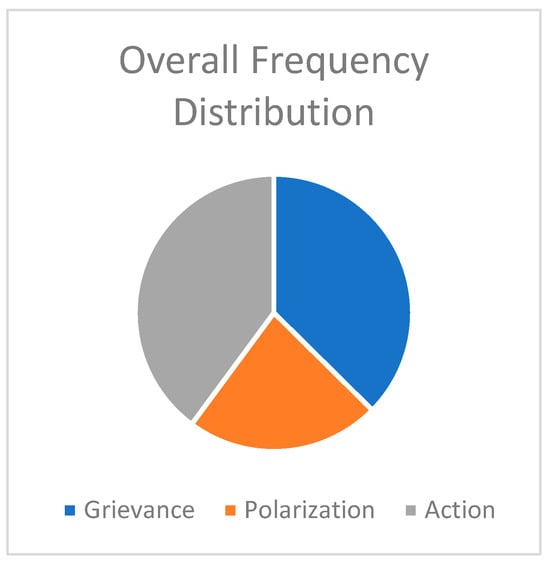
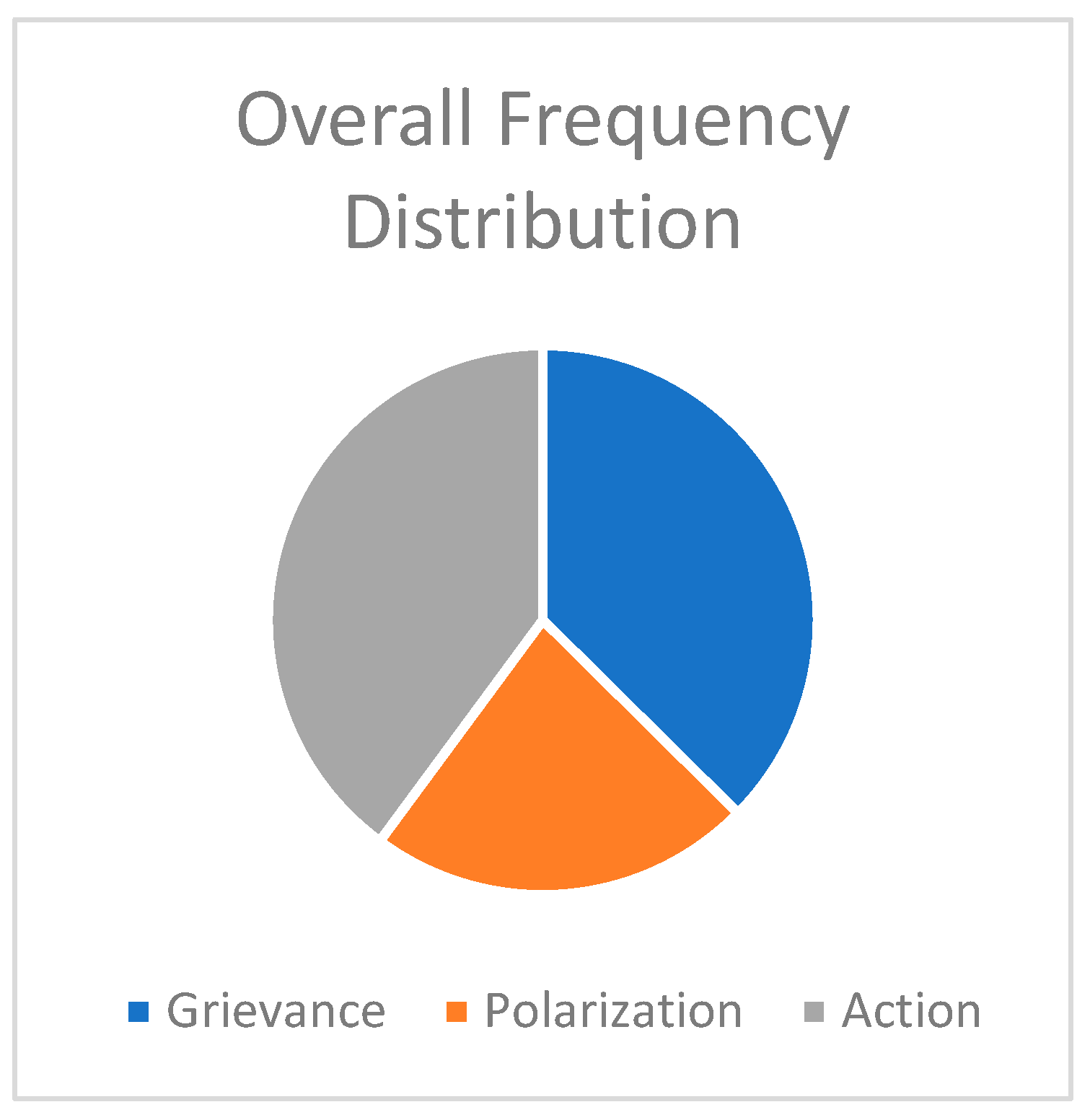
In analyzing the meanings conveyed by the banners in the photographic sample, we employed a mixed-methods approach that combined quantitative and qualitative elements. For the quantitative component, a bivalent frequency analysis of the photographs was conducted along two dimensions: (1) the analytical categories of grievance, polarization, and action, and (2) the locations where the photographs were collected (Belgrade, Kragujevac, Niš, and Novi Sad). The frequency distribution of the photographs is presented in Table 2, while their distribution across the analytical categories is shown in Figure 1.
Table 2.
Frequency of photographs by analytical categories across locations.
Figure 1.
Frequency distribution of analytical categories in the sample.
Overall, nearly two-thirds of the banners express complaints about institutions and call for action, while the remainder contains ideologically polarized content. At first glance, this polarization is articulated through a binary distinction between “us” and “them.” Typical grievance banners appear in Compilation 1, examples of polarization in Compilation 2, and instances of action in Compilation 31. Such an orderly distribution of banners might suggest a grassroots, civic-oriented character of the protest movement. However, this interpretation becomes less straightforward when the distribution of categories is examined at the local level.
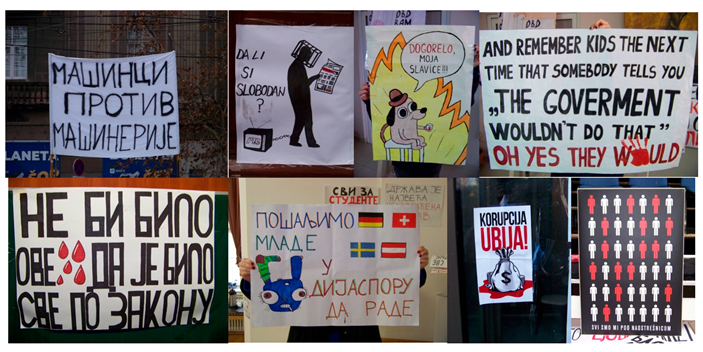
Compilation 1. Examples of the analytical category of grievance.
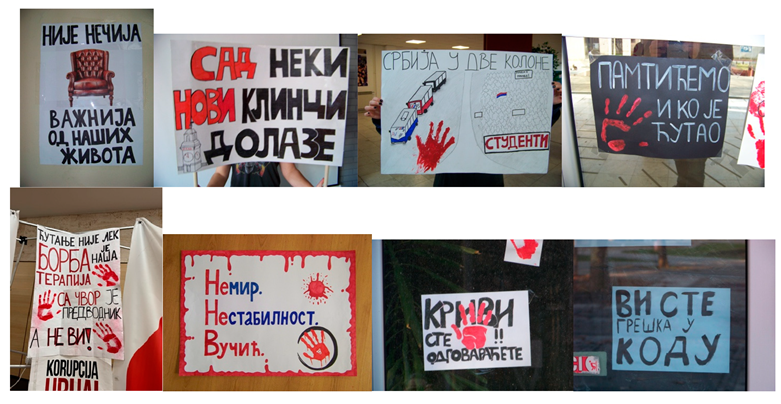
Compilation 2. Examples of the analytical category of polarization.
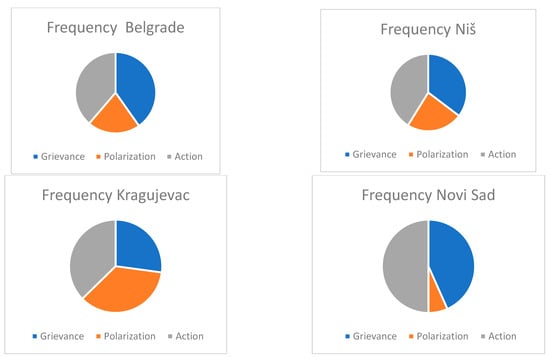
As shown in Figure 2, a near-perfect correspondence with the overall frequency distribution occurs only in Belgrade. Because the largest number of photographs was collected at the University of Belgrade and the University of Arts in Belgrade, the aggregate distribution tends to portray the movement primarily as a civic rather than a political mobilization.
Figure 2.
Frequency distribution of photographs by university.
The regional variations, however, paint a different picture. At the universities in Kragujevac, Niš, and Novi Sad, the largest share of banners falls under the category of action, consisting of calls for protests against the government and instructions on how citizens could support the students through various forms of micro-performative participation (honk, shout, be silent, block, jump).
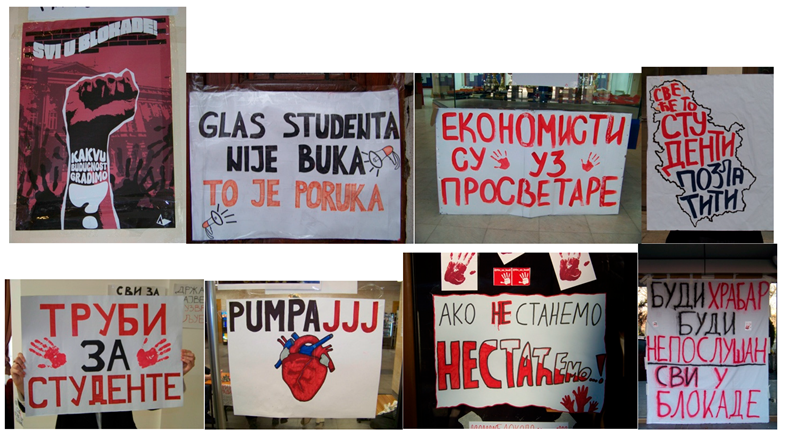
Compilation 3. Examples of the analytical category of action.
Kragujevac exhibits a particularly high frequency of banners containing ideologically polarizing content. Niš, by contrast, more closely resembles Belgrade in its overall distribution, though it has a somewhat greater presence of polarizing messages. Novi Sad, as the site of the tragedy, is the only university center that presents an almost ideal civic profile of protest expression, with no need to generate polarization (only two photographs from Novi Sad contained ideologically polarizing content).
The qualitative component of the analysis focuses on intentionality, that is, the banners’ orientation toward shaping perceptions of the student movement as a grassroots, civic uprising against captured institutions, particularly the judiciary and the media. The aim of this analysis is to identify clusters of messages conveyed through the banners. Rather than relying on predefined clusters derived deductively from existing discourse-based studies of political culture in Serbia, we adopted an inductive approach, identifying recurring messages by analyzing the banner content itself. The resulting clusters, along with their frequencies, are presented in Table 3.
Table 3.
Frequency of clusters in total numbers by university.
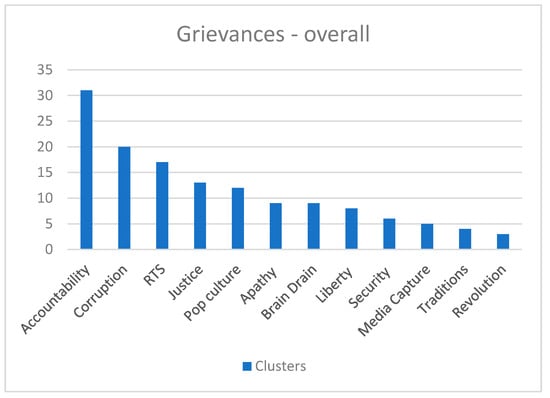
As summarized in Table 3 and Figure 3, most message clusters recur across universities, regardless of students’ institutions. Once again, Novi Sad is the most interesting case. Within its most prevalent analytical category (grievance), clusters such as “corruption,” “justice,” “RTS2,” and “captured media” are notably absent. Instead, the symbolic and communicative emphasis is placed on accountability.
Figure 3.
Distribution of clusters within the analytical category of grievances.
There are minor regional differences related to spatial proximity to the canopy collapse site. The closer the proximity to the tragedy itself, the more direct and focused the representations of the issue tend to be (as in Novi Sad). Conversely, as geographical distance increases (as in Niš and Kragujevac), the themes become more diverse, with the emergence of locally specific clusters such as “brain drain.”
In Belgrade, the political center of the protests and the city with the most occupied faculties, we observe a relatively balanced distribution of the clusters “accountability,” “corruption,” and “captured public broadcasting service.” These political clusters constitute textbook examples of the grievances that generate protest movements in post-communist contexts (Rennick & Vranić, 2026). At the same time, they have been present since the mass anti-authoritarian student protests of 1991, 1992, and 1996 (Vladisavljević, 2020).
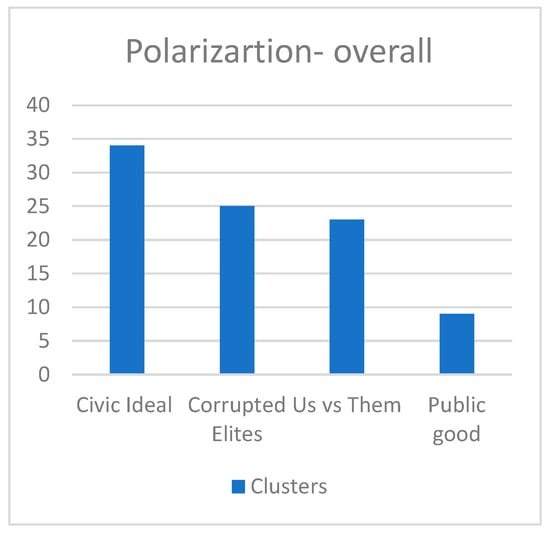
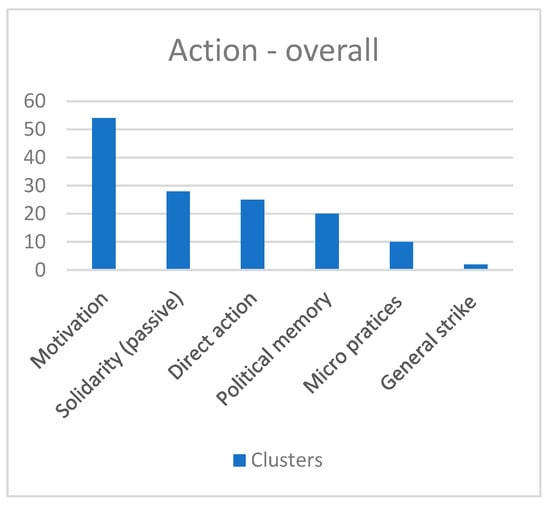
Within the categories of polarization and action, we identify a modest number of clusters (Figure 4 and Figure 5). Polarization, which reflects an ideological condition, exhibits a highly uniform structure, consisting of only four clusters: the image of the student (identity), corrupt elites, us-versus-them, and the public good.
Figure 4.
Distribution of clusters within the analytical category of polarization.
Figure 5.
Distribution of clusters within the analytical category of action.
Regional differences are evident again. In Novi Sad, polarization is almost entirely absent, with only two banners activating the cluster of corrupt elites. In Niš and Kragujevac, polarization is most strongly expressed through the explicit message that the SNS is responsible for the canopy collapse. By contrast, in Belgrade, the communicative emphasis is on portraying students as embodiments of civic virtue.
This finding points to different strategies within the contentious politics field (Tarrow, 2014). Novi Sad differs from the other university centers in that it communicates blockades more explicitly as a method of contentious action, designed to exert pressure on institutions and compel them to demonstrate accountability. In Novi Sad, there is a clear intention to demand accountability, accompanied by minimal politicization. In Niš and Kragujevac, however, the politicization of the protests themselves becomes a central message communicated through the banners. Belgrade once again follows a broader civic strategy, in which the primary objective is to construct students’ identity as agents of change and actors capable of liberating society from corruption.
This narrative becomes particularly evident when examined alongside the category of action. In Belgrade, Niš, and Kragujevac, the dominant communicative emphasis is on encouraging citizens to express solidarity with the student uprising, without prescribing a specific course of action. Instead, the banners present a set of possibilities, primarily through two clusters: direct action, such as participating in street blockades; and micro-practices of support, including honking car horns, whistling, or observing moments of silence alongside the students.
5.2. The Intension of the Content of Student Protest Banners
In analyzing the intension of the statements on student banners, two categories were used: sentence type and sentence function. When determining the banners’ truth conditions, the analysis was limited to linguistic content, while symbols and drawings were treated as elements of the broader meaning and, therefore, as components of extension rather than intension. The analysis was conducted on a location-by-location basis for each university center (Belgrade, Kragujevac, Niš, and Novi Sad). Frequency counts were calculated only secondarily to facilitate comparisons across sentence types and the two communicative functions. The total number of banners analyzed was 361. The aggregate results are presented in Table 4.
Table 4.
Distribution of banners according to sentence type and their communicative functions (in total numbers).
The results indicate that the largest share of banners were written in the imperative mood. Consequently, messages expressed through imperative constructions are subject to certain limitations arising from their grammatical structure. Imperatives lack an explicit subject and, therefore, cannot be assigned a truth value in the same way as assertions. Many of the analyzed banners expressed some form of belief about what ought to be done following the canopy collapse, either through a performative function (encouraging action or generating emotional engagement) or through a descriptive function (describing the condition of society or expressing empathy). A substantial number of banners combined slogans with visual elements, ranging from the ubiquitous bloody handprint symbol to more complex visual representations.
In Belgrade, Kragujevac, and Niš, the ratio of imperatives to declarative statements is approximately 2:1. Novi Sad is the only university center where declarative statements are somewhat more prominent, suggesting a stronger orientation toward establishing factual truth about responsibility for the canopy collapse and a greater emphasis on strengthening the epistemological framework surrounding the student actions. The other university centers were more open to incorporating a broader range of social issues. As a result, mobilization was directed toward activating beliefs that extended beyond the canopy collapse itself, treating the tragedy as part of a broader cluster of issues associated with the struggle against corruption. The idea that political elites are corrupt has been a central driver of civic protest movements in Serbia since the introduction of the multiparty system in 1989 (Spasojević & Lončar, 2023). Finally, questions were the least represented sentence type on the banners. This suggests that there was little space for open-ended responses or critical deliberation between the students and the public. Instead, the communicative intention was strongly oriented toward achieving the outcomes already identified through the analysis of extension, namely mobilization, identification, and collective action.
The mapping between sentence functions and sentence types does not align perfectly with the distribution observed across the categories. Since the largest number of banners were written as imperatives, one would expect their functions to be predominantly performative. As shown in Table 4, however, Belgrade and Kragujevac contain more performatives than imperatives, whereas Niš and Novi Sad contain fewer performatives relative to imperatives. This discrepancy arises because in Belgrade and Kragujevac we identified several declarative statements and questions that also served a performative function; that is, they were intended not merely to communicate information but to prompt action and produce social effects.
This pattern is particularly pronounced in Kragujevac, the city where polarization is most strongly expressed. There, the relationship between performatives and descriptions is heavily weighted toward performativity. Approximately half of the declarative statements and questions function as truth claims (true/false), while the other half provide guidance on how individuals should act in each situation. Consequently, in the cities where mobilization was most extensive, banners frequently employed statements that, in form, claimed to communicate truth but, in function, encouraged action. They combined descriptive and mobilizing dimensions, presenting political claims as factual while simultaneously calling upon citizens to respond through collective action (see Compilation 4).
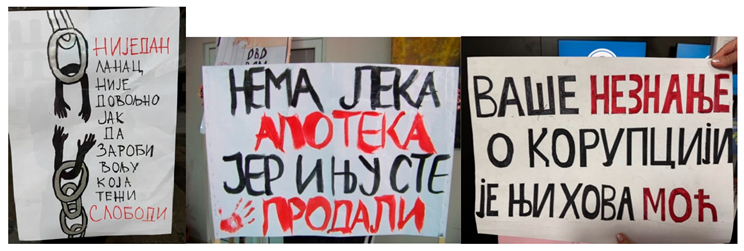
Compilation 4. Examples of banners written in the form of declarative statements but performing a performative function.
The situation is reversed in Niš and Novi Sad. In Niš, the results indicate an almost equal distribution of descriptions and performatives, even though the distribution of sentence types is not balanced between imperatives on the one hand and assertions and questions on the other. In addition to assertions and questions serving performative functions, we observed cases in which banners written as imperatives nonetheless functioned primarily to raise awareness or to describe participants’ emotional states. This pattern is even more pronounced in Novi Sad, where descriptions outnumber performatives. Consequently, the banners in Novi Sad, in both sentence type and communicative function, are oriented more strongly toward establishing the truth value (true/false) of claims related to the local canopy collapse event, and less toward broader political mobilization aimed at systemic political change.
6. Discussion
In the introductory section, we formulated three research hypotheses. Following the analysis, we can now provide clearer answers about their validity:
H1.
The banners incorporate elements of ideological mobilization through performative production with the intention of including a broader age cohort in protests.
H2.
The banners adopt the format and logic of Internet memes, providing new imaginaries of existing societal issues through the perspective of Generation Z.
H3.
The banners establish a connection between the university blockades and the political memory of older generations, particularly memories of the 1990s protest movements.
Regarding H1, the analysis yields mixed conclusions. The artificial nature of the banners and the ‘snapshot nature’ of the photographs did not provide sufficient material to assert that the students’ clear intention in the blockade was to use the banners to remind older cohorts of the benefits of protesting for democracy. A valid conclusion on this would require qualitative interviews with the creators of the banners, which we consider a methodological limitation of the approach we adopted in this paper. However, we gathered enough empirical evidence to assert that the banners’ content clearly transcended purely intragenerational mobilization and was directed toward older cohorts through the repetition or reimagining of clusters that had also been present during the major anti-authoritarian student protests of 1992 and 1996.
We seek theoretical and qualitative support for by drawing on research on the construction of generational identity among students under blockade (Vlajić et al., 2026). Based on 14 qualitative, semi-structured interviews with student activists, the study offers valuable interpretations, two of which are particularly relevant to H1. First, students perceive themselves as “the generation that ‘awakens’ society, acting as a value corrective of the older generations” (Vlajić et al., 2026, p. 42). In the interviews, students suggest that citizens’ performative action is the best way to increase civic participation, in contrast to passive attitudes and the general silence under authoritarianism. Second, the study shows that the interviewed students are the children of parents who participated in the student protest in 1996/97. However, they clearly distinguish themselves by generation, claiming that the new generation is more horizontally connected and, at its core, anti-hierarchical and anti-authoritarian (Vlajić et al., 2026, pp. 46–47). These attitudes were structurally mirrored in the organization of plenums, as we noted in Part 2 of this paper. In this context, the banners could be interpreted as the material and symbolic reflection of the old struggles against authoritarianism in a new key. However, when we compare these interpretations with the social structure in Serbia, where students represent 3.73% of the total population and about a quarter of all young people aged 18–30, we stress that the banners’ reflections are more the new societal imaginaries of the future elite rather than the consensual generational key. In this sense, the banners are, at best, the symbolic and material expression of the future elite, communicating with the rest of society in the present and in the specific context of the protests.
As shown in Compilation 5 (Popović & Grujičić, 2025, pp. 489, 490, 506, 510), clusters such as media freedoms/capture and corrupted elites once again proved highly relevant to civic mobilization. Public opinion research conducted by the independent Serbian CSO, the Center for Research, Transparency and Accountability (CRTA, 2025), in February 2025 shows considerable overlap with these clusters (though not in the same order of importance). In the survey, corruption was perceived as the most significant problem facing Serbia (24% of first responses), while issues associated with the student protests ranked second (15% of first responses). Furthermore, when respondents were asked to evaluate different explanations for the canopy collapse, 72% agreed that the tragedy was the result of “anger caused by negligence and corruption.” This finding closely aligns with the most frequent grievance category identified in our analysis and with the accountability and corruption clusters. In this sense, we can confirm some of the existing theoretical assumptions (Ilić, 2025, p. 501) that the purpose of the student banners was to articulate existing ‘mind’ attitudes as political attitudes, thereby taking a stance in an ongoing political debate.
Because the survey was conducted between 8 and 13 February 2025, at the peak of the student movement’s formative phase, the evidence suggests that intergenerational communication successfully mobilized citizens. According to the same survey, trust in the students reached 46%, the highest level of public support recorded for grassroots social movements in Serbia in a decade.
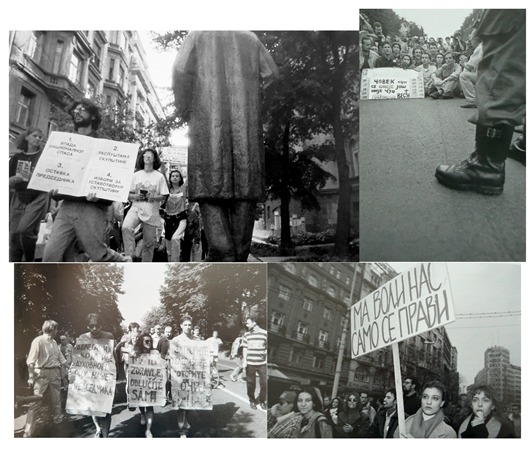
Compilation 5. Banners from the mass student protests in Belgrade in 1992 and 1996.
However, spatial and historical context play a significant role in determining whether the messages conveyed by the banners are directly ideological. The analysis shows that a clear correspondence between ideological content and mobilizing intent exists only at the University of Kragujevac. Historically, Kragujevac has been an important center of opposition, industry, and trade unions, and it played a significant role in laying the groundwork for the opposition’s victory and the democratic transition that followed the Bulldozer Revolution of 5 October 2000 (Rennick & Žilović, 2025). We encounter banners calling for a general strike in Kragujevac, emphasizing solidarity between students and workers and portraying corruption among governing elites as a key driver of brain drain. In contrast, Novi Sad, despite exhibiting the highest concentration of performative messages, is primarily oriented toward constructing communicative situations as mental models, directing protest discourse toward establishing the truth about the canopy collapse. The emphasis is less on ideological confrontation and more on accountability and factual clarification. Belgrade and Niš, as Serbia’s capital and second-largest city, respectively, occupy an intermediate position between these two protest models. These university centers also account for the largest number of photographed banners. Although most of these banners perform a performative function, they are not primarily ideological in the sense of polarization. Instead, they are dominated by the categories of grievance and action. Given the previously identified bias in the archive, we cannot directly and impartially confirm the hypothesis that the protests were primarily oriented toward civic mobilization. What can be stated with greater confidence, however, is that the mobilization was intergenerational in scope, regardless of whether its dominant character should be interpreted as civic or ideological.
According to the CRTA (2025) survey, respondents were asked whether Serbia is moving in the right or wrong direction: 46% said the country is moving in the right direction, 38% believed it is moving in the wrong direction, and 16% were undecided. These findings confirm that persistent polarization over political, economic, and social issues continues to characterize Serbian society, even amid intense political and media contestation over what constitutes “a message about wrongness” (Brandt, 2026). For this reason, the quantitative bias arising from the uneven distribution of photographs must be offset by a qualitative analysis of intentionality. Such an analysis must consider both the historical context of opposition activism and spatial factors, including city size, distance from the site of the canopy collapse, and the increasing pluralism of interests that accompanies larger urban environments. This is reflected in the fact that Belgrade and Niš exhibit a wider range of clusters related to grievance and action than Novi Sad. The evidence therefore points to the conclusion that the mobilization had a clear ideological intent. Its goal was not the broad mobilization of all citizens, including those who support the governing elites, but rather the targeted mobilization of citizens already inclined toward opposition politics. Among the 33% of Serbian citizens who support Aleksandar Vučić’s actions, only 12% also expressed support for the students (CRTA, 2025). This relatively small proportion suggests that the students’ actions in the blockade did not fully transcend the traditional patterns of political polarization that continue to structure political life in Serbia.
The confirmation of H2 is more straightforward. Quantitative indicators are particularly important in supporting this hypothesis, most notably the phenomena of hyperproduction and dense thematic clustering. As the analysis demonstrates, an exceptionally large number of banners were produced within a relatively short period, a pattern atypical for protest movements in Serbia. Traditionally, protest banners in Serbia focus on a single core campaign theme or symbol, with subsequent variations and individual expressions built around that central message (Atlagić, 2018). In the case of the student protests, however, the analysis identified a highly diverse set of campaign themes organized into clusters (22 unique clusters across the three analytical categories). Rather than communicating a unified theme through a simplified image of reality, the large number of clusters suggests that the students in the blockade adopted a diversified communication strategy more characteristic of campaigns conducted in digital environments.
Our research empirically contributes to debates about algorithms as a form of power production in society, particularly in the context of protests and political communication. We understand algorithms not as a matter of coding and cybernetics but, as Beer points out, as products of social forces, as are their implementations and redesigns (Beer, 2016, p. 4). As he further stresses, citing Crawford, the social embeddedness of algorithms is closely connected to agency (Beer, 2016, p. 5). Note that our interpretation of the banners focuses more on their structure than on the claim that they are algorithms. Because the banners are material products of human agency, their content offers a roadmap and clear instructions for civic participation through the repeatability and reproduction of political and cultural functions across generations. Similar findings on human agency and algorithms (such as bureaucratic organizations) term these relations “recursive functions” of algorithms in the social sciences (Totaro & Ninno, 2014, p. 44). We termed these functions clusters with algorithmic structure.
The most frequent clusters within each category (accountability, the image of the student, and motivation) are also the ones most consistently repeated across all universities. These clusters are distinctly intergenerational, having appeared repeatedly since the first major student protests in Serbia in 1991 and 1992. They articulate demands for political accountability, present students as a form of “politically uncorrupted youth,” and seek to motivate older generations to overcome apathy and engage in public action. Furthermore, the banners were visually structured through combinations of language, symbols, and images, and their content relied heavily on humor, satire, neologisms, and references to popular culture (Perišić, 2025), all characteristics commonly associated with Internet memes (see Compilation 6). The qualitative analysis likewise revealed substantial overlap with meme structures. The presence of popular-culture references on the banners, including song lyrics, movie quotations, and even Internet memes themselves, although not quantitatively dominant (ranking fifth among the clusters within the category of discontent), nevertheless points to a style of expression characteristic of linguistic memes (Madsen, 2026) and of the ways in which Generation Z communicates emotions and political attitudes, rather than to the conventions of traditional political protest banners.
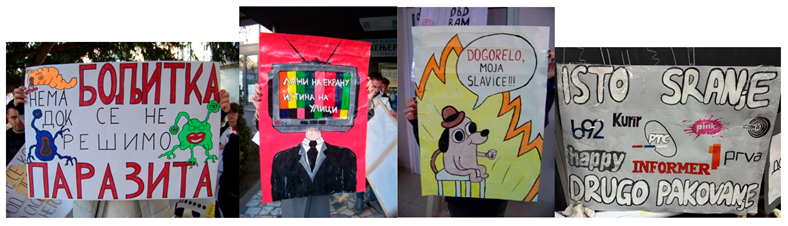
Compilation 6. Examples of visual structure of the banners directly associated with popular memes.
The analysis of intentionality also helped us better understand the relationship between the student banners and those used during the 1990s protests, as proposed in H3. Although the banners exhibit clear mimetic characteristics, their mobilizing function is directly performative, generating micro-practices in the physical world, such as blockades, noise-making, and collective silence.
The imperative slogan “Pumpaj!” (“Keep Pumping!”), which later became one of the defining symbols of the mass student protests (Perišić, 2025, p. 388), appears in only a single photograph in the archive (included in Compilation 3). Nevertheless, this performative expression warrants special attention because its strongly mimetic structure later became a prominent example of how digital content can be translated into everyday, offline interpersonal discourse. The slogan itself originated in a viral video of a performance by a popular folk singer at a 2022 wedding (013Info, 2025), entirely unrelated to either the protests or the canopy collapse. Its later appropriation by the student movement reinforces our argument about the mimetic structure of the banners produced by students, demonstrating how elements of digital culture can be detached from their original contexts, reinterpreted, and transformed into politically meaningful forms of collective expression.
The analysis of intension likewise indicates that the banners’ dominant function is performative. The meaning of these performatives is context-dependent, as they do not primarily call for direct action such as participating in protests. This is particularly important given that, immediately after the canopy collapse, a substantial portion of Serbian citizens exhibited a highly apathetic attitude toward politics in general and toward the prospects of organized opposition action in particular (Danas, 2024). Since a high degree of mobilization had already been achieved among the students themselves, the messages conveyed by the banners appear to have been directed less toward strengthening the movement’s internal cohesion and more toward reminding older generations of democratic partisans of their capacity for political participation. Only a small number of photographs in the sample explicitly referred to student organizational processes, such as legitimizing the plenum as an alternative organizational structure to existing student organizations and representative bodies. As the analysis demonstrates, most banners with ideological content focused on shaping the students’ public image. The image constructed in this way corresponds closely to the traditional representation of students in Serbia as individuals willing to struggle honestly for political ideals, in contrast to corrupt political elites. It is also in line with the image of Generation Z students as a global community that protests against the crisis of representation in late neoliberalism and blocks authoritarian actors from gaining power.
7. Concluding Remarks
The initial research question concerned identifying the communication pattern used by the student movement in Serbia to mobilize broader public support and evolve into a mass movement. We focused on communication between Students in Blockade and age cohorts over 30, positing that students have communication habits characteristic of Generation Z and that there is a communication gap between digital natives and digital immigrants. For successful social mobilization, we considered communication tools to bridge the gap between digitally socialized youth and citizens formed in the analog media environment. We utilized a database of photographs of student banners, arguing that the banners served as a bridge of communication between generations and as a tool for the political articulation that citizens had culturally internalized.
The results of the intensional analysis indicate that the banners served as a significant communicative mechanism for producing meaning in a political struggle against the captured institutions. The analysis was organized into three analytical groups: grievances, polarization, and action. The number of photographs suggests that the student protest’s objective was to articulate grievances and action, thereby giving the movement a distinctly civic character. However, a deeper analysis reveals that the quantity is a result of the availability of photographs, with the largest number taken at certain faculties of the University of Belgrade. Regional differences among faculties, spatial distance from the site of the tragedy, cultural and historical context, and the structural characteristics of student organizations were considered when assessing student mobility. This provided a balanced perspective on sheer numbers. The Students in Blockade movement established its political identity through polarization within a grassroots frame, distancing itself from the dominant “corrupt elites”. This ideological positioning opened political space for wider mobilization.
The analysis shows that a significant share of the banners was structured using internet-specific communication elements, including concise, easily recognizable messages. The analysis also shows that banners functioned both intentionally and algorithmically, repeating and reimagining thematic clusters historically known to mobilize oppositional citizens in Serbia. The algorithmic structure of the banners represents a novel form of post-digital political communication. This supports the hypothesis that the logic of memetic culture can be successfully materialized through traditional forms of protest. Consequently, the student protests in Serbia in 2025 exemplify successful post-digital political mobilization.
Regarding the impact on and triggering of political memory among older generations in Serbia, clusters such as corruption, accountability, and a captured public media service show a strong correspondence with the symbolic repertoire of student and civic protests of the 1990s. In this way, the banners served as a bridge between contemporary student activism and the collective memory of the generations who participated in Serbia’s previous waves of democratization. However, the differences observed in the discussion indicate that the student movement was not ideologically homogeneous but rather a decentralized network of nearly feudal interpretations of general clusters articulated through banners. Consequently, it is difficult to identify an ideological topic in Serbia that would mobilize citizens en masse, arguing for a more nuanced political campaign that addresses local grievances through political communication.
Author Contributions
Conceptualization, B.V., A.V.; Methodology, B.V.; Formal Analysis, B.V.; Investigation, B.V.; Data Curation, B.V.; Writing—original draft preparation, B.V., A.V.; writing—review and editing, B.V.; visualization, B.V. All authors have read and agreed to the published version of the manuscript.
Funding
This research received no external funding.
Institutional Review Board Statement
Not applicable.
Informed Consent Statement
Not applicable.
Data Availability Statement
The photographic archive used in this manuscript can be access at https://zenodo.org/records/15470518 (accessed on 28 June 2026).
Conflicts of Interest
The authors declarer no conflict of interest.
Notes
| 1 | Each compilation consists of eight photographs. Two photographs were selected from each university and arranged in the following order: Belgrade, Kragujevac, Niš, and Novi Sad. The selection was made for illustrative purposes. |
| 2 | RTS is a Serbian acronym for state owned public broadcaster Radio Television of Serbia. |
References
- 013Info. (2025). Zašto se kaže “Pumpaj”? Available online: https://013info.rs/zanimljivosti/zasto-se-kaze-pumpaj/#google_vignette (accessed on 12 June 2026).
- Atlagić, S. (2018). Politička slika sveta na izbornom plakatu u Srbiji od 1990 do 2017. godine. CM: Communication and Media, 13(43), 29–48. [Google Scholar] [CrossRef] [Scilit]
- Atlagić, S., Otović Višnjić, F., Obradović, N., & Sajić, N. (2026). Media and international relations: Serbian media narrative on the EU in light of the “lithium crisis” in Serbia. Journalism and Media, 7(1), 14. [Google Scholar] [CrossRef] [Scilit]
- Balunović, F. (2026). The obsolescence of human rights. CEU Press. [Google Scholar]
- BBC. (2024). Izbori u Srbiji 2023: Ubedljiva pobeda SNS na izborima za Skupštinu Srbije, u skupštinu ulazi 10 lista—RIK. Available online: https://www.bbc.com/serbian/lat/srbija-67744444 (accessed on 20 June 2026).
- Beer, D. (2016). The social power of algorithms. Information Communication & Society, 20(1), 1–13. [Google Scholar] [CrossRef] [Scilit]
- Brandt, E. E. S. (2026). Mirrors and messaging: The role of media in Serbia’s protests, 2023–2025. Philosophy and Society, 37(1), 99–120. [Google Scholar] [CrossRef] [Scilit]
- Bursać, D., Vučićević, D., & Stamenković, V. (2025). Political experience of local representatives in a flawed democracy: Serbia in comparative perspective. In D. Vučićević, & M. Veković (Eds.), Super election year 2024 (pp. 55–83). Udruženje za političke nauke Srbije & Univerzitet u Beogradu, Fakultet političkih nauka. [Google Scholar] [CrossRef] [Scilit]
- Cini, L., della Porta, D., & Guzman-Concha, C. (2021). Student movements in late neoliberalism: Forms of organisation, alliances, and outcomes. In L. Cini, D. della Porta, & C. Guzman-Concha (Eds.), Student movements in late neoliberalism (pp. 1–26). Palgrave Macmillan. [Google Scholar]
- CRTA. (2025). Stavovi građana Srbije o protestima i blokadama fakulteta. Available online: https://crta.rs/wp-content/uploads/2025/02/Crta-Istrazivanje-javnog-mnjenja-februar-2025.pdf (accessed on 10 June 2026).
- Danas. (2024). Istraživač agencije Faktor Plus: Rejting Vučića u ovom trenutku nije ugrožen. Available online: https://www.danas.rs/vesti/politika/rejting-vucic-2/ (accessed on 20 June 2026).
- Denzin, N. K. (2017). The research act: A theoretical introduction to sociological methods (1st ed.). Routledge. [Google Scholar]
- Djordjević, V., & Radeljić, B. (2026). From denial to demonization: Securitizing the 2024/25 student protests in Serbia. Journal of Political Power, 19(2), 296–321. [Google Scholar] [CrossRef] [Scilit]
- Fagan, A., & Ejdus, F. (2022). Lost at the waterfront? Explaining the absence of green organisations in the Don’t Let Belgrade D(r)Own movement. Environmental Politics, 31(7), 1289–1308. [Google Scholar] [CrossRef] [Scilit]
- Ferhani, A., & Nyman, J. (2023). What does security look like? Exploring interpretive photography as method. European Journal of International Security, 8(3), 354–376. [Google Scholar] [CrossRef] [Scilit]
- Fistrić, M. (2019). Utjecaj digitalizacije na generacijski jaz—Od bejbibumersa do generacije Z. Communication Management Review, 4(1), 120–139. [Google Scholar] [CrossRef] [Scilit]
- Freeden, M. (2015). The morphological analysis of ideology. In M. Freeden, L. T. Sargent, & M. Stears (Eds.), The Oxford handbook of political ideologies (pp. 115–137). Oxford University Press. [Google Scholar]
- Ganita, V., & Ardianto, A. (2024). Code-switching and slang: An analysis of language dynamics in the everyday lives of Generation Z. Linguistics Initiative, 4(1), 76–87. [Google Scholar] [CrossRef] [Scilit]
- Ilić, V. (2025). Protest “Bitnish”: Political communication through banners at student protests in Serbia (2024/2025). Etnoantropološki Problemi, 20(2), 497–534. [Google Scholar] [CrossRef] [Scilit]
- Jerkov, A., Bešlin, M., & Radeljić, B. (2025). The depoliticization of protest: Understanding the 2024/2025 Serbian students’ uprising. Cogent Social Sciences, 11(1), 2583748. [Google Scholar] [CrossRef] [Scilit]
- Jevtić, M. (2025). The pain on the political battlefield: Structuring the role of the media in protests triggered by mass murders in Serbia. Frontiers in Political Science, 7, 1654950. [Google Scholar] [CrossRef] [Scilit]
- Jost, J. T., Federico, C. M., & Napier, J. L. (2015). Political ideologies and their social psychological functions. In M. Freeden, L. T. Sargent, & M. Stears (Eds.), The Oxford handbook of political ideologies (pp. 232–250). Oxford University Press. [Google Scholar]
- Kulić, M. (2021). Dezinformacije u polarizovanom okruženju: Medijska slika Srbije. In A. Krstić (Ed.), Građani u doba dezinformacija (pp. 7–26). Udruženje za političke nauke Srbije & Univerzitet u Beogradu, Fakultet političkih nauka. [Google Scholar]
- Lončar, J., & Spasojević, D. (2022). Noise against the dictatorship: Battle for symbolic representation. Sociologija, 64(2), 227–247. [Google Scholar] [CrossRef] [Scilit]
- Luescher, T. M., Makhubu, N., Oppelt, T., Mokhema, S., & Radasi, M. Z. (2021). Tweeting #FeesMustFall: The online life and offline protests of a networked student movement. In L. Cini, D. della Porta, & C. Guzmán-Concha (Eds.), Student movements in late neoliberalism (pp. 117–145). Palgrave Macmillan. [Google Scholar] [CrossRef] [Scilit]
- Madsen, D. Ø. (2026). Generation Alpha speaks in memes: A conceptual framework for platformed language. Frontiers in Communication, 11, 1695863. [Google Scholar] [CrossRef] [Scilit]
- Marković, A., Zvijer, N., & Radoman, M. (2025). Photographic archive of student protest banners from the faculty blockades in Serbia, 2024–2025 (Version 1) [Data set]. Zenodo. [CrossRef]
- Matović, M., Milojević, M., Milin Perković, S., Tomašević, A., Josifović, S., & Jović, M. (2025). Media literacy of Serbia’s citizens: Survey research report. In Organization for security and co-operation in Europe, mission to Serbia. OSCE. Available online: https://serbia.osce.org/sites/default/files/documents/official_documents/2026/01/2025%20Media%20Literacy%20of%20Serbia%E2%80%99s%20citizens%2C%20Survey%20Research%20Report.pdf (accessed on 23 May 2026).
- Moskovljević, M., & Lazović, D. (2025). Between cultural engineering, media sensationalism and memetic propaganda: A curious case of erratic obituaries for the late American Secretary, Madeleine Albright. Critical Arts, 39(4), 187–208. [Google Scholar] [CrossRef] [Scilit]
- Nikitović, V. (2022). Stanovništvo Srbije: Dinamika i strukture. Republički Zavod za Statistiku. Available online: https://popis2022.stat.gov.rs/media/31458/1_stanovnistvo_srbije_dinamike_strukture.pdf (accessed on 8 April 2026).
- Peredy, Z., Vigh, L., Quingyu, W., & Muyi, J. (2024). Analysing generation Z communication attitudes, values and norms. Acta Periodica, 30, 4–19. [Google Scholar] [CrossRef] [Scilit]
- Perišić, N. (2025). The discourse of banners at student protests in Serbia (2024–2025). CM: Communication and Media, 20(58), 375–399. [Google Scholar] [CrossRef] [Scilit]
- Polanyi, M. (1966). The tacit dimension. Doubleday & Co, Inc. [Google Scholar]
- Pollozhani, L. (2026). Democracy pulse: Gen Z in the Western Balkans. Available online: https://osfwb.org/publication/democracy-pulse-gen-z-in-the-western-balkans-2/ (accessed on 8 April 2026).
- Popović, U., & Grujičić, N. (Eds.). (2025). Goranka matić. RTS Izdavaštvo & Službeni Glasnik. [Google Scholar]
- Prensky, M. (2001). Digital natives, digital immigrants, Part 1. On the Horizon, 9(5), 1–6. [Google Scholar] [CrossRef] [Scilit]
- Rennick, S. A., Jmal, N., Paturyan, J., & Vranić, B. (2025). Policy report: How EU democracy assistance to civil society can help secure democratic gains. EMBRACE Project. Available online: https://embrace-democracy.eu/wp-content/uploads/2025/05/EMBRACE_WP4_Policy-Brief-2.pdf (accessed on 14 May 2026).
- Rennick, S. A., & Vranić, B. (2026). Editorial: Configurations for democratic, economic and policy shifts after popular uprisings in European neighbourhood. Frontiers in Political Science, 8, 1776012. [Google Scholar] [CrossRef] [Scilit]
- Rennick, S. A., & Žilović, M. (2025). Seeking a way in/resisting a way out: Labor market dualization and democratic transition in Serbia and Tunisia. Frontiers in Political Science, 7, 1682080. [Google Scholar] [CrossRef] [Scilit]
- Reporters Without Borders. (2026). World press freedom index: Serbia. Available online: https://rsf.org/en/country/serbia (accessed on 9 April 2026).
- Rogers, R., & Giorgi, G. (2024). What is a meme, technically speaking? Information, Communication & Society, 27(1), 73–91. [Google Scholar] [CrossRef] [Scilit]
- Russell-Omaljev, A. (2016). Divided we stand: Discourses on identity in “First” and “Other” Serbia. Ibidem Press. [Google Scholar]
- Searle, J. R. (2010). Making the social world: The structure of human civilization. Oxford University Press. [Google Scholar]
- Spasojević, D. (2024). Antipolitika. Akademska knjiga. [Google Scholar]
- Spasojević, D., & Lončar, J. (2023). Facing protests in Serbia: Patterns of new competitive authoritarianism. Democratization, 30, 1380–1399. [Google Scholar] [CrossRef] [Scilit]
- Spasojević, D., Uljarević, D., & Cvetkovikj, I. (2025). Civic mobilization as a response to institutional deficit. Available online: https://collections.fes.de/publikationen/content/titleinfo/1886125 (accessed on 20 June 2026).
- Statistical Office of the Republic of Serbia. (2023). Enrolment students. Available online: https://www.stat.gov.rs/en-US/vesti/statisticalrelease/?p=14042 (accessed on 8 April 2026).
- Tarrow, S. (2014). Contentious politics. In D. della Porta, & M. Diani (Eds.), The Oxford handbook of social movements (pp. 86–107). Oxford University Press. [Google Scholar]
- Totaro, P., & Ninno, D. (2014). The concept of algorithm as an interpretative key of modern rationality. Theory Culture & Society, 31(4), 29–49. [Google Scholar] [CrossRef] [Scilit]
- Tzifakis, N., & Vasdoka, E. (2025). A strategic–relational approach to European Union enlargement: The reversed conditionality of Western Balkan governing elites. Comparative Southeast European Studies, 73(4), 475–502. [Google Scholar] [CrossRef] [Scilit]
- Van Dijk, T. A. (2015). Ideology and discourse. In M. Freeden, L. T. Sargent, & M. Stears (Eds.), The Oxford handbook of political ideologies (pp. 175–196). Oxford University Press. [Google Scholar]
- Vladisavljević, N. (2020). Izbori, demokratija i takmičarski autoritarizam u Srbiji (1990–2020). In M. Jovanović, & D. Vučićević (Eds.), Izbori u Srbiji 1990–2020 (pp. 991–1010). Službeni Glasnik. [Google Scholar]
- Vladisavljević, N. (2026). Serbia’s turbulent democratization. In I. Vujačić (Ed.), The post-socialist transition of Serbia: Economic policy, democracy, and European integration (pp. 257–284). Palgrave Macmillan. [Google Scholar]
- Vladisavljević, N., & Krstić, A. (2023). Competitive authoritarianism and populism in Serbia under Vučić in political cartoons. Europe-Asia Studies, 75(9), 1429–1452. [Google Scholar] [CrossRef] [Scilit]
- Vlajić, M., Tomanović, S., & Stanojević, D. (2026). The Generational “We”: Constructing generational consciousness among students in the 2024/25 protest. In V. Backović, A. Marković, M. Radoman, & N. Zvijer (Eds.), Studentski Protesti 2024/25:BloKADA, Ako Ne SADA? (pp. 35–51). Univerzitet u Beogradu—Filozofski fakultet i Institut za sociološka istraživanja. [Google Scholar] [CrossRef] [Scilit]
- Vranić, B. (2020). A clash of myths: Populism and ethno-nationalism in Serbia. In R. Heinisch, E. Massetti, & O. Mazzoleni (Eds.), The people and the nation: Populism and ethno-territorial politics in Europe (pp. 256–279). Routledge. [Google Scholar]
- Vranić, B. (2024). Političke ideologije: Od istine do tiranije. Clio. [Google Scholar]
- Vranić, B., & Jevtić, M. (2024). One tabloid to rule them all: Structuring populist media response—The case of Belgrade Waterfront protests in 2016. Politička Misao, 61(4), 7–29. [Google Scholar] [CrossRef] [Scilit]
- Vukelić, M. (2026). Cyber Westphalia and the post-digital man: The case of culture wars in liberal democracies after 2014. Millennium, 52(2), 240–265. [Google Scholar] [CrossRef] [Scilit]
- Vuković, D., & Stefanović, M. (2024). Leaving no one behind: Party clientelism in social welfare in Serbia. Anali Pravnog fakulteta u Beogradu, 72(4), 697–722. [Google Scholar] [CrossRef] [Scilit]
- Vuković, Đ., & Vranješ, A. (2025). Virtualna lomača: Kako društvene mreže razaraju javnu debatu? HeraEdu & Institut za Političke Studije. [Google Scholar]
- World Economics. (2025). Nepal’s median age—Latest estimate in years. Available online: https://www.worldeconomics.com/Demographics/Median-Age/Nepal.aspx (accessed on 8 April 2026).
- Yaseen, M. S., Alzyod, R., Al-Adwan, A., & Sa’di, R. (2026). English and identity in the digital age: Social media, code-switching, and linguistic hybridity among Jordanian Generation Z. World Journal of English Language, 16(2), 502–511. [Google Scholar] [CrossRef] [Scilit]
- Zvijer, N., Marković, A., & Radoman, M. (2025). Svi u blokade! Analiza parola tokom studentskih blokada u Srbiji 2024/2025. Sociologija, 67(4), 589–613. [Google Scholar] [CrossRef] [Scilit]

Disclaimer/Publisher’s Note: The statements, opinions and data contained in all publications are solely those of the individual author(s) and contributor(s) and not of MDPI and/or the editor(s). MDPI and/or the editor(s) disclaim responsibility for any injury to people or property resulting from any ideas, methods, instructions or products referred to in the content. |
© 2026 by the authors. Licensee MDPI, Basel, Switzerland. This article is an open access article distributed under the terms and conditions of the Creative Commons Attribution (CC BY) license.