


Abstract
This systematic review draws on the concepts of continuous learning and unlearning to examine the emerging competencies journalists need in the AI-driven news environment, focusing on the need to both learn new AI-related skills and unlearn outdated practices. The study reviewed 90 peer-reviewed studies and 10 industry reports published between 2000 and 2025 on AI literacy, data-driven reporting, algorithmic understanding, and AI ethics. The findings reveal a significant gap between the traditional competencies emphasised in journalism training and the evolving demands of AI-enabled newsrooms. The study suggests that journalists must not only learn new skills such as algorithmic reasoning and data analysis but also unlearn legacy practices, including linear workflows and traditional gatekeeping roles. The study identifies continuous learning and unlearning as essential for journalists to maintain editorial autonomy, critical engagement, and ethical responsibility in AI-mediated environments. The study underscores the importance of integrating both learning and unlearning into ongoing professional development to ensure sustainable, effective journalism in the age of AI.
1. Introduction
Journalism in the twenty-first century is increasingly shaped by the rapid diffusion of artificial intelligence (AI) technologies, transforming news gathering, production, distribution, and audience engagement (Noain-Sánchez, 2022; Pavlik, 2023). AI-driven tools, automated content generation, algorithmic news selection, data scraping, and verification systems are redefining professional norms and raising fundamental questions about journalistic competence, authority, and identity in contexts of human–machine collaboration (Moran & Shaikh, 2022; Kothari & Cruikshank, 2022). These shifts revive a long-running debate about what journalistic competence itself entails, a debate that predates AI but is newly urgent under algorithmic conditions (Guo & Volz, 2021; Estella, 2021). While these developments promise efficiency and innovation, they simultaneously disrupt long-standing routines and epistemologies, challenging established notions of gatekeeping and editorial autonomy; journalism is therefore no longer sustained solely through acquiring new technical skills but increasingly depends on journalists’ capacity to critically reassess and abandon practices misaligned with AI-enabled environments (Noain-Sánchez, 2022; Kothari & Cruikshank, 2022).
Journalism education and professional training still focus heavily on traditional skills, linear workflows, manual verification, and human editorial control. As AI becomes more integrated into newsroom systems, concerns arise about journalists’ readiness to navigate algorithm-driven environments (Moran & Shaikh, 2022; Kothari & Cruikshank, 2022). Research consistently highlights the importance of developing skills like algorithmic literacy, data-based reporting, automated fact-checking, and ethical judgement, but these areas are not evenly incorporated into ongoing professional development (Pavlik, 2023; Noain-Sánchez, 2022; Sonni et al., 2024). Less attention is given to unlearning: the process of abandoning routines and beliefs that impede effective AI engagement. When unlearning is discussed, it is often implicit rather than recognised as a formal part of professional change, leading to a fragmented understanding of how journalists adapt and why resistance to AI persists, keeping old newsroom practices alive.
This paper reviews emerging journalistic competencies in the AI era, treating learning and unlearning as linked strategies. Using PRISMA, it synthesises studies, curriculum analyses, reports, and policies from 2000–2025 to examine how journalistic competence is being redefined amid algorithmic mediation, proposing an integrated framework in which deliberate unlearning is as vital as skill acquisition. Two research questions guided the study:
- i.
- What new competencies, skills, and literacies are identified in the literature as essential for journalists to operate effectively in AI-enabled news environments?
- ii.
- What legacy routines, practices, and professional assumptions must journalists unlearn to adapt successfully to AI-driven transformations in journalism?
The paper next outlines the theoretical framework, methodology, findings, and implications for journalism training, professional norms, and future research.
2. Theoretical Framework: Continuous Learning and Unlearning in AI-Enabled Journalism
Before exploring how journalists learn and unlearn, it is important to define journalistic competence. Competence goes beyond a single skill; it encompasses cognitive, knowledge-based, functional, personal, behavioural, and ethical aspects, forming an integrated ability to fulfil a professional role. Guo and Volz (2021), through analysing broadcast job advertisements, highlight this multidimensional perspective. This approach warns against viewing AI literacy as an isolated skill; instead, AI skills coexist with and influence the cognitive, functional, and ethical components that have traditionally shaped journalistic professionalism (Willnat et al., 2013).
Journalistic competence is also historically contingent rather than fixed. Estella (2021) shows that the professional toolbox journalists are expected to hold has been repeatedly redefined by successive waves of disruption, from digital and mobile production to the platform era. Emerging competencies in the AI era are therefore not an entirely new category but the latest stage in a long-running renegotiation of what journalists must know, do, and value, providing the conceptual anchor for the continuous learning and unlearning perspective that follows.
Continuous Learning and Unlearning
This paper is grounded in continuous learning, a multidimensional framework rooted in lifelong learning theory, institutional learning, work-integrated learning, and computational models of continual learning. In journalism studies, continuous learning is increasingly viewed as an ongoing, cumulative, reflexive process through which journalists adapt their skills, identities, and practices in response to technological, institutional, and epistemic change (Bidzilya et al., 2022; Koivula et al., 2023), refreshing skills, literacies, and ethical reasoning as news production becomes increasingly data-driven, automated, and algorithm-mediated (Murphy, 2019; Balčytienė, 2025).
Institutional and workplace learning theories refine this understanding by emphasising that newsroom cultures, institutional logics, and power relations shape professional learning and can enable or constrain adaptation. Koivula et al. (2023) indicate that journalists’ motivation to learn is mediated by competing institutional logics, including professional autonomy, commercial pressures, and technological rationalisation, while studies of retraining initiatives reveal that interventions prioritising technical upskilling without addressing entrenched professional norms produce superficial rather than substantive adaptation (Zervakaki et al., 2025; Murphy, 2019). Continuous learning is therefore inseparable from unlearning, a concept developed in the organisational learning literature to describe the deliberate discarding of established routines and assumptions to make way for new ones (Hedberg, 1981; Tsang & Zahra, 2008), denoting the intentional disengagement from legacy routines, assumptions, and hierarchies misaligned with contemporary media environments (Kilpert & Shay, 2013; Koivula et al., 2023).
Work-integrated and practice-based learning models extend this framework by situating learning within real newsroom contexts where knowledge is acquired through doing, collaboration, and iterative reflection, converging with information literacy research linking lifelong learning to creativity, work performance, and professional resilience (Valencia-Forrester, 2020; Balčytienė, 2025; Saadia & Naveed, 2023; Shaukat et al., 2024). Computational theories of continual learning offer a complementary perspective. In AI research, continual learning describes systems that gradually acquire new knowledge while avoiding catastrophic forgetting (Wang et al., 2023; Graffieti et al., 2022). Applied to journalism, this highlights the importance of integrating new skills while selectively discarding outdated practices, as exemplified by the “journalist-in-the-loop” model, which positions journalists as active learners continuously refining both human judgement and machine outputs through iterative feedback (Karmakharm et al., 2019).
This framework addresses the paper’s two guiding questions by treating competency identification and deliberate unlearning as complementary analytical lenses that together underpin sustainable journalism in the age of artificial intelligence.
3. Methodology
3.1. Research Design and Approach
This study employed a systematic review design supported by a qualitative, theory-informed synthesis to examine emerging journalistic competencies and the unlearning of legacy professional practices in the artificial intelligence era. The review followed the PRISMA 2020 reporting guidelines (Page et al., 2021). All stages of identification, screening, eligibility assessment and inclusion were documented and aligned with PRISMA 2020. However, the review protocol was not formally preregistered. The completed PRISMA 2020 checklist is provided as Supplementary Material.
The review adopted an interpretive and integrative orientation suited to the heterogeneous literature spanning journalism studies, media education, communication research and computational social science. The synthesis prioritised conceptual mapping and thematic interpretation rather than statistical aggregation. This approach enabled the review to examine how professional learning, reskilling and unlearning are conceptualised across different disciplinary and professional contexts.
3.2. Eligibility Criteria
Clearly defined inclusion and exclusion criteria were applied to enhance the transparency, consistency and reproducibility of the review (see Table 1). Eligibility decisions were guided by relevance to journalism, artificial intelligence and professional competencies rather than methodological uniformity.
Table 1.
Inclusion and exclusion criteria.
During synthesis, studies were grouped by dominant analytical orientation: journalism education and training; newsroom practice and workflows; artificial intelligence literacy and verification; automation and professional identity; and ethical or governance-related competencies.
3.3. Information Sources
Scopus was the primary bibliographic database used to identify scholarly literature. It was selected because its structured indexing and interdisciplinary coverage enabled the systematic retrieval of research across journalism, communication, media education, technology and computational social science. The final Scopus search was conducted on 1 February 2026. The database search was supplemented by targeted searches of official organisational, professional and institutional websites to identify relevant reports and policy documents. Reference lists of influential and eligible studies were also examined through backward citation searching. Forward citation searching was conducted using the Scopus “Cited by” function to assess the coverage of influential and frequently cited publications. The supplementary searches identified 20 reports and policy-related documents. Following eligibility assessment, 10 of these documents were included in the final synthesis. These supplementary sources were included to capture professional, institutional, and policy developments that may not have been adequately represented in the peer-reviewed literature.
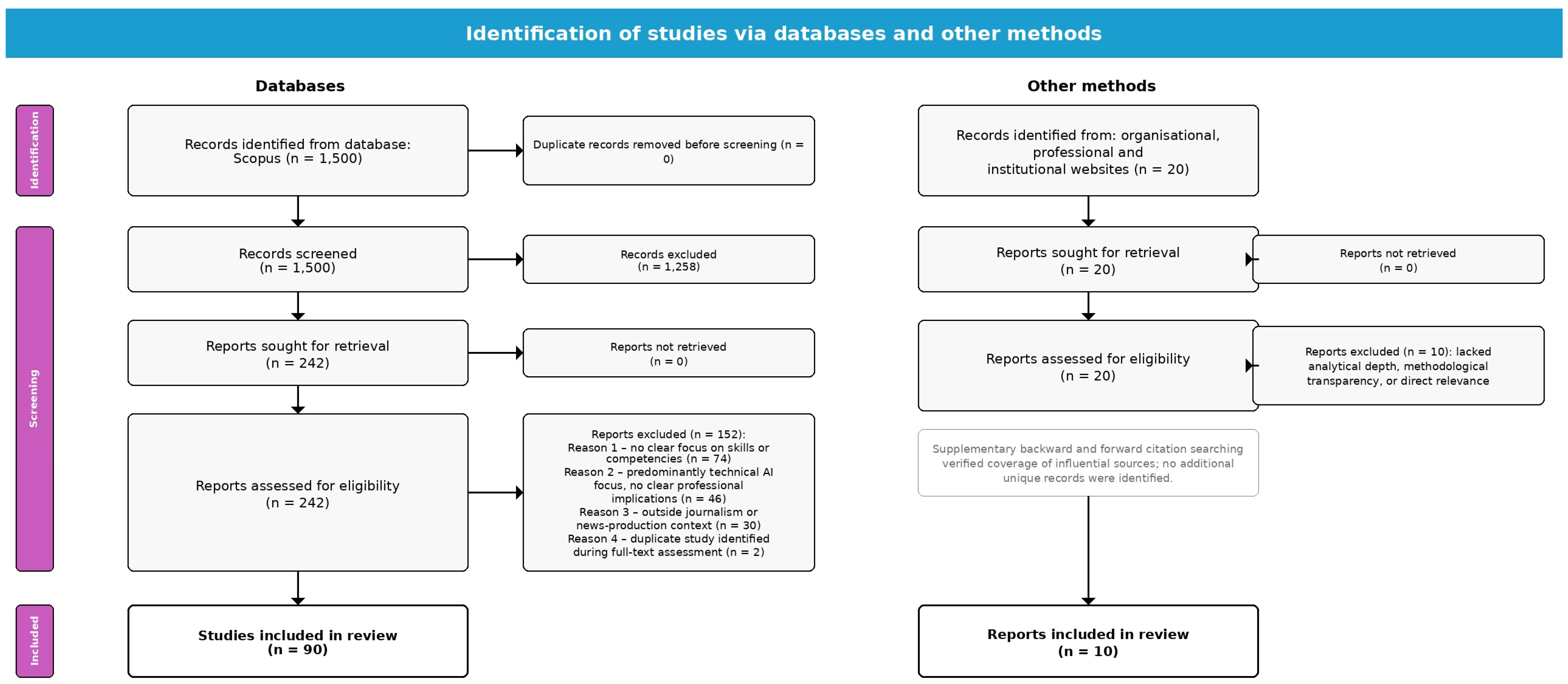
Scopus was judged sufficient as the sole bibliographic database for the systematic search because its interdisciplinary indexing spans the journalism, communication and media-education outlets central to this review as well as the computer-science and human–computer interaction venues where more technically oriented AI-and-journalism scholarship is often published, and because it provides the structured export functionality needed for a reproducible, auditable search. This single-database strategy is nevertheless a limitation, which is why it was deliberately combined with grey-literature searching and backward and forward citation tracking (Section 3.4) to offset recall gaps. Records exported from Scopus were checked for duplicates within the reference-management spreadsheet at the point of export and again during title-and-abstract screening; because the grey-literature, backward-citation and forward-citation searches described below were cross-checked against the Scopus set before being added to the corpus, rather than merged into it as a second database stream, no duplicate records required removal at the identification stage, as reported in Figure 1.
Figure 1.
PRISMA Flow Diagram for Study Selection Process. The PRISMA flow diagram presents the two identification streams separately—the Scopus database search and the supplementary grey-literature/institutional-website search—and documents the number of records at each stage and the reasons for exclusion, so that the figures reported here reconcile fully with those reported in the text (Section 3.5) (Page et al., 2021).
3.4. Search Strategy
The search strategy was designed to support comprehensive and transparent identification of relevant literature (see Table 2). The academic search was executed electronically in Scopus, while the retrieved records were screened manually. The Scopus search was organised around three concept blocks representing artificial intelligence, journalism and professional competencies. Terms within each concept block were connected using the Boolean operator OR, while the three concept blocks were connected using AND. The following search string was applied to the titles, abstracts and keywords of indexed publications:
Table 2.
Search strategy and information retrieval procedures.
(“artificial intelligence” OR AI OR “automated journalism” OR “algorithmic journalism” OR “robot journalism”) AND (journalism OR journalists OR “news production” OR newsroom) AND (skill OR competence OR literacy OR training OR education)
No date, document-type or subject-area restrictions were applied during the initial database search. This broad strategy was intended to capture the historical development of artificial intelligence-related competency debates within journalism. The Scopus search retrieved 1500 records.
In parallel, grey literature and policy documents were identified through targeted keyword searches of official organisational, professional and institutional websites. Search combinations included terms such as “AI in journalism” AND report, “automated journalism” AND policy, and “artificial intelligence” AND journalism AND skills. These searches identified 20 potentially relevant reports and policy documents.
Backward reference searching was conducted by examining the reference lists of key studies. Forward citation searching was undertaken using the Scopus “Cited by” function. These supplementary procedures were used to verify the coverage of influential publications and identify any relevant sources not captured through the primary search. No additional unique academic studies were identified beyond those already captured in the Scopus search.
3.5. Selection Process
The study selection process followed the PRISMA 2020 flow structure and was undertaken by the author. During the identification stage, 1500 academic records were retrieved from Scopus, and 20 records were identified through targeted searches of institutional, organisational and policy websites. During title and abstract screening, 1258 academic records were excluded because they did not adequately address the intersection of journalism, artificial intelligence and professional competencies. This left 242 academic publications for full-text eligibility assessment.
The 20 reports and policy documents were screened separately. Ten were excluded because they lacked sufficient analytical depth, methodological transparency or direct relevance to the review objectives. The remaining 10 documents were retained for full-text assessment and subsequently included in the review. At the eligibility stage, the full texts of 242 academic publications were assessed against the criteria presented in Table 1. A total of 150 publications were excluded. These exclusions comprised publications lacking an explicit focus on skills or competencies (n = 74), studies with a predominantly technical artificial intelligence focus and no clear professional implications (n = 46), and studies situated outside journalism or news production contexts (n = 30). The final corpus comprised 90 peer-reviewed academic studies and 10 eligible reports and policy documents, producing a total of 102 included sources (see Appendix A and Appendix B). The selection process and reasons for full-text exclusion are presented in the PRISMA flow diagram in Figure 1.
Screening was conducted by the author, with ChatGPT used only to support an initial rapid assessment of records against the predetermined eligibility criteria in Table 1. All records flagged as relevant, irrelevant or borderline were subsequently checked manually. The author made all final inclusion and exclusion decisions. Because screening was undertaken by a single reviewer, no independent second-reviewer assessment was conducted, and no inter-rater reliability statistic was calculated. This limitation is acknowledged in the Limitations section.
3.6. Data Extraction
Data extraction was conducted after completion of title-and-abstract screening and full-text eligibility assessment. Bibliographic metadata for all records were exported from Scopus and organised in a structured spreadsheet. Detailed data were then extracted manually from the full texts of the 90 included peer-reviewed studies. The extraction matrix captured the author, publication year, geographical and institutional context, publication type, study aim, methodological design, participant or data source, form of artificial intelligence examined, stage of news production affected, and principal findings. Information that was absent or unclear in the original publication was recorded as “not reported” rather than inferred.
A second level of extraction focused specifically on evidence relevant to the review objectives. This included emerging journalistic skills and competencies, legacy practices requiring adaptation or unlearning, professional learning mechanisms, barriers and enablers of competency development, and implications for journalism education, newsroom practice, professional identity, ethics and governance. Relevant findings were recorded as close paraphrases or short illustrative extracts, together with page numbers, to maintain traceability to the original sources. The 10 included institutional and policy reports were extracted using the same thematic fields whilst being recorded separately from the peer-reviewed studies to preserve the distinction between scholarly and grey literature.
3.7. Risk of Bias and Quality Appraisal
Given the predominance of conceptual, qualitative and narrative publications within the corpus, conventional quantitative risk-of-bias instruments were not applied. Instead, the included publications were subjected to an interpretive quality appraisal focusing on transparency of argumentation, clarity of analytical scope, identification of the evidential basis and coherence between the evidence presented and the conclusions reached. This approach was consistent with established guidance for qualitative and integrative evidence synthesis (Popay et al., 2006).
The quality and methodological strength of the included literature were uneven. Conceptual, normative, and curriculum-oriented contributions constituted more than half of the peer-reviewed corpus, accounting for 54 of the 90 academic studies (58.7%), as shown in Table 3. Empirical investigations of actual newsroom practices, competency development and professional unlearning were comparatively limited. Consequently, a substantial proportion of the claims within the literature rested on conceptual argumentation, normative reasoning and disciplinary consensus rather than directly observed professional practice.
The corpus was also geographically concentrated. These limitations do not invalidate the principal themes identified in the review because the themes recur across multiple independent sources. However, they reduce the extent to which findings from individual studies can be generalised across different journalistic, institutional and geographical contexts.
3.8. Synthesis Methods
A two-stage synthesis strategy was employed. The first stage involved descriptive mapping of publication patterns, methodological orientations, geographical distribution and thematic concentration. The second stage consisted of a qualitative thematic analysis combining inductive and deductive coding, informed by continuous professional learning and unlearning frameworks (Braun & Clarke, 2021). Inductive coding was used to identify recurrent competencies, professional practices and emerging concerns within the included literature. Deductive coding was used to examine how these findings related to broader concepts of professional learning, reskilling, adaptation and unlearning. The initial codes were compared, refined and organised into broader analytical categories and themes. No statistical meta-analysis, subgroup analysis, heterogeneity assessment or sensitivity analysis was undertaken because the review did not synthesise comparable quantitative effect estimates.
3.9. Reporting Bias and Certainty of Evidence
Potential reporting bias was addressed partly by including reports and policy documents alongside peer-reviewed academic research. This enabled the review to incorporate evidence concerning professional standards, organisational responses, training initiatives and policy developments that may not yet have been represented in academic publications. Formal certainty-of-evidence frameworks such as GRADE were not applied because the review predominantly synthesised qualitative, conceptual and heterogeneous evidence rather than intervention-effect estimates. Confidence in the findings was therefore assessed through the recurrence and convergence of themes across independent sources, the methodological transparency of the included publications, the coherence between evidence and claims, and the consistency of interpretations across different disciplinary and geographical contexts.
4. Results
4.1. Characteristics of the Studies
The following bibliometric overview is reported briefly as background to the substantive thematic findings that follow, which form the core contribution of the review.
4.1.1. Publication Trends (2000–2025) in the 90 Studies
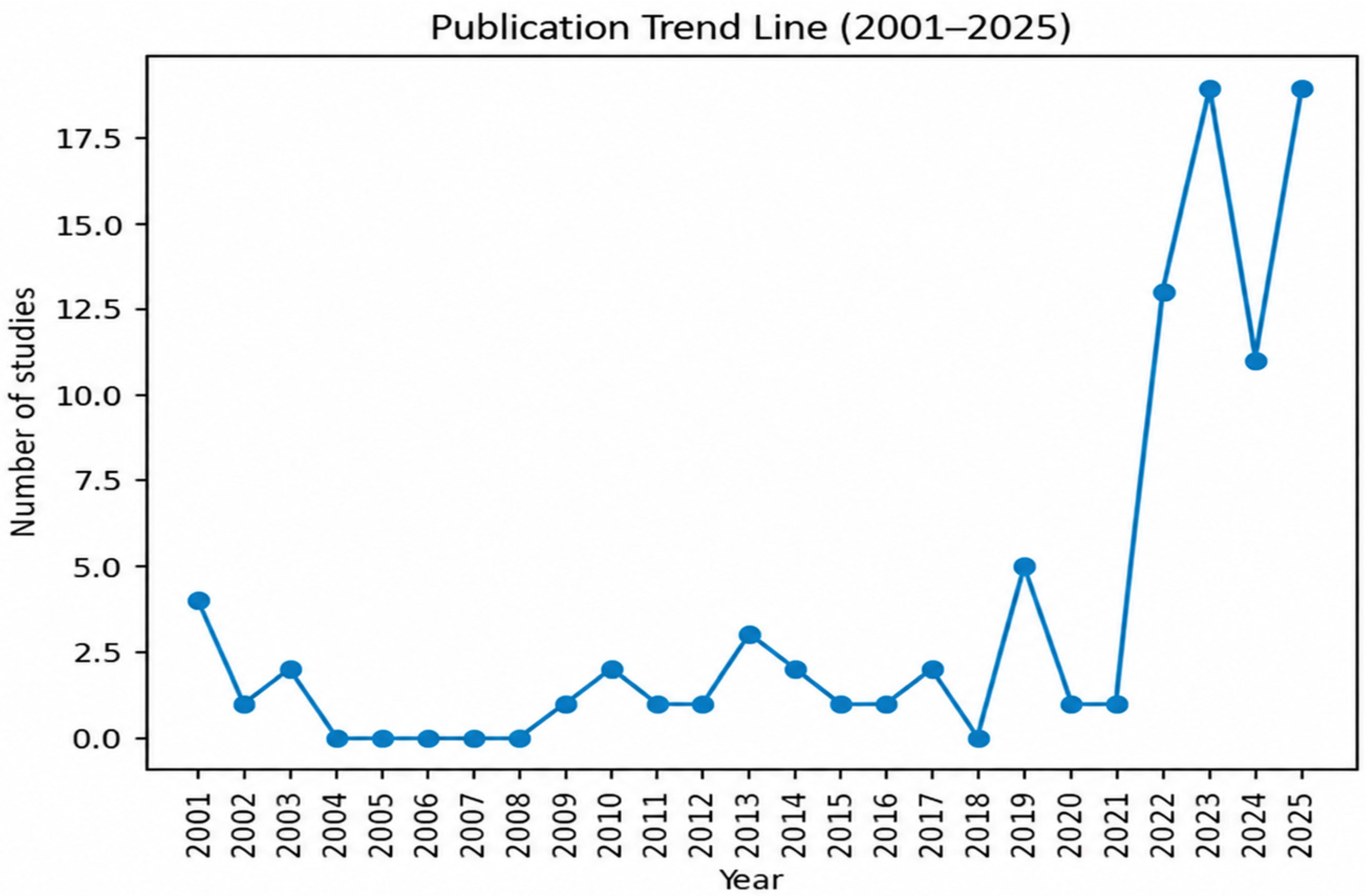
Publication activity rose sharply after 2022 (see Figure 2). Only 16 studies appeared before 2018, focusing on foundational topics such as journalism education and digital skills with limited reference to AI, whereas 62 studies were published between 2022–2025, reflecting the rapid expansion of generative AI in journalism. The peak years are 2023–2025: 19 studies each, with 2024 accounting for 11, confirming AI’s growing recognition as a driver of change in journalistic learning and adaptation.
Figure 2.
Trends in publications.
4.1.2. Research Designs and Methods in Reviewed Studies (n = 90)
Methodologically, the corpus is dominated by conceptual, normative, and curriculum-oriented contributions (54/90; Table 3), indicating that most scholarship focuses on defining competencies and theorising professional change rather than testing claims empirically. Survey/quantitative studies account for 17/90, while qualitative studies, case studies/theses, mapping/scoping outputs, and comparative or content-analysis designs are each comparatively rare, suggesting that systematic interpretive designs remain less visible than reform-driven conceptual work.
Table 3.
Methodological distribution.
4.1.3. Thematic/Conceptual Focus (Multi-Coding)
The thematic distribution (Table 4) shows that the literature is concerned mainly with learning, professional change, and institutional adaptation rather than narrowly technical questions. The prominence of education, skills, and continuous learning themes confirms that AI is treated primarily as a professional and pedagogical issue, while the substantial presence of ethics, trust, and professional identity themes suggests that AI increasingly challenges core journalistic assumptions, implicitly signalling the need to unlearn old routines even where this is not explicitly stated.
Table 4.
Dominant Thematic Areas.
4.1.4. Country Distribution of Studies
The 90 studies are geographically uneven: the United Kingdom (12.0%) and Spain (9.8%) are the largest single-country contributors, followed by China, Germany/Central Europe, South Africa, the United States, Portugal, and India, with a long tail of countries contributing one or two studies each (Table 5). Global or cross-national studies form the single largest category overall (17.4%), indicating that journalism scholarship increasingly treats AI-driven change as a globally shared phenomenon rather than a purely national one.
Table 5.
Distribution of Studies by Country (n = 90).
4.2. Qualitative Thematic Analysis
Before presenting the four thematic patterns in detail, Table 6 summarises the specific emerging competencies identified across the reviewed literature, together with a brief explanation of what each involves and the sources from which it was drawn. The four themes discussed below elaborate on how these competencies are acquired, exercised, and sustained through continuous learning.
Table 6.
Emerging Journalistic Competencies Identified in the Reviewed Literature.
These eight competencies are not discrete or sequential; the reviewed literature treats them as overlapping capacities that journalists develop iteratively, often in combination, as the sections below discuss in turn.
Two analytical distinctions guide how the competencies and unlearning dimensions below are read against the underlying evidence. First, the corpus is not evidentially uniform: only 30/90 studies employ a primary empirical design (survey, qualitative, case study/thesis, comparative or content analysis; Table 3), a further 8/90 are literature reviews or mapping/scoping studies synthesising others’ evidence, and 54/90 are conceptual, normative or curriculum-analytic contributions not based on new data collection; the 10 institutional and policy reports are professional rather than peer-reviewed sources. Empirical findings are reported below using observational language (e.g., “journalists reported,” “interviews indicate”), whereas conceptual, curriculum-analytic and report-based sources are flagged as arguing, proposing or recommending; where a theme rests predominantly on the latter, this is noted explicitly rather than left implicit, consistent with the more cautious, hedged interpretation the corpus composition warrants (Section 3.7).
Second, “unlearning” itself is treated unevenly across the literature. A minority of sources engage unlearning directly, either drawing explicitly on organisational-unlearning theory (Hedberg, 1981; Tsang & Zahra, 2008; Kilpert & Shay, 2013; Koivula et al., 2023) or empirically documenting journalists actively discarding specific routines (Murphy, 2019; Gutierrez Lopez et al., 2023). The majority of sources cited under the two unlearning-oriented themes below (Section 4.2.3 and Section 4.2.4) do not use the term “unlearning” themselves; rather, their findings on resistance, routine persistence, or role disruption are interpreted through the unlearning lens as part of this review’s synthesis. This distinction matters for evidentiary strength: the unlearning themes represent this review’s theoretical contribution more than a direct empirical consensus already established in the primary literature, a point returned to in the Discussion.
4.2.1. Algorithmic, Data, and AI Literacy as Core Journalistic Competence Through Continuous Learning
Throughout the reviewed literature, algorithmic, data, and AI literacy are consistently treated as essential professional competencies requiring ongoing development, not supplementary technical skills. Drawing on journalism-as-a-knowledge-profession perspectives (de Burgh, 2003; Donsbach, 2014) and institutional logics theory (Koivula et al., 2023), scholars argue that journalistic authority increasingly depends on journalists’ ability to understand, interpret, and critically engage with the algorithmic systems that now shape news discovery, selection, production, and dissemination. Rather than a neutral efficiency tool, algorithms actively participate in meaning-making by shaping visibility and steering narrative trajectories, requiring journalists to continually update their epistemic skills to preserve editorial judgement and autonomy (van Dalen, 2012; Deuze & Beckett, 2022; Simon, 2024).
Interpreted through continuous learning theory, this literacy is an adaptive disposition rather than fixed knowledge, cultivated iteratively as technologies and newsroom practices evolve (Kilpert & Shay, 2013; Murphy, 2019; Bidzilya et al., 2022; Brautović, 2021), often through work-integrated, practice-based learning that lets journalists learn in situ (Valencia-Forrester, 2020; Biswas & Bland, 2024). This competence also functions as epistemic authority: AI tools embed data-driven inference and opaque logics into editorial decision-making, so journalists must interpret system outputs critically and recognise error margins rather than becoming dependent on systems whose internal logic they do not understand (Jones et al., 2022; Gutiérrez-Caneda et al., 2023; Cools & Diakopoulos, 2024).
This algorithmic and data literacy is, in turn, inseparable from broader information literacy and lifelong learning. Journalists with stronger foundations in critical data reasoning adapt more readily to AI-driven change (Saadia & Naveed, 2023; Shaukat et al., 2024). Professional reports corroborate this: Reyes-de-Cózar et al. (2022) identify data literacy, verification, and ethical reasoning as essential but under-prioritised, while the earlier SANEF Skills Audit (Tsedu et al., 2002) had already flagged an overemphasis on technical execution over analytical competence, a gap AI now amplifies.
4.2.2. Hybrid Human–Machine Collaboration, Verification, and Ethical AI Competence as Emerging Journalistic Skills
Beyond algorithmic and data literacy, the reviewed literature converges on a second cluster of competencies centred on hybrid human–machine collaboration, AI-supported verification, and ethical judgement. Interpreted through continuous learning theory, these reflect a shift from tool-based adaptation toward relational, supervisory expertise. Journalists increasingly operate AI systems in high-stakes editorial contexts. In these environments, authority is distributed between human and computational actors (Karmakharm et al., 2019; Sirén-Heikel et al., 2023; Opdahl et al., 2023). This pattern is corroborated by Sonni et al.’s (2024) systematic review of 127 studies. The review found that AI adoption was more commonly associated with the emergence of hybrid “journalist-programmer” roles than with the straightforward replacement of journalistic tasks.
At the core of this theme is human-in-the-loop and journalist-in-the-loop competence, which redefines journalistic labour as iterative oversight rather than linear production. Journalists must evaluate system outputs, intervene on errors and biases, and provide feedback that recalibrates algorithmic performance over time (Thurman et al., 2017; Karmakharm et al., 2019; Postma, 2024). This competence is not static; it matures through repeated interaction and experiential learning rather than one-off training (Murphy, 2019; Brautović, 2021; Koivula et al., 2023).
Closely linked is AI-enhanced verification and credibility assessment. AI tools increasingly detect misinformation and assess source credibility at scale (Chiang et al., 2022; Saadia & Naveed, 2023; Shaukat et al., 2024), but such systems reconfigure rather than replace journalistic verification, requiring journalists to interpret probabilistic outputs and recognise the limits of automated detection (Lermann Henestrosa et al., 2023; Jones et al., 2022). Ethical competence is a third dimension. AI adoption amplifies existing responsibilities while introducing new dilemmas around transparency, accountability, bias, and hallucinated content (Mahony & Chen, 2025; Zhaxylykbayeva et al., 2025; Abdulrauf et al., 2025; Simon, 2024; Moravec et al., 2024), requiring ethical reasoning sustained through reflection rather than compliance with static codes (Balčytienė, 2025; Hickerson, 2025). Professional and policy reports reinforce this evidence. The NCTJ (2014) both emphasise adaptive judgement and collaborative decision-making over static, role-based expertise; Reyes-de-Cózar et al. (2022) show high-performing newsrooms prioritise interpreting algorithmic outputs, and the earlier SANEF Skills Audit (Tsedu et al., 2002) found that a narrow focus on task execution left journalists ill-equipped for technological change.
4.2.3. Unlearning Linear, Individualised, and Tool-Centric Newswork Logics
Across the reviewed literature, a central impediment to effective adaptation lies not in the absence of new technologies but in the persistence of legacy newswork logics that structure how journalists conceptualise production, authority, and professional value. Unlearning, in this sense, is not a passive fading of obsolete routines but an intentional, reflexive process through which outdated cognitive and organisational frames are destabilised to create space for new practice (Adam, 2001; Hedberg, 1981; Kilpert & Shay, 2013; Murphy, 2019; Tsang & Zahra, 2008; Koivula et al., 2023). The linear model of news production is historically stabilising but increasingly constraining, as AI-enabled workflows introduce automation, prediction, and generation at multiple points in the news cycle (Thurman et al., 2017; Sirén-Heikel et al., 2023; Ufarte-Ruiz et al., 2023). A design ethnography of AI adoption in two London newsrooms illustrates this. Gutierrez Lopez et al. (2023) found that AI tools were successfully absorbed only where journalists and technologists jointly redesigned workflows, whereas bolting automation onto an unchanged, linear workflow produced friction and low uptake, reinforcing scepticism toward automation (Moran & Shaikh, 2022; Makwambeni et al., 2023).
Equally significant is unlearning individualised, writing-centric professional identities. Traditional journalistic authority has been anchored in authorship and the autonomous reporter, but AI systems that generate text and curate content decouple authorship from human labour (van Dalen, 2012; Ellekrog, 2022; Lermann Henestrosa et al., 2023), allowing new roles centred on editorial supervision, verification, and sense-making, where judgement is exercised relationally rather than individually (Møller et al., 2025; Kevin-Alerechi et al., 2025). The literature also critiques tool-centric innovation: competence now lies in understanding how systems influence news values and power relations, not merely operating interfaces (Deuze & Beckett, 2022; Moravec et al., 2024). Professional reports corroborate this evidence. The SANEF Skills Audit (Tsedu et al., 2002) and NCTJ (2014) both found that treating innovation as tool acquisition produces superficial upskilling. Reyes-de-Cózar et al. (2022) indicate that competency frameworks still prioritise operational tools over system-level understanding and non-linear production.
4.2.4. Unlearning Normative Assumptions of Neutrality, Stability, and Professional Immunity
A further unlearning-oriented theme concerns the need for journalists to reconsider long-standing assumptions about neutrality, professional stability and immunity from technological disruption. AI-driven transformations increasingly challenge the belief that journalism operates from a position of objectivity. They also destabilise the assumption that journalistic authority is inherently secure and enduring. In addition, these transformations demonstrate that journalists are not insulated from the disruptive forces affecting other knowledge-based professions (Simon, 2024; Moravec et al., 2024). At the core of this theme is unlearning the belief that journalistic neutrality can be preserved independently of technological infrastructure. AI systems are socio-technical assemblages that embed assumptions and biases through data selection and optimisation criteria (Dodds et al., 2024; Mahony & Chen, 2025), thereby shaping what counts as newsworthy or credible. The literature reviewed here does not read as an argument for abandoning fairness, verification or professional independence; rather, it converges on a narrower claim: that neutrality needs to be reconsidered within AI-mediated sociotechnical systems rather than assumed as an intrinsic, self-sustaining professional trait. Because the technical infrastructure journalists increasingly rely on is not itself neutral, objectivity is better treated as a situated practice that must be actively maintained through verification procedures and editorial judgement, rather than a stable disposition that, once adopted, requires no further vigilance (Balčytienė, 2025; Opdahl et al., 2023).
Closely related is unlearning expectations of professional stability and linear career progression. AI-driven change frequently disrupts established occupational pathways (Zervakaki et al., 2025; Vicsek et al., 2025; Greguš et al., 2025), and journalists who reconceptualise their careers as evolving learning trajectories are less vulnerable to displacement than those who cling to fixed roles (Koivula et al., 2023; Murphy, 2019). Finally, journalists must unlearn their professional immunity to ethical and technological risks. Uncritical trust in automated systems can distort credibility and accountability, particularly with generative AI (Mahony & Chen, 2025; Zhaxylykbayeva et al., 2025), requiring an ongoing capacity to reassess responsibility as technologies evolve. Major reports support this picture. The NCTJ report (Spilsbury, 2014) indicates that technological change has already challenged professional stability through declining newsroom jobs and a shift toward freelance careers. Reyes-de-Cózar et al. (2022) find that neutrality and authority must now be actively maintained through ethical practice and verification rather than assumed. The SANEF Skills Audit (Tsedu et al., 2002) reinforce the idea that reliance on traditional norms without continuous skill development leaves journalists vulnerable to the risks posed by algorithms to credibility and to misinformation.
The two unlearning themes discussed above (Section 4.2.3 and Section 4.2.4) can be organised into a single matrix that links each legacy assumption to the evidence of its limitations, the alternative practice the literature points toward, and the strength of the evidence base supporting that shift, consistent with the evidentiary distinctions set out at the start of Section 4.2.
Table 7 below captures the themes in detail.
Table 7.
Unlearning Matrix: Legacy Assumptions, Evidence of Limitations, Emerging Alternatives, and Strength of Supporting Evidence.
5. Discussion
5.1. Principal Findings: From a Skills Gap to a Dual Demand
Read together, the four themes identified in this review indicate that AI-driven change in journalism is best understood as a dual demand rather than a single skills gap. Journalists must acquire new technical and relational competencies (Section 4.2.1 and Section 4.2.2) while simultaneously discarding assumptions that no longer hold (Section 4.2.3 and Section 4.2.4). This reframing matters practically: skill acquisition alone does not explain why some newsrooms adapt to AI more successfully than others facing similar technical constraints. Across the studies reviewed, what differs is less the availability of training than whether legacy assumptions about linearity, individual authorship, and neutrality are actively unlearned alongside the new skills being learned, illustrated by the contrast Gutierrez Lopez et al. (2023) document between newsrooms that jointly redesigned workflows with technologists and those that layered automation onto unchanged routines. The centrality of algorithmic, data, and AI literacy in the reviewed literature confirms and extends existing work on computational and news literacy, showing this literacy functioning as a cumulative, adaptive disposition rather than a discrete, one-off competency. Similarly, the hybrid human–machine collaboration theme corroborates findings that AI reshapes rather than replaces verification and editorial judgement (Feuerriegel et al., 2023; Karmakharm et al., 2019), depending on sustained, reflexive supervision rather than one-off training.
5.2. What Is Being Relearned and Unlearned: Verification and Neutrality Made Concrete
Two questions raised in the previous round of review deserve a direct, concrete answer rather than a restatement of the themes. First, what is being “reshaped” in verification, and from what to what? Before AI-supported tools, verification in the reviewed literature is characterised as a largely manual, source-by-source practice: checking documents, contacting sources, and applying professional heuristics developed through experience (Thurman et al., 2017). The studies reviewed under Section 4.2.2 describe this shifting toward a supervisory model, in which AI tools perform first-pass detection of manipulated content, cross-reference claims at a scale no individual journalist could match, and flag statistical anomalies (Chiang et al., 2022; Lermann Henestrosa et al., 2023), while the journalist’s verification labour shifts from execution to interpretation: assessing the confidence and provenance of a machine-generated flag, deciding when a probabilistic output is trustworthy enough to act on, and knowing where automated detection systematically fails—for instance, with manipulation techniques a system was not trained to recognise. What is “reshaped”, in other words, is the locus of expert judgement, from doing the check to supervising and interpreting it, not the underlying professional commitment to verify before publishing, which the literature treats as intensified rather than diminished.
Second, what does it mean, concretely, for journalists to “unlearn” neutrality, and what follows from it? The studies reviewed do not describe journalists abandoning fairness, source verification, or editorial independence; no source in this corpus argues for that. What they describe unlearning is a narrower, specific assumption: that neutrality is a stable personal or professional disposition that, once adopted, requires no further active maintenance. Because AI systems embed assumptions and biases through data selection, training data, and optimisation criteria (Dodds et al., 2024; Mahony & Chen, 2025), a journalist who treats their own neutrality as self-evident is not well placed to notice when an algorithmic system they rely on is not neutral. The consequence, per the reviewed literature, is practical rather than philosophical: journalists working with AI-generated leads, summaries or rankings need the technical and critical literacy to interrogate why a system surfaced one story angle over another, much as they would interrogate a human source’s potential bias—otherwise the appearance of algorithmic objectivity can substitute for, rather than support, actual verification (Balčytienė, 2025; Opdahl et al., 2023). The more defensible and better-supported framing, in other words, is a need to reconsider neutrality within AI-mediated sociotechnical systems, not an argument for abandoning it.
5.3. Why a Learning-and-Unlearning Lens: Added Value Beyond Literacy and Skills-and-Practices Approaches
A reasonable question is why this synthesis needs a learning-and-unlearning framework at all, rather than the AI-literacy or skills-and-practices vocabularies already established in journalism studies. Literacy-based accounts (e.g., the information-literacy tradition drawn on by Saadia & Naveed, 2023 and Shaukat et al., 2024) are well suited to specifying what journalists need to know and be able to do, but are less well equipped to explain why journalists who already possess relevant technical literacy still resist or under-use AI tools, since literacy frameworks generally treat competency as additive: journalists simply have more or less of it. Skills-and-practices approaches similarly describe what changes in day-to-day newsroom routines but are typically agnostic about the cognitive and institutional work required to let go of a prior routine before a new one can take hold. The organisational-unlearning literature this review draws on (Hedberg, 1981; Tsang & Zahra, 2008) supplies this missing mechanism: it treats the retention of an obsolete routine, rather than the absence of a new skill, as a primary obstacle to change, consistent with the pattern Gutierrez Lopez et al. (2023) and Moran and Shaikh (2022) report of technically capable newsrooms still struggling to integrate AI tools into unchanged workflows. The analytical value added by this review, then, is not the discovery of new competencies—several are already named in the literacy and skills literature—but the argument that acquiring them is necessary yet insufficient without a parallel, deliberate process of discarding the assumptions (linearity, individual authorship, self-evident neutrality) that make the new competencies hard to use even once learned.
5.4. Implications for Journalism Education and Training
If the review’s contribution is read as a contribution to education, it has a specific implication for how journalism training is organised, not only what it covers. Journalism training varies considerably by context: newsroom-based, on-the-job training in commercial broadcast organisations (Wenger & Owens, 2013) differs substantially from university curricula (Deuze, 2001; Kilpert & Shay, 2013) and from sector-wide professional-body initiatives such as the NCTJ (Spilsbury, 2014) or SANEF (Steyn & de Beer, 2002) audits this review draws on for an industry perspective. What the studies reviewed here converge on, despite that variation, is that training format matters as much as training content: initiatives that treat AI competence as a one-off course or a checklist of tool operation produce superficial upskilling (Steyn & de Beer, 2002; Spilsbury, 2014), whereas work-integrated, iterative, in-situ learning is more consistently associated with journalists actually revising their assumptions rather than only their skill inventory (Valencia-Forrester, 2020; Biswas & Bland, 2024; Murphy, 2019). This suggests that journalism educators and newsroom trainers applying this framework should design explicitly for unlearning—through mentoring, iterative feedback, and structured reflection on why a prior routine no longer fits—rather than assuming it will follow automatically once new skills are taught, whether the training occurs in a university programme or a newsroom.
5.5. Implications for Research: Theorising Technology Adoption
If the contribution is instead read as a contribution to research, the clearest gap this review identifies is evidentiary rather than conceptual: as noted in Section 4.2, the two unlearning-oriented themes rest more heavily on conceptual argumentation and on the reinterpretation of findings not originally framed as being about unlearning than on direct empirical documentation of journalists unlearning specific practices in real time. Addressing that gap would require ethnographic and longitudinal studies of newsrooms during active AI adoption, extending the design-ethnography approach Gutierrez Lopez et al. (2023) apply to two London newsrooms to a wider and more varied set of organisations, capable of observing not just whether new competencies are acquired but whether, and how, legacy assumptions are actually discarded, resisted, or quietly retained alongside new tools. This also points to a more specific theoretical task than simply calling for more research: existing technology-adoption models are generally built to explain adoption or non-adoption of a tool, not the parallel cognitive and institutional work of discarding a prior practice. A concrete next step for research is to extend or hybridise existing models with organisational-unlearning theory (Hedberg, 1981; Tsang & Zahra, 2008). This would allow AI adoption and organisational unlearning to be examined as two distinct and observable processes that may occur independently, rather than assuming that established routines and practices are automatically abandoned once new technologies are adopted. Such an approach could help explain why newsrooms with similar technological capabilities adapt to AI at markedly different rates.
Taken together, these findings suggest that journalism’s adaptation to AI depends less on the availability of training than on newsrooms’ willingness to treat unlearning as a deliberate, ongoing practice alongside learning. This reframes AI-related professional development as a cultural and institutional challenge as much as a curricular one, a point developed further in the Conclusion below.
6. Conclusions
This study examined the dual processes of learning and unlearning in preparing journalists to navigate artificial intelligence (AI) in news production. This paper has argued that remaining ethical, relevant, and effective in the AI era requires journalists not only to acquire new skills, algorithmic literacy, data-driven reporting, and AI ethics. It also requires them to unlearn outdated practices such as linear workflows and the unexamined assumption that neutrality is a stable trait requiring no active maintenance, rather than a situated practice that must be continually renegotiated within AI-mediated systems. AI literacy is crucial for maintaining professional autonomy and editorial integrity in AI-enabled newsrooms, while unlearning entrenched habits, gatekeeping roles, and resistance to human–machine collaboration is equally vital; together, these results suggest that continuous learning is necessary for journalists to adapt and retain credibility in a rapidly evolving media landscape.
For practice, these findings point to a concrete shift. Newsroom leaders and journalism educators need to embed an ongoing learning model in which AI literacy, hybrid human–machine collaboration, and ethical reasoning are recurring components of professional development rather than one-off training. This requires newsrooms to actively unlearn linear, individualised, and tool-centric habits through mentoring, iterative feedback, and cross-functional teams. For theory, the study extends continuous learning theory by treating learning and unlearning as reciprocal rather than sequential, an ongoing counterpart rather than a preliminary clearing-away, unsettling static conceptions of professional identity and positioning competence as a moving target that must be continually renegotiated rather than a stable credential.
These conclusions should be read alongside the limitations discussed below, which bear most directly on how far the findings can be generalised. Future research would benefit from primary data, interviews, ethnographies, and longitudinal studies of newsrooms undergoing this transition, testing whether the learning-and-unlearning dynamic varies by newsroom size, national media system, or regulatory context, and comparative work using multiple, database-triangulated search strategies to establish how far these patterns generalise. Notwithstanding these open questions, the review offers a framework for understanding how journalists can navigate AI-driven change without abandoning the ethical and epistemic commitments that anchor the profession.
Limitations
The main limitation of the study was its reliance on secondary data, which may not fully capture the real-time challenges journalists face in AI-enabled newsrooms. The review did not draw on primary data from interviews or case studies, limiting insight into journalists’ day-to-day experience, nor did it systematically account for regional differences or variation among news organisations in AI adoption and associated skills and unlearning needs. A further limitation, discussed in the methodology (Section 3.3), is that literature identification relied on a single bibliographic database, Scopus, rather than a multi-database strategy combining, for example, Scopus, Web of Science and relevant computer-science indexes; although this was partly offset by grey-literature searching and backward and forward citation tracking, some eligible studies indexed only in other databases may not have been captured. Screening was also conducted by a single reviewer without a second independent coder or a formal inter-rater reliability check, which is a further constraint on reproducibility for a review that otherwise follows PRISMA 2020 reporting standards. The research would have been strengthened by primary data and a broader, multi-database, dual-reviewer search strategy, both of which would provide a clearer, more verifiable picture of the learning and unlearning processes underway in newsrooms; where a second independent coder is not available, an intra-coder reliability check, in which the author re-screens a random subsample of records after an interval and compares decisions, offers a partial, more feasible safeguard that future iterations of this review could adopt.
Supplementary Materials
The following supporting information can be downloaded at: https://www.mdpi.com/article/10.3390/journalmedia7030192/s1, PRISMA 2020 Checklist.
Funding
This research received no external funding.
Institutional Review Board Statement
Not applicable.
Informed Consent Statement
Not applicable.
Data Availability Statement
The data supporting this study’s findings are available from the corresponding author upon reasonable request; due to privacy considerations, some materials may not be publicly accessible.
Acknowledgments
This paper used ChatGPT 5.2 for creating tables and screening papers during the review. Grammarly was employed for editing and proofreading to improve clarity and readability. While AI tools aided some aspects, including the initial screening pass described in the Selection Process, all eligibility judgements, research, analysis, and writing were done by the author, ensuring content integrity.
Conflicts of Interest
The author declares no conflicts of interest.
Appendix A
Table A1.
Chronological Mapping of Journalism Competencies, Learning, and Unlearning in the Context of AI (n = 90 uniquely verified entries; see note below).
Appendix B
Table A2.
Data Extraction Table.
References
- Abdulrauf, H., Lawal, A. A., Mba, A. N. U., Ademola, C., Yusuf, Z. B., Babatayo, S., & Ayinde, I. (2025). Artificial intelligence in journalism: A narrative review of opportunities, challenges, ethical tensions, and human-machine collaboration. American Journal of Arts and Human Science, 4(4), 5–18. [Google Scholar] [CrossRef] [Scilit]
- Adam, G. S. (2001). The education of journalists. Journalism, 2(3), 315–339. [Google Scholar] [CrossRef] [Scilit]
- Balčytienė, A. (2025). Strengthening responsible journalism through self-efficacious learning-oriented media literacy interventions. Media and Communication, 13, 9038. [Google Scholar] [CrossRef] [Scilit]
- Bidzilya, Y. M., Rusynko-Bombyk, L. M., Solomin, Y. O., Hetsko, H. I., & Barchan, O. V. (2022). Implementation of the lifelong learning principles as a background for quality specialized education of journalists. Journal of Curriculum and Teaching, 11(1), 142–153. [Google Scholar] [CrossRef] [Scilit]
- Biswas, M., & Bland, D. (2024). AI in journalism and communication teaching: Use, challenges and opportunities. Teaching Journalism and Mass Communication, 14(1), 11–20. [Google Scholar]
- Braun, V., & Clarke, V. (2021). Thematic analysis: A practical guide. SAGE Publications. [Google Scholar]
- Brautović, M. (2021). E-learning and lifelong education of journalists: Case study, Poynter Institute. Media Dialogues–Medijski Dijalozi, 14(1), 31–42. [Google Scholar]
- Chiang, T. H. C., Liao, C.-S., & Wang, W.-C. (2022). Impact of artificial intelligence news source credibility identification system on effectiveness of media literacy education. Sustainability, 14(8), 4830. [Google Scholar] [CrossRef] [Scilit]
- Cools, H., & Diakopoulos, N. (2024). Uses of generative AI in the newsroom: Mapping journalists’ perceptions of perils and possibilities. Journalism Practice, 20(3), 878–896. [Google Scholar] [CrossRef] [Scilit]
- de Burgh, H. (2003). Skills are not enough: The case for journalism as an academic discipline. Journalism, 4(1), 95–112. [Google Scholar]
- Deuze, M. (2001). Educating “new” journalists: Challenges to the curriculum. Journalism and Mass Communication Educator, 56(1), 4–17. [Google Scholar] [CrossRef] [Scilit]
- Deuze, M., & Beckett, C. (2022). Imagination, algorithms and news: Developing AI literacy for journalism. Digital Journalism, 10(10), 1913–1918. [Google Scholar] [CrossRef] [Scilit]
- Dodds, T., Vandendaele, A., Simon, F. M., Helberger, N., Resendez, V., & Yeung, W. N. (2024). The impact of knowledge silos on responsible AI practices in journalism. arXiv, arXiv:2410.01138. [Google Scholar]
- Donsbach, W. (2014). Journalism as the new knowledge profession and consequences for journalism education. Journalism, 15(6), 661–677. [Google Scholar] [CrossRef] [Scilit]
- Ellekrog, O. B. (2022). The rise of the robo-journalists: What human journalists think of the creativity of their AI colleagues [Master’s thesis, Charles University]. Charles University Digital Repository. [Google Scholar]
- Estella, P. G. (2021). The journalist’s “toolbox” of competencies in the digital-global age: Reflections on the global state of research. Pacific Journalism Review: Te Koakoa, 27(1–2), 194–214. [Google Scholar] [CrossRef] [Scilit]
- Feuerriegel, S., Hartmann, J., Janiesch, C., & Zschech, P. (2023). Generative AI. Business and Information Systems Engineering, 66(1), 111–126. [Google Scholar] [CrossRef] [Scilit]
- Graffieti, G., Borghi, G., & Maltoni, D. (2022). Continual learning in real-life applications. IEEE Robotics and Automation Letters, 7(3), 6195–6202. [Google Scholar] [CrossRef] [Scilit]
- Greguš, Ľ., Furtáková, L., & Janáčková, Ľ. (2025). Artificial intelligence in news production: Audience perception and attitudes to technological changes in journalism. Communication Today, 16(2), 36–53. [Google Scholar] [CrossRef] [Scilit]
- Guo, L., & Volz, Y. (2021). Toward a new conceptualization of journalistic competency: An analysis of U.S. broadcasting job announcements. Journalism and Mass Communication Educator, 76(1), 91–110. [Google Scholar] [CrossRef] [Scilit]
- Gutierrez Lopez, M., Porlezza, C., Cooper, G., Makri, S., MacFarlane, A., & Missaoui, S. (2023). A question of design: Strategies for embedding AI-driven tools into journalistic work routines. Digital Journalism, 11(3), 484–503. [Google Scholar] [CrossRef] [Scilit]
- Gutiérrez-Caneda, B., Vázquez-Herrero, J., & López-García, X. (2023). AI application in journalism: ChatGPT and the uses and risks of an emergent technology. Profesional de la Información, 32(5), e320514. [Google Scholar] [CrossRef] [Scilit]
- Hedberg, B. (1981). How organizations learn and unlearn. In P. C. Nystrom, & W. H. Starbuck (Eds.), Handbook of organizational design: Vol. 1. Adapting organizations to their environments (pp. 3–27). Oxford University Press. [Google Scholar]
- Hickerson, A. (2025). Algorithmic turn in journalistic competencies and journalism education. In A. Sarısakaloğlu, & M. Löffelholz (Eds.), The handbook of artificial intelligence and journalism (pp. 179–190). Wiley. [Google Scholar]
- Jones, B., Jones, R., & Luger, E. (2022). AI “everywhere and nowhere”: Addressing the AI intelligibility problem in public service journalism. Digital Journalism, 10(10), 1731–1755. [Google Scholar] [CrossRef] [Scilit]
- Karmakharm, T., Aletras, N., & Bontcheva, K. (2019). Journalist-in-the-loop: Continuous learning as a service for rumour analysis. In Proceedings of the 2019 Conference on Empirical Methods in Natural Language Processing and the 9th International Joint Conference on Natural Language Processing: System Demonstrations (pp. 115–120). Association for Computational Linguistics. [Google Scholar]
- Kevin-Alerechi, E., Abutu, I., Oladunni, O., Osanyinro, E., Ojumah, O., & Ogundele, R. (2025). AI and the newsroom: Transforming journalism with intelligent systems. Journal of Artificial Intelligence, Machine Learning and Data Science, 3(1), 1930–1937. [Google Scholar] [CrossRef] [Scilit] [PubMed]
- Kilpert, L., & Shay, S. (2013). Kindling fires: Examining the potential for cumulative learning in a journalism curriculum. Teaching in Higher Education, 18(1), 40–52. [Google Scholar] [CrossRef] [Scilit]
- Koivula, M., Saari, T., & Villi, M. (2023). “I love learning new things”: An institutional logics perspective on learning in professional journalism. Journalism, 25(4), 881–899. [Google Scholar] [CrossRef] [Scilit]
- Kothari, A., & Cruikshank, S. A. (2022). Artificial intelligence and journalism: An agenda for journalism research in Africa. African Journalism Studies, 43(1), 17–33. [Google Scholar] [CrossRef] [Scilit]
- Lermann Henestrosa, A., Greving, H., & Kimmerle, J. (2023). Automated journalism: The effects of AI authorship and evaluative information on the perception of a science journalism article. Computers in Human Behavior, 138, 107445. [Google Scholar] [CrossRef] [Scilit]
- Mahony, S., & Chen, Q. (2025). Concerns about the role of artificial intelligence in journalism, and media manipulation. Journalism, 26(9), 1859–1877. [Google Scholar] [CrossRef] [Scilit]
- Makwambeni, B., Matsilele, T., & Bulani, J. G. (2023). Between utopia and dystopia: Investigating journalistic perceptions of AI deployment in community media newsrooms in South Africa. In C. A. Dralega (Ed.), Digitisation, AI and algorithms in African journalism and media contexts: Practice, policy and critical literacies (pp. 17–32). Emerald Publishing. [Google Scholar]
- Moran, R. E., & Shaikh, S. J. (2022). Robots in the news and newsrooms: Unpacking meta-journalistic discourse on the use of artificial intelligence in journalism. Digital Journalism, 10(10), 1756–1774. [Google Scholar] [CrossRef] [Scilit]
- Moravec, V., Hynek, N., Skare, M., Gavurova, B., & Kubak, M. (2024). Human or machine? The perception of artificial intelligence in journalism, its socio-economic conditions, and technological developments toward the digital future. Technological Forecasting and Social Change, 200, 123162. [Google Scholar] [CrossRef] [Scilit]
- Møller, L. A., Skovsgaard, M., & de Vreese, C. (2025). Reinforce, readjust, reclaim: How artificial intelligence impacts journalism’s professional claim. Journalism, 26(7), 1373–1390. [Google Scholar] [CrossRef] [Scilit]
- Muringa, T., & Adjin-Tettey, T. D. (2025). Assessing the responsiveness of journalism curricula to the labor market needs in South Africa: A systematic review. Journalism and Mass Communication Educator, 80(4), 331–354. [Google Scholar] [CrossRef] [Scilit]
- Murphy, C. (2019). Changing by the click: The professional development of UK journalists. Education Sciences, 9(4), 249. [Google Scholar] [CrossRef] [Scilit]
- National Council for the Training of Journalists. (2014). Future of journalism. Available online: https://www.nctj.com/life-as-a-journalist/future-of-journalism/ (accessed on 10 September 2026).
- Noain-Sánchez, A. (2022). Addressing the impact of artificial intelligence on journalism: The perception of experts, journalists and academics. Communication and Society, 35(3), 105–121. [Google Scholar] [CrossRef] [Scilit]
- Opdahl, A. L., Tessem, B., Dang-Nguyen, D.-T., Motta, E., Setty, V., Throndsen, E., Tverberg, A., & Trattner, C. (2023). Trustworthy journalism through AI. Data and Knowledge Engineering, 146, 102182. [Google Scholar] [CrossRef] [Scilit]
- Page, M. J., McKenzie, J. E., Bossuyt, P. M., Boutron, I., Hoffmann, T. C., Mulrow, C. D., Shamseer, L., Tetzlaff, J. M., Akl, E. A., Brennan, S. E., Chou, R., Glanville, J., Grimshaw, J. M., Hróbjartsson, A., Lalu, M. M., Li, T., Loder, E. W., Mayo-Wilson, E., McDonald, S., … Moher, D. (2021). The PRISMA 2020 statement: An updated guideline for reporting systematic reviews. BMJ, 372, n71. [Google Scholar] [CrossRef] [Scilit] [PubMed]
- Pavlik, J. V. (2023). Collaborating with ChatGPT: Considering the implications of generative artificial intelligence for journalism and media education. Journalism and Mass Communication Educator, 78(1), 84–93. [Google Scholar] [CrossRef] [Scilit]
- Popay, J., Roberts, H., Sowden, A., Petticrew, M., Arai, L., Rodgers, M., Britten, N., Roen, K., & Duffy, S. (2006). Guidance on the conduct of narrative synthesis in systematic reviews: A product from the ESRC Methods Programme. Lancaster University. [Google Scholar]
- Postma, L. (2024). Data journalism, digital verification and AI: The case for newsroom convergence. VIEW Journal of European Television History and Culture, 13(25), 9–19. [Google Scholar] [CrossRef] [Scilit]
- Reyes-de-Cózar, S., Pérez-Escolar, M., & Navazo-Ostúa, P. (2022). Digital competencies for new journalistic work in media outlets: A systematic review. Media and Communication, 10(1), 27–42. [Google Scholar] [CrossRef] [Scilit]
- Saadia, H., & Naveed, M. A. (2023). Effect of information literacy on lifelong learning, creativity, and work performance among journalists. Online Information Review, 48(2), 257–276. [Google Scholar] [CrossRef] [Scilit]
- Shaukat, R., Naveed, M. A., Asghar, M. Z., Järvenoja, H., & Ul Hassan, M. U. (2024). Measuring the nexus between information literacy, creativity, and lifelong learning in media professionals. Administrative Sciences, 14(12), 345. [Google Scholar] [CrossRef] [Scilit]
- Simon, F. M. (2024). Artificial intelligence in the news: How AI retools, rationalizes, and reshapes journalism and the public arena. Tow Center for Digital Journalism, Columbia University. [Google Scholar]
- Sirén-Heikel, S., Kjellman, M. J., & Lindén, C.-G. (2023). At the crossroads of logics: Automating newswork with artificial intelligence—(Re)defining journalistic logics from the perspective of technologists. Journal of the Association for Information Science and Technology, 74(3), 354–366. [Google Scholar] [CrossRef] [Scilit]
- Sonni, A. F., Hafied, H., Irwanto, I., & Latuheru, R. (2024). Digital newsroom transformation: A systematic review of the impact of artificial intelligence on journalistic practices, news narratives, and ethical challenges. Journalism and Media, 5(4), 1554–1570. [Google Scholar] [CrossRef] [Scilit]
- Spilsbury, M. (2014). Emerging skills for journalists: An independent research report commissioned by the National Council for the Training of Journalists. National Council for the Training of Journalists. Available online: https://www.nctj.com/wp-content/uploads/2021/08/NCTJ-Emerging-Skills-FINAL.pdf (accessed on 4 February 2026).
- Steyn, E., & de Beer, A. S. (2002). SANEF’s 2002 South African national journalism skills audit: Final report. South African National Editors’ Forum. [Google Scholar]
- Thurman, N., Dörr, K. N., & Kunert, J. (2017). When reporters get hands-on with robo-writing: Professionals consider automated journalism’s capabilities and consequences. Digital Journalism, 5(10), 1240–1259. [Google Scholar]
- Tsang, E. W. K., & Zahra, S. A. (2008). Organizational unlearning. Human Relations, 61(10), 1435–1462. [Google Scholar] [CrossRef] [Scilit]
- Tsedu, M., Wrottesley, S., & Clay, P. (2002). Sanef’s 2002 South African national journalism skills audit: An introduction. Ecquid Novi: African Journalism Studies, 23(1), 5–10. [Google Scholar] [CrossRef] [Scilit]
- Ufarte-Ruiz, M.-J., Murcia-Verdú, F.-J., & Túñez-López, J.-M. (2023). Use of artificial intelligence in synthetic media: First newsrooms without journalists. Profesional de la Información, 32(2), e320203. [Google Scholar] [CrossRef] [Scilit]
- Valencia-Forrester, F. (2020). Models of work-integrated learning in journalism education. Journalism Studies, 21(5), 697–712. [Google Scholar] [CrossRef] [Scilit]
- van Dalen, A. (2012). The algorithms behind the headlines: How machine-written news redefines the core skills of human journalists. Journalism Practice, 6(5–6), 648–658. [Google Scholar]
- Vicsek, L., Pintér, R., & Bauer, Z. (2025). Shifting job expectations in the era of generative AI hype—Perspectives of journalists and copywriters. International Journal of Sociology and Social Policy, 45(1–2), 1–16. [Google Scholar] [CrossRef] [Scilit]
- Wang, L., Zhang, X., Su, H., & Zhu, J. (2023). A comprehensive survey of continual learning: Theory, method, and application. IEEE Transactions on Pattern Analysis and Machine Intelligence, 46(8), 5362–5383. [Google Scholar] [CrossRef] [Scilit] [PubMed]
- Wenger, D. H., & Owens, L. C. (2013). An examination of job skills required by top U.S. broadcast news companies and potential impact on journalism curricula. Electronic News, 7(1), 22–35. [Google Scholar] [CrossRef] [Scilit]
- Willnat, L., Weaver, D. H., & Choi, J. (2013). The global journalist in the twenty-first century: A cross-national study of journalistic competencies. Journalism Practice, 7(2), 163–183. [Google Scholar]
- Zervakaki, V., Papathanassopoulos, S., & Karadimitriou, A. (2025). Re-training Greek journalists on new media practices: Expecting re-employment, yet falling short. Journalism, 27(6), 1671–1692. [Google Scholar] [CrossRef] [Scilit]
- Zhaxylykbayeva, R., Burkitbayeva, A., Zhakhyp, B., Kabylgazina, K., & Ashirbekova, G. (2025). Artificial intelligence and journalistic ethics: A comparative analysis of AI-generated content and traditional journalism. Journalism and Media, 6(3), 105. [Google Scholar] [CrossRef] [Scilit]

Disclaimer/Publisher’s Note: The statements, opinions and data contained in all publications are solely those of the individual author(s) and contributor(s) and not of MDPI and/or the editor(s). MDPI and/or the editor(s) disclaim responsibility for any injury to people or property resulting from any ideas, methods, instructions or products referred to in the content. |
© 2026 by the author. Licensee MDPI, Basel, Switzerland. This article is an open access article distributed under the terms and conditions of the Creative Commons Attribution (CC BY) license.