


Abstract
Disinformation has become one of the main contemporary social and political concerns. However, both public and academic debates continue to exhibit an epistemological confusion between disinformation—characterized by a deliberate intention to deceive—and the errors or deficiencies arising from journalistic practice. The aim of this study is to conceptually define these errors under the phenomenon of poor journalism and to propose a taxonomy that allows it to be examined as distinct from disinformation. To this end, a qualitative integrative systematic review was conducted, based on the inductive analysis of peer-reviewed academic publications in Spanish and English, indexed in Scopus, Web of Science, and EBSCO Host. The analysis identifies two main analytical dimensions: deficient practices and structural causes. The findings show that poor journalism does not stem from a deliberate intention to deceive, but rather from structural factors, commercial logics, and corporate interests within the media ecosystem. This phenomenon is intensified by a circular logic in which the same causes that generate it also reinforce it. This study helps to clarify a relevant conceptual gap by offering a definition and a taxonomy that may be used in future research and media literacy initiatives.
1. Introduction
Trust in news, understood as trust or lack thereof in news content and media outlets, has declined steadily since 2015: 60% of the world’s population does not trust news (Newman et al., 2024). This trend is accompanied by a decrease in news consumption, a growing tendency to actively avoid information (Strömbäck et al., 2020), and a sustained increase in public concern about disinformation (Newman et al., 2022, 2023, 2024, 2025). These indicators reveal a paradoxical situation: while audiences increasingly distrust news and limit their exposure to information—often relying primarily on social media—they simultaneously express heightened concern about the risk of being misled (Newman et al., 2022, 2023).
This growing global concern about the phenomenon is reflected in warnings issued by international organizations and institutions, which identify disinformation as one of the main threats to democratic societies, electoral processes, and the global economy (Departamento de Seguridad Nacional, 2024; World Economic Forum, 2024; Secchi & Kalpschtrej, 2022). At the same time, the popularization of the term “fake news” has contributed to conceptual confusion in public discourse, as it operates as an interpretive framework that oversimplifies the phenomenon, shifts responsibility toward the media, and is frequently employed to undermine media credibility and discredit critical journalists (Departamento de Seguridad Nacional, 2022; Salaverría, 2021; Rodríguez, 2019; Waisbord, 2018).
As a result of this conceptual ambiguity, the concept of disinformation is often associated not only with content created and disseminated intentionally, but also with errors, shortcomings, or negligence in journalistic practice (García-Ojeda & Saavedra, 2025; Waisbord, 2018), thus equating errors in news reporting with content deliberately designed to manipulate public opinion (Wardle, 2017).
It is therefore necessary to establish a distinction between what constitutes disinformation and what constitutes poor journalism in order to avoid equating the two phenomena. The problem is that, although communication research repeatedly addresses journalistic ethics and professional conduct, there are few definitions of poor journalism in the academic literature. Some studies link it to practices such as sensationalism; lack of verification; biased, tendentious, inaccurate, incomplete, or contradictory reporting; and the practice of statement journalism. It is also related to the immediacy imposed on news production and the precariousness of the sector (Brajnovic, 1978; Casero-Ripollés, 2012; Moreno-Castro & Crespo, 2023; Newman & Fletcher, 2017; Sánchez-Gey, 2019). Likewise, some studies have shown that the public confuses poor journalism with misinformation, encompassing within what they associate with fake news both false or manipulated content and some of these bad journalistic practices (Newman & Fletcher, 2017; Nielsen & Graves, 2017).
Against this background, the aim of this study is to conceptually define the phenomenon of poor journalism and propose a taxonomy that allows it to be differentiated from disinformation and to delimit the ways in which it manifests itself. This taxonomy can be used by the academic community for further studies analyzing the presence of poor journalism. To this end, this research is methodologically anchored in the technique of an integrative systematic review. In addition, this research seeks to contribute to media literacy initiatives by offering tools that help explain to the public the differences between the two phenomena and avoid conflating journalistic errors with deliberately false content.
From Disinformation to Poor Journalism: A Conceptual Ambiguity
Although poor journalism has not been sufficiently addressed in academic literature, the study of disinformation has been explored in depth. In order to distinguish between the two phenomena, it is necessary to establish some basic notions about disinformation, understood as “false, inaccurate, or misleading information that is designed, presented, and promoted with the deliberate intention of causing public harm or obtaining economic benefit” (European Commission, 2018, p. 10) and “whose function is to deceive” (Fallis, 2015, p. 422). Both definitions share a key element: the deliberate intention to deceive. Furthermore, disinformation can have harmful effects on individuals, institutions, economic systems, and societies as a whole, regardless of whether false information is disseminated deliberately or unintentionally (Vosoughi et al., 2018).
However, it is appropriate to frame disinformation within the context of information disorders, a set of phenomena in which content, whether true or false, is used to generate confusion, undermine trust in institutions, or influence the public sphere (Wardle & Derakhshan, 2017). These authors distinguish three types: disinformation—false or manipulated content that is deliberately created and disseminated to cause harm or manipulate audiences; misinformation—false information that is shared in the belief that it is true, without the intention to deceive or cause harm; and malinformation—real information but used illegitimately, taken out of context or disseminated with the aim of obtaining some benefit, as in the case of private or sensitive data. From this broader framework, it is useful to differentiate other forms of information distortion, such as poor journalism.
Unlike disinformation and other information disorders, poor journalism lacks an academically sound definition. However, it is possible to define what good journalism is in order to infer what poor journalism is, as the opposite of proper journalistic practice.
For Kovach and Rosenstiel (2014), the fundamental objective of journalism is to inform citizens so that they can live freely. To this end, journalistic practice must be guided by the search for truth, the verification of information, independence from its sources, the supervision of power, and the presentation of facts with sufficient context and proportionality, assuming its social function as the guarantor of the right to receive truthful and pluralistic information.
These characteristics coincide with those proposed by Deuze (2005), who considers journalism to be a public service aimed at acting as a counterweight to power, preserving objectivity, guaranteeing editorial autonomy and freedom, offering updates on events, and being guided by ethics as a legitimizing element of journalistic practice.
From the audience’s perspective, journalistic quality is evaluated based on the perception of the media, the interest aroused by the news, and criteria such as the relevance of the topic and depth, context, impartiality, accuracy, rigor, and comprehensibility of the text (Urban & Schweiger, 2014). These expectations are aligned with the professional standards described by Kovach and Rosenstiel (2014) and with the values that journalists themselves identify as necessary for quality journalism that is attractive to the audience: immediacy, accuracy, objectivity, transparency, contextualization, and interpretation of events, among others (Jenkins & Nielsen, 2020).
All of this forms “a lasting professional ethos, which incorporates the notion of a public service mission together with the principles of objectivity, accuracy, and impartiality” (Ruggiero et al., 2022, p. 309).
This ethos is diluted precisely when these principles are not upheld, thus producing journalistic errors and professional negligence. In other words, this results in poor journalism. Academic literature also identifies a set of structural causes and professional dynamics that contribute to this erosion, which do not function as isolated factors, but rather as interrelated conditions that jointly shape deficient journalistic practices.
First, the precariousness of the sector and the poor working conditions of journalists often mean that information is “not treated with the highest quality” (Moreno-Castro & Crespo, 2023, p. 100). On the other hand, the immediacy to which news organizations and journalists are subjected when processing and publishing information takes time away from essential practices such as verification (Sánchez-Gey, 2019). This dynamic increases the pressure to publish increasingly attractive content that draws an audience, with fewer journalists on staff (Jenkins & Nielsen, 2020).
Beyond working conditions, organizational logics behind news organizations can also contribute to poor journalism. For example, the media may begin to prioritize audience ratings over the quality of information, given that traffic generates advertising revenue. Thus, the media have begun to operate with a mercantilist logic, abandoning the public service role of journalism and creating a dependence on advertising that leads them to avoid reporting on issues that could negatively impact their advertisers. In this way, advertising and economic profits condition editorial decisions and criteria and, therefore, the quality of information (Winseck & Jin, 2011).
In certain national contexts, such as Spain, media systems display a high degree of political parallelism (Casero-Ripollés, 2012), which contributes to audiences distrusting them because they perceive partiality and ideological bias, fostering “a set of polarized opinions […] and not exposing lies, hiding information, or creating a false equivalence of partisan opinions that obscures the facts and understanding” (Newman & Fletcher, 2017, p. 5). These dynamics are characteristic of polarized pluralist models, in which the media see themselves as defenders of political ideologies and their commitment to them takes precedence over professional culture (Hallin & Mancini, 2004). Furthermore, in Spain and other Mediterranean countries, statement journalism is common, a practice that detracts from the quality of information, as it offers neither analysis nor context (Casero-Ripollés, 2012).
Other studies highlight professional practices linked to the spectacularization and commodification of news content, which further contribute to poor journalism. Sensationalism, understood as the prioritization of emotional or scandalous stories to capture audiences, displaces rigorous content on politics or economics and can erode public trust (Esser, 1999). These dynamics are reinforced by narrative and visual resources that intensify the emotional charge of the news, using shocking images or exaggerated language (Grabe et al., 2001).
Similarly, the use of clickbait headlines aimed at maximizing traffic and advertising revenue has a negative impact on the quality and credibility of news (Molyneux & Coddington, 2019). Audiences perceive these headlines as exaggerated and associate them, along with inaccurate, superficial, or decontextualized information, with poor journalism (Newman & Fletcher, 2017; Nielsen & Graves, 2017). As a result, journalists prioritize the potential for content to be shared, favoring fast-paced and sensationalist content over public service information (Harcup & O’Neill, 2017; Tandoc, 2014).
These concerns are not new. Brajnovic (1978) warned about these practices, which devalue the social function of journalism, and alerted us to “Schund Journalism” (p. 172), which focuses on the commercial success of content to the detriment of journalistic rigor and ethics. More broadly, Boukes (2019) understands this set of dynamics under the term infotainment, a phenomenon that prioritizes entertainment and emotionality over the informative function.
Taken together, elements such as infotainment, together with job insecurity, mercantilist and commercial logic, the pressure for immediacy, and certain professional practices, aggravated by the demand to attract new audiences and produce more and more content in less time and with fewer journalists on staff, generate a media ecosystem in which informational quality is compromised. All these interrelated dynamics contribute to the consolidation of poor journalism, which, far from responding to an intention to deceive, derives from structural pressures within the media system rather than from deliberate efforts to mislead.
To understand the need to differentiate, in conceptual terms, between disinformation and poor journalism, it is important to consider the consequences of confusing the two at the epistemological, social, and political levels.
At an epistemological level, equating disinformation with journalistic errors has contributed to diluting the meaning of the concept of disinformation itself and reinforcing the social use of imprecise expressions such as fake news. As Tandoc et al. (2018) warn, this term has undergone a shift in meaning in public discourse, moving from referring to satirical or parodic content to being used as a generic label to attack the legitimacy of the media.
In response to this ambiguity, the proposal of information disorders (Wardle & Derakhshan, 2017) highlights the need to distinguish between phenomena with different motivations, dynamics, and effects, as not all information-related dysfunctions respond to a deliberate intention to deceive. Along these lines, Egelhofer and Lecheler (2019) insist that bad journalism—understood here as poor journalism—should not be confused with disinformation, as its origin lies in failures in the journalistic process and not in deliberate manipulation strategies.
From a social perspective, this conceptual confusion contributes to eroding trust in the media, reinforcing the perception of partiality, ideological bias, or low-quality information as disinformation (Newman & Fletcher, 2017). Furthermore, the widespread use of fake news as an expression that delegitimizes journalistic work partly explains the increase in the phenomenon of information avoidance by audiences (Newman et al., 2023). This context weakens the role of the media as guarantors of truthfulness and limits their effectiveness against disinformation, favoring social fragmentation and distorting the perception between what is false and what is true (Fernández-Castrillo & Magallón-Rosa, 2023; Oficina de Ciencia y Tecnología del Congreso de los Diputados, 2023).
At a political level, the ambiguity between disinformation and poor journalism has been exploited to discredit the media and question its legitimacy, especially when it exercises a critical function vis-à-vis power (Departamento de Seguridad Nacional, 2022; Rodríguez, 2019; Salaverría, 2021; Waisbord, 2018). The strategic use of the term “fake news” by political actors not only undermines journalistic credibility, but also hinders the design of effective public policies to combat disinformation (European Commission, 2018).
In this sense, the lack of conceptual precision can lead to inadequate regulatory responses that, in some extreme cases, could result in restrictions affecting the right to information and freedom of the press (Wardle & Derakhshan, 2017).
Finally, it should be clarified that this study does not treat errors, professional negligence, and the phenomenon of poor journalism as equivalent or interchangeable concepts. As discussed in this section, errors can be understood as specific failures in the journalism production process, whereas negligence refers to shortcomings in professional diligence. In this sense, although errors and negligence may formally resemble poor journalism or even form part of its ecosystem, they do not, by themselves, explain or define it as an autonomous phenomenon.
This distinction is analytically relevant, as it allows poor journalism to be conceptualized as a distinct phenomenon rather than as the mere accumulation of professional errors or negligent practices.
2. Materials and Methods
To carry out this study, a qualitative methodological design was adopted, using exploratory techniques that allow for the analysis of the phenomenon of poor journalism, the reorganization of existing knowledge, and the development of new theoretical proposals.
Accordingly, the methodology is structured in two complementary stages. First, a descriptive phase highlights the conceptual gap surrounding poor journalism and underpins key conceptual distinctions. Second, this theoretical gap is addressed empirically through the application of a systematic integrative review, which allows for the identification of patterns, causes, and possible preliminary definitions.
This approach is particularly relevant in contexts where prior literature is limited, as it allows for a comprehensive understanding of a specific phenomenon (Toronto, 2020) and the reorganization of existing knowledge in order to critically reinterpret it and develop new conceptual and theoretical proposals (Torraco, 2005). In addition, it enables theorization around conceptually novel and understudied aspects (Sandelowski & Barroso, 2006). Accordingly, integrative reviews facilitate both the synthesis of existing knowledge and the generation of new theoretical perspectives (Elsbach & van Knippenberg, 2020).
This process has been developed in accordance with the PRISMA 2020 guidelines, with the aim of ensuring methodological transparency and the traceability of the process of identifying, selecting, and synthesizing the literature. This systematic review, within the field of social sciences, has not been previously registered in any protocol repository.
The review meets the criteria set out by Torraco (2005), such as justifying the approach and method, providing conceptual value, structuring the findings in a coherent manner, and transparently displaying the search process and the selected sample in order to finally synthesize it critically and generate new conceptual proposals, in this case, a new definition and taxonomy of the phenomenon studied.
The following inclusion criteria were taken into account in the search for literature to be reviewed:
- Indexed and peer-reviewed academic publications
- Academic articles or book chapters
- English or Spanish language
- Published between 2005—when digital journalism began to expand—to 2024
- Addressing any of the following topics: poor journalism, journalistic errors, malpractice, substandard journalism, taxonomy or typologies of journalistic malpractice, distinction between misinformation and unintentional journalistic errors, or structural factors that undermine journalistic quality.
To conduct the search, carried out in May 2025, three scientific databases were used: Scopus, Web of Science, and EBSCOhost, including the libraries of Communication Source; Academic Search Ultimate; Library & Information Science Source; Information Science & Technology Abstracts.
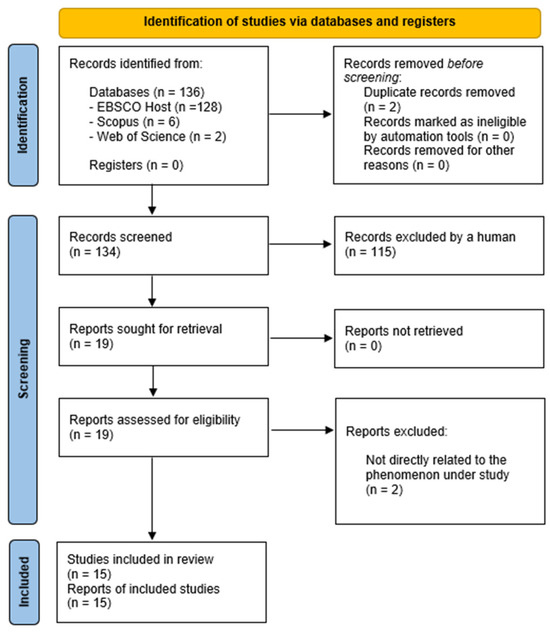
Once the search was completed, six results were identified in Scopus, two in Web of Science, and 128 in EBSCOhost. One triplicate record was identified; therefore, two duplicate records were removed and a single instance was retained. In the first screening phase, the titles and abstracts of all retrieved works were reviewed. Once this process was complete, the following exclusion criteria were applied: non-academic opinions, articles that only addressed disinformation, technical texts, and methodological studies that did not address the phenomenon under study from a conceptual, empirical, or critical perspective.
Following this process, fifteen results from EBSCO Host, one from Scopus, and one from Web of Science were included. Subsequently, two works were excluded because, upon reading them in their entirety, it was found that they were not directly connected to the phenomenon under study. Thus, after reviewing the abstracts of the 136 articles and applying the inclusion and exclusion criteria described above, the final sample consisted of 15 articles and/or book chapters. This outcome is consistent with the objectives of the study and with the methodological approach adopted, as the value of an integrative review lies in its ability to integrate, critically analyze, and reorganize existing knowledge, even in contexts with limited prior literature, in order to advance conceptual and theoretical understanding.
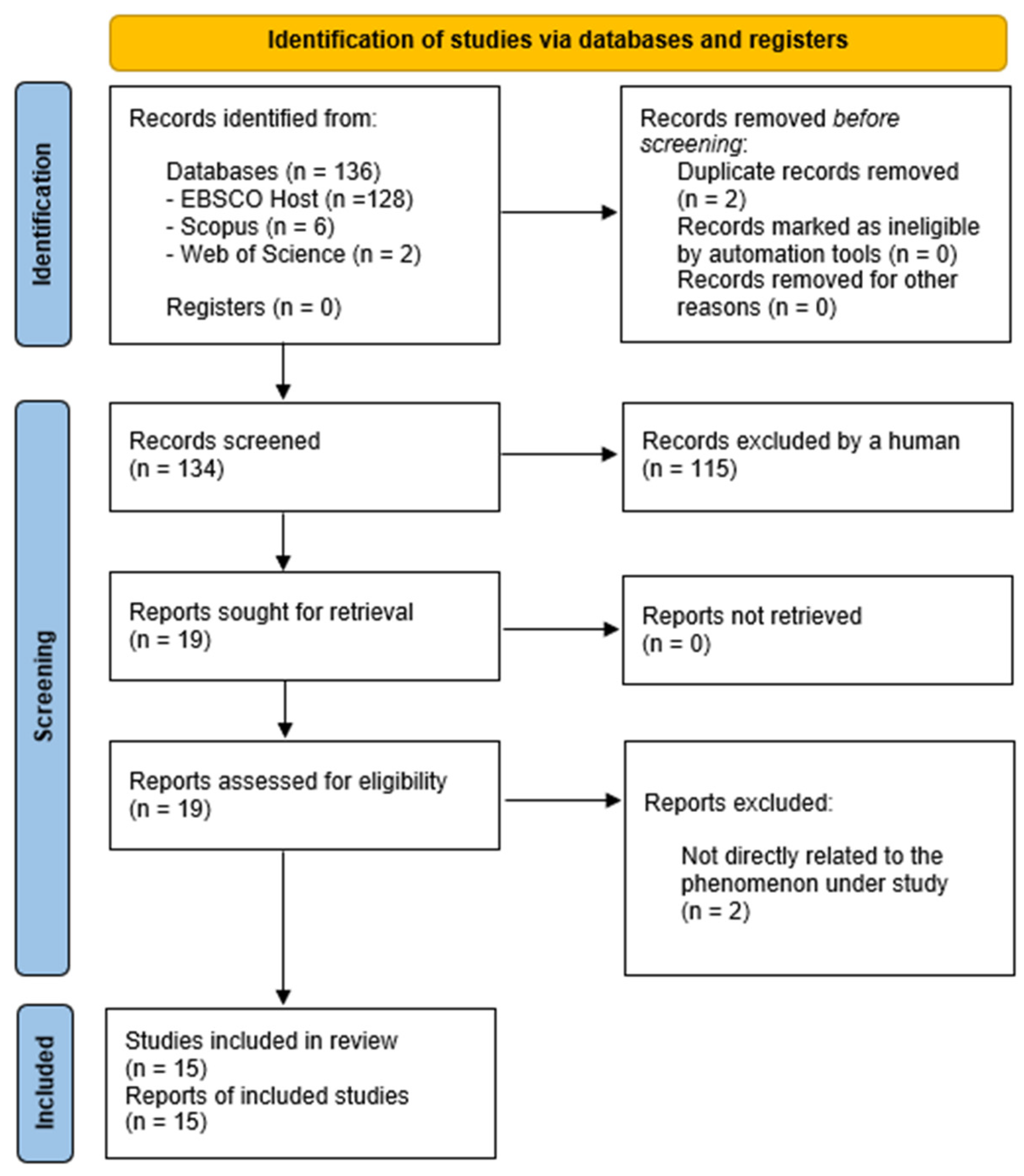
The process of identifying, screening, evaluating, and selecting the studies, as described above, is summarized in Figure 1.
Figure 1.
PRISMA flow diagram of the literature selection process.
To carry out the integrative review, qualitative data analysis software (CAQDAS) (ATLAS.ti version 25.0.1) was used, which allows the analysis and coding procedures to be systematized (Costa & Mfolo, 2024), as well as processing, organizing, and analyzing the data (Andrade et al., 2019). Specifically, the software ATLAS.ti (version 25.0.1) was used. Its choice was not only a technical one, but also because this software allows for better visualization of the relationships between concepts and the construction of new ideas based on inductive analysis (Costa & Mfolo, 2024). Thus, this software was used both for the organization of the texts and for the coding and extraction of relevant fragments and their subsequent analytical synthesis.
The review was conducted using an inductive approach; i.e., it did not start from a list of pre-established codes, but rather coding was carried out as the complete texts were analyzed, based on the knowledge obtained after developing the theoretical framework.
Once the coding process was complete, conceptually similar codes were unified to refine the initial codebook and facilitate analytical interpretation. This consolidation allowed codes that had been assigned to the same units of meaning to be integrated, avoiding redundancies. To recalculate the occurrences, only unique citations per code or per consolidated code were used. After this process, the category of poor practices consisted of 95 occurrences, the category of causes consisted of 49 occurrences, and the category of other elements consisted of 25 occurrences.
The entire process described above was carried out by a single reviewer, following a repetitive process of comparison and contrast, but validated by all authors. No formal assessment of the risk of bias in the included studies was performed, given that the objective of the review is conceptual and integrative in nature and the literature analyzed presented heterogeneous methodological approaches. This decision is consistent with reviews aimed at theoretical synthesis and conceptual development, as exemplified by Torraco (2005).
Generative artificial intelligence tools were used as a support resource during the research process, mainly for text revision and language editing. They were also employed to assist with preliminary conceptual reflection and the organization of ideas, as well as to support the interpretative discussion of the results. The methodological design, empirical process, analysis, and final interpretation of the results were carried out entirely by the authors. Any suggestions provided by GenAI tools (Open AI, version 4 and 5.2) were subject to critical evaluation and validation by the authors.
3. Results
The inductive analysis of the literature included in the integrative review resulted in three categories, as mentioned in the Materials and Methods section, each composed of different codes that were created as the review progressed. Rather than reproducing existing classifications, these categories synthesize recurring patterns identified across the literature and provide the analytical basis for the taxonomy, dimensions, and definition proposed in this study. An overview of the three macro-categories identified is presented in Table 1.
Table 1.
Macro-categories of the qualitative analysis and their frequencies.
This synthetic approach enables sharper conceptual distinctions between deficient practices, underlying causes, and other elements identified through the review process while also supporting the articulation of dimensions, a taxonomy, and a definition of poor journalism.
As can be seen, more than half of the codes correspond to practices associated with poor journalism, suggesting that, although the phenomenon has not been studied in depth, journalistic deficiencies have been, albeit in a scattered manner and not as a whole. Nearly 30% of the analysis corresponds to the causes of this phenomenon, which suggest a greater empirical attention to practices than to structural causes within the reviewed literature, without implying differences in theoretical relevance or explanatory weight. In this study, coding density is interpreted as an indicator of thematic emphasis in the literature, rather than as a proxy for theoretical importance or explanatory power.
On the other hand, almost 15% refers to other elements found in the reviewed literature, mainly focused on the confusion between different concepts associated with information disorders, which reinforces the initial hypothesis that there was a theoretical gap surrounding the phenomenon of poor journalism.
This confusion has been confirmed throughout the process, as the texts use the term fake news in an imprecise and polysemous manner. Among its many uses, it is used to refer to journalistic errors, biased framing, or sensationalism (Wilner et al., 2022).
In addition, other expressions are found, such as junk news (Farkas & Schousboe, 2024), false news, and distorted news, to explain the phenomenon of disinformation (Canavilhas & Jorge, 2022). The first is used to describe content that is of low informational quality, poorly constructed, or biased, but its literal meaning corresponds to “trash news”. This pejorative connotation can create a disconnect between journalists and their audience (Farkas & Schousboe, 2024). The other two expressions have different meanings and confirm the epistemological confusion that exists when cataloging other informational dysfunctions that do not fit the phenomenon of disinformation.
From the audience’s perspective, disinformation is defined as the perception of editorial bias in the news (Fletcher, 2021), which once again highlights the need to conceptualize the phenomenon of poor journalism independently.
Throughout the integrative review, poor practices and structural and editorial causes have been identified, the similarities between practices and causes have been noted, and some tensions and paradoxes of this phenomenon have been detected. This analytical process provides the basis for the definition and taxonomy presented in the following sections.
3.1. Deficient Practices Identified
This integrative review has identified eleven poor journalistic practices, through inductive coding, with definitions drawn from the reviewed academic literature. These practices are presented in Table 2.
Table 2.
Deficient journalistic practices identified in the analysis, their definitions, and frequencies.
These practices are considered journalistic errors and negatively affect the credibility of the media. In fact, there is an inverse relationship: the lower the perception of errors, the greater the trust, and vice versa. However, it is important to differentiate between substantive errors—the practices identified—and formal errors—typos or textual errors: the former erode trust, while the latter reinforce it (Wilner et al., 2022).
When it comes to poor practices, there is a paradox: although sensationalism and decontextualized information are the errors most detected by audiences, they do not have a significant impact on media credibility. This is mainly because they are subjective assessments, and audiences are not sure they have correctly identified an error (Wilner et al., 2022).
Furthermore, in contexts of crisis and increased information stress, journalistic dysfunctions increase. The practices most commonly identified in these contexts are sensationalism, alarmism, and exaggeration of facts, with “deliberately exaggerated language” (Salvador-Mata & Cortiñas-Rovira, 2023, p. 4).
The set of practices identified allows us to suggest a central idea: these are not simple journalistic errors committed in isolation, but rather part of a set of structural dynamics, editorial logics, and systemic failures of the media industry. All of these appear recurrently in the literature reviewed, so it is necessary to analyze their root causes.
3.2. Causes of Poor Journalism
In addition to identifying poor journalistic practices, the analysis made it possible to identify the causes behind them, according to the scientific literature. In this regard, six causes were detected: five linked to structural conditions or logic in the journalism industry and one associated with accidental failures and human error, which are nevertheless related to structural factors.
The causes of poor journalism do not act in isolation, but are interrelated and articulated around a survival logic, which runs through the entire phenomenon, generated by the media’s need to attract audiences in order to increase revenue (Palmer & Edgerly, 2024; Román-San Miguel et al., 2022). However, these practices end up having the opposite effect: they increase audience distrust of the media, decrease the quality of information, and damage the quality of public debate (Aguirre, 2020).
The six causes identified as a result of the inductive analysis are presented in Table 3.
Table 3.
Causes of deficient journalistic practices identified in the analysis and their frequencies.
As indicated in the table, the most frequent cause identified in the systematic review is economic priorities over informational criteria (26.53%), followed by political parallelism and editorial line (18.37%) as a factor that conditions the media’s treatment of information, and external pressures (16.33%), which, although not a premeditated strategy, condition and compromise journalistic rigor and the adequate treatment of information.
These causes are not accidental, but in many cases respond to a media strategy aligned with ideological, economic, or commercial interests (Aguirre, 2020).
It is particularly relevant that the three main causes share the same consequence: giving greater weight to editorial, economic, or political considerations over journalistic and informational criteria. Together, they account for 61.23% of the causes found, which highlights a relevant trend within the journalism industry.
This finding highlights the survival logic mentioned above. The media do not make decisions based on informational criteria because they believe it is less profitable. As a result, they use audience-capturing strategies to increase their profit margin (Rodríguez-Virgili et al., 2021).
Immediacy, on the other hand, is a cause interrelated with other structural factors, such as the precariousness of the sector and the lack of journalists on staff. As a result, less and less time is devoted to essential journalistic practices, such as properly verifying and cross-checking information; professionals assume that they must use clickbait headlines to generate more traffic and, therefore, more profits; or less and less time is devoted to reporting or investigative journalism (Canavilhas & Jorge, 2022; Fisher et al., 2021). In this way, immediacy operates as a mechanism that translates structural causes into specific poor journalistic practices.
Unintentional errors appear marginally in the literature reviewed (10.20%) and are often related to other structural factors already identified, such as the precariousness of the sector or immediacy, which leaves less time for proper news coverage. Although these unintentional errors could occur even if the phenomenon of poor journalism did not exist, this would lead to them being interpreted differently. In the context of the phenomenon under study, these errors act simultaneously as both a cause and a consequence of poor journalism.
The intersection between causes and poor practices allows us to identify emerging patterns and observe how practices relate to the causes that give rise to them. We can also see how both practices and causes interact with each other, which enables a more comprehensive conceptualization of the phenomenon of poor journalism and its underlying dimensions. These analytical intersections do not merely summarize prior research, but inform the structuring of the proposed taxonomy by clarifying how causes and practices co-occur and give rise to distinct dimensions of poor journalism
3.3. Analysis of Code Co-Occurrences and Emerging Patterns
Once the deficient practices and their causes have been identified, this section presents the co-occurrences between codes—causes and practices and the interrelation of practices—. This analysis allows us to observe emerging patterns, which are particularly useful for understanding the dimensions of poor journalism.
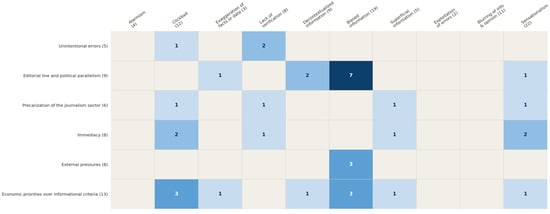
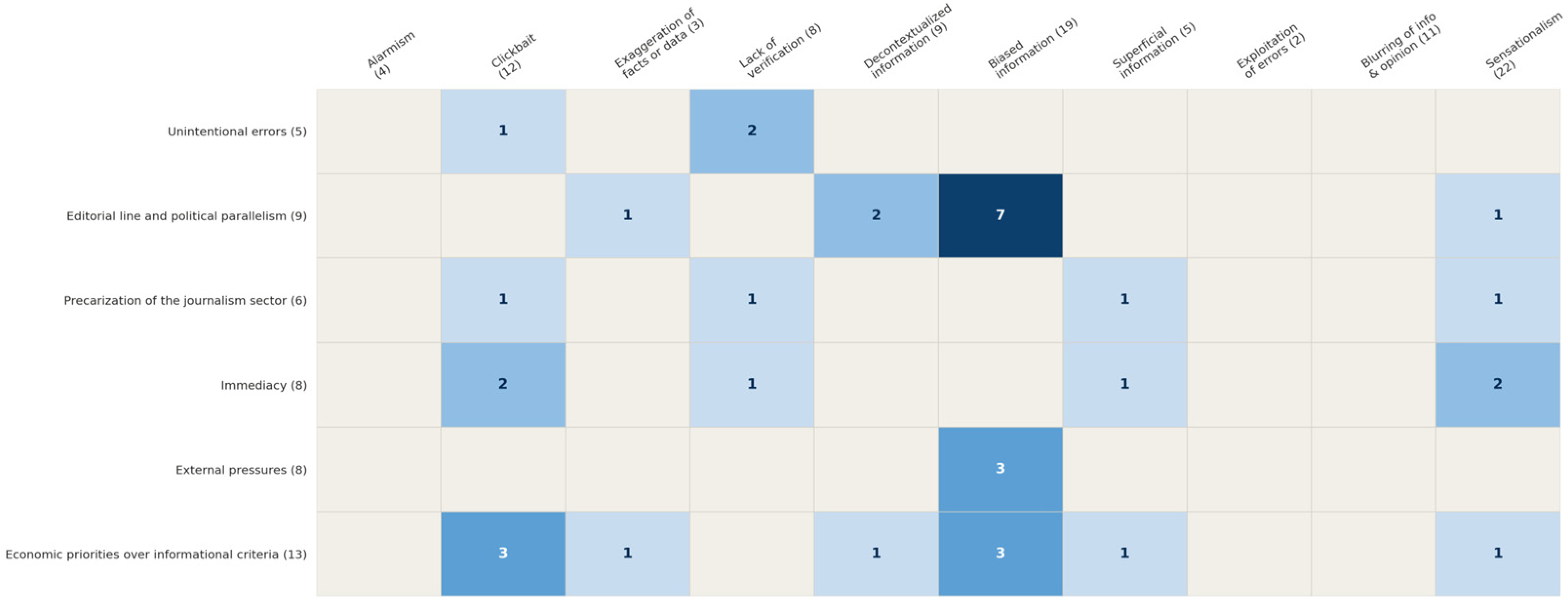
First, the co-occurrences table between causes and practices is presented in Figure 2.
Figure 2.
Co-occurrence matrix between deficient journalistic practices and their underlying causes. The figure shows the frequency of co-occurrences between practices and causes identified in the qualitative analysis, based on simultaneous coding within the same unit of meaning. Darker shades indicate higher frequencies of co-occurrence. The analysis was conducted using ATLAS.ti.
The table of co-occurrences allows us to identify some of the underlying logics of poor journalism. First, there is an asymmetry between causes, in that some generate a greater number of poor practices, while others have a more limited effect.
In addition, a pattern emerges that makes it difficult to explain certain practices as the result of isolated human errors, as they appear to be linked to structural and editorial decisions. Thus, biased information appears to be associated with editorial line and political parallelism, as well as external pressures and the priority of economic criteria over informational criteria.
These results allow us to highlight three relevant issues. First, media outlets with a more explicit editorial line tend to generate a greater volume of biased information. Second, it can be observed that the media yield to external pressures, probably due to the adverse effects of not doing so. Finally, there is evidence of the economic dependence of media companies on advertisers or investors, thus prioritizing economic, political, or ideological criteria over informational criteria. Taken together, these findings indicate that biased information is not the result of an unintentional error, but rather the result of a deliberate business and editorial strategy.
The editorial line is not only associated with biased information, but also with decontextualized information. This practice, characterized by the omission or exaggeration of data or by presenting information in a false context, distorts the meaning of the information and conditions the audience’s interpretation.
On the contrary, unintentional human errors appear to be mainly linked to a lack of verification, which coincides with structural causes such as the immediacy and precariousness of the sector. These factors reduce the time that professionals can spend on essential practices, such as properly verifying information.
However, poor journalism should not be understood solely as an ideological phenomenon, but also as one linked to the production logic. Practices such as clickbait and superficial reporting coincide with economic priorities over journalistic standards. Clickbait thus operates as a strategy to attract audiences and maximize advertising revenue.
In addition, two cross-cutting aspects emerge. On the one hand, sensationalism appears to be associated with most ideological and productive causes; on the other hand, immediacy is related to various poor practices, suggesting that it operates as an intermediate cause that translates structural conditions into concrete practices.
Overall, the analysis allows us to identify predominant logics. Some practices are mainly linked to political, ideological, commercial, or economic motivations—biased information, decontextualized information, exaggeration of data or facts—while others are associated with a productive logic—clickbait, superficial information, or lack of verification. However, these practices do not appear in isolation and present other relevant concurrences, which will be taken into account in the final conclusions.
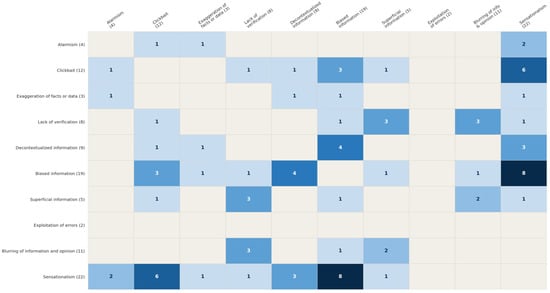
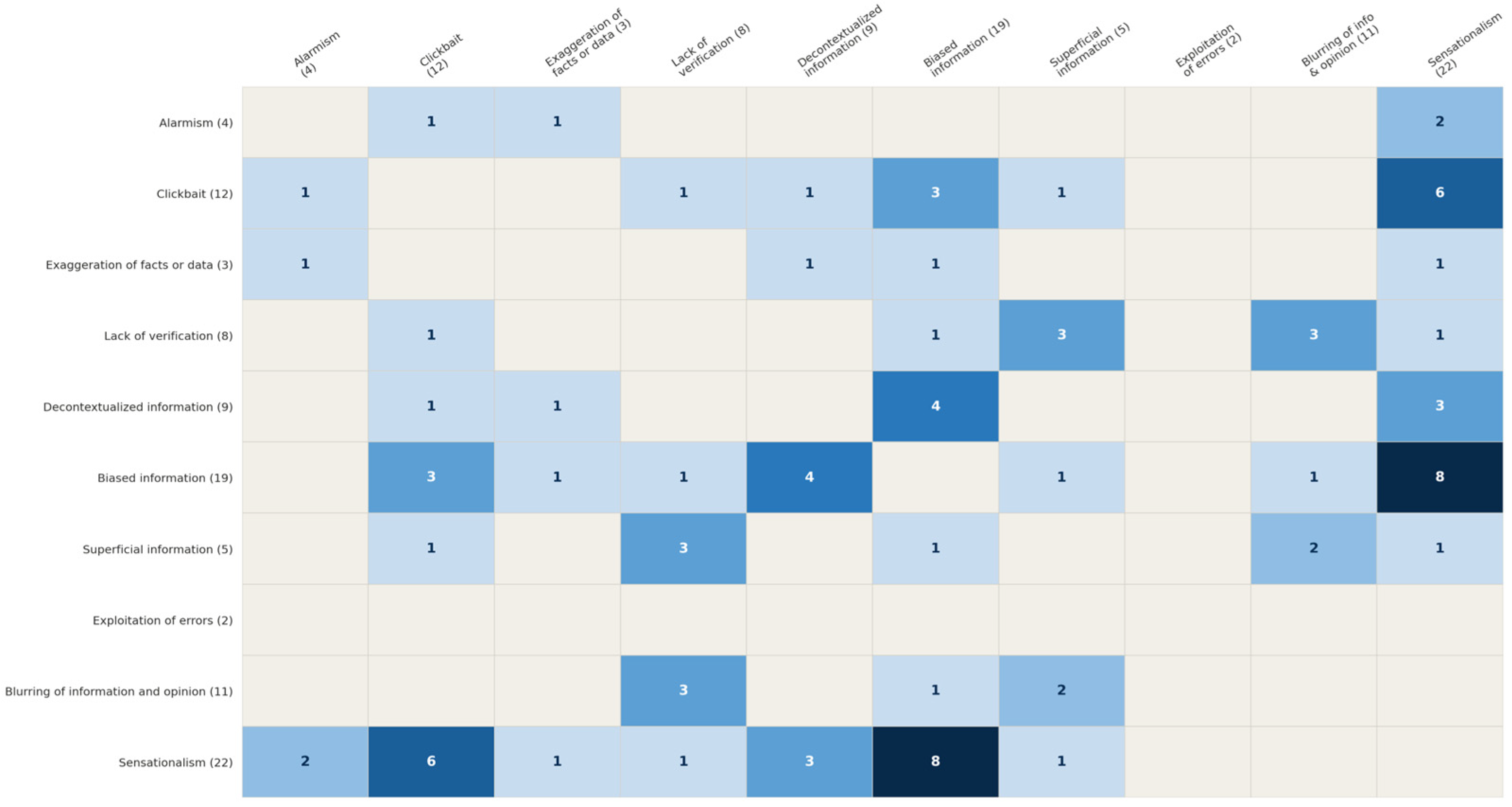
Once the emerging patterns in the relationship between causes and practices have been identified, the table of co-occurrences between practices is constructed as presented in Figure 3, allowing for an analysis of their interrelationship and overall organization.
Figure 3.
Co-occurrence matrix between deficient journalistic practices. The figure shows the frequency of co-occurrences between different practices identified in the qualitative analysis, based on simultaneous coding within the same unit of meaning. Darker shades indicate higher frequencies of co-occurrence. The analysis was conducted using ATLAS.ti.
The connections between practices allow the identification of groups and logics in which poor practices are organized. On the one hand, we observe cross-cutting or hybrid practices, such as biased information or sensationalism, which coincide with most of the others and function as bridging mechanisms between production logic and ideological-strategic logic. On the other hand, there is a productive logic articulated around clickbait, superficial information, or lack of verification. These practices converge with each other and are associated with the accelerated pace of production, the precariousness of the sector, and the need to maximize audiences to obtain revenue, as noted above. Finally, practices linked to an ideological-strategic logic are identified, such as the mixing of information and opinion, the exaggeration of data or facts, and alarmism.
The cross-cutting nature of sensationalism is particularly relevant, combining practices from different logics and acting as a platform on which other deficient practices are articulated. The overlaps also show two notable patterns: a high degree of coincidence with clickbait, indicating the frequent use of these headlines in sensationalist reporting, and with biased information; i.e., biased reporting incorporates sensationalist treatment, or, conversely, sensationalist content incorporates bias.
In this sense, sensationalism cannot be understood solely as a structural or productive logic practice, but also as a practice that may respond to business or ideological interests, following a deliberate strategy.
Biased information, for its part, shows a strong co-occurrence with decontextualized information, showing that decontextualization constitutes a specific form of bias in the treatment of information.
Likewise, the analysis highlights a relevant relationship between superficial information and lack of verification, which in turn coincides with the mixing of information and opinion, a practice that includes rumors and speculation. These results suggest that superficial information is produced mainly to generate a large volume of content quickly in order to fill news space and thus attract audiences and increase revenue—which is why it also coincides with clickbait, albeit to a lesser extent. In this context, insufficient time is spent on verification and cross-checking, and rumors or speculation are used to fill out superficial content.
Another notable relationship can be observed in alarmism, which only occurs alongside clickbait, the exaggeration of data or facts, and sensationalism. This pattern suggests that social alarmism is not a response to unintentional errors, but rather a deliberate strategy.
In short, the analysis of co-occurrences allows us to identify emerging patterns in the organization of poor journalism. We observe the existence of structural logics, such as immediacy or the precariousness of the sector, which facilitate the emergence of practices aimed at the accelerated production of content to maximize audience and revenue, such as clickbait, superficial information, lack of verification, or mixing opinion with information. An ideological and business strategy is also identified, which shifts decision-making away from informational criteria toward business criteria, generating practices such as biased information, decontextualized information, exaggeration of data or facts, and alarmism.
Neither the causes of poor journalism nor the practices that constitute it act in isolation. Both feed into each other, creating organizational inertia within media companies that is difficult to break.
3.4. Dimensions of Poor Journalism
The emerging patterns and co-occurrences analyzed now allow for the conceptualization of poor journalism from three dimensions, which organize the phenomenon and explain why it appears and how it is configured.
Thus, poor journalism operates in three dimensions. First, in a productive–structural dimension, that is, how the media industry is organized and under what conditions information is produced. This axis includes deficiencies derived from structural factors—such as the precariousness of the sector or immediacy—and from the logic of accelerated production—such as economic priorities over informational criteria—which seek to ensure the economic sustainability of the sector through a high volume of published content that increases audience size and maximizes revenue. Some of the deficient practices associated with this axis are lack of verification, superficial information, the mixing of opinion and information, and clickbait. These practices are not necessarily explained by editorial decisions, but rather by the structural and productive logic of media companies that transcend specific media outlets. Thus, the productive–structural dimension generates deficient practices that are structurally likely, which in many cases are favored by these same conditions. In this sense, these practices can be understood simultaneously as both a cause and a consequence of the structural situation of the media industry.
Secondly, a strategic–editorial dimension is identified, which includes causes linked to editorial and business decisions, such as editorial line and political parallelism, as well as external pressures. This dimension refers to how editorial decisions are made and why certain approaches or frames are chosen for the information. This axis includes practices such as biased information, decontextualized information, exaggeration of data or facts, and alarmism. This dimension generates practices that respond to stable editorial and business criteria, rather than specific failures in the information production chain.
Finally, there is the narrative–discursive dimension, which refers to how the news story is constructed. This dimension does not operate autonomously, but rather constitutes a mechanism that translates structural pressures and editorial decisions into specific narrative and expressive resources. Among the practices associated with this axis are sensationalism and clickbait, as well as, on certain occasions, the exaggeration of data or facts. This dimension connects with the previous two, as both the productive–structural and strategic–editorial dimensions resort to narrative and discursive resources to achieve their objectives.
At this point, two clarifications should be made. Clickbait appears in two dimensions as it constitutes a content titling technique. Its appearance is mainly explained by productive–structural dynamics linked to audience capture, although it uses narrative–discursive techniques to achieve its objective.
On the other hand, sensationalism falls within the narrative–discursive dimension, as it is a narrative resource. However, analysis of co-occurrences shows that its use is neither neutral nor solely structural: it is recurrently associated with practices typical of the strategic–editorial dimension, such as biased information or decontextualization. Therefore, sensationalism can be used instrumentally as part of a deliberate editorial strategy.
It is important to note that the dimensions are not isolated compartments, but interact with each other. These axes explain the structural motivation and function of poor practices, although their use and intended effect may then be different. Thus, for example, narrative–discursive techniques will be used to achieve an editorial or productive goal.
In short, the productive–structural dimension explains the conditions under which information is produced; the strategic–editorial dimension accounts for how and why editorial and business decisions are made in the media industry; and the narrative–discursive dimension describes how these conditions and decisions are reflected in the final news product.
3.5. Taxonomy and Definition of Poor Journalism
Based on the identified dimensions and the previous co-occurrences analysis, a taxonomy of poor journalism practices is proposed in Table 4. This taxonomy does not present mutually exclusive categories, as they may be interrelated, but rather orders the practices according to their explanatory and functional dimension and their descriptive and operational category of journalistic deficiency.
Table 4.
Proposed taxonomy of poor journalism by analytical dimension.
Of the ten practices initially identified, only nine have been classified in this taxonomy. The excluded practice, exploitation of error, has not been found to coincide with other practices or with any of the causes analyzed, allowing it to be identified as a practice documented in scientific literature, but mainly of a reactive nature. Therefore, it cannot be considered part of the usual practices that make up the phenomenon of poor journalism.
On the other hand, it should be noted that, although some productive–structural conditions facilitate biased or incomplete news coverage, the co-occurrence analysis confirms that decontextualized information is mainly articulated as a form of bias, not as an effect of accelerated production. Furthermore, the exaggeration of data or facts, although it may manifest itself in narrative forms, does not in itself fulfill a discursive function, but rather an editorial and strategic one. However, as with dimensions, these taxonomic categories do not behave in isolation, and mobility of practices between categories can be observed in specific case studies.
In any case, this taxonomy allows for a precise and rigorous approach to the phenomenon of poor journalism. This exercise is completed with an operational definition of the phenomenon under study, which is presented below.
Poor journalism refers to a set of professional practices that, without constituting deliberate misinformation, produce journalistic content characterized by deficits in the treatment of information, derived both from structural dynamics of the media system and from editorial decisions based on business or ideological criteria. These practices include, among others, superficial reporting, the use of misleading headlines, sensationalist treatment of information, decontextualization, and informational bias. As a result, they reduce the quality of information and trust in the media, weaken public debate, and erode the public sphere as a whole.
4. Discussion
The results of this research point to a circular logic of poor journalism. The acceleration of the news cycle, a greater workload for journalists, and the prioritization of audience metrics are some of the structural causes of this phenomenon (Ramon et al., 2022). In addition, news media companies have become highly dependent on advertisers, who, as explained above, influence the treatment of information. This prioritizes economic performance over journalistic criteria, but at the same time alienates the audience and erodes trust in the media, reinforcing dependence on advertising revenue, as stated by Winseck and Jin (2011) and as suggested by Aguirre (2020).
However, as Newman and Fletcher (2017) pointed out, these poor practices, which the media use to attract audiences and improve their advertising revenue, can have the opposite effect: the public trusts the media less and less due to the perception of partiality and bias. This creates a cyclical relationship in which the audience detects errors, does not tolerate them, and thus feeds their mistrust (Rodríguez-Virgili et al., 2021; Wilner et al., 2022).
This dynamic highlights a paradox of poor journalism: if the media use poor practices to attract audiences and generate revenue, but this does not happen, these same practices are reinforced in order to continue trying, increasingly alienating the audience.
The solutions to this phenomenon are limited by the very structures that cause it. The media neglect control, transparency, and accountability mechanisms because they would require a financial investment that they are not willing to make (Ramon et al., 2022). Thus, poor journalism becomes self-reinforcing and reproduces itself, making it difficult to correct from within the industry and generating a form of circular structural inertia that is hard to break.
Precisely, the results confirm what has been pointed out in previous literature: the precariousness of the sector and immediacy condition the work of professionals (Moreno-Castro & Crespo, 2023; Sánchez-Gey, 2019). These factors increase the pressure to publish more content in less time and with fewer resources (Jenkins & Nielsen, 2020). This pressure is a central tension in poor journalism: greater content production is demanded with fewer resources to do so, which facilitates the systemic failures identified in the Section 3, such as lack of verification or superficial information.
But there is also a structural tension. Audiences distrust poor information and demand better journalism with more in-depth stories, but they do not value increasing media staff numbers and are not willing to pay for journalistic products (Fisher et al., 2021). This creates a paradox regarding how better content can be offered when audiences are unwilling to pay for it and do not consider it appropriate to increase the number of journalists on staff. This situation places audiences as a relevant actor in the reproduction of poor journalism, as it creates tension between expectations of quality and production conditions.
Nevertheless, another factor must be added to the structural logic: the media belong to publishing companies, whose objectives do not always align with the journalistic criteria defended by Deuze (2005) and Kovach and Rosenstiel (2014). Journalistic companies have political, ideological, economic, and commercial interests (Aguirre, 2020), which can create tensions between journalistic criteria and business logic.
The introduction to this research already pointed to the low level of trust in the news (Newman et al., 2024), and the systematic review has allowed us to delve deeper into this: there is an inversely proportional relationship between the perception of errors and trust in the media (Salkin & Grieves, 2022; Wilner et al., 2022).
Furthermore, the descriptive phase pointed out that the political parallelism of the media (Casero-Ripollés, 2012; Hallin & Mancini, 2004) generated biases in the information that contributed to mistrust (Newman & Fletcher, 2017). The absence of bias was precisely one of the criteria by which the audience evaluated journalistic quality (Urban & Schweiger, 2014).
The results obtained in this study allow for a more nuanced understanding of this issue. Poor journalism operates at multiple levels. First, it generates mistrust and fuels information avoidance. Second, the links between the media and journalists with specific political currents generate poor practices, such as biased information, and erode media credibility (Palmer & Edgerly, 2024).
Sensationalism and clickbait, both poor practices already noted in the theoretical introduction (Esser, 1999; Harcup & O’Neill, 2017; Newman & Fletcher, 2017; Tandoc, 2014), have been consistently identified in the reviewed literature (Mourão & Robertson, 2019).
Interestingly, the review found that sensationalism does not have a significant impact on audience trust, despite being the most detected by the public. This is because sensationalism is perceived as a subjective deviation and audiences are not always certain that it constitutes an actual journalistic error. This finding allows for an alternative interpretation: sensationalism has less influence on trust because it may have become normalized (Wilner et al., 2022).
The analysis also confirms the presence of practices already highlighted in the theoretical corpus, such as sensationalism, lack of verification, biased information, and decontextualized information (Brajnovic, 1978; Moreno-Castro & Crespo, 2023; Newman & Fletcher, 2017; Sánchez-Gey, 2019). All these practices have been included in the proposed taxonomy that emerged from the empirical stage (Canavilhas & Jorge, 2022; Mourão & Robertson, 2019; Palmer & Edgerly, 2024; Rodríguez-Virgili et al., 2021; Román-San Miguel et al., 2022; Wilner et al., 2022).
Beyond this, poor journalism not only encourages mistrust of the media or the phenomenon of information avoidance, but also undermines the quality of public debate (Aguirre, 2020). This dual effect makes it a major challenge, not only from the point of view of information quality, but also in terms of pluralism and diversity of perspectives. Although the causes behind its emergence are not the same as those behind the phenomenon of disinformation, its effect is very similar: it erodes the public sphere.
As just noted, the phenomenon of poor journalism must be understood differently from disinformation. In this sense, it is relevant to analyze whether poor journalism can be integrated into the framework of information disorders proposed by Wardle and Derakhshan (2017) or whether, on the contrary, this framework needs to be revised and redefined to include poor practices.
The introduction to this study pointed to the polysemy detected in the term fake news, used by leaders and personalities to delegitimize the media (Departamento de Seguridad Nacional, 2022; Rodríguez, 2019; Salaverría, 2021). The findings of this review reinforce this approach: the epistemological confusion between fake news and disinformation, coupled with the lack of a category such as the one proposed in this research, contributes to audiences categorizing errors detected in journalistic practice under one of the two previous expressions (Fletcher, 2021; Palmer & Edgerly, 2024; Wilner et al., 2022).
As argued by Egelhofer and Lecheler (2019), using the term fake news to refer to poor journalism distorts the social perception of journalism, as audiences use the word fake to refer to erroneous content, but without the intention to deceive.
Both disinformation and poor journalism erode public debate and media credibility, yes, but according to the results and the literature reviewed, they respond to different logics. Until now, there has been a blurred line between journalism and false content, making it difficult to determine whether poor content resulted from disinformation, human error, or an editorial strategy. As demonstrated in this study, poor journalism results from an accumulation of structural, productive, business, and economic causes, but it is not rooted in a deliberate intention to deceive.
5. Conclusions
Poor journalism constitutes an informational dysfunction that must be analyzed as an autonomous phenomenon distinct from disinformation. Although it does not operate under the same logic, its effects are similar: it weakens trust in the media, deteriorates the quality of information, and erodes the public sphere. This study has shown that these consequences are not the result of isolated, unintentional errors, but rather a network of systemic practices inherent to the functioning of the journalism industry.
Based on the results of the integrative review, a conceptualization of poor journalism has been proposed, articulated in three dimensions—productive–structural, strategic–editorial, and narrative–discursive—and a taxonomy of practices that allows us to identify how this phenomenon materializes in news products—nine practices associated with six causes. The results confirm that the prioritization of economic criteria, political parallelism, and yielding to external pressures act as determining factors, generating practices such as sensationalism or biased information. These practices operate recurrently and contribute to a circular logic in which the structural conditions of the sector and deficient practices reinforce each other.
In this sense, poor journalism emerges as a structural phenomenon that is difficult to correct from within the industry itself, as the media sector remains trapped in a survival logic. Correcting it would require a profound and necessary transformation of the media ecosystem. The main contribution of this study lies in offering a new conceptual framework that allows these deficiencies to be named, defined, and analyzed without resorting to the label of disinformation. Thus, it contributes both to academic research and to media literacy initiatives, allowing for a more accurate understanding of contemporary journalism and its effects on the public sphere.
Author Contributions
Conceptualization, E.G.-O. and M.S.; methodology, E.G.-O.; formal analysis, E.G.-O.; investigation, E.G.-O.; resources, E.G.-O.; data curation, E.G.-O.; writing—original draft preparation, E.G.-O.; writing—review and editing, M.S.; visualization, E.G.-O.; supervision, M.S.; project administration, M.S.; funding acquisition, E.G.-O. All authors have read and agreed to the published version of the manuscript.
Funding
This research was funded by the Spanish Ministry of Science, Innovation and Universities through an FPU predoctoral fellowship (Formación del Profesorado Universitario FPU24/00132). No APC were incurred, as this paper was developed and submitted within the framework of the Spanish Society of Journalism (SEP) conference.
Institutional Review Board Statement
Not applicable.
Informed Consent Statement
Not applicable.
Data Availability Statement
The data presented in this study are available on request from the corresponding author.
Acknowledgments
The authors acknowledge the support of Spanish Ministry of Science, Innovation and Universities through an FPU predoctoral fellowship (Formación del Profesorado Universitario). During the preparation of this manuscript, the authors used ChatGPT (Open AI, version 4 and 5.2) as a support tool for text revision, language editing, and the organization of ideas during the writing process. The authors have reviewed and edited the output and take full responsibility for the content of this publication.
Conflicts of Interest
The authors declare no conflicts of interest.
References
- Aguirre, M. J. (2020). Ethical levels as a guarantee of quality journalism. Ramon Llull Journal of Applied Ethics, 1(11), 179–207. [Google Scholar]
- Andrade, L. R., Costa, A. P., Linhares, R. N., de Almeida, C. A., & Reis, L. P. (2019). Qualitative data analysis software packages: An integrative review. In A. P. Costa, L. P. Reis, & A. Moreira (Eds.), Computer supported qualitative research (pp. 279–290). Springer International Publishing. [Google Scholar] [CrossRef] [Scilit]
- Boukes, M. (2019). Infotainment. In T. P. Vos, & F. Hanusch (Eds.), The international encyclopedia of journalism studies (Vol. 2, pp. 1–9). Wiley Blackwell. [Google Scholar] [CrossRef] [Scilit]
- Brajnovic, L. (1978). Deontología periodística. Ediciones Universidad de Navarra. [Google Scholar]
- Canavilhas, J., & Jorge, T. d. M. (2022). Fake news explosion in Portugal and Brazil the pandemic and journalists’ testimonies on disinformation. Journalism and Media, 3(1), 52–65. [Google Scholar] [CrossRef] [Scilit]
- Casero-Ripollés, A. (2012). El periodismo político en España: Algunas características definitorias. In A. Casero-Ripollés (Ed.), Periodismo político en España: Concepciones, tensiones y elecciones (pp. 19–46). Sociedad Latina de Comunicación Social. [Google Scholar]
- Costa, K., & Mfolo, L. (2024). Qualitative evidence synthesis using the costaqda online software. Research Square. [Google Scholar] [CrossRef] [Scilit]
- Departamento de Seguridad Nacional (Ed.). (2022). Lucha contra las campañas de desinformación en el ámbito de la seguridad nacional: Propuestas de la sociedad civil. Ministerio de la Presidencia, Relaciones con las Cortes y Memoria Democrática.
- Departamento de Seguridad Nacional. (2024). Informe anual de seguridad nacional 2023. Ministerio de la Presidencia, Relaciones con las Cortes y Memoria Democrática.
- Deuze, M. (2005). What is journalism? Professional identity and ideology of journalists reconsidered. Journalism, 6(4), 442–464. [Google Scholar] [CrossRef] [Scilit]
- Egelhofer, J. L., & Lecheler, S. (2019). Fake news as a two-dimensional phenomenon: A framework and research agenda. Annals of the International Communication Association, 43(2), 97–116. [Google Scholar] [CrossRef] [Scilit]
- Elsbach, K., & van Knippenberg, D. (2020). Creating high-impact literature reviews: An argument for ‘integrative reviews’. Journal of Management Studies, 57(6), 1277–1289. [Google Scholar] [CrossRef] [Scilit]
- Esser, F. (1999). «Tabloidization» of news. European Journal of Communication, 14(3), 291–324. [Google Scholar] [CrossRef] [Scilit]
- European Commission. (2018). A multi-dimensional approach to disinformation: Report of the independent High-Level Group on fake news and online disinformation. Publications Office of the European Union. [Google Scholar] [CrossRef]
- Fallis, D. (2015). What is disinformation? Library Trends, 63(3), 401–426. [Google Scholar] [CrossRef] [Scilit]
- Farkas, J., & Schousboe, S. (2024). Facts, values, and the epistemic authority of journalism: How journalists use and define the terms fake news, junk news, misinformation, and disinformation. Nordicom Review, 45(1), 137–157. [Google Scholar] [CrossRef] [Scilit]
- Fernández-Castrillo, C., & Magallón-Rosa, R. (2023). Arqueología de la desinformación en el siglo XXI: Evolución, lenguajes y perspectivas de futuro. In M. I. Míguez-González, & A. Dafonte-Gómez (Eds.), Narrativas digitales contra la desinformación. Verificación de datos y alfabetización en la sociedad de la información (pp. 15–28). Comunicación Social Ediciones y Publicaciones. [Google Scholar] [CrossRef] [Scilit]
- Fisher, C., Flew, T., Park, S., Lee, J. Y., & Dulleck, U. (2021). Improving trust in news: Audience solutions. Journalism Practice, 15(10), 1497–1515. [Google Scholar] [CrossRef] [Scilit]
- Fletcher, R. (2021). How news audiences think about misinformation across the world. In S. Jayakumar, B. Ang, & N. D. Anwar (Eds.), Disinformation and fake news (pp. 47–57). Palgrave Macmillan. [Google Scholar] [CrossRef] [Scilit]
- García-Ojeda, E., & Saavedra, M. (2025). Veinte años del 11M: ¿Desinformación o periodismo deficiente? Análisis del impacto sociopolítico en las elecciones generales. Anuario Electrónico de Estudios en Comunicación Social «Disertaciones», 18(2). [Google Scholar] [CrossRef] [Scilit]
- Grabe, M. E., Zhou, S., & Barnett, B. (2001). Explicating sensationalism in television news: Content and the bells and whistles of form. Journal of Broadcasting & Electronic Media, 45(4), 635–655. [Google Scholar] [CrossRef] [Scilit]
- Hallin, D. C., & Mancini, P. (2004). Comparing media systems: Three models of media and politics. Cambridge University Press. [Google Scholar]
- Harcup, T., & O’Neill, D. (2017). What is news? News values revisited (again). Journalism Studies, 18(12), 1470–1488. [Google Scholar] [CrossRef] [Scilit]
- Jenkins, J., & Nielsen, R. K. (2020). Proximity, public service, and popularity: A comparative study of how local journalists view quality news. Journalism Studies, 21(2), 236–253. [Google Scholar] [CrossRef] [Scilit]
- Kovach, B., & Rosenstiel, T. (2014). The Elements of Journalism: What newspeople should know and the public should expect (3rd ed.). Three Rivers Press. [Google Scholar]
- Molyneux, L., & Coddington, M. (2019). Aggregation, clickbait and their effect on perceptions of journalistic credibility and quality. Journalism Practice, 14(4), 429–446. [Google Scholar] [CrossRef] [Scilit]
- Moreno-Castro, C., & Crespo, M. (2023). The impact of disinformation on the media industry in spain and portugal. IBERIFIER. [Google Scholar] [CrossRef] [Scilit]
- Mourão, R. R., & Robertson, C. T. (2019). Fake news as discursive integration: An analysis of sites that publish false, misleading, hyperpartisan and sensational information. Journalism Studies, 20(14), 2077–2095. [Google Scholar] [CrossRef] [Scilit]
- Newman, N., & Fletcher, R. (2017). Bias, bullshit and lies. Audience perspectives on low trust in the media. Reuters Institute for the Study of Journalism. [Google Scholar] [CrossRef]
- Newman, N., Fletcher, R., Eddy, K., Robertson, C. T., & Nielsen, R. K. (2023). Digital news report 2023. Reuters Institute for the Study of Journalism. [Google Scholar] [CrossRef]
- Newman, N., Fletcher, R., Robertson, C. T., Eddy, K., & Nielsen, R. K. (2022). Digital news report 2022. Reuters Institute for the Study of Journalism. [Google Scholar] [CrossRef]
- Newman, N., Fletcher, R., Robertson, C. T., Ross Arguedas, A., & Nielsen, R. K. (2024). Digital news report 2024. Reuters Institute for the study of Journalism. [Google Scholar] [CrossRef]
- Newman, N., Ross Arguedas, A., Robertson, C. T., Nielsen, R., & Fletcher, R. (2025). Digital news report 2025. Reuters Institute for the study of Journalism. [Google Scholar] [CrossRef]
- Nielsen, R. K., & Graves, L. (2017). “News you don’t believe”: Audience perspectives on fake news. Reuters Institute for the Study of Journalism. Available online: https://reutersinstitute.politics.ox.ac.uk/our-research/news-you-dont-believe-audience-perspectives-fake-news (accessed on 11 November 2025).
- Oficina de Ciencia y Tecnología del Congreso de los Diputados. (2023). Informe C: Desinformación en la era digital. Oficina de Ciencia y Tecnología del Congreso de los Diputados. [Google Scholar] [CrossRef]
- Palmer, R., & Edgerly, S. (2024). How journalists perceive news avoidance: Reactions and solutions to the missing audience as boundary work. Journalism Studies, 25(12), 1555–1572. [Google Scholar] [CrossRef] [Scilit]
- Ramon, X., Mauri-Ríos, M., Díaz-Campo, J., & Suárez-Villegas, J. C. (2022). A disconnect in media accountability: Spanish journalists’ and citizens’ perceptions of established and innovative instruments at the organizational level. Journal of Applied Journalism and Media Studies, 11(1), 81–102. [Google Scholar] [CrossRef] [Scilit]
- Rodríguez, C. (2019). No diga fake news, di desinformación: Una revisión sobre el fenómeno de las noticias falsas y sus implicaciones. Comunicación, 40, 65–74. [Google Scholar] [CrossRef] [Scilit]
- Rodríguez-Virgili, J., Serrano-Puche, J., & Fernández, C. B. (2021). Digital disinformation and preventive actions: Perceptions of users from Argentina, Chile, and Spain. Media and Communication, 9(1), 323–337. [Google Scholar] [CrossRef] [Scilit]
- Román-San Miguel, A., Sánchez-Gey, N., & Elías, R. (2022). Los profesionales de la información y las fake news durante la pandemia del COVID-19. Vivat Academia. Revista de Comunicación, 155, 131–149. [Google Scholar] [CrossRef] [Scilit]
- Ruggiero, C., Karadimitriou, A., Lo, W. H., Núñez-Mussa, E., Bomba, M., & Sallusti, S. (2022). The professionalisation of journalism: Global trends and the challenges of training and job insecurity. In J. Trappel, & T. Tomaz (Eds.), Success and failure in news media performance: Comparative analysis in the media for democracy monitor 2021 (pp. 309–335). Nordicom, University of Gothenburg. [Google Scholar] [CrossRef]
- Salaverría, R. (2021). Entender y combatir la desinformación sobre ciencia y salud. In Ministerio de Ciencia e Innovación (pp. 1–25). Ministerio de Ciencia e Innovación. [Google Scholar]
- Salkin, E., & Grieves, K. (2022). The “major mea culpa:” Journalistic discursive techniques when professional norms are broken. Journalism Studies, 23(9), 1096–1113. [Google Scholar] [CrossRef] [Scilit]
- Salvador-Mata, B., & Cortiñas-Rovira, S. (2023). Spanish press coverage of the COVID-19 crisis. When front pages alarm and editorials reassure. Doxa Comunicacion, 36, 65–85. [Google Scholar] [CrossRef] [Scilit]
- Sandelowski, M., & Barroso, J. (2006). Handbook for synthesizing qualitative research. Springer. [Google Scholar]
- Sánchez-Gey, N. (2019). False news and the work of information professionals in the coverage of events. IROCAMM: International Review of Communication and Marketing Mix, 2(1), 74–86. [Google Scholar] [CrossRef] [Scilit]
- Secchi, P., & Kalpschtrej, K. (2022). Cómo contrarrestar la desinformación electoral: Guía práctica para organizaciones y cuerpos electorales. UNESCO. Available online: https://unesdoc.unesco.org/ark:/48223/pf0000380594 (accessed on 16 April 2026).
- Strömbäck, J., Tsfati, Y., Boomgaarden, H., Damstra, A., Lindgren, E., Vliegenthart, R., & Lindholm, T. (2020). News media trust and its impact on media use: Toward a framework for future research. Annals of the International Communication Association, 44(2), 139–156. [Google Scholar] [CrossRef] [Scilit]
- Tandoc, E. C. (2014). Journalism is twerking? How web analytics is changing the process of gatekeeping. New Media & Society, 16(4), 559–575. [Google Scholar] [CrossRef] [Scilit]
- Tandoc, E. C., Lim, Z. W., & Ling, R. (2018). Defining “fake news”. Digital Journalism, 6(2), 137–153. [Google Scholar] [CrossRef] [Scilit]
- Toronto, C. (2020). Overview of the Integrative Review. In C. Torono, & R. Remington (Eds.), A step-by-step guide to conducting an integrative review (pp. 1–9). Springer. [Google Scholar] [CrossRef] [Scilit]
- Torraco, R. J. (2005). Writing integrative literature reviews: Guidelines and examples. Human Resource Development Review, 4(3), 356–367. [Google Scholar] [CrossRef] [Scilit]
- Urban, J., & Schweiger, W. (2014). News quality from the recipients’ perspective. Journalism Studies, 15(6), 821–840. [Google Scholar] [CrossRef] [Scilit]
- Vosoughi, S., Roy, D., & Aral, S. (2018). The spread of true and false news online. Science, 359(6380), 1146–1151. [Google Scholar] [CrossRef] [Scilit]
- Waisbord, S. (2018). Truth is what happens to news: On journalism, fake news, and post-truth. Journalism Studies, 19(13), 1866–1878. [Google Scholar] [CrossRef] [Scilit]
- Wardle, C. (2017). Fake news. It’s complicated. First Draft. Available online: https://firstdraftnews.org:443/articles/fake-news-complicated/ (accessed on 12 November 2025).
- Wardle, C., & Derakhshan, H. (2017). Information disorder: Toward an interdisciplinary framework for research and policy making. Council of Europe. [Google Scholar]
- Wilner, T., Wallace, R., Lacasa-Mas, I., & Goldstein, E. (2022). The tragedy of errors: Political ideology, perceived journalistic quality, and media trust. Journalism Practice, 16(8), 1673–1694. [Google Scholar] [CrossRef] [Scilit]
- Winseck, D., & Jin, D. Y. (Eds.). (2011). The political economies of media. Bloomsbury Academic. [Google Scholar] [CrossRef] [Scilit]
- World Economic Forum. (2024). The global risks report 2024. World Economic Forum. ISBN 978-2-940631-64-3. [Google Scholar]

Disclaimer/Publisher’s Note: The statements, opinions and data contained in all publications are solely those of the individual author(s) and contributor(s) and not of MDPI and/or the editor(s). MDPI and/or the editor(s) disclaim responsibility for any injury to people or property resulting from any ideas, methods, instructions or products referred to in the content. |
© 2026 by the authors. Licensee MDPI, Basel, Switzerland. This article is an open access article distributed under the terms and conditions of the Creative Commons Attribution (CC BY) license.