
Article

On the Interdependence Between Podcast Design and Usage Motives in German-Language Podcasts

1
Institute of Human Behaviour, Society and Technology, School of Applied Psychology, Zurich University of Applied Sciences, CH-8037 Zurich, Switzerland
2
Cast/Audiovisual Media, Department Design, Zurich University of the Arts, CH-8031 Zurich, Switzerland
*
Authors to whom correspondence should be addressed.
Journal. Media 2026, 7(2), 86; https://doi.org/10.3390/journalmedia7020086
Submission received: 22 December 2025 / Revised: 14 March 2026 / Accepted: 13 April 2026 / Published: 22 April 2026

Abstract

Systematic frameworks for describing podcast design remain scarce. Previous research on listening motives often treats podcasts as a monolithic category or focuses on specific genres, leaving open how motives vary across different design types. This dual-perspective investigation examines two questions: Which primary design types characterize German-language podcasts, and how are listening motives related to these design types? Using a multi-method qualitative approach, 30 podcasts were analyzed through iterative listening and 16 expert interviews to develop a typology of design. Additionally, 29 semi-structured listener interviews were examined via qualitative content analysis to identify usage motives and their associations with design types. The analysis identified three podcast design types—story, talk, and factual (STF)—each characterized by distinct structural and aesthetic features. The analysis further suggested that factual design types were primarily associated with cognitive motives, talk design types with social motives, and story design types with affective motives. The resulting STF model is a relevant framework for both academic research and practical applications in podcast production. The results further suggest that usage motives may be linked to these design types and thus indicates how podcast form and audience needs and gratifications may be interdependent.

1. Introduction

Podcasts have become an integral part of everyday media consumption, both globally (Edison Research, 2025; Newman et al., 2025; Ofcom, 2025; Listen Notes, 2025; Podwires, 2025) and in German-speaking countries (IGEM, 2025; Online Audio Monitor, 2025). They are digitally distributed audio formats specifically produced for online publication—distinct from traditional audio-on-demand services. Serialization and syndication are inseparable from the medium’s distribution mechanism. The content of podcasts is predominantly narrative and non-fictional in nature, ranging from journalistic to non-journalistic productions. Because podcasts can be listened to anytime and anywhere, they are often perceived as a highly user-centered medium. Although video elements increasingly accompany audio productions, this investigation focuses exclusively on the audio dimension.
Initially a niche phenomenon in the early 2000s, podcasts have evolved in the “second age of podcasting” (Bonini, 2015) into a mass medium, accompanied by increasing professionalization and diversification of formats and genres—a trend also evident in German-speaking countries. With more than 110,000 podcasts, German-language podcasts rank among the world’s top five by number (Listen Notes, 2025). This development calls for a systematic investigation of the podcast landscape to identify key characteristics that differentiate formats in terms of design and production. Similar to television research, which typically differentiates between subcategories such as news, fiction, reality TV, documentary, sports, talk shows, or game shows (Miller et al., 2023), rather than treating “TV use” as a monolithic concept, podcast research requires a framework that enables nuanced differentiation between subtypes.
To address this need, the present investigation combines two complementary perspectives: content design and user motivation. By combining production and reception perspectives within a multidisciplinary framework, we aim to move beyond partial analyses toward a holistic understanding of the podcast landscape. Specifically, this approach pursues two objectives: (a) to develop a systematic model for describing and classifying podcast design—something that existing research has not yet achieved; and (b) to explore how user motives relate to different design types—a connection largely unexplored in prior studies.
The first focus of this investigation is on podcast design and its aesthetic characteristics. This is important because, as Wild and Katzenberger (2021) (see also Katzenberger et al., 2022) note, research still lacks detailed analyses of how podcasts are structured and what their content looks like. Existing discussions of podcast aesthetics tend to be vague and rely on broad descriptions. Llinares et al. (2018) describe podcasts as a distinct medium with their own sound aesthetic, and Berry (2016) introduces the idea of “podcastness”—a quality that listeners can sense but that is difficult to define precisely.
Attempts to define podcasts more systematically often rely on the concept of genre. However, the term is used in various ways. Drew (2017) employs “genre” to categorize different types of production when analyzing educational podcasts. S. McHugh (2016) treats “audio storytelling” as a genre that is being reshaped by podcasting. Lindgren (2021) describes news podcasts as a “genre of audio journalism.” Examining Spotify’s catalogue, Rime et al. (2022) identify “a plethora of genres and subgenres in the ‘podverse’.” Similarly, Johnson and McCall (2025) use the term to classify comedy, true crime, and history podcasts along with others.
Among these categories, narrative and journalistic podcasts have received the most scholarly attention (Preger, 2019; Schlütz, 2020). Within this area, true crime—often treated as a sub-genre of narrative journalism—has been particularly well studied, with major contributions from Boling and Hull (2018), Sherrill (2022) and Dowling (2024). However, true crime podcasts extend well beyond narrative journalism. It includes conversational formats, monologic storytelling, and productions that approach the aesthetics of radio drama. This range of forms illustrates how porous and unstable genre boundaries can be, raising the question of whether the concept of genre is adequate for such a fluid and hybrid medium.
Another limitation of genre-based analysis is that it focuses too narrowly on narrative and journalistic podcasts, even though conversational formats constitute an important part of the podcast’s landscape and remain largely unexplored in genre theory. Collins (2018, p. 229) introduces the acronym CHIP (“Comedian Hosted Interview Podcast”) to describe this type of format. According to Smith (2019, pp. 174–178) CHIP podcasts are characterized by improvised conversations, “casualness and informality,” “self-reflexivity,” and “heightened character enrichment”. Collins further argues that this format offers “audio that allows the greatest access to the deepest secrets of celebs” (Collins, 2018, p. 244). Similarly, Piper (2015) highlights the blend of humour and honesty as a defining feature of comedian podcasts. These individual insights are valuable, but they still do not offer a comprehensive understanding of conversational podcasts.
In summary, the concept of genre is used in different ways. It functions, on the one hand, as a broad category for classifying content types such as true crime, news, or comedy. On the other hand, it is applied to describe a specific design of podcasts—a usage that, in practice, refers almost exclusively to the “narrative non-fiction genre”. To address the limitations of genre theory, Berry (2020) argues for the development of podcast typologies. On his website, he proposes three overarching typologies—Conversations, Narratives, and Creations (fictional storytelling)—as a means of classifying the podcast landscape. He further calls for an examination of “what podcast DNA looks like,” suggesting a shift toward more foundational, structure-oriented forms of categorization.
Building on this line of reasoning, study I seeks to develop a systematic framework for classifying podcasts based on design characteristics rather than content, which is typically used to define genres. The aim is to identify distinct design types that will enable a comprehensive classification of podcast formats in German-speaking countries.
With this concept of design in mind, study II extends to the audience perspective, where previous research has identified diverse listening motives (for a review, see Li et al., 2024). Prior studies frequently draw on the uses and gratifications approach, which assumes that audiences actively select media content from which they expect the greatest gratification (Ruggiero, 2000). According to this framework, listeners make active choices within the highly diverse podcast landscape to access content that meets their needs. A common way to structure the variety of usage motives is to distinguish between cognitive, affective, social, and habitual motives (e.g., Bonfadelli et al., 2010; Perks & Turner, 2019).
Among cognitive motives, a prominent motive for podcast use centers on knowledge, information, and learning. Listeners seek to obtain information, learn new things, or acquire new knowledge (e.g., Boling & Hull, 2018; Carrotte et al., 2023; Chung & Kim, 2015; Craig et al., 2023; Meidina & Kurniasari, 2022; Whipple et al., 2023; Whittle, 2024). Another cognitive motive is inspiration, where listeners seek creative impulses or ideas (Brand, 2020).
Among affective motives, entertainment and the use of podcasts as a way to pass time are frequently reported (e.g., Boling & Hull, 2018; Chung & Kim, 2015; Craig et al., 2023; Lin & Huang, 2024; McClung & Johnson, 2010; Wiethe et al., 2020). Additionally, emotion regulation is typically classified as an affective motive, referring either to the optimization of one’s emotional state (including relaxation) or the maintenance of a focused state of arousal (Boling & Hull, 2018; Brand, 2020; Caoilte et al., 2023; Perks & Turner, 2019). Another affective motive is escapism, where podcasts serve as a means to immerse oneself in a parallel ‘media world’ and temporarily escape everyday life (e.g., Boling & Hull, 2018; Chan-Olmsted & Wang, 2020; Chung & Kim, 2015; Craig et al., 2023).
Among social motives, relationships with both mediated and non-mediated individuals are central. The motive of parasocial relationships refers to friendship-like bonds with podcast hosts that are maintained through listening (e.g., Lin & Huang, 2024; Perks & Turner, 2019; Schlütz & Hedder, 2021; Wiethe et al., 2020). The motive of voyeurism describes the desire to gain insight into other people’s lives, including personal secrets (Boling & Hull, 2018; Chan-Olmsted & Wang, 2020). The motive of subsequent interpersonal communication refers to listening in order to discuss the podcast and its content with friends or to provide personal recommendations (e.g., Boling & Hull, 2018; Chung & Kim, 2015; McClung & Johnson, 2010; Perks & Turner, 2019).
Among habitual motives, rituals and habits related to the time and place of listening are frequently mentioned (Boling & Hull, 2018; Chung & Kim, 2015; Wiethe et al., 2020). The motive of multitasking refers to the fact that podcasts are consumed because they can be combined with other activities (Brand, 2020; Lin & Huang, 2024; Perks & Turner, 2019). Another habitual motive concerns the use of podcasts as a substitute for other media activities, such as listening to radio or music, or watching television (Chan-Olmsted & Wang, 2020; Perks & Turner, 2019).
Previous research thus paints a vivid picture of the diverse motives for podcast listening. However, prior studies have often focused broadly on podcasts as a medium (e.g., Chan-Olmsted & Wang, 2020; Craig et al., 2023; Schlütz & Hedder, 2021) which is very general and might obscure motives more prevalent within certain subcategories, e.g., gernes or design types. Alternatively, past research has focused on specific genres such as true crime (Boling & Hull, 2018; Vitis & Ryan, 2023), news podcasts (Whittle, 2024), or mental-health-related podcasts (e.g., Carrotte et al., 2023). However, this approach offers only partial insights and might miss important motives more prevalent in other genres. Moreover, as explained above, genres often inform about content and usually are not informative of design. However, certain design elements of podcasts might also relate to the gratification of certain usage motives (e.g., the portrayal of the hosts for social motives). To overcome these limitations, and by linking the uses-and-gratifications-approach with design elements, study II investigates motives of podcast usage across different design types, aiming to reveal patterns that genre-based approaches may overlook.
Taken together, this article addresses two central research questions: (a) Which primary design types can be identified among German-language podcasts, and how can they be systematically described? (b) What are the motives for listening to German-language podcasts, and how are these motives related to different design types? To answer these questions, the multi-study investigation adopts a multidisciplinary approach that combines design and audience perspectives using qualitative methods. The article is structured as follows: first, we present the approach and findings related to podcast design (study I); second, we outline the methods and results concerning audience motives (study II), building on insights from the design analysis. Finally, the discussion synthesizes both perspectives to provide a comprehensive understanding of the podcast landscape.

2. Materials and Methods: Design Perspective (Study I)

A central feature of the present investigation is the selection of podcasts that were used as a basis in both the design and audience perspective (study I and study II). To this end, 30 German and Swiss German-language podcasts were selected. The selection was based on the “most different case study” approach (Gerring, 2017), which involves a targeted, non-random selection.
The podcasts were selected in such a way that the sample covered as many facets of production and design features as possible. The selection criteria were refined with each step of the investigation from the design perspective, constituting an iterative process. If it became apparent that facets were still missing, a targeted search was conducted for a podcast that exhibited this facet. In the course of study I, for example, it became apparent that no analysis had yet been conducted of any corporate communication podcast, so two examples were selected for review. The final selection criteria were descriptive such as publisher, seriality, frequency of release, episode length or subject, and qualitative such as diversity of producers, extensiveness of the design, nature of content or production quality amongst others. Table 1 gives an overview of the final selection of podcasts.
To start our investigation of potential design types (study I), we used prototyping, a method widely used in design research (Downton, 2003; Michel, 2007) in which the methodology evolves in line with the object of investigation. This is due to the nature of the subject of design, which derives its insights from practice rather than theory. From the prototyping of the methods, listening analysis emerged as a suitable approach to understanding. In this phenomenological approach, episodes of podcasts undergo listening analysis which are comparable to “close analytical listening” (Spinelli & Dann, 2019, p. 5). The team members randomly selected episodes of a certain podcast, mostly from the earlier and later phases, to understand the genesis of the series. Each team member contributed their own area of expertise to the analysis, including podcast production, radio programming; film production, editing and screenwriting; TV production. As the funding required the involvement of a practical industry partner, one member of the research team—who worked as a producer at a Swiss podcast production company—provided the necessary practical perspective.
In a second step, each team member listened to some different and some identical episodes (number: approx. 4–6) individually, closely examining narrative structures, host roles, sound dramaturgy amongst others. The selected episodes date from 2016 to 2024 and were analysed by the research team between December 2023 and April 2025. In the synthesis, the individual analyses were compiled, condensed in oral discussions, and finally written down in precise language. This procedure was done for all 30 selected podcasts.
In addition to the phenomenological listening analyses, semi-structured interviews with ten production studios in Switzerland and Germany were conducted between December 2024 and May 2025 (see detailed Table A1 in Appendix A). The production facilities selected were those whose podcasts were also the subject of the listening analyses. This enabled to supplement the producers’ points of view to our own analyses.
Further semi-structured interviews with six experts from related artistic disciplines—including theatre, film, sound design, entertainment production, and participatory culture (see Table A2)—were conducted between November 2024 and April 2025. The aim was to identify explanatory approaches for phenomena that could not be fully understood through listening alone. For example, insights from theatre studies proved crucial for interpreting the structure of “chatty” talk podcasts.
All interviews, both with production studios and with artistic experts, were evaluated qualitatively. Questions arising from the listening analyses were presented to the producers, whose responses helped refine the subsequent analyses. Any new insights that emerged during the interviews were incorporated directly into the development of the model.
The listening analyses and interviews thus formed an iterative process: findings from the listening sessions informed the interviews, and the insights gained from the interviews shaped the next round of listening analyses. This continuous interplay contributed to the progressive refinement of the overall framework.

3. Results Design Perspective (Study I): Basic Types of Podcasts—STF Model

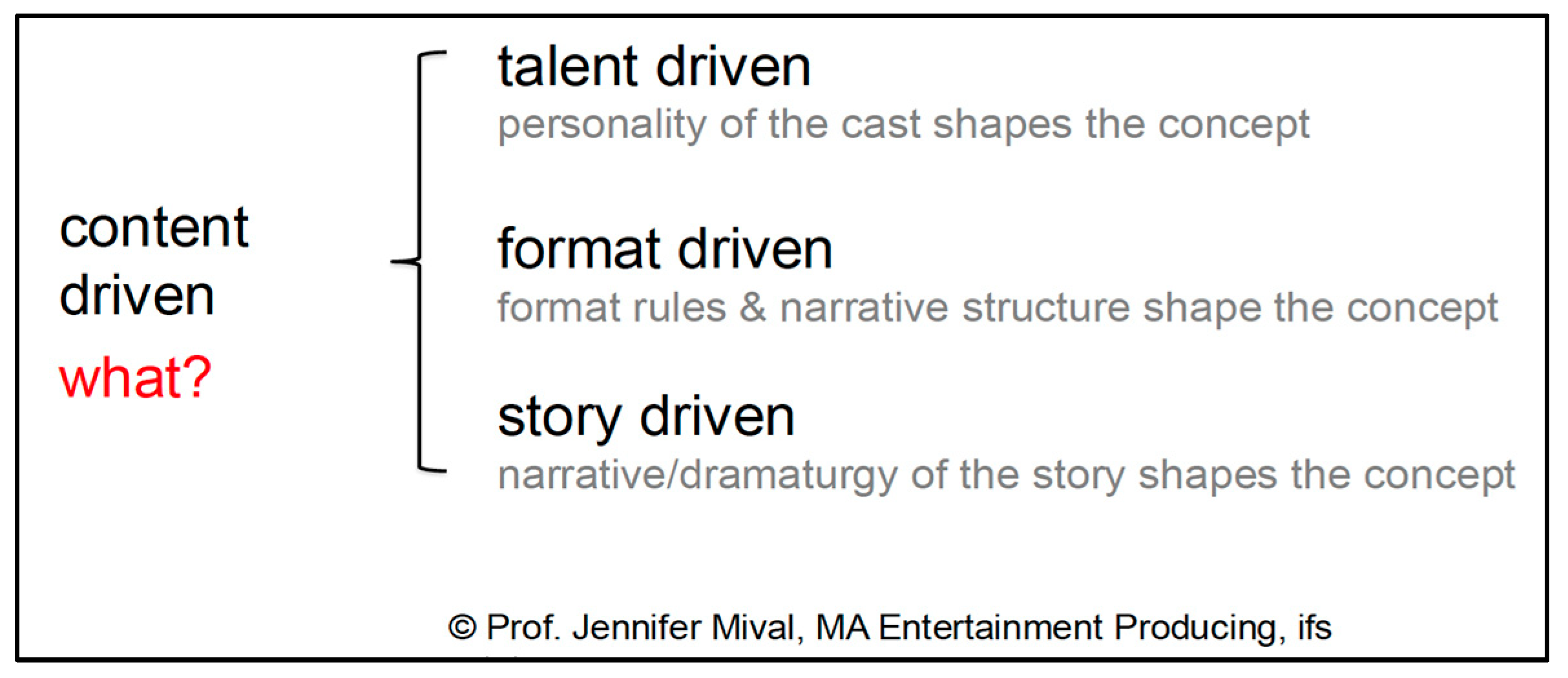
The empirical findings indicate that, rather than numerous loosely defined genres, three fundamental types of podcasts can be identified: story, talk and factual. Together, these three types form the basis of the STF model. Building on Jennifer Mival’s “format development framework for television and streaming” (previously unpublished, presented in Figure 1 with the kind permission of the author), these types can be understood as story-driven, talent-driven, or format-driven respectively. This provides a clearer and more functional way of describing podcast formats based on how they are constructed and what primarily drives them. Table 2 summarizes key characteristics of the three design types within the STF model.
It is worth noting that the different basic types are not mutually exclusive: each podcast can be assigned to one primary type but will often exhibit characteristics of the other types too.

3.1. Story

A story podcast depends on having a strong, compelling story at its core, which is why it is fundamentally story-driven. Finding such a story requires thorough research and often investigative journalism. Once the material is identified, dramaturgical knowledge is needed to shape it into a coherent and engaging narrative. By telling the story across multiple episodes, story podcasts build suspense over time. Unlike film documentaries that rely on visual imagery, story podcasts use scenic storytelling: sound brings scenes to life. Sound design therefore becomes the central tool for bringing the narrative to life in an auditory form.
This chapter analyses the structural principles, production methods and aesthetic characteristics of podcasts that predominantly tell journalistic stories in a serial and narrative manner. The following are essential for the characterisation of story podcasts:
  • Investigative journalism.
  • Dramaturgy.
  • Horizontal narration.
  • Sound design.
  • Collaborative working.

3.1.1. Investigative Journalism

A story podcast is fundamentally built around a non-fiction narrative. Fiction-based storytelling exists within podcasting, but it occupies a comparatively marginal role; exploring the reasons for this lies beyond the scope of this article. The predominance of non-fiction explains why investigative journalism is central to many story podcasts: it uncovers real events and narratives that have not previously been told and that are compelling enough to sustain listener interest. Narratives that are suitable for story podcasts typically possess clear dramaturgical qualities: they attract attention, contain multiple turning points, and can be developed across several episodes through serial storytelling. However, such stories have inherent limitations, as the available material is finite. “Every week, around 40 stories appear in the printed issues of SPIEGEL, a fraction of which appear in one of our podcasts. Only a few of these are suitable for podcasting” (Sperber, interview). Hence, the most interesting stories only become feasible when one considers what material is available. Investigative research thrives on recorded material, making it audible and accessible. Highly publicised events—such as the coverage of the Nord Stream pipeline attack by Der SPIEGEL and ARD—illustrate this constraint, since many producers pursue the same story simultaneously, leaving little room for distinctive narrative development. The core challenge, therefore, lies in identifying subjects that provide sufficient depth for serial narrative construction while also featuring strong, relatable protagonists, as audience engagement depends primarily on their emotional connection to the individuals involved (Yorke, 2014).

3.1.2. Dramaturgy

Interview data showed that the storyteam of BR (Bayerischer Rundfunk) is explicitly looking for “protagonist-centered stories” (Ottlitz, interview) that can be told as a ‘hero’s journey’ (Campbell, 2008). Every story needs a character who embodies its theme. For the audience to engage with the protagonist, the main character must evolve over the course of several episodes, experiencing conflicts and turning points. The production studios interviewed for this study often conduct ‘turning point interviews’ with protagonists to establish whether there is ‘enough’ narrative material. Of course, ‘turning point interviews’ can only be used if the story has already been completed. This approach can’t be applied to investigative researched documentary stories, however, as the research process is not linear, “it involves a journey into the unknown” (Johnstone, 1999, p. 75). Sometimes an interview opens doors; sometimes it closes theme.
In Operation Nord Stream (Der SPIEGEL), the investigative journalist retraces the alleged assassins’ route on a yacht in order to reconstruct the attack. In her search for the truth, she becomes the protagonist herself, transforming from a reporter into a detective. Part of the narrative strategy is to make the investigative process transparent. She doesn’t just recount what happened. She shows how it happened. Her subjective view of the story becomes part of the story itself, enabling listeners to form an emotional connection with the journalist. McKee’s term for this is “creating an audience bond”(McKee, 1997, p. 143).
With the regard of the audience, a premise helps to capture their attention, as John Truby explains in “The anatomy of story” (Truby, 2008). It is implied at the start and gives the audience a sense of direction, showing them where the story is going. “A clear premise states what a listener will hear in the podcast. It does this without revealing too much of the content” (Preger, interview).
Once a story and main protagonist have been found, the question arises as to how the story should be structured to hold the interest of the target audience. The process of structuring stories is known as storytelling (Franklin, 1987). In journalistic podcasts, storytelling is always a form of staging and selective condensation, as the example Operation Nord Stream shows, the podcast does not pursue all traces, as documented by other podcasts on this subject like Tatort Ostsee.

3.1.3. Horizontal Narration

An important dramaturgical device to create suspense is the horizontal narration. “We attempt to identify an overarching dramatic arc, and then a dramatic arc within each episode. The episodes have a classic three-act structure” (Stegemann, interview). Rather than relying on linear chronology to create effective dramaturgy, events, characters and original sounds must be arranged so that a coherent and effective story emerges. Sometimes a vehicle is needed to transport the story, forming the central theme in the main narrative thread, upon which the subplots can be arranged. In Operation Nord Stream, the journalist attempts to reconstruct the route of the assault over four episodes using a chartered yacht. Each episode focuses on a different aspect of the story, such as the yacht, the suspects, the doubts and the masterminds, providing answers while raising new questions. Knowing where to place these questions is part of the dramaturgical toolkit for maintaining curiosity and suspense. The arc of suspense is either completed episodically or designed as an overarching horizontal season structure.
The pivotal question in Operation Nord Stream is whether it’s feasible to conduct an assault on a gas pipeline using a chartered yacht. The answer is revealed at the end of the fourth and last episode, creating suspense throughout. Finding the answer at the end of the season is a central feature of the ‘horizontal narrative style’, which is characteristic of story podcasts. In the course of interviews with podcast producers, the preponderant influence of Anglo-American television series on HBO, and film documentaries on Netflix, was unmistakable. “Telling true stories” (Kramer & Call, 2007) is a firmly established concept in Anglo-American journalism and film, particularly in documentaries and TV dramas. The way Serial (2014) is designed, still influences the way stories are told in German-speaking countries, as numerous production companies confirmed in the interviews.
From a narrative perspective, the self-contained nature of story podcasts is an advantage compared to ongoing podcasts. Packaging material into seasons helps to compete for users’ attention. However, a dilemma still remains: unlike fictional stories, documentary stories can only be stretched to a limited extent. After one season, the story is usually complete. If the story is told across too few episodes, the material will be ‘wasted’; if it is told across too many episodes, the story will be watered down. The story podcasts examined typically comprise 4–6 episodes, which seems to be a useful benchmark.

3.1.4. Sound Design

Interestingly, story-centred production studios like Undone claim their approach to conceptualising stories is cinematic. Host Khesrau Behroz has a background in documentary filmmaking, which strongly shapes this approach. Similar to documentary film production, Undone develops stories based on original sound material, depending on what material is available and how it can be used to construct a narrative. Because podcasts lack images, sound design plays a crucial role in story podcasts, as it helps make the recorded material engaging and accessible to listeners.
From the outset of production, sound design was a key consideration in all of the story podcasts that were analysed. Sound designers are an integral part of the production team, developing the soundscapes of stories using mood boards. In Operation Nord Stream, the central soundscape was based on sounds of wind, water, and sea. It helps to reinforce the spatial dimension in scenic storytelling. Radio theoretical writer Arnheim notably referred to “acoustic stage design” (Arnheim, 2001) in regard to the sound aesthetics of radio drama. Both radio drama and radio feature have shaped the fundamentals of sound design for podcasting. As with other elements of dramaturgical design, sound design involves making creative choices: Which sound elements serve the story? What effect does adding or omitting them have? Does it make the story more exciting? Does it make the story more accessible to listeners? “In the best-case scenario, sound, sound design and music act as integral parts of the whole; they are part of the story” (Grab, interview).
Sound design is a non-verbal design element whose effect is measured by how well it supports the unfolding of the story. However, this presents a particular challenge: unlike written or spoken language, whose dramaturgical structures and effects can be clearly described, sound design and its narrative functions are harder to explain and must first be translated into words. “The challenge is establishing a common vocabulary when discussing music or the desired mood of a podcast… The better you know each other, the easier it is to understand what the other person really means” (Bezzola, interview). Consequently, it takes time for the production team to develop a shared vocabulary. In the examined story podcasts (Operation Nord Stream, Tatort Ostsee, Springerstiefel, Hacking Anonymous, Ohn(e)Macht), sound design therefore played an integral role in the production process.

3.1.5. Collaborative Working

Unlike talk podcasts, which are produced virtually live (see below), story podcasts require a very complex production process. The examined cases relied on collaborative working methods, as it has been shown through practical experience that teamwork leads to better results and decisions. Lea Utz, Host and producer of Telephobia, confirmed that due to the teamwork, “it’s a curated version of myself that can be heard on the podcast” (Utz, interview).
Ideas are discussed in diverse pitch meetings to enable a variety of feedback (Ottlitz, interview). Storyboarding serves as a central means of visually planning the structure and narrative flow of story podcasts and testing them prototypically. “We think about a rough structure before we start reporting, but the actual development—i.e., the storyboarding and narrative development—happens afterwards and is totally dependent on the material” (Wilhelm, interview).
During so-called “edit sessions” or “table reads”, the team acts as the test audience. “When there are three to five people in the room, sometimes someone will say, I was lost at that point. I didn’t understand that at all” (Ottlitz, interview). Effective creative decisions rely on crowd intelligence rather than individual decisions. The work processes are often iterative and correspond to ‘classical’ prototyping, which frequently creates conflicting objectives for the studios. “As managing director, I can see the wallet shrinking with each edit session, but as an author and journalist, I would like to do ten” (Stegemann, interview).
Storyboarding, editing and sound design are carried out in several stages before the production is ready for publication. In terms of work organisation, project-based work is replacing traditional editorial hierarchies. In the BR Storyteam, roles such as project management, editing or distribution are assigned as required. Collaborative work is based on flexibility, diverse roles and shared responsibility.
Due to the high demands on resources (time, budget), all podcasts examined (except the one from SPIEGEL) were produced either directly by public broadcasters or commissioned by private production studios. To raise their profile, those private production studios started to build brands for ‘compelling stories’. One way to achieve this is to produce content under the brand of the studio, as with the Berlin-based studio Undone and its Legions series. Hosts can also develop their own personalities, as Khesrau Behroz from Undone, and become the public face of the story brand.
A helpful transition from story podcasts to the following section of talk podcasts is a hybrid story format that sits at the intersection of both types. The dramaturgy unfolds exclusively through oral storytelling: one host assumes the role of the knowledgeable narrator, while the other listens attentively and poses informed, probing questions. This interaction can be referred to as the “one knows, one does not” principle. Examples from the analysed podcasts include Geschichten aus der Geschichte and Wired Crimes.
In this “narrator–listener” setup, the storyteller assumes that the other host has no prior knowledge of the story. This creates an intentional asymmetry: the storyteller provides information, while the questioning host adopts a stance of “Socratic ignorance.” Through reactions, questions, and expressions of curiosity, the questioning host acts as a proxy for the audience. These dynamic fosters closeness and engagement, evoking the atmosphere of “campfire-style oral tales” (Hancock & McMurtry, 2017)—a traditional form of storytelling historically used to pass down legends and fairy tales (Propp et al., 1994).

3.2. Talk

When it comes to talk podcasts, their design is distinctive because people not only shape them but also express themselves through them. This characteristic is immediately visible: in many cases, the host and the producer are the same person. Talk podcasts center on people speaking with one another. The structure and development of the content emerge through dialogue, and expression relies primarily on the human voice. This importance of the voice is already reflected in the Latin verb personare, meaning “to make one’s voice heard.” Aristotle described the voice as “a kind of sound of an animated being” (Aristoteles, 1982, p. 103).
This chapter analyses the structural principles and production methods of talk podcasts, as well as their typical forms. The key characteristics of talk podcasts are as follows:
  • Cast.
  • Conversational skills.
  • Improvisation.
  • Recurring elements.

3.2.1. Cast

The hosts are the “face” of a talk podcast—without them, the format would not exist. Its success therefore depends heavily on casting, which makes talk podcasts fundamentally talent-driven. According to the German casting director Nina Haun, the “right” cast cannot be identified through technical criteria but can only be tested in practice.
In contrast to story podcasts, which centre on protagonists, hosts in talk podcasts are more akin to radio presenters. Although they may appear as “animated beings” in the Aristotelian sense, they only become true protagonists in exceptional cases—for example, when they take on an investigative role and actively search for truth.
Typically, however, hosts do not undergo development in the dramaturgical sense. The character of the host remains relatively stable from the beginning to the end of an episode and often across multiple episodes or even entire seasons. In this sense, hosts resemble the characters of vertically structured television series. Similar to these figures, podcast hosts therefore have a serial dimension. Unlike film characters, who are introduced in an exposition, hosts are not formally introduced. Instead, listeners “learn” who they are over time through repetition—similar to how television series build familiarity with recurring characters (Snyder, 2015).
What connects hosts in talk podcasts with protagonists in story podcasts is the audience’s interest in them (Yorke, 2014). As Sven Preger notes, “They are not only the voice and mediators, but also presenters and role models” (Preger, interview). Hosts often have insider knowledge or specialist expertise that is not accessible to the average listener, and they move within worlds that feel distant or exclusive—for example, such as the entertainment and stage realms of Gemischtes Hack or Fest & Flauschig.
The “tone of voice” (Pastor, interview) of those podcasts sounds like “private talk in public sphere”(Jarrett, 2009). This creates a sense of closeness: hosts can feel like personal friends to the audience. As Jennifer Mival describes it, “they engage in an intimate conversation, and we all pretend that we’re actually in the room.” Listening to the podcast offers a symbolic invitation to become part of these otherwise inreachable worlds (Pastor, interview). As will be shown below, these dynamic forms an ideal basis for developing parasocial relationships (Schlütz & Hedder, 2021). It allows the audience to take pleasure in being the “third person” in the room—present, emotionally involved, yet silently observing.
In practice, most host pairings in podcasting do not need to be formally cast because the hosts already know each other and have formed their partnership “organically” (Mival, interview). It is, in effect, a form of self-casting. For example, the hosts of Gemischtes Hack and Kurds & Bündig were friends long before starting their podcasts; the show simply extends their existing social media presence.
A shared intrinsic interest often forms a strong foundation for an authentic hosting duo, and many partnerships emerge in this way. The podcast Beziehungskosmos, for instance, grew out of an interview that journalist Sabine Meyer conducted with psychotherapist and couples therapist Felizitas Ambauen for a public service broadcast. Their exchange sparked the collaboration that eventually became the podcast.
If casting is needed, the process—finding the right combination of hosts—often begins by bringing together two people who do not yet know each other well, sometimes for strategic reasons such as reaching different target audiences. This can create tension between popularity and suitability. For example, some individuals may have strong expertise but lack the communication skills needed to engage listeners, as seen in Tatort Kunst. Conversely, some hosts may have charisma and a large following yet fail to establish a productive on-air connection with the main host. Adding to this challenge, key talents such as enthusiasm for conversation, quick wit, or the ability to engage in meaningful dialogue are limited and cannot simply be manufactured (Mival, interview)
Interviews with production studios highlight that, to keep a talk podcast engaging, hosts should bring different perspectives—whether shaped by distinct values, life experiences, or backgrounds. These differences create productive friction and dynamic interaction, which in turn sustain audience interest. Compatibility, however, cannot be determined in theory. It can only be assessed through testing and piloting during the casting process. As Tony Pastor notes, casting should begin by selecting one host first; the second host should then be chosen collaboratively, based on how well they complement the first. A general rule of thumb is to cast according to the hosts’ existing strengths. Yet “talent-driven” also implies potential for development. This means paying close attention to whether a format truly aligns with—and makes use of—the strengths of the people involved (Mival, interview).
According to Beziehungskosmos host Sabine Meyer, conversations work well when there is “good chemistry” between the speakers—something she describes as a kind of “third element” that emerges between two people. The term chemistry is originating from theatre and film, where “chemistry castings,” “chemistry reads,” and “constellation castings” are used to assess how well people connect (Haun, interview). In media production, this function is fulfilled by the pilot episode. From a media-psychological perspective, the term chemistry is difficult to capture precisely. Media practice also shows that chemistry cannot be fully planned; rather, hosts must “test their chemistry in front of a live audience,” as Jennifer Mival puts it. However, certain factors that support chemistry can be intentionally considered: shared values, preferences, and interests should be assessed, and enough time must be given for trust to develop (Meyer, interview).
In the end, it is not the casting process itself that determines who becomes a successful podcast host, but rather whether listeners genuinely enjoy hearing them speak. In podcast terminology, fixed hosting teams are called closed casts, whereas talk podcasts that feature regularly changing guests, often in an interview format, are known as open casts. The advantage of open casts is that new guests continually bring fresh perspectives and topics, keeping the content dynamic. The depth and quality of the conversation depend both on the choice of guest and on the host’s skill in leading interviews. Examples of long-running podcasts that successfully use this model include Hotel Matze and Deutschland 3000.

3.2.2. Conversational Skills

Talk is the most popular and widespread podcast format, as shown by the chart rankings, i.e., in Germany (AGMA, 2025). The reason is straightforward: compared to story podcasts, talk podcasts require far less production effort to create something engaging. Their appeal lies in the conversation itself, through which the content develops. The level of conversational structure can range from very loose to highly organised.
Some podcasts examined in this study can be described as topic-driven. Their themes range from football and history to general life issues. Examples include Sykora-Gisler, Telephobia, and Hotel Matze. The topics and questions are prepared journalistically, with the aim of addressing issues that matter to the audience. To support this preparation, scripts or keyword lists can help structure the conversation and “internalise the dramaturgy of the dialogue” (Meyer, interview).
Facts and figures—usually listed in the show notes—must be researched thoroughly. In addition, hosts need both expertise and strong communication skills, along with a genuine passion for discussing their chosen topics (Pastor, interview). What truly distinguishes these topic-driven talk podcasts, however, is that even with a journalistic approach, the conversations are framed through a personal lens. As Jennifer Mival notes, “It’s not journalists talking about a topic, but people sharing insights from an insider’s perspective.”
Conversely, a considerable proportion of the podcasts examined resemble casual chatting or small talk—for example, Kurds & Bündig, Gemischtes Hack, Hobbylos, or Zividiliring. The term ‘Laberpodcast’ has become established in German, a descriptive and informal term that comes closest to the Anglo-American term ‘chat podcast’, more precisely, a casual talk podcast based on unscripted conversation. Narratively, The hosts of ‘Laberpodcasts’ are quite similar to those of “buddy story” (Snyder, 2015), a storytelling tradition dating back to Don Quixote and popularised in cinema, from Butch Cassidy and the Sundance Kid to Wicked. As screenwriting expert Blake Snyder notes, “My beloved buddy” is a classic and enduring motif because “stories about great friendships resonate with each and every one of us” (Snyder, 2015, p. 50).
In ‘Laberpodcasts’ like Zivadiliring, the three hosts casually share personal details in the way only very close friends typically would, as the listening analysis shows. By doing so, these celebrities offer glimpses into their private lives—similar to what British TV chat shows or docu-soaps provide. “It’s the sort of mundane stuff that’s being negotiated.” (Mival, interview). Quick wit, improvisational skill, and the ability to turn everyday experiences into entertaining stories are crucial for these formats, as the podcast Drinnies (discussed in more detail below) clearly demonstrates. Many hosts in this genre have “entertainment biographies,” often coming from show business backgrounds such as comedy or writing for late-night TV.
Interestingly, user research shows that both chat podcasts like Zivadiliring and topic-focused podcasts like Hotel Matze are perceived as entertaining, despite their obvious differences. This suggests that the decisive factor is not what is being discussed, but how it is being discussed.
Listening analyses and interviews with production studios indicate that the perceived “entertaining” quality of these formats may stem from their similar setting. In both cases, the conversational environment feels natural and relaxed, characterised by a strong sense of trust among the participants. This atmosphere shapes how the audience experiences the conversation and contributes significantly to the podcasts’ appeal.
According to theatre researcher Gunter Lösel, creating this kind of atmosphere requires a benevolent, fear-free environment—an essential precondition for successful conversations (Lösel, interview). Ideally, the exchange should sound as effortless as a conversation between friends, giving listeners the impression that they are hearing something “off the record.” This atmosphere relies on active listening, being fully present in the moment, and showing genuine interest in the other person (Lösel, interview). It also requires a willingness to share personal information and to respond with empathy (Mival, interview).
These conditions for conducting conversations can also be observed in the examined cases Hotel Matze and Deutschland 3000. In interviews, the typical balance of “give and take” in a conversation may become intentionally asymmetrical, since this structure is explicitly agreed upon. Conducting such conversations and interviews is therefore a central component of producing content for talk podcasts.
Although audiences do not hear talk podcast conversations live, the conversations themselves are recorded in real time. Consequently, the main challenge when conducting the conversation is simulating an audience. Hosts of chat podcasts often rely on experience gained from performing on stage. As casting expert Nina Haun notes, “comedic timing is something you either have or you don’t.” According to Gunter Lösel, such performers instinctively sense when an audience might be losing interest because “they’ve experienced it a thousand times on stage” (Lösel, interview).

3.2.3. Improvisation

At first glance, ‘Laberpodcasts’ often appear unstructured and random. The conversation seems to jump freely between thoughts, spontaneous associations, and unrelated topics, creating an overall impression of unpredictability. However, theatre studies—particularly research on related performance practices—offers a useful way to explain this seemingly chaotic structure. The associative flow of these conversations is shaped by principles of improvisational theatre developed in Chicago in the 1970s (Johnstone, 1999).
Although the format may seem relaxed and spontaneous, it follows an implicit compositional technique, as demonstrated by the podcast Drinnies. The two hosts talk about topics related to introversion, share everyday experiences, and turn these into entertaining content presented as a playful series of anecdotes and semi-fictional personal stories. This makes the podcast a strong example for illustrating how principles of improvisational theatre are applied in, and shape the effect of, chat podcasts.
Similar to the ‘games’ principle in improvisational theatre, Drinnies uses a compositional technique based on associative exchange. The hosts build on one another’s ideas—topics, keywords, or aspects—in a manner that resembles a sporting game. They toss metaphorical balls back and forth within a shared semantic field, which is why the method is also referred to as “theatresports” (Johnstone, 1981).
According to Gunter Lösel each of these exchanges is called a turn. When a particular field of associations has been fully explored, it results in a beat. Several beats together form a game, meaning that multiple association fields have been played through until they reach saturation. Rather than relying on pure spontaneity, this approach depends on structured openness—a learnable skill (Lösel, interview).
This technique requires attentively considering the other person’s ideas and building on them according to the “Yes, and” principle (Johnstone, 1999). Drinnies provides explicit examples of this practice, with the hosts literally responding, “Yes, and…” to affirm and extend each other’s thoughts. For the principle to work, each contribution must be accepted as a gift—and reciprocated with something new in return (Lösel, interview). For a game to function well, there must be a balanced exchange of “giving and taking.” If one participant contributes significantly less, the other becomes fatigued, and the game quickly loses energy. A topic is explored until no more surprising associations can be generated; at that point, the players shift into a new game based on a different topic.
Running gags and recurring segments such as “Introvert Tip” and “Bubble Update” function as catalysts for shifting between different “games.” They serve a role similar to audience cues in improvisational theatre, where the audience is tellingly referred to as “prompts” (Johnstone, 1999). These keywords and recurring elements help structure the podcast by changing its rhythm, creating suspense, and marking turning point.
Listening analyses of numerous episodes of Drinnies reveal how this results to a dense, constantly surprising chain of associated ideas across the episodes. However, the individual ‘games’ are often not completed, but redone repeatedly, resulting in long-form improvisation. Many topics are explored both vertically within individual episodes and horizontally across several episodes (e.g., sweets, going shopping, delivery services).
Both hosts skilfully manage audience expectations, a concept known in improvisational theatre as the “circle of expectation” (Johnstone, 1999). Moving in and out of this circle keeps a conversation engaging. The tricky part is finding the right balance between meeting expectations and venturing outside the box. “If someone always acts outside the circle of expectations, they become exhausting and things fall apart—consistency is lost. Conversely, if someone always stays within expectations, things become boring” (Lösel, interview). To keep the conversation surprising yet still easy to follow, the hosts of Drinnies have divided these roles between them. Chris Sommer tends to step outside audience expectations, while Giulia Becker remains largely within them.

3.2.4. Recurring Elements

The podcast Drinnies also demonstrates particularly well how recurring elements—such as running gags and segments—shape a talk podcast. While these elements act as catalysts or “prompts” for improvisational turns, they also help structure the podcast vertically. As the conversations do not follow a linear path with a clear dramatic arc, the timing of recurring elements provides listeners with orientation.
The choice, emphasis, and organisation of these elements ultimately shape the form of a talk podcast, as seen in Gemischtes Hack, Hobbylos, and Fest & Flauschig. These podcasts use clearly defined segments that, “are almost like a small format within which certain rules are followed.” (Mival, interview). When used playfully, such segments resemble the structured elements commonly found in late-night shows.
The recurring elements in the examined podcasts do not follow a strict plan; at times, they even seem random. As Kelleter (2015) notes, this reflects a forward-looking play with audience expectations and is characteristic of “popular seriality.” Randomly selected running gags and regularly “irregular” segments or games create an effect of “remembering forward” (Sielke, 2012, p. 390). Listeners recall earlier segments or games, refresh these memories, and adjust them based on new episodes. They begin to anticipate what might happen next: What will the next segment bring? What new question will emerge in the game? Recurring elements and content act like little ‘subplots’. This serialised content is what keeps curiosity alive in a podcast that has been running for several hundred episodes. After a while, these ‘subplots’ disappear or are replaced when demand for something new arises, as can be seen in Reddit communities such as Drinnies and Fest & Flauschig. Although the talk podcast episodes are self-contained and told vertically, their recurring elements create a suspenseful arc across the episodes thanks to their balanced reliability and randomness.

3.3. Factual

Models for factual podcasts originate in television, where they fall under the category of factual entertainment programming. This includes reality TV, docu-soaps, and docutainment format (Krüger, 2010). Well-known examples of TV docutainment include Terra X (ZDF), Galileo (Pro7), and Street Food (Netflix). These non-fiction formats are based on real events but are often dramatized for narrative effect. While they are designed to be entertaining, their primary focus is the presentation of facts, knowledge, or everyday realities—often in a journalistic, documentary, or semi-documentary style (Krüger, 2010). Half of the podcasts examined in this study can be described as docutainment-oriented factuals. Their main aim is to convey knowledge in an engaging and entertaining way.
This chapter analyses the structural principles and production methods of factual podcasts, as well as their typical forms. The key characteristics of factual podcasts are as follows:
  • Format idea.
  • Structure and sequence.
  • Vertical narration.
  • Sharing knowledge.

3.3.1. Format Idea

Among the podcasts examined, the factual ones are typically knowledge-based. Examples include Tatort Kunst, which explores theft, counterfeiting, and fraud in the art world, and CheckPod, a children’s knowledge podcast adapted from a TV format. Factual podcasts often explore topics in depth. Beziehungskosmos, for instance, focuses on the psychology of relationships, while Sykora-Gisler mixes gossip, sports history, and cultural analysis to discuss football. Some of the factual podcasts examined focus on current topics—for example, Apropos or ZEIT Was jetzt—or provide background information on ongoing issues, as in SRF Newsplus + Hintergründe or Inside Austria. Other factual series, such as Tatort Kunst, Telephobia, or Herzfrequenz, address subjects that receive media attention and therefore maintain an indirect connection to current events.
Factual podcasts are defined by the specific way they approach their subject matter. They are format-driven and rely on a strong, repeatable concept. “From an analytical perspective, I believe that a format-driven approach is particularly important when making decisions in the development process. The key question is: how do you develop an idea, and what makes it stand out?” (Mival, interview).
The podcast Servus, Grüezi, Hallo is built around the idea of three journalists from German-speaking countries competing to determine who is the sharpest and most articulate. The journalists report for the weekly publication Die ZEIT. In Telephobia, host Lea Utz helps people make long-overdue phone calls connected to unresolved chapters in their life stories.
Factual formats are also well suited for corporate communications or branded content because their conceptual structures can be easily reproduced. For example, USZ Direkt provides a behind-the-scenes look at the University Hospital Zurich and portrays the people who work there. Herzfrequenz, published by the Swiss Heart Foundation, raises awareness about heart disease by sharing stories from those affected.

3.3.2. Structure and Sequence

A defining feature of factual podcasts is the fixed sequence set by the format, which ensures a consistent and reproducible structure. “What happens within an episode is largely determined by the rules that we, as format developers, set” (Mival, interview). These rules may define specific games, recurring segments, or the order in which topics are addressed. The podcast Mordlust—in which two journalists recount true crime stories —shows how simple such a structure can be: after a short warm-up chat, one host presents the first case, followed by a brief recap with background information. The second host then presents another case, again followed by a recap.
Another example of a simple, repeatable structure is the daily news podcast Apropos. After a short introduction, the first interview discusses a current issue with an editorial colleague; a second interview on another topic follows, and the episode ends with a teaser for the next episode. Some formats are more complex and consist of several “content containers,” each functioning like a mini-format. In CheckPod, for example, recurring elements include a “talking database,” telephone experts, a “three questions”- segment, and the “host’s secret.” These elements appear in the same order in every episode, serving as time markers and giving the podcast a clear and recognisable structure.
The structure of factual podcasts—often unchanged since their launch and easy to recognise—provides strong content consistency. As Beziehungskosmos host Sabine Meyer notes: “Interestingly, the structure has not changed since the beginning and was the result of just 30 minutes’ deliberation. It wasn’t hours of planning. But somehow it seems to work pretty well.”
No matter which episode a listener starts with, factual podcasts adhere to the same format in the present as series in the early episodes. One of the longest-running podcasts in the German-speaking podcast universe, Geschichten aus der Geschichte (Stories from History), has maintained nearly the same format for over a decade and has released more than 500 episodes. Regardless of which episode is listened to, the podcast reliably satisfies interest on a particular topic.
As interviews with producers suggest, the main challenge in factual podcasts is avoiding both predictability and a sense of arbitrariness. Proven strategies include creating authentic moments—for example, through improvisational contributions. The host of CheckPod demonstrates this by engaging spontaneously with the children who appear as guests. Because factual podcasts usually follow a predetermined sequence and are often scripted, it becomes essential to write for speaking and to gain enough experience to ensure the narration does not sound written or stiff. “We deliberately do this in dialect, for example. It should have a certain informality and accessibility,” explains Noah Fend, producer of Apropos (Fend, interview).
Many of the analysed podcasts, such as Geschichten aus der Geschichte, Beziehungskosmos, and Servus, Grüezi, Hallo, rely heavily on personalisation to avoid predictability and maintain freshness. In these cases, the driving force behind factual podcasts is a combination of format and talent. As Jennifer Mival observes, “A few things have to fall into place for it to work. In addition to a clear concept, the presenter and cast must be suitable” (Mival Interview).

3.3.3. Vertical Narration

The content of factual podcasts is self-contained and told vertically, meaning that listeners do not need to have heard previous episodes to understand a new one. Some factual podcasts—particularly knowledge-based topics formats—develop increasing depth over time. With each episode of Beziehungskosmos, for example, listeners can expect to learn more about the psychology of relationships, similar to progressing through a language course. As Sabine Meyer notes, the hosts’ own learning process mirrors that of the audience, creating a shared sense of personal development (Meyer, interview). Despite this cumulative depth, any episode can be listened to independently because the content remains self-contained. Suspense arcs unfold within individual episodes rather than across them. However, as listeners become habituated to the format, episodes may start to be perceived like a continuation—even when each one stands alone.

3.3.4. Sharing Knowledge

The factual podcasts examined often focus on niche topics—such as relationship dynamics, heart disease, or ‘Austria’s political abysses’ (Inside Austria). They convey specialised knowledge in an entertaining way. Their relaxed tone and personal style of presenting “serious” subjects resemble approaches commonly found in YouTube formats. The niche character of these topics also recalls the focus of specialist journals. Through journalistic research, existing knowledge is condensed and presented in an engaging manner within the limited time span of an episode. “For us, a production is successful if we can create depth in a sometimes complex topic within 20 minutes. We achieve this through an accessible conversation” (Fend, interview).

4. Materials and Methods: Audience Perspective (Study II)

To address the research questions related to the usage motives, we conducted interviews with regular listeners of the selected German-Language podcasts. The initial aim was to interview 1–2 listeners per podcast selected in the design part. If enough participants were available, one female and one male person were selected per podcast. Overall, care was taken to ensure a heterogeneous composition of the total sample in terms of age and education/occupation. Calls for participants were shared via the Ron Orp website in Switzerland, the social media channels of the participating researchers and universities, and via communities of the podcasts of interest. Participants were rewarded with a CHF 40 voucher for a popular online shop in Switzerland.
Due to perceived theoretical saturation achieved during the interview process regarding usage motives, the interview phase was concluded after 29 interviews. As a result, only 16 podcasts out of 30 from the design part of the project are accompanied by at least one interview. However, the conducted interviews enabled to explore a diverse range across podcast design types. See Table A3 for an overview of the final sample of participants and podcasts. Interviews were conducted between March 2024 and March 2025.
In the interviews, a semi-structured guide was used (based on Suter et al., 2021, expanded and adapted for this project). Each interview focused on one specific podcast (see Table A3). However, other podcasts and their use were also allowed to be discussed and documented during the interviews. The interview began with general questions about podcast use (e.g., mode and frequency of use) before shifting to the podcast of interest. Subsequent questions focused on reasons for listening to the selected podcast (motives) and the perceived role of the hosts (parasocial relationship). Further, podcast-specific questions addressing aspects from the listening analysis were included. The interviews lasted an average of 50 min, ranging from 35 to 65 min. They were conducted either online via Microsoft Teams video call, in university office spaces, or at participants’ homes, depending on participants’ preferences. All interviews were carried out by the same interviewer, in German or Swiss German as preferred by the participants. All participants provided informed consent to take part in the study and to have the audio recorded.
After conducting the interviews, the audio recordings were transcribed using AI-supported transcription software (supported by the researchers’ home institution, ensuring data security) that transformed the spoken German and Swiss German interviews into a written German transcript. To ensure data quality, the transcripts were checked individually.
To analyze the motives, a qualitative content analysis following Mayring (2010) was conducted using MAXQDA software (version 2024) (VERBI Software, 2021). The coding process was based on a predefined coding system. In line with previous ways to structure the variety of usage motives (Bonfadelli et al., 2010; Perks & Turner, 2019), we distinguished between cognitive, affective, social, and habitual motives as the main categories. Subcategories further distinguished between different motives within the main categories that had been established in past studies (details provided in the Introduction section). The final coding system is displayed in Table 3. The coding system was further supplemented by detailed instructions in the coding manual.
Coding was performed by two coders. Initially, three interview transcripts were coded independently. The inter-rater reliability was strong, with a Cohen’s kappa of 0.87 (M. L. McHugh, 2012). Discrepancies were discussed and resolved, leading to further coding instructions in the coding manual. The remaining 26 transcripts were divided between the two coders and coded independently.
The analysis of podcast motives only considers segments referring to the 16 podcasts of interest, excluding segments related to motives for general podcast use or for podcasts that were not the focus of the interview. For this purpose, the function of code-relations-matrix in MAXQDA was used. Due to privacy and ethical restrictions the data presented in this study are available on request from the corresponding author.
To examine the relationship between motives and design types, additional analytical steps were required. First, each podcast had to be classified according to its design types (story, talk, factual). For this purpose, the design research team (four people) quantitatively rated the 16 podcasts focused on in the interviews individually. Each podcast was assessed on the extent to which each of the three design types was present (acknowledging that multiple types could co-occur), using a scale from 0 to 100. Inter-rater agreement was moderate (Krippendorff’s alpha = 0.77). Ratings with substantial interrater discrepancies (standard deviations > 20 for certain design types) were re-assessed through discussion between one design team member and one audience team member to reach consensus. Minor differences were resolved by adjusting values toward the majority rating without further discussion (consensus criterion). As a result, each podcast received three final design-type values (one for story, one for talk, and one for factual design type), on a scale from 0 to 10 (the original 0–100 scale was rescaled for simplicity), as well as one main design type (defined as the design type with the highest score; see Table A4 for details).
Second, for each podcast, the importance of the four usage motives within each podcast was calculated based on the number of segments coded. For each podcast, the most prevalent motive was assigned a value of 10 (high importance) and the least prevalent motive a value of 0 (low importance). The remaining two motives were assigned proportional values based on the number of segments coded (using min-max standardization). As a result, each podcast received four motive-importance values (for cognitive, affective, social, and habitual motive) between 0 (low importance) to 10 (high importance). Crucially, this procedure allowed for two highly prevalent motives within a podcast to both receive high values.
Finally, to investigate the relationship between motives and design types, correlations were calculated between the motive-importance values and the design-type values across all 16 podcasts. Kendall’s τ was selected as the correlation measure because it provides a more conservative estimate of association compared to alternatives (such as Spearman’s ρ), which can overstate effect sizes in small samples. It is worth noting that the resulting correlational values should not be interpreted as exact measures but rather as indicators of trends (based on qualitative analysis and a small sample of podcasts). To further illustrate this point, 95% confidence intervals were computed using 1000 bootstrap resamples. These computations were performed in JASP (JASP Team, 2025, Version 0.95.4).

5. Results Audience Perspective (Study II)

5.1. Motives for Podcast Use

Table 3 summarizes the results regarding motives for podcast use. Overall, social motives were reported most frequently, followed by cognitive and affective motives, whereas habitual motives were mentioned least often.
Among the more fine-grained subcategories, the category “knowledge, information, and learning” stands out: it was applied 196 times, exceeding the total frequency of some main categories. The analysis shows that people listen to podcasts because they provide access to information and enable learning. Listeners use podcasts to acquire new knowledge, fill knowledge gaps, gain different perspectives, and engage with topics of personal or professional interest, including news, history, and educational content.
Another frequently coded subcategory was “parasocial relationships” (169 segments). People listen to podcasts because they foster a sense of personal connection with the hosts, creating a quasi-friendship or parasocial relationship. Listeners feel familiarity, sympathy, and sometimes admiration, follow hosts across platforms, and enjoy content as if engaging with friends.
A further prominent subcategory was “entertainment” (105 segments). In this regard, people use podcasts because they provide entertainment and serve as a means of passing time, preventing boredom, and creating enjoyment. They can offer distraction from unpleasant tasks or negative moods and often evoke amusement or laughter.
In addition, usage driven by “habits and routines” was also mentioned repeatedly (77 segments). People listen to podcasts because they are integrated into daily routines and rituals. Listening often occurs at fixed times during the day or week, or during specific activities, such as commuting, cooking, or starting and ending the day, making podcast consumption a habitual part of everyday life.
Further affective motives include “emotion regulation” and “escapism”. Regarding “emotion regulation” (42 segments), people listen to podcasts because they help regulate emotions by promoting relaxation, reducing stress, improving mood, or maintaining a desired emotional state. Podcasts can provide comfort through familiar voices, support winding down after a busy day, and even aid in falling asleep. Regarding “escapism” (9 segments), podcasts are used because they allow listeners to escape from everyday reality, immerse themselves in an alternative world, and distract from negative thoughts. Podcasts provide a mental break from daily routines and can serve as a coping strategy for stress or overload.
Another cognitive motive refers to “inspiration” (11 segments). Podcasts are used because they offer inspiration by providing fresh ideas, new perspectives, and creative impulses. Listeners seek content that broadens horizons, challenges habitual thinking, and sparks motivation for novel actions or viewpoints. The focus is on impulses and creativity rather than on factual learning, which differentiates this category from the “knowledge, information, and learning” category.
Further social motives include “subsequent interpersonal communication, and social interaction” and “voyeurism”. Regarding “subsequent interpersonal communication, and social interaction” (40 segments), people listen to podcasts because they enable social interaction and follow-up conversations with family, friends, or acquaintances. Listeners engage with podcasts to recommend episodes, discuss content with friends, and sometimes listen together to create shared experiences and maintain social bonds. Regarding “voyeurism” (19 segments), podcasts are used because they satisfy curiosity by offering intimate insights into other people’s lives, including personal stories or secrets. This motive is driven more by fascination and a desire for behind-the-scenes details than by sympathy or educational interest.
Further habitual motives are “multitasking” and “podcasts substitute other media activities”. Regarding “multitasking” (21 segments), podcasts are used because they enable listeners to consume content while performing other activities such as commuting, cleaning, cooking, or exercising. This flexibility is perceived as a major advantage over media formats that require undivided attention or a permanent location. Regarding “podcasts substitute other media activities” (6 segments), our analysis shows that podcasts are used because they replace other media activities, such as reading books, listening to audiobooks, or consuming news via newspapers, television, or radio. Listeners perceive podcasts as a convenient alternative that fits better into their routines.

5.2. Relationship Between Usage Motives and Design Type

Table 4 displays the results illustrating how usage motives and design types relate to each other across the investigated podcasts. Notably, the correlational values should not be interpreted as exact measures but rather as indicators of general trends, as the analysis is based on qualitative data and a small sample size. Because this analysis draws on only 16 podcasts, the statistical power is limited, and interpretation therefore warrants caution.
The results suggest a tendency whereby podcasts for which affective motives were more important appeared less likely to show characteristics of the factual design type, and more likely to show characteristics of the story design type. However, the 95% CI for the correlation between affective motives and story design type indicates that this relationship might also be negative. Thus, this positive association should be treated with caution. The correlation between affective motives and talk design characteristics was weak and non-significant, meaning that both high and low levels of affective motives occurred in talk design types.
For cognitive motives, there was a tendency for higher values to co-occur with more characteristics of the factual design type and fewer characteristics of the talk design type. The association between cognitive motives and story design characteristics was close to zero, suggesting no clear tendency in either direction and indicating that both high and low levels of cognitive motives occurred in story design types.
Social motives showed a tendency to co-occur more frequently with characteristics of the talk design type and less frequently with characteristics of the story design type. The negative association of social motives with factual design characteristics was weak and non-significant, indicating that such motives occurred less in factual design types but were not strongly linked to them.
Stronger habitual motives showed a weak tendency to be associated with podcasts exhibiting characteristics of the story design type. The association with talk design characteristics was weak and non-significant, indicating that such motives occurred in talk design types but were not strongly or consistently linked to them. Habitual motives were unrelated to factual design characteristics, suggesting that, in this sample, both high and low levels of habitual motives occurred in factual design types.
Taken together, the patterns observed here may indicate that factual design types are more frequently associated with cognitive motives, talk design types with social motives, and story design types with affective motives. However, given the small sample size and broad confidence intervals, these patterns should be viewed as exploratory and interpreted with caution.
Table 4 further displays the correlations between the four usage motives. When cognitive motives were of high importance, affective motives were typically of rather low importance and vice versa. The remaining associations between the different usage motives were weak and non-significant, indicating that they might be unrelated to each other.
Table 4 suggests that, within this sample, talk design types were negatively associated with story and factual design types. This indicates a tentative pattern in which podcasts with many talk characteristics appeared to display few story and factual characteristics and vice versa. Story and factual design types were uncorrelated, implying that in this dataset, story podcasts did not systematically exhibit factual design characteristics and vice versa.

6. Discussion

Across two studies, we aimed to advance understanding of podcasts by integrating two complementary perspectives: design and audience motives. Responding to the lack of systematic approaches in prior research, which often treats podcasts as a monolithic category or focuses narrowly on specific genres, our findings provide a more nuanced view of the podcast landscape. Through a multi-method approach, we identified three primary design types—story, talk and factual—and examined how these structural features relate to listeners’ usage motives.
Building on these findings, the discussion first addresses the identification and systematic description of primary podcast design types among German-language podcasts, before turning to the analysis of listening motives and their relationship to these design types.
Each of the three identified types is built on a different set of prerequisites that shapes its production. A story podcast depends on having a strong story, a talk podcast relies on the right combination of hosts, and a factual podcast requires a compelling format idea. Drawing on Jennifer Mival’s “format development model for TV and streaming” (see Figure 1) these three types can be described as story-driven, talent-driven, or format-driven. Their core characteristics are as follows:
Story podcasts are hybrid formats that combine investigative journalism, dramaturgical structuring and sound design to create serial, non-fiction narratives. They rely on strong protagonists, turning points and horizontal narration to sustain suspense across episodes. Production processes are collaborative and iterative, involving storyboarding, table reads and multi-stage editing. Sound design functions as a central narrative tool, compensating for the lack of visuals and enhancing scenic storytelling. Given the finite nature of real events, suitable stories are limited, typically resulting in seasons of 4–6 episodes. Increasingly, producers build brand identities through recurring formats and prominent hosts.
Talk podcasts are talent-driven formats centered on conversation, improvisation and recurring elements. Their success primarily depends on the chemistry between the cast members, their personal authenticity, and their ability to create an entertaining, “off-the-record” tone. Conversations range from journalistically prepared, topic-driven discussions to improvised ‘chat podcasts’ shaped by the associative, theatrical principles originating in improvised theatre. Despite minimal sound design, these podcasts rely on interpersonal dynamics, active listening, and parasocial engagement. Recurring segments and running gags provide structure and sustain long-term audience interest across episodes.
Factual podcasts derive from television-based factual entertainment, specifically from docutainment formats, blending journalistic and documentary elements to present real-world topics in engaging formats. They follow reproducible structures, enabling consistent vertical narration where each episode is self-contained. Format-driven and often niche, they explore topics such as art crime, healthcare, and relationship psychology. Success relies on combining structured sequences, an accessible, conversational tone, often reinforced by the regular presence of the same hosts. Despite scripted frameworks, producers encourage authenticity to maintain listener interest. These podcasts, typically 25–60 min long, are designed for routine consumption and knowledge sharing through personalised, conversational delivery.
The three basic podcast types—story, talk and factual—can each be identified through specific design features. This allows podcasts to be categorised in a precise way based on how they are designed rather than on genre labels. On the one hand, genre labels signal “what is in them” (Berry, 2020), often relying on broad assumptions about a podcast’s content. On the other hand, they are used to denote specific narrative non-fiction formats, creating ambiguity in how the term is applied—an issue that a design-based typology seeks to resolve.
However, within a design-based typology, podcasts cannot always be assigned neatly to a single basic type. As shown above, the “one knows—one doesn’t” format represents a hybrid situated at the intersection of story and talk. Likewise, the boundary between talk and factual formats is particularly fluid. Examples such as Beziehungskosmos or Servus, Grüezi, Hallo illustrate this: both podcasts are built on a strong format idea, which is typical of factual podcasts. Although these concepts could, in principle, have been realised with different hosts, over time the current hosts have become so central to the podcast’s identity that the shows are now inseparable from them—a hallmark of talk podcasts. A distinction that emerged from the listening analyses helps clarify the difference between talk and factual formats: talk podcasts revolve around personal life experiences, whereas factual podcasts focus on specific topics that are presented with a personal touch.
A further outcome of the research is that authenticity is an important feature across different podcast design types, but it has not yet been examined in depth. Existing studies (Maloney Yorganci & McMurtry, 2024) suggest that the concept of mediated authenticity (Enli, 2015) is particularly useful for understanding our own findings. Mediated authenticity describes specific “markers” that shape whether audiences perceive a media figure as authentic. One key marker is “ordinariness”—the sense that a host is “one of us” from the audience’s perspective (Maloney Yorganci & McMurtry, 2024). This was identified by podcast production studios as an essential feature in talk podcasts. Other markers, such as spontaneity, immediacy, and imperfection, were also evident in talk and factual podcasts, but appeared to be less important in story-driven podcasts. Because mediated authenticity is shaped both by the host or medium itself and by audience interpretation—making it a social and subjective construct—it offers a strong foundation for future research.
One central question in the listening analysis concerned whether news formats fit into the STF model. “News” is an umbrella term encompassing a wide range of formats, all of which involve journalistic reporting on current events. For example, The Daily’s spin-off The Headlines is very similar to traditional radio news, providing short updates in the form of brief headlines. The Daily itself, however, combines interviews and reportage within a narrative structure to explore a topic in depth. Its day-to-day episodes follow a clear and repeatable format and present topics with a personal touch—features typical of factual podcasts.
The analysed news podcasts, such as Apropos, ZEIT—Was Jetzt? and NZZ Akzent, use a similar approach: they cover current affairs journalistically but frame them in a personal, narrative way, that sets them apart from the ‘polished professionalism’ of traditional broadcasting (Lacey, 2025, S. 5). Even SRF Newsplus + Hintergründe, which focuses strongly on storytelling about current events, presents its stories with a personal tone and within a defined format. For these reasons, it was concluded that news podcasts can be classified as factual, given that they ‘tell’ the news through a distinctly personal framing.
Personal narratives in podcast journalism are often described as “intimacy,” particularly when listeners develop parasocial relationships with hosts, which Dowling (2025) identifies as a key characteristic. The personal framing observed in the journalistic podcasts analyzed here can be understood as part of this intimacy. However, none of the hosts displayed the level of personality typically associated with parasocial relationships, as seen in widely cited podcasts such as The Daily. Interviews with podcast producers also provided no evidence of the journalistic stance Dowling calls “reflexivity” (Dowling, 2025), which he describes as metajournalistic transparency and postmodern approaches to evidence, and which he considers constitutive of podcast journalism. The limited presence of intimacy and the absence of reflexivity may partly result from the broader scope of the study, in which journalistic podcasts formed only one subset of the sample. However, they may also point—cautiously—to cultural differences between Anglo-American and German-language approaches to journalistic podcasts.
Regarding the audience perspective, cognitive, affective, social and habitual motives for podcast listening were identified. The most frequent subcategory was “knowledge, information, and learning”, suggesting that podcasts serve as an important source of information and knowledge for many listeners and are often consumed with the goal of learning. Another prominent subcategory referred to “parasocial relationships”, indicating that social bonds with the podcast hosts often drive listening. A further important motive was “entertainment”. Listeners use podcasts as a means of passing time, preventing boredom, and creating enjoyment. In addition, usage driven by “habits and routines” was also mentioned repeatedly, highlighting podcast consumption as a habitual part of everyday life. The analysis employed a deductive approach and supported the usage motives that have been reported in previous studies (e.g., Li et al., 2024; Perks & Turner, 2019). However, the results also showed that some motives (e.g., information, entertainment, parasocial relationships) were more prevalent in the listeners’ narrations than others (e.g., escapism, inspiration, voyeurism).
Another key finding concerns the associations between usage motives and podcast design types. Cognitive, affective, social, and habitual motives varied in their importance across design types. The results suggest that factual designs were primarily associated with cognitive motives, talk designs with social motives and—with less confidence—story designs with affective motives. This pattern points to a possible link between usage motives and design features, indicating how podcast design and audience needs and experiences might be interdependent. These findings align with uses-and-gratifications theory (Ruggiero, 2000), and hint at a possible extension of this approach, as gratifications could not only depend on content but also on design features.
The factual design type showed the strongest association with cognitive motives. This type bears similarity to docutainment format, emphasizes real-world topics, and aims to convey knowledge. It is reasonable that these features address the motive of acquiring knowledge in the listeners, a central motive within the category of cognitive motives. Whipple et al. (2023) found that listeners perceive podcasts as fulfilling several gratifications traditionally associated with journalism and news sharing, such as keeping them informed. The fact that this perception was more pronounced among more frequent users may be driven by their potential consumption of factual design type podcasts, which also include news podcasts, that tend to be published more frequently (e.g., daily) than other design types.
The talk design type was primarily associated with social motives. These podcasts rely heavily on the hosts and their interpersonal, positive dynamic. Parasocial relationships—identified as the most prevalent social motive—are likely reinforced by the entertaining, informal and “off-the-record” tone which evokes feelings of being part of a conversation among friends.
The story design type primarily co-occurred with affective motives, although the relationship was non-significant and should thus be interpreted with caution. However, this association is plausible given the deliberate design process, including storyboarding and sound design, which places narratives at the center, and elicits emotions and entertainment. Richly detailed stories further enable listeners to escape from everyday life and immerse themselves in the narratives, making affective motives likely.
Some limitations should be mentioned. A limitation of this investigation is the focus on German-language podcasts. This choice was driven, first, by practical considerations, as the research team is based at universities in the German-speaking region, and second by substantive reasons, as the podcast market in this region has undergone significant development in recent years, making systematic investigation warranted. Future research should examine whether the STF model, with its three design types—story, talk, and factual—can be applied to podcasts in other languages, particularly English, in order to validate its broader relevance.
From a design perspective, the absence of an established method for analysing podcast design presented a challenge. As outlined above, design research does not rely on a fixed set of methods; instead, it generates insights through practice rather than through predefined theory. The idea to decode podcast design through detailed listening to individual episodes is grounded in Spinelli and Dann’s (2019) concept of ‘close analytical listening’, which inspired our phenomenological approach.
Due to this approach, the listening analyses conducted by the research team inevitably retained an element of subjectivity, even though initial findings were critically examined and consolidated in team discussions. For example, the team initially found it difficult to engage with “chatty” podcasts. Their qualities were not immediately apparent due to the research team’s predominantly rational-analytical perspective. Recognising this “need for cognition” bias helped broaden our interpretative lens.
Ultimately, the team’s understanding benefited from an iterative process in which the listening analyses were continuously refined through insights gained from interviews with production studios, experts from related artistic disciplines, and the project’s practical partner. These additional perspectives served to validate the results of the listening analyses and to address aspects that might otherwise have remained overlooked.
Finally, the serial nature of the podcast medium represents a further limitation. Analysing a selection of episodes in a short period of time can only capture the “serial effect” of podcasts—which often corresponds to habituated usage behaviour—to a certain extent. However, to mitigate this issue, several episodes were listened to.
Regarding the audience perspective, the results may have been influenced by the interview questions and the selection of podcasts. First, some interview questions explicitly addressed the role of the hosts and parasocial relationships. This was based on prior experiences from an earlier project (Suter et al., 2021), which showed that listeners rarely mention hosts spontaneously as reason for listening, although their importance becomes evident when asked directly. Consequently, the number of responses and coded segments related to “parasocial relationships” may be slightly inflated compared to other motive categories. Second, the selection of podcasts might have affected the findings. As shown, the factual design type is linked to cognitive motives and was also the most frequent design type in the interviews. This may have led to an overrepresentation of cognitive motives relative to other categories. However, the goal of qualitative research is not to provide precise numbers and proportions, but to develop a nuanced understanding of the phenomenon.
Another limitation concerns the analysis of the relationship between usage motives and design types, as this analysis was based on only 16 podcasts. Given the small sample size and low statistical power, correlations should be interpreted with caution, as the probability of chance findings (false positives) or failing to detect true effects (false negatives) is substantial. Future research should examine whether the associations identified in study II replicate in larger samples.
A key strength of this multi-study investigation lies in its integration of design and audience perspectives, enabling a nuanced analysis of podcast characteristics and user motives. The interdisciplinary approach facilitated a more comprehensive understanding of the phenomena under investigation. Regular cross-disciplinary exchange in the research team further enhanced methodological rigor and strengthened the overall knowledge-building process.
While study II focused on the motives that drive podcast use, the negative associations between certain motives and design types suggest that some motives may discourage listening to certain podcasts. For example, some interviewees reported that a podcast focused on knowledge and information was not to their liking despite their attempts to listen to it. Conversely, others indicated that a podcast employing cliffhangers and other entertaining techniques did not appeal to them, even though the topic itself was of interest. Future research could therefore further explore “anti-motives”, or motives for not using podcasts.
Although the investigation focused solely on the audio aspect of podcasts, it became clear during the research that an increasing number of audio productions are incorporating video elements. In fact, the study The Podcast Consumer states that “video is redefining the podcast landscape” (Edison Research, 2025). Usage data from Germany (Online Audio Monitor, 2025) also indicates that video is becoming an increasingly important part of the podcast market. In light of this trend, future research will need to examine video podcasting in German-speaking markets more closely.

7. Conclusions

The STF model offers a new framework for the description of podcasts and their design. Results from the audience research part support the model, as different usage motives seem to be associated with different design types.
Besides the theoretical contribution of moving away from using genre as a classificatory framework, the STF model has practical value. Podcast producers might employ it as a framework to analyze existing podcasts and identify potential for improvement, and to design better podcasts by incorporating key characteristics of the podcasts design types and by considering knowledge about audience motives in their productions.

Author Contributions

Conceptualization, L.S. and H.K.; methodology, H.K., L.S., G.W. and C.F.; formal analysis (qualitative content analysis with MAXQDA), P.S. and S.D.-B.; investigation (listening analyses), H.K., C. F., P.S. and N.L.; investigation (expert interviews), H.K. and C.F.; investigation (listener interviews), P.S.; data curation (audience perspective), P.S.; data curation (design perspective), H.K.; writing—original draft preparation, L.S. and H.K.; writing—review and editing, L.S., H.K., C.F., P.S., S.D.-B., G.W. and N.L.; supervision, N.L. and G.W.; project administration, H.K. and G.W.; funding acquisition, H.K., L.S. and G.W. All authors have read and agreed to the published version of the manuscript.

Funding

This research was funded by the Digitalization Initiative of the Zurich Higher Education Institutions (DIZH).

Institutional Review Board Statement

At the time of data collection, no formal ethics review was required according to institutional and national guidelines (Swiss Human Research Act, Art. 2 HRA). Nevertheless, the study adhered to established ethical standards for qualitative research. All participants received detailed information about the purpose, procedures, and voluntary nature of the study and provided informed consent prior to the interviews. Participation was entirely voluntary, and participants could withdraw at any time. All data were stored securely and processed in compliance with applicable data protection regulations. Data from audience interviews were pseudonymized, and no identifying information appears in the published material. For the expert interviews, consent for non-anonymous quotations was obtained prior to publication.

Informed Consent Statement

Informed consent was obtained from all subjects involved in the study.

Data Availability Statement

The data presented in this study are available on request from the corresponding author due to privacy and ethical restrictions.

Acknowledgments

We thank Cheyenne Mackay, Franziska Engelhardt, and Eric Andreae for their support in conducting listening analyses and expert interviews. We thank Anina Frieden for her support in literature research regarding usage motives. During the preparation of this manuscript, the authors used ZHAW’s internal service (based on D’Intino & Hutter, 2025) for the purposes of transcribing the oral interviews. The authors have reviewed and edited the output and take full responsibility for the content of this publication.

Conflicts of Interest

The authors declare no conflicts of interest. The funders had no role in the design of the study; in the collection, analyses, or interpretation of data; in the writing of the manuscript; or in the decision to publish the results.

Appendix A

Table A1. Interviews with production studios.
NameTitleCompany/InstitutionCountry *
Bezzola, MartinSound designerKlanggestalter GmbHCH
Fend, Noah Head of podcastTamediaCH
Mayer, SabineJournalistBeziehungskosmosCH
Ottlitz, TillHead of StoryteamBayerischer RundfunkGER
Pastor, TonyCo-FounderGoalhangerUK
Sperber, SandraSenior Editor Cross-media Depart.Der SPIEGELGER
Stegemann, PatrickFounderUndoneGER
Tanner, SereinaHead of Audio & Video FormatsRingierCH
Wilhelm, Jan PhilippProducerACB StoriesGER
Utz, LeaHost StoryteamBayerischer RundfunkGER
* CH = Switzerland, GER = Germany.
Table A2. Interviews with experts from related art disciplines.
NameTitleCompany/InstitutionCountry *
Benecchi, EleonaraPhD, researcher (MER)Faculty of Communication, Culture and Society, Università della Svizzera italianaCH
Grab, SimonSound Artist ProducerFreelanceCH
Haun, NinaCasting directorUFA BerlinGER
Lösel, Gunter Theatre scholar actor, psychologistZurich University of the ArtsCH
Mival, JenniferProf. Entertainment Producingifs Internationale Filmschule Köln, CologneGER
Preger, Sven Storytelling and podcast expert GER
* CH = Switzerland, GER = Germany.
Table A3. Final sample description regarding participants and podcasts in focus for the audience perspective.
Participant IDAgeGenderOccupationPodcast in FocusMain Design Type
139femaleMedia Informatics SpecialistHacking AnonymousStory
232femaleJournalistOperation NordstreamStory
349femaleYoga InstructorOperation NordstreamStory
431femaleManaging Director of Circular Economy CompanyTatort KunstStory
534femaleInsurance ProfessionalTatort KunstStory
640maleChef/CookGemischtes HackTalk
725femaleBusiness PsychologistKurds & bündigTalk
826maleCivil EngineerKurds & bündigTalk
927femaleRisk ManagerServus.Grüezi.Hallo.Talk
1029femalePhD Candidate at a University of Teacher EducationServus.Grüezi.Hallo.Talk
1126maleIT SpecialistSykora GislerTalk
1248maleMusicianSykora GislerTalk
1320femaleNursing ApprenticeshipZivadiliringTalk
1431femaleOffice AdministrationZivadiliringTalk
1537femaleInsurance ProfessionalAproposFactual
1642maleFinancial AnalystAproposFactual
1727femalePsychologistBeziehungskosmosFactual
1827femaleRegistered NurseBeziehungskosmosFactual
1931maleIT SpecialistBeziehungskosmosFactual
2041femalePsychologistCheckPodFactual
2145maleUniversity LecturerCheckPodFactual
2234femaleArchivistGeschichten aus der GeschichteFactual
2346maleSchool PrincipalGeschichten aus der GeschichteFactual
2430femaleArchitectMordlustFactual
2533maleManaging Director of Mobility CompanyMordlustFactual
2642maleCivil ServantTelephobiaFactual
2761femaleRegistered NurseUSZdirektFactual
2853femaleArchitectWas jetzt?Factual
2950femaleDesignerWas jetzt?Factual
Table A4. Podcasts, their main design type and design type values, respectively.
Podcast NameMain Design Type *Value:
Story Design Type
Value:
Talk Design Type
Value:
Factual Design Type
Legion: Hacking AnonymousStory1021
Tatort KunstStory907
Operation NordstreamStory1000
Gemischtes HackTalk0100
ZivadiliringTalk1101
Servus, Grüezi, HalloTalk187
kurds und bündigTalk1100
Sykora GislerTalk185
BeziehungskosmosFactual2710
MordlustFactual448
Geschichten aus der GeschichteFactual368
TelephobiaFactual719
USZdirektFactual2110
AproposFactual1110
CheckPod—Der Podcast mit Checker TobiFactual2210
Was jetzt?Factual1010
* Multiple design types can co-occur. Main design type is the design type most prominently present.

References

  1. Arbeitsgemeinschaft Media-Analyse (AGMA). (2025). Ma podcast 2025 Juli. Radiozentrale. Available online: https://www.radiozentrale.de/studien-trends/mediaanalyse/ma-podcast-2025-juli/ (accessed on 12 August 2025).
  2. Aristoteles. (1982). Über die Seele (G. Krapinger, Trans.). Reclam. [Google Scholar]
  3. Arnheim, R. (2001). Rundfunk als Hörkunst und weitere Aufsätze zum Hörfunk. Suhrkamp Taschenbuch Wissenschaft 1554. Suhrkamp. [Google Scholar]
  4. Berry, R. (2016). Podcasting: Considering the evolution of the medium and its association with the word “radio”. The Radio Journal, 14(1), 7–22. [Google Scholar] [CrossRef]
  5. Berry, R. (2020). There are just 3 types of podcast. Available online: https://richardberry.eu/there-are-just-3-types-of-podcast/ (accessed on 14 November 2025).
  6. Boling, K. S., & Hull, K. (2018). Undisclosed information—Serial is my favorite murder: Examining motivations in the true crime podcast audience. Journal of Radio & Audio Media, 25(1), 92–108. [Google Scholar] [CrossRef]
  7. Bonfadelli, H., Friemel, T. N., & Wirth, W. (2010). Medienwirkungsforschung. In H. Bonfadelli, O. Jarren, & G. Siegert (Eds.), Einführung in die Publizistikwissenschaft (3rd ed., pp. 605–656). Haupt Verlag. [Google Scholar]
  8. Bonini, T. (2015). The second age of podcasting: Reframing podcasting as a new digital mass medium. Quaderns del CAC, 41, 23–33. [Google Scholar]
  9. Brand, S. (2020). Selbstoptimierung to go: Eine qualitative Analyse der Nutzungsmotive für Ratgeber-Podcasts. kommunikation@gesellschaft, 21(2), 2. [Google Scholar] [CrossRef]
  10. Campbell, J. (2008). The hero with a thousand faces (3rd ed.). New World Library. [Google Scholar]
  11. Caoilte, N. Ó., Lambert, S., Murphy, R., & Murphy, G. (2023). Podcasts as a tool for enhancing mental health literacy: An investigation of mental health-related podcasts. Mental Health & Prevention, 30, 200285. [Google Scholar] [CrossRef]
  12. Carrotte, E. R., Blanchard, M., Groot, C., Hopgood, F., & Phillips, L. (2023). Podcasts, mental health, and stigma: Exploring motivations, behaviors, and attitudes among listeners. Communication Studies, 74(3), 200–216. [Google Scholar] [CrossRef]
  13. Chan-Olmsted, S., & Wang, R. (2020). Understanding podcast users: Consumption motives and behaviors. New Media & Society, 24(3), 684–704. [Google Scholar] [CrossRef]
  14. Chung, M.-Y., & Kim, H.-S. (2015). College students’ motivations for using podcasts. Journal of Media Literacy Education, 7(3), 13–28. [Google Scholar] [CrossRef]
  15. Collins, K. (2018). Comedian hosts and the demotic turn. In D. Llinares, N. Fox, & R. Berry (Eds.), Podcasting: New aural cultures and digital media (pp. 227–250). Palgrave Macmillan. [Google Scholar] [CrossRef]
  16. Craig, C. M., Brooks, M. E., & Bichard, S. (2023). Podcasting on purpose: Exploring motivations for podcast use among young adults. International Journal of Listening, 37(1), 39–48. [Google Scholar] [CrossRef]
  17. D’Intino, F., & Hutter, H.-P. (2025). Advancing STT for Low-Resource Real-World Speech. In H. Degen, & S. Ntoa (Eds.), Artificial intelligence in HCI (pp. 290–309). Springer Nature Switzerland. [Google Scholar]
  18. Dowling, D. O. (2024). Podcast journalism: The promise and perils of audio reporting. Columbia University Press. Available online: https://www.jstor.org/stable/10.7312/dowl21322 (accessed on 14 November 2025).
  19. Dowling, D. O. (2025). Theorizing podcast journalism: Toward a medium-specific framework for audio reporting. Journalism and Media, 7(1), 2. [Google Scholar] [CrossRef]
  20. Downton, P. (2003). Design research. RMIT University Press. [Google Scholar]
  21. Drew, C. (2017). Educational podcasts: A genre analysis. E-Learning and Digital Media, 14(4), 201–211. [Google Scholar] [CrossRef]
  22. Edison Research. (2025). The podcast consumer 2025. Available online: https://www.edisonresearch.com/the-podcast-consumer-2025/ (accessed on 14 November 2025).
  23. Enli, G. (2015). Mediated authenticity. How the media constructs reality. Peter Lang Verlag. [Google Scholar] [CrossRef]
  24. Franklin, J. (1987). Writing for story: Craft secrets of dramatic nonfiction by a two-time Pulitzer prize winner. New American Library. [Google Scholar]
  25. Gerring, J. (2017). Case study research: Principles and practices. Cambridge University Press. [Google Scholar]
  26. Hancock, D., & McMurtry, L. (2017). “Cycles upon cycles, stories upon stories”: Contemporary audio media and podcast horror’s new frights. Palgrave Communications, 3(1), 17075. [Google Scholar] [CrossRef][Green Version]
  27. IGEM. (2025). Digimonitor Studie Mediennutzung Schweiz 2025. Available online: https://www.igem.ch/digimonitor-studie-mediennutzung/ (accessed on 14 November 2025).
  28. Jarrett, K. (2009). Private talk in the public sphere: Podcasting as broadcast talk. Communication, Politics & Culture, 42(2), 116–135. [Google Scholar]
  29. JASP Team. (2025). JASP (Version 0.95.4) [Computer software]. JASP Team. [Google Scholar]
  30. Johnson, K., & McCall, M. (2025). Trust in pod: Listener trust of news content heard on different genre podcasts. Media and Communication, 13, 9182. [Google Scholar] [CrossRef]
  31. Johnstone, K. (1981). Impro, improvisation and the theater. Bloomsbury. [Google Scholar]
  32. Johnstone, K. (1999). Impro for storytellers: Theatresports and the art of making things happen. Faber and Faber Limited. [Google Scholar]
  33. Katzenberger, V., Keil, J., & Wild, M. (2022). Mehr als die Summe seiner Teile: Entwicklung, Forschungsstand und Definition von Podcasts. In V. Katzenberger, J. Keil, & M. Wild (Eds.), Podcasts: Perspektiven und Potenziale eines digitalen Mediums (pp. 1–19). Springer Fachmedien. [Google Scholar] [CrossRef]
  34. Kelleter, F. (2015). Populäre Serialität: Narration—Evolution—Distinktion: Zum seriellen Erzählen seit dem 19. Jahrhundert (2nd ed.). Transcript. [Google Scholar]
  35. Kramer, M., & Call, W. (2007). Telling true stories: A nonfiction writers’ guide from the Nieman Foundation at Harvard University. Penguin. [Google Scholar]
  36. Krüger, U. M. (2010). Factual entertainment—Fernsehunterhaltung im Wandel. Media Perspektiven, 4(2010), 158–181. [Google Scholar]
  37. Lacey, K. (2025). Listening in good faith: Cosmopolitan intimacy and audio journalism. Media and Communication, 13, 9147. [Google Scholar] [CrossRef]
  38. Li, Y., Wan, A., Hashim, H., Zhang, L., & Wu, A. (2024). Motivations for using podcasts: A systematic literature review. Information, Medium, and Society: Journal of Publishing Studies, 22(2), 41–60. [Google Scholar] [CrossRef]
  39. Lin, S.-W., & Huang, C.-D. (2024). Hooked on audio! Unveiling the secrets of podcast stickiness through social identity and uses and gratification theories. Technology in Society, 76, 102422. [Google Scholar] [CrossRef]
  40. Lindgren, M. (2021). Intimacy and emotions in podcast journalism: A study of award-winning Australian and British podcasts. Journalism Practice, 17(4), 704–719. [Google Scholar] [CrossRef]
  41. Listen Notes. (2025). Podcast stats: How many podcasts are there? Available online: https://www.listennotes.com/podcast-stats/ (accessed on 9 December 2025).
  42. Llinares, D., Fox, N., & Berry, R. (Eds.). (2018). Podcasting: New aural cultures and digital media. Palgrave Macmillan. [Google Scholar] [CrossRef]
  43. Maloney Yorganci, K. T., & McMurtry, L. (2024). “One of us”: Examining the authenticity and parasocial relationships of stand-up comedian podcast hosts. Journal of Radio & Audio Media, 1–21. [Google Scholar] [CrossRef]
  44. Mayring, P. (2010). Qualitative Inhaltsanalyse. Beltz. [Google Scholar]
  45. McClung, S., & Johnson, K. (2010). Examining the motives of podcast users. Journal of Radio & Audio Media, 17(1), 82–95. [Google Scholar] [CrossRef]
  46. McHugh, M. L. (2012). Interrater reliability: The kappa statistic. Biochemia Medica, 22(3), 276–282. [Google Scholar] [CrossRef]
  47. McHugh, S. (2016). How podcasting is changing the audio storytelling genre. Radio Journal, 14(1), 65–82. [Google Scholar] [CrossRef]
  48. McKee, R. (1997). Story: Substance, structure, style, and the principles of screenwriting. HarperCollins. [Google Scholar]
  49. Meidina, D. L., & Kurniasari, N. (2022). Audience’s motives and gratification in listening to the podcast. COMMENTATE: Journal of Communication Management, 3(1), 1–6. [Google Scholar] [CrossRef]
  50. Michel, R. (Ed.). (2007). Design research now: Essays and selected projects. De Gruyter. [Google Scholar] [CrossRef]
  51. Miller, C., Marshall, H., & Green, L. (2023). Creating tv formats: From inception to pitch. Routledge. [Google Scholar]
  52. Newman, N., Ross Arguedas, A., Robertson, C. T., Nielsen, R. K., & Fletcher, R. (2025). Reuters institute digital news report 2025. Reuters Institute for the Study of Journalism. [Google Scholar] [CrossRef]
  53. Ofcom. (2025). Audio listening in the UK 2025. Available online: https://www.ofcom.org.uk/siteassets/resources/documents/research-and-data/data/statistics/2025/audio-report-2025/audio-report-2025.pdf?v=397444 (accessed on 9 December 2025).
  54. Online Audio Monitor (OAM). (2025). Mindline media. Available online: https://www.online-audio-monitor.de/aktuelle-studie/ (accessed on 9 December 2025).
  55. Perks, L. G., & Turner, J. S. (2019). Podcasts and productivity: A qualitative uses and gratifications study. Mass Communication and Society, 22(1), 96–116. [Google Scholar] [CrossRef]
  56. Piper, M. (2015). Little big dog pill explanations: Humor, honesty, and the comedian podcast. Philament, 20, 41–60. [Google Scholar]
  57. Podwires. (2025, February 13). Spanish-language podcast demand surges as content supply lags. Available online: https://www.joinpodwires.com/i/173231304/spanish-language-podcast-demand-surges-as-content-supply-lags (accessed on 9 December 2025).
  58. Preger, S. (2019). Geschichten erzählen: Storytelling für Radio und Podcast. Springer. [Google Scholar]
  59. Propp, V. I., Scott, L., & Wagner, L. A. (1994). Morphology of the folktale (2nd ed.). The University of Texas Press. [Google Scholar]
  60. Rime, J., Pike, C., & Collins, T. (2022). What is a podcast? Considering innovations in podcasting through the six-tensions framework. Convergence, 28(5), 1260–1282. [Google Scholar] [CrossRef]
  61. Ruggiero, T. E. (2000). Uses and gratifications theory in the 21st century. Mass Communication and Society, 3(1), 3–37. [Google Scholar] [CrossRef]
  62. Schlütz, D. (2020). Auditive “deep dives”: Podcasts als narrativer Journalismus. kommunikation@gesellschaft, 21(2), 1–18. [Google Scholar] [CrossRef]
  63. Schlütz, D., & Hedder, I. (2021). Aural parasocial relations: Host–listener relationships in podcasts. Journal of Radio & Audio Media, 29(2), 457–474. [Google Scholar] [CrossRef]
  64. Sherrill, L. A. (2022). The “Serial Effect” and the true crime podcast ecosystem. Journalism Practice, 16(7), 1473–1494. [Google Scholar] [CrossRef]
  65. Sielke, S. (2012). Joy in repetition. In F. Kelleter (Ed.), Populäre Serialität: Narration—Evolution—Distinktion: Zum seriellen Erzählen seit dem 19. Jahrhundert (pp. 383–396). Transcript. [Google Scholar]
  66. Smith, A. N. (2019). Achieving a depth of character: Long-form improv practices in US comedy podcast culture. Comedy Studies, 10(2), 167–182. [Google Scholar] [CrossRef]
  67. Snyder, B. (2015). Rette die Katze!: Das ultimative Buch übers Drehbuchschreiben. Autorenhaus Verlag GmbH. [Google Scholar]
  68. Spinelli, M., & Dann, L. (2019). Podcasting: The audio media revolution. Bloomsbury Academic. [Google Scholar]
  69. Suter, L., Waller, G., Knobloch, H., & Zimper, M. (2021). Motive der Podcast-Nutzung: Ergebnisse aus zehn leitfadengestützten Interviews mit jungen Erwachsenen. ZHAW Zürcher Hochschule für Angewandte Wissenschaften. [Google Scholar] [CrossRef]
  70. Truby, J. (2008). The anatomy of story: 22 steps to becoming a master storyteller. Farrar, Straus and Giroux. [Google Scholar]
  71. VERBI Software. (2021). MAXQDA 2024 (Version 2024) [Computer software]. VERBI Software. Available online: https://www.maxqda.com/ (accessed on 8 December 2025).
  72. Vitis, L., & Ryan, V. (2023). True crime podcasts in Australia: Examining listening patterns and listener perceptions. Journal of Radio & Audio Media, 30(1), 291–314. [Google Scholar] [CrossRef]
  73. Whipple, K., Ashe, I., & Cueva Chacón, L. M. (2023). Examining podcast listeners’ perceptions of the journalistic functions of podcasts. Electronic News, 17(1), 40–66. [Google Scholar] [CrossRef]
  74. Whittle, C. (2024). Preliminary study on the gratifications received by listeners of daily news podcasts. Journal of Radio & Audio Media, 31(2), 396–409. [Google Scholar] [CrossRef]
  75. Wiethe, L., Rudeloff, C., & Tellkampf, U. (2020). Zwischen Unterhaltung und Interaktion: Über das Warum der Podcast-Nutzung. kommunikation@gesellschaft, 21(2), 2. [Google Scholar] [CrossRef]
  76. Wild, M., & Katzenberger, V. (2021). Experiment mit Zukunft? Eine Fallstudie zum Podcastangebot deutscher Zeitungs- und Zeitschriftenverlage. Communicatio Socialis, 54(2), 194–206. [Google Scholar] [CrossRef]
  77. Yorke, J. (2014). Into the woods. Penguin Random House UK. [Google Scholar]
Figure 1. Typology of approaches to concept development in media production as defined by Prof. Jennifer Mival. Reproduced with permission from Prof. Jennifer Mival.
Journalmedia 07 00086 g001
Table 1. Description of the final selection of 30 podcasts.
Podcast NameIssuerType of IssuerCountry *Seriality Launch DateFrequencySubject
Apropos TamediaPublishing houseCHserialMarch 2021dailynews
Beziehungskosmos Independent Self-publishingCHserialMarch 2020biweeklypsychology
CheckPodARDPublic broadcasterGERserialMay 2021weeklykids
Deutschland3000ARDPublic broadcasterGERserialJune 2017biweeklypeople
DrinniesHeavy German ShitProduction studio GERserialDecember 2020weeklypop culture, entertainment
Fest & FlauschigSpotifyStreaming serviceGERserialMay 2016weeklypop culture, politics
Gemischtes Hack SpotifyStreaming serviceGERserialSeptember 2017weeklyyouth culture
Geschichten aus der Geschichte Studio BummensPrivate broadcasterAUTserialOctober 2015weeklyhistory
Hacking AnonymousUndoneProduction studioGERseriesOctober 20221 seasoninvestigative story
HerzfrequenzSwiss Heart FoundationCorporate CHseriesMarch 20211 seasonhealth
HobbylosSpotifyStreaming serviceGERserialJuly 2021weeklyyouth culture
Hotel Matze Mit Vergnügen GmbHProduction studioGERserialOctober 2016weeklypeople
Inside Austria SpiegelPublishing houseGERserialOctober 2021 weeklypolitics
Kurds und bündigIndependent Self-publishingCHserialMarch 2022weeklymigrant youth culture
MordlustARDPublic broadcasterGERserialJuly 2018weeklytrue crime
NZZ Akzent NZZPublishing houseCHserialJune 2020dailynews
Ohn(e) MachtIndependent Self-publishingCHseriesJune 20241 seasoninvestigative story
Operation NordstreamSpiegelPublishing houseGERseriesSeptember 20231 seasoninvestigative story
Servus, Gruezi, HalloDie ZEITPublishing houseGERserialFebruary 2018biweeklypolitics
SpringerstiefelACB StoriesProduction studioGERseriesOctober 20232 seasonspolitics, youth culture
SRF Newsplus + HintergründeSRFPublic broadcasterCHserialSeptember 2019multiple seasonspolitics
Sykora GislerSRFPublic broadcasterCHserialNovember 2019biweeklysoccer
Tatort Kunst ARDPublishing houseGERseriesSeptember 20232 seasonsart crime
Tatort OstseeARDPublic broadcasterGERseriesSeptember 20231 seasoninvestigative story
Telephobia—dieser Anruf ARDPublishing houseGERseriesMay 20231 seasonpersonal development
USZ direktUniversity Hospital ZHCorporate CHserialJanuary 2022irregularhealth
Weird Crimes Studio BummensPrivate broadcasterGERserialJuly 2021weeklytrue crime
Zeit Verbrechen Die ZEITPublishing houseGERserialApril 2018biweeklytrue crime
Zeit Was jetzt Die ZEITPublishing houseGERserialSeptember 2017dailynews update
ZivadiliringIndependent Self-publishingCHserialSeptember 2021biweeklyfeminism, pop culture
* AUT = Austria, CH = Switzerland, GER = Germany.
Table 2. Key characteristics of the STF model describing three different design types.
StoryTalkFactual
Premisestory-driventalk-drivenformat-driven
Starting pointa storycastformat concept
Prevalence journalistic contenthighlowmedium
Promise (sender)what’s it all about: a storybe part of an elusive worldthe specific manner a topic is discussed
Expectation (audience)suspensebelongingreliability
Serialityhorizontalverticalvertical
Skillsinvestigative journalismconversation skillsdesign of structure
dramaturgycastingjournalism
horizontal narrationimprovisationconversation skills
sound design casting
collaborative working sound design
Influenced byradio featurelate night TV showsTV-factuals
documentary filmTalk showYouTube tutorials
TV—seriescomedymagazine programmes
radio dramaImpro theatre
new journalism
Table 3. Coding system of usage motives with the resulting number of coded segments.
Main CategoriesSubcategoriesNumber of Coded Segments
Affective motivesEntertainment105
Emotion regulation42
Escapism9
Affective motives total156
Cognitive motivesKnowledge, Information, and learning196
Inspiration11
Cognitive motives total207
Social motivesParasocial relationships169
Subsequent interpersonal communication, and social interaction40
Voyeurism19
Social motives total228
Habitual motivesHabits and routines77
Multitasking21
Podcasts substitute other media activities6
Habitual motives total104
Number of coded segments total696
Table 4. Kendall’s τ Correlations Between Design Types and Usage Motives across Podcasts (with 95% Confidence Intervals).
Variablesτ95% CIp
Affective motives—Story 0.291[−0.116, 0.652]0.102
Affective motives—Talk0.174[−0.172, 0.481]0.318
Affective motives—Factual −0.383 *[−0.649, −0.020]0.030
Affective motives—Cognitive motives−0.612 ***[−0.815, −0.357]<0.001
Affective motives—Social motives−0.063[−0.467, 0.343]0.716
Affective motives—Habitual motives−0.076[−0.439, 0.306]0.664
Cognitive motives—Story 0.094[−0.387, 0.500]0.603
Cognitive motives—Talk −0.483 **[−0.757, −0.135]0.007
Cognitive motives—Factual 0.550 **[0.185, 0.841]0.002
Cognitive motives—Social motives−0.237[−0.625, 0.164]0.178
Cognitive motives—Habitual motives−0.181[−0.562, 0.227]0.308
Social motives—Story −0.350 *[−0.689, 0.024]0.048
Social motives—Factual −0.147[−0.479, 0.207]0.404
Social motives—Talk 0.400 *[0.103, 0.634]0.022
Social motives—Habitual motives0.139[−0.274, 0.472]0.424
Habitual motives—Story −0.505 **[−0.768, −0.135]0.005
Habitual motives—Talk 0.254[−0.217, 0.683]0.149
Habitual motives—Factual 0.084[−0.332, 0.509]0.637
Story—Talk−0.511 **[−0.789, −0.167]0.004
Story—Factual−0.006[−0.405, 0.394]0.973
Talk—Factual−0.431 *[−0.761, −0.034]0.015
* p < 0.05, ** p < 0.01, *** p < 0.001. Confidence intervals were computed using 1000 bootstrap resamples.
Disclaimer/Publisher’s Note: The statements, opinions and data contained in all publications are solely those of the individual author(s) and contributor(s) and not of MDPI and/or the editor(s). MDPI and/or the editor(s) disclaim responsibility for any injury to people or property resulting from any ideas, methods, instructions or products referred to in the content.