


Abstract
Journalism is an inherently fast-paced and pressure-filled profession with features such as industry competition and reporting on traumatic events that can cause mental health issues for journalists. However, little work has examined the extent to which rapid implementation of new technologies might also contribute to the stress that journalists experience. In this study, I carried out qualitative interviews with working journalists to understand how they manage technostress in their work. The journalists’ experiences indicated that they approach technostress based on different levels within the decision-making process to adopt, reinvent, or reject an innovation. At the individual professional level, journalists used the strategies to adapt and alter technology for their needs and implement new tools when meeting timeliness, not just deadlines; at the social connection level, journalists built off educational encouragement through personal experimentation and engaged with mentors, coworkers, and audience for support; and at the foundational meaning level, journalists took breaks from technologies while acknowledging their downsides and kept humanity at the center of journalistic work. These findings contribute to diffusion of innovations theory by focusing on the ongoing decisions made to manage adverse impacts of a new tool being adopted. Further, the findings showcase that humanity remains central to the journalistic enterprise even in the technology-saturated digital age.
1. Introduction
Disruptions have become a routine component of modern work. Especially after the COVID-19 pandemic, organizational leaders such as marketing C.E.O. Kirwan (2021) began noting that disruption is the “new normal,” describing such constant upheavals as “opportunit[ies] to adapt and improve.” One routine disruption that employees often experience involves the implementation of new digital technologies, such as videoconferencing platforms, project management tools, and, most recently, generative artificial intelligence (AI) tools, into their workflows. Besides recent AI-related concerns, technostress has also appeared with other information and communication technologies incorporated into the workplace, such as mobile phones and email, and is related to workplace factors such as overwork, role overload and ambiguity, and privacy invasions (Ayyagari et al., 2011). Management analysts such as Mankins et al. (2021), partners at the consultant firm Bain & Company, have even argued that constant implementation of new technologies may be a strategy to “future-proof” an organization. However, the constant pressure to adopt new technologies can cause stress and mental health concerns for some employees. The International Labour Organization (2024) reported that increased digitalization of work has led to mental health struggles among workers. Termed “technostress,” workers experience anxiety related to potential future technologies, such as AI competing for their jobs, as well as experiencing burnout due to changing their work processes constantly to adapt to new technological innovations (Bondanini et al., 2020). Unlike general work-related stress, technostress is specifically tied to the adoption of new technologies. While evolving digital technologies represent a necessary feature of twenty-first-century work, they also present challenges.
The rise in technostress experienced by workers provides a complexity to such views that must be examined, especially in the demanding field of journalism. Scholars have found that technostress often appears in workplaces in which boundaries are blurred between personal life and work, frustrating interpersonal relationships are not well managed, and technology is invasive, overwhelming, and/or intrusive (Kumar, 2024). All these factors are common within journalistic workplaces, in which journalists often work within personal spaces, must manage fast-paced schedules driven by managers often using distancing communication technologies, and must use personal devices and software to carry out elements of their work, often including tracking personal data such as notes, social media platforms, etc. Already, in addition to technological concerns, journalists have been struggling with the increasing precarity of their essential work, due to economic and social forces (Springer & Rick, 2025). Regardless of technological changes, constant pressure to perform and a lack of support and opportunities within the industry have even led some journalists to quit the profession (Mathews et al., 2023). Journalists also currently face several political threats causing strain on their work, such as the growing pressure on press freedom, indicated by actions such as the detention of reporter Evan Gershkovich (de Avila, 2024) and U.S. president Donald Trump’s aggressive challenges to news media (Bridgood, 2025). Coping mechanisms such as remembering the larger purpose of journalistic work, humanizing the workplace by talking about and expressing mental health concerns, as well as unhealthy coping strategies such as substance abuse, have all appeared within journalistic workplaces as journalists manage overlapping sociopolitical, technological, and personal stressors related to continually facing traumatic events (Seely, 2019). The arrival of generative AI, with its capabilities of producing content at low cost, has further caused upheaval in the field (Richardson & Arzaba, 2025). These issues showcase the challenges and pressure that journalists face in the twenty-first century.
In this study, I explored how journalists manage technological changes and any “technostress” that arises from innovations such as generative AI. This study contributes to scholarship on the adoption and diffusion of innovations—particularly on the understudied components of reinvention, resistance, and harm that are sometimes involved in how new technology spreads (Joseph, 2010; Kahma & Matschoss, 2017). Overall, my findings contribute to an improved understanding of technostress as a feature of modern work, especially within the journalistic field.
2. The Literature Review
Studied mostly in the context of information and communication technologies (ICTs), technostress has several different dimensions that lead to differences in outcomes for both individuals and organizations. Tarafdar et al. (2007) provided specific measurable dimensions of technostress, including techno-overload, techno-invasion, techno-complexity, techno-insecurity, and techno-uncertainty. Techno-insecurity, complexity, and uncertainty involve a person feeling incompetent with complicated technologies or uncertain about constant updates; techno-overload involves workers having to work more and faster due to technologies; techno-invasion involves the breakdown of boundaries between work and personal contexts via technologies (Kim & Lee, 2021). Tarafdar et al. (2019) later outlined a framework for the influencers of technostress, a “technostress trifecta” of techno-eustress, techno-distress, and design of the technological system. Techno-eustress refers to individuals experiencing challenge or even excitement due to the complexity of a new tool; techno-distress refers to negative perceptions of a new tool as a threat; and design features minimizing negative impacts include prioritizing thrill, ease of use and navigation, and providing helpful feedback appropriate for the user’s task and role (Tarafdar et al., 2019). While these frameworks have been useful for technology scholars, they have yet to be fully extended to the context of journalism, connected to diffusion of innovations theory, or applied in a way that considers overlapping technology use—multiple technologies being adopted, not all of which are ICTs. This study addresses these gaps in the literature.
2.1. Journalism Stress and Technology
Resistance and stress related to technological innovations are not phenomena unique to the twenty-first century or the age of AI. For instance, in the early 1800s, groups of textile workers called Luddites organized protests against the rise in industrial machinery in their work (O’Rourke et al., 2013). In fact, social unrest has surrounded many industrial innovations that impact labor—including the printing press, an innovation with direct connections to the development of modern journalism (Starr, 2005). Given the long history of technological disruption within work, scholars have examined technological adoption and implications through models such as the technology acceptance model (TAM) and the unified theory of acceptance and use of technology (UTAUT). Davis (1989) articulated the TAM in an information systems context, in order to measure the belief and attitude factors that shape whether an individual adopts a technology or not. Originally used to study employee use of technologies, the UTAUT also involves measurable factors such as price value and habitual experiences on how people use new tools (Venkatesh et al., 2012). However, these bodies of scholarship have focused more on measurable factors surrounding isolated technologies, not several ongoing adoption decisions within a social system layered with multiple levels of socially constructed meaning.
Further, technological adoption decisions are certainly not the only stressors detrimental to the mental health of journalists. Seely (2019) found that journalists who frequently cover traumatic events can display severe mental health issues, such as post-traumatic stress disorder (PTSD) symptoms. Journalists have higher levels of PTSD than the rest of the population and indicate that their workplaces do not encourage considerations regarding mental health (Aoki et al., 2012). Coping with trauma and stress is so inherent to the work of journalism that students and educators have even noted a need to include mental health support strategies in journalism education, though little formal implementation of this has occurred (Markovikj & Serafimovska, 2023). Besides witnessing and reporting on traumatic events, journalists also face professional stress from cutbacks in the newsroom and financial difficulties, especially after the far-reaching COVID-19 pandemic (Banerjee & Kumar, 2025). Thus, managing mental health represents a routine necessity for journalists, whether related to technology or not.
Like other workers, journalists rely on a wide variety of technologies to do their work and often face pressure to adapt their workflows to meet evolving societal and professional needs. While journalistic values should remain consistent even through times of change, journalism has long shifted with technological developments that provide new tools for journalists to produce their stories, carry out reporting, and reach new audiences (Pavlik, 2000; Zelizer, 2019). For instance, with the proliferation of social media and multimedia narratives as well as AI, journalists face pressure to “upskill” and “multiskill” with a wide variety of skillsets to leverage in their work (Katzenberger, 2024). Regarding AI, scholars have examined the challenge technologies can pose to the overall journalistic mission of pursuing truth and related ethics guiding the behaviors of journalists, such as threats to the human witnessing of reporting, damaged credibility through outsourcing work to tools, and scrambling important contexts such as timeliness and proximity due to personalized news feeds (Shi & Sun, 2024). Thus, a constant reality of being a professional journalist involves adopting new technologies and managing their related uncertainty in a way compatible with both the needs of the individual journalist and the unique journalistic mission. Given the reality of constant technological adoption, scholars Ibrahim et al. (2021) have found that technostress may also impact journalists, but little work has examined how technostress is an outcome of the diffusion process as journalists decide whether and to what extent to adopt new tools.
2.2. Diffusion of Innovations
Diffusion of innovations describes how innovations spread—or do not spread—through social systems (Rogers, 2003). The diffusion process occurs because of communication between networks of individuals. Sociologist Gabriel Tarde, writing around the turn of the 20th century, first identified diffusion when he noticed that interactions between people ultimately caused new ideas to spread, leading to social change (Srivastava & Moreland, 2012). Rogers (2003) later examined and further articulated Tarde’s ideas, outlining in more detail the mechanisms of diffusion, including different types of adopters and attributes of innovations. Different individuals have different thresholds for adopting new ideas and technologies, placing them in one of the adopter categories, which include: innovators, early adopters, early majority, late majority, and laggards (Valente, 1996). Change agents, individuals external to the social network who actively promote an innovation, and opinion leaders, individuals who are prominent and influential in the social network, also play important roles in diffusion (De Berranger et al., 2001; Olshansky et al., 2023; Rogers, 2003). In addition, different innovations have attributes that influence, hinder, or facilitate the diffusion process, including compatibility, relative advantage, trialability, observability, and complexity (Fliegel & Kivlin, 1966; Makse & Volden, 2011). While often focused on new technologies, diffusion is a broad process that explains how social change occurs within societies.
Journalism can both facilitate diffusion and be impacted by it. Rogers (2003) mentioned mass communication, including journalism, as one of the main ways people become aware of an innovation. At the same time, journalism as a professional field is a social network of its own, influenced by the new ideas circulating among its members. Adopter categories of journalists in different organizational and national contexts can influence the spread of new technologies, such as Twitter (English, 2016). Technological convergence spread through news media organizations due in part because of the relative advantage attribute that the innovation offered (Singer, 2004). Opinion leaders, early adopters, and change agents have been found in newsroom contexts during diffusion such as immersive journalism (Cheng & Verboord, 2024). This scholarship indicates that diffusion does happen within journalism; however, the full impact of pressure to adopt new technologies on journalists’ mental health is understudied.
Even with a potentially revolutionary and useful innovation, diffusion does not always go smoothly. Pressure from organizational leaders to adopt new technologies can leave workers feeling powerless, with low self-esteem and confidence in their work, and frustrated about the time-consuming and clumsy processes related to implementing the innovation (Diamond, 1996). Differences in the identity dimensions of an individual, such as gender, also impact diffusion. For instance, women journalists face stereotyped prejudice as not being savvy with digital technologies, impacting their long-term careers in a field that relies so heavily on adopting new technologies (De Vuyst, 2020; Holman & Perreault, 2023). Further, in their study on how data journalism diffused in China, Zhang and Feng (2019) showcased that cultural norms may impact resistance to or reinvention of an innovation. Diffusion is a highly context-dependent process, not proceeding linearly or with universal impacts on all potential adopters.
In fact, diffusion scholarship has faced criticism about presenting the spread of new ideas in a manner too simplistic, such as presenting adopter categories as too rigid and focusing on adoption as an outcome rather than the beginning of a social change process (García-Avilés, 2020; Rogers, 2003). In response to these criticisms, scholars have started examining innovation resistance, reinvention, and adverse effects that occur during diffusion (Joseph, 2010; Kahma & Matschoss, 2017). While much diffusion scholarship focuses on successfully adopted innovations, variations in how adopters use an innovation and non-adoption also occur. As described by MacVaugh and Schiavone (2010) in their extensive literature review on nuances in the diffusion process, “Utility is in the eye of the beholder” (p. 203). However, these features of diffusion are understudied compared to the examination of successful diffusion outcomes and have not been applied to the context of journalists managing new technological pressures in their work.
Thus, a gap exists in scholarship regarding how technostress appears within the diffusion of innovations within journalism. To address this gap in the literature, regarding all technological innovations including generative AI, I ask the research question: How have journalists managed technostress when deciding how to adopt new technologies into their work?
3. Materials and Methods
To answer my research question, I used semi-structured qualitative interviews with journalists about their experiences using new technologies in their work. At first, I used purposeful sampling to identify working journalists in a variety of career stages and types of journalism (such as broadcast, print, digital, etc.). As defined by Koerber and McMichael (2008), purposeful sampling is when “the researcher is looking for participants who possess certain traits or qualities,” and is appropriate when a researcher is trying to get a sample of widely varying perspectives (p. 464). To identify potential participants, I used my personal network for three participants and then expanded my scope using online resources, such as the Local Journalism Directory and individuals listed as affiliated with the Society of Professional Journalists.
In total, I interviewed 12 journalists for this project, as listed in Table 1. All the journalists were based across the United States but worked for a variety of news outlets including local, national, and international coverage. The interviews took place from October through early December 2025. The interview questions included prompting the participant to explain (a) their career story, (b) the technologies they use in their work, (c) their general comfortability/discomfort with new technologies, and (d) their views on use of new technologies such as generative AI within journalism. None of the questions prompted participants to describe “technostress” specifically, to allow for organic discussion about pressure and anxiety related to technologies. For de-identified reference, each journalist was assigned a random pseudonym through asking Microsoft Copilot for Microsoft 365, supported by my institution, to provide some names similar in tone or “vibe” to the person’s real first name, and then I chose a name that fit best with that person’s context and personality, such as their gender presentation, use of a shorter nickname, and similar etymology of their actual name. As explored by Heaton (2022), use of pseudonyms is common in qualitative work and can help recenter participants’ humanity and identity within the research process. I will use these pseudonyms to refer to the participants throughout this paper.
Table 1.
List of journalist pseudonyms, including their type of journalism organization(s) and career stage (indicated by estimated total years working in that type of journalism, based on discussion within the interviews and checking via LinkedIn or the journalist’s organization’s website).
I stopped recruiting participants and data analysis once I reached theoretical saturation, indicated by repetition of insights related to technostress in journalism (Glaser & Strauss, 1999). The sample size of 12 also falls within the previous literature as an appropriate number of participants to reach theoretical saturation within a qualitative study (Malterud et al., 2016; Marshall et al., 2013). The diversity in perspectives is reflected in the type of journalism and career stage of the journalists interviewed, as indicated in Table 1 above. The robustness of the data is reflected in the length of interviews: averaging about 54 min and 45 s and yielding 105,630 total words and 195 total single-spaced transcript pages. This study received ethical institutional review board approval before any data was collected or stored. Reliability was ensured through following the guidance on Lincoln and Guba (1985) on trustworthiness within qualitative studies, namely, spending extended time engaging with the rich and robust dataset, clarifying that these findings are contextualized by a journalism context and are aimed at transferability rather than generalizability, and citing the literature about technostress in non-journalism contexts for comparison.
To analyze the data, I used a grounded theory perspective, letting themes emerge organically from the data and then synthesizing them into theory-building concepts (Corbin & Strauss, 1990). Early open codes involved directly identifying repeated or emphasized themes relating to the technostress that the journalists described experiencing or not experiencing, such as deadline pressure or leaning on mentor support. These codes emerged organically from the data and were mostly related to identifying technostress minimizers and contributors. Then, in the axial coding stage, I collapsed those thematic codes into a list of strategies used to navigate the technostress minimizers and contributors, such as using mentors for support and adapting technologies to one’s own needs. Finally, in the selective coding stage, I further synthesized the codes into broader concepts that answered my research question through pairing technostress causes with their minimizers, presenting the different levels at which strategies emerged for journalists to help manage any technostress they experience in their work.
4. Results
While many journalists mused upon the industry’s most recent widespread innovation—generative AI—several other technologies were mentioned as arguably more central to journalistic work. Half the participants, six journalists, brought up automatic transcription services enabled by AI as a routine tool used for their work, including Otter.ai and Apple’s Voice Memo application’s transcription function. Freelance and multimedia journalists such as Jacob and Seren also described routine use of smartphones to take photographs and videos for their stories. Early-career, digital journalists including Jonah, Seren, and Adelaide also brought up tools used to manage website content, track digital readership metrics, and evaluate search engine optimization for articles. Finally, all the journalists brought up social media as a routine tool used in their job to reach audiences, find sources, and build their reputation. However, even social media seemed to be less important than transcription services, website platforms, and digital analytic tools, which seemed to be the main technologies the journalists interacted with for their routine reporting work.
The journalists I talked with for this project expressed an appreciation for innovations and noted that adopting new technologies was a routine, expected part of their work. All the journalists included in this study displayed an appreciation for routine learning and exploring new skills. “I always love learning in general,” community-focused early-career journalist Jonah said when considering how he has adapted to new technologies during his career. “Discovery is a big part of my life, both professionally and personally,” echoed Dean, an editor and opinion journalist with over eight years of journalism experience. None of the journalists expressed outright resistance to learning how to use new technologies or adapting their work to accommodate new directions in the field. Surprisingly, journalists also did not focus extensively on the threat of tools such as generative AI to their jobs. Expressing a sentiment repeated by other interviewed journalists, Jonah said, “I don’t feel like it [generative AI] will be able to replace any sort of writing or jobs that reporters do because it’s hard for it to capture that touch of personality or characteristic that you want in a lot of stories.” While noting that journalism cannot fully be done without human reporters, Seren acknowledged the practical threat of generative AI and said, when asked for advice on managing this stress: “Something that I think about all the time is: One day will I wake up and not have a job? I would say, always keep your options open. If you know that you love to write and you have a passion for telling stories, find other avenues in which you can profit off of this that aren’t necessarily ‘I’m a writer at such and such.’” Thus, she described that meaningful elements of her work can always continue even if the employment context looks different.
Journalists also described several different contextual qualities that can heighten or minimize discomfort surrounding using new tools in their work. Contributors and minimizers to technostress are listed in Table 2. These findings can be synthesized as presenting strategies at the “individual professional” level, the “social connection” level, and the “foundational meaning” level. Individual professional strategies center on internal needs of the human journalist; social connection strategies center on external people who support and guide technology use within journalism; and foundational meaning strategies provide structure, security, and purpose to journalists carrying out their work.
Table 2.
Journalists’ strategies to manage technostress in their work.
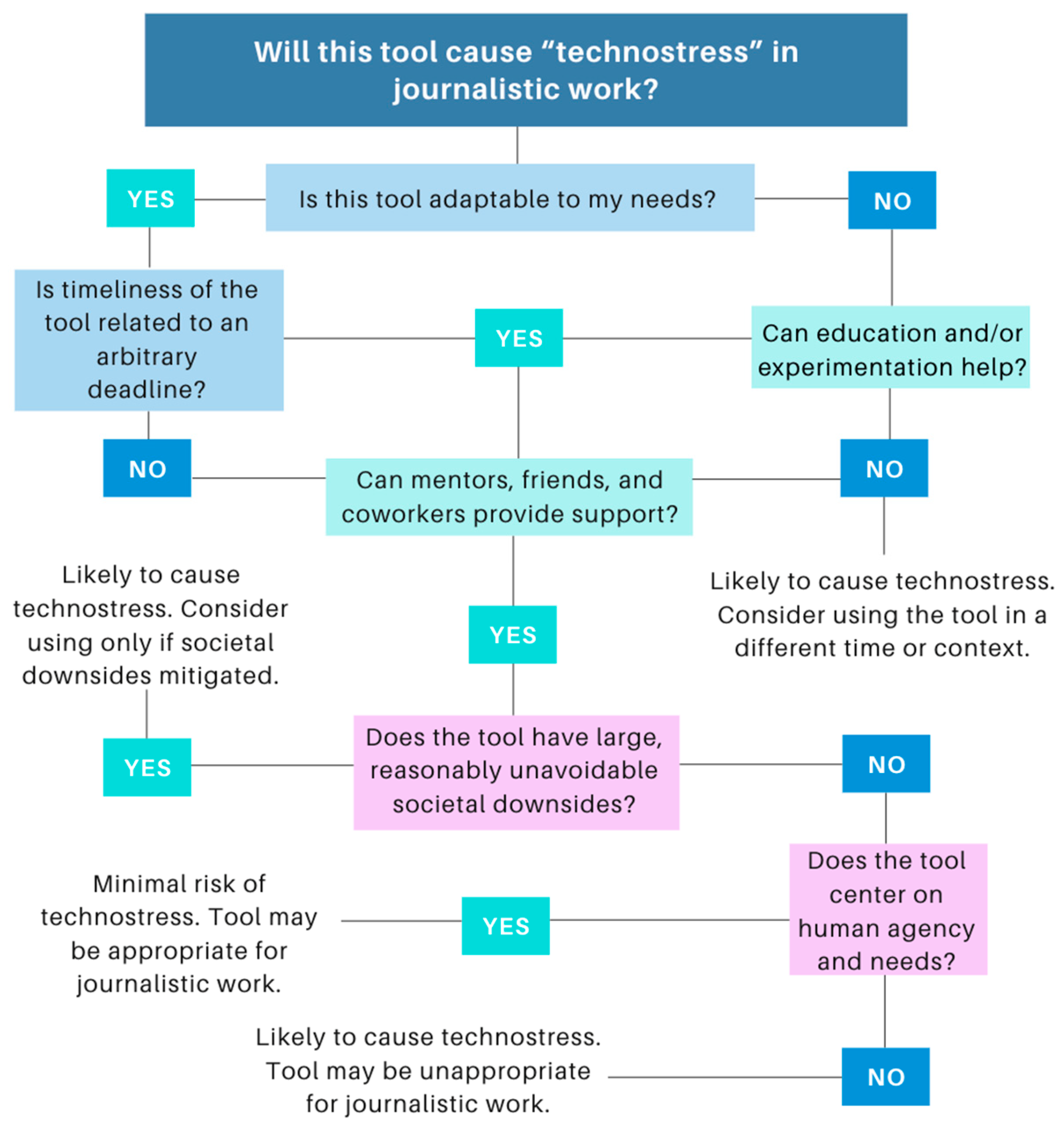
Journalists moved through the individual professional, social connection, and foundational meaning levels of considerations while deciding whether or not they would be comfortable adopting a new tool into their work. Thus, they constantly evaluated and reevaluated their adoption of technologies—adopting a new tool was not a one-time decision with a single set of strategies for minimizing technostress. Rather, innovation adoption was a multi-stepped, evolving decision, including three different levels of strategies. A decision map illustrating the strategies journalists used to minimize technostress is depicted in Figure 1.
Figure 1.
Journalist considerations when evaluating whether a new tool is appropriate for their work. Individual professional level decisions are in light blue, social connection level decisions are in lighter green, and foundational meaning level decisions are in darker pink.
As early-career, regional magazine journalist Adelaide noted in her interview conducted for this study, “The industry is always going to ask something new of you.” However, the interviewed journalists have found ways to manage technostress related to using or resisting new tools while reinforcing their core values about journalism.
4.1. Individual Professional Level Strategies
Strategies to navigate the early stages of an innovation adoption decision related to minimizing technostress through focusing on the needs and limitations of the individual journalist. The strategies include: adapt and alter technology for your needs, and implement new tools when meeting timeliness, not just deadlines.
Regarding the adapt and alter technology for your needs strategy: Technologies that were intuitive, flexible, and related to a need already existing in the journalists’ workflow minimized frustrations that arose while implementing them. For instance, Adelaide discussed her organization implementing the project management tool Monday, which she described as “really nice because it’s so flexible, like you can really build whatever. However you need it to function for you is how it functions.” Other journalists noted liking technologies that adapted to their needs, even if the technology was not originally implemented for that purpose. For instance, freelancer Jacob, who also does part-time content creation work in a strategic communication context adjacent to his journalism, described enjoying the content management platform WordPress because he could implement minor corrections, such as correcting a typo, “Whereas in print, you know, you have to live with that mistake for the rest of your life.” Tools that allowed adopters to reinvent them to shifting needs minimized technostress and remained implemented long-term.
On the other hand, technologies that were added arbitrarily to a journalist’s workflow due to organizational or industry pressure either caused frustration or fell into disuse. For instance, midsized-town local reporter and editor Eudora described an organizational attempt to adopt the communication platform Discord, “and it wasn’t for any particular reason that we aren’t using it [anymore].” She described that the individual who pushed for the platform to be used left the small-newsroom organization, after which the platform was not used because there had not been a real need for it in the first place. “We don’t use it as much now because if I need something, I just email,” Eudora said. “I don’t see how it really makes things better or easier.” Thus, in Eudora’s experience, Discord did not remain adopted due to the arbitrariness of adopting a new tool for its own sake, rather than to solve an existing need. Within a similarly small newsroom but a big-city context, Seren described a situation in which organizational leaders advocated for using AI to produce images to pair with content, even though the organization already had low-cost options for its visuals. When asked about this contradiction, Seren offered a few explanations and then concluded, “I don’t know what their reasoning is.” Further in the discussion on this topic, she stated outright, “As of now, we are not adopting that level of generative AI,” showing that unless there is a compelling need, journalists may be skeptical about adopting something arbitrarily, even when facing pressure to do so.
The implement new tools when meeting timeliness, not just deadlines strategy also focuses on base-level needs relating to the individual journalist. Journalists described managing technostress best when urgency related to implementing a technology could be treated as an opportunity to reach news values such as timeliness and novelty, rather than just an extra stressor while trying to meet an impenetrable deadline. Importantly, these deadlines were facilitated and at times even driven by pressures relating to technological advancement, such as constant social media streams of information and competition with AI tools. “We’re all trying to put our work out there as fast as possible,” said Christopher, who covers the sports beat in a large city. “And AI is a tool that can help you do that. And timely reporting is so important and so that [use of AI] can give you a leg up on the competition.” Christopher’s experience shows that technostress surrounding technologies may be worthwhile to face when the new tools help manage other work-related stress, including ever-present deadlines and industry competition. In a small-town context more focused on opinion journalism and local politics, Dean similarly mentioned that generative AI tools such as ChatGPT could aid in minimizing stress, saying, “The AI component can relieve... a ton of the stress.” He described that “before AI”:
In Dean’s view, using AI tools to help with copyediting and speeding up the reporting process, while not using them to replace your writing style or fact-finding process, could itself be a technostress minimizer.“It was very stressful, meaning you had to make deadlines; you had to make sure that your stories and your columns made sense, that no... copy editor was going to get a hold of it and rip it all to shreds, and... you know, fights with copy editors and all that sort of thing.”
However, technology adoption at times seemed to contribute to stress, and strategically managing the context in which and when to implement a tool was important to minimizing technostress. Christopher advised journalists new to the field, “Don’t worry about it [technology such as generative AI] right now. Like go and develop your skills... Go and write and make mistakes...” Christopher advised focusing on the foundational work of journalism, rather than adopting technologies when facing deadlines. Overall, for the interviewed journalists, decisions to adopt, resist, or reinvent a technology were often practical, based on quickly following through on a story. Local news multimedia journalist Isadora described deciding whether or not to use a DSLR camera or a smartphone to record footage for packages: “I’ll use my phone when it is breaking news and first responders are, like, cleaning up a crash scene... If they’re about to dip, I don’t have time to pull out the camera, so I grab my phone and I’m recording it.” So, in Isadora’s experience within broadcasting, the decision to adopt a tool arose due to time limitations to get a story complete rather than a philosophy about the technology.
4.2. Social Connection Level Strategies
The strategies that arose during this level of adoption decision making include a focus external to the journalist’s own workflow and needs. At this level, journalists begin reaching out for social guidance and support to minimize technostress related to the innovation adoption process. These strategies include: build off educational encouragement through personal experimentation and engage with mentors, coworkers, and audience for support.
First, the build off educational encouragement through personal experimentation strategy arose due to several journalists mentioning education as setting them up to manage technostress well in their work. For instance, Eudora described getting comfortable adopting new technologies when learning how to use tools such as Photoshop during her time working in a past professional role in which “if you didn’t know how to do something, they were always offering classes and they would pay for it.” Christopher similarly expressed that educational mentors and internship opportunities led to his success adapting to technostress: “I got to learn in a fast-paced, deadline-oriented environment. And in college, I had over 300 clips... I think that experience is necessary if you want to put yourself in the best position to succeed after.” Levi mentioned education too, and taking time to experiment and learn a new tool and skill well: “Don’t skirt around the learning process.” Early experience with technologies and stressful environments helped the interviewed journalists throughout their careers to adopt new technologies.
Discomfort with technology could also arise from educational experience. Many of the journalists in the entry-level career stage, including Jonah, Adelaide, Samantha, and Levi, described first hearing about AI and other tools, such as transcription services, while in college. Levi said his first encounter with AI was a feature within the social media application Snapchat: “They had, like, an AI dude that you could talk to.” This generation of journalists also expressed hesitancy about AI leftover from the initial experience of college classmates cheating using ChatGPT or professors concerned about cheating using the tool. Jonah described learning about the technology in college as “just like a brainstorming kind of thing to do... I personally didn’t trust it to write out like an essay or anything for me, just because... I would rather sit there and write it.” Similarly, Adelaide described “classmates using it” while in college and that she used it as a tool to brainstorm, “but I like wasn’t using it for essays or anything.” Thus, educational experiences with new technologies did shape future perspectives on those tools.
The educational opportunities related to technologies worked best to manage technostress when that early training was not treated as comprehensive. So, journalists were able to manage technostress better when education sparked an interest in them exploring new tools on their own, rather than expecting the training to have provided all the details for using specific technologies. For instance, early-career multimedia journalist Isadora described independently experimenting with the neighborhood application Nextdoor to find story ideas, saying, “I found that out on my own accord; no one did that.” Editor and opinion journalist Dean mentioned “trial and error” in learning how to use tools such as ChatGPT effectively, and longtime political-oriented journalist Gordon said, “I guess it’s kind of like the old adage of taking a car out for a test drive.” Computational journalist Daniel, whose work includes actively developing cutting-edge tools to be used within news, similarly described independent experimentation but cautioned journalists to hold published work to a higher standard:
In fact, Daniel often factored in the experience of the audience when experimenting with new technologies: “A lot of what I’m doing when I have time to experiment is trying to answer that question of like: What capability could we put in someone’s hands by applying this technology?” Thus, journalists who experimented with technologies and evaluated them based on how an audience of citizens could be empowered managed technostress successfully.“I think it’s always good to be testing the boundaries… We all have the ability to draw a line between what we do in the… experimentation around the edge with what we do that actually is on the path to publication, and it’s important that we’re very careful about when things make the jump from one side of that to the other.”
Another way journalists described managing technostress involved engaging with mentors, coworkers, and audience for support. Describing his own workplace, Christopher said, “If you’re feeling stressed, you know, that’s what your editors are there for. You don’t have to go through this alone... There are tons of people that you can reach out to that’ll help you.” Further, journalists noted that personal connections and relationships helped with stress specifically related to technology. While discussing reaching out to specialized human experts instead of turning to tools that disconnect a journalist from other people, Samantha described avoiding technostress relating to ChatGPT by resisting using the tool to answer a question she had about “the difference between tomato bisque soup and just tomato soup... Instead of going and googling or asking AI whatever nonsense, I texted my dad, because he does a lot of cooking. And he had an answer for me.” Seeking out this human expertise and support allowed Samantha to disengage with the “slippery slope” of ethical issues she finds within tools such as ChatGPT.
Newsroom culture and status also factored into the technostress that journalists manage. Daniel and Levi mentioned considering publication reputation when implementing new tools. “I think it’s a credibility issue,” Levi said about the use of generative AI, while Daniel mentioned a need to consider the “competitive edge” of the journalistic outlet he works for when considering using or avoiding new technologies. A key minimizer of technostress regarding publication reputation involved close-knit newsrooms and/or good camaraderie with the community that represents the audience for the publication. Jonah mentioned both as helpful in navigating any technostress, describing mentorship from his boss and good reputation with the publication’s community:
Thus, both personal relationships and organizational culture factored into how journalists responded to new technologies.“As far in talking to some people, it can be intimidating as well, especially being new to the area. But I always kind of have to trust that, hey, these people know who we are and we’re a respected organization... We’re not out to get anybody or anything like that. We’re truly trying to just tell the stories, how they are, the news, how it is, and keep people informed.”
Notably, only one journalist in my sample (Seren) had an organization that clearly offered guidance, such as training or formal organizational policies, for generative AI use. The lack of formal policies might contribute to some discomfort for the other journalists in the sample, especially those in entry-level or freelancing positions, as these individuals were the participants who expressed concern about being caught “cheating” using AI tools. Jacob, who works for a variety of journalistic outlets and acknowledged not disclosing his limited AI use to editors, also described “examples of people getting caught” using AI tools in an unethical and error-ridden fashion and mentioned “I think there are a lot of people who are starting to try to figure out ways to kind of use it to kind of cheat” by generating content with little human oversight or transparency. Isadora, who expressed outright resistance to generative AI within journalistic work, mentioned that the technology was regarded as “hush hush” by younger employees in the newsroom. Levi also described hesitancy to use and acknowledge use of generative AI, describing example cases of “a publication has gotten caught doing this” and being met with “rage and anger.” When asked for clarification on his opinions about AI being used within journalism, Levi further described, “It’s cheating. Cheating goes way beyond, you know, academia. Once you get to the workplace, if you’re not doing it yourself, that’s a form of plagiarism.” Overall, while the journalists did not directly state that they needed more organizational policies related to technology use, such as with generative AI, their descriptions revealed that such guidance may be helpful, especially for early-career and freelance journalists.
4.3. Foundational Meaning Level Strategies
Finally, journalists managed technostress within the foundational meaning level of the decision process through two strategies: take breaks from technologies while acknowledging their downsides and keep humanity at the center of all journalistic work. This level of decision making included philosophical and ethical considerations about the broader sociopolitical impacts of the innovation.
Journalists described minimizing technostress at this level through taking breaks from technologies while acknowledging their downsides. For instance, when discussing how he has adapted to manage the demands of his small newsroom and having to monitor developing stories and opinions on social media “when everything’s moving so fast,” Jonah described going on morning runs to “just kind of space out. Being able to find time to for sure just kind of get in touch with yourself. Especially when there’s so much ugly stuff going on,” such as negativity on social media platforms. Dean similarly described the importance of taking personal breaks from professional demands. He described that carrying “a chip on my shoulder” as an opinion journalist “wouldn’t be fair” in his personal life, “whether it be as a husband, father, grandfather, friend.” He also described facing backlash for his work, at times, via social media and online comment sections: “Being an opinionated columnist in a smaller city means there are as many people that hate you that love you,” and he noted that this feature of his job has only been amplified by technologies such as social media. These experiences show that journalists routinely experience criticism and feeling overwhelmed due to technologies, but the journalists managed that stress through breaks. Importantly, moments of peace were not something the journalists found by happenstance but instead were intentionally carved between the routine pressures of covering news.
At the same time, the interviewed journalists emphasized the need to balance breaks with periods of acknowledging the larger societal downsides of technologies, especially when the technological systems impacted the communities the journalists serve. Seren, whose journalism is directly dedicated to serving communities historically underserved by mainstream news, brought up the larger implications of the system of AI:
So, in Seren’s experience, large-scale sociopolitical issues with the technological system can also lead to justified discomfort when adopting a tool. On a more functional level, Daniel described keeping in mind the technical limitations of tools. For instance, regarding generative AI he described: “The limitation is that you can ask it anything and it will confidently respond, and you can ask it something that it’s not well suited to do alongside something that it is well suited to do, and the confidence of the response is essentially identical.” Samantha also uses technical limitations to guide the decision to adopt a new tool: “I kind of resist at first because I want to see how it breaks for other people, so that I can make sure it doesn’t break for me.” Journalists balanced a willingness to try out new technologies with taking breaks away from overwhelming new tools and acknowledging their implications that may contradict the journalistic mission.“I am a big hater of ChatGPT... You know, the centers that it takes to run these machines are in black and brown communities that are already experiencing a lot of inequities, and it’s poisoning our water. And so there [are] a lot of other negative impacts to that... I’m always going to be looking at: What effect does this have in the long term?”
Finally, the interviewed journalists reinforced that journalism must keep humanity at the center of all journalistic work no matter how technology advances. In fact, this core value of always focusing on the human in their reporting to steady the interviewed journalists when facing technostress. Community-focused Seren kept bringing up the importance of human autonomy to the journalistic process no matter the technologies used:
Therefore, human independence of thought seemed central to the journalistic enterprise, at least for Seren. Sports-oriented Christopher similarly noted, “My goal is to give the readers something more than a box score. Not just, hey, here’s what happened, but why does this matter?” For Christopher, as with the other journalists in the sample, no matter the technologies used in the process, journalism remains about serving a human community.“And at the end of the day, I mean, a job is a job. But journalism... We exist to convey as much truth as exists to the greater human community in a broad sense of the definition. And that requires personal autonomy to decide, well, how is the story going to break? How am I going to relay this information to this community? And why is it relevant to them? There has to be a humanized element there [so] that even without AI, you can tell when, oh, Chase Banks sponsored this article... Any kind of outside influence like that.”
Other journalists, including Dean, Isadora, and Jacob, described not letting technostress worry them simply because they found the work of journalism enjoyable. Isadora said, “What’s the point of being in this business if you’re going to copy and paste something into AI?... [That] kind of just defeats the fun out of it.” To describe outsourcing the human work of journalism to technologies, Dean used the metaphor of loving golf and then making a clone to play golf instead, which would negate the actual enjoyment of playing golf. “You have a real satisfaction of knowing that you wrote the story,” he said. Further, Daniel noted that without technology, reporting could still continue—but without human reporting, journalism would no longer exist. “The foundation of any news organization that is doing actual original reporting... the reporting is the foundation of the entire organization. And that is the one skill that if you were to just remove it from the org... essentially just the presses would stop. I mean, there’s nothing left.” In other words, humans finding and verifying facts that are meaningful to humans remains the core of journalism.
The journalists interviewed for this project emphasized that technologies will constantly change, but the core values and ethical principles of journalism should remain the same. New technologies are so common to journalism that entry-level Levi advocated “embrace the change.” Director-level Gordon described this “natural progression” of technologies shifting within journalism, from “the morning paper” to radio and TV. “But when I was a kid,” Gordon said, “the older folks then would have told you everything was different then from what it was years and years and decades before, too. So it’s always been evolving… All the way back to the days of Ben Franklin. The paper used to be wider. Now it’s narrower. The font sizes, everything changed.” After discussing these changes, Gordon emphasized the values that remain essential no matter the tools used to report on a story: “I think for journalists... there’s a level of integrity and a level of genuineness that we need to maintain and retain.” The interviewed journalists managed technostress by reinforcing their own unbending principles related to their work.
Overall, the strategies identified in this study connect to diffusion of innovations theory in several ways, such as reflecting on the innovation attributes originally outlined by Rogers (2003). The journalists mentioned the following attributes as central to minimizing technostress: trialability (build off educational encouragement through personal experimentation), compatibility (adapt and alter technology for your needs), and observability (engage with mentors, coworkers, and audience for support). Complexity of the technology was also mentioned across several of the identified strategies, as journalists preferred tools they could understand. When asked what makes her more comfortable with a technology, early-career magazine journalist Adelaide instructed, “Dumb it down a lot and, like, explain very simply how it works and how it will help with whatever it’s designed to do.” Despite extensive work with computational tools within journalism, often even helping engineer the design of the tools, Daniel similarly emphasized thinking critically about technologies by “look[ing] at how it works” and distrusting generative AI because “I feel like my understanding does not allow me to just sort of trust it completely.” Relative advantage appeared across the strategies, as well, such as in Eudora’s description of organizational disuse of Discord and in other decisions described by the journalists. For instance, Seren described using her smartphone to take images for stories because “I’m living on the former college student salary... iPhone video is pretty great quality nowadays.” So, that technology non-adoption decision was based on whether purchasing another more technically advanced tool was advantageous enough to be worth the investment. This signals the contextual nature of the strategies used to minimize technostress, moving through the personal, social, and societal levels of considerations—adoption of an innovation is not a one-step, one-time, or isolated decision.
5. Discussion and Conclusions
To answer my research question, journalists managed technostress through six strategies that arose at different levels of the technology adoption decision-making process. At the individual professional level, journalists adapted and altered technology for their needs and implemented new tools when meeting timeliness, not just for deadlines. At the social connection level, journalists built off educational encouragement through personal experimentation with new tools and engaged with mentors, coworkers, and audience members for support. Finally, at the foundational meaning level, journalists took breaks from technologies while acknowledging their downsides and reinforced that humanity must remain at the center of all journalistic work. As found by other scholars such as Seely (2019) when examining the broad issue of mental health within the journalistic profession, the journalists interviewed for this project noted dealing with technostress through taking breaks from technology-amplified work stress (implement new tools when meeting timeliness, not just for deadlines), leaning on others (engage with mentors, coworkers, and audience for support), and centering themselves in the “higher purpose” of their work (keep humanity at the center of all journalistic work). With technostress, versus other types of mental health concerns, a re-evaluation and re-articulation of what it means to be a human journalist serving human community members with human agency seemed to be even more important than reinforcing the sociopolitical and personal meanings of journalism.
The technostress that journalists experience may also be tied to context just as much as personality traits or qualities of the technology. Internal factors related to the specific organizations in which the journalists worked seemed to cause more technostress than larger external factors, such as the threat of AI to journalism jobs. This finding meshes with past scholarship on causes of technostress being internal organizational factors such as unbalanced workload and lack of clear boundaries between work and personal life (Ayyagari et al., 2011). Entry-level journalists (Jonah, Adelaide, Seren, Isadora, Levi) relied on mentors, peers, and bosses/editors in shaping their use of new tools such as generative AI. Journalists at the director level of working in the field for more than eight years, often holding leadership and editorial roles (Gordon, Dean, Daniel), relied more on their own experimentation and comfortability with new tools. Broadcast and multimedia journalists (Isadora), journalists in small, hard news-based news outlets (Jonah, Dean, Eudora) and freelancers (Levi, Jacob) seemed to have more concerns about implementing technologies on routine deadlines and were practical in their decision to use a tool, such as focusing on efficiency. In comparison, journalists at outlets with rolling publication deadlines, longer publication schedules, and a focus on behind-the-scenes work such as video editing (Seren, Adelaide, Gordon, and Samantha) philosophized more about the ethical dimensions of using new technologies within journalism as both an industry and service-oriented practice. Further, context within the innovation adoption decision-making process, whether at the individual, social, or societal level of considerations, can influence which strategies journalists use to minimize technostress.
Contributing to diffusion scholarship, this study showcases that reinvention of an innovation is (a) influenced by opinion leaders, (b) is an ongoing process with multiple levels of decision making, and (c) can minimize adverse mental health concerns related to technostress during diffusion. The journalists noted opinion leaders such as mentors influencing the adoption of new technologies. Opinion leaders also influence resistance toward innovations, just as they influence adoption. For example, early educational experiences in which an instructor considered the use of a technology to be “cheating” may be related to a journalist’s hesitancy to use that technology even in environments where such use would be considered acceptable. The influence of opinion leaders providing support and guidance during the process and the multi-level decision making of technology adoption connect to previous findings relating to technostress, especially the dimensions of techno-uncertainty, techno-complexity, and techno-insecurity, as well as work on fostering techno-eustress instead of techno-distress (Tarafdar et al., 2007; Tarafdar et al., 2019). The design of the technologies themselves, as explained previously regarding innovation attributes, also influenced experiences with technostress, connecting to the findings of Tarafdar et al. (2019). This indicates that, even in contexts of multiple technological adoption decisions ongoing and technologies besides ICTs, dimensions of technostress previously found in scholarship may still apply.
This finding may relate to the importance of “social learning” to reinvention of an innovation as outlined by Hays (1996) in a study on political policy diffusion, but more work on this dimension of reinvention is needed. Further research is needed to see how this finding applies to contexts besides journalism, which as a field has many learning-oriented and resilient individuals by default, potentially shaping how adopters respond to new ideas. In addition, a limitation of this study is its focus on technostress during the reporting process—future work should also include the other professional roles involved in journalism organizations, such as marketing, social media management, sales, information technology, etc. Finally, technostress within journalism should be further examined in contexts besides the U.S. and more directly considering differences in technostress experienced by people of different identities, such as across genders, races/ethnicities, etc. A further limitation of this study, as with all self-reported and interview-based research, is participants self-consciously shaping their answers to be viewed as desirable or agreeable. While this limitation was minimized through open-ended questions, lack of forced prompting to discuss stress or anxiety specifically, and a focus on factual stories and general advice rather than bringing up “mental health” directly, more research with different methodological approaches may address this limitation.
The main practical contribution of these findings is that technostress may happen within diffusion in the context of journalism, but there are a variety of ways to mitigate it. For instance, individual journalists can reinvent technologies to be appropriate for their own human needs and their audiences. Leaders within journalistic organizations could (a) have clear yet flexible policy guidance about technology use, (b) provide training about the limitations of technologies rather than just their uses, and (c) transparently center all technological guidance on the journalistic goal of empowering human audiences to seek truth. Technologists designing tools to be used within journalistic contexts could consider intuitive flexibility, system simplicity, and having human-centric focus in their designs—and should keep in mind that hardware may trigger more playful experimentation than software. Finally, this study shows that pressure to “upskill” and implement new technologies can have adverse mental health impacts unless managed in a healthy way for individual adopters, organizations, and society at large. While technostress may be “the new normal” for journalists, or perhaps more realistically given the history of the field, a “renewed normal,” it does not need to be destructive to the journalistic pursuit of truth. Overall, the findings of this study are hopeful—even in an age of faked and bot-produced content, journalists remain dedicated to the human process of sorting out the truth to communicate it accurately to other humans. While technostress may be normal, it can be mitigated to not corrupt the journalistic mission.
Funding
This research received no external funding.
Institutional Review Board Statement
This study was conducted in accordance with the Declaration of Helsinki and approved by the Institutional Review Board of Texas Christian University (protocol code IRB#2025-296 approved 5 September 2025).
Informed Consent Statement
Informed consent was obtained from all subjects involved in this study.
Data Availability Statement
The data for this project is unavailable due to privacy restrictions. Participants only gave consent for de-identified data to be used in public material.
Acknowledgments
An automatic transcription tool provided by the Schieffer Media Insights Lab, housed within the TCU Bob Schieffer College of Communication, was used during data analysis for this project. Publication charges for this article were supported by the TCU Library Open Access Fund.
Conflicts of Interest
The author declares no conflicts of interest.
References
- Aoki, Y., Malcolm, E., Yamaguchi, S., Thornicroft, G., & Henderson, C. (2012). Mental illness among journalists: A systematic review. International Journal of Social Psychiatry, 59(4), 377–390. [Google Scholar] [CrossRef] [Scilit]
- Ayyagari, R., Grover, V., & Purvis, R. (2011). Technostress: Technological antecedents and implications. MIS Quarterly, 35, 831–858. [Google Scholar] [CrossRef] [Scilit]
- Banerjee, S., & Kumar, A. (2025). The unseen strains: Mental health battles of Indian journalists amid COVID-19-induced economic uncertainty. Media Practice and Education, 26(2), 133–148. [Google Scholar] [CrossRef] [Scilit]
- Bondanini, G., Giorgi, G., Ariza-Montes, A., Vega-Muñoz, A., & Andreucci-Annunziata, P. (2020). Technostress dark side of technology in the workplace: A scientometric analysis. International Journal of Environmental Research and Public Health, 17(21), 8013. [Google Scholar] [CrossRef] [Scilit]
- Bridgood, J. (2025, July 21). Trump sharpens attacks on a favorite foe: The news media. The New York Times. Available online: https://www.nytimes.com/2025/07/21/us/politics/trump-news-media.html (accessed on 1 November 2025).
- Cheng, K., & Verboord, M. (2024). The diffusion of immersive journalism as media innovation from media professionals’ perspectives. Journalism, 26(12), 1–17. [Google Scholar] [CrossRef] [Scilit]
- Corbin, J. M., & Strauss, A. (1990). Grounded theory research: Procedures, canons, and evaluative criteria. Qualitative Sociology, 13(1), 3–21. [Google Scholar] [CrossRef] [Scilit]
- Davis, F. D. (1989). Perceived usefulness, perceived ease of use, and user acceptance of information technology. MIS Quarterly, 13(3), 319. [Google Scholar] [CrossRef] [Scilit]
- de Avila, J. (2024, May 3). Press freedom is under attack in much of world, U.N. ambassador says. The Wall Street Journal. Available online: https://www.wsj.com/world/press-freedom-is-under-attack-in-much-of-world-u-n-ambassador-says-c451eecd (accessed on 1 November 2025).
- De Berranger, P., Tucker, D., & Jones, L. (2001). Internet diffusion in creative micro-businesses: Identifying change agent characteristics as critical success factors. In Organizational learning and knowledge management (pp. 197–214). Psychology Press. [Google Scholar]
- De Vuyst, S. (2020). Hacking gender and technology in journalism. Routledge. [Google Scholar]
- Diamond, M. A. (1996). Innovation and diffusion of technology: A human process. Consulting Psychology Journal: Practice and Research, 48(4), 221. [Google Scholar] [CrossRef]
- English, P. (2016). Twitter’s diffusion in sports journalism: Role models, laggards and followers of the social media innovation. New Media & Society, 18(3), 484–501. [Google Scholar]
- Fliegel, F. C., & Kivlin, J. E. (1966). Attributes of innovations as factors in diffusion. American Journal of Sociology, 72(3), 235–248. [Google Scholar] [CrossRef] [Scilit]
- García-Avilés, J. A. (2020). Diffusion of innovation. The International Encyclopedia of Media Psychology, 1(8), 1–8. [Google Scholar] [CrossRef] [Scilit]
- Glaser, B., & Strauss, A. (1999). The discovery of grounded theory: Strategies for qualitative research. Aldine de Gruyter. [Google Scholar]
- Hays, S. P. (1996). Influences on reinvention during the diffusion of innovations. Political Research Quarterly, 49(3), 631–650. [Google Scholar] [CrossRef] [Scilit]
- Heaton, J. (2022). “* Pseudonyms are used throughout”: A footnote, unpacked. Qualitative Inquiry, 28(1), 123–132. [Google Scholar] [CrossRef] [Scilit]
- Holman, L., & Perreault, G. P. (2023). Diffusion of innovations in digital journalism: Technology, roles, and gender in modern newsrooms. Journalism, 24(5), 938–957. [Google Scholar] [CrossRef] [Scilit]
- Ibrahim, A. M., Osman, M. N., & Gusau, A. L. (2021). Correlation of technostress creators with employees’ work-life balance in the context of journalists’ use of information and communication technology at work: Moderating role of self-efficacy. International Journal of Media & Information Literacy, 6(2), 338–353. [Google Scholar]
- International Labour Organization. (2024, December 12). Mental health at work in the era of digitalization. Ilo.org. Available online: https://www.ilo.org/resource/news/mental-health-work-era-digitalization#:~:text=Whilst%20the%20introduction%20of%20new,adapting%20to%20constantly%20evolving%20technologies (accessed on 30 April 2025).
- Joseph, R. C. (2010). Individual resistance to IT innovations. Communications of the ACM, 53(4), 144–146. [Google Scholar] [CrossRef] [Scilit]
- Kahma, N., & Matschoss, K. (2017). The rejection of innovations? Rethinking technology diffusion and the non-use of smart energy services in Finland. Energy Research & Social Science, 34, 27–36. [Google Scholar] [CrossRef] [Scilit]
- Katzenberger, V. (2024). Mind the gap: Re-thinking digital skills in journalism education in Germany. Media Practice and Education, 1–15. [Google Scholar] [CrossRef] [Scilit]
- Kim, D. G., & Lee, C. W. (2021). Exploring the roles of self-efficacy and technical support in the relationship between techno-stress and counter-productivity. Sustainability, 13(8), 4349. [Google Scholar] [CrossRef] [Scilit]
- Kirwan, D. (2021, February 16). The ‘new normal’ is disruption itself. Forbes. Available online: https://www.forbes.com/councils/forbesagencycouncil/2021/02/16/the-new-normal-is-disruption-itself/ (accessed on 30 April 2025).
- Koerber, A., & McMichael, L. (2008). Qualitative sampling methods: A primer for technical communicators. Journal of Business and Technical Communication, 22(4), 454–473. [Google Scholar] [CrossRef] [Scilit]
- Kumar, P. S. (2024). Technostress: A comprehensive literature review on dimensions, impacts, and management strategies. Computers in Human Behavior Reports, 16, 100475. [Google Scholar] [CrossRef] [Scilit]
- Lincoln, Y. S., & Guba, E. G. (1985). Establishing Trustworthiness. In Y. S. Lincoln, & E. G. Guba (Eds.), Naturalistic inquiry (pp. 289–327). Sage Publications. [Google Scholar]
- MacVaugh, J., & Schiavone, F. (2010). Limits to the diffusion of innovation: A literature review and integrative model. European Journal of Innovation Management, 13(2), 197–221. [Google Scholar] [CrossRef] [Scilit]
- Makse, T., & Volden, C. (2011). The role of policy attributes in the diffusion of innovations. The Journal of Politics, 73(1), 108–124. [Google Scholar] [CrossRef] [Scilit]
- Malterud, K., Siersma, V. D., & Guassora, A. D. (2016). Sample size in qualitative interview studies: Guided by information power. Qualitative Health Research, 26(13), 1753–1760. [Google Scholar] [CrossRef] [Scilit]
- Mankins, M., Garton, E., & Schwartz, D. (2021). Future-proofing your organization: Prepare your team to stay ahead in the post-pandemic world. Harvard Business Review. Available online: https://hbr.org/2021/09/future-proofing-your-organization (accessed on 1 November 2025).
- Markovikj, M., & Serafimovska, E. (2023). Mental health resilience in the journalism curriculum. Journalism & Mass Communication Educator, 78(2), 233–250. [Google Scholar] [CrossRef] [Scilit]
- Marshall, B., Cardon, P., Poddar, A., & Fontenot, R. (2013). Does sample size matter in qualitative research? A review of qualitative interviews in IS research. Journal of Computer Information Systems, 54(1), 11–22. [Google Scholar] [CrossRef] [Scilit]
- Mathews, N., Bélair-Gagnon, V., & Carlson, M. (2023). “Why I quit journalism:” Former journalists’ advice giving as a way to regain control. Journalism, 24(1), 62–77. [Google Scholar] [CrossRef] [Scilit]
- Olshansky, A., Hayes, C., & Kee, K. F. (2023). The characteristics of influencers and opinion leaders of science gateways and cyberinfrastructure for innovation diffusion. Computing in Science and Engineering, 25(2), 30–39. [Google Scholar] [CrossRef] [Scilit]
- O’Rourke, K. H., Rahman, A. S., & Taylor, A. M. (2013). Luddites, the industrial revolution, and the demographic transition. Journal of Economic Growth, 18(4), 373–409. [Google Scholar] [CrossRef] [Scilit]
- Pavlik, J. (2000). The impact of technology on journalism. Journalism Studies, 1(2), 229–237. [Google Scholar] [CrossRef] [Scilit]
- Richardson, R., & Arzaba, A. (2025, May 5). Chaos and credibility: A snapshot of how AI is impacting press freedom and investigative journalism. Global Investigative Journalism Network. Available online: https://gijn.org/stories/ai-impacts-press-freedom-investigative-journalism/ (accessed on 1 November 2025).
- Rogers, E. (2003). Diffusion of innovations. Free Press. [Google Scholar]
- Seely, N. (2019). Journalists and mental health: The psychological toll of covering everyday trauma. Newspaper Research Journal, 40(2), 239–259. [Google Scholar] [CrossRef] [Scilit]
- Shi, Y., & Sun, L. (2024). How generative AI is transforming journalism: Development, application and ethics. Journalism and Media, 5(2), 582–594. [Google Scholar] [CrossRef] [Scilit]
- Singer, J. B. (2004). Strange bedfellows? The diffusion of convergence in four news organizations. Journalism Studies, 5(1), 3–18. [Google Scholar] [CrossRef] [Scilit]
- Springer, N., & Rick, J. (2025). Coping with precarity: Journalists’ strategies to find ease in a professionally vulnerable situation. Digital Journalism, 13, 990–1008. [Google Scholar] [CrossRef] [Scilit]
- Srivastava, J., & Moreland, J. J. (2012). Diffusion of innovations: Communication evolution and influences. The Communication Review, 15(4), 294–312. [Google Scholar] [CrossRef] [Scilit]
- Starr, P. (2005). The creation of the media: Political origins of modern communications. Basic Books. [Google Scholar]
- Tarafdar, M., Cooper, C. L., & Stich, J. F. (2019). The technostress trifecta-techno eustress, techno distress and design: Theoretical directions and an agenda for research. Information Systems Journal, 29(1), 6–42. [Google Scholar] [CrossRef] [Scilit]
- Tarafdar, M., Tu, Q., Ragu-Nathan, B. S., & Ragu-Nathan, T. S. (2007). The impact of technostress on role stress and productivity. Journal of Management Information Systems, 24(1), 301–328. [Google Scholar] [CrossRef] [Scilit]
- Valente, T. W. (1996). Social network thresholds in the diffusion of innovations. Social Networks, 18(1), 69–89. [Google Scholar] [CrossRef] [Scilit]
- Venkatesh, V., Thong, J. Y., & Xu, X. (2012). Consumer acceptance and use of information technology: Extending the unified theory of acceptance and use of technology. MIS Quarterly, 36, 157–178. [Google Scholar] [CrossRef] [Scilit]
- Zelizer, B. (2019). Why journalism is about more than digital technology. Digital Journalism, 7(3), 343–350. [Google Scholar] [CrossRef] [Scilit]
- Zhang, S., & Feng, J. (2019). A step forward? Exploring the diffusion of data journalism as journalistic innovations in China. Journalism Studies, 20(9), 1281–1300. [Google Scholar] [CrossRef] [Scilit]

Disclaimer/Publisher’s Note: The statements, opinions and data contained in all publications are solely those of the individual author(s) and contributor(s) and not of MDPI and/or the editor(s). MDPI and/or the editor(s) disclaim responsibility for any injury to people or property resulting from any ideas, methods, instructions or products referred to in the content. |
© 2026 by the author. Licensee MDPI, Basel, Switzerland. This article is an open access article distributed under the terms and conditions of the Creative Commons Attribution (CC BY) license.