


Abstract
(1) Background: The incidence and impact of misleading information on public opinion in the field of nutrition and food science, focusing on the mechanisms of dissemination and their potential consequences, are increasingly being explored in academia. It is therefore essential to highlight the importance of studying discourse to understand the contexts and motivations behind the persistent circulation of hoaxes. For this reason, this research compiles and analyses the news content on food fake news published in the web repository of Spanish information verifiers Newtral and Maldita Alimentación. (2) Method: The period analysed extends from the launches of both platforms (2018 and 2021, respectively) to 2024, examining a total of 564 news items using computerised analysis software. (3) Results: The results show three thematic clusters related to the information refuted by Newtral and five clusters belonging to Maldita Alimentación. The findings of this research are consistent with a prevalence of concern for public health; the risk of disease due to poor food management; the role of authorities, especially in the European context; the supervision of food quality and the protection of public health; and the debunking of messages about food properties without scientific evidence. (4) Conclusions: The article highlights the importance of implementing strategies that foster trust in information sources, such as fact-checkers, and encourage the scientific dissemination of food-related content in an accessible manner.
1. Introduction
The public debate generated on various food issues plays a fundamental role in shaping public policies and consumption practices. Hoaxes and misinformation on topics related to food, health, and nutrition are an intrinsic part of public opinion, so understanding the discourse surrounding their typology and persistence, regardless of their debunking over the years, is imperative in contemporary society. One of the most recurrent themes in public opinion on food is the rejection of genetically modified foods (GMOs). In the European context, most consumers show strong opposition to GMOs due to concerns related to health, the environment and lack of information, and insist that authorities should seek scientific advice when defining their policies on science (González, 2007). Misinformation about these products has been particularly problematic given the dissemination of messages that contradict existing scientific evidence (Linnhoff et al., 2017). In this regard, consumers report that they obtain information about GMOs mainly through the Internet, which increases the possibility of accessing both accurate information and hoaxes (Cui & Shoemaker, 2018; Wunderlich & Gatto, 2015; Gesser-Edelsburg et al., 2017). This fact also extends to other communities, such as Venezuela, where general ignorance about biotechnology, genetically modified foods and GMOs leads to moderate acceptance with persistent doubts about their risks to human health (Ferrer Escalona, 2009).
Specifically, in addition to Venezuela, in Spain, the media plays a crucial role in shaping public perception of biotechnology, especially with regard to cloning and GMOs (J. A. D. Martínez & Peláez, 2007; Ferrer Escalona, 2009), highlighting the need to increase the scientific and technological literacy of the population. While young people are more receptive to scientific information, recognising their lack of knowledge, adults are more critical and sceptical, especially in relation to media control (J. A. D. Martínez & Peláez, 2007). The influence of the media on public perception of food has also been observed in the debate on organic and sustainable food. In the United States and Germany, the topics discussed in the news have a direct impact on readers’ comments and opinions about organic food. Here, it is noteworthy that the media acts as the main shaper of the public agenda on issues of food safety, quality and sustainability (Danner et al., 2022). Therefore, consumers’ perceived mistrust of food safety is linked to an increase in preference for products with healthier and safer connotations (Xu et al., 2024). Another subject of debate has been food supplements. Studies such as that by Molinero and Márquez (2009) point to the dangers faced by athletes due to a lack of knowledge about these supplements, resulting in exposure to substances that are not permitted in competitions and are also harmful to health. In this regard, it should be noted that the European Food Safety Authority (EFSA) did not authorise 80.3% of the claims made about food supplements advertised in Spain in 2017 (Muela-Molina et al., 2021).
The facts discussed highlight the need to examine messages containing misinformation about health, food and nutrition, especially and exhaustively examining fallacies, possible conspiracy theories and the increase in unqualified influencers and/or opinion leaders on social media, as they can negatively affect people’s knowledge, attitudes and behavioural intentions (Martins, 2021; Myrick & Erlichman, 2019; Schmid et al., 2023). Therefore, information verification platforms play a fundamental role in debunking false content (Buchanan, 2020; Tirado García & Alonso-Muñoz, 2024). In Spain, in recent years, information verification carried out by fact-checking platforms such as Newtral and Maldita has become particularly relevant in issues related to politics, feminism and xenophobia (Abuín-Penas et al., 2023; Blanco-Alfonso et al., 2021; De Borja Martínez-Parra & Torrado-Morales, 2020; Gamir-Ríos & Tarullo, 2022; García-Marín et al., 2023; Malavé & Quintana, 2023), as well as fake news related to COVID-19 (Aguado-Guadalupe & Bernaola-Serrano, 2020; Salaverría et al., 2020). Hoaxes about vaccines, meanwhile, have been one of the most debunked areas (Almansa-Martínez et al., 2022), along with myths directly linked to science and public health institutions (Salaverría et al., 2020), nutrition and food (Moreno-Castro, 2022; Roger-Monzó et al., 2023). According to Blanco-Herrero et al. (2024, p. 510), “the variable with the most marked differences is the presence of health-related topics in verified content”, which represents a decrease from 30% to 12% between 2020 and 2022. They also warn that content that may incite hatred is more closely linked to political and social issues than to science, health and technology.
As can be seen in the existing academic literature, there are studies that have addressed the investigation of hoaxes, myths and misinformation about health and nutrition from various communication perspectives, as well as specific cases of false information about a particular product that has negatively affected people’s health (Duarte et al., 2022; Henrina et al., 2020). While the information in the press is based on evidence and the dismantling of numerous hoaxes, misinformation and disinformation do circulate on social media and other private platforms, as reported by verification platforms. In this regard, it is worth noting how political beliefs shape users’ willingness to accept or reject verified information, often leading to polarisation and the reinforcement of pre-existing ideas (Shin & Thorson, 2017; Uscinski & Butler, 2013).
This research paper aims to make a more specific contribution to the analysis of food misinformation and disinformation circulating in Spain, emphasising the importance of discourse analysis when examining news items about hoaxes published on the websites of the information verifiers Newtral and Maldita Alimentación up to 2024. In this regard, this article has taken into account both disinformation and misinformation (both malicious and non-malicious, Armitage & Vaccari, 2021; Stahl, 2006) addressed and refuted on these two Spanish fact-checking platforms. In both cases, professionals in information and data science are responsible for examining and debunking them. It should be emphasised that it is the original news items collected from these platforms that are analysed and not the platforms themselves.
To address the research objectives, the following research questions were formulated: (RQ1) What types of hoaxes are disseminated in food-related news, and what is their volume? (RQ2) What characterises the discourse of the predominant debunked messages identified by each fact-checking platform? (RQ3) What similarities and differences exist between the information disseminated across both verification platforms?
Based on these research questions, the study proposes the following hypotheses:
H1.
Many hoaxes are primarily related to genetically modified organism (GMO) products and frequently include claims regarding health benefits or specific properties, particularly in relation to food supplements.
H2.
The discourse of debunked content predominantly incorporates non-technical language designed to be accessible and understandable to the public.
H3.
Both platforms demonstrate a strong reliance on scientific evidence in their verification processes; however, the most significant differences between them are reflected in the volume and scope of the content analysed.
2. Theoretical Framework
Content verification, as we understand it today, emerged in the United States at the end of the 20th century (Blanco-Alfonso et al., 2024). In this sense, fact-checkers have managed to establish robust teamwork communities in which they share experiences about their practices and technological tools. These are made up of experts in journalism, data science, computer science and politics, who mainly publish allegedly misleading content and explanatory articles that clarify complex issues without judging their veracity (García-Marín et al., 2023).
The role played by information verifiers is a clear example of how science and journalism converge to combat fake news. Currently, information verification on food content is offered by specialised platforms, which are becoming increasingly relevant in Spain and South America, as fake news is a significant problem (Vizoso & Vázquez-Herrero, 2019). This is the case of Newtral, which experienced an increase in verifications in March 2020 during the COVID-19 outbreak, with the debunked news items coming from social networks such as WhatsApp and Twitter, now X (Aguado-Guadalupe & Bernaola-Serrano, 2020), and Maldita, whose collaborative working model encourages citizen participation and promotes media literacy (Antón et al., 2022). Specifically, Maldita Alimentación was created in 2018 with the aim of bringing together both expert voices and communication professionals to debunk food hoaxes and offer tools to the population, enabling them to improve their decision-making regarding their health and well-being (Maldita Alimentación, n.d.). Thus, it allows “the phenomenon to be measured through the most relevant cases of disinformation in terms of danger and virality” (Blanco-Herrero et al., 2024, p. 505).
One of the existing barriers facing society is resistance to changing beliefs regardless of the information and scientific basis presented. This fact can be seen in the research presented by Duarte et al. (2022), where coconut oil consumers did not change their eating habits despite scientific evidence warning that this product does not have cardiometabolic benefits. This finding is in line with the conclusions of van Stekelenburg et al. (2020) and Wang (2021), who argue that people tend to assimilate new information in a biased manner, adjusting it to their previous beliefs. That is why the media, social networks and its influencers, plus the digital platforms play an essential role in promoting trust in science and debunking false beliefs about health due to the consumption of certain foods (Moreno-Castro, 2022; Vegas, 2022; Sheats & Jones, 2016).
For a deeper understanding of users’ trust and selective consumption system and the determination of the discourse approach towards that target audience from a sociological perspective of power structures and social dynamics (Lang, 2019; Hess, 2011; Bourdieu, 1991), food science can be understood as a structured social space where different agents compete for legitimate authority to define what is considered valid knowledge about nutrition and eating habits. In this field, scientists and nutrition experts often occupy dominant positions, allowing them to influence the social construction of categories such as ‘healthy food’, ‘quality product’ or ‘food risk.’ However, this influence is not exerted directly on consumers but is articulated through the media, which function as fundamental intermediaries in the circulation of scientific knowledge. The media not only select what scientific information is disseminated, but also reinterpret and adapt it to narrative and commercial logic. In this process, hybrid actors emerge, such as influencers or specialised communicators, who use their social and symbolic capital to translate scientific discourse into practical recommendations, thus helping to shape consumer perceptions and decisions.
Consumers’ food choices, therefore, do not respond solely to individual or rational criteria, but are deeply conditioned by social and cultural norms that define which foods are legitimate or desirable, and are the result of a dynamic interaction between the scientific, media and economic fields. However, science communication on food has received limited attention within the academic field itself. This can be seen as a reflection of the dynamics of power and censorship within the scientific field, which tend to prioritise topics that reinforce the symbolic capital of dominant agents and exclude those considered less legitimate or relevant (Bourdieu & Passeron, 1977).
Therefore, in an environment where information overload prevails and scientific evidence hangs in the balance, when misinformation reaches users through social media such as Instagram, the quality of the information has a significant impact on eating behaviour, especially in posts with less scientific rigour, as they tend to attract more users (Denniss et al., 2024; Ruani et al., 2023). Given this context, young users are more likely to use social media, making them more vulnerable to misinformation and disinformation, especially when they rely on their close circle or influencers who lack expert training in areas such as nutrition and health (Castellini et al., 2021). Spanish Instagram influencers contribute very little to fact-checking, with only 3.9% of their posts focused on debunking hoaxes, particularly those related to healthy eating (Argiñano & Goikoetxea-Bilbao, 2021). In these contexts, it is also necessary to focus on fake news, as it is more likely to spread without pre-established controls due to the lack of regulation and effective supervision by technology platforms, as is also the case with WhatsApp (I. C. Martínez et al., 2022; Palomo & Amundarain, 2018).
For this reason, it is essential that scientists in the fields of health and nutrition disseminate the results of their research to help counteract misperceptions among the public (Miller et al., 2006). In 2021, 47% of Spaniards believed that scientists are not good communicators, compared to 39% of the population who believed the opposite (European Commission, 2021). On the other hand, 73% confirmed that scientists inspired confidence in them, which suggests an antagonism between the scientific information provided by professionals and society’s trust in those messages. This highlights an implicit need for collaboration between journalists and food industry professionals in order to combat food hoaxes and strike a balance between trust, public empathy and the correction of misinformation (Sharon & Baram-Tsabari, 2020; Stare, 1992). For their part, Diekman et al. (2023) point to the need to train communication experts to disseminate content based on scientific evidence that is accessible to society, provided that technical language is used sparingly so as not to hinder understanding (Capocasa & Venier, 2023).
Xiao et al. (2021) suggest that trust in information verification platforms depends on user experience and the perceived competence of such platforms, with the perception of integrity being a factor that can negatively influence users’ willingness to verify information. While some people are receptive to fact-checkers, many question their practices, motivations, and credibility (Amazeen et al., 2024). This indicates that the effectiveness of fact-checking is mediated not only by the quality of the checks, but also by the public’s perception of the fact-checkers, so the provenance of the source plays a considerable role. Here, reframing journalism at the centre of communication studies could help to more effectively address the challenges related to food misinformation and disinformation, promoting inclusive narratives based on scientific evidence, enabling consumers to make more informed decisions (Zelizer, 2011). Research shows that “anonymous individuals or organisations are the creators of 30% of hoaxes, unknown individuals or organisations of 20%, and known individuals of almost 10%” (Almansa-Martínez et al., 2022, p. 193).
López-Martín and Cabús (2021) point out that the infodemic during the COVID-19 pandemic exacerbated the difficulty of distinguishing between facts and myths, especially among those with limited digital skills. In their study, verification platforms played a key role in verifying misinformation, although the results corroborated that media literacy is a significant challenge for the Spanish population. Kreft et al. (2023) reinforce this idea, noting that a high percentage of YouTube and other social media users have difficulty distinguishing reliable from unreliable information, highlighting the need to improve media literacy in the field of health and nutrition.
Digital literacy, which includes critical skills such as analytical thinking, is another key factor in the ability to discern between false and true information (Flores-Vivar & Zazo-Correa, 2023; Pozo-Montes & León-Manovel, 2020; Vinader-Segura & Puebla-Martínez, 2021), making it imperative to improve its regulation so that users can better recognise the signs of misinformation (Cai et al., 2021). Studies such as that by Tanemura and Chiba (2022) assert that beliefs about the benefits of certain foods, such as green tea, make it difficult to demystify them among individuals with low health literacy. Authors like Herrero-Diz et al. (2022) propose measures such as journalists understanding the phenomenon of hoaxes, identifying fake news, detecting bias and evaluating the credibility of sources, among others.
3. Methods
3.1. Sample Design
The present paper has taken under consideration both the content of disinformation and misinformation (intentional and unintentional) reported and debunked on these two Spanish fact-checking platforms. Professionals in information science, telecommunications engineering and data science are responsible for investigating and refuting the content on both platforms. It should be highlighted that it is the content originally compiled from these platforms that is being analysed, not the platforms themselves.
To extract the sample, Octoparse web scraping software (version: 8.6.8, February 2024) was used, which allowed each news item and its textual content to be downloaded. The collected period was carried out on 16 April 2024. The period analysed covers all the first news items debunked by Newtral and Maldita Alimentación on their web platforms (2018 and 2021 respectively) up to 2024, comparing both platforms and seeing if the hoaxes coincide, which ones persist and if there was any change after the pandemic.
A sample of 479 news items published by Maldita Alimentación and 1634 by Newtral was obtained. In the case of the latter, from the 1634 news items, only those whose content was related to food issues were selected for analysis. This reduced the number to a total of 85 publications. Consequently, the final sample consists of a total of 564 news items that refute hoaxes and misinformation related to food.
To summarise, Table 1 shows the number of news items that make up the final sample for this study. Numbered lists can be added as follows:
Table 1.
Total compilation of news items analysed.
3.2. Analysis Techniques
The research used T-LAB computerised linguistic analysis software (Plus 2020 version), which enabled the following to be carried out:
- (a)
- In relation to OE1: A quantitative analysis that counts the predominant thematic groups (number of occurrences) in the publications of both media outlets, Newtral and Maldita Alimentación.
- (b)
- In relation to OE2 and OE3: A qualitative analysis of the predominant themes in the news items to identify the main content of each thematic group found in analysis (a) of the two fact-checking platforms, as well as any similarities and differences that may exist.
For this work, elementary context analysis was used, as well as the bisecting k-means algorithm (Reforgiato Recupero, 2007; Steinbach et al., 2000). In this regard, the number of occurrences was increased to ≥4 in order to identify the most representative clusters on the topics covered in the news items on food misinformation. This type of unsupervised algorithm allows the identification of thematically grouped clusters formed organically thanks to records categorised as keywords, lemmas, and the elementary contexts corresponding to the text (Roger-Monzó et al., 2023; Von-Polheim et al., 2023). Likewise, for a more comprehensive analysis, the partitioning has been refined and made more precise using the Naive Bayes algorithm (Wickramasinghe & Kalutarage, 2020).
With regard to the linguistic corpus, the texts of the news items were taken, compiling the publications into a single document, excluding the headlines. After thoroughly reviewing the lemmas and basic contexts, we proceeded to eliminate non-descriptive empty words that, if considered, would make the grouping imprecise, such as pronouns, auxiliaries, prepositions, etc. (Reforgiato Recupero, 2007).
4. Results
4.1. Results of the Quantitative Analysis
Following the analysis of the basic contexts, the number of contexts examined in Newtral’s publications amounts to 1329 with 92 characteristic lemmas, while in Maldita Alimentación there are 8374 with 87 characteristic lemmas, as can be seen in Table 2. Similarly, three predominant thematic groups can be observed in Newtral’s news items and five clusters related to Maldita Alimentación’s publications. Authors should discuss the results and how they can be interpreted from the perspective of previous studies and of the working hypotheses. The findings and their implications should be discussed in the broadest context possible. Future research directions may also be highlighted.
Table 2.
Analysis of basic contexts and characteristic keywords by verification platform.
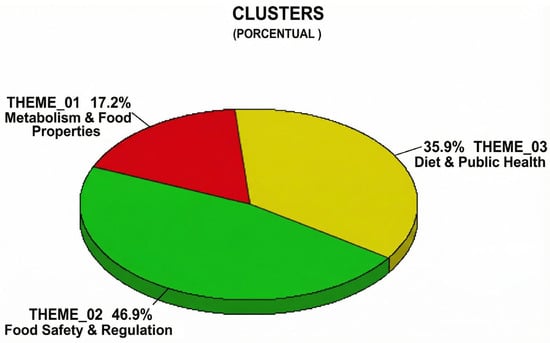
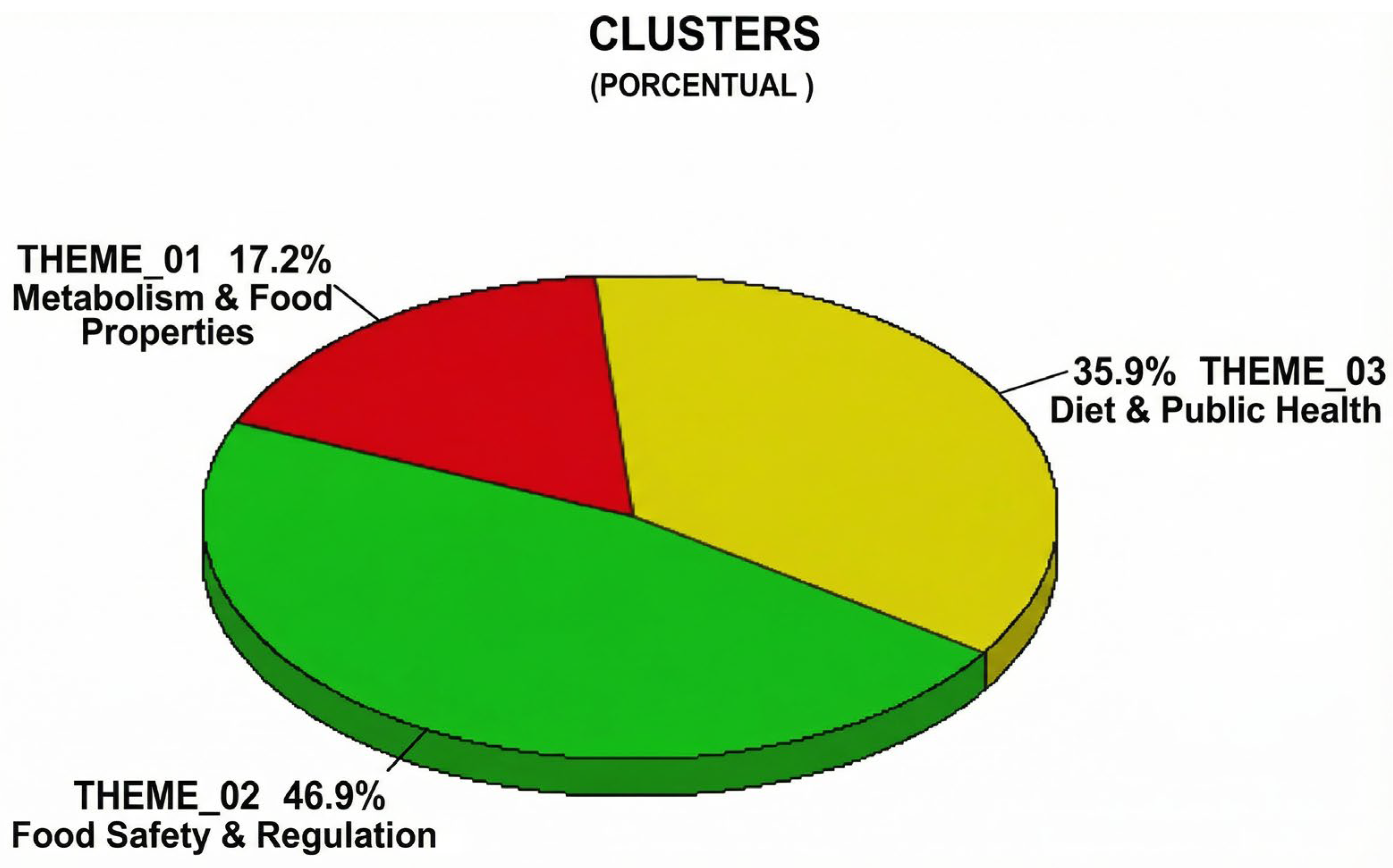
Figure 1 below details the representative percentage value of each of the main topics examined in Newtral’s news items:
Figure 1.
Percentage of predominant thematic groups in Newtral news items.
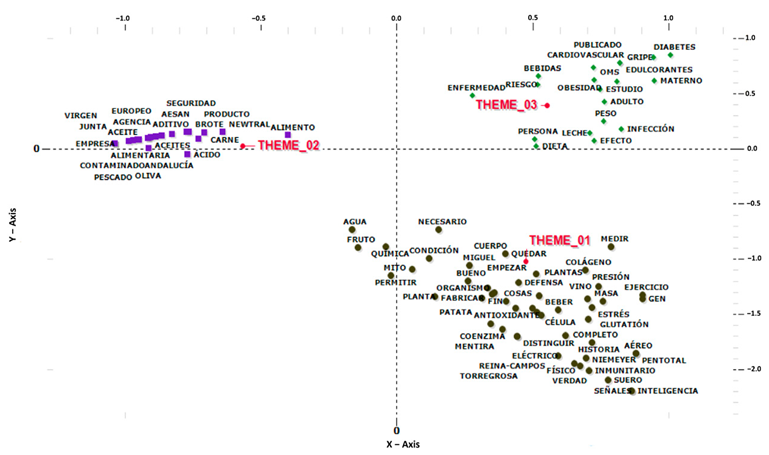
Theme_01 (first cluster) relates to news focused on the properties of food in relation to human metabolism and represents 17.2%, the least significant. Theme_02 (second cluster) covers publications related to institutional regulations and food safety, accounting for the largest number of news items with a total of 46.9%. The third cluster, Theme_03, represents 35.9% and focuses on the impact of diet on chronic diseases and public health.
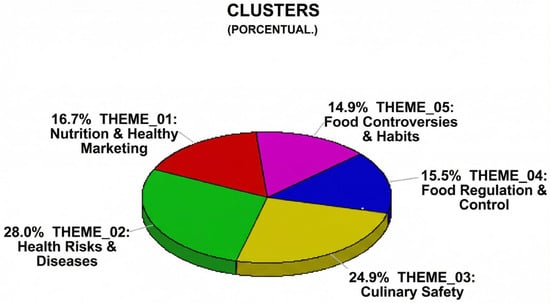
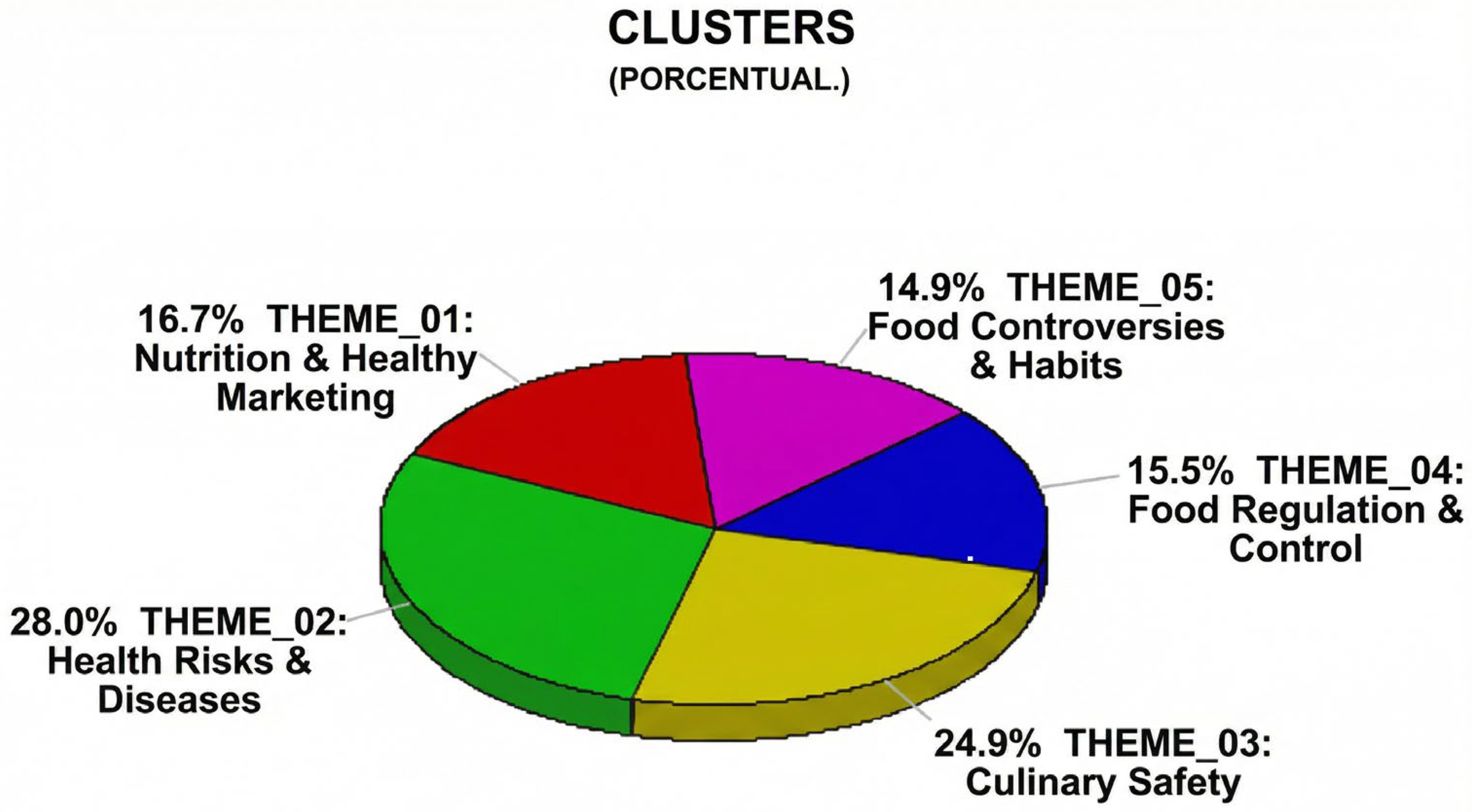
With regard to Maldita Alimentación news items, Figure 2 shows the percentage value of the predominant clusters:
Figure 2.
Percentage of predominant thematic groups in Maldita Alimentación news items.
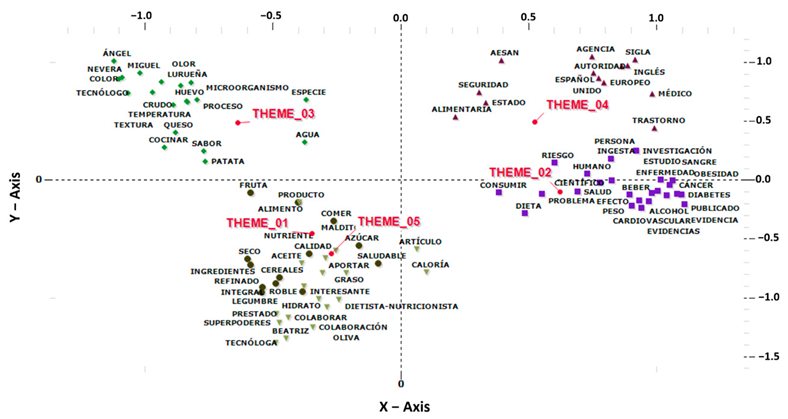
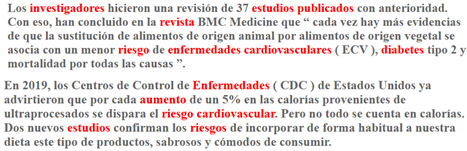
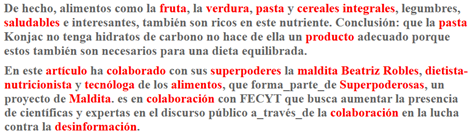
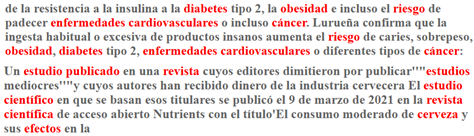
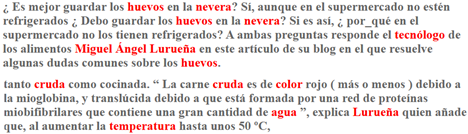
The results of the first cluster (Theme_01) are related to news focused on nutrition and healthy food marketing, which represents 16.7% and is the third least significant. The second cluster, Theme_02, encompasses publications on health risks and possible diseases associated with food, making it the most relevant and accounting for 28% of the total. The second most prevalent is Theme_03 (third cluster), which accounts for 24.9% of the news items and focuses on culinary processes and food preparation safety. Next, Theme_04 (fourth cluster) represents 15.5% and is linked to food safety regulation and control issues. Finally, Theme_05 (fifth cluster) and the least representative, covers 14.9% of the news and addresses food controversies and consumption habits.
4.2. Results of the Qualitative Analysis
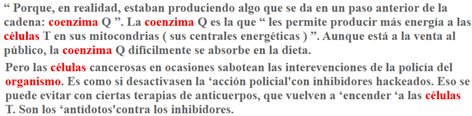
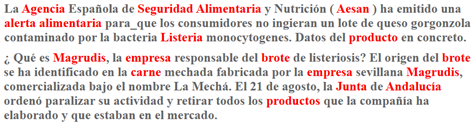
The results of this analysis delve into each of the thematic groupings that emerged from the elementary contexts examined by the media outlets (Newtral and Maldita Alimentación) in this research project. In this regard, Table 3 shows two representative examples per cluster analysed:
Table 3.
Samples extracted from the basic contexts by thematic cluster.
As can be seen in Table 2 and Table 3, Newtral’s representative thematic groupings show three main clusters in a space summarising the discourse on food, from regulation to health effects, as discussed above. The following lines provide a more detailed description of each of the themes separately:
- Theme_01: The terms that stand out are water, myth, antioxidant, cell, collagen, condition, and coenzyme. This cluster can be interpreted with a focus on food science, its properties and its link to health. The terms seem to point to the biochemistry of food, focusing on the physiology and benefits of certain ingredients. Concepts such as cell, coenzyme, collagen, and antioxidant suggest a discussion of how certain foods impact the body at the cellular level. There is also a demystification of misconceptions, which indicates refuting information about foods or nutrients that adversely affect health.
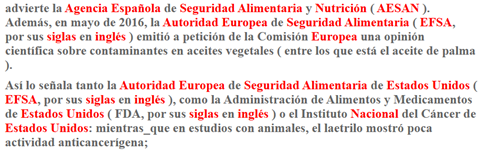
- Theme_02: The terms that stand out are AESAN, agency, safety, outbreak, neutral, and food. This cluster is related to issues of food regulation and safety. Terms related to government institutions (AESAN, agency, board) and safety issues that may arise (outbreak, contaminated) appear. The reference to more institutional and technical language indicates the importance of quality control and food regulations.
- Theme_03: The terms that stand out are diabetes, obesity, disease, risk, study, adult, and person. This thematic grouping is linked to public health and diet-related diseases. The focus of these terms is on how dietary risks can affect people. In addition, emphasis is placed on the importance of prevention and scientific studies related to diet and disease.
With regard to the thematic groupings of Maldita Alimentación, these evoke a more dispersed distribution of content and greater diversity in the subjects covered, reflecting a wide differentiation between clusters. The five clusters summarise information on the discourse surrounding food and its social, nutritional and health implications, which are discussed below:
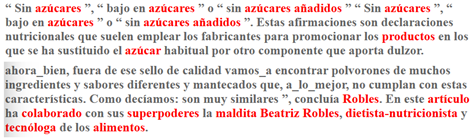
- Theme_01: The terms that can be highlighted are product, food, nutrient, quality, superpowers, cereals, oil, healthy, and legumes. In turn, emphasis is placed on nutritional aspects and food composition, which may suggest an interest in natural and healthy foods. Specifically, for this cluster, the term superpowers is used to describe the presence of professional dietitians. The involvement of experts in the narrative on food quality and the promotion of healthy products may integrate a professional approach into the discourse.
- Theme_02: The terms that can be highlighted are consume, risk, health, human, problem, evidence, and disease. This cluster focuses on the dangers that the consumption of certain products can pose to health. For example, it highlights how diet is related to cancer and diabetes. It also highlights the importance of scientific evidence in assessing these risks.
- Theme_03: The terms that can be highlighted are egg, microorganism, raw, cooking, process, temperature, flavour, and cheese. This theme groups together technical terms related to food preparation and processing. It encompasses biochemical and culinary aspects with a special focus on preservation processes. It also suggests an interest in processes that affect organoleptic characteristics and food safety. It also highlights the importance of hygiene and microbiological control in food preparation.
- Theme_04: The terms that can be highlighted are AESAN, agency, authority, food safety, research, study, and European. This cluster reflects the intervention of regulatory bodies, such as the Spanish Food Safety and Nutrition Agency, and highlights the role of European institutions in research and the control of health standards. It also emphasises the fundamental role of research in assessing the risks and benefits of food control.
- Theme_05: The terms that can be highlighted are calorie, article, collaborate, damned, and sugar. This thematic grouping proposes the demonisation of certain ingredients, especially sugar, and the intervention of the media and experts in the dissemination of information on food issues. This reflects the constant discussions about the negative effects of certain products and the need for a balanced diet. Similarly, this cluster has a certain connection with the first in terms of the expert sources cited in the media. The difference with the second cluster is the specificity of the danger. While Theme_02 focuses more on general consumption without awareness of the danger, Theme_05 refers to more specific products such as sugar.
5. Discussion and Conclusions
The study has revealed a number of key patterns in the spread of hoaxes and misinformation related to food and nutrition. After analysing the basic contexts of the news items published by the fact-checkers Newtral and Maldita Alimentación, the results show that food hoaxes are not uniform but are organised into different themes, and that the factors underlying their dissemination vary depending on the content and platform. Misinformation about food not only affects public knowledge, but also consumption habits and health. As we have seen throughout the study, European consumers, and Spanish consumers in particular, express significant rejection of genetically modified organisms (GMOs), often based on health and environmental concerns, which are fertile ground for misinformation (González, 2007; Linnhoff et al., 2017; Wunderlich & Gatto, 2015). In line with this fact, we can find a biased assimilation that explains how individuals adjust to new information based on their pre-existing beliefs, reinforcing misconceptions rather than rectifying them (van Stekelenburg et al., 2020; Wang, 2021).
In relation to the first hypothesis (H1), the analysis shows that food hoaxes tend to be structured around specific recurring themes that reflect different areas of interest among the platforms analysed. Newtral, for example, organises hoaxes mainly around three categories: food properties (Theme_01), regulations and food safety (Theme_02) and chronic diseases related to food (Theme_03). This classification suggests an approach aimed at debunking myths about food science and health risks, with a technical and institutional perspective. In contrast, Maldita Alimentación diversifies its categories into five main areas that include the organoleptic properties and compounds of food, such as nutrients, as well as the dangers of certain eating habits and the effects of consuming certain foods. This denotes a more holistic approach that incorporates dimensions of food quality and the social impact of food. These thematic differences suggest that both platforms tailor their verification to the characteristics of their respective audiences. In this sense, Newtral is more technical and Maldita Alimentación is more inclusive, with a breadth of scope that promotes media literacy (Antón et al., 2022; Kreft et al., 2023).
With regard to hypothesis two (H2), it is worth noting the importance of the discourse used in verified news items, which varies according to the nature of the hoaxes. Newtral uses technical language when refuting scientific topics (Theme_01) and employs terminology that, while seeking precision, can be difficult for a non-specialist audience to understand (Capocasa & Venier, 2023). This represents a challenge for accessible scientific communication, as specialised discourse can limit understanding. Maldita Alimentación, on the other hand, uses a simpler and more accessible approach, as can be seen in its choice of terms that are closer to the general public, which facilitates media and scientific literacy in its audience.
The third hypothesis (H3) identifies that there is a clear similarity in the news from both fact-checkers in terms of concern for public health and diet-related diseases (Xu et al., 2024; Capocasa & Venier, 2023). Shared terms such as risk, diabetes and cancer show that both clusters highlight the adverse effects that certain foods can have on health. It is also interpreted that part of the discourse revolves around scientific evidence and statements by experts in the field (Salaverría et al., 2020).
Food safety and policy regulation are other common points among the clusters represented. The Spanish Food Safety and Nutrition Agency (AESAN) is clearly reflected in the content and demonstrates concern for public policies and controls that ensure the quality and safety of food products, while also demonstrating the need to provide reliable sources (Blanco-Alfonso et al., 2024). This correspondence highlights the role of authorities, especially in the European context, in supervising and protecting public health, where trust in institutional actors, such as regulatory agencies and food producers, are key factors in consumers perceiving food as safe (Kjærnes, 2006). This approach is particularly relevant in a globalised world where food safety and ethical concerns about production methods are interconnected with trust in the institutions that oversee them. Likewise, these dynamics underscore the need for verifiers to not only present evidence-based information, but also to strengthen their public image as impartial and reliable sources.
Despite advances in understanding the relationship between public opinion and food, significant gaps in knowledge remain. For example, although the relationship between public opinion and GMOs has been extensively researched, there is a need for more comprehensive studies on how these perceptions evolve over time and how they are affected by specific cultural and demographic factors. A notable example is the study by Martín (2012), who analyses how public opinion is influenced by scientific research and the food industry to link dietary cholesterol with the risk of cardiovascular disease. This case illustrates how the interaction between science, industry and public opinion can shape food practices and perceptions of health.
It is important to note the balance between scientific rigour and accessible language in order to reach wider and more inclusive audiences (Gibson et al., 2020). Collaboration between fact-checking platforms, scientists and regulators such as AESAN could maximise the impact of communication strategies. These alliances would enable the creation of joint campaigns that reinforce public confidence in scientific evidence and messages from the authorities (Moreno-Castro, 2022). Likewise, integrating influencers with adequate training into public health campaigns could be an effective tool for combating hoaxes on social media, where myths and misinformation are widely disseminated (Argiñano & Goikoetxea-Bilbao, 2021). To ensure the effectiveness of these strategies, it is essential to develop evaluation mechanisms that analyse how audiences receive and process debunked messages. Longitudinal studies could help determine whether verified messages succeed in changing consumers’ beliefs or behaviours (Denniss et al., 2024).
Together, these actions would strengthen not only the ability of fact-checkers to mitigate misinformation, but also the empowerment of citizens, enabling them to make more informed and critical decisions. This contributes to a more aware and resilient society in the face of the challenges of the digital context. Similarly, this study reaffirms the importance of fact-checking in the food sector as a tool for mitigating misinformation, highlights the need to improve the accessibility of discourse, and promotes media literacy. Addressing these challenges will be key to strengthening public trust in science and promoting a more informed society.
With regard to the limitations of the research and future lines of work, this study focused exclusively on two verification platforms in a specific geographical context. Future research could expand this analysis to other regions and explore the relationship between debunking and changing audience perceptions. In addition, it is recommended to evaluate the effectiveness of different communication strategies to determine which is most effective in countering misinformation and myths.
Further recommendations: Based on the results obtained, it is suggested that a manual or guide to good practice be developed in the future, aimed at scientists and communicators in the field of food and health, which would enable scientific knowledge on these topics to be conveyed to society more effectively. In this regard, the topics identified in the analysis could serve as a basis for designing communication strategies that prioritise the use of accessible language, the contextualisation of scientific evidence and the anticipation of frequent misinformation narratives. It is also recommended that collaboration between researchers, science communicators and verification platforms be strengthened in order to promote the dissemination of verified and understandable information to the general public, thereby contributing to improving scientific literacy and informed decision-making on food issues.
Funding
The study presented in this paper was carried out as part of the project “ESMODA-ECO—Study of food trends through the communicative ecosystem” (RTI2018-099663-B-I00), funded by MCIN/AEI /10.13039/501100011033 and ERDF A way of making Europe. Also, the corresponding author, is a beneficiary of the Training University Lecturers’ Program (FPU), funded by the Spanish Ministry of Science & Innovation (Government of Spain): FPU2020-06223.
Institutional Review Board Statement
Not applicable.
Informed Consent Statement
Not applicable.
Data Availability Statement
The original contributions presented in this study are included in the article. Further inquiries can be directed to the corresponding author.
Conflicts of Interest
The author declares no conflicts of interest.
References
- Abuín-Penas, J., Corbacho-Valencia, J., & Pérez-Seoane, J. (2023). Análisis de los contenidos verificados por los fact-checkers españoles en Instagram. Revista de Comunicación, 22(1), 17–34. [Google Scholar] [CrossRef] [Scilit]
- Aguado-Guadalupe, G., & Bernaola-Serrano, I. (2020). Verificación en la infodemia de la COVID-19: El caso Newtral. Revista Latina de Comunicación Social, 78, 289–308. [Google Scholar] [CrossRef] [Scilit]
- Almansa-Martínez, A., Fernández-Torres, M. J., & Rodríguez-Fernández, L. (2022). Desinformación en España un año después de la COVID-19. Análisis de las verificaciones de Newtral y Maldita. Revista Latina de Comunicación Social, 80, 183–200. [Google Scholar] [CrossRef] [Scilit]
- Amazeen, M. A., Vasquez, R. A., Krishna, A., Ji, Y. G., Su, C. C., & Cummings, J. J. (2024). Missing voices: Examining how misinformation-susceptible individuals from underrepresented communities engage, perceive, and combat science misinformation. Science Communication, 46(1), 3–35. [Google Scholar] [CrossRef] [Scilit]
- Antón, L. A., Fernández, Á. F., & Sánchez, J. P. (2022). Modelos organizacionales en los medios de verificación de información. VISUAL REVIEW International Visual Culture Review/Revista Internacional de Cultura Visual, 10(1), 1–11. [Google Scholar] [CrossRef] [Scilit]
- Argiñano, J. L., & Goikoetxea-Bilbao, U. (2021). El rol de fact-checkers de los influencers españoles de la alimentación en Instagram. Comunicación y Medios, 30(44), 14. [Google Scholar] [CrossRef] [Scilit]
- Armitage, R., & Vaccari, C. (2021). Misinformation and disinformation. In The Routledge companion to media disinformation and populism (pp. 38–48). Routledge. [Google Scholar] [CrossRef] [Scilit]
- Blanco-Alfonso, I., De Los Ángeles Chaparro-Domínguez, M., & Repiso-Caballero, R. (2021). El fact-checking como estrategia global para contener la desinformación. Estudios Sobre el Mensaje Periodístico, 27(3), 779–791. [Google Scholar] [CrossRef] [Scilit]
- Blanco-Alfonso, I., Solano-Altaba, M., & Rodríguez-Luque, C. (2024). Actitudes, sesgos cognitivos y sentimientos ante la desinformación a través de redes sociales. Estudios Sobre el Mensaje Periodístico, 30(3), 467–475. [Google Scholar] [CrossRef] [Scilit]
- Blanco-Herrero, D., Arcila-Calderón, C., & Torrealba, M. T. (2024). Pandemia, polarización y odio: Características de la desinformación en España. Estudios Sobre el Mensaje Periodístico, 30(3), 503–515. [Google Scholar] [CrossRef] [Scilit]
- Bourdieu, P. (1991). The peculiar history of scientific reason. Sociological Forum, 6, 3–26. [Google Scholar] [CrossRef] [Scilit]
- Bourdieu, P., & Passeron, J.-C. (1977). Reproduction in education, society and culture. Sage Publications. Available online: https://uk.sagepub.com/en-gb/eur/book/reproduction-education-society-and-culture#reviews (accessed on 2 February 2025).
- Buchanan, T. (2020). Why do people spread false information online? The effects of message and viewer characteristics on self-reported likelihood of sharing social media disinformation. PLoS ONE, 15(10), e0239666. [Google Scholar] [CrossRef] [Scilit]
- Cai, H. C., King, L. E., & Dwyer, J. T. (2021). Using the GoogleTM search engine for health information: Is there a problem? Case study: Supplements for cancer. Current Developments in Nutrition, 5(2), nzab002. [Google Scholar] [CrossRef] [Scilit]
- Capocasa, M., & Venier, D. (2023). Opening scientific knowledge to debunk myths and lies in human nutrition. European Journal of Nutrition, 62(8), 3447–3449. [Google Scholar] [CrossRef] [Scilit]
- Castellini, G., Savarese, M., & Graffigna, G. (2021). Online fake news about food: Self-evaluation, social influence, and the stages of change moderation. International Journal of Environmental Research and Public Health, 18(6), 2934. [Google Scholar] [CrossRef] [Scilit]
- Cui, K., & Shoemaker, S. P. (2018). Public perception of genetically-modified (GM) food: A nationwide Chinese consumer study. npj Science of Food, 2(1), 10. [Google Scholar] [CrossRef] [Scilit]
- Danner, H., Hagerer, G., Pan, Y., & Groh, G. (2022). The news media and its audience: Agenda setting on organic food in the United States and Germany. Journal of Cleaner Production, 354, 131503. [Google Scholar] [CrossRef] [Scilit]
- De Borja Martínez-Parra, F., & Torrado-Morales, S. (2020). Fake news y redes sociales: Análisis del fact-checker Newtral durante las elecciones al Parlamento de Andalucía de 2018. Revista de Estilos de Aprendizaje, 13(26), 106–117. [Google Scholar] [CrossRef] [Scilit]
- Denniss, E., Lindberg, R., Marchese, L. E., & McNaughton, S. A. (2024). #Fail: The quality and accuracy of nutrition-related information by influential Australian Instagram accounts. The International Journal of Behavioral Nutrition and Physical Activity, 21(1), 16. [Google Scholar] [CrossRef] [Scilit] [PubMed]
- Diekman, C., Ryan, C. D., & Oliver, T. L. (2023). Misinformation and disinformation in food science and nutrition: Impact on practice. The Journal of Nutrition, 153(1), 3–9. [Google Scholar] [CrossRef] [Scilit]
- Duarte, A. C., Spiazzi, B. F., Merello, E. N., Amazarray, C. R., Sulzbach de Andrade, L., Socal, M. P., Trujillo, A. J., Brietzke, E., Colpani, V., & Gerchman, F. (2022). Misinformation in nutrition through the case of coconut oil: An online before-and-after study. Nutrition, Metabolism, and Cardiovascular Diseases, 32(6), 1375–1384. [Google Scholar] [CrossRef] [Scilit]
- European Commission: Directorate-General for Communication. (2021). European citizens’ knowledge and attitudes towards science and technology: Report. Publications Office of the European Union. [Google Scholar]
- Ferrer Escalona, A. (2009). Percepción pública de la biotecnología agrícola en la ciudad de Mérida, Venezuela. Agroalimentaria, 15(28), 67–89. Available online: http://ve.scielo.org/scielo.php?script=sci_arttext&pid=S1316-03542009000100008&lng=es&tlng=es (accessed on 16 March 2025).
- Flores-Vivar, J. M., & Zazo-Correa, L. (2023). Análisis de impacto del uso del clickbait en los perfiles de Twitter de los medios de comunicación españoles. Revista de Comunicación, 22(2), 175–188. [Google Scholar] [CrossRef] [Scilit]
- Gamir-Ríos, J., & Tarullo, R. (2022). Características de la desinformación en redes sociales: Estudio comparado de los engaños desmentidos en Argentina y España durante el 2020. Contratexto, 037, 203–228. [Google Scholar] [CrossRef] [Scilit]
- García-Marín, D., Rubio-Jordán, A. V., & Salvat-Martinrey, G. (2023). Chequeando al fact-checker. Prácticas de verificación política y sesgos partidistas en Newtral (España). Revista de Comunicación, 22(2), 207–223. [Google Scholar] [CrossRef] [Scilit]
- Gesser-Edelsburg, A., Walter, N., & Shir-Raz, Y. (2017). The “new public” and the “good ol’ press”: Evaluating online news sources during the 2013 polio outbreak in Israel. Health Communication, 32(2), 169–179. [Google Scholar] [CrossRef] [Scilit]
- Gibson, S., Adamski, M., Blumfield, M., Dart, J., Murgia, C., Volders, E., & Truby, H. (2020). Promoting evidence based nutrition education across the world in a competitive space: Delivering a massive open online course. Nutrients, 12(2), 344. [Google Scholar] [CrossRef] [Scilit] [PubMed]
- González, V. L. (2007). El consumidor europeo ante los alimentos transgénicos. Revista Icade. Revista de las Facultades de Derecho y Ciencias Económicas y Empresariales, 72, 359–371. Available online: https://dialnet.unirioja.es/servlet/articulo?codigo=2481056 (accessed on 16 March 2025).
- Henrina, J., Lim, M. A., & Pranata, R. (2020). COVID-19 and misinformation: How an infodemic fuelled the prominence of vitamin D. British Journal of Nutrition, 125(3), 359–360. [Google Scholar] [CrossRef] [Scilit]
- Herrero-Diz, P., Pérez-Escolar, M., & Aramburu, D. V. (2022). Competencias de verificación de contenidos: Una propuesta para los estudios de Comunicación. Revista de Comunicación, 21(1), 231–249. [Google Scholar] [CrossRef] [Scilit]
- Hess, D. J. (2011). Bourdieu and Science Studies: Toward a reflexive sociology. Minerva, 49, 333–348. [Google Scholar] [CrossRef] [Scilit]
- Kjærnes, U. (2006). Trust and distrust: Cognitive decisions or social relations? Journal of Risk Research, 9(8), 911–932. [Google Scholar] [CrossRef] [Scilit]
- Kreft, M., Smith, B., Hopwood, D., & Blaauw, R. (2023). The use of social media as a source of nutrition information. South African Journal of Clinical Nutrition, 36(4), 162–168. [Google Scholar] [CrossRef] [Scilit]
- Lang, F. (2019). Bourdieu, latour and rasha abbas: The uses of actor-network theory for studying the field(s) of cultural production in the Middle East and North Africa. Cultural Sociology, 13(4), 428–443. [Google Scholar] [CrossRef] [Scilit]
- Linnhoff, S., Volovich, E., Martin, H., & Smith, M. (2017). An examination of millennials’ attitudes toward genetically modified organism (GMO) foods: Is it franken-food or super-food? International Journal of Agricultural Resources, Governance and Ecology, 13(4), 371–390. [Google Scholar] [CrossRef] [Scilit]
- López-Martín, Á., & Cabús, A. C. (2021). Fact checking para combatir la “Infodemia” del COVID-19: Los casos de AFP Factual y Newtral. In Fact checking para combatir la “Infodemia” del COVID-19 (pp. 516–533). Dykinson. ISBN 9788413773285. Available online: https://www.dykinson.com/libros/ecosistema-de-una-pandemia-covid-19-la-transformacion-mundial/9788413773285/#:~:text=Covid%2019,%20la%20transformaci%C3%B3n%20mundialVinader%20Segura,%20Raquel%20;%20Puebla%20Mart%C3%ADnez (accessed on 16 March 2025).
- Malavé, N. M., & Quintana, P. P. (2023). La verificación de bulos relacionados con el feminismo: Un análisis de los desmentidos sobre género publicados en Maldita.es y Newtral. Signo y Pensamiento, 42. [Google Scholar] [CrossRef] [Scilit]
- Maldita Alimentación. (n.d.). Por qué este proyecto. Maldita. Available online: https://maldita.es/alimentacion/ (accessed on 20 September 2024).
- Martins, L. H. (2021). O impacto das fake news envolvendo alimentos industrializados no Brasil-uma abordagem teórica. Revista Tecnologia e Sociedade, 17, 185. [Google Scholar] [CrossRef] [Scilit]
- Martín, R. I. (2012). Prácticas efectivas y conocimientos parciales: Negociaciones en torno a la “hipótesis del colesterol”. Revista Iberoamericana de Ciencia, Tecnología y Sociedad-CTS, 7(20), 55–83. Available online: https://www.revistacts.net/contenido/numero-20/practicas-efectivas-y-conocimientos-parciales-negociaciones-en-torno-a-la-hipotesis-del-colesterol/ (accessed on 19 January 2025). [CrossRef] [Scilit]
- Martínez, I. C., Martínez, J. M. R., Zapata, C. M., & Moreno, S. M. (2022). Conversación y difusión de información política en WhatsApp: Un análisis de la “caja negra” desde las teorías de la interacción en redes sociales. Revista de Comunicación, 21(1), 117–136. [Google Scholar] [CrossRef] [Scilit]
- Martínez, J. A. D., & Peláez, A. L. (2007). Clonación, alimentos transgénicos y opinión pública en España. Revista Internacional de Sociología, 65(48), 75–98. [Google Scholar] [CrossRef] [Scilit]
- Miller, G. D., Cohen, N. L., Fulgoni, V. L., Heymsfield, S. B., & Wellman, N. S. (2006). From nutrition scientist to nutrition communicator: Why you should take the leap. American Journal of Clinical Nutrition, 83(6), 1272–1275. [Google Scholar] [CrossRef] [Scilit]
- Molinero, O., & Márquez, S. (2009). Use of nutritional supplements in sports: Risks, knowledge, and behavioural-related factors. Nutrición Hospitalaria, 24(2), 128–134. Available online: https://doaj.org/article/f9183d6aa3eb497ab57d9c8902fc7763#:~:text=A%20large%20number%20of%20recreational%20and%20elite%20athletes%20use%20nutritional (accessed on 19 January 2025). [PubMed]
- Moreno-Castro, C. (2022). Tipología y patrones de los bulos difundidos durante la pandemia de la COVID-19 sobre salud y nutrición. Arbor, 198(806), a675. [Google Scholar] [CrossRef] [Scilit]
- Muela-Molina, C., Perelló-Oliver, S., & García-Arranz, A. (2021). False and misleading health-related claims in food supplements on Spanish radio: An analysis from a European Regulatory Framework. Public Health Nutrition, 24(15), 5156–5165. [Google Scholar] [CrossRef] [Scilit]
- Myrick, J. G., & Erlichman, S. (2019). How audience involvement and social norms foster vulnerability to celebrity-based dietary misinformation. Psychology of Popular Media, 9(3), 367–379. [Google Scholar] [CrossRef] [Scilit]
- Palomo, B., & Amundarain, J. A. S. (2018). WhatsApp como herramienta de verificación de fake news. El caso de B de Bulo. Revista Latina de Comunicación Social, 73, 1384–1397. [Google Scholar] [CrossRef] [Scilit]
- Pozo-Montes, Y., & León-Manovel, M. (2020). Plataformas fact-checking: Las fakes news desmentidas por Newtral en la crisis del coronavirus en España. Revista Española de Comunicación en Salud, S1, S103–S116. [Google Scholar] [CrossRef] [Scilit]
- Reforgiato Recupero, D. (2007). A new unsupervised method for document clustering by using WordNet lexical and conceptual relations. Information Retrieval, 10, 563–579. [Google Scholar] [CrossRef] [Scilit]
- Roger-Monzó, V., Martí-Sánchez, M., & Moreno-Castro, C. (2023). La información sobre las dietas en los diarios digitales españoles: Análisis de los contextos temáticos en el discurso mediático. Dígitos. Revista de Comunicación Digital, (9), 143–158. [Google Scholar] [CrossRef] [Scilit]
- Ruani, M. A., Reiss, M. J., & Kalea, A. Z. (2023). Diet-Nutrition information seeking, source trustworthiness, and eating behavior changes: An international web-based survey. Nutrients, 15(21), 4515. [Google Scholar] [CrossRef] [Scilit]
- Salaverría, R., Buslón, N., López-Pan, F., León, B., López-Goñi, I., & Erviti, M. (2020). Desinformación en tiempos de pandemia: Tipología de los bulos sobre la COVID-19. El Profesional de la Información, 29(3), 1–15. [Google Scholar] [CrossRef] [Scilit]
- Schmid, P., Altay, S., & Scherer, L. D. (2023). The psychological impacts and message features of health misinformation. European Psychologist, 28(3), 162–172. [Google Scholar] [CrossRef] [Scilit]
- Sharon, A. J., & Baram-Tsabari, A. (2020). The experts’ perspective of “ask-an-expert”: An interview-based study of online nutrition and vaccination outreach. Public Understanding of Science, 29(3), 252–269. [Google Scholar] [CrossRef] [Scilit]
- Sheats, D., & Jones, J. (2016). Grains and health: Misinformation and misconceptions. In Encyclopedia of food grains (2nd ed., pp. 23–28). Academic Press. [Google Scholar] [CrossRef] [Scilit]
- Shin, J., & Thorson, K. (2017). Partisan selective sharing: The biased diffusion of fact-checking messages on social media. Journal of Communication, 67(2), 233–255. [Google Scholar] [CrossRef] [Scilit]
- Stahl, B. C. (2006). On the difference or equality of information, misinformation, and disinformation: A critical research perspective. Informing Science, 9, 83. [Google Scholar] [CrossRef] [Scilit]
- Stare, F. J. (1992). Combatting misinformation—A continuing challenge for nutrition professionals. Nutrition Today, 27(3), 43–46. Available online: https://journals.lww.com/nutritiontodayonline/Abstract/1992/05000/Combatting_Misinformation_A_Continuing_Challenge.8.aspx#:~:text=This%20author%20of%20over%20400%20research%20and%20review%20publications,%20textbooks (accessed on 16 March 2025). [CrossRef] [Scilit]
- Steinbach, M., Karypis, G., & Kumar, V. (2000). A comparison of document clustering techniques. In Proceedings of the international KDD workshop on text mining. Available online: http://cs.fit.edu/~pkc/classes/ml-internet/papers/steinbach00tr.pdf (accessed on 12 September 2024).
- Tanemura, N., & Chiba, T. (2022). La utilidad de un esquema de confirmación basado en un enfoque de lista de verificación para identificar información de salud relacionada con la COVID-19 poco confiable: Un estudio de caso en Japón. Humanidades y Ciencias Sociales Comunicación, 9(1), 270. [Google Scholar] [CrossRef] [Scilit]
- Tirado García, A., & Alonso-Muñoz, L. (2024). Estrategia de difusión de las agencias de verificación españolas en sus canales de WhatsApp. Index Comunicación, 14(2), 33–56. [Google Scholar] [CrossRef] [Scilit]
- Uscinski, J. E., & Butler, R. W. (2013). The epistemology of fact checking. Critical Review, 25(2), 162–180. [Google Scholar] [CrossRef] [Scilit]
- van Stekelenburg, A., Schaap, G., Veling, H., & Buijzen, M. (2020). Correcting misperceptions: The causal role of motivation in corrective science communication about vaccine and food safety. Science Communication, 42(1), 31–60. [Google Scholar] [CrossRef] [Scilit]
- Vegas, S. P. P. (2022). Tipología de los contenidos virales de desinformación durante los primeros meses de emergencia sanitaria por la COVID-19 en el Perú. Revista de Comunicación, 21(2), 197–223. [Google Scholar] [CrossRef] [Scilit]
- Vinader-Segura, R., & Puebla-Martínez, B. (2021). Un año de investigación científica sobre los efectos de la pandemia. In Ecosistema de una pandemia. COVID 19, la transformación mundial. Dykinson. Available online: https://www.dykinson.com/libros/ecosistema-de-una-pandemia-covid-19-la-transformacion-mundial/9788413773285/#:~:text=Covid%2019,%20la%20transformaci%C3%B3n%20mundialVinader%20Segura,%20Raquel%20;%20Puebla%20Mart%C3%ADnez (accessed on 16 March 2025).
- Vizoso, Á., & Vázquez-Herrero, J. (2019). Fact-checking platforms in Spanish. Features, organisation and method. Communication & Society, 32(1), 127–142. [Google Scholar] [CrossRef] [Scilit]
- Von-Polheim, P., Cano-Orón, L., & Vengut-Climent, E. (2023). Types of discourse disseminated by food influencers: Trends on Instagram in France, Germany, Italy, Spain, and the United Kingdom. Profesional de la Información, 32(6), e320618. [Google Scholar] [CrossRef] [Scilit]
- Wang, Y. (2021). Debunking misinformation about genetically modified food safety on social media: Can heuristic cues mitigate biased assimilation? Science Communication, 43(4), 460–485. [Google Scholar] [CrossRef] [Scilit]
- Wickramasinghe, I., & Kalutarage, H. (2020). Naive bayes: Applications, variations and vulnerabilities: A review of literature with code snippets for implementation. Soft Computing, 25(3), 2277–2293. [Google Scholar] [CrossRef] [Scilit]
- Wunderlich, S., & Gatto, K. (2015). Consumer perception of genetically modified organisms and sources of information. Advances in Nutrition, 6(6), 842–851. [Google Scholar] [CrossRef] [Scilit]
- Xiao, H. C., Liang, C., Yen, J. H., & Sun, Y. (2021). Exploring fact-checking behavior: A case study on food safety messaging. Journal of Educational Media and Library Science, 58, 87–122. [Google Scholar] [CrossRef]
- Xu, H., Xiao, M., & Zeng, J. (2024). How public opinion of food safety affects green food purchase intentions: The mediating role of insecurity and the moderating role of green label trust. Cleaner and Responsible Consumption, 14, 100212. [Google Scholar] [CrossRef] [Scilit]
- Zelizer, B. (2011). Journalism in the service of communication. Journal of Communication, 61(1), 1–21. [Google Scholar] [CrossRef] [Scilit]

Disclaimer/Publisher’s Note: The statements, opinions and data contained in all publications are solely those of the individual author(s) and contributor(s) and not of MDPI and/or the editor(s). MDPI and/or the editor(s) disclaim responsibility for any injury to people or property resulting from any ideas, methods, instructions or products referred to in the content. |
© 2026 by the author. Licensee MDPI, Basel, Switzerland. This article is an open access article distributed under the terms and conditions of the Creative Commons Attribution (CC BY) license.