1. Introduction
AMI has become a fundamental component in the evolution of modern power systems, enabling more efficient, flexible, and intelligent management of energy networks. Unlike traditional metering systems, AMI integrates smart meters, communication networks, and data management platforms to establish bidirectional communication between end-users and grid operators. This integrated architecture supports near real-time monitoring of energy consumption, anomaly detection, automation of operational processes, and demand-side management strategies [
1]. Furthermore, the deployment of AMI has been shown to improve operational efficiency, reduce both technical and non-technical losses, and facilitate the integration of distributed energy resources within the smart grid paradigm [
2]. In this context, AMI relies not only on advanced metering devices but also on robust communication infrastructures to ensure reliable data exchange across the system [
3].
Within this framework, AMI plays a critical role in enabling the reliable, efficient, and flexible operation of microgrids. Unlike conventional power systems, microgrids exhibit high operational variability due to the integration of distributed generation, dynamic loads, and their ability to operate in both grid-connected and islanded modes. These characteristics require continuous and accurate monitoring of electrical variables, which AMI supports through real-time data acquisition and bidirectional energy flow management [
2]. As a result, AMI enables coordinated operation among generation, storage, and demand, improving system reliability, facilitating early fault detection, and reducing operational losses [
4,
5]. Moreover, as microgrids increasingly incorporate renewable energy sources, AMI becomes essential for managing variability and uncertainty, contributing to more sustainable and resilient energy systems [
6].
AMI has evolved into a cornerstone of data-driven and decentralized energy systems. From an architectural perspective, AMI comprises interconnected layers including smart meters, hierarchical communication networks, and data management platforms responsible for handling large-scale measurement data. The literature emphasizes that the effective integration of these components is essential to ensure interoperability, scalability, and system efficiency, particularly in distributed environments such as microgrids. In addition, secure and flexible communication infrastructures, together with advanced data management platforms, enable real-time monitoring, control, and energy analytics services [
1,
7,
8], positioning AMI as a cyber-physical backbone for next-generation energy systems.
Beyond communication and data management, AMI also enables strategic interactions among utilities, prosumers, aggregators, and other stakeholders. In this context, computational game-theoretic models have emerged as a promising framework for analyzing dynamic pricing, demand-side participation, and risk-aware decision-making in adaptive energy systems. These approaches provide valuable insights into the coordination of multiple market participants and represent an important research direction for enhancing the intelligence and flexibility of future AMI-enabled smart grids [
9].
The integration of AMI with advanced data analytics and control platforms further enhances microgrid operation by enabling coordinated demand management, peak load reduction, and efficient utilization of distributed energy resources [
2,
10]. Additionally, advanced metering supports detailed monitoring of consumption patterns and grid conditions, improving system reliability and responsiveness under the variability of renewable generation [
11,
12]. These capabilities reinforce the role of AMI as a key enabler of resilient, sustainable, and intelligent microgrids, supporting long-term energy efficiency and planning strategies [
13]. Despite these advances, existing studies often address AMI from fragmented perspectives—such as cybersecurity, data privacy, communication architectures, or machine learning—limiting a holistic understanding of its role within integrated and data-driven microgrid environments [
1,
5]. This fragmentation hinders the identification of interdependencies among key system components and constrains the development of comprehensive solutions for modern power systems.
Unlike previous studies on this topic, this paper presents a comprehensive and systematic overview of the research field by examining the relationships among the technological, architectural, and operational components of AMI. This integrated perspective provides a clearer understanding of the evolution of AMI and its role in microgrid applications. To accomplish this objective, a bibliometric assessment using Bibliometrix was carried out on publications published between 2019 and 2024, allowing the identification of publication trends, thematic developments, and emerging research areas. The conceptual structure and thematic mapping of the retrieved literature were generated automatically using the thematicMap function within the Bibliometrix package (v5.2.0) in R. In order to preserve statistical objectivity and eliminate selection bias, the analysis relies strictly on the computational outputs generated by the tool’s integrated algorithms (Walktrap community detection and Callon’s normalization). No manual modifications or arbitrary rearrangements were performed on the resulting thematic clusters, ensuring that the identification and categorization of research frontiers represent an unmanipulated bibliometric synthesis of the field. This quantitative methodology offers an objective representation of the knowledge landscape, reducing the subjectivity commonly associated with conventional narrative reviews [
14]. In addition, the analysis specifically focuses on the application of AMI in microgrids, an increasingly important research domain that has received comparatively limited attention in the existing literature.
Through the integration of thematic clustering and conceptual analysis, this study illustrates how AMI has evolved from a traditional metering system into a key enabler of digital transformation, intelligent grid operation, and advanced energy management. As a result, the paper establishes an up-to-date and well-structured reference framework that facilitates a deeper understanding of current research trends while helping to identify promising directions for future investigations in decentralized and intelligent energy systems.
By combining thematic clustering with conceptual analysis, this work reveals the transition of AMI from a conventional metering infrastructure toward a strategic platform for digitalization, intelligent operation, and advanced energy management. Consequently, it provides an updated and structured reference framework that enhances the understanding of the state of the art and supports the identification of future research opportunities in decentralized and smart energy systems.
The remainder of this paper is organized as follows.
Section 2 presents the bibliometric methodology and thematic analysis, including the search strategy, selection criteria, and identification of key research trends.
Section 3 provides a comprehensive overview of AMI, covering its evolution, architecture, core components, and enabling technologies such as integration of the Internet of Things (IoT), data management platforms, and communication protocols.
Section 4 analyzes the main challenges and barriers associated with AMI implementation in microgrids, including technological, cybersecurity, regulatory, and economic aspects.
Section 5 discusses emerging technologies that are shaping the future of AMI, with a particular focus on artificial intelligence, advanced analytics, and next-generation communication frameworks. Finally,
Section 6 presents strategic recommendations and concluding remarks, summarizing the main findings and outlining future research directions for AMI in microgrid environments.
2. Thematic Map-Based Analysis of the AMI Research Landscape
A comprehensive literature search was conducted to ensure an accurate and representative coverage of research on AMI, with the aim of identifying key concepts and emerging technological trends in smart metering. The search strategy focused on technologies that contribute to the evolution of intelligent measurement systems, particularly those enabling new services and improving data transmission capabilities. The keywords used were: Smart Metering, Smart Power Grid, Advanced Metering Infrastructure, IoT, Meter Data Management System, and energy consumption monitoring.
The bibliometric dataset was exclusively retrieved from the Scopus database. This choice was motivated by its extensive multidisciplinary coverage of engineering, energy, and information technology research, as well as the high level of standardization of its bibliographic metadata, including citations, author affiliations, keywords, and references. Moreover, the use of a single and well-established database ensures methodological consistency, avoids duplicate records, and facilitates the reproducibility of the bibliometric analysis performed with Bibliometrix.
Although the use of Scopus provides broad coverage of the scientific literature related to AMI, some relevant publications indexed exclusively in other databases, such as Web of Science or publisher-specific repositories, may not have been included. Nevertheless, given the scope of this study and its emphasis on research published between 2019 and 2024, this limitation is not expected to substantially affect the identification of the principal research trends, thematic evolution, and knowledge structure.
The representative papers presented in
Table 1 were selected based on their bibliometric relevance within each thematic cluster. Specifically, priority was given to the most highly cited publications, as citation count is a widely recognized indicator of scientific impact and influence within a research field. In addition, the selection sought to ensure that the chosen studies adequately represent the principal research directions, methodological approaches, and application domains identified through the bibliometric analysis.
The search was restricted to the 2019–2024 period in order to capture the most recent and relevant contributions in the field. As a result, a total of 1334 documents were obtained and subsequently processed using the Bibliometrix package [
22] within the R environment. While this tool supports multiple types of bibliometric analyses, this study is specifically focused on the construction and interpretation of the Thematic Map as the central analytical approach.
In contrast to many existing review studies that address AMI from fragmented perspectives—such as cybersecurity, data privacy, communication architectures, or machine learning techniques—this work proposes an integrated and structured characterization of the field. By relying on a bibliometric approach centered on the Thematic Map, the study enables the identification of thematic relationships, emerging research directions, and the evolution of key topics within the 2019–2024 period, providing a clear and data-driven understanding of the research landscape.
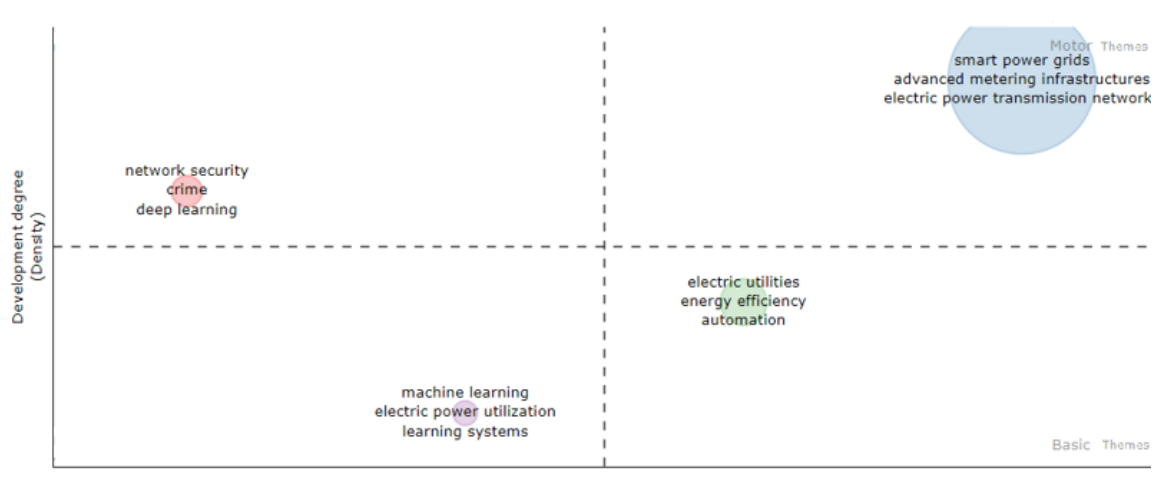
The analysis is based on a co-word approach implemented through the Thematic Map in Bibliometrix, which provides a strategic representation of the research field by positioning themes according to their relevance and level of development. This visualization is structured along two dimensions: centrality, represented on the horizontal axis, which indicates the degree of interaction of a theme with other topics in the field; and density, shown on the vertical axis, which reflects the internal cohesion and maturity of each thematic cluster. Additionally, the size of each node is proportional to the frequency of occurrence of the associated keywords within the analyzed corpus.
The resulting Thematic Map (
Figure 1) organizes the research field into four categories based on their position in the centrality–density space: motor, niche, emerging or declining, and basic themes. Motor themes exhibit high centrality and density, acting as the main drivers of the field (e.g., smart power grids, advanced metering infrastructure). Niche themes are highly developed but weakly connected areas, reflecting specialized research topics such as network security and deep learning. Emerging or declining themes show low centrality and density, indicating either nascent or fading research directions, including machine learning and electric power utilization. In contrast, basic themes combine high centrality with low density, representing foundational topics such as electric utilities, energy efficiency, and automation.
Based on this classification,
Section 2.1,
Section 2.2,
Section 2.3 and
Section 2.4 provide a structured analysis of each thematic group. For each quadrant, the 20 most cited articles are examined to identify key characteristics, research trends, and the overall impact of the topics within the field.
2.1. Motor Themes: Key Drivers of the Research Field
The upper-right quadrant of the Thematic Map corresponds to motor themes, which represent the most mature, interconnected, and high-impact research directions in the field. The analysis of the most cited publications in this quadrant reveals four core research domains that collectively define the current state of the art in AMI and smart grids: (i) security mechanisms for protecting cyber-physical energy infrastructures, (ii) data-driven approaches for energy theft detection, (iii) advanced analytics for energy data management and decision-making, and (iv) emerging architectures and enabling technologies for next-generation power networks. These domains reflect a strong convergence between cybersecurity, artificial intelligence, data analytics, and communication technologies, highlighting the transition toward more intelligent, data-centric, and resilient energy systems. The following subsections provide a detailed synthesis of each domain, emphasizing the main methodologies, technological approaches, and open challenges that are shaping the evolution of these motor themes.
2.1.1. Security in Smart Grids and AMI
Security in Smart Grids and AMI constitutes a multidimensional research domain aimed at ensuring system reliability, data integrity, and user privacy in increasingly digitalized power systems. A primary research focus is the development of Intrusion Detection and Prevention Systems (IDS/IDPSs) [
15,
23,
24,
25,
26], which enable real-time identification and mitigation of cyberattacks targeting energy infrastructures. Complementarily, security is addressed at multiple layers of the AMI ecosystem [
14,
24,
27,
28,
29,
30,
31], including smart meters, communication networks, and billing data systems.
A second key research direction involves the definition and implementation of security protocols and standards [
4,
14,
27,
32], which provide the necessary framework for interoperability and secure system operation. Within this context, significant attention has been given to the detection of cyberattacks and energy fraud [
23,
24,
28,
29,
30,
33,
34], where machine learning and deep learning techniques are employed to identify anomalous patterns and malicious behaviors.
Additionally, the protection of user data privacy has emerged as a critical concern [
14,
27,
35], given the sensitive nature of consumption information. To address these challenges, recent studies explore secure key management schemes and authentication mechanisms [
27,
31], as well as data compression and authentication strategies that optimize resource-constrained AMI devices [
31]. Finally, preventing data falsification [
29,
31,
33] remains a major challenge, as it is essential to ensure measurement integrity and protect utility revenues.
2.1.2. Energy Theft Detection
Energy theft detection represents a critical research area focused on identifying and mitigating fraudulent activities in smart grids through advanced data-driven techniques. A dominant line of research relies on traditional machine learning methods [
15,
24,
28,
29,
33,
36,
37], where algorithms such as Support Vector Machines (SVMs), k-Nearest Neighbors (k-NN), Extreme Learning Machines (ELMs), and clustering-based approaches are used to detect abnormal consumption behaviors.
In parallel, deep learning techniques have gained significant attention due to their ability to model complex temporal patterns in consumption data. Architectures such as Convolutional Neural Networks (CNNs), Long Short-Term Memory (LSTM), Gated Recurrent Units (GRUs), and autoencoders [
30,
36,
38] enable the extraction of high-level features from large-scale datasets, improving detection accuracy. Hybrid approaches [
15,
33,
34,
36], combining optimization methods, clustering, and deep learning, further enhance both performance and computational efficiency.
Complementary to these approaches, statistical techniques [
28,
29,
33], such as ARMA, EWMA, and Dynamic Time Warping (DTW), are used to characterize deviations in consumption patterns. The modeling of anomalous consumption profiles [
28,
29,
30,
33,
36,
38] plays a central role in distinguishing legitimate from fraudulent usage. Moreover, ensuring robustness against data manipulation attacks [
29,
31,
33,
38] has become a key research challenge, driving the development of more resilient and adaptive detection frameworks.
2.1.3. Advanced Energy Data Analytics and Management
Advanced data analytics in Smart Grids and AMI has emerged as a key enabler for improving system efficiency, reliability, and decision-making capabilities. A central research direction focuses on extracting actionable insights from high-resolution consumption data to support intelligent energy management. In this context, building occupancy detection using AMI data [
35] has gained attention, where models such as CNN-BiLSTM enable real-time inference of user behavior, contributing to demand-side optimization.
Another relevant line of research addresses the probabilistic and resilient operation of microgrids [
39], using stochastic models and cloud–fog computing architectures to manage uncertainty in renewable generation and dynamic system conditions. These approaches enhance operational flexibility and support more efficient energy dispatch strategies.
Additionally, data-driven optimization techniques contribute to improving energy efficiency by enabling more accurate demand–supply matching and adaptive control strategies. At the infrastructure level, data compression methods such as compressive sensing [
31] have been proposed to reduce communication overhead while preserving data integrity through integrated authentication mechanisms. Overall, these developments highlight the role of advanced data analytics as a cornerstone for enabling intelligent, efficient, and secure energy systems.
2.1.4. Emerging Architectures and Technologies for Power Networks
The development of new architectures and technologies is driving a paradigm shift in Smart Grids toward more scalable, interoperable, and secure systems. A primary research focus involves the design of advanced network architectures [
4,
14,
23], which integrate cyber-physical components, communication standards, and security frameworks to support coordinated grid operation.
Within this context, technologies such as Deep Packet Inspection (DPI) [
25] have been explored to enhance real-time threat detection in network traffic, particularly in industrial and IoT-enabled environments. In parallel, cloud–fog computing architectures [
39] provide distributed processing capabilities that improve scalability, reduce latency, and increase system resilience in complex microgrid operations.
Furthermore, the integration of emerging technologies such as artificial intelligence, blockchain, and federated learning [
14] is redefining security and data management paradigms, enabling decentralized and collaborative solutions. Hardware-based security mechanisms, such as Physical Unclonable Functions (PUFs) [
27], strengthen device authentication and protect against physical attacks. However, the integration of IoT devices introduces new challenges related to limited processing capacity, interoperability, and cybersecurity vulnerabilities [
4,
14,
25], highlighting the need for robust and scalable architectural solutions. Collectively, this research direction reflects the convergence of communication networks, cybersecurity, and emerging technologies in shaping the next generation of intelligent power systems.
2.2. Niche Themes: Specialized Research Challenges
The upper-left quadrant of the Thematic Map corresponds to niche themes, which represent highly developed but weakly interconnected research areas within the field. The analysis of the most cited publications in this quadrant reveals five specialized domains: (i) security and privacy in AMI, (ii) IoT and IoE integration in smart grids, (iii) secure data aggregation and blockchain-based solutions, (iv) advanced metering and network protection, and (v) forecasting and optimization of microgrids. These domains are characterized by strong internal development and technical depth, addressing specific challenges that require advanced methodologies and domain-specific expertise. The following subsections provide a structured analysis of each area, highlighting its main approaches, technological contributions, and its role in complementing the broader development of AMI and smart grid systems.
2.2.1. Security and Privacy in AMI
Security and privacy in AMI constitute a critical and highly specialized research area focused on protecting sensitive data and ensuring the resilience of smart grid systems. A primary line of research addresses the identification of vulnerabilities in metering networks and the challenges associated with data integrity, privacy breaches, and cyberattacks [
1,
40,
41,
42]. In response, several studies propose lightweight and secure authentication protocols based on elliptic curve cryptography and hash functions [
41,
43], designed to operate efficiently in resource-constrained smart meter environments.
2.2.2. IoT/IoE in Smart Grids
The integration of the Internet of Things (IoT) and the Internet of Energy (IoE) represents a key enabler for enhancing communication, control, and energy management capabilities in smart grids. A central research focus highlights IoT as a foundational technology for modernizing electrical infrastructures by enabling device interconnectivity, process automation, and the development of distributed and scalable architectures [
5,
7,
8,
17,
42]. These capabilities support applications such as real-time monitoring, advanced metering, vehicular communication, and environmental management.
Complementarily, the concept of IoE extends IoT by integrating distributed energy resources, renewable generation, storage systems, and electric vehicles into a unified energy ecosystem [
17]. This integration relies on bidirectional communication architectures, protocol interoperability, and the digitalization of energy infrastructures. As a result, IoT and IoE technologies contribute to improving operational efficiency, system resilience, and sustainability in modern power systems [
7,
8], positioning them as key components in the evolution of intelligent energy networks.
2.2.3. Secure Data Aggregation and Blockchain
Secure data aggregation and blockchain technologies have emerged as important research directions for enhancing trust, privacy, and data integrity in AMI systems. A primary focus is the development of privacy-preserving aggregation schemes that combine techniques such as homomorphic encryption and secure multiparty computation [
16,
44,
45,
46]. These approaches ensure that only aggregated data is accessible to operators or third parties, preventing the disclosure of individual consumption patterns even in the presence of potential collusion.
In addition, blockchain-based solutions are increasingly explored to provide decentralized and tamper-resistant data management mechanisms. By enabling secure and transparent recording of energy transactions, blockchain enhances traceability and eliminates the need for trusted intermediaries [
16,
45]. Beyond simple data logging, this cryptographic foundation enables the deployment of advanced automation tools for decentralized markets. For instance, evolutionary smart contracts are being leveraged to coordinate virtual power plant (VPP) trading within cross-regional energy markets. By integrating multi-stage negotiation frameworks and prospect theory, these smart contracts can dynamically model prosumers’ risk aversion and behavioral uncertainties, optimizing multi-party energy trading directly on the blockchain [
47]. Together, these technologies strengthen the security and reliability of data management processes in smart grids, contributing to greater user trust and system robustness.
2.2.4. Advanced Metering and Network Protection
Advanced metering has evolved into a fundamental component for enhancing monitoring, protection, and control capabilities in modern power systems. Beyond traditional billing functions, AMI enables real-time observability, bidirectional communication, and advanced automation in distribution networks [
1,
48]. Smart meters are increasingly functioning as active nodes that provide critical information for fault detection, system supervision, and protection schemes in emerging grid architectures [
49].
Furthermore, the integration of advanced metering systems with IoT technologies and communication networks improves system reliability and resilience, particularly in scenarios with high penetration of distributed energy resources [
50,
51]. However, large-scale AMI deployment introduces challenges related to data security and reliability. Key issues include cryptographic key management, authentication mechanisms, and ensuring data integrity [
1,
32]. To address these challenges, recent studies propose integrated solutions combining data compression and secure transmission [
31], enabling efficient communication without compromising security. These developments highlight the dual role of AMI as both a measurement and protection enabler in modern smart grids.
2.2.5. Forecasting and Optimization of Microgrids
Forecasting and optimization in microgrids constitute a rapidly growing research area focused on improving the operational efficiency and reliability of distributed energy systems. A key research direction involves the application of artificial intelligence, machine learning, and edge computing techniques for accurate prediction of energy demand, renewable generation, and system dynamics [
17,
18]. These approaches enable more precise and adaptive energy management strategies.
In particular, Edge-AI architectures have gained attention for their ability to process large volumes of data in real time using models such as CNNs, LSTMs, and GRUs [
18]. These techniques support improved forecasting accuracy and facilitate real-time decision-making in dynamic environments. Building upon these predictive capabilities, advanced optimization frameworks are shifting toward decentralized approaches for energy storage systems (ESSs). For instance, evolutionary game theory (EGT) and replicator dynamics have been applied to model collaborative decision-making and operational strategies among storage units, directly mitigating renewable intermittency and enhancing grid balancing [
52]. As a result, forecasting methods contribute to better energy balancing, enhanced integration of renewable resources, and improved response to demand variability [
17]. Overall, this research area underscores the importance of intelligent and predictive tools in enabling more sustainable, flexible, and resilient microgrid operation.
2.3. Emerging and Declining Themes: Transition Toward Intelligent and Decentralized Energy Systems
The lower-left quadrant of the Thematic Map corresponds to emerging or declining themes, which represent research areas with low centrality and density, typically associated with early-stage development or transitional phases. The analysis of the most cited publications in this quadrant reveals a clear shift toward digitalization and decentralized intelligence in modern power systems. Four main research domains are identified: (i) artificial intelligence and machine learning for energy management, (ii) demand-side management and demand response strategies, (iii) digitalization, blockchain, and the Energy Internet (EI), and (iv) the integration of renewable energy, hybrid AC/DC microgrids, and electric vehicles. These domains reflect the ongoing transformation of energy systems toward more adaptive, data-driven, and distributed paradigms. The following subsections examine each area, highlighting its key methodologies, technological advances, and its potential to evolve into future motor themes.
2.3.1. Artificial Intelligence and Machine Learning for Energy Management
Artificial intelligence (AI) and machine learning (ML) have emerged as key enablers for optimizing energy management in smart grids, microgrids, and intelligent buildings. A primary research direction focuses on the use of Deep Reinforcement Learning (DRL) techniques to enable real-time energy optimization under highly dynamic conditions, particularly in systems with significant renewable energy integration [
53,
54,
55]. Algorithms such as Deep Q-Learning and Deep Policy Gradient have demonstrated their ability to reduce peak demand, improve operational efficiency, and minimize energy costs [
53,
54].
In addition, bio-inspired optimization methods, such as the Whale Optimization Algorithm (WOA), and hybrid approaches combining model predictive control (MPC) with intelligent algorithms have been proposed to manage hybrid AC/DC microgrids [
10,
56,
57,
58]. These approaches consider system constraints related to energy storage, electric vehicles, and critical loads. Overall, these studies highlight that AI-driven methods enhance decision-making capabilities, facilitate renewable integration, and provide robust frameworks for intelligent energy management in distributed systems [
10,
53,
55,
57,
58].
2.3.2. Demand Side Management and Demand Response
Demand Side Management (DSM) and Demand Response (DR) have become key strategies for improving energy efficiency and operational flexibility in smart grids. A central research focus is the use of DSM techniques to reduce the peak-to-average ratio (PAR), minimize operational costs, and enhance system stability through the coordinated integration of distributed energy resources (DERs), renewable energy, and electric vehicles [
12,
59].
Several studies propose demand response models aimed at peak load reduction using mathematical optimization tools such as IBM ILOG CPLEX and stochastic optimization techniques to address uncertainty in energy consumption and generation [
11,
59]. Additionally, dynamic demand management approaches are explored in residential and institutional microgrids, enabling adaptive responses to market signals and improving resource utilization [
10,
11,
12]. These contributions demonstrate that DSM and DR not only enhance energy efficiency but also increase system flexibility and resilience under variable operating conditions [
10,
11,
59].
2.3.3. Digitalization, Blockchain, and the Energy Internet (EI)
Digitalization, blockchain technologies, and the Energy Internet (EI) represent a transformative research direction aimed at enabling decentralized, secure, and interoperable energy systems. A primary research focus highlights digitalization as a key driver for developing flexible and participatory energy models, where users can act as prosumers within local energy markets through secure digital platforms [
13,
19,
20,
60].
Blockchain-based architectures are widely explored to support decentralized energy transactions, enabling peer-to-peer (P2P) trading mechanisms while ensuring transparency, traceability, and data integrity [
61]. Furthermore, the Energy Internet paradigm integrates enabling infrastructures such as smart meters, energy routers, IoT networks, and storage systems to facilitate efficient coordination of distributed energy resources [
19,
20]. Collectively, these studies indicate that the convergence of digitalization, blockchain, and EI is a key pillar for modernizing power systems, reshaping both technical operations and energy market models [
13,
19,
60,
61].
2.3.4. Integration of Renewable Energy, Hybrid Microgrids, and Electric Vehicles
The integration of renewable energy sources, hybrid AC/DC microgrids, and electric vehicles (EVs) represents a strategic research direction driven by the need for more sustainable and flexible energy systems. A primary focus lies in addressing the operational challenges associated with high penetration of intermittent renewable generation, energy storage systems, and EV charging dynamics [
57,
62].
To tackle these challenges, several studies propose model predictive control (MPC) strategies and stochastic optimization methods that account for uncertainties in generation and demand, enabling more efficient energy management in hybrid systems [
2,
57,
58]. Additionally, strategies for ensuring reliable operation under both grid-connected and islanded modes are investigated, aiming to maximize resource utilization while maintaining system stability [
2,
62]. These works highlight the importance of coordinated energy management frameworks that integrate generation, storage, and consumption, supporting the transition toward more resilient and sustainable power systems [
57,
58,
62].
2.4. Basic Themes: Foundational Research Directions
The lower-right quadrant of the Thematic Map corresponds to basic themes, which represent highly central but less internally developed areas that form the conceptual backbone of the research field. The analysis of the most cited publications in this quadrant identifies four core domains: (i) anomaly and fraud detection in smart grids, (ii) clustering and consumer behavior analysis, (iii) data processing in AMI, and (iv) privacy and security in AMI systems. These themes play a fundamental role in supporting the development of more advanced research directions, providing essential methodologies, datasets, and analytical frameworks. The following subsections examine each domain, highlighting their main approaches, contributions, and relevance within the broader context of AMI and smart grid research.
2.4.1. Anomaly and Fraud Detection in Smart Grids
Anomaly and fraud detection has become a critical research area for ensuring the operational sustainability and financial stability of modern power systems. In particular, non-technical losses (NTLs), primarily associated with energy theft and data manipulation, are identified as major challenges arising from the large-scale deployment of AMI [
28,
37]. To address this issue, numerous studies propose data-driven approaches based on machine learning (ML) and deep learning (DL), leveraging high-resolution temporal data from smart meters to detect abnormal consumption patterns.
Advanced models based on recurrent neural networks and hybrid architectures have demonstrated strong capabilities in capturing complex temporal dependencies in consumption data, significantly improving detection accuracy compared to traditional methods [
36]. In parallel, classical supervised techniques such as Support Vector Machines remain effective when labeled datasets are available, although their performance depends heavily on feature selection processes [
30]. More broadly, recent studies highlight a transition from statistical and rule-based methods toward fully data-driven approaches, including deep learning, unsupervised learning, and hybrid models, due to their improved adaptability and generalization capabilities [
37].
In addition, anomaly detection is increasingly addressed from an unsupervised perspective, focusing on identifying deviations from normal consumption patterns rather than directly detecting fraud. Clustering techniques and load profile analysis enable the grouping of similar consumers and the identification of anomalous behaviors associated with faults or fraudulent activities [
63]. Methods such as spectral clustering applied to voltage and consumption time series have proven effective in detecting structural inconsistencies using only AMI data [
64]. Hybrid approaches combining unsupervised detection with supervised classification further improve reliability by reducing false positives [
21]. Overall, this research area highlights the importance of early anomaly detection as a key component for enhancing system resilience, security, and trust.
2.4.2. Data Processing in AMI
Data processing in AMI focuses on addressing challenges related to data quality, integrity, and efficient handling of large-scale measurement datasets. A primary research direction involves the development of methods for missing data imputation, particularly in scenarios affected by communication failures or technical issues. Techniques such as dynamic interpolation, neural networks, and k-nearest neighbors (KNN) have been widely applied to reconstruct incomplete datasets [
65,
66].
Another important line of research focuses on data compression and efficient storage, aiming to reduce the volume of transmitted and stored information without compromising accuracy. Approaches based on Fourier transforms, wavelets, and autoencoder models have demonstrated effectiveness in achieving compact data representations [
67,
68]. Additionally, multivariate feature extraction and classification techniques are explored to build more informative representations of energy consumption patterns, incorporating variables such as active and reactive power, voltage, and frequency [
65,
67].
These studies emphasize the importance of robust data preprocessing as a prerequisite for reliable analytics, forecasting, and control applications. Ensuring data quality and consistency is essential for maintaining the operational reliability of AMI systems in large-scale and dynamic environments.
2.4.3. Privacy and Security in AMI Networks
Privacy and security in AMI networks are fundamental for protecting user data and ensuring the integrity of smart grid operations. This research area addresses multiple strategies to prevent unauthorized access, safeguard data confidentiality, and strengthen system resilience against cyber threats. For instance, some studies propose privacy-preserving mechanisms based on data anonymization and aggregation techniques, allowing the use of energy data without compromising user identity [
66].
In parallel, intrusion detection systems (IDSs) based on machine learning have been developed to identify malicious activities and fraud attempts in real time [
69]. These systems enhance the capability of AMI networks to detect and respond to cyber threats dynamically. More broadly, the integration of cryptographic techniques, secure authentication schemes, and intelligent detection models provides a comprehensive framework for ensuring system security.
Given the distributed and digital nature of AMI systems, this research area is not only technically critical but also relevant from regulatory and ethical perspectives. The protection of energy data is essential to ensure user trust and enable the widespread adoption of smart grid technologies.
2.4.4. Clustering and Consumer Behavior Analysis
Clustering and consumer behavior analysis play a key role in understanding energy consumption patterns and enabling data-driven decision-making in smart grids. This research direction focuses on grouping users with similar consumption profiles to identify typical usage patterns and detect deviations that may indicate inefficiencies or anomalies.
Techniques such as k-means, hierarchical clustering, and spectral clustering are widely used to analyze load profiles and segment consumers based on temporal and behavioral characteristics [
63]. These methods support applications such as demand forecasting, tariff design, and demand-side management by providing insights into user behavior. Furthermore, clustering-based approaches are often integrated with anomaly detection frameworks to enhance the identification of abnormal consumption patterns.
Overall, this research area provides essential tools for transforming raw consumption data into actionable knowledge, supporting more efficient, personalized, and adaptive energy management strategies.
3. AMI in Microgrids: Foundations, Architectures, and Enabling Role in Intelligent Energy Systems
This section presents a structured and comprehensive analysis of AMI, explicitly organized according to its key functional components. First, the definition and evolution of Smart Metering are discussed, emphasizing its role in enabling observability and control in microgrids. Next, the architecture and core components of AMI are examined, including smart meters, communication networks, and data management systems. The section then analyzes the main benefits of AMI in energy management, particularly in terms of real-time operation, demand response, and integration of distributed energy resources. Subsequently, the integration of emerging technologies such as the Internet of Things (IoT) and advanced data management platforms is addressed, highlighting their contribution to system intelligence and scalability. In addition, the role of data management platforms is explored, focusing on their impact on system efficiency through data analytics, edge–cloud architectures, and predictive models. Finally, communication protocols and standards are analyzed as key elements to ensure interoperability, scalability, and cybersecurity in AMI deployments.
Despite these advancements, existing studies often address these components in isolation, with limited emphasis on their integrated role within microgrid environments. This gap hinders the full exploitation of AMI capabilities for coordinated, data-driven, and resilient microgrid operation, highlighting the need for comprehensive frameworks that jointly consider architecture, data management, and communication strategies.
3.1. Definition and Evolution of Smart Metering and Its Role in Microgrids
Smart Metering constitutes a fundamental component of modern power systems, enabling real-time monitoring, bidirectional communication, and data-driven decision-making within smart grids and microgrids. It is defined as an advanced metering system that integrates electronic devices capable of measuring energy consumption and electrical variables at high temporal resolution, while establishing bidirectional communication between end-users and grid operators. These smart meters operate within the broader framework of AMI, which comprises metering devices, communication networks, and data management platforms designed to support advanced billing, grid monitoring, and operational decision-making based on detailed consumption data [
1,
49]. In this context, Smart Metering enhances system observability and enables active user participation, facilitating the integration of digital and communication technologies into modern power systems [
48].
The evolution of Smart Metering is closely linked to the transition from conventional power systems toward more decentralized and intelligent energy networks. Traditional systems operated under unidirectional paradigms with limited visibility of grid conditions, whereas early Automatic Meter Reading (AMR) technologies provided only remote and unidirectional data acquisition. The shift toward AMI introduced bidirectional communication and high-resolution data acquisition, transforming smart meters from passive recording devices into active nodes within the electrical system [
48,
49]. This transformation enables the management of bidirectional energy and information flows, which is essential for systems with high penetration of distributed energy resources.
As a result, Smart Metering has become a key enabler for the development of flexible and resilient microgrids. By providing accurate, real-time information and communication capabilities, it supports coordinated operation between generation, storage, and demand, enhances situational awareness, and enables advanced control strategies. These capabilities are critical for managing the variability of renewable energy sources and ensuring reliable operation under both grid-connected and islanded modes [
1,
48,
49].
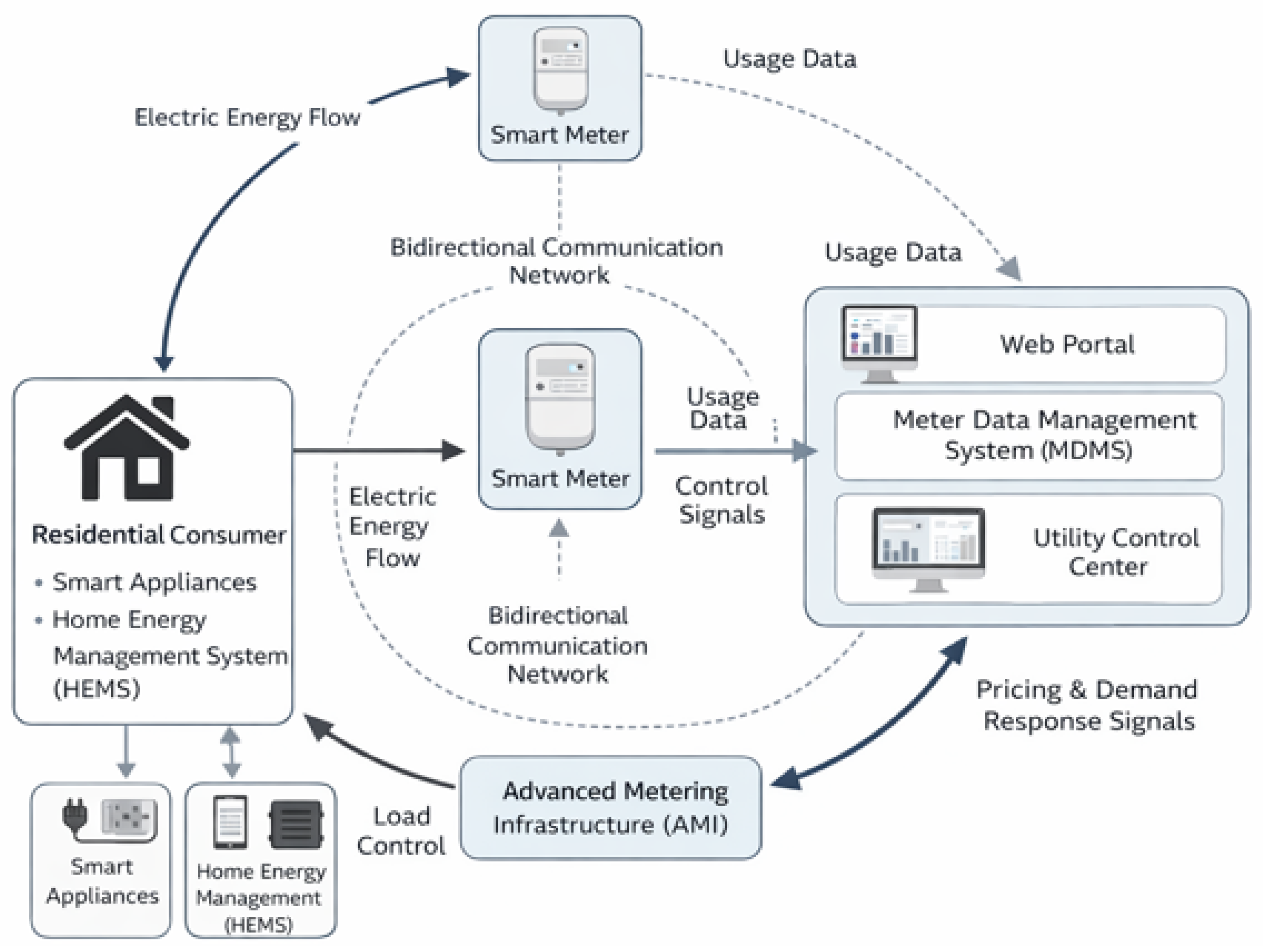
The Smart Metering architecture illustrated in
Figure 2 represents an integrated framework that connects end-users, communication networks, and utility management systems through bidirectional data and energy flows. On the consumer side, residential users equipped with smart appliances and Home Energy Management Systems (HEMSs) interact with smart meters, which measure electricity consumption and enable real-time monitoring. These smart meters are interconnected through a bidirectional communication network that allows continuous exchange of usage data and control signals. The collected data is transmitted to higher-level platforms, including web portals, Meter Data Management Systems (MDMSs), and utility control centers, where it is processed for monitoring, billing, and operational decision-making. In turn, the utility layer sends pricing signals and demand response commands back to the consumers, enabling load control and adaptive energy management. This closed-loop interaction highlights the role of AMI as a cyber-physical system that integrates measurement, communication, and control, supporting intelligent and responsive operation of modern power systems.
3.2. AMI Architecture and Core Components
The architecture of AMI is a fundamental element that enables the coordinated operation, monitoring, and control of modern power systems. It integrates smart meters, communication networks, and data management platforms into a unified framework that supports real-time data acquisition and decision-making [
1].
Within this framework, communication networks play a critical role in ensuring reliable and scalable data exchange across the AMI ecosystem. In particular, Software-Defined Networking (SDN) technologies enhance system flexibility by enabling dynamic control of data traffic, improved network security, and increased reliability under contingency conditions [
7]. The separation between control and data planes provides a scalable architecture that supports interoperability among heterogeneous devices and facilitates the integration of emerging technologies.
Furthermore, the incorporation of the Internet of Energy (IoE) concept extends the functionality of AMI, transforming it into a more robust cyber-physical system. As highlighted by Shahinzadeh et al. [
17], IoE enables seamless interaction with distributed energy resources such as energy storage systems, microgrids, and electric vehicles, enhancing system monitoring, coordination, and responsiveness. Consequently, AMI evolves beyond a data acquisition platform to become a strategic infrastructure that supports advanced automation, real-time analytics, and the secure integration of distributed energy resources in intelligent power systems.
3.3. Benefits of AMI in Energy Management
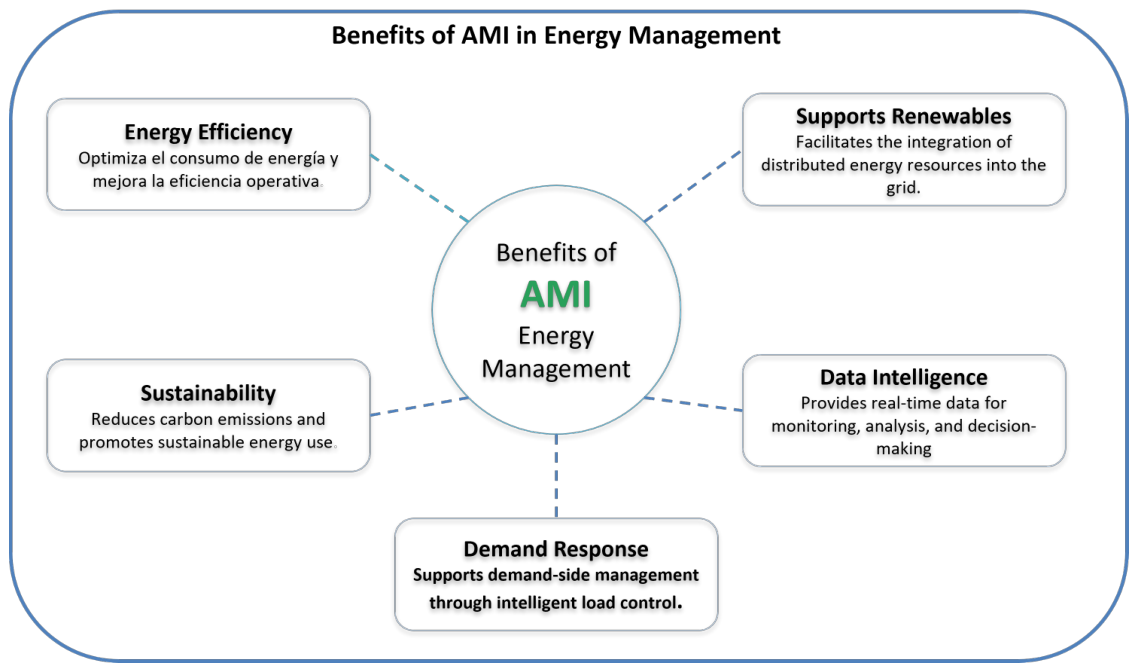
AMI provides significant benefits for modern energy systems by enhancing observability, operational efficiency, and data-driven decision-making. Its ability to collect and process high-resolution consumption data enables utilities and users to optimize energy usage and improve overall system performance. One of the most significant advantages of AMI lies in its ability to support efficient operation in microgrid environments. In particular, its integration into AC/DC microgrids enables real-time visibility of energy flows, allowing more accurate power–load balancing and reducing operational costs associated with distributed generation [
2]. This capability is especially critical in systems with high penetration of renewable energy sources, where variability and uncertainty require adaptive control strategies and continuous monitoring.
Furthermore, AMI facilitates the implementation of demand response (DR) programs and peak load reduction strategies. The availability of time-series consumption data allows intelligent load management, enabling the redistribution of demand according to system conditions and market signals. For instance, studies in photovoltaic microgrids have demonstrated that AMI-based monitoring can significantly reduce peak demand, improving system stability and minimizing economic penalties associated with overconsumption [
13]. These features contribute to a more flexible and responsive operation of the power system.
In addition to operational benefits, AMI supports the integration of distributed energy resources (DERs) and renewable generation by enabling coordinated energy management and improved system flexibility. Its communication and data processing capabilities allow seamless interaction between generation, storage, and demand, facilitating more efficient and reliable grid operation (see
Figure 3).
From a broader perspective, AMI is also a key enabler of sustainable and smart energy systems. Its deployment in smart cities promotes more efficient resource utilization, reduces greenhouse gas emissions, and supports the transition toward low-carbon energy systems. As highlighted by Chen et al. [
13], AMI contributes to building more resilient, sustainable, and intelligent urban environments by enabling advanced monitoring, control, and optimization of energy consumption. Overall, AMI evolves beyond a metering solution to become a strategic infrastructure that integrates efficiency, flexibility, and intelligence, supporting the transformation toward modern, decentralized, and data-driven energy systems.
3.4. Integration of IoT and Data Management Systems
The IoT within AMI constitutes a key enabler for real-time data exchange, enhanced system observability, and intelligent energy management in modern power systems. By interconnecting smart meters, sensors, and actuators, IoT enables continuous communication between end-users and grid operators, facilitating accurate monitoring of energy consumption, service quality, and network conditions. This real-time connectivity strengthens decision-making processes in dynamic and distributed electrical environments [
1]. Furthermore, IoT leverages communication technologies such as WiFi, ZigBee, LoRa, and NB-IoT to provide a flexible and scalable infrastructure suitable for large-scale and heterogeneous energy networks.
In addition to improving observability, IoT enhances the operational reliability and security of AMI systems. Through remote monitoring capabilities, IoT enables rapid detection of events, active load management, and automated fault recovery mechanisms. These functionalities are further supported by Software-Defined Networking (SDN) architectures, which provide dynamic control over data flows, improved network segmentation, and increased resilience against cyber threats [
7]. The separation of control and data planes allows more efficient management of communication resources and strengthens the overall robustness of AMI networks.
Moreover, the evolution toward the Internet of Energy (IoE) extends the capabilities of IoT by integrating distributed energy resources into a unified and intelligent energy ecosystem. This paradigm enables advanced data analytics, improved coordination among generation, storage, and demand, and more efficient operation of microgrids [
17]. As a result, the interoperability enabled by IoT and IoE facilitates the integration of renewable energy sources, enhances grid stability, and supports the implementation of advanced energy management strategies. Collectively, these technologies position AMI as a data-centric and adaptive platform for the operation of next-generation smart grids and microgrids.
3.5. Data Management Platforms and Their Impact on System Efficiency
Data management platforms have become a critical component of AMI, enabling the transformation of large-scale metering data into actionable insights that enhance the efficiency, reliability, and sustainability of modern power systems. The massive deployment of smart meters generates high volumes of time-series data that, when properly stored, processed, and analyzed, support key applications such as load forecasting, demand response, tariff design, and anomaly detection. In this context, advanced data analytics allows system operators to make informed decisions based on the actual behavior of the electrical network, improving both operational performance and service quality [
68].
To address the challenges associated with large-scale data management, various approaches have been developed to enhance data processing efficiency within AMI systems. Data mining techniques based on probabilistic models and machine learning enable the identification of consumption patterns, user segmentation, and early-stage evaluation of predictive models [
70]. These methods provide valuable insights into consumption behavior and support the development of more accurate forecasting and control strategies. Additionally, consumer-centric data analysis approaches extract representative usage profiles, allowing personalized energy management strategies that improve demand response participation and reduce system losses [
71].
Moreover, data compression and classification techniques have emerged as essential tools to reduce storage requirements while preserving critical information for operational and tariff-related analyses [
67]. These methods optimize data transmission toward centralized platforms such as Meter Data Management Systems (MDMSs) or cloud-based infrastructures, reducing communication overhead and improving latency in monitoring processes. In parallel, the integration of predictive models based on time-series analysis and deep learning enhances real-time operational management and increases the forecasting capabilities of the system.
The evolution toward hybrid data processing architectures further strengthens the performance of AMI systems. By combining edge computing—enabling fast, localized decision-making—with centralized cloud platforms for large-scale storage and advanced analytics, these architectures significantly reduce latency and communication burdens while ensuring operational continuity under limited connectivity conditions [
17]. Within this framework, MDMS platforms play a central role by ensuring data traceability, historical availability, and support for optimization and prediction algorithms in grid operation [
43]. Additionally, the integration of robust cybersecurity mechanisms, including authentication, encryption, and access control, enhances system resilience against cyber threats and protects the integrity of the AMI ecosystem [
1].
Overall, the value of AMI extends beyond remote data acquisition, positioning data management platforms as key enablers for transforming raw information into operational, economic, and sustainability-driven actions. This data-centric approach is fundamental for the development of intelligent, adaptive, and resilient power systems.
3.6. Analysis of Communication Protocols and Standards in AMI
Communication protocols and standards constitute a fundamental component of AMI, enabling reliable, scalable, and secure data exchange across modern smart grid systems. AMI relies on a hierarchical communication architecture that facilitates the interaction between smart meters, end-users, and utility operators. This architecture is commonly structured into three layers: Home Area Network (HAN), Neighborhood Area Network (NAN), and Wide Area Network (WAN), each characterized by specific requirements in terms of latency, bandwidth, and scalability [
1]. Within this framework, a combination of wired and wireless communication technologies is employed, integrating short- and long-range solutions to ensure continuous transmission of metering data, events, and control signals.
The evolution of smart grids has driven the adoption of interoperable and IP-based communication protocols, which enable seamless integration of AMI with data management platforms and other grid services [
42,
48]. This interoperability is essential for supporting heterogeneous devices and ensuring the scalability of AMI deployments in increasingly complex and distributed energy systems.
From a standardization perspective, the use of open protocols is critical to avoid vendor lock-in and to ensure compatibility among diverse technologies within the AMI ecosystem. The coexistence of multiple communication technologies introduces challenges related to interoperability, network management, and cybersecurity, motivating the development of comprehensive frameworks that jointly address communication, authentication, and data protection requirements [
1]. In particular, communication protocols in AMI must incorporate robust security mechanisms to guarantee data confidentiality, integrity, and authenticity, given the critical nature of energy data and its direct impact on system operation [
32].
Overall, the selection and standardization of communication protocols play a key role in enabling scalable, secure, and interoperable AMI deployments, supporting the reliable operation of modern smart grids and their integration with advanced energy management systems [
1,
48].
Despite the significant advantages provided by AMI, including enhanced observability, real-time monitoring, and improved energy management capabilities, its large-scale implementation in microgrid environments introduces several critical challenges. The increasing volume of data, the heterogeneity of devices and communication protocols, and the need for secure and reliable data exchange create significant technical and operational constraints.
Moreover, the integration of AMI within decentralized and dynamic systems such as microgrids amplifies concerns related to interoperability, scalability, cybersecurity, and regulatory compliance. These challenges not only affect system performance but also influence the economic feasibility and user acceptance of AMI technologies.
Therefore, a comprehensive understanding of these limitations is essential to fully exploit the potential of AMI in modern energy systems. The following section analyzes the main challenges, barriers, and opportunities associated with AMI implementation in microgrids.
4. Challenges, Barriers, and Opportunities in AMI Implementation for Microgrids
The deployment of AMI in microgrids involves a set of multidimensional challenges that extend beyond technological adoption, encompassing technical, security, regulatory, and economic aspects that directly influence its feasibility and scalability. While AMI acts as a foundational layer for monitoring, communication, and data-driven control, its effective implementation in microgrid environments—characterized by distributed generation, dynamic operation, and high data exchange—requires overcoming significant integration and operational constraints.
This section provides a comprehensive analysis of the main factors that shape the current landscape of AMI deployment in microgrids. First, technological challenges are examined, including interoperability issues among heterogeneous devices and protocols, as well as the limitations associated with large-scale data storage, processing, and real-time analytics. Next, cybersecurity and privacy concerns are analyzed, highlighting vulnerabilities in communication architectures and risks associated with data integrity and user information exposure. The section then addresses regulatory and standardization barriers, emphasizing the lack of unified frameworks and the need for policies that ensure interoperability, security, and data protection. In addition, economic constraints are discussed, focusing on high initial investment costs, long return periods, and the need for sustainable business models. Finally, these challenges are reframed as opportunities for innovation, where advances in communication technologies, data analytics, and system architectures can enable more resilient, secure, and scalable AMI-based microgrid solutions.
4.1. Technological Challenges (Interoperability, Data Storage, and Processing)
Technological challenges represent one of the main barriers to the effective implementation of AMI in microgrids. These challenges arise from the increasing complexity of distributed energy systems, where heterogeneous devices, large-scale data generation, and real-time processing requirements must be efficiently managed.
A primary challenge is the lack of interoperability among diverse communication protocols and devices. In current infrastructures, smart meters operate using multiple communication technologies such as PLC, RF, LTE, and Ethernet, which must coexist with IoT platforms and SCADA/BMS systems. When standards are not fully compatible, critical functions such as remote monitoring, operational control, and system scalability are significantly constrained [
48]. To address these limitations, the literature proposes the adoption of Software-Defined Networking (SDN) architectures, which enable centralized traffic management and improve compatibility across devices from different manufacturers [
7].
Another key challenge relates to the massive volume of data generated by smart meters. The increasing temporal resolution of measurements leads to large-scale data production that can overwhelm communication and storage infrastructures. For instance, recent studies estimate that a country such as Germany could generate more than 25 TB of residential consumption data per day [
67]. This situation requires the implementation of advanced data compression techniques and hybrid storage strategies combining cloud and edge computing, which reduce bandwidth usage while ensuring system continuity and scalability.
In addition, real-time data analytics represents a major challenge in AMI-based systems. Data must be processed at high speed to enable preventive actions, dynamic demand response, and energy efficiency strategies. Data management platforms such as Meter Data Management Systems (MDMSs), integrated with artificial intelligence and data mining algorithms, enhance load classification, anomaly detection, and user behavior prediction [
68,
71]. However, these capabilities require reliable hardware resources within the microgrid and robust cybersecurity infrastructures to ensure secure and continuous operation.
To overcome these challenges, several technological solutions have been proposed, including: (i) the adoption of open communication protocols such as Modbus/TCP, DLMS/COSEM, and MQTT to enhance interoperability; (ii) the use of distributed processing through edge computing to reduce latency; (iii) the implementation of efficient big data management strategies supported by machine learning; and (iv) the reinforcement of cybersecurity through lightweight authentication and end-to-end encryption mechanisms [
1,
17,
41]. These approaches enable microgrids to evolve toward more reliable, resilient, and scalable systems, maximizing the benefits of AMI without compromising operational stability or security.
4.2. Security and Privacy Challenges in Data Transmission
Security and privacy represent critical challenges in AMI, driven by the massive interconnection of smart meters and distributed management systems within modern power networks. The hierarchical communication architecture of AMI—comprising Home Area Networks (HANs), Neighborhood Area Networks (NANs), and Wide Area Networks (WANs)—introduces multiple points of vulnerability that can be exploited for cyberattacks such as denial-of-service (DoS), data manipulation, and unauthorized access to the electrical network [
48]. Moreover, the lack of standardized authentication mechanisms across different manufacturers hinders the implementation of uniform and end-to-end security across the entire communication chain.
A major security risk is associated with data integrity, particularly through false data injection attacks, which can directly impact billing processes, energy balancing, and overall system stability [
1]. To mitigate these threats, various approaches have been explored, including cryptographic verification methods and emerging technologies such as Software-Defined Networking (SDN), which enable network segmentation and centralized enforcement of security policies [
7]. However, these solutions often require increased computational capabilities at the device level, posing significant challenges for resource-constrained systems such as smart meters.
In addition to security concerns, protecting user privacy remains a key challenge in AMI deployments. The high temporal granularity of metering data can reveal detailed information about household behavior, including appliance usage patterns and occupancy schedules, raising concerns about personal privacy and domestic security if such data is not properly protected [
71]. To address these risks, techniques such as data anonymization, homomorphic encryption, and distributed key management have been proposed, demonstrating promising results in research contexts. Nevertheless, their large-scale implementation remains limited due to high computational and operational requirements [
40,
41].
Overall, ensuring robust cybersecurity and privacy protection is essential for the reliable operation and social acceptance of AMI systems. The development of lightweight, scalable, and standardized security mechanisms remains a key research priority to enable secure and trustworthy deployment of AMI in microgrid environments.
4.3. Regulatory and Standardization Limitations
Regulatory and standardization limitations represent a critical barrier to the large-scale deployment and interoperability of AMI in microgrid environments. The absence of unified and widely adopted standards hinders seamless integration among devices, Meter Data Management Systems (MDMSs), and IoT platforms, particularly in decentralized energy systems. As highlighted in [
48], the lack of standardized communication and data exchange frameworks restricts interoperability across networks, while [
1] emphasizes that this regulatory gap also affects system security, as implementation decisions are often left to manufacturers, resulting in heterogeneous and potentially vulnerable infrastructures.
Another key regulatory challenge relates to the protection of data privacy and integrity. AMI systems collect high-resolution consumption data that can reveal sensitive information about user behavior, making robust regulatory frameworks essential. Existing studies indicate that regulations should mandate the implementation of authentication mechanisms, encryption protocols, and access control policies to safeguard personal data processed within MDMS platforms [
41]. In regions with more advanced regulatory frameworks, such as the European Union, the adoption of data protection standards like GDPR has facilitated greater social acceptance of smart metering technologies. In contrast, regions such as Latin America are still in the process of developing and adapting regulatory policies, which may delay large-scale adoption and increase uncertainty for stakeholders.
Overall, the lack of harmonized regulations and standardized frameworks not only limits interoperability and security but also slows down the deployment of AMI technologies. Addressing these regulatory gaps is essential to enable reliable, secure, and scalable implementation of AMI in modern and future microgrid systems.
4.4. Costs and Investment Models in AMI
The deployment of AMI involves significant upfront investment costs, which constitute one of the main barriers to its large-scale adoption in microgrid environments. These costs are primarily associated with the installation of smart meters, communication networks, and data management platforms. However, recent studies indicate that these initial investments can be offset over time through reductions in operational costs. In particular, the automation of processes such as remote meter reading, fault detection, and service reconnection leads to substantial savings for utility companies [
71]. Additionally, improvements in energy efficiency enabled by AMI reduce the need for infrastructure expansion in generation and distribution systems [
48].
Beyond operational savings, the value of AMI is increasingly justified through its data-driven capabilities. Advanced data analytics enables the implementation of demand-side management strategies, load forecasting, and optimized system control, which contribute to long-term cost reductions. As highlighted in [
68], these techniques allow the identification of anomalous behaviors, non-technical losses, and operational inefficiencies, generating economic returns in the short and medium term. This has led to the emergence of investment models based on progressive cost recovery through operational savings, commonly referred to as operational-expenditure-driven models.
Another important dimension of cost optimization is related to data management efficiency. The large volume of data generated by AMI systems, particularly in large-scale deployments, increases storage and communication requirements. To address this issue, techniques such as data compression and advanced classification have been proposed to reduce computational and storage demands while preserving critical information for operational analysis [
67]. These approaches directly impact the reduction of IT infrastructure costs and support more sustainable deployment models, especially in microgrids with limited financial resources.
Overall, while AMI implementation requires substantial initial investment, its long-term economic benefits, supported by operational efficiency, advanced analytics, and optimized data management, enable financially viable and scalable deployment strategies.
Table 2 summarizes the main economic challenges and proposed mitigation strategies for AMI projects.
4.5. Development of Emerging Technologies for AMI Optimization
Emerging technologies are significantly enhancing the performance and capabilities of AMI, enabling more efficient, secure, and resilient energy systems. Among the most relevant developments is the adoption of Software-Defined Networking (SDN), which allows dynamic and programmable control of data traffic within communication networks. This approach improves network stability, enhances resource allocation, and reduces vulnerabilities to failures and cyberattacks [
7]. Such flexibility is particularly critical in modern microgrids, where bidirectional energy flows and real-time data exchange require adaptive and reliable communication infrastructures.
In parallel, the concept of the Internet of Energy (IoE) extends the Internet of Things (IoT) paradigm into the energy domain, enabling distributed control, real-time monitoring, and automated response to variations in demand and generation [
17]. IoE facilitates the seamless integration of distributed energy resources (DERs), energy storage systems, and electric vehicles into a unified and intelligent ecosystem. This paradigm shift promotes a more decentralized, user-centric, and sustainable operation of power systems.
From a cybersecurity perspective, recent advances in lightweight cryptographic schemes and key management systems have been developed to address the resource constraints of AMI devices. These approaches improve authentication, encryption, and data integrity mechanisms while minimizing computational overhead and communication latency [
40]. As a result, they provide robust protection against data interception, manipulation, and unauthorized access, strengthening the overall security of AMI networks.
Additionally, advanced data analytics and machine learning techniques have emerged as key enablers for optimizing AMI operation. Applications such as load forecasting, consumption pattern classification, and anomaly detection contribute to improving operational efficiency, reliability, and decision-making processes [
68]. These data-driven approaches enable more accurate demand estimation, early fault detection, and adaptive energy management strategies, supporting the transition toward intelligent and autonomous power systems.
Despite these advancements, the integration of emerging technologies into AMI systems introduces several challenges, including interoperability among heterogeneous devices, scalability of communication and data management infrastructures, and the protection of sensitive user data. To address these issues, the literature highlights the importance of adopting open communication protocols, standard-based architectures, and robust regulatory frameworks that ensure cybersecurity, privacy, and system interoperability [
1,
7].
4.6. Artificial Intelligence and Machine Learning for Metering Data Management
The integration of artificial intelligence (AI) and machine learning (ML) has become a key enabler for managing the massive volumes of data generated by AMI. The exponential growth of high-resolution metering data has driven the need for advanced analytical tools capable of extracting actionable insights. In this context, AI-based analytics facilitate the identification of hidden consumption patterns, anomaly detection, and demand optimization, thereby supporting data-driven decision-making in smart grids [
68].
Building upon this foundation, ML models have demonstrated significant effectiveness in load forecasting and loss reduction. Compared to conventional statistical methods, intelligent models provide higher prediction accuracy and adaptability to dynamic system conditions. As reported in [
72], these techniques significantly improve energy forecasting performance, which is particularly critical in microgrids with high penetration of renewable energy sources, where variability and uncertainty must be continuously managed.
In addition to forecasting applications, ML techniques have also enhanced the monitoring and operation of distribution networks. A notable example is phase identification, a traditionally complex and resource-intensive task, which has been significantly improved through unsupervised learning approaches. The spectral clustering model presented in [
64] leverages voltage time series obtained from AMI to accurately associate loads with their corresponding phases, reducing system imbalances and improving network reliability.
Furthermore, AI contributes to addressing scalability challenges associated with large-scale data handling. To mitigate storage and communication constraints, intelligent data compression and classification schemes have been proposed, reducing data redundancy while preserving essential information [
67]. These approaches enable more efficient data transmission and support the scalable deployment of AMI systems with lower computational and infrastructure costs.
Beyond operational improvements, AI-driven analytics also enhance user-centric services within AMI environments. Advanced data analysis enables the development of value-added services such as consumption profiling, personalized recommendations, dynamic pricing schemes, and real-time usage alerts. As highlighted in [
71], these capabilities empower consumers to make informed decisions and actively participate in energy management, promoting more efficient and sustainable energy usage.
Despite these advantages, the integration of AI and ML into AMI systems presents several critical challenges. The massive volume of data generated by smart meters requires advanced storage, processing, and data governance capabilities to prevent network congestion and performance degradation [
68]. Moreover, the quality and representativeness of data directly affect the performance of predictive models, necessitating robust preprocessing, data cleaning, and noise reduction techniques [
72]. From a cybersecurity perspective, the incorporation of intelligent algorithms expands the attack surface, making it essential to implement secure authentication, encryption, and data protection mechanisms [
1]. Additionally, the lack of standardization and interoperability between analytics platforms and power system management tools remains a significant barrier. Addressing these challenges requires scalable integration strategies, the adoption of open protocols, and the development of standardized frameworks to ensure compatibility, security, and long-term sustainability. Collectively, these challenges define the roadmap for future research in intelligent data management for AMI, aiming to enable more secure, efficient, and resilient energy systems.
The challenges discussed in this section highlight the increasing complexity of deploying AMI in microgrid environments. Issues related to interoperability, data management, cybersecurity, regulatory frameworks, and economic feasibility demonstrate that traditional approaches are insufficient to fully address the evolving requirements of modern power systems.
In this context, the need for more adaptive, intelligent, and scalable solutions becomes evident. Emerging technologies are playing a key role in overcoming these limitations by enabling advanced data analytics, decentralized architectures, and enhanced communication capabilities. In particular, the integration of artificial intelligence, machine learning, and next-generation communication frameworks offers new opportunities to improve the performance, security, and resilience of AMI systems.
The following section presents the main emerging technologies that are shaping the evolution of AMI and their role in addressing the challenges identified in microgrid environments.
5. Recommendations for AMI Optimization in Microgrids
The optimization of AMI in microgrids requires a transition toward more intelligent, autonomous, and data-driven systems. Recent research trends indicate that integrating advanced artificial intelligence (AI) and machine learning (ML) techniques is essential to enable predictive consumption analysis, early anomaly detection, and the identification of non-technical losses. In particular, deep learning models, clustering methods, and time-series analysis have demonstrated their capability to improve the accuracy of energy behavior characterization and to support operational decision-making in complex microgrid environments [
21,
36,
37].
In addition to data-driven intelligence, enhancing interoperability, scalability, and system resilience is a fundamental requirement for AMI optimization. The adoption of open architectures and standardized communication protocols facilitates the integration of heterogeneous devices and supports the progressive evolution of energy infrastructures. In this context, the convergence between AMI, the Internet of Things (IoT), and distributed communication platforms enables the development of more flexible and adaptive systems. Furthermore, distributed processing paradigms such as edge and fog computing play a key role in reducing latency, optimizing bandwidth usage, and ensuring operational continuity under connectivity constraints [
1,
42,
48].
Finally, ensuring security, privacy, and user trust emerges as a critical dimension for the large-scale adoption of AMI. Future research must focus on trust-oriented design approaches that incorporate robust authentication mechanisms, secure identity management, and privacy-preserving data protection strategies from the early stages of system development. In this regard, emerging technologies such as blockchain, federated learning, and distributed data governance models offer promising solutions to enhance transparency, traceability, and trust in AMI systems. These research directions, combined with adaptive regulatory frameworks and ethical considerations in energy data management, will consolidate AMI as a key enabler of resilient, sustainable, and user-centric microgrids [
32,
73].
5.1. Strategies to Improve AMI Implementation and Adoption
The successful implementation of AMI in microgrids depends on the development of intelligent, scalable, and adaptive systems capable of operating under highly dynamic conditions. In this context, the integration of AI and ML techniques plays a central role in enabling predictive demand analysis, early anomaly detection, and optimized energy management. Advanced models based on deep learning, clustering, and time-series analysis improve the characterization of user behavior and support decision-making processes in systems with high penetration of distributed energy resources [
21,
36,
37].
Complementing these capabilities, the adoption of interoperable and open architectures is essential to ensure the long-term sustainability of AMI systems. The convergence between AMI and IoT, together with the implementation of distributed processing paradigms such as edge and fog computing, enhances system flexibility and operational efficiency. These approaches reduce communication latency, optimize bandwidth usage, and improve system resilience, particularly in microgrids where local autonomy and real-time response are critical requirements [
1,
42,
48].
5.2. Best Practices in Cybersecurity and Data Management
Cybersecurity represents a fundamental challenge in AMI systems due to the increasing connectivity and continuous exchange of sensitive data. As a result, security must be addressed through a security-by-design approach, incorporating robust authentication mechanisms, identity management frameworks, and end-to-end encryption from the early stages of system development. Additionally, the implementation of intrusion detection and prevention systems, along with risk assessment methodologies, strengthens the resilience of AMI infrastructures against cyberattacks and unauthorized access [
32].
At the same time, efficient and secure data management is essential to handle the large volumes of information generated by AMI. Future research should focus on data compression, anonymization, and distributed analytics techniques that reduce storage and communication costs without compromising data quality. In this context, emerging technologies such as blockchain and federated learning provide promising solutions to ensure data integrity, traceability, and privacy, while also enhancing user trust and system transparency [
67,
73].
5.3. Considerations for Efficient Integration with Other Technologies
The evolution of power systems toward more digitalized and decentralized environments requires seamless integration between AMI and other emerging energy technologies. In particular, the convergence of AMI with the Internet of Energy (IoE) and distributed energy resource management platforms enables advanced functionalities such as active demand management, coordinated distributed generation, and prosumer participation. This integration supports the development of more autonomous, flexible, and locally optimized microgrids [
48].
Furthermore, interoperability with energy management systems, cloud-based analytics platforms, and intelligent automation solutions constitutes a key direction for future research. The adoption of modular and standards-based architectures facilitates integration with technologies such as electric vehicles, energy storage systems, and local energy markets. Altogether, these developments position AMI not only as a metering infrastructure but as a strategic platform for digitalization, automation, and intelligent operation in next-generation microgrids [
1].
The emerging technologies discussed in this section demonstrate the significant potential to enhance the performance, intelligence, and resilience of AMI in microgrid environments. However, their effective adoption requires more than technological availability; it demands structured implementation strategies that consider system integration, scalability, security, and operational constraints.
In particular, the successful deployment of these technologies depends on the alignment between technical capabilities, regulatory frameworks, and user requirements. Without a strategic approach, the benefits of artificial intelligence, advanced analytics, and next-generation communication systems may not be fully realized in practical applications.
Therefore, it is essential to translate these technological advances into actionable guidelines that support efficient implementation and long-term sustainability. The following section presents a set of recommendations aimed at improving the deployment, integration, and operation of AMI in microgrid environments.
6. Conclusions and Recommendations
This study provides a comprehensive and structured analysis of AMI within the context of smart grids and microgrids, based on a bibliometric and thematic evaluation of the research field. The analysis, conducted using Bibliometrix/Biblioshiny on a corpus of 1322 documents published between 2019 and 2024, reveals a rapidly evolving and highly active research domain. The results highlight a clear transition from traditional metering and communication-focused approaches toward more advanced applications centered on data analytics, cybersecurity, and intelligent system operation.
A key finding of this work is the identification of the main research directions shaping the AMI landscape. These include anomaly detection and non-technical loss identification, data privacy and cybersecurity, large-scale data processing, and the integration of artificial intelligence for energy behavior analysis. Furthermore, the thematic clustering reveals four major domains that reflect the multidimensional nature of AMI research: (i) security and privacy, (ii) communication technologies and smart grid architectures, (iii) advanced data analytics and machine learning applications, and (iv) energy management and system optimization. Together, these domains confirm the evolution of AMI from a conventional metering infrastructure into a strategic platform for digitalization, automation, and resilience in modern power systems.
From an application perspective, the findings emphasize the growing importance of AMI in microgrid environments. AMI is no longer limited to measurement and billing functions but has become a key enabler for real-time monitoring, demand-side management, and the efficient integration of distributed energy resources. This transformation supports the development of more flexible, decentralized, and data-driven energy systems. However, the results also highlight critical challenges that must be addressed to enable large-scale deployment. These include interoperability among heterogeneous devices, scalability under massive data generation, data privacy concerns, and vulnerability to cyber threats. Additionally, the operational complexity of microgrids requires more robust, adaptive, and intelligent system architectures.
Looking forward, the evolution of AMI is expected to be strongly influenced by its convergence with emerging technologies such as the Internet of Things (IoT), the Internet of Energy (IoE), edge and fog computing, and advanced artificial intelligence techniques. This integration will enable predictive analytics, autonomous control, and enhanced system optimization, positioning AMI as a core component of next-generation intelligent energy systems. In this context, AMI will continue to evolve beyond its traditional role to become a central platform for enabling resilient, sustainable, and user-centric microgrids.
Although Scopus provides extensive multidisciplinary coverage and is widely recognized as a reliable source for bibliometric studies, the use of a single database represents a limitation of this review. It is possible that some relevant publications indexed exclusively in other databases, such as Web of Science, IEEE Xplore, or ScienceDirect, were not captured in the analysis. Therefore, future studies could incorporate multiple complementary databases to perform cross-database validation, further improve the comprehensiveness of the literature retrieval process, and strengthen the robustness of the resulting bibliometric mapping.
Finally, this study contributes a structured reference framework that supports both academic research and practical implementation of AMI-based solutions. The identification of key trends, challenges, and research gaps provides valuable guidance for future work. In particular, priority research directions include the development of intelligent and scalable architectures, advanced data governance and privacy-preserving mechanisms, and the integration of AMI with distributed energy resources, storage systems, electric vehicles, and local energy markets. Addressing these challenges will be essential to unlock the full potential of AMI and to support the transition toward more efficient, secure, and sustainable energy systems.





 ,
,