


Abstract
Among the wastes produced in a refinery are solids containing water, in particular: (i) bottom sludge accumulated in storage tanks and (ii) sludge agglomerated during the processing of crude oil. Potentially useful industrial secondary resources, co-processed with clays lead to the manufacturing of novel ceramic building products. Among the expected advantages, resulting to industrial symbiosis, is the inclusion of ashes and residual metals from the wastes within the ceramic structure, leading to the inertization of inorganic ingredients, through the thermal processing of clay to building ceramic products.
1. Introduction
The exploitation of a hazardous solid waste heaped in refineries, from heavy clay ceramic industries, seem to affect both industrial sectors:
- a
- Several studies draw attention on Europe’s deficit capability for industrial hazardous solid waste management. However, recent studies refer to organic liquid and solid wastes as alternative fuels, mainly for use in energy intensive industries.
- b
- Building ceramic manufacturing plants can evaluate different sources of new revenue for their facilities by providing waste management services. Usually, each new source of revenue also helps to lower plant fuel or raw material costs in the never-ending effort to remain competitive in a well-established and mature market.
According to the Statistical Annual Report (ANP) [1], the worldwide production of sludge in refineries in 2009 raised to at least 190,000 m3 daily, which corresponds to 1.5% of the total produced.
The European ceramic industry is a “global player”, with 25% of production exported outside the EU and a positive trade balance of €3.7 billion. Providing over 200,000 jobs in Europe, with an annual production value of €28 billion, this industrial sector actually makes a substantial contribution to the European economy [2]. The clays required from the heavy clay industries are mined on or close to the plant sites.
Due to the way ceramic building materials are produced, it is suggested to recycle industrial organic wastes by mixing them with clays, to produce ready-shaped ceramic products, exploiting the valuable energy contained in these organic wastes, thus resulting to significant energy savings, while also benefiting from useful metal oxides these wastes also contain. The mixing of industrial organic wastes with clays to produce novel building materials is a GHG mitigation option, as a consequence of CH4 and CO2 reductions from the valorization of organic waste that, otherwise, would emit these two gases. The sintering of the ceramic building materials is taking place in kilns, where the residence time, temperature, and turbulent environment are ideal for the disintegration of organic components. At the same time inorganic components are incorporated in the ceramic microstructure of the produced building ceramic body. Most plants have installed particulate scrubbing as a part of Clean Air Act emissions compliance.
Water is found in oil sludges at concentrations between 30 and 90 wt%. Oil sludges also contain 4 to 7 wt% precipitates, mostly composed of minerals like halite, calcite, kaolinite and quartz [3]. The petroleum hydrocarbons contained in a sludge are traced at concentrations between 5 and 60 wt%. The contained saturated hydrocarbons are found in the range of 40 to 60 wt%, aromatic hydrocarbons at 25 to 40 wt%, resins at 10 to 15 wt% and asphaltene at 10 to 15 wt% [4,5]. According to Shie et al. [4], BTEX (Benzene, Toluene, Ethylbenzene, Xylene) are commonly found among the aromatic compounds, as are phenols and PAH’s (Polycyclic Aromatic Hydrocarbons), which are partially responsible for the flammability of petroleum sludge and its consequent classification as hazardous waste [6]. A few works have been conducted concerning the incorporation of petroleum wastes into clay ceramics [7,8,9,10,11,12]. The incorporation of sludge containing metals in clays, followed by sintering, results in: (i) an effective treatment of wastes and (ii) the production of bricks and roof tiles by replacing clays with secondary raw materials [13,14,15]. Experimental studies report improved mechanical properties for the new ceramic bodies compared to traditional bricks [16]. Verification of the experimental studies at pilot scale, will meet one of the prerequisites for end of waste criteria. On the other hand, leaching tests have shown that heavy metals, seem to be immobilized in the new ceramic bodies, which if true at pilot scale, meets another prerequisite of the end of waste criteria [15]. A successful waste-to-resource strategy, requires knowledge of the mechanism and efficiency of removing or deactivating pollutants from the waste – secondary raw material, for reliable control of product safety and quality.
In the present work, ceramic bodies were prepared from mixtures of clays with bottom oil sludge (5 wt% and 10 wt%) and sintered at two different temperatures (950 °C and 1050 °C). The leaching of heavy metals from the sintered ceramic matrix is within the allowable limits, in all cases.
2. Materials and Methods
The sources of the oil refinery sludge that was studied are [17]:
- Tank bottom sludges (European list of wastes—ELW 05 01 03*)
- Sludges from on-site effluent treatment (ELW 05 01 09*)
- Oily sludges from maintenance operations of the equipment of the plant (ELW 05 01 06*)
The above-mentioned oil sludges are selected and stored in separate tanks. They are submitted to a heating and centrifugation process that separate three phases, namely:
- Wastewater, which goes to the wastewater treatment unit
- Oil, that returns as input to the refinery
- Solid residual material (SRM), used for the mixing with clays
The principal chemical—characteristics of the processed SRM are given in Table 1:
Table 1.
SRM typical characteristics (after centrifugation).
Two clay samples from different deposits in Central Greece were selected and characterized. These clays are considered representative of the main types of clayey raw materials used by the ceramic industry (clay A and B). The composition of the two clays used is given in Table 2.
Table 2.
The composition (%) of the clay raw materials used in the present study.
The Winkler [18] method determines the ideal mixing ratio of clay soils A and B so that the resulting mixture is suitable for brick production. The most appropriate mixing ratio, considering the chemical composition of clay raw materials, is A 60 wt%-B 40 wt%.
Compact test ceramic bodies 48 mm × 23.5 mm × 75 mm were prepared: (a) without adding waste (b) with the addition of 5%wt & 10%wt SRM. Clay/SRM mixtures were kneaded and extruded using a pilot plant vacuum extruder provided with manual cutter. The specimens were dried at room temperature for 24 h and subsequently in an oven at 110 °C for at least 24 h. Dried specimens heated following a protocol of gradual temperature increase up to the desired final sintering temperature by using an electric furnace. The final sintering temperatures examined were T1 = 950 °C, and T2 = 1050 °C.
The produced specimens were subjected to leaching tests for each batch of specimens produced, in accordance with the standard ΕΝ 12457-2 (L/S = 10).
3. Results and Discussion
Standard EN 12457-2 was followed to perform the leaching tests and the liquid-to-solid phase ratio was L/S = 10 L/kg. Leaching Test results are given in Table 3, expressed as dry phase values in mg/kg.
Table 3.
Leaching Test results (phase values in mg/kg).
The standard methods used to analyse the leachate is given in Table 4.
Table 4.
Standard Analytical Methods.
From the results reported in Table 3, both standard and waste-added test specimens are classified in the non-hazardous category in accordance with Decision 2003/33/EC.
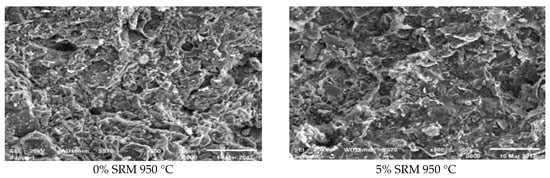
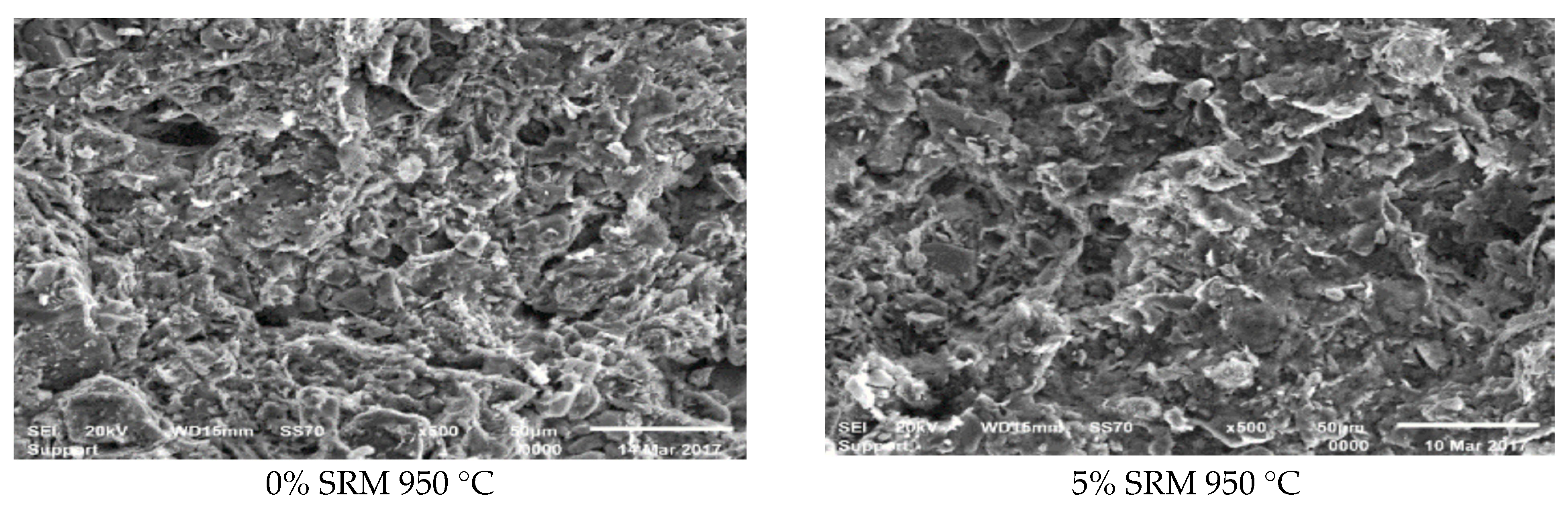
From the electronic scanning microscope (SEM) images it is evident that the waste-added test specimens have the standard structure of a ceramic material, i.e. the addition of the waste does not adversely affect their structure (Figure 1), while the pores formed are more evident.
Figure 1.
500× magnification SEM images for waste-free and added samples.
The addition of waste significantly increases the concentrations of (SO42−) sulphate anions. This is due to the binding of the S present in the waste from the soil Ca and the formation of CaSO4. This combined with the severity of the leaching test (particles < 4 mm of which many were in powder form) and the solubility of CaSO4 (0.21 g/100 mL), contributes to the increased quantities of SO42− in leached sulphates.
In the specimens with added waste, the binding of the contained to waste S from Ca of clay soils is evident, resulting to reduced emissions of gaseous pollutants. This finding is important in that the usual process of producing structural ceramic materials is shown to be an anti-pollution process for secondary raw materials—substitutes for clay soils containing S.
4. Conclusions
The sintering process taking place in the building ceramic manufacturing process, is suitable for the utilization of wastes as secondary raw materials and at the same time, contributes to reducing the amount of wastes produced from different industrial processes in a sustainable way. The waste used, irrespective of the percentage, shall be satisfactorily incorporated into the ceramic test specimens produced. According to the leaching tests, the products are classified in the category of non-hazardous waste for disposal after the end of their life, on the basis of Decision 2003/33/EC. The addition of waste shall not burden the concentrations detected in the leaching tests, except in the case of sulphate anions (SO42−).
The environmental benefits are expected to be significant in the following areas:
- Reduce the cost of waste management for the producer companies (refineries).
- Safe disposal of the waste concerned. As demonstrated by the leaching tests of structural ceramics, products containing the waste in question do not have an adverse impact on the environment or human health.
- Promoting industrial symbiosis in the context of the “Circular Economy”, an EU priority policy. SRM can be used directly without any treatment other than normal industrial practice in the process of producing structural ceramic materials.
- Increase the thermal insulation capacity of ceramic construction products, which will help to save energy during the product life cycle.
- Reduction in the consumption of fossil fuels required for the sintering of ceramic materials, with a simultaneous reduction in greenhouse gas emissions.
- Substitution of primary raw materials (clay soils) with secondary raw materials in the process of producing structural ceramic materials.
- Zero secondary waste production by incorporating SRM in the process of producing structural ceramic materials.
Institutional Review Board Statement
Not applicable.
Informed Consent Statement
Not applicable.
Acknowledgments
The authors gratefully acknowledge financial support from Hellenic Petroleum S.A. and “TERRA S.A., for providing the clay materials”.
References
- ANP (National Agency for Petroleum, Natural Gas and Biofuels). Anuário Estatístico da ANP [Statistical Yearbook of the ANP]. 2010. Available online: http://www.anp.gov.br/ (accessed on 2 August 2010).
- Cerame Unie, Paving the Way to 2050, The Ceramic Industry Roadmap. Available online: https://secv.es/cerame-unie-paving-the-way-to-2050/ (accessed on 28 March 2021).
- Monteiro, S.N.; Vieira, C.M.F.; Ribeiro, M.M.; Silva, F.A.N. Red ceramic industrial products incorporated with oily wastes. Constr. Build. Mater. 2007, 21, 2007–2011. [Google Scholar] [CrossRef] [Scilit]
- Shie, J.L.; Lin, J.P.; Can, C.Y.; Wu, C.H.; Lee, D.J.; Chang, C.F.; Chen, Y.H. Oxidative thermal treatment of oil sludge ate low heating rates. Energy Fuels 2004, 18, 1272–1281. [Google Scholar] [CrossRef] [Scilit]
- Speight, J.G.S. The Chemistry and Technology of Petroleum, 4th ed.; Taylor & Francis Group: London, UK, 2006. [Google Scholar]
- Xia, X.H.; Yu, H.; Yang, Z.F.; Huang, G.H. Biodegradation of polycyclic aromatic hydrocarbons in the natural waters of the Yellow River: Effects of high sediment content on biodegradation. Chemosphere 2006, 65, 457–466. [Google Scholar] [CrossRef] [Scilit] [PubMed]
- Kaminskas, A.; Valiukevicius, C. Influence of Petroleum-Refining Waste/Product Contaminated Soil on Properties of Porous Ceramic Article. Mater. Sci. 2005, 11, 159–161. [Google Scholar]
- Teixeira, S.R.; De, G.T.; Santos, A. Incorporation of waste from lube oil re-refining industry in ceramic body: Characterization and properties. In Proceedings of the 2nd International Congress University-Industry Cooperation, UNINDU 2007, Perugia, Italy, 9–12 December 2007; Available online: https://www.researchgate.net/publication/305176346_INCORPORATION_OF_WASTE_FROM_USED_LUBE_OIL_RE-REFINING_INDUSTRY_IN_CERAMIC_BODY_CHARACTERIZATION_AND_PROPERTIES (accessed on 28 March 2021).
- Souza, A.J.; Pinheiro, B.C.A.; Holanda, J.N.F. Sintering Behavior of Vitrified Ceramic Tiles Incorporated with Petroleum Waste. Available online: https://www.intechopen.com/chapters/42534 (accessed on 28 March 2021).
- Souza, A.J.; Pinheiro, B.C.A.; Holanda, J.N.F. Valorization of solid petroleum waste as a potential raw material for clay-based ceramics. Waste Biomass Valor. 2011, 2, 381–388. [Google Scholar] [CrossRef] [Scilit]
- Eliche-Quesada, D.; Martínez-Martínez, S.; Pérez-Villarejo, L.; Iglesias-Godino, F.J.; Martínez-García, C.; Corpas-Iglesias, F.A. Valorization of biodiesel production residues in making porous clay brick. Fuel Process. Technol. 2012, 103, 166–173. Available online: https://ur.booksc.eu/book/16817191/ffbb81 (accessed on 28 March 2021). [CrossRef] [Scilit]
- Latosińska, J.; Żygadło, M. Effect of sewage sludge addition on porosity of lightweight expanded clay aggregate (Leca) and level of heavy metals leaching from ceramic matrix. Environ. Prot. Eng. 2009, 35, 189–196. [Google Scholar]
- Wiebusch, B.; Seyfried, C.F. Utilization of Sewage Sludge Ashes in the Brick and Tile Industry. Water Sci. Technol. 1997, 36, 251–258. [Google Scholar] [CrossRef] [Scilit]
- Reinosa, J.J.; Silva, A.C.; Rubio-Marcos, F.; Mello-Castanho, S.R.H.; Moya, J.S.; Fernandez, J.F. High Chemical Stability of Stoneware Tiles Containing Waste Metals. J. Eur. Ceram. Soc. 2010, 30, 2997–3004. [Google Scholar] [CrossRef] [Scilit]
- Zhang, H.; Zhao, Y.; Qi, J. Study on Use of MSWI Fly Ash in Ceramic Tile. J. Hazard. Mater. 2007, 141, 106–114. [Google Scholar]
- Vieira, M.T.; Catarino, L.; Oliveira, M.; Sousa, J.; Torralba, J.M.; Cambronero, L.E.G. Optimization of the Sintering Process of Raw Material Wastes. J. Mater. Process. Technol. 1999, 97, 92–93. [Google Scholar] [CrossRef] [Scilit]
- Mountouris, A.; Leventos, D.; Papadimos, D.; Antotsios, C.; Papadopoulos, S.; Vatseris, C.; Wallner, H.; Kiroplastis, A.; Karnavos, N. Biotreatment of oil refinery sludge. Desalination Water Treat. 2011, 33, 194–201. [Google Scholar] [CrossRef] [Scilit]
- Ziegelindustrie International. Methods of Evaluation for Raw Material Suitability and Body Optimization (Part 2). 6/2015 Technical Paper/Fachbeitrag. Available online: https://www.zi-online.info/en/artikel/zi_Methods_of_evaluation_for_raw_material_suitability_and_body_optimization_2404608.html/ (accessed on 28 March 2021).
- European Commission. Council Decision 2003/33/EC of 19 December 2002 Establishing Criteria and Procedures for the Acceptance of Waste at Landfills Pursuant to Article 16 of and Annex II to Directive 1999/31/EC. Available online: https://eur-lex.europa.eu/legal-content/EN/ALL/?uri=celex:32003D0033 (accessed on 28 March 2021).

Disclaimer/Publisher’s Note: The statements, opinions and data contained in all publications are solely those of the individual author(s) and contributor(s) and not of MDPI and/or the editor(s). MDPI and/or the editor(s) disclaim responsibility for any injury to people or property resulting from any ideas, methods, instructions or products referred to in the content. |
© 2021 by the authors. Licensee MDPI, Basel, Switzerland. This article is an open access article distributed under the terms and conditions of the Creative Commons Attribution (CC BY) license (https://creativecommons.org/licenses/by/4.0/).