


Abstract
The rapid growth of the population, industrialisation, and technological advancement has increased waste generation in many economies, including South Africa (SA). In 2019, 2020, and 2021, SA generated approximately 11.22 million, 5.90 million, and 10.42 million waste tyres, respectively. As general waste, tyres require proper disposal due to their environmental impact. This study identifies and quantifies traditional waste tyre management strategies in SA and assesses their environmental impacts using life cycle assessment (LCA). The SimaPro software (v9.4.0.2) and ReCiPe 2016 (v1.07) midpoint and endpoint methods were used to evaluate environmental consequences of tyre landfilling, open-air combustion, and exporting. In 2019, an estimated 163,375 tons of uncollected waste tyres was managed through landfilling (51%), open-air burning (4%), and exporting (1%). LCA findings showed that open-air combustion had the highest intermediate and long-term damaging effects on the atmosphere, releasing harmful gases and particulate matter linked to human health carcinogenic risks. Landfilling contributed significantly to long-term human carcinogenic toxicity and freshwater pollution, while exporting posed high resource depletion impacts. This study suggests that addressing waste tyre management challenges in SA requires a shift from traditional disposal methods toward reuse, recycling, and material and energy recovery to ensure more sustainable and ecologically responsible solutions.
1. Introduction
Rising living standards and economic growth in both developed and emerging nations has led to a surge in motor vehicle use, making vehicles indispensable to modern life. This trend has resulted in the generation of approximately 1.5 billion waste tyres (about 4 million tons) annually [1]. Industrialised regions, including the United States (274 million) [2], European Union (137 million) [3], and Japan (90 million) [4] contribute significantly to the waste tyre generation figure. Emerging economies are rapidly catching up, with China generating 300 million waste tyres per year, followed by India (60 million) [5], Thailand (18 million) [6], and SA (11.7 million) [7].
Projections suggest a sustained increase in waste tyre generation due to continued automotive demand in these regions [8,9]. Furthermore, it is predicted that the increasing automobile production trend will lead to a yearly increase of 4.3% in the accumulation of waste tyres [10]. This exacerbates waste tyre management difficulties and poses substantial risks to the environment and human health.
Traditional waste tyre management methods, including landfilling, open-air incineration, and exporting, remain prevalent in many countries and are associated with serious environmental burdens due to the release of harmful chemicals used during tyre manufacturing. Landfilling presents several notable challenges, including (i) the dispersal of debris by wind, (ii) infestations by rodents, insects, and birds (which may transmit diseases), (iii) contamination of ground and surface water, (iv) the risk of spontaneous combustion of waste, (v) unpleasant odours, and (vi) the emission of greenhouse gases (GHGs) such as methane [11,12].
Tyre burning releases carcinogenic smoke into the atmosphere, posing significant environmental and health hazards [13]. The presence of dangerous and harmful additives used in the manufacturing of tyres, namely stabilisers, extruder oils, accelerators, activators, dyes, fillers, and flame retardants, have the potential to pose environmental and human health risks [14]. Key pollutants of concern include GHG emissions, polycyclic aromatic hydrocarbons (PAHs), volatile organic compounds (VOCs), and heavy metals such as zinc (Zn), iron (Fe), nickel (Ni), lead (Pb), and others [15]. Hita et al. [16] and Jain [15] outlined the origin of these compounds: GHGs result from the degrading of natural (NR) and synthetic rubbers (SR); PAHs originate predominantly from waste tyre aromatic oils used as a chemical additive during tyre manufacturing; VOCs are released from waste tyre synthetic rubbers, namely styrene-butadiene rubber (SBR) and isoprene rubber (IR); Zn is the most abundant element derived from zinc oxide and it acts as vulcanisation support used during tyre manufacturing.
This study aims to (i) identify the traditional waste tyre management strategies currently employed in SA, (ii) quantify the amount of waste tyres diverted to each management method at a national level to better understand the scale of the issue, and (iii) conduct an LCA to evaluate the environmental impacts associated with these management strategies in order to identify more sustainable alternatives. The study’s limitations include a reliance on data from 2016 to 2022, which may constrain broader trend analysis. Moreover, the export scenario excludes overseas shipping and burning emission profiles, which are based on the literature instead of local measurements due to a lack of reported data.
2. Waste Tyre Management Strategies and Their Environmental Impacts
2.1. Waste Tyre Landfilling
Emerging countries, including SA, face growing challenges related to waste tyre accumulation and its associated environmental and health risks [17]. In response, the South African government announced in 2012 its intent to divert all waste tyre assortments from municipal landfills [18]. However, due to tyres’ non-biodegradable nature and bulky form, landfill operators often consider them unsuitable for disposal, resulting in widespread illegal dumping and open-air burning.
Aligned with the waste management hierarchy of avoidance, minimization, reuse, and recycling, landfilling is widely recognised as the least desirable option [19]. Despite the environmental drawbacks, many countries, including SA, continue to rely heavily on landfilling [20].
Historically, landfilling has been the dominant waste tyre disposal method in SA, primarily due to its perceived cost-effectiveness and the lack of infrastructure for alternative disposal strategies [21]. To reduce landfill dependency, the Department of Forestry, Fisheries, and the Environment (DFFE) set waste tyre diversion targets of 59,000 tons in 2014, rising to 242,000 tons by 2017 [22]. However, the waste tyre sector fell short of meeting these targets in 2016 and 2017, highlighting systemic challenges. As awareness of the environmental and health impacts of waste tyres continues to grow, there is now a marked shift toward exploring more sustainable waste tyre management strategies.
2.2. Tyre Open-Air Combustion
In developing regions, poor socio-economic conditions and regulatory enforcement gaps often lead to non-compliant waste tyre disposal practices, such as open burning and informal incineration. In India, the large volume of post-consumer tyres has led to the widespread combustion for heat and material recovery, prompting the Central Pollution Control Board to shut down 270 non-compliant tyre pyrolysis plants in 2019 due to environmental and public health concerns [23].
In Ghana, although open burning is officially prohibited, impoverished communities burn tyres to recover steel cords for resale, providing a vital source of income [11]. A similar trend is evident in SA, where tyre burning is common for steel recovery and domestic heating, especially in economically disadvantaged areas [24,25].
Open burning in SA has also emerged as a symbolic act during service delivery protests, particularly in underdeveloped communities. According to Quintal [26], these demonstrations have increased in frequency and intensity over the past decade. Ngumbela [27] further highlights that SA has averaged three such protests per week, ranging from brief disruptions to prolonged unrest. Given the country’s persistent socio-economic and governance challenges, this trend is likely to continue [28].
2.3. Waste Tyre Exporting
Exporting waste tyres to economically disadvantaged regions remains a common practice, with developed regions such as those in Europe and North America exporting roughly 10% of their waste tyres as second-hand products to areas like Eastern Europe, Africa, and Latin America [29]. However, recipient nations often lack the regulatory frameworks and infrastructure needed to manage these imports sustainably, resulting in significant environmental burdens [30]. In response, countries like China in 2018 and Australia in 2021 implemented bans on waste tyre imports and exports respectively, to promote domestic accountability and reduce global waste displacement [5].
In SA, the Recycling and Economic Development Initiative of South Africa (REDISA) introduced the Integrated Industry Waste Tyre Management Plan (IIWTMP) to formalise waste tyre management practices. Despite export restrictions, REDISA reported exporting up to 30% of monthly tyre waste, contravening regulations that permit only derived products (not raw waste tyres) for export [17]. Any deviation required ministerial approval under Section 12 of the IIWTMP [31].
Following REDISA’s dissolution in 2017, the Waste Management Bureau (WMB) assumed interim responsibility for waste tyre operations. More recently, the Council for Scientific and Industrial Research (CSIR) developed a revised IIWTMP, gazetted on 20 March 2024. This plan aims to enhance sustainability, improve processing efficiency, and strengthen regulatory compliance within the sector [32].
2.4. Waste Tyre Environmental Impact Studies
A comprehensive analysis of the environmental impacts of tyre management techniques remains limited, particularly in SA, where such effects have not been thoroughly investigated. Over the past two decades, interest has grown in understanding the environmental and socio-economic impacts of waste tyre management practices, highlighting the need for more robust assessment methods [33]. LCA is a highly effective tool utilised to evaluate the environmental consequences of various waste conversion systems. The tool enables the evaluation of environmental impact factors, including the following: (i) Global warming potential (GWP) involves the release of GHGs such as carbon monoxide (CO), carbon dioxide (CO2), methane (CH4), and nitrogen dioxide (NO2), which contribute to the rise in global temperatures. (ii) Acidification potential (AP) assesses the emission of acidifying substances, such as sulphur dioxide (SO2), sulphur trioxide (SO3), noxious oxide (NOx), hydrochloric acid (HCl), and hydrogen fluoride (HF), causing acid rain. (iii) Eutrophication potential (EP) examines the excessive discharge of NOx compounds, which affect plant biodiversity, soil composition, and groundwater quality. (iv) Fine particulate matter formation (FPMF) monitors the release of small particles suspended in the air, contributing to air quality degradation. (v) Human carcinogenic toxicity (HCT) evaluates the emission of carcinogenic substances that pose cancer risks to human health. Ecotoxicity refers to the presence of toxic chemicals with dangerous concentrations to land and water dependent organisms. (vi) Water resource depletion (WRD), mineral resource depletion (MRD), and fossil resource depletion (FRD) are the quantities of resources used versus quantities of resource reserves left [34].
Since the early 2000s, SA has undertaken LCA research, culminating in about 44 LCAs by 2021 [35]. The primary focus is on specific waste categories like glass, plastic, paper, biomass, biofuels, biorefineries, and wastewater, with limited attention to waste tyres. This is concerning given the high CO2 emissions and leachate risks associated with tyre disposal [35].
Leaching of heavy metals and chemical additives from the surface of the tyre rubber poses significant risks in landfilling applications. These substances, including stabilisers, plasticisers, and flame retardants, can disrupt soil microbiota and contaminate groundwater [20]. Research demonstrates that zinc leaching from tyre tread particles intensifies in acidic conditions (pH 3–7) and that toxicity increases with extended exposure times (24–48 h) [36]. Moreover, exposure to UV light enhances toxicity by 1–39 times, likely due to the presence of phototoxic substances, such as PAH [37]. Ferrão, Ribeiro, and Silva [20] found that landfilling yielded the highest environmental impact score, with an eco-indicator 99 score of 1.73, compared to retreading (−0.95), recycling (−0.49), and co-incineration in cement plants (−0.01) and power plants (0.00).
The open-air combustion of waste tyres generates smoke, oil, and char that can potentially leach hazardous chemicals that affect the soil and groundwater. The combustion smoke generated from tyre combustion yields significant quantities of mutagenic and carcinogenic emissions [38]. Czajczynska et al. [39] characterised gases released during open tyre burning to be CO, CO2, NOx, SOx, VOCs, PAHs, and heavy metals. Jimoda et al. [40] observed increasing emissions of CO, NO2, and SO2 from the uncontrolled combustion of bicycle, motorcycle, car, and truck tyres, with car and truck tyres surpassing the maximum NO2 emission limits set by the US Environmental Protection Agency. Similarly, Sulaymon et al. [41] found that the uncontrolled burning of these tyres exceeded permissible NO2 emission levels.
A review study by Dong et al. [33] indicated that tyre transportation has relatively minor environmental impacts, with reported values for GWP (1.5–2.5 kg CO2 eq), acidification (0.012–0.031 kg SO2 eq), eutrophication (0.0021 kg PO4−3eq), (1.8 × 10⁻⁷–1.8 × 10⁻⁷ kg CFC-11eq), and energy consumption (0.016 Giga Joules). Moreover, the transportation of tyres can lead to dust emissions and fuel consumption. The negligible impacts reported on the transportation process are due to the many studies that ignore this stage. Although minor, these impacts can cumulatively affect sustainability and the overall carbon footprint of tyre life cycle processes.
By quantifying the environmental burdens of conventional tyre disposal pathways in SA, the LCA will highlight the associated human health risks, ecosystem degradation, and resource depletion. This study aligns with key Sustainable Development Goals (SDGs 3, 9, 12, 13, and 15) and the African Union Agenda 2063 by addressing systemic waste management challenges such as informal burning, weak regulatory enforcement, and limited processing capacity. It further supports National Development Plan (NDP) 2030 of SA and priorities related to infrastructure development, environmental protection, and employment creation through strengthened waste management value chains. The application of ReCiPe 2016 midpoint and endpoint indicators will provide a comprehensive framework for evaluating intermediate and long-term environmental impacts, generating robust evidence to inform policy, technological investment, and sustainable waste tyre management strategies.
3. Materials and Methods
3.1. National Study Focus Areas and Waste Management Trends
South Africa, divided into nine provinces, has experienced significant population growth and rapid urbanisation, leading to increased waste generation across multiple categories, including waste tyres. Between 2011 and 2022, the population grew by approximately 4 million every five years [42,43], placing mounting pressure on existing waste management infrastructure.
Nkosi et al. [9] reported the provincial distribution of waste tyres in SA, with Gauteng generating the highest share at 39%, followed by the Western Cape (16%), KwaZulu-Natal (13%), and Mpumalanga (7%). These four urbanised and populous provinces contribute 71% to the nation’s GDP [44] and generate 75% of SA’s total waste tyres. Classified as general solid waste, end-of-life tyres require appropriate disposal to mitigate environmental harm. The National Environmental Management Waste Act (Act No. 59 of 2008) mandates proper waste management to safeguard public health and ecosystems [45].
In 2016, Statistics South Africa [46] reported waste collection rates across provinces, revealing significant disparities: Western Cape (86.9%), Gauteng (83.6%), Free State (69.7%), Northern Cape (61.8%), North-West (54.8%), KwaZulu-Natal (47.7%), Eastern Cape (41.3%), Mpumalanga (39.4%), and Limpopo (21.9%). This distribution reflects a clear urban–rural divide, with higher collection rates in more urbanised provinces and significantly lower rates in predominantly rural regions. These disparities highlight the urgent need for greater investment in waste management infrastructure and services, particularly in underserved rural areas.
While SA has over 2000 general waste processing facilities, only 530 are fully permitted [47]. The high number of unlicensed and non-compliant sites continues to hinder the effective and safe management of various waste streams, highlighting the urgency for regulatory enforcement and infrastructural upgrades.
3.2. South African Waste Tyre Generation and Collection Statistics
In 2011, SA had accumulated approximately 60 million waste tyres, primarily stored in large stockpiles or illegally dumped [48]. This figure continues to grow, with an estimated 11 million end-of-life tyres generated annually. In 2013 and 2017, over 90% and 78% of these tyres, respectively, were landfilled [49].
The South African Tyre Manufacturers’ Conference (SATMC) [7] tracks annual waste tyre volumes, with generation data from 2015 to 2022 summarised in Table 1. The peak occurred in 2016, followed by a sharp decline in 2017. The lowest volume was recorded in 2020, largely due to global COVID-19 pandemic travel restrictions that reduced vehicle use. Tyre production and disposal rebounded in 2021 as restrictions eased.
Table 1.
Annual waste tyre quantities generated, collected, and processed between 2016 and 2022 [7,50].
The DFFE reported waste tyre collection data from 2016 to 2021 [50], as shown in Table 1. Notably, 2017 had the lowest collection volume, coinciding with legal and operational disruptions within REDISA, likely affecting its performance. The erratic collection patterns reflect a poorly coordinated waste tyre management sector, further evidenced by the failure to meet 2017 diversion targets.
This study uses 2019 data on waste tyre generation and collection to develop and simulate national waste tyre management scenarios for the following reasons: (i) the reported 11.2 million waste tyres aligns with the annual average (11–12 million); (ii) the figures are unaffected by pandemic-related disruptions; and (iii) 2019 recorded the highest collection (44.2%) and processing (29.4%) rates reported by the WMB.
Scenario development involved three steps: first, quantifying 2019 waste tyre generation and collection (Table 1); second, estimating the volume diverted to conventional management pathways by calculating the difference between total generation and tyres collected (Equation (1)); and third, determining the volumes directed to landfilling, open-air incineration, and export. These scenarios, with associated inventory data, were input into SimaPro to evaluate the environmental impacts of each strategy.
3.3. The Development of National Waste Tyre Management Scenarios
South Africa employs a range of waste tyre management methods, including retreading, ambient mechanical grinding, tyre-modified asphalt, and energy recovery. Despite these advancements, traditional practices including landfilling, open-air burning, and exporting remain predominant. Table 2 presents the 2019 volumes associated with each management route. Accordingly, the functional unit for this study is defined as the total quantity of waste tyres generated in South Africa in 2019, measured at 294,741 tons. The input quantities for the waste management scenarios are also presented in Table 2.
Table 2.
Quantification of conventional waste tyre management options for SimaPro input data.
3.4. Life Cycle Assessment Methodology
The LCA methodological procedure adheres to a systematic, sequential approach comprising four principal phases: (i) Goal and scope definition: Defines the study’s objectives and context. The evaluated product, process, or activity is well defined including the system boundaries, assumptions, and environmental aspects to be assessed. (ii) Inventory analysis: Input data (including energy, water, and raw materials) and output data (comprising products, air emissions, wastewater, and solid waste) are collected and quantified to assess resource utilisation and environmental discharges throughout the life cycle of the process. (iii) Impact assessment: The data derived from the inventory analysis is evaluated to determine potential environmental, human health, and resource depletion impacts. This involves examining the impact of resource consumption and emissions on challenges including climate change, ecosystem deterioration, and public health risks. (iv) Interpretation: The results from the preceding steps are analysed, compared, and validated to draw meaningful conclusions. This phase identifies trade-offs, emphasises areas for improvement, and supports decision-making by accounting for uncertainties and the assumptions developed during the study.
3.4.1. Goal Definition and Scoping
The study goal is to quantify and identify the 2019 waste tyre the environmental impacts of South Africa’s conventional waste tyre management options, including landfilling, open-air burning, and exporting.
Waste tyre open-air burning scenario development: Ngumbela [27] reported an average of three service delivery protests per week in SA over the past decade. Similarly, Damoah [51] noted up to 15 daily protests between 2004 and 2005. While tyres are frequently burned during such events, empirical data quantifying the number incinerated remain limited.
For this study, it is assumed that 25 tyres are burned per protest, resulting in approximately 3900 units (102 tons) annually for road blockades. Beyond protests, tyres are also informally burned in the open environment to recover steel for resale or generate heat. Assuming 1% of 2019’s collected waste tyres were burned for these purposes, this accounts for an additional 112,192 tyres (2917 tons).
In total, an estimated 116,092 tyres (3019 tons) are burned annually in open environments, constituting a significant, unregulated pollution source. The LCA for open-air burning excludes transport and focuses on the combustion of 3019 tons, primarily for recovering approximately 15% (453 tons) of embedded steel. The open-air burning scenario carries uncertainties due to the informal and variable nature of tyre burning for protests, steel recovery, and heat generation, which can differ across provinces. As a result, the estimated 3019 tyre tons burned annually should be considered a conservative approximation, and the associated LCA results may under-report the full environmental burden of informal tyre burning in SA.
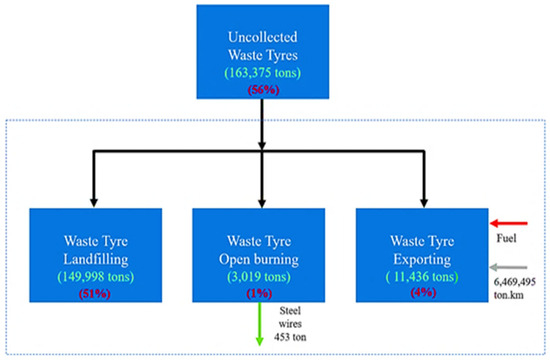
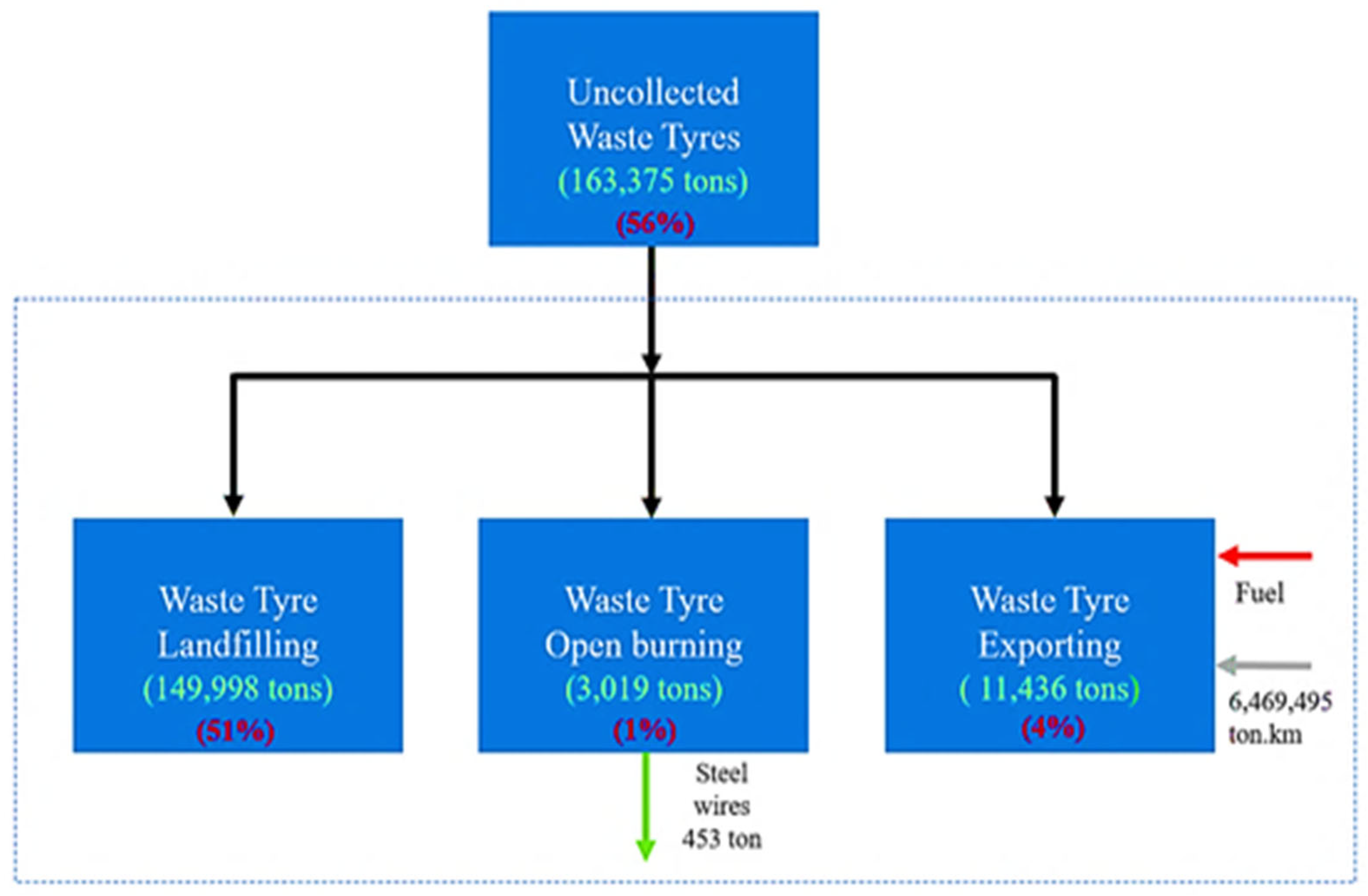
Waste tyre exporting scenario development: Between 2016 and 2017, approximately 7% (11,436 tons) of South Africa’s collected waste tyres were exported for overseas markets [52]. For this scenario, transportation was modelled using a 32-ton freight lorry, requiring an estimated 357 trips to Durban harbour and generating a total transport distance of 6,488,786 ton-kilometres (t.km), excluding oversees shipping. This confirms exportation as an established management strategy. Overseas maritime transportation was excluded from the LCA in accordance with the system boundaries defined in Figure 1, thereby limiting the assessment to environmental burdens occurring within SA.
Figure 1.
Conventional waste tyre management scenario and system boundary.
Waste tyre landfilling scenario development: In 2019, approximately 163,375 tons of waste tyres remained uncollected for processing. Of this total, 11,436 tons (4%) were exported and 3019 tons (1%) were openly burned, leaving approximately 149,998 tons presumed to be landfilled. This study assumes disposal occurred in a sanitary landfill, representing the standard end-of-life pathway for uncollected tyres.
Figure 1 represents the system boundaries for the landfilling, open-air burning, and exporting of waste tyres. The LCA methodology for landfilling excludes the transportation stage, assuming direct disposal at the landfill site. The tyre exporting system boundary included only road transportation and excluded shipping. Lastly, waste tyre burning is uncontrolled and releases the resulting fumes to the open atmosphere.
3.4.2. Life Cycle Inventory Analysis (LCIA)
The inventory analysis quantifies the material and energy flows associated with the primary waste tyre management techniques in South Africa. Table 3 presents the LCIA for open-air incineration, landfilling, and exporting. Landfilling represents the most common disposal method, with 149,998 tons of tyres deposited in sanitary landfills without material recovery. During open-air burning, 3019 tons of tyres are openly combusted, resulting in roughly 453 tons of recovered steel wire as an avoided product. Exportation involves 11,436 tons of tyres, delivered by freight trucks with a capacity exceeding 32 metric tons over an average distance of 567.4 km, necessitating 356.3 trips. This transportation activity results in a total burden of 6,469,494.8 t.km. The data generated in this inventory serve as the basis for the subsequent impact assessment, facilitating the evaluation of the environmental consequences of each management strategy.
Table 3.
National waste tyre open-air burning and landfilling inventory list.
3.4.3. Impact Assessment
A cradle-to-grave LCA approach was employed to ensure comprehensive impact evaluation.
The LCA of SA’s conventional waste tyre management scenarios and the associated environmental loads was conducted using SimaPro software (v9.4.0.2). Life Cycle Inventory Assessment (LCIA) was performed at the national level using the ReCiPe 2016 v1.07 methodology, applying both midpoint and endpoint approaches. Midpoint indicators reflect specific environmental indicators such as climate change. Endpoint indicators assess broader damage to areas of protection, such as (i) human health (expressed in disability-adjusted life years, DALYs), (ii) ecosystem quality (measured by species loss over area and time), and (iii) resource depletion (expressed as surplus costs for future extraction in USD 2013, over an infinite time horizon). The egalitarian (E) perspective was selected because it adopts a precautionary approach, considers longer time horizons, and considers the wider environmental consequences of each impact [53]. This choice aligns with the study’s national-scale objective and work by [54] of characterising the full, long-term environmental burdens of SA’s prevailing waste tyre management practices. By capturing impacts that may manifest over extended temporal scales, this perspective provides a conservative, public-health-protective framework consistent with the study’s goal and scope.
Waste tyre LCA studies typically evaluate environmental impacts across key damage categories: (i) ecosystem impacts (GWP, AP, EP, and ODO), human health impacts (FPMP, HC, and HTC), and resource depletion (MRD, FRD, and WRD) as suggested in reports by the DEA [55,56,57]. This study adopts a similar approach.
3.4.4. Study Limitations
The export scenario omits international shipping, and the emission profiles for open-air combustion are sourced from the literature rather than local measurements, owing to the lack of recorded data. Due to the scarcity of original data, several assumptions were established based on comparable waste tyre management techniques. These assumptions were essential for maintaining consistency in scenario building and for a systematic comparison study.
4. National Waste Tyre Environmental Impacts
In 2019, approximately 163,375 tons (56%) of waste tyres in SA remained uncollected for processing. Of these, 149,998 tons (51%) were landfilled, 3019 tons (4%) were openly burned, and 11,436 tons (1%) were exported through conventional channels. These disposal practices have been linked to environmental harm, including degradation of ecosystems, land, aquatic systems [33,58,59].
4.1. Waste Tyre Landfilling, Open Burning, and Exporting Environmental Impacts Using the Midpoint Method
The ReCiPe 2016 v1.07 methodology was used to assess a wide range of environmental impacts. This study focused on GWP, TAP, and FEP effects within the ecosystem damage category. For human health impacts, FPMF and HTC effects were evaluated. Resource depletion impacts included MRD, FRD, and WRD footprints. Table 4 summarises the environmental impacts of landfilling, open-air burning, and exporting of waste tyres, highlighting their effects on ecosystems, human health, and resource sustainability. The analysis applied the ReCiPe midpoint (E) approach, which captures intermediate effects from emissions and resource use.
Table 4.
Waste tyre management options environmental impacts using ReCiPe 2016 midpoint method (E).
4.1.1. Ecosystem Impacts
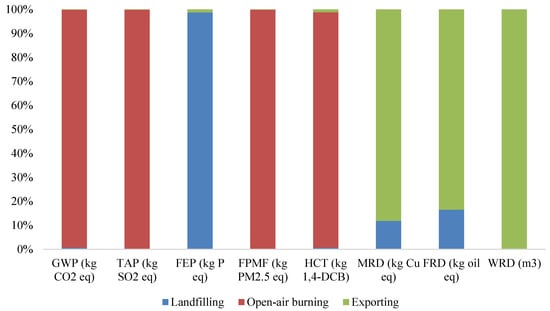
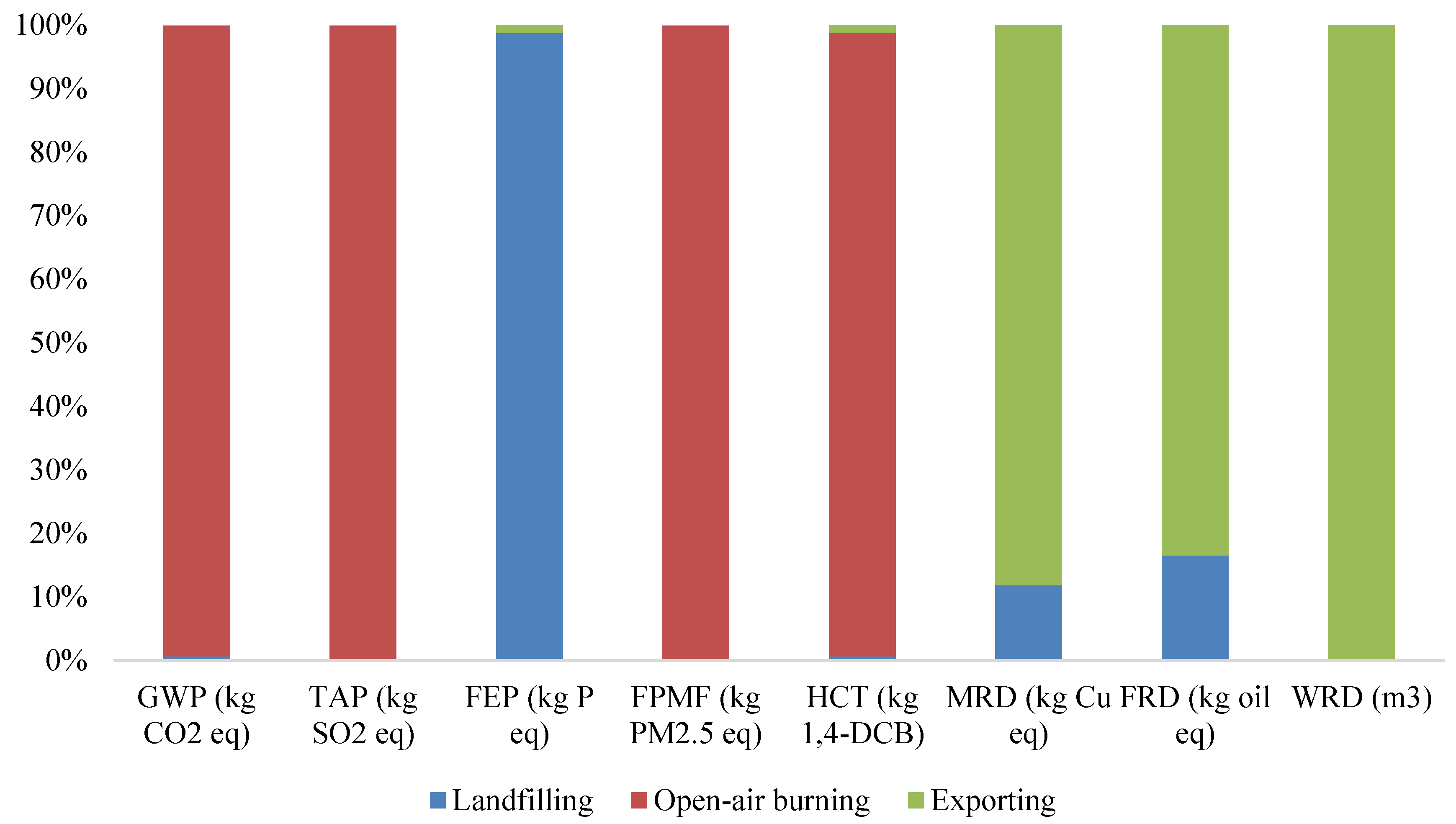
Global warming threatens ecosystems by intensifying climate change through the accumulation of GHGs, which trap heat, disrupt weather patterns, and endanger biodiversity. Major GHG contributors include CO2 (72% of total emissions in 2022), CH4 (10%), NOx (7%), and fluorinated gases (3%) [60]. As presented in Table 4 and Figure 2, tyre open-air burning produced the highest GWP, with emissions of 9.67 × 101 kg CO2-eq (constituting 99% of total GWP impacts across the scenarios). In comparison, tyre exporting and landfilling generate significantly lower emissions at 6.66 × 10⁻¹ kg and 1.12 × 10⁻¹ kg CO2-eq, respectively. The extreme GWP impact of open-air burning stems from the uncontrolled release of CO2, CH4, NOx, and other pollutants during combustion.
Figure 2.
Waste tyre management midpoint environmental impacts percentage distribution.
Fiksel et al. [61] reported that NR combustion contributes 27% of the total CO2 emissions associated with tyre burning. As shown in Figure 2, the open-air burning of 3019 tons of tyres accounts for 99% of GWP-related CO2 emissions across the evaluated scenarios. This aligns with Jimoda et al. [40], who found that passenger vehicle tyres (comprising approximately 70% of South Africa’s waste tyre stream) contributed 96% of GWP impacts. Additionally, Cetkovic et al. [62] highlighted the serious public health risks of open-air tyre burning, linking it to elevated rates of respiratory and cardiovascular diseases due to the release of toxic pollutants.
Tyre export had the second-highest GWP impact (6.66 × 10⁻¹ kg CO2 eq), mainly due to fossil fuel combustion in internal combustion engines (ICEs). Landfilling had the lowest GWP (1.12 × 10⁻¹ kg CO2 eq) attributed to the tyres’ slow degradation caused by their cross-linked molecular structure. According to Landi et al. [63], tyre breakdown can exceed 100 years, effectively sequestering carbon and limiting GWP impact.
Unregulated tyre burning resulted in the highest TAP (4.11 × 10⁻¹ kg SO2 eq), accounting for 99% of total TAP emissions, as shown in Table 3 and Figure 2. This is primarily driven by nitrogen and sulphur deposition, which acidifies soils and disrupts terrestrial ecosystems [64]. Char residues and soot from tyre combustion may leach toxic compounds into soils and water bodies, execrating acidification effects [63]. Tyre exportation also contributes to atmospheric acidification through the emission of NOx and SOx, compounds from fuel combustion. These findings align with [33], where the acidification potential was the third-highest (0.8%) environmental impact after GWP and EP effects.
Tyre landfilling generated the highest FEP impact (2.82 × 10⁻³ kg P eq, 98%), primarily due to phosphate leaching as tyres degrade over time under environmental exposure, releasing additives like stabilisers, plasticisers, and flame retardants that pollute ground and surface water. In contrast, tyre exporting contributed only 3.63 × 10⁻⁵ kg P eq (2%), while open-air burning showed no measurable FEP emissions, as indicated in Table 4 and Figure 2. In the open-air burning scenario, no intermediate phosphorus emissions are generated, as tyre combustion primarily produces gaseous pollutants rather than leachate-forming residues. Phosphorus from tyres is released mainly through slow degradation and leaching; this process occurs over extended environmental exposure with the leachate eventually reaching freshwater systems.
The hazardous chemicals used in tyre manufacturing pose long-term environmental risks, especially during disposal. Finding sustainable alternatives is critical. For example, Eranki and Landis [65] found that using guayule as a substitute for Hevea NR reduced GWP, AP, and EP impacts by 6–30%. Furthermore, co-combustion with bagasse also lowered energy use by 10% and reduced total impacts by 11%. Innovations like modular and biodegradable tyres can enhance recyclability and support circular economy strategies, reducing emissions and dependency on virgin resources [66].
4.1.2. Human Health Impacts
As indicated in Table 4 and Figure 2, open-air tyre burning produced the highest fine particulate emissions at 1.26 × 10⁻¹ kg PM2.5 eq, accounting for 99% of total emissions in this category. The uncontrolled conditions under which open burning occurs often leads to incomplete combustion, significantly increasing the release of fine airborne particulates. This practice is common in low-income areas where tyres are burned to recover steel. In this study, the combustion of 3019 tons of tyres yielded an estimated 453 tons of steel, valued at R2/kg [67]. However, the health risks outweigh economic gains, as exposure to fine particulates is linked to respiratory, cardiovascular, and dermatological conditions and increased mortality [40].
Open tyre burning also resulted in the highest human toxicity potential, with emissions reaching 1.98 kg 1,4-DCB eq (70% of total emissions), largely due to the release of VOCs such as benzene, xylene, and acetone [61,68]. Additionally, incineration residues contain high levels of heavy metals, Zn (3876.52 mg/kg), Fe (1648.14 mg/kg), chromium (149.07 mg/kg), Ni (120.06 mg/kg), cobalt (117.90 mg/kg), manganese (33.95 mg/kg), copper (22.4 mg/kg), Pb (13.27 mg/kg), and cadmium (4.32 mg/kg), according to [41], creating a toxic environment for nearby communities.
Tyre exporting has the second-highest impact on HCT at 2.40 × 10⁻² kg of 1,4-DCB (97% contribution), primarily due to VOC emissions during transportation, linked to the degradation of SBR and IR components used during tyre production. Landfilling posed the least HCT impact (1.36 × 10⁻² 02 kg of 1,4-DCB eq), though VOC emissions can still affect seed development and soil microbiota [67,69]. These findings align with previous studies [61,70], which show that diverting tyres from landfills can reduce GWP, FRD, AP, and photochemical smog impacts.
4.1.3. Natural Resource Depletion Impacts
Within the life cycle of waste tyres, transportation is the least environmentally damaging phase. According to Kromer et al. [71], it contributes just 1.9% to the total environmental burden, compared to 85.1% from tyre use and 11.3% from raw material production. However, as shown in Table 4 and Figure 2, tyre exporting significantly impacts resource depletion categories: MRD (3.30 × 10⁻⁴ kg Cu eq, 88%), FRD (3.63 × 10⁻² kg oil eq, 83%), and WRD (3.74 × 10⁻⁴ m3, 100%). These are primarily due to fuel consumption, which accelerates the depletion of natural resources (e.g., coal), fossil fuels (e.g., crude oil), and water. Conversely, tyre landfilling was associated with a net reduction in water resource depletion (−3.76 × 10⁻³ m3). Notably, open-air burning did not contribute to mineral or water resource depletion or acidifying emissions (TAP), though it remains highly harmful in other impact categories.
4.2. Waste Tyre Landfilling, Open Burning, and Exporting Environmental Impacts Using the Endpoint Method
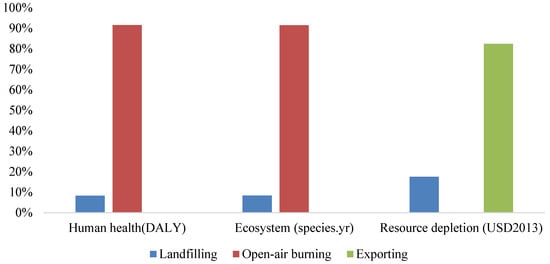
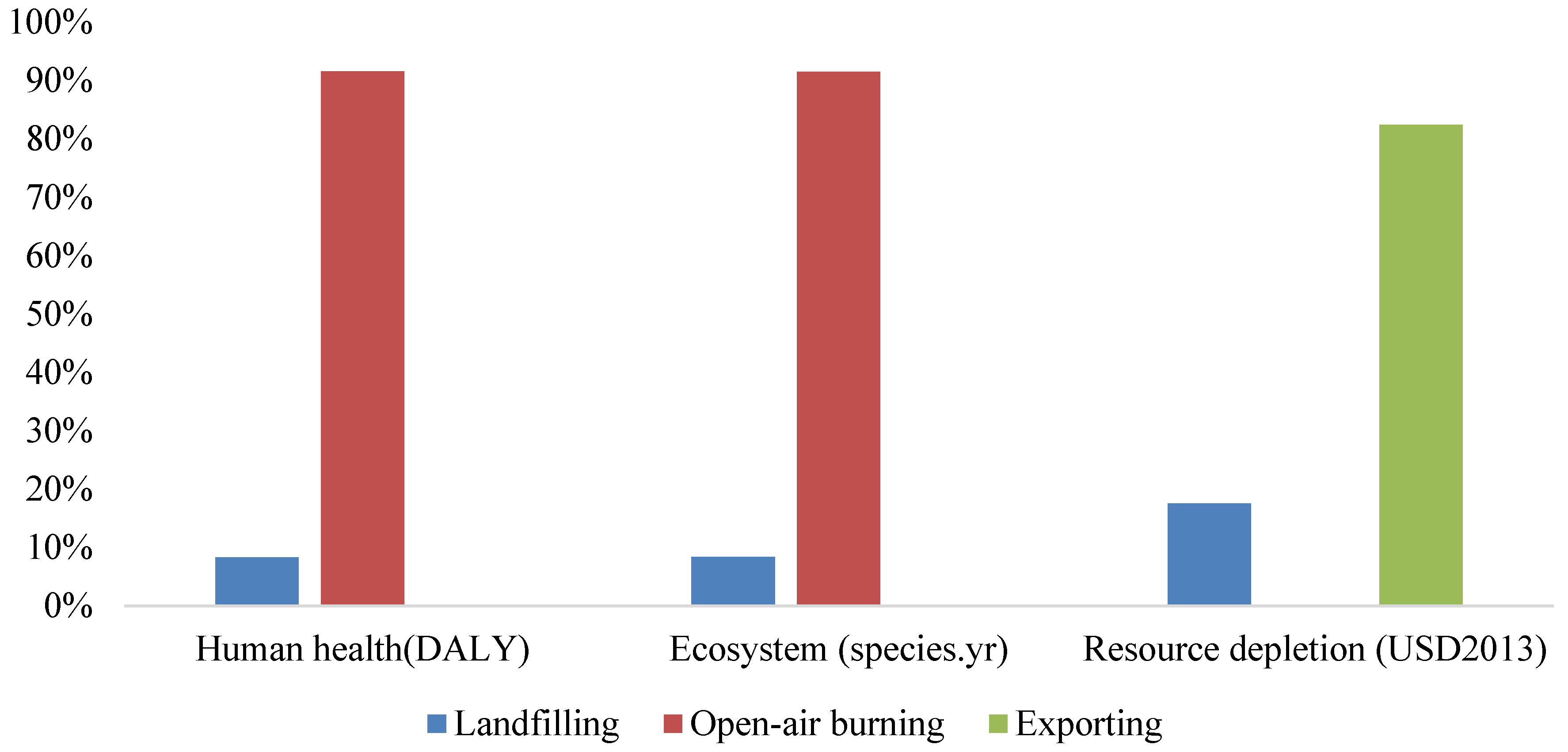
Table 5 and Figure 3 present the long-term environment, human health, and resource depletion impacts of waste tyre landfilling, open-air burning, and exporting, assessed using the ReCiPe 2016 v1.07 endpoint (E) method. This approach offers an integrated perspective on the cumulative consequences of each waste management strategy.
Table 5.
Waste tyre management options environmental impacts using ReCiPe 2016 midpoint method (E).
Figure 3.
Waste tyre management options environmental impacts using ReCiPe 2016 endpoint method (E).
A study by Wright et al. [72] links these impacts to increased respiratory disorders, cancer incidence, and water scarcity-induced malnutrition. Among the evaluated tyre management options, open-air burning poses the greatest threat to human health, contributing 8.78 × 10⁻³ DALY (91.6% of health-related impacts), followed by landfilling at 7.94 × 10⁻⁴ DALY (8.3%) and exporting at 1.33 × 10⁻⁵ DALY (0.1%). These findings align with a study by Dastjerdi et al. [73], which reported that solid waste incineration contributed 5.52 × 10⁻⁷ DALY (86% to GWP) and landfilling accounted for 1.29 × 10⁻⁴ DALY (71% to FPMF).
Ecosystem damage, particularly from TAP and FEP, pose substantial risks to freshwater, terrestrial, and marine biodiversity. According to Table 5 and Figure 3, tyre open-air burning and landfill disposal accounted for 91.5% (4.80 × 10⁻⁶ species·yr) and 8.4% (4.40 × 10⁻⁷ species·yr) of total long-term ecosystem impact respectively. These findings highlight the ecological burden of current practices and suggest that while landfilling is less harmful than open burning, it remains unsustainable as a long-term waste tyre management solution.
Ferrão, Ribeiro, and Silva [20] further highlighted the environmental burdens of various tyre disposal methods, reporting that landfilling yields the highest eco-indicator 99 score (1.73), while incineration (0.00), co-processing in cement kilns (−0.001), recycling (−0.49), and retreading (−0.95) show significantly lower impacts. These results position landfilling as the most ecologically harmful option, with recycling, retreading, and co-processing emerging as more sustainable alternatives.
As shown in Table 5 and Figure 3, tyre exporting contributed significantly to resource depletion, particularly of minerals and fossil fuels, due to oil and coal extraction. Resource depletion impacts for the export scenario dominate the endpoint analysis, primarily due to the fossil fuel consumption associated with transporting 11,436 tons of waste tyres to Durban Harbour, a process that required 348 diesel powered freight trips. The South African transport sector is heavily dependent on conventional fossil fuel-derived energy sources such as diesel and petrol, which significantly amplifies the resource depletion burden of this pathway. Consequently, the export scenario accounted for 1.31 × 10⁻² USD2013, representing 82% of total resource depletion; this is largely driven by the production of CO, NOx, and SOx during diesel combustion [71].
These findings highlight the substantial environmental and health impacts associated with conventional tyre management practices such as landfilling, open-air combustion, and exporting within the South African context. Post-COVID-19 pandemic increases in vehicle usage may elevate waste tyre volumes, while improved collection efficiency could reduce environmentally harmful practices such as open burning and illegal dumping. Conversely, lower collection rates may intensify environmental burdens. Accordingly, this study recommends conducting a formal sensitivity analysis to ensure a robust evaluation aligned with present trends. The presence of hazardous chemicals used in tyre production further amplifies the pressing need for sustainable alternatives in the automotive industry to mitigate environmental harm across the entire life cycle of tyres.
Alternative waste tyre management methods, including reuse, recycling, and material and energy recovery strategies, have demonstrated greater environmental and economic sustainability. Key findings from the literature support the advantages of these alternatives: (i) ref. [20] found that manufacturing a new tyre requires 2.3 times more energy and generates 1.8 times more global warming potential (GWP) than retreading. This environmental advantage is evident in SA, with some guiding standards for tyre retreading already developed [74]. Retreaded tyres are widely utilised across specific sectors, including South African Airways (SAA) and government vehicle fleets [75]. Moreover, approximately 35% to 60% of heavy commercial vehicle tyres, such as those used for trucks and buses, are retreaded locally [44], highlighting both the technical viability and growing market acceptance of retreading as a sustainable waste tyre management strategy. (ii) Corti and Lombardi [76] reported that ambient grinding produced minimal environmental impacts across several categories, including GWP (122 kg CO2/ton tyre), AP (0.474 kg SO2/ton tyre), and EP (1 g PO4/ton tyre). In terms of human health, they observed reductions in hazardous substances such as HTC (−0.05 g Benzo[a]pyrene/ton tyre) and heavy metals (1 g Pb/ton tyre). Resource depletion impacts were also relatively low, with 6087 kg of water, 4968 MJ of energy, and a net reduction in solid waste of −1196 kg/tonne. In SA, the recovery of waste tyres for material recycling increased from 12% in 2016 to 22% in 2018 [52]. This upward trend is largely attributed to several ambient mechanical grinding facilities across the country. (iii) Clauzade et al. [77] proved that tyre incineration, when controlled and optimised, can avoid the substantial impacts of GWP (−1466 kg eq. CO2/ton tyre), AP (−7031 g eq. SO2/ton tyre), EP (−327 g eq. PO4/ton tyre), WRD (−12 m3/ton tyre), and energy consumption (−43 GJ/ton tyre), while producing zero waste. Between 2016 and 2018, the use of tyres in co-processing applications increased from 38% to 59% in SA [78]. This growth is primarily driven by cement and brick manufacturing companies integrating tyres into their energy mix. (iv) Banar [79] showed that tyre pyrolysis produced reduces GWP of 70 kg CO2 eq./ton tyre, AP of 4.2 kg SO2 eq./ton tyre, and EP 0.18 kg PO4 eq./ton tyre. Between 2016 and 2018, approximately 17% of generated waste tyres were diverted to pyrolysis applications. Although pyrolysis technology in not new in SA, it remains underutilised and has yet to achieve widespread commercial success [12]. Collectively, the growing adoption of these alternative waste tyre management strategies demonstrates their technical feasibility in SA. However, a comprehensive, South African-specific LCA is needed to quantify their environmental impacts and associated trade-offs. Such an assessment would support evidence-based decision-making, inform policy development, and guide strategic investments toward the most environmentally sustainable options.
5. Conclusions
In 2019, SA generated around 219,741 tons of waste tyres, of which only 44% (128,366 tons) was collected for processing. The remaining 56% (163,375 tons) remained uncollected and was primarily managed through landfilling (51%), with smaller fractions exported (4%) or subjected to combustion in the open environment (1%). This study employed the SimaPro software (v9.4.0.2) LCA tool and the ReCiPe 2016 v1.07 midpoint and endpoint methods to evaluate the environmental impacts of various waste tyre management techniques.
The analysis revealed that open-air combustion resulted in the most severe atmospheric pollution, due to the release of toxic gases and particulate matter. Landfilling posed substantial risk to human health, particularly through carcinogenic toxicity, and contributed significantly to the degradation of freshwater ecosystems. Tyre exporting resulted in notable carbon and resource depletion impacts, due to high fossil fuel, mineral, and water demands.
This study suggests that addressing these challenges requires a concerted shift away from conventional tyre disposal methods in SA. Interprovincial tyre exportation may be a viable interim solution in regions equipped with appropriate waste management infrastructure. However, priority should be given to strategies that promote tyre reuse, recycling, and material and energy recovery initiatives. Such practices offer environmentally preferable alternatives that reduce emissions, conserve resources, and mitigate long-term ecological harm.
Crucially, these alternatives must also undergo comprehensive life cycle assessments to understand their broader implications within the South African context. Finally, the establishment and enforcement of robust policies and regulations centred on environmental protection and resource efficiency are vital to driving systemic change and achieving sustainable tyre management at a national scale.
Author Contributions
Conceptualization, N.N. and T.N.; methodology, N.N and T.N.; software, T.N.; validation, T.N., A.-e.M. and M.B.; investigation, N.N.; data curation, T.N.; writing—original draft preparation, N.N.; writing—review and editing, A.-e.M.; visualization, N.N.; supervision, M.B. All authors have read and agreed to the published version of the manuscript.
Funding
The authors are grateful to the National Research Foundation Black Academics Advancement Programme (NRF-BAAP) Research Grant NFSG240510218233, and the University of Johannesburg’s Global Excellence and Stature Scholarship (GES 4.0) for financial support.
Institutional Review Board Statement
Not applicable.
Informed Consent Statement
Not applicable.
Data Availability Statement
Data can be requested from the authors.
Acknowledgments
The authors also acknowledge the Durban University of Technology, the University of Johannesburg, and the University of South Africa for supporting this work.
Conflicts of Interest
The authors declare no conflicts of interest.
References
- Wang, K.; Shan, T.; Li, B.; Zheng, Y.; Xu, H.; Wang, C.; Tian, X. Study on pyrolysis characteristics, kinetics and thermodynamics of waste tires catalytic pyrolysis with low-cost catalysts. Fuel 2023, 356, 129644. [Google Scholar] [CrossRef] [Scilit]
- United States Tire Manufacturers Association. “2021 US Scrap Tire Management Summary”. Available online: https://www.ustires.org/system/files/files/2024-02/21%20US%20Scrap%20Tire%20Management%20Report%20101722.pdf (accessed on 20 February 2026).
- World Business Council for Sustainable Development, “Global ELT Management—A Global State of Knowledge on Regulation, Management Systems, Impacts of Recovery and Technologies,” World Business Council for Sustainable Development (WBCSD): Wuhan, China. Available online: https://docs.wbcsd.org/2019/12/Global_ELT_Management–A_global_state_of_knowledge_on_regulation_management_systems_impacts_of_recovery_and_technologies.pdf (accessed on 7 January 2022).
- The Japan Automobile Tyre Manufacturers Association, “Tyre Industry of Japan 2024”. Available online: https://www.jatma.or.jp/docs/publications/tyre_industry_2024.pdf (accessed on 19 November 2024).
- Ferdous, W.; Manalo, A.; Siddique, R.; Mendis, P.; Zhuge, Y.; Wong, H.S.; Lokuge, W.; Aravinthan, T.; Schubel, P. Recycling of landfill wastes (tyres, plastics and glass) in construction—A review on global waste generation, performance, application and future opportunities. Resour. Conserv. Recycl. 2021, 173, 105745. [Google Scholar] [CrossRef] [Scilit]
- Buadit, T.; Rattanapan, C.; Ussawarujikulchai, A.; Suchiva, K.; Papong, S.; Ma, H.-W. Life Cycle Assessment of Material Recovery from Pyrolysis Process of End-of-Life Tires in Thailand. Int. J. Environ. Sci. Dev. 2020, 11, 488–498. [Google Scholar] [CrossRef] [Scilit]
- South African Tyre Manufacturers Conference, “Industry Insights,” SATMC. Available online: https://www.satmc.co.za/industry-insights/ (accessed on 10 February 2024).
- Parthasarathy, P.; Choi, H.S.; Park, H.C.; Hwang, J.G.; Yoo, H.S.; Lee, B.-K.; Upadhyay, M. Influence of process conditions on product yield of waste tyre pyrolysis- A review. Korean J. Chem. Eng. 2016, 33, 2268–2286. [Google Scholar] [CrossRef] [Scilit]
- Nkosi, N.; Nhubu, T.; Mthombeni, N.H. An inventory analysis of waste tyre generation and management in South Africa. Waste Manag. 2025, 194, 353–365. [Google Scholar] [CrossRef] [Scilit] [PubMed]
- Machin, E.B.; Pedroso, D.T.; de Carvalho, J.A. Energetic valorization of waste tires. Renew. Sustain. Energy Rev. 2017, 68, 306–315. [Google Scholar] [CrossRef] [Scilit]
- Arthur, E.; Dorfiah, P.; Hilbert, I.; Kyere, V.N.; Ocran, P.K. Waste tyre management baseline study for Ghana, Sustainable Recycling Industries. Available online: https://www.sustainable-recycling.org/reports/waste-tyre-management-baseline-study-for-ghana/ (accessed on 16 February 2022).
- Nkosi, N. Waste Tyre Management Trends and Batch Pyrolysis Studies in Gauteng, South Africa; University of Johannesburg: Johannesburg, South Africa, 2015; Available online: https://hdl.handle.net/10210/13581 (accessed on 30 March 2026).
- Arole, K.; Velhal, M.; Tajedini, M.; Xavier, P.G.; Bardasz, E.; Green, M.J.; Liang, H. Impacts of particles released from vehicles on environment and health. Tribol. Int. 2023, 184, 108417. [Google Scholar] [CrossRef] [Scilit]
- Nkosi, N.; Belaid, M.; Nhubu, T.; Muzenda; Mbohwa, C. Waste Tyre Environmental Impacts and Life Cycle Assessment Review for Reuse, Material Recovery, and Energy Recovery Strategies. In 2nd International Conference on Frontiers of Energy and Environment Engineering, Environmental Science and Engineering; Springer: Singapore, 2024. [Google Scholar] [CrossRef] [Scilit]
- Jain, A. Compendium of Technologies for the Recovery of Materials/Energy from End of Life (EoL) Tyres, International Environmental Technology Centre. Available online: https://wedocs.unep.org/handle/20.500.11822/31533 (accessed on 27 January 2022).
- Hita, I.; Arabiourrutia, M.; Olazar, M.; Bilbao, J.; Arandes, J.M.; Castaño, P. Opportunities and barriers for producing high quality fuels from the pyrolysis of scrap tires. Renew. Sustain. Energy Rev. 2016, 56, 745–759. [Google Scholar] [CrossRef] [Scilit]
- Nkosi, N.; Muzenda, E.; Belaid, M.; Mateescu, C. A Critical Analysis of the Integrated Industry Waste Tyre Management Plan of South Africa. Adv. Sci. Technol. Eng. Syst. J. 2021, 6, 1046–1054. [Google Scholar] [CrossRef] [Scilit]
- Godfrey, L.; Oelofse, S. Historical Review of Waste Management and Recycling in South Africa. Resources 2017, 6, 57. [Google Scholar] [CrossRef] [Scilit]
- D’iNverno, G.; Carosi, L.; Romano, G. Meeting the challenges of the waste hierarchy: A performance evaluation of EU countries. Ecol. Indic. 2024, 160, 111641. [Google Scholar] [CrossRef] [Scilit]
- Ferrão, P.; Ribeiro, P.; Silva, P. A management system for end-of-life tyres: A Portuguese case study. Waste Manag. 2008, 28, 604–614. [Google Scholar] [CrossRef] [Scilit] [PubMed]
- Department of Forestry Fisheries and the Environment. National Waste Management Strategy 2020, Department of Environment Forestry and Fisheries—Republic of South Africa. Available online: https://www.dffe.gov.za/sites/default/files/docs/nationalwaste_management_strategy.pdf (accessed on 19 July 2021).
- Parliament of the Republic of South Africa, Targets for Diverting Waste Tyres from Landfill Sites. Available online: https://static.pmg.org.za/180417Waste_Tyre.pdf (accessed on 9 October 2020).
- Akkireddy, L. Burning Tires: A Persistent Menace to the Environment. The Softcopy. Available online: http://thesoftcopy.in/2021/11/25/burning-tires-a-persistent-menace-to-the-environment/ (accessed on 15 August 2022).
- Department of Forestry Fisheries and the Environment, Functioning of Waste Bureau; Progress in Waste Tyre Management, Parliamentary Monitoring Group. Available online: https://pmg.org.za/committee-meeting/33027/ (accessed on 13 September 2022).
- Nkosi, N.; Muzenda, E.; Zvimba, J. An analysis of the waste tyre management plans in South Africa. In Proceedings of the 2013 ICIET International Conference on Innovations in Engineering and Technology, Bangkok, Thailand, 25–26 December 2013; pp. 104–110. [Google Scholar] [CrossRef]
- Quintal, G. Service Delivery Protests Increasing and Most Are Violent, BusinessLIVE. Available online: https://www.timeslive.co.za/news/south-africa/2018-05-14-service-delivery-protests-increasing-and-most-are-violent/ (accessed on 1 January 2023).
- Ngumbela, X.G. The Relationship Between Policy, Governance And Service Delivery In Local Government In South Africa. Int. J. Innov. Technol. Soc. Sci. 2022, 2, 1–12. [Google Scholar] [CrossRef] [Scilit]
- Khambule, I.; Nomdo, A.; Siswana, B. Burning capabilities: The social cost of violent and destructive service delivery protests in South Africa. Ubuntu J. Confl. Soc. Transform. 2019, 8, 51–70. [Google Scholar] [CrossRef] [Scilit]
- Reschner, K. Scrap Tire Recycling. 2003. Available online: https://trid.trb.org/view/427152 (accessed on 27 July 2022).
- Makitan, V. Waste Tyre Recycling: Current Status, Economic Analysis and Process Development; Curtin University of Technology: Perth, Australia, 2010; Available online: http://espace.library.curtin.edu.au/R?func=dbin-jump-full&local_base=gen01-era02&object_id=147853 (accessed on 31 January 2022).
- Department of Environmental Affairs. Notice of Approval of an Integrated Industry Waste Tyre Management Plan for the Recycling and Economic Development Initiative of South Africa (REDISA), 2011. Available online: https://www.gov.za/sites/default/files/gcis_document/201409/35927gon988.pdf (accessed on 9 October 2020).
- Department of Forestry Fisheries and the Environment. National Environmental Management: Waste Act, 2008 (Act No. 59 of 2008) Industry Waste Tyre Management Plan, Government Gazette of The Republic of South Africa. Available online: https://www.dffe.gov.za/sites/default/files/legislations/nemwa_industrywastetyreplan_g50322gon4542.pdf (accessed on 2 August 2024).
- Dong, Y.; Zhao, Y.; Hossain, U.; He, Y.; Liu, P. Life cycle assessment of vehicle tires: A systematic review. Clean. Environ. Syst. 2021, 2, 100033. [Google Scholar] [CrossRef] [Scilit]
- Dong, J.; Tang, Y.; Nzihou, A.; Chi, Y.; Weiss-Hortala, E.; Ni, M. Life cycle assessment of pyrolysis, gasification and incineration waste-to-energy technologies: Theoretical analysis and case study of commercial plants. Sci. Total. Environ. 2018, 626, 744–753. [Google Scholar] [CrossRef] [Scilit]
- Harding, K.G.; Friedrich, E.; Jordaan, H.; le Roux, B.; Notten, P.; Russo, V.; Suppen-Reynaga, N.; van der Laan, M.; Goga, T. Status and prospects of life cycle assessments and carbon and water footprinting studies in South Africa. Int. J. Life Cycle Assess. 2020, 26, 26–49. [Google Scholar] [CrossRef] [Scilit]
- Gualtieri, M.; Andrioletti, M.; Vismara, C.; Milani, M.; Camatini, M. Toxicity of tire debris leachates. Environ. Int. 2005, 31, 723–730. [Google Scholar] [CrossRef] [Scilit]
- Wik, A.; Dave, G. Environmental labeling of car tires—Toxicity to Daphnia magna can be used as a screening method. Chemosphere 2005, 58, 645–651. [Google Scholar] [CrossRef] [Scilit]
- DeMarini, D.M.; Lemieux, P.M.; Ryan, J.V.; Brooks, L.R.; Williams, R.W. Mutagenicity and chemical analysis of emissions from the open burning of scrap rubber tires. Environ. Sci. Technol. 1994, 28, 136–141. [Google Scholar] [CrossRef] [Scilit]
- Czajczyńska, D.; Krzyżyńska, R.; Jouhara, H.; Spencer, N. Use of pyrolytic gas from waste tire as a fuel: A review. Energy 2017, 134, 1121–1131. [Google Scholar] [CrossRef] [Scilit]
- Jimoda, L.A.; Sulaymon, I.D.; Alade, A.O.; Adebayo, G.A. Assessment of environmental impact of open burning of scrap tyres on ambient air quality. Int. J. Environ. Sci. Technol. 2017, 15, 1323–1330. [Google Scholar] [CrossRef] [Scilit]
- Sulaymon, I.D.; Jimoda, L.A.; Sulaymon, Z.O.; Adebayo, G.A. Assessment and toxicity potential of the gaseous pollutants emitted from laboratory-scale open burning of scrap tyres. Int. J. Environ. Eng. 2018, 9, 355. [Google Scholar] [CrossRef] [Scilit]
- Department of Statistics. 2011 Population of South Africa. Available online: https://www.statssa.gov.za/?page_id=595 (accessed on 17 May 2021).
- Statistics South Africa, Mbalo Brief: Census 2022 Results, Pretoria, South Africa, 2023. Available online: https://www.statssa.gov.za/wp-content/uploads/2023/10/Mbalo-brief-October-2023-WEB-FINAL.pdf (accessed on 30 March 2026).
- Department of Statistics, Provincial Gross Domestic Product 2023, 2024. Available online: http://www.cbsl.gov.lk/pics_n_docs/latest_news/press_20151028eb.pdf (accessed on 9 May 2025).
- Department of Environmental Affairs. National Environmental Management: Waste Act 59 of 2008; Department of Environmental Affairs: Pretoria, South Africa, 2009; Volume 525, pp. 1–97, no. 7. Available online: https://cer.org.za/virtual-library/legislation/national/pollution-and-waste/national-environmental-management-waste-act-2008 (accessed on 7 November 2023).
- Department of Statistics. The State of Basic Service Delivery in South Africa: In-Depth Analysis of the Community Survey 2016 Data, 2017. Available online: https://www.statssa.gov.za/publications/Report (accessed on 17 June 2021).
- Schoeman, H. The Viability of Waste Disposal Facility Management As an Alternative Energy Source in South Africa; University of Pretoria: Pretoria, South Africa, 2008; Available online: https://repository.up.ac.za/server/api/core/bitstreams/8e129178-e4f2-4e9a-8627-8bdafb7f69fb/content (accessed on 30 March 2026).
- Mulaudzi, L. Process Modelling and Economic Evaluation of Waste Tyres to Limonene via Pyrolysis; Stellenbosch University: Stellenbosch, South Africa, 2017; Available online: https://scholar.sun.ac.za/items/d30bd06a-11f2-4e5a-9be6-7146351e580f (accessed on 5 May 2022).
- Department of Environmental Affairs, South Africa State of Waste Report First Draft Report, Pretoria, South Africa, 2018. Available online: https://lib.uct.ac.za/government-publications/articles/2018-05-30-south-africa-state-waste-report-first-draft-report-2018 (accessed on 19 July 2021).
- Department of Environmental Affairs, South Africa State of Waste Report 2018. Available online: https://www.scribd.com/document/726136799/141119143510-state-of-Waste-Report-2018-1National-Waste-Management-Strategy-as-implemented.pdf (accessed on 19 July 2021).
- Damoah, B. Ramifications environment. Int. J. Environ. Sustain. Soc. Sci. 2023, 4, 652–663. [Google Scholar]
- Department of Environmental Affairs. Waste Tyre Processing: Presentation to Parliamentary Portfolio Committee, Department of Environmental Affairs. Available online: https://pmg.org.za/committee-meeting/26453/ (accessed on 18 November 2021).
- Pré Sustainability, Simapro Database Manual: Methods Library. Available online: https://simapro.com/wp-content/uploads/2022/07/DatabaseManualMethods.pdf (accessed on 15 April 2025).
- Mazhandu, Z.S.; Muzenda, E.; Belaid, M.; Nhubu, T. Comparative assessment of life cycle impacts of various plastic waste management scenarios in Johannesburg, South Africa. Int. J. Life Cycle Assess. 2023, 28, 536–553. [Google Scholar] [CrossRef] [Scilit]
- Department of Environmental Affairs. National Environmental Management: Air Quality Act, 2004 (Act No. 39 of 2004) National Ambient Air Quality Standards; Department of Environmental Affairs: Pretoria, South Africa, 2009; pp. 6–9. Available online: https://www.gov.za/sites/default/files/gcis_document/201409/328161210.pdf (accessed on 22 February 2022).
- Department of Environmental Affairs, Amendments to The Listed Activities and Associated Minimum Emission Standards Identified in Terms of Section 21 of The National Environment Management: Air Quality Act, 2004 (Act No.39 of 2004), Government Gazette of The Republic of South Africa. Available online: https://www.gov.za/sites/default/files/gcis_document/202003/43174gon421.pdf (accessed on 4 January 2023).
- Department of Environmental Affairs. National Framework for Air Quality Management in the Republic of South Africa, Pretoria, South Africa. 2017. Available online: www.gpwonline.co.za (accessed on 22 February 2022).
- Anh, P.T. Sustainable Options for Scrap Tire in Vietnam: From Waste to Energy. In Advances and Trends in Agricultural Sciences; BP International: West Benga, India, 2019; Volume 2, pp. 1–10. [Google Scholar] [CrossRef] [Scilit]
- Torretta, V.; Rada, E.C.; Ragazzi, M.; Trulli, E.; Istrate, I.A.; Cioca, L.I. Treatment and disposal of tyres: Two EU approaches. A review. Waste Manag. 2015, 45, 152–160. [Google Scholar] [CrossRef] [Scilit]
- International Panel on Climate Change (IPCC). Summary for Policymakers: Climate Change 2023 Synthesis Report, The Intergovernmental Panel on Climate Change. Available online: https://www.ipcc.ch/report/ar6/syr/downloads/report/IPCC_AR6_SYR_SPM.pdf (accessed on 6 November 2023).
- Fiksel, J.; Bakshi, B.R.; Baral, A.; Guerra, E.; DeQuervain, B. Comparative life cycle assessment of beneficial applications for scrap tires. Clean Technol. Environ. Policy 2010, 13, 19–35. [Google Scholar] [CrossRef] [Scilit]
- Ćetković, J.; Lakić, S.; Žarković, M.; Vujadinović, R.; Knežević, M.; Živković, A.; Cvijović, J. Environmental Benefits of Air Emission Reduction in the Waste Tire Management Practice. Processes 2022, 10, 787. [Google Scholar] [CrossRef] [Scilit]
- Landi, D.; Gigli, S.; Germani, M.; Marconi, M. Investigating the feasibility of a reuse scenario for textile fibres recovered from end-of-life tyres. Waste Manag. 2018, 75, 187–204. [Google Scholar] [CrossRef] [Scilit]
- Czajczyńska, D.; Czajka, K.; Krzyżyńska, R.; Jouhara, H. Waste tyre pyrolysis—Impact of the process and its products on the environment. Therm. Sci. Eng. Prog. 2020, 20, 100690. [Google Scholar] [CrossRef] [Scilit]
- Eranki, P.L.; Landis, A.E. Pathway to domestic natural rubber production: A cradle-to-grave life cycle assessment of the first guayule automobile tire manufactured in the United States. Int. J. Life Cycle Assess. 2018, 24, 1348–1359. [Google Scholar] [CrossRef] [Scilit]
- Dobrotă, D.; Dobrotă, G.; Dobrescu, T. Improvement of waste tyre recycling technology based on a new tyre markings. J. Clean. Prod. 2020, 260, 121141. [Google Scholar] [CrossRef] [Scilit]
- Mandini, Mandini waste tyre processing facility. Available online: https://mandini.co.za/ (accessed on 19 May 2024).
- Abdel-Shafy, H.I.; Mansour, M.S.M. A review on polycyclic aromatic hydrocarbons: Source, environmental impact, effect on human health and remediation. Egypt. J. Pet. 2016, 25, 107–123. [Google Scholar] [CrossRef] [Scilit]
- Adhikari, B.; De, D.; Maiti, S. Reclamation and recycling of waste rubber. Prog. Polym. Sci. 2000, 25, 909–948. [Google Scholar] [CrossRef] [Scilit]
- Jeswani, H.; Azapagic, A. Assessing the environmental sustainability of energy recovery from municipal solid waste in the UK. Waste Manag. 2016, 50, 346–363. [Google Scholar] [CrossRef] [Scilit]
- Šenitková, I.; Bednárová, P. Life Cycle Assessment. JP J. Heat Mass Transf. 2015, 11, 29–42. [Google Scholar] [CrossRef] [Scilit]
- Wright, C.Y.; Kapwata, T.; du Preez, D.J.; Wernecke, B.; Garland, R.M.; Nkosi, V.; Landman, W.A.; Dyson, L.; Norval, M. Major climate change-induced risks to human health in South Africa. Environ. Res. 2021, 196, 110973. [Google Scholar] [CrossRef] [Scilit]
- Dastjerdi, B.; Strezov, V.; Kumar, R.; Behnia, M. Environmental Impact Assessment of Solid Waste to Energy Technologies and Their Perspectives in Australia. Sustainability 2022, 14, 15971. [Google Scholar] [CrossRef] [Scilit]
- Department of Trade and Industry. Standards Act, 2008 (Act No. 8 of 2008), Notice 487 of 2018. Available online: https://www.gov.za/sites/default/files/gcis_document/201808/41839gen487.pdf (accessed on 2 August 2024).
- Phale, A.R. Environmental Impact and Waste Management of Used Tyres in the RSA; University of Johannesburg: Johannesburg, South Africa, 2005; Available online: https://www.google.com/url?sa=t&source=web&rct=j&opi=89978449&url=https://ujcontent.uj.ac.za/view/pdfCoverPage%3FinstCode%3D27UOJ_INST%26filePid%3D136035530007691%26download%3Dtrue&ved=2ahUKEwjlh5jO6d-TAxUkqpUCHa1uDYsQFnoECBYQAQ&usg=AOvVaw3jvA95rl9u_9qEPktbQ4wF (accessed on 30 March 2026).
- Corti, A.; Lombardi, L. End life tyres: Alternative final disposal processes compared by LCA. Energy 2004, 29, 2089–2108. [Google Scholar] [CrossRef] [Scilit]
- Clauzade, C.; Osset, P.; Hugrel, C.; Chappert, A.; Durande, M.; Palluau, M. Life cycle assessment of nine recovery methods for end-of-life tyres. Int. J. Life Cycle Assess. 2010, 15, 883–892. [Google Scholar] [CrossRef] [Scilit]
- Hartley, F.; Caetano, T.; Daniels, R.C. Economic benefits of extended producer responsibility initiatives in South Africa: The case of waste tyres. Energy Res. Cent. 2016, 1–17. Available online: www.erc.uct.ac.za (accessed on 30 September 2021).
- Banar, M. Life cycle assessment of waste tire pyrolysis. Fresenius Environ. Bull. 2015, 24, 1215–1226. [Google Scholar]

Disclaimer/Publisher’s Note: The statements, opinions and data contained in all publications are solely those of the individual author(s) and contributor(s) and not of MDPI and/or the editor(s). MDPI and/or the editor(s) disclaim responsibility for any injury to people or property resulting from any ideas, methods, instructions or products referred to in the content. |
© 2026 by the authors. Licensee MDPI, Basel, Switzerland. This article is an open access article distributed under the terms and conditions of the Creative Commons Attribution (CC BY) license (https://creativecommons.org/licenses/by/4.0/).