


Abstract
This research experiment aimed to transform multicomponent Ni-based superalloys produced with e-waste additives into corrosion-resistant materials via heat treatment. The experiment involved a two-hour heat treatment of as-cast samples at 1000 °C in an argon atmosphere, followed by quenching in water and characterization by scanning electron microscopy coupled to energy-dispersive spectroscopy (SEM-EDS). Thereafter, the corrosion characteristics of the heat-treated and non-heat-treated samples were studied in 0.5 M sulfuric acid using open circuit potential (OCP), electrochemical impedance spectroscopy (EIS), and potentiodynamic polarization (PDP). Results showed that the FCC gamma solid-solution matrix in the microstructure was homogenized by heat treatment. A continuous grain boundary M23C6 and interdendritic M6C were redistributed into discrete particles after the heat treatment, which facilitated the reduction in galvanic pathways and boosted corrosion resistance. The heat-treated samples exhibited nobler OCP, increased low-frequency impedance, reduced corrosion current density, a broader passive range, and increased breakdown potential. These findings have proved that it is feasible to convert scrap to service affordably.
1. Introduction
One of the urban ores that is not fully exploited is electronic waste (e-waste) [1]. Recycling complex scrap streams into high-value structural and corrosion-resistant alloys is a straightforward path to circular metallurgy, one that can close material loops and generate performance-competitive metals. This paper pushes that agenda a step further as copper, antimony, and lead-bearing scrap are introduced into the existing Hastelloy grades to create a multicomponent Ni-based superalloy, which is then subjected to controlled heat treatment to adjust microstructure and corrosion characteristics. The thermal processing of the casting route provides a viable route between heterogeneous secondary feedstock and useful alloy, both sustainability initiatives and stringent metallurgical design [2].
The novelty of this study is twofold. Firstly, the alloy concept systematically incorporates elements derived from e-waste into a Ni-based superalloy matrix without compromising integrity, proving that skillful alloying with unconventional additions is practicable when guided by microstructural evidence. Also, the experiment combines compositional upcycling with a processing technique that has scalability and precision undertones. Heat treatment at high temperature in an inert environment and water quenching is employed to homogenize solutes and reorganize secondary phases to engineer the final phase topology to an enhanced microstructure and corrosion characteristics [3]. The methodology is experimentally based using scanning electron microscopy (SEM) and electrochemical analysis in a well-prepared sulfuric acid solution, which can provide a precise connection between processing and structure to property.
The core issue in the project is multicomponent alloy melting and solidification using recycled feeds, which introduces a microstructural complexity to the alloy system. This is because cast material is liable to segregate chromium, molybdenum, cobalt, iron, and tungsten in a face-centered cubic Ni structure, coupled with the formation of grain boundaries and interdendritic carbides [4]. This kind of heterogeneity increases local galvanic contrast and provides favored routes to corrosion. The work demonstrates that heat treatment at 1000 °C enhances atomic diffusion, promoting γ-matrix homogenization and solute redistribution, while simultaneously eliminating localized compositional gradients and continuous diffusion pathways associated with dendritic and interdendritic carbide networks. This microstructural transformation gives a mechanistic explanation for better passivation and the lowering of pit coalescence.
The prospects of the study are manifold. In technical terms, the processing path can be handled by the conventional foundry and heat treatment facilities, and processing maps of the microstructure generated at this stage may guide heat treatment of related recycles. In terms of methodology, the joint application of scanning electron microscopy, energy dispersive spectroscopy, and standard electrochemical procedures gives a transferable validation template for future use of recycled superalloys in other hostile media. Theoretically, the work proves that the recycling of e-waste into multicomponent superalloys can give performance benefits instead of decreases and leaves behind new alloy design spaces that are both performance-driven and resource-responsible. In short, the study paves an innovative pathway from scrap to service (S-to-S) by linking casting, heat treatment, and corrosion science and showcasing evidence that recycled feedstock, when properly fabricated, can enhance stable passive films and robust corrosion resistance in alloy systems.
2. Methodology
This study was designed to systematically investigate the microstructure and corrosion characteristics of heat-treated e-waste-reinforced nickel-base multicomponent superalloys. Two superalloy samples (heat-treated and non-heat-treated) were precisely cut to 10 mm × 10 mm × 10 mm dimensions using a precision cutter to ensure size uniformity. Heat treatment was carried out in a tube furnace under a controlled argon atmosphere, where the samples were heated to 1000 °C, held for two hours, and then water-quenched to retain the desired microstructure. For microstructural analysis, the samples were hot-mounted in Bakelite resin, ground and polished with progressive grit papers and diamond suspension lubricant, and etched using Marble’s reagent. Scanning electron microscopy (SEM) was subsequently employed to characterize the microstructure and phase composition. It should be noted that phase identification in this study is based on SEM–EDS compositional signatures, morphology, and spatial distribution consistent with the reported behavior of Ni-based superalloys. Also, the definitive crystallographic confirmation of M23C6, M6C, or potential secondary intermetallic phases would require complementary techniques such as X-ray diffraction or transmission electron microscopy, which were beyond the scope of the present work.
Corrosion testing was performed by mounting the samples in epoxy resin to expose a defined surface area, followed by electrochemical analyses in 0.5 M H2SO4 using a three-electrode setup with a potentiostat. The tests included open circuit potential (OCP), potentiodynamic polarization (PDP), and electrochemical impedance spectroscopy (EIS) to assess corrosion resistance. After testing, samples were cleaned, dried, and analyzed again with SEM to evaluate corrosion-induced morphological changes. All experimental data, including microscopy images and electrochemical measurements, were systematically recorded and analyzed to establish correlations between processing parameters, microstructure, and corrosion behavior, ensuring rigorous control and reproducibility throughout the study. It should be noted that the e-waste-derived alloying elements (Cu, Sb, and Pb) were introduced as a composite scrap feedstock, and the study therefore emphasizes microstructural and corrosion performance trends arising from heat treatment of a single melt rather than strict compositional optimization or benchmarking against nominal Hastelloy-type alloy chemistries.
3. Results and Discussion
3.1. Microstructure
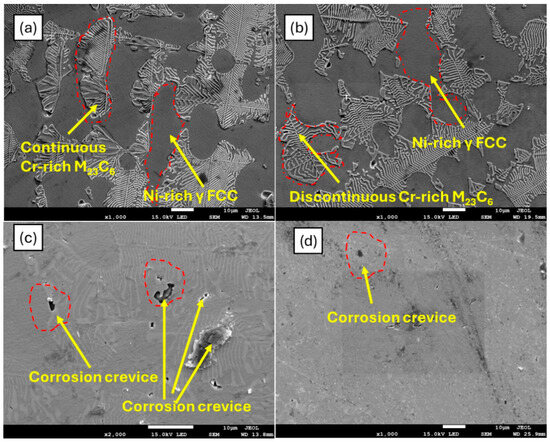
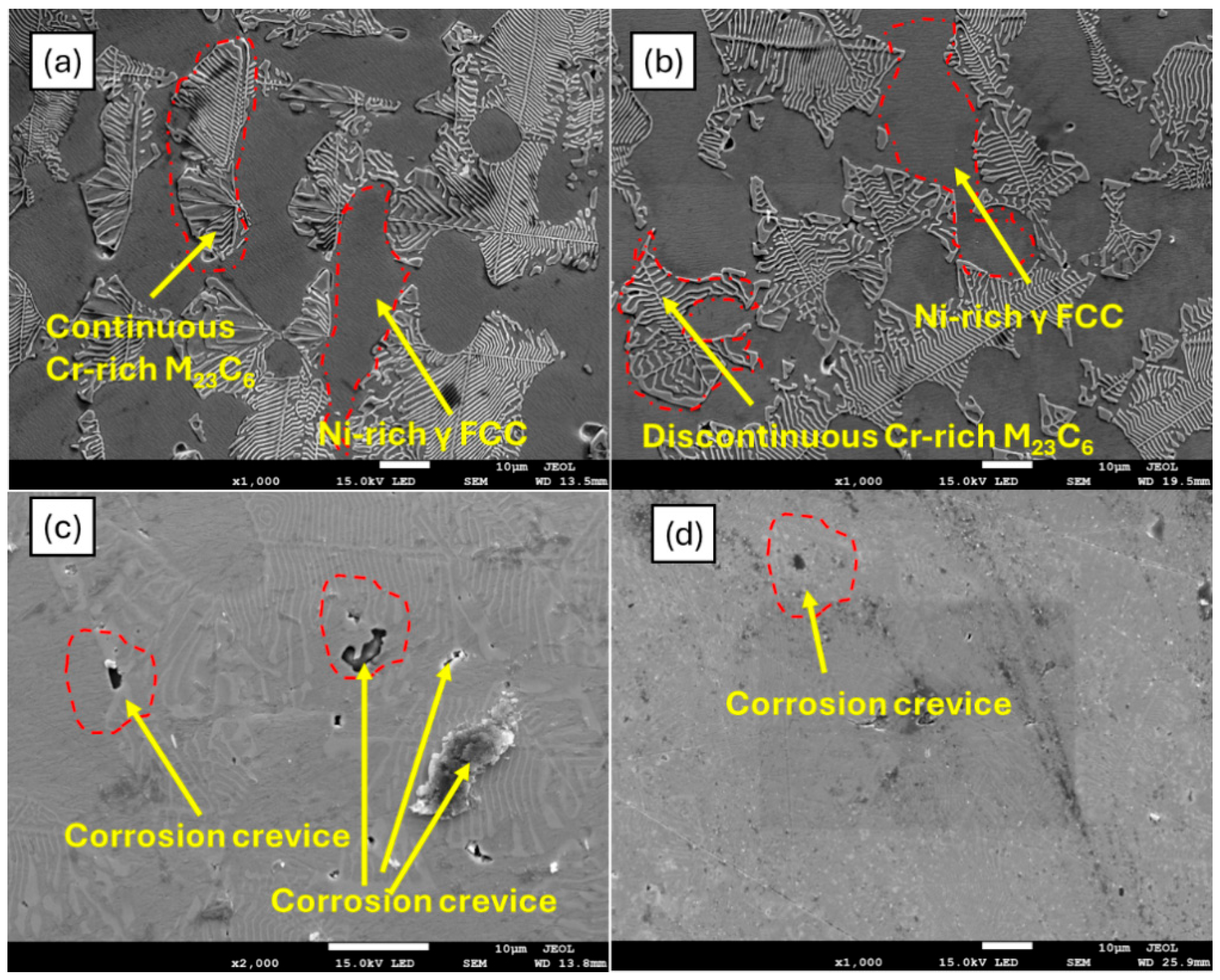
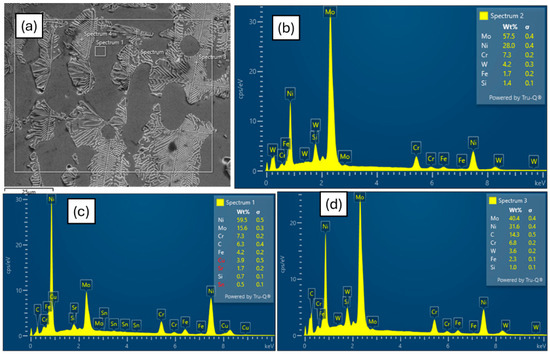
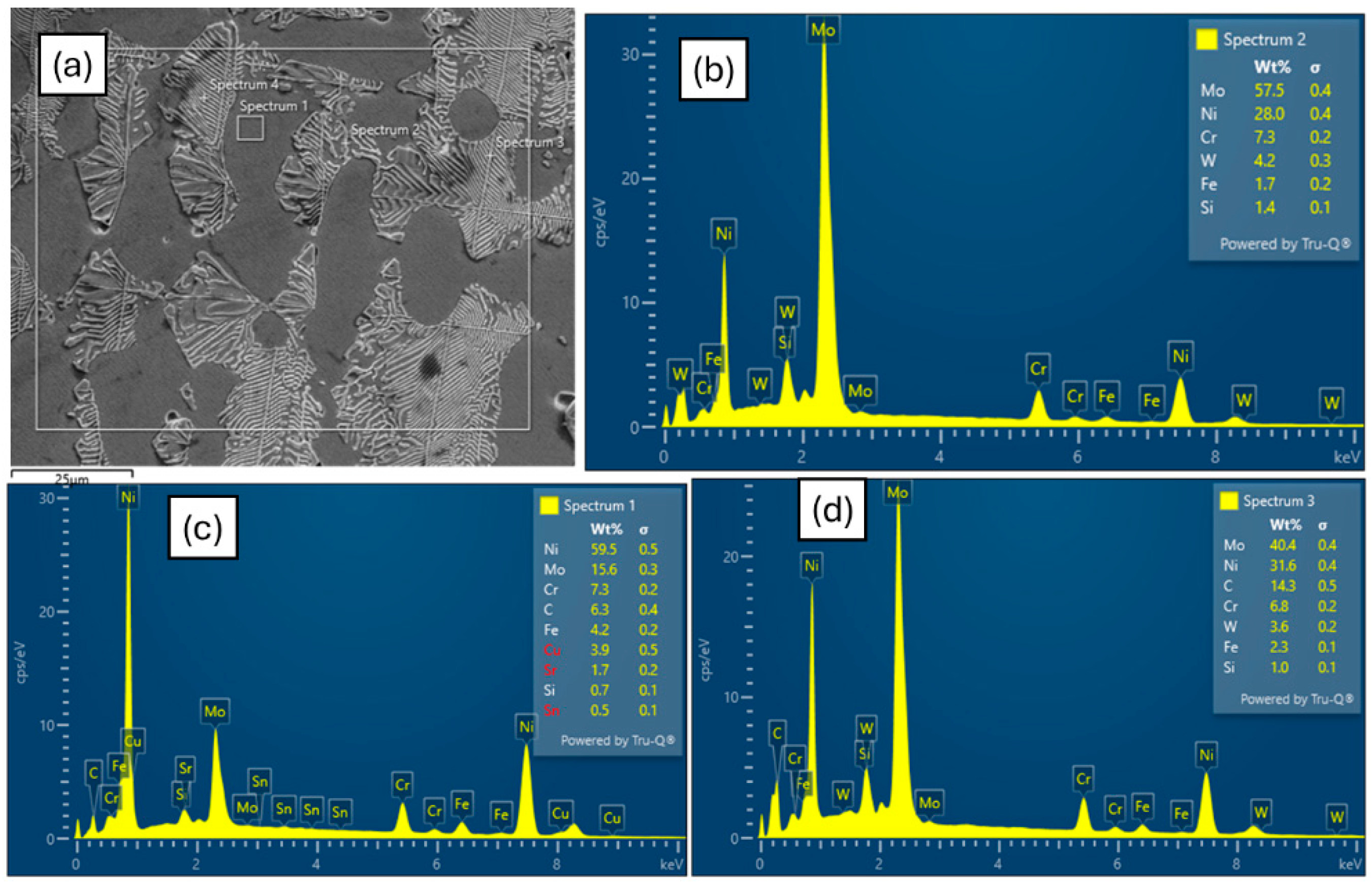
Figure 1 shows SEM micrographs of heat-treated and non-heat-treated Ni-based superalloy. The solid solution matrix therein is γ face-centered cubic (FCC) rich in Ni (Figure 1a,b). The solid solution strengthening elements present in the system include Cr, Mo, Co, Fe, and W, as shown in EDS (Figure 2). The dendrites present in the non-treated (Figure 1a), after heat treatment, decreased to interdendrite chemical gradients of these solutes, resulting in a more homogenous matrix (Figure 1b). The grain boundary is rich in Cr but is made of M23C6, as revealed by EDS. They are continuous in the non-heat-treated alloy system, but after heat treatment, they are more outstanding and discontinuous. There also exist interdendritic carbides rich in molybdenum, M6C. These always exist in heat-treated interdendritic pools, which evolve during solidification and are refined or partly dissolved via homogenization [5].
Figure 1.
Scanning Electron Microscopy Images of (a) non-heat-treated Ni-based superalloy, (b) heat-treated Ni-based superalloy, (c) corroded surface of non-heat-treated Ni-based superalloy, (d) corroded surface of heat-treated Ni-based superalloy.
Figure 2.
Energy dispersive spectroscopy images of a non-heat-treated Ni-based alloy. (a) SEM micrograph of analyzed region, (b) EDS spectrum showing overall elemental composition, (c) Chromium rich region spectrum, (d) Molybdenum rich region spectrum.
In Figure 1c,d, the corroded surfaces of non-heat-treated and heat-treated samples are shown. The microstructure retains an as-cast dendritic configuration. It is seen that interdendritic regions are rich in molybdenum and host bright M6C carbides. The boundaries are replete with Cr-rich M23C6 that links into films. The matrix close to the films shows Cr depletion at the submicrometric scale, which weakens passive film formation. SEM of the corroded surface shows preferential attack along interdendritic regions and shallow crevices along carbide-lined boundaries, consistent with local Cr depletion and strong micro-galvanic coupling, more pronounced in the non-heat-treated alloy system.
Heat treatment homogenizes the matrix and the second-phase topology. After the heat treatment, the M23C6 boundary became more pronounced instead of a film-like structure, while the interdendritic M6C got reduced in continuity. The flatter solute gradients and broken-up carbide networks facilitated the reduction in microgalvanic drivers [6,7] and closure of percolation pathways that would have assisted lateral pit growth; hence, the decrease in pit in heat-treated microstructure (see Figure 1c,d).
In the sulfuric acid medium, the alloy formed a duplex oxide, an inner Cr-rich barrier, and an outer NiO2. On the non-heat-treated system (Figure 1c), crevices nucleated swiftly at interdendritic M6C sites and along M23C6-lined boundaries. The SEM image shows undercut pit mouths and boundary trenching, depicting Cr depletion. On the heat-treated alloy system (Figure 1d), higher and more uniform Cr reactivity facilitated the formation of a thicker, less defective inner barrier, which resulted in fewer, smaller, and more isolated.
Chromium plays a critical role in governing the corrosion resistance of Ni-based superalloys through its ability to form a stable, adherent, and self-healing Cr2O3-rich passive film. Sufficient chromium availability at the alloy surface promotes the development of a dense inner barrier layer that limits metal dissolution and suppresses defect-mediated ionic transport. Conversely, chromium depletion zones adjacent to carbides or segregation regions weaken passive film integrity and function as preferential sites for breakdown and localized corrosion. Heat-treatment-induced diffusion homogenization mitigates these chromium-depleted regions by redistributing Cr into the γ-matrix, thereby enhancing passive film uniformity, increasing breakdown potential, and reducing susceptibility to galvanic attack. As such, chromium content and distribution, rather than bulk composition alone, are decisive factors controlling passivation stability and corrosion performance in Ni-based superalloys [7,8,9].
3.2. Corrosion
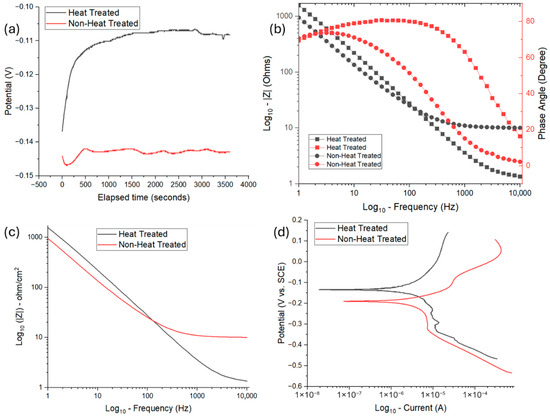
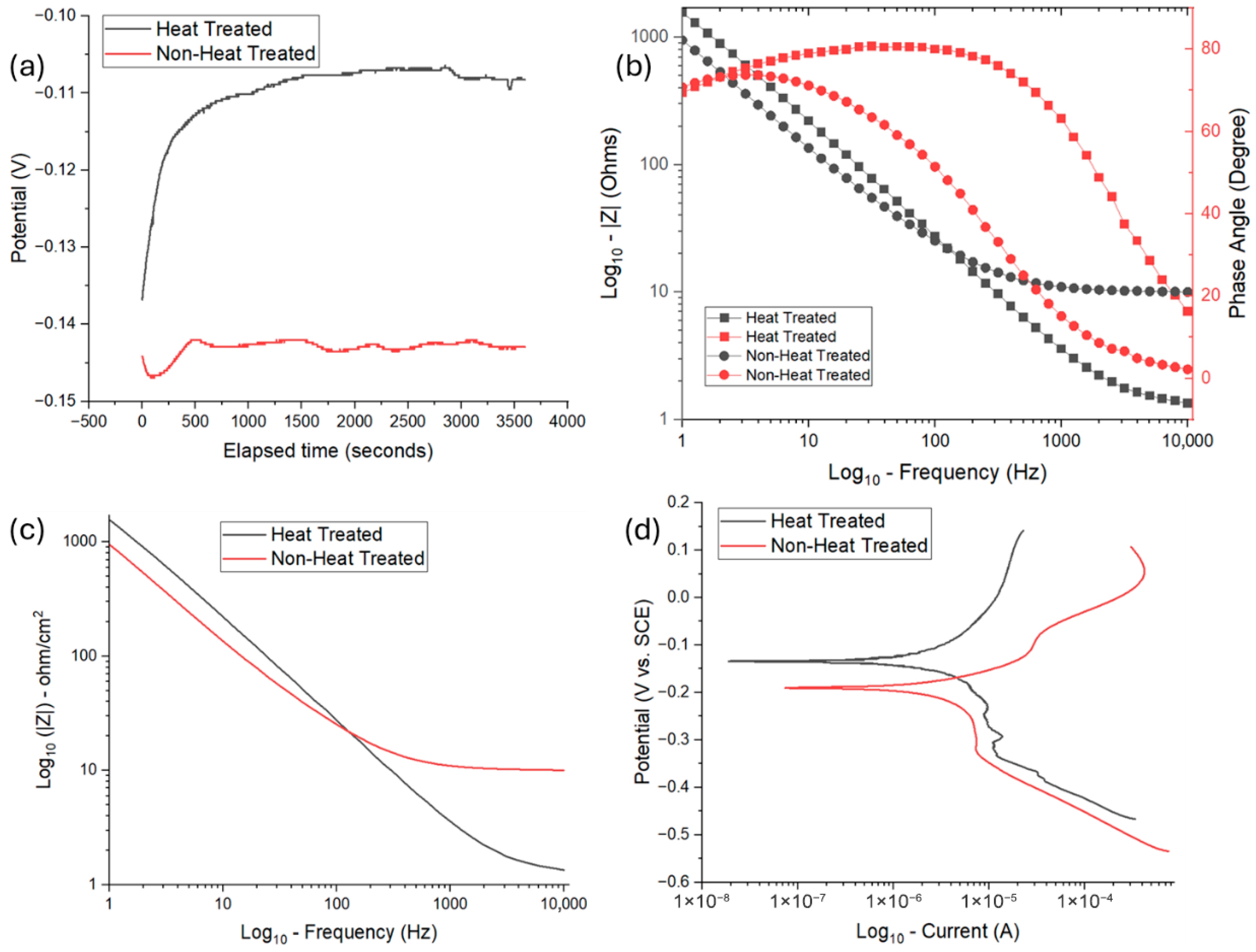
Figure 3a shows OCP profiles of both heat-treated and non-heat-treated Ni-based superalloy systems. The OCP profile shows the trend of each of the surfaces to be in a quasi-steady state as the interfacial reactions approach equilibrium.
Figure 3.
Electrochemical characteristics plots, (a) open circuit plot, (b) electrochemical impedance spectroscopy (BODE plot), (c) electrochemical impedance spectroscopy (Nyquist plot), (d) potentiodynamic polarization plot.
Faster stabilizing, OCP of the heat-treated material indicated its nobility over that of the non-heat-treated sample. Heat-treated alloy systems equally showed more positive potential, which is indicative of a more stable system in a harsh, corrosive medium. This indicates the faster development of a compact oxide and the lower defect density of the outer film. The heat treatment encourages redistribution of carbide or gamma prime precipitation rich in Ni systems with chromium and minor amounts of Mo, which depletes detrimental reactive solutes in the matrix, diminishing anodic sites of dissolution as the immersion subsists in the corrosion medium. A higher impedance modulus with a broad, high phase-angle plateau approaching 70–85 degrees shows a protective, capacitive passive layer (Figure 3b). In comparison to the non-heat-treated superalloys, the heat-treated superalloy showed both a higher impedance |Z| and a wider phase-angle shoulder, depicting increased charge transfer resistance (RCT) and decreased defect-mediated transport across the system [10]. The larger phase angle and higher area of impedance exhibited by the heat-treated alloy are indicative that it is nobler to resist corrosion attack than the non-heat-treated superalloy [11]. In the Nyquist plot (Figure 3c), the semicircle diameter indicates the level of charge transfer resistance and, therefore, the inverse of corrosion rate [12]. It is seen that the area under the curve of the heat-treated alloy is larger, and this shows that it has slower interfacial kinetics, an indication of higher corrosion resistance. It should be noted that equivalent electrical circuit modeling was not applied in this study; instead, EIS interpretation was based on model-independent features such as low-frequency impedance magnitude, phase-angle response, and Nyquist semicircle size, as the dynamically evolving and chemically heterogeneous passive films formed in sulfuric acid complicate the selection of a unique and physically representative circuit. In the potentiodynamic polarization (PDP) curve shown in Figure 3d, it is seen that the heat-treated alloy displays a lower corrosion current density with a shift in Ecorr toward nobler potentials. It equally exhibited a wider passive region and a higher breakdown or pitting potential, which are consistent with improved passivation film and defect control. In a sulfuric acid medium, an increased breakdown potential and corrosion potential show high passivation capacity and corrosion resistance. Hence, the heat-treated superalloy possessed higher corrosion resistance than the non-heat-treated superalloy. This is because heat treatment reduces dislocation density and removes high-energy defect clusters that form the pit nucleation sites, as can be seen in Figure 1a. An adequate heat treatment eliminates these defects and removes the continuity of the dendritic films of Cr-rich M23C6, thereby decreasing the galvanic hot spots [13]. It should be noted that the duplex passive film structure proposed here is inferred from established behavior of Ni-based superalloys and supported by electrochemical response trends; direct chemical and depth-resolved verification of oxide composition using techniques such as XPS or SIMS was beyond the scope of the present study and will be addressed in future work. Generally, heat treatment transforms microstructure at grain boundaries, relieves cold-work residuals, and stimulates the development of a duplex passive film, forming an inner Cr-rich barrier (Cr2O3 with possible NiCr2O4 spinel) and an outer oxide layer of Ni (NiO). The superior low-frequency impedance and higher polarization resistance show that ionic transport and electron tunneling via the inner layer are not readily supported after heat treatment. The combined OCP, EIS, and PDP characteristics have proved that heat treatment produces a more protective and stable passive state, thereby reducing uniform corrosion attacks and slowing sulfide-induced breakdown. When in service, this translates to longer servicing intervals and higher accommodation to thermal and chemical fatigue. So, optimizing Cr activity and controlling the segregation of minor elements during heat treatment are key to maintaining barrier-layer integrity [14]. Similar to other waste-derived material systems, functional performance in e-waste-based alloys can be maintained through processing-driven microstructural control rather than strict compositional precision, as demonstrated in recycled composite systems where property retention was achieved despite inherent feedstock variability [15,16,17]. While direct experimental benchmarking against commercial Hastelloy or Inconel alloys was beyond the scope of this study, the corrosion metrics obtained fall within the range reported for Ni–Cr–Mo superalloys in acidic media, indicating that the recycled multicomponent alloy exhibits performance levels consistent with service-relevant Ni-based corrosion-resistant materials. Although mechanical properties were not evaluated in this study, the observed γ-matrix homogenization and redistribution of continuous M23C6 and M6C carbides into more discontinuous morphologies are expected to mitigate grain-boundary embrittlement, enhance ductility, and improve creep resistance, while direct mechanical testing will be required to fully substantiate these effects [18,19].
4. Conclusions and Recommendations
This study shows an innovative route of “from scrap to service” by transforming e-waste-enriched feedstocks into a multicomponent Ni-based superalloy whose microstructure and corrosion characteristics were enhanced via heat treatment. Homogenization at 1000 °C and quenching in water exhibited refined grains, redistributed solutes, and broke continuous carbide networks into discontinuous particles, producing a more uniform γ matrix with decreased galvanic coupling. In 0.5 M H2SO4, the heat-treated alloy exhibited nobler OCP stability, higher low-frequency impedance, lower corrosion current density, a wider passivation region, and higher breakdown potential, promoted by a thicker Cr-rich inner barrier and a more coherent outer Ni-rich oxide. It should be noted that service applicability in this study is discussed primarily in terms of corrosion resistance; mechanical properties such as strength, hardness, creep resistance, and fracture behavior were not evaluated and must be established in future work before full structural or load-bearing service deployment can be confirmed. These results prove that targeted thermal treatment can enhance durable passivation and robust corrosion resistance in alloys derived from complex recycled streams, advancing circular metallurgy without compromising performance. Future work should involve durability testing with chloride and mixed acid media, comprising long-term exposures, and coupling electrochemistry with oxide depth profiling by X-ray photoelectron spectroscopy (XPS). The mechanical properties and weldability should also be tested to ascertain their structural relevance and applicability.
Author Contributions
Conceptualization: B.M., M.S., P.A.O., and C.O.U.; methodology, O.E.; software, B.M.; validation, C.O.U., O.E., and P.A.O.; formal analysis, S.D.O.; investigation, D.A.D.; resources, P.A.O. and M.D.M.; data curation, C.O.U.; writing—original draft preparation, S.D.O. and N.P.M.; writing—review and editing, O.E. and C.O.U.; visualization, P.A.O. and M.D.M.; supervision, C.O.U. and O.E.; project administration, P.A.O.; funding acquisition, M.D.M. and P.A.O. All authors have read and agreed to the published version of the manuscript.
Funding
This research was funded by the Department of Science, Technology, and Innovation (DSTI), South Africa, and the University of Johannesburg.
Institutional Review Board Statement
Not applicable.
Informed Consent Statement
Not applicable.
Data Availability Statement
Data should be made available upon request.
Acknowledgments
The authors appreciate the Department of Science, Technology, and Innovation (DSTI), South Africa, and the University of Johannesburg for funding the research that produced this work.
Conflicts of Interest
The authors declare no conflict of interest.
References
- Routray, S.K. Electronic waste and environmental sustainability. IEEE Potentials 2025, 44, 15–20. [Google Scholar] [CrossRef] [Scilit]
- Król, M.; Tański, T.; Snopiński, P.; Tomiczek, B. Structure and properties of aluminium–magnesium casting alloys after heat treatment. J. Therm. Anal. Calorim. 2017, 127, 299–308. [Google Scholar] [CrossRef] [Scilit]
- Ayadi, S.; Hadji, A.; Kaleli, E.H. Effect of Heat Treatment Temperature on the Microstructure, Wear and Friction of Ni–Nb–V Alloyed Manganese Steel. Int. J. Met. 2025, 19, 1067–1080. [Google Scholar] [CrossRef] [Scilit]
- Yin, Y.R.; Ren, C.L.; Han, H.; So, K.P.; Ye, X.X.; Zhang, X.; Huai, P.; Zhu, Z.-Y. Theoretical study of fluorine-induced surface segregation of Cr in non-passivated Ni-based alloys. J. Appl. Phys. 2018, 124, 135302. [Google Scholar] [CrossRef] [Scilit]
- Ramakrishnan, A.; Dinda, G. Microstructure and mechanical properties of direct laser metal deposited Haynes 282 superalloy. Mater. Sci. Eng. A 2019, 748, 347–356. [Google Scholar] [CrossRef] [Scilit]
- Gugua, E.C.; Ujah, C.O.; Asadu, C.O.; Von Kallon, D.V.; Ekwueme, B.N. Electroplating in the modern era, improvements and challenges: A review. Hybrid Adv. 2024, 7, 100286. [Google Scholar] [CrossRef] [Scilit]
- Ujah, C.O.; Kallon, D.V.V.; Aigbodion, V.S. Corrosion characteristics of high-entropy alloys prepared by spark plasma sintering. Int. J. Adv. Manuf. Technol. 2024, 132, 63–82. [Google Scholar] [CrossRef] [Scilit]
- Pyshmintsev, I.Y.; Maltseva, A.N.; Vavilova, O.V.; Zhuchkova, T.M.; Kotov, S.I. Effect of chromium content in steel on its corrosion resistance in carbon dioxide environments. Metallurgist 2025, 68, 1787–1799. [Google Scholar] [CrossRef] [Scilit]
- Ujah, C.O.; Kallon, D.V.; Aigbodion, V.S. Study on properties of high entropy alloys reinforced with carbon nanotubes/graphene—A review. J. Alloy. Met. Syst. 2024, 8, 100117. [Google Scholar] [CrossRef] [Scilit]
- Shi, X.; Liang, H.; Li, Y. Effect of Si Content on Phase Structure, Microstructure, and Corrosion Resistance of FeCrNiAl0.7Cu0.3Six High-Entropy Alloys in 3.5% NaCl Solution. Coatings 2025, 15, 342. [Google Scholar] [CrossRef] [Scilit]
- Zhang, Z.; Wang, H.; Wu, J.; Wang, C.; Hou, Z.; Tang, Y.; Liu, Z.; Ouyang, X. Improvement of corrosion resistance of Ni-based alloy by adding 5 wt.% rhenium. Mater. Today Commun. 2023, 35, 106387. [Google Scholar] [CrossRef] [Scilit]
- Wu, M.; Gao, Z.; Wu, S.; Liu, Y.; Hu, W. Effect of temperature on corrosion behavior of X70 pipeline steel in 3.5% NaCl solution. Int. J. Electrochem. Sci. 2021, 16, 210665. [Google Scholar] [CrossRef] [Scilit]
- Sun, W.; Qin, X.; Guo, J.; Lou, L.; Zhou, L. Microstructure stability and mechanical properties of a new low cost hot-corrosion resistant Ni–Fe–Cr based superalloy during long-term thermal exposure. Mater. Des. 2015, 69, 70–80. [Google Scholar] [CrossRef] [Scilit]
- Yang, S.; Ma, J.; Chen, C.; Zhang, C.; Ren, J.; Jiang, Z.; Fan, G.; Han, P. Effects of B and Ce Grain Boundary Segregation on Precipitates in Super Austenitic Stainless Steel. Metals 2023, 13, 326. [Google Scholar] [CrossRef] [Scilit]
- Ganesamoorthy, R.; Suresh, G.; Padmavathi, K.R.; Rajaparthiban, J.; Vezhavendhan, R.; Bharathiraja, G. Experimental Analysis and Mechanical Properties of Fly-ash Loaded E-Glass Fiber Reinforced IPN (Vinylester/polyurethane) Composite. Fibers Polym. 2022, 23, 2916–2926. [Google Scholar] [CrossRef] [Scilit]
- Suresh, G.; Srinivasan, T.; Meganathan, S.; Ramu, P.; Ravi, R.; Krishnan, G.S.; Vivek, S. Experimental analysis of compressive behavior of E-Glass fiber reinforced IPN (vinyl ester/polyurethane) composite pipes. IOP Conf. Ser. Mater. Sci. Eng. 2020, 988, 012011. [Google Scholar] [CrossRef] [Scilit]
- Rajaparthiban, J.; Suresh, G.; Ganesamoorthy, R.; Padmavathi, K.R.; Abbas, S.H.M.; Meenakshi, C.M. Effect of polyurethane ratio on mechanical behavior of banana fiber/polyurethane-vinylester matrix composites. Mater. De Jan. 2022, 27, e13182. [Google Scholar] [CrossRef] [Scilit]
- Murugan, S.S. Mechanical properties of materials: Definition, testing and application. Int. J. Mod. Stud. Mech. Eng. 2020, 6, 28–38. [Google Scholar]
- Ujah, C.O. Characteristic Properties and Applications of Ceramics Particulates-Reinforced High Entropy Alloys for Structural Application. Trans. Indian Inst. Met. 2025, 78, 1–17. [Google Scholar] [CrossRef] [Scilit]
Disclaimer/Publisher’s Note: The statements, opinions and data contained in all publications are solely those of the individual author(s) and contributor(s) and not of MDPI and/or the editor(s). MDPI and/or the editor(s) disclaim responsibility for any injury to people or property resulting from any ideas, methods, instructions or products referred to in the content. |
© 2026 by the authors. Licensee MDPI, Basel, Switzerland. This article is an open access article distributed under the terms and conditions of the Creative Commons Attribution (CC BY) license (https://creativecommons.org/licenses/by/4.0/).