


Abstract
Quantum dots (QDs) have drawn a lot of attention as photocatalytic materials due to the growing need for environmentally friendly wastewater treatment technologies. Among these, carbon-based QDs, including graphene oxide quantum dots (GOQDs), graphitic carbon nitride (g-C3N4), and carbon quantum dots (CQDs), have exceptional optical, electronic, and surface characteristics that increase their suitability for degrading pollutants when exposed to sunlight or visible light. These composites are better at transferring charges, staying stable in light, and breaking down pollutants. Metal-based QDs like ZnO and CdS also have strong photocatalytic activity, but their sustainability remains a concern due to the potential release of toxic ions when they corrode in light. The green synthesis approach addresses these challenges. Using natural extracts, like polyphenols from tea leaves, to biofunctionalize surfaces has been shown to reduce toxicity and improve photocatalytic performance. Green synthesis using renewable precursors solves problems with toxicity, resource depletion, and environmental pollution, which supports a low-impact and circular technological approach. This study examines recent developments in the making, modifying, and use of QD-based photocatalysts in the environment, with a focus on CQD/g-C3N4 hybrid systems. Future research should focus on making green, non-toxic, regenerable, and highly active carbon-based QDs for safe large-scale water treatment.
1. Introduction
Rapid urbanization, industrial expansion, and population growth have intensified the release of complex wastewater streams containing dyes, pharmaceuticals, pesticides, heavy metals, and emerging contaminants into aquatic environments [1]. Conventional treatment technologies, including coagulation–flocculation, adsorption, biological processes, and chlorination, often fail to eliminate persistent organic pollutants and may generate toxic by-products or secondary sludge, underscoring the need for more sustainable and efficient treatment strategies [2]. Photocatalysis, as an advanced oxidation process, provides a promising approach for the mineralization of refractory contaminants under mild conditions through the generation of highly reactive oxygen species (ROS) driven by light irradiation [3]. However, conventional inorganic photocatalysts such as TiO2 and ZnO suffer from wide bandgaps, limited visible-light absorption, and rapid electron–hole recombination, which constrain their effectiveness under solar illumination [4]. QDs have emerged as a new class of photocatalysts characterized by tunable bandgaps, strong light-harvesting capability, and high specific surface area [5]. CQDs and related carbon-based QDs, including graphene QDs and g-C3N4 QDs, are particularly attractive due to their low toxicity, good aqueous stability, abundant surface functional groups, and highly tunable photoluminescence properties [5]. These attributes enable multiple photocatalytic functions, such as up-conversion of low-energy photons, photosensitization of wide-bandgap semiconductors, mediation of charge transfer as electron reservoirs, and enhanced pollutant adsorption through π–π interactions and surface functional groups [2]. From a sustainability standpoint, QDs can be synthesized via green routes using biomass and other renewable precursors, thereby reducing hazardous reagents and energy consumption [6]. Recent reviews highlight that CQDs and CQD/g-C3N4 or CQD/inorganic hybrid systems can substantially broaden the usable solar spectrum, suppress charge recombination, and enhance photocatalyst stability, positioning them as key components for next-generation photocatalytic water purification technologies [7,8]. Beyond pollutant degradation, heterogeneous photocatalysis has also emerged as a promising technology for the production of green energy. Heterogeneous photocatalysis has emerged as a promising technology for both environmental remediation and green energy production by harnessing solar energy to drive advanced oxidation and reduction reactions. This approach enables the degradation of diverse pollutants in water and air while simultaneously facilitating clean energy generation processes such as hydrogen evolution and CO2 reduction [9,10,11]. Recent advances in heterogeneous photocatalysis emphasize the combined strategies of rational heterojunction engineering, defect modulation, and band structure optimization to enhance visible-light absorption and interfacial charge transfer. Atomic-scale defect engineering in 2D photocatalysts enables precise bandgap tuning and improved charge separation. Integrating defect-rich materials into nanocomposite heterojunctions, such as Type-II, Z-scheme, and S-scheme, further boosts photocatalytic efficiency by optimizing interfacial charge transfer and band alignment [12]. In this context, the present work focuses on the environmental applications of QDs in the photocatalytic treatment of urban wastewater, with particular emphasis on carbon-based QDs and CQD/g-C3N4 hybrid systems. The discussion encompasses synthesis and characterization strategies, photocatalytic mechanisms, applications for the removal of organic pollutants, heavy metals, and pathogens, and a critical evaluation of the advantages, limitations, and sustainability considerations associated with quantum-dot-based photocatalysts for safe and scalable urban wastewater treatment.
Classification of Quantum Dots for Environmental Applications
QDs constitute a broad class of nanomaterials that are primarily classified into metal-based, carbon-based, and composite categories, each exhibiting distinct characteristics that govern their environmental applications. Metal-based QDs, including CdS, ZnO, and perovskite QDs, are extensively investigated due to their tunable optoelectronic properties and high photocatalytic efficiency; however, their application is limited by pronounced environmental and toxicity concerns arising from heavy-metal content, resulting in regulatory restrictions in several regions [13,14]. Carbon-based QDs, such as CQDs and graphene quantum dots (GQDs), are increasingly preferred in sustainable water treatment owing to their low toxicity, high photostability, good water solubility, environmentally benign synthesis from biomass or waste sources, and multifunctionality in sensing and pollutant degradation processes [15]. Composite QDs, which integrate metal-based and carbon-based components or are coupled with materials such as metal–organic frameworks (MOFs), are designed to enhance stability, selectivity, and photocatalytic performance through synergistic interactions [16,17]. Consequently, the emphasis on carbon-based QDs in sustainable applications is driven by their biocompatibility, reduced environmental impact, cost-effectiveness, and ability to mitigate limitations, including metal leaching and photodegradation, commonly associated with metal-based QDs [14].
2. Synthesis and Characterization of Quantum Dots
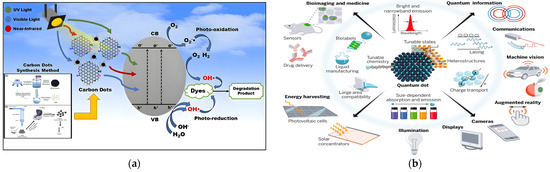
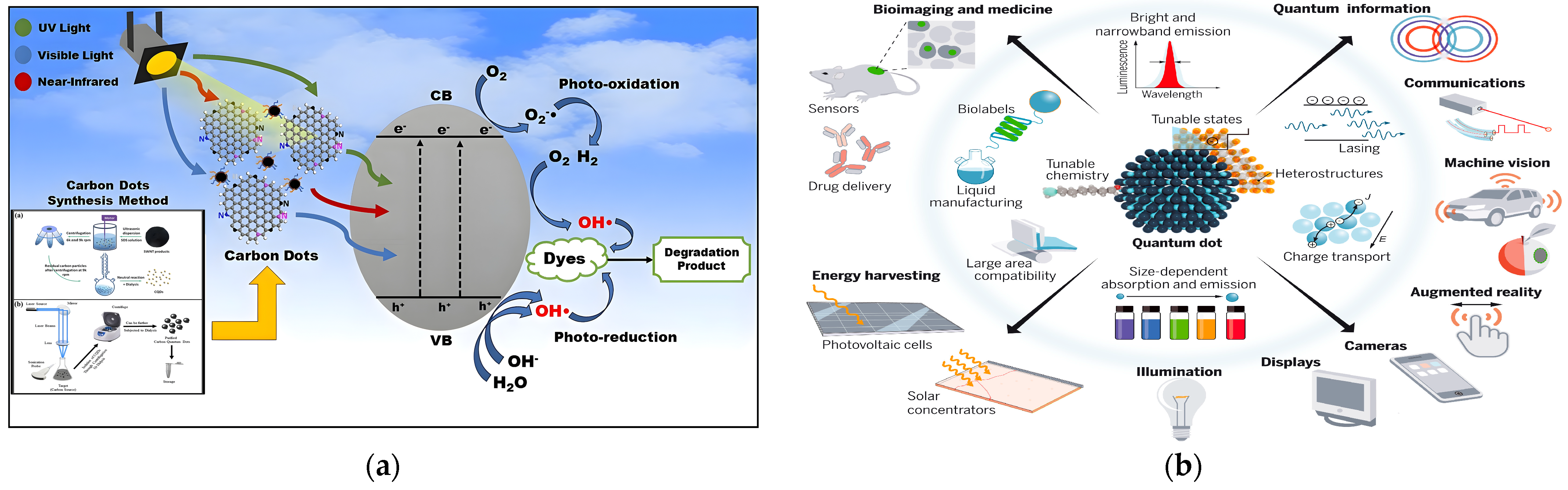
QDs used for photocatalytic treatment of urban wastewater are typically prepared via top-down or bottom-up routes, with a strong recent emphasis on green, biomass-derived methods for carbon-based QDs such as CQDs, GQDs, and g-C3N4 QDs [18,19]. Bottom-up approaches dominate because they provide precise control over particle size, surface chemistry, and optical properties [19]. Metal and metal-oxide QDs are commonly prepared using hydrothermal, solvothermal, or precipitation techniques and are frequently combined with CQDs or polymeric matrices to enhance stability and recyclability [20]. Figure 1 shows the synthesis, properties, and applications of QDs.
Figure 1.
Schemes of (a) synthesis, properties, and utilization of CQDs as photocatalysts for the degradation of dyes [21] and (b) application of QDs, from [22].
3. Mechanism of Photocatalytic Degradation
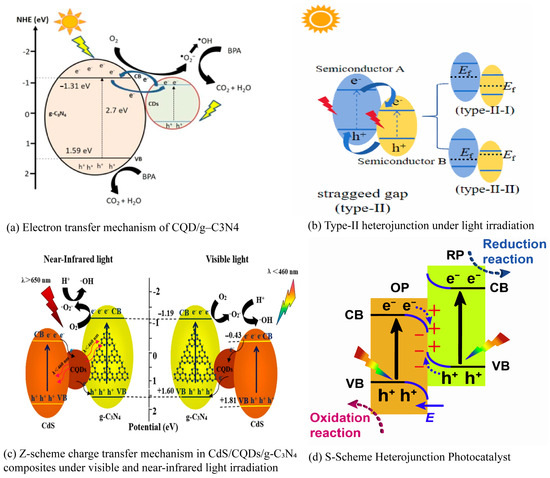
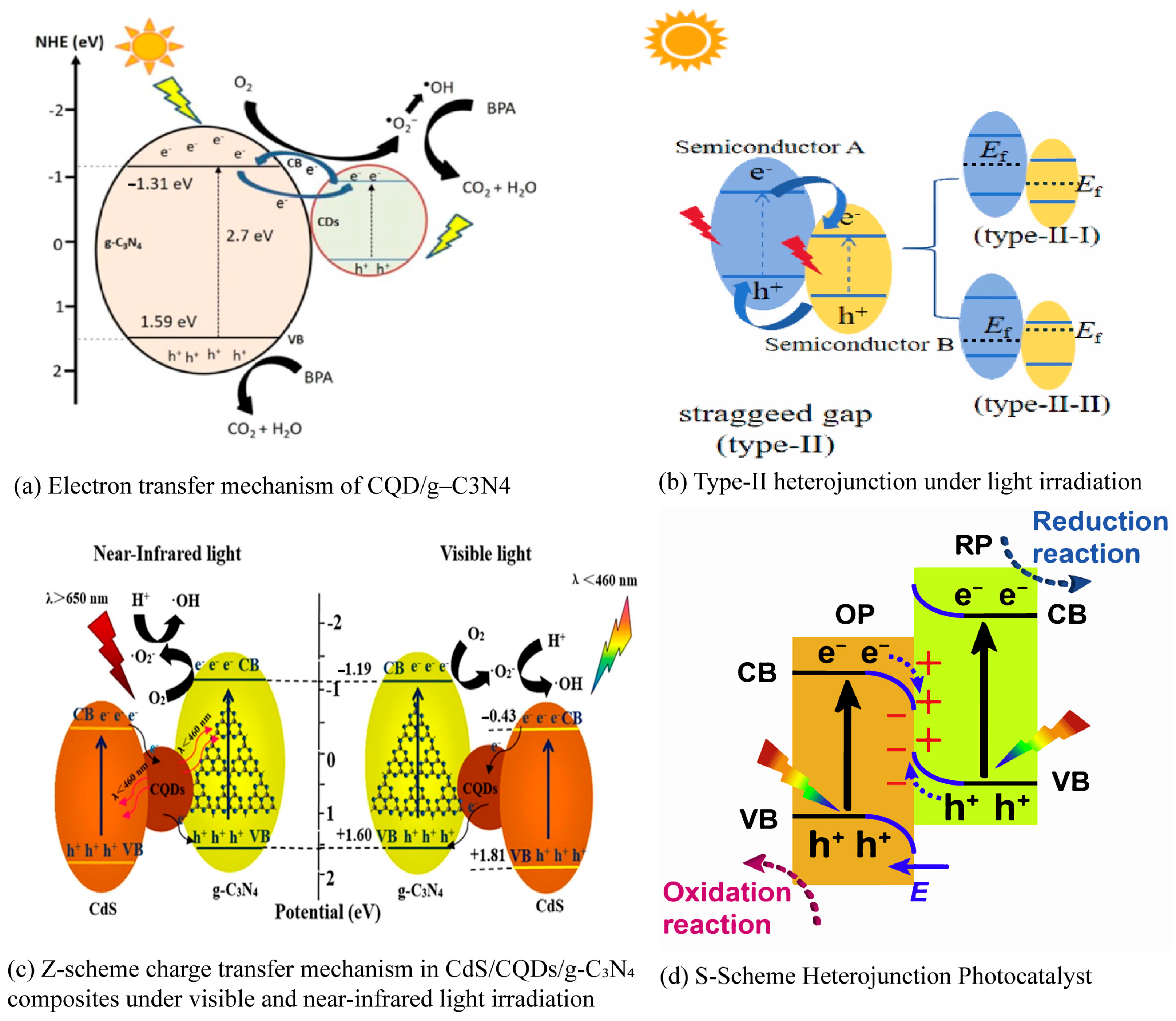
Photocatalytic degradation by QDs in urban wastewater proceeds through light-induced charge generation, charge separation, and subsequent redox reactions that generate reactive oxygen or sulfur species capable of oxidizing or reducing pollutants [23]. CQDs and CQD/g-C3N4 composites extend light absorption into the visible region, thereby increasing the density of photogenerated charge carriers and enabling solar-driven degradation of pharmaceuticals, dyes, and other urban contaminants [23,24]. A key limitation of QD-based photocatalysis is the recombination of photogenerated electron–hole pairs, and QD-based heterostructures are therefore designed to enhance charge separation. CQDs anchored on g-C3N4 act as electron reservoirs and photosensitizers by accepting photogenerated electrons, prolonging carrier lifetimes, facilitating electron transfer to dissolved oxygen, and sensitizing g-C3N4 through photosensitization-like pathways [25]. In CQDs/g-C3N4 and related systems, superoxide radicals (•O2−), hydroxyl radicals (•OH), and photogenerated holes (h+) are identified as the dominant active species responsible for antibiotic and dye degradation [24]. In certain CQD–FeOOH systems, enhanced electron migration from FeOOH to CQDs governs ROS generation and NOx oxidation [26]. Following their formation, ROS and photogenerated holes attack pollutants through oxidation or reduction pathways involving organic contaminants such as dyes, pharmaceuticals, phenols, and petroleum hydrocarbons [27]. Figure 2 shows the schematic representation of different charge transfer mechanisms in CQD/g-C3N4 and CdS-based heterojunction systems under light irradiation: (a) electron transfer pathway in CQD/g-C3N4 illustrating band structure and photogenerated carrier migration; (b) energy band alignment and charge separation process in a Type-II heterojunction; (c) Z-scheme charge transfer mechanism in CdS/CQDs/g-C3N4 composites under visible and near-infrared light irradiation with reactive species generation; and (d) S-scheme heterojunction mechanism demonstrating selective recombination of low-energy carriers and preservation of strong redox capability for photocatalytic reactions.
Figure 2.
Schematic illustration of charge transfer mechanisms in CQD/g-C3N4 and CdS-based heterojunction systems: (a) electron transfer in CQD/g-C3N4; (b) Type-II heterojunction band alignment under light irradiation; (c) Z-scheme charge transfer in CdS/CQDs/g-C3N4 under visible and near-infrared light, and (d) S-scheme heterojunction photocatalytic mechanism. Collected from [28,29,30,31].
3.1. Type-II Heterojunctions
In conventional Type-II CQD/semiconductor heterojunctions, the conduction band (CB) edge of one component and the valence band (VB) edge of the other are energetically staggered, such that both electrons and holes migrate “downhill” in energy. Upon visible-light excitation, electrons excited to the higher-lying CB (e.g., in g-C3N4 or Cd0.5Zn0.5S) transfer to the lower-lying CB of the second phase, while holes move from the deeper VB to the shallower VB of its partner [32]. This interfacial charge migration spatially separates electrons and holes, thereby reducing their recombination probability and enhancing steady-state carrier densities. However, because electrons accumulate in the lower-energy CB and holes in the higher-energy VB, the overall redox power is weakened: the electrons become less reducing and the holes less oxidizing, which can limit the degradation of recalcitrant pollutants or multi-electron reduction reactions [32,33]. Type-II alignment has been directly confirmed in g-C3N4/CeO2 QD systems by band-edge mapping with XPS and work-function measurements, revealing small but negative conduction and valence band offsets that drive this directional but potential-sacrificing charge transfer [34]. In CQD/g-C3N4 composites that behave closer to Type-II, DFT and PL/TRPL studies show that CQDs act as sinks for photoexcited electrons from the g-C3N4 CB, aided by the internal electric field created by work-function differences, thereby prolonging carrier lifetimes even if some redox strength is compromised [35].
3.2. Z-Scheme Systems
Z-scheme CQD/semiconductor heterojunctions are designed to overcome the loss of redox potential intrinsic to Type-II systems. In these architectures, the band alignment and interfacial energetics favour recombination between the weaker carriers, namely, CB electrons of the more-positive-CB semiconductor and VB holes of the more-negative-VB semiconductor, while preserving the strongly reducing electrons and strongly oxidizing holes on opposite sides of the junction [36,37]. In typical CQD-mediated Z-schemes such as CdS/CQDs/g-C3N4, ZnIn2S4/CQDs/CeO2, or g-C3N4-CQDs/BiVO4, visible-light excitation generates electrons in both CBs; CQDs, with an intermediate Fermi level and high conductivity, act as solid-state electron shuttles that selectively channel electrons from the CB of one semiconductor to recombine with holes in the VB of the other [36,37,38]. As a result, electrons remain on the more negative CB, where they can drive H2 evolution or Cr(VI)/CO2 reduction, while holes accumulate on the more positive VB with sufficient potential to generate •OH and •O2− for oxidative degradation [10,39]. Energy-level diagrams supported by PL quenching, EIS, transient photocurrent, and EPR measurements consistently show that CQDs sit between the two semiconductors in terms of work function, enabling directional Z-scheme transfer without large energy barriers [36]. In CQD/g-C3N4-based systems, the CB of g-C3N4 is typically more negative than the CQD Fermi level, while the CQD VB is higher than that of the coupled oxide; this alignment promotes recombination of g-C3N4 holes with CQD-mediated electrons from the oxide, leaving highly reducing electrons on g-C3N4 and highly oxidizing holes on the oxide surface, a configuration crucial for sustainable water treatment and CO2 reduction [40].
3.3. S-Scheme Pathways
More recently, S-scheme (step-scheme) heterojunctions involving CQDs have been proposed as a refined picture of direct Z-schemes, explicitly incorporating band bending and built-in electric fields at the interface. In S-scheme CQD/semiconductor composites, such as CQDs/Bi2WO6, contact between components with different work functions (and hence different Fermi levels) leads to electron migration until Fermi-level equilibration, producing opposite band bending and an internal electric field localized at the chemically bonded interface like Bi–O–C linkages [10]. Under illumination, electrons and holes are preferentially driven by this field such that low-energy electrons and holes recombine across the interface. In contrast, high-energy electrons in the more negative CB and high-energy holes in the more positive VB are spatially pulled apart, generating an “S-shaped” potential profile across the junction [35,41]. In CQD/g-C3N4 systems, calculations and spectroscopic analyses show that CQDs induce structural distortion and charge redistribution in g-C3N4; charges accumulate on CQD regions facing g-C3N4 cavities and deplete near heptazine units, forming micro-scale internal electric fields that direct photoelectrons toward CQDs and holes toward g-C3N4 or depending on doping and work function [40]. Work-function measurements in CQD/CN nanosheets further indicate that electron transfer from CQDs to CN before illumination bends the bands and establishes an interfacial field; during photocatalysis, this field orchestrates S-scheme recombination between CN CB electrons and CQD holes, causing strongly reductive electrons to accumulate in the CQDs while oxidative holes reside in CN, which is ideal for simultaneous CO2 reduction and pollutant oxidation [35]. In all these S-scheme CQD/semiconductor heterojunctions, the key design principle is precise control of energy-level alignment and interfacial bonding so that band bending and built-in fields cooperate with the CQDs’ mediator role to maximize charge separation while preserving extreme redox potentials, thereby enabling efficient and robust environmental photocatalysis [10,35,41].
4. Applications in Urban Wastewater Treatment
4.1. Degradation of Organic Pollutants
Quantum-dot-based photocatalysts enable efficient degradation of a broad spectrum of organic pollutants relevant to urban wastewater, including dyes, pharmaceuticals, parabens, phenols, and antibiotics, with performance governed by light harvesting, charge separation, and ROS generation at the catalyst–pollutant interface [42]. CQD and g-C3N4-based systems, as well as quantum-dot/semiconductor heterojunctions, have been applied to the degradation of dyes such as Rhodamine B, methylene blue, methyl orange, crystal violet, and direct red 16 [42]. CQDs are frequently employed to modify g-C3N4 or other semiconductors, resulting in enhanced visible-light activity and improved pollutant degradation performance [43]. CQDs/g-C3N4 and CQD-functionalized g-C3N4 systems exhibit markedly higher degradation efficiencies for dyes, antibiotics, and phenols than bare g-C3N4 due to expanded light absorption and improved charge separation [43,44]. In Z-scheme heterojunctions such as CdS/CQDs/g-C3N4 and g-C3N4/CQDs/BiVO4, CQDs function as electron mediators, promoting Z-scheme charge transfer and enabling efficient degradation of Rhodamine B, methylene blue, phenol, and parabens under visible to near-infrared light irradiation [30]. Recent reviews consistently identify CQDs/g-C3N4 composites as a leading class of metal-free photocatalysts for the degradation of real organic wastewater, demonstrating good recyclability and long-term stability [45]. The enhanced performance was attributed to the synergistic effects of CQDs, oxygen vacancies, and the bio-template CEM, which improved charge separation and reactive species generation. Another example from Harbin University of Science and Technology and Heilongjiang University in China involved Bi2WO6 modified with lignin-derived CQDs, achieving an 86.96% degradation of Rhodamine B under visible light, highlighting the potential for urban river pollution control [46]. While organic pollutant degradation represents the most extensively studied application of QD-based photocatalysis, effective urban wastewater treatment also requires addressing inorganic contaminants such as heavy metals, which pose distinct redox and adsorption challenges [47].
4.2. Heavy-Metal Removal
QDs remove heavy metals from urban wastewater primarily through photocatalytic reduction in toxic species such as Cr(VI) and through adsorptive or cation-exchange capture of metal ions, including Pb2+ and Cd2+, frequently integrating removal with in situ optical sensing capabilities [48]. Most quantum-dot-based photocatalytic studies focus on hexavalent chromium reduction, whereas adsorption-based systems target Pb2+, Cd2+, Hg2+, Ni2+, As3+, and other cationic heavy metals [48,49]. CQDs alone can efficiently reduce Cr(VI), achieving 94–99% reduction within 120 min via direct electron transfer under acidic conditions and via peroxymonosulfate-activated ROS such as •O2− and 1O2 at higher pH values [50]. Beyond photocatalytic reduction, carbon-quantum-dot-based systems enable adsorptive and ion-exchange removal of Pb2+, Cd2+, and other cationic heavy metals [48]. CQD-based materials are promising dual-function platforms for heavy-metal sensing via fluorescence modulation and high-efficiency removal, often outperforming conventional adsorbents while enabling in situ monitoring [49]. Beyond chemical contaminants such as organic pollutants and heavy metals, urban wastewater also contains pathogenic microorganisms, necessitating photocatalytic strategies capable of simultaneous disinfection and contaminant degradation [51].
4.3. Pathogen Inactivation
Urban wastewater contains diverse pathogenic bacteria, viruses, and antibiotic-resistant strains, and quantum-dot-based photocatalysts contribute to disinfection by generating ROS under light irradiation, damaging microbial membranes, and, in hybrid systems, integrating photocatalysis with intrinsic antimicrobial components. Carbon-based QDs exhibit broad-spectrum antibacterial activity with relatively low cytotoxicity and high aqueous dispersibility [52,53]. Under light irradiation, these QDs generate ROS such as •O2−, •OH, and 1O2, which oxidize lipids, proteins, and nucleic acids, leading to membrane disruption and DNA damage [53]. Carbon dots with suitable surface passivation function as visible-light bactericidal agents, significantly reducing Escherichia coli viability under household LED or ambient laboratory light, indicating effectiveness under low-intensity indoor or solar illumination [54]. Reviews consistently report that graphene QDs, GOQDs, and CQDs can inactivate drug-resistant bacteria through photodynamic mechanisms, with surface functionalization enhancing biocompatibility and stability while retaining bactericidal efficiency [53]. CQD-modified g-C3N4 systems are particularly relevant for photocatalytic disinfection applications [55]. Overall, quantum-dot-based photocatalysts, particularly carbon-based systems and CQD/g-C3N4 composites, provide an energy-efficient, solar-driven approach for pathogen inactivation in urban wastewater with the added benefit of simultaneous degradation of co-contaminants such as dyes and antibiotics [54,56]. Together, these multifunctional capabilities position QDs not merely as pollutant degraders but as versatile components in integrated wastewater treatment platforms [57].
4.4. Others
Beyond the degradation of organic pollutants, heavy-metal removal, and pathogen inactivation, quantum-dot-based photocatalysts enable additional functions that are directly relevant to urban wastewater treatment and to circular, low-carbon technological pathways [40]. Quantum-dot-based materials also function as efficient activators in advanced oxidation processes [58]. CQDs and g-C3N4 QDs function not only as photocatalysts but also as adsorbents, membrane modifiers, and sensing materials [5]. CQDs provide abundant surface functional groups, including carboxyl, hydroxyl, and amino moieties, together with π–π interactions that enhance adsorption of aromatic organic contaminants and metal ions, supporting hybrid adsorption–photocatalysis treatment schemes [5]. g-C3N4 QDs have been incorporated into membranes and sorbent materials for the removal of dyes, pharmaceuticals, bacteria, and mercury, where adsorption, photocatalysis, and filtration operate synergistically to improve overall treatment performance [59]. Beyond contaminant destruction, QDs can also facilitate resource recovery from wastewater streams [60].
5. Advantages and Limitations of QDs in Photocatalysis
QDs have emerged as promising photocatalysts due to their unique quantum size effects, tunable optical properties, and high surface activity. However, challenges remain, including stability issues, high recombination rates of charge carriers in some QDs, complex synthesis procedures, and potential toxicity concerns that limit their practical deployment. Understanding both the benefits and limitations of QD-based photocatalysts is essential for advancing their design and optimizing their performance in sustainable photocatalytic systems [61,62].
5.1. Advantages of Quantum-Dot-Based Photocatalysts
QDs, particularly carbon-based systems such as CQDs, GOQDs, and g-C3N4 QDs, offer distinct advantages for the photocatalytic treatment of urban wastewater while also presenting important practical and environmental constraints [2]. A major advantage of CQDs is their combination of strong light-harvesting capability with low toxicity, high aqueous stability, chemical inertness, and good biocompatibility, which makes them more attractive for water treatment applications than many traditional metal-based QDs [2,5]. When coupled with semiconductor photocatalysts such as TiO2, ZnO, BiOBr, or g-C3N4, CQDs act as electron reservoirs or mediators that promote charge separation, suppress electron–hole recombination, and enhance quantum efficiency, resulting in faster degradation of organic pollutants [40]. From a sustainability perspective, QDs, especially CQDs, can be synthesized from renewable and low-cost precursors, including biomass, starch, and food waste, through hydrothermal or microwave methods, supporting green chemistry principles while reducing resource depletion and secondary pollution [63]. Metal-free CQD/g-C3N4 systems are particularly attractive as non-toxic, earth-abundant photocatalysts suitable for long-term environmental applications [40]. QDs offer significant advantages in photocatalysis, including strong light absorption across a wide spectrum, efficient charge separation, and tunable electronic properties due to quantum confinement effects. For example, CuInS QDs have high absorption coefficients and long lifetimes of photogenerated electron–hole pairs, making them effective and environmentally sustainable photocatalysts, as studied at Dali University and the University of Naples Federico II in China and Italy [64].
5.2. Limitations and Practical Constraints
Despite these advantages, several limitations hinder the large-scale implementation of quantum-dot-based photocatalysis. In many systems, incomplete separation of photogenerated charge carriers leads to recombination losses that restrict quantum efficiency, particularly in complex real wastewater matrices [8]. Photocatalyst stability under prolonged irradiation, variable pH conditions, and the presence of competing ions or natural organic matter can further reduce photocatalytic activity and recyclability under realistic operating conditions [42]. Recovery and reuse of QDs in photocatalysis face challenges due to difficulties in efficiently separating QDs from treated water, which can limit their practical application and increase operational costs. Stability issues arise as some QDs, especially inorganic types like CdS, suffer from photocorrosion, leading to leaching of toxic metal ions such as cadmium, posing environmental and health risks; biofunctionalization strategies, like coating with natural extracts, have been shown to improve stability and reduce leaching [65]. However, challenges such as photo-bleaching of CQDs reduce their photocatalytic efficiency over time, while metal-ion leaching from CdS or ZnO QDs raises environmental concerns and affects catalyst durability [66]. Fouling is another significant limitation, where the accumulation of organic matter and other contaminants on QD surfaces or QD-modified membranes reduces photocatalytic efficiency, particularly when treating complex real wastewater matrices containing diverse pollutants [67]. Complex wastewater matrices further complicate reuse due to fouling caused by natural organic matter and competing ions, which can block active sites and reduce photocatalytic performance [68]. Membrane-based systems incorporating QDs show promise in mitigating fouling and improving anti-fouling properties, but still require optimization for sustained operation in real wastewater conditions [68]. Importantly, most reported photocatalytic performances are evaluated using single model pollutants under controlled laboratory conditions. Real urban wastewater contains complex matrices of natural organic matter, inorganic ions, turbidity, and competing radical scavengers that significantly alter photocatalytic kinetics and stability [69]. Systematic studies under realistic conditions, including pilot-scale demonstrations and long-term cycling experiments, remain limited. Addressing this translational gap is essential for bridging laboratory-scale advances with practical environmental deployment [70,71].
6. Factors Influencing Photocatalytic Performance of QDs
The photocatalytic efficiency of QDs in urban wastewater treatment is governed by a combination of intrinsic material properties and operational conditions, and understanding these factors is essential for rational design and optimization [72]. QDs exhibit size-dependent bandgaps due to quantum confinement effects, with smaller particles typically possessing larger bandgaps but higher surface area and a greater density of active sites [72]. Abundant surface carboxyl, hydroxyl, and amino functional groups on CQDs enhance the adsorption of dyes and pharmaceuticals and facilitate interfacial charge transfer, thereby increasing photocatalytic reaction rates [73]. Metal or non-metal doping provides an effective strategy to tune band structure and extend light absorption into the visible or near-infrared regions [74]. Anchoring QDs on suitable supports such as graphene oxide, bentonite, chitosan, wood, or ferrites increases effective surface area, improves dispersion, and facilitates catalyst recovery [18]. Solution pH strongly influences QD surface charge, pollutant speciation, and radical generation pathways [23]. Photocatalyst dosage plays a critical role in determining light utilization efficiency and the availability of active sites [18]. Optimal catalyst loadings exist for most systems, beyond which excessive dosage leads to light scattering and shielding effects that reduce overall photocatalytic efficiency [18]. Higher initial pollutant concentrations often result in lower apparent removal efficiencies due to light attenuation and saturation of active sites, even though the total mass of degraded pollutant may increase [23]. The presence of oxidants, such as hydrogen peroxide or peroxymonosulfate, and the availability of dissolved oxygen significantly affect the generation pathways of reactive species [75].
7. Conclusions
This review evaluates the potential of QDs, with particular emphasis on carbon-based QDs and CQD/g-C3N4 hybrid systems, as advanced photocatalysts for sustainable urban wastewater treatment. Their tunable electronic structures, strong visible-light absorption, and high density of surface functional groups enable efficient solar-driven degradation of organic pollutants, removal of heavy metals, and inactivation of pathogenic microorganisms, addressing key limitations associated with conventional photocatalytic materials. The enhanced performance of quantum-dot-based systems is primarily attributed to synergistic mechanisms involving improved light harvesting, suppressed electron–hole recombination, efficient interfacial charge transfer, and ROS generation. CQDs function as photosensitizers, electron mediators, and adsorption sites, while their integration with g-C3N4 further improves charge separation, catalytic stability, and reusability. These include recombination losses in complex wastewater matrices, uncertainties regarding long-term catalyst stability under realistic operating conditions, and limited understanding of the environmental fate, transformation, and ecotoxicological impacts of QDs. Addressing these gaps is essential for responsible deployment. Future research should therefore focus on the design of fully green, non-toxic, and regenerable quantum-dot-based photocatalysts, the development of scalable and reproducible synthesis pathways, and comprehensive life cycle and risk assessments conducted under representative wastewater conditions. Despite significant laboratory-scale progress, unresolved concerns regarding environmental fate, metal-ion leaching, and techno-economic feasibility necessitate cautious advancement toward large-scale implementation. Progress in these areas will be crucial for enabling the safe and large-scale implementation of quantum-dot-based photocatalytic technologies in urban wastewater treatment systems.
Author Contributions
Conceptualization, T.I.P. and S.H.; methodology, S.T.J.S. and M.N.R.; software, M.N.R.; investigation, M.N.R.; writing—original draft preparation, S.T.J.S. and M.N.R.; writing—review and editing, M.N.R. and S.T.J.S.; visualization, M.N.R.; supervision, S.T.J.S. and M.N.R. All authors have read and agreed to the published version of the manuscript.
Funding
This research received no external funding.
Institutional Review Board Statement
Not applicable.
Informed Consent Statement
Not applicable.
Data Availability Statement
The original contributions presented in this study are included in the article. Further inquiries can be directed to the corresponding author.
Conflicts of Interest
The authors declare no conflicts of interest.
References
- Zourou, A.; Ntziouni, A.; Karagianni, A.; Alizadeh, N.; Argirusis, N.; Antoniadou, M.; Sourkouni, G.; Kordatos, K.V.; Argirusis, C. Recent Advances in Carbon Dots-Based Photocatalysts for Water Treatment Applications. Inorganics 2025, 13, 286. [Google Scholar] [CrossRef] [Scilit]
- Sharma, S.; Dutta, V.; Singh, P.; Raizada, P.; Rahmani-Sani, A.; Hosseini-Bandegharaei, A.; Thakur, V.K. Carbon Quantum Dot Supported Semiconductor Photocatalysts for Efficient Degradation of Organic Pollutants in Water: A Review. J. Clean. Prod. 2019, 228, 755–769. [Google Scholar] [CrossRef] [Scilit]
- Li, S.; Rong, K.; Wang, X.; Shen, C.; Yang, F.; Zhang, Q. Design of Carbon Quantum Dots/CdS/Ta3N5 S-Scheme Heterojunction Nanofibers for Efficient Photocatalytic Antibiotic Removal. Acta Phys.-Chim. Sin. 2024, 40, 2403005. [Google Scholar] [CrossRef] [Scilit]
- Si, Q.-S.; Guo, W.-Q.; Wang, H.-Z.; Liu, B.-H.; Ren, N.-Q. Carbon Quantum Dots-Based Semiconductor Preparation Methods, Applications and Mechanisms in Environmental Contamination. Chin. Chem. Lett. 2020, 31, 2556–2566. [Google Scholar] [CrossRef] [Scilit]
- Rani, U.A.; Ng, L.Y.; Ng, C.Y.; Mahmoudi, E. A Review of Carbon Quantum Dots and Their Applications in Wastewater Treatment. Adv. Colloid Interface Sci. 2020, 278, 102124. [Google Scholar] [CrossRef] [Scilit]
- Khan, R.; Shukla, S.; Kumar, M.; Barceló, D.; Zuorro, A.; Bhargava, P.C. Progress and Obstacles in Employing Carbon Quantum Dots for Sustainable Wastewater Treatment. Environ. Res. 2024, 261, 119671. [Google Scholar] [CrossRef] [Scilit] [PubMed]
- Patial, S.; Sonu; Sudhaik, A.; Chandel, N.; Ahamad, T.; Raizada, P.; Singh, P.; Chaukura, N.; Selvasembian, R. A Review on Carbon Quantum Dots Modified G-C3N4-Based Photocatalysts and Potential Application in Wastewater Treatment. Appl. Sci. 2022, 12, 11286. [Google Scholar] [CrossRef] [Scilit]
- Goswami, J.; Hazarika, P.; Agarwalla, R.; Saikia, L. Carbon Quantum Dot-Based Hybrid Photocatalysts: A Perspective on Water Purification. ChemNanoMat 2025, 11, e202500203. [Google Scholar] [CrossRef] [Scilit]
- Aleksandrova, M.; Ivanova, T.; Gesheva, K.; Strijkova, V.; Tsanev, T.; Singh, J.; Singh, A.K. Fabrication of Transparent ITO/Ga-Doped ZnO Coating as a Front Panel Electrode Toward Efficient Thin Film Solar Cells. Mater. Proc. 2020, 2, 1. [Google Scholar] [CrossRef] [Scilit]
- Ren, H.; Qi, F.; Labidi, A.; Zhao, J.; Wang, H.; Xin, Y.; Luo, J.; Wang, C. Chemically Bonded Carbon Quantum Dots/Bi2WO6 S-Scheme Heterojunction for Boosted Photocatalytic Antibiotic Degradation: Interfacial Engineering and Mechanism Insight. Appl. Catal. B Environ. 2023, 330, 122587. [Google Scholar] [CrossRef] [Scilit]
- Wang, H.; Li, X.; Zhao, X.; Li, C.; Song, X.; Zhang, P.; Huo, P.; Li, X. A Review on Heterogeneous Photocatalysis for Environmental Remediation: From Semiconductors to Modification Strategies. Chin. J. Catal. 2022, 43, 178–214. [Google Scholar] [CrossRef] [Scilit]
- Li, S.; You, C.; Xue, Q.; Zhao, Y.; Yang, F.; Liu, Y.; Bai, L.; Zhang, M.; Zhuang, C. Carbon Quantum Dots and Interfacial Chemical Bond Synergistically Modulated S-Scheme Mn0.5Cd0.5S/BiOBr Photocatalyst for Efficient Water Purification. J. Mater. Sci. Technol. 2025, 214, 255–265. [Google Scholar] [CrossRef] [Scilit]
- Salunkhe, T.T.; Gurugubelli, T.R.; Viswanadham, B.; Babu, B.; Sreekanth, T.V.M.; Yoo, K. Exploring Photocatalytic and Photoelectrochemical Applications of G-C3N4/Metal Sulfide Quantum Dots Nanocomposites: A Review of Recent Trends and Innovations. J. Chem. 2025, 2025, 8849437. [Google Scholar] [CrossRef] [Scilit]
- He, H.; Deng, S.; Liu, Y. Environmentally Friendly Synthesis of Quantum Dots and Their Applications in Diverse Fields from the Perspective of Environmental Compliance: A Review. Discov. Nano 2025, 20, 132. [Google Scholar] [CrossRef] [Scilit]
- Soren, D.; Panda, J.; Swain, J.; Priyadarshini, A.; Swain, S.; Swain, J.; Pati, R.; Mohapatra, S.R.; Das, Y.; Samantaray, R.; et al. Sustainable Carbon Quantum Dots from Mahua (Madhuca longifolia) for Biomedical and Environmental Applications. Sci. Rep. 2025, 15, 33727. [Google Scholar] [CrossRef] [Scilit] [PubMed]
- Zhang, Y.-Y.; Lin, M.-Y.; Tsai, Y.-T.; Leung, M.-K.; Fang, M.-H. Sustainable Quantum Dot-Vitrimer Composites: A Synergy of Quantum Dots and Dynamic Covalent Bonds. ChemSusChem 2025, 18, e202500464. [Google Scholar] [CrossRef] [Scilit]
- Murugesan, A.; Li, H.; Shoaib, M. Recent Advances in Functionalized Carbon Quantum Dots Integrated with Metal–Organic Frameworks: Emerging Platforms for Sensing and Food Safety Applications. Foods 2025, 14, 2060. [Google Scholar] [CrossRef] [Scilit]
- Qayyum, W.; Tahir, N.; Zahid, M.; Noreen, S.; Yaseen, M.; AlObaid, A.A.; Abbas, Q.; Mustafa, G. Robust Ternary System of Corncob-Derived Carbon Quantum Dots/ZnFe2O4/Graphene Oxide for Wastewater Treatment. BMC Chem. 2025, 19, 86. [Google Scholar] [CrossRef] [Scilit] [PubMed]
- Iravani, S.; Varma, R.S. Green Synthesis, Biomedical and Biotechnological Applications of Carbon and Graphene Quantum Dots. A Review. Environ. Chem. Lett. 2020, 18, 703–727. [Google Scholar] [CrossRef] [Scilit]
- Padmanaban, D.B.; McGlynn, R.; Maguire, P.; Mariotti, D. A “Green” Reaction Cycle Pathway for Synthesizing Metal Oxide Quantum Dots. Meet. Abstr. 2023, MA2023-01, 1518. [Google Scholar] [CrossRef] [Scilit]
- Saputra, A.M.A.; Piliang, A.F.R.; Dellyansyah; Marpongahtun; Andriayani; Goei, R.; H.t.s., R.R.; Gea, S. Synthesis, Properties, and Utilization of Carbon Quantum Dots as Photocatalysts on Degradation of Organic Dyes: A Mini Review. Catal. Commun. 2024, 187, 106914. [Google Scholar] [CrossRef] [Scilit]
- García De Arquer, F.P.; Talapin, D.V.; Klimov, V.I.; Arakawa, Y.; Bayer, M.; Sargent, E.H. Semiconductor Quantum Dots: Technological Progress and Future Challenges. Science 2021, 373, eaaz8541. [Google Scholar] [CrossRef] [Scilit] [PubMed]
- Sheshmani, S.; Mardali, M.; Shokrollahzadeh, S.; Bide, Y.; Tarlani, R. Synthesis, Optical, and Photocatalytic Properties of Cellulose-Derived Carbon Quantum Dots. Sci. Rep. 2025, 15, 19027. [Google Scholar] [CrossRef] [Scilit]
- Das, G.S.; Shim, J.P.; Bhatnagar, A.; Tripathi, K.M.; Kim, T. Biomass-Derived Carbon Quantum Dots for Visible-Light-Induced Photocatalysis and Label-Free Detection of Fe(III) and Ascorbic Acid. Sci. Rep. 2019, 9, 15084. [Google Scholar] [CrossRef] [Scilit] [PubMed]
- Zhao, Y.; Wang, S.; Sun, Z.; Liu, Q.; Ma, J. Carbon Quantum Dot Implanted Graphite Carbon Nitride Nanorod with Enhanced Photocatalytic Activity: Mechanisms, Degradation Pathway and DFT Calculation. Mater. Sci. Semicond. Process. 2024, 172, 108056. [Google Scholar] [CrossRef] [Scilit]
- Huang, Y.; Gao, Y.; Zhang, Q.; Zhang, Y.; Cao, J.; Ho, W.; Lee, S.C. Biocompatible FeOOH-Carbon Quantum Dots Nanocomposites for Gaseous NO Removal Under Visible Light: Improved Charge Separation and High Selectivity. J. Hazard. Mater. 2018, 354, 54–62. [Google Scholar] [CrossRef] [Scilit] [PubMed]
- Wang, C.; Rong, K.; Liu, Y.; Yang, F.; Li, S. Carbon Quantum Dots-Modified Tetra (4-Carboxyphenyl) Porphyrin/BiOBr S-Scheme Heterojunction for Efficient Photocatalytic Antibiotic Degradation. Sci. China Mater. 2024, 67, 562–572. [Google Scholar] [CrossRef] [Scilit]
- Koe, W.S.; Lee, J.W.; Chong, W.C.; Pang, Y.L.; Sim, L.C. An Overview of Photocatalytic Degradation: Photocatalysts, Mechanisms, and Development of Photocatalytic Membrane. Environ. Sci. Pollut. Res. 2020, 27, 2522–2565. [Google Scholar] [CrossRef] [Scilit]
- Li, J.; Tu, P.; Yang, Q.; Cui, Y.; Gao, C.; Zhou, H.; Lu, J.; Bian, H. A Novel Type-II–II Heterojunction for Photocatalytic Degradation of LEV Based on the Built-in Electric Field: Carrier Transfer Mechanism and DFT Calculation. Sci. Rep. 2024, 14, 10643. [Google Scholar] [CrossRef] [Scilit] [PubMed]
- Feng, S.; Chen, T.; Liu, Z.; Shi, J.; Yue, X.; Li, Y. Z-Scheme CdS/CQDs/g-C3N4 Composites with Visible-near-Infrared Light Response for Efficient Photocatalytic Organic Pollutant Degradation. Sci. Total Environ. 2020, 704, 135404. [Google Scholar] [CrossRef] [Scilit] [PubMed]
- Xu, Q.; Zhang, L.; Cheng, B.; Fan, J.; Yu, J. S-Scheme Heterojunction Photocatalyst. Chem 2020, 6, 1543–1559. [Google Scholar] [CrossRef] [Scilit]
- Liu, Y.; Chu, X.; Zhu, C.; Li, W.; Li, C.; Lu, S. Carbon Quantum Dots as Photogenerated Carrier Transfer Bridges in All-Solid Z-Scheme ZnIn2S4/CQDs/CeO2 Heterostructures for Efficient Visible-Light-Driven Photocatalytic Hydrogen Generation. Nano Res. 2025, 18, 94907559. [Google Scholar] [CrossRef] [Scilit]
- Liu, E.; Xu, C.; Jin, C.; Fan, J.; Hu, X. Carbon Quantum Dots Bridged TiO2 and Cd0.5Zn0.5S Film as Solid-State Z-Scheme Photocatalyst with Enhanced H2 Evolution Activity. J. Taiwan Inst. Chem. Eng. 2019, 97, 316–325. [Google Scholar] [CrossRef] [Scilit]
- Sreekanth, T.V.M.; Nagajyothi, P.C.; Dillip, G.R.; Lee, Y.R. Determination of Band Alignment in the Synergistic Catalyst of Electronic Structure-Modified Graphitic Carbon Nitride-Integrated Ceria Quantum-Dot Heterojunctions for Rapid Degradation of Organic Pollutants. J. Phys. Chem. C 2017, 121, 25229–25242. [Google Scholar] [CrossRef] [Scilit]
- Xu, Y.; Hou, W.; Huang, K.; Guo, H.; Wang, Z.; Lian, C.; Zhang, J.; Wu, D.; Lei, Z.; Liu, Z.; et al. Engineering Built-In Electric Field Microenvironment of CQDs/g-C3N4 Heterojunction for Efficient Photocatalytic CO2 Reduction. Adv. Sci. 2024, 11, 2403607. [Google Scholar] [CrossRef] [Scilit]
- Tian, M.; Hu, C.; Yu, J.; Chen, L. Carbon Quantum Dots (CQDs) Mediated Z-Scheme g–C3N4–CQDs/BiVO4 Heterojunction with Enhanced Visible Light Photocatalytic Degradation of Paraben. Chemosphere 2023, 323, 138248. [Google Scholar] [CrossRef] [Scilit]
- Qi, H.; Shi, C.; Jiang, X.; Teng, M.; Sun, Z.; Huang, Z.; Pan, D.; Liu, S.; Guo, Z. Constructing CeO2/Nitrogen-Doped Carbon Quantum Dot/g-C3N4 Heterojunction Photocatalysts for Highly Efficient Visible Light Photocatalysis. Nanoscale 2020, 12, 19112. [Google Scholar] [CrossRef] [Scilit]
- Guan, X.; Li, Z.; Geng, X.; Lei, Z.; Karakoti, A.; Wu, T.; Kumar, P.; Yi, J.; Vinu, A. Emerging Trends of Carbon-Based Quantum Dots: Nanoarchitectonics and Applications. Small 2023, 19, e2207181. [Google Scholar] [CrossRef] [Scilit]
- Kumar, A.; Sharma, S.K.; Sharma, G.; Naushad, M.; Stadler, F.J. CeO2/g-C3N4/V2O5 Ternary Nano Hetero-Structures Decorated with CQDs for Enhanced Photo-Reduction Capabilities under Different Light Sources: Dual Z-Scheme Mechanism. J. Alloys Compd. 2020, 838, 155692. [Google Scholar] [CrossRef] [Scilit]
- Zhang, L.; Zhang, J.; Xia, Y.; Xun, M.; Chen, H.; Liu, X.; Yin, X. Metal-Free Carbon Quantum Dots Implant Graphitic Carbon Nitride: Enhanced Photocatalytic Dye Wastewater Purification with Simultaneous Hydrogen Production. Int. J. Mol. Sci. 2020, 21, 1052. [Google Scholar] [CrossRef] [Scilit] [PubMed]
- Chen, Y.; Cheng, M.; Lai, C.; Wei, Z.; Zhang, G.; Li, L.; Tang, C.; Du, L.; Wang, G.; Liu, H. The Collision Between g-C3N4 and QDs in the Fields of Energy and Environment: Synergistic Effects for Efficient Photocatalysis. Small 2023, 19, 2205902. [Google Scholar] [CrossRef] [Scilit] [PubMed]
- Ikram, Z.; Azmat, E.; Perviaz, M. Degradation Efficiency of Organic Dyes on CQDs As Photocatalysts: A Review. ACS Omega 2024, 9, 10017–10029. [Google Scholar] [CrossRef] [Scilit] [PubMed]
- Qian, X.; Wu, Y.; Kan, M.; Fang, M.; Yue, D.; Zeng, J.; Zhao, Y. FeOOH Quantum Dots Coupled G-C3N4 for Visible Light Driving Photo-Fenton Degradation of Organic Pollutants. Appl. Catal. B Environ. 2018, 237, 513–520. [Google Scholar] [CrossRef] [Scilit]
- Liang, Y.; Xu, W.; Fang, J.; Liu, Z.; Chen, D.; Pan, T.; Yu, Y.; Fang, Z. Highly Dispersed Bismuth Oxide Quantum Dots/Graphite Carbon Nitride Nanosheets Heterojunctions for Visible Light Photocatalytic Redox Degradation of Environmental Pollutants. Appl. Catal. B Environ. 2021, 295, 120279. [Google Scholar] [CrossRef] [Scilit]
- Balu, S.; Ganapathy, D.; Arya, S.; Atchudan, R.; Sundramoorthy, A.K. Advanced Photocatalytic Materials Based Degradation of Micropollutants and Their Use in Hydrogen Production—A Review. RSC Adv. 2024, 14, 14392–14424. [Google Scholar] [CrossRef] [Scilit]
- Li, Y.; Wang, S.; Zhu, X.; Yan, H.; Li, F. Photocatalytic Degradation of Rh B in Bi2WO6 Nanocomposites Modified by Lignin Carbon Quantum Dots. Res. Chem. Intermed. 2024, 50, 1065–1080. [Google Scholar] [CrossRef] [Scilit]
- Gang, R.; Xu, L.; Xia, Y.; Cai, J.; Zhang, L.; Wang, S.; Li, R. Fabrication of MoS2 QDs/ZnO Nanosheet 0D/2D Heterojunction Photocatalysts for Organic Dyes and Gaseous Heavy Metal Removal. J. Colloid Interface Sci. 2020, 579, 853–861. [Google Scholar] [CrossRef] [Scilit]
- Sgreccia, E.; Gallardo Gonzalez, F.S.; Prosposito, P.; Burratti, L.; Sisani, M.; Bastianini, M.; Knauth, P.; Di Vona, M.L. Heavy Metal Detection and Removal by Composite Carbon Quantum Dots/Ionomer Membranes. Membranes 2024, 14, 134. [Google Scholar] [CrossRef] [Scilit] [PubMed]
- El-Azazy, M.; Osman, A.I.; Nasr, M.; Ibrahim, Y.; Al-Hashimi, N.; Al-Saad, K.; Al-Ghouti, M.A.; Shibl, M.F.; Al-Muhtaseb, A.H.; Rooney, D.W.; et al. The Interface of Machine Learning and Carbon Quantum Dots: From Coordinated Innovative Synthesis to Practical Application in Water Control and Electrochemistry. Coord. Chem. Rev. 2024, 517, 215976. [Google Scholar] [CrossRef] [Scilit]
- Yang, W.-M.; Liu, F.; Jin, Y.-T.; Dong, Z.-M.; Zhao, G.-C. Efficient Reduction of Cr(VI) with Carbon Quantum Dots. ACS Omega 2022, 7, 23555–23565. [Google Scholar] [CrossRef] [Scilit] [PubMed]
- Ahtasham Iqbal, M.; Akram, S.; Khalid, S.; Lal, B.; Hassan, S.U.; Ashraf, R.; Kezembayeva, G.; Mushtaq, M.; Chinibayeva, N.; Hosseini-Bandegharaei, A. Advanced Photocatalysis as a Viable and Sustainable Wastewater Treatment Process: A Comprehensive Review. Environ. Res. 2024, 253, 118947. [Google Scholar] [CrossRef] [Scilit] [PubMed]
- Stachowska, J.; Gibbons, E.; Kelarakis, A.; Krysmann, M. Photoactive Carbogenic Nanotracers with Remarkable Antimicrobial Properties for pH-Sensing Applications. Mater. Proc. 2020, 4, 31. [Google Scholar] [CrossRef] [Scilit]
- Zare, I.; Zahed Nasab, S.; Rahi, A.; Ghaee, A.; Koohkhezri, M.; Ramezani Farani, M.; Madadi Gholipour, H.; Atabaki, A.H.; Hamblin, M.R.; Mostafavi, E.; et al. Antimicrobial Carbon Materials-Based Quantum Dots: From Synthesis Strategies to Antibacterial Properties for Diagnostic and Therapeutic Applications in Wound Healing. Coord. Chem. Rev. 2025, 522, 216211. [Google Scholar] [CrossRef] [Scilit]
- Meziani, M.J.; Dong, X.; Zhu, L.; Jones, L.P.; LeCroy, G.E.; Yang, F.; Wang, S.; Wang, P.; Zhao, Y.; Yang, L.; et al. Visible-Light-Activated Bactericidal Functions of Carbon “Quantum” Dots. ACS Appl. Mater. Interfaces 2016, 8, 10761–10766. [Google Scholar] [CrossRef] [Scilit]
- Xu, N.; Liu, S.; Xu, Q.; Yuan, P.; Zhang, P.; Zhuo, S.; Zhu, C.; Du, J. Facile Synthesis of Porous Graphitic Carbon Nitride Modulated by Up-Conversion Carbon Quantum Dots for Visible Light-Triggered Photocatalysis Towards Bacteria Inactivation. Appl. Catal. A Gen. 2024, 673, 119586. [Google Scholar] [CrossRef] [Scilit]
- Wang, W.; Zeng, Z.; Zeng, G.; Zhang, C.; Xiao, R.; Zhou, C.; Xiong, W.; Yang, Y.; Lei, L.; Liu, Y.; et al. Sulfur Doped Carbon Quantum Dots Loaded Hollow Tubular G-C3N4 as Novel Photocatalyst for Destruction of Escherichia coli and Tetracycline Degradation Under Visible Light. Chem. Eng. J. 2019, 378, 122132. [Google Scholar] [CrossRef] [Scilit]
- Amari, A.; Elboughdiri, N.; Ghernaout, D.; Lajimi, R.H.; Alshahrani, A.M.; Tahoon, M.A.; Rebah, F.B. Multifunctional Crosslinked Chitosan/Nitrogen-Doped Graphene Quantum Dot for Wastewater Treatment. Ain Shams Eng. J. 2021, 12, 4007–4014. [Google Scholar] [CrossRef] [Scilit]
- Ming, H.; Wei, D.; Yang, Y.; Chen, B.; Yang, C.; Zhang, J.; Hou, Y. Photocatalytic Activation of Peroxymonosulfate by Carbon Quantum Dots Functionalized Carbon Nitride for Efficient Degradation of Bisphenol A under Visible-Light Irradiation. Chem. Eng. J. 2021, 424, 130296. [Google Scholar] [CrossRef] [Scilit]
- Goren, A.Y.; Recepoglu, Y.K.; Vatanpour, V.; Yoon, Y.; Khataee, A. Insights into Engineered Graphitic Carbon Nitride Quantum Dots for Hazardous Contaminants Degradation in Wastewater. Environ. Res. 2023, 223, 115408. [Google Scholar] [CrossRef] [Scilit]
- Yang, D.; Sun, Y.; Ding, B.; Luo, Q.; Han, M.; Hu, C.; Lyu, L. Simultaneous Pollutant Removal and Ag Recovery in an Expanded Water Self-Purification System by Mo–Sn Quantum Dots. Environ. Sci. Technol. 2025, 59, 14116–14128. [Google Scholar] [CrossRef] [Scilit]
- Gao, W.; Zhang, S.; Wang, G.; Cui, J.; Lu, Y.; Rong, X.; Gao, C. A Review on Mechanism, Applications and Influencing Factors of Carbon Quantum Dots Based Photocatalysis. Ceram. Int. 2022, 48, 35986–35999. [Google Scholar] [CrossRef] [Scilit]
- Zhao, L.; Zhang, P.; Li, L.; Li, N.; Tuerhong, R.; Su, X.; Sun, W.; Han, L. Revealing the Potential of Quantum Dot Nanomaterials in Photocatalytic Applications. Chemosphere 2024, 361, 142547. [Google Scholar] [CrossRef] [Scilit] [PubMed]
- Sheshmani, S.; Mardali, M.; Shokrollahzadeh, S.; Bide, Y. Starch-Derived Carbon Quantum Dots: Unveiling Structural Insights and Photocatalytic Potential as a Bio-Sourced Metal-Free Semiconductor. Int. J. Biol. Macromol. 2024, 271, 132535. [Google Scholar] [CrossRef] [Scilit] [PubMed]
- Zhang, J.; Bifulco, A.; Amato, P.; Imparato, C.; Qi, K. Copper Indium Sulfide Quantum Dots in Photocatalysis. J. Colloid Interface Sci. 2023, 638, 193–219. [Google Scholar] [CrossRef] [Scilit]
- Shivaji, K.; Sridharan, K.; Kirubakaran, D.D.; Velusamy, J.; Emadian, S.S.; Krishnamurthy, S.; Devadoss, A.; Nagarajan, S.; Das, S.; Pitchaimuthu, S. Biofunctionalized CdS Quantum Dots: A Case Study on Nanomaterial Toxicity in the Photocatalytic Wastewater Treatment Process. ACS Omega 2023, 8, 19413–19424. [Google Scholar] [CrossRef] [Scilit]
- Alsohaimi, I.H.; Alhumaimess, M.S.; Alzaid, M.; Essawy, A.A.; El-Aassar, M.R.; Mohamed, R.M.K.; Hassan, H.M.A. Tailoring Confined CdS Quantum Dots in Polysulfone Membrane for Efficiently Durable Performance in Solar-Driven Wastewater Remediating Systems. J. Environ. Manag. 2023, 332, 117351. [Google Scholar] [CrossRef] [Scilit]
- Meena, S.; Sethi, M.; Saini, S.; Kumar, K.; Saini, P.; Meena, S.; Kashyap, S.; Yadav, M.; Meena, M.L.; Dandia, A.; et al. Molecular Surface-Dependent Light Harvesting and Photo Charge Separation in Plant-Derived Carbon Quantum Dots for Visible-Light-Driven OH Radical Generation for Remediation of Aromatic Hydrocarbon Pollutants and Real Wastewater. J. Colloid Interface Sci. 2024, 660, 756–770. [Google Scholar] [CrossRef] [Scilit]
- Zhang, J.; Wang, Z.; Zheng, X.; Liu, K.; Chen, X.; Xiang, Y.; Chiao, Y.-H.; Gonzales, R.R.; Zeng, G. Zero-Dimensional Quantum Dot-Modified Membrane Materials for the Effective Treatment of Industrial Wastewater: A Comprehensive Review. Sep. Purif. Technol. 2025, 354, 129273. [Google Scholar] [CrossRef] [Scilit]
- Rueda-Marquez, J.J.; Levchuk, I.; Fernández Ibañez, P.; Sillanpää, M. A Critical Review on Application of Photocatalysis for Toxicity Reduction of Real Wastewaters. J. Clean. Prod. 2020, 258, 120694. [Google Scholar] [CrossRef] [Scilit]
- Tolić Čop, K.; Gotovuša, M.; Mutavdžić Pavlović, D.; Dabić, D.; Grčić, I. Diazepam Photocatalytic Degradation in Laboratory- vs. Pilot-Scale Systems: Differences in Degradation Products and Reaction Kinetics. Nanomaterials 2025, 15, 827. [Google Scholar] [CrossRef] [Scilit] [PubMed]
- Lykos, C.; Kourkouta, T.; Konstantinou, I. Study on the Photocatalytic Degradation of Metronidazole Antibiotic in Aqueous Media with TiO2 Under Lab and Pilot Scale. Sci. Total Environ. 2023, 870, 161877. [Google Scholar] [CrossRef] [Scilit] [PubMed]
- Mohamed, W.A.A.; Abd El-Gawad, H.H.; Mousa, H.A.; Handal, H.T.; Galal, H.R.; Ibrahem, I.A.; El-Beih, A.A.; Fawzy, M.M.; Ahmed, M.A.M.; Mekkey, S.D.; et al. Confinement Size Effect on Dielectric Properties, Antimicrobial Activity, and Recycling of TiO2 Quantum Dots via Photodegradation Processes of Congo Red Dye and Real Industrial Textile Wastewater. Nanotechnol. Rev. 2024, 13, 20240001. [Google Scholar] [CrossRef] [Scilit]
- Malitha, M.D.; Molla, M.T.H.; Bashar, M.A.; Chandra, D.; Ahsan, M.S. Fabrication of a Reusable Carbon Quantum Dots (CQDs) Modified Nanocomposite with Enhanced Visible Light Photocatalytic Activity. Sci. Rep. 2024, 14, 17976. [Google Scholar] [CrossRef] [Scilit]
- Mondal, N.J.; Ghosh, M.P.; Sonkar, R.; Thakur, S.; Saikia, E.; Chowdhury, D. Temperature-Dependent Photocatalytic Activity and Emergence of Weak Ferromagnetism in Cobalt-Incorporated ZnSe Quantum Dots. Solid State Sci. 2025, 160, 107827. [Google Scholar] [CrossRef] [Scilit]
- Gadore, V.; Mishra, S.R.; Ahmaruzzaman, M. Green and Environmentally Sustainable Fabrication of SnS2 Quantum Dots/Chitosan Nanocomposite for Enhanced Photocatalytic Performance: Effect of Process Variables, and Water Matrices. J. Hazard. Mater. 2023, 444, 130301. [Google Scholar] [CrossRef] [Scilit]
Disclaimer/Publisher’s Note: The statements, opinions and data contained in all publications are solely those of the individual author(s) and contributor(s) and not of MDPI and/or the editor(s). MDPI and/or the editor(s) disclaim responsibility for any injury to people or property resulting from any ideas, methods, instructions or products referred to in the content. |
© 2026 by the authors. Licensee MDPI, Basel, Switzerland. This article is an open access article distributed under the terms and conditions of the Creative Commons Attribution (CC BY) license (https://creativecommons.org/licenses/by/4.0/).