


Abstract
Extrusion-based 3D concrete printing (3DCP) enables geometries that are difficult to realize using conventional formwork, but their translation into load-bearing building systems requires coordinated consideration of structural design, material behavior, printing, reinforcement, building services, transport and assembly. PRINTCON—3D-Printed Modular Architectural Structures—investigates prefabricated printed components belonging to controlled families and connected into larger structural assemblies. Topology optimization is used as a structural form-generation method; within a defined architectural design domain and for prescribed supports and loading conditions, it identifies principal force-transfer paths and an initial material distribution. The resulting form is subsequently regularized to ensure printability and enable reinforcement integration, then divided into transportable segments and detailed for jointed, post-tensioned assembly. This conceptual paper develops a constraint-oriented workflow; organizes the relevant inputs, design variables, constraints and verification requirements; and formulates a focused research agenda for subsequent numerical and experimental work.
1. Introduction
Extrusion-based 3D concrete printing (3DCP) can produce geometries that would require complex conventional fabrication, with the elimination of or reduction in conventional formwork representing its most immediate advantage. However, the long-term relevance of additive manufacturing in construction should not be limited to replacing one production tool with another. As steel and fiber-reinforced polymers demonstrate, new construction technologies reach maturity by developing unique structural forms and production methods that maximize their specific advantages. If a 3D printer is used only to reproduce conventional walls, columns or beams, the resulting structural application remains governed by constraints that are less pronounced in cast concrete. The printable mixture must be pumpable, extrudable and sufficiently stable during printing [1,2]. Layer interfaces and printing orientation can influence the mechanical response [3,4,5], while reinforcement, building services, dimensional tolerances and connections should be coordinated with the printing and assembly processes [6,7,8].
PRINTCON adopts this principle by treating neither the elimination of formwork nor geometric complexity alone as sufficient justification for 3DCP. Reusable molds remain effective for large series of identical elements. The central hypothesis is therefore that 3D printing becomes structurally and economically meaningful when combined with parametric design, topology optimization and controlled prefabrication. The research addresses the design space between identical standardization and unrestricted one-off production; a controlled family of components can retain common interfaces and production rules while adapting its geometry to different architectural and structural requirements. Within this process, topology optimization is used as a structural design method to identify principal load paths and distribute material within a defined architectural design domain.
The intended contribution is not a new topology-optimization algorithm or printing process, but an integrated problem structure that links structural form generation, controlled component families, manufacturing constraints, segmentation and post-tensioned assembly. The framework was developed through a structured synthesis of constraints reported in the 3DCP literature and project-specific architectural, structural, manufacturing and assembly considerations. These requirements were grouped according to their role in structural formulation, component development, manufacturing, segmentation and assembly, and verification. Accordingly, this paper defines the initial problem structure of PRINTCON, identifies the variables and constraints involved in translating an architectural design domain into structurally optimized and printable segments forming a continuous assembly, and formulates response strategies and research questions for subsequent work.
2. Topology Optimization and Controlled Component Families
PRINTCON investigates spatial systems generated from repeated but adaptable architectural–structural components. The starting point is a design domain defined by the intended architectural space and structural performance requirements. Topology optimization is then used to identify an efficient load-bearing layout and the principal force-transfer paths within that domain. Depending on the later formulation, the objective may concern stiffness, material use, or another structural performance measure, while strength, stability, and architectural requirements may be introduced as constraints. The essential point is that topology optimization is used to inform structural form and load transfer, rather than to generate geometric complexity for its own sake.
The optimized result is subsequently interpreted as a component or as a family of related components. A component family is a shared parametric and constructional system, a component is one architectural–structural unit within that family, a segment is a printable, transportable part of a component, and an assembly is the connected load-bearing system. Membership in a component family is determined by compatibility instead of geometric identity. Components remain within the same family if they can be generated by a shared parametric definition, use compatible segment interfaces and connection principles, and comply with common manufacturing and assembly rules. Their dimensions, span, curvature and branching geometry can differ because these quantities represent variable parameters within the same system. The permissible parameter ranges must subsequently be established through structural, printability, reinforcement, transport and connection checks.
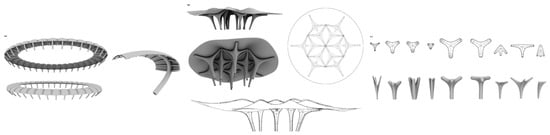
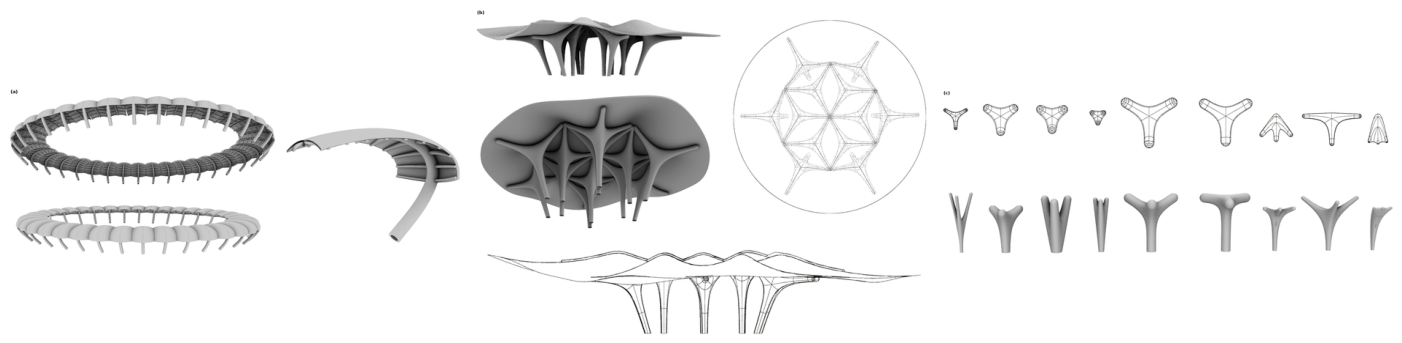
Figure 1 presents preliminary architectural–structural concepts used to illustrate the relationship between a component family, its individual components, and the resulting assemblies. The variants shown on the right (Figure 1c) are potential members of a branching component family generated by changing a shared set of parameters, including component height, branch length, branching angle, and the number and orientation of branches. Their repetition, rotation and arrangement could generate assemblies such as the circular roof configurations shown on the left (Figure 1a) and the tree-supported canopy arrangements shown in the center (Figure 1b). These configurations are illustrative design proposals, not the results of topology optimization; a representative design domain, loading condition and structural objective will be defined in a subsequent project phase.
Figure 1.
Preliminary PRINTCON concepts: circular roof assemblies; tree-supported canopy arrangements; and potential variants within a branching component family.
3. From Topology-Optimized Form to Printable Assembly
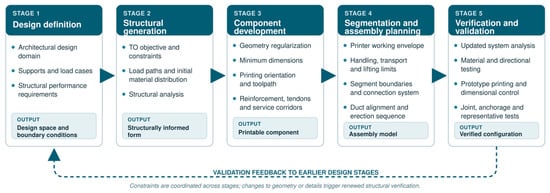
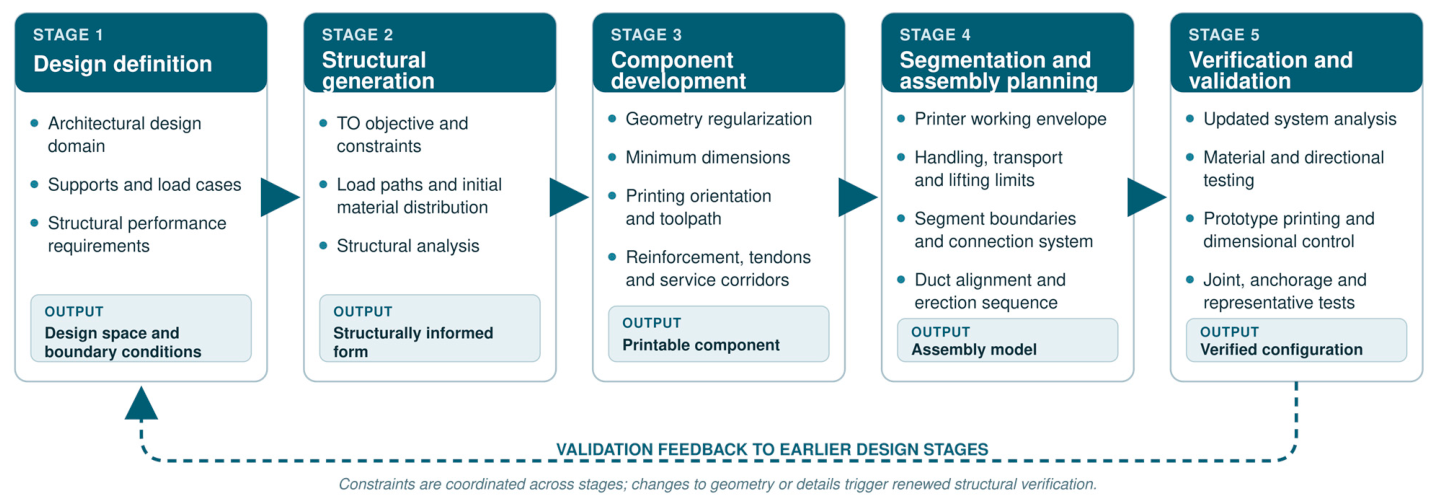
The proposed workflow begins with the definition of an architectural design domain, support and loading conditions, structural performance requirements, and ends with the validation of the assembled structural system. Topology optimization is used to establish the principal force-transfer paths and material distribution within the design domain. The resulting geometry must then be interpreted as a component that can carry the required loads, remain printable, accommodate reinforcement and post-tensioning ducts, and integrate building services, satisfying handling and transport constraints. The main stages of this workflow are summarized in Figure 2.
Figure 2.
PRINTCON workflow.
Although the workflow can be represented as a sequence of stages, the design process cannot be strictly linear. Decisions made during the conversion of the optimized form into a printable assembly may require modifications to the structural geometry and a return to an earlier stage. Service openings introduced after structural optimization could interrupt principal force-transfer paths, while tendon ducts introduced only after segmentation may be difficult to align and stress. Similarly, if printing orientation and toolpath requirements are neglected during form development, the resulting geometry may be structurally efficient but difficult or unreliable to produce. PRINTCON therefore treats structural design, internal functional integration, printability and assembly as coupled parts of an iterative design process.
The proposed framework coordinates five domains of design information: structural definition and performance, component geometry, manufacturing, segmentation and assembly, and functional integration and verification. Within each domain, the inputs, design variables, constraints and response quantities must be distinguished during the subsequent formulation of the design process. Table 1 organizes the principal constraint domains according to their implications for the proposed system and the corresponding response strategies to be examined within PRINTCON.
Table 1.
Principal constraints and corresponding directions for PRINTCON development.
Printability is not a single material property but the result of several interacting material and process requirements. The mixture must flow through the pumping and extrusion system, form a continuous filament and retain its geometry under the weight of subsequent layers. Yield stress, viscosity and structural build-up therefore interact with nozzle geometry, printing speed, layer height and the interlayer time interval [1,2]. Longer intervals and surface drying may weaken layer interfaces, while the orientation of layers and internal voids contribute to anisotropic behavior [3,4,5]. These relationships must therefore be evaluated at the scale of the intended component and not only through small material specimens.
Building services should be integrated into the internal geometry of the components instead of being coordinated only after the structural concept has been fixed. These corridors cannot be treated merely as geometric exclusions from the optimized form. Once their geometry has been defined, the ducts and openings must be included in the structural model so that their effects on stiffness, stress concentrations and reinforcement demand can be evaluated. Their position and dimensions must also be coordinated with the principal force-transfer paths, reinforcement and tendon trajectories, printing requirements, and the minimum dimensions of the remaining load-bearing sections. The same principle applies to post-tensioning ducts, local anchorage zones, and lifting provisions.
Segmentation is introduced after an initial continuous structural form has been obtained because the final segment boundaries depend on the printer working envelope, printing orientation, transport and lifting limits, site access and the selected connection system. Even if a common connection principle has already been established for the component family, the number and position of joints and their mechanical properties may not be known until the segmentation layout has been selected. The adopted assembly must therefore be analyzed using the actual joint locations, contact conditions, tendon or reinforcement continuity, local strengthening and relevant assembly stages. If both the segment layout and the mechanical representation of the connections are defined at the outset, they could be incorporated into the initial structural model, eliminating the need for a separate model update solely due to segmentation.
4. Segmental Assembly Concept
Precast segmental bridges provide a useful constructional analogy—individual segments are produced under controlled conditions, transported to site, assembled in sequence and activated by post-tensioning. This principle is relevant to PRINTCON because it separates production quality from construction scale—the final structure may be large, while individual printed segments can remain within a manageable manufacturing envelope.
Post-tensioning is treated as the primary connection and activation strategy. Its feasibility depends on tendon layout, anchorage forces, joint opening, interface stress, prestress losses and construction tolerances. Tendons can be threaded through ducts printed or formed within the segments and stressed after assembly. Post-tensioning introduces compression across the segment interfaces. Its effect within each printed segment, however, depends on the tendon trajectory, component geometry, printing orientation and load combination. When the prestressing force acts predominantly perpendicular to the layer interfaces, it may help keep these interfaces in compression and reduce the likelihood that interlayer tensile resistance controls the response. In addition to tendons, steel or FRP bars may be inserted into cavities and grouted to provide passive reinforcement, ductility, and robustness. Adhesive interfaces, shear keys and grout can assist positioning and shear transfer. Building on these requirements, Table 2 presents the main connection mechanisms considered for segmental 3DCP assemblies, together with their intended structural functions and key design considerations.
Table 2.
Candidate mechanisms for segmental continuity and their principal verification requirements.
5. Research Questions and Development Agenda
The research questions are organized according to the transition from structural generation to fabrication and verification and are summarized, together with the decision criteria and evidence required to address them, in Table 3.
Table 3.
Focused PRINTCON research questions and the evidence required to address them.
The immediate project sequence can therefore remain general until a representative typology is selected: define its design domain, supports and load cases; formulate the topology-optimization problem; regularize the resulting structural form; select a printing and reinforcement concept; introduce services and segmentation; analyze and test representative segments and joints; and verify an assembly-level model and prototype. Numerical parameter ranges and acceptance criteria will be set from the selected typology, available printing system, applicable structural requirements and results of the preceding project phases.
6. Conclusions
This paper presented a constraint-oriented PRINTCON framework for segmental 3D-printed concrete systems. Five conclusions guide further development:
- The unit should be a controlled component family, not an identical module or unrestricted one-off object;
- Print orientation, toolpath, voids, reinforcement and tendon routes are coupled production and structural variables;
- Segmentation may follow initial form definition, but joints require reassessment;
- Segment size balances production and handling control against joint and assembly complexity;
- Post-tensioning is a plausible activation strategy whose effectiveness depends on joint behavior, anchorage, losses, tolerances, and layer orientation.
The project does not yet define numerical limits, a final connection, or a complete optimization procedure. Its present contribution is to identify the coupled decisions that precede a representative design and validation program.
Author Contributions
Conceptualization, J.G. and L.S.; methodology, J.G., L.S., D.A. and V.V.; writing—original draft preparation, J.G. and L.S.; writing—review and editing, J.G., L.S., D.A. and V.V.; supervision, J.G.; project administration, J.G.; funding acquisition, J.G. All authors have read and agreed to the published version of the manuscript.
Funding
The research was conducted as a part of the 3D-Printed Modular Architectural Structures (PRINTCON) project at the University of Zagreb, Faculty of Architecture, Croatia. The project received EU funding through the Croatian National Recovery and Resilience Plan (NRRP) under the EU 581 Recovery and Resilience Facility (RRF).
Data Availability Statement
No new data were created or analyzed in this study. Data sharing is not applicable to this article.
Acknowledgments
The authors acknowledge the interdisciplinary research environment of the Faculty of Architecture, University of Zagreb, and collaborators involved in the development of additive manufacturing research for architectural structures. During manuscript preparation, the authors used OpenAI ChatGPT (GPT-5) for language drafting and editorial support. The authors reviewed and edited the manuscript and take full responsibility for its content.
Conflicts of Interest
The authors declare no conflicts of interest.
References
- Mechtcherine, V.; Bos, F.P.; Perrot, A.; Da Silva, W.L.; Nerella, V.N.; Fataei, S.; Wolfs, R.J.M.; Sonebi, M.; Roussel, N. Extrusion-based additive manufacturing with cement-based materials – Production steps, processes, and their underlying physics: A review. Cem. Concr. Res. 2020, 132, 106037. [Google Scholar] [CrossRef] [Scilit]
- Roussel, N. Rheological requirements for printable concretes. Cem. Concr. Res. 2018, 112, 76–85. [Google Scholar] [CrossRef] [Scilit]
- Bos, F.; Menna, C.; Robens-Radermacher, A.; Wolfs, R.; Roussel, N.; Lombois-Burger, H.; Baz, B.; Weger, D.; Nematollahi, B.; Santhanam, M.; et al. Mechanical properties of 3D printed concrete: A RILEM TC 304-ADC interlaboratory study — approach and main results. Mater. Struct./Mater. Et. Constr. 2025, 58, 5. [Google Scholar] [CrossRef] [Scilit]
- Huang, X.; Yang, W.; Song, F.; Zou, J. Study on the mechanical properties of 3D printing concrete layers and the mechanism of influence of printing parameters. Constr. Build. Mater. 2022, 335, 127496. [Google Scholar] [CrossRef] [Scilit]
- Maroszek, M.; Hager, I.; Mróz, K.; Sitarz, M.; Hebda, M. Anisotropy of Mechanical Properties of 3D-Printed Materials—Influence of Application Time of Subsequent Layers. Materials 2025, 18, 16. [Google Scholar] [CrossRef] [Scilit] [PubMed]
- Ahmed, Z.; Wolfs, R.; Bos, F.; Salet, T. A Framework for Large-Scale Structural Applications of 3D Printed Concrete: The Case of a 29 m Bridge in the Netherlands. Open Conf. Proc. 2022, 1, 5–19. [Google Scholar] [CrossRef] [Scilit]
- Mechtcherine, V.; Nerella, V.N. Integration der Bewehrung beim 3D-Druck mit Beton. Beton-Und Stahlbetonbau 2018, 113, 496–504. [Google Scholar] [CrossRef] [Scilit]
- Menna, C.; Mata-Falcón, J.; Bos, F.P.; Vantyghem, G.; Ferrara, L.; Asprone, D.; Salet, T.; Kaufmann, W. Opportunities and challenges for structural engineering of digitally fabricated concrete. Cem. Concr. Res. 2020, 133, 106079. [Google Scholar] [CrossRef] [Scilit]

Disclaimer/Publisher’s Note: The statements, opinions and data contained in all publications are solely those of the individual author(s) and contributor(s) and not of MDPI and/or the editor(s). MDPI and/or the editor(s) disclaim responsibility for any injury to people or property resulting from any ideas, methods, instructions or products referred to in the content. |
© 2026 by the authors. Licensee MDPI, Basel, Switzerland. This article is an open access article distributed under the terms and conditions of the Creative Commons Attribution (CC BY) license.