


Abstract
This study examines alkali-activated concrete (AAC) containing 15 wt.% wood biomass ash (WBA) as a partial precursor replacement for precast street furniture. The bench was produced using ground granulated blast furnace slag (GGBFS), WBA, and graded aggregates, activated with sodium hydroxide and sodium silicate solution. Fresh properties, including workability and density, were assessed, while hardened concrete was evaluated for compressive and tensile strength, modulus of elasticity, water absorption, and freeze–thaw resistance. The results indicate that the AAC demonstrates high workability, long-term strength development, and adequate durability, confirming its potential as a sustainable, high-performance alternative to conventional concrete for outdoor urban applications.
1. Introduction
The construction sector is under increasing pressure to reduce CO2 emissions and develop more sustainable binder systems. Portland cement production accounts for a significant share of global greenhouse gas emissions, prompting the development of alternative materials with a lower carbon footprint [1,2]. In this context, alkali-activated materials (AAMs) have emerged as a promising alternative due to their capacity to incorporate industrial and agricultural by-products and their reduced environmental impact [1,3,4].
The most used precursors in AAM systems are ground granulated blast furnace slag (GGBFS) and fly ash; however, their availability depends on regional industrial activities. Consequently, alternative materials such as biomass ash are increasingly being investigated, as they can serve as partial precursor replacements or as sources of alkaline components [5]. Wood biomass ash (WBA) has attracted attention due to its chemical and mineralogical properties, which enable its use in alkali-activated systems while offering potential improvements in sustainability and material circularity [6].
Recent studies have shown that WBA can be successfully used in AAM systems as a partial replacement for slag or other aluminosilicate precursors, influencing mechanical properties, microstructure, and durability [7]. However, its application often requires mix design optimisation due to variability in chemical and physical composition, as well as the presence of soluble salts, which may affect mechanical and durability properties [1].
The use of AAMs in precast elements is particularly attractive due to controlled production conditions and the potential for industrial-scale implementation of sustainable materials. Nevertheless, ensuring adequate durability remains essential for wider application, especially resistance to freeze–thaw cycles, which continues to be a key challenge for AAM systems.
The aim of this study is to evaluate the feasibility of using alkali-activated concrete (AAC) with 15 wt.% WBA as a partial slag replacement in precast urban furniture. Fresh and hardened properties, as well as durability under simulated service conditions, were analysed, with emphasis on mechanical performance and freeze–thaw resistance.
2. Materials and Methods
The precast AAC bench was produced using ground granulated blast furnace slag (GGBFS), supplied by Ecocem Benelux BV, and mixed wood biomass ash (WBA) sourced from Žakanje, Croatia. The binder was combined with aggregates with a maximum grain size of 16 mm, consisting of natural (washed) fractions (designated as PPF) and crushed, graded fractions (designated as PDF).
AAMs were activated with an alkaline solution composed of sodium hydroxide (NaOH, 25 M), sodium silicate solution (waterglass; 27.58 wt.% SiO2, 16.9 wt.% Na2O, and 55.6 wt.% H2O), and tap water. The final activator composition corresponded to a Na2O content of 4.50 wt.% relative to the precursor, a silica modulus (SiO2/Na2O) of 0.50, and a water-to-precursor mass ratio of 0.42. The alkaline solution was prepared 24 h before casting to ensure chemical stability.
The alkali-activated composite was produced using ground granulated blast furnace slag (GGBFS) as the main precursor, partially replaced by mixed wood biomass ash (WBA). The precursor blend contained approximately 85% GGBFS and 15% WBA by mass. Activation was achieved with a low-modulus sodium silicate–sodium hydroxide system. The water-to-precursor ratio was about 0.4. The aggregate skeleton comprised a mix of natural and recycled aggregates of various size fractions, with fine aggregates (0–4 mm) making up about 45% and coarse aggregates (4–16 mm) about 55% of the total aggregate content. The largest individual fraction was the recycled 0–4 mm aggregate, which constituted approximately 35% of the aggregate mixture.
The mixing procedure was as follows. First, the aggregates were mixed for 2 min. GGBFS and WBA were then added and mixed for a further 1 min. The alkaline activator was subsequently introduced, followed by mixing for an additional 4 min. The total water content was adjusted to account for aggregate moisture and absorption.
Experimental investigations were conducted on the AAC mixture in both fresh and hardened states (Table 1). Fresh concrete properties were evaluated immediately after mixing and included density and workability, determined by the slump test.
Table 1.
Test methods for the evaluation of physical, mechanical and durability properties of AAC precast bench.
Mechanical properties were assessed after curing periods of 28 days and 180 days, including compressive strength, tensile splitting strength, and modulus of elasticity. Durability performance was evaluated through freeze–thaw resistance with de-icing salts under different pre-saturation regimes, as well as total water absorption of hardened concrete. The pre-saturation regimes applied prior to freeze–thaw testing were as follows:
- exposure to deionised water for 3 days,
- exposure to 3% NaCl solution for 3 days,
- exposure to 3% NaCl solution for 7 days.
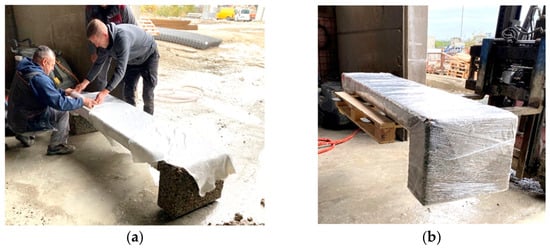
After demoulding and surface washing, the AAC bench was subjected to curing (Figure 1). The specimen was first wrapped in geotextile to retain moisture, then sealed with plastic foil. This curing method was used to ensure adequate moisture conditions, thereby promoting early-age strength development and enhancing durability performance.
Figure 1.
Curing preparation of the AAC bench: (a) geotextile wrapping; (b) plastic foil covering.
3. Results
3.1. Fresh State Properties
The results for the fresh state concrete properties, including consistency (slump) and density, are presented in Table 2.
Table 2.
Properties of AAC in the fresh state.
The AAC mixture had a slump value of 215 mm, indicating high workability corresponding to slump class S4–S5. The measured density was 2313.38 kg/m3, which is within the expected range for this type of material. Nevertheless, the quality and consistency of the concrete mix were ensured by factory measurements and controlled production parameters.
3.2. Hardened Properties
3.2.1. Mechanical Properties
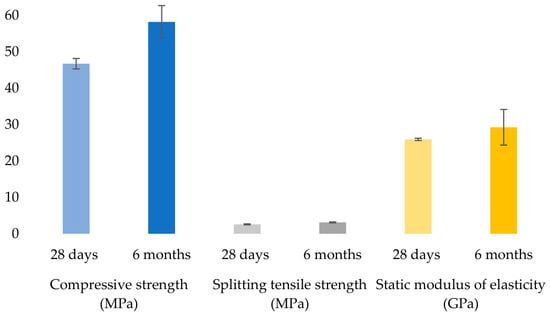
The mechanical properties of the AAC mixture at 28 days and 6 months are presented in Table 3 and Figure 2, illustrating strength development over time. The performance of AAC was evaluated based on compressive strength, splitting tensile strength, and static modulus of elasticity.
Table 3.
Mechanical properties of AAC at age of 28 days and 6 months.
Figure 2.
Mechanical properties of AAC at age of 28 days and 6 months.
At 28 days, the AAC achieved a compressive strength of 46.77 ± 1.44 MPa, which increased to 58.25 ± 4.48 MPa after 6 months, corresponding to a strength gain of approximately 24%. A similar trend was observed for splitting tensile strength, which increased from 2.59 ± 0.13 MPa to 3.23 ± 0.13 MPa over the same period.
The static modulus of elasticity also increased with time, rising from 25.96 ± 0.31 GPa at 28 days to 29.28 ± 4.90 GPa at 6 months. This trend indicates progressive stiffening of the material, consistent with the observed increase in compressive strength.
Overall, the results demonstrate continuous development of the mechanical properties of the AAC over time, suggesting ongoing microstructural evolution within the alkali-activated binder system. This behaviour is characteristic of slag-based AAMs and confirms their potential for long-term structural performance.
3.2.2. Durability Properties
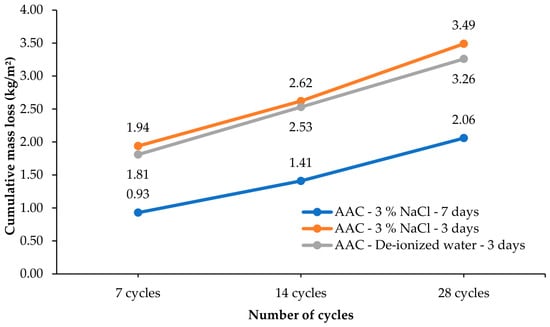
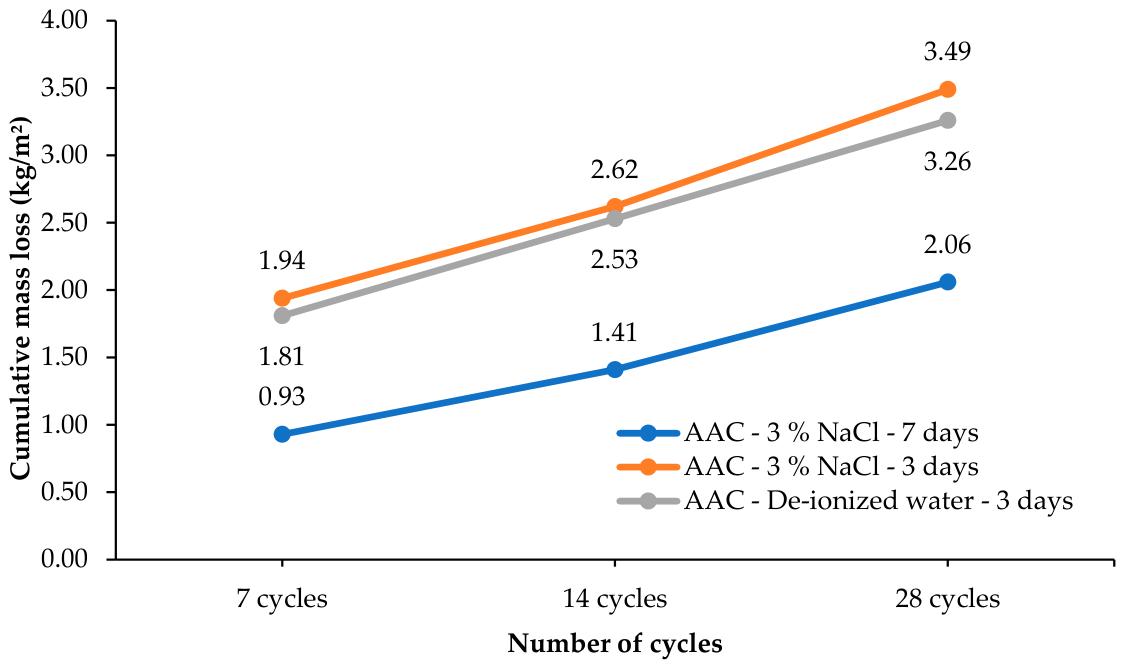
The durability-related parameters of the AAC mixture, including freeze–thaw resistance with de-icing salts and total water absorption, are shown in Table 4. The average mass loss values as a function of the applied pre-saturation regime are illustrated in Figure 3, highlighting the influence of conditioning duration on freeze–thaw performance.
Table 4.
Durability parameters of AAC.
Figure 3.
Mass loss of tested mix with different pre-saturation regimes.
The freeze–thaw resistance of the AAC mixture was assessed by measuring mass loss after 28 cycles under different pre-saturation conditions. According to [14], the maximum permissible mass loss is 1.5 kg/m2.
For specimens pre-saturated in deionised water for 3 days, the maximum individual mass loss was 3.26 kg/m2, exceeding the specified limit. A similar result was observed for samples pre-treated in 3% NaCl solution for 3 days, with a slightly higher mass loss of 3.49 kg/m2. These results indicate that short pre-saturation periods provide insufficient resistance to freeze–thaw cycles in the presence of de-icing salts.
In contrast, extending the pre-saturation period to 7 days in 3% NaCl reduced the mass loss to 2.06 kg/m2. Although this value still slightly exceeds the prescribed limit, the improvement is significant, demonstrating the strong influence of pre-conditioning duration on durability performance. This may be attributed to a more uniform internal moisture distribution achieved during prolonged saturation.
Regarding water absorption, the AAC mixture exhibited a total water absorption of 6.75 ± 0.06%, which complies with the [14] requirement of less than 7%. This suggests a relatively dense pore structure, limiting capillary water uptake and contributing positively to durability in outdoor exposure conditions.
Overall, while the AAC meets the standard requirements for water absorption, it does not fully satisfy the freeze–thaw resistance criterion under the tested conditions. However, the improvement observed with extended pre-saturation indicates clear potential for optimisation. Adjustments in curing procedures or pre-conditioning regimes may further enhance resistance to freeze–thaw cycles and de-icing salts, thereby improving compliance with durability standards.
4. Discussion
The analysis of both fresh and hardened state properties of AAC precast bench, in which 15 wt.% of the precursor was replaced by WBA, demonstrated promising performance in workability, density, and long-term mechanical behaviour. The slump test confirmed high workability, while the measured density indicated a well-compacted material.
Mechanical properties, including compressive strength, splitting tensile strength, and modulus of elasticity, increased over the curing period from 28 days to 6 months, even under outdoor exposure conditions simulating the environment of the precast bench. This strength development reflects ongoing microstructural evolution within the alkali-activated binder system and highlights the potential of AAC for construction applications, particularly for structures requiring long-term durability.
Durability testing showed that total water absorption met [14], indicating a sufficiently dense pore structure. Freeze–thaw resistance with de-icing salts, however, was below the standard for shorter pre-saturation periods, while extended pre-saturation (7 days in 3% NaCl) significantly improved performance. These results emphasise the importance of pre-conditioning regimes and suggest that optimisation of curing and pre-saturation procedures could further enhance freeze–thaw resistance.
Future research should focus on the potential benefits of air-entraining admixtures, and systematic evaluation of pre-conditioning effects on freeze–thaw performance. Furthermore, longer-term field monitoring of precast AAC elements could provide valuable insights into their durability under real environmental conditions.
Overall, the results confirm that AAC with partial WBA replacement is a high-performance, sustainable material with considerable potential for further development in the field of alternative binders, offering both mechanical reliability and environmental benefits for precast concrete applications.
5. Conclusion
This study evaluated the use of AAC with 15 wt.% WBA as a partial precursor replacement for precast street furniture. The results show that:
- Fresh state properties—The AAC mixture exhibited high workability (slump 215 mm) and adequate density (~2313 kg/m3), indicating good compaction and suitability for precast applications.
- Mechanical performance—Compressive strength, splitting tensile strength, and static modulus of elasticity increased steadily between 28 days and 6 months, reflecting ongoing microstructural development and confirming the material’s potential for long-term structural performance.
- Durability—Total water absorption met [14] requirements (<7%), while freeze–thaw resistance improved with extended pre-saturation in 3% NaCl. These findings highlight the importance of pre-conditioning regimes in enhancing durability under outdoor exposure and de-icing salt conditions.
- Sustainability and application potential—Partial replacement of precursors with WBA contributes to a more sustainable binder system while maintaining high mechanical and durability performance. AAC is a promising material for precast street furniture, combining environmental benefits with structural reliability.
Overall, the study confirms that AAC with WBA is a viable, high-performance alternative to conventional concrete for precast urban applications. Future research should focus on optimising curing and pre-saturation procedures, evaluating long-term field performance, and investigating admixture strategies to further enhance freeze–thaw resistance.
Author Contributions
Conceptualization, M.S. and M.M.; methodology, M.G.; validation, M.S. and N.Š.; formal analysis, J.Š.B., M.G. and M.M.; investigation, M.G.; resources, N.Š.; data curation, J.Š.B., M.G. and M.M.; writing—original draft preparation, M.M.; writing—review and editing, M.S., J.Š.B., M.G., N.Š. and M.M.; visualisation, M.G. and M.M.; supervision, N.Š.; project administration, N.Š.; funding acquisition, N.Š. All authors have read and agreed to the published version of the manuscript.
Funding
This work was carried out within the framework of the research project AshCycle—Integration of Underutilized Ashes into Material Cycles by Industry-Urban Symbiosis (Project No. 101058162), funded under the European Union’s Horizon Europe programme (HORIZON-CL4-2021-TWIN-TRANSITION-01). The doctoral candidate’s work was supported by the “Career Development Programme for Young Researchers—Training of New Doctoral Researchers (NPOO-DOK-2023-10)”, funded by the Croatian Science Foundation (CSF).
Institutional Review Board Statement
Not applicable.
Informed Consent Statement
Not applicable.
Data Availability Statement
Data will be available on request.
Acknowledgments
The findings presented within this paper were obtained as part of the scientific project AshCycle-Integration of Underutilized Ashes into Material Cycles by Industry-Urban Symbiosis, 101058162, HORIZON-CL4-2021-TWIN-TRANSITION-01. The authors would also like to express their sincere gratitude to concrete factory Beton Lučko d.o.o. for their valuable support, expert knowledge and for actively supporting the experimental phase of the project.
Conflicts of Interest
Author Jelena Šantek Bajto was employed by the company Tomting 2010 d.o.o. The remaining authors declare that the research was conducted in the absence of any commercial or financial relationships that could be construed as a potential conflict of interest.
Abbreviations
The following abbreviations are used in this manuscript:
| AAC | Alkali-activated concrete |
| AAM | Alkali-activated material |
| WBA | Wood biomass ash |
| GGBFS | Granulated blast furnace slag |
| PPF | Natural (washed) fractions |
| Crushed, graded fractions |
References
- Du, Y.; Pundienė, I.; Pranckevičienė, J.; Kligys, M.; Girskas, G.; Korjakins, A. A review of biomass wood ash in alkali-activated materials: Treatment, application, and outlook. J. Compos. Sci. 2024, 8, 161. [Google Scholar] [CrossRef] [Scilit]
- Jurado-Contreras, S.; Bonet-Martínez, E.; Sánchez-Soto, P.J.; Gencel, O.; Eliche-Quesada, D. Synthesis and characterization of alkali-activated materials containing biomass fly ash and metakaolin: Effect of the soluble salt content of the residue. Arch. Civ. Mech. Eng. 2022, 22, 3. [Google Scholar] [CrossRef] [Scilit]
- Silva, G.J.B.; Santana, V.P.; Wójcik, M. Investigation on mechanical and microstructural properties of alkali-activated materials made of wood biomass ash and glass powder. Powder Technol. 2021, 377, 900–912. [Google Scholar] [CrossRef] [Scilit]
- Kuasakul, T.; Tabyang, W.; Keawsawasvong, S.; Thongchom, C.; Sanit-in, P.; Suksiripattanapong, C. Mechanical, fatigue, and microstructural properties of rubber wood fly ash-based alkali-activated concrete. Case Stud. Constr. Mater. 2025, 23, e05539. [Google Scholar] [CrossRef] [Scilit]
- Bedov, O.O.; Draganić, S.; Serdar, M. Biomass ash in alkali-activated materials technology—A scoping review. In Proceedings of the SINARG Conference; Faculty of Civil Engineering and Architecture, University of Niš: Niš, Serbia; Serbian Academy of Sciences and Arts–Branch in Niš: Niš, Serbia, 2025; pp. 695–705. [Google Scholar] [CrossRef] [Scilit]
- Du, Y.; Pundienė, I.; Pranckevičienė, J.; Korjakins, A.; Kligys, M. Mechanical properties and lifecycle assessment of a green alkali-activated mortar based on biomass wood ash. Environ. Clim. Technol. 2024, 28, 195–207. [Google Scholar] [CrossRef] [Scilit]
- Zhu, K.; Wang, H.; Dong, L.; Zhao, X.; Jin, J.; Liu, Y.; Liu, J.; Lv, D. One-part alkali-activated wood biomass binders for cemented paste backfill. Minerals 2025, 15, 273. [Google Scholar] [CrossRef] [Scilit]
- EN 12350-6:2019; Testing Fresh Concrete—Part 6: Density. CEN: Brussels, Belgium, 2019.
- EN 12350-2:2019; Testing Fresh Concrete—Part 2: Slump Test. CEN: Brussels, Belgium, 2019.
- EN 12390-3:2019; Testing Hardened Concrete—Part 3: Compressive Strength of test Specimens. CEN: Brussels, Belgium, 2019.
- EN 12390-13:2021; Testing Hardened Concrete—Part 13: Determination of Secant Modulus of Elasticity in Compression. CEN: Brussels, Belgium, 2021.
- EN 12390-6:2023; Testing Hardened Concrete—Part 6: Tensile Splitting Strength of test Specimens. CEN: Brussels, Belgium, 2023.
- EN 13198:2004; Precast Concrete Products—Street Furniture and Garden Products. CEN: Brussels, Belgium, 2004.
- CEN/TS 12390-9:2016; Testing Hardened Concrete—Part 9: Freeze–Thaw Resistance-Scaling. CEN: Brussels, Belgium, 2016.
- EN 13369:2023; Common Rules for Precast Concrete Products. CEN: Brussels, Belgium, 2023.

Disclaimer/Publisher’s Note: The statements, opinions and data contained in all publications are solely those of the individual author(s) and contributor(s) and not of MDPI and/or the editor(s). MDPI and/or the editor(s) disclaim responsibility for any injury to people or property resulting from any ideas, methods, instructions or products referred to in the content. |
© 2026 by the authors. Licensee MDPI, Basel, Switzerland. This article is an open access article distributed under the terms and conditions of the Creative Commons Attribution (CC BY) license.