


Abstract
In this study, an on-site installation type track slab using glass fiber-reinforced polymer (GFRP) reinforcing bars was developed and analyzed for its structural response to high-speed train loading. Concrete track slabs have the most severe deterioration in track circuit characteristic values due to the conduction influence of existing steel bars. Therefore, a track slab applying an insulator and lightweight GFRP reinforcement by replacing the existing steel bar was proposed from a design perspective. In order to present the validity of the proposed method, a full-size specimen was manufactured and a structural performance test was conducted, and the results were compared and verified through three-dimensional numerical analysis. The results showed that the new orbital slab applying the GFRP reinforcement has satisfactory insulation and provides sufficient structural performance that can replace the existing steel bar.
1. Introduction
With the recent emergence of high-speed railways and the rapid increase in trains as transport, concrete track slabs that can increase the longitudinal and transverse resistance of trajectories are applied to stabilize the structure on traditional gravel tracks. However, the steel reinforcement used in concrete slabs may negatively affect the signal stabilization of the track structure due to a lack of insulation. It is important to insulate each other when installing reinforced concrete pavement to prevent the reduction of signal currents in audio frequency track circuits on reinforced concrete pavement, and it is a way to minimize changes in line constant due to the use of reinforced steel.
The best way to solve the problem is to apply an insulating glass fiber-reinforced polymer (GFRP) reinforcing bar that replaces steel reinforcing bars on the track slab. GFRP reinforcing bars are a construction material that can replace existing steel reinforcing bars because they have superior tensile strength, corrosion resistance, salt resistance, insulation, durability, construction, and life cycle compared to steel reinforcing bars [1]. Recent studies have further proved the benefits of GFRP reinforcement in various structural applications [2,3,4,5,6]. However, research on applying GFRP reinforcements to track slabs in the railway field is still in its infancy; although, it has been applied to Chinese and Russian railway track slabs, including the Miami Metro in the United States.
When applying GFRP reinforcements in place of steel rebars to track slabs, structural performance that can replace steel reinforcement is required. In particular, it is necessary to investigate the structural performance of the road slab after applying glass fiber reinforcements to the slab installed on the railway bridge through static, dynamic, fatigue tests, and simulations targeting the most important concrete track slab among railway structures in consideration of train load.
In this study, the structural performance (strength) of a real-scale test object is compared through forging and cycle loading tests with a real-scale test object applied with a steel reinforcing bar. Based on experimental results, variables were identified through the analysis of the three-dimensional finite element structure of the real-scale test object.
2. Experiments
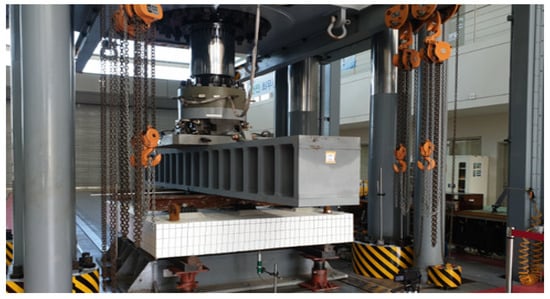
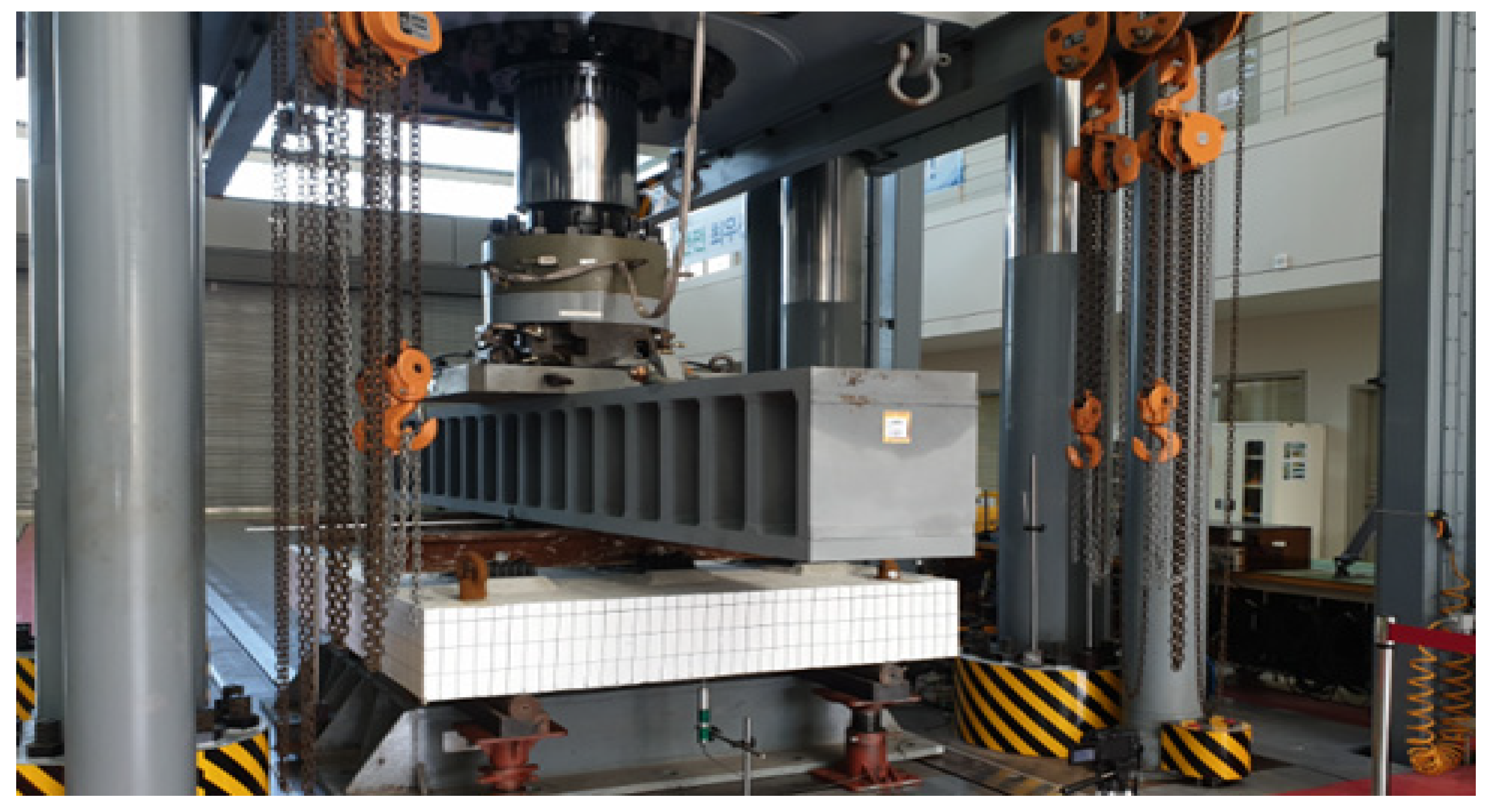
Since this study was carried out based on the on-site pouring concrete slab under construction using existing steel rebars, a GFRP rebar was added in the longitudinal direction to improve the bond strength by axial force in consideration of the different expansion coefficients between the steel and GFRP rebar. Figure 1 shows the front view of the test setting.
Figure 1.
Test view of specimen in the transverse direction and longitudinal specimen.
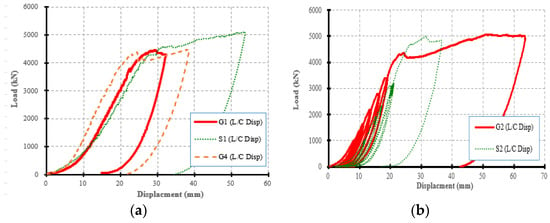
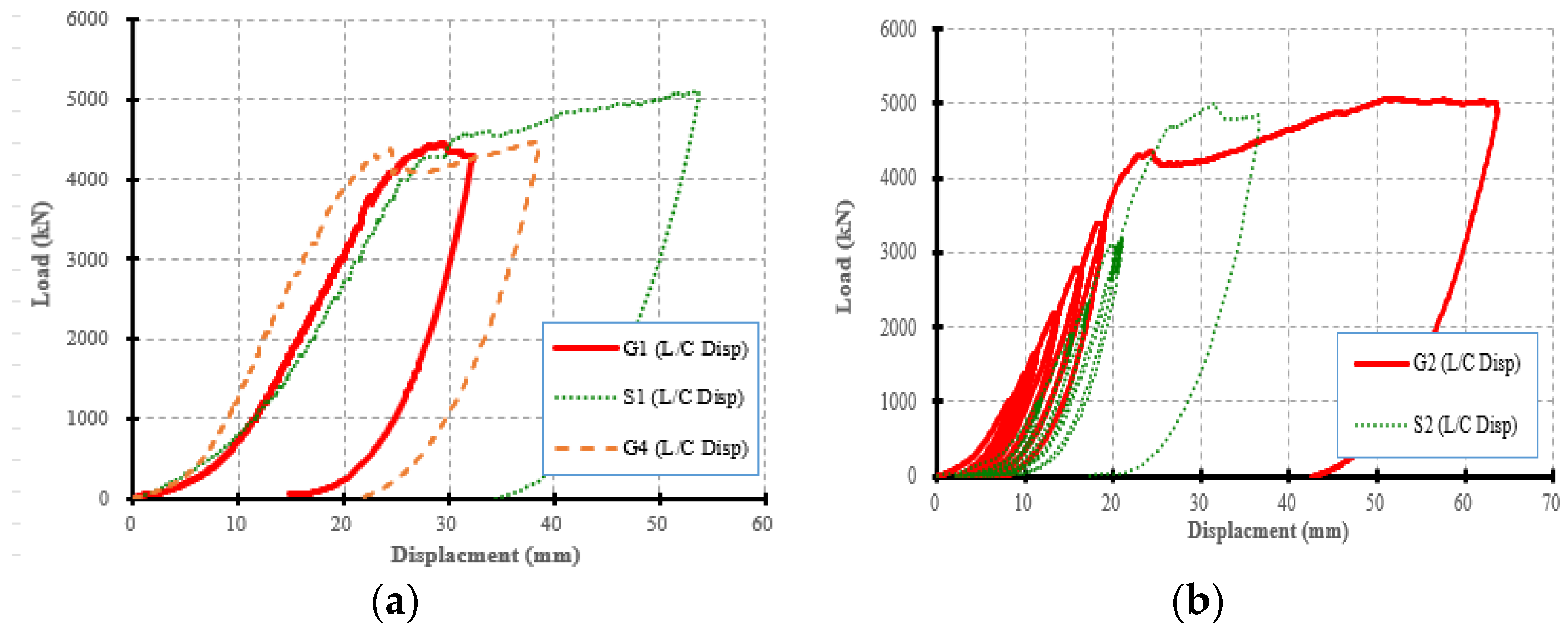
In this study, the specimens to which the GFRP rebar was applied were divided into specimens (G1 and G2) designed based on ACI standards and specimens (G4) that were arranged in the same way as existing steel rebar. For relative comparison with the performance test results of GFRP specimens, tests were performed on the specimens (S1 and S2) embedded with steel rebar, respectively. Figure 2 shows the load–displacement curve for the monotonic and cycling loading of the longitudinal specimen according to the load-cell position. In the monotonic loading test, the final loading load of the steel reinforcement specimen (S1) was measured to be larger than that of G1 and G4, but the load tended to temporarily decrease and then increase again after the maximum point representing the final load.
Figure 2.
Comparisons of load–displacement curves at load cell: (a) monotonic loading; (b) cycling loading.
In this case, the peak of the load before the temporarily decreasing section occurs is regarded as the final load. When compared based on the maximum point where the load does not decrease, the G1, G4, and S1 specimens show similar trends in the maximum load without load reduction. This trend was similar in the cycling loading result. In the case of the monotonic loading, the maximum loads of the G1, G4, and S1 specimens were similar, while the average value of the displacement at the time of the final load was smaller in the GFRP reinforcement specimen than in the steel reinforcement specimen. The reason is believed to be that the tensile strength of the GFRP rebar is higher than that of the steel rebar.
3. Numerical Verification
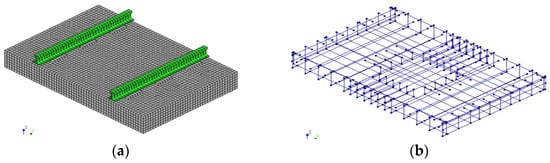
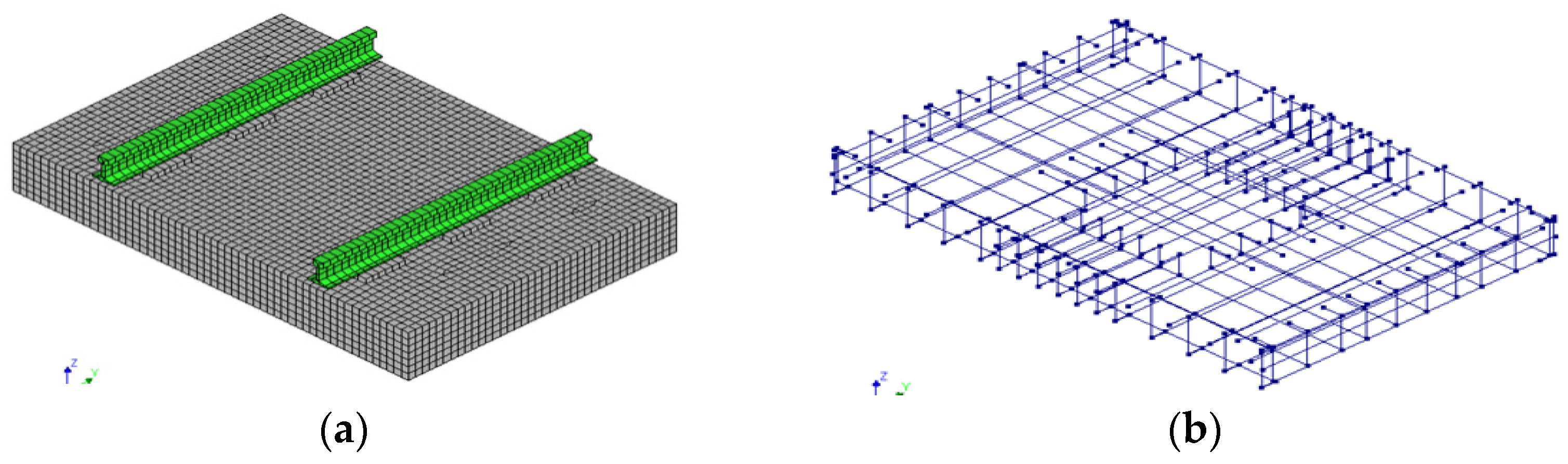
In this study, a three-dimensional precise numerical analysis modeling was performed to compare and analyze the performance of the flexural tensile strength and crack pattern of concrete track slab to which GFRP reinforcement was applied by replacing the existing steel rebar using the FEA program [7]. Figure 3 shows the overall shape modeling and detailed modeling of the reinforcement of the longitudinal and transverse real specimens.
Figure 3.
Finite element modeling of the longitudinal real specimen: (a) entire modeling; (b) embedded rebar modeling.
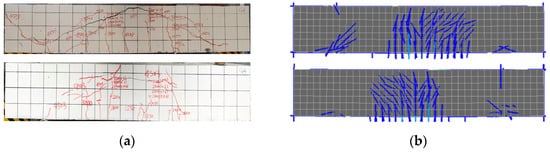
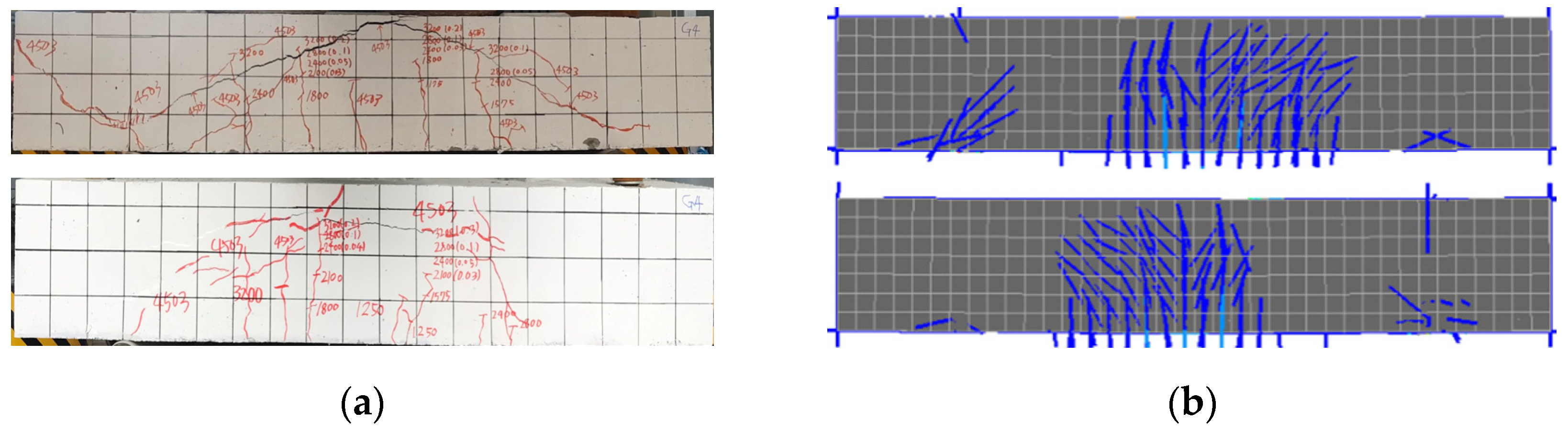
Figure 4 shows the test results by simulating the entire crack shape in the case of the longitudinal GFRP-reinforcing bar application test (G4). The case of applying reinforcing bars showed a similar trend. Figure 5 shows the crack size according to the loading size for the longitudinal GFRP-reinforcing bar application test (G4) by monotonic loading. Similarly to the performance test, the crack pattern started as a vertical crack in the center and showed a diagonal crack shape as the load increased, and the overall trend was similar.
Figure 4.
Comparison of crack occurrence of longitudinal specimen (GFRP rebar): (a) experimental results; (b) simulation results.
Figure 5.
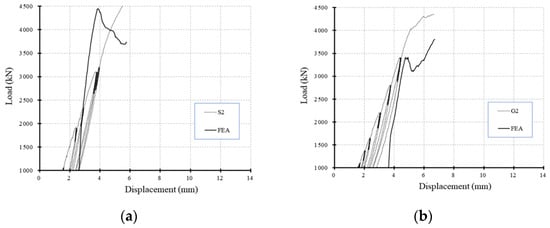
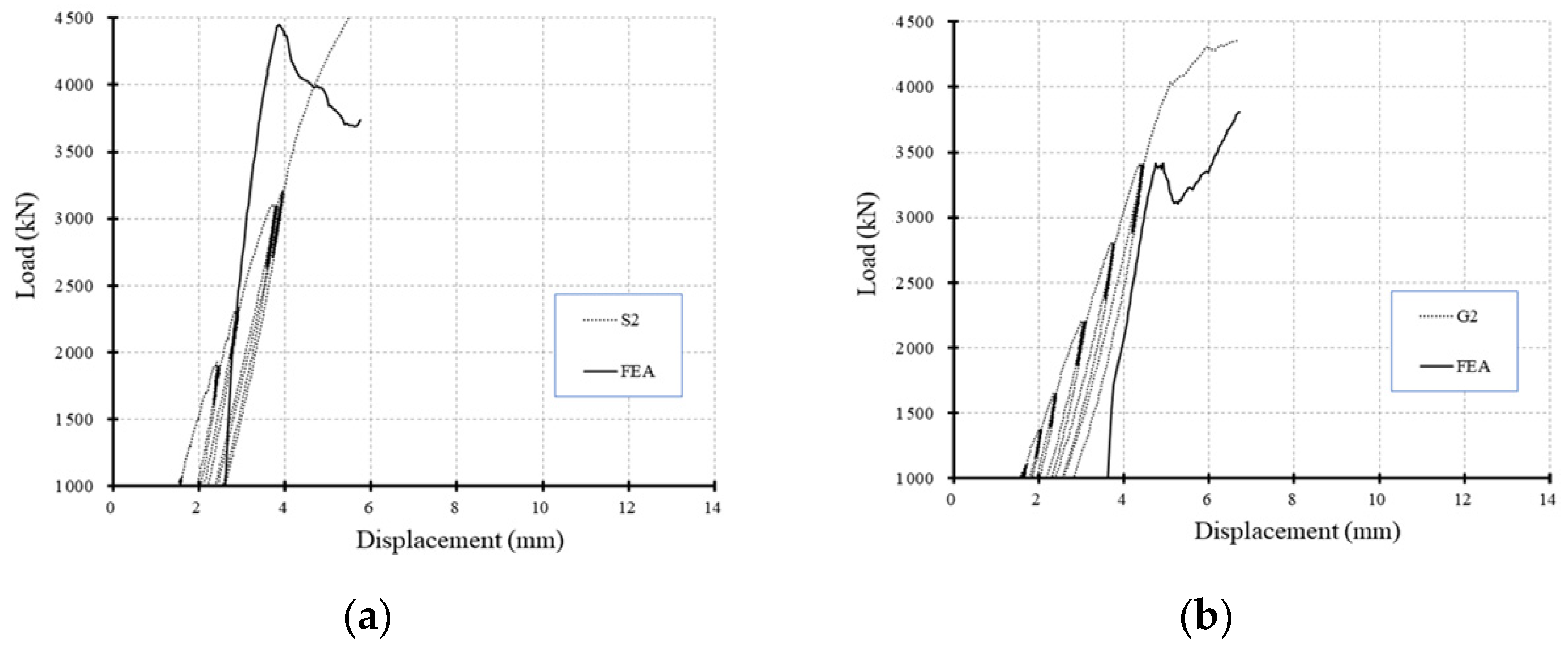
Comparison of load–displacement curves for longitudinal full-scale tests and simulations: (a) steel rebar (S2)-reinforced concrete slab; (b) GFRP rebar (G2)-reinforced concrete slab.
Table 1 presents the comparison of the experimental results and numerical analysis results according to longitudinal load loading, focusing on the maximum load. The reason why the maximum load value of the numerical analysis differs slightly from the results of the table is that the finite element analysis result is a complete constraint, and in the finite element analysis, the maximum load is judged to be slightly lower than the actual experiment because the sleeper was modeled but the reinforcement connection between the sleeper was not reflected.
Table 1.
Comparison of simulation results with the longitudinal full-scale test.
Figure 5 shows comparisons of the load–displacement curves derived by experiments and numerical analysis for the longitudinal specimen, respectively. As shown in the figure, the slope of the load–displacement curve in the elastic region was found to coincide with the trend of the experiment and numerical analysis results.
4. Conclusions
In this study, theoretical analysis and structural design, real-scale specimen manufacturing and performance tests, and three-dimensional numerical analysis comparison verification were performed by applying GFRP reinforcements that completely replace steel rebar applied to a concrete slab that requires insulation. The results of the longitudinal test specimen structural performance were compared and verified from the finite element three-dimensional structural analysis, and the maximum load value, overall crack pattern, crack size, and load–displacement curve generally matched the test results. An optimized GFRP reinforcing bar was designed before conducting a high-cost real structural performance experiment through future simulation variable research.
The GFRP reinforcing bars proposed in this study prevent unexpected train accidents by preventing interference or loss of electrical signals in the steel slab. They are advantageous in terms of construction performance and maintenance due to corrosion resistance and being lightweight. It is expected that the practical use of more economical GFRP reinforcing bars will continue to be promoted through cross-sectional improvement and arrangement optimization in the future. It can be applied to on-site installation type steel slab, but in the case of pre-production type steel slab, the application of GFRP reinforcing bars replaced with steel bars is sufficient, so research and development will be necessary in the future.
Funding
This research was funded by Ministry of Trade, Industry and Resources, grant number RS-2024-0046875 and Korea National Railway.
Institutional Review Board Statement
Not applicable.
Informed Consent Statement
Not applicable.
Data Availability Statement
The raw data supporting the conclusions of this article will be made available by the authors upon request.
Conflicts of Interest
The authors declare no conflicts of interest.
References
- Al-Zahrani, M.M. Durability of concrete-embedded GFRP bars after 20 years of tidal zone exposure: Correlation with accelerated aging tests. Case Stud. Constr. Mater. 2024, 21, e03435. [Google Scholar] [CrossRef] [Scilit]
- Wang, Y.; Zhang, J.; Huang, L. Structural behavior of concrete slabs reinforced with GFRP bars under cyclic loading. Compos. Struct. 2022, 282, 115044. [Google Scholar]
- Fico, R.; Micelli, F.; Aiello, M.A. Durability and mechanical performance of GFRP-reinforced concrete elements exposed to aggressive environments. Constr. Build. Mater. 2023, 365, 130158. [Google Scholar]
- Kassem, C.; Farghaly, A.S.; Benmokrane, B. Design and performance of concrete bridge deck slabs reinforced with GFRP bars under fatigue loading. Eng. Struct. 2021, 244, 112764. [Google Scholar]
- Chen, J.; Wang, C.; Bai, Y. Long-term deflection behavior of GFRP-reinforced concrete beams under sustained loading. J. Compos. Constr. 2023, 27, 04022082. [Google Scholar]
- Habib, M.; El Refai, A.; Abed, F. Assessment of serviceability of GFRP reinforced concrete slabs subjected to static and dynamic loads. Structures 2022, 38, 1221–1234. [Google Scholar]
- DIANA FEA BV. DIANA User’s Manual Release 10.7; DIANA FEA BV: Delft, The Netherlands, 2024. [Google Scholar]

Disclaimer/Publisher’s Note: The statements, opinions and data contained in all publications are solely those of the individual author(s) and contributor(s) and not of MDPI and/or the editor(s). MDPI and/or the editor(s) disclaim responsibility for any injury to people or property resulting from any ideas, methods, instructions or products referred to in the content. |
© 2026 by the author. Licensee MDPI, Basel, Switzerland. This article is an open access article distributed under the terms and conditions of the Creative Commons Attribution (CC BY) license.