


Abstract
Air traffic controllers (ATCOs) are currently constrained by a sector-based competence endorsement model that requires extensive, sector-specific training and limits operational flexibility. To address this, the SESAR project IFAV3 proposes solutions to facilitate service provision flexibility. A fundamental part of achieving this objective is to have a common regulatory framework which allows one to provide a service in a different airspace. The Common Unit Competence Scheme (CUCS) is a unified framework designed to harmonize the endorsement process across Europe. The CUCS is a methodology that aims to create a framework for Air Navigation Services Providers (ANSPs), which emphasizes training, planning and endorsement processes across multiple sector groups and Air Traffic Service Units (ATSUs) while remaining compliant with Regulation (EU) 2015/340 and Regulation (EU) 2017/373. CUCS intends to enhance interoperability and workforce adaptability, being a necessary step towards ATCO’s flexibility to operate across a wider range of sectors. This paper outlines the CUCS methodology, detailing its intended benefits and its limitations, and concludes by presenting a set of practical use cases that illustrates its potential implementation in diverse operational scenarios. The methodology allows any ANSP to implement the operational strategy that best suits its needs, guaranteeing compliance with regulations and favouring greater flexibility in the provision of ATC services.
1. Introduction
The constant increase in the complexity and volume of air traffic operations [1,2], together with the lack of effective flexibility in the management and allocation of controllers [3], has highlighted the limitations of the traditional Air Traffic Control (ATC) model, based on specific units with little capacity of adaptation [4]. Currently, each Air Navigation Service Provider applies different internal operational strategies to manage the airspace of its responsibility, which in many cases generates operational inefficiencies and an uneven service provision and does not adequately adjust to traffic demand. These inefficiencies have the effect to not fairly respect the workload of ATCOs [5,6]. It is common to find situations where the workload between controllers is clearly unbalanced, having to control sectors where demand is at the limit of their capacity, and where controllers must operate at maximum capacity [7], while, in other sectors, the workload is considerably lower than the level that the same controller can handle. This generates imbalances in the air traffic structure, especially depending on the time of the day, week or even season [8]. All of this affects Air Traffic Control, and thus Air Traffic Management.
The SESAR [9] IFAV3 project aims to increase flexibility in ATCOs service provision. IFAV3 has the aim to favour the provision of the service of ATCOs in different Air Traffic Service Units, or even in airspace responsibility of different ANSPs, in order to allocate resources in an optimized way, avoiding the inefficiencies previously identified.
Inside the framework of IFAV3, this paper proposes the development of the Common Unit Competence Scheme (CUCS), which proposes a harmonized framework [10] that could allow ANSPs to manage ATCOs’ competencies and to improve ATC service provision [11]. This methodology is created at a regulatory level. The CUCS does not propose to impose a single operating model, but rather to provide a common methodology that allows each ANSP to adapt its strategies to operational realities, ensuring that regulatory requirements and standards are always covered. Competency-based ATC management is always aligned with the operational strategies of each ANSP [12] and is also considered as part of the CUCS objectives.
This paper will describe a solution that allows ANSPs to adopt more flexible and demand-driven operational strategies, facilitating more efficient management and ensuring a more equitable distribution of resources among ATCOs. All while complying with current regulations.
To understand the CUCS methodology developed, Section 2 describes the CUCS framework and its key concepts. Section 3 the presents a use case where an ANSP can apply two different approaches to achieve its goal and, finally, Section 4 sums up the main conclusions on the application of the methodology and its potential implementation.
2. Methodology
The CUCS has been developed to offer a harmonized, yet adaptable, methodology that supports ANSPs in designing, evaluating, and validating the competence frameworks required for ATCO endorsements. The CUCS purpose is not to replace existing schemes, but to serve as a common reference that can be used by any ANSP, regardless of the operational solutions they will adopt. By structuring competence validation around a set of shared principles and evaluation criteria, the CUCS facilitates interoperability, consistency and ensures alignment with EU regulations, without compromising on the operational autonomy of individual providers.
Traditionally, ATCOs’ endorsements are fixed and linked to specific sectors within a control unit, limiting cross-sector deployment. The CUCS extends this concept by enabling the creation of broader endorsement scopes that may span multiple sectors or ATS units, while ensuring that safety, performance, and compliance standards are maintained.
However, the responsibility for defining these endorsement scopes remains within each ANSP, allowing them to tailor the framework to their specific operational context.
The development and application of the CUCS methodology follows four main steps:
2.1. Regulatory Analysis
The starting point of CUCS is the analysis of Regulation (EU) 2015/340 and Regulation (EU) 2017/373, which set out the requirements for ATCOs to acquire and maintain the necessary competences to serve in the unit in which they are endorsed. The analysis of these regulations allowed the identification of a set of areas, which constitute the first classification within the methodology.
2.2. Identification of Evaluation Areas
Based on Regulations (EU) 2015/340 and 2017/373, the CUCS defines a set of Evaluation Areas that ANSPs should address when designing their Competence Schemes. These areas represent key dimensions of the performance of controllers, such as their selection, training, type of endorsements or any other area that is associated with the development of ATCO competencies. Table 1 shows the Evaluation Areas that an ANSP should consider to comply with currency requirements, which are stated in the CUCS.
Table 1.
Evaluation Areas identified.
2.3. Definition of Categories
Within each Evaluation Area, each ANSP should define a set of categories that intends help to build a common framework that helps ANSPs to define their currency requirements.
2.4. Definition of Means of Compliance (MoCs)
The final step involves identifying the Means of Compliance that ANSPs could meet to help in the definition of their currency requirements. Within each category, ANSPs should select different ways of complying with the regulations, depending on the objective that best aligns with their operational strategy and taking into account the resources available. These are the Means of Compliance (MoC) for each category. CUCS classifies MoCs into three levels, each representing a progressively higher degree of complexity, interoperability and flexibility:
- Level 1: Common MoCs for any scenario and operational conditions (current situation).
- Level 2: MoC based on operational conditions of the environment as well as ATCO technical/procedural support.
- Level 3: MoC based on operational conditions and specific ATCO competencies, which includes ATCO experience and assessment.
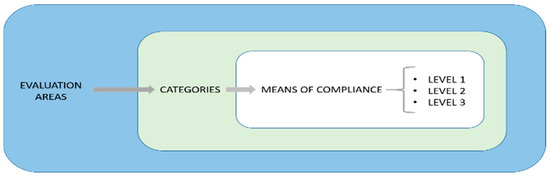
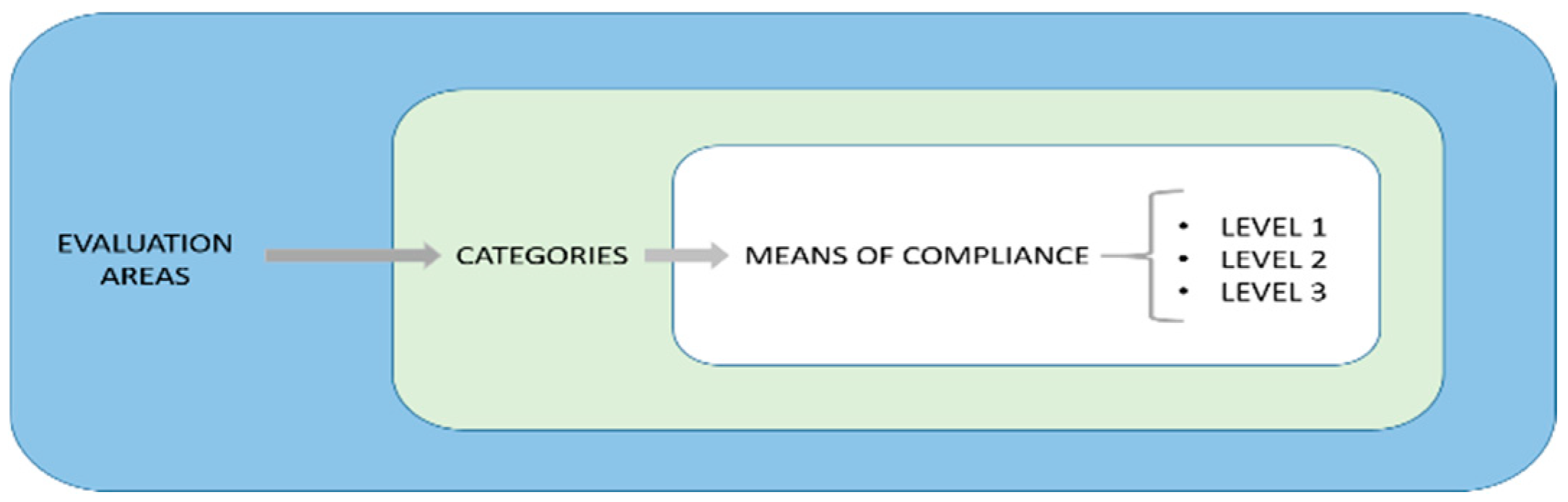
Each level of compliance is associated with specific training and requirements, adapted to the scope and demands of the endorsement. As the level increases, so does the complexity and depth of the competencies required. This tiered approach provides a scalable structure that supports both local and cross-border operational flexibility, while ensuring that the level of safety and regulatory oversight remains consistent across the system. Figure 1 illustrates the structure and key components of the CUCS methodology.
Figure 1.
Organizational methodology scheme.
The CUCS aims to provide a structured and harmonized methodological framework to support the definition of the currency requirements. By offering a common set of principles and evaluation criteria, it could enable ANSPs and National Competent Authorities (NCAs) to determine whether a proposed endorsement strategy satisfies the essential regulatory, safety and operational requirements.
3. Use Case: Evaluation Area—Planning and Management
To understand the CUCS framework, a reduced use case is presented to illustrate how an ANSP, which pretends to provide service in a flexible way, could use this methodology. This use case is reduced to the Evaluation Area Planning and Management, which focuses on how ANSPs organize the airspace and Air Traffic Control units in accordance with traffic demands, operational constraints and internal procedures.
3.1. Use Case Description
This section presents a scenario designed to explore how an ANSP can apply the proposed framework to meet operational needs. In this scenario, an ANSP intends to maintain its existing ATSU structure. However, increasing operational demands requires that ATCOs occasionally provide service in sectors outside their originally assigned unit.
Through this example, we assess how the methodology could enable different strategies to achieve a common goal; granting endorsements that reflect both operational flexibility and safety assurance.
3.2. Means of Compliance
To properly understand the scope of the methodology, Table 2 presents the MoCs related to the Planning and Management of four categories identified in this use case.
Table 2.
Planning and Management Evaluation Area.
Two different solutions will be presented. The two solutions are different applications of the CUCS, based on the reference scenario. These solutions aim to prove that CUCS is a flexible framework, and that ANSPs could develop different currency requirements complying with EU regulations depending on their endorsement strategy. After this, the summary of a validation activity with experts will be presented to demonstrate that CUCS could be beneficial.
3.3. Solution 1
The first solution for the use case is presented in Table 3. The CUCS methodology will be applied while preserving the existing unit endorsement, it is possible to achieve the objective outlined in the use case description. The key is leveraging the dynamic flexibility of the unit structure, enabling operational adaptations without altering the formal organization of the airspace.
Table 3.
Solution 1 MoCs selection.
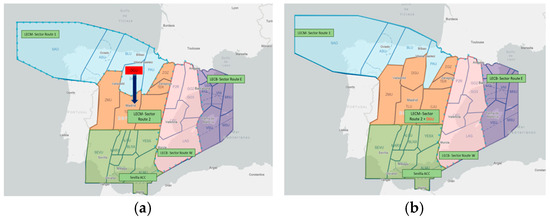
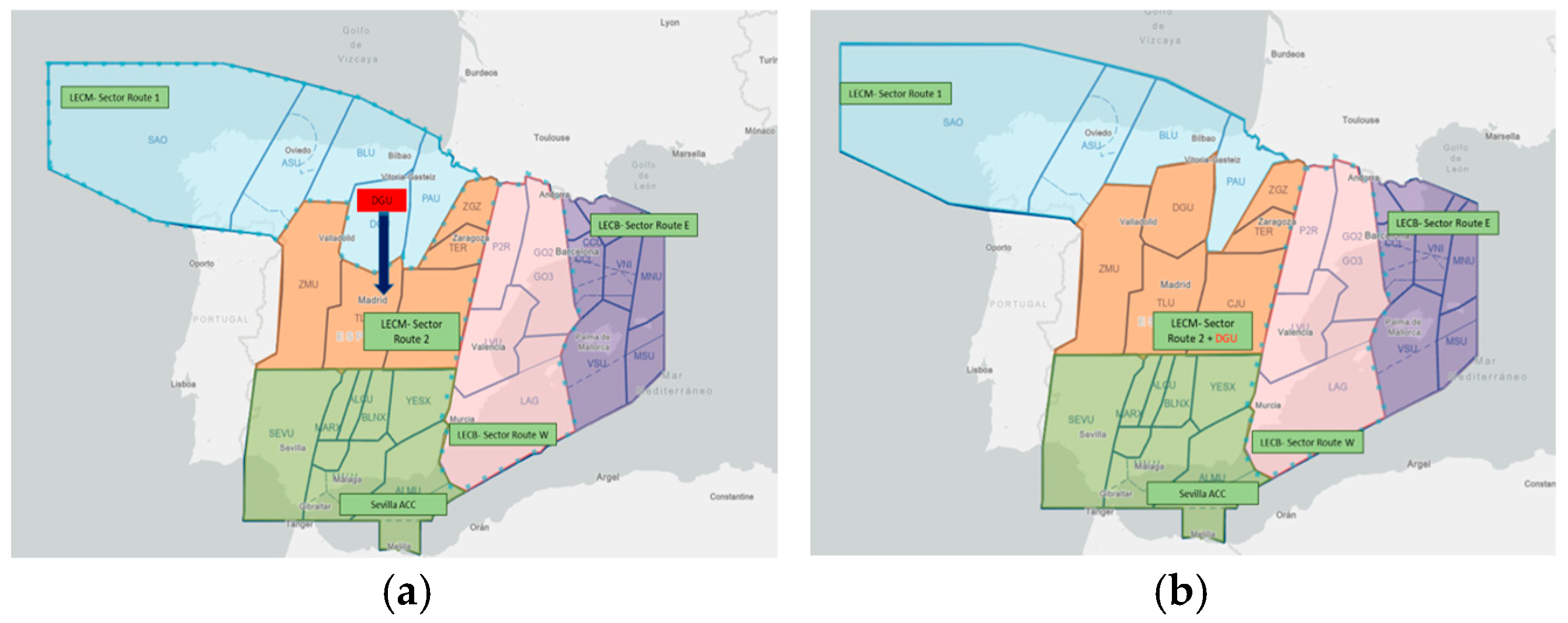
CUCS can demonstrate how, by maintaining the ATCO`s existing unit endorsement, operational flexibility can be achieved through a dynamic reorganization of the airspace structure within the unit. Instead of modifying controller endorsements, the flexibility comes from adapting how sectors are grouped and managed according to traffic demand over time. This is the strategy followed in Solution 1.
Figure 2 shows that, by maintaining a fixed ATCO endorsement and introducing a dynamic unit structure, ANSPs can reorganize the airspace as needed without retraining controllers, enhancing flexibility and operational efficiency.
Figure 2.
Solution 1 scheme. (a) Initial ATSUs organization in Solution 1. (b) ATSUs organization after change in DGU ATC sector in Solution 1.
3.4. Solution 2
As in the previous solution, the CUCS methodology is used to achieve the same operational objective in Solution 2, presented in Table 4. However, this solution follows a different path: the airspace structure within the unit remains fixed, while the focus shifts to the flexibility of the controller’s endorsement, allowing it to be adapted to cover sectors experiencing higher demand.
Table 4.
Solution 2 MoCs selection.
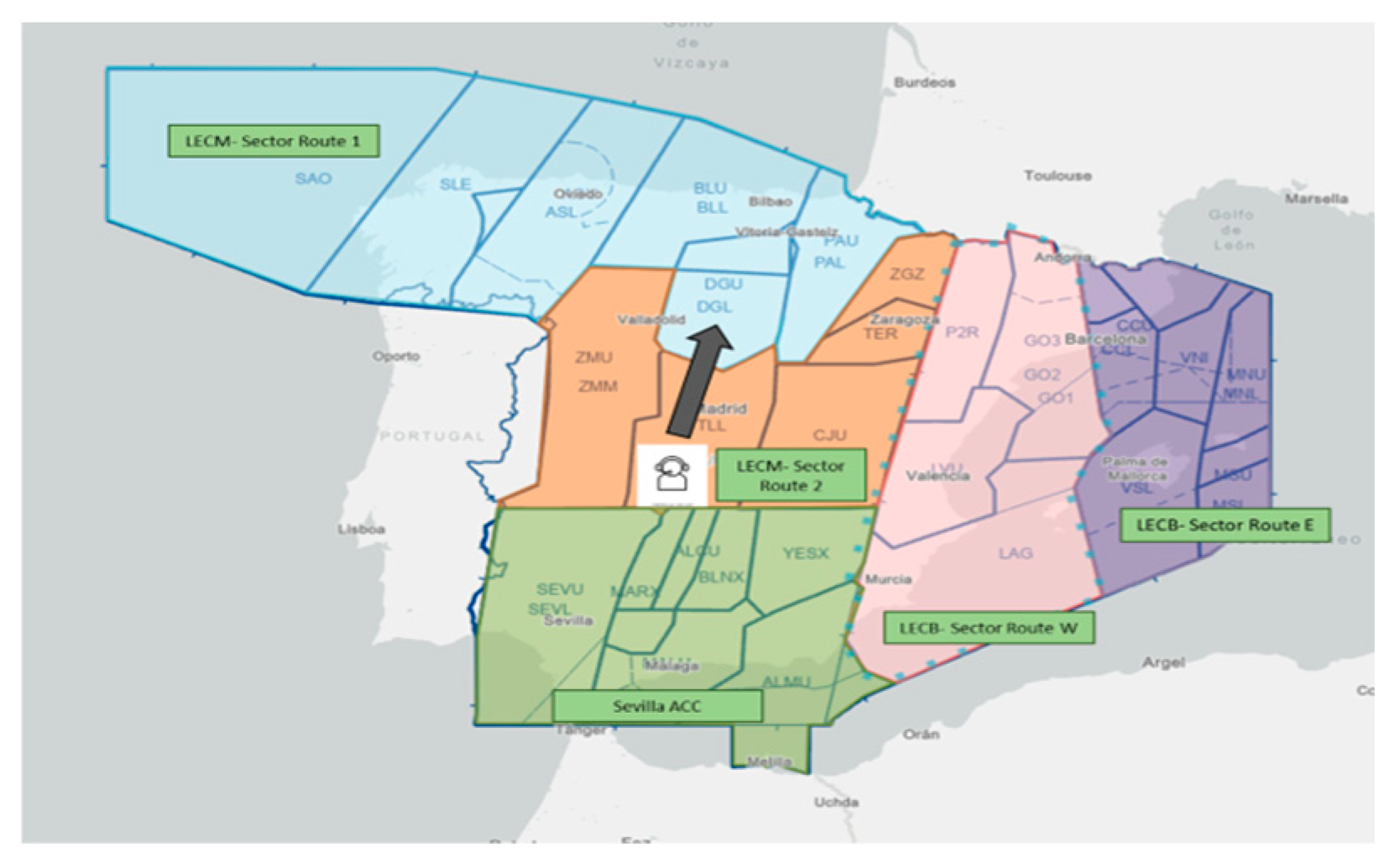
Based on the selected levels, this solution illustrates a more flexible endorsement strategy in which the structural organization of ATSUs and sector groups remains primarily geographic and static. However, the flexibility is introduced through the individualized endorsement scope, allowing ATCOs to be endorsed for a variable number of sectors based on their competencies and experience. This approach enables endorsements that go beyond the traditional limits of sector groupings or ATSUs, enhancing operational adaptability while maintaining a stable organizational baseline.
This scenario presented in Figure 3 highlights a strategy where flexibility is achieved through the ATCO’s endorsement rather than changes to the airspace structure. While the sector and ATSU organization remains fixed, selected controllers are endorsed to operate in sectors outside their designated ATSU, allowing for greater adaptability and optimized resource use without altering the existing airspace configuration.
Figure 3.
Solution 2 scheme.
3.5. Validation
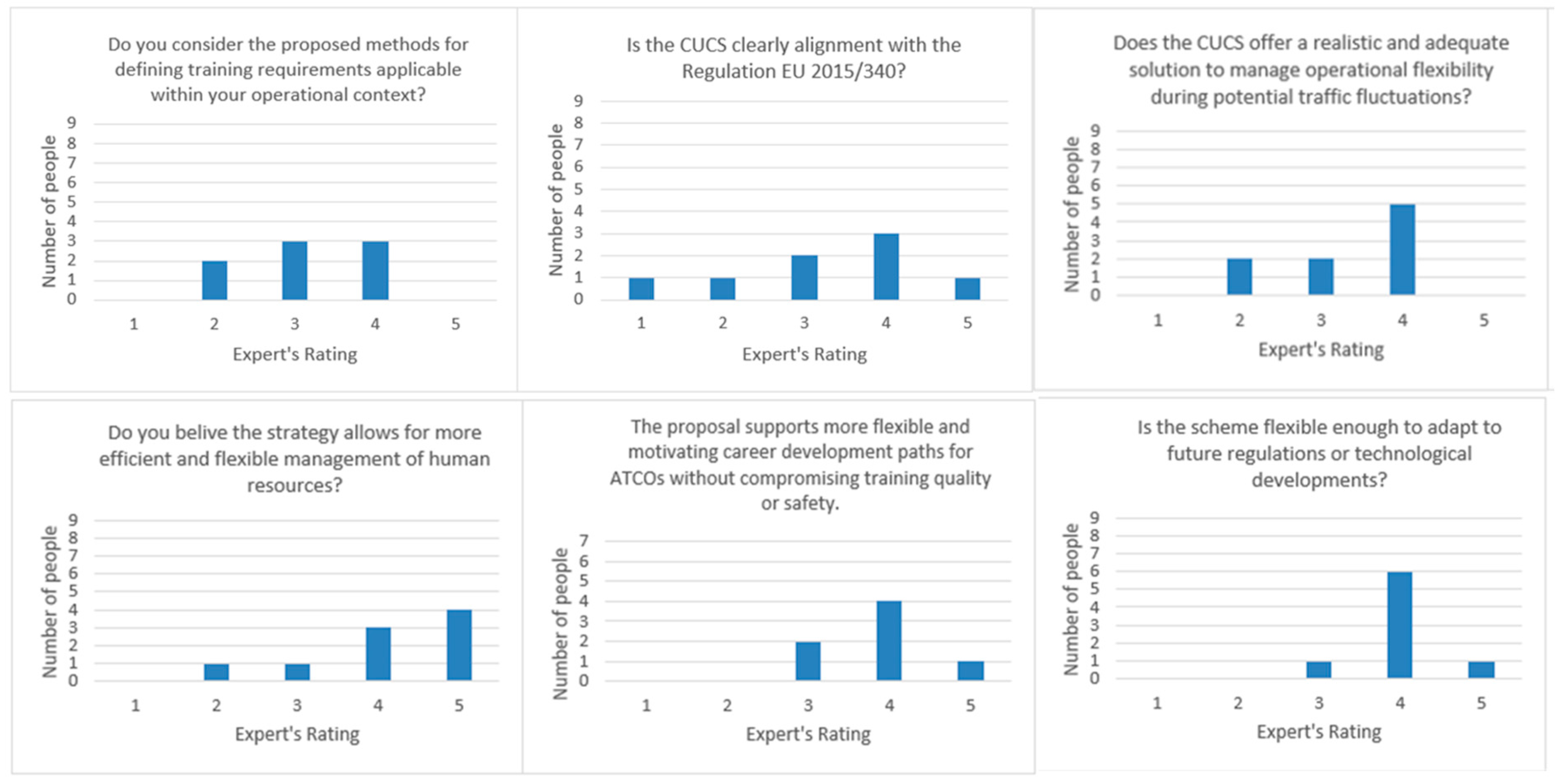
To validate the concept and fulfilment of the CUCS objective, a validation process has been carried out through expert judgement. As it falls within the IFAV3 framework, it has been possible to count on the participation of different ANSPs that have developed the proposed use cases. In addition to different European companies, ATC training organizations and universities have also participated. Figure 4 presents the main results of the surveys carried out.
Figure 4.
CUCS validation survey results.
These results, which are mostly satisfactory, lead to the conclusion that CUCS may be a measure that primarily benefits the creation of currency requirements associated with technological improvements in ANSPs and better human resources management. In addition, it may allow for more flexible and appropriate rostering in the face of fluctuations. The greatest variety in results was found in compliance with Regulation (EU) 2015/340 and feasibility in the current operating environment. Compliance with the regulation may be due to the interpretation of the rule by Member States. Although the regulation is very flexible, the subsequent adoption of the rule by Member States may hinder the development of the CUCS in certain respects. Feasibility in the current operating environment may be due to different factors, although within the CUCS, MoC level 1 has been considered to describe the current situation, so this level would include the current currency requirements of ANSPs.
4. Conclusions
The CUCS aims to provide a common competency framework that balances standardization with flexibility in the management of ATCOs’ rostering. Overcoming the limitations of the traditional model, the CUCS intends ANSPs to tailor their currency requirements to be aligned with their strategies.
One of the main strengths of this methodology lies in the design and choice of different MoCs, which allows each ANSP to select the implementation path that best fits operational strategy. This flexibility should not compromise either safety or regulatory compliance.
At the same time, interoperability is intended to be strengthened; the recognition of CUCS by different states could permit ATCOs to operate more flexibly across sectors or even ATS units.
Ultimately, the CUCS could contribute to building a more robust, flexible and standardized airspace, where competition schemes are not only safe and compliant but also adapt to current and future operational challenges.
Author Contributions
Conceptualization, M.H.S.; methodology, F.P.M.; software, R.D.-A.J.; validation, R.D.-A.J.; formal analysis, M.Z.S.; investigation, M.H.S.; resources, V.F.G.C.; data curation, C.G.A.; writing—original draft preparation, F.P.M.; writing—review and editing, M.Z.S.; supervision, C.G.A.; project administration, V.F.G.C. All authors have read and agreed to the published version of the manuscript.
Funding
The IFAV3 project has received funding from the SESAR 3 Joint Undertaking under grant agreement No 101114683 under European Union’s Horizon Europe research and innovation programme.
Data Availability Statement
The data presented in this study are available on request from the corresponding author.
Conflicts of Interest
The authors declare no conflicts of interest.
References
- Brázdilová, S.; Cásek, P.; Kubalcík, J. Air traffic complexity for a distributed air traffic management system. Proc. Inst. Mech. Eng. Part G-J. Aerosp. Eng. 2011, 225, 665–674. [Google Scholar] [CrossRef] [Scilit]
- Hongyong, W.; Ziqi, S.; Ruiying, W.; Zhao, Y. Study on evolution characteristics of air traffic situation complexity based on complex network theory. Aerosp. Sci. Technol. 2016, 58, 518–528. [Google Scholar] [CrossRef] [Scilit]
- Radišić, T.; Novak, D.; Juričić, B. Reduction of Air Traffic Complexity Using Trajectory-Based Operations and Validation of Novel Complexity Indicators. IEEE Trans. Intell. Transp. Syst. 2017, 18, 3038–3048. [Google Scholar] [CrossRef] [Scilit]
- Antulov-Fantulin, B.; Juricic, B.; Radisic, T.; Çetek, C. Determining Air Traffic Complexity Challenges and Future Development. Promet-Traffic Transp. 2020, 32, 475–485. [Google Scholar] [CrossRef] [Scilit]
- Suárez, M.; Valdés, R.; Moreno, F.; Jurado, R.; de Frutos, P.; Comendador, V. Understanding the research on air traffic controller workload and its implications for safety: A science mapping-based analysis. Saf. Sci. 2024, 176, 106545. [Google Scholar] [CrossRef] [Scilit]
- Balta, E.; Psarrakis, A.; Vatakis, A. The effects of increased mental workload of air traffic controllers on time perception: Behavioral and physiological evidence. Appl. Ergon. 2024, 115, 104162. [Google Scholar] [CrossRef] [Scilit] [PubMed]
- Moreno, F.; Comendador, V.; Jurado, R.; Janisch, D.; Valdés, R. Determination of Air Traffic Complexity Most Influential Parameters Based on Machine Learning Models. Symmetry 2022, 14, 2629. [Google Scholar] [CrossRef] [Scilit]
- Zhang, X.; Liu, H.; Zhao, Y.; Zhang, X. Multifractal detrended fluctuation analysis on air traffic flow time series: A single airport case. Phys. A-Statical Mech. Its Appl. 2019, 531, 121790. [Google Scholar] [CrossRef] [Scilit]
- Comendador, V.G.; Valdés, R.A.; Sanz, L.P. New Air Traffic Control Markets Promoted by Single Sky Regulation in Spain. J. Aircr. 2011, 48, 1456–1465. [Google Scholar] [CrossRef] [Scilit]
- Jurado, R.; Ye, X.; Plaza, V.; Suárez, M.; Moreno, F.; Valdés, R. An introduction to the current state of standardization and certification on military AI applications. J. AIR Transp. Manag. 2024, 121, 102685. [Google Scholar] [CrossRef] [Scilit]
- O’Neil, P. High Reliability Systems and the Provision of a Critical Transportation Service. J. Contingencies Crisis Manag. 2011, 19, 158–168. [Google Scholar] [CrossRef] [Scilit]
- Leones, J.; Morales, M.; D’Alto, L.; Escalonilla, P.; Herrer, D.; Bravo, M.; Cámara, F.; Mateo, A.; Wang, M.N.B.S.; Grover, A.; et al. Advanced Flight Efficiency Key Performance Indicators to support Air Traffic Analytics: Assessment of European flight efficiency using ADS-B data. In IEEE-AIAA Digital Avionics Systems Conference; IEEE: New York, NY, USA, 2019; pp. 1122–1131. [Google Scholar]

Disclaimer/Publisher’s Note: The statements, opinions and data contained in all publications are solely those of the individual author(s) and contributor(s) and not of MDPI and/or the editor(s). MDPI and/or the editor(s) disclaim responsibility for any injury to people or property resulting from any ideas, methods, instructions or products referred to in the content. |
© 2026 by the authors. Licensee MDPI, Basel, Switzerland. This article is an open access article distributed under the terms and conditions of the Creative Commons Attribution (CC BY) license.