


Abstract
We designed and implemented facial recognition smart glasses to assist visually impaired individuals in recognizing people and navigating their environment safely and independently. The smart glasses utilize a Raspberry Pi 4 as the processing unit, integrating a Pi Camera for facial recognition and a USB camera for object detection. A face recognition library is employed to extract 128-dimensional facial embeddings using a convolutional neural network, enabling real-time face identification at close range (100–500 cm) under proper lighting conditions. Object detection is performed using a YOLOv5-based model, while ultrasonic sensors provide proximity alerts through audio feedback. Real-time processing is optimized to minimize latency and protect user privacy. The smart glasses were tested on participants with varying levels of visual impairment, including low vision, legal blindness, and total blindness. The system achieved an overall facial recognition accuracy of 88.89% and an object detection accuracy of 61.11%. The results demonstrate the viability of edge-AI wearable devices in assistive technology, with user feedback highlighting strengths in audio feedback and recognition accuracy, as well as areas for improvement, such as device comfort and low-light performance.
1. Introduction
Recent studies have explored wearable assistive technologies designed to improve mobility, object detection, and facial recognition for visually impaired individuals [1,2,3,4,5]. Several systems integrate obstacle avoidance, navigation, and user-centered design principles to improve accessibility and usability [6,7,8,9,10]. These technologies aim to improve the independence and quality of life of visually impaired users. According to the World Health Organization, over 285 million people worldwide live with visual impairment [11]. Commercial assistive devices such as Google Glass and OrCam also provide support for visually impaired users; however, these systems remain expensive and may experience limitations under poor lighting or crowded environments [12].
This study aims to address these gaps by developing smart glasses capable of performing facial recognition, object detection, and obstacle sensing while delivering real-time audio and haptic feedback. The objectives were: (1) to design and implement a wearable system that integrates recognition and detection functions on an embedded platform; (2) to test the system in real-world conditions across users with varying levels of visual impairment; and (3) to evaluate its usability, power efficiency, and overall effectiveness.
2. Materials and Methods
2.1. Hardware Components
The smart glasses were developed using a Raspberry Pi 4 Model B (Cambridge, UK) as the central processing unit. A Pi Camera was installed to perform facial recognition, while a USB camera was used for object detection. An ultrasonic sensor was integrated to detect obstacles within close range. Additional components, including an LED and a buzzer, provided visual and auditory alerts to the user. The device was powered by a 10,000 mAh power bank to ensure portability and extended operation.
2.2. Software
The software was developed in Python 3.11 utilizing multiple libraries to implement recognition and feedback functionalities. OpenCV version 4.10 was employed for image preprocessing, while the face_recognition library version 1.3.0 was used for facial feature extraction and matching [4,13]. Object detection was implemented using the YOLOv5 deep learning model based on MobileNet architectures [14]. Audio feedback was generated using the eSpeak text-to-speech engine version 1.48, providing real-time verbal guidance to the user.
2.3. Prototype Design
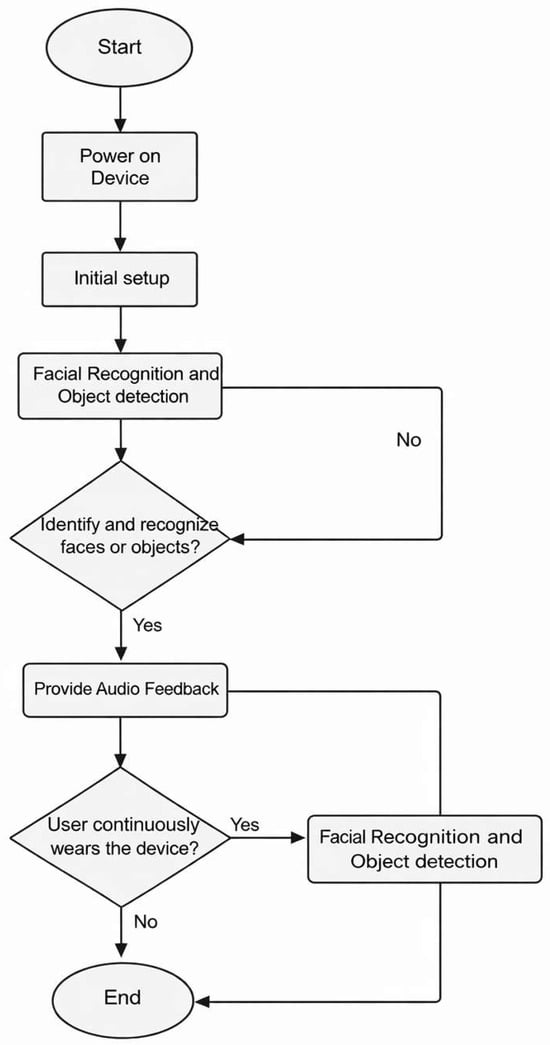
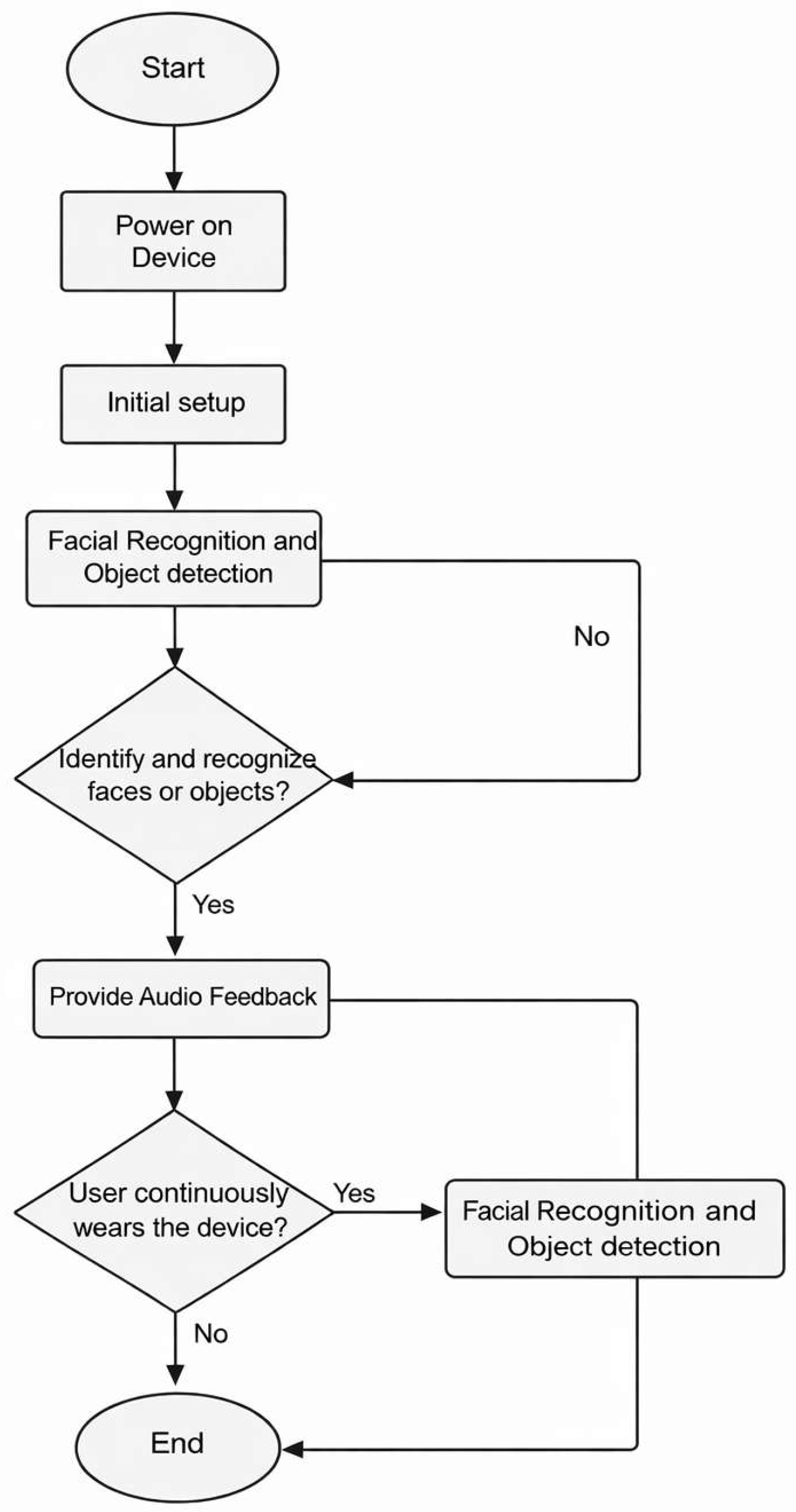
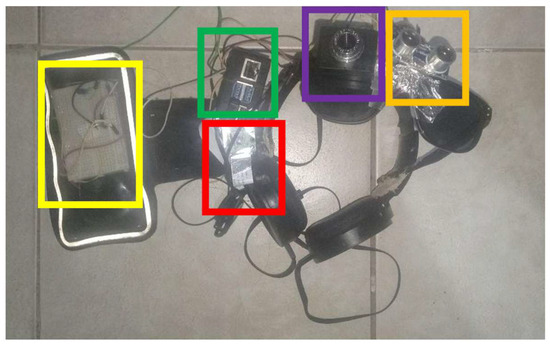
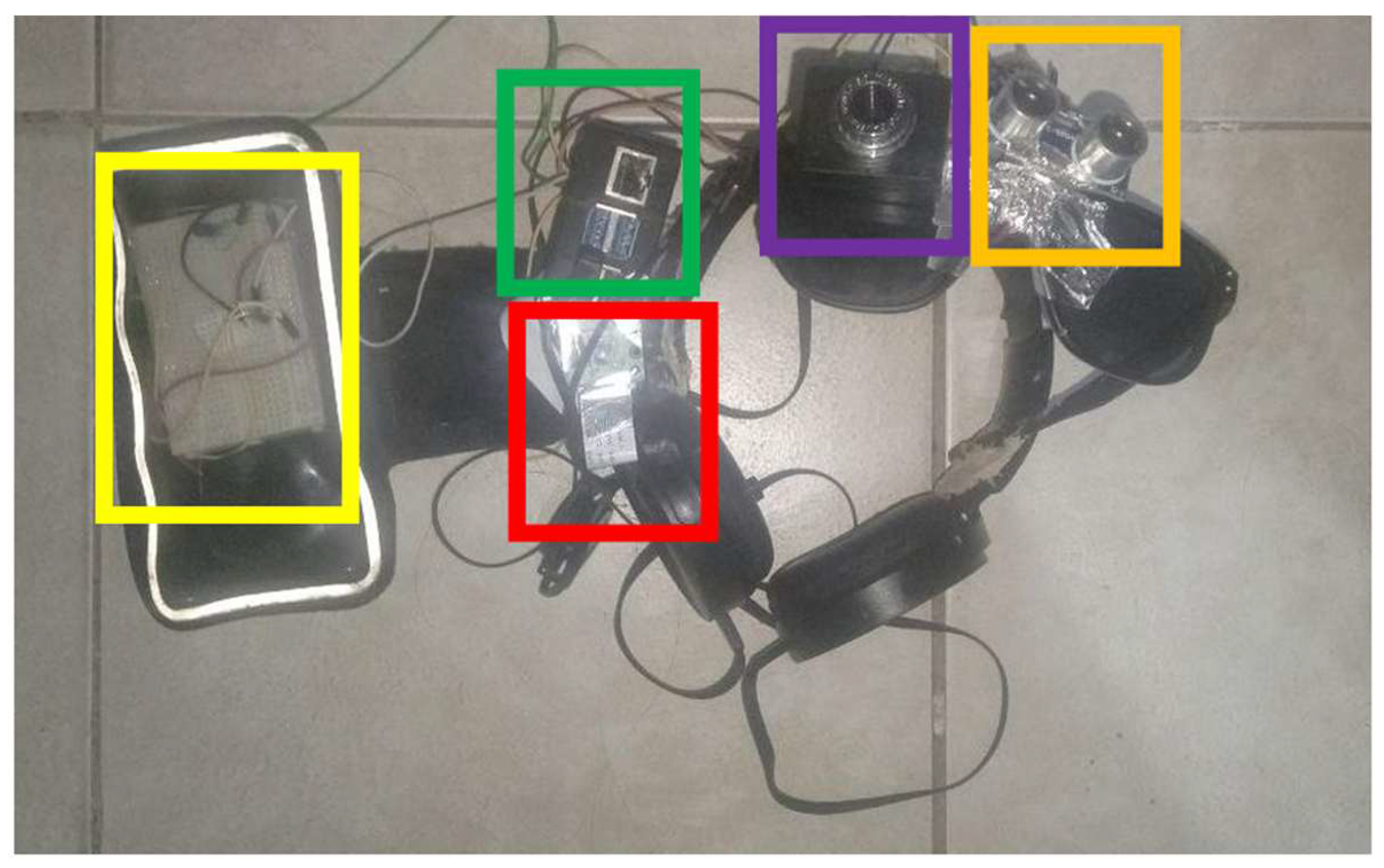
The hardware components were mounted onto an eyeglass frame to form a wearable smart glasses prototype. The Raspberry Pi Camera (Cambridge, UK) and USB camera were positioned at the front to enable optimal data acquisition, while the ultrasonic sensor was oriented forward to measure obstacle distance. The system architecture allows the Raspberry Pi to process inputs in real time and deliver feedback through audio, LED, and buzzer outputs. Figure 1 illustrates the system flowchart, while Figure 2 shows the assembled smart glasses with labeled components.
Figure 1.
System process.
Figure 2.
Prototype smart glasses. The different colored boxes highlight the major system components: the yellow box indicates the breadboard and circuit connections, the green box shows the processing unit, the red box represents the power supply module, while the purple and orange boxes correspond to the camera and ultrasonic sensors used for object detection and distance measurement.
2.4. Testing Procedure
The smart glasses were evaluated with nine participants representing three categories of visual impairment: low vision, legal blindness, and total blindness. Each participant completed structured trials designed to assess system recognition performance and overall usability. Testing was conducted under varying conditions, including distances of 3–5 m, angles ranging from 0° to 30°, and different lighting environments (well-lit and low-light).
Key performance metrics were measured, including facial recognition accuracy, object detection success rate, and sensor reliability. In addition, participants provided subjective feedback through a Likert scale questionnaire evaluating comfort, audio clarity, ease of use, and overall usability. The evaluation methodology and usability metrics were adapted from prior studies on assistive technologies and wearable systems for visually impaired users [3,9,15,16,17].
Figure 2 illustrates the hardware setup used during testing. The different colored boxes highlight the major system components: the yellow box indicates the breadboard and circuit connections, the green box shows the processing unit, the red box represents the power supply module, while the purple and orange boxes correspond to the camera and ultrasonic sensors used for object detection and distance measurement.
3. Results and Discussion
3.1. Facial Recognition and Object Detection
The facial recognition module achieved an overall accuracy of 88.89%, with optimal performance observed at approximately 1 m under well-lit conditions. Recognition accuracy declined noticeably at greater distances and when the user was positioned at an angle. Object detection yielded an accuracy of 61.11%, demonstrating stronger performance for medium-sized objects, such as wallets and notebooks, but reduced effectiveness for small or partially occluded items (Table 1). These findings are consistent with previous studies that highlight the limitations of wearable assistive devices in terms of distance sensitivity, environmental conditions, and real-time processing constraints [18,19,20].
Table 1.
Recognition accuracy under different conditions.
3.2. User Feedback
Table 2 shows that the participants rated the system positively overall (3.8/5). Audio clarity received the highest score (4.0/5), with most users reporting that voice feedback was understandable and useful for navigation. Comfort was rated lower (3.0/5) due to the heaviness of the smart glasses, which limited prolonged use. Ease of use was scored at 3.5/5, indicating that while the system was generally intuitive, some users found the multiple feedback modes slightly complex.
Table 2.
User feedback score (Likert scale, 1–5).
3.3. Power Consumption
Table 3 shows that the power consumption ranged between 2.75 W (facial recognition only) and 5.5 W (with both recognition and detection active). This allowed an estimated operating time of 9–18 h with a 10,000 mAh power bank.
Table 3.
Power consumption and estimated runtime.
4. Conclusions
The smart glasses developed in this study demonstrate the potential of wearable assistive technology for individuals with visual impairments. The system exhibited high accuracy in close-range facial recognition, effective audio feedback, and usability across varying levels of impairment. User trials indicated improvements in participant confidence and perceived independence, supporting the viability of the device as a practical assistive tool. The system’s low-cost, open-source design integrates facial recognition, object detection, and obstacle awareness into a single wearable platform. Compared with existing commercial solutions, the proposed smart glasses offer enhanced accessibility, flexibility, and adaptability.
Despite these promising results, several limitations were identified. System accuracy decreased at longer distances; the hardware configuration remained relatively bulky, and object detection performance was moderate in cluttered environments. Future work should focus on hardware miniaturization, expansion and refinement of training datasets, improved low-light performance, and the integration of energy-efficient processing units, such as the Coral TPU. Additionally, longer-term evaluations with a larger participant base, as well as potential integration with mobile or cloud-based systems, are recommended to further validate real-world applicability.
Author Contributions
Conceptualization, A.J.E. and R.G.; methodology, A.J.E.; software, A.J.E.; validation, A.J.E. and R.G.; formal analysis, A.J.E.; investigation, A.J.E.; resources, A.J.E.; data curation, A.J.E.; writing—original draft preparation, A.J.E.; writing—review and editing, A.J.E.; visualization, A.J.E.; supervision, A.J.E.; project administration, A.J.E.; funding acquisition, R.G. All authors have read and agreed to the published version of the manuscript.
Funding
This research received no external funding.
Data Availability Statement
The data presented in this study are available within the article. Additional data are not publicly available due to privacy and ethical restrictions.
Conflicts of Interest
The authors declare no conflict of interest.
References
- Shen, H.; Chun, T.; Hu, J. Google Glass-Based System for Assisting Blind and Visually Impaired People. Int. J. Inf. Syst. Crisis Response Manag. 2014, 6, 27–43. [Google Scholar]
- Bougharriou, N.; Wali, A.; Trabelsi, A. Facial Recognition System Embedded in a Wearable Assistive Device for Visually Impaired Persons. Procedia Comput. Sci. 2017, 113, 346–352. [Google Scholar]
- Manjari, K.; Verma, M.; Singal, G. A survey on Assistive Technology for visually impaired. Internet Things 2020, 11, 100188. [Google Scholar] [CrossRef] [Scilit]
- Wang, M.; Deng, W. Deep Face Recognition: A Survey. Neurocomputing 2021, 429, 215–244. [Google Scholar] [CrossRef] [Scilit]
- Țapu, R.; Mocanu, B.; Zaharia, T. Wearable Assistive Devices for Visually Impaired: A State of the Art Survey. Pattern Recognit. Lett. 2020, 137, 37–52. [Google Scholar] [CrossRef] [Scilit]
- Tachiquin, R.; Velázquez, R.; Del-Valle-Soto, C.; Gutiérrez, C.A.; Carrasco, M.; De Fazio, R.; Trujillo-León, A.; Visconti, P.; Vidal-Verdú, F. Wearable Urban Mobility Assistive Device for Visually Impaired Pedestrians Using a Smartphone and a Tactile-Foot Interface. Sensors 2021, 21, 5274. [Google Scholar] [CrossRef] [Scilit] [PubMed]
- Katz, B.; Shahar, S. Usability of Wearable Devices for Visually Impaired Individuals. J. Assist. Technol. 2015, 9, 162–173. [Google Scholar]
- Dakopoulos, D.; Bourbakis, N.G. Wearable Obstacle Avoidance Electronic Travel Aids for Blind: A Survey. IEEE Trans. Syst. Man Cybern. 2010, 40, 25–35. [Google Scholar] [CrossRef] [Scilit]
- Gupta, V.; Puri, V.; Singh, R. User-Centered Design in Assistive Technologies for the Visually Impaired. IEEE Trans. Hum.-Mach. Syst. 2017, 47, 1–12. [Google Scholar]
- Chen, Y.; Shen, J.; Sawada, H. A wearable assistive system for the visually impaired using object detection, distance measurement and tactile presentation. Intell. Robot. 2023, 3, 420–435. [Google Scholar] [CrossRef] [Scilit]
- World Health Organization. Visual Impairment and Blindness. Available online: https://www.who.int/news-room/fact-sheets/detail/blindness-and-visual-impairment (accessed on 20 February 2026).
- OrCam Technologies. OrCam MyEye: Smart Wearable Device. Available online: https://www.orcam.com (accessed on 20 February 2026).
- Schroff, F.; Kalenichenko, D.; Philbin, J. FaceNet: A unified embedding for face recognition and clustering. In Proceedings of the IEEE Conference on Computer Vision and Pattern Recognition (CVPR), Boston, MA, USA, 7–12 June 2015; pp. 815–823. [Google Scholar]
- Howard, A.G.; Zhu, M.; Chen, B.; Kalenichenko, D.; Wang, W.; Weyand, T.; Andreetto, M.; Adam, H. MobileNets: Efficient Convolutional Neural Networks for Mobile Vision Applications. arXiv 2017, arXiv:1704.04861. [Google Scholar] [CrossRef] [Scilit]
- Liu, H. Evaluation Metrics for Face and Object Recognition in Assistive Devices for the Visually Impaired. Int. J. Adv. Comput. Sci. Appl. 2020, 11, 531–540. [Google Scholar]
- Liu, H. Development and Field Testing of Smart Glasses for Assisting Visually Impaired Individuals in Urban Environments. IEEE Access 2020, 8, 12009–12018. [Google Scholar]
- Chawla, S.; Prakash, A. Assistive Technology for the Visually Impaired in Public Transport Settings: Smart Glasses for Object and Face Detection. J. Transp. Technol. 2021, 11, 105–113. [Google Scholar]
- Buolamwini, J.; Gebru, T. Gender Shades: Intersectional Accuracy Disparities in Commercial Gender Classification. In Proceedings of the 1st Conference on Fairness, Accountability and Transparency, New York, NY, USA, 23–24 February 2018. [Google Scholar]
- Kim, J.; Cho, Y. Testing Assistive Smart Glasses for Classroom Settings. Assist. Technol. Res. 2019, 17, 137–146. [Google Scholar]
- Nahar, P.E. Smart Glasses for Visual Impairment: Home and Office Testing. J. Assist. Technol. Home Off. Environ. 2020, 7, 120–130. [Google Scholar]

Disclaimer/Publisher’s Note: The statements, opinions and data contained in all publications are solely those of the individual author(s) and contributor(s) and not of MDPI and/or the editor(s). MDPI and/or the editor(s) disclaim responsibility for any injury to people or property resulting from any ideas, methods, instructions or products referred to in the content. |
© 2026 by the authors. Licensee MDPI, Basel, Switzerland. This article is an open access article distributed under the terms and conditions of the Creative Commons Attribution (CC BY) license.