

Proceeding Paper

Time-Sensitive Networking and Time Scheduling Mechanisms for 5G Networks †
Broadband Networks Laboratory, Chunghwa Telecom Laboratories, Taoyuan 326, Taiwan
*
Author to whom correspondence should be addressed.
Presented at the 7th Eurasia Conference on IoT, Communication and Engineering 2025 (ECICE 2025), Yunlin, Taiwan, 14–16 November 2025.
Eng. Proc. 2026, 134(1), 8; https://doi.org/10.3390/engproc2026134008
Published: 30 March 2026

Abstract

With the rapid development of 5G communication technology, 5G networks are designed to achieve three major objectives: higher bandwidth, support for a greater number of connected devices, and lower latency. It is necessary to meet the requirements of the three primary 5G application scenarios: Enhanced Mobile Broadband, Massive Machine-Type Communications, and Ultra-Reliable and Low Latency Communications (uRLLC). To meet the stringent requirements for time synchronization and low latency, 5G is being integrated with Ethernet-based Time-Sensitive Networking (TSN) technologies. TSN plays an important role in achieving time determinism in uRLLC scenarios and ensures low-latency and high-reliability Ethernet communication through the transmission of time signals that are also known as the Precision Time Protocol. We applied TSN technology in the Institute of Electrical and Electronics Engineers 802.1Qbv standard and evaluated its transmission delay performance. Modifying the gate control list (GCL) to accommodate varying network traffic ensures low-latency transmission for high-priority traffic. We propose two GCL configurations for TSN that incorporate time-aware shaper to achieve efficient traffic scheduling.
Keywords:
5G; TSN; PTP; GCL

1. Introduction

With the ongoing advancement of 5G application scenarios and enabling technologies, the global telecommunications market is increasingly shifting towards 5G-based network architectures, aiming to achieve higher bandwidth, lower latency, and greater connection density. However, to meet the stringent requirements of emerging 5G use cases—such as Vehicle-to-Everything (V2X), remote healthcare, and industrial automation—relying solely on wireless communication technologies is insufficient to guarantee end-to-end deterministic communication. Therefore, to further enhance capabilities in time synchronization, transmission stability, and quality of service (QoS) assurance within communication systems, both industry stakeholders and standards organizations have begun integrating Time-Sensitive Networking (TSN) technology into 5G network architectures [1]. TSN, a series of Ethernet standards developed by the Institute of Electrical and Electronics Engineers (IEEE) 802, is designed to enable low-latency, low-jitter, and highly reliable data transmission, while also supporting precise time synchronization and deterministic traffic scheduling. By leveraging TSN technology, conventional non-deterministic Ethernet networks can achieve industrial-grade timing accuracy and transmission reliability, thereby meeting the stringent requirements of applications such as industrial automation that demand high levels of time synchronization.
Recently, the integration of 5G wireless communication and TSN technologies has garnered increasing attention [2]. 3rd Generation Partnership Project (3GPP) Releases 16 and 17 have formally incorporated TSN bridging and coordination mechanisms, along with network architectures that support centralized scheduling [3]. This integration not only enables 5G systems to provide flexible deployment models and wide-area wireless access but also facilitates end-to-end time synchronization and low-latency transmission, thereby meeting the deterministic communication requirements of applications such as industrial control and V2X.
TSN is an extension of traditional Ethernet, designed to ensure deterministic and low-latency transmission of time-critical data through the incorporation of various mechanisms. TSN supports a range of key functionalities, including traffic shaping, priority scheduling, and time synchronization. In the time synchronization domain, the Precision Time Protocol (PTP) is a fundamental communication protocol that enables nanosecond-level time synchronization and is widely adopted in high-precision networking environments [4,5]. The IEEE 802.1AS generalized PTP (gPTP) master clock periodically broadcasts synchronization messages to slave clocks, which then calculate the round-trip delay through synchronization message exchanges [6]. Based on these timestamps and delay information, the slave clock aligns its local clock to achieve synchronization with the master clock.
Among these, the IEEE 802.1Qbv standard introduces the concept of time slots for scheduling data transmissions [7]. Each time slot is dedicated to specific data flows based on their priority levels and timing requirements. Traffic shaping regulates data flow to ensure that no individual stream exceeds the network’s capacity, thereby reducing congestion and latency. Priority scheduling enables the network to control the timing and sequence of packet transmissions, ensuring that high-priority, time-sensitive data is delivered within its assigned time window. Time synchronization is accomplished by embedding timestamps into packets, enabling microsecond-level synchronization between devices within a local area network [8].

2. Results and Discussion

TSN comprises multiple standards designed to meet the strict timing requirements of real-time systems. Among them, IEEE Std 802.1Qbv is one of the core standards. It introduces the concept of transmission gates, where each queue is assigned a gate that controls the selection and transmission of data streams. A gate control list (GCL) defines the opening and closing of these gates, enabling precise transmission scheduling and ensuring deterministic latency for time-sensitive packets.
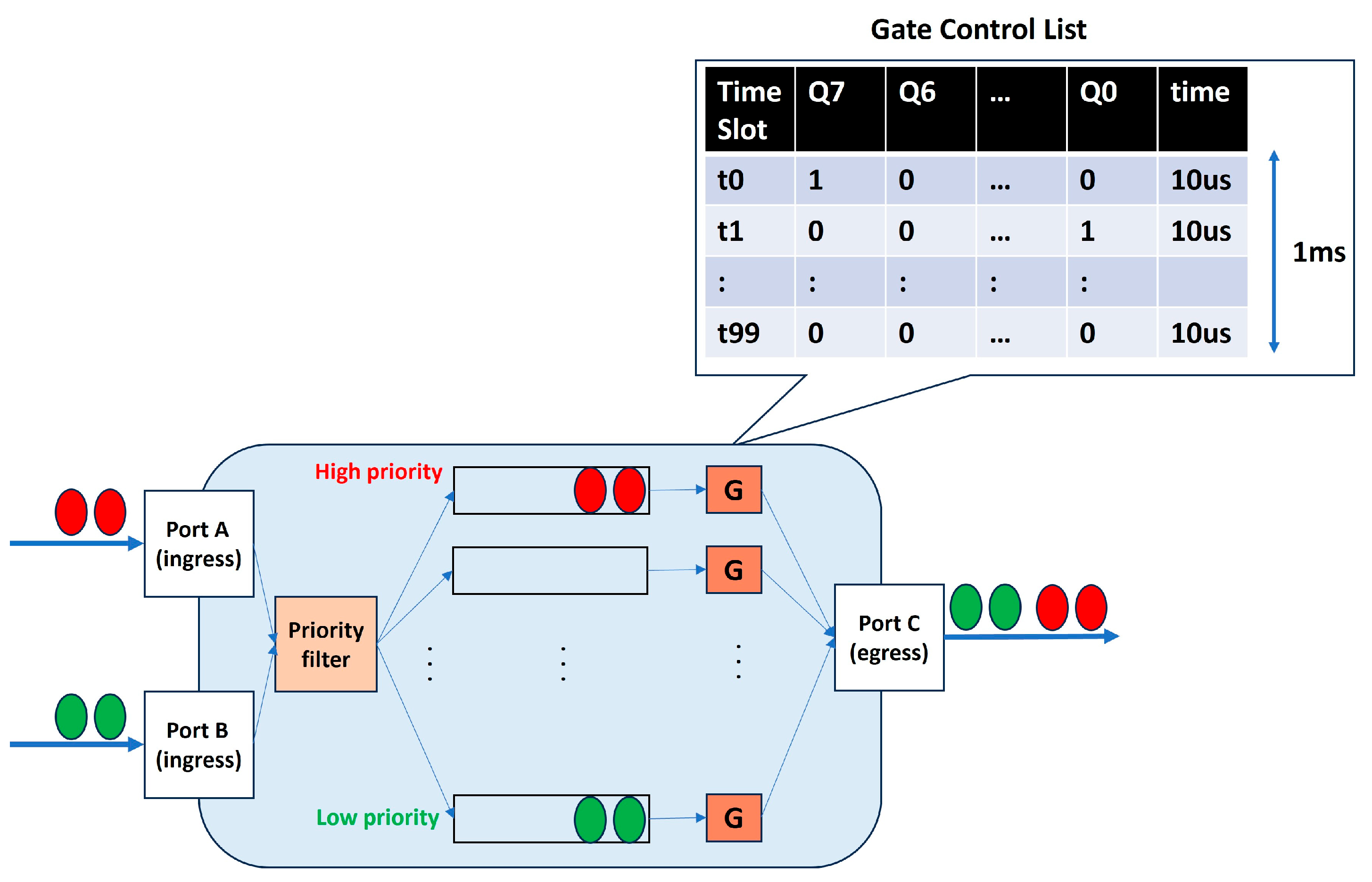
It also defines a time-aware shaper (TAS) mechanism that schedules traffic by opening and closing gates according to the GCL, thereby ensuring the timing determinism of time-sensitive packets. In TAS, each egress port is associated with a periodic gating schedule during which no other interfering traffic is allowed. As shown in Figure 1, packets are first classified into queues based on their priority, after which gate operations are executed according to GCL [9,10]. These operations control the transmission gate state for each traffic queue on the port. Each queue has a logical switch, called a gate: a value of 1 indicates that the gate is open and traffic in that queue can be transmitted; a value of 0 indicates that it is closed. GCL operates in a repeating cycle, periodically opening and closing the gates as defined by the schedule.
TSN IEEE 802.1Qbv [11] uses the TAS and GCL mechanisms to schedule traffic, ensuring dedicated bandwidth for transmissions within specific time windows [12]. Similar to 5G Time Division Duplexing (TDD), it applies time-slicing techniques to allocate time slots for different types of communication, thereby ensuring timely and efficient data delivery while minimizing interference.
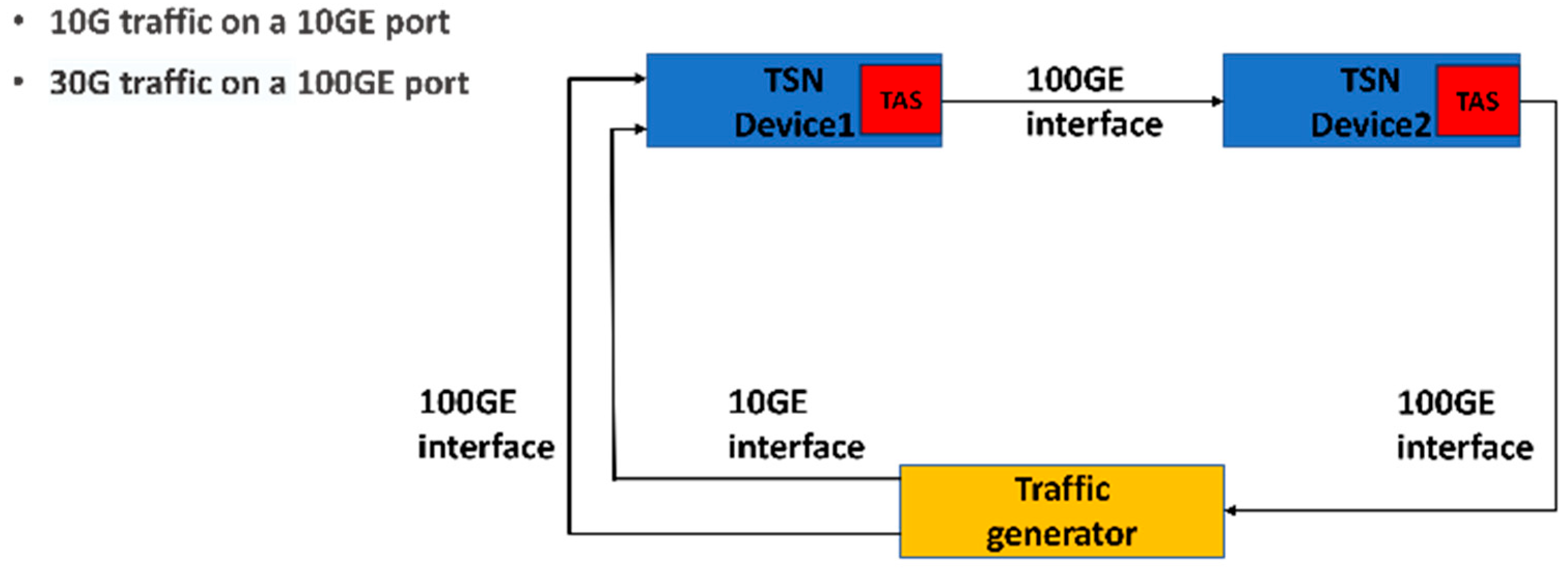
A traffic generator was employed to generate Ethernet packets of various sizes, which were transmitted over Ethernet interfaces operating at different data rates with the TAS function enabled. Latency measurements were conducted for each data rate, and the results are summarized in Table 1. The corresponding test architecture is shown in Figure 2.
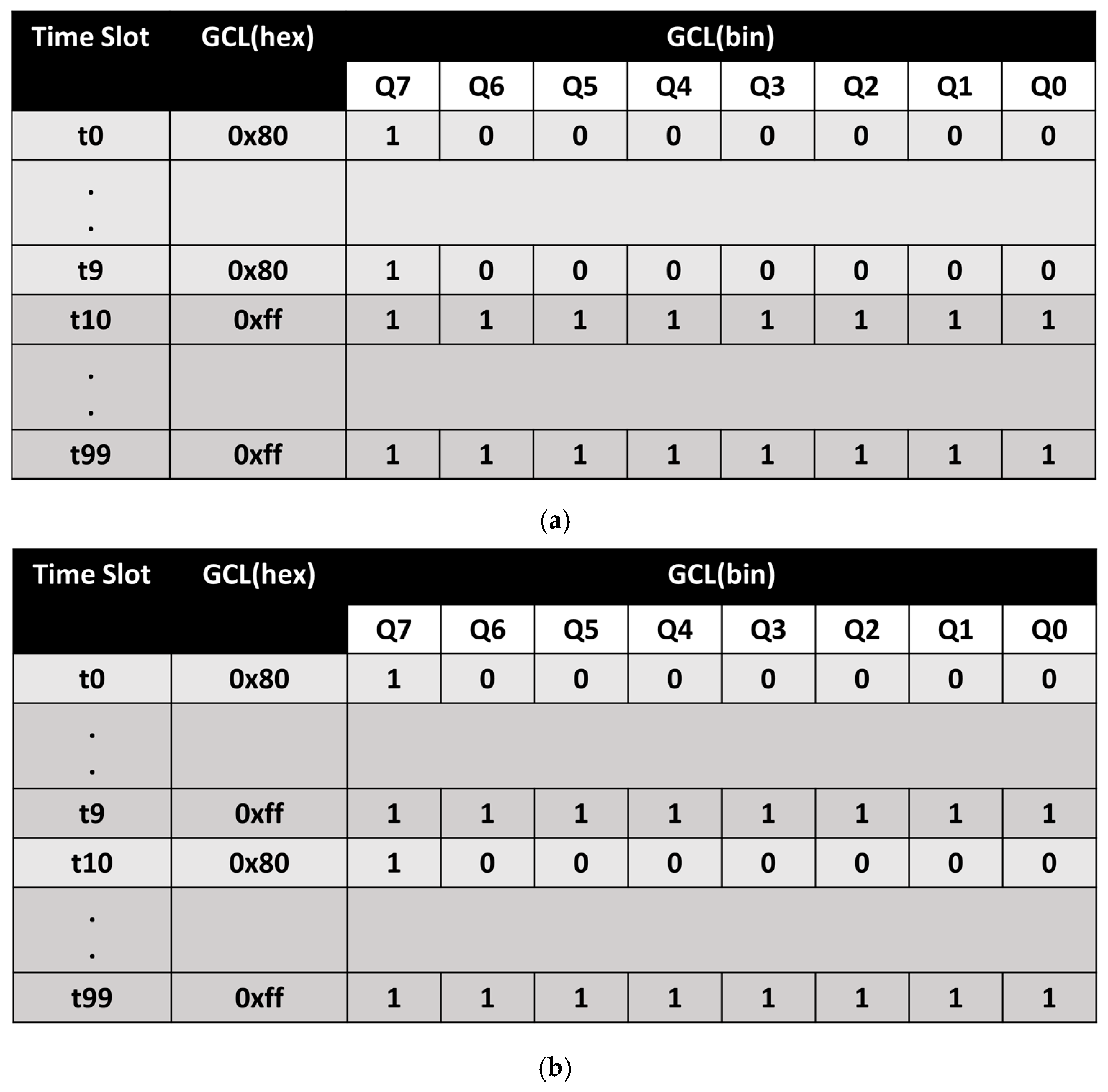
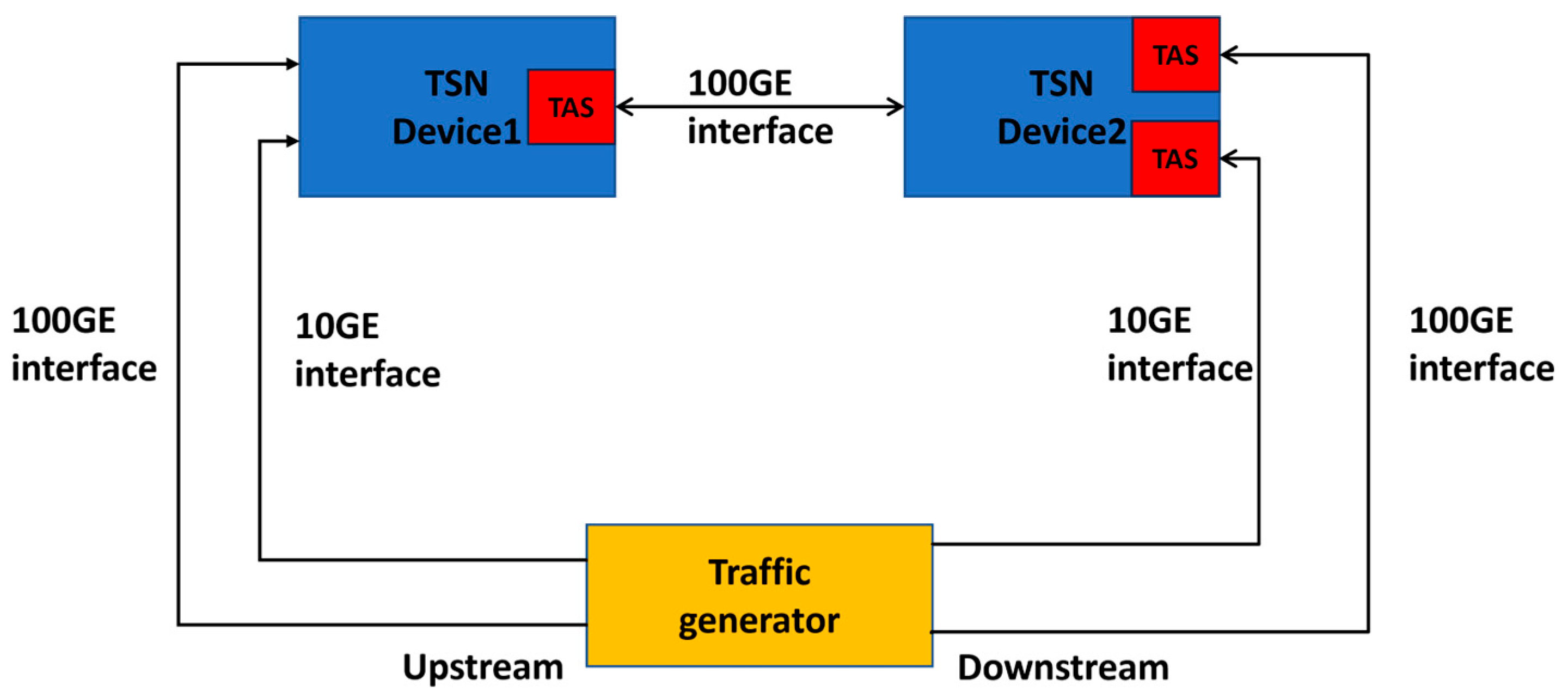
In this study, we proposed two methods for configuring the GCL: a centralized high-priority GCL (Figure 3a) and a distributed high-priority GCL (Figure 3b). In the test architecture (Figure 4), a traffic generator was employed on 100G and 10G ports to generate both upstream and downstream traffic with different priority queues [13]. The TAS function of the TSN device was enabled in the upstream direction to evaluate and verify the latency performance of the TSN device under traffic scheduling. The test results are shown in Table 2.
The results in Table 2 indicate that the proposed centralized and distributed GCL designs ensure bandwidth allocation and latency performance for high-priority traffic. Upstream traffic is scheduled using the GCL with TAS functionality, while downstream traffic is managed by the network’s existing QoS mechanism, following a strict prioritization policy. This ensures that high-priority traffic is transmitted first, while low-priority traffic is processed based on the first-in-first-out mechanism.
In the uncongested network test case, both the centralized and distributed GCLs ensure sufficient bandwidth for high-priority upstream traffic, maintaining low latency. The latency of low-priority upstream traffic is affected by the bandwidth allocated to high-priority traffic. Since the centralized GCL allocates bandwidth for a longer duration, low-priority traffic experiences relatively higher latency. Therefore, appropriately adjusting the bandwidth allocation for high-priority traffic can help improve the latency performance of low-priority traffic.
In the congested network test case, the GCL mechanism enabled by TAS continues to ensure the latency performance of high-priority upstream traffic, achieving results comparable to those of downstream traffic managed by QoS mechanisms. However, low-priority traffic is significantly impacted by network congestion, leading to a substantial increase in latency.

3. Conclusions

TSN effectively supports real-time transmission of high-priority traffic, demonstrating excellent performance. However, if only high-priority traffic is considered and low-priority traffic is neglected, network congestion may result in high-priority traffic being continuously processed first. Therefore, low-priority traffic must be allocated a portion of the bandwidth, and transmission fairness must be ensured through QoS technology. In the future, integrating QoS with dynamic GCL adjustments is expected to enable more efficient queue scheduling. In this study, we propose two GCL configurations for TSN that incorporate TAS to achieve efficient traffic scheduling. The IEEE 802.1Qbv standard in TSN employs priority queuing mechanisms on Ethernet to ensure that high-priority data is transmitted first. As a result, lower-priority traffic is transmitted only after high-priority traffic has been completed, thereby guaranteeing maximum bandwidth and minimal latency for critical data. Both centralized and distributed GCLs ensure the reliable transmission of high-priority data with minimal latency.
The results of this research demonstrate that the time-aware scheduling capabilities of TSN can enable effective queue scheduling. In the future, leveraging QoS technologies and dynamically adjusting the TAS structure will enable highly efficient queue scheduling for applications in time-sensitive networks.

Author Contributions

Conceptualization, P.-K.C. and M.-H.L.; methodology, P.-K.C. and Y.-C.L.; software, P.-K.C. and J.-K.H.; validation, C.-C.H. and Y.-P.Y. All authors have read and agreed to the published version of the manuscript.

Funding

This research received no external funding.

Institutional Review Board Statement

Not applicable.

Informed Consent Statement

Not applicable.

Data Availability Statement

Data are contained within the article.

Conflicts of Interest

The authors declare no conflict of interest.

References

  1. Messenger, J.L. Time-Sensitive Networks: An Introduction. IEEE Commun. Stand. Mag. 2018, 2, 29–33. [Google Scholar] [CrossRef]
  2. ETSI TS 123 501 V18.9.0; 3GPP TS 23.501 Version 18.9.0 Release 18 5G; System Architecture for the 5G System (5GS). European Telecommunications Standards Institute: Sophia Antipolis, France, 2025.
  3. 3GPP. Liaison Statement S2-2003508: Specification Maturity for IEEE TSN Integration Work in 3GPP Release-16; 3GPP: Sophia Antipolis, France, 2020. [Google Scholar]
  4. IEEE 1588-2019; IEEE Standard for a Precision Clock Synchronization Protocol for Networked Measurement and Control Systems. IEEE: Piscataway, NJ, USA, 2019.
  5. IEEE 1588-2008; IEEE Standard for a Precision Clock Synchronization Protocol for Networked Measurement and Control Systems. IEEE: Piscataway, NJ, USA, 2008.
  6. IEEE 802.1AS-2020; IEEE Standard for Local and Metropolitan Area Netoworks—Timing and Synchronization for Time-Sensitive Applications. IEEE: Piscataway, NJ, USA, 2020.
  7. IEEE Std 802.1Qbv-2015; IEEE Standard for Local and Metropolitan Area Networks—Bridges and Bridged Networks—Amendment 25: Enhancements for Scheduled Traffic. IEEE: Piscataway, NJ, USA, 2016; pp. 1–57.
  8. IEEE Std 802.1Q-2011; IEEE Standard for Local and Metropolitan Area Networks--Media Access Control (MAC) Bridges and Virtual Bridged Local Area Networks. IEEE: Piscataway, NJ, USA, 2011.
  9. Craciunas, S.S.; Oliver, R.S.; Chmelík, M.; Steiner, W. Scheduling real-time communication in IEEE 802.1 Qbv time sensitive networks. In Proceedings of the 24th International Conference on Real-Time Networks and Systems, Brest, France, 19-21 October 2016; ACM: New York, NY, USA, 2016; pp. 183–192. [Google Scholar]
  10. Li, Q.; Li, D.; Jin, X.; Wang, Q.; Zeng, P. A simple and efficient time-sensitive networking traffic scheduling method for industrial scenarios. Electronics 2020, 9, 2131. [Google Scholar] [CrossRef]
  11. Institute of Electrical and Electronics Engineers, Inc. 802.1Qbv—Enhancements for Scheduled Traffic; IEEE: New York, NY, USA, 2016; Draft 3.1. [Google Scholar]
  12. Kopetz, H.; Bauer, G. The time-triggered architecture. Proc. IEEE 2003, 91, 112–126. [Google Scholar] [CrossRef]
  13. Craciunas, S.S.; Oliver, S. Combined task-and network-level scheduling for distributed time-triggered systems. Real-Time Syst. 2016, 52, 161–200. [Google Scholar] [CrossRef]
Figure 1. Illustrative diagram of the gate control list in networks.
Engproc 134 00008 g001
Figure 2. Test architecture for various speeds and packet sizes.
Engproc 134 00008 g002
Figure 3. (a) Centralized high-priority gate control list. (b) Distributed high-priority gate control list.
Engproc 134 00008 g003
Figure 4. Comparison of gate control list test architecture.
Engproc 134 00008 g004
Table 1. Latency measurement results for various speeds and packet sizes (GbE denotes Gigabit Ethernet).
Packet Size100 GbE Interface Latency (μs)10GbE Interface Latency (μs)
64 bytes1.04 μs 1.18 μs
128 bytes1.06 μs 1.23 μs
512 bytes1.14 μs 1.59 μs
1024 bytes1.15 μs 2.05 μs
1500 bytes1.15 μs 2.4 μs
9000 bytes1.15 μs 8.78 μs
Table 2. Latency measurement results for various speeds and packet sizes.
Test CaseGate Control ListUpstream LatencyDownstream Latency
100G100G10G10G100G100G10G10G
Q7Q6Q7Q6Q7Q6Q7Q6
1G traffic on a 10GE port
10G traffic on a 100GE port
Centralized1.14 μs 6.44 μs2.46 μs7.78 μs1.14 μs 1.14 μs2.45 μs2.45 μs
Distributed1.14 μs 1.66 μs2.47 μs 3 μs1.14 μs 1.14 μs2.45 μs2.45 μs
10G traffic on a 10GE port
100G traffic on a 100GE port
Centralized1.46 μs 123 μs2.88 μs124 μs1.47 μs 110 μs2.84 μs112 μs
Distributed1.46 μs 122 μs2.84 μs124 μs1.47 μs 110 μs2.84 μs112 μs
Disclaimer/Publisher’s Note: The statements, opinions and data contained in all publications are solely those of the individual author(s) and contributor(s) and not of MDPI and/or the editor(s). MDPI and/or the editor(s) disclaim responsibility for any injury to people or property resulting from any ideas, methods, instructions or products referred to in the content.