1. Introduction
Manual folding of flexible plastic packaging bags in the food, agricultural, and textile industries is widely performed by human operators. However, manual operations are labor-intensive, sensitive to worker skill and fatigue, and prone to inconsistency in crease position and final dimensions. As product appearance and dimensional tolerances become more critical, and as labor costs continue to rise, purely manual folding is increasingly difficult to sustain. There is therefore a clear need for automated or semi-automated folding solutions that can stabilize cycle time, improve crease accuracy, and reduce dependence on manual labor.
To address similar issues in paper-based packaging, several researchers have developed automated or semi-automated bag-making systems. Patil et al. [
1] designed an automated paper bag-making machine that combined motorized feeding, gluing, folding, and cutting into a single line, and showed that the system reduced labor requirements while maintaining stable output quality. Kumar et al. [
2] fabricated a compact automated paper bag machine for small retailers, focusing on feeding and folding mechanisms and demonstrating that simple, low-cost actuation can support continuous production. Gunawardena et al. [
3] developed a low-cost automated machine for paper gathering and folding, in which synchronized drives and clamping units collected multiple sheets and folded them with acceptable accuracy at higher speeds than manual operation. Borude et al. [
4] further explored cost reduction and sustainability by using waste newspapers as raw material for a semi-automatic bag-making machine, showing that simple roller, gluing, and folding modules could convert recycled paper into usable bags.
Subsequent studies refined both the mechanical design and structural understanding of folding processes. Ku [
5] established geometric and kinematic principles for converting mathematical folding patterns into manufacturable mechanisms with finite-thickness materials, providing a theoretical basis for reliable fold lines, hinges, and motion sequences in engineering applications. Gawade et al. [
6] proposed a newspaper bag-making machine with multiple gluing and folding stages and reported that their computer-aided design (CAD)-based design with low-cost drives achieved stable operation for small-scale production. Bendre et al. [
7] presented a paper bag/pouch manufacturing machine that integrated conveying, gluing, and folding modules and carried out strength and power calculations for belts, shafts, and bearings, highlighting the importance of proper mechanical sizing for long-term reliability. More recently, Nithul and Vikas [
8] developed and prototyped a compact automatic paper bag machine aimed at reducing the carbon footprint and equipment cost, showing that small automated systems can meet rising demand for paper bags under plastic-use regulations.
Based on the mechanical principles and automation strategies reported in previous studies on paper-based packaging machinery, we applied the previous research results to the folding of flexible plastic bags, which pose different challenges in stiffness, friction behavior, and shape retention. The integrated feeding–folding architectures demonstrated by Patil et al. [
1], Kumar et al. [
2], and Gunawardena et al. [
3] provide the foundational framework for combining sequential feeding, folding, and motion coordination, while the structural and kinematic analyses [
5] and the mechanical sizing approaches of Gawade et al. [
6] and Bendre et al. [
7] were applied in the design of fold-line geometry, hinge motion, and actuator capacity in this study. Then, we developed a folding mechanism tailored to soft plastic bags, incorporating modular tooling, servo-based actuation, and torque-oriented drive sizing. The system was evaluated to verify that the referenced design principles can be effectively translated from paper-bag machinery to flexible plastic materials under practical production conditions.
2. Automated Folding System Design
The automated folding system for flexible plastic bags (feed bags and general packaging bags) was designed to improve production efficiency, folding accuracy, and consistency by replacing traditional manual folding processes with standardized mechanisms and parametric control. The system consists of modular units for feed positioning, edge guidance and creasing, active/passive flipping, compaction/forming, and discharge. Combined with vision-based positioning and torque closed-loop control, the system can adapt to different types and materials of bags.
All panels in the main structure are made of 3 mm thick 6061-T6 aluminum alloy, the balancing of rigidity, weight, and machinability ensured by using SUS304 stainless steel shafts and joints enhancing wear resistance and corrosion resistance. The guide rails, rollers, and pressure plates in contact with the bag material are made of polyoxymethylene or polyurethane to reduce surface friction and scratches. Adjustable eccentric bushings and locating pins are provided at key joints for easy maintenance and quick clamp replacement. The total weight of panels is 15 kg, meaning the overall machine weight is in the tens-of-kilograms range, far below the design weight limit of 80 kg, facilitating handling and limiting actuator load in subsequent torque design.
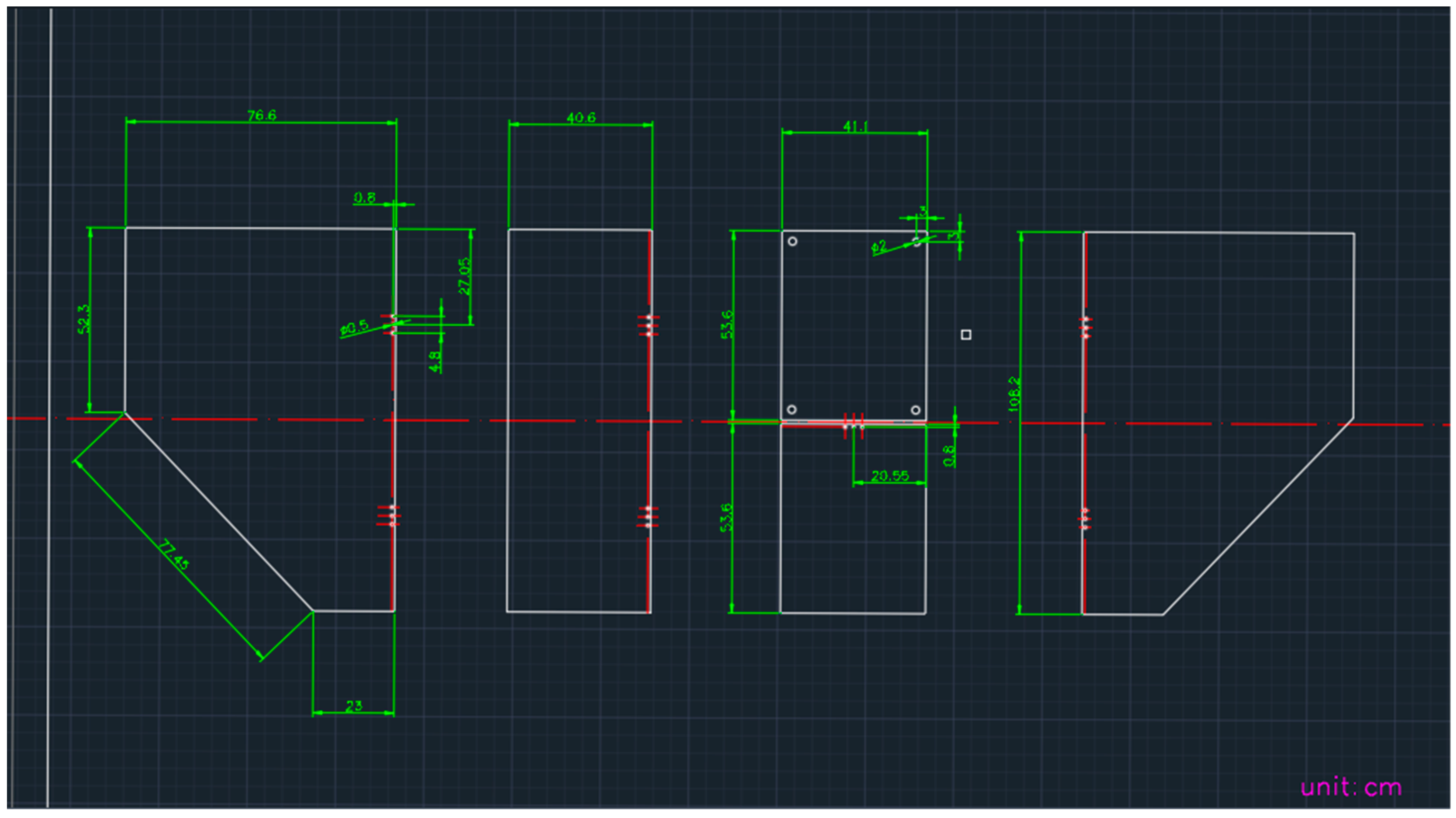
First, panels 1 and 2 are folded inwards simultaneously, followed by panel 3 being folded from left to right, and finally panel 4 being folded from bottom to top, thus completing the folding surface closure.
Figure 1 shows a size chart for flexible plastic bags. Panels 1 and 2 are both isosceles trapezoids (53.8 cm wide at the top, 75.2 cm wide at the bottom, and 50.9 cm high), each with an area of 5017.6 square centimeters and a mass of 4.1 kg. Their centers of mass are 33 cm from the vertical pivot, forming the left and right sides of the folding surface. Panel 3 is the central long plate, measuring 39.3 × 106.2 cm, with an area of 4173.66 square centimeters and a weight of 3.356 kg. Its center of gravity is 28 cm from the pivot, providing primary support for the central area. Panel 4 is one of the upper and lower halves, measuring 39.3 × 53.1 cm, with an area of 2086.83 square centimeters and a weight of 1.678 kg. Its center of gravity is 26 cm from the pivot. Panel 5 has the same rectangular geometry and weight as panel 4, but is installed as a fixed (non-moving) insert.
The main folding arm is actuated by a 400 W AC servo motor with a synchronous belt reduction of 1:30, providing 34 N·m of output torque under closed-loop speed/position control. This drive configuration balances cost and dynamic response, adapting well to varying crease lengths and operating speeds while maintaining a sufficient dynamic folding torque margin based on the panel mass and center-of-gravity distance mentioned above.
Based on the center of gravity of each panel, the quasi-static torque requirement is calculated using the formula τ = m·g·d. Panels 1 and 2 equally weigh 4.1 kg and have a center of gravity 33 cm from the pivot. Therefore, the static torque for each panel is 19.89 N·m. Panel 3 (3.356 kg, 28 cm from the pivot) generates a torque of 9.22 N·m, and panel 4 (1.678 kg, 26 cm from the pivot) generates a torque of 6.39 N·m. Panel 5 is fixed and does not participate in the folding motion. Therefore, its torque requirement is negligible. These torque values are compatible with a commercially available 400 W AC servo motor with a 1:30 belt reduction ratio; therefore, a 400 W servo driver was selected for panels 1 to 4 under closed-loop speed/position control.
Automated equipment achieves three times the output of manual labor, controls crease deviation within 2.0 mm, and significantly reduces production fluctuations caused by human factors. It makes the system suitable for large-scale production deployment while maintaining cleanliness, maintainability, and overall cost-effectiveness.
3. Performance Evaluation
We evaluated the operational performance of the proposed folding mechanism in terms of torque capacity, motion speed, output, and output. The selected 400 W servo motor, combined with a 1:30 reduction ratio, provides 34 N·m of torque, thus offering a sufficient safety margin for dynamic effects. During extended operation, the drive system did not exhibit abnormal torque peaks, step loss, or protection tripping, indicating that the actuator size is sufficient to handle the worst-case folding conditions derived from the static torque model.
From a kinematic and productivity perspective, the mechanism consistently performs folding motions at a frequency of 90 times per hour under experimental conditions, while maintaining synchronized coordination between the feeding, edge guiding, flipping, and compaction modules. Under typical operating conditions, the automated folding machine achieves a nominal output of about 90 pieces per hour, whereas manual folding produces roughly 30 pieces per hour. Using these values as a basis, different operating strategies can be used to estimate automated output and the corresponding gain relative to a single human operator.
The annual output of a laborer’s work is 30 pieces/h × 8 h/day × 5 days/week × 52 weeks/year = 62,400 pieces/year. Using the device instead of one laborer’s 5 working days per week and 8 h per day, the annual output is 90 pieces/h × 8 h/day × 5 days/week × 52 weeks/year = 187,200 pieces/year. Thus, the automated device increases the yield by 124,800 pieces. When the device operates 5 days per week and 24 h per day, the annual output is 90 pieces/h × 24 h/day × 5 days/week × 52 weeks/year = 561,600 pieces/year. When the device operates for 160 h and is off-duty for 8 h per week, the annual output is 90 pieces/h × 160 h/week × 52 weeks/year = 748,800 pieces/year.
Quality measurement results based on repeated crease-location sampling indicate that deviations can be controlled within 2.0 mm, and visual inspection also confirms a significant reduction in wrinkles, scratches, and misalignments. In this study, the good-piece rate (%) was defined as the ratio of samples that satisfied the crease-deviation criterion and showed no visible defects (wrinkles, scratches, or misalignment) to the total number of samples, multiplied by 100%. Across representative test batches, the good-piece rate for manual folding was observed at roughly 95%, whereas the automated system achieved a yield in the range of about 98%. The proportion of parts requiring rework was reduced by 2%. Consequently, the yield became stable and less susceptible to operator variability. Torque, speed, output, and quality metrics collectively demonstrated that the system provides quantifiable and repeatable performance, making it well-suited for deployment as a standard folding module in flexible packaging production lines.
4. Benefit Analysis
We evaluated the economic benefits of introducing an automatic folding machine for plastic bags. The analysis considers equipment capacity and staffing (including shift and holiday arrangements), how automation can replace manual work at folding stations, and the associated equipment investment, electricity consumption, and maintenance costs.
In the baseline scenario, a manual folding workstation is assumed to operate 8 h per day, 5 days per week, corresponding to 2080 working hours per year. With a basic wage of NT$190 per hour, the annual direct wage cost for one operator is NT$395,200. After including benefits, year-end bonuses, and social insurance contributions (health and labor insurance), the total annual personnel cost for one manual folding station is about NT$520,000.
The initial investment cost of the automatic folding device is NT$500,000, the annual labor cost is NT$520,000, the annual maintenance cost is NT$100,000, the annual depreciation cost is NT$100,000, and the operating consumables and electricity costs are approximately NT$80,000. Using one automatic folding device can annually save approximately NT$520,000 − NT$100,000 − NT$100,000 − NT$80,000 = NT$240,000.
When the device operates 5 days per week and 24 h per day, the annual output is 561,600 pieces/year, and the annual savings are NT$128,000. When the device operates for 160 h and is off-duty for 8 h per week, the annual output is 748,800 pieces/year, and the annual savings are NT$1,280,000.
5. Conclusions
We developed an automated system for folding flexible packaging bags in this study. The system produces 90 folded plastic bags per hour with a yield rate of 98% and a rework rate reduced to 2%. Replacing one worker with this automated device increases annual output by 124,800 folded bags, saving NT$240,000. When the device operates 120 h per week, the annual output is 561,600 pieces/year. The annual savings reach NT$128,000. When the device operates 160 h per week, the annual output is 748,800 pieces/year, and the annual savings are NT$1,280,000.