


Abstract
The aviation sector is accelerating the transition toward low-carbon propulsion, and Sustainable Aviation Fuels (SAFs) represent a key leverage to reduce lifecycle emissions without modifying existing turbine architectures. Microturbines offer an effective and low-cost platform for assessing SAF behaviour under engine-representative conditions. In this work, a zero-dimensional performance and emission model of the GTM-140 microturbine was developed in GSP and validated against experimental data at 70,000–112,000 rpm for Jet A-1 and HEFA paraffinic blends. The model reproduces thrust and fuel-flow trends with good fidelity, with deviations typically below 6% across all operating points. Introducing 50% HEFA consistently reduces fuel consumption, leading to a TSFC decrease of 3–6%, with the strongest effect at high rotational speed, where compressor efficiency is highest. CO emission indices decrease by 6–9% at mid-load and converge at full power due to enhanced oxidation, while NOx increases by 6–15%, driven by the higher adiabatic flame temperature associated with HEFA’s increased H/C ratio and heating value. These results confirm that simplified 0D modelling can reliably capture performance and emission trends of SAF-fuelled microturbines and demonstrate the dual effect of HEFA: improved combustion efficiency and CO reduction, at the expense of moderately higher NOx formation.
1. Introduction
The aviation sector accounts for approximately 2% of global anthropogenic CO2 emissions, a value that is expected to increase due to the growth of passenger traffic in the next few decades [1]. Despite the sector having reduced fuel consumption per passenger by nearly 70% over the last 50 years through advancements in aerodynamics and propulsion efficiency [2], the progressive decarbonisation of air transport requires the adoption of low-carbon fuels capable of overcoming the intrinsic limits of conventional kerosene. In this context, Sustainable Aviation Fuels (SAFs) represent a viable solution, as they can be blended with or fully replace fossil fuels while reducing lifecycle greenhouse gas emissions. Among the SAF production pathways approved by the ASTM D7566 standard [3], paraffinic kerosene derived from Hydroprocessed Esters and Fatty Acids (HEFAs) is currently the most mature technology, largely produced from waste oils and fats.
Assessing the impact of SAFs on turbine engine performance and emissions typically requires full-scale experimental campaigns, which involve complex instrumentation, high costs and logistical constraints. Miniature gas turbines and microturbines, therefore, represent a valuable alternative for preliminary investigations. They offer representative thermodynamic behaviour and emission trends, and are increasingly used both in scientific research and in propulsion systems for unmanned aerial vehicles (UAVs/UAS) due to their compactness, reliability and ease of testing [4,5,6,7,8,9]. Additionally, microturbines enable the validation of low-cost numerical models that can support the assessment of engine behaviour with alternative fuels.
Although experimental studies have investigated the effects of Jet A-1/HEFA blends in microturbines [5,6,7], there is still a lack of validated low-order simulations capable of predicting both performance and emissions for SAF-powered miniature engines. Moreover, most existing numerical works do not address fuel surrogate limitations or the parametrisation of chemical properties in 0D models. To contribute to filling this gap, this work develops and validates a zero-dimensional model of the JETPOL GTM-140 microturbine using the Gas Turbine Simulation Program (GSP), focusing on the influence of Jet A-1/HEFA blends on thrust, fuel consumption and exhaust emissions.
2. Materials and Methods
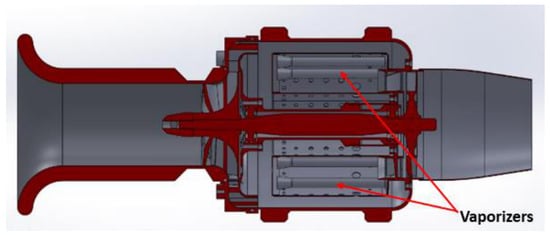
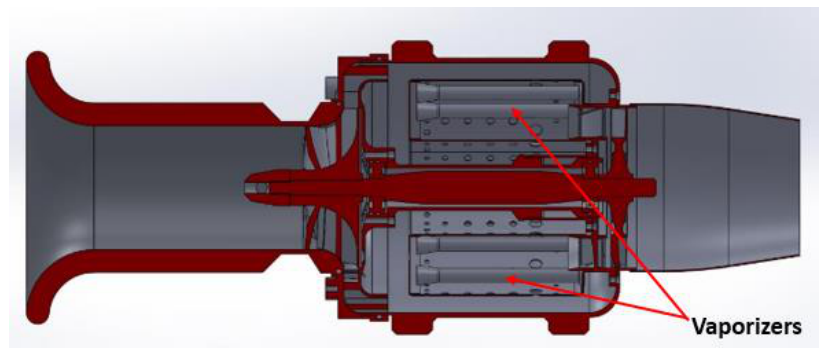
The JETPOL GTM 140 is a miniature turbojet engine, which operates in the range of 33,000–120,000 rpm with a maximum thrust of 140 N. The engine has a single-stage radial compressor driven by a single-stage axial turbine and an annular combustion chamber with a set of vaporiser tubes (Figure 1). The basic engine specifications are shown in Table 1.
Figure 1.
Structure of JETPOL GTM 140.
Table 1.
Engine specifications of JETPOL GTM 140.
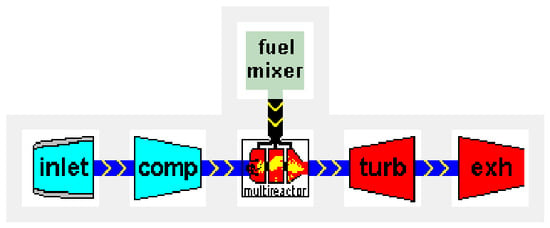
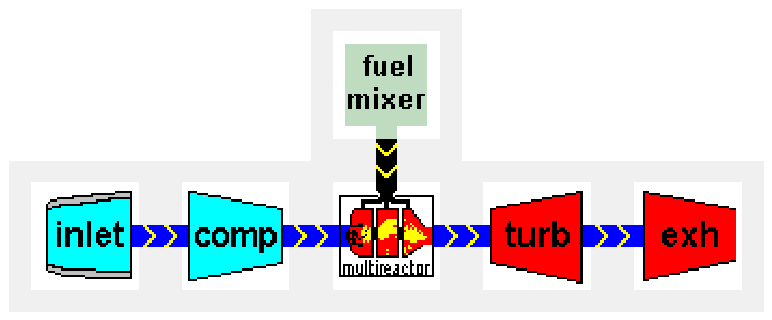
The numerical model of the microturbine JETPOL GTM 140 for this research work is shown in Figure 2. It was created using the “Gas Turbine Simulation Program 12” software for kerosene and Sustainable Aviation Fuel blends.
Figure 2.
Layout of the JETPOL GTM 140 model in GSP for fuel blends.
The Gas Turbine Simulation Program (GSP) is a modelling environment based on zero-dimensional (0D) modelling of the processes determined by maps and thermodynamic equations for the different gas turbine components. The GSP solves a set of non-linear differential equations and runs in steady-state and transient simulations for prediction and analysis of performance. A gas turbine model is created by arranging different predefined components (like inlets, compressors, combustors, turbines and exhaust nozzles) in a configuration corresponding to the specific gas turbine type to be simulated. The exit gas condition of a component then forms the inlet gas condition of the next component in the configuration [10].
The microturbine was tested according to the methodology and profile of the engine run presented in reference [9]. The profile of the engine test refers to the selected operating modes of a turbojet engine.
For the test, the conventional Jet A-1 fuel was used and afterwards blends of Jet A-1 with synthetic components obtained from the HEFA process in a concentration of 50% of HEFA were used. The sustainable feedstock of a synthetic component is the used cooking oils (UCOs) [6].
The simulation with blends of Jet A-1 and HEFA is carried out in the GSP through the Fuel Mixer component, which is designed for modelling fuel blends. Due to limitations of the software, in Fuel Mixer, it is not possible to use surrogates of different chemical species that represent the blends of Jet A-1 and HEFA, but only a blend of two different types of fuel. These are limited in composition to chemical species present in the software, where only one species is customisable (CxHyOz); to achieve this, the enthalpy of formation and specific heat capacity of that species are needed. However, for the purpose of modelling, it is necessary to use an integer formula due to computer code limitations. Therefore, kerosene is defined as C11H22 [11]. In the literature, there are several studies about HEFA composition and its different formulations of surrogates [12,13,14,15,16,17]. Therefore, the HEFA fuel, which is composed of about 90% di iso-paraffin in this work, is defined as iso-dodecane C12H26 (Table 2), which is the main representative component of iso-alkanes. Moreover, GSP requires at least a trace of oxygen in the blends, so the kerosene composition is 99.99% C11H22 and 0.01% of O2.
Table 2.
Specifications of fuel compositions. Fuel properties were weighted on a mass basis (w/w), following ASTM D7566 blending criteria and the procedure of Gawron et al. [6].
3. Results
3.1. Design Point Simulation
The first stage of the modelling procedure consists of computing the design point (DP), which serves as the reference condition for all subsequent off-design simulations. At the DP, the engine layout is fixed, and the nominal operating condition is defined, allowing the software to dimension each component according to the specified thrust, rotational speed, fuel properties and boundary conditions. Once the DP is established, the performance maps and thermodynamic parameters of the compressor, turbine and combustor are scaled accordingly, ensuring that off-design predictions remain consistent with the actual engine configuration. The results of the Design Point simulation are shown in Table 3.
Table 3.
Design point parameter values.
3.2. Off-Design Simulation
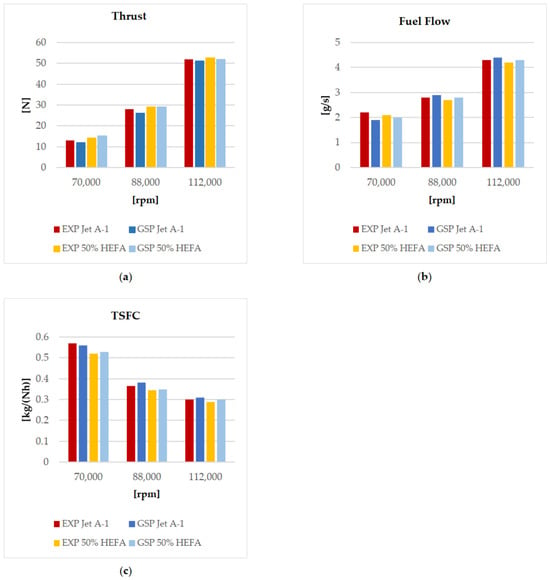
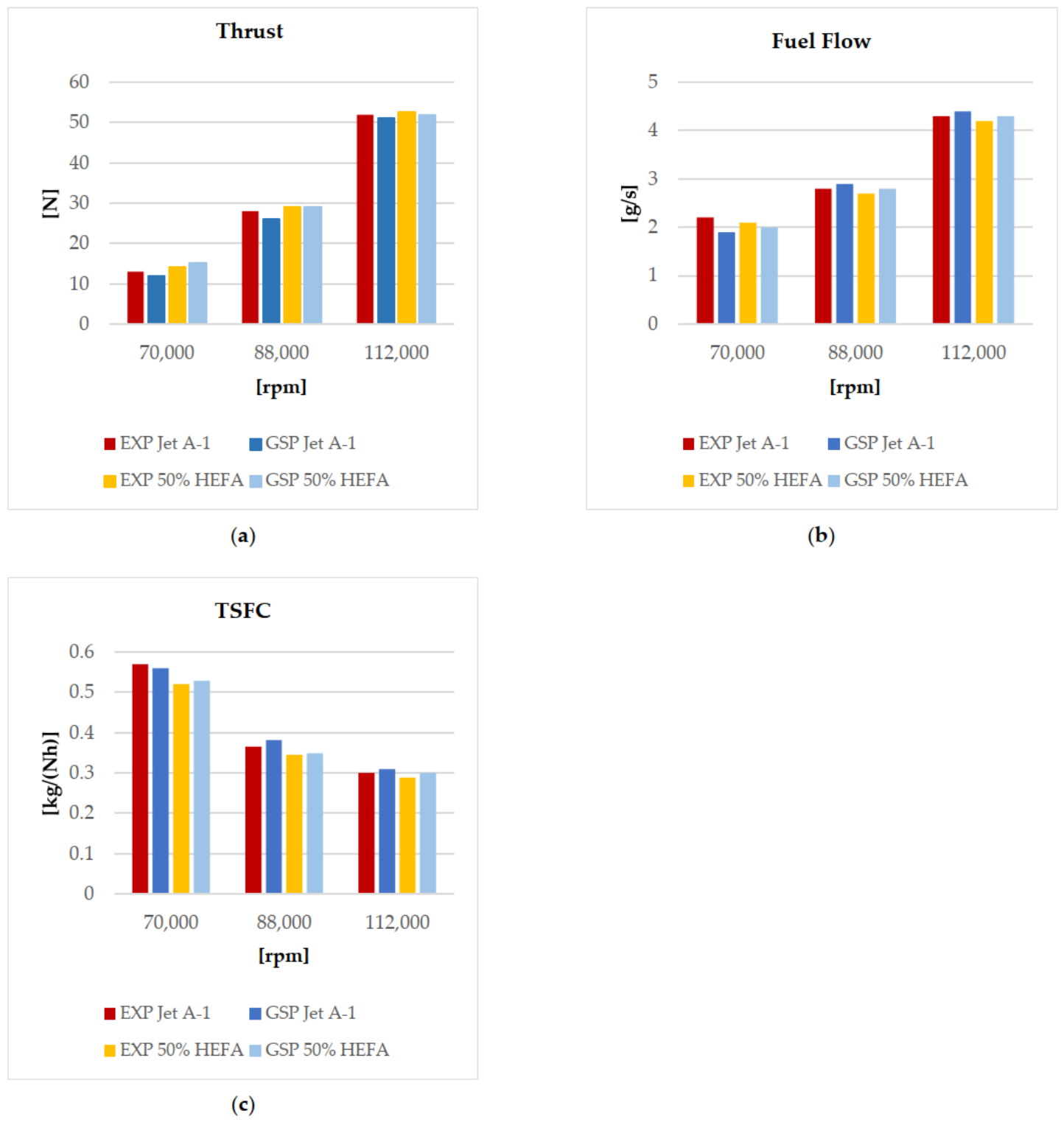
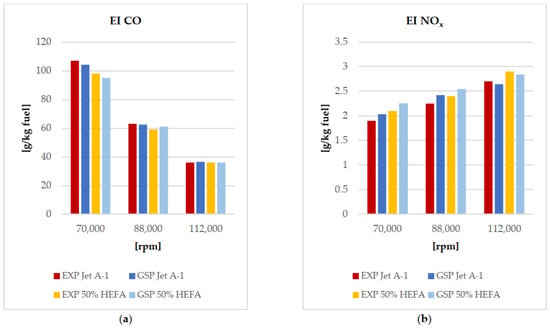
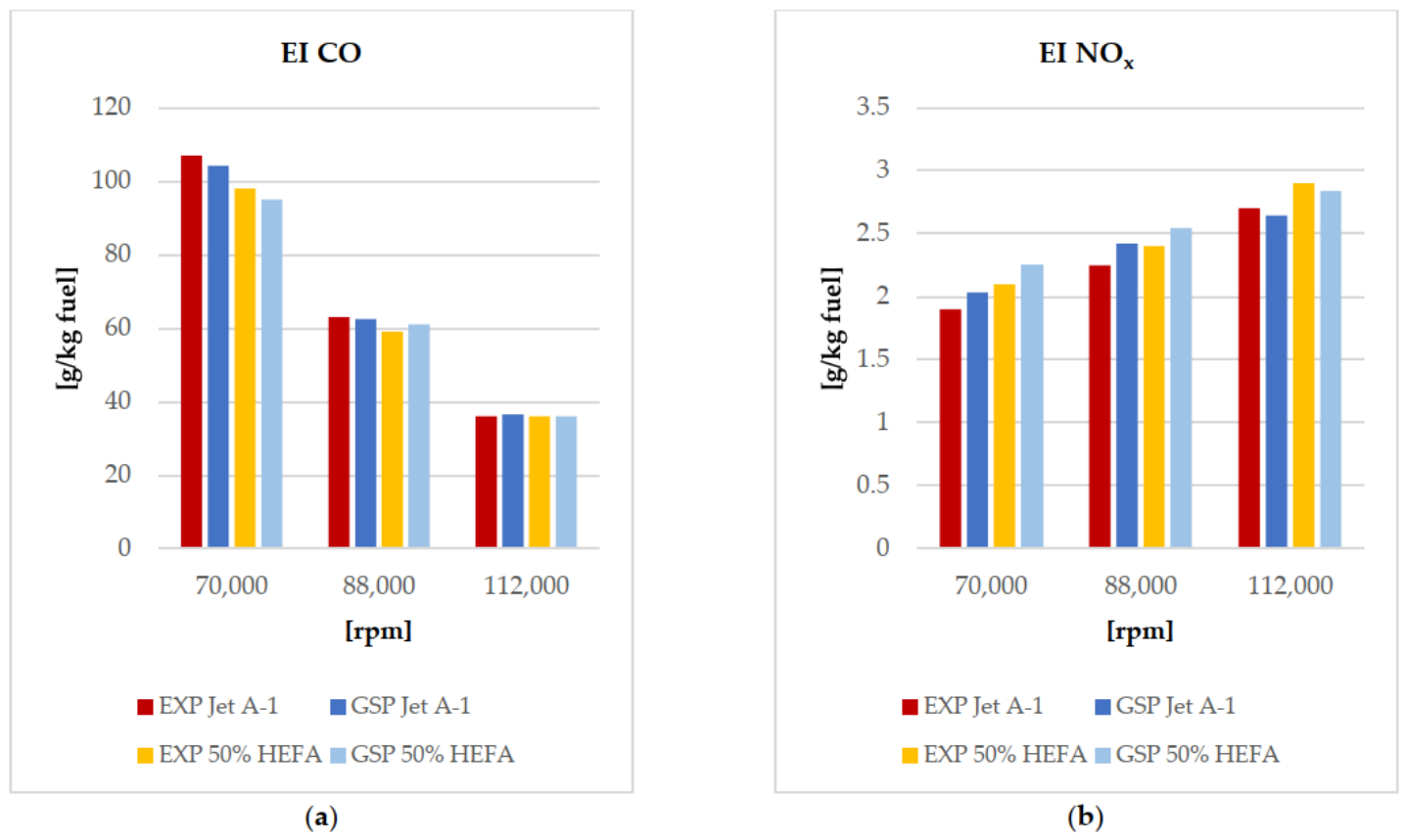
The off-design point is calculated by solving a set of non-linear differential equations. The equations are determined by the mass balance, the heat balance, the equation for conservation of momentum and the energy balance for all components [10]. The off-design simulation was run in steady state. For steady-state operating point calculations, all parameters are assumed to be constant in time. The simulating sessions were chosen based on the following operating points: 70,000 rpm, 88,000 rpm, and 112,000 rpm. The results obtained by steady-state simulations and their comparison with test data are presented in Figure 3 and Figure 4.
Figure 3.
Selected engine parameters as a function of rotational speed: (a) thrust; (b) fuel flow; and (c) thrust-specific fuel consumption.
Figure 4.
Selected emission index as a function of rotational speed: (a) emission index of CO; (b) emission index of NOx.
3.2.1. Performance Analysis
Figure 3 compares the experimental measurements with the 0D GSP model predictions for Jet A-1 and HEFA blends at 70,000, 88,000, and 112,000 rpm. Overall, the numerical model captures the performance behaviour with good accuracy, showing deviations typically between 2 and 6% for thrust and 3 and 5% for fuel flow, confirming that simplified fuel surrogates are adequate for steady-state microturbine simulations.
Both experimental and simulated thrust increase nearly linearly with shaft speed, reflecting correct reproduction of compressor matching and nozzle expansion within the GSP model. At 70,000 rpm, thrust ranges from 12 to 15 N, with the GSP predictions within ±7% of experimental values. At 88,000 rpm, thrust stabilises at around 28–29 N, with GSP underpredicting Jet A-1 by ~7% but matching the HEFA case almost exactly. At 112,000 rpm, thrust for all fuels converges to 52–52.5 N, with GSP remaining within 2% of measurements. The small difference among fuels (<3%) demonstrates that thrust is primarily governed by the mass flow and turbine expansion ratio, which are only weakly affected by the modest fuel-property variations between Jet A-1 and HEFA. Fuel mass flow decreases consistently when switching from Jet A-1 to HEFA. At 70,000 rpm, experimental flow drops from 2.2 g/s (Jet A-1) to 2.1 g/s (HEFA) (≈5% reduction). At 88,000 rpm, the reduction is similar (2.8 → 2.7 g/s). At 112,000 rpm, Jet A-1 requires 4.3 g/s, while HEFA requires 4.2 g/s, corresponding again to a 3–5% decrease. This consistent reduction reflects the higher lower heating value and higher H/C ratio of paraffinic HEFA, which raises the combustor exit temperature (T4) and improves turbine work extraction, thereby reducing the fuel needed to achieve a given thrust. GSP predictions replicate these trends well, with deviations < 5% for all operating points. The thrust-specific fuel consumption (TSFC) confirms the improved fuel economy with HEFA. At 70,000 rpm, TSFC decreases by 5–6% when switching from Jet A-1 to HEFA. At 88,000 rpm, TSFC drops from roughly 0.37 to 0.35 kg/(N·h) experimentally (≈5% reduction). At 112,000 rpm, TSFC decreases from ~0.30 to ~0.29 kg/(N·h) (≈3–4%), with the GSP model showing nearly identical reductions.
The largest improvement occurs at high power, where the microturbine operates near peak compressor efficiency and is more sensitive to the fuel heating value. This highlights that fuel composition effects become more relevant under high-load regimes, such as take-off or high-power UAV missions.
3.2.2. Emission Analysis
Figure 4 compares the experimental and simulated emission indices (EIs) of CO and NOx for Jet A-1 and HEFA blends at three rotational speeds. The agreement between measurements and GSP predictions is satisfactory across all operating points, confirming that the 0D surrogate-fuel modelling approach is able to reproduce the main emission trends, despite the simplified representation of real-fuel chemistry. For CO emissions (Figure 4a), both experimental and numerical data show a consistent reduction when switching from Jet A-1 to HEFA. At 70,000 rpm, the experimental EI(CO) decreases from 107 to 98 g/kg fuel (−8.4%), while the GSP model predicts a similar drop from 104.2 to 95.0 g/kg fuel (−8.8%). At 88,000 rpm, this reduction is slightly smaller (−6.3% experimentally and −2.4% numerically). At 112,000 rpm, CO emissions converge for both fuels (36 g/kg fuel), reflecting improved oxidation at higher combustor temperatures and reduced sensitivity to fuel composition. These quantitative trends are consistent with the expected behaviour of HEFA fuels, the low aromatic content and high paraffinic fraction of which enhance oxidation completeness and limit CO formation.
In contrast, NOx emissions (Figure 4b) increase with HEFA concentration. Experimentally, EI(NOx) rises by approximately 11% at 70,000 rpm, ≈8% at 88,000 rpm, and ≈6% at 112,000 rpm. GSP simulations correctly capture this trend, showing increases of ≈10%, ≈6%, and ≈5%, respectively. The rise in NOx is attributed to the higher heating value and higher H/C ratio of HEFA, which elevates the temperature in the combustion chamber and downstream of the turbine, consequently strengthening thermal-NOx formation via the extended Zeldovich mechanism. The stronger effect at low speeds is consistent with longer combustor residence times, whereas at maximum speed, the temperature increase remains the main driver for NOx formation. While the model captures relative trends reliably, absolute deviations from measured data can arise due to simplified boundary/operating assumptions in the model (e.g., idealised mixing/combustion completeness assumptions), uncertainty in fuel composition/thermochemical properties for blended fuels, limitations of reduced or semi-empirical sub-models (e.g., emissions correlations/calibration ranges), and sensitivity of NOx formation to temperature field details and residence time, which may not be perfectly reproduced in the simplified modelling framework. Overall, the combined analysis indicates a clear trade-off: HEFA improves CO emissions by up to 9% but increases NOx by 5–11% depending on the operating point. The GSP model captures both effects with good fidelity, supporting its suitability for steady-state microturbine performance and emissions prediction with blended SAFs [3,4,5].
4. Conclusions
This work demonstrates that a zero-dimensional GSP-based model can reliably predict the steady-state behaviour of the JETPOL GTM-140 microturbine when fuelled with Jet A-1 and HEFA blends, despite the inherent limitations of surrogate fuel representation in 0D tools. The model reproduced thrust, fuel flow, and TSFC with deviations generally below 5–6% and successfully captured the main emission trends associated with the use of paraffinic SAFs. The comparison with experimental data confirms that HEFA improves combustion efficiency, yielding a systematic reduction in fuel consumption and CO emissions, while moderately increasing NOx due to the higher adiabatic flame temperature of the blend. These quantitative trends were consistently reproduced by the numerical framework, demonstrating that simplified 0D modelling is sufficiently accurate for preliminary assessment of SAF behaviour in small-scale turbines. Overall, the modelling strategy presented in this study provides an effective and computationally efficient tool for analysing and comparing the performance and emissions of alternative aviation fuels. The results reinforce the potential of HEFA as a technically viable and lower-carbon substitute for conventional kerosene, while also highlighting the need for further experimental–numerical studies to support fuel certification pathways and guide aviation decarbonisation strategies aligned with the 2050 climate-neutrality targets.
Author Contributions
Conceptualisation, M.G.D.G. and A.G.; methodology, M.G.D.G.; software and numerical modelling, M.G.D.G., A.G., S.B. and P.D.G.; experimental validation, B.G., T.B. and A.K.; formal analysis, M.G.D.G.; investigation, M.G.D.G., S.B. and P.D.G.; resources, A.G. and B.G.; data curation, M.G.D.G., S.B. and P.D.G.; writing—original draft preparation, M.G.D.G. and A.G.; writing—review and editing, M.G.D.G., A.G. and B.G.; visualisation, M.G.D.G.; supervision, A.G. and B.G.; project administration, A.G.; funding acquisition, B.G. All authors have read and agreed to the published version of the manuscript.
Funding
This research was founded by the Department of Engineering for Innovation at the University of Salento, with resources provided by the Italian Ministry of University and Research, Art. 238, paragraph 5 of Decree-Law No. 34 of 19 May 2020 (converted with amendments by Law No. 77 of 17 July 2020), and by the NATO Support Programme “Exploring the Potential of Hydrogenas a Sustainable Jet Fuel” P-2023-03-SP-POL-ITA.
Institutional Review Board Statement
Not applicable.
Informed Consent Statement
Not applicable.
Data Availability Statement
The raw data supporting the conclusions of this article will be made available by the authors on request.
Conflicts of Interest
The authors declare no conflicts of interest.
Abbreviations
The following abbreviations are used in this manuscript:
| 0D | Zero dimensional |
| CO | Carbon monoxide |
| CO2 | Carbon dioxide |
| EI | Emission index |
| GSP | Gas turbine Simulation Program |
| HEFAs | hydroprocessed esters and fatty acids |
| NOx | Nitrogen oxides |
| rpm | Revolutions per minute |
| SAF | Sustainable aviation fuel |
| SPK | Synthetic paraffinic kerosene |
| T4 | Temperature downstream of the turbine |
| TSFC | Thrust specific fuel consumption |
| UAS | Unmanned aircraft system |
| UAV | Unmanned aerial vehicle |
| UCO | Used cooking oil |
References
- Lee, D.; Fahey, D.W.; Forster, P.M.; Newton, P.J.; Wit, R.C.N.; Lim, L.L.; Owen, B.; Sausen, R. Aviation and global climate change in the 21st century. Atmos. Environ. 2009, 43, 3520–3537. [Google Scholar] [CrossRef] [Scilit]
- Marszałek, N.; Lis, T. The future of sustainable aviation fuels. Combust. Engines 2022, 191, 29–40. [Google Scholar] [CrossRef] [Scilit]
- ASTM D7566; Standard Specification for Aviation Turbine Fuel Containing Synthesized Hydrocarbons. ASTM International: West Conshohocken, PA, USA, 2022.
- Erario, M.L.; De Giorgi, M.G.; Przysowa, R. Model-Based Dynamic Performance Simulation of a Microturbine Using Flight Test Data. Aerospace 2022, 9, 60. [Google Scholar] [CrossRef] [Scilit]
- Gawron, B.; Białecki, T. Impact of a Jet A-1/HEFA blend on the performance and emission characteristics of a miniature turbojet engine. Int. J. Environ. Sci. Technol. 2018, 15, 1501–1508. [Google Scholar] [CrossRef] [Scilit]
- Gawron, B.; Białecki, T.; Janicka, A.; Suchocki, T. Combustion and Emissions Characteristics of the Turbine Engine Fueled with HEFA Blends from Different Feedstocks. Energies 2020, 13, 1277. [Google Scholar] [CrossRef] [Scilit]
- Przysowa, R.; Gawron, B.; Białecki, T.; Łęgowik, A.; Merkisz, J.; Jasiński, R. Performance and Emissions of a Microturbine and Turbofan Powered by Alternative Fuels. Aerospace 2021, 8, 25. [Google Scholar] [CrossRef] [Scilit]
- Przysowa, R.; Grundas, D.; Gawron, B.; Zieliński, K. Reducing Environmental Impact of Jet Engines by Hydrogen Co-combustion. J. Phys. Conf. Ser. 2024, 2716, 012010. [Google Scholar] [CrossRef] [Scilit]
- Gawron, B.; Białecki, T. Measurement of exhaust gas emissions from miniature turbojet engine. Combust. Engines 2016, 167, 58–63. [Google Scholar] [CrossRef] [Scilit]
- GSP Development Team. GSP 11 User Manual; NLR-Royal Netherlands Aerospace Centre: Amsterdam, The Netherlands, 2021. [Google Scholar]
- Xu, R.; Wang, K.; Banerjee, S.; Shao, J.; Parise, T.; Zhu, Y.; Wang, S.; Movaghar, A.; Lee, D.J.; Zhao, R.; et al. A physics-based approach to modeling real-fuel combustion chemistry—II. Reaction kinetic models of jet and rocket fuels. Combust. Flame 2018, 193, 520–537. [Google Scholar] [CrossRef] [Scilit]
- Vozka, P.; Šimáček, P.; Kilaz, G. Impact of HEFA Feedstocks on Fuel Composition and Properties in Blends with Jet A. Energy Fuels 2018, 32, 11595–11606. [Google Scholar] [CrossRef] [Scilit]
- Saraee, H.S.; Hughes, K.J.; Shi, S.; Ingham, D.B.; Pourkashanian, M. Skeletal and Compact Validated Mechanisms for Iso-dodecane Using a Decoupling Methodology. Energy Fuels 2023, 37, 2307–2318. [Google Scholar] [CrossRef] [Scilit]
- Cazères, Q.; Ogier, T.; Lesaffre, T.; Benedicte, C.; Eleonore, R. Automatic reduction of HEFA bio-jet fuel: From detailed composition to CFD compatible reduced kinetics. In Proceedings of the Low Carbon Combustion, Cambridge, UK, 5–6 April 2022. [Google Scholar]
- Casey, M.A. Advanced Rapid Compression Machine Test Methods and Surrogate Fuel Modeling for Bio-Derived Jet and Diesel Fuel Autoignition. Ph.D. Thesis, Michigan State University, East Lansing, MI, USA, 2012. [Google Scholar]
- Casey, A.; Valco, D.; Toulson, E.; Edwards, T.; Lee, T. Ignition behavior and surrogate modeling of JP-8 and of camelina and tallow hydrotreated renewable jet fuels at low temperatures. Combust. Flame 2013, 160, 232–239. [Google Scholar] [CrossRef] [Scilit]
- Lesaffre, T.; Benedicte, C.; Eleonore, R. Hydroprocessed Esters and Fatty Acids (HEFA) model for Large Eddy Simulation. In Proceedings of the ISABE Conference, Toulouse, France, 22–27 September 2024. [Google Scholar]

Disclaimer/Publisher’s Note: The statements, opinions and data contained in all publications are solely those of the individual author(s) and contributor(s) and not of MDPI and/or the editor(s). MDPI and/or the editor(s) disclaim responsibility for any injury to people or property resulting from any ideas, methods, instructions or products referred to in the content. |
© 2026 by the authors. Licensee MDPI, Basel, Switzerland. This article is an open access article distributed under the terms and conditions of the Creative Commons Attribution (CC BY) license.