


Abstract
One of the fundamental aspects of achieving sustainability in aviation is reducing aircraft emissions. While the effects of CO2 have been studied extensively, it is crucial to also consider non-CO2 emissions. This paper presents the fundamental ideas of the research developed to analyse the path to sustainability in aviation within the framework of the European Environmentally Friendly Aviation for All Classes of Aircraft (EFACA) project. Nine scenarios are considered in the analysis: two reference scenarios, the EFACA base scenario and six EFACA variations scenarios. The EFACA base scenario considers the project’s proposal for sustainable aviation for all classes of aircraft. Additionally, the methodology followed in the analysis is presented. The decisions made to calculate carbon and total emissions, costs and investments, and economic effects are specified. The analytical approaches adopted are also discussed. Projections for the different scenarios up to 2050 are calculated and comparative and sensitivity analyses performed. The paper presents the logic behind each stage and demonstrates how this methodological approach can be used as a valuable tool for analysing the prospects for a more sustainable aviation in terms of reducing emissions.
1. Introduction
One of the major challenges currently faced by the aviation industry is the development of new technologies and the improvement of existing ones to move towards sustainability. The environmental impacts of aviation can be divided into two main categories: aircraft noise and exhaust gas emissions [1]. This paper will focus on the latter.
CO2 is one of the most studied gases globally due to its contribution to global warming. The impact of aviation-related CO2 emissions has been extensively studied. However, aviation is one of the most difficult sectors in which to reduce CO2 emissions.
Aviation climate assessments have systematically quantified the dominant climate-forcing components. As well as CO2 emissions, these include emissions associated with nitrogen oxides (NOx) and persistent contrails [2]. Research into NOx emissions has increased in recent years. Nitrogen oxides play a significant role in altering the composition of the atmosphere. This is most evident in the formation of ozone in the upper troposphere [3]. NOx emissions from aviation cause photochemical changes that increase ozone (O3) formation and reduce the lifetime and abundance of methane (CH4) [4]. Another of the most widely studied components is contrails. These are formed when aircraft fly through cold, humid air masses. They warm the Earth–atmosphere system by reducing the amount of terrestrial radiation returned to space. However, they also cool it by increasing the Earth’s albedo [5]. Modelling contrails is complex and of great interest to industry and academia.
One of the major challenges in reducing aviation emissions is the sector’s intrinsic characteristics. Firstly, there is heavy dependence on fossil fuels. Although several technologies are currently under development, kerosene will continue to be essential for aircraft propulsion. Another unique feature of aviation is its international nature. For measures to be effective, they must be agreed upon by different industry stakeholders.
In addition to international collaboration, new technologies must overcome various barriers. The most notable of these are regulatory, operational and market barriers.
To be scaled up, new technologies must undergo a significant technological development process and be certified. These certification processes can be very complex. Furthermore, a regulatory framework that considers new technologies needs to be developed.
At the operational and market level, conventional aircraft propulsion relies on kerosene. While new propulsion technologies and fuel alternatives may offer significant advantages over kerosene, these environmental benefits alone may not be sufficient to replace traditional fossil fuels. Additional approaches are required to scale the use of these technologies, some of which are economic or regulatory in nature. A clear example of this is sustainable aviation fuels (SAF). The authors of [6] present an analysis of SAF. One of their main conclusions is that SAF have the potential to fulfil the aviation industry’s fuel requirements and potentially replace traditional, fossil-based aviation fuels. Among their recommendations, they state that incentives should be introduced to promote the use of SAF, alongside penalties for greenhouse gas emissions through a tax system. They also recommend developing robust policy frameworks that allow for transparency to encourage partnerships and collaborations.
To achieve global reductions in emissions, the aviation industry was the first transport sub-sector to adopt a global emissions reduction system. Launched in 2016 by the International Civil Aviation Organization (ICAO), this initiative is called the Carbon Offsetting and Reduction Scheme for International Aviation (CORSIA) [7]. Currently, international climate targets involve achieving net-zero global carbon dioxide emissions by mid-century and net-zero greenhouse gas emissions by the end of the century [8]. This paper defines 2050 as the target year for its calculations.
To achieve the aviation 2050 objectives, one of the tools most widely used in the aviation sector is the development of roadmaps. These roadmaps have been defined by industry experts and researchers. For instance, the International Air Transport Association (IATA) has created a series of roadmaps to guide the actions required for aviation to become carbon neutral by 2050. Additionally, researchers have developed multiple roadmaps that consider key aspects of sustainability. The authors of [9] conduct a review of strategies and technologies for optimising aircraft routes, and define a roadmap to improve them. The authors of [10] study user acceptance of the most advanced aviation developments. In their case, they propose a roadmap for achieving public acceptance once the challenges are identified.
The European Environmentally Friendly Aviation for All Classes of Aircraft (EFACA) project studies sustainable technologies for different classes of aircraft. Work Package (WP) 10 of this project focuses on developing roadmaps that consider the project’s results. To this end, WP 10 includes the design of roadmaps associated with technologies, aircraft, emissions and noise.
This paper presents the guiding principles that are considered when developing roadmaps for reducing emissions, considering both CO2 and non-CO2 emissions. Due to space limitations, the approach of this paper is methodological, presenting the main ideas that guide the research. The rest of the paper is therefore divided into five additional sections. Section 2 presents the study’s objective. Section 3 presents the nine scenarios considered in its development. Section 4 describes the four-stage methodology followed in the analysis. Section 5 presents the three complementary analyses developed. Finally, Section 6 presents the study’s main conclusions and identifies areas for future research.
2. Objective of the Analysis
As mentioned above, this analysis is part of the EFACA project. The project studies a combination of different sustainable aviation technologies for all classes of aircraft. Specifically, four categories of aircraft are considered. The analysis aims to evaluate the impact on CO2 and other emissions of introducing new technologies to these aircraft categories. These technologies are introduced as soon as they are mature. Projections are analysed up to the year 2050. The temporal evolution considered fulfils the project’s objective of defining a roadmap for a major reduction in emissions by 2050. To present a holistic approach of the research developed, three fundamental elements must be considered. First, the defined scenarios should be explained. These scenarios form the basis for the subsequent calculation process. Secondly, the methodology followed is presented. It is important to consider the four blocks that constitute the methodology and enable the identification of not only emissions-related impacts, but also other fundamental dimensions such as the economic aspects. The third element consists of the analyses to be developed. In this case, three complementary analyses are carried out. Each of the following three sections will explain these three elements in detail.
3. Presentation of the Scenarios
The first fundamental element of the analysis is the scenarios considered. These operational situations form the basis for subsequent calculations. To consider different dimensions in the study, nine scenarios have been identified and divided into three groups.
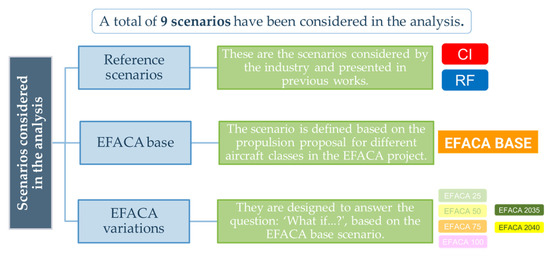
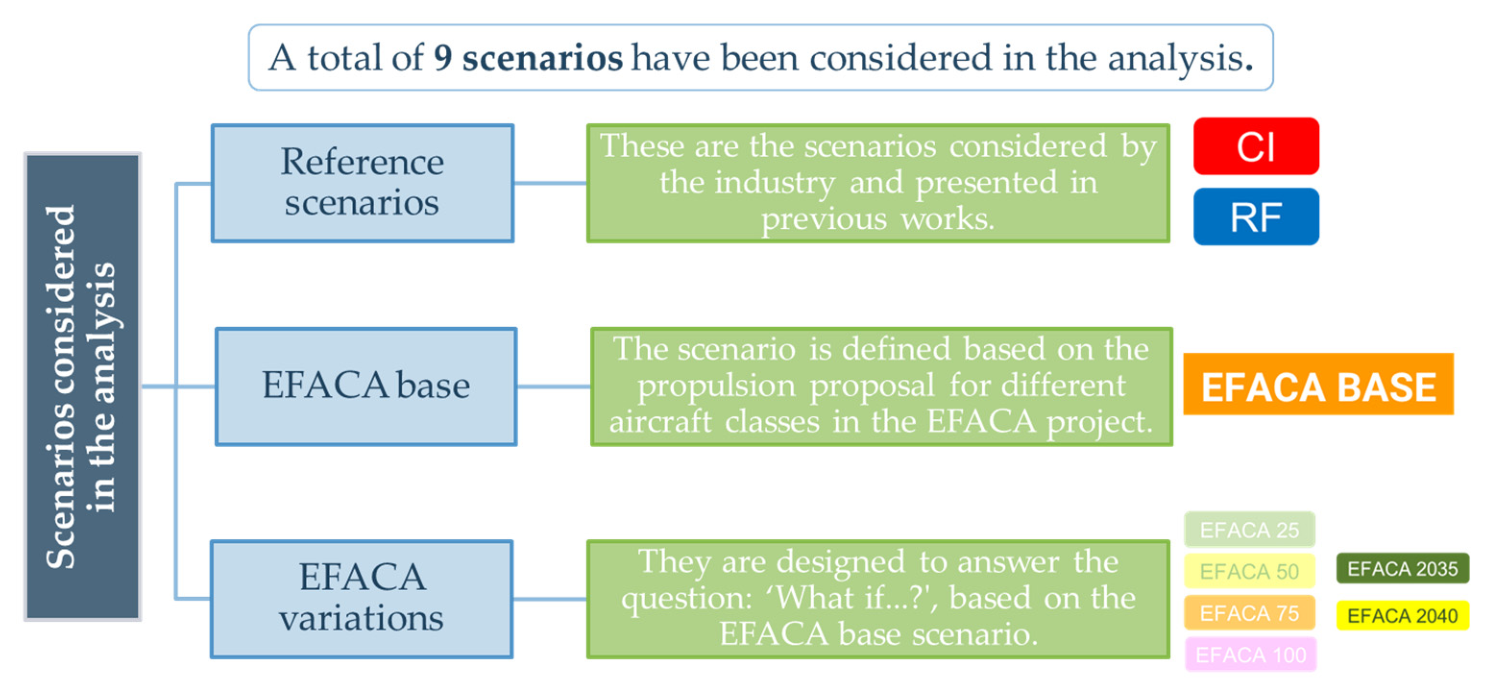
Figure 1 presents an overview of the nine scenarios considered in the analysis.
Figure 1.
Overview of the scenarios considered in the analysis: reference scenarios, EFACA base scenario and EFACA variations scenarios.
The groups of scenarios are as follows:
- Reference scenarios: These are the scenarios considered by the aviation industry and presented in previous studies. They provide a basis for comparing the results obtained from analysing the technologies and aircraft considered in the EFACA project.
- EFACA base scenario: This scenario is based on the EFACA project’s propulsion proposal. As will be explained later, four different classes of aircraft are considered. Each class is associated with a type of propulsion or a new concept of sustainable aircraft. It is essential to define the Entry Into Service (EIS) date for each of the technologies.
- EFACA variations scenarios: These are six additional scenarios that are created by introducing modifications to the EFACA base scenario. These variations enable the analysis to consider the impact of certain improvements in relation to the EFACA base scenario.
These scenarios enable the establishment of an industry benchmark, model EFACA’s propulsion proposal and analyse modifications to it, respectively. More detailed explanations of each group of scenarios can be found in the following subsections.
3.1. Reference Scenarios
The first group of scenarios consists of reference scenarios. These are the two scenarios that constitute the reference situations shared by the aviation industry. The two scenarios are:
- Carbon Intensive (CI). In this scenario, aircraft propulsion continues to be based on fossil fuels. It is assumed that no measures to reduce emissions are introduced. This pessimistic scenario is considered the negative baseline to be improved.
- Reduced Fossil (RF). This scenario considers that the measures proposed by IATA since 2021 have been introduced. It is a more sustainable scenario.
These scenarios are adapted from [8], a previous work of great interest. The scenarios referred to in previous work are adapted in this paper to make them compatible with the propulsion methods considered in the analysis.
3.2. EFACA Base Scenario
The EFACA base scenario translates the EFACA project’s sustainable propulsion proposal into a scenario applicable to all classes of aircraft. This subsection is divided into two parts. The first provides a general overview of the EFACA base scenario. It also presents the four market segments considered. For each of these segments, it proposes a different propulsion type and an EIS. The second part discusses the EFACA base scenario in the context of the aviation industry projections and trends. It focuses particularly on the analysis of the EIS dates in the EFACA base scenario, comparing them with other studies and reference dates from important aviation manufacturers.
3.2.1. Presentation of the EFACA Base Scenario
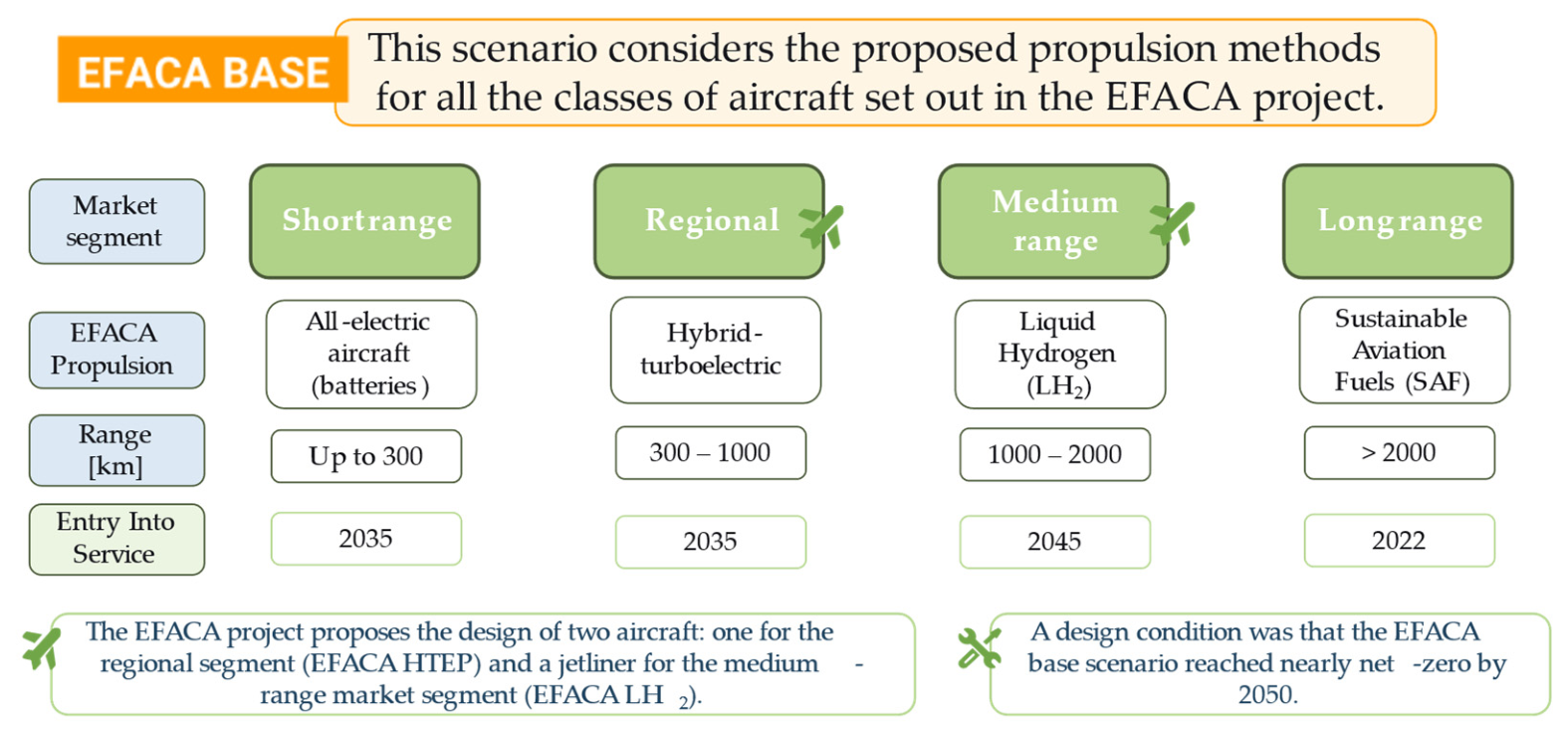
The project considers four aviation market segments: short range, regional, medium range and long range. The developed analysis associates each aviation market segment with a propulsion technology studied by EFACA, as well as an interval of operating ranges for these aircraft. Additionally, the EIS date of each technology is defined.
According to the EFACA proposal, the short-range market segment is battery-powered. The technology associated with the regional market, meanwhile, is hybrid turboelectric. Likewise, liquid hydrogen powers medium-range aircraft, while long-range aircraft use SAF.
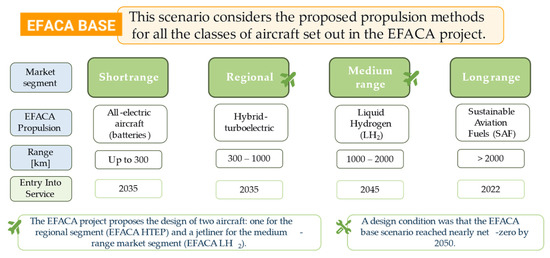
This EFACA base scenario considers the two aircraft designed within the project framework. The EFACA HTEP is a turboprop aircraft that will enter the regional market. The EFACA LH2 aircraft is a jetliner designed for the medium-range market. In addition to assigning characteristic ranges to each market segment, the model considers the dates on which the technologies and aircraft enter into service. The EIS date for SAF is 2022. The EIS for battery-powered aircraft and the EFACA HTEP aircraft is 2035. The date for the EIS of the EFACA LH2 aircraft is 2045. The model is designed so that the EFACA base scenario will reach almost net-zero by 2050. This implies that, when other technologies are not yet mature enough, introducing SAF into the relevant markets is proposed to promote sustainability. Figure 2 presents a summary of the market segments considered in the EFACA base scenario and their associated features.
Figure 2.
Detailed overview of the proposed propulsion methods in the EFACA base scenario.
3.2.2. Discussion of the EFACA Base Scenario
The four market segments considered are defined within the EFACA framework. They are analysed following two different approaches within the project. WP 6 and WP 9 of the EFACA project respectively study the use of batteries to power short-range aircraft and the use of SAF for long-range aircraft. In these cases, the approach is research oriented. Additionally, as mentioned above, two WPs are defined within the project framework: WP 7 and WP 8, which focus on the design of the EFACA HTEP and EFACA LH2 aircraft, respectively.
The model assumes that different technologies will be implemented as they reach maturity. Until then, SAF is included in the corresponding segments as a fundamental contribution. This approach aligns with the outcomes of the ICAO Environmental Report 2025. This report details that one of the main contributions for the 2023–2025 work triennium is the adoption of the ICAO Global Framework for SAF, Lower Carbon Aviation Fuels (LCAFs) and other Aviation Cleaner Energies. The objective is to achieve a collective, global, aspirational vision for reducing CO2 emissions in international aviation by 5 per cent by 2030 using cleaner aviation energies [11].
Another interesting approach is the discussion of the dates considered in the EFACA base scenario, compared to other industry references.
The first of these is the 2035 EIS for the short-range market. While batteries are currently being used to power small aircraft, the main challenge here is technical. Several years of additional research are required to improve battery energy density values. Other alternatives to lithium, which is a fundamental component of current batteries, will also be sought. The year 2035 has also been used in previous studies as the date for the EIS of electric aircraft. An interesting example is the analysis presented in [12].
The year 2035 is also considered the date of EIS for the EFACA HTEP aircraft. Due to its characteristics, this aircraft can be considered similar to the ATR72, as the reference aircraft. The ATR EVO concept is ATR’s sustainable proposal for regional aviation. Among other features, it incorporates a new power plant with hybrid capability. The estimated EIS date for this concept is mid-2030 [13]. Therefore, the EIS date considered in the EFACA base scenario for the regional market segment aligns with industry projections.
Finally, the estimated EIS date for the EFACA LH2 aircraft is 2045. The introduction of liquid hydrogen in aviation poses a major challenge. According to previous ICAO work, this technology is not expected to make a significant contribution by 2050, with an anticipated energy share of only 1.9%, but this could increase in the 2050s and 2060s if it is technically feasible and commercially viable [14]. The Airbus ZEROe is considered the reference aircraft in this market segment. The manufacturer has recently announced that it is postponing its initial target of 2035. This delay is expected to be around 5–10 years [15]. Therefore, the date considered in the EFACA base scenario for the medium-range market segment also aligns with industry projections.
3.3. EFACA Variations Scenarios
Six additional scenarios are defined as a complement to the EFACA base scenario. These are known as EFACA variations scenarios. They consider improvements compared to the initial EFACA base scenario. There are two groups. The first group considers variations in the percentage of the total regional market segment represented by the EFACA HTEP aircraft, designed by the EFACA project. Depending on this percentage, the following scenarios are defined: EFACA 25, EFACA 50, EFACA 75 and EFACA 100. In the EFACA 100 scenario, for example, the EFACA HTEP aircraft represents 100% of the regional market segment in 2050. The second group of scenarios modifies the EIS date of the EFACA LH2 aircraft, designed by the EFACA project. In the EFACA base scenario, this date is set at 2045. The two additional EFACA variations scenarios bring this forward to 2035 (the EFACA 2035 scenario) and 2040 (the EFACA 2040 scenario), respectively.
4. Methodology
It was defined that the methodology should consider different dimensions, including emissions, costs and economic impacts. This section presents the general ideas associated with each stage of the methodology.
A variant of the Kaya identity specific to the aviation sector is used to calculate carbon emissions [8]. This model enables the analysis and combination of different demand (D) and energy intensity (e) pathways with different carbon intensity (f) pathways.
To calculate non-CO2 emissions, an adaptation of the multiplier methodology presented in [4] is developed. This methodology defines multipliers for each fuel and calculates the equivalent effect of different emissions compared to CO2. The analysis defines multipliers for fossil jet fuel, liquid hydrogen and SAF. Assumptions are made in relation to liquid hydrogen and SAF to calculate these multipliers, based on previous work and the results of the EFACA project.
As part of the study, a new methodology is defined to calculate costs and infrastructure investments. This methodology considers up to 49 different parameters. These parameters are related to fuels (SAF and liquid hydrogen), fuel cell data, fuel and electricity prices, infrastructure investment, and the effect on costs related to fossil fuels.
The economic effects are calculated to determine the impact on direct operational costs (DOCs) and ticket prices associated with new fuels and technologies. These calculations are developed for the year 2050.
5. Overview of the Analyses Performed
Once the scenarios and methodology used for the calculations have been explained, the third fundamental element of the research is the analysis carried out. Three different types of analysis are developed to obtain numerical and graphical results:
- Projections up to 2050: The objective of this approach is to understand how the scenarios evolve over time.
- Comparative analysis: This approach aims to compare the EFACA base scenario with reference scenarios and draw conclusions.
- Sensitivity analysis: This involves analysing the possible variations introduced in the EFACA base scenario.
This section summarises some of the sub-analyses considered in each of the above analytical approaches. It also specifies which scenarios the results apply to.
In the analysis of projections up to 2050, graphical representations are created, and numerical results are calculated to present the evolution of the scenarios over the years. For the nine scenarios considered in the study (the two reference scenarios, the EFACA base scenario, and the six EFACA variations scenarios), the following evolution graphs are calculated: passenger demand, cargo demand, energy demand, carbon emissions, non-CO2 emissions, costs, and infrastructure investments. Additionally, for the EFACA base and EFACA variations scenarios, the analysis is complemented by projections of the aircraft production ratio, the EFACA fleet and the total aircraft fleet.
The comparative analyses examine the differences between the EFACA base scenario and the reference scenarios. In other words, the EFACA base scenario is compared with the CI and RF scenarios. The analyses include carbon and total emissions analysis, fuel cost analysis, and infrastructure investment analysis. The main objective is to contextualise the EFACA base scenario to other industry scenarios and to draw conclusions.
The third analytical approach is sensitivity analysis. The six EFACA variations scenarios are compared to the EFACA base scenario in these analyses. The proposed analyses include energy demand analysis, carbon and other non-CO2 emissions analysis, fuel cost analysis and infrastructure investment analysis. These analyses quantify the progress and improvements that could be achieved by increasing the production ratio of the EFACA HTEP aircraft and bringing forward the EIS date of the EFACA LH2 aircraft, both of which are designed by the EFACA project.
6. Conclusions and Future Work
This paper presents an overview of the research developed to define the prospects for sustainable aviation in the framework of the EFACA project. The EFACA project considers different technologies for different classes of aircraft. It also proposes the design of two aircraft: EFACA HTEP and EFACA LH2. Battery-powered aircraft and SAF are also considered. The model defines nine scenarios in total. Two of these are reference scenarios, one is the EFACA base scenario, while the other six introduce improvements and changes relative to the EFACA base scenario. The developed methodology allows CO2 and non-CO2 emissions to be calculated, and infrastructure costs and economic effects to be integrated into the analysis. These calculations can be used to make projections up to 2050 and perform comparative and sensitivity analyses. The proposed model enables the simultaneous consideration of multiple variables, and facilitates the evaluation of the necessary steps and milestones required to achieve the design condition of reaching nearly net-zero by 2050 for the EFACA base scenario. Analysing the EFACA variations scenarios enables the potential benefits of increasing the production ratio of the EFACA HTEP aircraft and/or bringing forward the EIS date of the EFACA LH2 aircraft to be assessed. This paper presents the methodological development of the model. Future work will present the results obtained in detail, as well as the lessons learned from the analysis.
Author Contributions
Conceptualization, M.Z.S.: methodology, M.Z.S. and R.M.A.V.; validation, R.D.-A.J., C.G.A., F.P.M. and V.F.G.C.; investigation, M.Z.S.; resources, R.M.A.V. and V.F.G.C.; writing—original draft preparation, M.Z.S.; writing—review and editing, M.Z.S., R.M.A.V., R.D.-A.J., C.G.A., F.P.M. and V.F.G.C.; visualization, M.Z.S. and R.M.A.V.; supervision, V.F.G.C.; project administration, V.F.G.C.; funding acquisition, V.F.G.C. All authors have read and agreed to the published version of the manuscript.
Funding
The development of this work is framed in the Environmentally Friendly Aviation for All Classes of Aircraft (EFACA) project. This project is funded by the European Union Horizon Europe research and innovation programme (HORIZON-CL5-2021-D5-01-05) under grant agreement no. 101056866.
Institutional Review Board Statement
Not applicable.
Informed Consent Statement
Not applicable.
Data Availability Statement
The original contributions presented in this study are included in the article. Further inquiries can be directed to the corresponding author.
Conflicts of Interest
The authors declare no conflicts of interest.
References
- Abrantes, I.; Ferreira, A.F.; Silva, A.; Costa, M. Sustainable Aviation Fuels and Imminent Technologies-CO2 Emissions Evolution towards 2050. J. Clean. Prod. 2021, 313, 127937. [Google Scholar] [CrossRef] [Scilit]
- Prather, M.J.; Gettelman, A.; Penner, J.E. Trade-Offs in Aviation Impacts on Climate Favour Non-CO2 Mitigation. Nature 2025, 643, 988–993. [Google Scholar] [CrossRef] [Scilit] [PubMed]
- Chen, L.; Zhang, Q.; Zhu, M.; Li, G.; Chang, L.; Xu, Z.; Zhang, H.; Wang, Y.; Zheng, Y.; Zhong, S.; et al. A Convolutional Neural Network Prediction Model for Aviation Nitrogen Oxides Emissions throughout All Flight Phases. Sci. Total Environ. 2024, 929, 172432. [Google Scholar] [CrossRef] [Scilit] [PubMed]
- Lee, D.S.; Fahey, D.W.; Skowron, A.; Allen, M.R.; Burkhardt, U.; Chen, Q.; Doherty, S.J.; Freeman, S.; Forster, P.M.; Fuglestvedt, J.; et al. The Contribution of Global Aviation to Anthropogenic Climate Forcing for 2000 to 2018. Atmos. Environ. 2021, 244, 117834. [Google Scholar] [CrossRef] [Scilit] [PubMed]
- Schumann, U.; Bugliaro, L.; Dörnbrack, A.; Baumann, R.; Voigt, C. Aviation Contrail Cirrus and Radiative Forcing Over Europe During 6 Months of COVID-19. Geophys. Res. Lett. 2021, 48, e2021GL092771. [Google Scholar] [CrossRef] [Scilit] [PubMed]
- Qasem, N.A.A.; Mourad, A.; Abderrahmane, A.; Said, Z.; Younis, O.; Guedri, K.; Kolsi, L. A Recent Review of Aviation Fuels and Sustainable Aviation Fuels. J. Therm. Anal. Calorim. 2024, 149, 4287–4312. [Google Scholar] [CrossRef] [Scilit]
- Olumoh, F.; Li, E.; Catcha-Picard, A.E.; Abdulla, A. Assessing the Cost and Resource Requirements of Converting Carbon Dioxide into Synthetic Aviation Fuels. Environ. Res. Energy 2025, 2, 045001. [Google Scholar] [CrossRef] [Scilit]
- Bergero, C.; Gosnell, G.; Gielen, D.; Kang, S.; Bazilian, M.; Davis, S.J. Pathways to Net-Zero Emissions from Aviation. Nat. Sustain. 2023, 6, 404–414. [Google Scholar] [CrossRef] [Scilit]
- Qureshi, L. Aviation Route Optimization. Energy Convers. 2025, 101. [Google Scholar]
- Tepylo, N.; Straubinger, A.; Laliberte, J. Public Perception of Advanced Aviation Technologies: A Review and Roadmap to Acceptance. Prog. Aerosp. Sci. 2023, 138, 100899. [Google Scholar] [CrossRef] [Scilit]
- ICAO Secretariat. ICAO Global Framework for SAF, LCAF and Other Aviation Cleaner Energies. In 2025 ICAO Environmental Report; ICAO: Montreal, QC, Canada, 2025; pp. 155–158. [Google Scholar]
- Talwar, C.; Joormann, I.; Ginster, R.; Spengler, T.S. How Much Can Electric Aircraft Contribute to Reaching the Flightpath 2050 CO2 Emissions Goal? A System Dynamics Approach for European Short Haul Flights. J. Air Transp. Manag. 2023, 112, 102455. [Google Scholar] [CrossRef] [Scilit]
- ATR EVO Concept. Available online: https://www.atr-aircraft.com/innovation/atr-evo-concept/ (accessed on 28 December 2025).
- ICAO Committee on Aviation Environmental Protection. Report on the Feasibility of a Long-Term Aspirational Goal (LTAG) for International Civil Aviation CO2 Emission Reductions; ICAO Committee on Aviation Environmental Protection: Montreal, QC, Canada, 2022. [Google Scholar]
- Airbus ZEROe Plan Postponement Cools Prospects For Hydrogen Propulsion|Aviation Week Network. Available online: https://aviationweek.com/aerospace/emerging-technologies/airbus-zeroe-plan-postponement-cools-prospects-hydrogen-propulsion (accessed on 4 January 2026).
Disclaimer/Publisher’s Note: The statements, opinions and data contained in all publications are solely those of the individual author(s) and contributor(s) and not of MDPI and/or the editor(s). MDPI and/or the editor(s) disclaim responsibility for any injury to people or property resulting from any ideas, methods, instructions or products referred to in the content. |
© 2026 by the authors. Licensee MDPI, Basel, Switzerland. This article is an open access article distributed under the terms and conditions of the Creative Commons Attribution (CC BY) license.