


Abstract
One of today’s major challenges in air transport is accommodating future growth in traffic demand, which requires addressing capacity limitations. Since separation minima influence airspace capacity, technological progress enables exploring innovative approaches. This paper presents the Ad Hoc Separation concept, which involves applying different separation minima between aircraft pairs based on aircraft type, weight, encounter geometry, flight level, or wind. As a novel approach requiring operational changes to the current ATM system, further research is justified only if tangible benefits are demonstrated. Fast-time simulations in European en-route sectors, both conventional and Free Route Airspace, are performed to assess the benefits. The results show a capacity gain of about one aircraft per hour, along with positive environmental and cost-efficiency benefits.
1. Introduction
The SESAR program, as the technological pillar of the Single European Sky (SES) initiative, aims to modernize the European Air Traffic Management (ATM) system. This modernization is guided by the European ATM Master Plan [1], which provides the strategic roadmap for the evolution of the system. This evolution contributes to improvements in capacity, environment, safety, and cost-efficiency key performance areas (KPAs) under the SES Performance Scheme.
In recent years, several concepts have been researched and implemented to support the modernization of the European ATM system. Among the most notable are: the Advanced Flexible Use of Airspace (AFUA) concept [2], which enables dynamic civil-military airspace management through the activation of temporary structures; the Performance-Based Navigation (PBN), based on the use of Global Navigation Satellite System (GNSS) as a navigation sensor, enhancing navigational accuracy and improving airport accessibility [3]; the Free Route Airspace (FRA) concept, which allows aircraft to plan direct routes within defined volumes of airspace without being constrained by fixed ATS routes, thereby reducing distance flown, fuel consumption, and emissions [4]; and the Time-Based Separation (TBS) [5] and RECAT [6] concepts, which provide advanced wake turbulence separation schemes that enhance runway throughput and improve arrival efficiency, particularly under challenging wind conditions.
Dynamic separation is one of the research lines specified in the European ATM Master Plan to be researched. While the main focus of these years has been the redefinition of wake turbulence separation minima (TBS and RECAT concepts), it is also necessary to start investigating the potential for reducing ATC Minimum Separation. This is because reduced Minimum Wake Separation (MWS) can only be implemented if the ATC Minimum Separation can be safely reduced. However, it may not be feasible to achieve a uniform reduction, as not all operational conditions and aircraft performance are equal. The Ad Hoc Separation concept arises in this context, and it refers to the application of different separation minima in the same volume of airspace depending on a set of factors such as aircraft models, encounter geometry, flight level (FL) or wind conditions, among others.
The Ad Hoc Separation concept has been developed in previous studies [7,8] and its impact on different conventional en-route scenarios (with predefined route structures) has already been assessed [9]. Nevertheless, since it is a new concept being researched and developed, it is of interest to investigate the potential benefits it could provide when applied in a future scenario (namely, one in which the Free Route concept is implemented) in terms of capacity, environment, and cost-efficiency, and to compare these benefits with those obtained in a conventional scenario (predefined routes). This is the objective of the present work. This study is organized as follows: Section 2 briefly describes the Ad Hoc Separation operational concept (CONOPS), while Section 3 outlines the methodology employed to assess the impact of implementing this concept on the capacity, environmental, and cost-efficiency KPAs. The results of the analysis of different scenarios are presented in Section 4. Finally, Section 5 provides conclusions drawn from the findings.
2. Ad Hoc Separation CONOPS
In this section the operational concept of Ad Hoc Separation is briefly described. For a more detailed explanation, the authors recommend [7,8,10].
The concept of Ad Hoc Separation [7] refers to the application of different separation minima values between each aircraft pair flying in the same volume of airspace depending on a set of factors such as aircraft model, aircraft weight, encounter geometry, FL, avoidance maneuver and wind conditions. In this study, Ad Hoc Separation is referred to as ATC Minimum Separation, which must always be greater than the en-route wake vortex separation minima. In the first phase of the development, the concept focuses on horizontal separation only, within a range from 3 to 5 nautical miles, aiming to reduce separation whenever it is safely possible. The initial application is limited to en-route airspace at upper FLs.
Because Air Traffic Control Officers (ATCOs) cannot mentally calculate different separation values, the Ad Hoc Separation Minima Tool (ASMT) [10] is introduced to support its labor and display, in real time, the required Ad Hoc Separation Minima (ADSM) for each aircraft pair. Although the ATCO remains responsible for maintaining separation, the tool identifies conflicts, suggests resolution maneuvers (Conflict Detection and Resolution, CD&R functionalities) according to each specific ADSM, and integrates modules for trajectory prediction, conflict detection, and separation calculation [10].
ADSM values are not computed in real time; instead, they are pre-computed, stored in a database, and validated through ICAO-compliant safety assessments before operational use. The determination of ADSM [8] relies on the absolute method of safety evaluation, which compares the estimated collision risk to a predefined Target Level of Safety (TLS). Different safe separation values for various combinations of operational factors (FLs, encounter geometry, etc.) are computed, ensuring that the proposed variable separation minima meet safety requirements prior to implementation.
3. Methodology
Nowadays, the approach adopted in the ATM system is based on the PBA (performance-based approach) [11], in which the focus is stated to be on the desired outcomes rather than prescribing specific solutions. KPAs and KPIs (Key Performance Indicators), among others, are key elements within the PBA concept for the analysis of system performance. KPAs are defined by ICAO as the way to categorize performance aspects relative to high-level ambitions and expectations. KPIs quantitatively express current, past or expected future performance as well as actual progress in achieving performance objectives [11]. The difference between KPIs and Performance Indicators (PIs) is that KPIs are those which have an associated Validation Target while PIs are those that do not. Based on this approach, the impact of the Ad Hoc Separation concept in different scenarios is evaluated. The following KPAs and PIs have been selected (Table 1).
Table 1.
KPAs and PIs used for evaluating the application of the Ad Hoc Separation concept.
3.1. Capacity Estimation
Airspace capacity is defined by EUROCONTROL as the maximum number of aircraft that can enter a Control Area within a given period while maintaining an acceptable level of Air Traffic Control (ATC) workload [12].
In this research, en-route capacity is computed from Fast Time Simulations (FTS), employing models based on the ATCO workload (WL). An extensive review of the models employed in different countries for capacity estimation is presented in [13]. Among the most widely used models is EUROCONTROL’s CAPAN method [12], which estimates ATCO workload by simulating predefined, event-driven tasks and summing their durations. That is, capacity is derived from the tactical ATCO’s workload (WL) values through FTS, where the ATCO’s workload is computed in time units. This method distinguishes between flight data management, conflict search, R/T (radio communication tasks), co-ordination and radar categories for ATC tasks. Specific weights and time durations are assigned to the different tasks included in each category. This is the model used in this research. Generally, the common ATC workload threshold used for estimating airspace capacity is 70%. Therefore, the capacity is calculated from the intersection of the curve representing the ATCO WL (found by regression) and the threshold value of 70%.
Capacity values were computed for the following three scenarios, first considering an airspace structure based on predefined routes. Then, airspace capacity was estimated under the FRA concept, applied to the same three scenarios:
- Baseline Scenario: Used as the reference scenario. Capacity is computed assuming a constant horizontal separation minima equal to the current value (i.e., 5 NM). This scenario represents the current ATM system.
- Scenario 1: Ad Hoc Separation concept is implemented together with the ASMT; however, this tool does not include the CD&R functionalities.
- Scenario 2: Ad Hoc Separation concept is implemented together with the ASMT including CD&R functionalities for each Ad Hoc Separation Minima value.
An important assumption when estimating capacity in a scenario where the Ad Hoc Separation concept is applied is that the ATCO’s workload (ATCO WL) might change. Although this new concept may initially seem more demanding (from the ATCO point of view), it is expected that ATCOs will be supported by a tool that provides the appropriate ADSM to be applied (the ASMT). This system also integrates advanced CD&R functionalities according to each specific ADSM. As a result, the ATCOs workload may stay at current levels or even decrease due to these enhanced capabilities.
Reducing the separation minima in some encounters decreases the number of LOS events within each scenario. According to the CAPAN methodology, every LOS occurring in a sector triggers a set of ATCO tasks that ultimately increase ATCO workload. Therefore, lowering the likelihood of conflict situations leads to a reduction in ATCO workload and, consequently, to an updated estimation of sector capacity (Scenario 1). Moreover, if the ATCO is supported by a tool that includes CD&R functionalities, the time that would normally be required for CD&R will be reduced, thanks to the tool’s automated features, which alert the ATCO to such situations (Scenario 2).
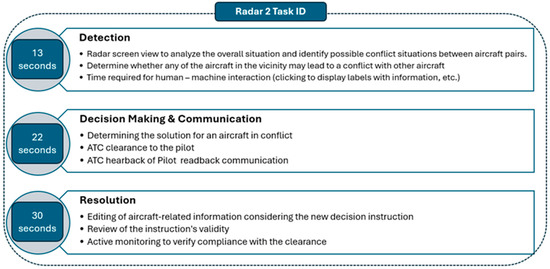
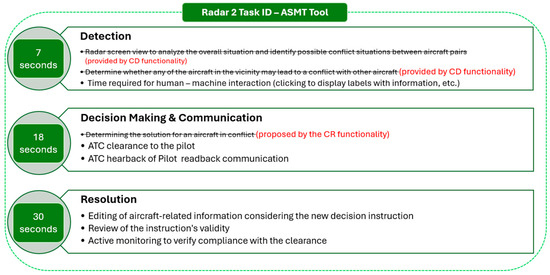
To illustrate the above, an example is provided (Figure 1). According to the CAPAN methodology, ATCO’s tasks are classified into five categories to calculate workload. The Radar category comprises activities associated with CD&R actions. As an example, Radar Task 2 refers to the action of “Conflict resolution by radar intervention: 2 aircraft, same direction, at least one climbing or descending (unstable).” A duration of 65 s is assigned to this task. According to expert judgment, this main task can be divided into the following sub-activities:
Figure 1.
Radar 2 task sub-activities.
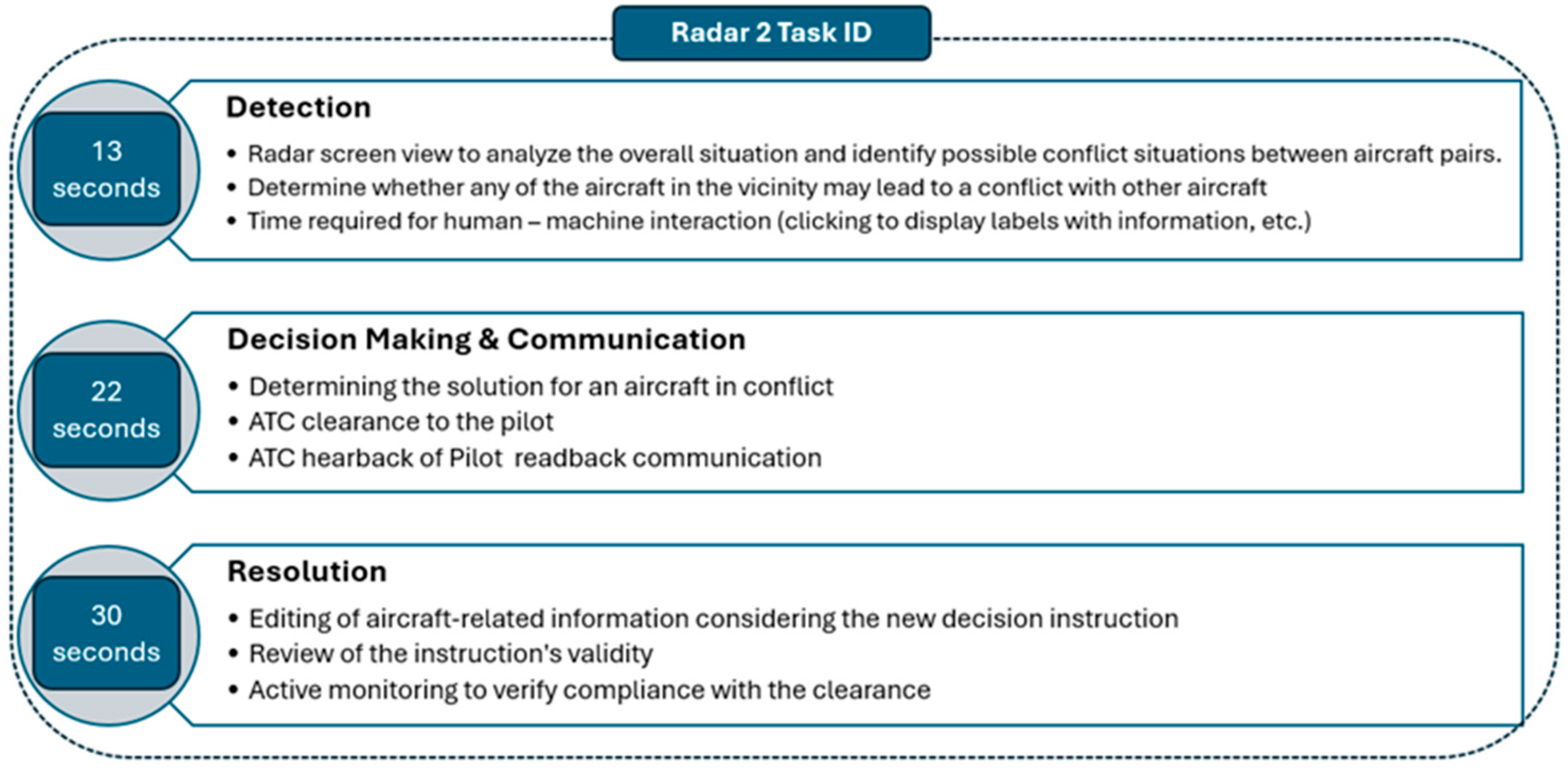
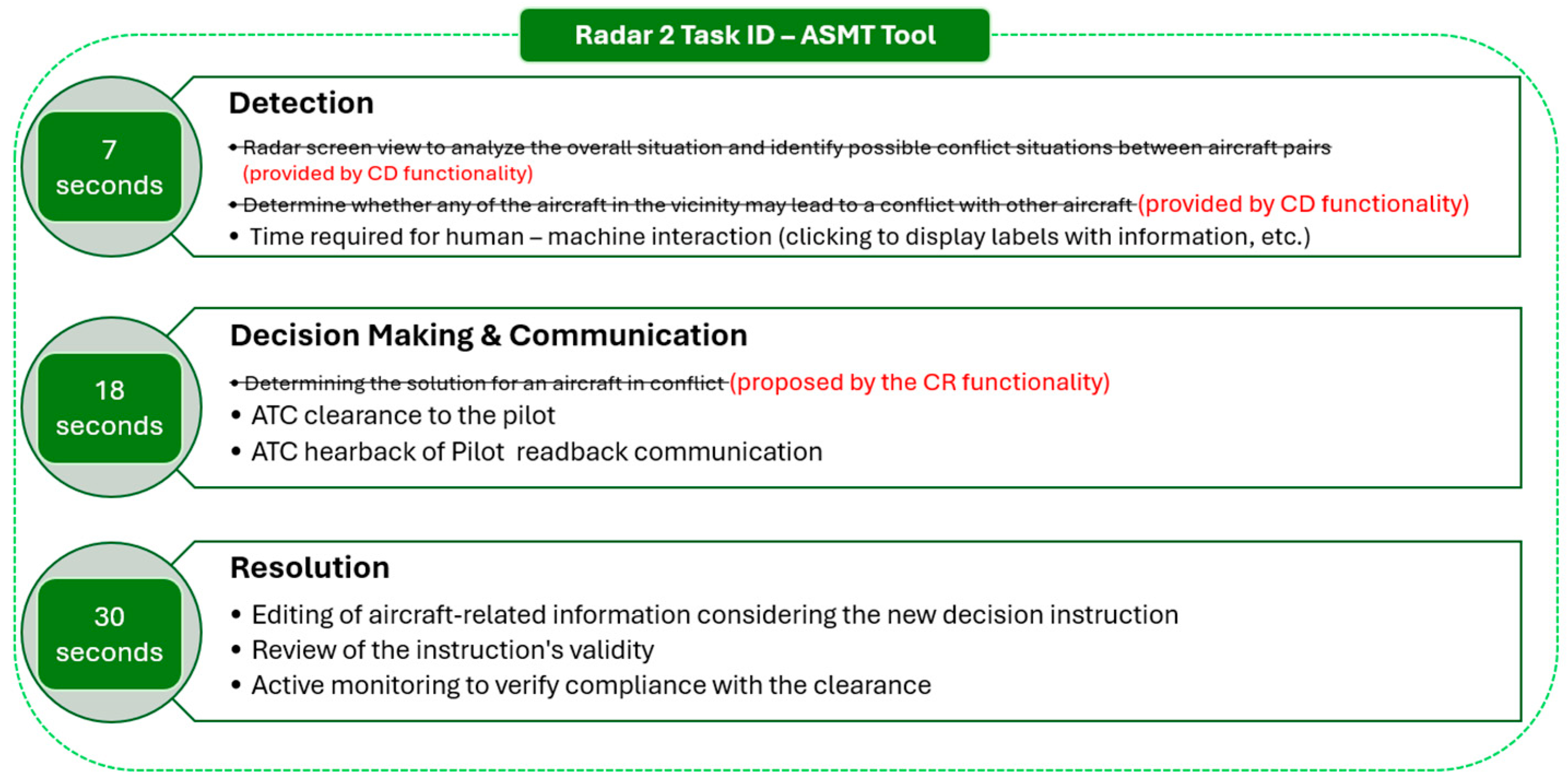
Based on expert judgment obtained from meetings with specialists from the Spanish ANSP and EASA (for further details on expert judgment process, see Chapter 4, Sections 4.2.4.1 and Annex F of [14]), and in line with the ASMT prototype tool, it is estimated that, if ASMT with CD&R functionalities is available to the ATCO in a given scenario, the detection action improves by 50% and the decision-making action improves by 20%. Therefore, if CD&R functionalities are considered (Scenario 2), Task 2 would be reduced to 55 s (Figure 2), as some of its sub-activities are supported by the tool:
Figure 2.
Radar 2 task sub-activities considering ASMT with CD&R functionalities.
3.2. Environment and Airspace User Cost-Efficiency Estimation
Environmental KPA is computed through three indicators which are distance, fuel and CO2 emissions reduction. Delay reduction is considered for computing the benefits achieved in the airspace user cost-efficiency estimation. It is defined as the reduction in additional flight time induced by CD&R maneuvers and achieved through the avoidance of LOS, as a consequence of the Ad Hoc Separation. These metrics were also used in previous studies [15,16].
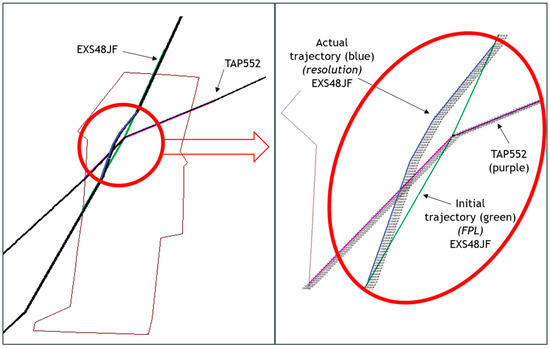
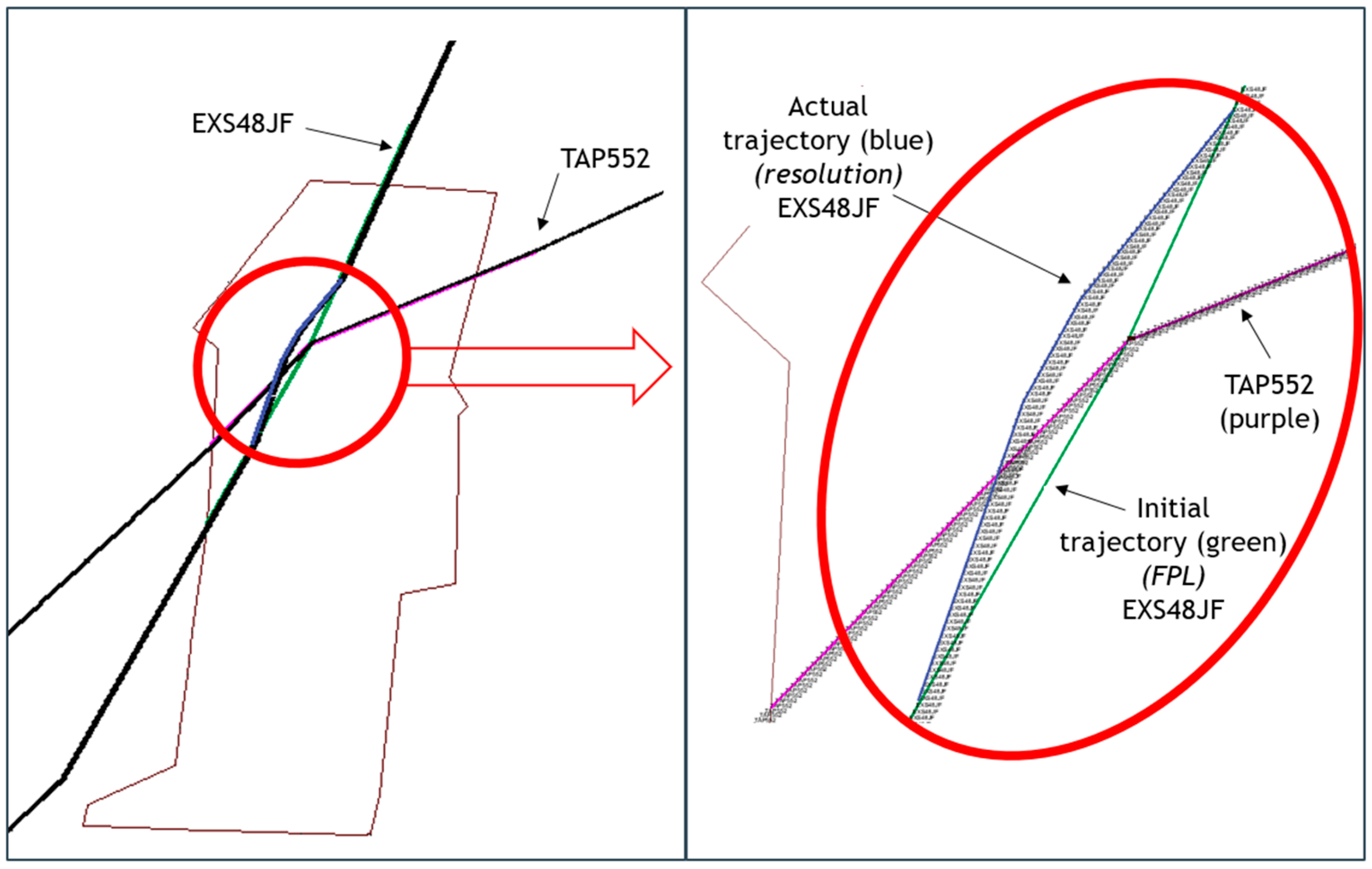
For the computation of the selected metrics, the focus is placed on the LOS saved as a result of applying the Ad Hoc Separation concept. When an LOS is saved, the trajectories of the aircraft involved (which under normal conditions would be modified to avoid the occurrence of the LOS, Figure 3) no longer require intervention from the ATCO. Consequently, it is possible, based on the following Expressions (1)–(4), to calculate the savings in distance flown, fuel consumption, CO2 emissions, and delay per LOS saved.
Figure 3.
Conflict resolution clearance (horizontal vector) example (radar traces).
Figure 3 shows the radar tracks of two aircraft flying at the same altitude that came as close as 4.5 NM. In the simulation, since the horizontal separation minimum was 5 NM, the ATCO issued a resolution maneuver (a vector to the EXS48JF aircraft). However, under the Ad Hoc Separation concept, this situation would not have occurred, as the separation between the two aircraft would have been 3 NM. Therefore, separation would not have been lost, and there would have been no need to modify their trajectories.
3.3. En-Route Sectors Simulation Scenarios
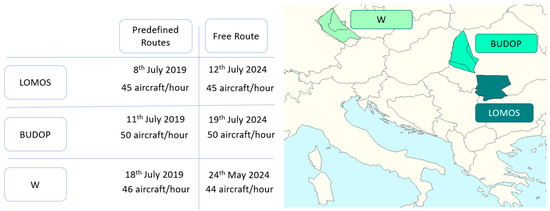
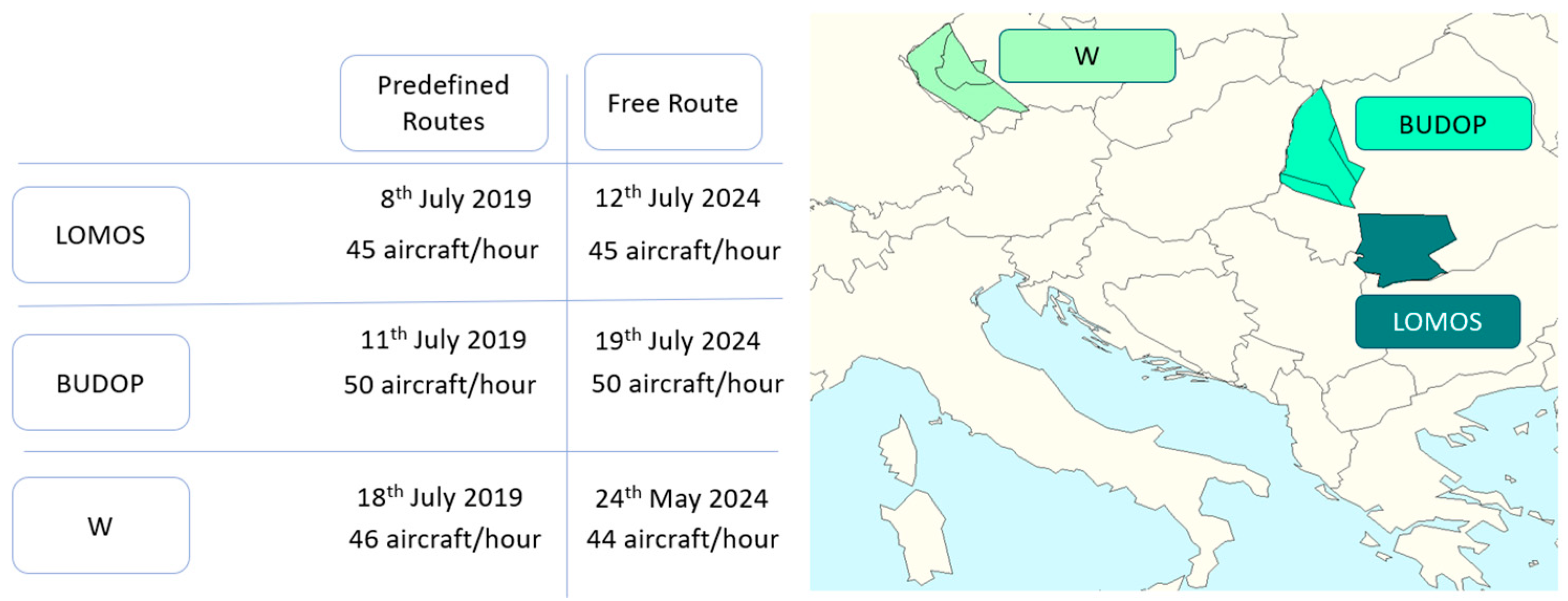
The simulation scenarios in which the Ad Hoc Separation concept has been applied correspond to upper en-route airspace sectors where the FRA concept is currently implemented (2024) but was not in place in 2019 (when predefined route structures were used). The purpose of this approach is to enable a consistent comparison between both sector typologies under similar traffic conditions, thereby avoiding the traffic downturn observed in 2020 due to the COVID-19 pandemic. The BUDOP (LRBBBUD) and LOMOS (LRBBLOM) sectors of the Bucharest FIR (Romania) and Sector W (LKAAW) of the Praha FIR (Czech Republic) were selected for this analysis.
For the capacity assessment, FTSs were performed during a representative week, including the busiest day. Multiple simulations were performed using traffic demand profiles derived from this week. Different traffic samples were generated by cloning and modifying the traffic demand, leading to non-identical simulation runs with varying traffic volumes. Both the predefined 2019 route structure and the FRA-implemented 2024 configuration were considered for the three scenarios (Baseline, Scenario 1, and Scenario 2). Figure 4 shows the geographical locations of the sectors along with the corresponding capacity values and busy days for both airspace structures.
Figure 4.
Geographical location and operational information (busy day and capacity) of the simulation scenarios.
4. Results and Discussion
This section presents the results of applying the Ad Hoc Separation concept to the three en-route sectors, categorized by KPAs and sectors.
4.1. Capacity Estimation
The capacity values from the Baseline Scenario are used as a reference to assess the outcomes of Scenario 1 and Scenario 2. It is observed that the capacity values in the Baseline Scenario for all three sectors closely match published real-world capacity figures. Consequently, the values derived using the CAPAN methodology are considered reliable benchmarks for comparison.
Overall, the results (Table 2) are favorable across all three sectors, showing an increase in one aircraft per hour. The most significant capacity gains are observed in Scenario 2, in which the ASMT incorporates CD&R functionalities. Furthermore, capacity values are found to be very similar whether a fixed-route structure or a Free Route scenario is considered. The overall capacity increase ranges from 1% to 2%, equivalent to approximately one additional aircraft per hour per sector. The application of this concept in a broader scenario (ACC, area control center), rather than in a single sector, would provide greater benefits.
Table 2.
Capacity results.
4.2. Environment and Airspace User Cost-Efficiency
The results for the Environment and Airspace User Cost-Efficiency KPAs are presented in Table 3. Both mean and maximum values are included for each indicator. It should be noted that lateral and longitudinal LOS were considered when estimating these indicators, and that the resolution maneuver issued by the ATCO in the RAMS software (https://www.softguide.com/program/rams-office, accessed on 22 April 2026) consisted of either a horizontal vector or a FL change. This explains why a direct correlation between fuel savings and distance reduction is not always observed: FL changes generate fuel savings but do not result in a significant reduction in flown distance. Differences across the three sectors are mainly due to their operational characteristics, with encounter geometry influencing how many LOS can be saved.
Table 3.
Environmental and airspace user cost-efficiency results (mean and maximum values).
For clarity and conciseness, the following Table 3 provides a summary of the mean and maximum reduction in each indicator per LOS saved for the three en-route sectors, considering both predefined route and FRA configurations. The main outcome is that, although the values are small, they are consistently positive.
5. Conclusions
This study assessed the impact of implementing the Ad Hoc Separation concept in both a predefined route scenario and a Free Route scenario in three European en-route sectors, evaluating its effects on capacity, environmental performance, and cost-efficiency KPAs. Capacity results indicate an increase in one aircraft per hour in both operational airspace structures, while environmental and cost-efficiency indicators show marginal but consistently positive improvements, suggesting incremental benefits. The near equivalence of outcomes may be due to the preliminary nature of the study, the limited sample, and the concept being applied only in two dimensions, preventing clear differentiation between scenarios. Therefore, no definitive conclusion can be drawn regarding which scenario benefits more (predefined routes or FRA). Future work could focus on (1) extending the Ad Hoc concept to three dimensions and (2) generalization of the ADSM methodology.
Author Contributions
Conceptualization, L.S.-M. and L.P.S.; methodology, L.S.-M.; software, M.S.-A.R.; validation, J.A.P.-C., E.S.A. and M.P.M.; data curation, M.S.-A.R.; writing—original draft preparation, L.S.-M.; writing—review and editing, J.A.P.-C., E.S.A., M.P.M. and L.P.S.; funding acquisition, L.P.S. All authors have read and agreed to the published version of the manuscript.
Funding
This research received no external funding.
Institutional Review Board Statement
Not applicable.
Informed Consent Statement
Not applicable.
Data Availability Statement
Data is unavailable due to privacy.
Conflicts of Interest
The authors declare no conflicts of interest.
References
- SESAR Joint Undertaking. European ATM Master Plan; SESAR Joint Undertaking: Brussels, Belgium, 2025. [Google Scholar]
- EUROCONTROL. FUA AMC CADF OPERATIONS MANUAL; EUROCONTROL: Brussels, Belgium, 2024. [Google Scholar]
- EUROCONTROL. European PBN Implementation and Transition Planning Handbook, 2nd ed.; EUROCONTROL: Brussels, Belgium, 2021; Available online: www.pbnportal.eu (accessed on 23 February 2025).
- Jelinek, F.; Quesne, A.; Carlier, S.; EUROCONTROL. The Free Route Airspace Project Environmental Benefit Analysis; EUROCONTROL: Bretigny Sur Orge Cedex, France, 2002. [Google Scholar]
- EUROCONTROL. EUROCONTROL Guidelines on Time-Based Separation (TBS) for Final Approach. 2021. Available online: www.eurocontrol.int (accessed on 10 December 2022).
- EUROCONTROL. ‘RECAT-EU’ European Wake Turbulence Categorisation and Separation Minima on Approach and Departure, 2nd ed.; EUROCONTROL: Brussels, Belgium, 2024. [Google Scholar]
- Serrano-Mira, L.; Sanz, L.P.; Pérez-Castán, J.A.; Netjasov, F.; Moreno, I.G.; Ayra, E.S. Preliminary Feasibility Study of the Ad Hoc Separation Operational Concept. Aerospace 2023, 10, 539. [Google Scholar] [CrossRef] [Scilit]
- Serrano-Mira, L.; Pérez-Castán, J.A.; Ayra, E.S.; Moreno, I.G.; Maroto, M.P.; Sanz, L.P. Risk-Based Method for Establishing Ad Hoc Separation Minima Between Aircraft in En-Route Airspace. IEEE Access 2025, 13, 112176–112196. [Google Scholar] [CrossRef] [Scilit]
- Serrano-Mira, L.; Sanz, L.P.; Pérez-Castán, J.A.; López, A.C.; Ayra, E.S.; Maroto, M.P. Preliminary Impact Assessment of the Ad Hoc Separation Minima: A New Separation Mode. Appl. Sci. 2024, 14, 3824. [Google Scholar] [CrossRef] [Scilit]
- Serrano-Mira, L.; Sanz, L.P.; Pérez-Castán, J.A.; Mas-Sardá, J.S.-C. Preliminary design of an ATC support tool for the implementation of the Ad Hoc Separation Minima concept in an en-route sector. J. Phys. Conf. Ser. 2024, 2716, 012079. [Google Scholar] [CrossRef] [Scilit]
- ICAO. Doc. 9750-AN/963. Global Air Navigation Plan 2016–2030, 5th ed.; ICAO: Montreal, QC, Canada, 2016. [Google Scholar]
- Eurocontrol. Pessimistic Sector Capacity Estimation. EEC Note 2003, 21, 1. Available online: http://scholar.google.com/scholar?hl=en&btnG=Search&q=intitle:REvisiting+the+Swiss+Cheese+model+of+accidents#0 (accessed on 10 June 2022).
- Majumdar, A.; Ochieng, W.Y.; Bentham, J.; Richards, M. En-route sector capacity estimation methodologies: An international survey. J. Air Transp. Manag. 2005, 11, 375–387. [Google Scholar] [CrossRef] [Scilit]
- Mira, L.S. Definition of a Methodology for the Computation and Application of a Variable Separation Minima Between Aircraft in an En-Route Environment; Universidad Politécnica de Madrid: Madrid, Spain, 2024. [Google Scholar] [CrossRef] [Scilit]
- Maroto, M.P.; García-Heras, J.; Sanz, L.P.; Serrano-Mira, L.; Pérez-Castán, J.A. Performance Impact Assessment of Reducing Separation Minima for En-Route Operations. Aerospace 2022, 9, 772. [Google Scholar] [CrossRef] [Scilit]
- García-Heras, J.; Soler, M.; González-Arribas, D.; Eschbacher, K.; Rokitansky, C.-H.; Sacher, D.; Gelhardt, U.; Lang, J.; Hauf, T.; Simarro, J.; et al. Robust flight planning impact assessment considering convective phenomena. Transp. Res. Part C Emerg. Technol. 2021, 123, 102968. [Google Scholar] [CrossRef] [Scilit]

Disclaimer/Publisher’s Note: The statements, opinions and data contained in all publications are solely those of the individual author(s) and contributor(s) and not of MDPI and/or the editor(s). MDPI and/or the editor(s) disclaim responsibility for any injury to people or property resulting from any ideas, methods, instructions or products referred to in the content. |
© 2026 by the authors. Licensee MDPI, Basel, Switzerland. This article is an open access article distributed under the terms and conditions of the Creative Commons Attribution (CC BY) license.