


Abstract
This paper presents a compact 122 GHz Terahertz FMCW radar using a plastic hollow-core dielectric waveguide for non-destructive testing. The guided approach simplifies the system, avoiding complex free-space optics and alignment, while improving the signal-to-noise ratio by isolating endpoint reflections from internal ones. Various configurations, including solid immersion lenses, enhance spatial resolution and imaging capabilities. Experiments combine 3D electromagnetic simulations and raster scanning to image fine details and detect subsurface defects. Applications span aerospace, automotive, and art conservation. Results demonstrate that the guided FMCW radar is a cost-effective, portable, and reliable alternative to traditional free-space setups, enabling broader, practical implementation across industries.
1. Introduction
Terahertz (THz) waves have attracted growing attention for their numerous imaging applications [1], ranging from material characterization to security screening and cultural heritage preservation [2]. Among the different THz imaging technologies, the Frequency Modulated Continuous Wave (FMCW) radar has demonstrated particular relevance for industrial inspection and composite material analysis, offering high resolution and penetration depth combined with compact and cost-effective architectures [3,4,5]. Traditionally, THz FMCW imaging systems operate in the far field, employing Gaussian beams shaped by lenses or mirrors to illuminate and scan the sample. In parallel, several studies have explored the use of THz waveguides as an alternative propagation medium, enabling guided delivery of THz radiation directly to the inspection site. In parallel, guided-wave approaches have been explored as an alternative to free-space propagation in terahertz systems, enabling the delivery of radiation directly to the inspection site and improving measurement robustness. Such approaches have been shown to be compatible with frequency-modulated continuous-wave (FMCW) operation for non-destructive testing applications [5]. In this work, we propose a new integration of this concept, combining a compact 3D-printed hollow-core dielectric waveguide with a 122 GHz FMCW radar module, forming a self-contained sensing unit. This approach eliminates complex optical alignment, improves measurement robustness, and is applied here to the non-destructive inspection of composite materials.
2. Materials and Methods
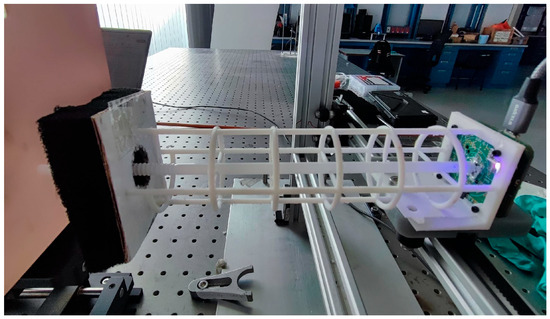
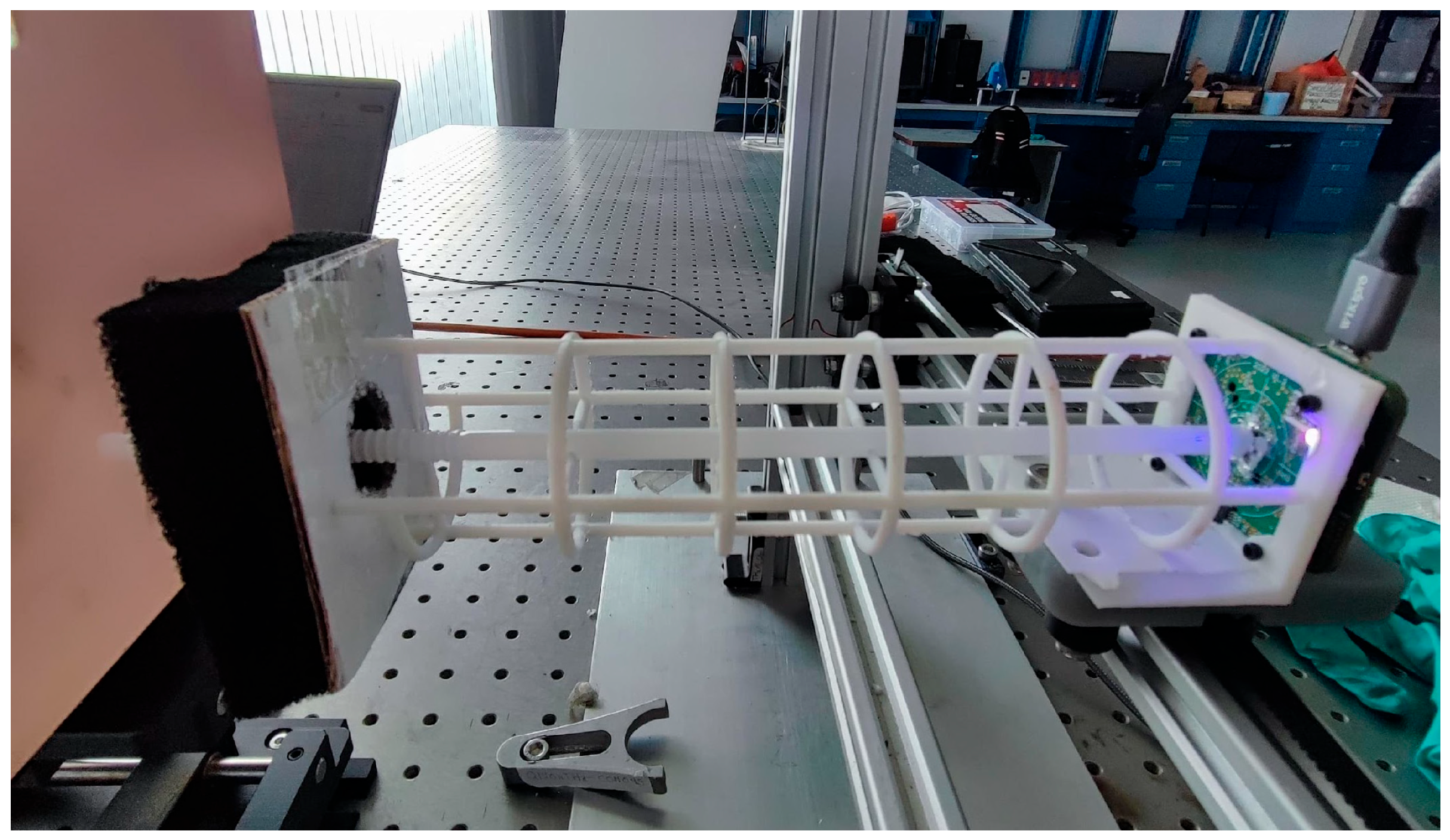
The setup, as illustrated in Figure 1, consists of a Siliconradar TRAˍ120ˍ002 FMCW radar, manufactured by Silicon Radar GmbH (Frankfurt am Main, Germany), operating at 122 GHz, without a collimator or lens, and with a 6 GHz bandwidth. The radar is coupled to a dielectric waveguide with a diameter of 5 mm and a length of 218 mm. The waveguide is held in place by a 3D-printed mount providing regular support along its length. The wave is transmitted along the waveguide to its terminal end, where the object under inspection is positioned. The waveguide is passed through an opening in absorbing foam to reduce the effect of uncoupled free-space radiation that could propagate outside the guide and introduce noise.
Figure 1.
Photography of the experiment. The FMCW radar is shown on the right; the waveguide and its holder in the middle; and the object on the left.
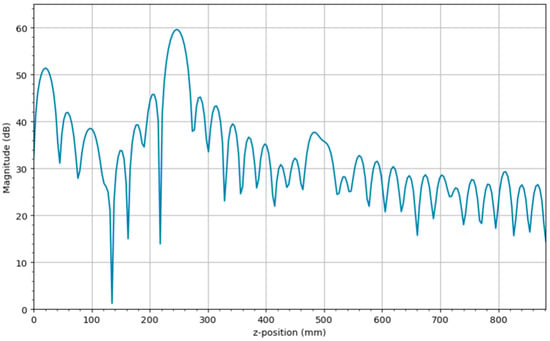
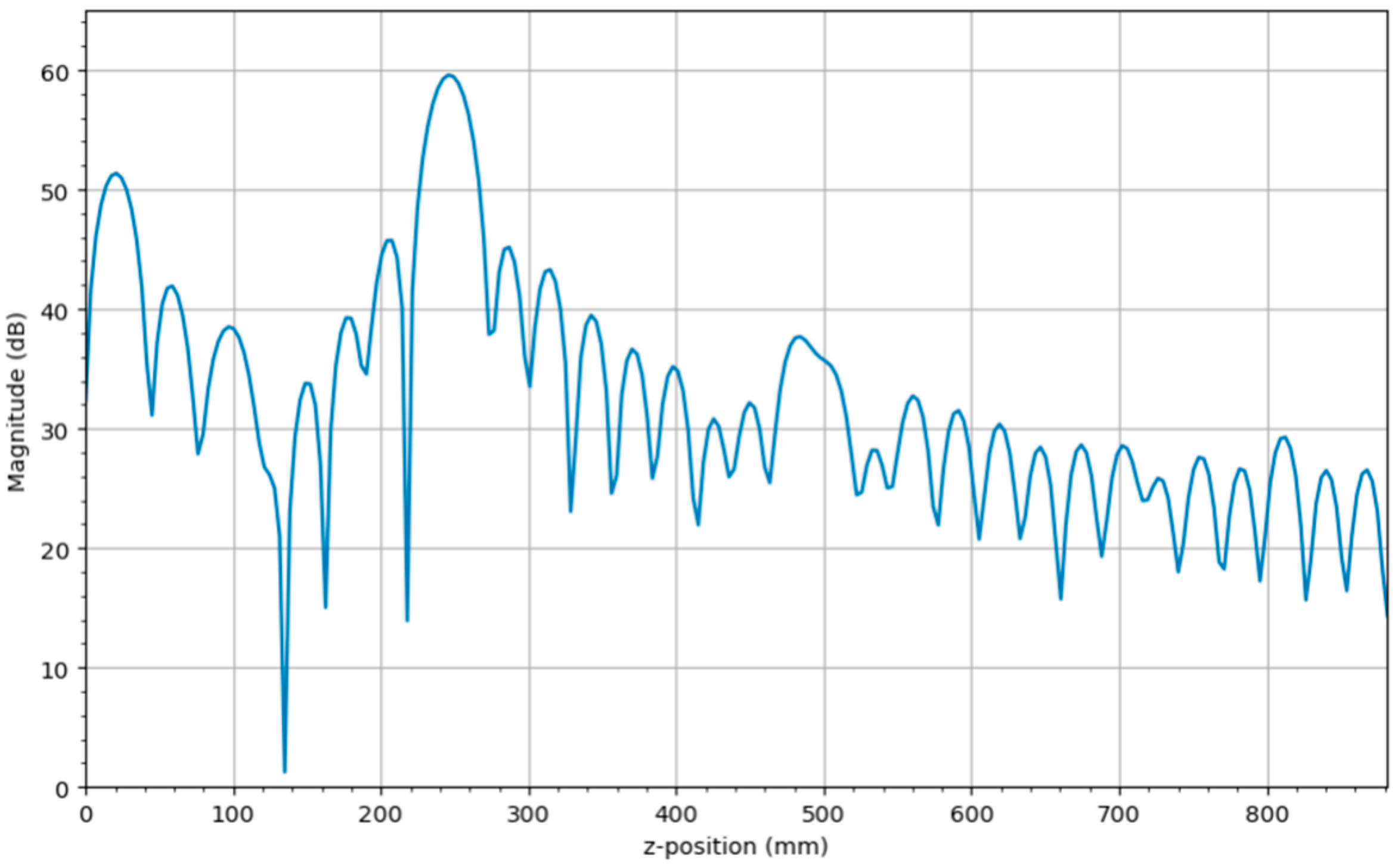
The first experiment involves positioning the probe in front of a reference mirror to obtain the baseline measurement, as illustrated in Figure 2, which shows a 60 dB peak at the 250 mm position.
Figure 2.
The reference signal was reflected when the probe is in contact with a reference mirror. A 60 dB peak can be observed at the 250 mm position.
3. Discussion
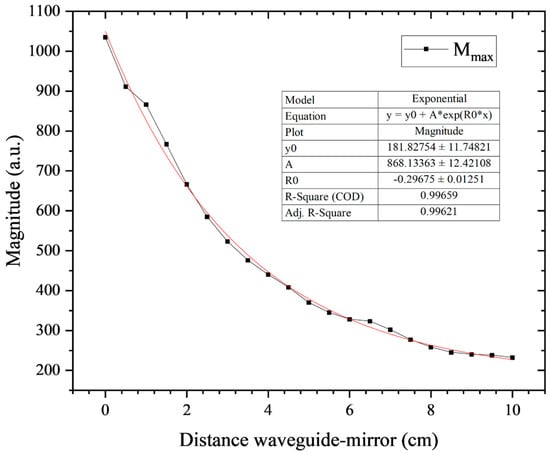
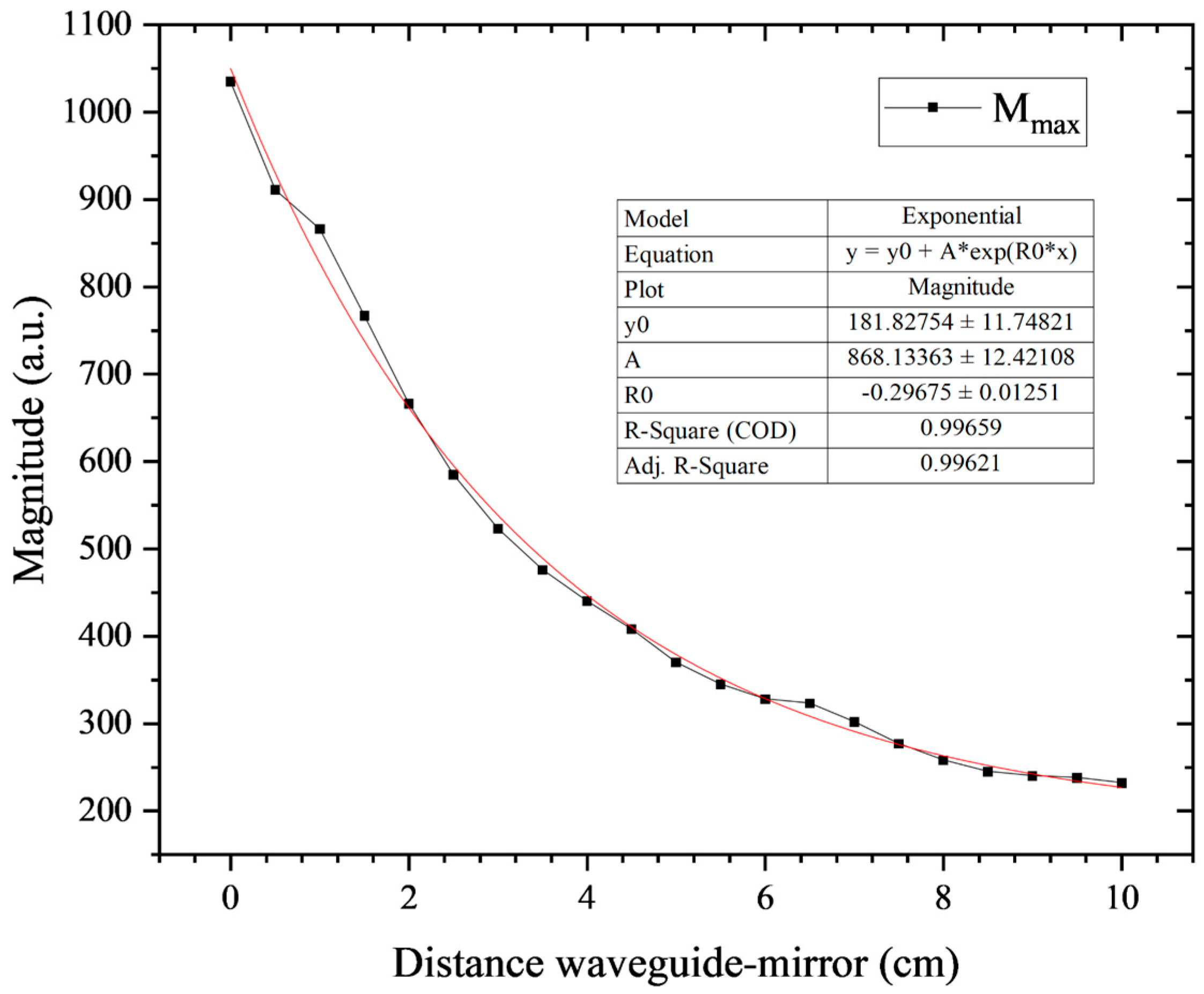
Following this preliminary work, a subsequent study was conducted to assess the impact of the probe–sample distance on the reflected signal. Previous studies have shown that the wave undergoes significant diffraction at the waveguide termination; this measurement allows for better calibration of the working distance for such a setup. The local maxima associated with the apparent mirror position in the previous graphs were used to perform an exponential fit, as illustrated in Figure 3.
Figure 3.
The local maxima associated with the apparent position of the mirror from the previous graphs (black squares) were used to perform an exponential fit (red curve).
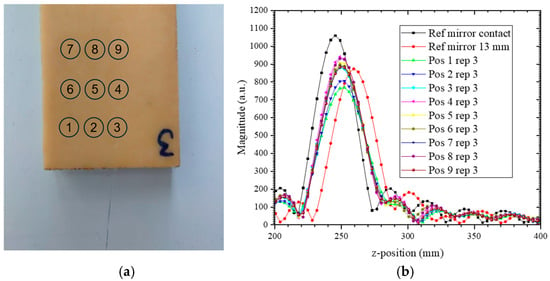
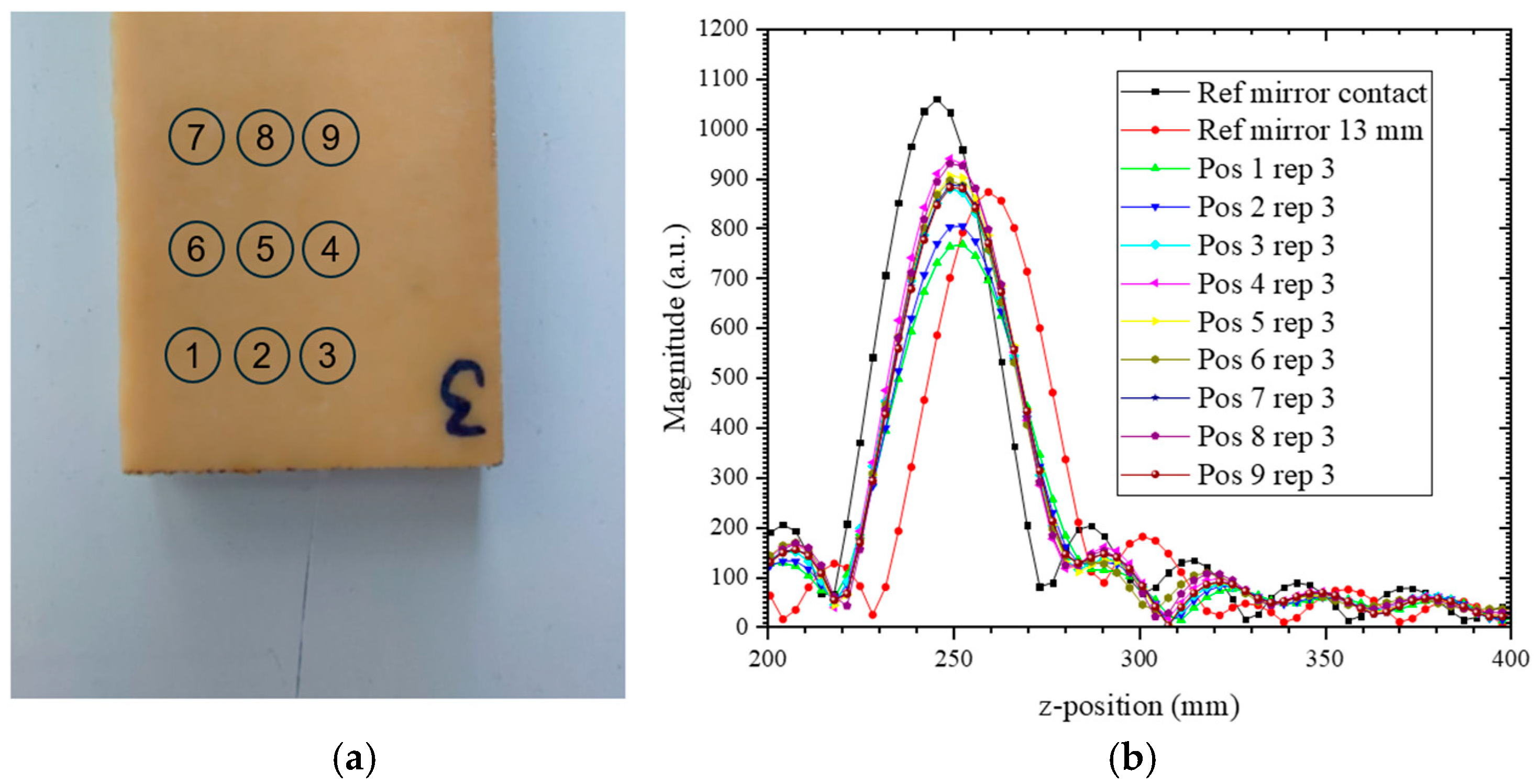
Following these calibration experiments, measurements were carried out on a GFRP composite material representative of the applications targeted by this technique. The different measurement points, shown in Figure 4a, correspond to the signals presented in Figure 4b.
Figure 4.
(a) Fiberglass composite material under test, including positions of the 9 zones under study; (b) magnitude of the main peak corresponds to the signal of each of the positions(Pos 1–9).
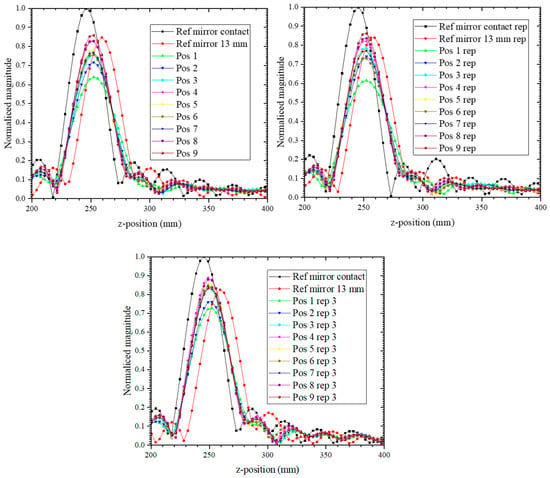
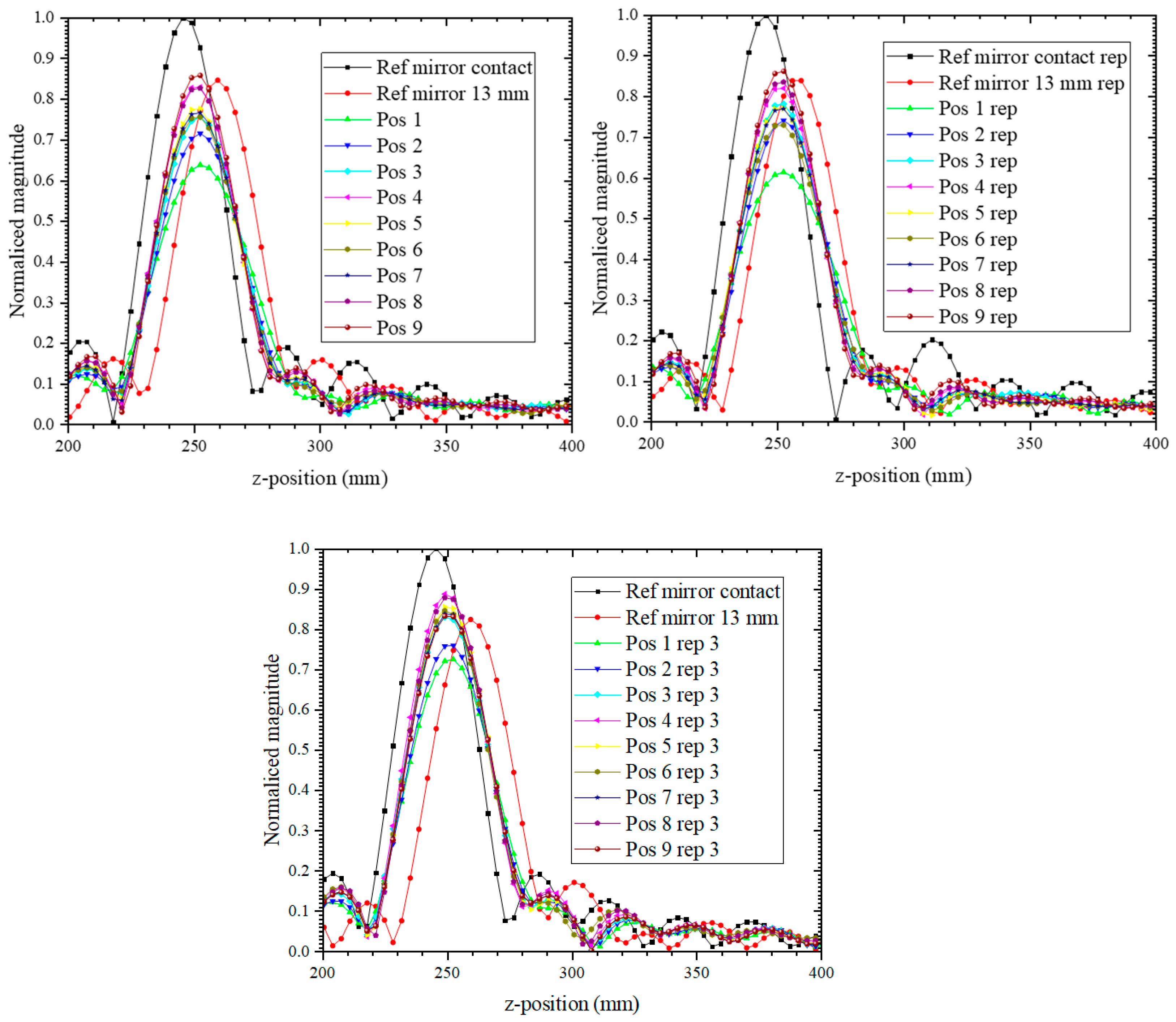
To validate the reproducibility of these results, the experiments were repeated several times. As shown in Figure 5, the measurements performed on multiple occasions yield comparable results.
Figure 5.
Several measurements were taken to check the reproducibility of the experiment results.
4. Conclusions
This work demonstrates the feasibility and advantages of integrating a compact 122 GHz FMCW radar with a 3D-printed hollow-core plastic dielectric waveguide for non-destructive testing applications. By replacing conventional free-space optical components with a guided-wave architecture, the system achieves a significant reduction in complexity, eliminating the need for precise optical alignment while enhancing portability and robustness. The incorporation of an absorbing foam interface further mitigates spurious free-space radiation, thereby enhancing the signal-to-noise ratio and ensuring that the measured reflections predominantly arise from the targeted inspection area.
A preliminary calibration campaign, involving measurements against a reference mirror at varying probe–sample distances, allowed for a precise characterization of the diffraction and propagation behavior at the waveguide termination. This step was essential to establish an optimal operational range for accurate measurements and to model the distance-dependent reflection amplitude through exponential fitting.
Subsequent experiments on a GFRP composite material—representative of aerospace and other industrial applications—validated the system’s capacity to detect and quantify variations in reflected signals across multiple points on the sample surface. The reproducibility of the measurements, confirmed through repeated acquisitions under identical conditions, underscores the reliability of the approach for practical inspection scenarios.
The proposed architecture offers several key benefits over traditional free-space FMCW radar setups: (i) reduced bulk and cost by avoiding lenses and mirrors; (ii) improved measurement fidelity through guided delivery of the signal to the region of interest; and (iii) versatility in adapting the waveguide geometry to the constraints of complex inspection environments. Furthermore, the compatibility with solid immersion lenses or other focusing elements opens the door to spatial resolution enhancement without fundamentally altering the system design.
These results highlight the strong potential of guided FMCW radar reflectometry as a portable, cost-effective, and application-oriented alternative to established THz imaging techniques. Future work will focus on extending the method to more complex geometries, integrating multi-channel guided systems for faster scanning, and exploring advanced signal processing techniques for defect classification. The approach presented here could find wide applicability across aerospace, automotive, civil engineering, and cultural heritage conservation, supporting the broader adoption of Terahertz sensing technologies in field-deployable inspection systems.
Author Contributions
Conceptualization, J.-P.G. and E.S.; methodology, E.S., M.T. and H.V.-S.; software, S.E.C.-R., M.Q.-J. and H.V.-S.; validation, J.-P.G. and E.S.; formal analysis, E.S. and H.V.-S.; investigation, E.S.; resources, J.-P.G., E.S., M.T. and M.Q.-J.; data curation, H.V.-S. and E.S.; writing—original draft preparation, J.-P.G. and E.S.; writing—review and editing, J.-P.G., E.S., H.V.-S. and S.E.C.-R.; visualization, J.-P.G.; supervision, E.S., M.Q.-J. and J.-P.G.; project administration, E.S. and M.Q.-J.; funding acquisition, E.S. and M.Q.-J. All authors have read and agreed to the published version of the manuscript.
Funding
This research was funded by CIDESI internal projects QIV011 and QIV028, “Tecnología de Terahertz”.
Institutional Review Board Statement
Not applicable. This study did not involve human participants or animals.
Informed Consent Statement
Not applicable.
Data Availability Statement
Data supporting the reported results can be found here: https://drive.google.com/drive/folders/1ZxvXHZHRZeNnDPWMsjuUqWdWR7aZqzmn?usp=sharing (accessed date on 11 August 2025).
Acknowledgments
H.V.-S. acknowledges support from a CONAHCYT doctoral scholarship. The work also benefited from supplies provided by the PAEP-UNAM Postgraduate Fund.
Conflicts of Interest
The authors declare no conflicts of interest.
References
- Valušis, G.; Lisauskas, A.; Yuan, H.; Knap, W.; Roskos, H.G. Roadmap of terahertz imaging 2021. Sensors 2021, 21, 4092. [Google Scholar] [CrossRef] [Scilit] [PubMed]
- Reyes-Reyes, E.S.; Carriles-Jaimes, R.; D’Angelo, E.; Nazir, S.; Koch-Dandolo, C.L.; Kuester, F.; Jepsen, P.U.; Castro-Camus, E. Terahertz time-domain imaging for the examination of gilded wooden artifacts. Sci. Rep. 2024, 14, 6261. [Google Scholar] [CrossRef] [Scilit] [PubMed]
- Bauer, M.; Hussung, R.; Matheis, C.; Reichert, H.; Weichenberger, P.; Beck, J.; Matuschczyk, U.; Jonuscheit, J.; Friederich, F. Fast FMCW terahertz imaging for in-process defect detection in press sleeves for the paper industry and image evaluation with a machine learning approach. Sensors 2021, 21, 6569. [Google Scholar] [CrossRef] [Scilit] [PubMed]
- Mohammadzadeh, S.; Bauer, M.; Kocybik, M.; Friederich, F. Nondestructive Inspection of Glass-Fiber Reinforced Plastic (GFRP) Composites with Photonic Terahertz Radar. In Proceedings of the 2024 49th International Conference on Infrared, Millimeter, and Terahertz Waves (IRMMW-THz) 2024, Perth, Australia, 1–6 September 2024; pp. 1–3. [Google Scholar]
- Carré, B.; Chopard, A.; Guillet, J.P.; Fauquet, F.; Mounaix, P.; Gellie, P. Terahertz nondestructive testing with ultra-wideband FMCW radar. Sensors 2022, 23, 187. [Google Scholar] [CrossRef] [Scilit] [PubMed]
Disclaimer/Publisher’s Note: The statements, opinions and data contained in all publications are solely those of the individual author(s) and contributor(s) and not of MDPI and/or the editor(s). MDPI and/or the editor(s) disclaim responsibility for any injury to people or property resulting from any ideas, methods, instructions or products referred to in the content. |
© 2025 by the authors. Licensee MDPI, Basel, Switzerland. This article is an open access article distributed under the terms and conditions of the Creative Commons Attribution (CC BY) license (https://creativecommons.org/licenses/by/4.0/).