1. Introduction
Natural gas is widely regarded as a key fuel in modern energy systems because of its high heating value and favorable combustion characteristics; however, untreated natural gas from reservoirs often contains non-hydrocarbon gases, such as carbon dioxide (CO
2) and hydrogen sulfide (H
2S), as well as water vapor (H
2O) and heavier hydrocarbons that may form condensate, which necessitates primary purification before transportation and downstream processing [
1]. These contaminants must be effectively removed to prevent issues such as pipeline corrosion, hydrate formation, equipment fouling, and reduced processing efficiency—common problems in untreated or improperly conditioned natural gas streams [
2]. Gas–liquid separators are critical components in gas processing and electrolysis-based systems, serving to isolate gaseous products from liquid media such as lye or hydrocarbon condensates. Traditional gravity-type separators operate based on the density difference between phases and rely on mechanisms such as gravitational settling or inertial impaction to achieve phase disengagement. While effective under stable conditions, their separation performance tends to decline when gas velocity increases or inlet flow conditions fluctuate [
3]. However, under conditions of high flowrates or unsteady inlet distributions, traditional separators experience a marked reduction in phase separation efficiency due to droplet re-entrainment, foam stabilization, and vortex-induced turbulence. These effects are especially pronounced in condensate-rich streams where the viscosity and surface activity of the liquid phase exacerbate entrainment phenomena and suppress droplet coalescence [
4]. Recent studies emphasize that enhancing separator internals—such as incorporating multi-layer baffles, vane packs, or wire-mesh demisters—can significantly improve phase disengagement by promoting droplet coalescence, suppressing foam carryover, and optimizing flow distribution. These structural additions reduce turbulence intensity, extend gas–liquid residence time, and mitigate entrainment losses, especially under fluctuating flow regimes or condensate-rich conditions [
5]. Despite these advances, there is a lack of field-scale studies validating such designs under high-pressure industrial conditions.
Natural gas purification and gas–liquid separation remain critical unit operations in industrial processing, where separator efficiency directly affects downstream reliability and equipment protection. Gas streams frequently contain entrained liquids (water or condensate), which may lead to operational issues such as corrosion, measurement errors, and flow instabilities, therefore requiring effective separation before further processing stages. Recent reviews also emphasize that separation performance is strongly governed by internal flow field behavior and droplet–gas interactions; consequently, separator internals and hybrid separation concepts are increasingly considered to expand operating envelopes and improve robustness [
5]. In addition, foam formation is a well-known limiting factor in gas treating systems, as it can reduce efficiency and increase pressure-drop fluctuations and carryover risks [
6]. Solid particles may further intensify foaming by accumulating at gas–liquid interfaces and inhibiting bubble coalescence, thereby stabilizing foam structures and extending foam lifetime [
7]. These mechanisms justify the use of practical internal modifications aimed at reducing turbulence-driven entrainment, promoting coalescence/drainage, and suppressing foam propagation under field-relevant operating conditions.
This study aims to fill that gap by developing and experimentally validating a high-performance gas–liquid separator equipped with structured internals, tested at the Somontepa gas field in Uzbekistan. The study evaluates its separation efficiency, hydrodynamic behavior, and overall operational performance compared to standard industrial units.
2. Background
Natural gas is predominantly composed of methane (CH
4), typically accounting for 70–90% of its volume, along with variable amounts of heavier hydrocarbons such as ethane (C
2H
6), propane (C
3H
8), and butanes (C
4H
10), as well as non-hydrocarbon components including nitrogen (N
2), carbon dioxide (CO
2), and hydrogen sulfide (H
2S). The exact composition depends heavily on the geological origin and reservoir characteristics of the gas field [
1]. In order to meet transportation and end-use requirements, raw natural gas must undergo extensive processing to remove contaminants that can compromise flow assurance and infrastructure integrity. Aside from its hydrocarbon fraction, untreated gas streams often contain water vapor, hydrocarbon condensates, and solid particulates such as sand, iron sulfide scale, and corrosion debris, all of which pose operational and safety risks if not adequately managed [
8]. The presence of acid gases, water vapor, and suspended solids in raw natural gas streams poses serious threats to downstream infrastructure by accelerating corrosion, promoting hydrate formation, initiating erosion at high-velocity zones, and inducing foaming under dynamic conditions. These effects compromise operational reliability, reduce equipment lifespan, and increase maintenance frequency [
9,
10]. The acidic gases CO
2 and H
2S are especially problematic, forming corrosive compounds upon contact with water:
These reactions reduce the pH of condensed water and accelerate corrosion, particularly in carbon steel pipelines [
8]. Gas condensates, which are primarily composed of heavier hydrocarbons (C
5+), are typically present in droplet form and can emulsify with water or foam under high-velocity conditions. This foam formation impairs phase separation and increases pressure drop in downstream units [
5,
11]. Conventional separators rely on gravitational settling, governed by Stokes’ law:
where
is the settling velocity,
and
are liquid and gas densities,
d is the droplet diameter, and
μ is gas viscosity. However, under turbulent flow (Re > 4000), smaller droplets and particles remain suspended and are easily re-entrained by the gas stream [
12,
13]. Recent studies have demonstrated that structured internals—such as multi-row baffles, vane packs, and anti-foaming wire meshes—can improve separation efficiency by increasing contact area, disrupting flow patterns, and mitigating foam propagation [
14]. This research builds on these findings by developing and testing a modified horizontal separator designed to process natural gas with high condensate and particulate loading from the Somontepa field in Uzbekistan.
3. Materials and Methods
3.1. Field Site and Gas Composition
The study was carried out at the Somontepa gas-condensate field, located in the southern region of Uzbekistan and operated by the “Muborak Oil and Gas Production Department.” The raw natural gas extracted from this field is characterized by a complex mixture of hydrocarbons, acid gases, and solid impurities. Based on laboratory analysis, the gas composition was as follows (vol%): CH
4—89.6%, C
2H
6—1.81%, C
3H
8—0.279%, CO
2—4.12%, H
2S—3.0%, and N
2—0.722%. The average gas condensate content was 16.58 g/m
3, formation water—4.84 g/m
3, and suspended solids—1.2 g/m
3. Sampling was conducted at both the separator inlet and outlet, and the gas samples were analyzed in accordance with ISO 6974-1:2012 using gas chromatography and gravimetric methods [
15].
3.2. Separator Design and Configuration
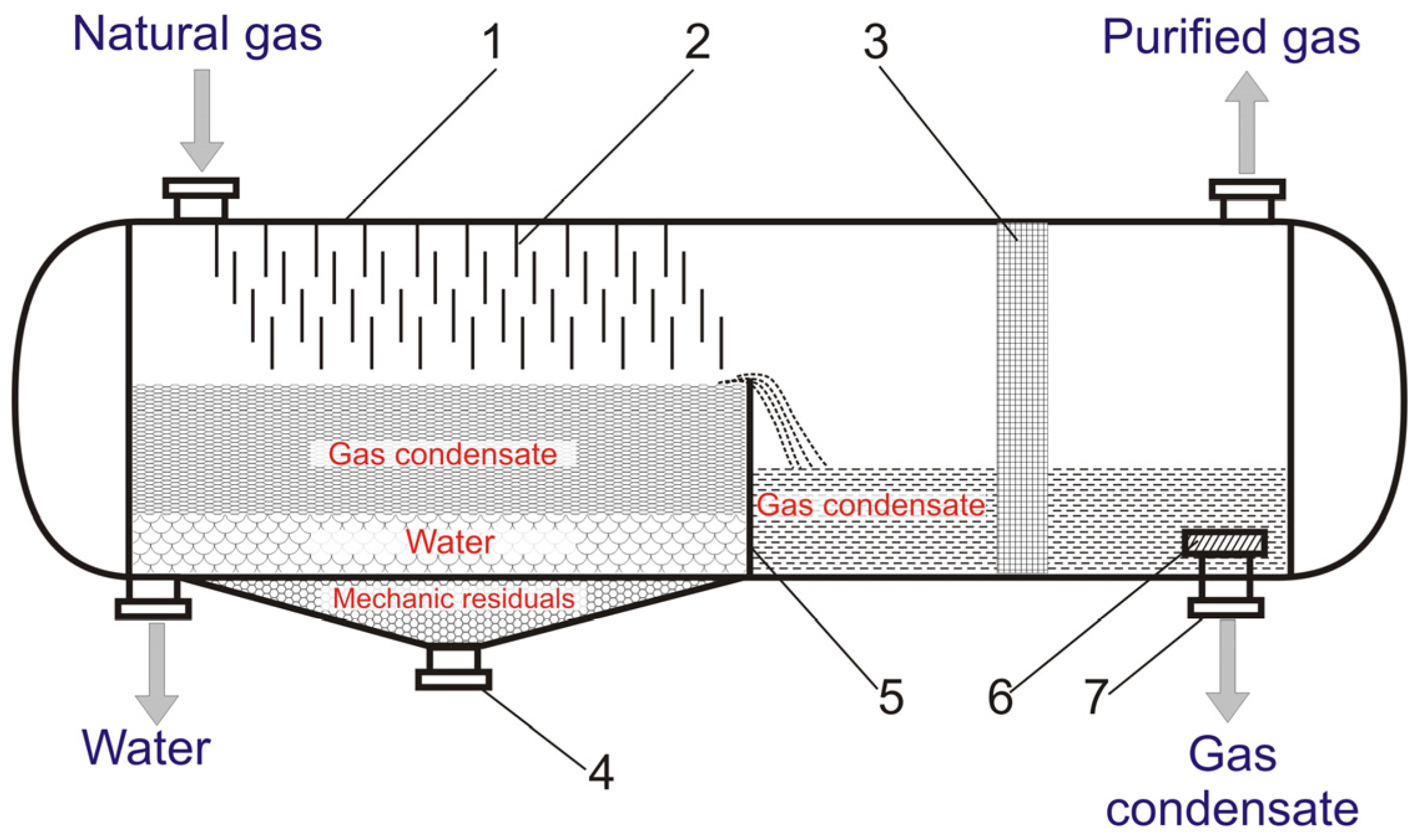
A modified horizontal gas–liquid separator was designed and fabricated specifically for handling high-condensate, high-pressure streams (up to 5.6 MPa). The separator was equipped with:
- −
30 suspended baffles (arranged in 3 rows of 10, spaced at 25 cm);
- −
One anti-foaming mesh, placed above the coalescence zone;
- −
Dedicated outlets for gas, condensate, formation water, and solid discharge;
- −
Shell diameter: 1500 mm;
- −
Length: 6700 mm;
- −
Total occupied area: 32 m2.
The baffles were designed with dimensions of 35 mm × 35 mm, using perforated stainless-steel sheets to promote droplet impingement and flow redistribution (
Figure 1).
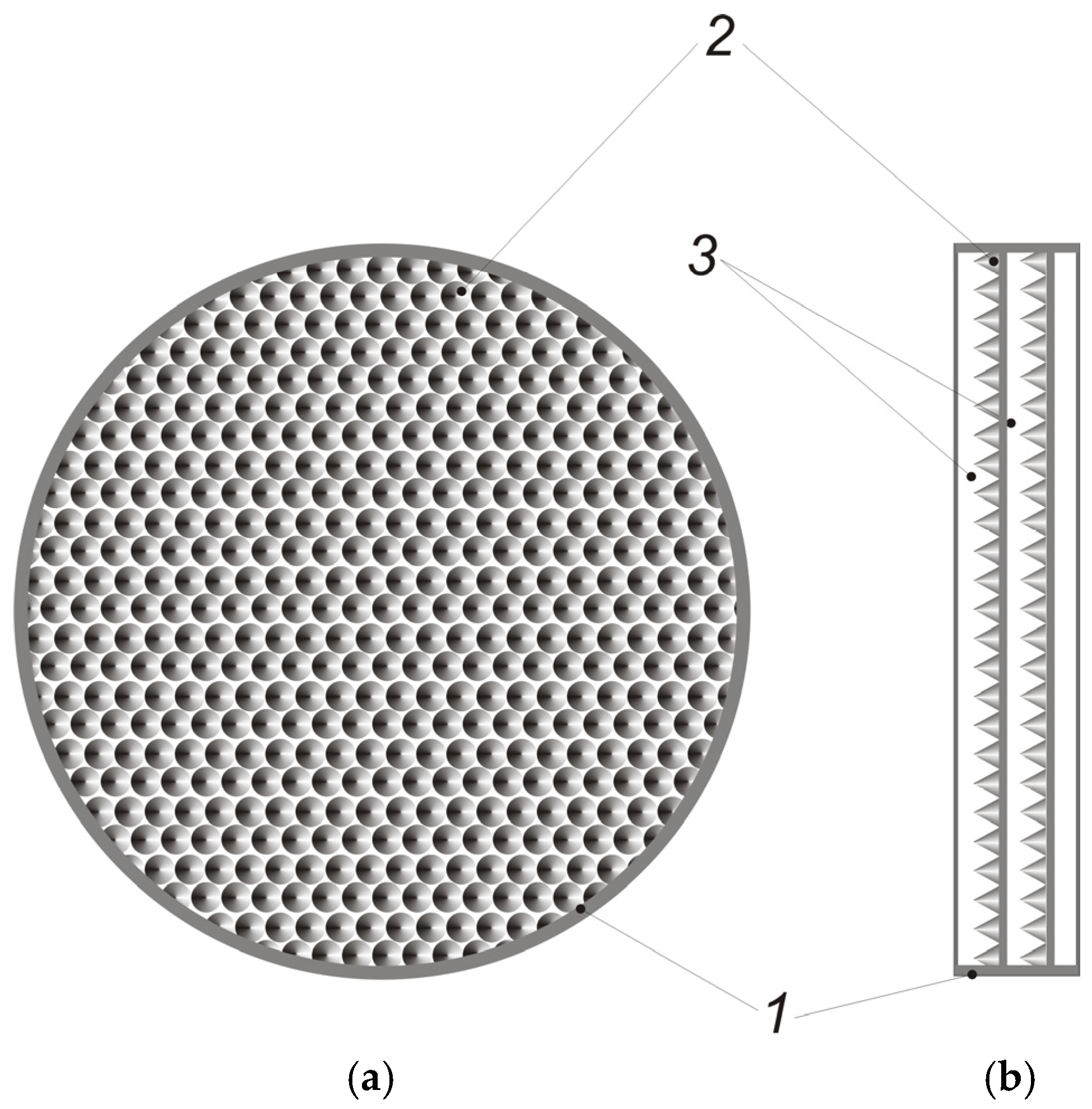
The anti-foaming wire mesh was constructed of high-void fraction stainless steel (
Figure 2), installed prior to the gas outlet nozzle to minimize re-entrainment.
To ensure resistance to acidic condensates containing hydrogen sulfide (H
2S), both the multi-row baffles and the anti-foaming mesh were fabricated using AISI 316L stainless steel. This material demonstrates excellent corrosion resistance due to its high chromium and molybdenum content and is widely approved for sour service applications per NACE MR0175/ISO 15156 standards [
16].
The developed separator demonstrates stable performance across a wide range of gas compositions and operating capacities. It effectively removes gas condensate (5–25 g/m3), water vapor (1–6 g/m3), and solid particles (0.5–3 g/m3), making it suitable for sweet and sour gas fields. The unit operates reliably within a flowrate range of 5000 to 50,000 m3/h, maintaining consistent phase separation via structured baffles and foam suppression mesh. Tested under pressures from 3.0 to 6.5 MPa and temperatures up to 60 °C, the separator complies with standard processing conditions. Its modular design supports integration into multi-stage systems and adapts well to both greenfield and retrofit installations. Constructed from AISI 316L stainless steel, the separator ensures long-term corrosion resistance in H2S-rich environments. Simulation and field data confirm that the design is scalable, easy to manufacture, and applicable in onshore, offshore, and mobile configurations.
Overall, the device offers strong promotion potential due to its broad adaptability, low maintenance needs, and proven efficiency across variable field conditions.
3.3. Experimental Procedure and Operating Conditions
Field-scale experiments were conducted in two stages: first, baseline performance data were collected using a conventional industrial gas–liquid separator; second, performance metrics of the newly developed separator were obtained under identical operating conditions. Both test phases were carried out at the Somontepa gas-condensate field. The operating parameters during testing were as follows: gas flowrate ranged from 1000 to 3000 Nm3/h; pressure varied between 4.2 and 5.6 MPa; inlet gas temperature was maintained at 17–18 °C. Gas velocities in the separator ranged from 20 to 65 m/s, corresponding to Reynolds numbers between 8.9 × 10⁶ and 2.9 × 10⁷, indicating turbulent flow conditions.
The upgraded separator was equipped with 30 suspended baffles arranged in 3 rows, and an anti-foaming mesh was installed before the gas outlet. Both devices were intended to enhance phase separation and suppress re-entrainment phenomena. Trials were run under steady-state conditions, with each test lasting 4 h to ensure stable hydrodynamic behavior. Samples of gas, liquid condensate, and solids were taken at both inlet and outlet ports every hour. Analytical techniques included gravimetric filtration for solids, Karl Fischer titration for water content, and distillation (ASTM D86) for gas condensate evaluation. All experiments were repeated in triplicate to ensure data reproducibility.
3.4. Measurements and Analytical Techniques
Separator performance was evaluated through quantitative analysis of three main parameters: pressure drop, separation efficiency, and fluid quality.
Pressure drop (ΔP) across the separator was measured using calibrated differential pressure transmitters installed at inlet and outlet points. The hydraulic resistance was calculated via the Darcy–Weisbach equation, incorporating measured flow velocity, gas density, and pipe dimensions.
Separation efficiency for gas condensate, formation water, and suspended solids was determined using inlet–outlet concentration differentials. The efficiency (
η) was calculated as
where
and
are contaminant concentrations at the separator’s inlet and outlet, respectively.
Water content was quantified via Karl Fischer titration (ISO 760:1978), gas condensate was analyzed using ASTM D86 distillation, and solids were separated by gravimetric filtration through pre-weighed membrane filters [
17]. Foam behavior was assessed by visually measuring foam height through transparent inspection windows, while average bubble size was determined from high-speed imaging and digital analysis. Foam suppression effectiveness of the anti-foaming mesh was quantified by comparing foam height before and after its installation.
Condensate quality was further evaluated by measuring:
- −
Density (ASTM D4052);
- −
Kinematic viscosity (ASTM D445);
- −
Sulfur content (ASTM D4294);
- −
Boiling range via ASTM D86 method.
Data validation was ensured through repeated trials (n = 3) and cross-checking with laboratory reference instruments. Instrument uncertainty and error propagation were considered in line with ISO 5167-1:2022 [
18] and ISO/IEC 17025 [
19] standards.
3.5. Repeatability and Uncertainty Analysis
To ensure the statistical reliability of the experimental data, all separation trials were performed in triplicate under identical operating conditions. For each contaminant (gas condensate, water, and suspended solids), the mean value, standard deviation (SD), and relative standard deviation (RSD) were calculated using
where
is the arithmetic mean of repeated measurements. RSD values below 5% were considered indicative of acceptable repeatability.
Measurement uncertainties for flowrate, pressure, temperature, and composition were estimated based on instrument calibration certificates and guidelines from ISO 5167-1:2022 and ISO/IEC 17025:2017. Combined standard uncertainty (uₙ) was calculated as
where
are the standard uncertainties of each independent measurement input.
Expanded uncertainty (U) was computed with a coverage factor
k = 2 for a 95% confidence level:
Instrument drift, sample handling errors, and environmental factors were also accounted for in uncertainty budgets. To minimize bias, all sampling and analytical procedures followed the same protocol across repetitions, and the laboratory analysts remained blinded to separator configuration during testing.
These measures confirm that the observed improvements in separation efficiency and hydraulic performance are statistically significant and reproducible.
4. Results and Discussion
The implementation of the suspended baffles and anti-foaming mesh significantly improved the separation efficiency of gas condensate, water, and suspended solids. As shown in
Table 1, the outlet concentration of gas condensate was reduced from 16.58 g/m
3 to 0.725 g/m
3, water from 4.84 g/m
3 to 0.1 g/m
3, and solid impurities from 1.2 g/m
3 to 0.0058 g/m
3.
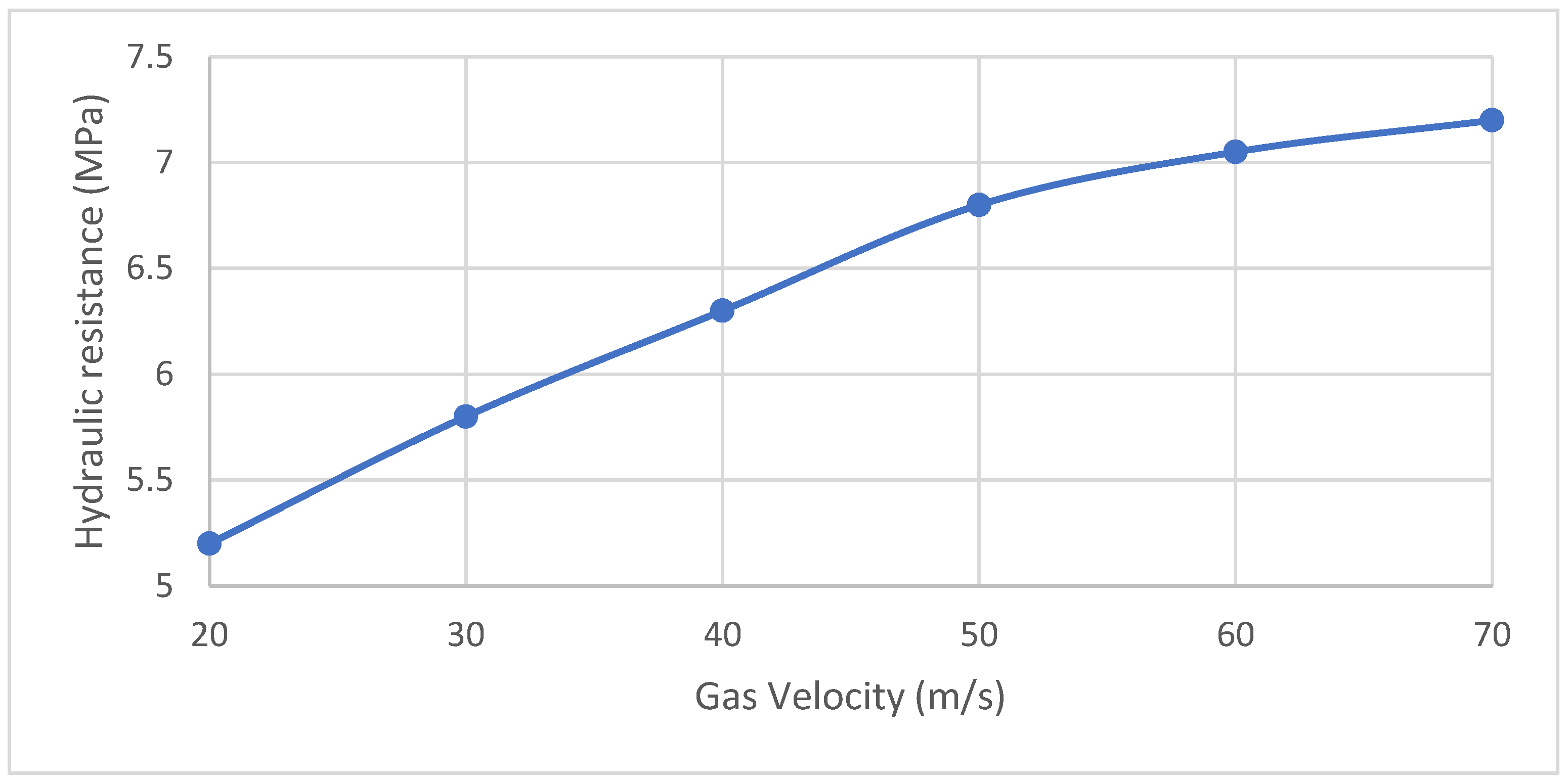
This performance increase is attributed to extended residence time, flow redistribution by multi-row baffles, and the anti-foaming mesh which suppressed liquid re-entrainment. The addition of structured internals resulted in a moderate increase in pressure drop. As shown in
Figure 1, the outlet hydraulic resistance increased from 5.2 MPa to 7.2 MPa as the gas flow velocity rose from 20 to 70 m/s. These values represent the measured outlet pressures under operational flow resistance and should not be interpreted as the actual pressure drop across the separator. However, based on the Darcy–Weisbach correlation and assumed geometric parameters, the pressure differential (ΔP) was estimated to be approximately 64 kPa (0.064 MPa) under maximum flow conditions—a value that remains within acceptable industrial thresholds for gas–liquid separation systems.
Hydraulic resistance followed a near-linear trend with velocity due to turbulent flow regimes (Re > 10
6). The multi-row baffle configuration increased surface drag but simultaneously enhanced the capture efficiency of fine droplets and aerosols (
Figure 3).
The installation of an anti-foaming mesh significantly suppressed foam height and reduced the risk of phase carryover. As shown in
Table 2, foam height decreased from 96.4 mm to 10.2 mm, while average bubble diameter decreased by more than 60%.
The effectiveness of the anti-foaming mesh was evaluated under identical process conditions. Without the mesh, the foam layer reached an average height of 96.4 mm, indicating high aerosol carryover potential. After installation, the foam height was reduced to 10.2 mm, corresponding to an 89.4% suppression efficiency. This improvement is attributed to enhanced bubble coalescence and drainage facilitated by the mesh structure.
Distillation analysis of the recovered gas condensate showed a 50% distillation point at 141 °C and a final boiling point of 229 °C, confirming its suitability for downstream processing. Physical properties such as density (0.7919 g/cm3), molecular weight (136.4 g/mol), viscosity (1.79 mm2/s at 20 °C), and sulfur content (0.33 wt%) indicated commercial-grade quality. Pressure drop measurements across different baffle configurations revealed an increase from 3670 Pa (1 row) to 8320 Pa (3 rows), with improved flow redistribution. Despite higher resistance, the gain in separation efficiency justifies the design. Statistical validation showed RSD values below 4.2%, confirming high reproducibility and reliability of the experimental outcomes.
5. Conclusions
This study presents the development, implementation, and evaluation of a high-performance gas–liquid separator specifically engineered for the deep purification of natural gas streams. The device integrates two major structural enhancements: multi-row suspended baffles for inertial separation and a stainless-steel anti-foaming mesh for suppression of foam-related entrainment.
Field-scale testing confirmed that the modified separator significantly outperforms conventional units. Compared to the baseline configuration, the improved design achieved:
- −
A 95% reduction in gas condensate content (from 16.58 g/m3 to 0.725 g/m3);
- −
A 93% reduction in solid particle concentration (from 0.086 g/m3 to 0.0058 g/m3);
- −
A 89.4% suppression of foam layer height (from 96.4 mm to 10.2 mm).
Controlled trials further revealed that the anti-foaming mesh contributed predominantly to foam collapse, while the baffles enhanced droplet coalescence and particulate disengagement. Distillation and physicochemical analysis of the recovered condensate confirmed its suitability for use in petrochemical feedstocks and blending applications. The unit demonstrated stable operation across a wide range of gas flowrates (5000–50,000 m3/h) and condensate loads, highlighting its scalability and industrial applicability.
The modified separator is designed to selectively remove key contaminants in raw natural gas, including entrained condensate droplets, dispersed/free water, and suspended solids. Owing to its combined baffle–mesh internal configuration, the unit maintains stable separation performance under variable gas quality and flow regimes, indicating strong applicability for both retrofit and scale-up in field and plant-scale gas treatment systems.
Overall, the proposed separator design offers a practical, cost-effective, and scalable solution for modern natural gas processing systems where deep contaminant removal and foam mitigation are operational priorities. Future work will focus on long-term reliability assessments, integration into multi-stage treatment trains, and material optimization for harsh-field applications.
Author Contributions
Conceptualization, A.U. and R.M.; writing—original draft preparation, A.N. and A.B.; visualization, A.N. and A.B.; writing—review and editing, A.U. and A.B.; supervision, A.N.; T.T. and R.M. contributed equally to this paper. All authors have read and agreed to the published version of the manuscript.
Funding
This work was funded by the Agency of innovative development under the Ministry of higher education, science and innovation of the Republic of Uzbekistan (Contract No. IL-8724053118).
Institutional Review Board Statement
Not applicable.
Informed Consent Statement
Not applicable.
Data Availability Statement
The data presented in this study are available on request from the corresponding author.
Conflicts of Interest
The authors declare no conflicts of interest.
References
- Speight, J.G. Composition and properties. In Natural Gas; Elsevier: Amsterdam, The Netherlands, 2019; pp. 99–148. [Google Scholar] [CrossRef]
- Mokhatab, S.; Poe, W.A.; Mak, J.Y. Natural Gas Treating. In Handbook of Natural Gas Transmission and Processing; Elsevier: Amsterdam, The Netherlands, 2015; pp. 181–222. [Google Scholar] [CrossRef]
- Hu, Y.; Yin, Z.; Han, C.; Tong, R.; Li, W.; Li, H. Study on gas-liquid separator for separation performance and structural optimization in AEL coupled with renewable energy sources. Int. J. Hydrog. Energy 2024, 88, 369–377. [Google Scholar] [CrossRef]
- Tu, H.; Zhang, R.; Guo, P.; Hu, S.; Peng, Y.; Ji, Q.; Li, Y. The Impact of Condensate Oil Content on Reservoir Performance in Retrograde Condensation: A Numerical Simulation Study. Energies 2024, 17, 5750. [Google Scholar] [CrossRef]
- Yang, L.; Chen, X.; Huang, C.; Liu, S.; Ning, B.; Wang, K. A review of gas-liquid separation technologies: Separation mechanism, application scope, research status, and development prospects. Chem. Eng. Res. Des. 2024, 201, 257–274. [Google Scholar] [CrossRef]
- Shahouni, R.; Abbasi, M.; Akrami, M. A comprehensive review on control and mitigating the foam formation in amine-based solvents. Chem. Eng. J. Adv. 2024, 19, 100618. [Google Scholar] [CrossRef]
- Vijayaraghavan, K.; Nikolov, A.; Wasan, D. Foam formation and mitigation in a three-phase gas–liquid–particulate system. Adv. Colloid Interface Sci. 2006, 123–126, 49–61. [Google Scholar] [CrossRef] [PubMed]
- Mokhatab, S.; Poe, W.A.; Mak, J.Y. Phase Separation. In Handbook of Natural Gas Transmission and Processing; Elsevier: Amsterdam, The Netherlands, 2015; pp. 137–167. [Google Scholar] [CrossRef]
- Thomas, F.B.; Bennion, D.B.; Andersen, G. Gas Condensate Reservoir Performance. J. Can. Pet. Technol. 2009, 48, 18–24. [Google Scholar] [CrossRef]
- Khan, M.I.; Islam, M.R. Transportation, Processing, and Refining Operations. In The Petroleum Engineering Handbook: Sustainable Operations; Elsevier: Amsterdam, The Netherlands, 2007; pp. 295–364. [Google Scholar] [CrossRef]
- Misyura, S.; Strizhak, P.; Meleshkin, A.; Morozov, V.; Gaidukova, O.; Shlegel, N.; Shkola, M. A Review of Gas Capture and Liquid Separation Technologies by CO2 Gas Hydrate. Energies 2023, 16, 3318. [Google Scholar] [CrossRef]
- Saldana, M.; Gallegos, S.; Gálvez, E.; Castillo, J.; Salinas-Rodríguez, E.; Cerecedo-Sáenz, E.; Hernández-Ávila, J.; Navarra, A.; Toro, N. The Reynolds Number: A Journey from Its Origin to Modern Applications. Fluids 2024, 9, 299. [Google Scholar] [CrossRef]
- Shoghl, S.N.; Naderifar, A.; Farhadi, F.; Pazuki, G. A novel strategy for process optimization of a natural gas liquid recovery unit by replacing Joule–Thomson valve with supersonic separator. Sci. Rep. 2022, 12, 22398. [Google Scholar] [CrossRef] [PubMed]
- Wang, J.; Ji, Z.; Liu, Z. Experimental and numerical investigation on the gas–liquid separation performance of a novel vane separator with grooves. Chem. Eng. Res. Des. 2022, 180, 306–317. [Google Scholar] [CrossRef]
- ISO 6974-1:2012; Natural Gas—Determination of Composition and Associated Uncertainty by Gas Chromatography. Part 1: General Guidelines and Calculation of Composition. ISO: Geneva, Switzerland, 2012. Available online: https://www.iso.org/standard/55839.html (accessed on 22 January 2026).
- ISO/DIS 15156-1; Oil and Gas Industries Including Lower Carbon Energy—Materials for Use in H2S-Containing Environments in Oil and Gas Production—Part 1: Materials and Materials Processing Requirements. ISO: Geneva, Switzerland. Available online: https://www.iso.org/obp/ui/en/#iso:std:iso:15156:-1:dis:ed-5:v1:en (accessed on 22 January 2026).
- ISO 760:1978; Determination of Water—Karl Fischer Method (General Method). ISO: Geneva, Switzerland, 1978. Available online: https://www.iso.org/ru/standard/5037.html (accessed on 22 January 2026).
- ISO 5167-1:2022; Measurement of Fluid Flow by Means of Pressure Differential Devices Inserted in Circular Cross-Section Conduits Running Full. Part 1: General Principles and Requirements. ISO: Geneva, Switzerland, 2022. Available online: https://www.iso.org/standard/79179.html (accessed on 22 January 2026).
- ISO/IEC 17025:2017; General Requirements for the Competence of Testing and Calibration Laboratories. ISO: Geneva, Switzerland, 2017. Available online: https://www.iso.org/standard/66912.html (accessed on 22 January 2026).
| Disclaimer/Publisher’s Note: The statements, opinions and data contained in all publications are solely those of the individual author(s) and contributor(s) and not of MDPI and/or the editor(s). MDPI and/or the editor(s) disclaim responsibility for any injury to people or property resulting from any ideas, methods, instructions or products referred to in the content. |
© 2026 by the authors. Licensee MDPI, Basel, Switzerland. This article is an open access article distributed under the terms and conditions of the Creative Commons Attribution (CC BY) license (https://creativecommons.org/licenses/by/4.0/).