


Abstract
Due to the world’s rising energy demand and reliance on fossil fuels, exploring cleaner energy sources is urgent. Green diesel from renewable resources, such as waste vegetable oil, is promising because it is compatible with petroleum diesel from fossil fuels. This study examined the simulation of the hydrotreatment process of waste cooking oil (WCO) to produce green diesel. ChemCAD version 8.1 was used to develop the simulation, along with a kinetic model based on the Langmuir–Hinshelwood mechanism (an LH-C-ND model), where fatty acids, such as oleic, stearic, and palmitic acid, in WCO are converted into long-chain hydrocarbons (C15, C16, C17, and C18). The influence of process parameters on green diesel yield was assessed at various temperatures, pressures, and H2/oil ratios. The best process conditions for green diesel production were identified as a temperature of 275 °C, a pressure of 30 bars, and an H2/oil ratio of 0.3. Minimising the formation of CO2, CO, and water. Under these conditions, a high green diesel yield was achieved, with WCO conversion exceeding 90%, and over 80% of the products were suitable for green diesel. This research supports SDG 7, which aims for universal access to affordable, reliable, sustainable, and modern energy, by exploring cleaner energy options, such as green diesel from waste vegetable oil. It is recommended to perform a life cycle assessment to evaluate the overall environmental impact.
1. Introduction
Fossil fuels have historically been essential for the development and maintenance of global energy infrastructure. As of 2019, a remarkable 81% of the world’s primary energy supply originated from them [1]. These non-renewable resources have been crucial for advancing technology, promoting urban development, and boosting economic growth [1,2,3]. Reliance on non-renewable fossil fuels, such as petroleum and diesel, contributes to fossil depletion [4] and produces harmful emissions, including carbon dioxide (CO2), carbon monoxide (CO), sulfur oxides (SOx), and nitrogen oxides (NOx). These emissions contribute to serious health problems, acid rain, and intensified greenhouse effects [2,5], as well as a decline in biodiversity, thereby endangering the stability and well-being of the planet’s ecosystems [1], a key concern for UN SDG 15: Life on Land. To address these challenges, it is essential to develop innovative renewable fuels that are both biodegradable and non-toxic [6], such as biodiesel and green diesel [7]. The pressing issues related to climate change, combined with the need for economic stability and energy security, have intensified the global discourse surrounding future energy sources [1]. The transition to renewable energy is increasingly recognised as a vital component in fundamentally reshaping our relationship with the environment, the economy, and societal values. Rather than mere technological alternatives, renewable energy sources represent a profound shift in energy production and consumption, reflecting a broader commitment to sustainability, resilience, and a more harmonious balance with nature [1,8]. This transition directly addresses UN SDG 13: Climate Action, as it promotes energy systems that inherently produce lower greenhouse gas emissions. According to Glišić et al. [9], the Transportation sector is the world’s largest consumer of fossil energy (around 40%), indicating the need to reduce high fossil fuel use in this sector in particular. Most greenhouse gas emissions originate from the transport sector and have been increasing over time [10]. The second-highest GHG contributor in South Africa is the Transportation sector, with a share of over 23%, while the Energy sector leads [11]. A promising alternative to fossil fuels is renewable fuel made from vegetable oils. Green diesel, also known as renewable diesel, and biodiesel are significant options for substituting for diesel [8,12]. This focus on sustainable transport is vital for achieving UN SDG 11: Sustainable Cities and Communities.
Biodiesel and green diesel are both from the same source, vegetable oil or animal fat [13,14]. Compared to petrodiesel, the main challenges in using and producing biodiesel are as follows: (i) the high cost of feedstock; (ii) reduced storage stability caused by oxidation; (iii) lower energy density; (iv) increased NOx emissions; and (v) limited compatibility with traditional fossil fuels [15]. Green diesel is an alternative to biodiesel, produced through the catalytic deoxygenation (DO) of oleaginous biomasses, such as triglycerides (TG) and fatty acids [15]. Unlike biodiesel production, which primarily relies on the esterification reaction, green diesel production focuses on hydrodeoxygenation [13]. Green diesel comprises straight-chain alkanes with 15 to 18 carbon atoms, having chemical structures identical to petroleum diesel [16]. The hydrotreatment consists of three main reactions: hydrodeoxygenation (HDO), decarbonylation (DCN), and decarboxylation (DCX) [14], resulting in the formation of n-alkanes that fall within the range of diesel fuel. In addition, several by-products are also produced during the hydrodeoxygenation reaction, including water, carbon dioxide (CO2), carbon monoxide (CO), propane (C3H8), propylene (C3H6), butane (C4H10), and methane (CH4). The benefit of this process is that it produces commercial by-products, such as fuel gas, in addition to products that are extremely similar to petrodiesel [13]. The use of green diesel offers several advantages over petroleum diesel. These advantages include greenhouse gas emissions that are 85% lower and cleaner combustion [14]. The key parameters in the production of green diesel are the operating conditions, which include process pressure, the oil-to-hydrogen ratio, and temperature. These parameters affect the selectivity of the hydrogenation reaction of triglycerides. One such hydrogenation reaction is decarboxylation or hydrodeoxygenation [13]. The impact on the food supply, the security of the energy supply, and the relatively high cost of producing renewable diesel are some of the outstanding issues that the increased level of substitution of fossil diesel fuel is and will continue to face [9]. Experience has shown that reducing the cost of raw materials (such as vegetable oil and animal fat), lowering utility consumption (energy), or implementing more effective processing technologies are the three main ways to explore lowering the total cost of producing renewable diesel. The cost of feedstock, such as sunflower, soybean, or other vegetable oil, which accounts for a significant portion of the total cost of biodiesel, is the primary factor influencing the relatively high production cost of renewable diesel fuel [9]. However, utilising waste cooking oil (WCO) will reduce the production cost associated with the feedstock cost [17].
Heriyanto et al. [18], performed an experimental study of the synthesis of green diesel from WCO-catalysed MiMo/NiMo/γ-Al2O3 catalysts, obtaining a maximum yield of 77.97%. Lee et al. [17] performed a catalytic deoxygenation of WCO over a metal-doped eggshell catalyst, obtaining a maximum yield of 61.6%. Razak et al. [19] successfully produced green diesel from domestic WCO via hydrogen-free and solvent-free deoxygenation using nickel-cobalt/organosilane-SBA-15 catalyst. Muharam & Putri [16] performed a simulation in a study titled “Hydrotreating of Vegetable Oil in a Slurry Bubble Column Reactor for Green Diesel Production”, wherein they catalysed vegetable oil hydrotreatment by NiMo-P/Al2O3, obtaining a maximum yield of 83.34%. Barbosa et al. [20] investigated the industrial production of green diesel (HVO) in Brazil from soybean oil hydrogenation using a simulation in Aspen HYSYS v12.0, and performed a process technoeconomic assessment to estimate feasibility with market price parity. Cavalcanti et al. [14] conducted a summation study of soybean oil hydrotreating, catalysed by NiMo/Al2O3 catalyst, using Aspen Plus v10. The study observed a 65% green diesel yield. Caporusso et al. [7] performed a techno-economic analysis of the green diesel production process from vegetable oils. The process was simulated using Aspen Plus, catalysed by Ni-W/SiO2-Al2O3 catalyst, obtaining a yield of 79%. The impact analysis reported that the net present value (NPV) of the project is highly sensitive to the green diesel selling price. Although remarkable results have been achieved with these simulation models, the use of virgin oils to produce green diesel and biodiesel has sparked debates in the literature over recent years. The primary dilemma is “food vs. fuel.” The increasing demand for fuel in developed nations poses a threat to food supply and could drive up the cost of crops, particularly in developing nations [21].
While several simulation studies have investigated green diesel production via the hydrotreating of virgin vegetable oils using commercial simulators, such as Aspen Plus [14], fewer studies have focused explicitly on the major composition of WCO as a feedstock and its implications for sustainability and process optimisation. In particular, many existing models rely on equilibrium or lumped-reaction approaches and do not explicitly incorporate Langmuir–Hinshelwood-based kinetics for fatty acid conversion. Despite the significant interest and extensive literature on green diesel, a knowledge gap exists in the simulation of the comprehensive composition of WCO as a viable feedstock. This is a critical area, as the WCO directly mitigates the “food vs. fuel” dilemma and offers a low-cost, waste valorisation approach, contributing to UN SDG 12: Responsible Consumption and Production. The present study addresses this gap by developing a process-level ChemCAD simulation of WCO hydrotreatment using an LH-C-ND kinetic model, which enables the systematic evaluation of operating parameters (temperature, pressure, and H2/oil ratio) on hydrocarbon yield and by-product formation. By rigorously modelling this process, this research provides vital engineering data for optimising WCO-based green diesel production, thereby directly contributing to the advancement of sustainable and affordable energy, aligning with the targets of UN SDG 7: Affordable and Clean Energy.
2. Methodology
WCO, the key component, and hydrogen gas, the second reactant, serve as the feedstock for the hydrotreating process [9]. WCO is a complex mixture of various compounds, including triglycerides (TGs) at 80–90% and free fatty acids (FFAs) at 5–15%. Palmitic acid (C16H32O2) 27%, stearic acid (C18H36O2) 13%, and oleic acid (C18H34O2) 60% are the constituents of WCO [9]. The composition reported assumes that the WCO underwent pretreatment, such as filtration, to remove any solids, and also that any moisture has been removed. This simplification was adopted to reduce computational complexity while capturing the dominant reaction pathways during hydrotreatment. Green diesel is a combination of four long-chain alkanes, namely, pentadecane (C17H36), hexadecane (C15H362 and C16H34), heptadecane (C17H36), and octadecane (C18H38). The by-products of the process are CO2, CO, and H2O.
The simulation process was performed using ChemCAD 8.1 and correlated using the Peng–Robinson equation for both the liquid and vapour phases. This model is used because it is capable of modelling the behaviour of complex fluid mixtures, such as those encountered in the production of green diesel from waste vegetable oil. The following are aspects of the model that make it a suitable choice for the simulation:
- Highly accurate model for predicting the phase behaviour and thermodynamic properties of mixtures at extreme conditions;
- Handling complexity by accounting for the interactions between different components.
The most crucial factors in the production of green diesel are operating conditions, such as temperature (250–400 °C), pressure (30 bar–120 bar), and wt.% ratio of oil/H2 (0.3–0.8) of the process, which will affect the selectivity of hydrogenation, decarbonylation, decarboxylation, and hydrogenation. The process involved pretreatment, in which the unsaturated fatty acid of WCO underwent hydrogenation (1). In this case, oleic acid was converted to stearic acid. This was followed by hydrocarbon production in the reactor, which included decarboxylation (2), decarbonylation (3), and hydrodeoxygenation (4).
The Peng–Robinson Equation (2) was used to model the vapour–liquid equilibrium (VLE) of the reaction mixture, which was crucial for optimising conditions in reactors and separation units. The equation’s ability to handle complex mixtures and a wide range of operating conditions ensured reliable simulations, which were essential for scaling up the process.
The proposed model is the LH-C-ND model, developed based on the Langmuir–Hinshelwood mechanism, which considers the hypothesis of competitive adsorption. According to this hypothesis, stearic acid (SA), palmitic acid (PA), and non-dissociated hydrogen are adsorbed on the same type of active site when a catalyst is used. This model can be used in both ways, depending on whether a catalyst is used. The expression for the fractional surface coverage of all compounds in this model is given by Equation (6), where Ki and Ci represent the adsorption equilibrium constant and the concentration of component j, respectively [22]. The model equations in the standard form to suit the ChemCAD kinetic reactor are found in the Supplementary Materials (Equations (S1)–(S8)). The activation energies (Ej) and adsorption enthalpies (ΔHads;i) are the kinetic parameters to be estimated. Reaction rates and adsorption equilibrium constants at different temperatures are calculated using the reparametrized Arrhenius and Van’t Hoff equations (Equations (S2) and (S3)). Adsorption enthalpies of organic species are assumed to be equal to decrease the number of parameters [23]. The simulation represents a generic hydrotreating process, without specifying a particular catalyst. Catalyst selection, deactivation, and coke formation are recognised as important industrial considerations but are beyond the scope of this process-level simulation study. The kinetics data are shown in Table S2.
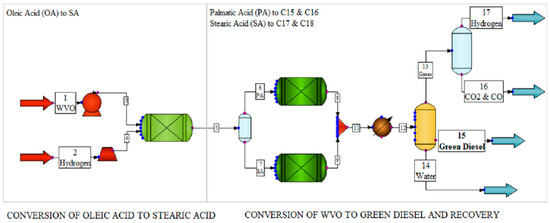
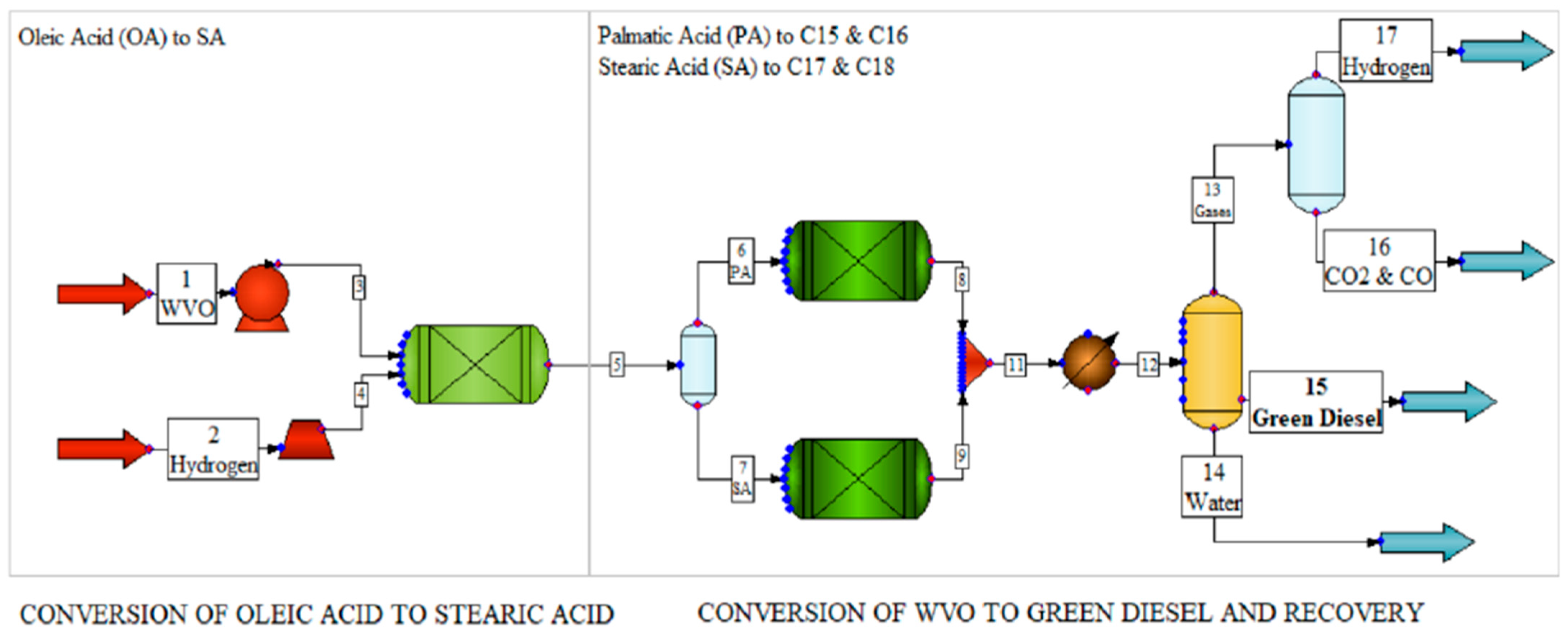
Figure 1 illustrates the process flow diagram for the hydrogenation of WCO. In this process, WCO and hydrogen (H2) are introduced into a stoichiometric reactor operating at 250 °C. Within this reactor, all oleic acid (C18H34O2) present in the feedstock is converted into stearic acid (C18H36O2) through a hydrogenation reaction. This transformation occurs because oleic acid is an unsaturated fatty acid that contains a double bond in its carbon chain. The introduction of hydrogen under the appropriate conditions—elevated temperature and the presence of a catalyst—reduces this double bond, resulting in stearic acid, a fully saturated fatty acid [24]. This process also minimises the risk of unwanted side reactions. Following the hydrogenation process, the reaction mixture is fed into a component separator, where the various reaction products and any unreacted components are isolated for further processing. After leaving the stoichiometric reactor, the stream is divided into two distinct paths: one stream contains palmitic acid (C16H32O2), while the other contains stearic acid (C18H36O2). Each of these streams is subsequently directed into individual kinetic plug flow reactors (PFRs), where further reactions occur, yielding hydrocarbons (C15, C16, C17, and C18) alongside by-products such as carbon monoxide (CO), carbon dioxide (CO2), and water (H2O). The primary reaction occurring in both PFRs is hydrodeoxygenation (HDO), where fatty acids (such as palmitic and stearic acids) react with hydrogen (H2) to eliminate oxygen atoms, producing hydrocarbons and releasing water. In this reaction, the carboxyl group (-COOH) of the fatty acid is removed as water (H2O), resulting in the corresponding alkane (C16 or C18). After the reactions are complete, the products are combined and sent to a separator, where water, green diesel, and gases are separated.
Figure 1.
Hydrotreatment of WCO for green diesel.
3. Results and Discussion
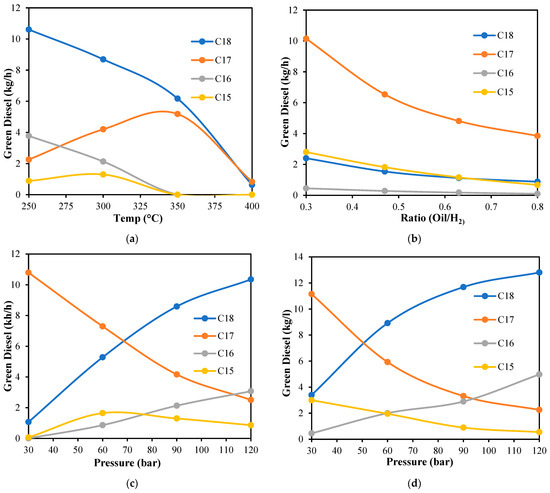
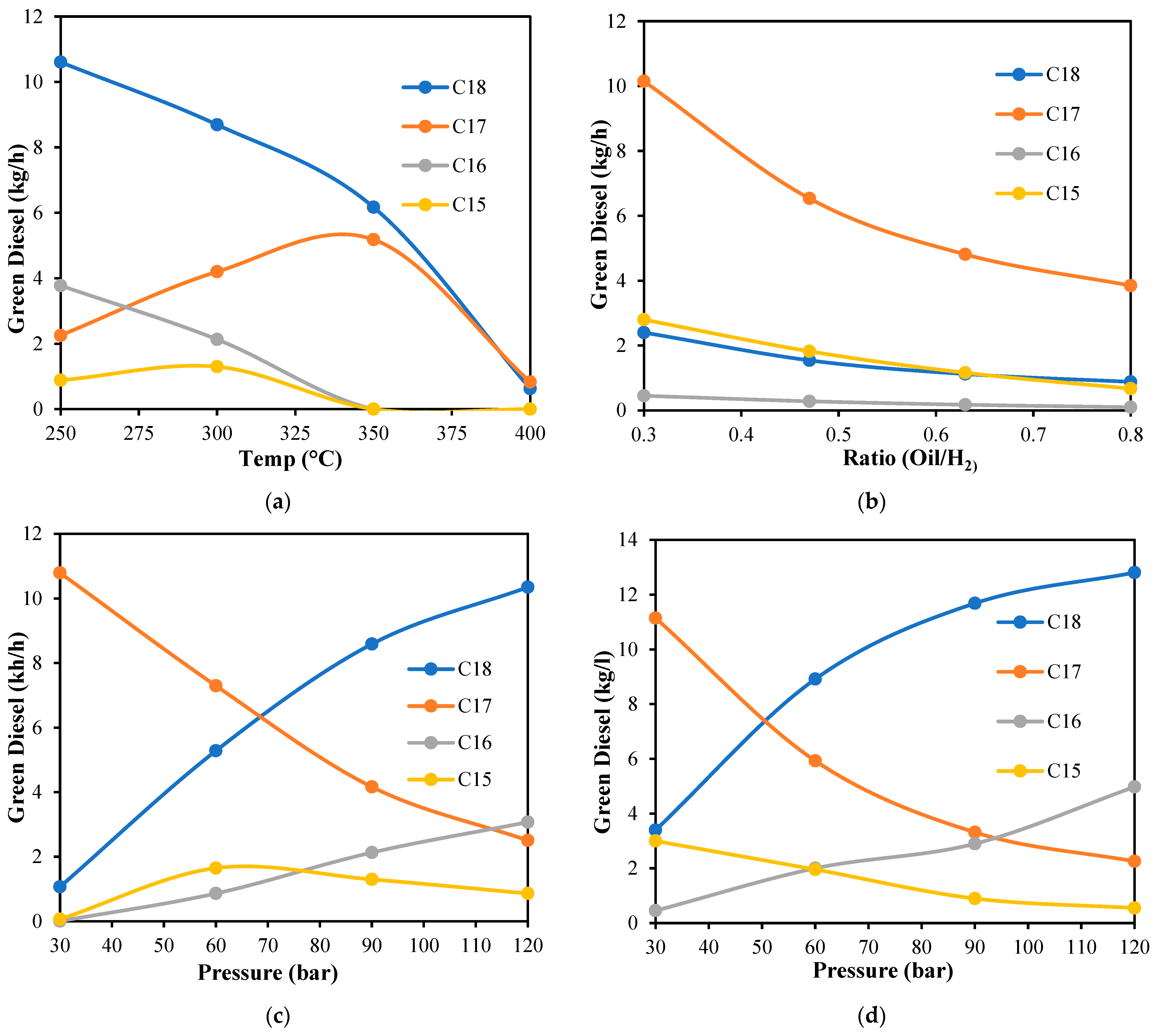
The green diesel produced is accounted for as the quantity of hydrocarbons (C15 to C18) produced and is represented in Figure 2. Figure 2a depicts the production rates of various green diesel hydrocarbons (C15 to C18) from waste vegetable oil (WVO) as a function of increasing temperature, while maintaining a constant pressure of 90 bar.
Figure 2.
Effect of process variables on green diesel production: (a) effect of temperature at 90 bar and ratio of 0.3; (b) effect of Oil/H2 ratio at 250 °C and 30 bar; (c) effect of pressure at 300 °C and ratio of 0.3 Oil/H2 ratio; and (d) effect of pressure at best process temperature 275 °C and 0.3 Oil/H2 ratio.
The hydrocarbon chains considered include C18, C17, C16, and C15, which are the primary constituents of green diesel. The production rates, measured in kg/h, are analysed over a temperature range of 250 °C to 400 °C. There is a distinct variation in the production rates of the different hydrocarbon chains. Each hydrocarbon follows a unique trend, indicating the temperature-dependent nature of the cracking or decarboxylation reactions responsible for its formation [25]. The production of C18 green diesel exhibits a sharp decline with increasing temperature. At 250 °C, C18 is the predominant hydrocarbon, with a production rate close to 11 kg/h. However, as the temperature increases, the production steadily decreases, falling below 2 kg/h at 400 °C. This suggests that C18 hydrocarbons undergo further cracking or are less stable at higher temperatures, resulting in the formation of shorter-chain hydrocarbons [26]. The C17 hydrocarbons trends show a bell-shaped curve. Initially, at 250 °C, the production rate is about 4 kg/h, and it increases to a maximum of around 6 kg/h at 350 °C. Beyond 350 °C, the production begins to drop, reaching near zero at 400 °C. This pattern suggests that C17 hydrocarbons are more stable and favoured at intermediate temperatures, but they likely undergo degradation or further cracking at higher temperatures. The production of C16 green diesel remains steady between 250 °C and 300 °C, peaks just under 4 kg/h at 350 °C, and then declines, reaching zero at 400 °C. C16 hydrocarbons are predominantly formed at intermediate temperatures. In contrast, C15 hydrocarbons exhibit minimal production below 350 °C but increase slightly at 350 °C, peaking at approximately 1 kg/h before dropping to zero at 400 °C. This suggests that C15 hydrocarbons form mainly at higher temperatures, possibly through the cracking of longer-chain hydrocarbons [26].
Figure 2b illustrates the relationship between the production of green diesel hydrocarbons (C15, C16, C17, and C18) and the WCO/H2 ratio. As the WCO/H2 ratio increases, the yield of all green diesel hydrocarbons generally decreases. A higher WCO/H2 ratio means that there is less hydrogen available per unit of WCO. Hydrogen is a crucial reactant in the hydrodeoxygenation (HDO) process, which is essential for converting triglycerides in WVO into green diesel hydrocarbons. With a limited supply of hydrogen, the conversion efficiency decreases, resulting in lower yields [27]. Other competing reactions, such as cracking and isomerisation, may become more prevalent. These reactions can consume hydrogen and produce unwanted by-products, further reducing the yield of green diesel hydrocarbons [9]. A strong inverse relationship between the WCO/H2 ratio and the production of green diesel hydrocarbons. To maximise green diesel yield, it is essential to maintain an appropriate balance between WCO and hydrogen in the hydrotreating process.
Figure 2c illustrates the production of green diesel hydrocarbons at different pressures. At lower pressures, the yield of C18 hydrocarbons increased, while the yields of C15, C16, and C17 initially rose but then declined as the pressure continued to increase. This trend can be attributed to the way pressure also affects the hydrodeoxygenation (HDO) process. At lower pressures, the HDO reaction was likely more effective, leading to higher C18 production. However, as pressure increased, other reactions like cracking became more common, breaking larger hydrocarbons like C18 into smaller ones such as C15, C16, and C17 [28]. This caused the C18 yield to drop while the smaller hydrocarbons increased.
Figure 2d illustrates the impact of pressure on the production of green diesel from waste vegetable oil. Various pressures were tested at a constant temperature of 275 °C and a consistent feed ratio of 0.3 wt/wt. The objective was to determine the optimum operating pressure that maximises the yield of hydrocarbons while also considering the by-products produced during the process. The hydrocarbons analysed include C18 (octadecane), C17 (heptadecane), C16 (hexadecane), and C15 (pentadecane). By summing the flow rates of all these hydrocarbons, the highest yield was obtained at a pressure of 90 bar. At 90 bar, the total flow rate of hydrocarbons amounted to 18.7991 kg/h, which is higher than the total yields at 30 bar, 60 bar, and 120 bar. Specifically, the production of C18 was relatively high at 11.6895 kg/h, while C16 and C15 contributed 3.3137 kg/h and 2.8987 kg/h, respectively, indicating that 90 bar was the most balanced pressure for hydrocarbon production. Although C17 production was not at its maximum under these conditions, its contribution of 3.3137 kg/h was significant enough to yield high-pressure products at 90 bar. Higher pressures can increase the solubility of hydrogen gas in the liquid phase, leading to improved mass transfer and a higher concentration of hydrogen available for reaction with waste vegetable oil (WCO) triglycerides. Additionally, pressure can influence reaction equilibria and potentially reduce coke formation, a common side reaction that can deactivate catalysts and reduce product quality [9]. The simulation results obtained are presented in Table S2. The highest conversion and yield obtained were 90% and 80%, respectively, in agreement with the results reported in the literature [7,14,29]. Although the maximum total hydrocarbon yield was observed at approximately 90 bar, lower pressures (around 30 bar) provided a favourable trade-off between green diesel yield, hydrogen consumption, and by-product formation. At reduced pressure, satisfactory conversion levels were achieved while limiting the formation of CO, CO2, and excessive hydrogen usage, which has implications for compression energy demand and overall process sustainability. Therefore, while higher pressures maximise hydrocarbon production, moderate pressures may be preferable from an energy-efficiency and sustainability perspective.
Wibowo et al. [13] reported the optimal operating conditions of 1/12 for oil/H2, 20 bar for pressure, and a temperature of 275 °C, with the optimal temperature aligning with the one found in the present study. Arora et al. [23] also reported ranges for optimised variables, noting pressures of 40–70 bar and temperatures of 275 to 325 °C. These factors are also influenced by the use of a catalyst; in the present study, a catalyst was not used. The R2 for validation was 0.8382 (Table S3), indicating that the model explains 83% of the variance and thus provides a strong fit, with 17% of variability arising from unaccounted factors or randomness.
4. Conclusions
The production of green diesel from waste vegetable oil (WVO) via hydrotreating offers a sustainable alternative to fossil fuels. Using a ChemCAD simulation, this study emphasises optimising process variables such as temperature, pressure, and hydrogen-to-oil ratio to maximise yield and reduce by-products. The process converts fatty acids like oleic, stearic, and palmitic acids into long-chain hydrocarbons through hydrodeoxygenation, providing a renewable energy source that lessens dependence on conventional fuels and mitigates environmental impact from WCO disposal. Simulation results indicate that higher pressures (around 90 bar) maximise total hydrocarbon yield; however, when hydrogen consumption, by-product formation, and energy efficiency are considered, moderate operating conditions (275 °C, 30 bar, and an H2/oil ratio of 0.3) provide a balanced and sustainable operating window. Under these conditions, the WCO conversion exceeded 90%, with more than 80% of the products falling within the green diesel range (C15–C18). These findings highlight the importance of multi-objective optimisation rather than yield maximisation alone when designing sustainable hydrotreating processes. These findings support SDG 7, promoting access to affordable, reliable, and sustainable energy. A key recommendation involves recycling unreacted hydrogen, which is essential in hydrotreating reactions. Implementing hydrogen recycling enhances process sustainability, improving energy efficiency and cost-effectiveness. This research advances green diesel technology, highlighting its potential for large-scale application and contributing to the transition toward cleaner energy solutions. The use of catalysts such as NiMoS2/γ-Al2O3 is recommended to enhance the production rate of green diesel. Future research should focus on catalyst-specific modelling, experimental validation, and long-term deactivation analysis to improve overall understanding and efficiency.
Supplementary Materials
The following supporting information can be downloaded at: https://www.mdpi.com/article/10.3390/engproc2025117027/s1, Table S1: The kinetic model parameters for the hydrotreatment process; Table S2: The effect of process conditions on the production of green diesel; Table S3: Statistical data validation and analysis.
Author Contributions
Conceptualisation, P.M.; methodology, P.M., T.M., and A.M.; software, P.M.; validation, P.M.; formal analysis, A.M. and T.M.; investigation, P.M., A.M., and T.M.; resources, P.M., A.M., and T.M.; data curation, P.M.; writing—original draft preparation, P.M., T.M., and A.M.; writing—review and editing, P.M.; visualisation, P.M.; project administration, P.M. All authors have read and agreed to the published version of the manuscript.
Funding
This research received no external funding.
Institutional Review Board Statement
Not applicable.
Informed Consent Statement
Not applicable.
Data Availability Statement
The data presented in this study are available on request from the corresponding author. The data are not publicly available due to privacy or ethical restrictions.
Acknowledgments
The authors would like to thank the Department of Chemical & Metallurgical Engineering of the Vaal University of Technology for providing research facilities.
Conflicts of Interest
The authors declare no conflicts of interest.
References
- Hassan, Q.; Viktor, P.; Al-Musawi, T.J.; Ali, B.M.; Algburi, S.; Alzoubi, H.M.; Al-Jiboory, A.K.; Sameen, A.Z.; Salman, H.M.; Jaszczur, M. The Renewable Energy Role in the Global Energy Transformations. Renew. Energy Focus 2024, 48, 100545. [Google Scholar] [CrossRef] [Scilit]
- Mwenge, P.; Luboya, A.; Muthubi, S.; Rutto, H.; Seodigeng, T. Biodiesel Production from Animal Fats Using Blast Furnace Geopolymer Heterogeneous Catalyst: Optimisation and Kinetic Study. Arab. J. Sci. Eng. 2025, 50, 9937–9951. [Google Scholar] [CrossRef] [Scilit]
- Mwenge, P.; Muthubi, S.; Rutto, H. Optimisation of Biodiesel Production from Waste Margarine Oil Using Response Surface Methodology. Eng. Proc. 2025, 87, 12. [Google Scholar]
- Mwenge, P.; Rutto, H.; Enweremadu, C. Biodiesel Production Using Chlor-Alkali Brine Sludge Waste as a Heterogeneous Catalyst: Optimisation Using Response Surface Methodology. Int. J. Sustain. Energy 2022, 41, 832–845. [Google Scholar] [CrossRef] [Scilit]
- Mwenge, P.; Djemima, B.; Zwane, S.; Muthubi, S.; Rutto, H.; Seodigeng, T. Kinetics and Simulation of Biodiesel Production Using a Geopolymer Heterogenous Catalyst. J. Environ. Sci. Health Part A 2024, 59, 499–511. [Google Scholar] [CrossRef] [Scilit]
- Mwenge, P.; Rutto, H.; Enweremadu, C. Production of Biodiesel Using Calcined Brine Sludge Waste from Chor-Alkali Industry as a Heterogeneous Catalyst. Environ. Clim. Technol. 2021, 25, 621–630. [Google Scholar] [CrossRef] [Scilit]
- Caporusso, A.; Giuliano, A.; Liuzzi, F.; Barletta, D.; De Bari, I. Techno-Economic Analysis of Green Diesel Production Process from Vegetable Oils. Chem. Eng. Trans. 2023, 100, 13–18. [Google Scholar] [CrossRef]
- Rashid, U.; Lee, C.L.; Hazmi, B.; Gamal, S.; Beygisangchin, M. Standard Specifications for Renewable Diesel. In Renewable Diesel; Elsevier: Amsterdam, The Netherlands, 2024; pp. 33–63. [Google Scholar]
- Glisic, S.B.; Pajnik, J.M.; Orlović, A.M. Process and Techno-Economic Analysis of Green Diesel Production from Waste Vegetable Oil and the Comparison with Ester Type Biodiesel Production. Appl. Energy 2016, 170, 176–185. [Google Scholar] [CrossRef] [Scilit]
- Tongwane, M.; Piketh, S.; Stevens, L.; Ramotubei, T. Greenhouse Gas Emissions from Road Transport in South Africa and Lesotho between 2000 and 2009. Transp. Res. Part D Transp. Environ. 2015, 37, 1–13. [Google Scholar] [CrossRef] [Scilit]
- Oladunni, O.J.; Mpofu, K.; Olanrewaju, O.A. Greenhouse Gas Emissions and Its Driving Forces in the Transport Sector of South Africa. Energy Rep. 2022, 8, 2052–2061. [Google Scholar] [CrossRef] [Scilit]
- Pacheco, J.R.; Villardi, H.G.D.; Cavalcante, R.M.; Young, A.F. Biodiesel Production through Non-Conventional Supercritical Routes: Process Simulation and Technical Evaluation. Energy Convers. Manag. 2022, 251, 114998. [Google Scholar] [CrossRef] [Scilit]
- Wibowo, A.A.; Mustain, A.; Lusiani, C.E.; Hartanto, D.; Ginting, R.R. Green Diesel Production from Waste Vegetable Oil: A Simulation Study. AIP Conf. Proc. 2020, 2223, 020008. [Google Scholar] [CrossRef] [Scilit]
- Cavalcanti, C.J.S.; Ravagnani, M.A.S.S.; Stragevitch, L.; Carvalho, F.R.; Pimentel, M.F. Simulation of the Soybean Oil Hydrotreating Process for Green Diesel Production. Clean. Chem. Eng. 2022, 1, 100004. [Google Scholar] [CrossRef] [Scilit]
- Lucantonio, S.; Di Giuliano, A.; Rossi, L.; Gallucci, K. Green Diesel Production via Deoxygenation Process: A Review. Energies 2023, 16, 844. [Google Scholar] [CrossRef] [Scilit]
- Muharam, Y.; Putri, A.D. Simulation of Hydrotreating of Vegetable Oil in a Slurry Bubble Column Reactor for Green Diesel Production. Int. J. Technol. 2018, 9, 1168. [Google Scholar] [CrossRef] [Scilit]
- Lee, Z.S.; Seah, C.C.; Habib, S.H.; Hafriz, R.S.R.M.; Razali, N.M. Production of Green Diesel from Waste Cooking Oil via Catalytic Deoxygenation Reaction Using Metal Doped Eggshell Catalyst. IOP Conf. Ser. Earth Environ. Sci. 2024, 1372, 012048. [Google Scholar] [CrossRef] [Scilit]
- Heriyanto, H.; Murti Sumbogo, S.; Heriyanti, S.I.; Sholehah, I.; Rahmawati, A. Synthesis of Green Diesel From Waste Cooking Oil Through Hydrodeoxygenation Technology With NiMo/γ-Al2O3 Catalysts. MATEC Web Conf. 2018, 156, 03032. [Google Scholar] [CrossRef] [Scilit]
- Abdul Razak, N.A.; Mijan, N.-A.; Taufiq-Yap, Y.H.; Derawi, D. Production of Green Diesel via Hydrogen-Free and Solventless Deoxygenation Reaction of Waste Cooking Oil. J. Clean. Prod. 2022, 366, 132971. [Google Scholar] [CrossRef] [Scilit]
- Barbosa, I.V.; Scapim, L.A.; Cavalcante, R.M.; Young, A.F. Industrial Production of Green Diesel in Brazil: Process Simulation and Economic Perspectives. Renew. Energy 2023, 219, 119591. [Google Scholar] [CrossRef] [Scilit]
- Capuano, D.; Costa, M.; Di Fraia, S.; Massarotti, N.; Vanoli, L. Direct Use of Waste Vegetable Oil in Internal Combustion Engines. Renew. Sustain. Energy Rev. 2017, 69, 759–770. [Google Scholar] [CrossRef] [Scilit]
- Hill, C.G., Jr.; Root, T.W. Elements of Heterogeneous Catalysis. In Introduction to Chemical Engineering Kinetics and Reactor Design; Wiley-VCH: Hoboken, NJ, USA, 2014; pp. 152–188. [Google Scholar]
- Arora, P.; Grennfelt, E.L.; Olsson, L.; Creaser, D. Kinetic Study of Hydrodeoxygenation of Stearic Acid as Model Compound for Renewable Oils. Chem. Eng. J. 2019, 364, 376–389. [Google Scholar] [CrossRef] [Scilit]
- De Oliveira Camargo, M.; Castagnari Willimann Pimenta, J.L.; De Oliveira Camargo, M.; Arroyo, P.A. Green Diesel Production by Solvent-Free Deoxygenation of Oleic Acid over Nickel Phosphide Bifunctional Catalysts: Effect of the Support. Fuel 2020, 281, 118719. [Google Scholar] [CrossRef] [Scilit]
- Douvartzides, S.L.; Charisiou, N.D.; Papageridis, K.N.; Goula, M.A. Green Diesel: Biomass Feedstocks, Production Technologies, Catalytic Research, Fuel Properties and Performance in Compression Ignition Internal Combustion Engines. Energies 2019, 12, 809. [Google Scholar] [CrossRef] [Scilit]
- Sadrameli, S.M. Thermal/Catalytic Cracking of Hydrocarbons for the Production of Olefins: A State-of-the-Art Review I: Thermal Cracking Review. Fuel 2015, 140, 102–115. [Google Scholar] [CrossRef] [Scilit]
- Lorenzi, G.; Baptista, P.; Venezia, B.; Silva, C.; Santarelli, M. Use of Waste Vegetable Oil for Hydrotreated Vegetable Oil Production with High-Temperature Electrolysis as Hydrogen Source. Fuel 2020, 278, 117991. [Google Scholar] [CrossRef] [Scilit]
- Tijani, M.E.H.; Zondag, H.; Van Delft, Y. Review of Electric Cracking of Hydrocarbons. ACS Sustain. Chem. Eng. 2022, 10, 16070–16089. [Google Scholar] [CrossRef] [Scilit]
- Pedroza, M.A.P.; Segtovich, I.S.V.; Sermoud, V.D.M.; Da Silva, M.A.P. Hydrodeoxygenation of Stearic Acid to Produce Diesel–like Hydrocarbons: Kinetic Modeling, Parameter Estimation and Simulation. Chem. Eng. Sci. 2022, 254, 117576. [Google Scholar] [CrossRef] [Scilit]
Disclaimer/Publisher’s Note: The statements, opinions and data contained in all publications are solely those of the individual author(s) and contributor(s) and not of MDPI and/or the editor(s). MDPI and/or the editor(s) disclaim responsibility for any injury to people or property resulting from any ideas, methods, instructions or products referred to in the content. |
© 2026 by the authors. Licensee MDPI, Basel, Switzerland. This article is an open access article distributed under the terms and conditions of the Creative Commons Attribution (CC BY) license.