


Abstract
This research focuses on synthesizing novel tetrahydroquinoline–1,2,3-triazole hybrids as potential agents for neurodegenerative diseases, particularly Alzheimer’s disease (AD). The series of structurally distinct hybrid compounds synthesized in this study has not been previously reported in the literature. The synthetic strategy involved a diastereoselective imino Diels–Alder reaction (Povarov reaction) to construct the tetrahydroquinoline (THQ) core, where various catalysts, including phthalic acid, Lewis acids, KSF (montmorillonite), and ceric ammonium nitrate (CAN), were screened. Phthalic acid was selected as the most efficient catalyst for this crucial step. Following this, we employed efficient click chemistry to introduce the triazole moiety, adhering to green chemistry principles throughout the process. The chemical structure of the synthetized compounds was assigned using an analysis of Nuclear Magnetic Resonance (NMR), Mass Spectrometry (MS), and Infrared (IR) spectroscopy. Furthermore, in silico analyses performed with Swiss ADME and OSIRIS Property Explorer indicated that most compounds exhibited excellent drug-like characteristics and favorable pharmacokinetic profiles. The synthesized compounds were evaluated as inhibitors of acetylcholinesterase (AChE) and butyrylcholinesterase (BChE) using the modified Ellman methodology. The inhibitory activity is presented as IC50 values for each enzyme and compared to galantamine as a reference standard. These findings offer promising directions for the development of new therapeutic agents for AD based on organic synthesis.
1. Introduction
Alzheimer’s disease (AD) is the leading cause of dementia, accounting for roughly 70% of cases and affecting tens of millions worldwide [1], and its multifactorial pathology produces progressive loss of memory and other cognitive functions [2]. Among pathogenic hypotheses, the cholinergic theory remains therapeutically tractable: the degeneration of basal forebrain cholinergic neurons and decreased acetylcholine (ACh) levels in the hippocampus and cortex contribute directly to deficits in attention, learning, and memory [3]. In the pharmacological view, the inhibition of acetylcholinesterase (AChE) and butyrylcholinesterase (BChE) increases the bioavailability of acetylcholine (ACh) and can partially restore cholinergic signaling in the central nervous system (CNV) [4,5]. The actual authorized drugs from the FDA are not completely useful, because they are not very selective and have secondary adverse effects. Here, we report the continuation of our last advance [6], which now involves the design, synthesis, and in vitro evaluation of potential inhibitors and their ADME/Tox profiles predicted in silico.
2. Results and Discussion
2.1. Synthesis Results
2.1.1. Povarov Reaction to THQ
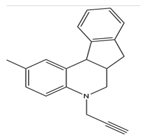
The Povarov reaction was not explored with this combination of reactives, and the results show a great advance from our last report [6] and other alternative methods to obtain a THQ core (Table 1, A) [7,8]. The test of four different catalysts probes the importance of molecular conversion and product distribution. Phthalic acid is demonstrated to be the most effective catalyst, reaching yields of 85% (Table 2). On the other hand, the Lewis acid (InCl3) produced lower yields and slower conversions; notably, KSF and CAN, though effective in some Povarov variants, proved less suitable for our substrate set and did not improve yields, which suggests that their modes of activation are suboptimal for the electron density patterns present in our anilines and dienophiles. These results highlight the importance of matching an optimal catalyst according to the specific electronic and steric demands of the chemical systems and their reaction patterns. In this case, phthalic acid rises as the better choice.
Table 1.
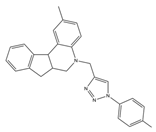
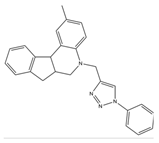
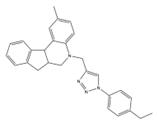
Compound abbreviation, nomenclature, reaction yield, and structure of synthesized tetrahydroquinoline and tetrahydroquinoline/1,2,3-triazole hybrid compounds.
Table 2.
Summary of yields of every tested catalyst.
2.1.2. Click Chemistry to Triazole Hybrids
The copper-catalyzed azide–alkine cycloaddition (click chemistry) was adapted to conjugate aryl azides onto the THQ core to produce the three new THQ–triazole hybrids, whose synthetized compounds have not been reported in the literature. This reaction was very efficient in terms of the isolated yields (up to 99%) and reaction times (around 1 h). The click chemistry was able to merge two pharmacophore chemical skeletons, expanding the molecular diversity. It is important to note the stereoselectivity of click chemistry [9]; it was a relevant tool for making just one molecule and facilitated the purification and posterior evaluation. Table 1 shows the results of the synthesis procedure, including the yield, molecular weight, and IUPAC name of the THQ (A) and the three hybrid compounds (B, C, and D).
2.2. In Silico Prediction
In the first step, the ADME properties were evaluated for the four compounds. The pharmacological targets (AChE and BChE) are in the CNS. With this focus, we emphasized the property that enables central exposure [10]: predicted blood–brain barrier (BBB) permeability. For every compound, we were able to cross that barrier according to the prediction. It is relevant to note that compound A was evaluated before, but this result showed that the THQ–triazole core was able to cross, too [11,12]. On the other hand, the efflux flow was evaluated according to the P-glycoprotein (P-gp) substrate criteria [13], and the results are, for all compounds, positive for P-gp substrate, demonstrating that the fusion of THQ with a triazole group does not change this property of the Indene–THQ (compound A) previously reported. From a translational perspective, the P-gp liability implies that measured in vitro potency may overestimate in vivo CNS efficacy unless efflux is mitigated by structural modification, a higher free fraction, or co-administration strategies; it also highlights the need to include P-gp assays and brain-penetration studies early in the screening cascade.
The evaluation of toxicity risk outcomes across mutagenicity, tumorigenicity, reproductive toxicity, and irritancy (Table 3) strengthens the case for advancing several series members to enzymatic and cellular assays [14]. This result indicates an outlier in the mutagenicity of compound D. This value means a moderate risk of mutagenicity in this case and is due to the ethyl bond to the benzyl group near the triazole. That information is key to avoiding toxicity for similar structures in the formation of hybrids and warrants immediate experimental follow-up (e.g., Ames test, micronucleus assay) before further resource investment.
Table 3.
Summary of pharmacological and toxicity profiles of every compound. ( ) nontoxic; (
 ) middle toxicity.
) nontoxic; () middle toxicity.
2.3. Biological Activity
The activity profile reveals a clear and tunable effect of the triazole substituent on both potency and enzyme selectivity. The parent THQ (compound A) (IC50AChE = 5.5 µM; IC50 BChE = 316 µM) is very AChE-preferring (selectivity index AChE vs BChE ≈ 57), while the three THQ–triazole hybrids (compounds B, C, and D) shift potency by more than an order of magnitude and split into distinct selectivity patterns (Table 4). For AChE, the hybrids measured as follows: B = 1.03 µM, C = 0.18 µM, and D = 4.02 µM. For BChE, they measured as follows: B = 0.26 µM, C = 27.81 µM, and D > 500 µM. The calculated selectivity (IC50BChE/IC50AChE), therefore, shows that B is BChE-biased (SI ≈ 0.25), D is strongly AChE-selective (SI ≈ 155), and C is strongly AChE-selective (SI > 124).
Table 4.
Enzymatic inhibition of the synthesized compounds.
These results carry two important implications. First, incorporation of the triazole does not simply increase potency uniformly but also reprograms target preference depending on the aryl substituent (Table 4), which indicates that small electronic or steric changes at the triazole handle substantially alter interactions within the catalytic gorge of each cholinesterase. This result is expected because of the wide spectrum of benefits of triazole in drug-related molecules [15]. Second, the D compound (IC50 AChE = 0.18 µM; SI = 155) emerges as a highly selective AChE inhibitor that matches the programmatic aim of central AChE augmentation with minimal BChE engagement, a profile that can reduce off-target peripheral cholinergic effects and simplify interpretation of in vivo pharmacology [16,17]. Conversely, the fact that C compound displays sub-micromolar BChE potency (IC50 = 0.26 µM) is notable: selective BChE inhibition has therapeutic relevance in later AD stages, where BChE activity increases and may complement or offer an alternative symptomatic strategy [18]. The mixed profile of compound B (high AChE selectivity) suggests the same mode of action as compound C, with less potency and selectivity. But, this study provides valuable data for understanding the interactions between the series compounds and the biological targets.
Mechanistically, the divergent selectivity suggests that the substituents modulate key interactions, for example, by altering the fit in the peripheral anionic site, hydrogen-bonding networks, or the orientation toward catalytic residues rather than merely changing the overall lipophilicity. These differential outcomes validate the hybridization approach for tuning both potency and selectivity and identifying distinct leads for either AChE-focused or BChE-focused therapeutic strategies.
3. Conclusions and Perspectives
Phthalic acid proved to be an efficient and practical promoter of the Povarov reaction, affording the THQ core in yields up to 85%, while the subsequent click chemistry step delivered THQ–triazole hybrids in excellent yields (up to 99%).
Biological evaluation demonstrated that triazole hybridization markedly enhanced AChE inhibitory potency compared with the parent THQ, with substituents dictating the selectivity profile. Among the series, compound D emerged as the most potent and selective AChE inhibitor (IC50 = 0.18 µM), approaching galantamine potency and showing no major predicted toxicity alerts, while the remaining derivatives also displayed favorable safety predictions. In silico ADME analysis supported blood–brain barrier permeability across the series but consistently flagged all compounds as P-gp substrates, highlighting a potential limitation for in vivo brain exposure.
Taken together, these findings identify THQ–triazole hybrids as a promising scaffold for cholinesterase inhibition in AD. Future work should prioritize compound D and selected analogues for confirmatory enzymatic and genotoxicity assays while leveraging focused SAR around the aryl-triazole substituent to retain potency, mitigate mutagenicity risks, and reduce P-gp recognition. Docking and molecular modeling studies will be essential to rationalize substituent effects and guide optimization toward candidates with improved CNS pharmacological profiles.
4. Materials and Methods
4.1. General Information
All reagents were purchased from Merck (Darmstadt, Germany) or Sigma-Aldrich Chemical Co. (St. Louis, MO, USA) and used without further purification. The obtained products were characterized by spectroscopic and spectrometric methods (IR, MS, 1H-NMR, and 13C-NMR). The progress of the reactions was monitored by thin-layer chromatography on aluminum TLC plates. Column chromatography was performed using silica gel (60–120 mesh), and the solvents used were of analytical grade.
4.2. Synthetic Procedures
4.2.1. Synthesis of N-Propargyl Toluidine
In a round-bottom flask, 3 g of toluidine (28 mmol) and 1.5 and 0.3 equivalents of K2CO3 and KI, respectively, were added in 10 mL of DMF and left in agitation for 15 min in ice bath (0 °C). Additionally, a solution of 0.8 equivalents of propargyl bromide in 5 mL of DMF was prepared. After 15 min, the solution was added drop by drop to the flask, and when dripping was finished, the reaction was maintained at room temperature for 2 h. Monitoring was performed by thin-layer chromatography. The solution was extracted with 20 mL of Brine solution and 20 mL of ethyl acetate (20 mL × 3). The organic phase was separated and filtered in approximately 5% of Sodium Sulfate. Finally, the product of interest was purified by liquid chromatography on silica gel and eluted with a mixture of ethyl acetate and petroleum ether.
4.2.2. Synthesis of Tetrahydroquinolines
In a round-bottom flask, the resulting propargyl toluidine was added in 10 mL of Acetonitrile; formaldehyde (70%) (5–6 mL) was added in excess and kept in agitation between 30 and 35 °C for 15 min. After this time, the Indene was added dropwise, slightly in excess. It was shaken continuously for 24 h. The solution was extracted with 20 mL of Brine solution and 20 mL of ethyl acetate (20 mL × 3). It was filtered in approximately 5% of Sodium Sulfate. Finally, the product of interest was purified by liquid chromatography on silica gel and eluted with a mixture of ethyl acetate and petroleum ether.
4.2.3. Synthesis of Triazole Hybrids
In a round-bottom flask, 100 mg of the THQ and 1 equivalent of each aryl azide was added in 11 mL of a mixture comprising 5:3:3 of THF: MeOH: H2O solvent. After 15 min, 40% of sodium ascorbate was added; after another 15 min, 8% of CuSO4 • 5H2O was added as catalyst, and the reaction was maintained at room temperature for 1–4 h. The solution was extracted with 20 mL of Brine solution and 20 mL of ethyl acetate (20 mL × 3). The organic phase was separated and filtered in approximately 5% of Sodium Sulfate. Finally, the product of interest was purified by liquid chromatography on silica gel and eluted with a mixture of ethyl acetate and petroleum ether.
4.3. Biological Evaluation
The Ellman method was used to determine the inhibition of cholinesterases; this photometric method has been widely used to determine AChE and BChE activity through changes in color intensity produced by fast and sensitive coupling reactions [19].
To evaluate the inhibitory activity of compounds A–D, the samples were prepared using 96-well plates (50 μL) with a phosphate buffer (K2HPO4 8 mM, NaH2PO4 2.3 mM, NaCl 150 mM, and 0.5% Tween 20, pH 7.6). AChE or BChE solution (50 μL, 0.30 units/mL) from Electrophorus electricus or equine serum, respectively, was added to the same buffer. Then, the solutions to be tested were pre-incubated with the enzymes at room temperature for 30 min. Subsequently, the substrate solution (Na2HPO4 (40 mM), acetylthiocholine (ATC)/butyrylthiocholine (BTC) (0.24 mM), and 5,5-dithio-bis(2-nitrobenzoic acid) (0.2 mM, DTNB, Ellman’s reagent)) was added and incubated for 5 min, and absorbance was measured at 405 nm. Enzyme activity was calculated as a percentage of inhibition and compared with the control. Compounds were tested in a dilution range of 500 to 0.002 μg/mL in triplicate. IC50 values were determined by regression analysis. Galantamine was used as the reference compound.
Author Contributions
Conceptualization, M.G., C.D. and M.P.; methodology, C.D. and M.P.; software, C.D.; validation, C.D. and M.P.; formal analysis, C.D. and M.P.; investigation, C.D. and M.P.; resources, M.G.; data curation, C.D. and M.P.; writing—original draft preparation, C.D.; writing—review and editing, C.D., M.P. and M.G.; visualization, C.D. and M.P.; supervision, M.G.; project administration, M.G.; funding acquisition, M.G. All authors have read and agreed to the published version of the manuscript.
Funding
This research received no external funding.
Institutional Review Board Statement
Not applicable.
Informed Consent Statement
Not applicable.
Data Availability Statement
The Data presented in this study are available on request from the corresponding author.
Acknowledgments
The authors express their sincere gratitude to Margarita Gutiérrez for her expertise, confidence, and scholarly guidance throughout the design and execution of this research. Special appreciation is extended to Mercedes Pinochet for her dedicated technical assistance and valuable instruction regarding experimental methodologies. The authors also thank the Institute of Chemistry of Natural Resources for providing access to the necessary infrastructure and resources for the successful completion of this study.
Conflicts of Interest
The authors declare no conflicts of interest.
References
- Alzheimer’s Disease International; Long, S.L.; Benoist, C.; Weidner, W. Informe Mundial Sobre el Alzheimer 2023. 2023. Available online: https://www.alzint.org/u/World-Alzheimer-Report-2023_Spanish.pdf (accessed on 14 May 2025).
- Scheltens, P.; De Strooper, B.; Kivipelto, M.; Holstege, H.; Chételat, G.; Teunissen, C.E.; Cummings, J.; van der Flier, W.M. Alzheimer’s disease. Lancet 2021, 397, 1577–1590. [Google Scholar] [CrossRef] [Scilit] [PubMed]
- Delozier, S.J.; Davalos, D. A Systematic Review of Metacognitive Differences between Alzheimer’s Disease and Frontotemporal Dementia. Am. J. Alzheimer’s Dis. Other Dement. 2016, 31, 381–388. [Google Scholar] [CrossRef] [Scilit] [PubMed]
- Bekdash, R.A. The cholinergic system, the adrenergic system and the neuropathology of alzheimer’s disease. Int. J. Mol. Sci. 2021, 22, 1273. [Google Scholar] [CrossRef] [Scilit] [PubMed]
- Shome, A.; Jha, K.T.C.; Chawla, V.; Chawla, P.A. An Insight into Medicinal Chemistry and SAR Studies of Cholinesterase and BACE-1 Inhibitors for Alzheimer’s Disease. CNS Neurol. Disord.-Drug Targets 2024, 24. [Google Scholar] [CrossRef] [Scilit] [PubMed]
- Dinamarca, C.; Pinochet, M.; Gutierrez, M. Synthesis and In-Silico Analysis of Novel Tetrahydroquinolines and Their Antioxidant Activity. Chem. Proc. 2024, 16, 99. [Google Scholar] [CrossRef] [Scilit]
- Kant, K.; Naik, P.; Patel, C.K.; Some, S.; Banerjee, S.; Aljaar, N.; Atta, A.K.; Malakar, C.C. Organocatalytic Approaches Towards the Synthesis of Asymmetric Tetrahydroquinoline (THQ) Derivatives. Synthesis 2025, 57, 296–330. [Google Scholar] [CrossRef] [Scilit]
- Muthukrishnan, I.; Sridharan, V.; Menéndez, J.C. Progress in the Chemistry of Tetrahydroquinolines. Chem. Rev. 2019, 119, 5057–5191. [Google Scholar] [CrossRef] [Scilit] [PubMed]
- Kumar, V.; Lal, K.; Naveen; Tittal, R.K. The fate of heterogeneous catalysis & click chemistry for 1,2,3-triazoles: Nobel prize in chemistry 2022. Catal. Commun. 2023, 176, 106629. [Google Scholar] [CrossRef] [Scilit]
- Sun, Y.; Zabihi, M.; Li, Q.; Li, X.; Kim, B.J.; Ubogu, E.E.; Raja, S.N.; Wesselmann, U.; Zhao, C. Drug Permeability: From the Blood–Brain Barrier to the Peripheral Nerve Barriers. Adv. Ther. 2023, 6, 2200150. [Google Scholar] [CrossRef] [Scilit] [PubMed]
- Daina, A.; Michielin, O.; Zoete, V. SwissADME: A free web tool to evaluate pharmacokinetics, drug-likeness and medicinal chemistry friendliness of small molecules. Sci. Rep. 2017, 7, 42717. [Google Scholar] [CrossRef] [Scilit] [PubMed]
- Komura, H.; Watanabe, R.; Mizuguchi, K. The Trends and Future Prospective of In Silico Models from the Viewpoint of ADME Evaluation in Drug Discovery. Pharmaceutics 2023, 15, 2619. [Google Scholar] [CrossRef] [Scilit] [PubMed]
- Elmeliegy, M.; Vourvahis, M.; Guo, C.; Wang, D.D. Effect of P-glycoprotein (P-gp) Inducers on Exposure of P-gp Substrates: Review of Clinical Drug–Drug Interaction Studies. Clin. Pharmacokinet. 2020, 59, 699–714. [Google Scholar] [CrossRef] [Scilit]
- Ajay Kumar, T.V.; Kabilan, S.; Parthasarathy, V. Screening and Toxicity Risk Assessment of Selected Compounds to Target Cancer using QSAR and Pharmacophore Modelling. Int. J. PharmTech Res. 2017, 10, 219–224. [Google Scholar] [CrossRef] [Scilit]
- Rohila, Y.; Sebastian, S.; Ansari, A.; Kumar, D.; Mishra, D.K.; Gupta, M.K. A Comprehensive Review of the Diverse Spectrum Activity of 1,2,3-Triazole-linked Isatin Hybrids. Chem. Biodivers. 2024, 21, e202301612. [Google Scholar] [CrossRef] [Scilit] [PubMed]
- Gambardella, M.D.; Wang, Y.; Pang, J. The Cholinergic Selectivity of FDA-Approved and Metabolite Compounds Examined with Molecular-Docking-Based Virtual Screening. Molecules 2024, 29, 2333. [Google Scholar] [CrossRef] [Scilit] [PubMed]
- Liston, D.R.; Nielsen, J.A.; Villalobos, A.; Chapin, D.; Jones, S.B.; Hubbard, S.T.; Shalaby, I.A.; Ramirez, A.; Nason, D.; White, W.F. Pharmacology of selective acetylcholinesterase inhibitors: Implications for use in Alzheimer’s disease. Eur. J. Pharmacol. 2004, 486, 9–17. [Google Scholar] [CrossRef] [Scilit] [PubMed]
- Fernández-Bolaños, J.G.; López, Ó. Butyrylcholinesterase inhibitors as potential anti-Alzheimer’s agents: An updated patent review (2018–present). Expert Opin. Ther. Pat. 2022, 32, 913–932. [Google Scholar] [CrossRef] [Scilit] [PubMed]
- Ellman, G.L.; Courtney, K.D.; Andres, V.; Featherstone, R.M. A new and rapid colorimetric determination of acetylcholinesterase activity. Biochem. Pharmacol. 1961, 7, 88–95. [Google Scholar] [CrossRef] [Scilit] [PubMed]



Disclaimer/Publisher’s Note: The statements, opinions and data contained in all publications are solely those of the individual author(s) and contributor(s) and not of MDPI and/or the editor(s). MDPI and/or the editor(s) disclaim responsibility for any injury to people or property resulting from any ideas, methods, instructions or products referred to in the content. |
© 2025 by the authors. Licensee MDPI, Basel, Switzerland. This article is an open access article distributed under the terms and conditions of the Creative Commons Attribution (CC BY) license (https://creativecommons.org/licenses/by/4.0/).