


Abstract
Computer-aided docking combined with AlphaFold-based protein modeling revealed strong binding affinities of the ligand DOLA ((Z)-5-(dimethylamino)-N-(octadec-9-en-1-yl)naphthalene-1-sulfonamide) to metabolic proteins in the insect species Tenebrio molitor, Tribolium castaneum, Locusta migratoria, Lucilia cuprina, and Drosophila melanogaster. Significant interactions were observed with cytochrome P450 families CYP6 and CYP4 involved in detoxification, hormone regulation, and fatty acid metabolism, with binding energies ranging from −10.4 to −8.5 kcal/mol. DOLA also showed affinity for enzymes related to fatty acid metabolism and transport, including long-chain fatty acid-CoA ligase, fatty acyl-CoA reductases, CYP18a1, lipocalins, and fatty acid desaturases. These in silico findings highlight DOLA as a promising ligand for studying insect metabolic pathways and as a potential agent for population control, warranting further experimental validation.
1. Introduction
The search for novel and effective methods for controlling insect populations remains a pressing challenge for agriculture and public health. Traditional insecticides often prove ineffective due to the development of resistance in insects; they also have detrimental effects on the environment and human health. In this context, the development of targeted insecticides, aimed at specific biochemical processes within insect organisms, represents a promising avenue. The present work is dedicated to employing molecular docking to identify potential inhibitors or substrates of proteins involved in xenobiotic detoxification, metabolism, transport, and the reception of fatty acids and their derivatives, and which constitute promising targets for the development of new tools for studying metabolism or insect population control agents.
2. Materials and Methods
Molecular docking was performed using AutoDock Vina 1.1.2 with the following parameters: a docking area of 6 × 6 × 6 nm centered on the protein, a step size of 0.1 nm, an exhaustiveness parameter of 15, and the calculation of five models. Visualization of the results was performed using BIOVIA Discovery Studio v16.1.0.15350. The original FYTdock assistant program [1] was used to automate the organization, execution of calculations, and analysis of the resulting data. The structure of compound DOLA ((Z)-5-(dimethylamino)-N-(octadec-9-en-1-yl)naphthalene-1-sulfonamide) was selected as the ligand. To create a library of protein structures from the UniProt (the Universal Protein Knowledgebase in 2025) and AlphaFold 3 databases, 383 structures of chemosensory, cuticular, transport, metabolic, and fatty acid/fatty acid derivative receptor proteins from the insect genera Lucilia, Locusta, Tenebrio, and Tribolium were selected, along with 229 cytochrome P450 structures from the insect genera Drosophila, Lucilia, Locusta, Tenebrio, and Tribolium. Results for the obtained ligand–protein model complexes with binding energy (Ebind) values no greater than −8.2 kcal/mol were considered in the discussion.
3. Results
Computational modeling revealed that most affine interactions occurred with the structures of insect CYP6 and CYP4 family cytochrome P450s (Table 1).
Table 1.
DOLA binding energies in modeled complexes with the structures of insect CYP6 and CYP4 families of cytochrome P450s.
The ligand was positioned in proximity to the heme group of the cytochrome P450s, with a distance no greater than 0.50 nm. Cytochrome P450s of the CYP6 family may participate in the metabolism of insect hormones and the detoxification of synthetic insecticides and other xenobiotics, while members of the CYP4 family are involved in the metabolism of fatty acids, as well as various foreign compounds, which underscores the significance of searching for substrates and inhibitors of these enzymes for studying metabolism and discovering new insect control agents [2,3].
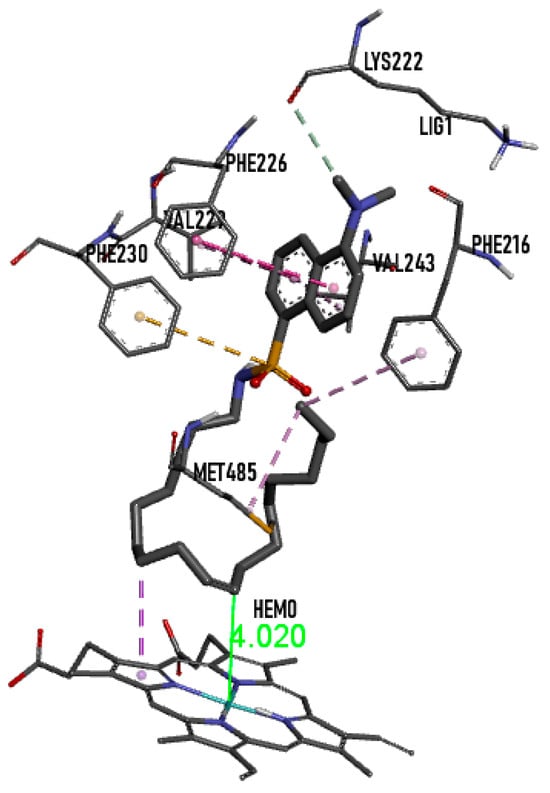
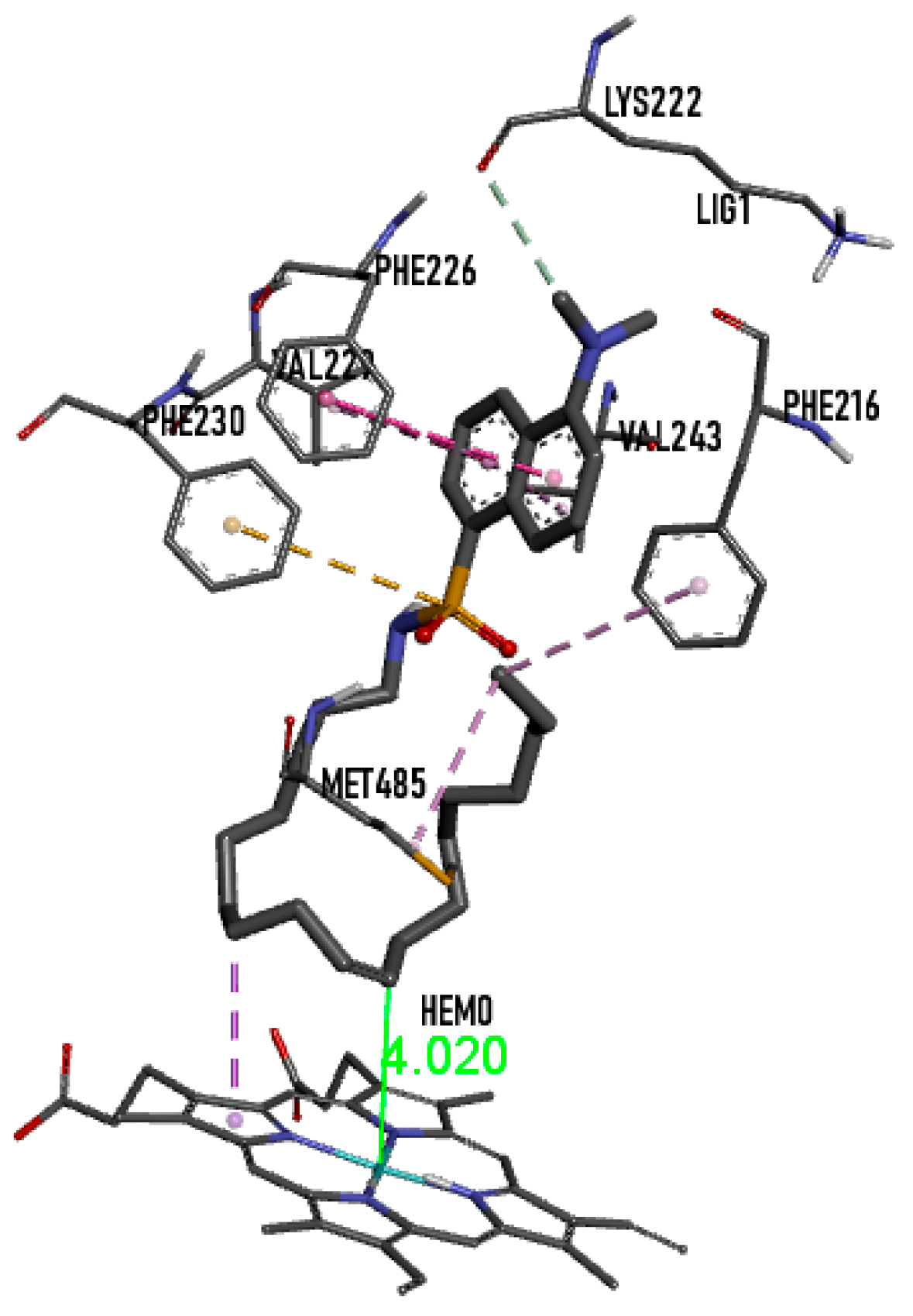
The DOLA compound was found to bind to the structure of CYP6t3, with the double bond of its alkyl fragment oriented near the heme iron atom (Figure 1).
Figure 1.
The calculated position of DOLA in proximity to the heme group of CYP6t3 (UniProt code—L0CRC5). Distances in the figures are indicated in green and specified in Angstroms (Å).
CYP6t3 may be involved in the metabolism of insect hormones and the breakdown of insecticides, but its precise role remains largely uncharacterized. Nevertheless, some evidence suggests its potential participation in insect development [4,5].
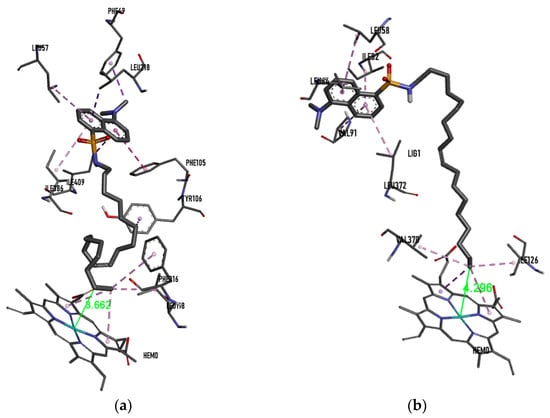
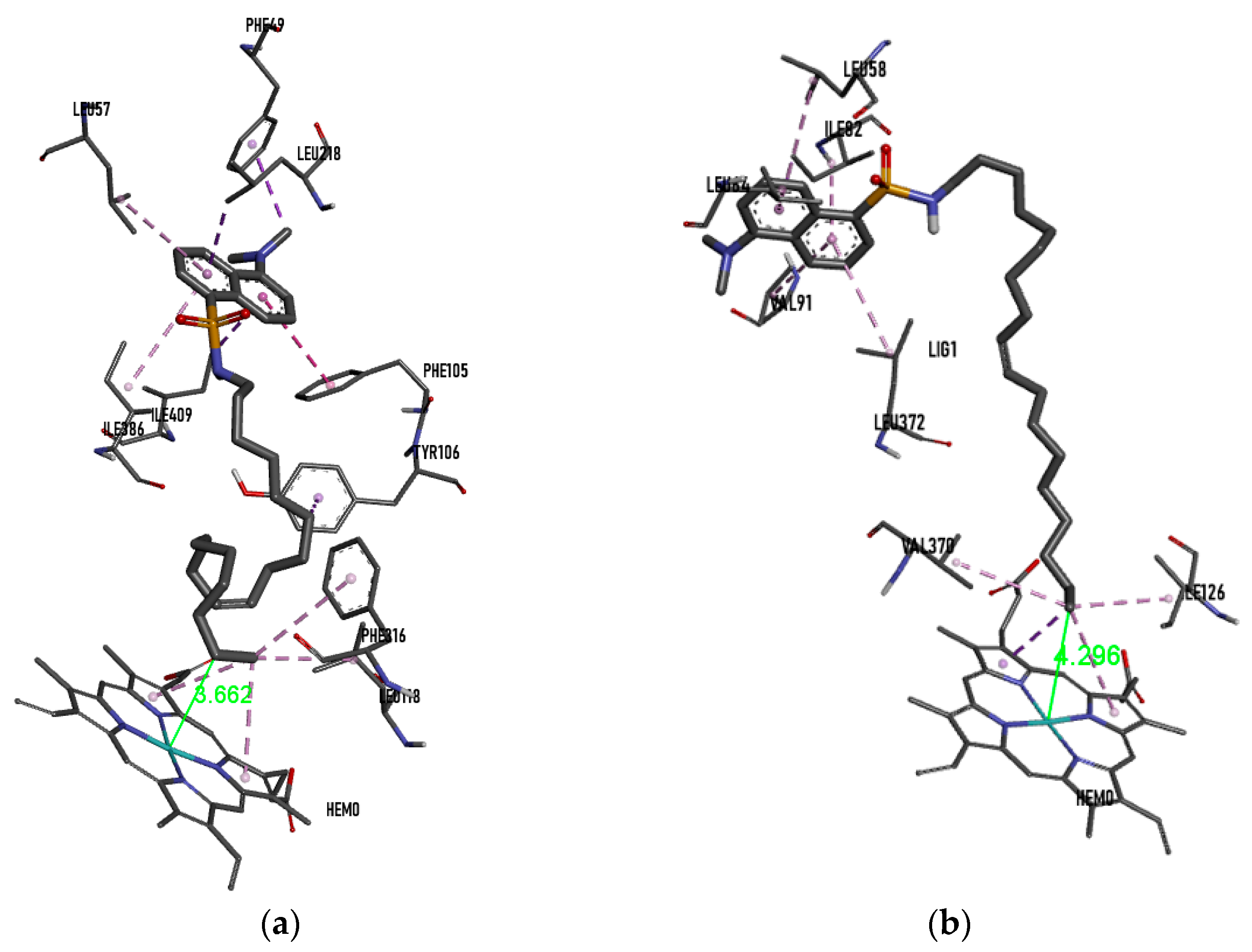
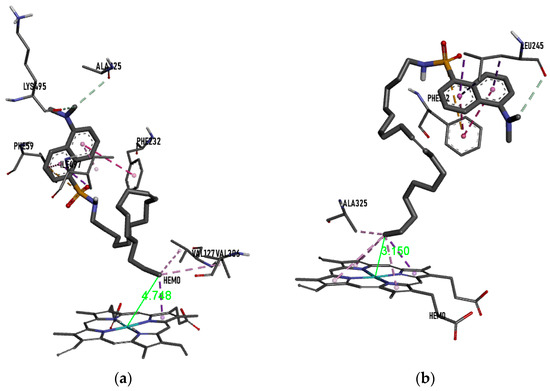
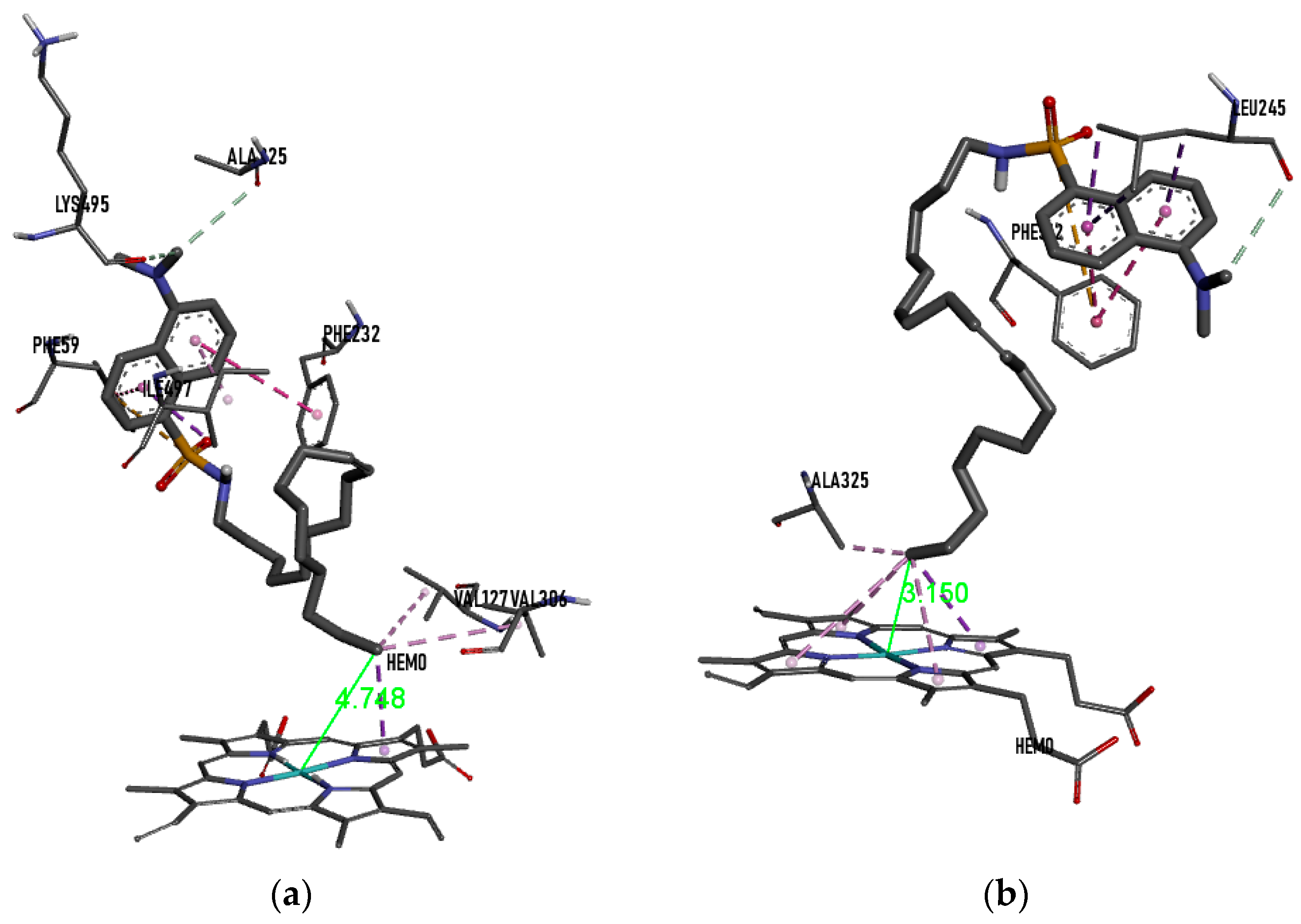
Computational modeling revealed that DOLA also binds to CYP4d2, an enzyme involved in the detoxification of insecticides [6,7] (e.g., β-cypermethrin [6]), with the methylene group at the ω-1 position of its alkyl chain positioned in close proximity to the heme iron atom (Figure 2a).
Figure 2.
(a) The calculated position of DOLA in proximity to the heme group of CYP4d2 (UniProt code—A0A0L0BXP5); (b) The calculated position of DOLA near the heme group of the ω-hydroxylase CYP4aa1 (UniProt code—A0A0L0CAR5). Distances in the figures are indicated in green and specified in Angstroms (Å).
Notably, the literature suggests that CYP4aa1 may possess ω-hydroxylase activity [8]. Our computational modeling indicated that ligand DOLA oriented the terminal methyl group of its alkyl fragment towards the heme group of Cyp4aa1, suggesting that ω-hydroxylation of this ligand could potentially occur (Figure 2b). Therefore, DOLA, possessing a fluorescent moiety within its structure, may serve as a valuable tool for investigating this interaction and the enzyme’s function.
The DOLA ligand was also oriented with the terminal methyl group of its alkyl fragment towards the heme of cytochromes Cyp6t1 and Cyp6g1 (Figure 3).
Figure 3.
(a) The calculated position of DOLA near the heme group of the CYP6g1 (UniProt code—A0A0L0CBH0); (b) The calculated position of DOLA near the heme group of the CYP6t1 (UniProt code—Q9VRI9). Distances in the figures are indicated in green and specified in Angstroms (Å).
Notably, Cyp6t1 is one of the P450 enzymes most closely related to Cyp6g1 [9]. CYP6g1 and CYP6g2 confer resistance to the neonicotinoids imidacloprid and nitenpyram in Drosophila melanogaster [10].
According to the protein–ligand interaction modeling, the ligand DOLA also binds to the structures of long-chain fatty acid-CoA ligase, fatty acyl-CoA reductases, CYP18A1, lipocalins, and fatty acid desaturase domain-containing proteins (Table 2).
Table 2.
DOLA binding energies in modeled complexes with the structures of insect fatty acid metabolism proteins.
CYP18A1 is a cytochrome P450 (26-hydroxylase) known to be involved in ecdysone (molting hormone) metabolism in insects and is also an ω-1-fatty acid hydroxylase involved in the synthesis of caste-specific pheromones in bees [8,11]. Fatty acyl-CoA reductases catalyze the reduction of fatty acyl-CoAs to fatty alcohols. Fatty alcohols are important components of waxes and lipids required for insect cuticle construction and can also be used for pheromone synthesis [12,13,14,15]. Fatty acid desaturases catalyze the formation of double bonds in fatty acids, which is necessary for the synthesis of unsaturated fatty acids and, consequently, for maintaining the structure of cell membranes, signal transduction, and adaptation to various environmental conditions [16,17,18]. Lipocalins are a family of proteins that bind hydrophobic compounds, such as lipids. In insects, they may be involved in the transport, storage, and metabolism of fatty acids, as well as in chemical communication and immune response [19,20].
4. Conclusions
Based on an in silico evaluation, the ligand DOLA was identified as a potential substrate for a number of important metabolic proteins in insects of the genera Drosophila, Lucilia, Locusta, Tenebrio, and Tribolium (cytochrome P450s, transport proteins, and proteins involved in the metabolism of fatty acids and their derivatives). The obtained data will serve as a basis for further experimental in vitro investigations of this compound as a tool for studying insect metabolism or as a potential regulator of their populations.
Author Contributions
Conceptualization, P.Y. and Y.F.; writing—original draft preparation, P.Y.; writing—review and editing, P.Y. and Y.F.; supervision, Y.F. All authors have read and agreed to the published version of the manuscript.
Funding
This research was funded by the Ministry of Education grant No. 20250893 and State Program for Scientific Research No. 20210560.
Institutional Review Board Statement
Not applicable.
Informed Consent Statement
Not applicable.
Data Availability Statement
Data are contained within the article.
Conflicts of Interest
The authors declare no conflicts of interest.
Abbreviations
The following abbreviations are used in this manuscript:
| DOLA | (Z)-5-(dimethylamino)-N-(octadec-9-en-1-yl)naphthalene-1-sulfonamide |
References
- Faletrov, Y.V.; Staravoitava, V.A.; Dudko, A.R.; Shkumatov, V.M. Application of Docking-Based Inverse High ThroughputVirtual Screening to Found Phytochemical Covalent Inhibitors of SARS-CoV-2 Main Protease, NSP12 and NSP16. Res. Sq. 2022, preprint. [Google Scholar] [CrossRef] [Scilit]
- Faletrov, Y.V.; Yakovets, P.S.; Glinskaya, L.; Shkumatov, V.M. Computer-aided evaluation of two fluorescent hexanoic acid piperazineamides as potential ligands for insect cytochromes P450. In Proceedings of the 3rd International Electronic Conference on Biomolecules, online, 23–25 April 2024; MDPI: Basel, Switzerland, 2024. Available online: https://sciforum.net/paper/view/17153 (accessed on 22 September 2025).
- Yakovets, P.S.; Faletrov, Y.V. Virtual screening of novel potential inhibitors of insect CYP15a1 epoxidase. In Proceedings of the International Scientific Conference “Physicochemical Biology in the Year of the 270th Anniversary of Moscow State University”, Moscow, Russia, 20–22 February 2025; Moscow State University: Moscow, Russia, 2025. [Google Scholar] [CrossRef] [Scilit]
- Ou, Q.; Magico, A.; King-Jones, K. Nuclear Receptor DHR4 Controls the Timing of Steroid Hormone Pulses During Drosophila Development. PLoS Biol. 2011, 9, e1001160. [Google Scholar] [CrossRef] [Scilit] [PubMed]
- Shimell, M.; O’Connor, M.B. The Cytochrome P450 Cyp6t3 Is Not Required for Ecdysone Biosynthesis in Drosophila melanogaster. MicroPubl Biol. 2022. [Google Scholar] [CrossRef] [Scilit]
- Wang, L.; Tang, H.; Xie, Z.; Li, D.; Yin, C.; Luo, B.; Yan, R.; Sun, W.; Liu, H. Identification and Functional Characterization of CYP4D2 Putatively Associated with β-Cypermethrin Detoxification in Phortica Okadai. Genes 2022, 13, 2338. [Google Scholar] [CrossRef] [Scilit] [PubMed]
- Hembrom, P.S.; Jose, T.; Shalini, K.; Grace, T. Detection of Variation in Expression of Insecticide Resistance Gene Cyp4d2 involved in Detoxification of Insecticides in Drosophila melanogaster. Res. J. Pharm. Technol. 2019, 12, 5315–5319. [Google Scholar] [CrossRef] [Scilit]
- Malka, O.; Karunker, I.; Yeheskel, A.; Morin, S.; Hefetz, A. The Gene Road to Royalty—Differential Expression of Hydroxylating Genes in the Mandibular Glands of the Honeybee. FEBS J. 2009, 276, 5481–5490. [Google Scholar] [CrossRef] [Scilit] [PubMed]
- Giang, A.; Martelli, F.; Fusetto, R.; Nero, T.L.; Lueke, B.; Nauen, R.; Batterham, P. Functional and structural insights into P450-mediated resistance: The role of Cyp6g1 and Cyp6g2 in the metabolism of neonicotinoids in Drosophila melanogaster. Pestic. Biochem. Physiol. 2025, 212, 106451. [Google Scholar] [CrossRef] [Scilit] [PubMed]
- Daborn, P.; Boundy, S.; Yen, J.; Pittendrigh, B.; Ffrench-Constant, R. DDT Resistance in Drosophila Correlates with Cyp6g1 Over-Expression and Confers Cross-Resistance to the Neonicotinoid Imidacloprid. Mol. Genet. Genom. 2001, 266, 556–563. [Google Scholar] [CrossRef] [Scilit] [PubMed]
- Guittard, E.; Blais, C.; Maria, A.; Parvy, J.-P.; Pasricha, S.; Lumb, C.; Lafont, R.; Daborn, P.J.; Dauphin-Villemant, C. CYP18A1, a Key Enzyme of Drosophila Steroid Hormone Inactivation, Is Essential for Metamorphosis. Dev. Biol. 2011, 349, 35–45. [Google Scholar] [CrossRef] [Scilit] [PubMed]
- Jaspers, M.H.J.; Pflanz, R.; Riedel, D.; Kawelke, S.; Feussner, I.; Schuh, R. The Fatty Acyl-CoA Reductase Waterproof Mediates Airway Clearance in Drosophila. Dev. Biol. 2014, 385, 23–31. [Google Scholar] [CrossRef] [Scilit] [PubMed]
- Tong, H.; Wang, Y.; Wang, S.; Omar, M.A.A.; Li, Z.; Li, Z.; Ding, S.; Ao, Y.; Wang, Y.; Li, F.; et al. Fatty Acyl-CoA Reductase Influences Wax Biosynthesis in the Cotton Mealybug, Phenacoccus Solenopsis Tinsley. Commun. Biol. 2022, 5, 1108. [Google Scholar] [CrossRef] [Scilit] [PubMed]
- Guo, H.; Liu, W.; Zhao, X.; Zhao, Y.; Liu, X.; Moussian, B.; Zhao, Z.; Zhang, J. Silencing fatty acyl-CoA reductase with dsRNA damaged the lipid-based cuticle barrier in Locusta migratoria. Pestic. Biochem. Physiol. 2025, 210, 106365. [Google Scholar] [CrossRef] [Scilit] [PubMed]
- Jurenka, R. Fatty Acid Origin of Insect Pheromones. In Advances in Experimental Medicine and Biology; Springer: Cham, Switzerland, 2024. [Google Scholar] [CrossRef] [Scilit]
- Zeng, J.; Ye, W.; Noman, A.; Machado, R.A.R.; Lou, Y. The Desaturase Gene Family Is Crucially Required for Fatty Acid Metabolism and Survival of the Brown Planthopper, Nilaparvata Lugens. Int. J. Mol. Sci. 2019, 20, 1369. [Google Scholar] [CrossRef] [Scilit] [PubMed]
- Xu, D.; Tong, Y.; Chen, B.; Li, B.; Wang, S.; Zhang, D. The influence of first desaturase subfamily genes on fatty acid synthesis, desiccation tolerance and inter-caste nutrient transfer in the termite Coptotermes formosanus. Insect Mol. Biol. 2023, 33, 55–68. [Google Scholar] [CrossRef] [Scilit] [PubMed]
- Suito, T.; Nagao, K.; Takeuchi, K.; Juni, N.; Hara, Y.; Umeda, M. Functional Expression of Δ12 Fatty Acid Desaturase Modulates Thermoregulatory Behaviour in Drosophila. Sci. Rep. 2020, 10, 11798. [Google Scholar] [CrossRef] [Scilit] [PubMed]
- Zhu, J.; Iannucci, A.; Dani, F.R.; Knoll, W.; Pelosi, P. Lipocalins in Arthropod Chemical Communication. Genome Biol. Evol. 2021, 13, evab091. [Google Scholar] [CrossRef] [Scilit] [PubMed]
- Santos, D.V.; Gontijo, N.F.; Pessoa, G.C.D.; Sant’Anna, M.R.V.; Araujo, R.N.; Pereira, M.H.; Koerich, L.B. An updated catalog of lipocalins of the chagas disease vector Rhodnius prolixus (Hemiptera, Reduviidae). Insect Biochem. Mol. Biol. 2022, 146, 103797. [Google Scholar] [CrossRef] [Scilit] [PubMed]

Disclaimer/Publisher’s Note: The statements, opinions and data contained in all publications are solely those of the individual author(s) and contributor(s) and not of MDPI and/or the editor(s). MDPI and/or the editor(s) disclaim responsibility for any injury to people or property resulting from any ideas, methods, instructions or products referred to in the content. |
© 2025 by the authors. Licensee MDPI, Basel, Switzerland. This article is an open access article distributed under the terms and conditions of the Creative Commons Attribution (CC BY) license (https://creativecommons.org/licenses/by/4.0/).