
Proceeding Paper

A Novel Approach to Using Magnetite Nanoparticles in Heterogeneous Catalysis: Microwave Assisted Synthesis of 1,3-Oxathiolan-5-ones †
by
Fernando Javier Lorenzo
1,
Gabriela Montiel Schneider
1,
Verónica Leticia Lassalle
1,
Darío Cesar Gerbino
1,* and
Romina Andrea Ocampo
1,2,*
1
Departamento de Química, Instituto de Química del Sur (INQUISUR-CONICET), Universidad Nacional del Sur, Avenida Alem 1253, Bahía Blanca B8000, Argentina
2
Centro de Investigaciones Científicas de la provincia de Buenos Aires (CIC-PBA), La Plata B1900, Argentina
*
Authors to whom correspondence should be addressed.
Presented at the 29th International Electronic Conference on Synthetic Organic Chemistry, 14–28 November 2025; Available online: https://sciforum.net/event/ecsoc-29.
Chem. Proc. 2025, 18(1), 110; https://doi.org/10.3390/ecsoc-29-26684

Published: 11 November 2025

Abstract

We report a solvent-free, microwave-assisted protocol for the synthesis of 2,2-disubstituted 1,3-oxathiolan-5-ones catalyzed by magnetite nanoparticles (MNPs). A design of experiments (DoE) approach was employed to optimize reaction parameters using the model reaction between acetophenone and 2-mercaptoacetic acid. Temperature, catalyst loading, and stoichiometry emerged as the most influential factors. Although the aromatic model substrate afforded modest yields (up to 24% by GC), the optimized conditions applied to aliphatic and cyclic ketones led to significantly higher yields, reaching up to 92%. This study highlights the value of combining heterogeneous nanocatalysis, microwave irradiation, and DoE to streamline optimization in heterocyclic synthesis.

1. Introduction

The synthesis of heterocycles remains a cornerstone in organic and medicinal chemistry, with ongoing efforts to develop sustainable protocols for accessing bioactive scaffolds [1,2]. Among them, 1,3-oxathiolan-5-ones are of particular interest due to their occurrence in natural products, their role as versatile synthetic intermediates, and their potential pharmacological applications [3,4]. Structurally, these six-membered heterocycles contain both sulfur and oxygen atoms together with a carbonyl group at position 5, which imparts unique reactivity.
Classical methods to prepare 1,3-oxathiolan-5-ones rely on the cyclocondensation of thioglycolic acid with aldehydes [5]. However, their extension to ketones remains scarce, mainly because of the lower electrophilicity and steric hindrance of ketone carbonyls, which usually result in low yields or require forcing conditions [6]. This highlights the need for new approaches enabling the efficient use of ketones as starting materials.
In this context, heterogeneous catalysis with magnetite nanoparticles (Fe3O4, MNPs) has emerged as a sustainable option. The Lewis acidic Fe(II/III) sites on their surface can activate carbonyl groups, while their intrinsic magnetic properties allow simple recovery, aligning with green chemistry principles [7]. At the same time, microwave-assisted organic synthesis (MAOS) provides rapid and homogeneous heating, reducing reaction times and improving energy efficiency [8,9]. The combination of MNP catalysis and MAOS is therefore highly attractive for the development of efficient solvent-free protocols.
To rationally optimize such processes, statistical design of experiments (DoE) offers a powerful framework for simultaneously evaluating multiple factors and their interactions, avoiding the inefficiency of one-variable-at-a-time optimization [10,11]. Recent applications of DoE in heterocyclic chemistry have demonstrated its value in identifying key parameters with a minimal number of experiments.
Herein, we report a microwave-assisted, solvent-free protocol for the synthesis of 1,3-oxathiolan-5-ones from ketones using MNPs. Reaction conditions were optimized through a 24 factorial DoE, which identified temperature, catalyst loading, and stoichiometry as critical variables. This methodological contribution illustrates the usefulness of DoE in heterocyclic synthesis and establishes operational windows for subsequent full studies on catalyst characterization and reuse.

2. Results and Discussion

2.1. Design of Experiment (DoE)

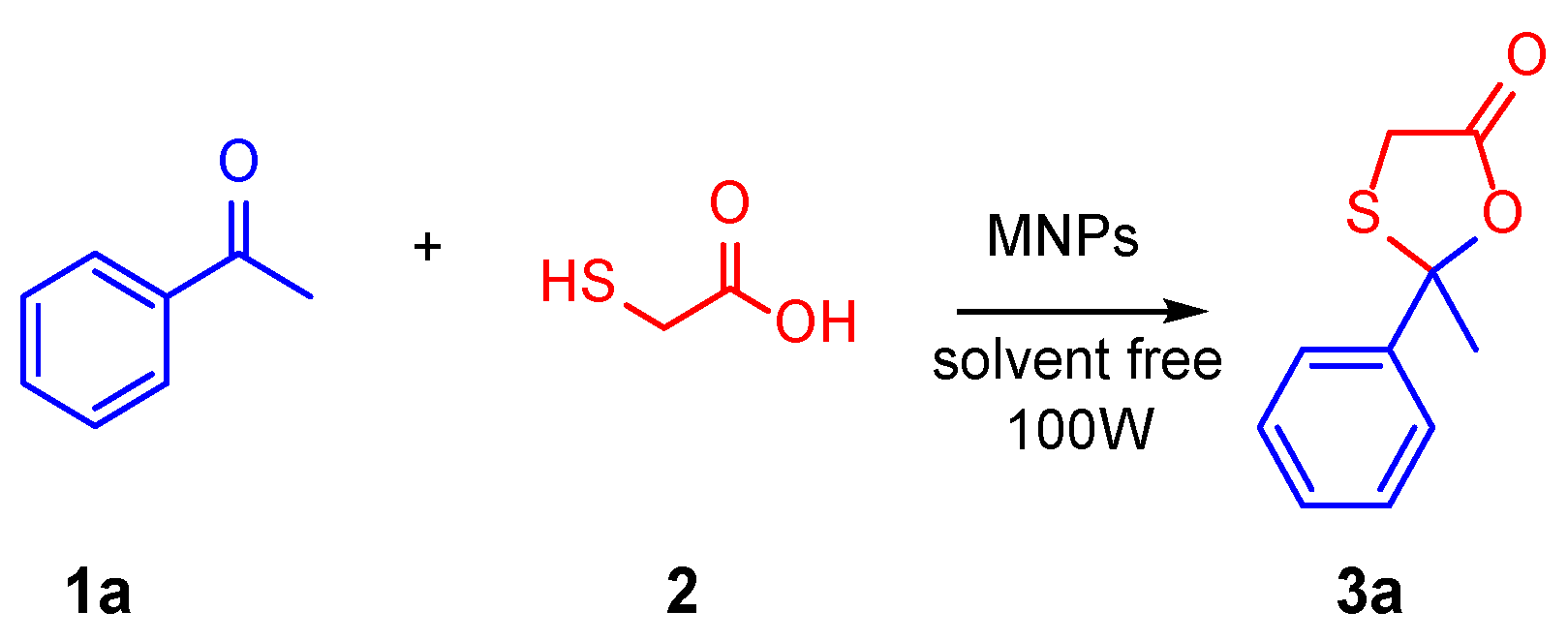
To optimize the model cyclocondensation between acetophenone and 2-mercaptoacetic acid under microwave irradiation (Scheme 1), a 24 factorial design with four central points (20 runs) was applied. The studied factors were catalyst loading, temperature, stoichiometric ratio, and reaction time (Table 1). Reaction yields, determined by GC–MS against an internal standard, ranged from 0 to 24% (Table 2).
All reactions were performed in a single block and without replicates. Reaction yields were determined by GC–MS using an internal standard (Table 2).
An initial observation of the data summarized in Table 2 revealed variability in the reaction yields, with a maximum of 24% (entry 10). To evaluate the statistical significance of the studied factors, an analysis of variance (ANOVA) was performed using Minitab Lab software version 22 (Table 3).

2.2. ANOVA and Factor Significance

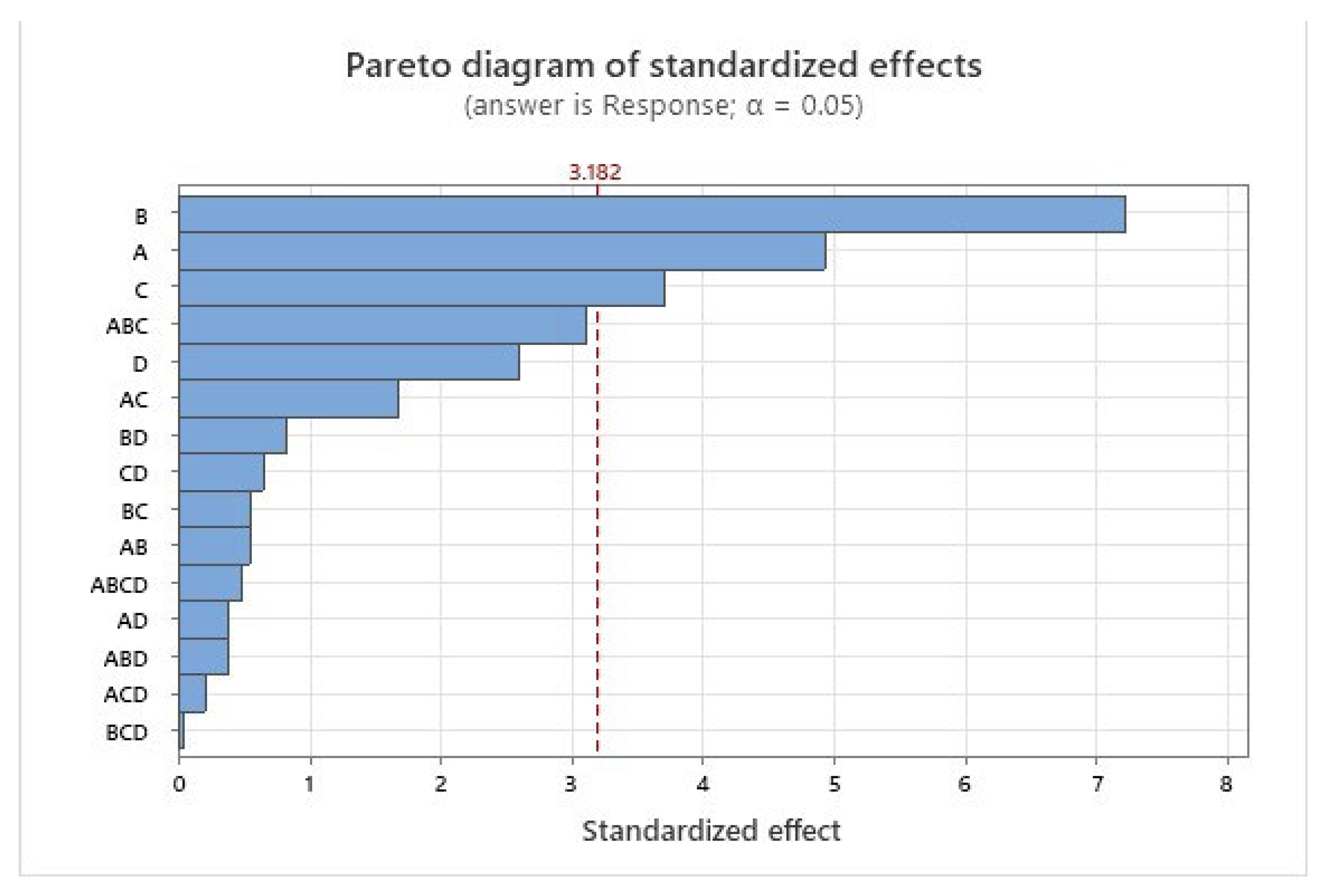
ANOVA analysis (Table 3) identified temperature (p = 0.005), catalyst loading (p = 0.016), and stoichiometry (p = 0.034) as statistically significant factors, while reaction time showed a marginal effect (p = 0.080). The curvature term was significant (p = 0.048), indicating non-linear contributions that limit the predictive accuracy of a first-order model. Although the global regression was marginally significant (p = 0.060), the Pareto chart clearly confirmed the influence of the three dominant factors (Figure 1).
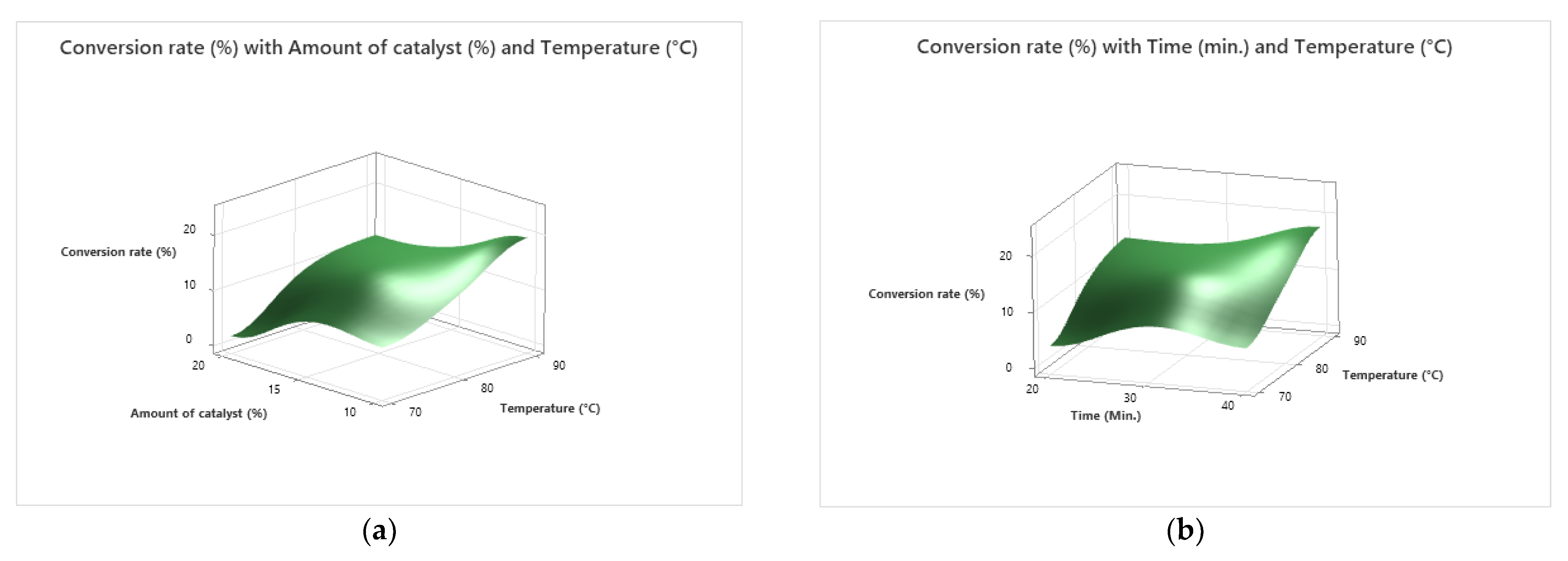
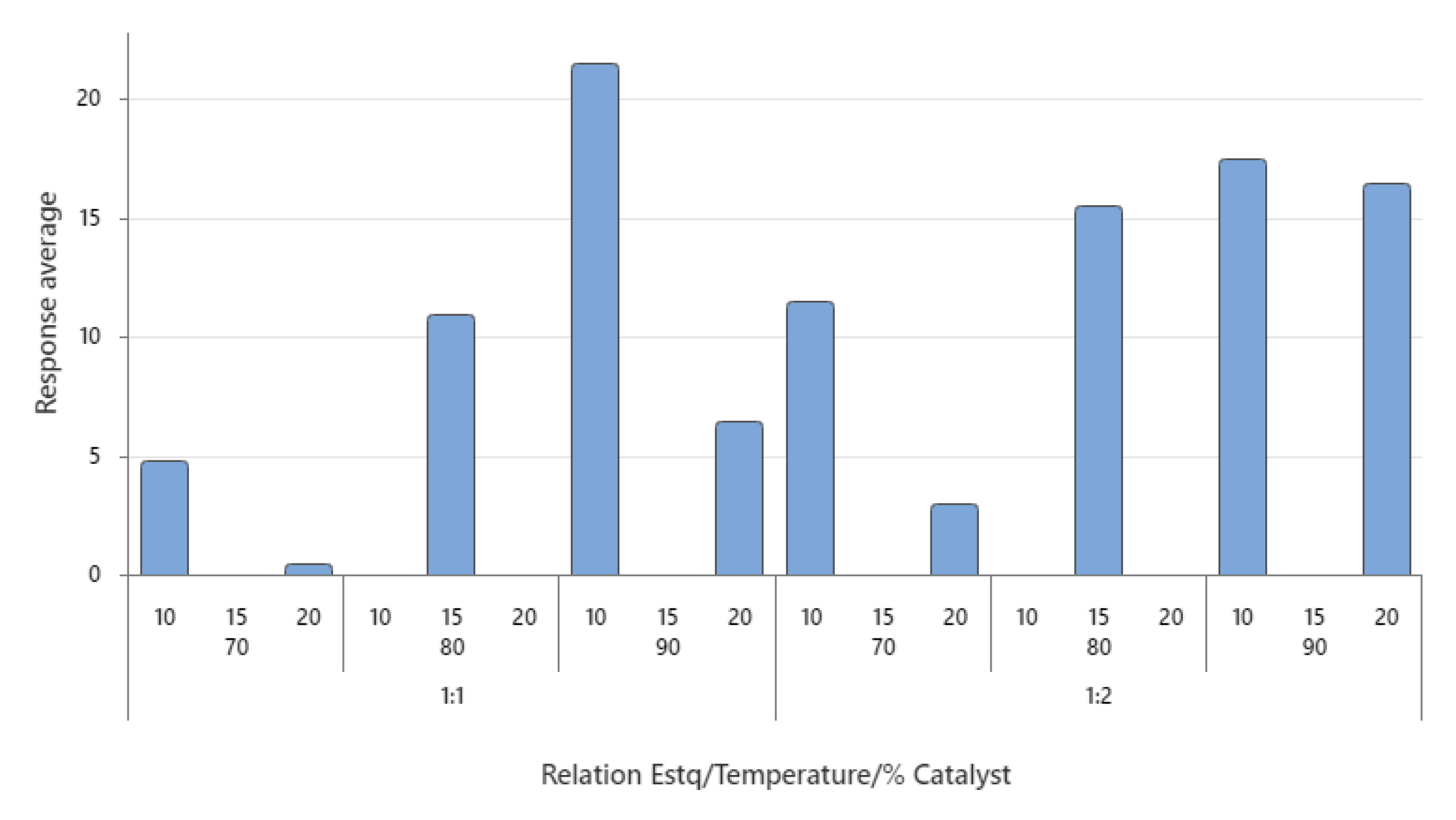
Response surface plots (Figure 2) provided a visual representation of the factor interactions, particularly the synergistic effect of temperature and catalyst loading on yield. These plots also suggested the existence of a maximum response plateau at moderate catalyst loadings and temperatures around 90 °C, consistent with the curvature effect detected in the ANOVA. The bar chart in Figure 3 summarizes the predicted versus observed yields, highlighting the overall adequacy of the model despite modest conversions in the aromatic system.

2.3. Substrate Scope

The optimized conditions (90 °C, 40 min, 10 mol% MNPs) were applied to a panel of ketones to evaluate substrate generality (Table 4). Aliphatic ketones such as 2-butanone and cyclic ketones like cyclohexanone afforded high yields (72–92%). In contrast, aryl–alkyl ketones, exemplified by propiophenone, delivered moderate yields (23–45%). No products were detected for conjugated enones or highly substituted ketones, likely due to electronic delocalization and steric hindrance. These results demonstrate the importance of substrate structure in governing reactivity under the optimized conditions

2.4. Practical Aspects and Implications

Products were readily isolated by crystallization, and structural confirmation was obtained by NMR and MS. While the model aromatic substrate provided modest yields, the broader scope confirmed the potential of combining MNP catalysis with microwave irradiation. Importantly, the DoE methodology proved effective in rapidly identifying the operational windows of the process, offering a rational basis for scaling and further investigations on catalyst recovery and reuse, which will be addressed in future full studies.

3. Conclusions

A design of experiments (DoE) approach was applied to the microwave-assisted, solvent-free synthesis of 1,3-oxathiolan-5-ones catalyzed by magnetite nanoparticles. Temperature, catalyst loading, and stoichiometry were identified as the most influential parameters, while reaction time had only a minor effect.
The model aromatic ketone provided modest conversions (up to 24%), but the optimized conditions proved highly effective for aliphatic and cyclic ketones, affording yields of up to 92%. This outcome highlights the strong substrate dependence of the transformation.
Beyond the specific synthetic results, this work underscores the methodological value of DoE in mapping operational windows for heterocyclic synthesis, providing a rational basis for future studies. Ongoing work will address catalyst characterization, recovery, and reuse, expanding the applicability of this sustainable protocol.

4. Methods

4.1. Materials and Instrumentation

All reagents were purchased from commercial suppliers and used without further purification. Magnetite nanoparticles (MNPs) were prepared by a standard co-precipitation method reported in the literature [12], washed with water and ethanol, and dried prior to use.
All reagents were of commercial grade and used without further purification, unless otherwise stated. Microwave reactions were performed in a CEM Discover® system (CEM Corporation, Matthews, NC, USA) equipped with continuous focused microwave power (100 W) in sealed 10 mL pressure glass vessels with magnetic stirring. Reaction temperature was monitored via an infrared sensor, and pressure was controlled by a septum-mounted sensor.
Analytical data were obtained using the following instruments: GC–MS (HP5-MS capillary column, 30 m × 0.25 mm, 0.25 μm; 5972 MS detector, 70 eV EI mode), FT–IR (Nicolet Nexus 470), NMR (1H 300 MHz, 13C 75 MHz, Bruker ARX 300; CDCl3, C6D6, or DMSO-d6 as solvents), elemental analysis (Exeter CE440), and melting point (Büchi B-545, uncorrected).

4.2. Experimental Procedures

4.2.1. Preparation of Magnetite Nanoparticles (MNPs)

MNPs were synthesized following a standard co-precipitation procedure. The resulting Fe3O4 nanoparticles were washed, dried, and directly employed as catalysts.

4.2.2. Design of Experiments (DoE)

A 24 factorial design with four central points (20 runs) was carried out using Minitab software. The studied factors were catalyst loading (5–15 mol%), temperature (70–110 °C), stoichiometric ratio (1:1–1:1.5), and reaction time (20–60 min). Yields were determined by GC–MS using an internal standard (n-decane).

4.2.3. General Procedure for the Model Reaction

Reactions were conducted in a sealed-vessel microwave reactor (100 W, 90 °C) equipped with magnetic stirring. A mixture of acetophenone (1 mmol), 2-mercaptoacetic acid (1 mmol), and MNPs (10 mol%) was irradiated for 40 min under solvent-free conditions. After cooling, the crude mixture was neutralized with saturated NaHCO3 solution and extracted with ethyl acetate. The organic layer was dried over anhydrous Na2SO4 and concentrated under reduced pressure.

4.3. Substrate Scope

For scope evaluation, different ketones (1 mmol) were subjected to the optimized conditions (90 °C, 40 min, 10 mol% MNPs). Products were isolated by crystallization or column chromatography and characterized by NMR and MS, in agreement with literature data.

4.4. Product Characterization

The purified products were characterized by 1H and 13C NMR, IR, MS, and elemental analysis.

Author Contributions

Conceptualization, R.A.O., V.L.L., G.M.S. and D.C.G.; methodology, R.A.O., G.M.S. and V.L.L.; formal analysis, R.A.O., D.C.G., G.M.S. and V.L.L.; research, R.A.O., F.J.L., G.M.S. and V.L.L.; resources, F.J.L. and G.M.S.; data curation, R.A.O., V.L.L., G.M.S. and D.C.G.; writing—original draft preparation, R.A.O. and F.J.L.; writing—review and editing, R.A.O. and D.C.G.; visualization, R.A.O., G.M.S. and F.J.L.; Supervision, D.C.G. and V.L.L.; project administration, D.C.G. and V.L.L.; funding acquisition, D.C.G. and V.L.L. All authors have read and agreed to the published version of the manuscript.

Funding

This work was supported by grants from CONICET (PIP 11220210100251CO01, Buenos Aires, Argentina) and UNS (PGI/Q138, Universidad Nacional del Sur, Bahía Blanca, Argentina).

Institutional Review Board Statement

Not applicable.

Informed Consent Statement

Not applicable.

Data Availability Statement

The original contributions presented in this study are included in the article. Further inquiries can be directed to the corresponding authors.

Conflicts of Interest

The authors declare no conflicts of interest.

References

  1. Al-Majedy, Y.K.; Al-Bayati, H.T.; Al-Salami, A.A.; Vlachou, T.C.; Kokotou, C.G.; Efthimiopoulos, K.E.; Liakopoulou, K.A.; Tzakos, S.J.; Papageorgiou, D.P.; Kostakis, M.; et al. Thioflavones as novel neuroprotective agents. Bioorganic Med. Chem. 2016, 24, 317–324. [Google Scholar] [CrossRef] [PubMed]
  2. Hassan, M.Z.; Mohamed, A.M.; Al-Balawi, S.M.; El-Naggar, A.A. Synthesis and anticancer activity of novel benzimidazole derivatives. Bioorg. Chem. 2016, 67, 127–141. [Google Scholar]
  3. Cihlar, T.; Ray, A.S. Nucleoside and nucleotide HIV reverse transcriptase inhibitors: 25 years after zidovudine. Antivir. Res. 2010, 85, 39–58. [Google Scholar] [CrossRef] [PubMed]
  4. Aher, U.P.; Srivastava, D.; Singh, G.P.; Jayashree, B.S. Synthetic Strategies toward 1,3-Oxathiolane Nucleoside Analogues. Beilstein J. Org. Chem. 2021, 17, 2680–2715. [Google Scholar] [CrossRef] [PubMed]
  5. Schneider, C. Catalytic Strategies for the Synthesis of Oxygen- and Sulfur-Containing Heterocycles. Eur. J. Org. Chem. 2019, 6659–6673. [Google Scholar]
  6. Sachse, F.; Schneider, C. Direct Access to 1,3-Oxathiolan-5-ones through (3 + 2)-Cycloaddition of Thioketones and Acetylenedicarboxylic Acid. Eur. J. Org. Chem. 2023, 31, e202300834. [Google Scholar] [CrossRef]
  7. Liu, M.; Ye, Y.; Ye, J.; Gao, T.; Wang, D.; Chen, G.; Song, Z. Recent Advances of Magnetite (Fe3O4)-Based Magnetic Materials in Catalytic Applications. Magnetochemistry 2023, 9, 110. [Google Scholar] [CrossRef]
  8. Kappe, C.O.; Pieber, B.; Dallinger, D. Microwave Effects in Organic Synthesis: Myth or Reality? Angew. Chem. 2013, 52, 088–1094. [Google Scholar] [CrossRef] [PubMed]
  9. de la Hoz, A.; Díaz-Ortiz, A.; Moreno, A. Microwaves in Organic Synthesis. Thermal and Non-Thermal Microwave Effects. Chem. Soc. Rev. 2005, 34, 164–178. [Google Scholar] [CrossRef] [PubMed]
  10. Weissman, S.A. Design of Experiments (DoE) and Process Optimization: A Review of Recent Publications. Org. Process Res. Dev. 2015, 19, 1605–1633. [Google Scholar] [CrossRef]
  11. Bouveyron, T.; Bratenberg, P.; Bell, P.; Eisenacher, M. Design of Experiments for Process Optimization of the Direct Wacker-Type Oxidation of 1-Decene to n-Decanal. Catalysts 2024, 14, 360. [Google Scholar] [CrossRef]
  12. Fadli, A.; Arisman, A.; Rahimah, I.; Addabsi, A. Synthesis of Magnetite Nanoparticles via Co-precipitation Method. Mater. Sci. Eng. 2019, 622, 0120123. [Google Scholar] [CrossRef]
Scheme 1. Model reaction between 1-phenylethanone (1a) and thioglycolic acid (2), used for reaction optimization and mech-anistic studies, affording 1,3-oxathiolan-5-one 3a.
Chemproc 18 00110 sch001
Figure 1. Pareto chart generated in Minitab. A (Catalyst); B (Temperature); C (Reactant ratio); D (Time).
Chemproc 18 00110 g001
Figure 2. (a) Graph of % conversion versus % catalyst and temperature. (b) Graph of % conversion versus time and temperature.
Chemproc 18 00110 g002
Figure 3. Bar chart showing the response measure (% yield) and summary variables.
Chemproc 18 00110 g003
Table 1. Experimental matrix of the full factorial design (24) with central points for the model reaction.
Experimental Design
With Two Possible Levels per FactorExperimental Domain
Factors (k)UnitsLowest level (−)Highest level (+)CP *
Catalyst (A)% mol 102015
Temperature (B)°C709080
Reactant ratio (C) -1-11-21-1 y 1-2
Time (D)minutes204030
* Center points.
Table 2. Experimental results for the synthesis of 2-phenyl-2-methyl-1,3-oxathiolan-5-one (3a) under the designed conditions.
Matrix
ExperimentABCDResponse (%) a
110701:1204
220701:1200
310901:12019
410701:2209
510701:1406
620901:1205
720701:220-
820701:140-
910901:22015
1010901:14024
1110701:24014
1220901:22013
1320901:1408
1420701:2404
1510901:24020
1620901:24020
1715801:13010
1815801:23015
1915801:13012
2015801:23016
a Determined by GC–MS using an internal standard.
Table 3. Analysis of variance generated by Minitab Lab Software.
SourceDFAdjust
SS.
Adjust.
MS
F Valuep-Value
Model161042.5665,1607.630.060
Linear4827.46206,86524.210.013
% Catalyst1207.36207,36024.270.016
Temperature1445.21445,21052.110.005
Stoichiometric Ratio1117.13117,12813.710.034
Time157.7657,7606.760.080
2-term interactions639.7166180.770.640
% Catalyst*Temperature12.5625600.300.622
% Catalyst*Stoichiometric Ratio124.0124,0102.810.192
% Catalyst*Time11.2112100.140.732
Temperature*Stoichiometric Ratio12.5625600.300.622
Temperature*Time15.7657600.670.472
Stoichiometric Ratio*Time13.6136100.420.562
3-term interactions484.3921,0972.470.242
% Catalyst*Temperature*Stoichiometric Ratio182.8182,8109.690.053
% Catalyst*Temperature*Time11.2112100.140.732
% Catalyst*Stoichiometric Ratio*Time10.360.3600.040.851
Temperature*Stoichiometric Ratio*Time10.010.0100.000.975
4-term interactions11.9619600.230.665
% Catalyst*Temperature*Stoichiometric Ratio*Time11.9619600.230.665
Curvature189.0489,04210.420.048
Error325.638544
Lack of fit121.6321,63210.820.081
Pure error24.002000
Total191068.19
Gl (Deegres of Freedom), Adjusted SS (Adjusted Sum of Squares), Adjusted MS (Adjusted Mean Square), F-value (contrast statistic) and p-value. The ANOVA results showed that three factors exhibited a significant effect at a 95% confidence level (p < 0.05): catalyst loading (p = 0.016), temperature (p = 0.005), and the stoichiometric ratio of reagents (p = 0.034). Reaction time did not display statistical significance under the studied conditions (p = 0.080). Additionally, a significant curvature (p = 0.048) was observed, suggesting that the linear model may not fully capture the behavior of the system and pointing to the presence of nonlinear interactions among the variables.
Table 4. Scope of the synthesis of 1,3-oxathiolan-5-ones from ketones.
Chemproc 18 00110 i001
Entry Yield (%) c
KetoneUncatalyzed Reaction aCatalyzed Reaction b
11a-25
21b-23
31c-45
41d-26
51e--
61f--
71g--
81h--
91i1072
101j2075
111k1578
121l2581
131m1892
141n1589
a Reaction conditions: ketone (1, 1 mmol) and 2-mercaptoacetic acid (2, 1 mmol) under solvent-free conditions, irradiated at 100 W and 90 °C for 40 min. Reaction progress monitored by TLC and GC-MS. b Same conditions, using 10 mol% magnetite. c Yields determined by GC analysis using an internal standard.
Disclaimer/Publisher’s Note: The statements, opinions and data contained in all publications are solely those of the individual author(s) and contributor(s) and not of MDPI and/or the editor(s). MDPI and/or the editor(s) disclaim responsibility for any injury to people or property resulting from any ideas, methods, instructions or products referred to in the content.