


Abstract
The Latin American Development Group for Maturity (GDLAM) protocol has been widely used to assess functional autonomy (FA) in community-dwelling older adults. However, to date, no percentile-based rating scale has been established for older Chilean women living in the community. The aim was to create a percentile-based rating scale for the GDLAM protocol in community-dwelling older Chilean women. 347 older women volunteered for this study. The sample was divided into five groups by age ranges (G1: 60.0–64.9 years, G2: 65.0–69.9 years, G3: 70.0–74.9 years, G4: 75.0–79.9 years, and G5: ≥80.0 years). The research had an observational, cross-sectional design with a descriptive strategy. The GDLAM protocol included (a) Putting on and taking off a T-shirt (PTS), (b) Standing up from the sitting position (SSP), (c) Standing up from the prone position (SPP), (d) Walking 10 m (W10 m), and (e) Sit-ting and getting up from the chair and moving around the house (SCMA), all assessed in seconds (s), while the General Index of Autonomy (GI) was calculated in points (p). The percentile-based classification was developed with the following thresholds: percentile ≤ 0.15: “Very Good,” percentile 0.16–0.49: “Good,” percentile 0.50–084: “Regular,” and percentile ≥ 0.85: “Poor.” After creating the percentile-based ranking scale for the five age ranges, it was observed that the older the age, the lower the FA, as represented by the five tests and the GI. The percentile-based ranking scale presented in this research will enable us to accurately assess and interpret the FA of older and community-dwelling women in Chile. However, the study is limited to women and cannot be generalized to older adults in general.
1. Introduction
In recent decades, the world population has experienced an increase in life expectancy [1], reaching a global average of 71.4 years. Chile is no exception to this trend, with an average life expectancy of 80 years for women and 75 years for men [2]. This increase in life expectancy indicates lower mortality; however, it does not necessarily imply that aging is accompanied by a better quality of life [3]. In this context, physical independence is one of the key indicators of quality of life, particularly after the age of 60 [4,5]. This indicator becomes more relevant when comparing women with men of the same age, since although women have a longer life expectancy, they tend to be more fragile, showing a higher burden of disease and disability; this sex–frailty paradox between women and men is probably related to a combination of biological, behavioral, and social factors [6]. For example, it has been shown that women have a testosterone concentration 10 times lower than men and that much of the testosterone as estrogens in premenopausal women derives from dehydroepiandrosterone (DHEA) and its sulfate (DHEA-S). Therefore, any change in the latter due to aging directly impacts women’s endocrine systems [7]. Aging also causes a decline in both insulin-like growth factor 1 (IGF-1) and growth hormone (GH) in both sexes; however, this decline is expressed differently depending on the baseline hormonal profile, amplifying its effects in the presence of menopause and estrogen loss [7]. In relation to subjective well-being, significant differences have been observed between older people of different genders, with women scoring higher (4.95 versus 4.69) [8]. Likewise, comorbidities tend to differ between men and women, both in prevalence and type, which can influence frailty profiles [6].
From a physical health perspective, functional autonomy (FA) is a key component in determining the quality of life of older adults [9]. This is because a good level of FA allows for performing activities of daily living (ADL) independently and autonomously [10]. Therefore, people of all ages, especially older adults, should be systematically assessed using valid and objective tests that are appropriate to each stage of life [11]. In this context, the timed up and go test (TUG), which measures walking speed and dynamic balance, has traditionally been used to assess the FA of older adults [12]. TUG is evaluated in time (s) and, depending on the result obtained, allows the prediction of both muscle strength [13] and the risk of falls [14,15]. In the latter case, for the Chilean Primary Care System, a time ≤ 10 s in the TUG represents “no risk of falls,” between 11 and 20 s “slight risk of falls,” and >20 s “high risk of falls” [12]. This test is easy to administer, justifying its use in primary care. However, the cut-off points for the TUG should not be universal or absolute, as they may vary according to gender, age, and the population being assessed. Furthermore, the TUG only assesses part of the physical functionality of older people and is therefore not comprehensive. In parallel, the Short Physical Performance Battery (SPPB) is another tool to assess the FA of older adults [16], and it is a good indicator for diagnosing sarcopenia [17]. In this regard, scores ≥ 3 and ≤9 have been proposed for the SPPB as criteria for the diagnosis of physical frailty and sarcopenia, respectively [18]. Also, scoring ≤ 8 [19] or ≤9 [20] in the SPPB has been identified as a measure of decreased physical performance. However, this test has shown greater applicability for assessing FA in institutionalized older adults [21,22], presenting a “ceiling effect” that limits representativeness in older adults with a good level of physical fitness [23]. In this context, despite the positive characteristics of both the TUG and the SPPB for assessing FA in older adults, it is also true that these tests have weaknesses. For example, they lack comprehensive representativeness of FA in older adults living in the community, and they do not have rating scales that allow people to be classified by sex and age range. There are other functional tests to assess ADL in older adults, including the Functional Independence Measure (FIM) and the Barthel ADL index [24]. However, these latter protocols are more applicable in clinical settings. Therefore, it is necessary to have a protocol that includes an assessment scale, which can be based on percentiles, and which demonstrates high sensitivity for older adults living in the community who are more physically fit.
Along these lines, the Latin American Development Group for Maturity (GDLAM) protocol is a battery of tests measuring community-dwelling older adults’ FA [11,25,26,27]. This protocol comprises five tests that represent the ADL. In addition, the interaction of the results of these five tests allows for obtaining the General Index of Autonomy (GI), a global indicator of FA [11]. Both GDLAM and GI protocols have shown good reproducibility in community-dwelling older women [28] without necessarily generating a “ceiling effect” [29]. Currently, there are two scales for assessing FA using the GDLAM protocol [26,30]. The first was created to evaluate older Brazilian women [26], while the second is to evaluate older Spanish women [30]. In this context, considering that older Chilean women differ from their Spanish and Brazilian counterparts in terms of culture, lifestyle, physical activity levels, and environment, it is necessary to develop an assessment scale for the GDLAM protocol tailored to this specific population. This would also enable more accurate detection and monitoring of changes in FA among community-dwelling older Chilean women, facilitating the individualization of physical exercise programs based on valid and reliable diagnoses [31]. In this context, the primary purpose of the present study was to create a percentile-based rating scale for the GDLAM protocol in community-dwelling older Chilean women. The secondary objective was to analyze and compare the results of the GDLAM protocol with existing assessment scales.
2. Materials and Methods
2.1. Design
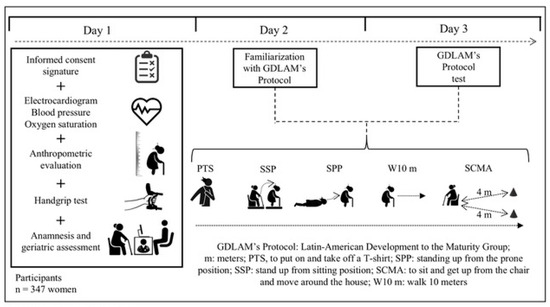
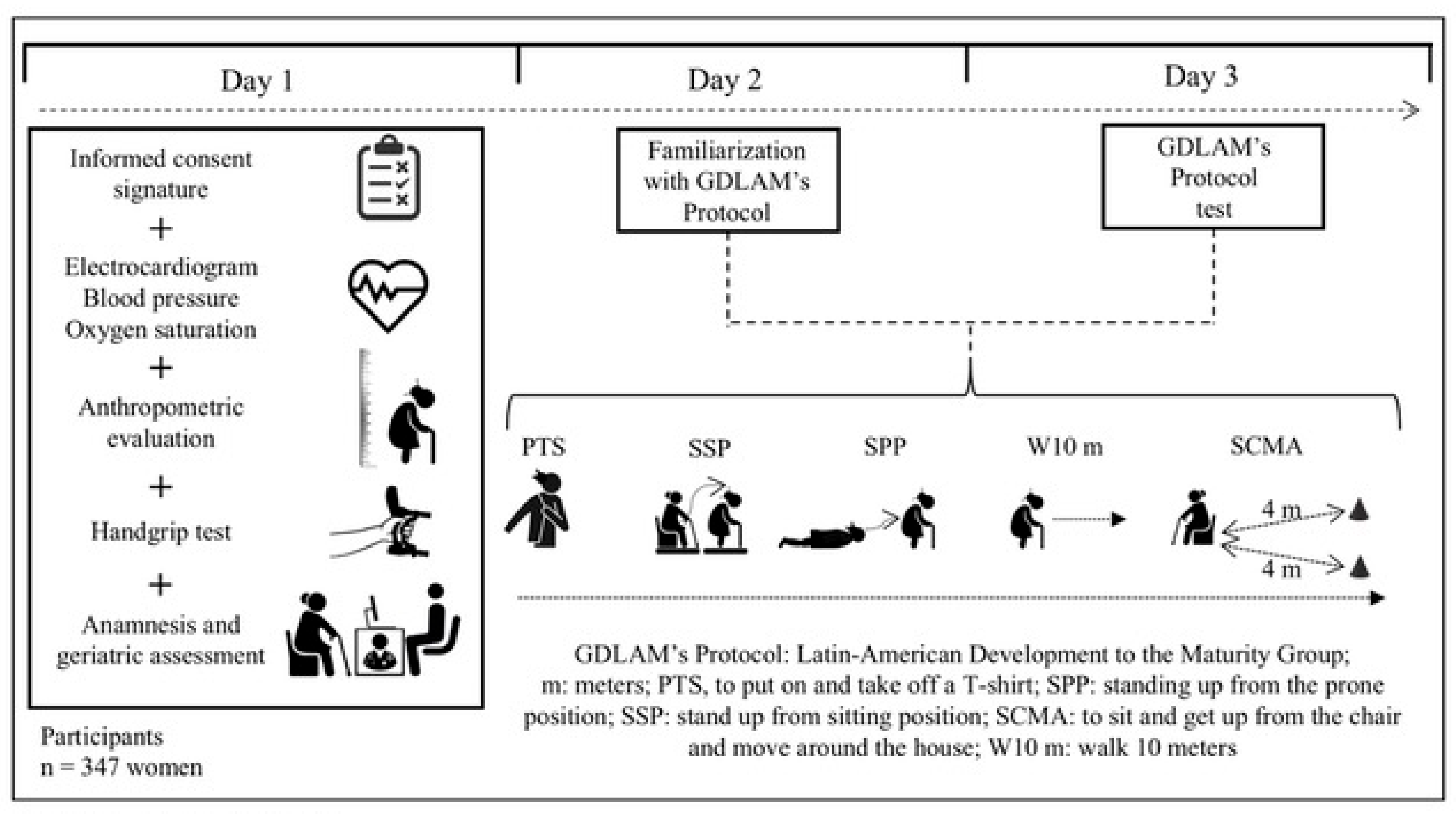
The following study was developed in accordance with the guidelines and recommendations of the Strengthening the Reporting of Observational Studies in Epidemiology (STROBE) [32,33]. The study employed observational research with a descriptive and cross-sectional design [34]. The study considered individual evaluations during three sessions (one per day), separated by 24 h. Between 15 and 20 participants were evaluated per week. Data was collected between April 2023 and July 2024 (Figure 1). All procedures complied with the ethical standards outlined in the Declaration of Helsinki (updated in 2013) and the ethical standards for exercise and sports sciences [35]. The study and the informed consent were approved by the Scientific-Ethical Committee of Universidad de Las Américas, Chile (registration number: CEC_PI_2023003).
Figure 1.
Research design. Figure adapted from Huerta Ojeda et al. [28].
2.2. Participants
To estimate the sample size, the statistical program G*Power (v3.1.9.7, Heinrich-Heine-Universität, Düsseldorf, Germany) was used [36]. The methodology combined three tests: a family of F tests, a statistical test (ANOVA: fixed effects, omnibus, one-way), and a Type of power analysis (a priori: compute the required sample size given α, power, and effect size). Next, the following parameters were introduced: Effect size f = 0.28, α-error < 0.05, and a power (1-β error) = 0.8, number of groups: 5. This calculation indicated that the sample size required for the study was equivalent to 160 participants divided into five groups.
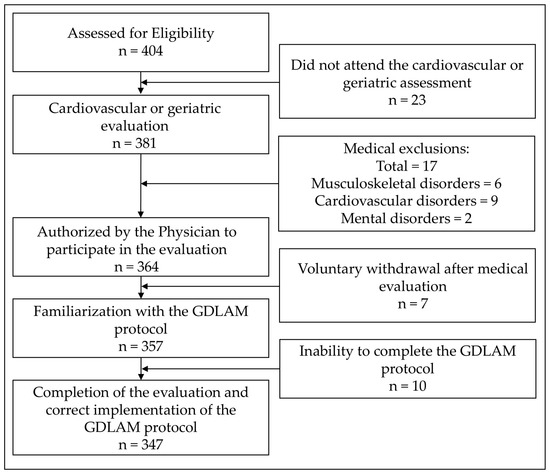
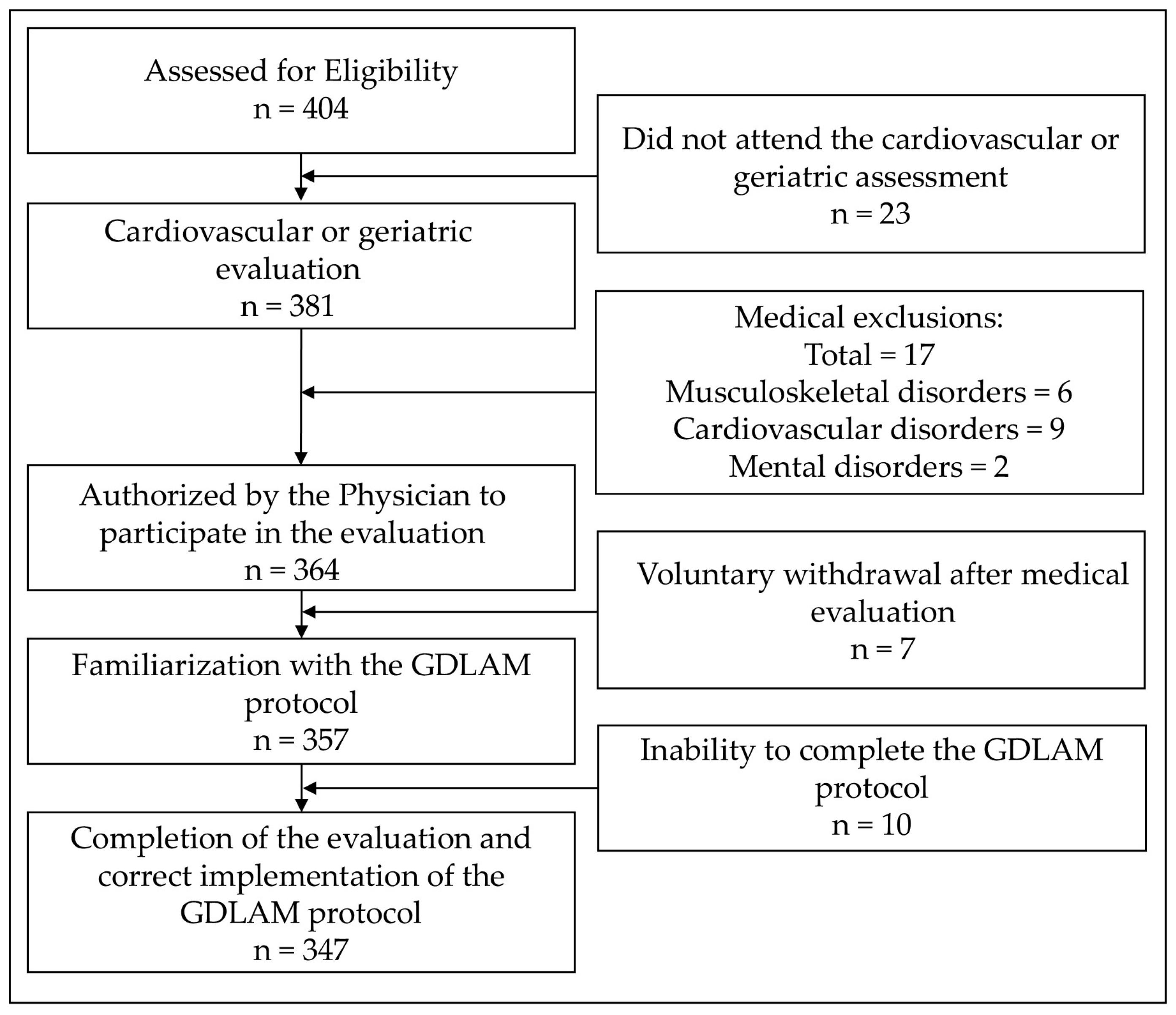
Three hundred forty-seven older women, aged 60.0 to 88.1 years, from eight cities in Chile, participated voluntarily in this study (Figure 2). Eight cities considered urban (Valparaíso, Viña del Mar, Quilpué, Quintero, Til Til, Santiago, Rancagua, and Talca) were selected for analysis. These cities were selected because of their large populations. The selection was also based on the proximity of these cities to rural areas. All participants were invited to an open informational meeting before the study. This meeting was coordinated with key local stakeholders and also publicized on social media platforms, including Facebook, Instagram, and WhatsApp. This allowed for the inclusion of older women from both urban and rural areas, thus ensuring adequate representation on the GDLAM protocol rating scale. The following equation was used to calculate the fraction of years: (number of days since last birthday/365) × 100. The participants were divided by age range: Group 1 (G1) between 60.0–64.9 years (n = 115), Group 2 (G2) between 65.0–69.9 years (n = 82), Group 3 (G3) between 70.0–74.9 years (n = 73), Group 4 (G4) between 75.0–79.9 years (n = 44), and Group 5 (G5) ≥ 80.0 years (n = 33). Inclusion criteria were (a) being female, (b) being ≥60.0 years old, (c) having the physical capacity to complete functional tests of daily living, and (d) giving consent to participate. Exclusion criteria were (a) having a terminal disease, (b) inability to control a chronic disease despite the use of medication, (c) having pre-existing severe cardiovascular conditions or those detected by the electrocardiographic evaluation (ECG) of the study, (d) having severe pulmonary conditions, (e) having fractures in the last three months, (f) having cognitive impairment or (g) having physical impossibility to perform some of the proposed tests.
Figure 2.
Flow diagram.
2.3. Electrocardiogram, Blood Pressure, and Handgrip Strength
The variables obtained from the ECG, blood pressure (BP), and handgrip strength (HS) were determinants for safely including participants in the study. However, they were not part of the study variables. The resting ECG was performed in the supine decubitus position. The ECG was performed with a 12-lead digital electrocardiograph with a wireless acquisition module (Mortara, model ELI 230®, Milwaukee, WI, United States). BP was assessed in the left arm, and the HS was placed while the participant was sitting. The left elbow was maintained at 125–135°, while the left forearm was supported on a table, according to the standardized Chilean blood pressure measurement technique [37]. BP was assessed with a digital monitor (OMRON, model HEM-7120®, Kyoto, Japan). HS was assessed with the participants seated, with the arm at the side of the body, the elbow flexed at 90°, and the forearm in the pronosupination position. The maximal isometric contraction was assessed using a digital dynamometer (Jamar Plus Hand Dynamometer, model number not specified, Sammons Preston Rolyan, Bolingbrook, IL, USA) for 3 to 5 s. Before the evaluation, the digital dynamometer was adjusted to the hand size [38]. ECG, BP, and HS results were used as background for the geriatric medical evaluation.
2.4. Anthropometry
Body mass and stature were assessed in underwear. Body mass (kg) was assessed using a digital weight scale (TANITA, model InnerScan BC-554, Tokyo, Japan) according to the international protocol for anthropometric assessment. Stature (m) was assessed using a stadiometer (SECA, model 700, Hamburg, Germany), with the subject in a position respecting the Frankfort plane and in maximum inspiration. Body mass index (BMI) was calculated by dividing body mass in kilograms (kg) by stature in meters squared (m2). BMI (kg/m2) was interpreted according to the adaptation of anthropometric standards for older adults [39].
2.5. GDLAM Protocol
The GDLAM protocol was used to evaluate the FA of the participants [11,26,27]. This protocol considers the application of five functional tests: (a) Putting on and taking off a T-shirt (PTS), (b) Standing up from the sitting position (SSP), (c) Standing up from the prone position (SPP), (d) Walking 10 m (W10 m), and (e) Sitting and getting up from the chair and moving around the house (SCMA). The unit of measurement for these tests was time in seconds (s). The GDLAM protocol was applied by experienced evaluators, who conducted more than 400 evaluations of older women as part of another research project on functional autonomy.
2.5.1. PTS
This test aimed to evaluate the participants’ functional autonomy in dressing themselves in their daily lives. The test consisted of putting on a T-shirt and taking it off as quickly as possible. The individual must be standing, with their arms at their sides and an extra-large (XL) T-shirt held in their dominant hand. On signal, the participant must put on the T-shirt and immediately remove it, returning to the initial position. The unit of measurement for this test was time in seconds.
2.5.2. SSP
The purpose of this test was to evaluate the functional capacity of the participants’ lower limbs. This test consists of standing up five consecutive times without assistance or resting the arms on support. The test begins with the participant sitting, with the chair height set at 50 centimeters (cm) from the floor. The unit of measurement for this test was time in seconds.
2.5.3. SPP
The purpose of this test was to evaluate the participants’ ability to rise from the floor in the prone position with their arms at their sides without assistance. The unit of measurement for this test was time in seconds.
2.5.4. W10 m
The purpose of this test was to evaluate the time, in seconds, it takes for the participant to cover a 10 m distance while walking without running.
2.5.5. SCMA
This test aimed to evaluate the participants’ agility and balance capacity in daily life situations. With a fixed chair on the floor, with two cones diagonally to the chair (four meters to the back and three meters to the right and left sides, respectively), the participant starts the test sitting on the chair, with his feet off the floor; at the ‘go’ signal, he stands up, moves to the right, turns around the cone, returns to the chair, sits down and removes both feet from the floor; immediately, he performs the same movement to the left. This sequence is repeated twice, emphasizing the completion of the course as quickly as possible. The unit of measurement for this test was time in seconds.
The five functional tests are described by Huerta Ojeda et al. [40]. Then, the result of the five tests allows the calculation of GI through the following formula [27]: GI = ([(PTS + SSP + SPP + W10 m) × 2] + SCMA)/4.
2.6. Statistical Analyses
The anthropometric data from the five GDLAM tests and the GI were arranged in a spreadsheet designed for the study. Descriptive data for the five age groups (G1: 60.0–64.9 years, G2: 65.0–69.9 years, G3: 70.0–74.9 years, G4: 75.0–79.9 years, and G5: ≥80.0) are presented as means and standard deviations (mean ± SD). For ≤50 cases, the distribution of the data was confirmed with the Shapiro–Wilk test; for >50 cases, the normal distribution of the data was confirmed by the Kolmogorov–Smirnov test; in both cases, the normality of the data was accepted with p > 0.05. Then, to analyze the dispersion of the sample, the coefficient of variation (CV) analysis was performed for all tests and the GI. Subsequently, rating scales were developed for the five tests of the GDLAM protocol and the GI. These scales were created based on percentiles: percentile ≤ 0.15: “Very Good,” percentile = 0.16–0.49: “Good,” percentile = 0.50–0.84: “Regular,” and percentile ≥ 0.85: “Poor”. These criteria were previously used by Dantas et al. [26] and Marcos-Pardo et al. [30] in the development of rating scales aimed at older women in Brazil and Spain, respectively. Since the performance measurement unit was time in seconds (s), a lower percentile value corresponds to a better FA. Statistical analysis was performed with Prism software version 10.4.1 for Windows®. The level of significance for all statistical analyses was p < 0.05. Finally, to identify the underlying structure among the variables that comprise the GI of the GDLAM protocol, an exploratory factor analysis was conducted using the principal axis factorization method [41]. Data adequacy was assessed using the Kaiser-Meyer-Olkin (KMO) measure and Bartlett’s sphericity test. Factors with eigenvalues greater than 1 (Kaiser’s criterion) were extracted, and the total variance explained by these factors was analyzed. A component matrix was used to observe the factor loadings of each variable in the main factor. These analyses were performed using IBM SPSS Statistics software version 21 for Windows®, with a significance level set at p < 0.05.
3. Results
The 347 participants who took part in the study were divided into the following age groups: G1 (62.39 ± 1.47 years), G2 (67.14 ± 1.37 years), G3 (72.15 ± 1.40 years), G4 (76.94 ± 1.49 years), and G5 (82.63 ± 2.72 years). The mean values of body mass, stature, and BMI for the five groups are reported in Table 1.
Table 1.
Characteristics of the sample by age groups (mean ± SD).
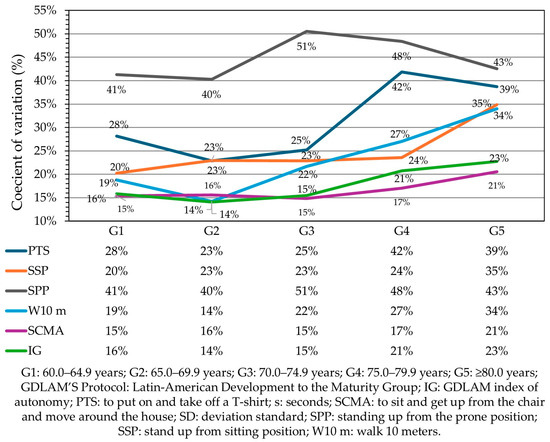
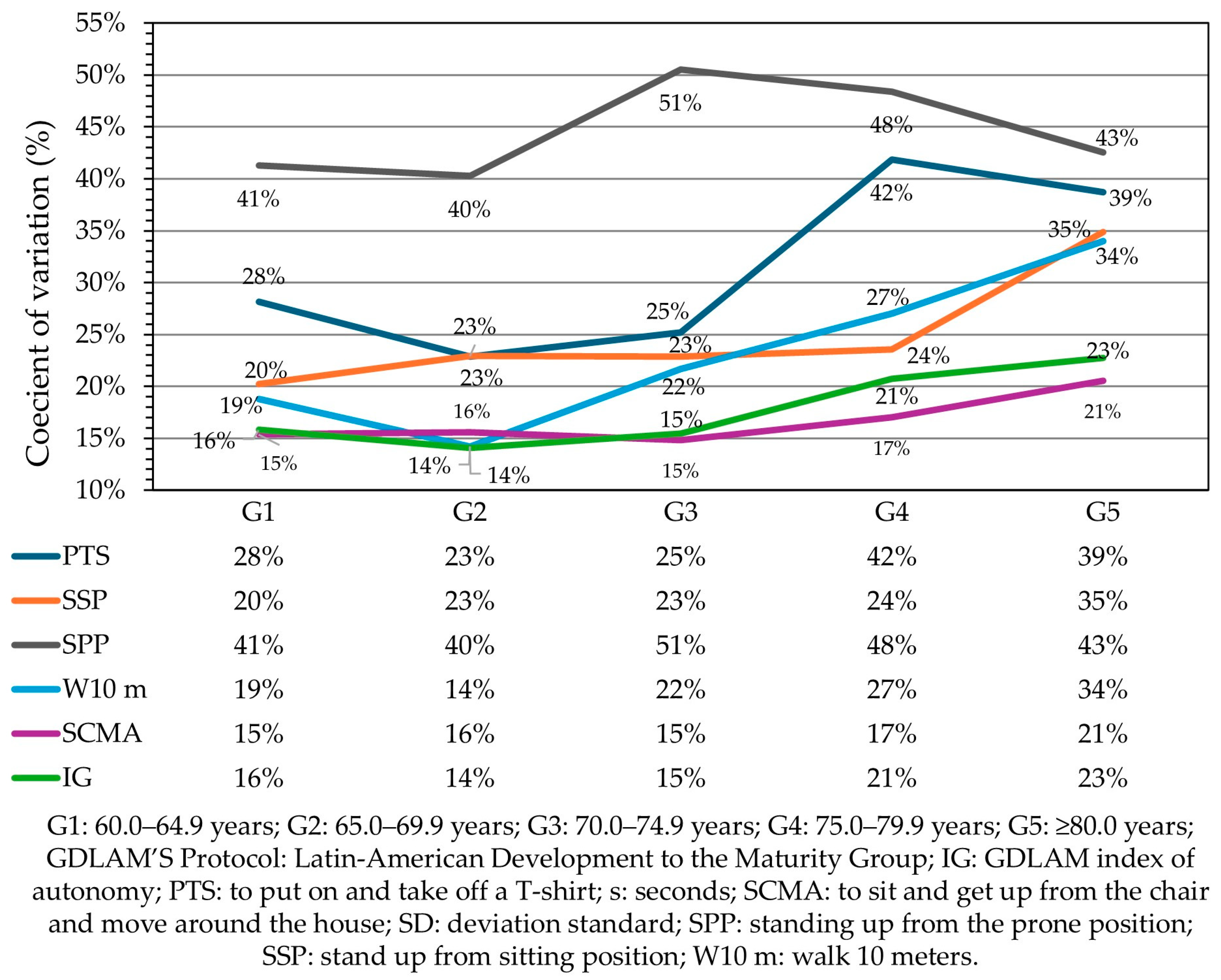
Upon completion of the GDLAM protocol, a significant decrease in performance associated with age ranges was observed in both the tests and the GI (p < 0.0001). The mean values, standard deviation, and results of the one-way ANOVA for the five tests are presented in Table 2. In parallel, the test that showed the highest CV for all age ranges was the SPP test, accentuating this value in G3 with 51%, while the GI had variations between 14–23%. The CV of the five tests and the GI for the five age groups are reported in Figure 3.
Table 2.
GDLAM’s protocol results by group.
Figure 3.
Coefficient of variation across age categories and test.
When analyzing the percentiles of each test of the GDLAM protocol, it is observed that the lower the times and the lower the score obtained in the GI, the better the classification of the FA. The percentile-based rating scale to assess the FA of community-dwelling Chilean older women, classified by rank (G1, G2, G3, G4, and G5), is reported in Table 3.
Table 3.
Standardized GDLAM’s protocol classification of functional autonomy for residents in Chile.
Exploratory factor analysis applied to the five variables that comprise the General Autonomy Index (GI) revealed a unidimensional structure. The KMO sample adequacy measure was 0.769, indicating an adequate correlation between variables. Meanwhile, Bartlett’s sphericity test was significant (χ2(10) = 807.93; p < 0.001), confirming the suitability of factor analysis. A single factor with an eigenvalue greater than 1 (one) was extracted, which explained 61.24% of the total variance, suggesting a strong convergence of the variables toward a common construct. The factor loadings observed in the matrix showed moderate to high associations with the main factor: PTS (0.519), SSP (0.684), SPP (0.631), W10 m (0.759), and SCMA (0.983). These loadings indicate that all variables contribute significantly to the GI, with SCMA and W10 m standing out as the most representative indicators of FA in the analyzed sample.
4. Discussion
This study was designed to create a percentile-based rating scale of the GDLAM protocol in community-dwelling Chilean older women. In this context, 347 women aged 60 years or older were part of the rating scale, indicating that FA progressively decreases with increasing age. Likewise, the SPP test showed the highest CV among the five tests of the GDLAM protocol, independent of the age range.
4.1. To Put On and Take Off a T-Shirt
This test was designed to assess individuals’ ability to dress independently and without assistance, with a specific focus on the upper extremities [42]. Based on the observed results, the performance for this test ranges from 5.64 to 55.90 s, while the ranges for the four criteria across the five age groups show a decreasing performance as age increases. In parallel, other rating scales of the GDLAM protocol have reported percentiles for the different criteria, including the PTS test, which is one of the factors that condition FA in older adults [26,30,43]. In this sense, both the Brazilian [26] and Spanish [30] scales indicate that the “Very Good” and “Good” criteria have values for each percentile (performance), similar to the scale created in the present study. For example, for the Chilean scale, the “Very Good” criterion, in the range 70.0–74.9 years, starts with a time ≤ 9.95 s, whereas the Spanish scale is a time ≤ 10.49 s, and the Brazilian scale with a time ≤ 9.29 s. Similarly, for the Chilean scale, the “Good” criterion for the range 70.0–74.9 years is between 9.96–12.77 s, while the Spanish scale is between 10.50–13.79 s, and the Brazilian scale is between 9.30–12.54 s. However, when the “Regular” and “Poor” criteria are analyzed between the scales, it is observed that the Chilean scale has greater similarity with the values reported in the Brazilian scale. For example, for the Chilean scale, the “Regular” criterion, in the range of 70.0–74.9 years, corresponds to a time of 12.78 to 16.11 s. In comparison, the Brazilian scale ranges from 12.55 to 16.56 s, and the Spanish scale falls within the range of 13.80 to 20.08 s. Likewise, the “Poor” criterion for the same age range evidences a similarity in absolute values between the Chilean and Brazilian scales, with times for the PTS test ≥ 16.12 and ≥16.57, respectively. These values are approximately 4 s lower than those presented on the Spanish scale for the same age range. Although it was not a specific objective of this research to evaluate the participants’ flexibility in isolation or to establish a correlation with their performance on the TPS test, the findings suggest that greater mobility in the upper limbs may be a key factor in the results of this initial test of the GDLAM protocol. Specifically, it has been demonstrated that older adults in Chile tend to exhibit higher reference values in flexibility compared to international norms for physical tests, such as the Senior Fitness Test [44]. However, this latter relationship still requires further investigation.
4.2. Stand Up from the Sitting Position
This test was designed to provide background information to determine the FA of older adults [45]. Specifically, the five-repetition SSP test is valid and reliable for assessing lower extremity functional capacity [46,47]. During the creation of the rating scale for Chilean women, mean performance decreased as age increased, ranging from 8.77 ± 1.77 s for G1 to 12.90 ± 4.49 s for G5. When comparing the results of the SSP test, which is part of the Chilean scale, with the other two existing scales [26,30] it is observed that Chilean older women perform better than Spanish women in all age ranges. Likewise, when comparing the dispersion of the data among the five age ranges of the Chilean scale with the Spanish scale, it is observed that the Chilean data are more clustered. Therefore, the absolute values defining each criterion for the rating scale are more demanding for older Chilean women. This same tendency is observed when comparing the Chilean scale with the Brazilian scale in the first three age ranges (G1, G2, and G3). However, when analyzing and comparing the last two age ranges (G4 and G5), it is observed that the performance of Brazilian older women is higher than that of Chilean older women over 75.0 years of age. These differences may be associated with varying levels of physical activity among the two populations [48]. However, these variables need further exploration.
4.3. Standing Up from the Prone Position
This test assesses the ability of older adults to rise from a seated position on the floor without assistance [49]. This test maintains the same trend as the two preceding tests, i.e., a decrease in mean performance is observed as age increases. In this specific case, the G1 started with a time of 3.99 ± 1.64 s, while the G5 finished the scale with 8.96 ± 3.81 s. When comparing these results with those of the other two existing scales [26,30], it is observed that Chilean older women in G1 (60.0–64.9 years) exhibit better performance than Spanish and Brazilian women. Likewise, Chilean G2 and G3 show better mean performance than Spanish G2 and G3. However, the absolute values for all age ranges are more demanding for Spanish older women. This same trend is observed when comparing the Chilean scale with the Brazilian scale across all age ranges, indicating that both Brazilian and Spanish older women have a more developed ability to get up from the floor without assistance. Consequently, their evaluation parameters are more stringent than those observed in older women from Chile.
4.4. Walk 10 m
This test evaluates the ability to walk 10 m in a straight line [50]. During the creation of the rating scale for Chilean women, mean performance decreased as age increased, ranging from 6.05 ± 1.13 s for G1 to 8.36 ± 2.84 s for G5. When comparing the results of the W10 m test, which is part of the Chilean scale, with those of the other two existing scales [26,30] it is observed that Chilean older women perform better than Spanish women across all age ranges. This same trend is observed when comparing the Chilean scale with the Brazilian scale in the first four age ranges (G1, G2, G3, and G4). However, when analyzing and comparing the last age range (G5), it is observed that the performance of Brazilian older women is higher than that of Chilean women. Despite these differences, the absolute values defining each criterion on the rating scale are similar among the three existing scales. Possibly, this similarity is associated with the functionality of the W10 m test and its representation of a daily life activity such as walking.
4.5. To Sit and Get Up from the Chair and Move Around the House
This test evaluates the agility and balance of older adults in daily life situations [51]. During the creation of the rating scale for Chilean older women, a decrease in mean performance was observed as age increased, starting with 37.00 ± 5.69 s for G1 to 50.44 ± 10.38 s for G5. Comparing the results of the SCMA test, which is part of the Chilean scale, with those of the other two existing scales [26,30] it is observed that Chilean older women have a better average performance than Spanish and Brazilian women across all age ranges. Likewise, when analyzing the different criteria in each age range, a similarity is observed in the absolute values for groups G1, G2, and G3. However, due to the dispersion of the results in G4 and G5, differences are observed between the scales, being more demanding for Brazilian women aged ≥75.0 years. These differences could be related to the diverse lifestyles of the people evaluated. However, further research is necessary to gain a deeper understanding of these variables.
4.6. GDLAM Index of Autonomy
The results of the five tests of the GDLAM protocol allow the calculation of the GDLAM index of autonomy [9,11,26,27,28]. Although the five tests provide an approximation of the FA status of older adults, as demonstrated by factor analysis, the GI corresponds to the global indicator of FA and is the most relevant result of the protocol [41]. During the creation of the percentile-based ranking scale for the GI of Chilean older women, a decline in FA was observed as age increased, ranging from 24.33 ± 3.84 points for G1 to 37.29 ± 8.47 points for G5 (p < 0.0001). When comparing the scores of the GI, which is part of the Chilean scale, with the other two existing indexes [26,30], it is observed that Chilean older women have a better score than Spanish women in all age ranges. Likewise, when comparing the dispersion of the data among the five age ranges of the Chilean scale with the Spanish scale, it is observed that the Chilean data are more clustered. Therefore, the absolute values defining each criterion for GI of the Chilean rating scale are more demanding than those of the Spanish scale. This same tendency is observed when comparing the Chilean scale with the Brazilian scale in the first three age ranges (G1, G2, and G3). However, when analyzing and comparing the last two age ranges (G4 and G5), it is observed that the scores for Brazilian older women are more demanding than for Chilean women over 75.0 years of age. These differences underscore the need for each test and protocol to have an evaluation scale tailored to the specific sociodemographic characteristics of the populations being studied.
5. Advantages and Disadvantages of Research
This research has several advantages that support its validity and applicability. First, a percentile-based rating scale was developed specifically for older Chilean women living in the community, which is a contextualized and culturally relevant tool. This specificity enables a more accurate and realistic assessment of functional autonomy (FA) in this population group, thereby avoiding inappropriate generalizations derived from the use of international scales that do not accurately reflect the local profile.
Secondly, the GDLAM protocol used proved to be a comprehensive, valid, and reliable test battery for measuring FA, with no ceiling effects, which favors its use in women with good levels of physical fitness. In addition, the sample size (n = 347), distributed across five age ranges, lends statistical robustness to the results.
However, certain disadvantages must also be acknowledged. One of these is the uneven distribution of participants across age groups, which could affect the representativeness of the results in groups with smaller sample sizes (especially G4 and G5). Furthermore, potentially influential variables such as level of physical activity, comorbidities, or educational level were not considered, which could have enriched the interpretation of the data. Finally, by focusing exclusively on Chilean women living in the community, the findings cannot be generalized to men, institutionalized individuals, or other populations.
6. Practical Implications
The GDLAM protocol, strengthened by this new percentile-based assessment scale, represents an accessible, economical, and easily applicable tool for the systematic evaluation of functional autonomy in older Chilean women. This tool is not only useful for sports and health science professionals but also for public health programs, as it facilitates evidence-based clinical and therapeutic decisions.
Furthermore, its incorporation into functional screening programs within Chilean primary care would enable the early identification of functional decline and the planning of community interventions aimed at promoting active and healthy aging. This applicability extends beyond the clinical setting, offering benefits in both preventive and educational contexts and promoting the development of personalized physical activity programs.
Furthermore, the fact that the results are stratified by age group and classified by performance level (“Very good,” “Good,” “Fair,” “Poor”) facilitates their interpretation by non-specialist professionals, thus promoting wider use in community, municipal, and educational contexts.
7. Conclusions
This study developed a percentile-based rating scale for the five functional tests of the GDLAM protocol and its GI, allowing for a valid, reliable, and specific assessment of FA in older Chilean women living in the community. The main results showed a progressive decline in functional performance with increasing age, with the SPP test showing the greatest variability between age groups. Likewise, the values obtained in the tests revealed better performance in younger Chilean women compared to their Spanish and Brazilian counterparts. In the older age groups, however, this trend is partially reversed, highlighting differences associated with sociocultural context and lifestyle.
Exploratory factor analysis confirmed the unidimensionality of the construct, with a high factor loading in all tests and an explained variance greater than 60%, supporting the use of GI as a global indicator of FA. When comparing the results obtained with previous scales developed in Brazil and Spain, similar trends were observed in the distribution of functional performance, although with specific differences in some percentiles. These findings reinforce the need for reference tables adapted to the cultural and demographic characteristics of each population, as is the case with older Chilean women.
Author Contributions
Conceptualization, Á.H.O., E.J.-S. and S.G.M.; methodology, Á.H.O., E.J.-S. and S.G.M.; validation, Á.H.O., E.J.-S. and S.G.M.; formal analysis, Á.H.O., E.J.-S. and S.G.M.; investigation, Á.H.O., E.J.-S., S.G.M., G.B.-F., C.J.-A., P.R.-A., R.d.V.G., M.-M.Y.-C. and M.B.Y.; resources, Á.H.O.; data curation, Á.H.O.; writing—original draft preparation, Á.H.O., E.J.-S., S.G.M., G.B.-F., C.J.-A., P.R.-A., R.d.V.G., M.-M.Y.-C. and M.B.Y.; writing—review and editing, Á.H.O. and M.-M.Y.-C.; visualization, Á.H.O., E.J.-S. and S.G.M.; supervision, Á.H.O.; project administration, Á.H.O.; funding acquisition, Á.H.O. All authors have read and agreed to the published version of the manuscript.
Funding
Fondo Concursable de Proyectos de Investigación Regular 2024, Vicerrectoría de Investigación y Postgrado, Universidad de Las Américas. ID: PIR202423, and Fondo Concursable de Verano, Dirección de Vinculación con el Medio Universidad de Las Américas 2022–2023.
Institutional Review Board Statement
All procedures were conducted in accordance with the ethical standards outlined in the Declaration of Helsinki (updated in 2013) and the ethical standards for exercise and sports sciences [35]. The study and the informed consent were approved by the Scientific-Ethical Committee of Universidad de Las Américas, Chile (registration number: CEC_PI_2023003). Date of decision: 13 March 2023.
Informed Consent Statement
Informed consent was obtained from all subjects involved in the study.
Data Availability Statement
The data that support the findings of this study are available on request from the corresponding author.
Acknowledgments
To Oficina del Adulto Mayor de la Ilustre Municipalidad Quintero, Oficina del Adulto Mayor de la Ilustre Municipalidad Viña del Mar, Asociación de Fútbol Pedro Aguirre Cerda de Valparaíso, Unidad Vecinal 186 Cerro El Litre, ONG Vivir Consentidos, the 347 older women who took part in the evaluations, and to the professionals Gabriela Lizana Romero, Makarena Albornoz Hernández, Rodrigo Beltrán Inostroza, María Francisca Machuca López, Tomás Lagos Contreras, Vicente Escobar Valencia, Nicolas Arancibia Gazali, and Pablo Vera Paredes, who collaborated in the data collection.
Conflicts of Interest
The authors declare no conflicts of interest. The result presented in this article, “The Qualitative Scale of the GDLAM Protocol to Assess the Functional Autonomy of Older and Community-Dwelling Chilean Women”, has been protected by copyright registered with the Department of Intellectual Rights (DDI) Chile, under registration number 2025-A-6527 dated 10/07/2025 in the name of Universidad de Playa Ancha de Ciencias de La Educación, Universidad San Sebastián, and Universidad de Las Américas. The authorship belongs to the authors of this article. The work is available for licensing.
Abbreviations
The following abbreviations are used in this manuscript:
| ADL | Activities of daily living |
| BMI | Body Mass Index |
| BP | Blood pressure |
| CV | Coefficient of Variation |
| DHEA | Dehydroepiandrosterone |
| DHEA-S | Dehydroepiandrosterone sulfate |
| ECG | Electrocardiographic evaluation |
| FA | Functional autonomy |
| G1 | Group 1 |
| G2 | Group 2 |
| G3 | Group 3 |
| G4 | Group 4 |
| G5 | Group 5 |
| GDLAM | Latin American Development Group for Maturity |
| GH | Growth hormone |
| GI | General Index of Autonomy |
| HS | Handgrip strength |
| IGF-1 | Insulin-like growth factor 1 |
| KMO | Kaiser-Meyer-Olkin KMO |
| PTS | Putting on and taking off a T-shirt |
| SCMA | Sitting, getting up from the chair, and moving around the house |
| SD | Standard Deviations |
| SPP | Standing up from the prone position |
| SPPB | Short Physical Performance Battery |
| SSP | Stand up from the sitting position |
| STROBE | Strengthening Reporting of Observational Studies in Epidemiology |
| TLA | Three-letter acronym |
| TUG | Timed up and go test |
| W10 m | Walking 10 m |
References
- Wyss-Coray, T. Ageing, Neurodegeneration and Brain Rejuvenation. Nature 2016, 539, 180–186. [Google Scholar] [CrossRef] [Scilit]
- Hugo Rojas, F.; Rodríguez Canache, L.; Rodríguez León, J. Documento de Trabajo, Envejecimiento en Chile: Evolución, Características de las Personas Mayores y Desafíos Demográficos para la Población; Instituto Nacional de Estadísticas: Santiago, Chile, 2022. [Google Scholar]
- Solís, P.; García-Guerrero, V.M. ¿Caminos Divergentes a La Baja Mortalidad? El Incremento En La Esperanza de Vida y La Desigualdad de Años Vividos En América Latina y Europa. Estud. Demogr. Urbanos Col. Mex. 2019, 34, 365–393. [Google Scholar] [CrossRef] [Scilit]
- Angulo, J.; El Assar, M.; Álvarez-Bustos, A.; Rodríguez-Mañas, L. Physical Activity and Exercise: Strategies to Manage Frailty. Redox Biol. 2020, 35, 101513. [Google Scholar] [CrossRef] [Scilit]
- Troncoso-Pantoja, C.; Concha-Cisternas, Y.; Leiva-Ordoñez, A.M.; Martínez-Sanguinetti, M.A.; Petermann-Rocha, F.; Díaz-Martínez, X.; Martorell, M.; Nazar, G.; Ulloa, N.; Cigarroa-Cuevas, I.; et al. Prevalencia de Fragilidad En Personas Mayores de Chile: Resultados de La Encuesta Nacional de Salud 2016–2017. Rev. Med. Chil. 2020, 148, 1418–1426. [Google Scholar] [CrossRef] [Scilit]
- Gordon, E.H.; Hubbard, R.E. Differences in Frailty in Older Men and Women. Med. J. Aust. 2020, 212, 183–188. [Google Scholar] [CrossRef] [Scilit] [PubMed]
- Pataky, M.W.; Young, W.F.; Nair, K.S. Hormonal and Metabolic Changes of Aging and the Influence of Lifestyle Modifications. Mayo Clin. Proc. 2021, 96, 788–814. [Google Scholar] [CrossRef] [Scilit]
- Feng, J.; Zheng, M. Gender Differences in the Subjective Wellbeing of the Older Adults and the Determinant Factors: A Case Study of Nanjing. Front. Public Health 2024, 12, 1447777. [Google Scholar] [CrossRef] [Scilit]
- Dantas, E.H.M.; Vale, R.G.d.S. Protocolo GDLAM de Avaliação Da Autonomia Funcional. Fit. Perform. J. 2004, 3, 175–183. [Google Scholar] [CrossRef] [Scilit]
- Faustino, A.M.; Gandolfi, L.; De Azevedo Moura, L.B. Capacidade Funcional e Situações de Violência Em Idosos. ACTA Paul. Enferm. 2014, 27, 392–398. [Google Scholar] [CrossRef] [Scilit]
- Vale, R.G.d.S. …Avaliação Da Autonomia Funcional Do Idoso. Fit. Perform. J. 2005, 4, 4. [Google Scholar]
- Mancilla, S.E.; Valenzuela, H.J.; Escobar, C.M. Rendimiento En Las Pruebas “Timed Up and Go” y “Estación Unipodal” En Adultos Mayores Chilenos Entre 60 y 89 Años. Rev. Med. Chil. 2015, 143, 39–46. [Google Scholar] [CrossRef] [Scilit]
- de Queiroz, L.L.; Silva, L.G.d.O.d.; Pinheiro, H.A. Can the Timed up and Go Test Be Used as a Predictor of Muscle Strength in Older Adults? Fisioter. Pesqui. 2023, 30. [Google Scholar] [CrossRef] [Scilit]
- Barry, E.; Galvin, R.; Keogh, C.; Horgan, F.; Fahey, T. Is the Timed Up and Go Test a Useful Predictor of Risk of Falls in Community Dwelling Older Adults: A Systematic Review and Meta Analysis. BMC Geriatr. 2014, 14, 14. [Google Scholar] [CrossRef] [Scilit]
- Beauchet, O.; Fantino, B.; Allali, G.; Muir, S.W.; Montero-Odasso, M.; Annweiler, C. Timed up and Go Test and Risk of Falls in Older Adults: A Systematic Review. J. Nutr. Health Aging 2011, 15, 933–938. [Google Scholar] [CrossRef] [Scilit]
- de Fátima Ribeiro Silva, C.; Ohara, D.G.; Matos, A.P.; Pinto, A.C.P.N.; Pegorari, M.S. Short Physical Performance Battery as a Measure of Physical Performance and Mortality Predictor in Older Adults: A Comprehensive Literature Review. Int. J. Environ. Res. Public Health 2021, 18, 10612. [Google Scholar] [CrossRef] [Scilit]
- Lee, S.Y.; Choo, P.L.; Pang, B.W.J.; Lau, L.K.; Jabbar, K.A.; Seah, W.T.; Chen, K.K.; Ng, T.P.; Wee, S.-L. SPPB Reference Values and Performance in Assessing Sarcopenia in Community-Dwelling Singaporeans—Yishun Study. BMC Geriatr. 2021, 21, 213. [Google Scholar] [CrossRef] [Scilit] [PubMed]
- Cesari, M.; Landi, F.; Calvani, R.; Cherubini, A.; Di Bari, M.; Kortebein, P.; Del Signore, S.; Le Lain, R.; Vellas, B.; Pahor, M.; et al. Rationale for a Preliminary Operational Definition of Physical Frailty and Sarcopenia in the SPRINTT Trial. Aging Clin. Exp. Res. 2017, 29, 81–88. [Google Scholar] [CrossRef] [Scilit] [PubMed]
- Cruz-Jentoft, A.J.; Bahat, G.; Bauer, J.; Boirie, Y.; Bruyère, O.; Cederholm, T.; Cooper, C.; Landi, F.; Rolland, Y.; Sayer, A.A.; et al. Sarcopenia: Revised European Consensus on Definition and Diagnosis. Age Ageing 2019, 48, 16–31. [Google Scholar] [CrossRef] [Scilit]
- Chen, L.-K.; Woo, J.; Assantachai, P.; Auyeung, T.-W.; Chou, M.-Y.; Iijima, K.; Jang, H.C.; Kang, L.; Kim, M.; Kim, S.; et al. Asian Working Group for Sarcopenia: 2019 Consensus Update on Sarcopenia Diagnosis and Treatment. J. Am. Med. Dir. Assoc. 2020, 21, 300–307.e2. [Google Scholar] [CrossRef] [Scilit]
- Santamaría-Peláez, M.; González-Bernal, J.J.; Da Silva-González, Á.; Medina-Pascual, E.; Gentil-Gutiérrez, A.; Fernández-Solana, J.; Mielgo-Ayuso, J.; González-Santos, J. Validity and Reliability of the Short Physical Performance Battery Tool in Institutionalized Spanish Older Adults. Nurs. Rep. 2023, 13, 1354–1367. [Google Scholar] [CrossRef] [Scilit]
- Soares Menezes, K.V.R.; Auger, C.; de Souza Menezes, W.R.; Guerra, R.O. Instruments to Evaluate Mobility Capacity of Older Adults during Hospitalization: A Systematic Review. Arch. Gerontol. Geriatr. 2017, 72, 67–79. [Google Scholar] [CrossRef] [Scilit]
- Bergland, A.; Strand, B.H. Norwegian Reference Values for the Short Physical Performance Battery (SPPB): The Tromsø Study. BMC Geriatr. 2019, 19, 216. [Google Scholar] [CrossRef] [Scilit]
- Gosman-Hedström, G.; Svensson, E. Parallel Reliability of the Functional Independence Measure and the Barthel ADL Index. Disabil. Rehabil. 2000, 22, 702–715. [Google Scholar] [CrossRef] [Scilit]
- Andrade, L.E.; Vale, R.G.d.S.; Lessa, K.M.; Paiva, M.N.; Sena, P.L.S.C.; Dantas, E.H.M. Avaliação Do Nível de Autonomia Funcional de Idosos, a Partir Da Aplicação de Bateria de Testes Do Protocolo GDLAM: Revisando a Literatura. Cad. Grad.-Ciências Biol. Saúde 2015, 3, 61–72. [Google Scholar]
- Dantas, E.H.M.; Figueira, H.A.; Emygdio, R.F.; Vale, R.G.d.S. Functional Autonomy GDLAM Protocol Classification Pattern in Elderly Women. Indian J. Appl. Res. 2014, 4, 262–266. [Google Scholar] [CrossRef] [Scilit]
- Vale, R.G.d.S.; Pernambuco, C.S.; Dantas, E.H.M. Manual de Avaliação do Idoso, 1st ed.; Ícone Editora Eireli: São Paulo, Brasil, 2021; ISBN 9788527412858. [Google Scholar]
- Huerta Ojeda, Á.; Jofré-Saldía, E.; Arriagada Molina, J.; Rojas Quinchavil, P.; Parada Toledo, M.P.; Galdames Maliqueo, S.; Yeomans-Cabrera, M.-M.; Jorquera-Aguilera, C.; Giakoni-Ramirez, F.; Bravo, M. Test-Retest Reliability of Latin American Group for Maturity (GDLAM) Protocol in Older Women. PLoS ONE 2024, 19, e0302134. [Google Scholar] [CrossRef] [Scilit]
- Marcos-Pardo, P.J.; González-Gálvez, N.; Carbonell-Baeza, A.; Jiménez-Pavón, D.; Vaquero-Cristóbal, R. GDLAM and SPPB Batteries for Screening Sarcopenia in Community-Dwelling Spanish Older Adults: Healthy-Age Network Study. Exp. Gerontol. 2023, 172, 112044. [Google Scholar] [CrossRef] [Scilit]
- Marcos-Pardo, P.J.; González-Gálvez, N.; Vaquero-Cristóbal, R.; Gea-García, G.M.; López-Vivancos, A.; Espeso-García, A.; Velázquez-Díaz, D.; Carbonell-Baeza, A.; Jiménez-Pavón, D.; de Castro, J.B.P.; et al. Functional Autonomy Evaluation Levels in Middle-Aged and Older Spanish Women: On Behalf of the Healthy-Age Network. Sustainability 2020, 12, 9208. [Google Scholar] [CrossRef] [Scilit]
- Vale, R.G.d.S.; Gama Linhares, D.; Santos Meireles, A.; da Silva, G.C.P.S.M.; da Silva, E.B. Effects of Physical Exercise on the Functional Autonomy in the Older Evaluated by the GDLAM Protocol: A Systematic Review with Meta-Analysis of Randomized Clinical Trials. J. Gerontol. Geriatr. 2024, 72, 160–171. [Google Scholar] [CrossRef] [Scilit]
- Cuschieri, S. The STROBE Guidelines. Saudi J. Anaesth. 2019, 13, 31–34. [Google Scholar] [CrossRef] [Scilit] [PubMed]
- von Elm, E.; Altman, D.G.; Egger, M.; Pocock, S.J.; Gøtzsche, P.C.; Vandenbroucke, J.P. The Strengthening the Reporting of Observational Studies in Epidemiology (STROBE) Statement: Guidelines for Reporting Observational Studies. Lancet 2007, 370, 1453–1457. [Google Scholar] [CrossRef] [Scilit] [PubMed]
- Ato, M.; López, J.J.; Benavente, A. A Classification System for Research Designs in Psychology. An. Psicol. Ann. Psychol. 2013, 29, 1038–1059. [Google Scholar] [CrossRef] [Scilit]
- Harriss, D.J.; MacSween, A.; Atkinson, G. Ethical Standards in Sport and Exercise Science Research: 2020 Update. Int. J. Sports Med. 2019, 40, 813–817. [Google Scholar] [CrossRef] [Scilit]
- Faul, F. G*Power. Available online: https://www.psychologie.hhu.de/arbeitsgruppen/allgemeine-psychologie-und-arbeitspsychologie/gpower (accessed on 30 October 2025).
- Ministerio de Salud. Guía Clínica Hipertensión Arterial Primaria o Esencial en Personas de 15 Años y Más, 1st ed.; Minsal: Santiago, Chile, 2005. [Google Scholar]
- Ruiz-Ruiz, J.; Mesa, J.L.M.; Gutiérrez, A.; Castillo, M.J. Hand Size Influences Optimal Grip Span in Women but Not in Men. J. Hand Surg. 2002, 27, 897–901. [Google Scholar] [CrossRef] [Scilit]
- Subsecretaria de Salud Pública. Manual de Aplicación Del Examen de Medicina Preventiva Del Adulto Mayor. Ministerio de Salud (MINSAL) de Chile: Santiago Metropolitan Region, Chile, 2012; pp. 1–16. Available online: https://diprece.minsal.cl/wrdprss_minsal/wp-content/uploads/2015/05/instructivo-de-control-de-salud-empam1.pdf (accessed on 18 November 2025).
- Huerta Ojeda, Á.; Toro-Zepeda, V.; Jofré-Saldía, E.; Bravo, M.; Parra, C.; Campos-Armijo, G.; Jorquera-Aguilera, C.; Albornoz Hernández, M.; Yeomans-Cabrera, M.-M.; Galdames Maliqueo, S. Relationship between Asymmetries and Functional Autonomy in Older Chilean Adults. Int. J. Environ. Res. Public Health 2022, 19, 15063. [Google Scholar] [CrossRef] [Scilit] [PubMed]
- Jolliffe, I.T.; Cadima, J. Principal Component Analysis: A Review and Recent Developments. Philos. Trans. A Math. Phys. Eng. Sci. 2016, 374, 20150202. [Google Scholar] [CrossRef] [Scilit]
- Vale, R.G.d.S.; Pernambuco, C.; Novaes, J.; Dantas, E.H.M. Teste de Autonomia Funcional: Vestir e Tirar Uma Camiseta (VTC). Functional Autonomy Test: To Dress and Undress a Sleeveless Shirt (Duss). Rev. Bras. Ciência Mov. 2006, 14, 71–78. [Google Scholar] [CrossRef] [Scilit]
- Daniel, F.; Vale, R.G.d.S.; Giani, T.; Bacelar, S.; Dantas, E.H.M. Functional Autonomy of Elderly Women Enrolled in a Physical Activity Program. Acta Sci. Health Sci. 2012, 34, 151–156. [Google Scholar] [CrossRef] [Scilit]
- Valdés-Badilla, P.; Concha-Cisternas, Y.; Guzmán-Muñoz, E.; Ortega-Spuler, J.; Vargas-Vitoria, R. Reference Values for the Senior Fitness Test in Chilean Older Women. Rev. Med. Chil. 2018, 146, 1143–1150. [Google Scholar] [CrossRef] [Scilit]
- Guralnik, J.M.; Simonsick, E.M.; Ferrucci, L.; Glynn, R.J.; Berkman, L.F.; Blazer, D.G.; Scherr, P.A.; Wallace, R.B. A Short Physical Performance Battery Assessing Lower Extremity Function: Association with Self-Reported Disability and Prediction of Mortality and Nursing Home Admission. J. Gerontol. 1994, 49, M85–M94. [Google Scholar] [CrossRef] [Scilit]
- Tsekoura, M.; Anastasopoulos, K.; Kastrinis, A.; Dimitriadis, Z. What Is Most Appropriate Number of Repetitions of the Sit-to-Stand Test in Older Adults: A Reliability Study. J. Frailty Sarcopenia Falls 2020, 5, 109–113. [Google Scholar] [CrossRef] [Scilit]
- Jerez-Mayorga, D.; Huerta-Ojeda, Á.; Chirosa-Ríos, L.J.; Guede-Rojas, F.; Guzmán-Guzmán, I.P.; Intelangelo, L.; Miranda-Fuentes, C.; Delgado-Floody, P. Test–Retest Reliability of Functional Electromechanical Dynamometer on Five Sit-to-Stand Measures in Healthy Young Adults. Int. J. Environ. Res. Public Health 2021, 18, 6829. [Google Scholar] [CrossRef] [Scilit] [PubMed]
- Jofré-Saldía, E.; Villalobos-Gorigoitía, Á.; Cofré-Bolados, C.; Ferrari, G.; Gea-García, G.M. Multicomponent Training in Progressive Phases Improves Functional Capacity, Physical Capacity, Quality of Life, and Exercise Motivation in Community-Dwelling Older Adults: A Randomized Clinical Trial. Int. J. Environ. Res. Public Health 2023, 20, 2755. [Google Scholar] [CrossRef] [Scilit] [PubMed]
- Alexander, N.B.; Ulbrich, J.; Raheja, A.; Channer, D. Rising from the Floor in Older Adults. J. Am. Geriatr. Soc. 1997, 45, 564–569. [Google Scholar] [CrossRef] [Scilit] [PubMed]
- Sipilä, S.; Multanen, J.; Kallinen, M.; Suominen, H. Effects of Strength and Endurance Training on Isometric Muscle Strength and Walking Speed in Elderly Women. Acta Physiol. Scand. 1996, 156, 457–464. [Google Scholar] [CrossRef] [Scilit]
- Andreotti, R.A.; Okuma, S.S. Validação de Uma Bateria de Testes de Atividades Da Vida Diária Para Idosos Fisicamente Independentes. Rev. Paul. Educ. Física 1999, 13, 46–66. [Google Scholar] [CrossRef] [Scilit]

Disclaimer/Publisher’s Note: The statements, opinions and data contained in all publications are solely those of the individual author(s) and contributor(s) and not of MDPI and/or the editor(s). MDPI and/or the editor(s) disclaim responsibility for any injury to people or property resulting from any ideas, methods, instructions or products referred to in the content. |
© 2026 by the authors. Licensee MDPI, Basel, Switzerland. This article is an open access article distributed under the terms and conditions of the Creative Commons Attribution (CC BY) license.