


Abstract
In the context of global carbon neutrality goals, substituting hydrogen for carbon as a reductant represents a critical pathway for mitigating emissions in the iron and steel industry. Hydrogen-based molten reduction technology, characterized by its rapid reaction kinetics and high feedstock flexibility, has emerged as a pivotal direction for the industry’s low-carbon transition. This article systematically reviews research progress on the hydrogen-based reduction of molten iron oxides. The thermodynamic behavior of molten systems is discussed, confirming the feasibility of reducing molten FeO with hydrogen at elevated temperatures. Furthermore, discrepancies and nonlinear characteristics within current mainstream thermodynamic databases regarding the high-temperature molten region are identified. Kinetic studies demonstrate that reduction rates in the molten state significantly exceed those in the solid state. The rate-limiting step is shown to vary with reaction conditions, primarily shifting between interfacial chemical reaction and liquid-phase mass transfer control. Additionally, the influence mechanisms of key parameters—including temperature, reaction time, gas flow rate, gas composition, and slag composition—on the reduction process are comprehensively reviewed. By synthesizing existing methodologies and theoretical advancements, this review aims to provide a theoretical reference for optimizing hydrogen-based molten reduction processes for iron oxides.
1. Introduction
In the context of global carbon neutrality goals, the iron and steel industry, as a major energy consumer and carbon emitter, is facing unprecedented pressure to decarbonize. Hydrogen metallurgy, defined as a novel metallurgical process utilizing hydrogen as the primary reductant to substitute carbonaceous fuels, is regarded as one of the most promising frontiers for the industry. Since its reduction product is solely water, it theoretically enables zero-carbon emissions in the ironmaking process. The conceptual framework of this technology originated from early explorations into alternative energy and clean processes during the mid-20th century, and its development trajectory clearly reflects an evolution from conceptual verification to engineering practice [1,2]. Characterized by its cleanliness and high reduction potential, substituting carbon with hydrogen as a reductant represents an effective pathway for mitigating carbon emissions in the ironmaking process.
Among these technologies, hydrogen-based direct reduction has already achieved industrialization. However, this process imposes strict requirements on raw material grade, and the reaction kinetics are often limited by the rate of internal gas diffusion within the solid phase [3]. Furthermore, the global depletion of high-grade iron ores makes it increasingly difficult to sustain solid-state direct reduction processes on a massive scale without extensive pre-processing. In contrast, molten reduction technology significantly shortens the process flow by directly reducing iron ore fines within a high-temperature molten bath. Nevertheless, traditional molten reduction processes remain predominantly carbon-based in their energy structure, failing to fundamentally resolve the issue of carbon emissions [4,5]. This liquid-state reaction effectively eliminates the internal diffusion barriers inherent to solid-state processes and facilitates excellent slag-metal separation, making it highly suitable for lower-grade complex ores.
Consequently, researchers have begun to explore the introduction of hydrogen as the primary reductant into molten reduction systems [5,6,7]. Compared to gas–solid reduction, hydrogen-based molten reduction involves the reduction of liquid iron oxides at elevated temperatures. It is characterized by significantly faster reaction rates (approximately 20 times that of gas–solid reduction [8]) and superior feedstock flexibility (capable of directly processing iron ore fines). Currently, the literature regarding the hydrogen reduction of iron oxides focuses primarily on solid-state reduction at low to medium temperatures; research targeting hydrogen-based reduction of molten iron oxides in the high-temperature zone remains relatively scarce. The study of molten systems is inherently more complex than that of solid-state systems, necessitating the consideration of factors such as multiphase fluid dynamics and melt structure. Therefore, this article aims to review the research progress on the hydrogen-based reduction of molten iron oxides and discusses the thermodynamics in the high-temperature molten zone, kinetic studies, and the influence mechanisms of key parameters.
2. Thermodynamic Research on Hydrogen Reduction of Molten Iron Oxides
Thermodynamic calculations serve as the theoretical foundation for assessing the feasibility of reducing molten iron oxides with hydrogen. By constructing thermodynamic equilibrium models of a reaction system, it is possible to clarify the reaction direction, equilibrium composition, and energy requirements of the process, providing a critical basis for optimizing process parameters and designing reactors. This section systematically reviews the major findings and existing issues in the thermodynamics of hydrogen-based molten iron oxide reduction.
Badr [9] utilized the FactSage 5.5 thermodynamic software to construct a reaction system model within the temperature range of 1600 °C to 2600 °C, based on the principle of Gibbs free energy minimization. The equilibrium state of 1 mol of liquid FeO with various reducing gases (and impurity gases such as H2O and CO2) was calculated. The calculation results indicate that the oxygen reduction potential of 1 mol H2 acting on 1 mol FeO is relatively stable; however, at higher temperatures, the amount of H2O produced decreases slightly, while the formation of OH increases. Between 1600 °C and 2600 °C, the total reduced oxygen (the sum of oxygen in H2O and OH) varies between 0.42 and 0.38 mol.
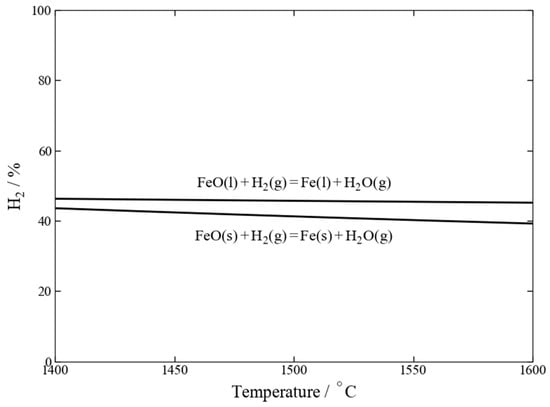
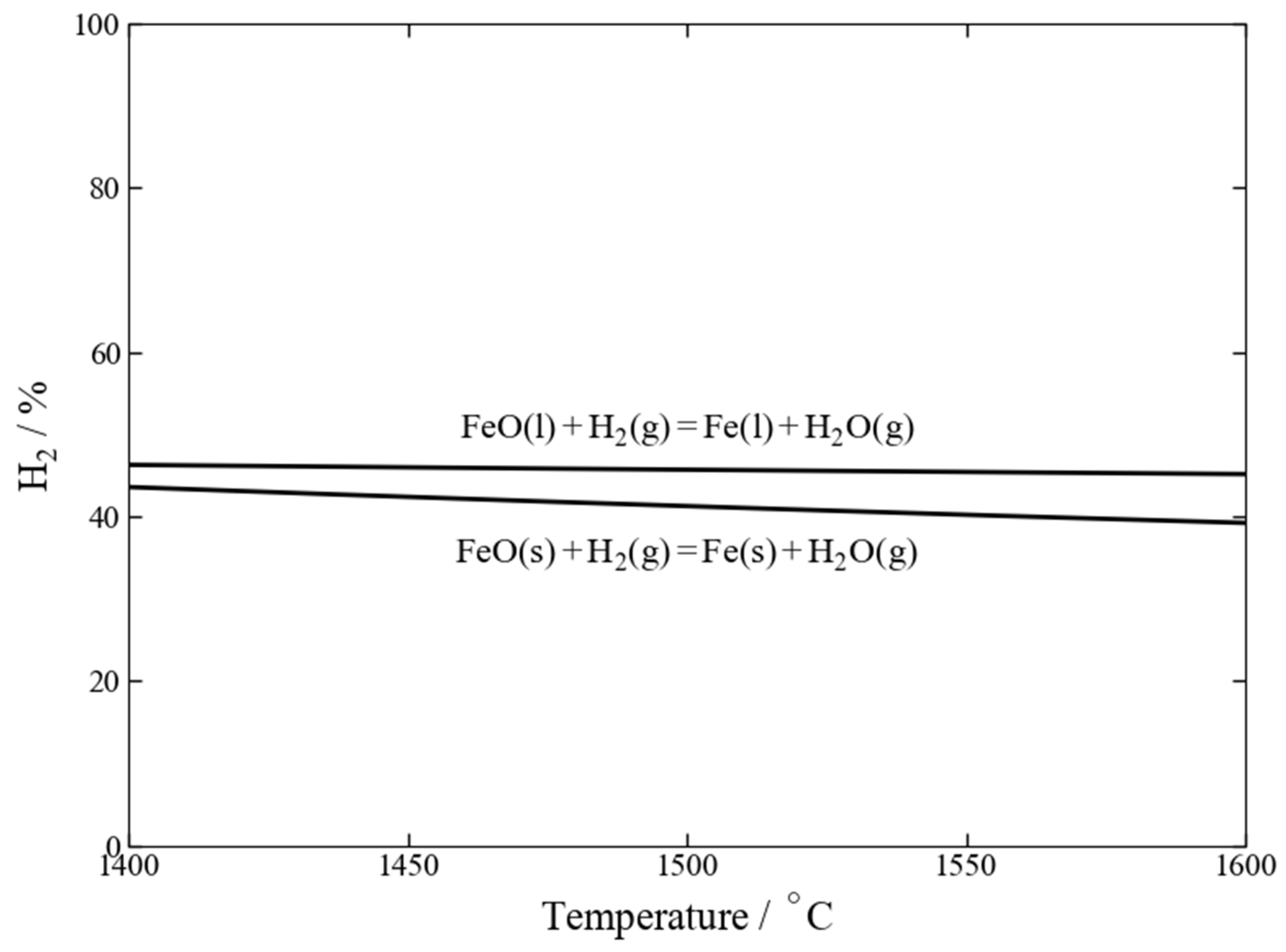
Cao et al. [10] discussed the feasibility of substituting carbon with hydrogen for molten reduction ironmaking through theoretical calculations. The study found that, based on the existing iron bath smelting reduction process, injecting hydrogen into the molten pool to replace carbonaceous energy sources can effectively reduce the thermal load in the reduction zone and lower energy consumption. To comprehensively evaluate the heat balance and reaction equilibrium of the hydrogen-based molten reduction system, the overall process can be decoupled into elementary chemical reactions and physical phase transitions. Based on the linear Ellingham approximation (where the heat capacity difference is assumed negligible over the specified high-temperature ranges), the constant term in the Gibbs free energy equation represents the mean standard enthalpy of reaction (). Based on theoretical formulas, the equilibrium diagram for the H2 reduction of ferrous oxide in the molten state was derived (see Figure 1). At a temperature of 1500 °C, the hydrogen content in the equilibrium gas phase was found to be 45.6%.
Figure 1.
Thermodynamic equilibrium diagram for the H2 reduction of iron oxides in both solid and molten states [10].
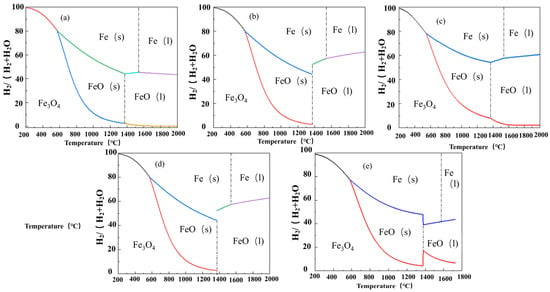
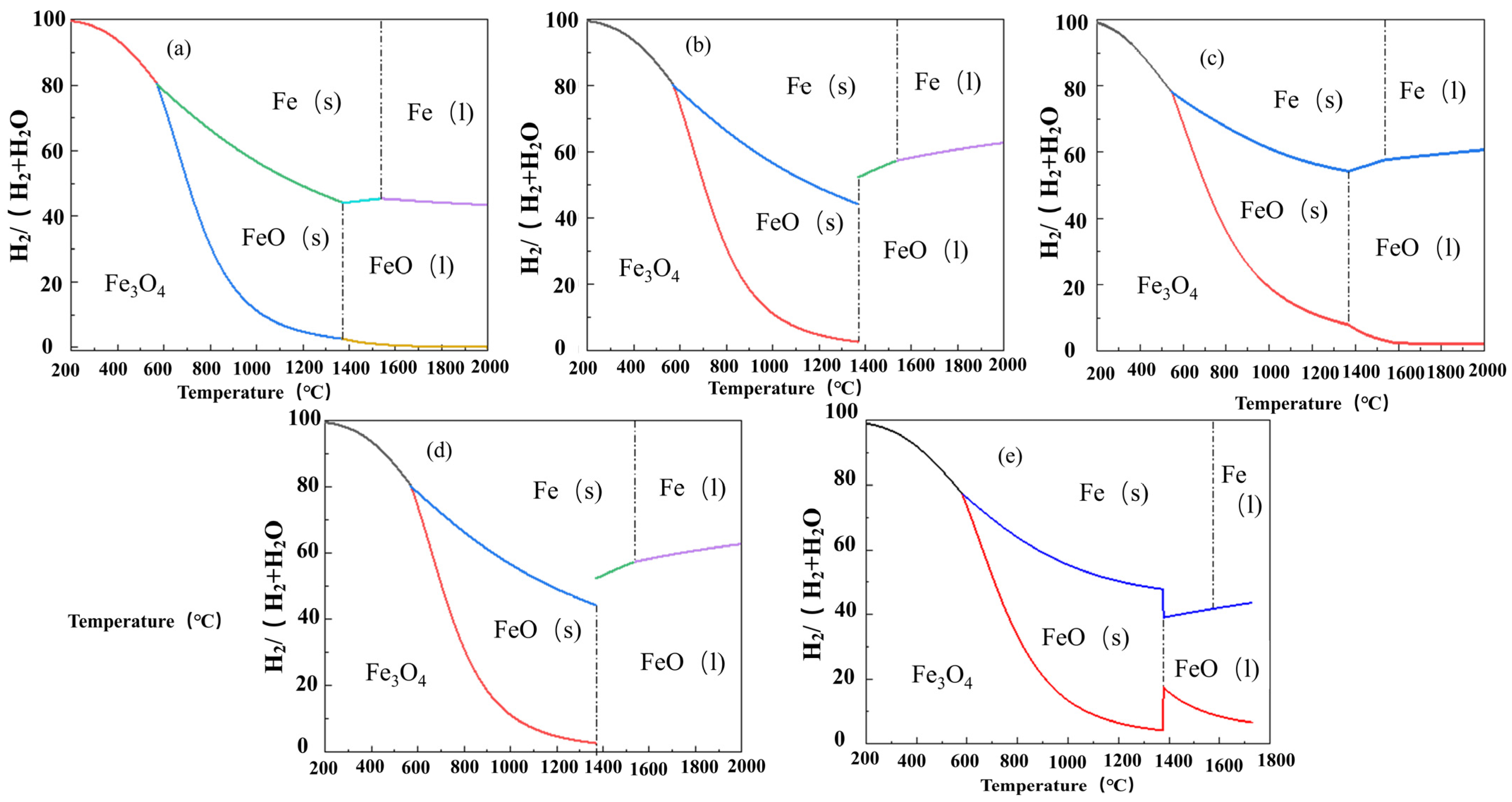
Li [11], by comparing data from standard metallurgy textbooks [12], thermodynamic data cited by Hayashi et al. [13], the FactSage 8.1 database, and three thermodynamic handbooks [14,15,16], performed calculations and fitting for the process of H2 reduction of FexO based on the principle of Gibbs free energy minimization. The results are presented in Figure 2. The results demonstrate that for the H2 reduction of FeO, within the temperature range of 1369 °C (melting point of FeO) to 1538 °C (melting point of Fe), the equilibrium curve rises with increasing temperature; that is, the required hydrogen partial pressure for reduction increases with temperature. However, when the temperature exceeds 1538 °C, results derived from standard metallurgy textbook data show a decrease in hydrogen partial pressure as temperature rises, which deviates from the calculation results of the other four data sources.
Figure 2.
Comparative analysis of equilibrium H2/(H2 + H2O) ratios for FexO reduction derived from five different data sources (a–e). (a) standard metallurgy textbooks; (b) textbooks combined with journal literature; (c) the FactSage 8.1 database; (d) FactSage 8.1 combined with journal literature; (e) thermodynamic handbooks [11].
As calculated and summarized by Li et al. [11] through comparing data from various databases, the equilibrium diagram for the H2 reduction of FexO is presented in Figure 2. To explicitly illustrate the physical chemistry logic underlying these cited curves, particularly the mathematical treatment of iron’s polymorphism at elevated temperatures, the standard thermodynamic calculation procedure is detailed in Appendix A.
Chen et al. [17], also based on the principle of Gibbs free energy minimization, established a thermodynamic calculation model for the hydrogen reduction of molten wüstite to investigate the endothermic and exothermic effects of the reaction in the high-temperature zone. The study calculated the enthalpy change and the required hydrogen partial pressure for the reaction at different temperatures, analyzing the energy variations during the process. A comprehensive comparison of data from FactSage 8.2, NIST, and four thermodynamic handbooks [14,18,19,20] revealed significant discrepancies in calculation results in the high-temperature range (particularly 1392–1536 °C), especially regarding enthalpy change and hydrogen partial pressure. The calculation results indicate that the data from the four thermodynamic handbooks show a slight decreasing trend in the hydrogen partial pressure with increasing temperature, whereas the FactSage 8.2 database shows an increasing trend with rising temperature for both solid and liquid FeO. Also, in the high-temperature range, the enthalpy change generally decreases with increasing temperature, except near the phase transition points of FeO melting and Fe melting in the FactSage 8.2 curve.
Furthermore, Dmitriev et al. [21] developed a quasi-dynamic model based on thermodynamic equilibrium calculations for the hydrogen reduction process of a multicomponent oxide melt (B2O3-CaO-FeO, mass ratio 60:20:20). The model assumes that: (1) bubbles have a sufficient residence time in the melt, allowing the gas inside the bubbles to reach local thermodynamic equilibrium with the surrounding melt; and (2) the gas-phase composition updates instantaneously after each reaction, with the reduced metal phase being removed from the system. Through a cyclic iterative algorithm of “input gas → calculate equilibrium → remove generated metal phase → update melt composition,” the dynamic trajectory of iron oxide concentration and slag ratio in the melt with varying hydrogen input was successfully simulated. This approach describes the reaction process without relying on complex kinetic parameters such as diffusion coefficients. A significant finding of the study is that within the temperature range of 1200 °C to 1650 °C, the equilibrium constant of the reduction reaction and hydrogen utilization rate do not change monotonically with temperature; instead, they exhibit nonlinear inflections near the phase transition points of FeO melting and Fe melting. This corroborates the enthalpy–temperature relationship curve obtained by Chen using the FactSage 8.2 database.
Thermodynamic calculations confirm the feasibility of reducing molten iron oxides with hydrogen and its theoretical advantages in reducing energy consumption. Existing research covers multiple dimensions, from pure substance system equilibrium to quasi-dynamic simulations of multicomponent slags, revealing that thermodynamic parameters exhibit complex nonlinear characteristics near the phase transition points of FeO and Fe. This phase transition temperature zone (>1538 °C) is the focal point of discrepancies in mainstream database predictions. The variations in predicting the trend of equilibrium hydrogen partial pressure with temperature are primarily due to the different solution models employed by databases to describe liquid oxides. FactSage does not employ a single “solution model”; instead, it performs Gibbs free energy minimization calculations for the entire reaction system by integrating multiple specialized databases and their built-in thermodynamic models [22]. In contrast, the NIST-JANAF table is an authoritative compilation of standard thermochemical data for elements and pure compounds and does not itself provide complex solution models. The handbook “Thermochemical Properties of Inorganic Substances” by Barin [14,15] compiles evaluated data for numerous substances but typically relies on relatively simple regular solution models or empirical fitting parameters when dealing with liquid solutions. Therefore, results calculated using the FactSage database are considered more accurate, although future work requires high-precision experimental correction of parameters to construct a unified, dedicated thermodynamic database.
3. Determination of Kinetic Parameters for Hydrogen Reduction of Molten Iron Oxides
The accurate determination of kinetic parameters serves as a core basis for exploring the reaction mechanism and identifying the rate-limiting steps in the hydrogen reduction of molten iron oxides. Compared to solid-state reduction, molten-state reduction involves more complex fluid flow, gas–liquid interfacial mass transfer, and changes in high-temperature physicochemical properties, resulting in significant differences in reaction rates and rate-controlling mechanisms. To investigate the intrinsic kinetic characteristics of this process, researchers have designed various experimental apparatuses. This section focuses on reviewing research findings obtained under different experimental conditions, comparing the applicability of various kinetic models, and analyzing the measurement results of key kinetic parameters.
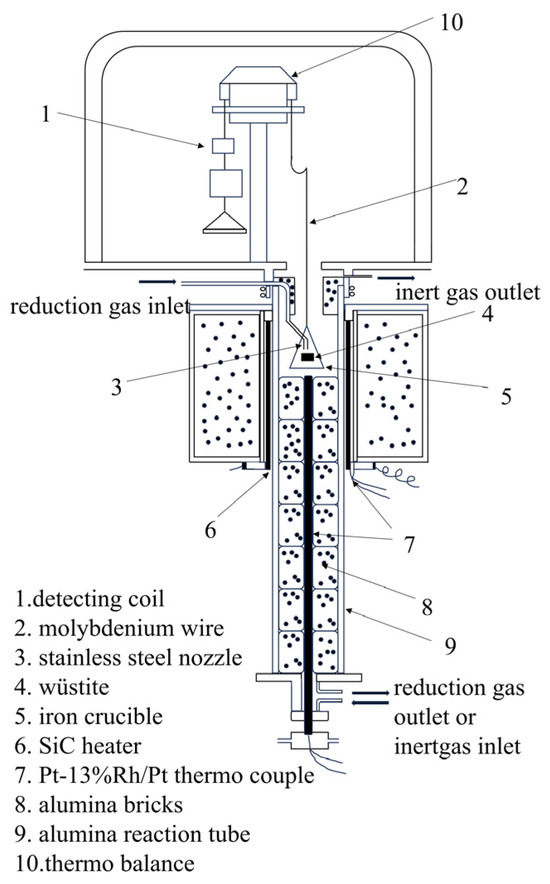
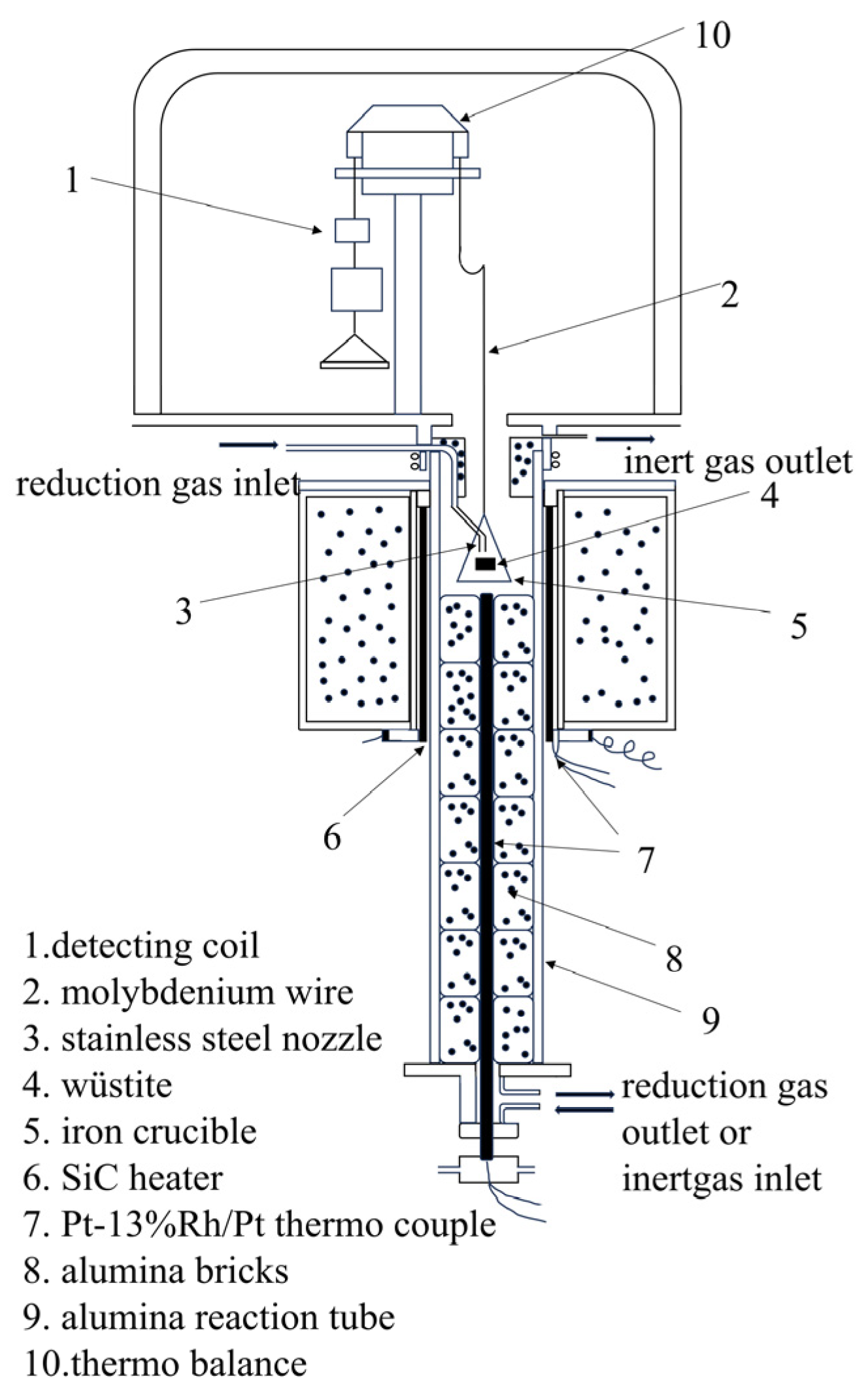
Ban-ya et al. [8,23,24] utilized a high-temperature thermogravimetric system, as shown in Figure 3, to study the hydrogen reduction kinetics of liquid iron oxide in an iron crucible. The experiments revealed that the reduction rate of molten FeO by hydrogen is extremely fast, exhibiting distinct first-order reaction characteristics (proportional to hydrogen partial pressure). Since the diffusion coefficient of a gas is closely related to the mass of its molecules, the diffusion coefficient of hydrogen in helium is much higher than in argon or nitrogen. If the reaction is controlled by gas-phase mass transfer, the reaction rate using a He-H2 mixture should be significantly higher than that with Ar-H2 at the same flow rate. Experimental results confirmed that gas-phase mass transfer is the rate-limiting step at low gas flow rates. To distinguish between gas-phase mass transfer control and chemical reaction control, researchers established an empirical correlation relating the Sherwood number (Sh) to the Reynolds number (Re) and Schmidt number (Sc):
Figure 3.
Schematic of the high-temperature thermogravimetric analysis system. The setup features an iron crucible (5) for containing molten wüstite and a precision thermobalance (10) to monitor continuous mass loss during H2 injection [8].
It was found that when the gas flow rate is low (i.e., small Re number), the experimental data fit this formula, indicating that the reaction rate is controlled by gas-phase mass transfer. When the flow rate increases, causing the rate to deviate from the predicted value, it suggests that the reaction is under mixed control or interfacial chemical reaction control. After eliminating the influence of gas-phase mass transfer, they determined that the interfacial chemical reaction rate r of pure liquid FetO has a linear relationship with the partial pressure of H2, expressed as:
where is the apparent rate constant, and is the equilibrium gas-phase partial pressure ratio, is the partial pressure of H2, and is the partial pressure of H2O. At 1400 °C, the measured rate constant was: .
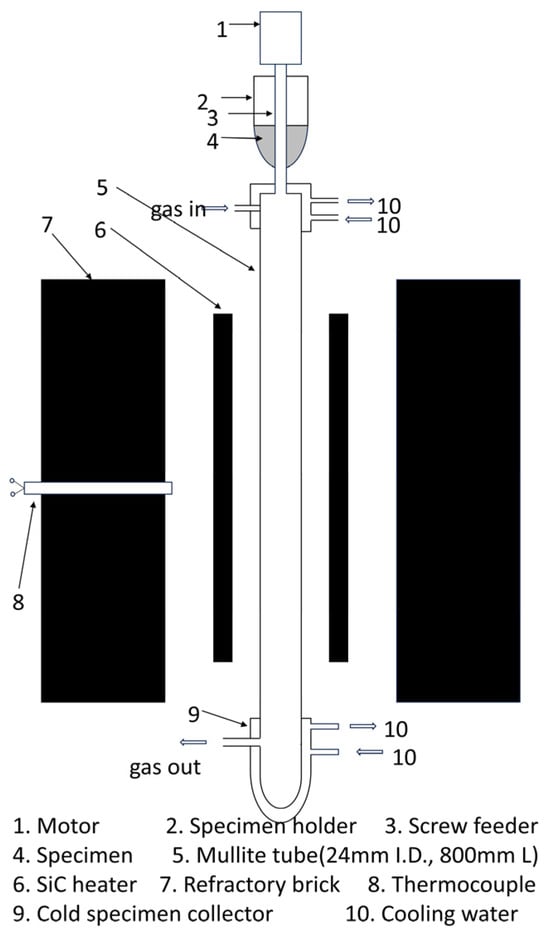
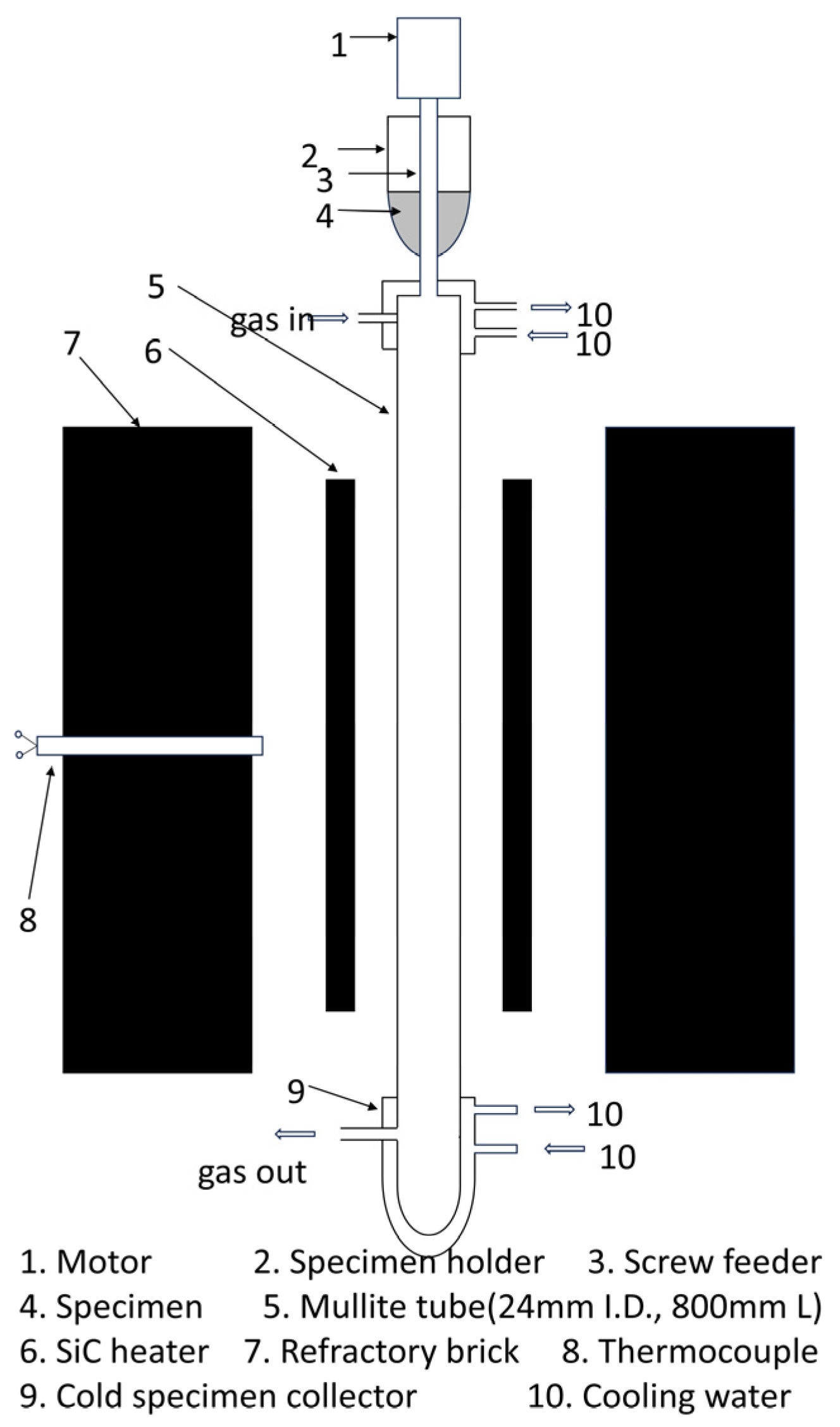
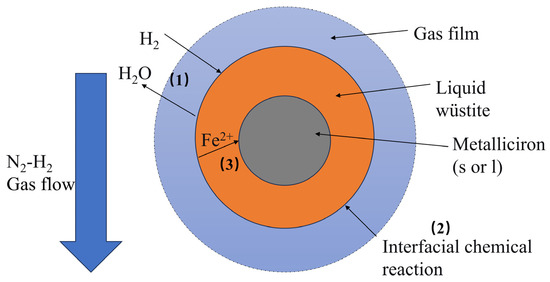
Hayashi et al. [13] employed a gas conveying system (as shown in Figure 4) to investigate the hydrogen reduction process of molten wüstite particles at high temperatures ranging from 1450 °C to 1550 °C. They allowed fine wüstite particles (average diameter 58 μm) to react during their descent. Through the quenching of falling droplets and subsequent cross-sectional microscopic observation (particle sectioning), it was revealed that the reduced metallic iron particles did not cover the surface but were entrapped within the liquid wüstite droplets. Furthermore, the droplets underwent significant volumetric shrinkage as the reaction proceeded, as illustrated in Figure 5. Consequently, they proposed a single-particle reaction rate equation considering particle shrinkage and mixing resistance:
where is the reaction rate of particles per unit bed volume in terms of H2; is the voidage of the particles in the gas-conveyed bed; a is a parameter defined as ; is the fractional reduction of wüstite particles; is the hydrogen content in the gas phase at a given bed position; is the equilibrium hydrogen content at Fe/FeO equilibrium; is the initial radius of wüstite particles at the bed top; is the mass transfer coefficient between gas and particle surface; K is the equilibrium constant of the liquid wüstite hydrogen reduction reaction; and is the apparent forward chemical reaction rate constant for the reduction. By integrating this model and fitting it with experimental data, researchers determined the activation energy for the hydrogen reduction of liquid wüstite to be 110 kJ/mol and established an Arrhenius relationship for the rate constant with temperature:
Figure 4.
Schematic of the gas-conveying drop-tube furnace system. Fine wüstite particles (average diameter 58 μm) are fed via a screw feeder (3) and react during their descent through the high-temperature zone (1450–1550 °C). The system facilitates rapid quenching in the cold collector (9) for post-reaction microstructural analysis [13].
Figure 5.
Schematic diagram of the mechanism of hydrogen reduction of molten FeO (wüstite) particles. (1) Gas-phase mass transfer (2) Interfacial chemical reaction (3) Liquid phase mass transfer [13].
Experimental results indicated that at 1500 °C, the rate constant was . This chemical reaction rate constant is close to, though slightly lower than, the value corrected by Ban-ya et al. through complex calculations. Such discrepancies may be attributed to differences in experimental methods, systems, and data analysis models. However, for melt reactions that are extremely difficult to measure due to their speed, these results are remarkably consistent, jointly confirming that the intrinsic rate of liquid FeO hydrogen reduction is extremely fast.
While the kinetic framework presented in Figure 5 effectively correlates with macroscopic reduction rates, further validation of the precise internal phase distribution and the proposed liquid-phase mass transfer mechanism requires more targeted microstructural studies. Early experiments primarily relied on the rapid quenching of falling droplets followed by particle sectioning and cross-sectional microscopic observation to visually confirm the entrapment of metallic iron within the liquid wüstite. However, morphological observation of cross-sections alone may not fully capture the localized transient gradients that drive the internal mass transfer. To more rigorously validate the concentration profiles of Fe2+ and oxygen within the melt, future work requires coupling particle sectioning with advanced local species profiling techniques.
Ni et al. [25] and Zheng et al. [26,27], in their experimental study on hydrogen–carbon molten reduction, used a medium-frequency induction furnace equipped with an induction-heated graphite ring above the crucible to independently heat the slag layer, along with a bottom-blowing hydrogen/nitrogen device for gas injection. The experiment employed a bottom-blowing hydrogen molten reduction method. With the molten pool temperature controlled at approximately 1400 °C, the reduction behavior of iron oxide in the slag by hydrogen was investigated. Based on experimental data, they plotted the relationship between and time , finding a linear correlation (correlation coefficient > 0.9), thereby confirming that the reduction process follows a first-order reaction kinetic model. By integrating the rate equation and isolating the reduction contributions from dissolved carbon and graphite, the researchers calculated the rate constant for hydrogen reduction of iron oxide at 1400 °C to be .
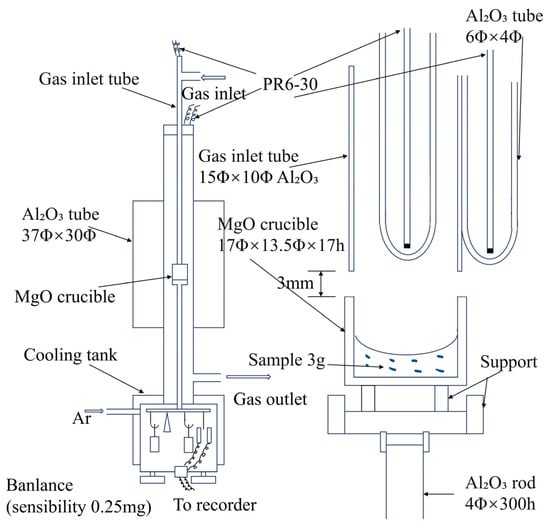
Katayama et al. [28] conducted a study on the reduction behavior of blast furnace-type slag in a hydrogen atmosphere at 1450 °C using a MgO crucible and a vertical resistance furnace equipped with a thermobalance (as shown in Figure 6). The reduction progress was monitored via periodic sampling analysis or off-gas monitoring. FeO prepared from Fe2O3 under a CO/CO2 atmosphere was added to a mother slag made of a mixture of CaCO3, Al2O3, and SiO2 pre-melted at 1550 °C. The initial FeO concentration was controlled between 5% and 15%. Experiments were conducted at 1450 °C with H2 concentrations ranging from 1% to 50% (mainly below 12%, balanced with Ar) and a gas flow rate of 1 L/min. Through experimental data and model fitting, they derived a rate formula for the reduction of FeO in blast furnace-type slag by hydrogen at 1450 °C, concluding that the capability of H2 gas to reduce FeO in slag is almost identical to that of solid carbon.
Figure 6.
Schematic diagram of the experimental apparatus. The setup features a vertical resistance furnace equipped with a thermobalance and an MgO crucible [29].
It was found that the reduction rate is not only proportional to the hydrogen partial pressure and iron oxide concentration but is also inhibited by the product water vapor. Therefore, they proposed the following rate equation:
In Equation (5), is the reduction rate of FeO in molten slag by hydrogen gas, is the reaction rate constant, is the partial pressure of hydrogen, is the mole fraction of FeO in molten slag, is the equilibrium constant of the reduction reaction, and is the partial pressure of water vapor. At 1450 °C, the parameters obtained are and .
The subtractive term in the equation clearly indicates that the accumulation of water vapor at the reaction interface reduces the chemical reaction rate. This is essentially a decrease in the net reaction rate as the reversible reaction approaches equilibrium. Therefore, to maintain high-efficiency reduction, the partial pressure of H2O in the gas phase must be controlled below the equilibrium partial pressure. Additionally, they determined the diffusion coefficient of iron oxide in the molten slag to be , pointing out the potential resistance of liquid-phase mass transfer.
Qu et al. [29,30,31,32] investigated the flash reduction behavior of hematite powder in a hydrogen atmosphere at high temperatures of 1427 °C to 1527 °C using a High-Temperature Drop Tube Furnace (HDTF). Hematite powder with a particle size of 54–74 μm was injected into the constant temperature reaction zone via a carrier gas, where it melted and reacted within an extremely short time (milliseconds to seconds), followed by rapid quenching and collection at the bottom for chemical titration analysis. Through cross-sectional morphology observation and kinetic model fitting, this study derived the rate formula for hydrogen reduction of iron oxide under high-temperature liquid conditions and confirmed that the reaction is controlled by the interfacial chemical reaction step.
The reduction process is accompanied by significant volume shrinkage, and the reduction rate is proportional to the concentration difference of hydrogen in the gas phase. Consequently, they proposed the following integral form of the interfacial chemical reaction control rate equation:
In Equation (6), denotes the fractional reduction degree of the gas–liquid stage; and are the molar densities of liquid wüstite and metallic iron (mol/m3), respectively; is the initial radius of the hematite particle (m); is the molar density of hematite (mol/m3); is the bulk concentration of the reducing gas (mol/m3); is the equilibrium reducing gas concentration for the gas–liquid reaction (mol/m3); is the equilibrium constant; is the chemical reaction rate constant (m/s); and is the reaction time (s).
The term on the left side of the equation describes the geometric shrinkage of the droplet considering density differences, while the right side clarifies that the reaction’s driving force depends on the gas concentration difference. This is similar to the conclusion of Katayama et al., essentially reflecting that the reaction is limited by the reversible chemical equilibrium at the interface. Therefore, to maintain efficient reduction, the hydrogen concentration in the gas phase must be kept well above the equilibrium concentration. Furthermore, by fitting this equation, they determined the rate constants at 1427 °C, 1477 °C, and 1527 °C to be 0.52, 0.64, and 0.93 m/s, respectively, and calculated an activation energy of 148 kJ/mol. This relatively high activation energy indicates that the process is strongly controlled by the chemical reaction. This corroborates Katayama et al.’s findings regarding the inhibitory effect of H2O, suggesting that at extremely high temperatures, gas film diffusion resistance is no longer the bottleneck, and the rate-limiting step lies in the effective collision and chemical conversion of gas molecules on the liquid oxide surface.
Li et al. [11,33] used the isothermal thermogravimetric analysis method, loading FeO powder into a platinum crucible and employing a Setaram ultra-high temperature thermal analyzer (Setsys EVO TG-DTA 1750, Caluire, France). Pure hydrogen was blown onto the FeO powder at set temperatures to conduct experiments in both solid and molten states. Blank experiments (without samples) were also performed to deduce system errors and buoyancy effects. The study established the optimal kinetic models for hydrogen reduction of solid and molten FeO. The research focused on the fundamental change in kinetic mechanism during the transition of FeO from solid to liquid. By comparing pure hydrogen reduction of FeO in different phases (gas–solid–solid, gas–solid–liquid, gas–liquid–liquid), they found that the reduction process fits the Mampel Power model well in both solid and liquid states, with the kinetic conditions for liquid reduction being superior. Accordingly, they determined the following kinetic equations:
For the solid-state reduction stage (900 °C), the kinetic equation is:
For the fully molten state (>1540 °C), the kinetic equation is:
In Equations (7) and (8), is the reduction conversion. By plotting depending on the specific model fit, described against time , the reaction rate constant at different temperatures was directly determined from the slope of the line. Further fitting the rate constants using the Arrhenius equation revealed that the activation energy for solid-state FeO reduction is extremely low, ranging only from 5.85 kJ/mol to 9.15 kJ/mol. In contrast, the average activation energy for liquid FeO reduction is 104.74 kJ/mol.
Lu et al. [34,35] used a bottom-blowing hydrogen induction smelting apparatus to study the reduction kinetics of molten iron oxide under bottom-blowing hydrogen conditions. The device utilizes an induction heating furnace to melt 5 kg of industrial oxide pellets (mainly Fe2O3), and hydrogen is injected directly into the molten pool through an annular porous plug at the bottom of the MgO crucible.
The study compared different mechanism function models and found that the bottom-blowing reduction process of molten iron oxide best fits the Phase Boundary Reaction Model. The kinetic equation is as follows:
In Equation (9), is the reduction conversion, is the rate constant, and is the reaction time. The equation represents the Contracting Cylinder geometric model of phase boundary shrinkage, indicating that the reaction interface continuously shrinks toward the interior of the molten pool or droplet as the reaction proceeds. By substituting experimental data into this model and plotting the relationship between and time , a good linear relationship was found. The slope of the line represents the reaction rate constant. Under the experimental condition of 1550 °C, the reduction reaction rate constant was measured as .
To systematically compare the kinetic characteristics obtained under different experimental conditions, Table 1 summarizes the experimental apparatuses, temperature ranges, rate-limiting steps, and key kinetic parameters from the literature discussed above. As shown in the table, the rate-limiting steps transition from chemical reaction to mixed or mass-transfer control depending on the reactor design and flow dynamics, while the high activation energies universally confirm the temperature sensitivity of the intrinsic interfacial reactions.
Table 1.
Comparison of kinetic parameters for hydrogen reduction of molten iron oxides under different experimental apparatuses.
In summary, existing kinetic models can adequately describe reduction behavior under various experimental conditions, confirming the high efficiency of liquid-state reduction. This provides important data support for the enhanced mass transfer design of future hydrogen-based molten reduction reactors. But it should be noted that the kinetic parameters and rate equations reviewed in this section have predominantly been derived from semi-batch experimental configurations—specifically, systems in which a fixed mass of molten iron oxide is exposed to a continuous flow of reducing gas (e.g., thermogravimetric analysis, induction furnaces with bottom blowing, or gas-conveyed droplet reactors). While such setups are invaluable for isolating intrinsic chemical kinetics and mass transfer resistances, they differ fundamentally from the hydrodynamic environment anticipated in industrial hydrogen-based molten reduction reactors. In a continuous industrial operation, both the molten oxide and the hydrogen stream are expected to flow concurrently or countercurrently, leading to distinct residence time distributions, gas–liquid interfacial renewal rates, and concentration boundary layer profiles. Consequently, the direct extrapolation of rate constants obtained from semi-batch experiments to the design and modeling of continuous-flow reactors should be undertaken with caution. Validation of these kinetic models under continuous-flow conditions, preferably in pilot-scale facilities that mimic the intended industrial flow regime, remains an essential area for future investigation.
4. Factors Influencing Hydrogen Reduction of Molten Iron Oxides
4.1. Effect of Reduction Temperature
Research [11] indicates that the phase state of the reaction products significantly alters the temperature dependence of the reduction process. When the reduction product, metallic iron, exists in a solid state (i.e., a gas–solid–liquid three-phase system), increasing the temperature from 1480 °C to 1520 °C causes the average reduction degree to rise significantly from 34.83% to 73.98%, demonstrating a pronounced positive correlation. However, within the temperature range of 1540 °C to 1580 °C—where the temperature exceeds the melting point of metallic iron (1538 °C) and the product exists in the molten state (i.e., a gas–liquid two-phase system)—the reduction degree still increases with temperature, but its increasing rate slows down.
As the temperature rises, the quantity of metallic iron increases markedly. Concurrently, the reduction in surface tension leads to severe foaming within the molten pool, which increases the gas–liquid contact area and promotes a “gas–liquid” reduction reaction. Microscopic observation of the reduced samples reveals that at temperatures below the melting point of iron, the presence of solid particles within the melt results in poor fluidity. This hinders the internal diffusion of both reactants and products, thereby impeding the reduction reaction at the interface and the aggregation of the metallic iron product (leading to slag entrapment). Conversely, when the temperature exceeds 1538 °C, the fluidity of the melt improves, and the diffusion conditions for reactants and products are optimized. This results in a more complete reduction reaction and enhanced separation efficiency between slag and iron.
Furthermore, the phase state of the system modulates the promoting effect of temperature on the reaction. When FeO is molten, but Fe remains solid, creating a complex multiphase system, the peak reduction conversion rate still shows an increasing trend, but the time required to reach this peak does not shorten significantly. In contrast, when both FeO and Fe are in a molten state, not only does the peak reduction conversion rate increase markedly, but the reduction time is also significantly reduced. These results suggest that in a complex multiphase system, the effect of temperature elevation on the reaction is limited. However, in a homogeneous molten phase, the promoting effect of temperature is much more significant, resulting in a distinctly accelerated and more intense reaction process [33].
Researchers [29] also found that the aggregation state of the reduction products is heavily influenced by temperature. In the lower temperature range of 1377 °C to 1427 °C, the generated metallic iron is dispersed within the liquid wüstite as numerous fine, irregularly shaped particles, making effective aggregation difficult. When the temperature rises above 1427 °C, the viscosity of the liquid droplets decreases and fluidity improves, facilitating the diffusion and migration of matter within the liquid phase. This promotes the rapid coalescence of dispersed iron particles under the influence of surface tension, eventually forming a single large spherical metallic iron particle encapsulated within the molten slag. The chemical reaction rate constant increases sharply with temperature, rising from 0.52 m/s at 1427 °C to 0.93 m/s at 1527 °C. This indicates that high temperatures not only greatly promote the interfacial chemical reaction, which is controlled by a high activation energy (148 kJ/mol), but also facilitate the nucleation and growth of the iron product.
Similarly, Hayashi et al. [13] established a quantitative Arrhenius relationship (Equation (4)) between the chemical reaction rate constant and temperature in the high-temperature range of 1450 °C to 1550 °C. This further confirms that increasing the temperature significantly enhances the reduction rate of liquid iron oxides by overcoming the high activation energy barrier.
4.2. Effect of Reduction Time
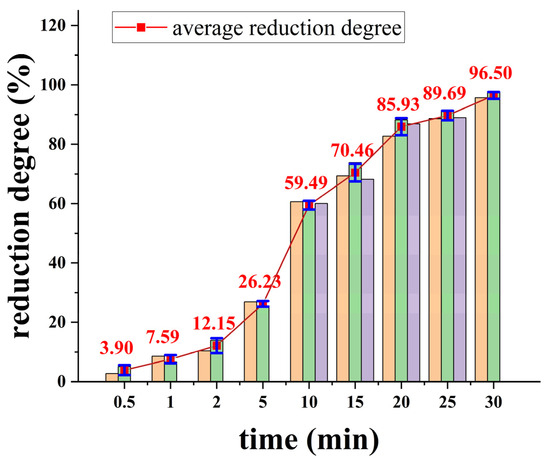
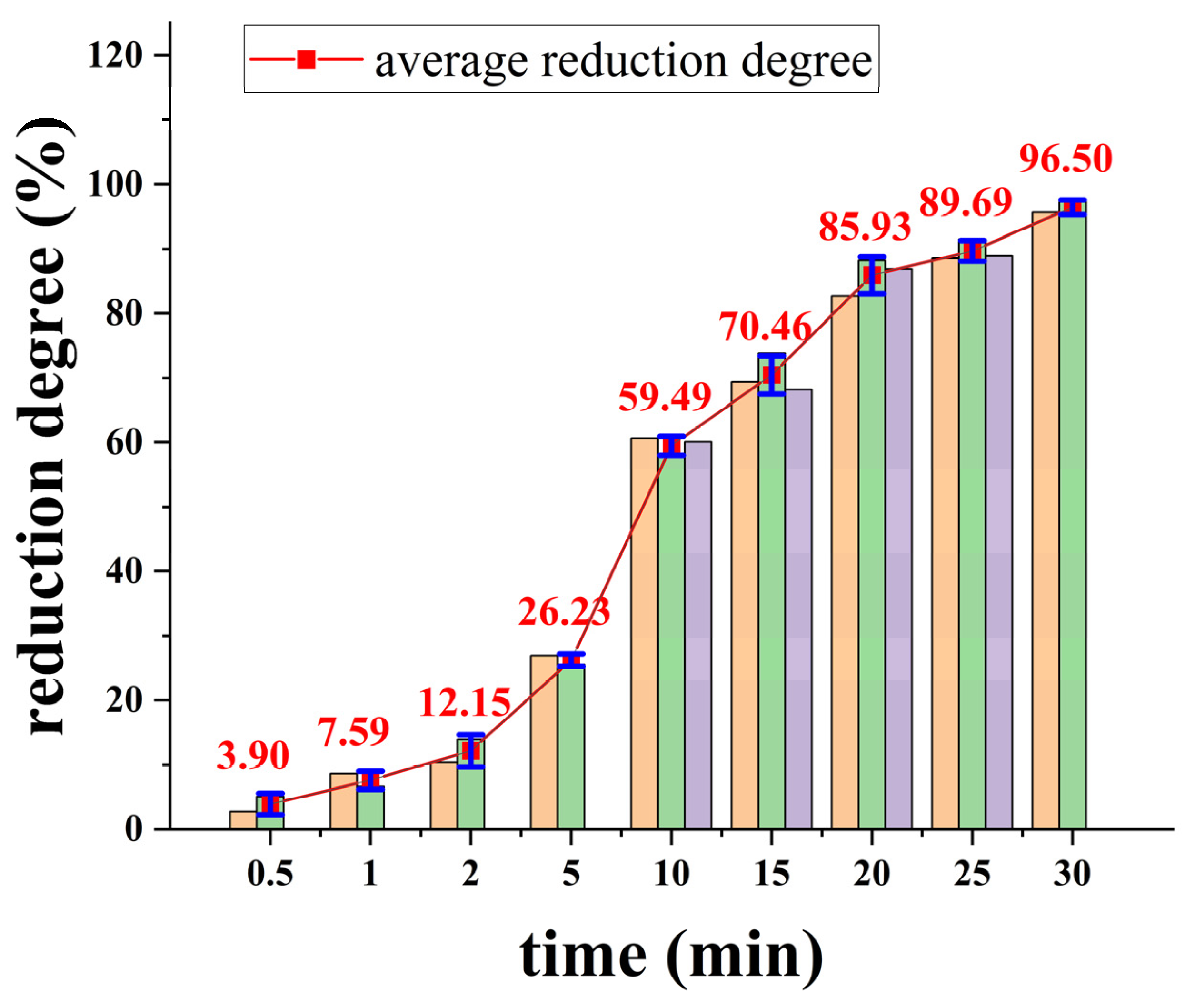
The kinetic models discussed above (Equations (6)–(9)) consistently indicate that prolonging the reduction time generally enhances the degree of reduction. Figure 7 illustrates the relationship between reduction degree and reduction time [11]; different colors indicate different experimental groups.
Figure 7.
Evolution of reduction degree at different reduction times (0.5–30 min). Bar colors denote different experimental groups, and the red line traces the average reduction degree with error bars indicating data variance [11].
It can be observed that within the first 5 min of the reaction, the average reduction degree increases from 3.90% to 26.23%. Based on the correspondence between the reduction degree and the valence states of iron elements, it can be preliminarily inferred that this stage primarily involves the reduction of high-valence iron oxides (Fe3O4) to low-valence iron oxides (FeO). By 10 min, the reduction degree rises to 59.49%, indicating the onset of the reduction from FeO to metallic Fe. During the initial 10 min, the average reduction rate is approximately 5.56 min−1. However, after 10 min, the reduction rate decelerates significantly; the reduction degree only increases from 59.49% to 96.50%, with the average rate dropping to 1.85 min−1. This stage corresponds to the continued reduction of FeO to Fe. Subsequent macroscopic and microscopic analyses of the samples corroborate this finding: the initial stage of hydrogen-based molten reduction is controlled by chemical reactions, while the later stage gradually shifts to a process limited by slag viscosity and internal diffusion, accompanied by the aggregation and growth of metallic iron particles. Similarly, in Ban-ya’s experiments, reactions with three different gas compositions exhibited first-order characteristics during the first 40 min, showing a linear relationship between reduction rate and time, after which the rate significantly slowed down.
4.3. Effect of Reducing Gas Flow Rate
Ban-ya et al. [8] demonstrated that at low gas flow rates, since the chemical reaction at the liquid interface is extremely fast, the total reaction rate is entirely controlled by the gas-phase mass transfer process. The apparent rate constant ka is proportional to the 2/3 power of the gas flow rate. At higher flow rates, the reduction rate is under mixed control by both gas-phase mass transfer and interfacial chemical reaction. This suggests that simply increasing the flow rate is insufficient to completely eliminate the influence of physical mass transfer to measure the pure interfacial chemical reaction rate.
Other studies [11] have also confirmed this phenomenon. When the hydrogen flow rate is less than 3 L/min, external gas diffusion conditions have a significant impact on the reduction process. Conversely, when the flow rate exceeds 3 L/min, the influence of external diffusion diminishes. Similarly, in isothermal experiments on hydrogen reduction of solid/liquid wüstite [33], it was found that beyond a certain threshold, further increases in reducing gas flow rate have almost no effect on the final reduction conversion and rate.
4.4. Effect of Reducing Gas-Phase Composition
Under constant gas flow rate, at temperatures of 1400 °C and 1450 °C, and with hydrogen partial pressures of 0.01, 0.03, 0.05, and 0.1 atm (higher partial pressures made the reaction too violent to measure), the experimental results show that the type of inert gas significantly affects the reduction rate of liquid wüstite Under all tested conditions, the measured reduction rates followed the same order: Ar-H2 > N2-H2 > He-H2 [8]. Researchers attributed the rate differences under different inert gases to the impact of gas physical properties on fluid dynamics. Consequently, the Reynolds number (Re) and Schmidt number (Sc) were introduced to derive Equation (1). Although helium (He) possesses a high diffusion coefficient, its low density results in a very small Reynolds number at the same flow rate, explaining why the reduction rate constant is lowest in the He-H2 atmosphere according to Equation (1).
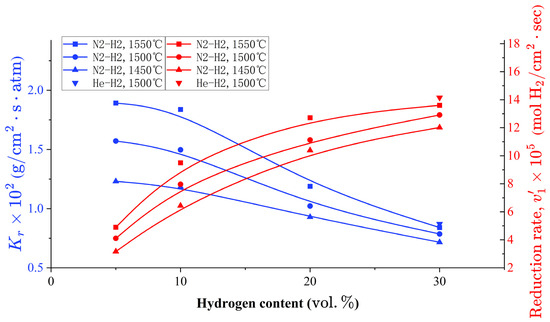
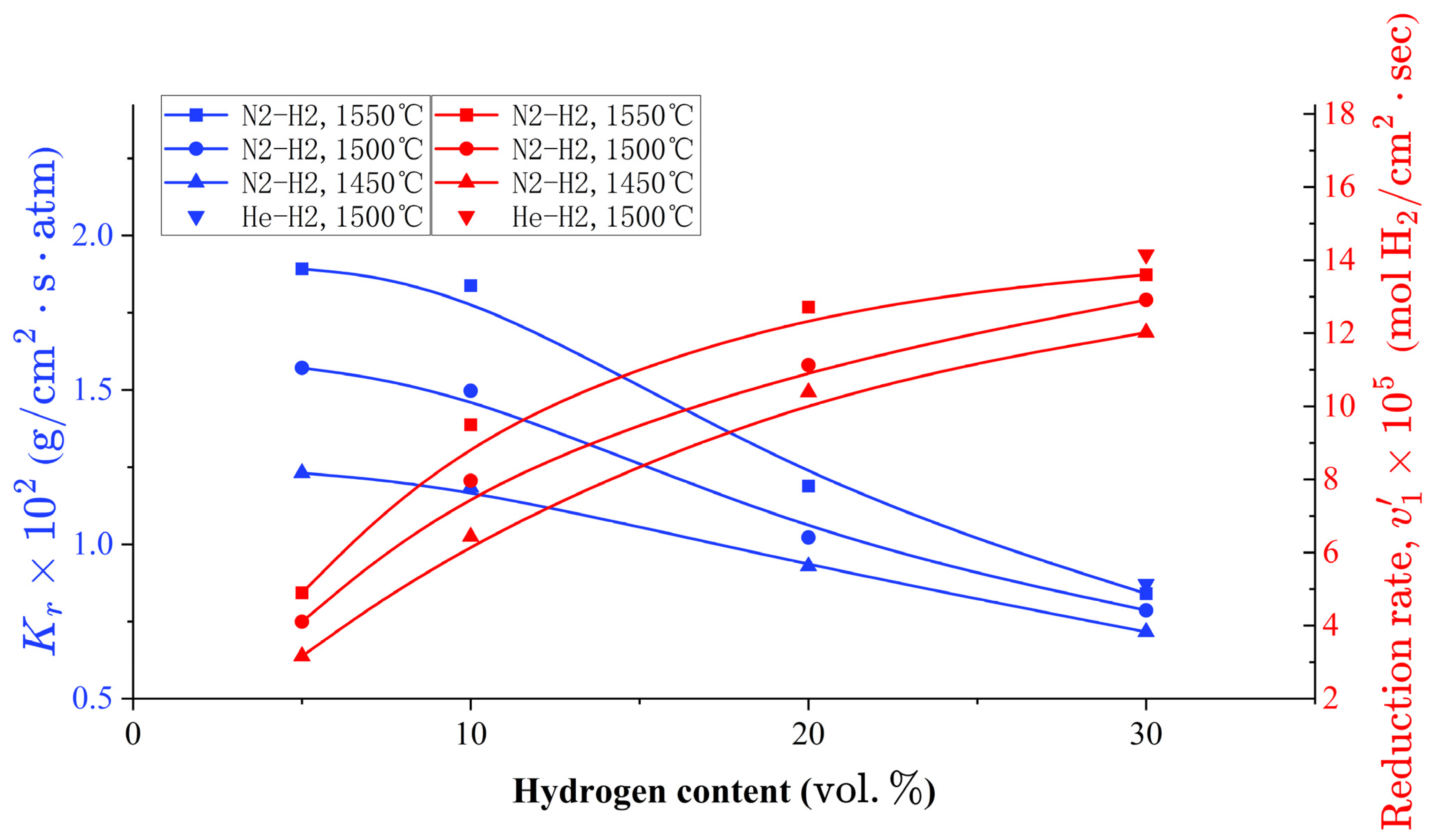
In the gas conveying system [13], however, changes in the type of inert gas did not induce significant variations in the reduction rate or rate constant, as shown in Figure 8. At 1500 °C with a fixed hydrogen ratio of 30%, the rate constants and reduction rates for N2-H2 and He-H2 were essentially the same. The authors also conducted experiments at four different hydrogen concentrations: 5%, 10%, 20%, and 30%. In the low-concentration range (5% to 10%), the reduction rate increased linearly with hydrogen concentration. However, when the hydrogen ratio was raised to 20% and 30%, the rate increase deviated from linearity, and the apparent rate constant decreased. This is because, at low concentrations, the reaction is strictly controlled by the interfacial chemical reaction. At higher concentrations, as the reaction speed increases, the liquid-phase mass transfer resistance inside the droplets rises and becomes a significant limiting factor. While increasing the hydrogen ratio improves the total reduction rate by increasing reactant concentration, the decline in the apparent rate constant at high ratios proves that the reaction mechanism shifts from single chemical reaction control to mixed control (chemical reaction + liquid-phase mass transfer).
Figure 8.
Relationship between rate constant, reduction rate, and hydrogen content in a gas conveying system [13].
In other experiments [33] at 1560 °C, tests were conducted with hydrogen ratios of 25%, 50%, 75%, and 100%. The results indicated that while the change in hydrogen ratio does not affect the final degree of reduction (samples achieved complete reduction, i.e., conversion rate of 1.0, under all conditions), increasing the hydrogen concentration significantly accelerates the reduction process.
4.5. Effect of Slag System
Nagasaka et al. [24] investigated the interfacial kinetics of hydrogen reduction of liquid FeO in slag containing different additives at 1400 °C. The experimental results indicate that CaO slightly increased the reaction rate constant for the reduction of molten FeO by H2, whereas SiO2 decreased the hydrogen reduction rate constant. Hayashi et al. [36] utilized a gas conveying system to study the effects of various additives on the hydrogen reduction of molten wüstite, with additive amounts of 14.5% CaO, 18.2% SiO2, and 5.15% Al2O3, respectively. Their experimental results similarly demonstrate that CaO enhances the reaction rate of FeO reduction by H2, while SiO2 reduces the reaction rate, and Al2O3 has no significant influence on the reduction process. Other researchers [37,38,39] have also investigated reduction by CO, with results likewise indicating that the reduction rate of FeO decreases significantly with increasing SiO2 content in the molten slag.
When investigating the effect of the slag system [11], Li Yang used raw ore powder with high silicon content, resulting in an excessively high melting point for the final slag. The addition of CaO significantly lowered the final slag melting point and reduced the variability of viscosity with temperature and FeO content. During the smelting of raw ore powder, in the absence of initial basic flux, the high content of FeO in the melt acted as a basic oxide, initially lowering viscosity. However, as the reaction proceeded and FeO was reduced (dropping below 50%), the viscosity of the raw ore slag spiked, hindering the internal diffusion process. In contrast, the slag system adjusted, with CaO, to a basicity of 1.2 and maintained low viscosity even as FeO content decreased, ensuring a sustained and efficient reduction reaction.
Pure reagent experiments were also conducted to isolate the effects of SiO2 and Al2O3. The results showed that both components reduce the rate of hydrogen reduction of molten FeO, but the negative impact of SiO2 is more severe. As the addition of SiO2 increased from 10 mol% to 50 mol%, the reduction rate constant decreased; at 50 mol% SiO2, the final reduction degree was only 54.65%. Al2O3 also reduced the reaction rate, but complete reduction was still achievable. Adding CaO to the FeO-SiO2 binary system significantly improved both reduction conversion and rate.
The mechanism is explained by the slag structure theory: SiO2 acts as a network former. Its addition decreases the number of non-bridging oxygens (NBO/T) and increases the degree of polymerization in the slag, promoting the formation of a dense silicate tetrahedral network. This highly polymerized structure not only increases viscosity but also microscopically hinders the adsorption of H2 on the molten FeO surface and the interaction with O2−, thereby limiting the interfacial chemical reaction rate. The addition of CaO to the slag breaks the complex Si-O tetrahedral network in the FeO-SiO2 system, increasing the number of non-bridging oxygens and decreasing the degree of polymerization. This increases the quantity of free O2− in the system, improving the adsorption conditions for H2 on the molten surface and promoting both the reduction rate and the final degree of reduction.
5. Conclusions and Prospects
5.1. Conclusions
- (1)
- Although discrepancies exist in calculation results among different databases within the high-temperature zone (particularly in the phase transition interval between FeO and Fe), the hydrogen reduction of molten FeO remains thermodynamically feasible. However, the equilibrium hydrogen partial pressure varies with increasing temperature and exhibits nonlinear characteristics near the phase transition points.
- (2)
- The reaction rate of hydrogen reduction of molten iron oxides significantly exceeds that of solid-state reduction, with the rate-limiting step varying according to experimental conditions. Upon the elimination of external diffusion effects, the intrinsic chemical reaction rate is extremely fast, and the apparent activation energy is higher than that of the solid state. Current research has established various kinetic models and determined reaction rate constants under different conditions.
- (3)
- Temperature, reduction time, gas flow rate, gas-phase composition, and slag composition all exert influence on the reduction process. High temperatures facilitate the reaction and slag-metal separation, yet foaming of the molten pool requires control. Prolonging reaction time improves the degree of reduction, though the later stage is limited by internal diffusion. Increasing the gas flow rate can accelerate the reaction, but the enhancement becomes marginal beyond a certain threshold. The type of gas-phase composition can alter the apparent rate by affecting gas-phase mass transfer. Slag structure, particularly the content of SiO2 and CaO, directly affects melt viscosity and the activity of Fe2+ in the slag, thereby influencing the reduction rate.
5.2. Prospects
Currently, significant discrepancies exist in thermodynamic data for high-temperature molten systems, necessitating more precise experimental measurements and calculations to construct a unified and reliable thermodynamic database for high-temperature melts, which will provide an accurate basis for process design and simulation. Furthermore, existing studies are predominantly conducted in small-scale apparatuses that differ significantly from industrial conditions; thus, future research should develop larger-scale experimental platforms that more closely mimic the flow conditions of actual molten pools to investigate gas–liquid–solid multiphase reactions. Additionally, while actual ironmaking processes involve complex slag compositions, current research focuses mostly on simple slag systems, highlighting the need to investigate multi-component complex slag systems to elucidate the synergistic or antagonistic effects of various oxides on the hydrogen reduction process.
Author Contributions
Conceptualization, J.Z.; investigation, B.F.; writing—original draft preparation, X.Z.; writing—review and editing, Y.W.; project administration, S.L.; funding acquisition, Z.L. All authors have read and agreed to the published version of the manuscript.
Funding
This research was funded by the National Natural Science Foundation of China (52374319), the Young Elite Scientists Sponsorship Program by CAST (NO. YESS20230029) and the National Natural Science Foundation of China (52574368).
Data Availability Statement
No new data were created or analyzed in this study.
Acknowledgments
During the preparation of this manuscript/study, the authors used DeepSeek V3.2 for the purposes of language translation, English language polishing, grammar correction, and readability enhancement. The authors have reviewed and edited the output and take full responsibility for the content of this publication.
Conflicts of Interest
The authors declare no conflicts of interest.
Appendix A
To validate and illustrate the physical chemistry logic underlying the equilibrium curves presented in Figure 2, a typical calculation procedure based on the principle of minimum Gibbs free energy is described below.
Appendix A.1. Thermodynamic Models and Iron Polymorphism
The equilibrium gas composition for the reduction of iron oxides is determined by calculating the standard Gibbs free energy of the reaction system. Based on Kirchhoff’s law and the Gibbs-Helmholtz equation, the standard molar free energy of each component as a function of temperature is derived from its specific heat capacity.
The isobaric heat capacity is expressed as a function of temperature:
By performing indefinite integration on the enthalpy and entropy, the standard molar free energy for a given substance is mathematically fitted as:
A critical factor in accurately predicting the high-temperature equilibrium—particularly near phase boundaries—is accounting for the allotropic transformations (polymorphism) of solid iron and the non-stoichiometry of wüstite. In our calculations, solid FeO is approximated using the non-stoichiometric data. Furthermore, the specific heat capacity parameters for iron are strictly segmented into different temperature ranges corresponding to its phase state:
- Sol-A (, BCC, Ferromagnetic): 25–760 °C
- Sol-B (, BCC, Paramagnetic): 760–910 °C
- Sol-C (, FCC): 910–1400 °C
- Sol-D (, BCC): 1400–1536 °C
- Liq (Liquid Fe): 1536–2875 °C
This segmented piecewise integration ensures that the latent heat of phase transitions is inherently incorporated into , explaining the non-linear inflection points observed in the high-temperature regions of the equilibrium curves.
Appendix A.2. Equilibrium Hydrogen Ratio Calculation
For the specific reduction reaction of molten iron oxide by hydrogen at elevated temperatures:
The standard Gibbs free energy change in the reaction, , is determined from the sum of the standard molar free energies of the products minus those of the reactants. The thermodynamic equilibrium constant is then related to by:
Assuming the total pressure of the system is 1 atm () and the activities of the pure condensed phases are unity, the equilibrium volume fraction of required for the reduction can be directly derived as:
By substituting the specific heat capacity coefficients (A, B, C, D) and integration constants into the equations above, the continuous equilibrium curves across various phase zones (as illustrated in Figure 2) are generated.
References
- Tang, J.; Chu, M.; Li, F.; Zhou, Y.; Wang, J.; Li, S.; Liu, Z. Development Status and Future Trend of Hydrogen Metallurgy in China. Hebei Metall. 2020, 8, 1–6. [Google Scholar]
- Du, Y.; Guo, H.; You, G.; Mao, S.; Cao, W. Research Progress on Green and Low-carbon Hydrogen Metallurgy Technology. Min. Eng. 2024, 22, 62–65. [Google Scholar]
- Patisson, F.; Mirgaux, O. Hydrogen ironmaking: How it works. Metals 2020, 10, 922. [Google Scholar] [CrossRef] [Scilit]
- Guo, P.; Zhao, P.; Pang, J.; Cao, C. Technical Analysis on Smelting Reduction Ironmaking Process. Iron Steel Vanadium Titan. 2009, 30, 1–9. [Google Scholar]
- Mao, Q.; Wu, L.; Meng, Y.; Hou, J.; Zhang, J.; Zhang, Q.; Li, Y. Discussion on low carbon hydrogen base molten reduction ironmaking technology. Metall. Stand. Qual. 2025, 63, 14–20, 27. [Google Scholar]
- Xu, T.; Zhang, Y.; Bu, E.; Zhou, H.; Ren, J.; Liu, Z.; Wang, K. Hydrogen-Based Smelting Reduction Low-Carbon Smelting Technology. Available online: https://kns.cnki.net/kcms2/article/abstract?v=lLcTIqQqO-3nOsZmo-N8paY7B07nprg6_RjpH3rf4ytuJkjLxdaP7uqV8INEJx-_nOif7Vo_JShR0JDKySaIuvnXZF0mAEGhL4P3mtSM5691---ErDIgf87XbMOORAJKU3O6ZdMY4hU8fmQpeOYozNGcfC3OFon2Zvxwd07dR-5rDLWBjeA9_A==&uniplatform=NZKPT&language=CHS (accessed on 7 March 2026).
- Edelson, J. Method for Reducing Particulate Iron Ore to Molten Iron with Hydrogen as Reductant. U.S. Patent 5,464,464, 7 November 1999. [Google Scholar]
- Ban-ya, S.; Iguchi, Y.; Nagasaka, T. Rate of reduction of liquid wüstite with hydrogen. Tetsu Hagané 1984, 70, 1689–1696. [Google Scholar] [CrossRef] [Scilit] [PubMed]
- Badr, K. Smelting of Iron Oxides Using Hydrogen Based Plasmas. Ph.D. Thesis, Montanuniversität Leoben, Leoben, Austria, 2007. [Google Scholar]
- Cao, C.; Guo, P.; Zhao, P.; Pang, J. Study on High Temperature Molten Hydrogen Metallurgy. Iron Steel Vanadium Titan. 2009, 30, 1–6. [Google Scholar]
- Li, Y. Study on Phase Study on Phase Evolution and Reduction Kinetics of Molten Iron Oxides Reduced by Hydrogen. Ph.D. Thesis, University of Science and Technology Beijing, Beijing, China, 2022. [Google Scholar]
- Huang, X. Principles of Ferrous Metallurgy; Metallurgical Industry Press: Beijing, China, 2013; pp. 44–273. [Google Scholar]
- Hayashi, S.; Iguchi, Y. Hydrogen Reduction of Liquid Iron Oxide Fines in Gas-conveyed System. ISIJ Int. 1994, 34, 555–561. [Google Scholar] [CrossRef] [Scilit]
- Barin, I.; Knacke, O. Thermochemical Properties of Inorganic Substances; Springer: Berlin, Germany, 1973; pp. 270–309. [Google Scholar]
- Barin, I.; Knacke, O.; Kubaschewski, O. Thermochemical Properties of Inorganic Substances (Supplement); Springer: Berlin, Germany, 1977; pp. 286–326. [Google Scholar]
- Ye, D.; Hu, J. Handbook of Practical Inorganic Thermodynamic Data, 2nd ed.; Metallurgical Industry Press: Beijing, China, 2002; pp. 47–228. [Google Scholar]
- Chen, S.; Zhang, J.; Wang, Y.; Wang, T.; Li, Y.; Liu, Z. Thermodynamic study of H2-FeO based on the principle of minimum Gibbs free energy. Metals 2023, 13, 225. [Google Scholar] [CrossRef] [Scilit]
- Guo, H. The Course of Metallurgical Physical Chemistry, 2nd ed.; Metallurgical Industry Press: Beijing, China, 2012; pp. 223–314. [Google Scholar]
- Wang, F.; Wang, X. Mathematica and Its Applications to Mathematics; China Agriculture Press: Beijing, China, 2013; pp. 255–327. [Google Scholar]
- MATLAB, version 9.11; Software for Technical Computation; MathWorks, Inc.: Natick, MA, USA, 1984.
- Dmitriev, A.N.; Vusikhis, A.S.; Sitnikov, V.A.; Leontiev, L.I.; Kudinov, D.Z. Thermodynamic modeling of iron oxide reduction by hydrogen from the B2O3-CaO-FeO melt in bubbled layer. Isr. J. Chem. 2007, 47, 299–302. [Google Scholar] [CrossRef] [Scilit]
- Bale, C.W.; Bélisle, E.; Chartrand Degterov, S.A.; Eriksson, G.E.A.H.; Hack, K.; Mahfoud, R.B.; Petersen, S. FactSage Thermochemical Software and Databases, 2010–2016. Calphad 2016, 54, 35–53. [Google Scholar] [CrossRef] [Scilit]
- Nagasaka, T.; Ban-ya, S. Rate of reduction of liquid iron oxide. Tetsu Hagané 1992, 78, 1753–1767. [Google Scholar] [CrossRef] [Scilit]
- Nagasaka, T.; Hino, M.; Ban-ya, S. Interfacial kinetics of hydrogen with liquid slag containing iron oxide. Metall. Mater. Trans. B 2000, 31, 945–955. [Google Scholar] [CrossRef] [Scilit]
- Ni, X.; Luo, L.; Yang, S.; Zheng, S. Experiment Study on Smelting Reduction with Carbon and Bottom-blowing Hydrogen. In Proceedings of the 2008 Annual Conference on Non-Blast Furnace Ironmaking of The Chinese Society for Metals, Shanghai, China, 15–17 October 2008; pp. 315–320. [Google Scholar]
- Zheng, S.B.; Sun, K.Q.; Hao, X.B.; Yang, S.L.; Wang, D.Y. Kinetics Test of Hydrogen-Carbon Smelting Reduction. China Metall. 2013, 23, 15–19. [Google Scholar]
- Zheng, S.; Ni, X.; Qi, Y.; Li, Z.; Hong, X.; Xu, J. Study on C-H2 smelting reduction process and reactor structure. In Proceedings of the 2008 Annual Conference on Non-Blast Furnace Ironmaking of The Chinese Society for Metals, Shanghai, China, 15–17 October 2008; pp. 272–275. [Google Scholar]
- Katayama, H.; Taguchi, S.; Tsuchiya, N. Reduction of iron oxide in molten slag with H2 gas. Tetsu Hagané 1982, 68, 2279–2286. [Google Scholar] [CrossRef] [Scilit]
- Xing, L.; Qu, Y.; Wang, C.; Shao, L.; Zou, Z. Gas liquid reduction behavior of hematite ore fines in a flash reduction process. Metall. Mater. Trans. B 2020, 51, 1233–1242. [Google Scholar] [CrossRef] [Scilit]
- Wang, X.; Fu, G.; Qu, Y.; Zhu, M. Flash reduction behavior of magnetite concentrate particles in methane-nitrogen atmospheres. Steel Res. Int. 2019, 90, 1800569. [Google Scholar] [CrossRef] [Scilit]
- Qu, Y.; Yang, Y.; Zou, Z.; Zeilstra, C.; Meijer, K.; Boom, R. Melting and Reduction Behaviour of Individual Fine Hematite Ore Particles. ISIJ Int. 2015, 55, 149–157. [Google Scholar] [CrossRef] [Scilit]
- Qu, Y.; Xing, L.; Wang, C.; Shao, L.; Zou, Z. Kinetic characterization of flash reduction process of hematite ore fines under hydrogen atmosphere. Int. J. Hydrog. Energy 2020, 45, 31481–31493. [Google Scholar] [CrossRef] [Scilit]
- Zhang, J.; Li, Y.; Liu, Z.; Wang, T.; Wang, Y.; Li, K.; Zhang, Y. Isothermal kinetic analysis on reduction of solid/liquid wüstite by hydrogen. Int. J. Miner. Metall. Mater. 2022, 29, 1830–1838. [Google Scholar] [CrossRef] [Scilit]
- Lu, L.; Wang, F.; Wang, H.; Qiu, J.; Ping, X. Kinetic Analysis of Molten Oxide Reduction Using Bottom-Blown Hydrogen Injection. Metals 2024, 14, 1255. [Google Scholar] [CrossRef] [Scilit]
- Lu, L.; Wang, F.; Wang, H.; Qiu, J.; Ping, X. Research status of thermodynamics and kinetics of carbon-hydrogen reduction of molten iron oxides. J. Iron Steel Res. 2024, 36, 150–162. [Google Scholar]
- Hayashi, S.; Iguchi, Y. Influence of gangue species on hydrogen reduction rate of liquid wüstite in gas-conveyed systems. ISIJ Int. 1995, 35, 242–249. [Google Scholar] [CrossRef] [Scilit]
- Kim, W.M.; Gränzdörffer, G.; Fine, H.A. The kinetics of reduction of iron oxide from molten slag. Steel Res. 1989, 60, 166–170. [Google Scholar] [CrossRef] [Scilit]
- Jahanshahi, S.; Wright, S. Kinetics of Reduction of CaO-FeOx-MgO-PbO-SiO2 Slags by CO-CO2 Gas Mixtures. Metall. Mater. Trans. B 2017, 48, 2057–2066. [Google Scholar] [CrossRef] [Scilit]
- Nakamoto, M.; Ono-Nakazato, H.; Kawabata, H.; Usui, T.; Tanaka, T. Reduction behavior of FeO compact including molten slag. ISIJ Int. 2004, 44, 2100–2104. [Google Scholar] [CrossRef] [Scilit]

Disclaimer/Publisher’s Note: The statements, opinions and data contained in all publications are solely those of the individual author(s) and contributor(s) and not of MDPI and/or the editor(s). MDPI and/or the editor(s) disclaim responsibility for any injury to people or property resulting from any ideas, methods, instructions or products referred to in the content. |
© 2026 by the authors. Licensee MDPI, Basel, Switzerland. This article is an open access article distributed under the terms and conditions of the Creative Commons Attribution (CC BY) license.